Leaving A Writing That Opens A Window To Their Souls

By Benjamin GroffMedia© | benandsteve.com | 2025 Truth Endures©

2–3 minutes

In Their Own Hand: How Handwriting Revealed the Soul of My Ancestors

I’ve been tracing my family tree for years, patiently tracking each lead and clue like breadcrumbs through time. Some discoveries came through census records, others through photographs or whispered family legends. But nothing has stirred my spirit more deeply than the sight of my great-grandparents’ handwriting—elegant, looping, unmistakably human.

The moment I first held a document written in their own hand, I felt something shift. Their penmanship, carefully practiced and beautifully formed, didn’t just tell me who they were—it revealed how they lived. It was a window to their character, their care, and their time.

The Lost Art of Penmanship

In the 19th and early 20th centuries, good handwriting was a matter of pride, discipline, and social standing. Penmanship was taught rigorously in schools. Techniques like the Spencerian script dominated in the mid-1800s. This was followed by the Palmer Method in the early 1900s. These systems weren’t just about communication—they emphasized grace, control, and personality in each letter’s curve and flow. A person’s handwriting was part of their reputation.

To write beautifully was to show respect: for the reader, for the message, and for oneself. That’s something we’ve largely lost in today’s age of keyboards and quick texts.

A Personal Connection

As I sorted through old family papers—birth certificates, letters, recipe cards—I found myself lingering over the handwriting. There was something intimate about it, something tender. These weren’t just names on a tree or dates on a ledger. These were real people, and here they were, writing. Their fingers once held that pen, their thoughts shaped these lines.

My great-grandmother’s cursive was especially elegant, delicate yet confident. Her capital “L” swept like a violin bow, and her lowercase “r” curled just so. She had taken her time. Her writing carried weight. And somehow, through the shape of her letters, I felt like I knew her.

Handwriting as Legacy

Before voice recordings or home videos, handwriting was how our ancestors captured themselves. They wrote love letters, grocery lists, prayers, and goodbyes. They signed their names to marriage licenses and land deeds, wills and war drafts—leaving behind a fingerprint of the soul.

Today, when we stumble across those scraps, they don’t just offer genealogical evidence. They give us a bridge—a real, living connection to the people who came before us. As the world moves faster, something sacred arises. It comes from slowing down to read their words in their own hand.

Preserving the Past

If you’ve begun your own family history search, don’t overlook the handwritten notes. Scan them, preserve them, study them. Teach younger generations about their significance. They may not understand the loops and flourishes right away—but they’ll feel the legacy behind them.

Because sometimes, a single line of cursive can carry more emotion than a thousand digital files.


Have you come across your ancestors’ handwriting? Share your story in the comments below—or better yet, share an image of it. Let’s celebrate the quiet beauty of those who came before us, one pen stroke at a time.
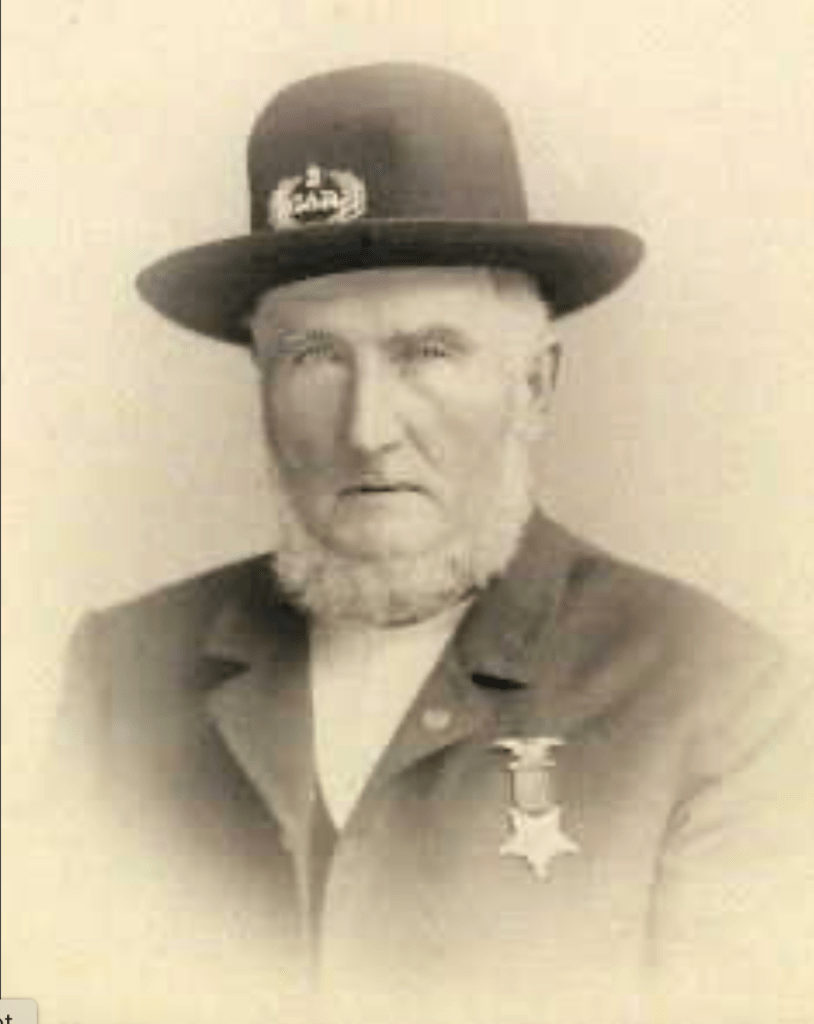
From Alps to Illinois: Ulrich L. Groff’s Inspiring Life Story

By Benjamin GroffMedia© | benandsteve.com | 2025 Truth Endures©

3–5 minutes

The Life and Legacy of Ulrich L. Groff

Ulrich Groff Sr.

Ulrich L. Groff was born on October 8, 1848, in the alpine village of Wengen, nestled in the canton of Bern, Switzerland. Ulrich and Mary Miller Groff were Swiss natives. They were described on their immigration papers as “tillers of the soil.” These were farmers seeking a better future. In Switzerland, the Groff family lived in a small but close-knit community. It was in this environment that Ulrich learned the values of hard work. He also learned perseverance and family unity.

In 1852, when Ulrich was just four years old, the Groff family made a monumental journey to America. 

Their voyage took them across the Atlantic Ocean. This information is from family records shared by Sylvia Little, the mother of Jackie Lee Little. They traveled aboard one of the last great sailing ships. The journey lasted a whole month at sea before they landed in the port of New Orleans. From there, the family traveled north through the Wabash and Illinois Rivers, eventually arriving in Vincennes, Indiana.

There, they purchased wagons and teams of oxen to make the final leg of their journey. The Groffs settled in Richland County, Illinois. They would lay down roots and build a new life from the ground up. They faced challenges like language barriers, unfamiliar customs, and the harshness of the American frontier.

By 1860, the Groffs had firmly established themselves in Claremont Township, Richland County. The census that year listed young Ulrich as a ten-year-old student, attending school alongside his brothers Michael and Joseph. His father, a determined farmer, was farming 640 dollars’ worth of land—no small feat for an immigrant family. It was a humble beginning but one filled with purpose and promise.

On December 6, 1870, Ulrich Jr. married Martha Allen Eaks in Richland County. Martha had been born in Cannon City, Tennessee, on December 11, 1849, to William C. and Frances Eakes. Ulrich and Martha began a family together and raised their children on the Illinois prairie.

Ulrich Groff Jr. And Family

By 1880, Ulrich was a working farmer, and he and Martha had three sons: Ira Allen, Harvey S., and Otis E. Over the years, their household expanded to include nine children, with Benjamin H. Groff I. becoming a middle child. Eight of Ulrich Jr.’s children survived to adulthood. The Groff household, a warm and united family, also became a multi-generational home. By 1900, Ulrich’s mother, Mary, was a 74-year-old widow. She had survived the long journey from Switzerland. She also overcame the challenges of building a life in a new land. At that time, she was living with the family.

Martha passed away on February 22, 1906, at 56, and was laid to rest in Eureka Cemetery in Claremont. In 1909, Ulrich remarried, taking Ellen L. Richter of Olney, Illinois, as his wife. Ellen had been born in Bullitt County, Kentucky, to James and Catherine Yates Richter. Ulrich and Ellen had no children together. Later, they helped raise two grandchildren, Cleo and Walker. They stepped in after the children lost their father, Odis Edward Groff.

Ulrich bridged two continents and saw a century of change. He became a U.S. citizen in 1869 and worked on Illinois soil, much like his ancestors did in Switzerland. He never learned to read or write but valued education and ensured his children access it. His life was defined by perseverance, faith, and the quiet strength of a man who carried his family’s burden. Ulrich also became a respected member of the Richland County community. He was known for his hard work, honesty, and willingness to help others.

Ulrich Jr. passed away on June 6, 1927, at the age of 78 years, 7 months, and 29 days. He was buried beside Martha in Eureka Cemetery. Ellen lived on until 1939 when she passed away at the age of 82. She, too, was buried in Eureka.

The legacy of Ulrich L. Groff endures in the farmland he once tilled. It continues through the descendants he raised. The journey his family made was filled with hope. It was marked by courage and the will to start again. They traveled from the Alps of Switzerland to the heartland of Illinois.

Before Otis passed away, he and Ulrich’s son, Benjamin, discovered land in Oklahoma. In the early 1900s, they began farming it together. Benjamin and his sister, Laura Alice Dowty, eventually settled there permanently. They raised their families there and spent the rest of their lives on that land.