The Guardians of Christmas Eve

Groff Media 2024© Truth Endures IMDbPro

Presented by benandsteve.com By: Benjamin Groff II©
3–4 minutes

In the heart of the bustling city, the frigid December air carried the soft hum of holiday cheer. Festive lights adorned streetlamps, casting warm glows onto the snow-dusted streets. For the officers of the 8th Precinct, Christmas Eve was far from quiet. Calls came in relentlessly: domestic disputes, stranded travelers, and even a wayward reindeer reported near the city park. These dedicated officers were on duty, ready to serve and protect.

What the officers didn’t know was that they had three spectral protectors watching over them—The Guardians of Christmas Eve.

Each of these ghostly policemen had once served the city. They were bound by duty. A deep sense of loyalty held their spirits. They lingered to make sure that no harm would come to those who now walked the beat.


Inspector Miles Hanley

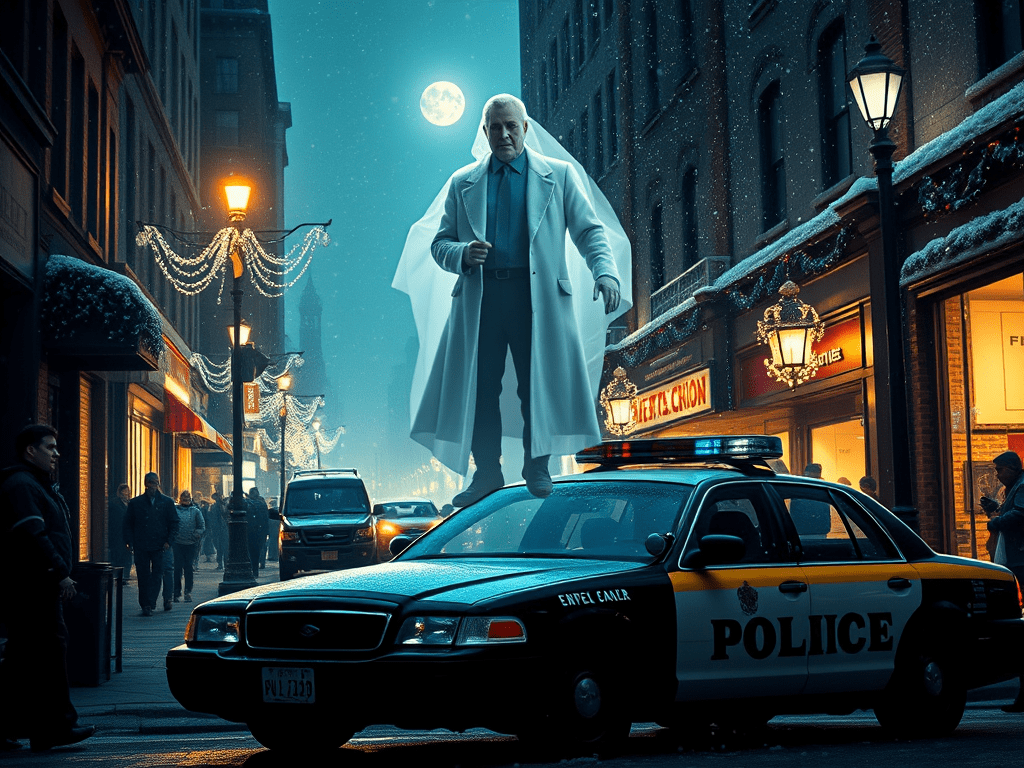
Miles Hanley was a tall and imposing figure. He had been the precinct’s first chief when the station was founded in the late 1800s. Known for his wisdom, he fiercely protected his officers. He carried his ghostly silver pocket watch. He used it to guide the others through the city. On this night, Hanley floated above a lone patrol car. It was parked at the edge of a dark alley. His translucent form shimmered in the moonlight.

“Johnson’s heading into a bad spot,”

Hanley muttered, watching the young officer approach a shadowy figure rummaging through garbage bins. With a flick of his watch, he whispered through the veil of time, nudging Johnson’s instincts. The officer hesitated, then called for backup—averting a potential ambush. Hanley grinned.

“Still got it.”


Officer Rosie McKinney

Rosie, affectionately called “Mama Mac” by her peers, had patrolled the city during the 1940s. She had an uncanny knack for reading people, even in death. Tonight, she hovered near a busy intersection where Officer Emily Torres was directing traffic midst a chaotic pile-up.

“Stay sharp, Emily,”

Rosie murmured, spotting a distracted driver barreling toward the scene. With a wave of her ethereal baton, she sent a gust of icy wind straight into the driver’s face. The man slammed on his brakes just in time, his car skidding to a halt inches from the officer. Rosie chuckled, tipping her ghostly hat. “That’s one less hospital visit tonight.”


Detective Lou Vargas

Lou had been a beloved detective in the 1970s, known for his quick wit and unshakable resolve. He now roamed the precinct’s cold case archives, whispering clues to frustrated officers. But tonight, Lou focused on Officer Brandon Lee. Officer Lee had just been called to investigate a suspicious package left near a crowded shopping district.

As Brandon approached the package, Lou materialized briefly behind him, a shadowy whisper in the winter night. “Check the wires, kid. Look left before you kneel.” Obeying the faint warning in his gut, Brandon discovered the package was harmless—a forgotten Christmas gift. Still, he felt the hairs on his neck stand like someone had been there with him.


A Christmas Morning Promise

As dawn broke over the city, the officers returned to the precinct, exhausted but safe. Unseen by human eyes, Miles, Rosie, and Lou gathered on the station’s rooftop, gazing at the snow-covered streets below.

“We did good,”

Lou said, leaning on his ghostly cane.

“Not a single officer lost,” Rosie added softly.

Miles held up his pocket watch, the spectral clock hands freezing as the sun rose. “Until next year,” he said, and the three faded into the morning mist.

Below, Officer Torres rubbed her arms against the chill. “Did you feel that?” she asked Officer Lee.

“Yeah,” he replied, staring at the horizon. “Like someone was watching over us.”

And so they were.

Santa Christ – Faith, Fantasy, and Tradition: Do Churchgoers Believe in Santa Claus?

Groff Media 2024© Truth Endures IMDbPro

Presented by benandsteve.com By: Benjamin Groff II©

Faith, Fantasy, and Tradition: Do Churchgoers Believe in Santa Claus?

Faith is often regarded as the cornerstone of religious belief, encompassing elements of the unseen, the unknowable, and the divine. Yet, the figure of Santa Claus gets nestled within the realm of modern Christian culture. Most believe Santa Claus is a mythical character who, though secular, occupies a sacred space in many homes during Christmas. This essay examines the relationship between faith and fantasy in a critical manner. It asks a provocative question:

Do churchgoers who actively engage in Christian religious services also believe in Santa Claus?

The Coexistence of Faith and Fantasy

With his roots in the historical St. Nicholas, Santa Claus has evolved into a cultural icon who embodies generosity, joy, and the season’s magic. Churchgoers, particularly those steeped in Christian tradition, often embrace Santa alongside their religious celebrations. But does this blending of faith and fantasy dilute the essence of religious belief, or does it complement it?

For many, Santa symbolizes the wonder and innocence of childhood. He exists not as a deity but as a symbol of kindness and giving, traits consistent with Christian teachings. Yet, the theological implications of believing—or perpetuating belief—in Santa Claus among devout churchgoers raise critical questions. Is it contradictory to teach children to believe in an omniscient God? Is teaching about a jolly figure who rewards good behavior with material gifts also contradictory?

Theological Tensions and Cultural Adaptation

Theologically, the Santa narrative can be seen as problematic. Santa’s omniscience—knowing when children are ‘naughty or nice’—mimics divine qualities attributed to God. For devout Christians, this parallel is viewed as trivializing the sacred attributes of their deity. Additionally, Santa’s rewards depend on behavior. This conditional nature starkly contrasts with the Christian doctrine of grace, which emphasizes unconditional love and forgiveness. These tensions stem from God and the principles of the Christian faith. They raise questions about the compatibility of Santa Claus with religious beliefs.

On the other hand, the inclusion of Santa in Christmas traditions reflects a broader cultural adaptation. Churchgoers, like the wider society, are products of their environment. Santa Claus’s commercial and cultural saturation makes him almost inescapable. For many Christians, incorporating Santa into holiday traditions helps bridge the secular and the sacred. This creates a more inclusive celebration and resonates across different belief systems.

The Role of Myth in Faith Development

Belief in Santa Claus can also be seen as an early form of faith training. Santa embodies the power of belief for children—trusting in something unseen and expecting its fruition. In this way, Santa serves as a precursor to more mature forms of faith. The eventual realization that Santa is a myth does not necessarily undermine belief in God. Instead, it can reinforce the idea of a deeper, more profound belief in the divine. Transitioning from belief in a myth to belief in a higher power can be crucial for a child’s faith. It shapes their understanding of the unseen. It also builds their ability to trust the divine.

Critics argue, nonetheless, that perpetuating the Santa myth risks fostering cynicism. When children discover Santa isn’t real, they question the truth of other intangible beliefs, including God. This potential disillusionment challenges religious parents, raising concerns about the impact on their children’s faith. They must carefully navigate the transition from childhood fantasy to mature faith.

Reclaiming the Meaning of Christmas

The integration of Santa Claus into Christian homes invites churchgoers to consider the true meaning of Christmas. Is it about celebrating the birth of Christ and the message of salvation? Or has it become overshadowed by consumerism and secular traditions? For many churchgoers, the challenge is to reclaim the sacred aspects of the holiday. They also want to allow room for the cultural joy Santa brings.

Balancing these elements requires intentionality. Churchgoers are crucial in emphasizing Santa’s values—generosity, kindness, and joy—while grounding these traits in their faith. By framing Santa as a symbol, Christians can preserve the integrity of their beliefs. They can still enjoy the cultural richness of the holiday. This underscores the importance of their role in this balance.

Conclusion

Whether churchgoers believe in Santa Claus touches on more significant themes of faith, tradition, and cultural adaptation. Santa initially appears to conflict with Christian doctrine. Yet, he also offers an opportunity to engage with the season’s spirit of giving and wonder. Churchgoers need to discover how to integrate this cultural icon into their faith practices. They must achieve this without compromising their beliefs.

The coexistence of Santa Claus and churchgoers shows how people can balance faith and fantasy. Each aspect contributes to our understanding of the world. They also shape our place within it. Santa Claus does not need to diminish the sacredness of Christmas. Instead, he can symbolize the joy and generosity central to the season. Yet, some find it difficult to reconcile a fictional figure with their spiritual beliefs. This tension arises when they apply the same evaluative framework to religious doctrine, revealing a deeper reliance on external authority. For many, this dependence stems from an unwillingness to embrace personal accountability fully. They seek a Santa-like figure year-round—someone or something to guide their choices and confirm their actions. They continue to believe in Santa Claus, though under a different guise.

The Season of Light

A December Story for Every Heart, Every Home, Every Tradition

By Benjamin GroffMedia© | benandsteve.com | ©2025 

3–4 minutes

In the little town of Mesa Ridge, the December sky seemed to hold every dream ever whispered. This town was tucked between a quiet stretch of desert. December didn’t arrive with just one story. It came with hundreds.

Not everyone called this time “Christmas.” Some families lit candles and spoke of miracles. Others gathered for feasts that marked the turning of the year. Some spent the month in quiet reflection, while others burst through the season with celebration and song.

But one thing was always the same: the light.

It started with a single lantern placed outside the old community center on the first day of December. No one remembered who began the tradition, but every night the lantern burned, its small glow chasing back the darkness. By the second evening, another family placed a candle beside it. Then the kids down the block added a tiny string of lights. A paper star was made by the third-grade class. The elders contributed a jar filled with sand and a tea light, remembering doing the same in their youth.

Within a week, the once-plain walkway to the center shone with a thousand shapes of light. These represented different traditions, different meanings, and different languages of hope. They were all gathered in the same place.

One chilly evening, as neighbors drifted in to admire the growing show, an elderly woman named Mrs. Cordero said softly,

“This is what the season is supposed to look like. All of us… together, not the same, but warm in the same glow.”

A teenager beside her shrugged.

“But what does it celebrate? Which holiday?”

Mrs. Cordero smiled the smile that had seen many Decembers.


“It celebrates us,”

She said.

“Us choosing to be a little softer with one another. A little kinder. A little more willing to look someone in the eye and say, ‘You matter to me.’ If the lights have a job, it’s simply to remind us that we’re better when we brighten one another.”

Word spread quickly, as all good messages do.

Light has no doctrine, and kindness has no borders.
In December, we simply shine a little brighter—together.

Soon, families who had never spoken found themselves sharing warm drinks and stories. The bakery owner delivered sweet rolls just because it felt right. A newcomer from across the country found herself wrapped in community she hadn’t expected. Even the grouchy widower who lived on the corner had not decorated for anything in decades. He quietly placed a single white lantern at the end of his driveway. No explanation needed.

On December 24th—whatever that date meant to each household—a gentle hush fell across Mesa Ridge. People walked the lantern path not as one faith or another, but simply as neighbors. The lights flickered, danced, and whispered the same message in a hundred different languages:

Goodwill belongs to everyone.
Kindness is not seasonal, but December is a good place to start.
And light—no matter where it comes from—shines brightest when shared.

When the last lantern was lit that night, the community didn’t cheer. They simply breathed in the moment, letting the warmth settle into their bones.

Some carried the glow home.
Some carried it into the New Year.
Some carried it for a lifetime.

And in the little town of Mesa Ridge, the tradition continued. It wasn’t because anyone told them to. It was because they remembered how it felt to step into the light together.


By Benjamin GroffMedia© | benandsteve.com | ©2025 

It Is Well After The American Turkey Day – So I am Going To Say It… Happy Christmas, Merry Holidays!

By Benjamin GroffMedia© | benandsteve.com | ©2025 

1–2 minutes

I’ve always felt that Hawaii is a state too often overlooked. I make it a point to include them whenever I’m searching for stories or news pieces. This Christmas—whatever your holiday season looks like—is no exception.

In times of uncertainty, we search for our better angels. We hope for a gentler tomorrow. I often turn to those who left us examples of grace, comfort, and tradition. There were people we once depended on to show up every Christmas. They became woven into the fabric of our holidays—at least for those of us in the United States.

To my friends outside the U.S., and to those who be too young to remember, I offer my apologies—this memory comes from another era. But I invite you along anyway. What I want to share is a small holiday wish from my own past.

It’s a moment wrapped in nostalgia, carried to us by a familiar voice: Bing Crosby.


By Benjamin GroffMedia© | benandsteve.com | ©2025 

The Unforgettable Story of Ethan: A Three-Legged Hero’s Courage and Sacrifice in Willowbrook

A Story By Benjamin H Groff© Groff Media Copyright 2024©

A man named Ethan lived in the quaint village of Willowbrook, nestled among rolling hills and serene landscapes. Ethan was unlike any other in the town; he was born with a third leg. Though some initially viewed him with curiosity and even pity, he became an integral part of the community, his unusual limb symbolizing resilience and strength.


The village cherished its traditions, and none was more beloved than the annual Christmas service held in the old stone church at the heart of Willowbrook. On Christmas Eve, every villager would gather for a night of songs, stories, and the sharing of a festive feast.
However, one fateful Christmas Eve, the peaceful village was disrupted by a band of ruthless hoodlums. Known for their brutal raids, they had been terrorizing nearby towns, leaving a trail of destruction in their wake. The villagers of Willowbrook had heard whispers of their approach but hoped their remoteness would spare them.


As the service commenced, distant hoofbeats grew louder, echoing ominously through the church. Panic spread among the villagers as the doors burst open, revealing the menacing figures of the hoodlums. They forced everyone into the central aisle, threatening violence and demanding valuables.


Ethan, seated near the back, watched the chaos unfold. His heart pounded, not out of fear for himself but for his friends and family. He knew he had to act. As the hoodlums corralled the villagers, Ethan stumbled and fell in the narrow central aisle, his third leg jutting out awkwardly.


Shouts of anger and confusion erupted from the hoodlums as they tripped over Ethan’s leg, one after another. Understanding Ethan’s silent signal, the villagers began to leap over his third leg with practiced ease. The invaders, unfamiliar with the anomaly, continued to fall, rendering themselves unconscious as they hit the stone floor.


Ethan’s bravery gave the villagers the precious moments they needed. The stronger men and women quickly disarmed the stunned hoodlums, binding them with whatever they could find. The church that had been a place of sanctuary became a fortress of courage and quick thinking.
In the aftermath, the village celebrated Ethan as a hero. His act of selflessness and his unique third leg had saved them all. Yet, Ethan, who had always been modest and kind-hearted, succumbed to injuries sustained in the struggle. He passed away that night, surrounded by those he had saved.


Ethan’s story became a legend, and when the townspeople spoke his name, it was done so with reverence and gratitude. A statue was erected in the village square, depicting him with his three legs, a testament to his bravery and the night he saved Willowbrook. Every Christmas Eve, the villagers would gather at the church, now with a plaque dedicated to Ethan, and recount the tale of the man whose unique gift had become their salvation.
The legend of Ethan, the three-legged savior of Willowbrook, lives on, symbolizing how even the most unexpected traits can be the greatest of blessings.