He awakes the next morning to find he is still there.
2–3 minutes
Sheriff Without a Gun
Harold was an ordinary man living in a small house on the edge of town. He spent most of his evenings quietly—reading, cooking for one, and watching old Western movies before bed. One night, after drifting off in his recliner, Harold dreamed he was a cowboy riding across the dusty plains.
When he awoke the next morning, he nearly fell out of bed. The world outside his window was no longer his quiet backyard—it was a wild west frontier town. And tied right outside his kitchen door stood a horse named Gus, saddled and ready. Harold blinked twice, rubbed his eyes, and muttered,
“Well… this is new.”
Stepping outside, he was greeted by the townsfolk calling himSheriff. Sheriff Harold, that is. The twist? He wore no gun.
“Best sheriff we ever had,”
they cheered,
“because you don’t bring trouble.”
But soon, trouble found them anyway. A group of gunslingers rolled into town, looking to cause mayhem.
Harold had no firearm to fight back. Thinking fast, he filled the pockets of his vest with smooth river rocks. When the gunslingers strutted down Main Street, Harold let fly. Whack—right in the shin—crack—one to the forehead. Pebbles rained down like hail until the bandits doubled over, tears streaming, too humiliated to continue.
Harold yelled –
“You get the hell out of here and don’t come back!”
They scrambled for their horses, chased out of town by the rock-throwing Sheriff himself.
From that day on, Sheriff Harold became a legend. The townsfolk swore he was the greatest Sheriff they’d ever known. This wasn’t because he outgunned the bad guys. It was because he outsmarted them. Every morning, Harold would pat Gus on the neck and tip his hat. He remembered that sometimes the simplest tools—a rock, a clever mind, and a little courage—are enough to keep the peace.
But somewhere else, in another world, Harold lay still. His daughter sat quietly at his bedside, holding his hand, eyes brimming with worry.
“Do you think he’ll ever regain consciousness?”
She asked the doctor softly.
The doctor shook his head.
“I don’t know. Stroke victims sometimes choose to stay where they are. Maybe Harold is better off living where he is. In that other place, he’s strong and needed. He is riding tall as Sheriff.”
His daughter squeezed his hand, whispering through tears,
“Then I hope he knows we’ll always be proud of him—here, or there.”
And in the world of his dreams, Sheriff Harold tipped his hat, smiled, and rode Gus into the golden horizon.
I was nine when my dad, sisters, and I rode horseback along the four-mile-long road circling our property. My dad liked the longer ride of four miles. He guided the horses through the deep sand that had accumulated in the red dirt of Western Oklahoma.
It was a bright, crisp spring afternoon. The season had warmed the land for several weeks. Still, I wore a light jean jacket to ward off the lingering chill.
Riding with my dad was always a solemn occasion. We never spoke much; we rode. Yet, when we returned home, we understood each other completely. Words weren’t necessary—the simple joy of riding together across the open land spoke directly to the soul.
Like my sisters, I had been on horseback since I could remember. My dad had propped me up in the saddle before I could sit upright. I considered myself a decent rider. Still, I was nowhere near my father’s skill. He seemed to move with his horse as though they were one being.
That afternoon, I sensed that my sisters were there more out of duty than enjoyment. Their smiles felt forced, their laughter shallow. Though they didn’t do it outright, I could tell their hearts were elsewhere. I didn’t think this would be the last time they rode with us. They were growing up. My sisters were drawn to other interests. They were leaving behind the horses that had once been a central part of our childhood.
I was the fourth rider in our single-file procession, coming behind my dad and sisters. We had traveled this route countless times. I knew the landmarks well. There was an oil well pump that sometimes startled the horses. Barking dogs lived at a neighbor’s line. A tattered rag flapped from a barbed-wire fence. These were the things that made a horse shy, and I took note of them with each ride.
We had covered nearly three miles when I noticed my dad and sisters had gained some distance ahead of me. It was just a few lengths, nothing unusual. But as I would later learn, riding close together has its benefits.
As we neared a mainly sandy stretch of road, my oldest sister turned in her saddle. She glanced back at me. Her expression was unreadable, but how she looked made my stomach tighten.
And then I saw it—a six-foot black bullsnake slithering onto the road.
It had watched the first three horses pass, believing the coast was clear. But I was still coming. Just as my eyes locked onto the snake, my horse saw it, too.
My horse reared before I knew what was happening, jerking to the left while I pitched to the right. The world tilted, and sand rushed up to meet me. Then, there was an impact. I hit the ground hard, my breath escaping in a sharp gasp.
I hated snakes. At that age, I was convinced they were all out to kill me. I was lying in the dirt. My heart pounded as I scrambled to my feet, half-expecting the snake to strike. But my faithful horse hadn’t abandoned me. The horse trotted back, ears flicking, nostrils flaring with the same nervous energy I felt.
Ahead, my dad turned in the saddle, completely unaware of what had just happened. He saw me standing there, dust-covered and rattled, and called out in his usual no-nonsense tone:
“Would you quit fooling around and get back on your horse?”
I was “fuming.” I muttered curses under my breath—at my horse, my dad, and that wretched snake. And at myself for not anticipating the spook that can send a horse sideways.
I climbed back into the saddle. I was convinced the snake would follow us up the road. It would try its luck again. It didn’t. But my horse remained, shying at every stick and shadow for the rest of the ride.
When we finally arrived home, I unsaddled and brushed him down, smoothing his coat and murmuring reassurances. He had been just as much a victim in the afternoon’s chaos as I had.
That afternoon was the second time I was ever thrown from a horse. The last time came when I was twenty. I was riding a high-spirited horse that my dad no longer handled. That horse was downright mean—no snakes needed to send him bucking.
The desert stretched endlessly before him. A sea of golden sand and jagged rock shimmering under the merciless sun. Nathan Calloway, a weathered cowboy, pulled his bandanna higher over his nose. He squinted against the glare. Nathan’s loyal companion, Dusty, plodded steadily ahead, hooves sinking into the loose sand. It had been days since they left the last water hole. The journey across this godforsaken land felt like it would never end.
Nathan had one canteen slung across his saddle. He’d filled it to the brim at the last watering hole, which seemed a hundred miles behind them now. Each time Nathan drank, he made sure Dusty drank, too. He’d pour water into his old, sweat-stained hat, holding it steady while the horse lapped it.
Miles passed, the sun crawling toward the horizon without relief. Nathan should’ve run dry by now. His canteen weighted it, sloshing like he had just filled it. He didn’t question it—just kept pouring for Dusty, letting the horse drink before taking a sip himself.
By the time they reached the halfway mark, the world felt different. The heat played tricks on Nathan’s mind, distorting the horizon and bending the sky. The rhythmic clopping of Dusty’s hooves became a heartbeat against the silence.
Then, Dusty spoke.
“Thanks, partner,”
The horse said, his voice deep and smooth as rolling thunder.
Nathan blinked hard, his throat tightening.
“What was that?”
“For the water,”
Dusty said, shaking his mane.
“I appreciate it.”
Nathan swallowed. He knew heat can make a man see things and hear things that weren’t real. But this felt different. He’d spent years with Dusty—maybe it just took this long to finally listen to him.
“You’re welcome, old boy,”
Nathan murmured, tipping the canteen over his hat again. Dusty drank, his dark eyes filled with something knowing, something grateful. The horse seemed to understand the sacrifice Nathan was making for him. Nathan, in turn, felt a deep sense of responsibility and care for his companion.
The two trudged on, man and horse, surviving together. The sun burned down. Their shadows stretched thin. The canteen never emptied as long as Nathan gave to Dusty first.
Then, just as the town rooftops shimmered into view, something changed.
Nathan stopped. His body ached, exhaustion weighing him down. The canteen felt lighter now. The end was so close—only a half-mile to go. He took a long, deep drink, the first he hadn’t shared. The water was warm but pure, sliding down his throat. Nathan’s hands trembled as he lowered the canteen.
Dusty faltered. The horse’s breath came shallow, his steps unsteady.
Nathan hesitated. He looked at the canteen, now feeling light as air. Nathan shook it—nothing.
The world spun. The last stretch of desert blurred. Nathan swayed in the saddle.
A mile outside town, they found him. The townsfolk rushed ahead, lifting the man from his horse, but Nathan Calloway was gone. Dusty stood by, head bowed, his sides heaving. The canteen dangled empty from the saddle, not a drop left inside.
“You almost made it,”
Someone whispered.
No one noticed Dusty raise his head slightly, his dark eyes glistening with something almost human. He looked toward where his rider lay, then toward the empty horizon.
Deep in the desert’s silence, a voice like rolling thunder whispered,
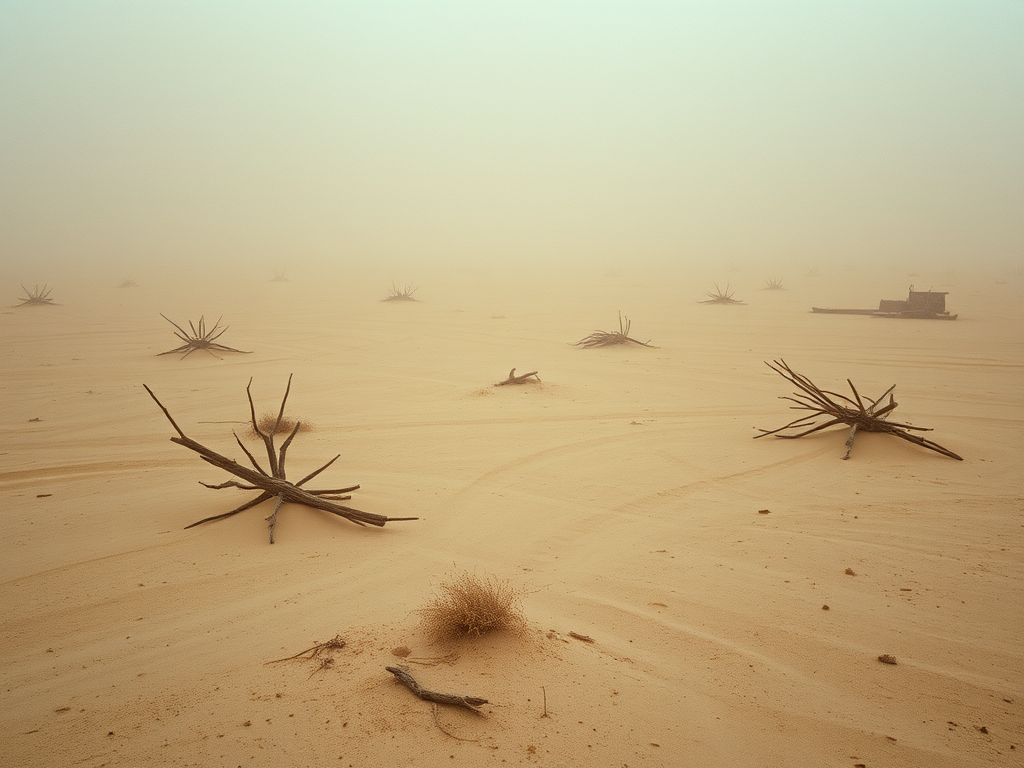
The winter had been relentless. The worst sandstorm in memory had swept through the region the year before. It buried the land in towering drifts of dust and sand. In some places, these drifts were waist-deep.
It marked the beginning of the Dust Bowl. This was a devastating era of dust storms. These storms crippled agriculture and reshaped life across the American and Canadian prairies in the 1930s.
Few families had stored enough food from the past year’s harvest. Even fewer were sure how long this disaster would last.
They say two things in life are certain: death and taxes. And for Elmer, tax time had come knocking. He had no choice but to ride nearly forty miles to the courthouse. He needed to pay his property taxes in person. He risked default if he didn’t. Despite the hard times, he had always kept his land in good standing. He intended to do so now, even with their dwindling savings. With three young children to feed, responsibility was heavily on his shoulders. His two sons and daughter were too young to fully grasp the hardship that had taken hold of the land. The struggle was real for Elmer and his wife, Ma Ma.
The night before his journey, Elmer told Ma Ma,
“I’ll be up by 3:30 and gone before sunrise. There’s no need to let anyone know I’m carrying money. Hard times make people desperate.”
While he trusted his neighbors, he wasn’t about to take unnecessary risks. He planned to make it halfway and camp near the Washita River before reaching the courthouse the next day.
At dawn, Pa Elmer saddled his pony, Smokey. Ma Ma handed him a small bundle—a few slices of fresh bread and beef jerky from the smokehouse.
“It’s not much,”
she said, touching his knee as he mounted up,
“but it’ll hold you over till you’re back. Ride safe, and don’t take any risks. Smokey can outrun any trouble that comes your way.”
Pa Elmer bent down in the saddle and kissed her.
“Two days there, a day and a half back. I’ll be fine.”
The parents didn’t know it. Their three children watched from behind the screen door, their little faces pressed against the mesh. As Ma-Ma gave Smokey a firm slap on the hip, Pa clicked his tongue and hollered,
“Yaw!”
The journey had begun.
Back inside, Ma Ma found the children still watching. She shooed them back to bed. Then she settled into her rocking chair with the Bible. It was her source of comfort through times of uncertainty.
The Ride to Town
Pa made good time. Smokey, eager for the open trail, trotted strong beneath him. By evening, they had covered thirty miles. Elmer found a spot near the Washita River where the grass was matted down—a daytime swimming hole. He unsaddled Smokey. Then, he tied him to a long rope to graze. Elmer stretched out beneath a tree, using his saddle as a pillow.
Sleep took him fast; it was a blessing he had dozed off facing east. The first light of dawn warmed his face, stirring him awake. After a quick breakfast of beef jerky, he saddled Smokey and continued.
By mid-morning, he reached the county seat. He tied Smokey to the hitching rail and strode into the courthouse. The county clerk barely glanced up from her papers.
“You here to ask for an extension on your taxes like everyone else?”
she asked.
Elmer tipped his hat.
“No, ma’am. I’m here to pay my taxes for this year and next.”
The clerk blinked, then scribbled out a receipt, her expression unreadable.
Paid this date: $28.33 for two years of property taxes.
Elmer folded the receipt and tucked it into the same safe spot where his money had been. Simply saying ––––
“Thank you, Mam!”
Pa had finished his business.
Trouble in Town
As he walked back to Smokey, a man loitering nearby gave a slow nod.
“That’s a fine-looking horse you got there. I’d buy him off you for $25.”
Elmer stiffened.
“No, you wouldn’t.”
The man’s eyes darkened, and his tone shifted.
“Maybe I just take the horse for nothin’.”
Elmer didn’t flinch. He met the man’s stare with steely resolve.
“No, you’d be lyin’ dead if you tried.”
A tense silence hung between them before the man forced a crooked smile.
“Mister, I was just jokin’.”
He backed away.
“You have yourself a nice day.”
Elmer wasted no time. He swung into the saddle and galloped out of town.
The Journey Home
The Journey Home
Elmer has made the ride back in a day. Still, he took his time. He stopped by a few relatives along the way. In this part of the country, it was tradition—when you passed by kin, you paid a visit.
Late in the afternoon, as he approached home, he saw Ma Ma and the kids waiting at the gate. The children ran to meet him, full of questions.
“Well, Pa? How’d it go?”
Ma Ma asked, relief washing over her face.
Elmer grinned and swung down from Smokey.
“Would’ve been home sooner,”
he said, stretching his legs,
“but I kept runnin’ out of pipe tobacco.”
Ma Ma shook her head with a chuckle. As the family led him inside, the weight of the journey melted away. Home had never felt so good.
Sitting in the large living room, Tim’s father called him down from his upstairs bedroom. As Tim entered, he wondered if he had forgotten to do his chores properly. He also thought about whether his father had bad news to deliver.
Sitting on the fireplace ledge, he faced his father, who sat in his favorite chair.
“I’m helping Jess Paul tomorrow down south of Mingo for Doc. We must drive cattle up from their southern pasture. Then, we will move them into holding pens for transport to the sale barns. We need a third rider to keep the point in key areas, and I’d like you to come with us.”
Tim’s heart leaped. He had never been to Mingo but had always heard about the town. It was one of the last places with a 19th-century reputation. It was known as a wild, lawless settlement. Gunfights on the main street occurred weekly. Jess Paul often talked about how the local cowboys were descendants of the originals who roamed the territory before statehood.
Jess Paul was one of his father’s closest friends. Ten years ago, he lost both legs below the knee in a farming accident. Despite this, he rehabilitated himself and learned to walk using only a cane. Jess Paul can mount a horse and ride all day without showing pain or discomfort. With his two wooden legs, he can break a wild two-year-old stud just as well as any other cowboy. To Tim, Jess Paul was the toughest man Tim had ever known. His hands were massive, and he had a story for every place they went.
Tim’s father instructed his older sister to stop by his school and collect any assignments he’d miss.
“Tell his teacher I need him to work cattle,”
he said matter-of-factly.
The next morning came early. At 4:00 AM, Jess Paul was already up, having slept in his truck’s camper parked in front of their house. Jess Paul’s horse had been kept with the others on Tim’s father’s farm. While his father and Jess Paul gathered saddles and horses, Tim hitched the stock trailer to his father’s pickup.
Jake, Tim’s father, rode his horse, Red Man. Tim mounted Sam, his temperamental gelding, while Jess Paul rode Sonny. With the horses loaded, they set out for Mingo—a journey of over 150 miles. Another 20 miles beyond the town lay the range land where the cattle waited.
Jess Paul talked nonstop during the long drive. Tim had heard some of his stories several times before. Each time, Jess Paul added a new detail to keep them fresh. This made the stories engaging.
After three hours on the road, they arrived and unloaded the horses. Tim dreaded the ride on Sam. The weather was unseasonably cool, and Sam was known for taking off bucking at the worst possible times.
“No cowboying,”
Jake warned.
“We want these cattle to walk to the pens. Just guide them—don’t rush them or get them running.”
Tim nodded. He understood why. Running the cattle would make them lose weight, reducing their value at the auction.
No cattle were in sight from the truck. The trio mounted up and rode south across the prairie. Half an hour later, they spotted the herd—about two hundred head—gathered in a valley, sheltered from the cold north wind. Jake moved wide to one side of the herd. Jess Paul took the opposite side. Tim took position on the hill. He was ready to steer the cattle north toward the pens.
Tim fought to keep Sam still as the cattle approached. The horse was itching to jump, and Tim braced himself, expecting a sudden bucking fit.
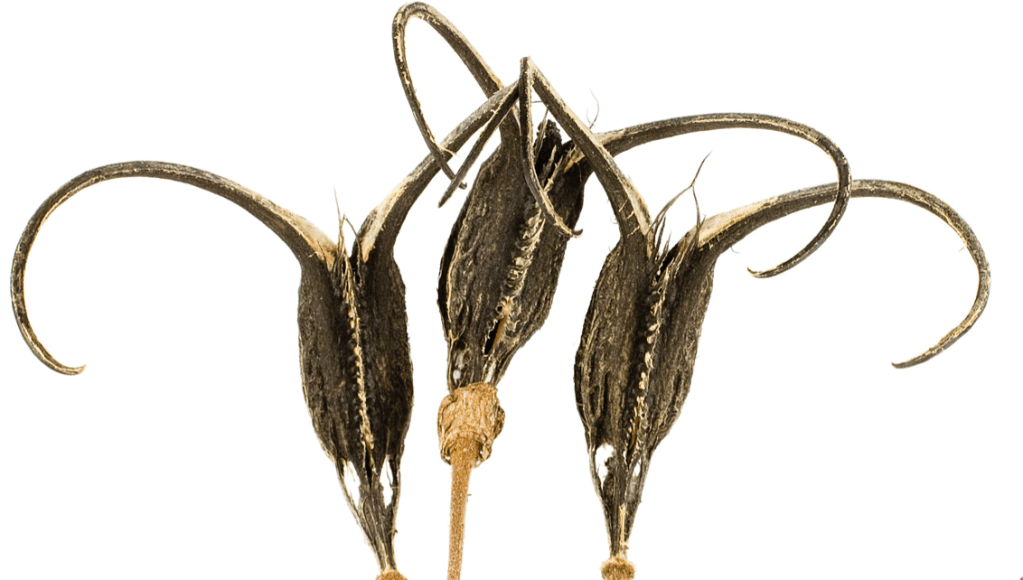
The first two turning points went smoothly. Tim maneuvered between the cattle and the next position with ease. But at the final turn, he noticed a devil’s claw tangled around Sam’s hind hoof. The dried-up weed flower was notorious for driving horses wild, making them kick and thrash to free themselves. Tim knew he had to stay calm.
Devils Claw Proboscidea louisianica
Slowly, he dismounted, working his way around Sam. He reached down with deliberate care. Then, he grabbed the devil’s claw and pulled it free. Using his boot, he brushed it away. Miraculously, Sam stood still.
Tim half expected the horse to explode at any moment. The last time Sam went full rodeo, they had been riding a narrow trail along a canyon. On one side was a dirt wall; on the other, a hundred-foot drop. Sam had bucked the entire way down to the canyon floor. Tim had held on for dear life. He cursed the horse with every bounce. Tim’s father scolded him for not stopping the horse. Tim never dared argue back. He had just been trying to survive the ride.
Now, with Sam behaving, Tim remounted and guided the cattle through the final turn. The herd moved steadily into the holding pens, where hay and grain had been spread. After the last cow entered, the trio loaded their horses back into the trailer, and the gates clanged shut. The job was done. They had answered the call south of Mingo, and now it was time to head home.
Riding home meant Jess Paul would tell more stories.
If there was anything Bud hated more than waking up to catch the school bus, it was getting to school and sitting in a classroom all day long. He couldn’t keep his mind on anything in a book. He could often find himself gazing out a classroom window and dreaming of riding his horse: anything but reading, writing, or arithmetic. His teacher knew his fondness for drifting into daydreams and would call his attention back to reality, usually asking if he knew what they were discussing. He didn’t, but he tried to fake it, bringing laughter to his classmates. It was test time, and it mattered, so he tried hard to pay attention because Bud didn’t want to be held back a year and have to repeat a grade level.
The week came for the test, and Bud had tried hard to study, fitting time between his farm chores and breaking his new horse, Rose. Unlike any horse Bud had ever owned, she was a delight to have. She even became friendly with Bud, meeting him at the pen gate and following him around as he cleaned out the barn. Staying in the pen was unusual; typically, horses would take to the pasture when the gates were open and get their exercise and run. She might go out for a spin, but she would return and spend most of the time with Bud, nudging him as he did his work. Which sometimes became a nuisance since scooping out the barn required much physical work, and she wanted his attention. After his chores, he always gave her a rub down, which Rose seemed to eat up. As he took the brush and rubbed down her back and hips, she would extend her neck into the air and twist her upper lip in a pleasing gesture. Bud thought this was strange for a horse someone had never touched until a few months ago. But what Bud doesn’t know is Rose would only let his father and Bud have anything to do with her.
Bud finished the rub down and told Rose,
“Well, girl, I have to take tests tomorrow, and I won’t be here on time, so don’t give up on me. I will be here, but I will be late.”
Rose nudged Bud’s shoulder; he thought maybe she understood.
The next day, Bud hated getting up at sunrise to catch the bus and go to school. He could do so many better things, but he did anyway. At school, those tests were waiting. He managed to get through all the day tests and, thanks to the new testing system, learned he had passed them all. He hoped the teacher would pass him on to the next grade. It depends on more than just grades at the school; it also includes conduct, attendance, and interests in subjects. The school would only send that notification in the middle of the summer. The excellent news for Bud is the last test meant that school was over for the season, and he was free for the summer. Once he got home, he didn’t have to catch that school bus for another three months.
It was later than usual when Bud rolled in on the school bus; it had run the route backward due to it being the last day of school and letting the students at the end of the route get home first for the last day of school. It was a trade-off for getting home first all the other days of the year for Bud. She was angry when he got to the Barn and Rose’s pen, nickering up a storm. Bud came in with hay, a gallon of oats, and a brush. He put the oats and hay in her feed bin, and as she began to eat, he gave her a rubdown. Which she immediately melted into.
Bud said to Rose as he calmed her,
“There, I told you I was going to be late. Calm down. I have a few more horses to take care of, too. I always come to you first!”
She gave him a gentle nudge, burying her head into his shoulder. He scratched her forehead. She closed her eyes and buried her head in his chest. Bud fed the other horses, returned to Rose, gave her another quick rubdown, and ensured she had fresh water.
Bud said to Rose patting her on the hips,
“I have to eat too –– so I will be here first thing in the morning. We have work to do!”
He closed the pen gate and went to the house. The day was about to come to a close. Now, he was looking forward to waking up at sunrise; he had Rose to get to and a day of riding.
Sunrise came sooner than Bud thought it would, and it was a bit tougher to get up than he thought it would, but he managed to get to the floor and get going the following day. He grabbed a quick bite of breakfast and was off to the barn and Rose’s pen. Bud found his horse ready to see him; Bud gave her a brush down and then saddled her up. He told her we leave the riding arena today and go to work.
Bud slipped on a bridal and a new set of roping reins that lightly touched Rose’s neck. She noticed that the thick plow reins were gone and that the light touch of the new reins seemed more to her liking. As Bud stepped into the left stirrup, rounded his right leg over Rose’s back, and settled into the western-made saddle, Rose shifted her feet and became comfortable with his mount. Having him aboard brought a prance to her step. When the two rode with others, comments were being made about how the Rose and Bud appeared so confident together, and the Rose’s stride was so prideful. She had a specila gate, rather than at a walking pace or when she loped. Rose had a trot that went a step beyond that of a fox trot and a lope that didn’t bounce Bud. She was the Caddilac ride!
On the first day, Rose proved to be as great of a horse as those riding five- and six-year-olds. She took every step. Rose never shied away from anything, and in every task Bud asked of her, Rose met. Bud even got off her several times to fix a fence post or pull up a wire along a fence line, and she never left his side; the other riders had to tie their horses off and walk back to them after fixing fence lines, but Rose, stayed right along wherever Bud went.
A month into summer, Bud’s father suggested he begin training Rose to cut cattle. To do so, Bud would begin having Rose train on turning goats in the roping arena. Rose took to it like she was born to do it. She was so swift at turning with the goats that she nearly caused Bud to lose his mount several times. However, Bud learned to sit with Rose, and the two became masters in cutting goats, cattle, or dogs if needed.
By the end of summer, Rose had become well-muscled and was turning four years old. She had begun to fill out. Bud’s father suggested that he breed the horse and get a colt from the horse for next spring, saying that he had a good horse. So Bud’s father made arrangements with a neighboring horseman to have Rose visit his stud, and a few weeks later, the news came that Rose would be expecting a colt next spring. While waiting, Bud began getting Rose ready to show in the upcoming county fairs.
Rose stood proudly in the county and several city fairs, and walking alongside Bud, she won several Blue and Red ribbons. It was a great experience to prepare her for riding in parades and rodeos. Bud did bring Rose to town several times; she walked proudly and enjoyed the crowds of people who looked on as she pranced down the streets or through the rodeo arenas.
Bud grew up fast, and so did Rose; she had several colts over the years. Bud would train them like he had Rose, usually selling them and putting them in a savings account when he got older. Rose remained loyal to Bud, and they rode nearly daily, even with school going on. It was something for Bud to look forward to after getting out of school. Living so far out in the country, neighbors weren’t nearby, and Rose was his best friend, at least closest to home.
When Bud turned 17, he got a pickup with the money he had saved. This was also the time his father began downsizing his horse farm. Rose was one of the last horses left in the place. One morning, Bud’s father came to him and said ––
“You know, Rose is at a good point for selling, and you will be moving away in a few months. You should think about selling her to your brother. And your saddle, too.”
Bud was heartbroken because he knew his father was right. He had been thinking about what to do for months. He knew that he would be leaving home for his first job in a few months, one that would require him to move away and that would not allow him to have Rose. Plus, his father had aged and was becoming unable to care for horses. That was the reason for the downsizing. Bud’s father had already sold all his horses and saddle. Something Bud never thought he would see happen.
Bud slept on it overnight; the following day, he talked to Rose, and she didn’t nudge him back when he spoke to her. He knew she understood. And she, too, was heartbroken. He closed the gate on her pen and walked away.








 benandsteve.com