The file on Chester Finch wasn’t stored in any digital archive. It was handwritten, double-sealed, and stored in a fireproof vault in Washington, D.C., under a codename known only to four men who still remembered it.
Operation Ashwood.
Eight years ago, Chester was part of a black-bag unit inside the U.S. Marshal Service—officially unrecognized, unofficially unstoppable. The team was created to root out systemic corruption in rural American towns with privatized law enforcement and cartel-backed leadership. The mission was simple: infiltrate, destabilize, expose.
Ashwood’s first three targets were textbook. The fourth—Gulch County, Texas—was different.
Chester had made the call. He exposed the sheriff, three council members, and a judge and brought them down with a clean sweep.
But the blowback was lethal.
Three of Chester’s team were ambushed at the exit. A safe house was burned down—with a whistleblower’s daughter inside. The press got hold of fragments, but the whole truth? That was buried in a sealed report and heavily redacted.
Chester took the blame. Not officially. But quietly. They let him keep the badge—under the condition that he’d never be given another high-profile operation again.
Until now.
Serenity was never meant to be his assignment. Someone had slipped his name into the dispatch. Someone with a more extended memory than the agency admitted to.
And now Gallow, the last surviving Ashwood “fixer,” was on the trail.
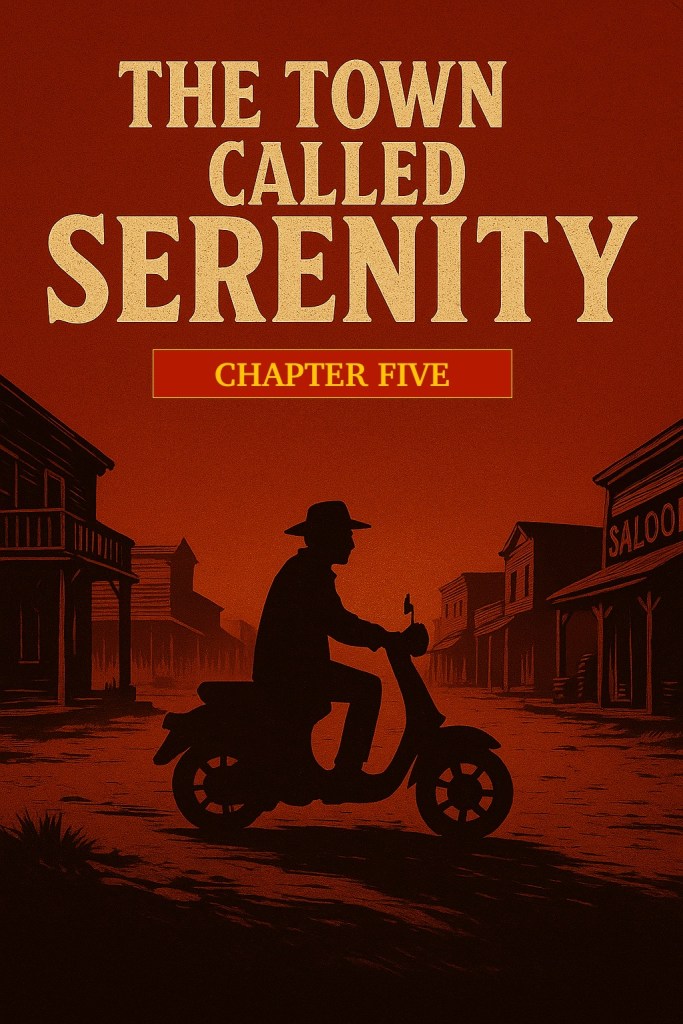
Now, remember this is only a pause between Chapters Five and Seven. This moment is to clarify what was happening. It serves to show what brought Chester Finch to these parts. When Chapter Seven opens, it will seem like only a few days have passed. That will be just enough time for Finch to remember his past, whether he likes it or not. Still, there is no word where he has left the moped. Surely, it would have been used as a bargaining chip with him by now.
The bell above Petal’s shop rang twice—slow and deliberate.
That was the signal.
Wren waited until the third cloud passed over the moon before sliding off the schoolhouse roof. She moved like a whisper down the alleyway, avoiding the creaky boards and broken glass with practiced ease. She paused behind the horse trough near the sheriff’s office and whistled once—two notes, flat and low.
Chester was sitting inside the dim jailhouse with his boots propped up on a barrel. His bruised rib was bandaged with a strip of curtain. He heard the sound and stood up.
He opened the door.
Wren stepped into the lamplight. She was small and wiry, wrapped in an oversized coat that had seen better days. Her eyes were dark and deliberate, scanning the room, the exits, the Marshal.
“I watched you fight the Gentlemen,”
She said without greeting.
Chester gave her a nod, cautious but not cold.
“You’re the girl from the roof.”
“I’m the girl from everywhere,”
She replied.
He gestured to a stool.
“You hungry?”
She hesitated, then sat.
“I want something else.”
“Alright.”
“I want Cain gone.”
Chester leaned back against the wall, arms crossed.
“That makes two of us. But wantin’ it and surviving it are two different things.”
Wren pulled her notebook from her coat and opened it. She showed him a crude map—of underground tunnels, secret entrances, schedules.
“I’ve been tracking his movements for six months,”
She said.
“He’s gotten sloppy. He trusts the wrong people. There’s a weak point—down in the old mines under the vault. He thinks no one remembers it exists.”
Chester raised an eyebrow.
“And you want to hit him there?”
“I want to expose him first. Show Serenity what he is. Not just a tyrant. A liar. A coward. I can get you inside. You have to decide if you’re willing to break the rules you came here to enforce.”
He looked at her for a long moment.
“You ever worked with a marshal before?”
“No,”
Wren replied.
“You ever work with a kid who knows where all the bodies are buried?”
Chester smiled.
“Can’t say that I have.”
She closed the notebook.
“Then we’re even.”
They shook hands—hers small and cold, his calloused and warm. In that moment, something changed. Not in Serenity. Not yet.
But it had started.
Meanwhile –––
Five miles west of Serenity, in a ravine that didn’t show on most maps, a boxcar shuddered to a halt. It stopped on rusted rails.
A figure stepped out—tall, dressed in black, face hidden beneath a wide-brimmed hat. Beside him, four others disembarked—mercenaries, by the look of them. Not local. Not from this state. Not from this country, maybe.
They called him Mr. Gallow.
No one knew if that was his real name. He didn’t speak often, but when he did, people obeyed—or disappeared.
Gallow held up a leather-bound dossier stamped with the faded seal of the Bureau of Internal Affairs. Inside was a photo of Chester Finch, clipped to a thick file marked:
“CLASSIFIED – OPERATION ASHWOOD.”
He flipped the page and revealed a second file—one that bore the name Braddock Cain.
And then a third.
Subject: WREN (Alias Unknown).
Status: Missing / Witness Protection Violation.
Gallow smiled faintly.
He turned to his team and said only two words.
“Kill quietly.”
They vanished into the desert night like wolves on the scent.
Back in Serenity
Petal watched the train lights fade on the horizon, her face tense.
She reached behind the counter, pulled out a dusty revolver, and said to herself,
“They’re all waking up now.”
And somewhere, far below, in the tunnels beneath Serenity, a clock that had long stopped ticking began to turn again.
So, Chester’s past is coming back to haunt him. What exactly are contained in the files OPERATION ASHWOOD Files? And, how much of it did Chester do or not do? He now cares less about the moped. If the contents of the file sees light of day, what would it mean for our Marshal? The man trying to cleanup this dirty town? And the tunnels, are another thing? Just a quick way to get about town or something more sinister?
Braddock Cain stood in front of a pool table inside The Assembly, lining up a shot with surgical calm. His eyes didn’t leave the cue ball even as Poke relayed the report.
“He bloodied Silas’s nose, bruised Dutch’s ribs, broke Miles’ fiddle, and made Jonas fall on his ass,”
Poke said, leaning against a cracked marble column.
“Didn’t even draw his gun.”
Cain took the shot. The cue ball clicked sharply and sank the eight-ball in the corner pocket.
He stood slowly, placed the cue stick back on the rack, and poured himself a drink.
“And the town?”
“They watched,”
Poke replied.
“They didn’t help, but they didn’t laugh either. Some of ’em even looked –– curious.”
Cain stirred his drink with one finger.
“That’s the worst part.”
Poke blinked.
“Sir?”
Cain turned toward the window.
“Fear keeps Serenity in check. When people get curious, they start to hope. And hope’s just a prettier way of saying ‘trouble.'”
He walked back to his velvet chair, every step echoing in the hollow room.
“I want to know everything about Marshal Finch. Where he came from. What he’s running from. Who sent him? And,”
He added, narrowing his eyes,
“who he’s willing to die for.”
Poke nodded and disappeared.
Cain sipped his drink and muttered to the empty room,
“Let’s see what kind of man rides into Hell on a scooter.”
Across the Rooftops
Wren sat cross-legged on the corrugated roof of what had once been Serenity’s schoolhouse. The sun was setting in a blood-orange smear across the sky. She held a spyglass in one hand and a half-sharpened pencil in the other. A leather-bound journal rested in her lap.
Inside were names. Maps. Notes.
She turned to a fresh page and wrote:
Chester Finch – Marshal – Took a hit, didn’t fall. I watched the Gentlemen leave bruised. He won’t last a month. He might last longer.
Beside her sat a worn revolver wrapped in canvas, untouched. Wren didn’t shoot unless necessary.
Observation was safer.
She reached into her coat and pulled out a folded piece of paper. It was a newspaper clipping, old and faded:
“LOCAL DEPUTY DIES IN FIRE — WIDOW, CHILD UNACCOUNTED FOR”
She stared at it for a long moment before tucking it away again.
Wren wasn’t born in Serenity. She was left here. Left during the chaos, after the fire, after the men in black suits came and went. Cain had taken her in—not out of kindness but calculation. He saw her silence, her memory, her talent for hiding in plain sight.
He never asked questions. Neither did she.
Until now.
She looked back toward the jailhouse, where Chester Finch was lighting a lantern in the window. He moved stiffly, but there was something in the way he held himself. Like a man who wasn’t afraid to die—but was trying real hard not to.
She flipped back through her notebook. She found a sketch she’d drawn weeks ago. It was a map of Serenity. The map had dotted lines marking the tunnels under the old mines. It showed the abandoned telegraph station and the hidden entrance to Cain’s private vault room.
Wren circled Chester’s name, then drew a faint arrow pointing to the vault.
It was almost time.
Elsewhere in Serenity ––
Petal wiped the dust from her apothecary shelves. She stared at a cracked photo of her brother. He was killed by Cain’s men for refusing to cook meth in the back room. She kept smiling, but her smile was starting to slip.
Julep Jake, now back in his cell by choice, was building something with matchsticks and chewing gum. “Civic infrastructure,” he explained to no one.
Silas Crane dipped his bleeding knuckle into holy water and laughed softly. “He’s gonna make me preach,” he whispered. “And I do love a sermon.”
Back in The Assembly, Cain sat alone in the dim light, polishing a gold coin between his fingers. One side bore the symbol of the old U.S. Marshal’s badge. The other side? Blank.
“Flip it,”
He whispered.
“Heads, he burns. Tails, he breaks.”
He flipped the coin into the air and caught it.
But he didn’t look.
Not yet.
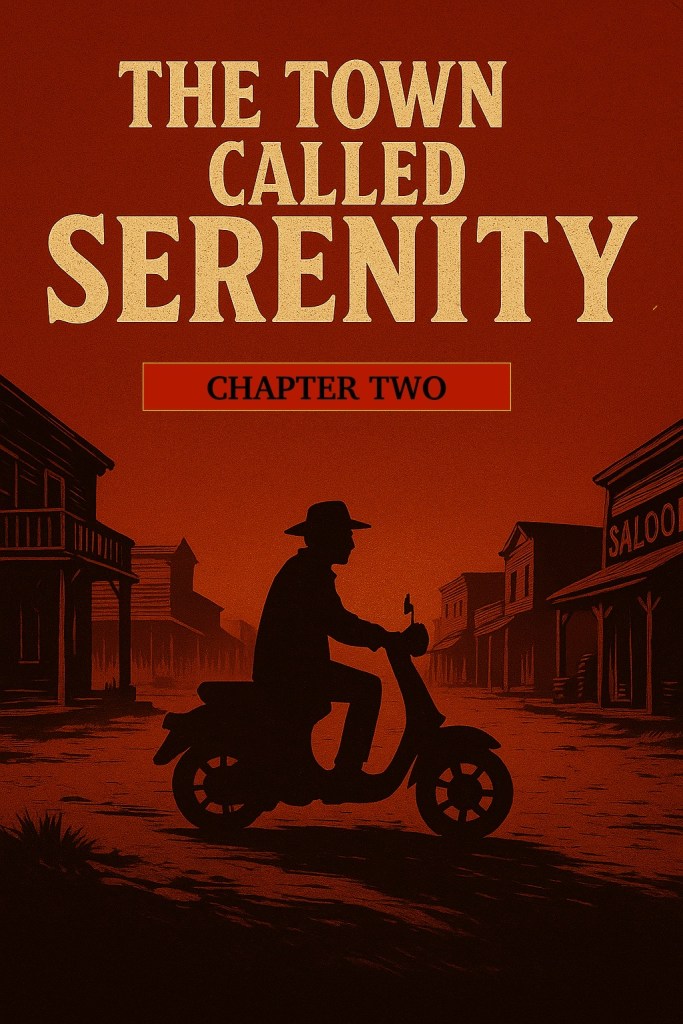
Yet another episode to our story concludes. And, still no word on whether the moped is safe. After all, nowhere in this story is it mentioned whether Chester Finch parked it in a loading zone. It also doesn’t say if he used a 1-hour only parking space when he got to town. So far it hasn’t been used to his advantage in any of the dealings he has had. In Chapter Five, you will find out why. There is a secret method to getting about the town. It is about to unfold.
By noon the next day, the heat in Serenity had risen to an oppressive boil. The town smelled of dry rot, sweat, and gun oil. Somewhere in the distance, a fiddle played off-key. Somewhere closer, someone was being punched.
Chester Finch stepped out of the rickety sheriff’s office he had claimed, swatting at flies with his hat. His left eye was bruised from a scuffle the night before, and he had re-holstered his sidearm four times that morning alone—once while buying coffee, once while crossing the street, once during a handshake, and once because a six-year-old pointed a slingshot at him and said,
“Bang.”
Serenity wasn’t just lawless—it was allergic to rules.
A woman named Petal ran the general store and apothecary. She greeted Chester with an arched brow, and a cigarette clung in the corner of her mouth.
“You’re still alive,”
She said, counting change.
“Didn’t expect that.”
“Thanks for the confidence,”
Chester replied, tipping his hat.
She shrugged.
“Ain’t personal. We don’t usually see second sunrises on lawmen.”
Chester had started to respond when a shadow fell across the dusty street. Four men approached—spaced out like predators, walking with the purpose that made children vanish and shutters slam.
The Gentlemen had arrived.
The one in front was tall, clean-shaven, and wore a preacher’s collar over a duster that flared in the wind. A thick Bible was tucked under one arm. His name was Silas Crane, but most folks called him Reverend Knuckle. He smiled with too many teeth.
“Marshal,”
He said.
“We heard you were new in town. Thought we’d come to say hello proper-like.”
Behind him stood the other three:
Dutch, a former bare-knuckle boxer with hands like cinder blocks and a voice like gravel being chewed.
Miles, a one-eyed fiddler with a twitchy finger, never stopped humming.
And Jonas, the silent butcher-aproned brute who carried a wood-chopping ax like it was a handshake waiting to happen.
Chester stayed calm. He’d dealt with worse—once, a rogue bootleg militia in Nevada. Another time, a cult leader in Kentucky had a fondness for snakes and a penchant for blackmail. These four? They were just another test. Or so he hoped.
“I appreciate the hospitality,”
Chester said, thumb resting on his belt.
“But I’m here on business.”
Silas opened his Bible, then punched Chester square in the jaw. The Marshal hit the dirt hard.
“Chapter One,”
Silas said, closing the book.
“Verse one: The meek get stomped.”
Dutch cracked his knuckles.
“You wanna deliver the sermon, or should we take it from here?”
Chester wiped the blood from his lip and sat up.
“You fellas always greet visitors with scripture and assault?”
“Wegreet threats,”
Silas replied, crouching.
“You’re Cain’s business now. That means you’re ours.”
Behind them, the few townsfolk watching began to edge away, some disappearing entirely. Petal stayed, lighting a second cigarette from the first.
Chester stood up slowly.
“You done?”
Silas raised an eyebrow.
Because that’s when the door behind them swung open, and out walked Julep Jake, shirtless, handcuffed, and barefoot.
“Marshal,”
Jake yelled, grinning wildly,
“you left the cell unlocked again! I declare myself free! By raccoon law!”
Everyone froze.
Even Jonas blinked.
Silas turned slightly.
“What is—?”
And that’s when Chester moved. Fast.
He used the distraction to land a gut punch on Dutch. He spun around Silas. Then, he kicked Miles’ fiddle clean across the street. Jonas came at him like a wrecking ball, but Chester ducked and flipped a barrel in the way. The brute went tumbling.
It wasn’t a win. It was a delay.
But it was enough.
When the dust settled, Chester stood there, breathing hard, badge still gleaming. Around him, the Gentlemen nursed bruises and bruised pride.
“You tell Cain,”
Chester said, voice steady,
“that if he wants me gone, he better send a storm. Because the breeze just isn’t cuttin’ it.”
Silas stared at him, blood on his lip. Then he smiled that too-wide smile again.
“This is gonna be fun,”
He whispered.
They left him standing there, Jake still rambling behind him about his re-election campaign.
Later That Night ––
From a rooftop, a girl no older than fourteen watched the fight unfold. Her name was Wren. She didn’t talk much and didn’t smile either. But she watched everything. She scribbled something in a notebook.
The new Marshal wasn’t like the last dozen.
This one fought back.
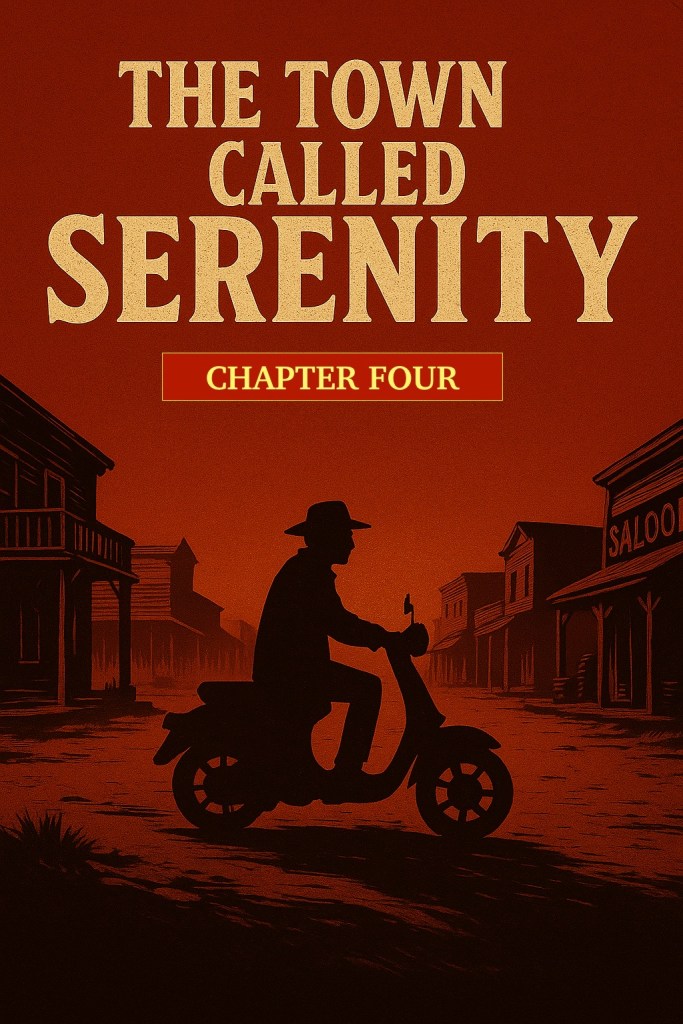
Well now—what a predicament! After crossing paths with The Gentlemen, will the Marshal still be standing? Or will he end up being used to mop the floor by the end of Chapter Four? And as for his trusty moped… is it safe around this unruly bunch? Check here tomorrow for more and Chapter Four of this very exciting story!
Braddock Cain held court in what used to be Serenity’s town hall. It has been redubbed The Assembly. This tongue-in-cheek title amused him to no end. The building’s original seal featured a gavel and olive branch. It had been charred. A mural of a coiled snake wrapped around a set of broken scales replaced it.
Cain reclined in a velvet chair salvaged from an old theater. His legs were crossed and his boots polished. A glass of brandy swirled in his hand. He dressed like a gentleman, but everything about him screamed predator. His jaw bore a faded scar shaped like a question mark, and his eyes—green, sharp, reptilian—missed nothing.
He was listening to the daily reports from his lieutenants. These included moonshine shipments and bribe tallies. They discussed who’d been bought and who needed reminding. It was during this time that the news came in.
“Marshal rode in today,”
Said a wiry man named Poke, who hadn’t blinked since 1989.
“Little fella on a moped. Arrested Julep Jake, if you can believe it.”
Cain’s eyebrow lifted slightly.
“Didn’t shoot him?”
He asked, his voice smooth as oiled leather.
“No, sir. I hauled him off. Jake’s in the old jailhouse right now. He’s hollerin’ about election fraud. He’s claimin’ he’s immune to state law because of a sacred raccoon spirit.”
Cain chuckled, swirling his drink.
Side Note:
Julep Jake was a Yale-educated botanist. He loved whiskey-fueled nonsense. He habitually wore a sash that read “Honorary Mayor 4 Life.” Despite all this, he had a breakdown during a lecture on invasive species. He ended up in Serenity after wandering the desert in a bathrobe. He decided, on divine instruction, that this was where civilization needed his governance. The raccoon spirit came later, after a bad batch of moonshine.
Cain leaned forward, elbows on his knees.
“So. The law’s back in town.”
Poke nodded.
“Says he’s here to clean up.”
Cain smiled faintly.
“Then let’s give him something to mop up.”
He rose, slow and deliberate. Every movement was calculated with the same precision he used to carve out his little empire. Cain wasn’t just a criminal—he was a tactician. He knew that fear didn’t come from bloodshed alone. It came from control. Predictability. Making people believe that resistance was a form of suicide.
“Send word to the Gentlemen,”
Cain said.
The Gentlemen weren’t gentlemen at all. They were Cain’s enforcers—four men, each with a particular specialty. One was a former preacher who liked to break fingers while quoting scripture. Another was a silent giant who wore a butcher’s apron even on Sundays.
“Tell them I want to meet our new Marshal. Kindly, of course. Offer him a warm Serenity welcome.”
Poke nodded and vanished.
Cain turned to the shattered windows behind him, looking out over his kingdom. Dust swirled in the streets. Somewhere, a gunshot echoed, followed by laughter.
“I do enjoy it when they come in idealistic,”
Cain murmured, sipping his drink.
“They bleed slower.”
The sun sets over Serenity. One question hangs heavy in the air: Will the town still be standing by morning? It’s the same question whispered every night by those who still dare to hope. But for Chester, the stakes are far more personal. His question is simpler—yet far more deadly: Will he live to see the sunrise? And if he does… will he finally come face to face with the elusive “Gentlemen”? Few ever have—and fewer still lived to speak of it.
Chapter Three reveals the fate of the town. It uncovers the future of Chester. The shadowy intentions of the Gentlemen are exposed, at least for one more day. A luxury not everyone in Serenity can count on.
In a remote corner of the state, the roads grow narrow. The trees lean in like they’re sharing secrets. There lies a town called Serenity. The name is a cruel joke—there’s nothing serene about it. This is a place where street signs double as target practice. The law has long since departed. No one has noticed. The welcome sign on the outskirts used to say, Population: 312. Someone scratched it out and replaced it with Too Many.
In Serenity, bars outnumber churches, and the only thing thinner than a promise is a badge. It’s where outlaws hide not from the law but from one another. It’s a haven for grifters, gunmen, and ghosts of good men who didn’t make it out.
And into this outlaw’s paradise rolled Chester Finch.
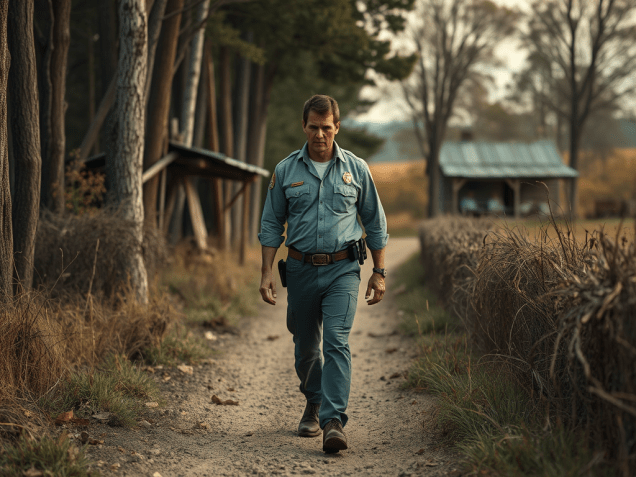
Deputy U.S. Marshal Chester Finch was not the image of frontier justice. He didn’t ride in on a stallion or a dusty pickup truck. No, Chester arrived in Serenity on a cherry-red moped. It’s the kind you’d see zipping through suburbs. You also find it parked at a vegan coffee shop. He wore regulation boots, a broad-brimmed hat, and a badge that gleamed as if it still held some hope.
The moped sputtered as it crossed the town’s crooked boundary, its two-cycle engine whining like a mosquito. Chester parked outside the Rusted Spur Saloon. It was half brothel, half bar, and all trouble. Eyes were already watching him from behind dusty windows and cracked doors.
On the porch, an older man with a shotgun across his knees spat into a tin can and said,
“That there’s the funniest damn thing I’ve seen all week.”
Chester dismounted, kicked the stand down, and brushed the dust off his badge.
“I’m lookin’ for the sheriff,”
He said.
The older man cackled.
“Ain’t had a sheriff since Mad-Eye Morgan got shot for winnin’ too many poker hands. That was six months back.”
“Then I suppose I’m it now,”
Chester replied, squinting at the sun.
“By order of the U.S. Marshal Service, I’m here to restore order.”
The laughter that followed came from more than just the porch. It drifted from second-story windows and behind swinging doors. It came from a town. The town believed the law was something you threw in a ditch. It was buried with the rest of your conscience.
Chester knew this wouldn’t be easy. He knew his badge would draw more bullets than respect. But he also knew Serenity was on the brink of something worse. The federal files hinted at growing ties to outlaw syndicates. There were whispers of gun-running. A name kept popping up: Braddock Cain.
Cain ran Serenity like a private kingdom. Tall, scarred, and charming as a rattlesnake in a bowtie, he was the unspoken king of vice. No one crossed him unless they wanted to disappear.
Chester had crossed worse. Or so he told himself.
His first night in Serenity ended with a knife fight. There was a horse in a bar. The moped was set on fire by a drunk named Julep Jake, who claimed to be the mayor. Chester arrested him anyway. This unpopular move earned him a cracked rib and a bloodied lip. It also earned him the first sliver of respect from the few decent souls still buried in Serenity’s mess.
By morning, Chester had taken over an old sheriff’s office. It was half caved in and smelled of rot and regret. He nailed his badge to the door. It was symbolic more than anything. And in this town, symbols were dangerous.
He had come for peace, riding on two wheels and carrying a quiet resolve. He found a town at war with itself. It was a fight that takes more than a badge to win.
But Chester Finch wasn’t here for symbolism. He was here to end the laughing.
Will the laughing continue? Will Chester live? And what about the town will it still be standing? Find out tomorrow when Chapter Two is presented.
A Frightening, Comical, and Hostile Ride: The Birth of Twila Elouise
By early June of 1960, Oklahoma’s summer heat had already settled in, pressing down across the vast plains. In Oklahoma City, JD Groff attended a convention of oil producers. He was representing Standard Oil Company alongside his superior. His superior was a man named Harold. Harold had a reputation for being both respected and heavy-handed with a whiskey glass.
Meanwhile, back in Clinton, JD’s wife Marjorie—known to family and friends as Margie—had decided to stay home during JD’s trip. Margie had four children already—Sheldon, Terry, Dennis, and Juli. She wanted to stay close to JD’s sister and brother-in-law. They could quickly step in and help with the kids if she needed to go to the hospital. It was a decision made with foresight and care, and as it turned out, it was the right one.
On June 2, Margie went into labor.
Her calm steadiness defined her actions. She went to the hospital, and the children were safely in good hands. Virgil Downing, her son-in-law, knew that JD needed to be reached quickly. He called the hotel in Oklahoma City. The oil convention was being held there. He had the front desk page, JD Groff.
“They called my name right in the middle of the banquet,”
JD later recalled.
“Everything stopped. I knew right then — it was time.”
JD bolted from the room, his heart pounding and his hands reaching for his keys when Harold intercepted him.
“You’re not driving,”
Harold slurred, wagging a finger.
“You’ll crash the damn car. You’re too excited, Groff. I’ll take you.”
JD tried to argue and pry the keys back, insisting that Harold should not drive. He even asked him multiple times to pull over. They should then switch places. Harold refused every time. He repeated with drunken certainty that he was the safer choice.
“You’ll wrap us around a tree,”
Harold barked, gripping the wheel with one hand and gesturing wildly with the other.
“You’re gonna be a daddy tonight, shaking too much to steer.”
A two-hour rollercoaster ride across the Oklahoma highways followed. It was a journey that JD would remember for the rest of his life.
“He passed cars on the left, passed them on the right,”
JD said later.
“He cussed at every truck, hollered at every red light, and nearly rear-ended a tractor. At one point, he tried lighting a cigar while doing 80 down a back road.”
As JD would describe,
“frightening, comical, and hostile all at once.”
By some miracle, they made it to Clinton in one piece. JD leaped from the car, bolted into the hospital, and made it to Margie’s side just in time.
That evening, on June 2, 1960, their daughter was born: Twila Elouise Groff.
JD had already picked the name. Twila for its soft, lyrical sound. Elouise served as a tribute to the Groff family lineage. This name stretched back to the family’s Swiss heritage. It was carried by strong women long before the Groffs ever set foot in America.
Twila’s birth quickly became more than a family milestone — it became a local legend.
In the next weeks and months, oil producers stopped by JD’s Standard Oil station in Clinton. Sales associates also visited. Colleagues from the convention came by as well. They checked in.
“How’s the baby?”
They’d ask.
“Did Harold drive you the whole way like a bat out of hell?”
Before long, the story had taken on a life of its own. Twila became affectionately known among oil company executives as
“The Standard Oil Baby.”
Her name would be mentioned at future conventions and meetings across Oklahoma. JD’s wild ride—and Twila’s prompt arrival—became an industry folklore, retold with laughter, awe, and camaraderie.
Years later, when new sales associates came through Clinton, they’d stop in and say,
“Is this where the Standard Oil Baby lives?”
And JD, with that familiar half-smile, would nod proudly and say,
The Curious Legacy of Red “Pinky” Green, Known to All as Blue
The little town of Marlow’s Ridge was nestled between dusty hills and a river. This river had long forgotten how to rush. In this quaint setting lived a man named Red Green. His middle name was “Pinky,” a leftover from a grandmother who thought nicknames were good luck. But everyone in town—young, old, shopkeeper, sheriff, or schoolkid—called him Blue.
No one quite remembered how the name Blue came to be. Some said it was due to the denim shirt he always wore. It was frayed at the cuffs and patched at the elbows. Others swore it was because of his eyes. They were deep and stormy. They held stories no one ever heard him tell. Whatever the reason, the name stuck. And so did he.
Blue wasn’t what you’d call important. He wasn’t elected to anything. He didn’t own a business. He didn’t sing in church or march in parades. He wasn’t married and never had kids. He lived alone in a one-room shack on the edge of town. He built it himself, board by salvaged board. His house had a tin roof and a potbelly stove. The garden always grew more vegetables than one man can eat.
He was a fixture more than a figure. You’d see him mending a neighbor’s fence one day. The next day, he is fishing at the creek. Sometimes, he’d sit on the courthouse bench, whittling a stick into something halfway useful. He spoke little, smiled often, and always paid cash—exact change. Kids liked him because he had a knack for fixing broken toys with bits of wire and rubber bands. Adults liked him because he never asked for anything and always showed up when you needed another set of hands.
Blue was what folks called thrifty. He wore the same clothes for years. He repurposed everything. He carried a coffee can full of loose screws like it was a treasure. He never took credit, never owed money, and never once called attention to himself.
He died peacefully, in his sleep, sometime between dusk and dawn. So when he passed, the town mourned. They felt that soft, uncertain way people do when they realize someone quiet had been a cornerstone all along.
There was no family to speak of. The county handled the burial, and someone brought a pie to the service, which seemed appropriate. The people were about to scatter and return to their lives. Just then, the county clerk arrived with a letter in hand.
It was Blue’s ‘Will.’
Written in neat cursive on lined notebook paper, the will was short, but what it said stunned everyone with its unexpected generosity:
To the Town of Marlow’s Ridge,
If you’re hearing this, it means I’ve gone on ahead. It’s no use making a fuss, but I have a few things to leave behind.
First, I’ve set aside $20,000 for the school’s library. I want to make sure the kids get real books with pages they can turn.
Second, I’m giving $15,000 to the fire department. You’ve bailed me out more than once when I let that stove get too hot.
To Miss Delaney at the diner, you’ll find I’ve paid off your mortgage. You gave me free coffee every Monday for ten years. I figured it was time I returned the favor.
To the town mechanic, I left you my truck. It barely runs, but the toolbox in the back can come in handy.
The rest—over $300,000 in cash and savings—I want to put into a fund for the town. I want to fix up the playground, paint the church, and replace the town hall’s roof. You know what needs doing.
You were all my family. Maybe I didn’t say it, but I hope I showed it.
Thanks for everything.
—Red “Pinky” Green, but you knew me as Blue.
There was silence. It was not the kind that follows shock or grief. It was the kind that settles when truth lands heavy and sweet, like the last snowfall of winter.
In the next weeks, the town changed. It didn’t change in the way bulldozers and scaffolding alter things. It changed in how people react when they realize they’ve misjudged someone. Children now whispered stories of Blue’s secret treasure. Adults spoke his name with a new reverence. The diner added a “Blue Plate Special” in his honor. Every kid at school got a brand new library card. His actions inspired a wave of kindness and respect that swept through the town.
The bench outside the courthouse where he used to sit remained empty. Someone carved his name into it, not his full name, just the one that mattered. A simple yet powerful tribute that ensured his memory would never fade.
BLUE
No title. No explanation.
This is just a reminder that sometimes, the quietest lives leave the loudest echoes.
I remember when the telephone was sacred. It wasn’t sacred in the biblical sense. It was sacred in how a thing becomes sacred through ritual and reverence. It hung on the kitchen wall. It was a beige rotary with a coiled cord. The cord always managed to tangle itself, no matter how carefully we stretched it. There was no strolling around the yard while chatting, no slipping it in your pocket. That phone was anchored to the wall, and in a way, so were we.
Back then, if you were expecting a call, you waited—at home. You couldn’t run errands or mow the lawn and hope they’d “just leave a message.” There was no voicemail, and answering machines were still considered a luxury or a spy device. If you missed a call, that was it. Maybe they’d try again. Or, they wouldn’t.
There was an entire culture built around the act of calling. If the phone rang during dinner, it was a dilemma. Do you get up and answer it? That would offend Mom, who just set the casserole on the table. Or do you let it ring and risk missing something important? ‘Important’ means anything—a job offer or a family emergency. More often than not, it was just Aunt Margaret from Tulsa, who forgot about time zones again.
It’s Your Dime!
Long-distance calls were a whole other beast. Before area codes were common knowledge, calling someone more than a town away was a financial decision. “Unlimited minutes” became a birthright later. You thought twice, maybe three times. Sometimes, you waited until Sunday after 7 p.m., when the rates went down. You’d hear people say,
“Make it quick; it’s a long distance,”
And suddenly, the air would tighten. Conversations became lean and efficient. There was no room for small talk when every second cost a dime.
And God help you if you live in a house with teenagers.
We had one line for the whole family. If someone was on the phone, that was it: no call waiting, no second line, no privacy. I sometimes sat on the front steps, listening to my older sister whisper sweet nothings to her boyfriend. At the same time, she stretched the phone cord into the hall closet for “privacy.” This meant insulation from our relentless teasing.
My Name Is In The Phone Book!
Phone books were gospel—fat and yellow and always near the phone. If someone’s number changed, you had to physically write it down in the back of the book. Otherwise, you risked losing it forever. If you didn’t know someone’s number, you called the operator, who answered with an almost magical,
“Information, how may I help you?”
There was a time when arriving in a new town didn’t mean turning on a GPS. It didn’t involve scrolling through social media, either. Instead, it meant pulling up to a phone booth and flipping through the phone book. Every booth had one, thick and heavy, usually hanging from a little metal chain to keep it from wandering off. If you were looking for someone, all you needed was their name. You’d find their phone number listed alphabetically, and right next to it—their home address.
It was all just there, in plain ink, as ordinary as the weather report. Privacy wasn’t the concern it is today. Back then, being listed in the phone book was considered part of being a community member. It was how people stayed connected. Out-of-town relatives, old friends, and even traveling salespeople brought to your doorstep with just a name and a little patience. And it meant something to have your name listed in the phone book.
It’s funny now how phones used to ring, and everyone rushed to answer. It was exciting—an event. Now our phones ring, and we stare at the screen half the time like it’s a burden. Back then, it was a connection. A real, human voice carried over copper lines and across miles. There was a weight to it. You felt the distance.
And maybe that’s what I miss the most—not the inconvenience, not the cords or the costs, but the intention. Calls were planned. Conversations were meaningful, not disposable. There was something beautiful about the limits. There was something grounding about a phone that couldn’t follow you around. There was honesty in waiting for someone to call and hoping they’d find you home.
Because that was the world then—tied to the wall, rooted in place, and always listening. It was a simpler time in many ways. Yet, it would confuse anyone who had never experienced the rotary telephone era.
The night shift at Ridgewood Corporate Plaza was supposed to be quiet. Ten floors of empty offices, humming servers, and fluorescent lights dimmed for the janitors’ comfort. The tenants had gone home. The day’s buzz was replaced by the solemn hum of vending machines. There was also the distant thrum of traffic.
That’s when the trouble started.
At exactly 11:42 PM, a woman from the 8th floor called 911. Her voice trembled as she whispered into the phone from behind a copier machine:
“It’s the security guard. He’s –– drunk. He has a gun, and he’s playing with it.”
“Officer intoxicated w/ a gun!”
Officer Marquez and his partner were already in the area and responded within minutes. They pulled up to the building’s glassy facade. They saw the guard—an older man with a thick mustache and sun-lathered skin. His uniform hung loose on his wiry frame. He stood under the lobby lights like he was in a stage play.
He spun a revolver on his index finger like an old-time cowboy. His other hand clutched a bottle of whiskey that sloshed wildly with each twirl.
“Pow!“
He shouted, aiming at an invisible outlaw in the corner.
“You see that, Tex? That’s the ol’ Ridgewood Quickdraw!”
Inside, a cluster of overnight IT workers and janitors peeked nervously from the elevator bank. Some held phones. Others gripped cleaning poles like makeshift weapons.
“Sir,”
Officer Marquez called out, stepping carefully from the squad car.
“Let’s talk. Put the gun down, okay?”
The guard, whose name tag read “Terry,” stopped spinning the weapon. He looked over as if noticing the world around him.
“Well, I’ll be,”
He slurred.
“Company’s here.”
He saluted with the barrel of the gun, then promptly dropped it. The weapon clattered to the floor. It spun in a circle like a coin. Finally, it came to a rest near a vending machine.
Marquez’s hand was already on his holster, but he didn’t draw. His partner approached slowly from the other side.
“Mr. Terry,”
She said, calm but firm.
“You’re scaring people. Can we take a seat over here and talk things through?”
Terry blinked at her, then at the people behind the glass, the ones he was supposed to protect.
“They don’t trust me,”
He muttered.
“Not anymore. It used to be a man with a badge, and a sidearm meant something.”
He took another swig from the bottle, winced, and gave a soft, hollow chuckle.
“Guess all that’s old-fashioned now.”
Marquez knelt beside the dropped gun and slid it back with his foot.
“It’s not about trust,”
He said.
“It’s about safety. Yours and theirs.”
Terry looked down at his trembling hands. The whiskey sloshed in the bottle, no longer steady. Finally, he let it drop, too, and it landed with a dull thunk.
He sat heavily on the bench by the entrance, slumping over like a man who hadn’t rested in decades. The officers approached, cuffed him gently, and led him out into the cool night.
As the police cruiser pulled away, the building behind him exhaled a collective sigh of relief.
Inside, someone from IT muttered,
“I never want to see another cowboy movie again.”
But for years afterward, whenever a door creaked open late at night, or the lights flickered for no reason, the cleaning crew would joke:
“That’s just Terry, doing one last patrol.”
And everyone would pause. They were half amused and half uneasy. They remembered the night the security guard became the danger he was supposed to guard against.
The morning sun had just begun to burn away the last wisps of fog. The fog clung to Pine Hollow’s deserted streets. At this moment, Detective Clara Vale stepped off the county bus. The little town—nestled between whispering pines and rocky hills—was where everyone knew your grandmother’s maiden name. In this town, no secret stayed buried for long. But something about the silent hush felt different today, as if the forest was holding its breath.
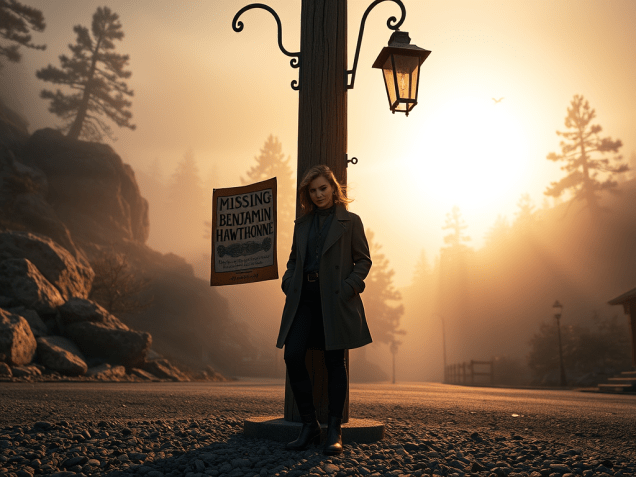
Clara’s boots crunched on the gravel. She walked to the crooked lamppost at the town square. There, a single bulletin board displayed the hand-painted flyer she’d come to see:
“Missing: Benjamin Hawthorne. Last seen at the Old Mill.”
Benjamin, a local schoolteacher, had vanished two nights before. He left only a trail of broken glass in his classroom. A smear of muddy footprints led into the woods. Clara studied the flyer’s edges—fresh tears around the corners told her someone had already pulled it down once. She taped it back in place and set off.
Her first stop was the Old Mill, its rotting wood groaning in the breeze. Inside, moonlight slanted through broken windows, illuminating desks overturned, and chalk dust still hovering in the air. Clara knelt by a desk. She noted the glass shards and a single, battered notebook. It lay open to a page filled with frantic mathematical equations. This was Benjamin’s lifework on the community’s crumbling dam.
Clara closed the book gently and pocketed it. The dam’s collapse would flood half the town; had Benjamin discovered a flaw and been threatened into silence?
As dusk fell, Clara meticulously combed through the Hawthorne farm. Benjamin’s aging parents stuttered about late-night visitors. Strange trucks idled on the gravel road, and their headlights flickered like watchful eyes. Their hands trembled as they described a low rumble, like a machine in the woods. Clara’s pulse quickened at the implication of clandestine logging or worse. She assured them she’d find Benjamin, her determination unwavering, then slipped out the back door.
By midnight, Clara was deep in the forest, tracking tire tracks that plunged toward the dam’s service tunnel. She shone her flashlight on fresh scuff marks along the tunnel walls. Heart pounding, she crept ahead until she heard a muffled voice.
“Detective… over here.”
Benjamin emerged from the shadows, bruised but alive, clutching the dam’s blueprints.
“They wanted me to falsify the safety report,”
He whispered.
“When I refused, they locked me up.”
Clara’s eyes narrowed as headlights flared above ground—masked men were coming back. Benjamin was by her side. She retraced her steps. She used the winding tunnel to slip past the guard trucks waiting at the entrance.
When they burst into the open, Clara raised her badge like a beacon.
“State Police—step away from the dam!”
Her command sent the conspirators scattering into the trees. Moments later, sirens rang in the distance—backup arrived earlier to secure the scene. In the stillness that followed, Clara handed Benjamin his blueprints.
“Now the town knows the truth,”
She said. As the first light of dawn filtered through the pines, Pine Hollow exhaled, its secrets finally laid to rest.
The collective sigh of relief was relatable as Detective Vale boarded the morning bus, ready for whatever mystery came next.
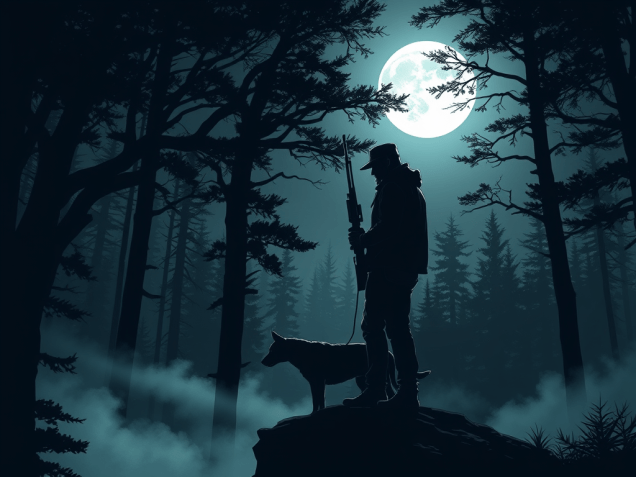
It was a night like any other in the deep woods outside Willow Creek. Forty years ago—give or take—a man and his dog set off for one of their usual late-night hunts. The man, grizzled and silent, kissed his wife on the forehead and muttered something about a long run. She barely looked up from her sewing. She was accustomed to his absences. He needed to run beneath the moonlight with only a rifle and his hound for company. She didn’t ask where he went. He never said.
The forest swallowed them quickly. Trees leaned in like eavesdropping strangers, and the undergrowth whispered beneath their boots and paws. The dog was a wiry black mutt with a white streak down its spine. It caught the scent of something just beyond the bend. It bolted. The man, cursing but grinning, gave chase.
They ran deeper and deeper into the overgrown trail for what felt like miles until the land suddenly disappeared.
The dog reached the edge of the cliff first. It barked, wild and electric, then dove headlong into the dark.
The man reached the edge just in time to see nothing at all. No bark. No rustle. There is just silence and blackness below. Without hesitation—without fear—he followed.
And that’s where the story ends, at least in the world we know.
The man awoke beside his dog in another place—somewhere between dream and fog. The stars above were fixed in unfamiliar constellations, and the air hummed with a silence too perfect to be real. He stood, brushed off dust that wasn’t dust, and called out.
No echo returned.
For years—or was it minutes?—he and the dog wandered this pale mirror of the forest they once knew. Sometimes, they saw flickers of their old lives. His wife was crying at the hearth. His brother was digging through the old footlocker for the will. But they couldn’t speak, they couldn’t reach, they only watched.
The man no longer aged. The dog’s coat remained pristine. Together, they waited—for what, neither capable of saying.
Then, one night, they heard something rustling through the brush ahead. They walked a trail that hadn’t been there before. The dog tensed. The man raised his hand. A shape moved—slowly, purposefully.
It was another hunter. Rifle slung over his shoulder. Dog at his side. Eyes vacant. He looked familiar.
The man called out. The hunter looked through him, then walked past.
The dog growled, uneasy.
And from the darkness behind them, a second pair of footsteps began to follow. They had found the lost forest of hunters who had died without a place to go.
Earl and Edna had been married for fifty-two years. In those five decades, they had developed a comfortable rhythm, like an old song they both knew by heart. Lately, the lyrics were getting harder to remember.
It all started on a Tuesday morning when Earl stood in the living room, scratching his head.
“Edna,”
He called,
“have you seen my glasses?”
“They’re on your head, Earl,”
Edna replied from the kitchen, her voice tinged with amusement.
Earl patted his scalp and chuckled.
“Well, I’ll be. Guess I’ve been wearing ‘em this whole time.”
But later that day, Edna forgot to turn off the iron. This left a suspicious scorch mark on Earl’s good slacks. That evening, Earl nearly brushed his teeth with muscle ointment. The next morning, Edna scheduled a doctor’s appointment—for both of them.
At Dr. Preston’s office, they sat side by side, holding hands, looking like two nervous schoolchildren awaiting their report cards.
“Doctor,”
Edna began,
“we’re both starting to forget things. Little things, mostly, but…”
Dr. Preston smiled kindly.
“That’s perfectly normal as we get older. One strategy that helps is to write things down. Keep a notepad handy, leave little notes where you’ll see them. It makes a world of difference.”
Earl snorted.
“Write things down? My memory’s just fine. It’s Edna’s that needs the fixing.”
Dr. Preston gave them both a knowing look.
“Just try it. You’ll thank me.”
When they got home, Edna felt a nap coming on and settled into her recliner with a cozy blanket. Earl switched on the TV, flipping channels, landing on a baseball game he wasn’t really watching.
After a while, Edna sat up.
“Earl, dear, would you go to the kitchen and get me a dish of ice cream?”
Earl muted the TV.
“Sure thing, sweetheart.”
“And write it down, so you don’t forget.”
Earl waved her off.
“Nonsense, Edna. It’s a dish of ice cream. I’ve got it.”
“But I’d like strawberries on it too,”
She added.
“And whipped cream.”
Earl tapped his temple confidently.
“Ice cream, strawberries, whipped cream. No problem.”
Edna gave him a skeptical look.
“You sure you don’t want to write it down?”
Earl shook his head and marched into the kitchen.
For the next fifteen minutes, Edna listened as pots clanged. Cabinet doors creaked. The microwave beeped, and something—was that the blender?—whirred loudly.
Finally, Earl returned, triumphant, a plate in his hands.
“Here you go!”
He declared, setting the plate on her lap.
Edna stared at the plate. Bacon. Eggs. A sprig of parsley.
She looked up at him with an exasperated sigh.
“Earl, where’s the toast I asked for?”
Earl blinked, confused.
“Toast?”
Edna shook her head, laughing despite herself.
“Looks like we’re both making notes from now on.”
Earl sat down beside her, rubbing his chin thoughtfully.
“Maybe we should just order takeout.”
And together, they chuckled, holding hands, as the baseball game played softly in the background.
After a moment, Earl squinted at the screen.
“Edna… do you know who’s winning? I can’t tell.”
Edna grinned slyly.
“That’s because, Earl… you’re on first base.”
Earl frowned.
“I’m on first base?”
“No, no,”
Edna said, shaking her head with mock seriousness,
“Who’s on first.”
Earl’s eyes widened.
“Who’s on first?”
Edna corrected, her eyes twinkling.
“No, Who’s on third,”
They both burst out laughing. They cackled until they were wiping tears from their eyes. The baseball game was long forgotten. Their memories were momentarily lost, but their joy was perfectly intact.
“How Earl Survived the End of the World (Three Times In One Week)”
It all started on Monday when the news said the world was ending. Again.
“Experts warn: AI, killer bees, and rising sea levels converge by Wednesday,” read the headline on Earl’s phone. He sighed, sipped his lukewarm coffee (the microwave broke last week—tragic), and Googled “How to survive multiple apocalypses.”
Step one: hoard supplies.
Earl ran to the grocery store, but unfortunately, so did the entire neighborhood. All that was left on the shelves were 37 cans of creamed spinach and one gluten-free hot dog bun. He grabbed both. Earl wasn’t proud.
Step two: fortify your home.
This was trickier. Earl’s DIY skills peaked at assembling an IKEA lamp in 2014 (and even that leans a little). He taped bubble wrap over the windows. He stacked his furniture into a makeshift barricade. He hung a sign on the door that read: “Beware of Dog (or raccoon—honestly not sure anymore).”
By Tuesday, the threat had shifted. AI wasn’t trying to destroy us; it just wanted us to finish a customer satisfaction survey. Earl politely declined. The bees were delayed due to weather conditions. The sea levels were rising slowly. Earl figured he had time to finish his Netflix backlog.
Then came Wednesday.
That’s when the real disaster struck:
🚨 The Wi-Fi went out. 🚨
Earl sat there, blinking into the void, unsure how to continue. How does one live without memes? How do you know what to be outraged about if you can’t check Twitter?
Earl tried reading a book. (Printed words? On paper? Barbaric.) He tried talking to my houseplants. Phil the fern judged him silently.
Finally, Earl ventured outside — mask on, hand sanitizer holstered like a gunslinger — only to discover ––
The neighborhood kids had set up a barter system.
“Two rolls of toilet paper for a bottle of sriracha!”
One kid yelled.
“Half a pack of Oreo’s for an iPhone charger!”
Another bargained.
Earl traded three cans of creamed spinach for a Wi-Fi hotspot code—the best deal of his life.
By Thursday, the headlines read: “World Fine (For Now).”
Earl sighed in relief –– until he heard a knock at the door.
A drone hovered outside, lowering a package. Earl opened it to find:
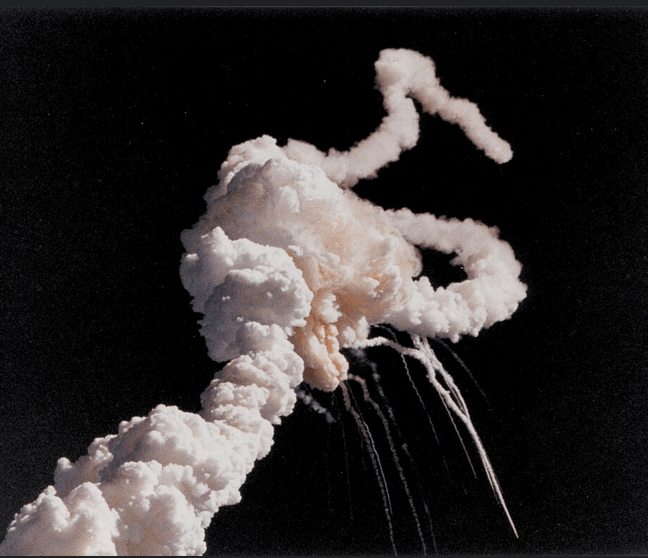
It was January 28th, 1986. Tim was driving to an appointment, his car weaving through fifty miles of winding highways. The radio crackled with the morning news. The Space Shuttle Challenger was set to launch, carrying the first civilian teacher into space.
As the announcer spoke, a sudden, vivid image flashed in Tim’s mind—an explosion, fiery and bright. He gripped the wheel tighter. Then, just as quickly, the vision faded.
This wasn’t the first time. During his years in law enforcement, Tim had experienced moments like this—flashes of insight, warnings he couldn’t explain. Colleagues had asked how he knew things before they happened. He’d only ever shrugged and said, “I’ve got a sixth sense, I guess.”
A commercial break interrupted the news. Tim leaned back, letting the hum of ads drown out the unease rising in his chest. Don’t be ridiculous, he told himself. There are engineers, scientists—people much smarter than me working on this. Who am I to question it?
Then the news returned, live coverage from Cape Canaveral. As the launch countdown continued, Tim felt it again. A deep, cold shiver passed across his neck. Then he envisioned the same haunting image of destruction.
He reached for the dashboard, then pulled his hand back. Should I call? he wondered. Would they even listen? The idea of calling NASA felt absurd. What would I say? he thought. That I had a feeling?
No one would believe him. He’d be laughed off the line—or worse. He pictured himself in a hospital gown, locked behind heavy doors for making prank calls to a national space agency.
So he drove on.
At the appointment, Tim entered the lobby and stepped up to the front desk. Just as he began to sign in, a man burst from his office, wide-eyed.
“You won’t believe what just happened!”
He turned on the TV. On the screen, the Space Shuttle Challenger rose into the sky—and then disintegrated in a plume of smoke and fire.
Gasps filled the room.
Tim stood frozen. The weight hit him all at once. Not just the horror of what had happened but also the hollow ache remained. He knew he had seen it coming… and done nothing.
In the days that followed, he replayed it again and again. The moment he didn’t call. The chance he didn’t take. The voice he silenced.
If he had picked up that phone, maybe nothing would’ve changed. Or maybe someone would’ve listened. Maybe someone smarter than him would’ve paused for just a second. He would never know.
One thing became clear to Tim that day. The burden of inaction weighs heavier than the risk of being wrong.
If he was able do it over, he’d make the call.
No matter how crazy it sounded.
This story is from actual events. The names of those in the story were changed to protect their privacy.
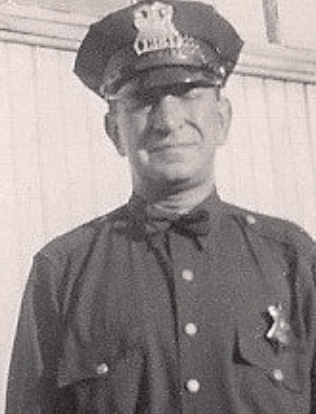
My grandfather had a host of brothers. Their father, Ulrich Groff Jr., had been married twice—the second time after his first wife died. Among my grandfather’s many brothers was one named Frank. In the family, he was known as Grand Uncle Frank or Great Uncle Frank, depending on who was telling. Frank lived a colorful, hard-worn life. He was the one who taught me how to ride a bike and always had a funny story to tell. He was raised on a farm. He worked odd jobs in his youth. Eventually, he found a steady calling with the Chicago Police Department.
Frank’s career on the force was mostly uneventful, at least by police standards. He would occasionally talk about the small-time crooks. He mentioned the drunks and the desperate people. He and his partner had to haul these people off to jail. But there was one story he told with a quiet solemnity—one that never left him. It was a time when being a police officer was a tough job, especially in a city like Chicago. The streets were rough, and the criminals should not be taken lightly.
Frank Groff
It was the night his partner died.
According to Frank, it had been a typical shift. He and his partner had picked up a couple of rowdy men, causing trouble. One of them shoved Frank’s partner during the scuffle. The man was quickly subdued and locked up. As far as Frank knew, it was nothing out of the ordinary. They had handled far worse and walked away without a scratch.
But the next morning, a knock at Frank’s door brought grim news. Fellow officers informed him that his partner, John Blazek, had passed away during the night.
John had hit his head during the scuffle—no one thought much of it at the time, including John himself. Like many men of his era, he brushed it off, finished his shift, and went home. Officer Blazek called a fellow officer to give him a ride. He didn’t feel quite right. Still, no one suspected anything serious. He went to bed and never woke up. The suddenness of his passing left everyone in shock and disbelief.
The official record read:
John Blazek
Patrolman John Blazek died after suffering a head injury. He fell or was pushed to the floor inside the 22nd District’s cell room. This incident occurred at 943 West Maxwell Street the prior night. He did not realize he had suffered a skull fracture. He attempted to go home at the end of his shift at 8:00 am. Blazek did not walk home and called another officer to pick him up. Once he got home, his condition worsened. He passed away the next day from the head injury.
Patrolman Blazek was a U.S. Army veteran of World War I who had served with the Chicago Police Department for 26 years. His sudden and unexpected death left a void in the community. His wife and two sons survive him.
Frank never quite recovered from that night. Though he stayed on the force, something in him changed. He stopped talking about the job as much. When he did, it was with a heavier voice. He had arrested many criminals and survived several street scuffles. Yet, the quiet death of his partner haunted him the most. They didn’t see it coming. He retired a few years later, and we see that the incident had taken a toll on him. He spent his days quietly, often lost in thought.
Years later, after Frank’s retirement, we found a worn copy of the police report. It was on John Blazek’s death and among his things. It was folded carefully into the pages of his Bible. Eventually, Frank passed on. On the back, in his handwriting, were the words:
“We don’t always know the moment something changes us. But we carry it. Always.”
Ever since he was a boy, Walter Finch had dreamed of the stars. His bedroom ceiling was a galaxy of glow-in-the-dark stickers. His shelves sagged under the weight of space encyclopedias and toy rockets. He knew the names of every astronaut in the Mercury, Gemini, and Apollo missions. He rattled off orbital mechanics faster than most people recite the alphabet.
There was just one problem.
Walter was terrified of heights.
Not just a little scared. Walter once got stuck on the third rung of a ladder while changing a light bulb. He had to call his neighbor for help. Airplanes? Never. Ferris wheels? A hard no. Balconies on tall buildings? He’d get dizzy just thinking about them.
So he buried his dreams of space travel beneath layers of rationalization. He became an aerospace technician—close enough to the action to feel involved, far enough from the edge to stay sane. Walter worked at the Johnson Space Center. There, he meticulously maintained spacecraft control panels. He also tested simulators and occasionally got to polish a real rocket capsule.
One evening, Walter had a particularly long day prepping a decommissioned capsule for a museum display. He climbed inside to double-check the switches. The interior was warm, quiet, and oddly comforting. He sat back in the pilot’s chair, which had once held real astronauts, and closed his eyes momentarily.
He fell asleep.
And the world moved on.
Somehow, through a wild and improbable series of events, Walter’s capsule encountered several issues. These included miscommunication, a sudden schedule change, and a very distracted launch coordinator. The capsule had been quietly reassigned to a last-minute uncrewed test mission. It was rolled onto the launchpad, sealed, and prepped for liftoff.
Walter awoke to the unmistakable rumble beneath him.
At first, he thought it was a dream. Then, the countdown began.
“Ten… nine…”
Panic hit like a tidal wave. He tried shouting, but the thick insulation swallowed his voice.
“Eight… seven…”
He fumbled with the comm system, but it was already rerouted for the launch.
“Six… five…”
By four, he was crying. At two, he was frozen. And at zero…
The world disappeared.
The force of the launch pinned him to his seat. His breath was ripped from his lungs. His heart pounded like a jackhammer. He blacked out for a second—maybe more.
When he came to, everything was quiet. No more rumble. No more fear.
Just space.
Black velvet studded with stars stretched infinitely beyond the small porthole. The Earth, a swirling marble of blue and green, floated beneath him. The capsule drifted peacefully, like a leaf on the wind.
Walter laughed.
It wasn’t fear anymore. It was a wonder. It was a joy.
For the first time in his life, Walter Finch wasn’t afraid of heights—because there was no height. There was only the infinite.
Mission Control eventually figured out what had happened. There was some yelling, some panicking, and a lot of paperwork.
But by then, Walter had already made history. He was the first untrained man to make it to orbit and back. This was achieved entirely by accident.
They brought him down safely and even gave him a medal. Someone suggested a movie deal. He just smiled and looked up.
From that day on, Walter Finch wasn’t the man afraid of ladders anymore. He was the man who slept his way into space—and found courage among the stars.
And now and then, late at night, he’d climb up to the roof of his house. He would lay on his back and stare at the sky.
Officer Tim Roff was headed to a remote corner of the county to interview a key witness. This witness was a young girl named Cissy, the only eyewitness to a serious crime.
Nothing about it sounded very difficult. It was a straightforward drive, with a few questions, and Tim wanted to return for lunch.
He fueled his cruiser and pulled out of Delk View, heading west on the highway. The farther he drove, the thinner the traffic got. Eventually, it was just him and the radio. A long ribbon of blacktop stretched toward the horizon.
Forty miles later, he turned off at a row of faded, leaning mailboxes. They looked like they’d been abandoned decades ago.
A dirt road led up a shallow ridge, ending at a rusted metal gate with a handmade sign nailed to it:
“IF U R HEar TO C the Anderson Folks, U-will walk up here.”
Tim squinted at it.
“Charming.”
He parked the cruiser on the shoulder and climbed the gate, boots crunching dry gravel as he started the walk. It was unusually quiet—no dogs barking, livestock, or even a bird in the trees. That struck him as odd for a farm.
The shack was sagging. It stood at the end of the trail, leaning slightly. It looked like it had given up on fighting gravity. Tim knocked. After a few moments, the door creaked open, revealing a woman standing in shadow.
“Ma’am,” Tim said, flashing his badge. “Officer Roff, Delk View PD. I’m here to speak with Cissy.”
The woman gave him a long, assessing look before replying,
“I’m her mother. But Cissy ain’t here. She’s up at my great-grandparents’ place.”
Of course, she was.
The woman stepped outside and pointed behind the shack.
“You’ll wanna follow the trail goin’ north. Not northeast, not northwest—north. Climb the hill. When you hit the first house, keep going. That ain’t it. Go around back and find the east trail. That’ll get you to Great-Grand Pap’s.”
Tim nodded, trying to chart the path mentally.
“Appreciate it,”
He said.
“Wish I’d worn jeans.”
The trail was steep and rocky, winding uphill through thickets and trees. After nearly an hour of hiking, sweat soaking through Tim’s dress shirt, he reached a cabin. An elderly couple sat out front on mismatched chairs, sipping something cold.
“You lost?”
The old man called out.
Tim waved.
“Looking for Great-Grand Pap’s place. Cissy’s supposed to be there.”
The woman laughed.
“You’re close. Just head east from here. And watch out for bees—they’ve been feisty.”
Tim scratched his neck, thinking out loud ––
“Bees? Terrific.”
Tim trudged on and eventually reached a much nicer house between two ridgelines. Two cars were parked out back.
“You’ve got to be kidding me,”
He muttered.
“They have a driveway.”
A white-haired man and woman sat on the stoop, smiling like they’d been expecting him.
“Howdy!”
They chimed in unison.
“Howdy,”
Tim replied, a little breathless.
“I’m Officer Roff. I need to speak with Cissy.”
The couple exchanged a look.
“She’s over at Grand-Uncle Maxwell’s place.”
The old man said.
Tim sighed.
“Grand-Uncle?”
“Yup. Her grandfather’s brother. She’s watchin’ him today while his wife’s out shoppin’.”
Tim, peeking through his sunglasses, looks up –
“Watching him?”
The great-grandfather nodded.
“Ain’t much to it. Maxwell’s tied to a tree out front. Forty-foot chain. Keeps him from wanderin’ off.”
Tim blinked.
“I—what?“
“Yeah,”
The old man said.
“See, Maxwell was showin’ his boy how to clean a rifle last year—told him you never clean a loaded gun. The boy asked why. So Maxwell loaded it up, held the barrel to his head like he was cleanin’ it. And said, ‘Because if you pull the trigger, this could hap—’ And bam. Shot himself right through the nose and out the top of his skull.”
The woman nodded solemnly.
“He ain’t been the same since. I can’t trust him to stay put. We lost three family members to gun cleanin’ accidents.”
“And y’all still own guns?”
Tim asked.
“Well, of course,”
The old man said.
“But we’re real careful now.”
Tim rubbed the back of his neck.
“So… why is he her Grand-Uncle and not a Great-Uncle?”
The old man sat up a little straighter.
“Well, see, Cissy’s mama’s brothers are her uncles. Her mama’s parents are her grandparents. You followin’? But Maxwell’s her grandfather’s brother—so he’s a grand-uncle—different branch. You followin’? My brothers are Great uncles, just like I am a Great Grandpa.You followin’?“
“I think so,”
Tim said.
“But I’m pretty sure Ancestry.com would call him a great-uncle.”
“City folks,”
The old man muttered, shaking his head.
Eventually, they led Tim to Cissy. She was a wide-eyed girl with a thick accent. Her vocabulary included terms Tim had never heard. She explained what she saw, pointing to where it happened, who was there, and what she heard. Tim took meticulous notes. He jotted down not just the events but also the phrases she used. Some of these need translating in court.
He chuckled softly in the cruiser as he rewound his way to civilization. He thought about the chains and the bees. The hand-drawn family tree in his mind intrigued him. He pondered the odd logic of backwoods kinship.
And he couldn’t help but remember what the old man had told him as he left:
“Cousins are once or twice removed, then after that, well… you can marry ’em.”
Tim hoped the DA had a good sense of humor—and a good translator.
When I began my career in law enforcement, I experienced many “firsts.” One of the earliest was being assigned to a beat. I patrolled the alleys and streets of downtown, checking businesses and parks at night. The darkness was deep and constant. If fear crept in, the silence can feel almost haunting at times.
But I never let the shadows spook me. Not the sudden dash of a stray cat nor the wind rattling loose tin from an awning overhead. For a long time, I found nothing out of the ordinary. That is, until one night.
It happened in the park, beneath a pavilion by the river’s edge. I noticed someone lying across a picnic table. At nearly 2 a.m., the park was supposed to be empty. I stayed alert as I approached. I was constantly aware that people didn’t always travel alone. I didn’t want to be caught off guard.
As I approached, I spotted a can of spray paint beside her. A streak of glossy red paint coated her nose and mouth, dripping down her chin. She was a woman, and visibly pregnant, nearly full-term by the look of her.
I tried to wake her, but she didn’t respond. Her pulse was faint. Luckily, I had just been issued a portable radio—until recently, we’d relied on call boxes for communication. The radio gave me direct access to headquarters.
I keyed the mic and said,
“I need an ambulance under the pavilion at the river’s edge entrance. I have an unconscious female subject who appears to have been huffing paint. She’s approximately nine months pregnant.”
Headquarters confirmed and dispatched an ambulance promptly. Once it arrived, I assisted the paramedics. The woman was transported to a local hospital and then transferred to a larger facility for specialized care.
While searching the area, I found someone nearby who had passed out by the riverbank. I managed to rouse him. He was a man, around 32 years old, clearly intoxicated and unsteady. I placed him under arrest for public intoxication.
As I helped him up to the road, he turned to me and asked quietly,
“Is she going to be okay? I told her not to do that–– but she wouldn’t listen. That’s my baby, you know? I hope she’s alright.”
“Yes,”
I said.
I said,
“I hope the baby is okay, too. I’ve arranged a ride and a safe place for you to sleep tonight.”
The transport unit pulled up. As he climbed in, he paused, looked at me, and said,
“I’m glad you found us. It has saved both of us. Thank you!”
I nodded and replied,
“You’re welcome, try to get some sleep.”
It was one of the few times someone going to jail thanked me for stepping into their life. There would be other moments like this, but not many involving an unborn child.
I later learned the mother’s actions had not affected the baby. She had been admitted for addiction treatment, and hopefully, she stayed through the delivery and beyond. I never saw her again. I often think of that night. I think of how close things came to ending differently. Sometimes, just showing up can change everything.
Growing up, it often felt like there wasn’t much to do. With six siblings and a life rooted on the farm, family trips or outside adventures seemed few and far between. But looking back now, I see how much my parents did to involve us in meaningful experiences.
They took us to local places of interest. They spent time with each of us in ways many parents couldn’t. At the time, I thought we were the ultimate close-knit family. My dad and I shared rodeos, horse sales, parades, and trail rides. He and my mother supported my sister’s love for basketball, attended games, and nurtured her talent. Another sister was given a piano, music lessons, and encouragement toward college. One of my brothers was allowed to buy into the farm and build a home. The two oldest boys had long since charted their paths. One went into the Marines. The other entered a world that eventually led to affluence. But no matter how far they went, they always came home for the holidays.
My mom’s youngest brother—my uncle—was a bonus sibling. He’d been born late in my grandparents’ lives, and as a teen and young adult, he often lived with us. He’d served in Vietnam. Though he was quiet about it, he carried a weight we all respected—even if we didn’t understand it fully.
One weekend, something unexpected happened. When I was 9, my uncle and brothers convinced my dad to take us to the lake. It was a rare outing, especially with all of us. I’d heard stories of him taking the family boating at lakes years before I was born. Yet, he had stopped going by the time I came along.
This lake trip, still, wasn’t a return to those stories. It was just up the road—Sayler’s Lake. It wasn’t much to look at. An old log cabin marked the entrance. The water looked murky and unsettling—it resembled a scene from a horror movie. Locals whispered that the lake had claimed lives—more than a few. It didn’t seem right, but the place had a reputation.
We arrived around 10 a.m. I was eager to get in the water, but my mother insisted I wear a life vest. I didn’t know how to swim, and she wasn’t taking any chances. I hated the bulky vest, but hated the thought of drowning more. My sisters had taken swimming lessons when we lived in town—those services didn’t exist where we were.
I paddled around, watching others enjoy themselves.
Across the water, people were diving from a rocky cliff. Some men dove headfirst, then climbed back up and did it again. It looked reckless, almost like a dare to death. Then, one of them dove in—and didn’t come back up.
I’ll never forget the girl on the cliff yelling,
“Where is he?”
People jumped into action. After five or ten long minutes, someone pulled his body from the water and dragged him to shore. The owner of the lake raced down in a pickup and began CPR. I stood there, stunned. It was the first time I’d ever seen someone dead—or nearly dead—pulled from water.
Then, the town ambulance arrived. It wasn’t like the ones you see on TV—it was a white Buick station wagon. An old man climbed out carrying an oxygen tank. When the victim’s friends saw him, they shook their heads and told him it was too late.
“You need a body bag.”
One of them said.
I didn’t know what a body bag was. But I figured it out when the old man pulled a stretcher from the back of the car. With the help of bystanders, he loaded the man’s body. Out of compassion, he turned on the red lights and the siren. Then he drove off.
I returned to where our family had set up a picnic. I don’t remember what I said—maybe something a little too grown-up or too curious—but I remember my father flicking me on the ear and speaking sharply,
“You aren’t quite that old yet.”
I’ve often wondered what that moment meant to him. Maybe he wasn’t angry—he was just shaken. Perhaps he didn’t want me to see what I had seen. That day made me grow up faster than he wanted. He liked to keep things under control, and this wasn’t one of those things.
Life doesn’t always allow us to choose the lessons we learn. Sometimes, they arrive uninvited on an ordinary day by a haunted lake.
When we arrived home that evening, the television was on in the living room. The news was starting. And there it was—Sayler’s Lake. A reporter stood near the very spot we’d been earlier, microphone in hand, delivering details about the drowning. I sat in disbelief, watching the event replay like it belonged to someone else’s world, not ours.
I remember thinking: How did they find out so fast? How had the news team gotten there?How did they film the scene, return to the station, and prepare the report all before dinner? It made the whole thing feel surreal—too real but somehow distant. The reporter confirmed what we had already feared. The man had died.
That moment glued itself to my memory. The sound of the television stayed with me, and the familiar living room around me lingered in my thoughts. The weight of what we had observed just hours earlier was still there. It layered into a quiet understanding. The world outside our farm can change in an instant. Sometimes, there are no answers—just echoes left behind by events too big to fully grasp.























 benandsteve.com