Old-School Policing: Stories From the Days Before Body Cameras

By Benjamin GroffMedia© | benandsteve.com | ©2025

3–5 minutes

Going Into Service

Police work operated on instinct, humor, and gritty common sense before body cameras. Every arrest didn’t turn into a viral upload back then. This approach belonged to another era. Officers learned from veterans who passed down unwritten rules — some practical, some questionable, and some downright hilarious. These stories aren’t a manual. They’re memories from a world that helped shape the officers we later became.


Don’s Lessons for Rookie Officers

Don was a seasoned officer whose wisdom mixed patience with a dry, knowing humor. He often told rookies about the prisoners who would scream for an entire transport ride. These are the same kind you see in fifteen-minute viral videos today.

He’d tell the infamous alum-powder story with a wink.

“Keep a plastic bag of it in your shirt pocket.

If you get a screamer, take a pinch and flick it – they will shut up!”

This always left rookies unsure whether he was pulling their leg. Or, was he sharing some relic from an era with fewer rules and more noise? His message was never about techniques. It was about the mindset: don’t let chaos set the tone. And always keep your humor intact.


The “Dog!” Brake Test

Another bit of old-school folklore involved the rowdy back-seat prisoner who wouldn’t stop cussing or kicking. Officers had a classic trick:

Get the patrol car up to about forty-five miles an hour.

Slam on the brakes.

Yell,

“Dog!”

The prisoner would slam into the cage divider and go silent. This silence would last until the second dog ran across the road. By the time they arrived at the jail, the only thing left in them was concern for the imaginary dogs.

It wasn’t policy. It wasn’t pretty. It was one of those stories officers shared over coffee. They shook their heads at “the way things used to be.”


The Gilligan’s Island Sobriety Test

DUI stops had their own brand of comedy. When you already knew the drunk driver was going to jail, the roadside field tests became… creative.

The “Gilligan’s Island Test” was a favorite:

Place your left hand over your head. Hold your right ear with your right hand. Balance on one foot. Sing the theme to Gilligan’s Island.

Most never made it past “a three-hour tour.”

It broke the tension. And after a long, cold night, sometimes everyone needed that.


Jurisdiction and the Art of Paperwork Avoidance

Jurisdiction lines used to shift like sand depending on who wanted — or didn’t want — the call. If the incident required endless paperwork, officers suddenly cared very deeply about city-limit boundaries, council-meeting notes, and outdated maps.

Veterans avoided calls they weren’t dispatched to, knowing the penalty: days off lost to court subpoenas. Midnight-shift officers often clocked out at dawn. They then sat in a courtroom until midafternoon. They did this while waiting for cases where they never said a word.

It was exhausting, but it was part of the rhythm of old-school policing.


These stories sound wild today, but much of policing back then was driven by common sense and community trust. People knew officers, and officers knew their people.

Citizens were often the first to speak up if an officer crossed a line. This happened long before social media or body cams existed. Even without technology, accountability came from individuals who believed in keeping standards high.

Most officers didn’t stop someone without a genuine reason. Those who abused that privilege rarely lasted. It was an unwritten rule — understood, enforced, and expected.


Closing Reflection

Old-school policing wasn’t perfect — not by a long shot. But it existed in a different world with different expectations. Humor softened harder edges. Community relationships carried more weight. And the job, for better or worse, relied on improvisation.

Today’s policing is built on transparency and technology, and that’s a good evolution. But these stories stay important. They are reminders of the human side of the badge, the long nights, and the strange solutions. These stories also recall the characters who trained us and the moments that shaped us along the way.

One persistent problem is untruths. Misinformation continues to mislead the public. These actions make the police look unfavorable.


Groff Media ©2025 benandsteve.com Truth Endures By: Benjamin Groff

About the Author:

Benjamin Groff is a former police officer and radio news anchor. He has hosted programs for CNN and ABC News affiliates in Colorado and Wyoming. His career in law enforcement began in 1980 and lasted more than two decades. This gave him firsthand insight into the criminal mind and public safety. Moreover, it provided him with an understanding of the human stories that often go untold. His writing draws on these experiences, blending street-level truth with a journalist’s eye for the bigger picture.

From the Plains to the Pavement: Agent Bill Johns’ Journey from the Wild West to Philadelphia’s Dark Alleys

4–5 minutes

Bill Johns: The Bureau’s Man in the 1940s

It was the 1940s, and the Bureau had just transferred Bill Johns to the Philadelphia office. He arrived with a reputation built out west. The cases there were more challenging. The distances were longer, and the suspects were meaner. Officially, he was sent to cover Oklahoma, Texas, and New Mexico. Unofficially, he’d become “the best investigating chicken thief agent in the West.” His fellow agents gave him this nickname with a wink.

But Bill Johns had investigated far more than stolen hens. His most significant case had been in Osage County, Oklahoma: three Indian women, each murdered after marrying into money. For nearly three years, Johns chased a trail of false alibis, hidden bank accounts, and hired killers. He and another agent narrowly escaped ambushes five different times. By constantly dropping low and drawing faster than the men who wanted them dead.

Johns wasn’t flashy, but he had something rare—an intuition that couldn’t be taught. He would size up a suspect the way a rancher sizes up a horse. He knew when someone was lying about a bloodstain on a shirt. He knew this the same way he knew when a horse trader was covering up a limp. He followed the tiny clues that led from stolen goods to the back rooms where the real deals happened. He also traced a murder weapon to the man who’d hidden it.

What the Bureau didn’t understand—and still doesn’t—is that this ability isn’t in a handbook. It isn’t taught at the Academy. It’s a gift, as fragile as it is powerful. Use it or lose it. And only a few men like Johns ever had it.

In Philadelphia, this instinct would serve him just as well. He found himself involved with city syndicates. He encountered labor racketeering and noticed spies slipping through the docks at night. The same gut feeling had kept him alive in Osage County. Now it helped him spot the double-talkers in the bars. It also identified the men who lingered just a second too long at a back door.

Johns became known for something unusual—he rarely needed his gun. He’d walk into a situation, lean against a doorway, and just talk. By the time he left, the suspect had revealed more than he intended. John had already secured the evidence. He was no saint. He wasn’t perfect either. Nonetheless, he was a quiet professional in an era when crime was changing. The country was changing too.

The Last Case in Philadelphia

It was a rainy October night in 1947 when Johns’ instincts jolted him awake. An informant had whispered about a shipment coming into the Delaware River docks. This shipment was not whiskey or smuggled textiles. It was microfilm from Europe that would compromise national security. By dawn, he was leaning against a warehouse door. He pulled his collar up against the mist. He watched the shadows move across the slick cobblestones.

Later, back at the Bureau’s office, his supervisor shook his head. “How’d you know?” Johns simply shrugged. He never talked about instinct. He never mentioned gifts. He didn’t say how he’d been listening to his gut since his days chasing killers in Osage County. But he knew this: it wasn’t about being the fastest shot or the toughest agent. It was about reading people, seeing the truth they were trying to hide, and moving before they did.

When the men finally appeared, Johns didn’t draw his gun. Instead, he stepped into the light. Placing his hands in his overcoat pockets. He spoke in the calm, level tone that had unnerved more suspects than handcuffs ever would. One man slipped, trying to hide a satchel, and Johns pounced on him. In seconds, the microfilm was in his hand. The men, rattled and unsure how he’d seen through their plan, dropped their smokes and bolted.

That was Bill Johns’ legacy — an unassuming agent who became legendary not for force, but for foresight. His name rarely made headlines. Still, his quiet successes became the stories younger agents told each other. They shared these stories when they needed courage. Stories that remind you some people are born to find the truth, no matter where it hides.

Even today, his old case files are dusty, brittle, and overlooked. They still read like short stories of the American frontier meeting the modern city. Behind each one is the same simple truth. There’s no substitute for knowing people. No training can replace genuine instinct.


By Benjamin GroffMedia© | benandsteve.com | ©2025 

About the Author:

Benjamin Groff is a former police officer and radio news anchor. He has hosted programs for CNN and ABC News affiliates in Colorado and Wyoming. His career in law enforcement began in 1980 and lasted more than two decades. This gave him firsthand insight into the criminal mind and public safety. Moreover, it provided him with an understanding of the human stories that often go untold. His writing draws on these experiences, blending street-level truth with a journalist’s eye for the bigger picture.


Harold the Tortoise Pulls Off Great Escape #2—This Time the Law Catches Up

Harold’s Great Escape

Photo by Edwin Lopez on Pexels.com

Harold was no ordinary backyard pet. Being a tortoise, his adventures rarely involved chasing tennis balls or tugging on ropes. Instead, Harold was a master of patience, persistence, and plotting. He had already made a name for himself with one backyard escape. Still, this time, his curiosity carried him farther than anyone expected.

It began with the fence. Harold had spent weeks studying it, eyeing the weak spots with quiet determination. One morning, the house was still waking up. He pressed against a loose slat. It was just enough for daylight to seep through. Inch by inch, Harold squeezed his shell until he was finally free. He paused. He sniffed the air (at least, as much as tortoises sniff). He set off at his own steady pace toward the unknown.

The journey was slow but deliberate. He trundled across lawns. He navigated flowerbeds. He even startled a neighbor’s cat. Upon seeing Harold’s ancient face, the cat decided this was a creature best left unchallenged. Hours passed. Harold’s determined little legs carried him farther. The sound of traffic began to hum in the distance.

By midafternoon, Harold had reached a busy city intersection. Cars rumbled by, drivers honked, and the crosswalk lights blinked red and green. Unfazed, Harold simply marched out onto the asphalt, oblivious to the commotion he was causing.

It was then that Officer Ramirez, patrolling the area, spotted something unusual in the middle of the road. At first glance, it looked like a rock—or maybe even debris. But as he got closer, he noticed the little legs moving steadily ahead.

“Well, you don’t see that every day,” Ramirez muttered, pulling his cruiser to the curb.

Stepping into the street, he held up his hand to stop traffic, much to the confusion of the waiting drivers. Then, carefully, he scooped Harold up. “You’re one brave little guy,” he said, examining the tortoise’s shell. That’s when he saw it: a neatly written phone number in permanent marker, curved along Harold’s back.

A quick call later, Harold’s worried family answered. Within the hour, Harold was back in his yard, much to their relief. The fence slat was nailed firmly back in place. Harold received a fresh helping of lettuce as a homecoming feast.

Of course, Harold munched away happily, but his eyes still lingered on the fence. After all, a tortoise’s heart—slow and steady though it is—was always drawn to adventure. For Harold’s caretakers, it would mean something different. The next day, the front page of the local newspaper ran with headlines and the story about Harold’s Great Escape!

By Staff Reporter Scoop Gatter

It isn’t every day that traffic stops because of a tortoise. Yet, that’s exactly what happened yesterday afternoon at the corner of Maple Avenue and 3rd Street.

Officer Luis Ramirez of the city police department was on routine patrol. He spotted what he thought was a rock in the middle of the intersection. A closer look revealed something far more unusual. A slow-moving tortoise named Harold was making his way across the street. It seemed to him as if it were just another stretch of backyard lawn.

“I had to do a double take,” Ramirez said with a laugh. “You expect to see dogs or cats wandering off now and then, but not a tortoise. Cars were stopping, people were staring—it was a sight.”

Officer Ramirez quickly stopped traffic and carried Harold to safety. A phone number was written in marker on Harold’s shell. This was a precaution his owner had taken after the tortoise’s first great escape. Thanks to that bit of foresight, Ramirez called the family directly.

Within the hour, Harold was back home, munching lettuce in his yard as though nothing had happened. His owner is relieved and amused. She says the family plans to reinforce their backyard fence. She also admits Harold has a knack for adventure.

“He’s slow, but he’s sneaky,” the owner joked. “You turn your back for an afternoon, and suddenly he’s halfway to downtown.”

As for Harold, he remains unfazed by all the attention. With his second escape under his belt, neighbors are already calling him “the Houdini of Maple Avenue.”

Henry’s Midnight Firestorm A Cloud Of Dust And Mistrust

2–3 minutes

Henry’s Midnight Firestorm

Henry had been laying low for months. He wasn’t exactly on the best terms with the brass at his small police department. He’d been on the midnight shift so long, most people in town barely remembered he worked there. To entertain himself, he left funny notes about the place signed “John Henry.” The detective division took six months to figure out who was behind the jokes. They learned the truth only by accident.

Henry confessed to one of the detectives during a neighborly beer session. The young detective was desperate for some action. He had gone a year without a single arrest. He thought maybe Henry can teach him a thing or two. Henry didn’t hold back: “For starters, I’m not sitting on my ass in the office for eight hours.” It stung. The detective had only one unit in his division. His wet-hen supervisor kept him glued to a desk. Henry, on the other hand, led the department in felony arrests for two years straight. His bluntness was legendary, especially among supervisors who loved to hate him.

But it was what happened at 3:00 a.m. one night that sealed Henry’s reputation. He pulled his black-and-white patrol unit up to the north entry door of the station. He wanted to check his oil. He also wanted to check his transmission fluid. Both were low. As he topped the transmission, some spilled onto the exhaust pipes and burst into flames. In seconds, the underside of the cruiser was lit up like a bonfire. Henry shouted, “Shit! Shit! Shit!” sprinted inside, grabbed the fire extinguisher, and went to work.

The flames went out. A massive cloud of extinguisher powder billowed everywhere—under the car, across the pavement, and straight into the police department itself. The breathalyzer, computers, and half the office equipment were dusted in a fine white film. To anyone walking in, it looked like a cocaine snowstorm had blown through the station.

Henry realized it would take 18 hours to clean, and he wasn’t about to spend his shift playing janitor. He called to a cat he saw over in a alley way. It came to him. He picked it up and threw it into the station. Then he rolled the extinguisher across the floor causing it to seem that it had knocked over. He dusted off his hands and thought: “Shit happens. Things happen. And I’ll be in the far south district when they find this mess.” shut and locked the door and headed south. And that is where he was at 0800. Day shift radioed saying they were 10-8. Henry replied, good I am Ten Dash Seven!

To this day, no one ever heard the story—until now. The Cat? No one ever mentioned it again!


By Benjamin GroffMedia© | benandsteve.com | 2025 

Your Claim To Sobriety Matters – Will You Be Able To Do It When You Are Asked To Step Up?

When Did Walking The Line Become A Thing?

3–4 minutes

If you’ve ever been told to “walk a straight white line,” the meaning depends a lot on where you’re standing. It also depends on who’s watching. In the Welsh valleys of How Green Was My Valley, the “white line” was a poetic path. It symbolized memory and loss. In American trucker slang, it’s the hypnotic blur of endless road miles. But to a police officer at 1 a.m. on the shoulder of a highway, that white line is all about one thing: sobriety.

A Path in Song and Story

In How Green Was My Valley, the final scene drifts to Alfred Newman’s Finale. It is woven with the Welsh hymn Pen Calfaria. Its the “white line” was a poetic path of memory and loss. “This shall never leave my memory”, feels like a pledge. This pledge is to never forget where you’ve walked. The “white line” here is a metaphorical road. It signifies a way home, a journey of life. It is the one path you try to stay true to.

Road Paint and Real Lines

Outside of metaphor, the first real white lines appeared on American roads in the early 20th century. Two names claim credit:

  • A leaking milk wagon inspired Edward Hines in 1911.
  • Dr. June McCarroll, who proposed painted center lines after a close call in 1917.

Whichever story you buy, the point is safety—keeping drivers in their lane and avoiding head-on collisions. And from there, the idea of “walking the line” naturally started meaning “stay where you’re supposed to.”

Law and Order: The Walk-and-Turn

The “walk the white line” sobriety test isn’t ancient Irish pub lore or a circus stunt. It’s a product of late 1970s American law enforcement. The U.S. National Highway Traffic Safety Administration (NHTSA) funded research to standardize roadside sobriety tests. Out of those studies came the now-famous “Walk and Turn” test:

  • Nine heel-to-toe steps along a straight line.
  • Turn in a prescribed way.
  • Nine steps back.

It’s part of the Standardized Field Sobriety Tests (SFSTs), along with the horizontal gaze test and the one-leg stand. The idea is to challenge both balance and divided attention—two abilities alcohol loves to mess with.

Officers used informal techniques before the SFSTs. They asked suspects to touch their nose. Suspects were also asked to recite the alphabet or, yes, walk a straight line. These early “white line” walks have been inspired by the painted road markings. They also have been inspired by circus balance acts. Alternatively, the practical idea of watching someone try to move in a perfectly straight path have been the inspiration.

Beyond the Pavement

Hymns about life’s journey include the image of a narrow path you must follow. Truckers experience “white line fever.” Country music promises fidelity with songs like Johnny Cash’s“I Walk the Line.” This imagery runs deep in human storytelling. The white line is painted down the middle of a highway, showing control and direction. It can also be imagined across the green hills of Wales. It shows the consequences of straying.

The modern police test feel clinical—clipboards, flashlights, and a yellow legal pad. Nevertheless, the symbolism is the same. Can you keep your feet steady? Is your head clear, and can you stay on the line?

Sometimes, the answer to “where did it come from?” is that it came from everywhere. It came from roads, songs, and courtrooms. It also originated from the human habit of evaluating a person’s worth. This is done by observing how well they adhere to the path.

The Sonoran Desert’s Buck Milford – Chapter 10: Cooler Heads (and Sandwiches) Prevail

Reclaiming Ajo, Arizona!

Dawn broke over a transformed Ajo. The Mexican beagle crickets, now thoroughly stuffed with peanut butter goodness, retreated to the desert brush. The crickets appeared content. It was as if the agreement had fulfilled their mission. A sense of calm, albeit a wry and weary one, settled over the town.

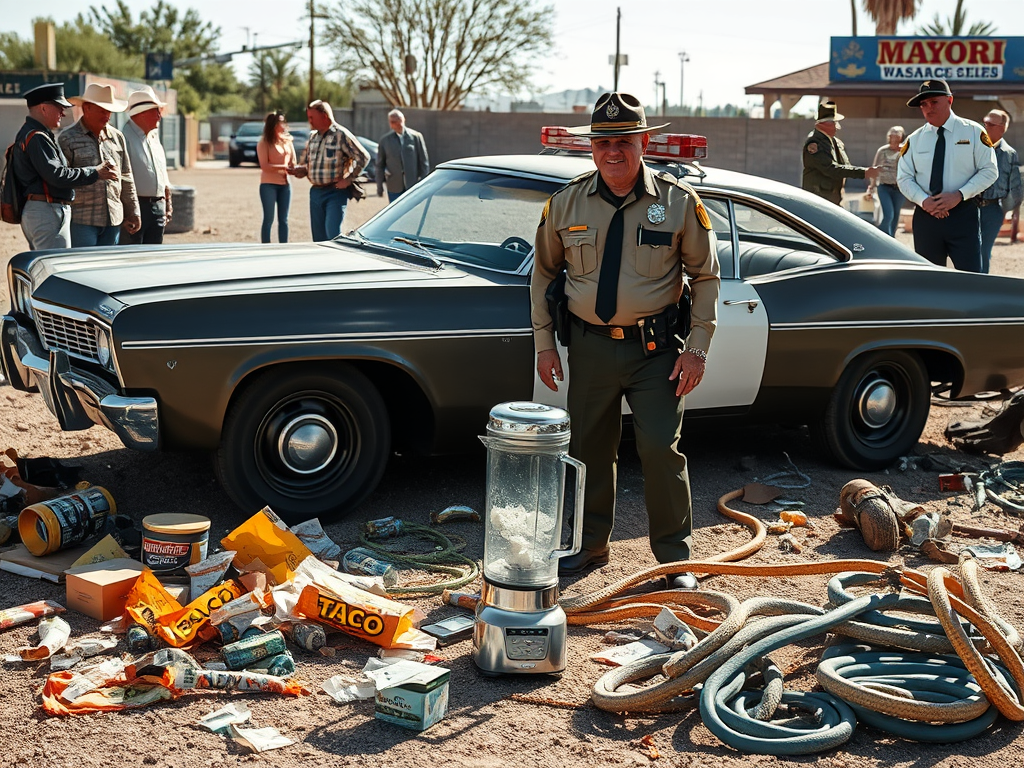
Buck found himself standing amid the remnants of last night’s epic showdown. Discarded taco wrappers were all around. A few broken garden hoses added to the debris. An old margarita blender lay as if a token of an absurd battle. The Mayor, still in full “wartime” regalia, shook hands with retirees. He even gave a slight nod of respect to Carl for his unorthodox diplomacy.

At the gas station, the local newspaper was already printing the headline:

“PEANUT BUTTER PACIFIST: HOW BUCK MILFORD CALMED THE CRICKET STORM”

— Ajo Today, alongside a coupon for “Buy One, Get One Free – Peace of Mind.”

Buck, ever the humble hero, tipped his hat.

“Sometimes, all it takes is cooler heads…and a couple of sandwiches,”

he remarked dryly.

The final act of the evening unfolded with a local radio show, hosted by Marty the janitor. Marty, now reformed, played a slow, soulful tune. The music blended cowboy ballads with cricket chirps in the background. Buck’s patrol car, dusty and battered, stood as a symbol of resilience against absurdity.

As the sun climbed higher in the sky the next morning, Ajo prepared for another day in the desert. Danger and humor mingled that day. There was also the possibility of another bizarre escapade in the shimmering heat. And Buck, always ready, knew that in a town like this, adventure was never too far away.

~THE END~

The Sonoran Desert’s Buck Milford – Chapter 9: Showdown at Sunset

By Benjamin GroffMedia© | benandsteve.com | 2025 Truth Endures©

2–3 minutes

Catching Heat In Ajo, Arizona

The sun dipped low. It cast long shadows over the scorched earth of Ajo. The stage was set for the ultimate confrontation. Every faction had gathered. Mayor Gonzalez stood with her fleet of feisty seniors armed with flyswatters. Carl Sandlin rode his tinfoil-covered dune buggy, banjo in hand. A defiant Barney Fife-lookalike still clutched his oversized ticket book. Buck was caught in the middle, displaying a mixture of resignation and amusement.

Across the dusty open space, the beagle crickets aligned themselves in rows that shimmered in the golden glow. Their usual hum was replaced by a rising, almost militant chorus of chirps. It was a rallying cry that sent a shiver down everyone’s spine (or was it just the cool desert breeze?).

Mayor Gonzalez stepped up, megaphone in hand, and declared,

“Today, we settle this once and for all! You bugs have terrorized our town long enough, and you’re coming to justice!

At the same time, Carl revved his banjo as if it were a trigger. He let out a wild, improvised yodel. This merged into a banjo riff—a challenge thrown down in musical form. The tension was palpable.

Then came the unexpected moment. Buck acted on pure instinct. His genius shone brightly from a half-forgotten lunch order. He pulled out a thermos of peanut butter sandwiches.

“Folks, and… critters,”

he announced, his voice steady.

“Sometimes all you need is a little tad of nourishment. It’s a reminder of simpler days.”

He scattered the sandwiches across the open space. The crickets, baffled by the offering (and even enticed by the rich aroma), paused their chorus. Slowly, as if savoring each bite, they began to nibble at the offerings. One by one, the insects lowered their guard. In that surreal instant, music and mayhem faded into an almost peaceful tableau.

Barney Fife-like hollered,

“This is it—the bug truce is on!”

While Mayor Gonzalez’s frown slowly morphed into a reluctant smile as her deputies put down their flyswatters.

For a heartbeat, the desert held its breath.

How long can everyone hold their breath? Too long, and we’ll have folks fainting in the streets—because that’s what happens when you forget to breathe! We hope the Mayor will remind the crowd to inhale. Barney Fife or Buck himself might do that too. We need this reminder before we move on to Chapter 10—the final installment of this wild ride.

If you’ve been reading since Chapter 1, you already know how it started. It began with unidentified flying toilets. Additionally, there was a full-blown invasion of Mexican Beagle Crickets across Southern Arizona’s Sonoran Desert. But if you just tuned in now… do yourself a favor—go back to the beginning. Otherwise, you’ll be as lost as the lady in the blue ’74 Buick LeSabre. She’s still sitting at the stop sign outside Ajo. She’s waiting for directions that may never come.

The Sonoran Desert’s Buck Milford – Chapter 8: Misting Stations and Mistrust

By Benjamin GroffMedia© | benandsteve.com | 2025 Truth Endures©

2–3 minutes

The Mexican Beagle Crickets Hum “Play Misty For Me?

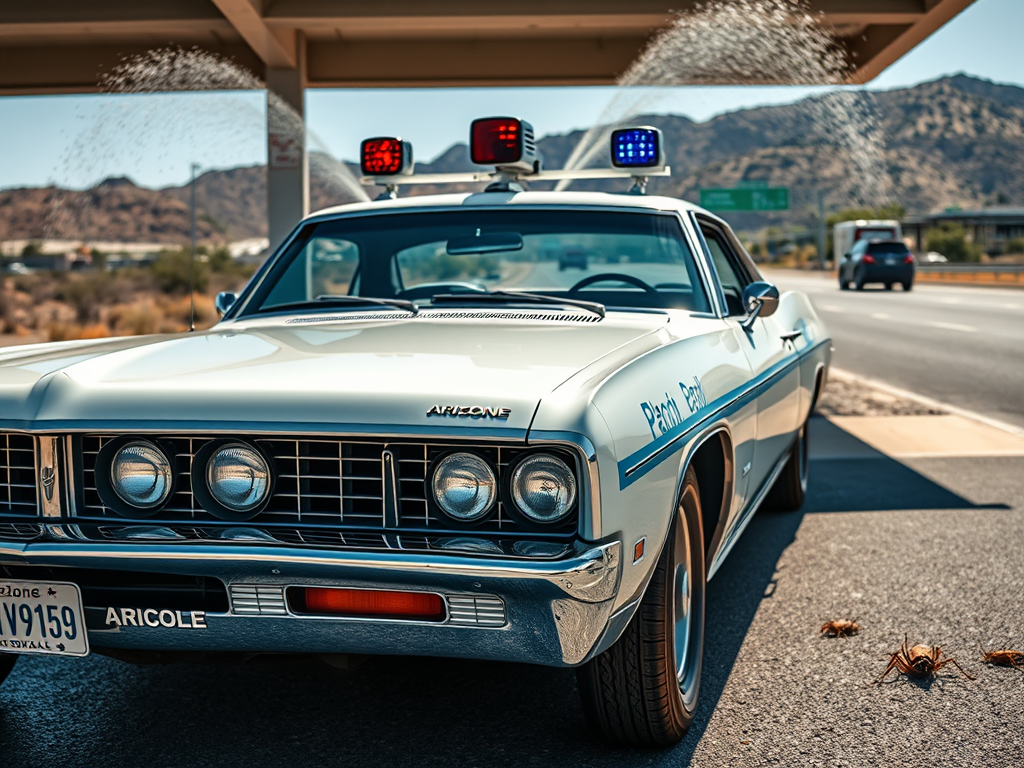
As news of the impromptu peace talks spread, another mystery began simmering like the endless desert heat. The highway crew’s newly installed solar-powered misting stations were intended to cool workers. They were also meant for eager beagle crickets. Nonetheless, they were causing far more problems than anticipated.

While Buck was patrolling near a row of these glistening stations, he noticed something amiss. Where the mist should have provided relief, it instead made the crickets multiply. A bizarre swarm of shiny, water-dappled insects was now marching in almost perfect formation.

Investigating further, Buck discovered that the misting stations weren’t a product of innovative engineering at all. They were part of a shady government contract mixed with local corruption. Additionally, there was a janitor who seemed to know every secret corridor in the county. The janitor was a quiet, stooped fellow known as Marty. He confessed that he had been “tinkering” with the control systems. He did this in exchange for a steady supply of his favorite snack: spicy cactus crisps.

“This here mist is subsidizing a bug bonanza!”

Buck grumbled as he took notes in a dog-eared notebook, the pages fluttering in the arid wind.

Suspicions mounted. Someone is using the misting stations to create a perfect breeding ground for the cricket phenomenon. This move would be designed to turn Ajo into a quirky tourist trap. It also would be a covert experiment in behavioral acoustics. Trust, it seemed, was as scarce as shade in the desert.

Before Buck confronts Marty with a ticket, the misting systems churned out another puff of fog. It sent confused retirees and cricket mediators scattering in every direction. Buck still intended to give Marty a stern talking-to.

Those misting machines didn’t cool things down—they cranked the chaos up a notch! Now, Mexican Beagle Crickets are swarming Ajo and its neighboring towns faster than you can shake a jalapeno-laced stick. Somewhere in the background, the ghostly voice of Karl Malden echoes. It is from a dusty 1978 American Express commercial. “What will you do? What will you do?” That, dear reader, is the burning question for Chapter Nine… and trust us, the heat is just getting started.

The Sonoran Desert’s Buck Milford – Chapter 7: Buck Joins the Bug Peace Talks

By Benjamin GroffMedia© | benandsteve.com | 2025 Truth Endures©

2–3 minutes

Salsa Dancing To A Deal With The Mexican Beagle Crickets

The escalating cricket crisis soon took a bizarre turn. After the Mayor declared martial law, Buck inexplicably found himself roped into a ceasefire negotiation. It was by invitation and circumstance, not entirely by choice.

Under the twilight sky, Buck set up a pair of folding chairs near the old taco stand. It was now decked out as a makeshift negotiation table. He sat alongside Carl Sandlin, who was still sporting his sequined –––

“diplomatic vest.”

An unexpected guest joined them: Gladys “The Negotiator” Ramirez. She is a spry 82-year-old with a background in community organizing and a penchant for peanut butter.

A gentle breeze stirred the desert sand as dozens of beagle crickets gathered in a semicircle. Their chirps and hums intermingled with the soft strumming of Carl’s banjo. It was not a formal diplomatic session at all. Instead, it was a surreal backyard barbecue meeting. Buck found himself as the unintended mediator.

Carl, with a dramatic flourish, announced,

“I propose we work together! You bugs, you stop the invasions, and we guarantee a steady supply of fresh, organic salsa.”

The crickets, of course, did not respond with words, but their synchronized humming seemed to offer a tentative –––

“aye.”

Then, Gladys cleared her throat.

“Now listen here, critters. We are not capable to talk your language, but I do know a thing or two about compromise. How ’bout a trade?”

There was a pause that lasted nearly two seconds in cricket time. A single cricket marched ahead. It tapped an abandoned sombrero with its leg, as if in silent agreement.

Buck, rubbing the bridge of his nose, grinned. He thought,

“I have to admit, this is just the most peculiar peace talk.”

It was indeed the most peculiar peace talk this side of a cactus convention.

The ceasefire was as fragile as the morning dew on the desert floor. For one mystical, humid moment, man and cricket reached an understanding.

Will this agreement hold? The Mexican Beagle Crickets and man—finally in harmony? Or will the crickets grow weary of salsa and develop a taste for avocado dip instead? Will a sudden craving for classic TV jingles like Sanford and Son or The Beverly Hillbillies derail the peace? And what happens when today’s senior citizens pass on—will the next generation need to renegotiate the whole deal? With only a few chapters left, Buck better hustle—answers aren’t going to find themselves!

The Sonoran Desert’s Buck Milford – Chapter 6: The Mayor Declares War

By Benjamin GroffMedia© | benandsteve.com | 2025 Truth Endures©

1–2 minutes

ONE STEP TOO FAR – TAKING OVER OF A TACO STAND

Mayor DeeDee Gonzalez wasn’t one to take a half-measure. Her town’s only claim to fame was a bug outbreak with a penchant for humming and line-dancing. Mexican beagle crickets had commandeered a taco stand once more. They also interrupted a high-stakes karaoke contest at the community center. She had had enough.

The emergency meeting took place in the town hall. Chairs were hastily arranged in a circle. The table was littered with half-eaten enchiladas. The Mayor banged her gavel with a determined clatter.

“Enough is enough!” 

She declared.

“These pests have overstepped their bounds. As of now, martial law is declared on all cricket activity in Ajo!”

In a matter of minutes, local retirees received “bug defense kits.” These kits featured oversized flyswatters and garden hoses. They also included homemade “cricket deterrent” spray (an odd blend of cactus juice and a hint of mint). The newly minted “deputies” marched down Main Street. The Beagle Cricket Brigade paused their evening serenade. It was as if to say, “They brought reinforcements!”

Buck, watching from the window of the Impala, smirked.

“Now that’s what you call bugging out,”

He muttered. He anticipated the chaos. It would ensue when a troop of seniors met a swarm of rhythmic insects.

How dare they! A Taco Stand? Those evil Beagle Crickets! It is only a matter of time before someone is called to main street for a shootout at high noon. But, will Buck’s aim hit something as small as a cricket in a shootout? Would the crime fighter be outmatched by crickets? Or will they challenge him to Karaoke sing off?

The Sonoran Desert’s Buck Milford – Chapter 5: Heatstroke and Hallucinations

By Benjamin GroffMedia© | benandsteve.com | 2025 Truth Endures©

2–4 minutes

Other Strange Sightings In The Desert

Buck Milford wasn’t the type to complain. He’d driven through sandstorms. He had broken up fistfights at quilt raffles. Once, he gave a field sobriety test to a goat wearing sunglasses. That day was different. The Arizona sun scorched the earth like a microwave set on vengeful. Even Buck was close to breaking.

The heat index had hit 127. A road sign melted. Melted. The “SLOW CHILDREN AT PLAY” sign now reads “OW.”

Buck had parked his cruiser under the only tree between Ajo and Yuma. It was a desperate little mesquite. It looked like it had made some poor life choices. He sipped water from his melted ice chest and tilted his hat over his forehead.

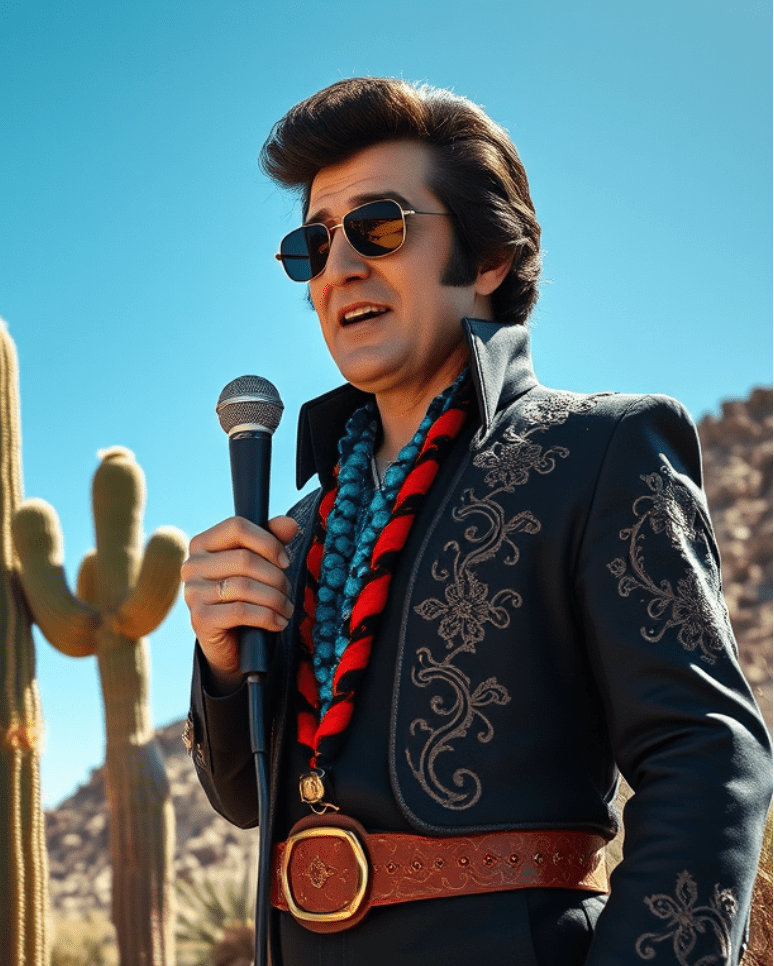
That’s when he saw Elvis.

Plain as day.

Standing next to the patrol car, wearing a powder-blue jumpsuit and holding a chili dog.

“Elvis?”

Buck mumbled.

“That you?”

Elvis gave him a nod. 

“It’s hot out here, hoss.”

Buck blinked. 

“I must’ve been out in the sun too long…”

Suddenly, another figure emerged from behind the tree.

Skinny. Nervous. Clutching a clipboard and a sheriff’s badge held on by Scotch tape.

“Buck! Buck, there’s been a violation!” 

The man squeaked. 

“A code triple-seven! Unlicensed harmonica discharge in a non-musical zone!”

Buck sat up straight. 

“Barney Fife?”

It was indeed Barney Fife. Or instead, it was someone who looked, sounded, and panicked exactly like Don Knotts. This person was holding a ticket book the size of a Bible.

Barney fumbled with his pen. 

“Now, now, Buck, I don’t want any trouble, but this whole desert’s outta code. These crickets! The yodeling! There’s dancing! Dancing, Buck! It’s indecent!”

Buck stood up, swaying slightly. 

“Barney, are you… real?”

Barney narrowed his eyes. 

“As real as a jelly doughnut on a Wednesday morning, Trooper. Now I’m gonna need you to confiscate Carl Sandlin’s banjo and suspend his taco license—right away!”

Behind them, Elvis leaned against the cruiser and took a bite of his chili dog. 

“Let the boy yodel, Barney.”

“I will not!”

Barney barked. 

“This is law and order, not Hee Haw Live!”

At that moment, Carl himself drove by in a dune buggy. It was covered in tinfoil and wind chimes. He waved like a parade marshal.

“I’m playin’ at dawn!”

Carl shouted. 

“Bring earplugs or bring maracas!”

Barney turned purple. 

“I’ll have his badge!”

Buck stared in stunned silence.

A cricket landed on his shoulder and began humming ––

“Love Me Tender.”

The next thing Buck remembered was being propped up in a folding chair outside the Ajo gas station. A bag of frozen peas was on his forehead. He had a bottle of Gatorade in each hand.

“You passed out cold.”

Said Melba, the station clerk, who also claimed to be a licensed Reiki therapist. 

“Said something about Elvis, Barney Fife, and indecent line dancing.”

Buck blinked. 

“I didn’t… wrestle Carl off a unicycle, did I?”

“Not today.”

Buck took a long drink, sighed, and muttered, 

“I’m starting to think this desert has a sense of humor.”

A Desert with a sense of humor? Barney Fife? Elvis? Our Crime Fighter has been out in the nether regions of the Sonoran Desert too long. That, or he sees dead people. Whatever it’s going to lead to, it’s another exciting story of Arizona’s most famous crime fighter, Buck Milford! That Mexican Beagle Cricket is sorta cute, isn’t it?

The Sonoran Desert’s Buck Milford – Chapter 4: Yodels and Yellows

By Benjamin GroffMedia© | benandsteve.com | 2025 Truth Endures©

2–4 minutes

Buck Plays a Tune!

The Mexican beagle crickets arrived five days ago. Already, the Arizona Department of Wildlife had received over 300 complaints. Not about damage, mind you—but about the music.

“They’re too dang punctual,”

one retiree griped.


“They hum like my mother-in-law when she’s judging me,”

wrote another.


One anonymous caller just yelled. MAKE IT STOP!” for forty-two seconds before hanging up.

Buck Milford was used to desert weirdness. He’d once ticketed a man for driving a dune buggy made entirely of rattlesnake skins. But nothing prepared him for Carl Sandlins latest idea: The Great Cricket Peace Yodel.

“I’ve been listenin’ to ‘em closely,”

Carl explained, pacing in front of his yurt-slash-taco-stand.

“And I think they respond to pitch. What we got here is a musical species. They ain’t hostile—they just need harmony!”

Carl wore what he called his “diplomatic vest.” It was a sequined denim jacket with fringe. He also equipped himself with an old harmonica, a rusted washboard, and a five-gallon pickle bucket labeled AMBASSADOR DRUM.

Buck just stared at him.

“You sure you haven’t been drinking your aloe again, Carl?”

But Carl was undeterred. That night at 2:00 a.m., he set up two lawn chairs. Fifteen minutes before the crickets’ usual humming ritual, he arranged a battery-powered spotlight. He also prepared a megaphone duct-taped to a broomstick.

“Alright, fellas,”

he said into the megaphone.

“Let’s talk tunes!”

Buck sat in the cruiser, sipping lukewarm coffee, radio off. “This is going to end with him either arrested, abducted, or somehow elected,” he muttered.

At exactly 2:15 a.m., right on schedule, the desert came alive with humming.

But this time… Carl joined in.

He yodeled.

He drummed.

He played a harmonica solo that sounded like a walrus stepping on bubble wrap.

And for thirty glorious seconds… the crickets paused.

Then, they hummed louder than ever.

They didn’t just hum The Andy Griffith Show this time. They mashed it up with Achy Breaky Heart. It sounded suspiciously like a 1996 Taco Bell jingle.

Carl dropped his bucket.

“They answered me, Buck! I think we’re collaborating!”

Buck opened his door.

“Carl, I think they’re angry.”

Suddenly, thousands of beagle crickets surged toward the yurt, drawn to the sounds of tin, harmonica, and misguided ambition. They swarmed Carl’s taco stand, leapt onto the megaphone, and—somehow—turned on his margarita blender.

It spun wildly. Salsa flew.

The crickets began line-dancing.

Buck had seen a lot, but beagle crickets doing synchronized grapevines under a disco light powered by solar lawn gnomes? That was new.

The next morning, the bugs had gone quiet. Carl stood in the rubble of his salsa bar. He was shirtless and proud.

“We made contact,”

he said, eyes shining.

“They danced, Buck. They danced!”

Buck surveyed the scene: overturned lawn chairs, chewed speaker wire, a cricket still stuck in a jar of queso.

“Well, Carl,”

he said,

“either they liked your music—or they mistook you for a piñata.”

Carl smiled.

“Doesn’t matter. Tonight, I’m bringin’ in the banjo!”

SO! CARL. He is bringing in the Banjo! Will it be on his knee? And will someone named Ole Susanna show up in Chapter Five if Carl swings that Banjo too wildly? That is a story for tomorrow. So be sure to check back and see if the Mexican Beagle Crickets have segued into classical jazz. Also, will the Highway Patrol get Buck a larger fly swatter?

The Sonoran Desert’s Buck Milford – Chapter 2: Carl and the UFO Porta-Potty

By Benjamin GroffMedia© | benandsteve.com | 2025 Truth Endures©

2–3 minutes

Buck’s Response To Mile Marker 88

Buck had just finished adjusting the old police scanner. It had been playing reruns of Hee Haw for the last hour. Suddenly, his radio crackled to life.

“Unit 12, please respond. Caller at mile marker 88 reports a suspicious hovering object. Caller believes it is extraterrestrial. Or a reflective commode. Please advise.”

Buck sighed and reached for his hat, which had molded to the dashboard like a forgotten tortilla.

“Lord help us,”

he muttered.

“If this is Carl again, I’m asking for hazard pay.”

Carl Sandlin, local yodeler and self-certified UFOlogist, had a unique reputation. It’s one you earn from a lifetime of heatstroke. Add to that expired beef jerky. Lastly, he had a mother who named him after her favorite brand of tooth powder.

Buck shifted the Impala into drive and pulled away from the shade of a sagging mesquite tree. The tires made a sound like frying bacon as they peeled off the scorched asphalt.

When he reached mile marker 88, Carl stood there. He was shirtless, shoeless, and sunburned. Carl was waving a fishing net wrapped in tin foil like a broken butterfly catcher.

“There it is, Buck!”

Carl bellowed.

“Hoverin’ just above my taco stand for forty-five minutes. Scared off my lunchtime crowd. Even the iguanas cleared out!”

Buck squinted toward the horizon. Sure enough, something metallic shimmered in the distance. It wobbled slightly in the heatwaves, casting a strange, shiny glow.

“You mean that thing?”

Buck asked, pointing.

Carl nodded so hard his hat flew off.

“Absolutely. That’s either an alien escape pod or a deluxe Porta-John.”

Buck pulled binoculars from his glove compartment, which were so fogged up with heat condensation they doubled as kaleidoscopes. After rubbing them on his sleeve, he focused in.

“…That’s a new solar-powered PortaCooler,”

he said finally.

“The highway crew’s been installing them for the road workers. It’s got misting fans, Bluetooth, and a cactus-scented air freshener.”

Carl squinted, unimpressed.

“You sure it ain’t Martian technology? Smells like sassafras and bad decisions over there.”

Buck stepped out of his patrol car, the soles of his boots sticking to the pavement with every step.

“Carl, unless the Martians are unionized and drive state-issued work trucks, I’m pretty sure they’re not putting in restrooms. Those restrooms aren’t off Route 85.”

Just then, as if to punctuate the point, a group of Mexican beagle crickets marched across the road. All in unison. All humming the Andy Griffith Show theme at exactly 2:15 p.m.

Carl froze.

Buck froze.

Even the misting PortaCooler froze up and made a high-pitched wheeze like it, too, was creeped out.

Carl whispered,

“You reckon they’re trying to send a message?”

Buck tipped his hat back and said,

“Only message I’m gettin’ is that we need stronger bug spray… and fewer heat hallucinations.”

The crickets finished their tune, executed a perfect pivot, and disappeared into the desert brush.

Carl crossed his arms.

“I still say that cooler’s alien.”

Buck opened the door to his cruiser and called over his shoulder.

“Well, if they are aliens, they’re better at plumbing than our city council.”

He chuckled as he pulled away, leaving Carl saluting the shimmering cooler like it was the mother ship.

The Sonoran Desert’s Buck Milford- Chapter 1 -Hotter Than Hades – A Hot Day Fighting Beatle Crickets In Arizona

Arizona State Trooper Buck Milford From Ajo Dispatched To One Of The Hottest Calls Of The Summer

By Benjamin GroffMedia© | benandsteve.com | 2025 Truth Endures©

3–4 minutes

A Hot Day Fighting Beagle Crickets In Arizona

It had been a hot day in the Arizona Desert. The sun had sizzled the sands in the Sonoran Desert for the last month. High temperatures reached over 115 degrees for each day during the past seven days. The weather forecast warned of night temperatures reaching 120°F or higher in the days ahead. Arizona State Trooper Wayne Milford had his 1968 Chevrolet Impala Patrol car parked outside Ajo. He had filled the fuel tank with fuel. An ice chest was filled with water. This was in case motorists or hikers needed rescue in the barren desert regions. Buck was known for his mishaps.

Trooper Milford was widely appreciated for his sense of humor. He would show community members safety tips during public meetings when he had spare time. He also attended public events during his off-duty time. He was respected by those even that received traffic tickets from and who had been arrested by the state trooper. Because he was known as a fair individual.

That summer was challenging. The extreme heat and the invasion of the Mexican beagle cricket placed the whole state under stress. Trooper Milford became essential because there would be more surprises than one could shake a stick at. And Buck had ton’s of sticks!

The Mexican beagle cricket wasn’t actually from Mexico. It didn’t bark like a beagle. Yet, it did hum the theme song to The Andy Griffith Show at exactly 2:15 a.m., every night, in unison. No one knew why. Some said it was a mating call. Others blamed radiation. Buck didn’t care. He kept a fly swatter in the glove box and an old harmonica to confuse them.

On this particular Thursday, Buck had just finished explaining the dangers of cooking bacon on your car hood. This activity was a popular desert pastime. He was speaking to a group of overheated tourists from Connecticut when his police radio crackled.

“Unit 12, we’ve got a report of a suspicious object at mile marker 88. The caller says it might be a UFO or possibly a very shiny porta-potty. Please respond.”

Buck took a sip from his melted water bottle, sighed, and muttered, 

“Well, that’s probably just Carl again.” 

Carl Sandlin is a local conspiracy theorist and professional yodeler. He had been filing UFO reports ever since a silver taco truck passed him on I-10 doing 95.

Still, the procedure was the procedure. Buck fired up the Impala. He turned on the siren, which sounded more like a kazoo than a siren thanks to a duct-tape repair. Then, he rumbled down the dusty road.

When he reached mile marker 88, he saw Carl. Carl was shirtless and shoeless. He was holding up what appeared to be a fishing net wrapped in aluminum foil.

“There it is, Buck!”

Carl shouted, pointing to a shimmering metal shape in the distance. 

“That thing’s been hovering over my taco stand for an hour. My queso is boiling itself!”

Buck squinted. The heatwaves shimmered, giving everything a wobbly, dreamlike quality.

“Carl… that’s a new solar-powered PortaCooler. The highway crew just installed it yesterday. It’s got a misting feature and Wi-Fi.”

Carl blinked. 

“You mean I can update my blog from out here now?”

“Yes, Carl.”

“Well, dang.”

Just then, a convoy of beagle crickets marched across the road in front of them, humming their nightly tune.

Buck and Carl watched in silence. 

Carl finally said,

“You reckon they take requests?”

The Town Called Serenity – Chapter Ten: Stand Still, and the Dust Will Bury You

By Benjamin GroffMedia© | benandsteve.com | 2025 Truth Endures©

3–5 minutes

Chapter Ten: Stand Still, and the Dust Will Bury You

By dawn, the desert wind carried more than heat. It took silence—the kind that comes before thunder.

  • Chester Finch stood on the steps of the half-burned church at the edge of Serenity’s main street. His badge was pinned high and proud. His ribs ached. His coat was torn. But his eyes were sharp, and the ledger in his hands could end a dynasty. 
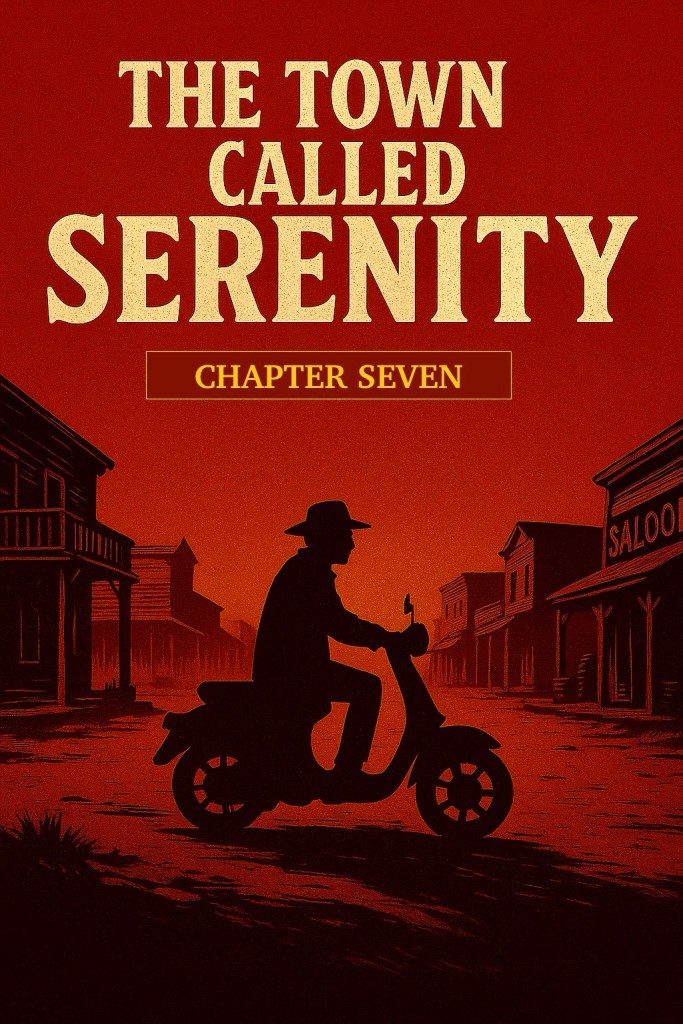
  • The Marshal had pulled his moped from hiding and had it juiced up for duty. The Vespa GTS (300cc) moped shone as slick as the day it was new. It had US Marshal emblems on it and had been stowed inside the jail’s secret compartment. A hiding place that Chester designed the night he arrived in town. 

Chester looked out over the gathering.

Wren was there, her arm in a sling, a rifle strapped across her back.

Petal stood beside her, bruised but alive, clutching a satchel full of Cain’s secrets.

Julep Jake leaned against the doorframe, sharpening his miniature whittled guillotine. 

“A town’s only worth the blood it takes to keep it,” 

He said. 

“Reckon we’re due.”

Even Buck Harlan was the old stagecoach driver who hadn’t spoken more than ten words in a decade. He stood with a shotgun across his knees.

And behind him came the others—storekeepers, grooms, forgotten women, broken men.

Cain had ruled them. Gallow had hunted them.

But now –– now they remembered their names.

Chester raised his voice.

“I’m no savior. I’m no sheriff. I’m just the last man they sent when no one else would come.”

He held up the badge.

“But I say this badge still means something. Not because it’s brass. Not because the government gave it to me. But because I’m willin’ to bleed for it.”

He threw the ledgers down onto the church steps.

“These are Cain’s sins. Every payment, every name, every blackmail note, every fix. And when this town turns that over to the federal office, I just wired—they’re gonna come. Not with a whisper. With subpoenas and dogs.”

A beat of silence.

Then a single voice called out:

“And Gallow?”

Chester turned. 

“He’ll come. Tonight, maybe. It could be sooner. He’ll bring fire.”

He looked to Wren.

“But fire don’t mean nothin’ if you’ve got water and grit.”

Wren nodded once. 

“We stand.”

The townsfolk murmured.

Then they shouted.

Then they began to build.

Barricades. Traps. Makeshift outposts from overturned wagons and scrap wood. Petal turned the saloon into a war room. Julep Jake strung piano wire across alleys. Even the bell tower rang for the first time in years, warning off the vultures.

The Last Hour

Cain, watching from The Assembly, saw the town rise against him and knew he’d lost the crown.

He poured a final drink, set it aside, and vanished through a trapdoor in the fireplace, bound for nowhere.

The Arrival

Gallow came at sunset, just as expected.

He walked straight down the main street—unarmed, unhurried—like he owned time.

But this time, time fought back.

The first tripwire knocked him off balance. A spotlight lit him up. A warning shot clipped his boot.

He crouched, ready to vanish into shadow—until he saw Chester.

Standing in the street. Moped beside him. Rifle in hand.

“You’re outgunned,” 

Gallow called.

“Nope,” 

Chester said. 

“I’m out-cowed.”

The townsfolk emerged—on roofs, behind crates, on balconies.

Gallow took a step. Then another.

Chester held firm.

And Wren, from the bell tower, raised her rifle.

The shot rang out.

Gallow stumbled. Not dead. Just marked.

He turned—bleeding, seething—and ran.

He vanished into the dust from which he’d come.

And the town never saw him again.

Epilogue: A New Kind of Quiet

Serenity changed.

The ledgers made it to Washington. Petal was deputized. Wren chose to stay and built the first real school the town had seen in thirty years. Julep Jake finally finished his guillotine and gave it to a museum in Tulsa.

As for Chester Finch?

He stayed, too.

He never left Serenity.

Not because he had to.

But sometimes, the worst places can create the most profound kind of peace.

Even if you get there on a moped.

The Town Called Serenity

A hero did not save it.

It was saved by the last man willing to stay when everyone else ran.

So the moped was hidden away in the jail’s secret spot—one no one else even knew existed. Good thing Chester made it out alive, or that Vespa would’ve turned into a time capsule! More importantly, this story is a great reminder: the bad guys never truly win.

THE TOWN OF SERENITY – Chapter Nine: A Predator in the Garden

By Benjamin GroffMedia© | benandsteve.com | 2025 Truth Endures©

3–4 minutes

Chapter Nine: A Predator in the Garden

Braddock Cain sat alone in The Assembly, a chessboard in front of him, half-played.

It was something he did when the whiskey wore off, and the world got too quiet. He played both sides of the board. He always made sure black lost.

Tonight, black wasn’t losing.

He moved a knight, sat back, and scowled.

The vault trap should have buried Finch and the girl. He’d received no word from Poke, which was unusual. Too unusual.

A low, sharp knock came at the door—three short raps. 

Then silence.

His eyes narrowed.

“Enter,”

He growled.

The door creaked open, and the man who stepped inside wasn’t Poke. Wasn’t anyone from Serenity? His clothes were clean, military-cut. His boots were dustless. He didn’t wear a hat—but his shadow felt longer than the room allowed.

“Mr. Cain,”

The stranger said. 

“I presume.”

Cain stood, hand already on the grip of his pistol.

“You don’t walk into this room without an invitation.”

“I didn’t walk,” 

The man replied. 

“I arrived.”

Cain didn’t move to open it.

“You’re Gallow,”

He said flatly.

“That’s what they used to call me,”

The man replied. 

“In certain circles. Not the ones you buy into.”

Cain sat back slowly. 

“What do you want?”

Gallow smiled faintly.

“Let’s call it… clarity. You’ve grown fat on rot, Cain. But rot attracts insects. I’m here to burn the carcass clean.”

Cain let out a cold laugh. 

“You think you can walk into my town and—”

Gallow was suddenly in front of him.

Cain hadn’t even seen the movement.

A knife gleamed under Cain’s chin.

“I don’t think,”

Gallow whispered. 

“I replace. You’ve become a liability to men far above either of us. The vault was never your property. The tapes, the ledgers, the names—you were supposed to manage them, not flaunt them.”

Cain’s eyes narrowed. 

“You’re not just here for Finch.”

“I’m not here for Finch at all,”

Gallow said softly.

“He’s just a broken piece. You’re the engine.”

He pulled the knife away and tucked it back into his sleeve.

“I won’t kill you tonight. That would be –– premature. But I will leave you with a choice.”

Gallow tapped the Ashwood file.

“Burn this. Leave town. Or wait for me to come back.”

Then he was gone.

Cain sat still for a long time, listening to the echo of Gallow’s departure. When his hand finally moved, it wasn’t for his gun.

It was for the bottle.

Elsewhere in Serenity

Poke’s body was found behind the saloon—face down, no bullet wound, no blood.

Just two coins were placed over his eyes.

Wren and Chester stood over him in silence.

“Gallow’s here,” 

Wren said. 

“And he’s not working for Cain. He’s cleaning the house.”

Chester looked toward the west horizon, where dust clouds rolled in from the direction of the rail line.

He pulled the badge from his coat and stared at it.

“Time to decide,” 

He muttered. 

“Do I play Marshal—or outlaw?”

Well now, Gallow is certainly making his presence known! And Cain clearly has a big decision to make—but will he actually leave town? If so, he better start packing snacks for the road. But if he’s thinking about staying, he’ll want to give Jonathan Lawson a call. He should secure himself a Colonial Penn Life Insurance policy. It’s unfortunate Poke didn’t think ahead. Maybe those two coins over his eyes are enough to cover a plot in the nearest potter’s field.

As for Marshal Chester Finch, he’s defied the odds and made it to Chapter Ten. And it looks like this final chapter will finally answer the big mystery: the moped. Where has it been? Who hid it? Why wasn’t it tampered with? What was it originally bought for? And when did Chester decide it would be his official Marshal’s ride?

All of this—and more—will be revealed in Chapter Ten. ~ WE Hope ~

The Town Called Serenity – Chapter Eight – The Devil Knows The Way Out

By Benjamin GroffMedia© | benandsteve.com | 2025 Truth Endures©

3–4 minutes

Chapter Eight: The Devil Knows the Way Out

The blast had sealed the main vault door and collapsed part of the tunnel behind them. Smoke choked the air. Brick and metal groaned under stress. Chester blinked through blood and dust, pulling Wren up from the rubble.

“You alright?”

He asked, coughing.

“Been worse,” 

Wren muttered, cradling her left arm. 

“Dislocated, not broken. I’ll pop it back.”

Chester pulled out a penlight and scanned the room. 

“No exit. That was the only way in.”

Wren smiled through the pain. 

“You thought it was.”

She limped to the far wall. A section of decorative tiling was there—old, Spanish-style. It jutted out from the stone like it didn’t belong. She knocked three times in a rhythm that echoed deeper than it should have.

A hollow click responded.

“Cain didn’t build the vault himself. He took it from a man who did. The original owner had escape routes.”

She traced a tile shaped like a broken star and twisted it counterclockwise. With a faint hiss, the tile wall slid inward, revealing a narrow stone chute, half-collapsed and riddled with centipedes.

Chester stared into the black.

“I don’t suppose you brought rope,”

He said.

“Nope.”

“Alright then,”

He grunted, and they vanished into the dark.

In the Streets Above

Petal stood at her shop counter grinding roots when the front door exploded inward.

She ducked instinctively, drawing her old revolver, but it was too late.

Two men in black tactical gear moved in fast, grabbed her arms, and yanked her across the counter. The third figure entered last—calm, silent.

Mr. Gallow.

He picked up a vial from the shelf, sniffed it, and set it down.

“I’ve read your name,”

He said, voice flat. 

“You’re a known associate of Wren. Harboring her. Aiding a rogue federal.”

Petal spat blood and smiled. 

“You got a badge?”

“No. I have jurisdiction.”

He signaled.

The men dragged her out.

They disappeared down the street. Julep Jake watched from his cell window. He was whittling a miniature guillotine from an old broom handle. 

“And now the harvest begins,”

He muttered.

The Long Climb

Chester and Wren emerged two hours later through a rusted maintenance grate behind the abandoned Serenity Theater. They were scratched, covered in brick dust, and exhausted—but alive.

Wren wiped grime from her face. 

“He set us up. Knew we were coming.”

Chester nodded grimly. 

“Means we rattled him.”

She held up the two ledgers she’d saved—one in each hand.

“He loses if these go public.”

Chester took them, tucking them into his coat. 

“Then let’s make sure they do.”

Suddenly—gunfire cracked in the distance. Three pops.

Wren froze. 

“That was near Petal’s.”

Chester’s face hardened. 

“We’re not the only ones he’s playing.”

They moved quickly down the alleys. Even as they ran, Wren stopped cold. She saw the mark scorched onto the alley wall: a circle with a horizontal line through it.

She grabbed Chester’s arm. 

“That’s not Cain’s symbol.”

“What is it?”

Wren’s voice dropped to a whisper. 

“It’s Gallow’s.”

Chester turned, scanning the rooftops.

“Then we’re out of time.”

What exactly did the symbol mean? Chester had the answer—or at least a regulation book with the answer—tucked away in the saddlebags on his moped. The problem? He didn’t bring it with him. And it’s too far to walk back now. Truth is, he hasn’t laid eyes on that moped since he rolled into town. So, is it hidden so well that he forgot where it is? Or is he protecting a strategic location he’s not ready to reveal? With only two chapters left, the Marshal better get moving!

The Town Called Serenity – Chapter Seven – The Hollow Vault

By Benjamin GroffMedia© | benandsteve.com | 2025 Truth Endures©

2–3 minutes

Chapter Seven: The Hollow Vault

Two nights later, Chester and Wren moved through the back alleys of Serenity like smoke.

The plan was simple: infiltrate the vault below The Assembly using the abandoned mine shaft Wren had mapped out. Inside, Cain kept more than just gold and guns—he kept records. Blackmail. Ledgers. Evidence.

Evidence that could break him!

Wren led them to a rusted grate hidden behind the collapsed ruins of an old hardware store. Beneath it: a shaft covered in rotted boards and bad intentions.

“Down there?” 

Chester asked.

“Unless you’d rather try the front door.”

They climbed down slowly, their boots sinking into decades of dust and discarded bones. Lantern light flickered over graffiti scratched into the stone. Old names. Gang signs. Some symbols are older than either of them recognized.

They crawled through two hundred yards of tight rock. They ducked under fallen beams and crossed a flooded tunnel chest-deep in cold water. Finally, they came to a narrow corridor with smooth brick walls.

“This was built after the mine closed,” 

Chester said.

“Cain built it,” 

Wren confirmed. 

“To smuggle in shipments during the lockdown years. It goes straight to his vault room.”

Chester’s hand rested on his revolver. 

“We go in quiet. No guns unless we’re cornered.”

They reached the door—an iron-bound, reinforced, and sealed structure with an old code lock. Wren pulled a tiny folded paper from her coat.

“Petal gave me this,” 

She said.

“It’s the combination. She wrote it down after Cain got drunk and showed off.”

Chester raised an eyebrow. 

“I’m beginning to like that woman.”

Wren punched in the numbers. The lock hissed. The door creaked open.

Inside, the vault glimmered like a serpent’s nest: stacks of cash, boxes of documents, safes within safes.

But the prize wasn’t money.

It was the black books.

Wren went for the ledgers. Chester opened a crate and pulled out a collection of old film reels labeled with names—judges, mayors, even a U.S. senator.

“This is it,”

He whispered.

“This is Cain’s Kingdom in a box!

“This is Cain’s kingdom in a box.”

But then, from behind them—a faint click.

Wren froze. 

“Did you hear—”

Chester tackled her just as the explosion hit.

The vault door slammed shut.

Dust and debris rained down. A trap. It had been rigged.

From above, in a hidden observation room, Braddock Cain watched through a spyglass.

He turned to Poke and said, 

“Let them cook. They wanted into my house. Now they can die in it.”

But neither he—nor Chester—knew that Wren had already mapped another way out.

And worse, Mr. Gallow had just entered Serenity.

Cain’s Kingdom In A Box? Sounds like evidence that sews up this case! But, now Mr. Gallow is in town, and this brings a whole new suggestion for more trouble. Or a solution. It is too early to tell. Maybe Mr Gallow came for the moped. What if the Marshal’s service issued the moped to Chester, and they want it back?

The Town Called Serenity – Chapter Six – Ashwood

By Benjamin GroffMedia© | benandsteve.com | 2025 Truth Endures©

1–2 minutes

Chapter Six: Ashwood

The file on Chester Finch wasn’t stored in any digital archive. It was handwritten, double-sealed, and stored in a fireproof vault in Washington, D.C., under a codename known only to four men who still remembered it.

Operation Ashwood.

Eight years ago, Chester was part of a black-bag unit inside the U.S. Marshal Service—officially unrecognized, unofficially unstoppable. The team was created to root out systemic corruption in rural American towns with privatized law enforcement and cartel-backed leadership. The mission was simple: infiltrate, destabilize, expose.

Ashwood’s first three targets were textbook. The fourth—Gulch County, Texas—was different.

Chester had made the call. He exposed the sheriff, three council members, and a judge and brought them down with a clean sweep.

But the blowback was lethal.

Three of Chester’s team were ambushed at the exit. A safe house was burned down—with a whistleblower’s daughter inside. The press got hold of fragments, but the whole truth? That was buried in a sealed report and heavily redacted.

Chester took the blame. Not officially. But quietly. They let him keep the badge—under the condition that he’d never be given another high-profile operation again.

Until now.

Serenity was never meant to be his assignment. Someone had slipped his name into the dispatch. Someone with a more extended memory than the agency admitted to.

And now Gallow, the last surviving Ashwood “fixer,” was on the trail.

Now, remember this is only a pause between Chapters Five and Seven. This moment is to clarify what was happening. It serves to show what brought Chester Finch to these parts. When Chapter Seven opens, it will seem like only a few days have passed. That will be just enough time for Finch to remember his past, whether he likes it or not. Still, there is no word where he has left the moped. Surely, it would have been used as a bargaining chip with him by now.

The Town Called Serenity – Chapter Five – The Clock In The Dust

By Benjamin GroffMedia© | benandsteve.com | 2025 Truth Endures©

3–5 minutes

Chapter Five: The Clock in the Dust

The bell above Petal’s shop rang twice—slow and deliberate.

That was the signal.

Wren waited until the third cloud passed over the moon before sliding off the schoolhouse roof. She moved like a whisper down the alleyway, avoiding the creaky boards and broken glass with practiced ease. She paused behind the horse trough near the sheriff’s office and whistled once—two notes, flat and low.

Chester was sitting inside the dim jailhouse with his boots propped up on a barrel. His bruised rib was bandaged with a strip of curtain. He heard the sound and stood up.

He opened the door.

Wren stepped into the lamplight. She was small and wiry, wrapped in an oversized coat that had seen better days. Her eyes were dark and deliberate, scanning the room, the exits, the Marshal.

“I watched you fight the Gentlemen,”

She said without greeting.

Chester gave her a nod, cautious but not cold. 

“You’re the girl from the roof.”

“I’m the girl from everywhere,”

She replied.

He gestured to a stool. 

“You hungry?”

She hesitated, then sat. 

“I want something else.”

“Alright.”

“I want Cain gone.”

Chester leaned back against the wall, arms crossed. 

“That makes two of us. But wantin’ it and surviving it are two different things.”

Wren pulled her notebook from her coat and opened it. She showed him a crude map—of underground tunnels, secret entrances, schedules.

“I’ve been tracking his movements for six months,”

She said. 

“He’s gotten sloppy. He trusts the wrong people. There’s a weak point—down in the old mines under the vault. He thinks no one remembers it exists.”

Chester raised an eyebrow. 

“And you want to hit him there?”

“I want to expose him first. Show Serenity what he is. Not just a tyrant. A liar. A coward. I can get you inside. You have to decide if you’re willing to break the rules you came here to enforce.”

He looked at her for a long moment. 

“You ever worked with a marshal before?”

“No,” 

Wren replied. 

“You ever work with a kid who knows where all the bodies are buried?”

Chester smiled. 

“Can’t say that I have.”

She closed the notebook. 

“Then we’re even.”

They shook hands—hers small and cold, his calloused and warm. In that moment, something changed. Not in Serenity. Not yet.

But it had started.

Meanwhile –––

Five miles west of Serenity, in a ravine that didn’t show on most maps, a boxcar shuddered to a halt. It stopped on rusted rails.

A figure stepped out—tall, dressed in black, face hidden beneath a wide-brimmed hat. Beside him, four others disembarked—mercenaries, by the look of them. Not local. Not from this state. Not from this country, maybe.

They called him Mr. Gallow.

No one knew if that was his real name. He didn’t speak often, but when he did, people obeyed—or disappeared.

Gallow held up a leather-bound dossier stamped with the faded seal of the Bureau of Internal Affairs. Inside was a photo of Chester Finch, clipped to a thick file marked:

“CLASSIFIED – OPERATION ASHWOOD.”

He flipped the page and revealed a second file—one that bore the name Braddock Cain.

And then a third.

Subject: WREN (Alias Unknown).

Status: Missing / Witness Protection Violation.

Gallow smiled faintly.

He turned to his team and said only two words.

“Kill quietly.”

They vanished into the desert night like wolves on the scent.

Back in Serenity

Petal watched the train lights fade on the horizon, her face tense.

She reached behind the counter, pulled out a dusty revolver, and said to herself, 

“They’re all waking up now.”

And somewhere, far below, in the tunnels beneath Serenity, a clock that had long stopped ticking began to turn again.