A while back, WordPress Community Members discussed a curious topic. They wondered whether it was possible to bring back a dinosaur. If so, they questioned which dinosaur it would be.
An attempt to do so may have been underway recently. This became obvious when a monitor lizard screamed and ran for its life. It crashed out of a second-floor window. It then proceeded to lead authorities through a multi-state chase. People were urged to protect their gardens, poodles, and pus— ugh, cats.
Anyways, it is making National News. And I fear that other lizards, regardless of their variety, will start trying the same thing. Suddenly Boom! There will be someone who succeeds, and their progress will be shared with like-minded individuals. Soon we will have a full-throated invasion of body-snatching giant lizards running around telling everyone they are dinosaurs.
Here is breaking news for when they do! HEADLINE: No, Monitor Lizards Are Not in The Dinosaur Family. They are a type of lizard belonging to the family Varanidae. While both dinosaurs and monitor lizards are reptiles, they diverged from a common ancestor long ago. Dinosaurs are part of the archosaur lineage, which also includes birds and crocodiles. Monitor lizards are part of the squamata lineage, which includes other lizards and snakes.
Tuff was no ordinary dog. He was a broad-chested, mixed-breed bulldog from the dusty plains of western Oklahoma. He was loyal to the core. He was tough as nails—just like his name. He belonged to a boy named JD, and from the moment they met, the two were inseparable.
Wherever JD went, Tuff followed. JD rode across the Caddo and Washita County prairie on his sturdy pony. He even rode it to the one-room schoolhouse west of Eakly. He rounded up cattle on the family farm. Regardless Tuff was there, his paws pounding the dirt in time with the horse’s hooves. At school, while JD sat through his lessons, Tuff stayed with the horse, standing guard like a seasoned sentry. Rain or shine, he never left his post. He stayed until the bell rang. Then, the trio trotted home together, just three-quarters of a mile up the road.
One warm afternoon, while JD was still in school, trouble came calling. A neighbor’s ornery bull had pushed its way through a loosely latched gate and wandered off. As luck would have it, it made its way straight to JD’s homestead, snorting and stomping with agitation. JD’s mother was outside hanging laundry to dry in the Oklahoma breeze. The bull burst through the linens like a locomotive. It tore shirts and sheets from the line as it charged.
Startled, she dropped her clothespin basket and backed toward the yard fence, but there was nowhere left to go. The bull pawed at the dirt, its head low, flaring its nostrils as it prepared to strike. Streaks of foam, mixed with dust and sweat, ran from its mouth. Its bulk towered just yards away from her.
Thinking fast, JD’s mom cupped her hands to her mouth and called out with everything she had:
“Tuff! Ole Tuff! Come on, boy!”
Three-quarters of a mile away, in the tall grass outside the schoolyard, Tuff heard her. His ears perked up. He knew that voice—and he knew something was wrong.
Without a moment’s hesitation, Tuff shot off like a bullet, heading for home. He crossed pasture and ditch, squeezing under fences and dodging brush, driven by pure instinct.
When he arrived, the bull was still threatening JD’s mother. Tuff didn’t bark or hesitate. He charged.
The bull turned at the last second. It was startled and tried to lower its head for a fight. But, Tuff was already on him. He raced in circles, nipping and weaving, confusing the brute. The bull spun to face him again and again, becoming dizzy from the dog’s unrelenting speed.
Then, in one perfectly timed leap, Tuff clamped down on the bull’s nose—hard. The bull bucked and shook, kicked and bawled, but Tuff held firm, teeth sunk deep, refusing to let go. He brought the angry beast to its knees, pinning it in place with nothing but grit and jaw strength.
Just then, a cowboy riding by spotted the commotion. JD’s mother waved him down, shouting, “Ride fast to the Yarnell place! Tell ’em their bull’s out before someone gets hurt!”
The man nodded and galloped off in a cloud of dust.
Within the hour, the Yarnells arrived with ropes, a nose ring, and a long wooden block to secure the bull. The farmer jumped down from his saddle, shaking his head in disbelief.
“I’m real sorry, ma’am,” he said. “I reckon I forgot to latch the gate. Wind must’ve blown it wide open.” He paused, nodding toward the growling dog still latched onto the bull’s nose. “But first, we’re gonna need that dog to let go.”
JD’s mom looked at Tuff, calm and composed despite the ordeal. “Tuff, let go now, boy. Come here.”
Without hesitation, Tuff released the bull and trotted obediently to her side, tongue lolling, chest heaving but proud. The bull didn’t move again until ropes were secured and the men began the long walk back to their farm.
JD’s mom glanced at her watch and smiled. “Tuff, JD’s about to get out of school. You’d better go meet him.”
And with that, Tuff turned and loped back down the road. He was headed to the schoolyard just in time to greet his boy.
That evening, Tuff was treated like a king. JD’s mom gave him the biggest soup bone she’d been saving. He was even allowed to lie on the kitchen floor during supper. This was something normally off-limits. As the family passed dishes and swapped stories, JD’s mom told them what Tuff had done.
The story of Ole Tuff was told time and again. It was passed down through the years by my grandmother and my dad. Every time it was told, Tuff got a little tougher. Tuff got a little braver. Yet, the heart of the story stayed the same.
Because sometimes, legends aren’t born in books or movies.
Sometimes, they’re born in backyards—with a boy, his dog, and a mama hanging laundry.
Sailors and an Arab camel herder load a Bactrian camel aboard the USS Supply during one of the two expeditions to procure camels – National Archives
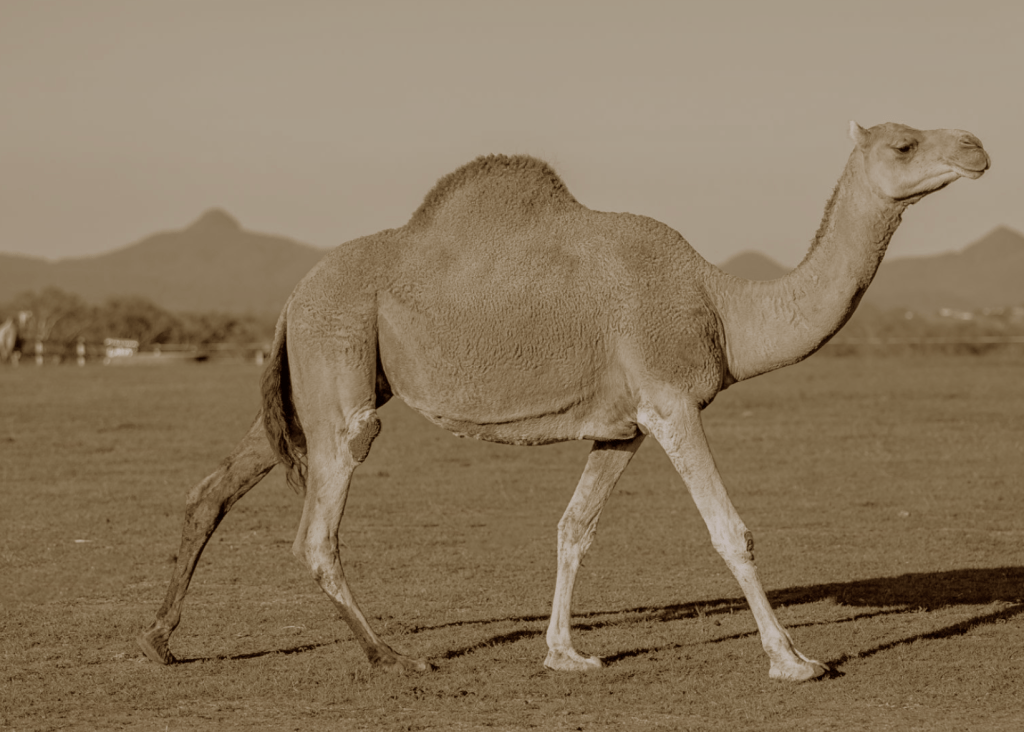
In the sun-scorched deserts of Arizona, the vast emptiness was once filled with the pounding hooves of horses and the steady march of soldiers from the United States Cavalry. But for a brief moment in history, an unlikely companion joined their ranks—the camel. Brought from distant lands, these towering creatures with their humped backs and long legs had intended to be the army’s answer to the challenges of traversing the rugged terrain of the Wild West.
A/I Created Photo
In the mid-1800s, under the guidance of Secretary of War Jefferson Davis, the U.S. government embarked on a truly unique experiment-the ‘Camel Corps’. Camels, renowned for their endurance in desert conditions, were imported to America and tasked with the challenging job of carrying supplies across the barren landscapes where wagons and horses often struggled. The soldiers stationed at the forts in Arizona and New Mexico were initially skeptical. They were baffled by the strange creatures that spit and moaned, their massive feet gliding over the desert sands as if weightless.
Among the camels, one stood out—a massive bull camel named Faris. He had traveled across the seas from the deserts of Egypt, his broad hump towering over his fellow camels. With piercing eyes and a personality as stubborn as the most seasoned cavalrymen, Faris became the pack’s leader, guiding the other camels through endless miles of scorching desert, carrying their loads without complaint.
Library of Congress
But the experiment was short-lived. As the Civil War loomed, funding for the Camel Corps dried up, and the forts in the Arizona desert began to close one by one. With the forts gone and no practical use for the camels, the military made a fateful decision: they turned them loose, setting them free in the vast desert wilderness. The soldiers and settlers who remained watched with mixed emotions as the camels slowly strode off into the horizon, their long necks and humps silhouetted against the setting sun.
Library of Congress
Faris led the herd, now wild, into the vast stretches of land where no human tread. Once tethered and burdened with human supplies, the camels embraced their freedom, roaming the desert, their calls echoing in the canyons and across the mesas.
For years, sightings of the camels became the stuff of legend. Travelers and settlers spoke of giant creatures wandering the wilderness, spooking horses, and disappearing into the dunes as quickly as they were seen. Stories of ‘The Red Ghost’ surfaced, a phantom camel said to be terrorizing ranchers, with strange tracks left in the dust after raids on isolated farms. The mystery deepened with some claiming to see a human skeleton strapped to the back of one rogue camel, but no one knew for sure whether this was fact or fiction.
Library of Congress
Faris, now older but still commanding, led his herd deeper into the desert as the years passed. The camels, with no soldiers to guide them, learned to live off the sparse vegetation, adapting as always. They became masters of the land, surviving where few others could, a testament to their remarkable adaptability.
Generations of Arizonans grew up hearing tales of the camels. Old ranchers would sit by the fire, recounting when they saw a lone camel watching them from the top of a ridge, its eyes gleaming in the moonlight before they vanished into the desert night. Cowboys whispered of Faris, the great camel leader, still roaming the wild, the last of a forgotten army, king of the untamed desert.
So, the camels of the Wild West became more than just a footnote in history—they became legends, ghosts of a time when even the most foreign creatures found a place in the rugged and unforgiving land of the Arizona desert.
A released camel or a descendent of one is believed to have inspired the Arizonan legend of the Red Ghost.
One of the few camel drivers whose name survives was Hi Jolly. He lived out his life in the United States. After his death in 1902, he was buried in Quartzsite, Arizona. His grave is marked by a pyramid-shaped monument topped with a metal profile of a camel.



 benandsteve.com