
By Benjamin GroffMedia© | benandsteve.com | 2025 Truth Endures©
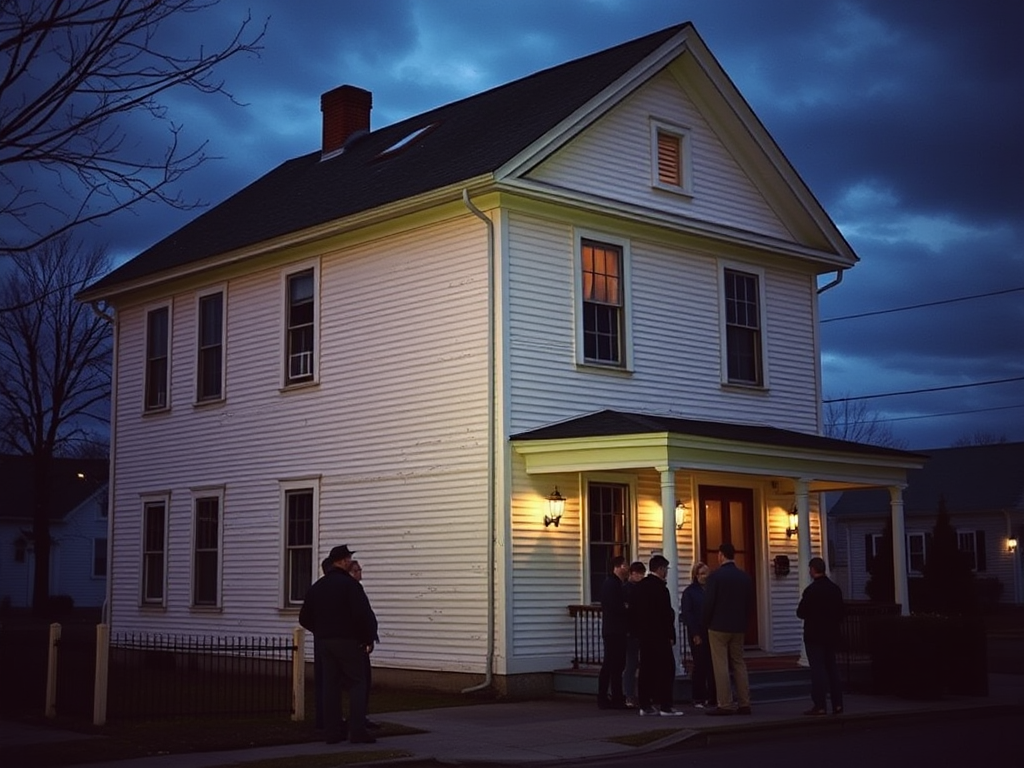
Far from the edges of the town, set an old two-story house. No one ever saw anyone going in or out of the house. The townspeople referred to the old house as the Sims’ place. As far as everyone knew, the last member of the Sims’ family had died years ago. They didn’t know who inherited the ownership of the house. Still, without being seen, the lawn remained manicured and the house was painted and kept up. It looked like the model home for anyone wanting to buy a house. The problem was it wasn’t for sale. As far as anyone knew, they never met anyone who lived there. If anyone lived there at all, nobody knew.
That didn’t stop the stories from spreading.
Children dared each other to run up the front walk and touch the heavy oak door. Teenagers boasted of throwing pebbles at the upstairs windows—until one swore he saw a pale face staring back. No one ever stayed long. The Sims’ place pressed against your skin. It was like a cold hand resting on the back of your neck.
The mail never piled up, though no one ever saw it being collected. No lights came on at night. The porch lantern flickered gently with each dusk. It was like it was welcoming someone home.
One autumn morning, a moving truck pulled into the narrow drive. This was just after the first frost turned the fields silver.
People watched from porches and behind curtains, half-certain the truck would vanish like smoke. But it didn’t. A tall man in a dark coat stepped out. He stood for a long moment at the edge of the walk. Then, he turned the knob and entered without knocking. The door swung open smoothly, like it had been waiting.
By noon, the truck was gone. No one had seen anything carried in or out.
That night, a light glowed faintly in the attic window—the first time anyone had seen one inside in decades.
The next day, the town’s quietest librarian, Mrs. Evelyn Crane, who hadn’t missed a shift in forty years, did not show up for work.
They found Mrs. Crane’s front door wide open, her coat still hanging by the hook, tea cooling on the counter. Nothing was out of place—except for the fact she was gone.
On the floor of her study, neatly laid out, was a photograph no one remembered being taken. It showed the Sims’ house bathed in golden afternoon light. In the top-floor window, a shadowy figure could just barely be made out. A figure with Evelyn Crane’s unmistakable silhouette—bunned hair, long cardigan, glasses catching the light.
The photo was crisp, fresh—too fresh. The paper hadn’t yellowed, and the ink hadn’t aged. Yet, the style, tone, and eerie texture of the photograph made it feel as if it were decades old.
Sheriff McKinley requested a discreet investigation.
Quiet was always the town’s way. A formal missing person report was filed. It was filed only after a week had passed. The report was done with hushed voices.
The librarian’s house sat untouched after that—no one eager to enter it. On the morning of the seventh day, someone noticed a flicker in the Sims’ attic window. The light now flickered slightly. Like a candle in a room with a draft. Like someone moving just beyond its reach.
Then others began to disappear.
Not suddenly, but subtly. A school janitor didn’t show up for work. The pharmacist’s assistant left for her lunch break and never came back. With each absence, the same pattern followed—no signs of struggle, no witnesses, just something left behind. A photograph, a trinket, a drawing… always showing the Sims’ house.
Always with a shadow in the attic.
One morning, the mayor ordered a city records search. He wanted to find any deeds, wills, or other documents related to the Sims family’s legal existence.
The file was blank.
No birth certificates. No death records. No property tax history. Just a penciled note in the margins of a 1933 zoning map:
By whom, no one knew. But the attic light still burned. And some said if you stood on the sidewalk long enough, you would hear soft music playing. A woman humming. And the sound of someone pacing slowly across wooden floors.
Would you like to explore who—or what—is in the attic next? Or maybe follow a new character brave (or foolish) enough to enter the house?
His name was Jonah Bell. A drifter by most accounts, though some swore he’d grown up just a few towns over. He had that type of face—familiar, yet hard to place—late thirties. Wore an old canvas satchel, carried a notebook bound in cracked leather, and spoke only when spoken to.
Jonah arrived on foot, just before dusk. He stopped outside the Sims’ house. He looked it over for a long minute. He muttered something under his breath that sounded like “Still standing.”
A few townsfolk watched him from a distance, expecting him to keep walking. Instead, he opened the rusted gate, walked straight up the weedless stone path, and knocked once.
No one had ever knocked before.
The door creaked open as if it had been listening.
He stepped inside.
The air in the entry hall was still and dry. It was faintly perfumed with old cedar and beeswax. There was also a hint of something sweeter, like lilacs. The floors gleamed under a thin veil of dust. Every piece of furniture stood precisely placed, as if awaiting a long-anticipated visit.
Jonah took out his notebook and began jotting down notes. He whispered as he walked, like he was reciting some memorized litany to keep his courage close.
He passed through the parlor—walls lined with books, many handwritten, their spines bare. The grandfather clock stood frozen at 3:17. In the mirror above the fireplace, his reflection wavered slightly, a half-second behind his movements.
He didn’t stop.
At the end of the hall, the narrow staircase rose, twisting sharply to the left halfway up. It was there, on the sixth step, that the air grew colder.
He reached the landing, hesitated only briefly, then started the climb to the attic. Each step groaned—not with age, but with reluctance, like the house was reconsidering his welcome.
The attic door was shut. White paint cracked along its edges. Carved into the wood, nearly invisible unless you looked for it, was a single word:
“Stay.”
Jonah opened it anyway.
The attic was warm, despite the chill below. A low, golden light poured from an unseen source, casting no transparent shadows. Dust floated like tiny spirits in the air.
In the center of the attic was a rocking chair. And in it, a woman sat.
She was facing the window, her back to Jonah. Gray hair pinned neatly. A music box was on a small table beside her. It played a lilting tune. This was the same tune Evelyn Crane used to hum at the library desk.
Jonah didn’t speak. He stepped closer, notebook open, pencil ready.
The woman turned her head slowly, not startled—expectant.
She had no eyes.
Just smooth, unbroken skin where they should have been. Still, she looked at him.
And she smiled.
“I was wondering,”
She said in a voice like leaves scraping on glass,
“When you’d come back.”
Jonah’s pencil trembled. A page fluttered loose from his notebook.
It was a drawing—sketched in charcoal—of this very attic. The woman in the chair. The music box. The golden light.
Dated: October 13, 1922.
Jonah stared at the sketch, hands trembling, mind racing.
“I don’t remember drawing this.”
He said aloud, but only to himself.
The woman in the chair—still smiling—nodded slowly.
“You never do, not at first.”
He took a cautious step closer, boots silent on the attic’s polished wood.
“Who are you?”
He asked.
“What is this place?”
The woman tilted her head.
“The house remembers.”
She said.
“Even when you forget.”
Jonah knelt to retrieve the page. His fingers brushed the corner of the rocking chair. In a sudden rush, something opened in him. It was a flood of memory. It was not like something recalled, but like a dream breaking the surface after years of sinking.
He was ten. Standing in this very attic. A woman—this same woman—was brushing his hair, humming that tune.
Her face was younger, but the eyes—nonexistent yet somehow seeing—were just the same.
“You called me your boy.”
He whispered, blinking hard.
“But that can’t be. You’re not… real.”
“Oh, I’m real.”
She said.
“As real as anything you forgot.”
He backed away.
“I’ve never lived here.”
The woman raised one hand and pointed to the rafters. Jonah followed her gaze.
Up near the slanted beams, nailed between two joists, was a faded photograph. A family portrait—sepia-toned.
A tall man with a mustache. A small boy with serious eyes. And a woman in a white dress, her arms around them both.
Jonah felt his knees weaken.
The boy was him.
Same face, same eyes.
He staggered back.
“No, no, this can’t—”
“You were born here, Jonah.”
The woman said gently.
“And you left. They made you leave. But the house… the house never forgot. Neither did I.”
He looked around now with different eyes. Not the attic of a haunted place, but something older. Familiar. As though the walls were whispering lullabies from a life he’d buried.
“I don’t understand,”
He murmured.
“You don’t have to.”
She said.
“You only need to remember why you came back.”
He looked down at his notebook again. Page after page of sketches—rooms in the house. A hand-drawn map of the garden. Symbols he didn’t recognize but somehow understood. At the very end, a single phrase repeated over and over:
“The house is waiting. The house is watching. The house wants me home.”
Suddenly, the attic door slammed shut behind him.
He didn’t turn.
The rocking chair creaked gently as the woman leaned forward.
“Now,”
She said, her voice sharper, colder.
“Are you ready to take your place?”
Jonah closed the notebook and looked out the attic window again. Down below, on the street, a child stood at the edge of the lawn. Watching the house and watching him.
The way he once had.
The woman’s eyes—those smooth, sightless hollows—seemed to deepen as she leaned closer.
“You were always meant to return.”
She said.
“Not as the boy you were, but as the man we need.”
Jonah’s voice caught in his throat.
“We?”
The rocking chair stopped moving.
Suddenly, the attic air thickened, as if the room had drawn a breath and was holding it. All around him, the golden light faded. It was replaced by a dim, pulsing glow from the floorboards beneath his feet. The wood creaked in rhythm—a heartbeat.
And then the whispering began.
Not from the woman. From the house.
It came from the walls, from the pipes, from behind the bookshelves. Countless voices, layered over one another. Some frantic, some pleading, others calm and patient, like they had waited an eternity.
He was made out the names—Evelyn, Tommy, Clara—names of the vanished.
“We are here.”
The voices murmured.
“Waiting. Watching. Living still.”
Jonah stumbled backward toward the attic window, but the light outside had changed. The sky beyond was no longer dusky violet but deep, ink-black. No stars. No moon. Only the faint shimmer of fog rolling in across the lawn.
The child he had seen moments ago was no longer there.
The woman in the chair stood.
Not slowly. Not creakingly. She rose, as though the gravity in the attic shifted just for her.
“The house keeps what it claims.”
She said.
“And it chose you long ago.”
Jonah opened his notebook again, desperately flipping pages. The last one had changed.
Where once the phrase had repeated—The house is waiting. The house is watching.—now there was only one line:
“The house has taken root in me.”
His hands began to tremble. He dropped the notebook.
The floor beneath him rippled slightly, the wooden planks softening beneath his boots. He looked down. He saw the faint outline of veins—not his. They were pressing against his skin from below. The veins snaked up his legs like ivy. His reflection in the attic’s glass window twisted subtly—his eyes darker, his face slackening.
The woman smiled gently now.
“You will remember everything soon.”
She whispered.
Then her body folded in on itself, collapsing like smoke caught in reverse. She vanished, leaving the rocking chair slowly swaying, empty once more.
Jonah tried to scream but found no sound.
The voices filled the attic.
“Welcome home.”
Outside, the porch lantern flickered brighter.
And in the attic window, a tall man is now be seen standing in the golden glow, perfectly still. Eyes like shadow. Watching.
Jonah Bell had returned.
But he would not be leaving again.
The next morning, a thin layer of fog clung to the outskirts of town, thickest around the old Sims’ place. The porch lantern had burned through the night, casting a low amber halo across the perfectly trimmed lawn.
A small group of townsfolk had gathered again on the sidewalk, just beyond the rusted gate. They stood quietly—arms crossed, coffee cups in hand, pretending they were just out for a walk.
Sheriff McKinley stood among them, jaw tight, his badge catching the early sun.
“Who was he?”
Asked Mr. Darnell, the barber, adjusting his cap.
“No one local.”
Said the sheriff.
“Drifter, maybe. Name’s Jonah Bell. Didn’t leave a car. Walked in, like they all do.”
The crowd fell silent again. No birds sang. Even the breeze seemed reluctant to pass through the yard.
And then, from the attic window, the light flickered once.
Mrs. Calloway, who had lived on that block the longest, shook her head slowly and muttered, half to herself:
“Oh dear. It’s starting all over again.”
No one disagreed.
They stood a while longer, staring at the house. They quietly dispersed. Each of them walked away faster than they meant to.
None of them noticed the child standing just beyond the fog, clutching a sketchpad and watching the window.
Waiting for the house to notice him.



 benandsteve.com