A while back, WordPress Community Members discussed a curious topic. They wondered whether it was possible to bring back a dinosaur. If so, they questioned which dinosaur it would be.
An attempt to do so may have been underway recently. This became obvious when a monitor lizard screamed and ran for its life. It crashed out of a second-floor window. It then proceeded to lead authorities through a multi-state chase. People were urged to protect their gardens, poodles, and pus— ugh, cats.
Anyways, it is making National News. And I fear that other lizards, regardless of their variety, will start trying the same thing. Suddenly Boom! There will be someone who succeeds, and their progress will be shared with like-minded individuals. Soon we will have a full-throated invasion of body-snatching giant lizards running around telling everyone they are dinosaurs.
Here is breaking news for when they do! HEADLINE: No, Monitor Lizards Are Not in The Dinosaur Family. They are a type of lizard belonging to the family Varanidae. While both dinosaurs and monitor lizards are reptiles, they diverged from a common ancestor long ago. Dinosaurs are part of the archosaur lineage, which also includes birds and crocodiles. Monitor lizards are part of the squamata lineage, which includes other lizards and snakes.
Professor Incredible and the Formula of All Things
Nobody paid much attention to Professor Incredible.
He was a quiet, peculiar man with wild hair and socks that rarely matched. He taught chemistry at the Third-Rate University of Northern Something. His lectures were confusing. His labs were explosive. His office smelled faintly of lemon cake and regret.
One Tuesday afternoon, Professor Incredible was mixing compounds to cure hiccups in parakeets (don’t ask). He tripped over his cat and accidentally spilled three unlabeled vials into a teacup. When he came to after the small puff of smoke cleared, he sipped the tea. Of course, he did. He then scribbled down what he felt was a rather pleasant aftertaste.
That night, he slept peacefully for the first time in years. His arthritis vanished. So did his neighbor’s yappy dog’s aggression. So did the neighborhood’s potholes. So did his runny nose. Something was… different.
The next day, two bickering students visited his office arguing over which was better—crunchy or creamy peanut butter. Absentmindedly, the professor handed them a flask of the leftover formula and said,
“Here. Split this and shake hands.”
They did.
Instantly, they blinked, smiled, and calmly agreed that both were wonderful in different ways. Then they shared a sandwich.
The formula, it turned out, only worked if applied by two people in conflict—who disagreed with equal passion. It didn’t pick a side. It didn’t declare a winner. Instead, it softened anger, lifted empathy, and melted stubbornness into understanding. It didn’t erase problems; it made people care enough to solve them together.
Soon, world leaders were sipping the formula while discussing borders. Rival fans hugged at sporting events. Siblings divided closets in peace. Traffic moved smoother. Even social media got a little less… cruel.
Professor Incredible was offered a Nobel Prize, but declined.
“The formula was an accident,”
he said.
“What matters is what people do with it.”
And so, the world changed—not because the formula was magic, but because people finally heard one another. Understood each other. Worked side by side.
All it took was a little chemistry—and two people willing to try.
John S. Foster Jr., 102, Pioneering Physicist and Architect of U.S. Nuclear Deterrence, Dies
John Stuart Foster Jr. was a visionary physicist. His career spanned over eight decades of American scientific and defense innovation. He passed away on April 25, 2025, in Goleta, California. He was 102. (1)
Born on September 18, 1922, in New Haven, Connecticut, Foster was the son of renowned Canadian physicist John S. Foster Sr. He began his academic journey at McGill University, earning a Bachelor of Science degree in 1948. He later obtained a Ph.D. in physics from the University of California, Berkeley, in 1952. (2)
Foster’s skill during World War II was instrumental in developing radar and countermeasure technologies at Harvard’s Radio Research Laboratory. He served as a scientific advisor to the 15th Air Force in the Mediterranean Theater. This role further demonstrated his dedication to the war effort. (3)
In 1952, Foster was recruited by Edward Teller to join the Lawrence Livermore National Laboratory (LLNL). His leadership in nuclear weapons design at LLNL was groundbreaking. He eventually became the director in 1961. This leadership fostered a culture of innovation and collaboration that continues to inspire today.
From 1965 to 1973, Foster served as the Director of Defense Research and Engineering at the U.S. Department of Defense, advising four Secretaries of Defense and two Presidents. He championed advancements in smart weapons, night vision, and reconnaissance technologies. (4)
After his tenure at the Pentagon, Foster joined TRW Inc. as Vice President of Science and Technology, later serving on its board of directors. He remained an influential figure in national security. He participated in the Defense Science Board. He also joined the President’s Foreign Intelligence Advisory Board. Additionally, he served on the Commission to Assess the Threat to the United States from Electromagnetic Pulse (EMP) Attack. (5)
Foster’s contributions earned him many accolades. These include the Enrico Fermi Award and the Founder’s Award from the National Academy of Engineering. He also received multiple Department of Defense Distinguished Public Service Medals. He was also honored internationally. He received the Knight Commander’s Cross of the Order of Merit of the Federal Republic of Germany. He was named Commander of the French Legion of Honor. (6)
In recognition of his enduring legacy, LLNL established the John S. Foster Jr. Medal, awarded annually to individuals demonstrating exceptional leadership in national security science and technology. (7)
Foster is survived by his family and a legacy that continues to influence U.S. defense policy and scientific research.
A memorial service will be held at Lawrence Livermore National Laboratory. Instead of flowers, the family requests donations be made to the Livermore Lab Foundation in his honor. (8)
Ever since he was a boy, Walter Finch had dreamed of the stars. His bedroom ceiling was a galaxy of glow-in-the-dark stickers. His shelves sagged under the weight of space encyclopedias and toy rockets. He knew the names of every astronaut in the Mercury, Gemini, and Apollo missions. He rattled off orbital mechanics faster than most people recite the alphabet.
There was just one problem.
Walter was terrified of heights.
Not just a little scared. Walter once got stuck on the third rung of a ladder while changing a light bulb. He had to call his neighbor for help. Airplanes? Never. Ferris wheels? A hard no. Balconies on tall buildings? He’d get dizzy just thinking about them.
So he buried his dreams of space travel beneath layers of rationalization. He became an aerospace technician—close enough to the action to feel involved, far enough from the edge to stay sane. Walter worked at the Johnson Space Center. There, he meticulously maintained spacecraft control panels. He also tested simulators and occasionally got to polish a real rocket capsule.
One evening, Walter had a particularly long day prepping a decommissioned capsule for a museum display. He climbed inside to double-check the switches. The interior was warm, quiet, and oddly comforting. He sat back in the pilot’s chair, which had once held real astronauts, and closed his eyes momentarily.
He fell asleep.
And the world moved on.
Somehow, through a wild and improbable series of events, Walter’s capsule encountered several issues. These included miscommunication, a sudden schedule change, and a very distracted launch coordinator. The capsule had been quietly reassigned to a last-minute uncrewed test mission. It was rolled onto the launchpad, sealed, and prepped for liftoff.
Walter awoke to the unmistakable rumble beneath him.
At first, he thought it was a dream. Then, the countdown began.
“Ten… nine…”
Panic hit like a tidal wave. He tried shouting, but the thick insulation swallowed his voice.
“Eight… seven…”
He fumbled with the comm system, but it was already rerouted for the launch.
“Six… five…”
By four, he was crying. At two, he was frozen. And at zero…
The world disappeared.
The force of the launch pinned him to his seat. His breath was ripped from his lungs. His heart pounded like a jackhammer. He blacked out for a second—maybe more.
When he came to, everything was quiet. No more rumble. No more fear.
Just space.
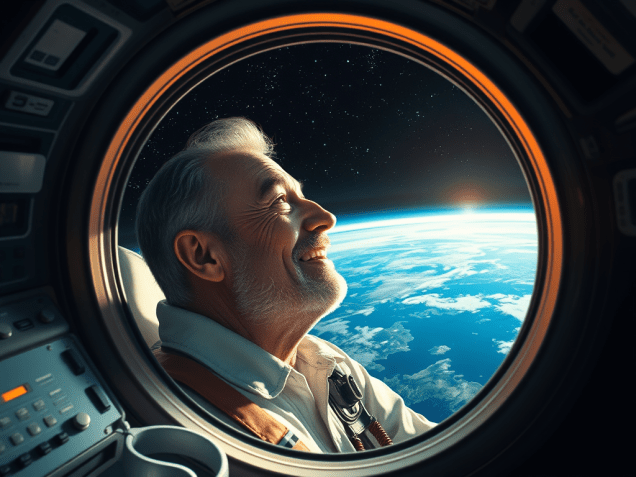
Black velvet studded with stars stretched infinitely beyond the small porthole. The Earth, a swirling marble of blue and green, floated beneath him. The capsule drifted peacefully, like a leaf on the wind.
Walter laughed.
It wasn’t fear anymore. It was a wonder. It was a joy.
For the first time in his life, Walter Finch wasn’t afraid of heights—because there was no height. There was only the infinite.
Mission Control eventually figured out what had happened. There was some yelling, some panicking, and a lot of paperwork.
But by then, Walter had already made history. He was the first untrained man to make it to orbit and back. This was achieved entirely by accident.
They brought him down safely and even gave him a medal. Someone suggested a movie deal. He just smiled and looked up.
From that day on, Walter Finch wasn’t the man afraid of ladders anymore. He was the man who slept his way into space—and found courage among the stars.
And now and then, late at night, he’d climb up to the roof of his house. He would lay on his back and stare at the sky.


 benandsteve.com