Professor Incredible: The Accidental Peacemaker

By Benjamin GroffMedia© | benandsteve.com | 2025 Truth Endures©

2–3 minutes

Professor Incredible and the Formula of All Things

Nobody paid much attention to Professor Incredible.

He was a quiet, peculiar man with wild hair and socks that rarely matched. He taught chemistry at the Third-Rate University of Northern Something. His lectures were confusing. His labs were explosive. His office smelled faintly of lemon cake and regret.

One Tuesday afternoon, Professor Incredible was mixing compounds to cure hiccups in parakeets (don’t ask). He tripped over his cat and accidentally spilled three unlabeled vials into a teacup. When he came to after the small puff of smoke cleared, he sipped the tea. Of course, he did. He then scribbled down what he felt was a rather pleasant aftertaste.

That night, he slept peacefully for the first time in years. His arthritis vanished. So did his neighbor’s yappy dog’s aggression. So did the neighborhood’s potholes. So did his runny nose. Something was… different.

The next day, two bickering students visited his office arguing over which was better—crunchy or creamy peanut butter. Absentmindedly, the professor handed them a flask of the leftover formula and said,

“Here. Split this and shake hands.”

They did.

Instantly, they blinked, smiled, and calmly agreed that both were wonderful in different ways. Then they shared a sandwich.

The formula, it turned out, only worked if applied by two people in conflict—who disagreed with equal passion. It didn’t pick a side. It didn’t declare a winner. Instead, it softened anger, lifted empathy, and melted stubbornness into understanding. It didn’t erase problems; it made people care enough to solve them together.

Soon, world leaders were sipping the formula while discussing borders. Rival fans hugged at sporting events. Siblings divided closets in peace. Traffic moved smoother. Even social media got a little less… cruel.

Professor Incredible was offered a Nobel Prize, but declined.

“The formula was an accident,”

he said.

“What matters is what people do with it.”

And so, the world changed—not because the formula was magic, but because people finally heard one another. Understood each other. Worked side by side.

All it took was a little chemistry—and two people willing to try.
The Unlikely Astronaut: Walter Finch’s Accidental Adventure

Benjamin GroffMedia© | benandsteve.com | 2025 Truth Endures©

3–4 minutes

Title: “The Accidental Astronaut”

 Walter Finch had dreamed of the stars.
Walter Finch “The Accidental Astronaut”

Ever since he was a boy, Walter Finch had dreamed of the stars. His bedroom ceiling was a galaxy of glow-in-the-dark stickers. His shelves sagged under the weight of space encyclopedias and toy rockets. He knew the names of every astronaut in the Mercury, Gemini, and Apollo missions. He rattled off orbital mechanics faster than most people recite the alphabet.

There was just one problem.

Walter was terrified of heights.

Not just a little scared. Walter once got stuck on the third rung of a ladder while changing a light bulb. He had to call his neighbor for help. Airplanes? Never. Ferris wheels? A hard no. Balconies on tall buildings? He’d get dizzy just thinking about them.

So he buried his dreams of space travel beneath layers of rationalization. He became an aerospace technician—close enough to the action to feel involved, far enough from the edge to stay sane. Walter worked at the Johnson Space Center. There, he meticulously maintained spacecraft control panels. He also tested simulators and occasionally got to polish a real rocket capsule.

One evening, Walter had a particularly long day prepping a decommissioned capsule for a museum display. He climbed inside to double-check the switches. The interior was warm, quiet, and oddly comforting. He sat back in the pilot’s chair, which had once held real astronauts, and closed his eyes momentarily.

He fell asleep.

And the world moved on.

Somehow, through a wild and improbable series of events, Walter’s capsule encountered several issues. These included miscommunication, a sudden schedule change, and a very distracted launch coordinator. The capsule had been quietly reassigned to a last-minute uncrewed test mission. It was rolled onto the launchpad, sealed, and prepped for liftoff.

Walter awoke to the unmistakable rumble beneath him.

At first, he thought it was a dream. Then, the countdown began.

“Ten… nine…”

Panic hit like a tidal wave. He tried shouting, but the thick insulation swallowed his voice.

“Eight… seven…”

He fumbled with the comm system, but it was already rerouted for the launch.

“Six… five…”

By four, he was crying. At two, he was frozen. And at zero…

The world disappeared.

The force of the launch pinned him to his seat. His breath was ripped from his lungs. His heart pounded like a jackhammer. He blacked out for a second—maybe more.

When he came to, everything was quiet. No more rumble. No more fear.

Just space.

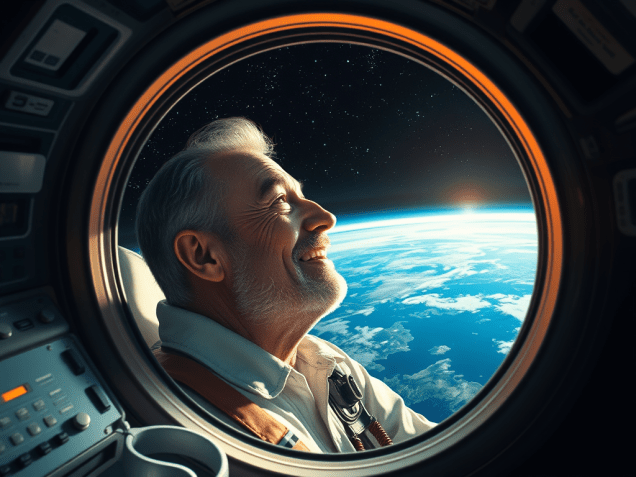
Black velvet studded with stars stretched infinitely beyond the small porthole. The Earth, a swirling marble of blue and green, floated beneath him. The capsule drifted peacefully, like a leaf on the wind.

Walter laughed.

It wasn’t fear anymore. It was a wonder. It was a joy.

For the first time in his life, Walter Finch wasn’t afraid of heights—because there was no height. There was only the infinite.

Mission Control eventually figured out what had happened. There was some yelling, some panicking, and a lot of paperwork.

But by then, Walter had already made history. He was the first untrained man to make it to orbit and back. This was achieved entirely by accident.

They brought him down safely and even gave him a medal. Someone suggested a movie deal. He just smiled and looked up.

From that day on, Walter Finch wasn’t the man afraid of ladders anymore. He was the man who slept his way into space—and found courage among the stars.

And now and then, late at night, he’d climb up to the roof of his house. He would lay on his back and stare at the sky.

He didn’t feel small anymore.

He felt infinite.

New Haven: Rebuilding Humanity After the First Contact War

In 2147, the world was altered irrevocably by the catastrophic aftermath of the First Contact War, a conflict that erupted when humanity made its first contact with an alien civilization. This discovery, instead of being the peaceful meeting of cultures and ideas that many had hoped for, led to a devastating war that ravaged Earth, leaving it a shadow of its former self, with much of the planet in ruins.

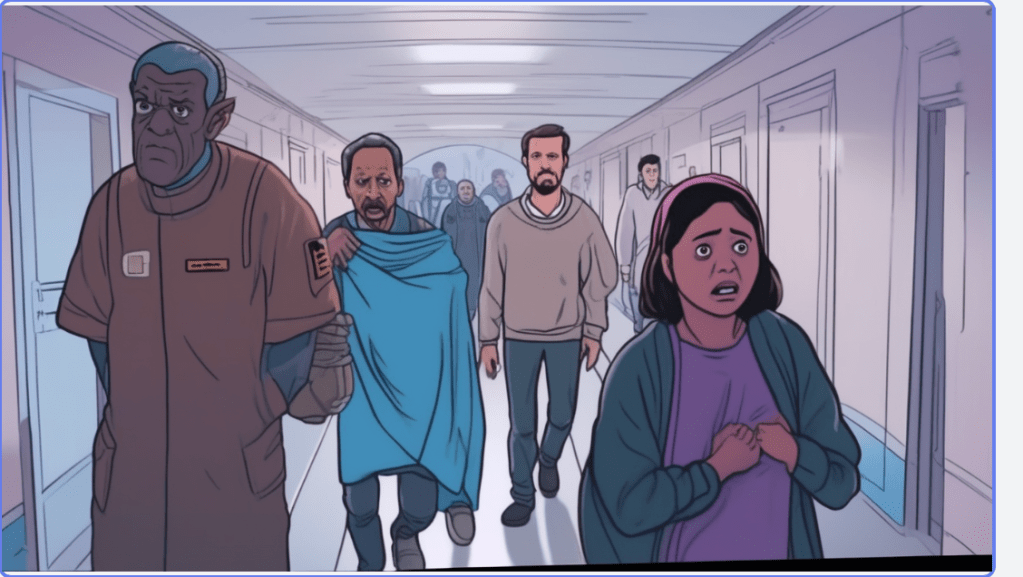
Amidst the desolation, small pockets of survivors, resilient and determined, tried to rebuild their lives. One such place was the settlement of New Haven, a converted underground research facility that provided refuge to humans and non-humans alike. In the dimly lit corridors of New Haven, it was here that a group of survivors, their spirits unbroken, made their way to the main meeting hall.

Leading the group was Dr. Rithian Torvak, a Xelorian biologist from a race that had formed a crucial alliance with humanity against the common enemy. The Xelorians, known for their green, textured skin, and elongated ears, were a race of peaceful scholars who had never engaged in warfare before. Despite the prosthetic arm—a reminder of the war’s brutal cost—he was a source of strength and wisdom, a testament to the unity forged in the face of adversity.

Anaya Patel, a young woman who had become a beacon of hope for many, closely followed Dr. Torvak’s research. Anaya had emerged as a natural leader, her compassionate heart and unyielding spirit rallying the survivors, united in their struggle, through their darkest days. Her parents had perished defending their home, but she had sworn to honor their memory by protecting those who remained.

Beside him, clutching a tattered blue blanket, was Samuel Grant, a former engineer who had lost his family in the initial invasion. Samuel’s eyes appeared haunted, but he found solace in aiding Dr. Torvak with his research, hoping their efforts might lead to a brighter future. His knowledge of pre-war technology was invaluable in keeping New Haven operational.

As they walked through the corridor, the walls echoed with the murmurs of the other residents, each carrying their own stories of loss and survival. The group was heading to a crucial meeting to discuss the latest developments in their efforts to reclaim the surface and search for other survivors.

The corridor opened into a large room filled with makeshift tables and chairs. On one wall, a digital display showed the map of their known world, with red zones marking areas still too dangerous to explore. These zones, remnants of the war, were filled with mutated creatures and unstable terrain, posing a constant threat to anyone who dared to venture into them. The air was thick with a mix of hope and desperation, as the survivors were acutely aware of the dangers that lurked just beyond their reach.

Dr. Torvak stepped forward to address the gathered crowd.

“We have received a transmission from what we believe to be another survivor enclave. This communication could mean there are more of us out there than we thought.”

The room buzzed with whispers. Anaya, her voice steady but filled with emotion, raised her hand, silencing the crowd.

“If there are more survivors, we must find them and bring them here. Every life matters, and together, we can rebuild.”

Her words, a testament to the hope that still burned within them, resonated with the survivors, filling the room with a renewed sense of purpose and determination.

Samuel nodded in agreement.

“We have the technology to send a team, but it will be dangerous. We must prepare for anything.”

Dr. Torvak glanced around the room, his eyes filled with determination.

“We have faced darkness and survived. Now, it is time to reclaim our world, to rebuild what we have lost, and to forge a future where all races can live in peace.”

His words, a rallying cry for the survivors, echoed in the room, filling them with a renewed sense of determination and unity.

As the meeting concluded, the survivors of New Haven felt a renewed sense of purpose. They knew the road ahead was perilous, but they believed, with a flicker of hope in their hearts, they could overcome any obstacle together. In the shadows of their broken world, they found the strength to hope, fight, and dream of a brighter, more peaceful tomorrow.

Despite their broken world, hope remained to rebuild even in the presence of a mixed culture of individuals—all who were put together not out of choice but out of a twist of fate!