On a breezy Saturday morning in Kansas City, a young girl named Ava stood on the steps of Union Station. She was playing a melody her grandfather once taught her. It was soft, trembling, then bold. People stopped. A man on his bike pulled over. A mother hushed her toddler. A retired Marine tapped his foot.
Without a word, a banjo player joined in. Then a trumpet. Someone brought a drum. Across the plaza, a gospel choir leaving rehearsal couldn’t help but add their voices. Tourists lifted their phones, but eventually set them down, choosing instead to simply listen.
The news spread. Within days, public squares from Birmingham to Boise lit up with spontaneous concerts. There were folk and funk, jazz and country, hip-hop, mariachi, and bluegrass performances. No auditions. No politics. Just people showing up and playing.
The sound swept across the country. Arguments quieted. Strangers talked again. Community cookouts popped up. Elders shared stories. Kids danced. People stopped comparing flags and started waving them together.
A Simple Note
It wasn’t shouted or broadcast. It didn’t flash across screens or scroll across headlines. It was just a single, simple note—played quietly on a porch in a small town.
No one knew where it came from at first. A child said it sounded like home. An old man wiped his eyes. A woman humming nearby forgot why she’d been angry. People paused. They listened.
The note turned into a song—one people didn’t realize they remembered. Neighbors began to gather. Strangers smiled. Across the country, others started to hear it too. Not through wires or speakers—but in hearts that had been waiting for something to believe in again.
It wasn’t about sides, slogans, or speeches. It was about belonging.
One simple note… And a nation began to find its way back to itself.
They called it the Harmony Movement—but there was no name when it began. Just one song, from one girl, on one morning, reminding a fractured nation what it still shared:
A rhythm. A voice. A chance to listen. And something worth singing for.
Old Man Teller always said, “You don’t need a weather app when the trees are talkin’.” Most folks in town rolled their eyes. They dismissed the words as just another tale from a man with more years behind him than teeth. But Maggie believed him—always had.
Each morning, before the sun stretched across the Oklahoma horizon, Maggie walked down to the creek behind her farmhouse. The tall cottonwood trees stood like ancient guardians. She’d place her hand on the bark and close her eyes. She’d listen. She listened not just with her ears, but with her skin, her breath, her bones.
One autumn, the cottonwoods began shedding their leaves earlier than usual. Not the vibrant yellow fall kind, but pale and crisp, like they’d been drained of color. The crickets were fewer, and the frogs that usually croaked a lullaby at dusk had gone strangely silent. A stillness settled in the evenings—not peaceful, but hollow, like a breath being held too long.
Teller nodded solemnly when Maggie brought it up. “Means drought’s comin’. The earth’s tightening its belt.”
Sure enough, by December the ponds were cracked at the edges and even the cattle seemed quieter. Yet it wasn’t just the drought. Coyotes started howling at midday. Raccoons were foraging in broad daylight. Wild plum bushes flowered in January—six weeks early.
Nature, it seemed, was shouting.
In spring, the winds changed direction. Not from the south like usual, but from the east—harsh, dry, and persistent. That’s when Teller warned the town council: “There’s fire in that wind. Better get ready.” They didn’t listen. But when the wildfires crept dangerously close in May, only Maggie’s house stood untouched. She’d cleared brush months ago, just as the cottonwoods had told her to.
The next year, people started listening more. They noticed the ants building their hills higher before rain. The deer migrating sooner. Even the sky’s color at dusk began to carry meaning again.
Nature doesn’t send memos or push notifications. But it tells you everything—if you’re willing to sit still, pay attention, and speak its language.
And as Old Man Teller liked to remind them, with a wink, “The land was here long before you. Trust it to know what’s comin’.”
“The Curious Friendship of Happy Goines and Sorrow Downs”
Happy Goines and Sorrow Downs
There once was a boy named Happy Goines. Not a soul could understand why he was always so terribly sad. His name sparkled like sunshine, but his face wore clouds. He dragged his feet to school. He sighed during recess. He stared out windows like he was watching for something that never came.
No one knew what made Happy so downcast. His parents loved him. His teachers were kind. But he always seemed to carry some invisible weight.
That is, until the day he met Sorrow Downs.
Sorrow was a new kid, just moved to town from a place no one could pronounce. He had the kind of grin that made your face smile back before you even realized it. His laugh was sudden and contagious. Even his freckles looked cheerful.
The teacher introduced him to the class. She said his name aloud—“Class, this is Sorrow Downs”. Everyone waited for a gloomy face or quiet voice. But instead, Sorrow waved both hands and said, “Nice to meet you! I love your shoes!” even though he hadn’t looked at anyone’s feet.
The kids chuckled. Except for Happy, who simply blinked.
At lunch, Sorrow sat across from Happy. Sorrow plopped a jelly sandwich on the table. It looked like a gold trophy.
“You look sad,” Sorrow said matter-of-factly.
“I am,” Happy replied.
Sorrow tilted his head. “But your name’s Happy.”
“I didn’t choose it,” Happy said with a shrug.
Sorrow grinned. “Well, I didn’t choose mine either. Imagine being named Sorrow and feeling like I do! Every day feels like a birthday to me!”
Happy cracked the tiniest smile.
“Tell you what,” Sorrow said, pulling a folded paper from his pocket. “Wanna try trading names for a day?”
Happy blinked. “We can’t just—”
“Why not? Who’s stopping us?” Sorrow stood on his chair and declared, “I am Happy Goines today! And this,” he said pointing down, “is Sorrow Downs!”
Some kids giggled. One clapped.
From that moment, something began to shift.
All day long, “Happy” Sorrow told jokes, made up songs, and danced down the hall. And “Sorrow” Happy, for the first time in ages, felt joy in laughing with someone. It was a different experience from laughing at something.
The two became inseparable.
They swapped shoes, lunches, and names whenever they felt like it. One day they were “Joy and Misery.” Another day, “Up and Down.” They learned that feelings didn’t always have to match what people expected.
One day Happy asked, “Aren’t you ever sad, Sorrow?”
Sorrow thought for a moment. “Sometimes. But I don’t stay there. I just let the sad walk beside me until it’s ready to go.”
And Happy nodded like it was the truest thing he’d ever heard.
As the months passed, Happy wasn’t always happy, and Sorrow wasn’t always cheerful. But together they built a friendship where feelings were safe. Names didn’t define you. A good laugh could turn an ordinary Tuesday into something extraordinary.
You might hear two boys shouting new names if you walk past the old schoolyard now. They could be called Sunshine and Thunder, or Giggles and Grumps. They laugh like the whole world belongs to them.
It sat on the back porch, just outside the screen door. It was an old wooden shelf, weather-worn and slightly crooked. Everyone in the family knew it as “the pie shelf.”
Nobody remembered who gave it that name. Maybe it was Grandma. She used to cool her pies on it every Sunday afternoon. That was back when a breeze still found its way through the kitchen windows. There were always two pies—one for dinner and one “just in case someone dropped by.”
That shelf saw more life than most furniture in the house. Birthday cakes cooled there. Jars of canned peaches lined up in neat rows. Once, a baby kitten was found curled up in the corner, fast asleep next to a lemon meringue.
Years later, after Grandma had passed and the house had new owners, the pie shelf remained. Weathered, yes. Empty, often. But it stood—quiet and proud—like it was waiting for one more pie to be set on top.
When I visited the house last fall, I found it just the same. I brushed off the dust. Then, I straightened one of the legs with a folded napkin. For no reason at all, I baked an apple pie and set it right there on the top shelf.
I didn’t expect visitors. But just before sunset, a neighbor from years ago strolled by, drawn by the scent. He laughed when he saw the pie shelf.
“Some things,”
he said,
“don’t ever really leave us.”
We each took a slice and sat there on the porch, sharing stories of the people who came before us. For a brief moment, it seemed as though they were still here. They felt just inside the screen door, waiting for us to come in.
Let’s get back to our story. –– Benji stood in the middle of the woods, heart racing, with three feral hogs growling and snorting nearby. Jackie had lost the scent trail. She couldn’t find the way home. Benji had just thrown away his only peace offering: the beef jerky. The hogs tore through the jerky in seconds. Benji and the three dogs tried to figure out what direction to go. But, now those hogs had regained interest in something more satisfying—the boy.
Oggy circled and snapped at the first boar, trying to keep it distracted. Jackie stood stiff and alert. She barked furiously at the second one. Her tail was rigid and her fur was raised. She positioned herself between the beast and Benji.
Bruiser, Dad’s Shadow
But it was Bruiser who took the lead.
With a thunderous bark, he lunged at the second boar. The clash was brutal. Bruiser’s sheer size and strength gave him an edge. Still, the wild boar was enraged and dangerous. It slashed with its tusks.
Benji screamed,
“No! Bruiser!”
But Bruiser didn’t back down. He planted his feet and forced the boar back with muscle and fury. Oggy darted in to nip at the animal’s hind legs while Jackie’s relentless barking finally drove the creature into retreat.
Within moments, the two remaining boars, startled and overwhelmed, turned tail and vanished into the trees.
Bruiser limped back, a fresh gash on his shoulder. Benji dropped to his knees and wrapped his arms around him, whispering,
“You saved us. You’re the bravest dog in the world.”
The three dogs surrounded Benji, panting heavily—not from fear, but from duty fulfilled. They had done their job.
The sun had dipped lower now, and the smell of distant cooking reminded Benji of home. He hoped Jackie would catch a scent that would guide them back—but no such luck.
They were still stuck in No Man’s Land.
Benji sighed and looked at his companions.
“Well, boys… looks like we’re gonna be here for a while. As well find a safe place to rest.”
The fading daylight painted the woods in long shadows. The path behind them had become a confusing tangle of trees and underbrush.
“I don’t know where we are,”
Benji admitted.
Oggy was licking his sore paws. Bruiser winced with every step. Jackie stood alert—ears perked, head rotating like a radar dish, listening for signs of danger.
Benji reached into his backpack and pulled out his trusty binoculars. Scanning the area, he spotted something—a cave etched into the canyon wall, not far off. It resembled an ancient hollow carved out of sandstone by the water long ago. If they can reach it safely, it can make a decent shelter for the night.
He pulled out a handkerchief. He tore it in half. He tied one piece to a high branch to mark the location.
Oggy took point. Bruiser limped beside Benji. Jackie stuck close this time and carefully marked her trail. They made their way to the cave.
Ten minutes later, they arrived at the entrance. The cave was shallow and quiet, with no signs of animal tracks inside. It looked safe—for now.
Benji gathered dead wood from the forest floor and built a small fire at the cave’s entrance. As the flickering flames grew, casting dancing shadows, the four of them settled in.
But Benji had a surprise.
He hadn’t given all the food to the hogs. He had two cans of Vienna sausages tucked in his backpack. They were beneath a rolled-up poncho. His dad always said to keep them in case of emergencies.
He popped open a can. Instantly, three sets of ears perked up.
Benji smiled and shared the sausages with the dogs, eating slowly and grateful that they had something to eat. But he couldn’t help wondering: How are we going to get out of this mess?
As night fell, the forest faded into darkness. The stars lit up the sky, and the wind rustled the trees outside. The cave offered shelter from the breeze, and the dogs took turns keeping watch while Benji dozed beside the fire.
At around three in the morning, a sharp, blood-curdling scream echoed through the canyon.
All three dogs leaped up, growling and tense. Benji jolted awake. The fire had burned down to glowing coals.
Another scream—closer this time.
Benji grabbed a long stick and jabbed it into the embers, trying to spark a flame. The dogs stood bristling, their fur raised, eyes locked on the darkness beyond.
This is the most dangerous moment yet—except maybe for the hogs.
Benji fumbled through his backpack and found a small flashlight. He switched it on and swept the beam across the canyon.
There, near a shallow watering hole, stood two full-grown wildcats—the biggest Benji had ever seen. Easily 130 pounds each. But the barking, the firelight, and the beam of the flashlight startled them. They bolted, disappearing into the trees.
Benji sat back down, heart pounding. Sleep was impossible now.
Thinking to himself –––
Was something else out there?
Has anyone even started looking for him yet?
He’d never been gone this long.
He sighed and pulled the blanket around him tighter.
“When I get back,”
he whispered to himself
“I’m gonna be in big trouble. For good this time.”
But for now, he is still in No Man’s Land.
And he is lost.
They called it No Man’s Land for a reason. Legend has it, no man who ever entered those woods was seen again. That little detail? It’s something Benji overlooked when planning his latest adventure. Rumor has it. No search party will go in after him. No one’s willing to take the chance they will not come back either. So maybe Benji ought to start thinking about an extended stay. Is anyone even organizing a search? Or will they just do a flyover, check a few boxes, and call it good? Check back tomorrow as the story continues—because things in No Man’s Land are only getting stranger.
In the summer of 1963, the hottest thing in the small town of Hickory Bluff wasn’t the weather—it was Mrs. Bonnie Ledbetter’s yard.
She’d just returned from a week in Florida. She unveiled her latest acquisition with grand ceremony. In one hand, she held a glass of instant iced tea. Her latest acquisition was a pair of bright pink plastic flamingos. They were staked proudly beside her birdbath like sentinels of suburbia.
“They’re classy,”
she declared.
“Very Palm Beach.”
This declaration ignited a cold war of lawn decor on Dogwood Lane.
Mr. Gilmore, her neighbor, responded with a gnome holding a fishing pole. Mrs. Thornton countered with a ceramic frog playing a banjo. By August, the entire block looked like a cross between a garden center clearance bin and a fever dream.
But it was eleven-year-old Joey Timmons who took things to the next level.
Armed with a flashlight, a wagon, and a deep appreciation for chaos, Joey launched what he called “Operation Lawn Flamingo.” On a moonless night, he crept from house to house, relocating Mrs. Ledbetter’s flamingos in increasingly absurd places. One was discovered straddling the mailbox. The other was found lounging in the birdbath, wearing doll sunglasses.
Mrs. Ledbetter was baffled but undeterred. She blamed squirrels.
Joey’s nightly missions escalated. The flamingos were soon photographed perched on the church steeple, tied to Mr. Gilmore’s TV antenna, and once—legend says—riding tandem on a neighbor’s Schwinn. Each time, they were quietly returned to the yard by sunrise.
But one morning, they were gone.
Panic swept Dogwood Lane. Mrs. Ledbetter posted hand-drawn fliers. Mr. Gilmore offered a $5 reward. The town paper ran a headline: “Fowl Play Suspected in Flamingo Heist.”
Days later, on Labor Day, the mystery was solved. A float in the town parade rolled by, sponsored by the hardware store. There they were—Bonnie’s flamingos—crowned with tinsel, waving from a kiddie pool atop a hay wagon.
Joey Timmons was soaked in sweat and joy. He rode behind them in a cowboy hat. He was grinning like a kid who had just outwitted the world.
Mrs. Ledbetter crossed her arms and muttered,
“Well, I suppose they are getting some sun.”
After the parade, she let Joey keep one of the flamingos. The other still stood guard in her yard until the day she died.
Joey’s been mayor of Hickory Bluff for twelve years now.
Some say he still keeps the flamingo in his office.
Two nights later, Chester and Wren moved through the back alleys of Serenity like smoke.
The plan was simple: infiltrate the vault below The Assembly using the abandoned mine shaft Wren had mapped out. Inside, Cain kept more than just gold and guns—he kept records. Blackmail. Ledgers. Evidence.
Evidence that could break him!
Wren led them to a rusted grate hidden behind the collapsed ruins of an old hardware store. Beneath it: a shaft covered in rotted boards and bad intentions.
“Down there?”
Chester asked.
“Unless you’d rather try the front door.”
They climbed down slowly, their boots sinking into decades of dust and discarded bones. Lantern light flickered over graffiti scratched into the stone. Old names. Gang signs. Some symbols are older than either of them recognized.
They crawled through two hundred yards of tight rock. They ducked under fallen beams and crossed a flooded tunnel chest-deep in cold water. Finally, they came to a narrow corridor with smooth brick walls.
“This was built after the mine closed,”
Chester said.
“Cain built it,”
Wren confirmed.
“To smuggle in shipments during the lockdown years. It goes straight to his vault room.”
Chester’s hand rested on his revolver.
“We go in quiet. No guns unless we’re cornered.”
They reached the door—an iron-bound, reinforced, and sealed structure with an old code lock. Wren pulled a tiny folded paper from her coat.
“Petal gave me this,”
She said.
“It’s the combination. She wrote it down after Cain got drunk and showed off.”
Chester raised an eyebrow.
“I’m beginning to like that woman.”
Wren punched in the numbers. The lock hissed. The door creaked open.
Inside, the vault glimmered like a serpent’s nest: stacks of cash, boxes of documents, safes within safes.
But the prize wasn’t money.
It was the black books.
Wren went for the ledgers. Chester opened a crate and pulled out a collection of old film reels labeled with names—judges, mayors, even a U.S. senator.
“This is it,”
He whispered.
“This is Cain’s Kingdom in a box!“
“This is Cain’s kingdom in a box.”
But then, from behind them—a faint click.
Wren froze.
“Did you hear—”
Chester tackled her just as the explosion hit.
The vault door slammed shut.
Dust and debris rained down. A trap. It had been rigged.
From above, in a hidden observation room, Braddock Cain watched through a spyglass.
He turned to Poke and said,
“Let them cook. They wanted into my house. Now they can die in it.”
But neither he—nor Chester—knew that Wren had already mapped another way out.
And worse, Mr. Gallow had just entered Serenity.
Cain’s Kingdom In A Box? Sounds like evidence that sews up this case! But, now Mr. Gallow is in town, and this brings a whole new suggestion for more trouble. Or a solution. It is too early to tell. Maybe Mr Gallow came for the moped. What if the Marshal’s service issued the moped to Chester, and they want it back?
The file on Chester Finch wasn’t stored in any digital archive. It was handwritten, double-sealed, and stored in a fireproof vault in Washington, D.C., under a codename known only to four men who still remembered it.
Operation Ashwood.
Eight years ago, Chester was part of a black-bag unit inside the U.S. Marshal Service—officially unrecognized, unofficially unstoppable. The team was created to root out systemic corruption in rural American towns with privatized law enforcement and cartel-backed leadership. The mission was simple: infiltrate, destabilize, expose.
Ashwood’s first three targets were textbook. The fourth—Gulch County, Texas—was different.
Chester had made the call. He exposed the sheriff, three council members, and a judge and brought them down with a clean sweep.
But the blowback was lethal.
Three of Chester’s team were ambushed at the exit. A safe house was burned down—with a whistleblower’s daughter inside. The press got hold of fragments, but the whole truth? That was buried in a sealed report and heavily redacted.
Chester took the blame. Not officially. But quietly. They let him keep the badge—under the condition that he’d never be given another high-profile operation again.
Until now.
Serenity was never meant to be his assignment. Someone had slipped his name into the dispatch. Someone with a more extended memory than the agency admitted to.
And now Gallow, the last surviving Ashwood “fixer,” was on the trail.
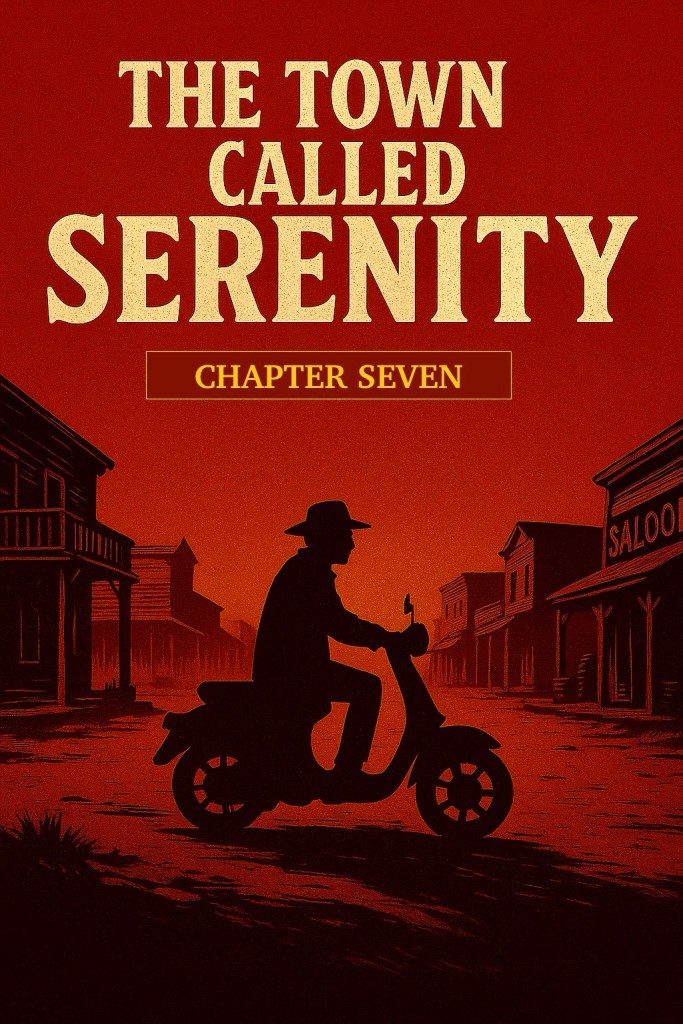
Now, remember this is only a pause between Chapters Five and Seven. This moment is to clarify what was happening. It serves to show what brought Chester Finch to these parts. When Chapter Seven opens, it will seem like only a few days have passed. That will be just enough time for Finch to remember his past, whether he likes it or not. Still, there is no word where he has left the moped. Surely, it would have been used as a bargaining chip with him by now.
The bell above Petal’s shop rang twice—slow and deliberate.
That was the signal.
Wren waited until the third cloud passed over the moon before sliding off the schoolhouse roof. She moved like a whisper down the alleyway, avoiding the creaky boards and broken glass with practiced ease. She paused behind the horse trough near the sheriff’s office and whistled once—two notes, flat and low.
Chester was sitting inside the dim jailhouse with his boots propped up on a barrel. His bruised rib was bandaged with a strip of curtain. He heard the sound and stood up.
He opened the door.
Wren stepped into the lamplight. She was small and wiry, wrapped in an oversized coat that had seen better days. Her eyes were dark and deliberate, scanning the room, the exits, the Marshal.
“I watched you fight the Gentlemen,”
She said without greeting.
Chester gave her a nod, cautious but not cold.
“You’re the girl from the roof.”
“I’m the girl from everywhere,”
She replied.
He gestured to a stool.
“You hungry?”
She hesitated, then sat.
“I want something else.”
“Alright.”
“I want Cain gone.”
Chester leaned back against the wall, arms crossed.
“That makes two of us. But wantin’ it and surviving it are two different things.”
Wren pulled her notebook from her coat and opened it. She showed him a crude map—of underground tunnels, secret entrances, schedules.
“I’ve been tracking his movements for six months,”
She said.
“He’s gotten sloppy. He trusts the wrong people. There’s a weak point—down in the old mines under the vault. He thinks no one remembers it exists.”
Chester raised an eyebrow.
“And you want to hit him there?”
“I want to expose him first. Show Serenity what he is. Not just a tyrant. A liar. A coward. I can get you inside. You have to decide if you’re willing to break the rules you came here to enforce.”
He looked at her for a long moment.
“You ever worked with a marshal before?”
“No,”
Wren replied.
“You ever work with a kid who knows where all the bodies are buried?”
Chester smiled.
“Can’t say that I have.”
She closed the notebook.
“Then we’re even.”
They shook hands—hers small and cold, his calloused and warm. In that moment, something changed. Not in Serenity. Not yet.
But it had started.
Meanwhile –––
Five miles west of Serenity, in a ravine that didn’t show on most maps, a boxcar shuddered to a halt. It stopped on rusted rails.
A figure stepped out—tall, dressed in black, face hidden beneath a wide-brimmed hat. Beside him, four others disembarked—mercenaries, by the look of them. Not local. Not from this state. Not from this country, maybe.
They called him Mr. Gallow.
No one knew if that was his real name. He didn’t speak often, but when he did, people obeyed—or disappeared.
Gallow held up a leather-bound dossier stamped with the faded seal of the Bureau of Internal Affairs. Inside was a photo of Chester Finch, clipped to a thick file marked:
“CLASSIFIED – OPERATION ASHWOOD.”
He flipped the page and revealed a second file—one that bore the name Braddock Cain.
And then a third.
Subject: WREN (Alias Unknown).
Status: Missing / Witness Protection Violation.
Gallow smiled faintly.
He turned to his team and said only two words.
“Kill quietly.”
They vanished into the desert night like wolves on the scent.
Back in Serenity
Petal watched the train lights fade on the horizon, her face tense.
She reached behind the counter, pulled out a dusty revolver, and said to herself,
“They’re all waking up now.”
And somewhere, far below, in the tunnels beneath Serenity, a clock that had long stopped ticking began to turn again.
So, Chester’s past is coming back to haunt him. What exactly are contained in the files OPERATION ASHWOOD Files? And, how much of it did Chester do or not do? He now cares less about the moped. If the contents of the file sees light of day, what would it mean for our Marshal? The man trying to cleanup this dirty town? And the tunnels, are another thing? Just a quick way to get about town or something more sinister?
Braddock Cain stood in front of a pool table inside The Assembly, lining up a shot with surgical calm. His eyes didn’t leave the cue ball even as Poke relayed the report.
“He bloodied Silas’s nose, bruised Dutch’s ribs, broke Miles’ fiddle, and made Jonas fall on his ass,”
Poke said, leaning against a cracked marble column.
“Didn’t even draw his gun.”
Cain took the shot. The cue ball clicked sharply and sank the eight-ball in the corner pocket.
He stood slowly, placed the cue stick back on the rack, and poured himself a drink.
“And the town?”
“They watched,”
Poke replied.
“They didn’t help, but they didn’t laugh either. Some of ’em even looked –– curious.”
Cain stirred his drink with one finger.
“That’s the worst part.”
Poke blinked.
“Sir?”
Cain turned toward the window.
“Fear keeps Serenity in check. When people get curious, they start to hope. And hope’s just a prettier way of saying ‘trouble.'”
He walked back to his velvet chair, every step echoing in the hollow room.
“I want to know everything about Marshal Finch. Where he came from. What he’s running from. Who sent him? And,”
He added, narrowing his eyes,
“who he’s willing to die for.”
Poke nodded and disappeared.
Cain sipped his drink and muttered to the empty room,
“Let’s see what kind of man rides into Hell on a scooter.”
Across the Rooftops
Wren sat cross-legged on the corrugated roof of what had once been Serenity’s schoolhouse. The sun was setting in a blood-orange smear across the sky. She held a spyglass in one hand and a half-sharpened pencil in the other. A leather-bound journal rested in her lap.
Inside were names. Maps. Notes.
She turned to a fresh page and wrote:
Chester Finch – Marshal – Took a hit, didn’t fall. I watched the Gentlemen leave bruised. He won’t last a month. He might last longer.
Beside her sat a worn revolver wrapped in canvas, untouched. Wren didn’t shoot unless necessary.
Observation was safer.
She reached into her coat and pulled out a folded piece of paper. It was a newspaper clipping, old and faded:
“LOCAL DEPUTY DIES IN FIRE — WIDOW, CHILD UNACCOUNTED FOR”
She stared at it for a long moment before tucking it away again.
Wren wasn’t born in Serenity. She was left here. Left during the chaos, after the fire, after the men in black suits came and went. Cain had taken her in—not out of kindness but calculation. He saw her silence, her memory, her talent for hiding in plain sight.
He never asked questions. Neither did she.
Until now.
She looked back toward the jailhouse, where Chester Finch was lighting a lantern in the window. He moved stiffly, but there was something in the way he held himself. Like a man who wasn’t afraid to die—but was trying real hard not to.
She flipped back through her notebook. She found a sketch she’d drawn weeks ago. It was a map of Serenity. The map had dotted lines marking the tunnels under the old mines. It showed the abandoned telegraph station and the hidden entrance to Cain’s private vault room.
Wren circled Chester’s name, then drew a faint arrow pointing to the vault.
It was almost time.
Elsewhere in Serenity ––
Petal wiped the dust from her apothecary shelves. She stared at a cracked photo of her brother. He was killed by Cain’s men for refusing to cook meth in the back room. She kept smiling, but her smile was starting to slip.
Julep Jake, now back in his cell by choice, was building something with matchsticks and chewing gum. “Civic infrastructure,” he explained to no one.
Silas Crane dipped his bleeding knuckle into holy water and laughed softly. “He’s gonna make me preach,” he whispered. “And I do love a sermon.”
Back in The Assembly, Cain sat alone in the dim light, polishing a gold coin between his fingers. One side bore the symbol of the old U.S. Marshal’s badge. The other side? Blank.
“Flip it,”
He whispered.
“Heads, he burns. Tails, he breaks.”
He flipped the coin into the air and caught it.
But he didn’t look.
Not yet.
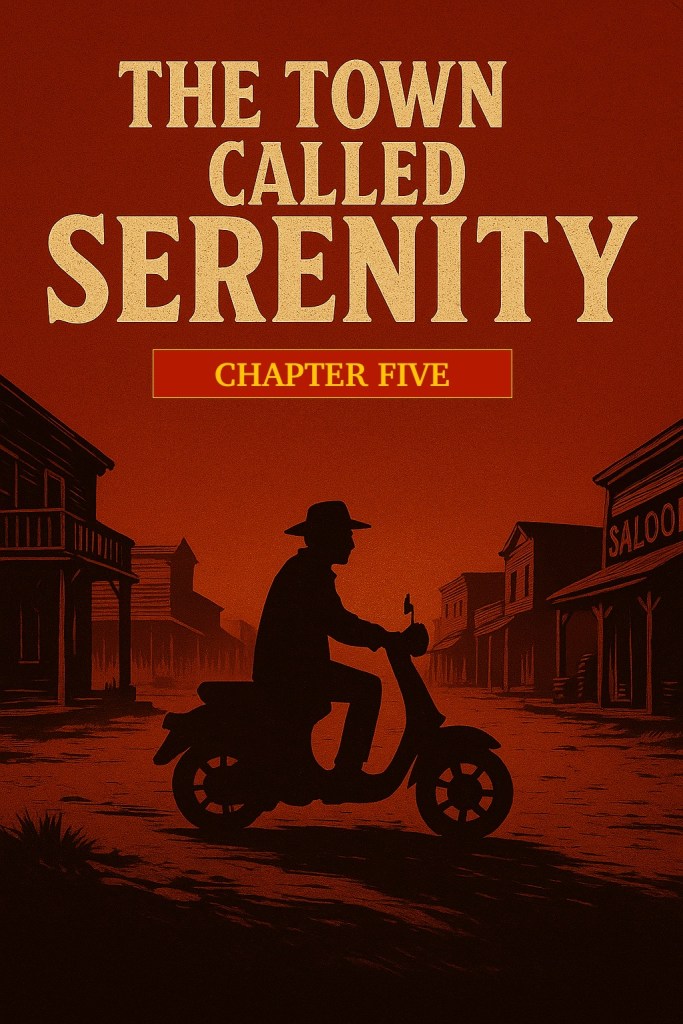
Yet another episode to our story concludes. And, still no word on whether the moped is safe. After all, nowhere in this story is it mentioned whether Chester Finch parked it in a loading zone. It also doesn’t say if he used a 1-hour only parking space when he got to town. So far it hasn’t been used to his advantage in any of the dealings he has had. In Chapter Five, you will find out why. There is a secret method to getting about the town. It is about to unfold.
By noon the next day, the heat in Serenity had risen to an oppressive boil. The town smelled of dry rot, sweat, and gun oil. Somewhere in the distance, a fiddle played off-key. Somewhere closer, someone was being punched.
Chester Finch stepped out of the rickety sheriff’s office he had claimed, swatting at flies with his hat. His left eye was bruised from a scuffle the night before, and he had re-holstered his sidearm four times that morning alone—once while buying coffee, once while crossing the street, once during a handshake, and once because a six-year-old pointed a slingshot at him and said,
“Bang.”
Serenity wasn’t just lawless—it was allergic to rules.
A woman named Petal ran the general store and apothecary. She greeted Chester with an arched brow, and a cigarette clung in the corner of her mouth.
“You’re still alive,”
She said, counting change.
“Didn’t expect that.”
“Thanks for the confidence,”
Chester replied, tipping his hat.
She shrugged.
“Ain’t personal. We don’t usually see second sunrises on lawmen.”
Chester had started to respond when a shadow fell across the dusty street. Four men approached—spaced out like predators, walking with the purpose that made children vanish and shutters slam.
The Gentlemen had arrived.
The one in front was tall, clean-shaven, and wore a preacher’s collar over a duster that flared in the wind. A thick Bible was tucked under one arm. His name was Silas Crane, but most folks called him Reverend Knuckle. He smiled with too many teeth.
“Marshal,”
He said.
“We heard you were new in town. Thought we’d come to say hello proper-like.”
Behind him stood the other three:
Dutch, a former bare-knuckle boxer with hands like cinder blocks and a voice like gravel being chewed.
Miles, a one-eyed fiddler with a twitchy finger, never stopped humming.
And Jonas, the silent butcher-aproned brute who carried a wood-chopping ax like it was a handshake waiting to happen.
Chester stayed calm. He’d dealt with worse—once, a rogue bootleg militia in Nevada. Another time, a cult leader in Kentucky had a fondness for snakes and a penchant for blackmail. These four? They were just another test. Or so he hoped.
“I appreciate the hospitality,”
Chester said, thumb resting on his belt.
“But I’m here on business.”
Silas opened his Bible, then punched Chester square in the jaw. The Marshal hit the dirt hard.
“Chapter One,”
Silas said, closing the book.
“Verse one: The meek get stomped.”
Dutch cracked his knuckles.
“You wanna deliver the sermon, or should we take it from here?”
Chester wiped the blood from his lip and sat up.
“You fellas always greet visitors with scripture and assault?”
“Wegreet threats,”
Silas replied, crouching.
“You’re Cain’s business now. That means you’re ours.”
Behind them, the few townsfolk watching began to edge away, some disappearing entirely. Petal stayed, lighting a second cigarette from the first.
Chester stood up slowly.
“You done?”
Silas raised an eyebrow.
Because that’s when the door behind them swung open, and out walked Julep Jake, shirtless, handcuffed, and barefoot.
“Marshal,”
Jake yelled, grinning wildly,
“you left the cell unlocked again! I declare myself free! By raccoon law!”
Everyone froze.
Even Jonas blinked.
Silas turned slightly.
“What is—?”
And that’s when Chester moved. Fast.
He used the distraction to land a gut punch on Dutch. He spun around Silas. Then, he kicked Miles’ fiddle clean across the street. Jonas came at him like a wrecking ball, but Chester ducked and flipped a barrel in the way. The brute went tumbling.
It wasn’t a win. It was a delay.
But it was enough.
When the dust settled, Chester stood there, breathing hard, badge still gleaming. Around him, the Gentlemen nursed bruises and bruised pride.
“You tell Cain,”
Chester said, voice steady,
“that if he wants me gone, he better send a storm. Because the breeze just isn’t cuttin’ it.”
Silas stared at him, blood on his lip. Then he smiled that too-wide smile again.
“This is gonna be fun,”
He whispered.
They left him standing there, Jake still rambling behind him about his re-election campaign.
Later That Night ––
From a rooftop, a girl no older than fourteen watched the fight unfold. Her name was Wren. She didn’t talk much and didn’t smile either. But she watched everything. She scribbled something in a notebook.
The new Marshal wasn’t like the last dozen.
This one fought back.
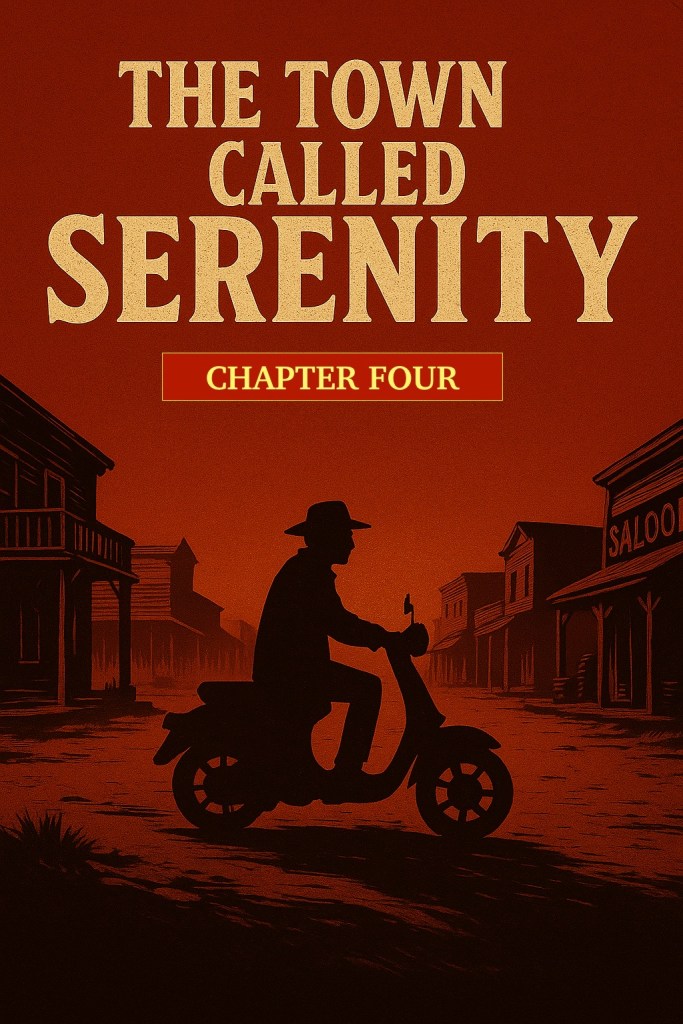
Well now—what a predicament! After crossing paths with The Gentlemen, will the Marshal still be standing? Or will he end up being used to mop the floor by the end of Chapter Four? And as for his trusty moped… is it safe around this unruly bunch? Check here tomorrow for more and Chapter Four of this very exciting story!
In a remote corner of the state, the roads grow narrow. The trees lean in like they’re sharing secrets. There lies a town called Serenity. The name is a cruel joke—there’s nothing serene about it. This is a place where street signs double as target practice. The law has long since departed. No one has noticed. The welcome sign on the outskirts used to say, Population: 312. Someone scratched it out and replaced it with Too Many.
In Serenity, bars outnumber churches, and the only thing thinner than a promise is a badge. It’s where outlaws hide not from the law but from one another. It’s a haven for grifters, gunmen, and ghosts of good men who didn’t make it out.
And into this outlaw’s paradise rolled Chester Finch.
Deputy U.S. Marshal Chester Finch was not the image of frontier justice. He didn’t ride in on a stallion or a dusty pickup truck. No, Chester arrived in Serenity on a cherry-red moped. It’s the kind you’d see zipping through suburbs. You also find it parked at a vegan coffee shop. He wore regulation boots, a broad-brimmed hat, and a badge that gleamed as if it still held some hope.
The moped sputtered as it crossed the town’s crooked boundary, its two-cycle engine whining like a mosquito. Chester parked outside the Rusted Spur Saloon. It was half brothel, half bar, and all trouble. Eyes were already watching him from behind dusty windows and cracked doors.
On the porch, an older man with a shotgun across his knees spat into a tin can and said,
“That there’s the funniest damn thing I’ve seen all week.”
Chester dismounted, kicked the stand down, and brushed the dust off his badge.
“I’m lookin’ for the sheriff,”
He said.
The older man cackled.
“Ain’t had a sheriff since Mad-Eye Morgan got shot for winnin’ too many poker hands. That was six months back.”
“Then I suppose I’m it now,”
Chester replied, squinting at the sun.
“By order of the U.S. Marshal Service, I’m here to restore order.”
The laughter that followed came from more than just the porch. It drifted from second-story windows and behind swinging doors. It came from a town. The town believed the law was something you threw in a ditch. It was buried with the rest of your conscience.
Chester knew this wouldn’t be easy. He knew his badge would draw more bullets than respect. But he also knew Serenity was on the brink of something worse. The federal files hinted at growing ties to outlaw syndicates. There were whispers of gun-running. A name kept popping up: Braddock Cain.
Cain ran Serenity like a private kingdom. Tall, scarred, and charming as a rattlesnake in a bowtie, he was the unspoken king of vice. No one crossed him unless they wanted to disappear.
Chester had crossed worse. Or so he told himself.
His first night in Serenity ended with a knife fight. There was a horse in a bar. The moped was set on fire by a drunk named Julep Jake, who claimed to be the mayor. Chester arrested him anyway. This unpopular move earned him a cracked rib and a bloodied lip. It also earned him the first sliver of respect from the few decent souls still buried in Serenity’s mess.
By morning, Chester had taken over an old sheriff’s office. It was half caved in and smelled of rot and regret. He nailed his badge to the door. It was symbolic more than anything. And in this town, symbols were dangerous.
He had come for peace, riding on two wheels and carrying a quiet resolve. He found a town at war with itself. It was a fight that takes more than a badge to win.
But Chester Finch wasn’t here for symbolism. He was here to end the laughing.
Will the laughing continue? Will Chester live? And what about the town will it still be standing? Find out tomorrow when Chapter Two is presented.
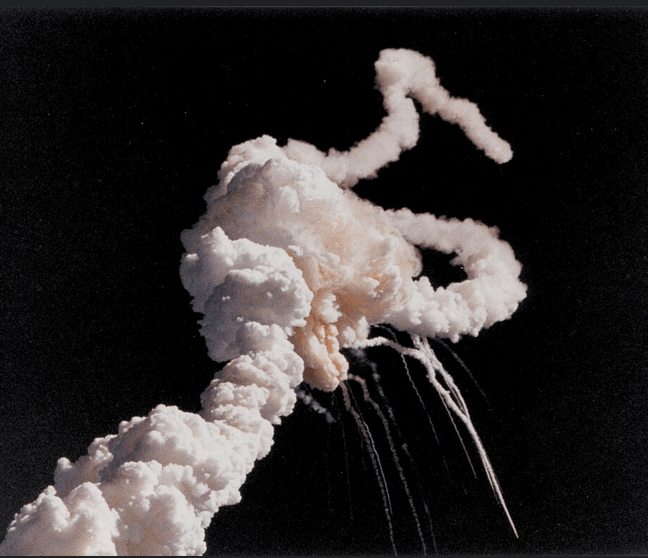
It was January 28th, 1986. Tim was driving to an appointment, his car weaving through fifty miles of winding highways. The radio crackled with the morning news. The Space Shuttle Challenger was set to launch, carrying the first civilian teacher into space.
As the announcer spoke, a sudden, vivid image flashed in Tim’s mind—an explosion, fiery and bright. He gripped the wheel tighter. Then, just as quickly, the vision faded.
This wasn’t the first time. During his years in law enforcement, Tim had experienced moments like this—flashes of insight, warnings he couldn’t explain. Colleagues had asked how he knew things before they happened. He’d only ever shrugged and said, “I’ve got a sixth sense, I guess.”
A commercial break interrupted the news. Tim leaned back, letting the hum of ads drown out the unease rising in his chest. Don’t be ridiculous, he told himself. There are engineers, scientists—people much smarter than me working on this. Who am I to question it?
Then the news returned, live coverage from Cape Canaveral. As the launch countdown continued, Tim felt it again. A deep, cold shiver passed across his neck. Then he envisioned the same haunting image of destruction.
He reached for the dashboard, then pulled his hand back. Should I call? he wondered. Would they even listen? The idea of calling NASA felt absurd. What would I say? he thought. That I had a feeling?
No one would believe him. He’d be laughed off the line—or worse. He pictured himself in a hospital gown, locked behind heavy doors for making prank calls to a national space agency.
So he drove on.
At the appointment, Tim entered the lobby and stepped up to the front desk. Just as he began to sign in, a man burst from his office, wide-eyed.
“You won’t believe what just happened!”
He turned on the TV. On the screen, the Space Shuttle Challenger rose into the sky—and then disintegrated in a plume of smoke and fire.
Gasps filled the room.
Tim stood frozen. The weight hit him all at once. Not just the horror of what had happened but also the hollow ache remained. He knew he had seen it coming… and done nothing.
In the days that followed, he replayed it again and again. The moment he didn’t call. The chance he didn’t take. The voice he silenced.
If he had picked up that phone, maybe nothing would’ve changed. Or maybe someone would’ve listened. Maybe someone smarter than him would’ve paused for just a second. He would never know.
One thing became clear to Tim that day. The burden of inaction weighs heavier than the risk of being wrong.
If he was able do it over, he’d make the call.
No matter how crazy it sounded.
This story is from actual events. The names of those in the story were changed to protect their privacy.
Ever since he was a boy, Walter Finch had dreamed of the stars. His bedroom ceiling was a galaxy of glow-in-the-dark stickers. His shelves sagged under the weight of space encyclopedias and toy rockets. He knew the names of every astronaut in the Mercury, Gemini, and Apollo missions. He rattled off orbital mechanics faster than most people recite the alphabet.
There was just one problem.
Walter was terrified of heights.
Not just a little scared. Walter once got stuck on the third rung of a ladder while changing a light bulb. He had to call his neighbor for help. Airplanes? Never. Ferris wheels? A hard no. Balconies on tall buildings? He’d get dizzy just thinking about them.
So he buried his dreams of space travel beneath layers of rationalization. He became an aerospace technician—close enough to the action to feel involved, far enough from the edge to stay sane. Walter worked at the Johnson Space Center. There, he meticulously maintained spacecraft control panels. He also tested simulators and occasionally got to polish a real rocket capsule.
One evening, Walter had a particularly long day prepping a decommissioned capsule for a museum display. He climbed inside to double-check the switches. The interior was warm, quiet, and oddly comforting. He sat back in the pilot’s chair, which had once held real astronauts, and closed his eyes momentarily.
He fell asleep.
And the world moved on.
Somehow, through a wild and improbable series of events, Walter’s capsule encountered several issues. These included miscommunication, a sudden schedule change, and a very distracted launch coordinator. The capsule had been quietly reassigned to a last-minute uncrewed test mission. It was rolled onto the launchpad, sealed, and prepped for liftoff.
Walter awoke to the unmistakable rumble beneath him.
At first, he thought it was a dream. Then, the countdown began.
“Ten… nine…”
Panic hit like a tidal wave. He tried shouting, but the thick insulation swallowed his voice.
“Eight… seven…”
He fumbled with the comm system, but it was already rerouted for the launch.
“Six… five…”
By four, he was crying. At two, he was frozen. And at zero…
The world disappeared.
The force of the launch pinned him to his seat. His breath was ripped from his lungs. His heart pounded like a jackhammer. He blacked out for a second—maybe more.
When he came to, everything was quiet. No more rumble. No more fear.
Just space.
Black velvet studded with stars stretched infinitely beyond the small porthole. The Earth, a swirling marble of blue and green, floated beneath him. The capsule drifted peacefully, like a leaf on the wind.
Walter laughed.
It wasn’t fear anymore. It was a wonder. It was a joy.
For the first time in his life, Walter Finch wasn’t afraid of heights—because there was no height. There was only the infinite.
Mission Control eventually figured out what had happened. There was some yelling, some panicking, and a lot of paperwork.
But by then, Walter had already made history. He was the first untrained man to make it to orbit and back. This was achieved entirely by accident.
They brought him down safely and even gave him a medal. Someone suggested a movie deal. He just smiled and looked up.
From that day on, Walter Finch wasn’t the man afraid of ladders anymore. He was the man who slept his way into space—and found courage among the stars.
And now and then, late at night, he’d climb up to the roof of his house. He would lay on his back and stare at the sky.
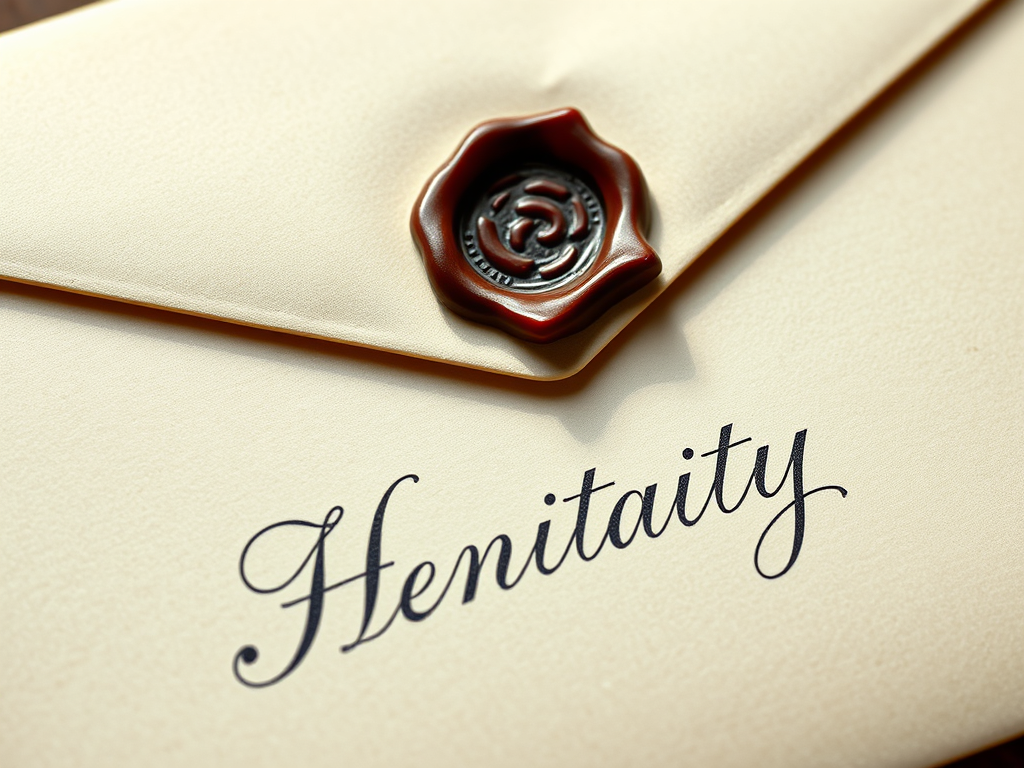
The letter arrived on a Wednesday, sealed with a wax insignia that Alex didn’t recognize. There was no return address, just his name scrawled in an elegant, old-fashioned script. The envelope itself was thick, the parchment that felt out of place in the modern world.
He hesitated before opening it, but curiosity won out. The letter inside was written in the same exquisite handwriting:
Mr. Alex Carter,
Your presence is requested at Blackwood Manor at precisely midnight this Friday. Do not be late. Bring only your wits, and tell no one of this invitation. All will be explained upon your arrival.
This is not a request.
There was no signature.
Alex stared at the letter, his pulse quickening. He had never heard of Blackwood Manor and wasn’t in the habit of receiving cryptic invitations. A prank? Or a mistake? But something about the paper’s texture, the commanding tone, and the archaic penmanship made him doubt that. He felt he had just been drawn into something far more significant than himself.
He spent the next two days researching. There was no official record of Blackwood Manor. Late one night, he found a reference buried in an obscure historical forum. It mentioned an estate on the outskirts of town, abandoned for nearly a century. There were no photographs, no listed owners, just a footnote about a once-prominent family that had vanished without explanation.
At midnight on Friday, Alex stood before the imposing iron gates of the manor. His heart pounded in his chest. The estate, a grand structure that seemed to defy the laws of time, loomed in the darkness. Its ivy-covered walls and Gothic architecture were barely illuminated by the sliver of moonlight breaking through the clouds. Despite their rusted appearance, the gates creaked open at his touch as though they had been waiting for him.
He stepped ahead, the gravel crunching beneath his feet. The air was thick with something replaceable, a tension that made his skin prickle. The massive wooden doors at the entrance groaned open before he knocked.
From a source unknown to Alex, a smooth and knowing voice called from within the manor, echoing through the night.
“Welcome, Mr. Carter. We’ve been expecting you.”
And with that, the door shut behind him, sealing his fate. The candles along the grand hallway flickered to life, casting eerie shadows on the walls. A sudden whisper echoed through the chamber, though no one was visible. Then, the voice returned, this time closer.
“There are three doors to which you must pass through to find what you have lost. If you can’t find your way through all three doors, you will not survive.”
Alex’s breath caught in his throat. He turned, expecting to see the speaker, but the hallway was empty. As he took another step ahead, the world around him seemed to flicker—like a light struggling to stay on. His head pounded, and suddenly, the floor beneath him dissolved. He was falling into a void of darkness, his senses overwhelmed by the absence of light and sound.
Then, a distant beeping noise. Faint voices. A feeling of weightlessness.
Somewhere far away, Alex lay in a hospital bed, his body unmoving. The monitors beeped steadily, measuring a life that hung in the balance. He didn’t know it yet, but the letter, manor, and voice were all part of something more profound. It seemed as though something was urging him to fight his way back.
The first door loomed before him, its frame flickering like a mirage. His hands trembled as he reached for the handle, knowing that whatever lay beyond was the key to his survival.
He entered and found he had to walk across a tightrope to reach the second door. Alex only saw blackness below. He was afraid of heights and not very well-balanced. Alex attempted to steady himself on the rope and inch across, but he couldn’t stay balanced. He returned to the first door and decided to belly crawl across the rope to the second door. It took longer, but he eventually got there.
At the second door, he found it locked by a combination. Only two numbers would open it. Alex tried combinations endlessly, his heart pounding in his chest, until finally pushing in 00, and the door opened. Inside was a spinning floor with different sections that would align with the third door. If he chose the right section, the third door would open. If not, the floor would continue spinning. Alex attempted six different sections before choosing the straightway section that led him to the third door. At the door, he can push or pull. Depending on which way he opened the third door would decide if he lived or died.
Standing at the third door, Alex contemplated which way to open it. His life flashed before him from when he was a baby to his current age. He saw friends and relatives who had passed and noticed things he had forgotten. It would be a gamble. He knew he couldn’t go back. All the doors behind had disappeared once he went through them. His situation hit him with immense gravity. He realized that his decision would decide his fate.
This was it. Would Alex pull or push? He decided to push. As he went through the door, a bright light appeared. Voices loudly chattered. It was as if Alex was opening his eyes for the first time. Then he heard his mother’s voice,
“My God, his eyes are open; Alex, can you hear me?”
Alex, looking around at a sterile room trying to figure out where he had ended up, replied –––
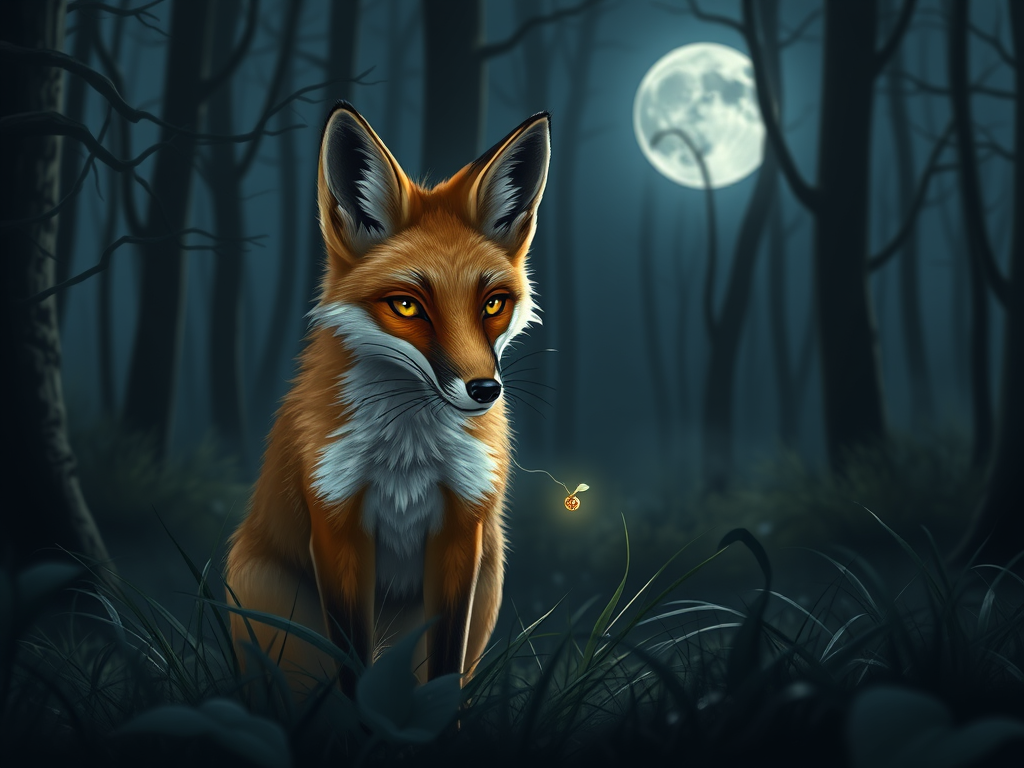
The trees hummed with the wind in the Whispering Woods’s heart. The moon painted silver on the forest floor. There lived a fox named Juniper. She was sleek, clever, and always alone. Other animals whispered about her, calling her a trickster, a thief. She had learned that being alone was more manageable than fighting their expectations.
One evening, a tiny glow flickered near her nose as she padded along the riverbank. A firefly, tiny and trembling, hovered in the air.
“You’re in my way,”
Juniper said, flicking her tail.
“I’m lost,”
The firefly admitted its light dimming.
Juniper sighed.
“Lost? How do you lose your way when you can fly?”
The firefly hesitated.
“I followed my friends, but the wind carried me away.”
Juniper should have walked on. She wasn’t the type to help. She had grown used to being alone, and companionship was foreign to her. But something about the firefly’s quivering glow made her pause.
“Fine,”
She said,
“I’ll help you, but only because I know these woods better than anyone.”
The firefly buzzed with gratitude.
“Thank you! I’m called Luma.”
For the first time in a long while, Juniper felt a glimmer of companionship. As they traveled together, Luma lit the dark paths. She guided Juniper through the thickest parts of the forest. Juniper used her sharp nose to avoid danger.
They spent the night talking. Luma didn’t fear or expect her to be anything other than what she was.
By dawn, they reached a clearing filled with twinkling lights—Luma’s family.
“Stay,”
Luma said.
Juniper almost did. But she was a fox, a creature of the earth, and Luma belonged to the sky.
Still, as she turned to leave, Luma promised,
“Whenever you walk the woods at night, look for my light. You’ll never be alone.”
And so, every night, as Juniper wandered, a tiny flickering glow followed her—an unlikely friendship that lit the darkness forever.
The older man rocked back and forth on the porch swing, the wood creaking under his weight. His nephew, Jake, sat cross-legged on the wooden planks, listening intently. The evening sun stretched its shadows long across the yard, the golden light flickering through the trees.
“You ever run through a plowed field, boy?”
Uncle Neb asked, a slow grin spreading across his weathered face.
Jake wrinkled his nose.
“Why would I do that?”
Ole Neb chuckled.
“Ah, you don’t know what you’re missin’. When I was your age, runnin’ through a fresh-plowed field was the best thing in the world. The dirt was soft, the furrows deep. Felt like jumpin’ across waves in the ocean—only, it was earth beneath your feet, not water.”
Jake smirked.
“Sounds messy.”
“Sure was!”
Uncle Neb laughed.
“And I’d get a good whuppin’ from your grandma for trackin’ mud in the house, too.”
He leaned back, sighing.
“Every spring, my daddy plowed and prepared the land to plant maize and oats. That was our winter feed for the livestock. Down at the bottom of our place, we had an alfalfa field. Grew some of the best in the county, thanks to the floods from the neighbor’s lake.”
“Wait—you let your field flood on purpose?”
Jake asked, wide-eyed.
“Didn’t have a choice, boy! The heavy spring rains would swell that lake, and the water would just roll over into our land. But let me tell you, that soaked ground made the alfalfa thick and green. We never had to worry about our cattle goin’ hungry.”
Jake traced a knot in the porch wood with his finger.
“You had cattle?”
“Sure did. Horses and chickens, guineas, goats—you name it. Had a big ol’ barn on the west side of the place where we kept ’em. But there was one animal I couldn’t go near—one of our milk cows. It is the meanest thing you have ever seen. That cow would lower her head and charge at me as soon as she spotted me.”
Jake grinned.
“You were scared of a cow?”
Uncle Neb narrowed his eyes playfully.
“You woulda been too, boy! Kids had tormented that cow before she came to us. Made her mad as a hornet. Your grandpa had to milk her himself ’cause she wouldn’t let nobody else close.”
Jake laughed.
“Sounds like she had a grudge.”
“That she did. But that was life on the farm, son. You learned to work with what you had, respect the land, and steer clear of mad cows.”
Ole Neb winked.
“Now come on, let’s go walk that field out back. Maybe you’ll see why runnin’ through dirt felt like flyin’ to a boy like me.”
Jake hesitated, then hopped up.
“Alright, Uncle Neb. But if I trip, you owe me ice cream.”
Neb laughed, his voice warm as the setting sun.
“Deal, boy. Deal.”
And together, they walked toward the fields, the past and gift blending with every step.
Harold Whitman woke before dawn, just as he had done for countless mornings. He stretched his aching limbs, feeling the stiffness permanently occupying his bones. The old house was quiet. Only the refrigerator’s soft hum and the occasional creak of settling wood were heard. This familiar symphony accompanied his every awakening.
He shuffled to the kitchen, brewed a pot of coffee, and sat at the window. He watched the sunrise paint the morning sky in shades of orange and pink. He savored the moment. The cup’s warmth was in his hands, and the faint aroma of the beans filled the air. His late wife had always loved those beans.
Today, he decided, would be a good day.
After breakfast, Harold walked to the park, as he had done for decades. He fed the ducks at the pond. He nodded to the joggers and dog walkers. They had become familiar faces over the years. These interactions, though brief, were like tiny rays of sunshine in his otherwise solitary life. A young boy, no older than six, waved at him from the swings. Harold smiled and waved back.
At the corner store, he bought a piece of his favorite caramel candy and an extra for the cashier. Marisol, a sweet girl, constantly reminded him of his granddaughter.
“You spoil me, Mr. Whitman,”
she said, laughing as she unwrapped the treat.
“Someone’s got to,”
he replied with a wink.
In the afternoon, he visited the cemetery. He sat on the bench beside his wife’s headstone, tracing her name with his fingers. The silence of the place soothed his soul. He felt a strange comfort thinking about joining his wife.
“I think I’ll be seeing you soon,”
he murmured.
“Maybe later tonight.”
There was no fear in him—just a quiet knowing.
Before heading home, he stopped by the diner, ordering a slice of apple pie and a cup of black coffee. The waitress, Lucy, patted his shoulder.
“You always get the same thing,”
she teased.
“Because I know what’s good,”
he said with a grin.
That evening, Harold sat in his favorite chair by the window, where the sunset bathed the room in golden light. He opened a book, though he barely read the words and content to hold it.
When sleep came, it was gentle, like slipping into a warm embrace.
Harold’s heart gave its final beat, and he sighed with quiet satisfaction. His last day had been good, a testament to the peace and acceptance that filled his heart.
There once was a man named Walter Higby. He traveled from town to town. He wore a tweed coat and a bowler hat. He also carried a cane he didn’t need. Walter was a whimsical figure. He had a peculiar habit. He greeted everyone the same way. This added a touch of whimsy to their lives.
“You do,”
he would say with a sly smile.
Usually caught off guard, the person would blink in confusion.
“What?”
“You remind me of a man,”
Walter would continue.
“Who do?”
The person would ask, leaning in, curious now.
“You do,”
Walter would insist, tapping his cane on the ground for emphasis.
The other person would reply,
“I do?”
Which Walter would say,
“No, you do.”
And the reply would be,
“What?”
Which Walter would, in return, say,
“Remind me of a man.”
By this point, the conversation had become a swirling, nonsensical loop, leaving the other person chuckling or scratching their head. Walter never explained why he did it, nor did he ever stay long enough for anyone to figure him out.
One day, a young boy named Tommy stops Walter before he can walk away. “Mister, why do you say that to people?”
Walter looked down at Tommy and grinned. “Because it makes them think, and it makes them smile. That’s enough, don’t you think?”
Tommy thought for a moment, then nodded. “Yeah, I guess so.”
Walter tipped his hat, tapped his cane, and continued down the road. He was ready to meet the next unsuspecting stranger with his playful riddle. The man spoke in circles and kept wandering, leaving a trail of puzzled and amused people in his wake.