
By Benjamin H. Groff II | Truth Endures | The Story Teller
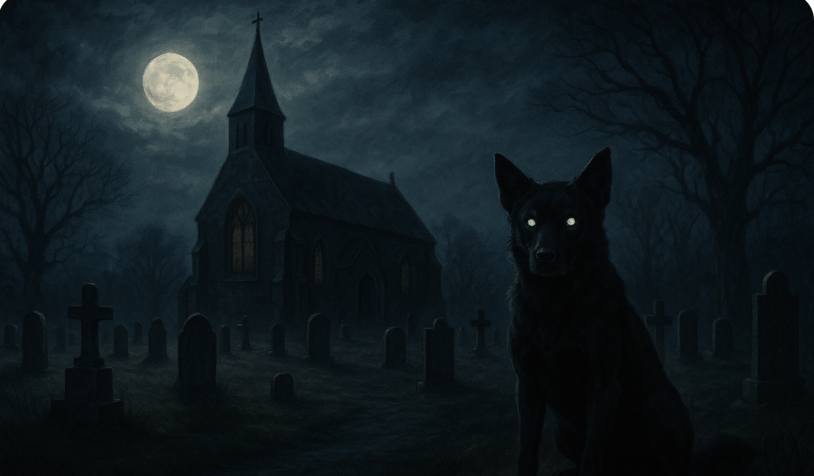
Tales are whispered across the cold stones of Scandinavia. They speak of an “evil dog” that once haunted the churches of Sweden. But those who truly know the legend say the creature was never evil at all. It was the kyrkogrim — a guardian spirit born not of sin, but of sacrifice.
A Dog Buried Beneath Holy Ground
In the centuries when churches first rose across the Nordic lands, builders followed a chilling custom. To guarantee their new sanctuaries would stand against evil, they buried a living creature beneath the cornerstone. This creature was often a black dog. Its final, terrified breath was thought to bind its soul to the ground, forming a spiritual sentinel.
That spirit became the kyrkogrim: the Church Grim. It was always black as midnight. It was condemned to patrol the churchyard. Its duty was to watch over the graves and keep the devil himself from defiling holy ground.
The Protector and the Omen
By day, the kyrkogrim was invisible. But when night fell and candles flickered low, villagers spoke of seeing the great black hound. It was pacing near the church doors. Its eyes glowed like coals in the dark. It was said to snarl at grave robbers and frighten off witches. Yet, for all its protection, it carried a darker burden.
To see the kyrkogrim was to get a warning. The watcher’s death, it was said, would soon follow. The same spirit shielded the church from evil. It also bore the scent of the grave. This grim paradox kept villagers both thankful and fearful of its presence.
The First Soul of the Graveyard
Long before Christianity spread through Scandinavia, ancient peoples offered animal sacrifices to bless new structures and sacred sites. Early Christian builders, inheriting these customs, altered them to fit their faith. The dog buried beneath the first church became “the first soul” in the graveyard. This ensured that no human would have to linger eternally as the church’s guardian.
Thus, the kyrkogrim was not a monster. Instead, it was a martyr. It symbolized the uneasy blend of pagan ritual and Christian devotion. It was the bridge between two worlds: the old gods of the land and the new God of the heavens.
Echoes Through Time
Even today, stories of the kyrkogrim persist in Swedish folklore. Some say the black dog still walks among the headstones on stormy nights, especially near churches centuries old. Others claim that every church has its own silent watcher — unseen, but always there.
What began as a superstition has evolved into something deeper. It reflects the human need to guard what we hold sacred. The kyrkogrim, once buried in darkness, lives on in story — a faithful spirit that never abandoned its post.
By Benjamin GroffMedia© | benandsteve.com | ©2025
 benandsteve.com
I think there’s always a silent watcher or unseen. Interesting prose, Benjamin!
LikeLiked by 1 person
This is true. It is taken for granted too often.
LikeLiked by 1 person