THE TOWN OF SERENITY – Chapter Nine: A Predator in the Garden

By Benjamin GroffMedia© | benandsteve.com | 2025 Truth Endures©

3–4 minutes

Chapter Nine: A Predator in the Garden

Braddock Cain sat alone in The Assembly, a chessboard in front of him, half-played.

It was something he did when the whiskey wore off, and the world got too quiet. He played both sides of the board. He always made sure black lost.

Tonight, black wasn’t losing.

He moved a knight, sat back, and scowled.

The vault trap should have buried Finch and the girl. He’d received no word from Poke, which was unusual. Too unusual.

A low, sharp knock came at the door—three short raps. 

Then silence.

His eyes narrowed.

“Enter,”

He growled.

The door creaked open, and the man who stepped inside wasn’t Poke. Wasn’t anyone from Serenity? His clothes were clean, military-cut. His boots were dustless. He didn’t wear a hat—but his shadow felt longer than the room allowed.

“Mr. Cain,”

The stranger said. 

“I presume.”

Cain stood, hand already on the grip of his pistol.

“You don’t walk into this room without an invitation.”

“I didn’t walk,” 

The man replied. 

“I arrived.”

Cain didn’t move to open it.

“You’re Gallow,”

He said flatly.

“That’s what they used to call me,”

The man replied. 

“In certain circles. Not the ones you buy into.”

Cain sat back slowly. 

“What do you want?”

Gallow smiled faintly.

“Let’s call it… clarity. You’ve grown fat on rot, Cain. But rot attracts insects. I’m here to burn the carcass clean.”

Cain let out a cold laugh. 

“You think you can walk into my town and—”

Gallow was suddenly in front of him.

Cain hadn’t even seen the movement.

A knife gleamed under Cain’s chin.

“I don’t think,”

Gallow whispered. 

“I replace. You’ve become a liability to men far above either of us. The vault was never your property. The tapes, the ledgers, the names—you were supposed to manage them, not flaunt them.”

Cain’s eyes narrowed. 

“You’re not just here for Finch.”

“I’m not here for Finch at all,”

Gallow said softly.

“He’s just a broken piece. You’re the engine.”

He pulled the knife away and tucked it back into his sleeve.

“I won’t kill you tonight. That would be –– premature. But I will leave you with a choice.”

Gallow tapped the Ashwood file.

“Burn this. Leave town. Or wait for me to come back.”

Then he was gone.

Cain sat still for a long time, listening to the echo of Gallow’s departure. When his hand finally moved, it wasn’t for his gun.

It was for the bottle.

Elsewhere in Serenity

Poke’s body was found behind the saloon—face down, no bullet wound, no blood.

Just two coins were placed over his eyes.

Wren and Chester stood over him in silence.

“Gallow’s here,” 

Wren said. 

“And he’s not working for Cain. He’s cleaning the house.”

Chester looked toward the west horizon, where dust clouds rolled in from the direction of the rail line.

He pulled the badge from his coat and stared at it.

“Time to decide,” 

He muttered. 

“Do I play Marshal—or outlaw?”

Well now, Gallow is certainly making his presence known! And Cain clearly has a big decision to make—but will he actually leave town? If so, he better start packing snacks for the road. But if he’s thinking about staying, he’ll want to give Jonathan Lawson a call. He should secure himself a Colonial Penn Life Insurance policy. It’s unfortunate Poke didn’t think ahead. Maybe those two coins over his eyes are enough to cover a plot in the nearest potter’s field.

As for Marshal Chester Finch, he’s defied the odds and made it to Chapter Ten. And it looks like this final chapter will finally answer the big mystery: the moped. Where has it been? Who hid it? Why wasn’t it tampered with? What was it originally bought for? And when did Chester decide it would be his official Marshal’s ride?

All of this—and more—will be revealed in Chapter Ten. ~ WE Hope ~

The Town Called Serenity – Chapter Eight – The Devil Knows The Way Out

By Benjamin GroffMedia© | benandsteve.com | 2025 Truth Endures©

3–4 minutes

Chapter Eight: The Devil Knows the Way Out

The blast had sealed the main vault door and collapsed part of the tunnel behind them. Smoke choked the air. Brick and metal groaned under stress. Chester blinked through blood and dust, pulling Wren up from the rubble.

“You alright?”

He asked, coughing.

“Been worse,” 

Wren muttered, cradling her left arm. 

“Dislocated, not broken. I’ll pop it back.”

Chester pulled out a penlight and scanned the room. 

“No exit. That was the only way in.”

Wren smiled through the pain. 

“You thought it was.”

She limped to the far wall. A section of decorative tiling was there—old, Spanish-style. It jutted out from the stone like it didn’t belong. She knocked three times in a rhythm that echoed deeper than it should have.

A hollow click responded.

“Cain didn’t build the vault himself. He took it from a man who did. The original owner had escape routes.”

She traced a tile shaped like a broken star and twisted it counterclockwise. With a faint hiss, the tile wall slid inward, revealing a narrow stone chute, half-collapsed and riddled with centipedes.

Chester stared into the black.

“I don’t suppose you brought rope,”

He said.

“Nope.”

“Alright then,”

He grunted, and they vanished into the dark.

In the Streets Above

Petal stood at her shop counter grinding roots when the front door exploded inward.

She ducked instinctively, drawing her old revolver, but it was too late.

Two men in black tactical gear moved in fast, grabbed her arms, and yanked her across the counter. The third figure entered last—calm, silent.

Mr. Gallow.

He picked up a vial from the shelf, sniffed it, and set it down.

“I’ve read your name,”

He said, voice flat. 

“You’re a known associate of Wren. Harboring her. Aiding a rogue federal.”

Petal spat blood and smiled. 

“You got a badge?”

“No. I have jurisdiction.”

He signaled.

The men dragged her out.

They disappeared down the street. Julep Jake watched from his cell window. He was whittling a miniature guillotine from an old broom handle. 

“And now the harvest begins,”

He muttered.

The Long Climb

Chester and Wren emerged two hours later through a rusted maintenance grate behind the abandoned Serenity Theater. They were scratched, covered in brick dust, and exhausted—but alive.

Wren wiped grime from her face. 

“He set us up. Knew we were coming.”

Chester nodded grimly. 

“Means we rattled him.”

She held up the two ledgers she’d saved—one in each hand.

“He loses if these go public.”

Chester took them, tucking them into his coat. 

“Then let’s make sure they do.”

Suddenly—gunfire cracked in the distance. Three pops.

Wren froze. 

“That was near Petal’s.”

Chester’s face hardened. 

“We’re not the only ones he’s playing.”

They moved quickly down the alleys. Even as they ran, Wren stopped cold. She saw the mark scorched onto the alley wall: a circle with a horizontal line through it.

She grabbed Chester’s arm. 

“That’s not Cain’s symbol.”

“What is it?”

Wren’s voice dropped to a whisper. 

“It’s Gallow’s.”

Chester turned, scanning the rooftops.

“Then we’re out of time.”

What exactly did the symbol mean? Chester had the answer—or at least a regulation book with the answer—tucked away in the saddlebags on his moped. The problem? He didn’t bring it with him. And it’s too far to walk back now. Truth is, he hasn’t laid eyes on that moped since he rolled into town. So, is it hidden so well that he forgot where it is? Or is he protecting a strategic location he’s not ready to reveal? With only two chapters left, the Marshal better get moving!

The Town Called Serenity – Chapter Seven – The Hollow Vault

By Benjamin GroffMedia© | benandsteve.com | 2025 Truth Endures©

2–3 minutes

Chapter Seven: The Hollow Vault

Two nights later, Chester and Wren moved through the back alleys of Serenity like smoke.

The plan was simple: infiltrate the vault below The Assembly using the abandoned mine shaft Wren had mapped out. Inside, Cain kept more than just gold and guns—he kept records. Blackmail. Ledgers. Evidence.

Evidence that could break him!

Wren led them to a rusted grate hidden behind the collapsed ruins of an old hardware store. Beneath it: a shaft covered in rotted boards and bad intentions.

“Down there?” 

Chester asked.

“Unless you’d rather try the front door.”

They climbed down slowly, their boots sinking into decades of dust and discarded bones. Lantern light flickered over graffiti scratched into the stone. Old names. Gang signs. Some symbols are older than either of them recognized.

They crawled through two hundred yards of tight rock. They ducked under fallen beams and crossed a flooded tunnel chest-deep in cold water. Finally, they came to a narrow corridor with smooth brick walls.

“This was built after the mine closed,” 

Chester said.

“Cain built it,” 

Wren confirmed. 

“To smuggle in shipments during the lockdown years. It goes straight to his vault room.”

Chester’s hand rested on his revolver. 

“We go in quiet. No guns unless we’re cornered.”

They reached the door—an iron-bound, reinforced, and sealed structure with an old code lock. Wren pulled a tiny folded paper from her coat.

“Petal gave me this,” 

She said.

“It’s the combination. She wrote it down after Cain got drunk and showed off.”

Chester raised an eyebrow. 

“I’m beginning to like that woman.”

Wren punched in the numbers. The lock hissed. The door creaked open.

Inside, the vault glimmered like a serpent’s nest: stacks of cash, boxes of documents, safes within safes.

But the prize wasn’t money.

It was the black books.

Wren went for the ledgers. Chester opened a crate and pulled out a collection of old film reels labeled with names—judges, mayors, even a U.S. senator.

“This is it,”

He whispered.

“This is Cain’s Kingdom in a box!

“This is Cain’s kingdom in a box.”

But then, from behind them—a faint click.

Wren froze. 

“Did you hear—”

Chester tackled her just as the explosion hit.

The vault door slammed shut.

Dust and debris rained down. A trap. It had been rigged.

From above, in a hidden observation room, Braddock Cain watched through a spyglass.

He turned to Poke and said, 

“Let them cook. They wanted into my house. Now they can die in it.”

But neither he—nor Chester—knew that Wren had already mapped another way out.

And worse, Mr. Gallow had just entered Serenity.

Cain’s Kingdom In A Box? Sounds like evidence that sews up this case! But, now Mr. Gallow is in town, and this brings a whole new suggestion for more trouble. Or a solution. It is too early to tell. Maybe Mr Gallow came for the moped. What if the Marshal’s service issued the moped to Chester, and they want it back?

The Town Called Serenity – Chapter Six – Ashwood

By Benjamin GroffMedia© | benandsteve.com | 2025 Truth Endures©

1–2 minutes

Chapter Six: Ashwood

The file on Chester Finch wasn’t stored in any digital archive. It was handwritten, double-sealed, and stored in a fireproof vault in Washington, D.C., under a codename known only to four men who still remembered it.

Operation Ashwood.

Eight years ago, Chester was part of a black-bag unit inside the U.S. Marshal Service—officially unrecognized, unofficially unstoppable. The team was created to root out systemic corruption in rural American towns with privatized law enforcement and cartel-backed leadership. The mission was simple: infiltrate, destabilize, expose.

Ashwood’s first three targets were textbook. The fourth—Gulch County, Texas—was different.

Chester had made the call. He exposed the sheriff, three council members, and a judge and brought them down with a clean sweep.

But the blowback was lethal.

Three of Chester’s team were ambushed at the exit. A safe house was burned down—with a whistleblower’s daughter inside. The press got hold of fragments, but the whole truth? That was buried in a sealed report and heavily redacted.

Chester took the blame. Not officially. But quietly. They let him keep the badge—under the condition that he’d never be given another high-profile operation again.

Until now.

Serenity was never meant to be his assignment. Someone had slipped his name into the dispatch. Someone with a more extended memory than the agency admitted to.

And now Gallow, the last surviving Ashwood “fixer,” was on the trail.

Now, remember this is only a pause between Chapters Five and Seven. This moment is to clarify what was happening. It serves to show what brought Chester Finch to these parts. When Chapter Seven opens, it will seem like only a few days have passed. That will be just enough time for Finch to remember his past, whether he likes it or not. Still, there is no word where he has left the moped. Surely, it would have been used as a bargaining chip with him by now.

The Town Called Serenity – Chapter Five – The Clock In The Dust

By Benjamin GroffMedia© | benandsteve.com | 2025 Truth Endures©

3–5 minutes

Chapter Five: The Clock in the Dust

The bell above Petal’s shop rang twice—slow and deliberate.

That was the signal.

Wren waited until the third cloud passed over the moon before sliding off the schoolhouse roof. She moved like a whisper down the alleyway, avoiding the creaky boards and broken glass with practiced ease. She paused behind the horse trough near the sheriff’s office and whistled once—two notes, flat and low.

Chester was sitting inside the dim jailhouse with his boots propped up on a barrel. His bruised rib was bandaged with a strip of curtain. He heard the sound and stood up.

He opened the door.

Wren stepped into the lamplight. She was small and wiry, wrapped in an oversized coat that had seen better days. Her eyes were dark and deliberate, scanning the room, the exits, the Marshal.

“I watched you fight the Gentlemen,”

She said without greeting.

Chester gave her a nod, cautious but not cold. 

“You’re the girl from the roof.”

“I’m the girl from everywhere,”

She replied.

He gestured to a stool. 

“You hungry?”

She hesitated, then sat. 

“I want something else.”

“Alright.”

“I want Cain gone.”

Chester leaned back against the wall, arms crossed. 

“That makes two of us. But wantin’ it and surviving it are two different things.”

Wren pulled her notebook from her coat and opened it. She showed him a crude map—of underground tunnels, secret entrances, schedules.

“I’ve been tracking his movements for six months,”

She said. 

“He’s gotten sloppy. He trusts the wrong people. There’s a weak point—down in the old mines under the vault. He thinks no one remembers it exists.”

Chester raised an eyebrow. 

“And you want to hit him there?”

“I want to expose him first. Show Serenity what he is. Not just a tyrant. A liar. A coward. I can get you inside. You have to decide if you’re willing to break the rules you came here to enforce.”

He looked at her for a long moment. 

“You ever worked with a marshal before?”

“No,” 

Wren replied. 

“You ever work with a kid who knows where all the bodies are buried?”

Chester smiled. 

“Can’t say that I have.”

She closed the notebook. 

“Then we’re even.”

They shook hands—hers small and cold, his calloused and warm. In that moment, something changed. Not in Serenity. Not yet.

But it had started.

Meanwhile –––

Five miles west of Serenity, in a ravine that didn’t show on most maps, a boxcar shuddered to a halt. It stopped on rusted rails.

A figure stepped out—tall, dressed in black, face hidden beneath a wide-brimmed hat. Beside him, four others disembarked—mercenaries, by the look of them. Not local. Not from this state. Not from this country, maybe.

They called him Mr. Gallow.

No one knew if that was his real name. He didn’t speak often, but when he did, people obeyed—or disappeared.

Gallow held up a leather-bound dossier stamped with the faded seal of the Bureau of Internal Affairs. Inside was a photo of Chester Finch, clipped to a thick file marked:

“CLASSIFIED – OPERATION ASHWOOD.”

He flipped the page and revealed a second file—one that bore the name Braddock Cain.

And then a third.

Subject: WREN (Alias Unknown).

Status: Missing / Witness Protection Violation.

Gallow smiled faintly.

He turned to his team and said only two words.

“Kill quietly.”

They vanished into the desert night like wolves on the scent.

Back in Serenity

Petal watched the train lights fade on the horizon, her face tense.

She reached behind the counter, pulled out a dusty revolver, and said to herself, 

“They’re all waking up now.”

And somewhere, far below, in the tunnels beneath Serenity, a clock that had long stopped ticking began to turn again.

The Town Called Serenity – Chapter Four – Pieces on the Board

By Benjamin GroffMedia© | benandsteve.com | 2025 Truth Endures©

3–5 minutes

Chapter Four: Pieces on the Board

Braddock Cain stood in front of a pool table inside The Assembly, lining up a shot with surgical calm. His eyes didn’t leave the cue ball even as Poke relayed the report.

“He bloodied Silas’s nose, bruised Dutch’s ribs, broke Miles’ fiddle, and made Jonas fall on his ass,” 

Poke said, leaning against a cracked marble column. 

“Didn’t even draw his gun.”

Cain took the shot. The cue ball clicked sharply and sank the eight-ball in the corner pocket.

He stood slowly, placed the cue stick back on the rack, and poured himself a drink.

“And the town?”

“They watched,” 

Poke replied. 

“They didn’t help, but they didn’t laugh either. Some of ’em even looked –– curious.”

Cain stirred his drink with one finger. 

“That’s the worst part.”

Poke blinked. 

“Sir?”

Cain turned toward the window. 

“Fear keeps Serenity in check. When people get curious, they start to hope. And hope’s just a prettier way of saying ‘trouble.'”

He walked back to his velvet chair, every step echoing in the hollow room.

“I want to know everything about Marshal Finch. Where he came from. What he’s running from. Who sent him? And,”

He added, narrowing his eyes, 

“who he’s willing to die for.”

Poke nodded and disappeared.

Cain sipped his drink and muttered to the empty room,

“Let’s see what kind of man rides into Hell on a scooter.”

Across the Rooftops

Wren sat cross-legged on the corrugated roof of what had once been Serenity’s schoolhouse. The sun was setting in a blood-orange smear across the sky. She held a spyglass in one hand and a half-sharpened pencil in the other. A leather-bound journal rested in her lap.

Inside were names. Maps. Notes.

She turned to a fresh page and wrote:

Chester Finch – Marshal – Took a hit, didn’t fall. I watched the Gentlemen leave bruised. He won’t last a month. He might last longer.

Beside her sat a worn revolver wrapped in canvas, untouched. Wren didn’t shoot unless necessary. 

Observation was safer.

She reached into her coat and pulled out a folded piece of paper. It was a newspaper clipping, old and faded:

“LOCAL DEPUTY DIES IN FIRE — WIDOW, CHILD UNACCOUNTED FOR”

She stared at it for a long moment before tucking it away again.

Wren wasn’t born in Serenity. She was left here. Left during the chaos, after the fire, after the men in black suits came and went. Cain had taken her in—not out of kindness but calculation. He saw her silence, her memory, her talent for hiding in plain sight.

He never asked questions. Neither did she.

Until now.

She looked back toward the jailhouse, where Chester Finch was lighting a lantern in the window. He moved stiffly, but there was something in the way he held himself. Like a man who wasn’t afraid to die—but was trying real hard not to.

She flipped back through her notebook. She found a sketch she’d drawn weeks ago. It was a map of Serenity. The map had dotted lines marking the tunnels under the old mines. It showed the abandoned telegraph station and the hidden entrance to Cain’s private vault room.

Wren circled Chester’s name, then drew a faint arrow pointing to the vault.

It was almost time.

Elsewhere in Serenity ––

  • Petal wiped the dust from her apothecary shelves. She stared at a cracked photo of her brother. He was killed by Cain’s men for refusing to cook meth in the back room. She kept smiling, but her smile was starting to slip.
  • Julep Jake, now back in his cell by choice, was building something with matchsticks and chewing gum. “Civic infrastructure,” he explained to no one.
  • Silas Crane dipped his bleeding knuckle into holy water and laughed softly. “He’s gonna make me preach,” he whispered. “And I do love a sermon.”

Back in The Assembly, Cain sat alone in the dim light, polishing a gold coin between his fingers. One side bore the symbol of the old U.S. Marshal’s badge. The other side? Blank.

“Flip it,”

He whispered. 

“Heads, he burns. Tails, he breaks.”

He flipped the coin into the air and caught it.

But he didn’t look.

Not yet.

The Town Called Serenity – Welcome Committee

By Benjamin GroffMedia© | benandsteve.com | 2025 Truth Endures©

3–5 minutes

Chapter Three: Welcome Committee.

A town allergic to rules.

The Town Called Serenity

By noon the next day, the heat in Serenity had risen to an oppressive boil. The town smelled of dry rot, sweat, and gun oil. Somewhere in the distance, a fiddle played off-key. Somewhere closer, someone was being punched.

Chester Finch stepped out of the rickety sheriff’s office he had claimed, swatting at flies with his hat. His left eye was bruised from a scuffle the night before, and he had re-holstered his sidearm four times that morning alone—once while buying coffee, once while crossing the street, once during a handshake, and once because a six-year-old pointed a slingshot at him and said, 

“Bang.”

Serenity wasn’t just lawless—it was allergic to rules.

A woman named Petal ran the general store and apothecary. She greeted Chester with an arched brow, and a cigarette clung in the corner of her mouth.

“You’re still alive,”

She said, counting change. 

“Didn’t expect that.”

“Thanks for the confidence,” 

Chester replied, tipping his hat.

She shrugged. 

“Ain’t personal. We don’t usually see second sunrises on lawmen.”

Chester had started to respond when a shadow fell across the dusty street. Four men approached—spaced out like predators, walking with the purpose that made children vanish and shutters slam.

The Gentlemen had arrived.

The one in front was tall, clean-shaven, and wore a preacher’s collar over a duster that flared in the wind. A thick Bible was tucked under one arm. His name was Silas Crane, but most folks called him Reverend Knuckle. He smiled with too many teeth.

“Marshal,” 

He said. 

“We heard you were new in town. Thought we’d come to say hello proper-like.”

Behind him stood the other three:

  • Dutch, a former bare-knuckle boxer with hands like cinder blocks and a voice like gravel being chewed.
  • Miles, a one-eyed fiddler with a twitchy finger, never stopped humming.
  • And Jonas, the silent butcher-aproned brute who carried a wood-chopping ax like it was a handshake waiting to happen.

Chester stayed calm. He’d dealt with worse—once, a rogue bootleg militia in Nevada. Another time, a cult leader in Kentucky had a fondness for snakes and a penchant for blackmail. These four? They were just another test. Or so he hoped.

“I appreciate the hospitality,” 

Chester said, thumb resting on his belt. 

“But I’m here on business.”

Silas opened his Bible, then punched Chester square in the jaw. The Marshal hit the dirt hard.

“Chapter One,”

Silas said, closing the book. 

“Verse one: The meek get stomped.”

Dutch cracked his knuckles. 

“You wanna deliver the sermon, or should we take it from here?”

Chester wiped the blood from his lip and sat up. 

“You fellas always greet visitors with scripture and assault?”

“We greet threats,”

Silas replied, crouching. 

“You’re Cain’s business now. That means you’re ours.”

Behind them, the few townsfolk watching began to edge away, some disappearing entirely. Petal stayed, lighting a second cigarette from the first.

Chester stood up slowly. 

“You done?”

Silas raised an eyebrow.

Because that’s when the door behind them swung open, and out walked Julep Jake, shirtless, handcuffed, and barefoot.

“Marshal,” 

Jake yelled, grinning wildly, 

“you left the cell unlocked again! I declare myself free! By raccoon law!”

Everyone froze.

Even Jonas blinked.

Silas turned slightly. 

“What is—?”

And that’s when Chester moved. Fast.

He used the distraction to land a gut punch on Dutch. He spun around Silas. Then, he kicked Miles’ fiddle clean across the street. Jonas came at him like a wrecking ball, but Chester ducked and flipped a barrel in the way. The brute went tumbling.

It wasn’t a win. It was a delay.

But it was enough.

When the dust settled, Chester stood there, breathing hard, badge still gleaming. Around him, the Gentlemen nursed bruises and bruised pride.

“You tell Cain,”

Chester said, voice steady, 

“that if he wants me gone, he better send a storm. Because the breeze just isn’t cuttin’ it.”

Silas stared at him, blood on his lip. Then he smiled that too-wide smile again.

“This is gonna be fun,” 

He whispered.

They left him standing there, Jake still rambling behind him about his re-election campaign.

Later That Night ––

From a rooftop, a girl no older than fourteen watched the fight unfold. Her name was Wren. She didn’t talk much and didn’t smile either. But she watched everything. She scribbled something in a notebook.

The new Marshal wasn’t like the last dozen.

This one fought back.

The Town Called Serenity – Chapter Two ~ The Man In The Velvet Chair ~

By Benjamin GroffMedia© | benandsteve.com | 2025 Truth Endures©

3–4 minutes

Chapter Two: The Man in the Velvet Chair

Braddock Cain held court in what used to be Serenity’s town hall. It has been redubbed The Assembly. This tongue-in-cheek title amused him to no end. The building’s original seal featured a gavel and olive branch. It had been charred. A mural of a coiled snake wrapped around a set of broken scales replaced it.

Cain reclined in a velvet chair salvaged from an old theater. His legs were crossed and his boots polished. A glass of brandy swirled in his hand. He dressed like a gentleman, but everything about him screamed predator. His jaw bore a faded scar shaped like a question mark, and his eyes—green, sharp, reptilian—missed nothing.

He was listening to the daily reports from his lieutenants. These included moonshine shipments and bribe tallies. They discussed who’d been bought and who needed reminding. It was during this time that the news came in.

“Marshal rode in today,” 

Said a wiry man named Poke, who hadn’t blinked since 1989. 

“Little fella on a moped. Arrested Julep Jake, if you can believe it.”

Cain’s eyebrow lifted slightly.

“Didn’t shoot him?” 

He asked, his voice smooth as oiled leather.

“No, sir. I hauled him off. Jake’s in the old jailhouse right now. He’s hollerin’ about election fraud. He’s claimin’ he’s immune to state law because of a sacred raccoon spirit.”

Cain chuckled, swirling his drink.

Side Note:

Julep Jake was a Yale-educated botanist. He loved whiskey-fueled nonsense. He habitually wore a sash that read “Honorary Mayor 4 Life.” Despite all this, he had a breakdown during a lecture on invasive species. He ended up in Serenity after wandering the desert in a bathrobe. He decided, on divine instruction, that this was where civilization needed his governance. The raccoon spirit came later, after a bad batch of moonshine.

Cain leaned forward, elbows on his knees. 

“So. The law’s back in town.”

Poke nodded. 

“Says he’s here to clean up.”

Cain smiled faintly. 

“Then let’s give him something to mop up.”

He rose, slow and deliberate. Every movement was calculated with the same precision he used to carve out his little empire. Cain wasn’t just a criminal—he was a tactician. He knew that fear didn’t come from bloodshed alone. It came from control. Predictability. Making people believe that resistance was a form of suicide.

“Send word to the Gentlemen,”

Cain said.

The Gentlemen weren’t gentlemen at all. They were Cain’s enforcers—four men, each with a particular specialty. One was a former preacher who liked to break fingers while quoting scripture. Another was a silent giant who wore a butcher’s apron even on Sundays.

“Tell them I want to meet our new Marshal. Kindly, of course. Offer him a warm Serenity welcome.”

Poke nodded and vanished.

Cain turned to the shattered windows behind him, looking out over his kingdom. Dust swirled in the streets. Somewhere, a gunshot echoed, followed by laughter.

“I do enjoy it when they come in idealistic,”

Cain murmured, sipping his drink. 

“They bleed slower.”

Coming Friday The Ten Part Story Begins On The Town Called Serenity

By Benjamin GroffMedia© | benandsteve.com | 2025 Truth Endures©

1–2 minutes

Summary:

The Town Called Serenity

A town lies in the lawless fringes of the state. It is so dangerous and rotten that only the most desperate or the most damned ever call it home. Serenity—where outlaws drink with murderers, where honest men bleed before their second breath, and where fear rides in daylight.

Enter Chester Finch, a disgraced Deputy U.S. Marshal with a forgotten past and a laughable ride—a moped. But Serenity’s not a place that cares about appearances. It cares about power. And when Chester arrives, he’s not just up against crooked sheriffs, backroom executions, and townsfolk too scared to speak. He’s walking into the jaws of Braddock Cain—a kingpin with an empire built on blackmail and buried secrets.

Chester uncovers the layers of corruption. He discovers a larger threat: Gallow. Gallow is a ghost from his past with no badge, no mercy, and no leash. When Gallow comes to cleanse Serenity in fire, Chester must rally the few brave enough to fight. He must stand in the middle of a street where justice hasn’t walked in years.

This is a tale of grit, guilt, redemption—and standing tall when hell itself tells you to kneel.

Watch for the first Chapter in a series of 10! You can find them here beginning May 30th, 2025!

When Radios Fell Silent: The 1978 Trooper Tragedy

By Benjamin GroffMedia© | benandsteve.com | 2025 Truth Endures©

4–6 minutes

The Day the Radios Fell Silent: A Personal Account of May 26, 1978

It was a warm May morning in 1978. I was 15 years old, working the phones at my dad’s office at Camp Red Rock in western Oklahoma. For several days, law enforcement radio traffic had been intense—more active than usual, more urgent. Something serious was happening.

An All-Points Bulletin had been issued statewide: two inmates had escaped from the Oklahoma State Prison in McAlester. They were described as extremely dangerous men, capable of committing horrific crimes. The Oklahoma Highway Patrol (OHP) and local authorities launched a massive manhunt, focusing on the southeastern region of the state. While there were scattered reports from other areas, the belief was that the fugitives remained nearby and on foot.

Trooper Houston F. “Pappy” Summers,
Motor Vehicle Inspection (MVI) Division in Enid.

Still, troubling reports emerged—houses broken into, firearms stolen, and even a car gone missing. An army of troopers scoured the countryside. The fugitives had to move carefully, methodically, to avoid detection. The search had only been underway for days, but it felt like weeks.

May 26, 1978, arrived. It would become one of the darkest days in the history of the Oklahoma Highway Patrol.

Although I was hundreds of miles away from the action, the search was broadcast live to my ears. The ranger office where I worked was equipped with radios that picked up all law enforcement frequencies. I heard it all: the calls, the coordination, the chaos.

Trooper Billy G. Young, Woodward MVI detachment.

That morning, a somber message came over the radio from Highway Patrol District Headquarters:

“Attention all stations and units: All nets are 10-63 until further notice.”

In plain terms, this meant that the radio network was reserved exclusively for emergency traffic related to the escapees. No unnecessary chatter. But maintaining a “10-63 net” requires constant reinforcement. Officers rotate shifts. New dispatchers come on duty. Without reminders, the rule starts to fade, and soon enough, radio traffic returns to normal. That’s exactly what happened.

As the air unit tried to communicate with ground teams, their messages were drowned out by unrelated conversations. Then, something chilling unfolded.

Lieutenant Pat Grimes,
Internal Affairs.

I listened in real time. The air unit tried to warn a team of troopers. They had approached a area. The escapees were hiding—just beyond the trees, lying in wait. The troopers, thinking it was a routine check, got out of their car casually. Suddenly, gunfire erupted. It was an ambush.

One of the troopers managed to retreat to his vehicle and tried to call for backup. The air unit, having seen everything from above, struggled to get through. The radio frequencies were jammed with idle chatter. It was a communications nightmare that have cost lives.

I sat there, helpless, listening to the air unit reporting the tragedy to headquarters. The dispatcher pleaded for all units to clear the net so emergency aid is dispatched. I was stunned—devastated. This moment became a lasting lesson in why radio discipline can be a matter of life and death.

Later that day, I was shocked again—two more troopers had been shot in the same area. And then, I heard the message that signaled the manhunt was over:

“Be advised, the search for the escapees is over. All units and stations can return to regular assignments.”

That phrase said it all. The escapees were no longer a threat. They hadn’t been captured—they were dead. Had they been taken alive, the dispatch would have named the unit responsible for their arrest.

The Fallen

Three troopers lost their lives that day:

  • Trooper Houston F. “Pappy” Summers, 62, a 32-year veteran stationed with the Motor Vehicle Inspection (MVI) Division in Enid.
  • Trooper Billy G. Young, 50, with 25 years of service, attached to the Woodward MVI detachment.
  • Lieutenant Pat Grimes, 36, from Internal Affairs, nearing his 12th year with the Patrol.

Summers and Young died in a gunfight on a rural road near Kenefic. This occurred after the escapees stole a farmer’s truck and weapons. The troopers, unaware of what they were driving into, were ambushed.

Later that day, in the small town of Caddo, Lt. Grimes and his partner, Lt. Hoyt Hughes, were searching a residential area when they, too, came under fire. Grimes was fatally shot. Hughes was wounded but managed to exit the vehicle and return fire at close range, killing one of the fugitives.

Just moments later, Lt. Mike Williams of the Durant detachment arrived. He fatally shot the second escapee. This action brought an end to a 34-day reign of terror that had stretched across six states.

The two escapees caused the deaths of eight people. This number includes the three troopers. They also injured at least three others during their violent run from justice.


Final Thoughts

What I heard that day shaped me. During my time in the police academy, I learned something important. My account of the events closely aligned with what was eventually confirmed. The tragedy of May 26, 1978, became a case study. It highlighted the importance of radio discipline. The event also emphasized operational coordination and situational awareness.

But for me, it was more than that. It was personal. I was there—listening. And I will never forget the sound of silence that followed.

Lessons from the street: Shattered Expectations

By Benjamin GroffMedia© | benandsteve.com | 2025 Truth Endures

3–4 minutes

“Shattered Expectations”

The night was calm in that tense, waiting way cops get used to. It was the quiet that makes your stomach coil. You know it won’t last. I was still new then, riding with my training officer. He was a crusty, seen-it-all type who barely spoke unless it was to point out something I’d done wrong. If I ever earned his approval, it’d be the same day pigs sprouted wings and took to the skies.

We cruised down a dark side street when I spotted a car weaving just enough to catch my attention. I hit the lights. It was a rust-bucket sedan packed with teenagers—maybe five of them, wide-eyed and frozen as I approached. My training officer stayed in the car. That was his style: throw the rookie in the water and see if he sank.

I had the driver step out. He was lanky, maybe seventeen. He wore his coat like a belt, tied around his waist. It seemed too warm for sleeves but too cool to ditch. As he stepped out, the hem of the coat caught on something. Then—clink clink clink—CRASH. Three or four bottles of beer tumbled from under the coat like traitors abandoning ship. They hit the pavement. The bottles shattered in an amber mess around our feet.

The kid froze. I froze. Then we both looked at the puddle between us. From where my training officer sat, it probably looked like I’d lost my temper and smashed the bottles myself. Great.

Before I processed the situation, the radio crackled with a priority call—armed robbery. We were the closest unit.

“Back in the car,”

Came the voice from the patrol unit.

I turned to the kids, who now looked ready to faint.

“Go to the police station. Wait there. I’ll meet you after this call.”

They didn’t argue. They didn’t run. I just nodded in frightened unison, which, in hindsight, has been the most surprising part of the whole thing.

We sped off. The call was a blur—adrenaline, sirens, controlled chaos. When it wrapped, I reminded my training officer about the teens.

“We need to swing by the station. The kids should be there.”

He gave me a skeptical glance.

“Right…”

But sure enough, there they were when we rolled up to the front of the station. All of them were sitting on the bench outside like they were waiting for a ride to Sunday school. Nobody had moved. Nobody had tried to hide or ditch the evidence.

I had them step inside one at a time. No citations. No handcuffs. It was just a firm talk I remembered getting when I was about their age. I laid it on thick—the “blood on the highway” speech, consequences, how lucky they were, all of it. They nodded solemnly. They got the message.

As we returned to the patrol car, my training officer gave me a sideways look.

“You know,”

He said,

“you didn’t have to bust the beer bottles like that. That was an asshole move.”

I laughed.

“That wasn’t me. The kid’s coat dragged them out. Total accident.”

He squinted at me like I was trying to sell him beachfront property in Kansas.

“Uh-huh,”

he said.

“Sure.”

I never did convince him. But a week later, during roll call, he told another officer I had

“a decent head on my shoulders.”

Coming from him, that was a standing ovation.

And me? I still smile every time I think of those kids. They sat quietly in front of the station, smelling like cheap beer and bad decisions. They were waiting for the rookie cop who didn’t quite screw it all up.

The Last Post: A Security Nightmare at Ridgewood

By Benjamin GroffMedia© | benandsteve.com | 2025 Truth Endures©

3–4 minutes

“The Last Post”

The night shift at Ridgewood Corporate Plaza was supposed to be quiet. Ten floors of empty offices, humming servers, and fluorescent lights dimmed for the janitors’ comfort. The tenants had gone home. The day’s buzz was replaced by the solemn hum of vending machines. There was also the distant thrum of traffic.

That’s when the trouble started.

At exactly 11:42 PM, a woman from the 8th floor called 911. Her voice trembled as she whispered into the phone from behind a copier machine:

“It’s the security guard. He’s –– drunk. He has a gun, and he’s playing with it.”

“Officer intoxicated w/ a gun!”

Officer Marquez and his partner were already in the area and responded within minutes. They pulled up to the building’s glassy facade. They saw the guard—an older man with a thick mustache and sun-lathered skin. His uniform hung loose on his wiry frame. He stood under the lobby lights like he was in a stage play.

He spun a revolver on his index finger like an old-time cowboy. His other hand clutched a bottle of whiskey that sloshed wildly with each twirl.

Pow! 

He shouted, aiming at an invisible outlaw in the corner.

“You see that, Tex? That’s the ol’ Ridgewood Quickdraw!”

Inside, a cluster of overnight IT workers and janitors peeked nervously from the elevator bank. Some held phones. Others gripped cleaning poles like makeshift weapons.

“Sir,” 

Officer Marquez called out, stepping carefully from the squad car. 

“Let’s talk. Put the gun down, okay?”

The guard, whose name tag read Terry,” stopped spinning the weapon. He looked over as if noticing the world around him.

“Well, I’ll be,” 

He slurred. 

“Company’s here.” 

He saluted with the barrel of the gun, then promptly dropped it. The weapon clattered to the floor. It spun in a circle like a coin. Finally, it came to a rest near a vending machine.

Marquez’s hand was already on his holster, but he didn’t draw. His partner approached slowly from the other side.

“Mr. Terry,” 

She said, calm but firm. 

“You’re scaring people. Can we take a seat over here and talk things through?”

Terry blinked at her, then at the people behind the glass, the ones he was supposed to protect.

“They don’t trust me,” 

He muttered. 

“Not anymore. It used to be a man with a badge, and a sidearm meant something.” 

He took another swig from the bottle, winced, and gave a soft, hollow chuckle. 

“Guess all that’s old-fashioned now.”

Marquez knelt beside the dropped gun and slid it back with his foot.

“It’s not about trust,” 

He said. 

“It’s about safety. Yours and theirs.”

Terry looked down at his trembling hands. The whiskey sloshed in the bottle, no longer steady. Finally, he let it drop, too, and it landed with a dull thunk.

He sat heavily on the bench by the entrance, slumping over like a man who hadn’t rested in decades. The officers approached, cuffed him gently, and led him out into the cool night.

As the police cruiser pulled away, the building behind him exhaled a collective sigh of relief.

Inside, someone from IT muttered, 

“I never want to see another cowboy movie again.”

But for years afterward, whenever a door creaked open late at night, or the lights flickered for no reason, the cleaning crew would joke:

“That’s just Terry, doing one last patrol.”

And everyone would pause. They were half amused and half uneasy. They remembered the night the security guard became the danger he was supposed to guard against.

Inside the Attic: Capturing a Dangerous Fugitive

By Benjamin GroffMedia© | benandsteve.com | 2025 Truth Endures©

2–3 minutes

Early in my law enforcement career, I rode with some of the best in the business. These included David “Booty” Ware, Bruce Poolaw, Junior Toehay, Don Gabbard, and Buttin Williams. All were Native American except for Gabbard, a character in his own right.


By the time I was 19, I had experienced more than most people do in a lifetime. I was just getting started.


One day, nearly every law enforcement officer in the county joined a search. They were looking for a man named Virgil Bass. He had a felony warrant and was considered dangerous. Virgil had vowed he wouldn’t go to jail without a fight. If anyone tried to arrest him, he’d either kill them or die trying.


We started early that morning, sweeping from one end of the county to another. By evening, we reached Virgil’s parents’ house on the county’s west side. We surrounded the place, each of us watching for any sign of an escape.


Bruce and I approached the door and stepped inside. His parents claimed they hadn’t seen him, but they kept glancing up at the ceiling.


Bruce, all 6’6″ of him, said firmly,

“We need to check everywhere.”


We made a show of slamming doors, stomping around, acting like we’d searched every corner. Then we got to the attic.


Bruce looked at me.

“You’re the only one who’ll fit up there. I’ll give you a boost.”


Before I knew it, my head was poking through the attic opening. It was pitch black. I called down,

“I need a flashlight!”


I was half-expecting a two-by-four to come crashing down on me—or worse. If Virgil was up there, he saw me silhouetted by the light from below.


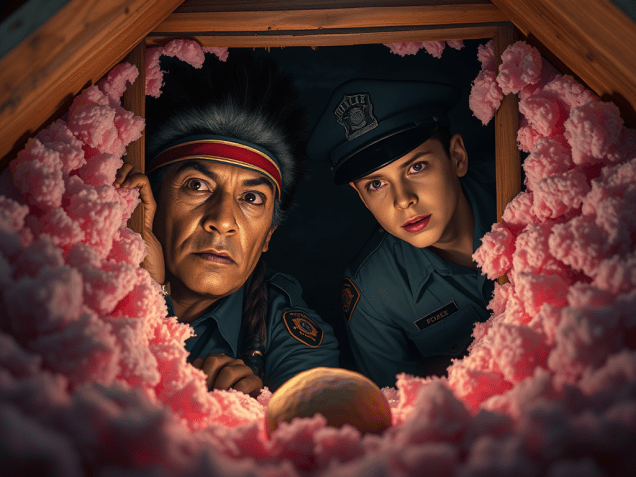
Bruce handed me his flashlight. I pulled myself up until my arms were entirely inside the attic and swept the beam around. The attic was filled with fluffy pink insulation. One spot was different. A trail led from the opening to a lumpy insulation patch. About five feet away, the insulation looked disturbed.


I looked down at Bruce.

“I need a poker iron.”


I heard Bruce ask the family if they had one, and he handed it to me within seconds. I jabbed the iron into the lump, then thought better of it and started whacking the hell out of it.


Suddenly, there was yelling and cursing, and Virgil burst out of the insulation.


“Stop it! Stop it! I give up!”

he hollered.


I ordered him to follow me down, and once he was out, we cuffed him. We took him outside to Booty’s patrol car. Booty looked at the lump rising over Virgil’s eye. He asked,

“How’d that happen?”


I shrugged.

“He fell on a poker iron.”


The whole crew burst out laughing. After all, it’s easy to fall on a poker iron. This is especially true when hiding in an attic after threatening to die before going to jail.

Kidnap Attempt Foiled: A Cop’s Gripping Night Shift

By Benjamin GroffMedia© | benandsteve.com | 2025 Truth Endures©

4–6 minutes

It had been a strange, unsettling night.

Officer Tim Roff
Tim Roff

The mid-shift clocked out at 0200 hours. Officer Tim Roff was left alone on the graveyard shift. He was the only officer covering the North and South Districts. Every radio call felt heavier. Every silence stretched longer. He hoped the mutual aid agreement with neighboring jurisdictions would hold if things spiraled beyond his reach. But for now, it was just him, his determination a steady flame in the darkness.

Alone.

Roff approached every call with a practiced urgency. He arrived fast, assessed fast, and moved on fast. Each moment was calculated to cover as much ground as one man can.

At 0330 hours, the dispatch’s voice crackled over the radio, sharp and urgent:

“Tim, we’ve got a report. The male suspect drove an older blue Chevy Monte Carlo, heading to 230 North Madison Street. Planning to kidnap a child from the grandmother watching them tonight.”

A chill settled in Roff’s chest. Alone or not, this couldn’t wait. Dispatch gave him a phone number for more intel.

Patrol Division Night Duty
On Patrol

He stopped briefly at the north division substation and called the number. The story spilled out: Robert Sams, 38 years old, white male, born February 20th, was not alone—he was bringing others. He didn’t have custody of the children, but he was coming to take them anyway. He was planning to run, wanting to force the mother’s hand.

Roff parked his cruiser near the house and waited. Time slowed. Every passing headlight made his pulse jump. Then—there it was. Like clockwork, the Monte Carlo crept down NW 23rd and turned onto Madison. Roff pulled in behind. He hit the emergency lights and followed as the car swung into the driveway. The tension in the air was palpable.

Before Roff even opened his door, the driver bolted for the house.

“Damn it,”

Roff muttered, keying the mic.

“Need backup.”

But the nearest unit was a reserve officer, miles away, filling in from another city—not tonight.

Roff watched the front door swallow the man and grimaced.

“What is this?” he muttered bitterly. “National Take-the-Night-Off Day for cops—and no one told me.”

When backup finally arrived, Roff pointed to the car’s occupants.

“Watch them—don’t let anyone leave.”

Then he approached the front door and knocked.

A woman opened it, anxious, shifting on her feet.

“He ran out the back,”

she said.

Roff’s instincts flared. He circled to the rear, scanning the rain-soaked earth outside the back door. Not a single footprint. Untouched. She’d lied.

He jogged back around. His heart pounded harder now—not from the chase. It was from the relentless math of being outnumbered and alone. The fear was a heavy burden on his shoulders.

He called to the backup officer, loud enough for the woman to hear:

“If anyone comes out the back—shoot!”

He knew it wouldn’t happen, but fear was leverage.

Facing the woman again, he leveled his voice.

“I know you’re lying. If you don’t come clean, I’ll take you in for harboring a fugitive.”

It wasn’t airtight, but it was enough.

Her shoulders sagged.

“He’s in the garage,”

she admitted.

“Under the table.”

She led him through the house. At the garage door, Roff drew his sidearm. Alone again, with no cover. His stomach clenched.

“Come out,”

he commanded,

“or I’ll shoot.”

A shaky voice from under the table:

“Don’t shoot! I’m coming out!”

Roff cuffed Sam and walked him to the cruiser. He identified the other passengers and radioed dispatch for warrant checks. One by one, the answers came: felony warrant. Felony warrant. Felony warrant. Every single one.

Four prisoners. One patrol car. A 25-mile drive to the county jail. And no one else to cover his city.

Roff radioed neighboring agencies asking them to cover calls if any came in. Then he called the sheriff’s office for the official notification ––

“County, be advised I am 10-15 four times to your location. If there are any calls for my area, ask area units to cover calls per the mutual aid compact.”

He locked them in, buckled them tight, and checked the restraints twice. Just as he closed the last door, a car pulled behind him. A woman stepped out, flashing her ID—the child’s mother.

“It’s over,” Roff told her. “We stopped it.”

She followed him inside and retrieved her child. Relief flooded her face as she hugged her baby, her tears a testament to the fear she had endured. She left, her steps lighter, her burden lifted.

Roff radioed the sheriff’s office,

As Roff pulled onto the highway toward the jail, the prisoners chatted pleasantly in the back seat. Their casual demeanor was unsettling, given the gravity of their crimes. But Roff’s nerves stayed taut. His eyes flicked to the mirror every few seconds. He was alone with four felons and had 25 miles of dark road ahead.

At the jail, the booking officer whistled when he saw them.

“You win tonight’s prize, Roff. Biggest catch I’ve seen from one guy in a long time. Hell it will probably hold as a record for a month or two.”

Roff just nodded, the weight of the night still pressing against his chest. The adrenaline was fading, leaving a hollow feeling. He was alone again, with the echoes of the night’s events reverberating in his mind.

Small Acts of Kindness: A Legacy of Compassion

By Benjamin GroffMedia© | benandsteve.com | 2025 Truth Endures©

3–4 minutes

Francis
Pope Francis

Today, the world said goodbye to Pope Francis. I was reminded of the man who called for compassion among the masses. He urged us to find understanding and acceptance in whatever ways we can. He believed that small steps lead to greater paths. Simple, quiet acts of goodness build a better world.

Altruism was instilled in me from an early age. Through my personal experiences, I’ve come to understand its true meaning. I instinctively understood the Pope’s message and often wished more people worldwide would embrace it as profoundly as I had.

For me, kindness has always been second nature, a lesson I learned from my father. I knew from childhood that even the smallest gestures mattered. It is holding a door open for someone. It is offering a word of acknowledgment or helping a stranger in need. My father, a man of few words but profound actions, taught me this.

Each Sunday morning, the sun rose. He and I would then load our truck with fresh produce from our farm. This was done before the first car appeared on Main Street. We would quietly deliver baskets of food to low-income families across town. It was a ritual performed with no expectation of thanks, no wish for recognition. My father made it clear: this was our shared mission, something sacred, something we did simply because it was right. The smiles on the faces of those families showed the impact of our small acts of kindness. The relief in their eyes was a testament to the difference we made.

Altruism can take on many faces—kindness, decency, a willingness to see others’ needs. Years ago, we visited Las Vegas with my better half and two fellow law enforcement officers. We stopped for a quick meal at a small pizza shop. I noticed an older man lying beneath a tree across the parking lot as we ate. He looked frail and vulnerable—homeless, clearly unwell.

Throughout the meal, I couldn’t shake the image of him. When we finished, I gathered our untouched slices into a to-go box. I told the others I would offer it to him. It didn’t feel right to leave that food behind, not when someone nearby desperately needs it.

As I approached, I saw fear and uncertainty in his eyes. But when I gently asked how he was doing and whether he had eaten, his expression softened. I handed him the pizza and a bottle of water. His hands trembled as he accepted them, tears welling in his eyes.

We spoke briefly. He told me it had been days since he last ate. He had been surviving on whatever water he found. He hadn’t asked for anything—but his gratitude was overwhelming.

Then, quietly, we went our separate ways.
That moment has stayed with me, just as those early Sunday mornings with my father have stayed with me. Compassion doesn’t have to be loud. Kindness doesn’t always wait to be invited. Sometimes, it’s simply about noticing—and acting.

I never saw that man again. I like to believe that the small act of kindness I showed him helped him feel seen and valued. It made him feel stronger for the journey ahead. It’s a testament to the power of small acts of kindness. It gives me hope for a more compassionate world.

As Pope Francis often reminded us, the world doesn’t change through grand gestures alone. It changes one small act of love at a time. And so, in his memory, I urge you, the reader. Please continue noticing. Keep caring and acting—quietly, humbly, and with open hearts. Each of us has the power to make a difference.

The Heartfelt Impact of Loss in Law Enforcement

By Benjamin GroffMedia© | benandsteve.com | 2025 Truth Endures©

3–4 minutes

JOHN BLAZEK

My grandfather had a host of brothers. Their father, Ulrich Groff Jr., had been married twice—the second time after his first wife died. Among my grandfather’s many brothers was one named Frank. In the family, he was known as Grand Uncle Frank or Great Uncle Frank, depending on who was telling. Frank lived a colorful, hard-worn life. He was the one who taught me how to ride a bike and always had a funny story to tell. He was raised on a farm. He worked odd jobs in his youth. Eventually, he found a steady calling with the Chicago Police Department.

Frank’s career on the force was mostly uneventful, at least by police standards. He would occasionally talk about the small-time crooks. He mentioned the drunks and the desperate people. He and his partner had to haul these people off to jail. But there was one story he told with a quiet solemnity—one that never left him. It was a time when being a police officer was a tough job, especially in a city like Chicago. The streets were rough, and the criminals should not be taken lightly.

Frank Groff

It was the night his partner died.

According to Frank, it had been a typical shift. He and his partner had picked up a couple of rowdy men, causing trouble. One of them shoved Frank’s partner during the scuffle. The man was quickly subdued and locked up. As far as Frank knew, it was nothing out of the ordinary. They had handled far worse and walked away without a scratch.

But the next morning, a knock at Frank’s door brought grim news. Fellow officers informed him that his partner, John Blazek, had passed away during the night.

John had hit his head during the scuffle—no one thought much of it at the time, including John himself. Like many men of his era, he brushed it off, finished his shift, and went home. Officer Blazek called a fellow officer to give him a ride. He didn’t feel quite right. Still, no one suspected anything serious. He went to bed and never woke up. The suddenness of his passing left everyone in shock and disbelief.

The official record read:

John Blazek

Patrolman John Blazek died after suffering a head injury. He fell or was pushed to the floor inside the 22nd District’s cell room. This incident occurred at 943 West Maxwell Street the prior night. He did not realize he had suffered a skull fracture. He attempted to go home at the end of his shift at 8:00 am. Blazek did not walk home and called another officer to pick him up. Once he got home, his condition worsened. He passed away the next day from the head injury.

Patrolman Blazek was a U.S. Army veteran of World War I who had served with the Chicago Police Department for 26 years. His sudden and unexpected death left a void in the community. His wife and two sons survive him.

Frank never quite recovered from that night. Though he stayed on the force, something in him changed. He stopped talking about the job as much. When he did, it was with a heavier voice. He had arrested many criminals and survived several street scuffles. Yet, the quiet death of his partner haunted him the most. They didn’t see it coming. He retired a few years later, and we see that the incident had taken a toll on him. He spent his days quietly, often lost in thought.

Years later, after Frank’s retirement, we found a worn copy of the police report. It was on John Blazek’s death and among his things. It was folded carefully into the pages of his Bible. Eventually, Frank passed on. On the back, in his handwriting, were the words:

“We don’t always know the moment something changes us. But we carry it. Always.”

Lloyd Bickerstaff: The Steady Voice of Elk City Police

By Benjamin GroffMedia© | benandsteve.com | 2025 Truth Endures©

3–4 minutes

The Quiet Backbone

Lt. Lloyd J. ‘Bick’ Bickerstaff E.C.P.D.

I keep a photo in a drawer in my desk. It is tucked beneath an old leather-bound notebook and a yellowing map of Beckham County. It’s a photo of Lloyd Joe “Bick” Bickerstaff. The image was taken about a month before his promotion to Captain with the Elk City, Oklahoma Police Department.

In the picture, Bick sits in his unit, his uniform crisp in the late autumn light. The shadows are long. The wind has just started to turn cold. That unmistakable Oklahoma sky behind him stretches flat and wide. It is quiet, open, and full of secrets. He wears a half-smile that says, 

“I’ve seen things, but I’ll carry them quietly.”

Bick and his brother were born in Sentinel, Oklahoma. I only heard his brother’s name once in passing. Sentinel is a patch of land barely big enough to hold the stories it carries. They began their careers as State Troopers with the Oklahoma Highway Patrol. The two brothers wore matching uniforms and chased something bigger than themselves.

But by the time I knew Bick, he rarely mentioned his siblings. I assumed time had done what it often does to families. Maybe there was a falling out—just distance. I never asked, and he never offered.

I knew he had a wife who baked cinnamon rolls on Sundays. He also had two children. One child was off in Sayre, chasing classes at a junior college. The other was a veterinarian who had graduated from Oklahoma State University. His life beyond the badge was quiet but rich. He even operated a small answering service—its operators worked right from his living room. You knew that life grounded him.

Nevertheless, Bick was more than just a veteran officer inside the department. He was the compass.

When rookies came in shaken from their first domestic call, Bick was the one who handed them a cup of bad coffee and said,

“It gets better if you let it.”

He never lectured. He just listened. And when he spoke, it was always worth hearing.

I remember the weeks leading up to his promotion. The department was shifting—a new Chief was being promoted, and a Major was moving up from Captain. Everyone felt the tremors of change. But Bick? He was steady and unmoved. I asked if he was nervous about entering a bigger role during such a turbulent time.

He just smiled that same quiet smile.

“Storms pass,” 

He said.

“Someone’s gotta keep the porch light on.”

He did more than that.

He held the whole house together.

Years passed. And then, like storms do, time took Bick from us. When the news came, I expected many familiar faces at the service. Officers from every corner of the state would be paying their respects. But they didn’t come. Time had moved on, and so had they. Somehow, the news of Bickerstaff’s passing hadn’t brought them back.

Elk City Police Chief Bill Putman did what mattered. He escorted Bick’s casket from Elk City to the Old Soldiers Cemetery in Oklahoma City. That quiet, deliberate ride said more than any ceremony. It was loyalty. It was respect. It was love.

I was there, too, standing back in the shadows as the service ended. I didn’t speak. Didn’t approach the family. I just paused long enough to leave a final tribute at the edge of his resting place. It was a farewell from someone who had seen firsthand what quiet strength looks like.

Maybe Bickerstaff would’ve preferred it this way. No fanfare. There is no parade of names—just those who mattered most.

I like to think I was one of them.

Bick was never the loudest voice in the room. He didn’t need to be.

But when he spoke, the room listened.

And when he left, the silence he left behind was deafening.

The echo he once carried over the radio has gone quiet. And somewhere out in Western Oklahoma, no one will ever hear that calm, steady voice call out again—

“Attention, all stations and units; stand by for a broadcast.”

From Cotton Fields to Sheriff: The Story of Jess Bowling

By Benjamin GroffMedia© | benandsteve.com | 2025 Truth Endures©

4–5 minutes

Sheriff Jess “Pooch” Bowling, Jr.: From Cotton Fields to County Leader

Jess ‘Pooch’ Bowling

Jess Bowling, Jr. was born in Binger, Oklahoma, on August 23, 1924. At just 11 years old, he left behind half his family. He also left the dusty plains of Oklahoma. He sought a new beginning in California. With his father and brother, young Jess traveled west in a weathered 1929 Buick. They finally settled in the small agricultural town of Dos Palos. His mother, two sisters, and another brother stayed behind in Oklahoma—a family split by circumstance but not by love.

Life in California was anything but easy. Jess Jr. rose with the sun. He toiled in the cotton fields until it set. He contributed what he could to help his family survive. It was hard work—grueling and endless—but there was resilience in the struggle. Sheriff later joked, “We did live in the biggest tent in Dos Palos!”

His father, Jess Sr., quickly became a cornerstone of the growing town. He opened a grocery store, invested in rental properties, and became active in local politics. His leadership and business savvy earned him a seat on the city council and, eventually, the title of Mayor.

Jess Jr. worked in the family store while attending school. He graduated from Dos Palos High School with a reputation for dependability and quiet strength. Not long after, fate stepped in when he met Darlene, a young woman from Iowa visiting relatives. The two married in 1945 and raised three children—Sharlynn, Shirley, and Michael.

The Badge and the Beat

Simulated Photo

Jess Bowling’s journey into law enforcement began in 1953 when he joined the Dos Palos Police Department. His first assignment? Tackling the town’s parking problem. Officer Bowling issued dozens of citations, doing so with a steady hand and a sense of duty. He even issued one to his father, the Mayor. Years later, he found that very ticket among his father’s possessions, a keepsake of humor and integrity.

Although that first stint in law enforcement was brief, it planted a seed. After returning to the family store, Bowling joined the Atwater Police Department in 1956. In 1958, he made the move that would define his career: joining the Merced County Sheriff’s Department.

Simulated Photo

In 1963, Bowling became the department’s first-ever canine handler, partnered with a large, loyal German Shepherd named Jim. Together, they helped pioneer a new era of policing.

By 1974, Jess Bowling had risen to the rank of Lieutenant when tragedy struck—the sudden passing of Sheriff Earl McKeown. In the aftermath, Bowling was appointed interim Sheriff. The people had already decided by the time the special election rolled around in May 1975. Bowling’s steady leadership and quiet competence earned him the Sheriff’s badge in his own right.

Reformer, Leader, Trailblazer

Sheriff Bowling led the department through six transformative years. He spearheaded major innovations that professionalized law enforcement in Merced County. Under his administration:

  • The Corrections Division was established, moving jail staffing from deputies to trained corrections officers.
  • Dispatch services were assigned to civilian professionals, freeing up sworn deputies for fieldwork.
  • He launched the county’s first-ever 24-hour patrol, marking the end of the “resident deputy” model.
  • He hired Merced’s first female deputy, breaking gender barriers in local law enforcement.
  • The department acquired its first handheld radios, enabling Bowling to reintroduce the classic “walking beat cop” in areas like Winton.

These weren’t just administrative changes but foundational shifts that shaped the Sheriff’s Department into a modern, responsive force.

His achievements were not only admired—they were preserved. Jess “Pooch” Bowling’s remarkable career is documented in a collection. His family lovingly maintains it as a tribute to a life of service.

Legacy and Final Salute

I had the privilege of knowing the Bowling family. One of my sisters even married Jess’s nephew. Every time he returned to town, Sheriff Bowling brought a yearbook from the department he once led. He proudly pointed out the growth and accomplishments of his former team. The department’s scope, the number of divisions, and the professionalism he helped instill always struck me, as did his accomplishments.

1974 – The first female deputy was sworn in

1974 – First portable transceivers issued to deputies

1974 – The first 24-hour patrol begins

1977 – First Special Emergency Response Team (SERT) organized

1977 – Marshal’s Office established

1980 – Hostage negotiators were trained and included on the SERT team

Merced County Sheriff’s Office, California

But behind the badge was a man who never forgot where he came from. Before the titles and the accolades, Jess “Pooch” Bowling was a boy in a Buick. He was a cotton picker working under the sun. He was a young man doing what he could to help his family survive.

After a doctor advised him to retire due to a serious heart condition, Sheriff Bowling stepped down in 1980. He lived to celebrate his 80th birthday during Merced County’s 150th anniversary in 2005. This honor was fitting for a man who helped shape its modern history.

Jess “Pooch” Bowling passed away on April 18, 2007. He was laid to rest beside his beloved Darlene in Dos Palos Cemetery.

His story is one of grit, integrity, and service. It is a journey from the cotton fields to the highest badge in the county.

Reflecting on the Oklahoma City Bombing: 30 Years Later

By Benjamin GroffMedia© | benandsteve.com | 2025 Truth Endures©

2–4 minutes

Thirty Years Ago Today

Thirty years ago, today, I was standing in a Federal Building when my pager went off. The screen lit up with all 9s—a code used to signal an emergency assignment. I needed to contact headquarters right away.

I had just stepped out of a federal courtroom in Denver, Colorado. Moments earlier, I had been inside, preparing to testify in a significant case involving a syndicated burglary operation. I’d been working undercover, embedded deep within their ranks. The courtroom was tense, but a recess had been called, and a few of us decided to grab coffee downstairs.

As we stepped into the elevator, my pager buzzed. I glanced around—no one else’s device had gone off. A sinking feeling set in, but I said nothing. When we reached the first floor, I peeled away from the group and went to a pay phone. I called my office.

My supervisor’s voice was grim on the other end of the line. A bombing had just occurred in downtown Oklahoma City. It was devastating—an entire city block destroyed, surrounding buildings heavily damaged. The scope of it was hard to fathom.

My first words were my gut instinct.
If they’re still alive, the person who did this is already on the road, on one of the Interstates. They’re putting as much distance as possible between themselves and the blast. They’ll go until they feel safe, then hunker down and watch.

Shortly after that call, my pager buzzed again—this time from the Federal Prosecutor’s Office. They informed me that all federal court proceedings were being canceled nationwide. I wouldn’t be needed back in court that day.

With nothing more to do, I contacted relatives in Oklahoma to ensure their safety. Then, like so many others, I returned to my room. I sat glued to the television and watched the horror unfold in real time.

The next day, I waited to hear if I’d stay in Denver. I wondered whether I would be reassigned. Another page came in from my office. A state trooper had made a traffic stop north of Oklahoma City. The individual taken into custody matched a profile. My instincts had been right.

In the weeks that followed, the nation learned his name. I choose not to say it now. Some people deserve to be remembered. He is not one of them.

Now, on this Saturday, April 19th, 2025, it’s been thirty years. Half of the people living in Oklahoma City today were either not born or didn’t live there in 1995. The memory of that day is fading, becoming a chapter in history instead of a scar felt daily.

Many survivors have since passed. Families of the victims have grown older, some have gone entirely. Some of those in the building that day were too young to remember it now. The face of that tragedy has changed, but its weight remains.

The Oklahoma City Bombing was the first of two national tragedies I learned about while standing in an elevator. The second came years later, on a crisp September morning—9/11. I remember thinking about stairs a lot after that. Elevators started to feel cursed.

But I never gave in to fear. I always got back in and waited for the doors to close. I figured if I didn’t, they would win.

And I wasn’t about to let that happen.

The Last Ride: A Father’s Legacy of Protection

Benjamin GroffMedia© | benandsteve.com | 2025 Truth Endures©

3–4 minutes

Dad’s Last Ride

Dad (JD Groff) on his horse, My Mollies Reed

My Dad was a man of fierce independence and deep protective instincts. He and my mom practiced defensive maneuvers as the days of aging grew—he had a plan. She would drop to the ground, and he would shoot over her, neutralizing any imagined threat. This was his way of ensuring our safety, a comforting thought for all of us. Of course, during practice, the gun was always unloaded. But as they grew older, my sisters became worried. Dad was on medication. It sometimes clouded his thinking. They feared he might one day forget to remove the bullets.

Years before, he had suffered a devastating injury. While inspecting a swimming pool facility, a large chlorine container malfunctioned, releasing a gas blast into a control room. He inhaled the toxic cloud, severely damaging his lungs. From that day onward, his breathing was labored, his movements slow and painful. The injury gradually robbed him of his strength until, eventually, he became bedridden.

As his physical strength faded, his concern for my mother’s safety grew stronger. He was terrified that they were vulnerable to burglars or intruders. And so, he devised a plan—an extension of the old drills. My mom would guide them to a specific location if someone ever forced their way into the house. He saw this spot clearly. She would drop to the floor just like in the old days, and he would be ready to fire.

That’s when my sisters turned to me. I’m a law enforcement officer, and they hoped I could safely remove the firearm from his possession. But that was easier said than done. When I spoke to him, he saw what I was thinking. Even in his weakened state, he firmly grasped his beliefs and authority. His determination was palpable. He made it clear that this was his home and responsibility. It was his plan to protect his wife.

But he also took the time to explain how seriously he took the safety of it all. His explanation wasn’t reckless or confused; it was thoughtful. He was rational and transparent in his thinking. In the end, I agreed. He was doing what he believed was best for them.

Still, I wanted to do something more—something that would help ease everyone’s minds. That day, I installed a motion detection system in the house. It covered the living and dining rooms, alerting them if anyone approached. Every door was now an alarm. It gave them peace of mind and ended the dramatic drop-and-shoot rehearsals.

Dad & Buck

Eventually, Dad was unable to get out of bed. He was confined to a hospital-style bed in a small office near their bedroom. His gun was out of reach, and it tore at him. One day, he felt sorrow and frustration. He asked for it not to defend the home. He wanted it to end his pain.

Two weeks later, my mother called an ambulance to rush my Dad to the hospital. They sedated Dad as fluid built up in his lungs, and he passed away there. Quietly, heavily, and—if I’m honest—less on his terms than he would have wanted.

I often think of the day he asked for the gun and couldn’t reach it. Part of me believes it would’ve been a more dignified end. He had spent his life in control. He always defended his family and lived by principle. But the law is clear, and so is the burden of those left behind. As much as it hurt, I nor anyone could hand it to him.