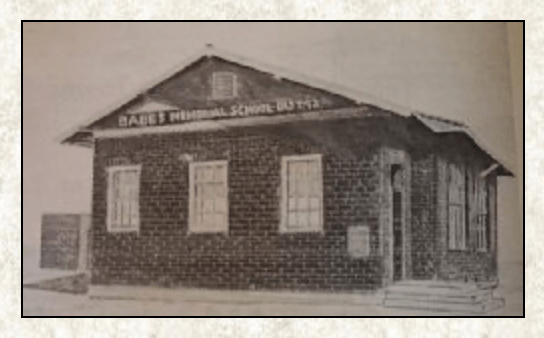
Every year at this time, I am reminded of a harrowing story. It is deeply etched into Oklahoma’s collective memory: the Babbs Switch School Fire of Christmas Eve, 1924. It stands as a tragic lesson in safety, humanity, and resilience.
The Fire
On that bitterly cold night, with heavy snow and sub-zero temperatures, 200 residents gathered. They met in Babbs Switch’s one-room schoolhouse for a Christmas Eve program. The school was tightly packed with engaged couples, grandparents, mothers, fathers, and children. The building’s windows were secured with wire mesh to deter intruders from the nearby railroad tracks. The sole exit—a door that opened inward—would soon become a deadly trap.
The program concluded with a teenage boy dressed as Santa Claus. He handed out toys and candy beneath a cedar Christmas tree. The tree was decorated with paper, tinsel, and lit candles. One of these candles brushed against the tree’s dry needles, igniting it instantly. Mrs. W.G. Boland, whose three children perished that night, later recounted the horror.
“I tried to beat it out with a paper sack,”
she said,
“but it did no good.”
Initially, the crowd laughed, believing the small blaze was being contained. But within moments, the flames engulfed the tree, the ceiling, and the entire structure.
Panic erupted.
The sole exit became a bottleneck as the crowd surged toward the door. Those at the back pushed forward, while the unlucky at the front got crushed in the chaos. Some attempted to pry open the wired windows, but their efforts were futile. Trapped inside, children, parents, and neighbors succumbed to the smoke and flames. Witnesses recalled the horrifying scene of people clawing at the exit. Bodies piled atop one another, and the acrid stench of burning flesh.
The Survivors
Among those who escaped was Lillie Biggers. She crawled out from under a desk clutching a doll she had just received. Her mother, Margaret, managed to get out but suffered severe burns to her hands and arms. Tragically, Lillie’s brothers, William, 9, and Walter, 15, did not survive. The Biggers family’s grief mirrored that of the entire community, where 36 lives were lost—half of them children. The belongings later identified the bodies of William and Walter. They carried a toy gun and a belt buckle.
The injured and deceased were transported to Hobart, the nearest town, where makeshift morgues were set up. The community’s response, known as the “Hobart Spirit,” saw residents drop everything to give aid and comfort. Newspaper accounts likened this effort to the Oklahoma Standard that emerged decades later after the Oklahoma City bombing.
Julie Braun with Mother Lillie’s Doll That Survived Fire
The Aftermath
The tragedy prompted a wave of reforms. Oklahoma legislators enacted fire safety laws requiring outward-opening doors, multiple exits, and accessible window screens in schools. Open flames were banned, and fire extinguishers became mandatory. The reforms eventually spread nationwide, though it would take more tragedies before they were fully adopted.
The morning after the Babbs Switch School Fire
A Missing Child
The story took a strange twist that turned it into a lingering mystery. Among the victims was three-year-old Mary Edens—or so it was believed. Her aunt, Alice Noah, escaped the building. She died days later. She claimed she had handed Mary to an unknown person outside the burning building. Mary’s body was never recovered, leading her family to hope she had survived.
In 1957, decades after the fire, a woman named Grace Reynolds came forth. She was from Barstow, California. She claimed to be the long-lost Mary. The Edens family reunited with her on Art Linkletter’s House Party television program, believing their prayers had been answered. Reynolds even wrote a book about her experiences. It is titled Mary, Child of Tragedy: The Story of the Lost Child of the 1924 Babbs Switch Fire.
But only some were convinced. A local newspaper editor who investigated the claim questioned its validity.
Skeptics noted inconsistencies in Reynolds’s story, but no definitive evidence confirmed or debunked her identity. To this day, the truth remains elusive.
Legacy
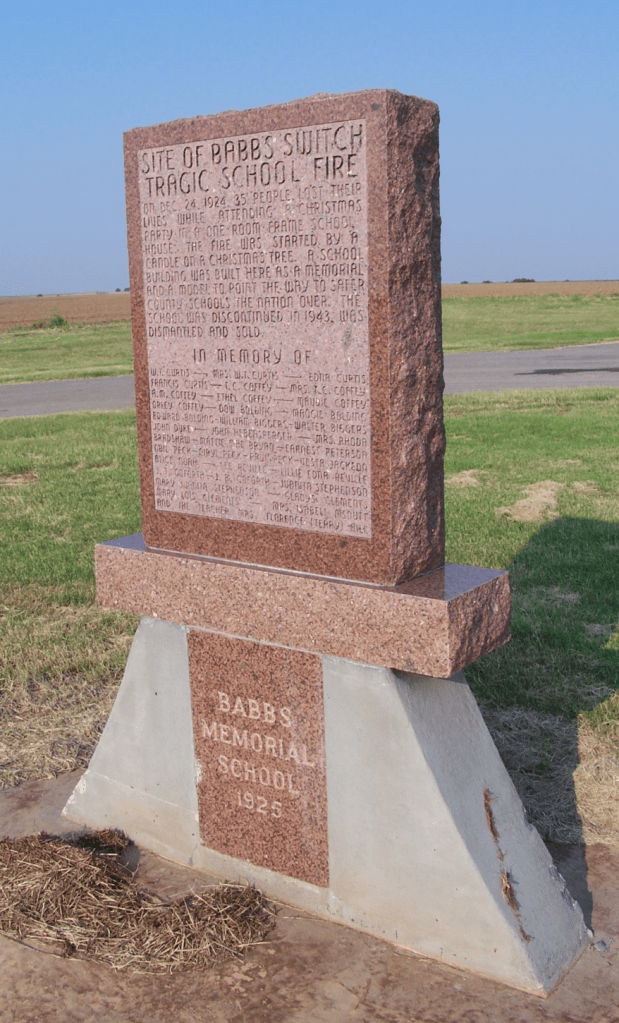
The Babbs Switch School Fire is remembered as one of the deadliest school fires in U.S. history. A stone monument now stands where the schoolhouse once stood, a quiet marker of lives lost and lessons learned. The physical scars of the tragedy have faded. Yet, its memory endures. It serves as a poignant reminder of the fragility of life and our enduring hope for safety and change.
Every Christmas Eve, the quiet village of Valley Brook transformed into a magical tableau. As snow blanketed the streets, an ethereal ringing of bells echoed through the valley. The sound was sweet and haunting, like a melody from another world. The villagers marveled at the phenomenon for decades, yet no one knew where the bells came from.
The mystery was part of Valley Brook’s charm. Some claimed the bells were angels’ gifts, while others swore they were the spirits of Christmases past. But to Ethan, a curious young man with a heart full of wonder, the mystery demanded answers.
Ethan had lived in Valley Brook his entire life. Each Christmas, he stood at the frozen brook’s edge. He strained to hear even the faintest hint of the bells’ origin. Now 19 and filled with determination, Ethan resolved that this year would be different.
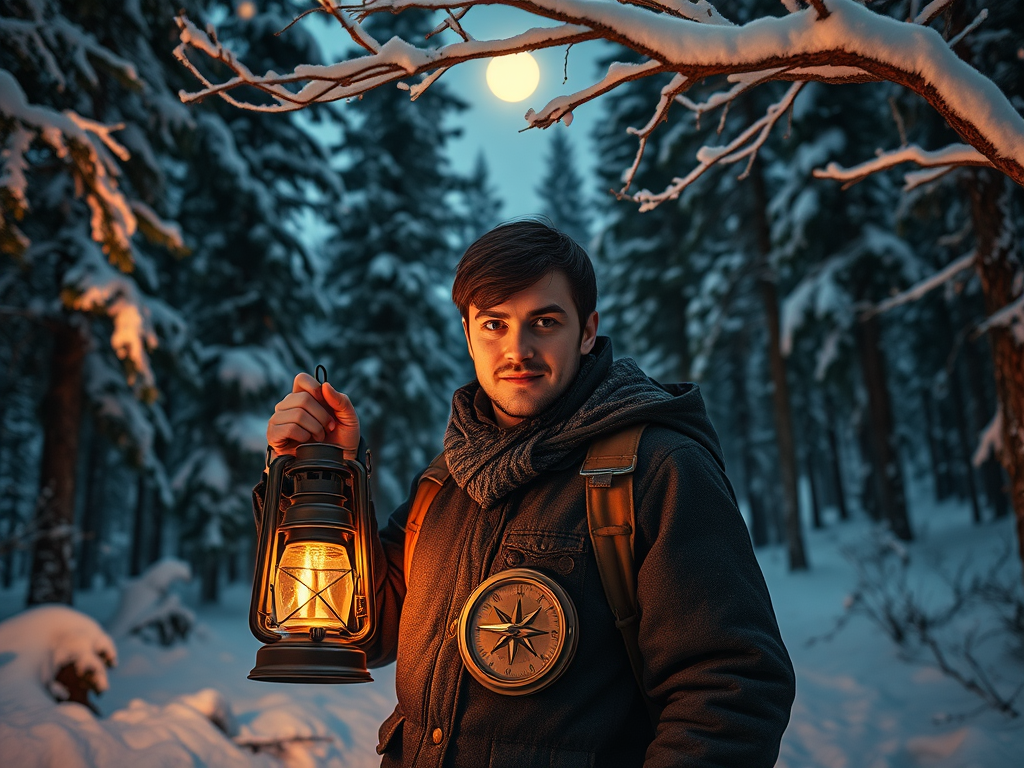
On Christmas Eve, armed with a lantern and his father’s old compass, Ethan entered the night. The air was crisp, and the snow crunched beneath his boots. As the bells began their enchanting tune, he paused to listen.
“North,” he whispered to himself, turning toward the sound.
The first stretch of his journey led him to the forest bordering the village. The tall pines were heavy with snow, their branches arching over him like cathedral ceilings. The bells grew louder as he walked deeper into the woods. Then, they seemed to shift direction, drawing him toward the hills.
Ethan climbed steadily, his lantern casting long shadows against the rocks. At the top of the hill, he paused to catch his breath. The bells sounded closer now, but their source still eluded him. His compass needle jittered as if caught in some unseen magnetic pull.
After the sound, Ethan descended into a hidden ravine. At the bottom, he discovered an ancient stone bridge, its surface worn smooth by time. Beneath it, the brook that gave the village its name flowed silently, its surface coated in thin ice. Ethan crouched and pressed his ear to the stones. The bells resonated through the bridge itself.
“This must be it!”
he exclaimed, but as soon as the thought formed, the melody shifted again, beckoning him onward.
Ethan continued his pursuit for hours, weaving through snow-covered meadows and icy trails. Finally, the first light of Christmas morning touched the horizon. He arrived at the mouth of a cavern nestled in the cliffs at the valley’s edge.
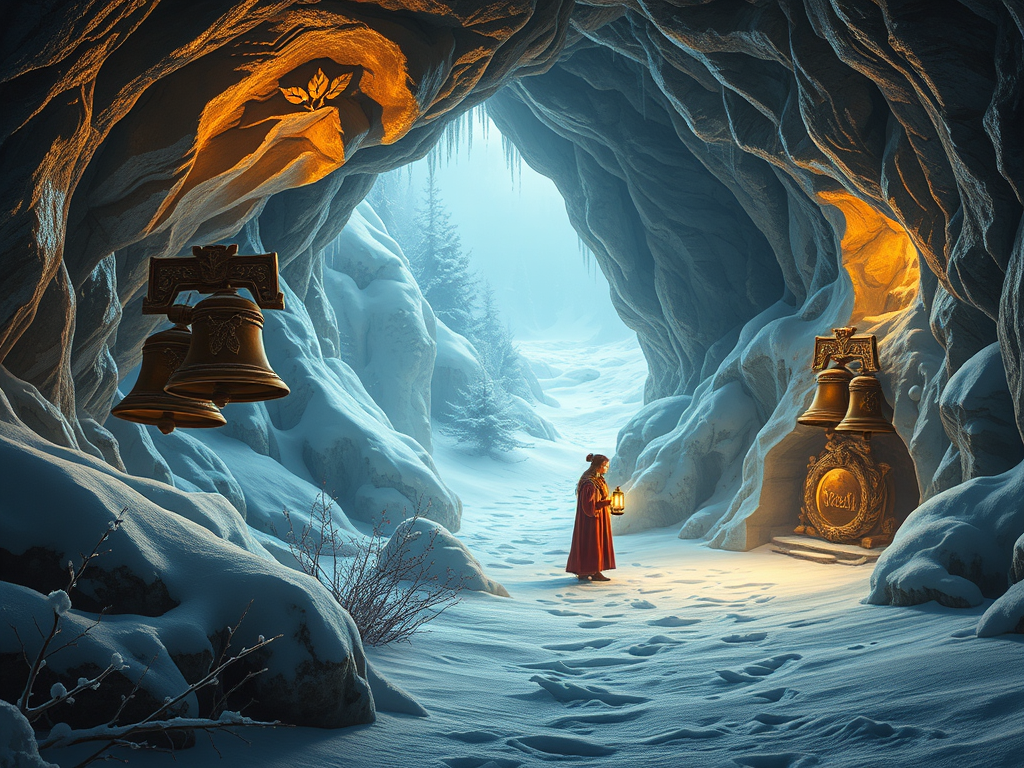
Inside, the bells chimed more clearly than ever. He entered cautiously, the glow of his lantern illuminating crystalline walls that shimmered like diamonds. He found them at the cavern’s heart. Rows of bronze bells were suspended in midair. Their surfaces were adorned with intricate carvings of holly and ivy.
Ethan approached in awe, reaching out to touch one of the bells. When his fingers brushed the metal, a warm light enveloped the cavern. A figure appeared—a woman in flowing robes, her face serene and timeless.
“Who are you?”
Ethan asked, his voice trembling.
“I am the Keeper of the Bells,”
she replied.
“These bells have rung for centuries to remind Valley Brook of the spirit of Christmas—hope, love, and unity. Only those who seek their origin with a pure heart will find them.”
“Why me?”
Ethan whispered.
“Because you dared to wonder,”
she said with a smile.
“Now, you must decide: will you keep their secret or share their magic with the world?”
Ethan thought of his village and how the bells brought everyone together each Christmas. Their mystery was part of what made them special. He nodded.
“I’ll keep the secret.”
The Keeper’s smile widened.
“Then the bells will continue to ring, their magic preserved for all who believe.”
When Ethan returned to Valley Brook, the bells still rang as they always had, their melody echoing through the valley. But now, when he stood at the edge of the brook, he smiled. He knew he was part of their timeless magic. He was a secret keeper of the Christmas Bells of Valley Brook.
Surveying the town, the Detective realized he was facing a unique challenge. His task was to apprehend the suspect responsible for the laundry mat break-in. Some witnesses described the suspect as an unusual figure. He towered at 6’5 and had distinctive pointy ears. His face was furry.
Wanda, the laundry mat attendant, was first to be interviewed by Detective Jim Roff. She told him the suspect had furry knuckles, too. She had watched through the office’s one-way mirror. He pried open washing machines’ coin boxes. Then, he filled a pouch in his front coat pocket. A coat, she said, was very blue and sparkly.
Merle was standing on the sidewalk outside. He was picking up cigarette butts along the walkway. He said the thief bumped into him while making his getaway. A few of the coins managed to roll down into the parking lot, where Merle had captured them.
“Fifty cents,”
Merle said.
Detective Roff asked Merle if he knew the person who had broken into the machines. Merle told the Detective that the suspect was known on the streets as Carpet Face.
Merle told the Detective,
“The dude used to work for a local carpet layer.” He got right down to his face, stretching the carpet across the floor. They called him Carpet Face. But I don’t think that is why he was named Carpet Face.”
The Detective asked out loud,
“Then why did he have such a furry appearance?”
A doctor who had seen the incident spoke up,
“It’s because of his genes.”
Detective Roff replied,
“His Blue Jeans?”
The Doctor laughed,
“No, his g-e-n-e-s”. “
“Oh,”
Roff said,
My bad.”
“That is ok, he should have been nicknamed Furboy. His real name is Lickery Nickery. He lives on the south side of town. His home is in an alleyway near an old garage. This garage is falling off Hickery Street.”
Doctor Badd, sadly proclaimed, Dr. Badd listed in the phone book as ‘Badd Doctor,’ played a significant role in the case. He informed the Detective that he had been discreetly treating Nickery, attempting to help him achieve a more conventional appearance. Yet, all his efforts with various medications had been in vain.
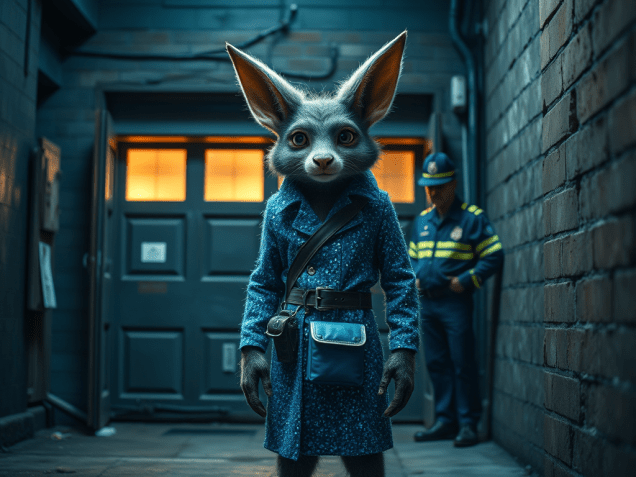
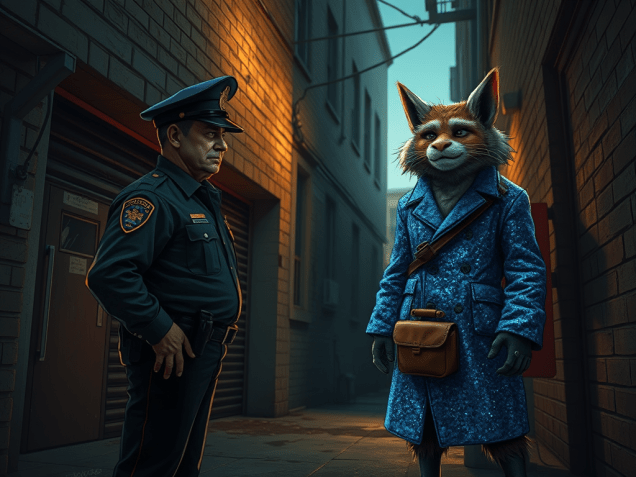
Detective Roff got into his police car and drove to the area where Nickery was supposed to live. Sure enough, there stood the suspect. Tall, furry, and stirring outside an old garage in an alleyway. Nickery still had a pouch attached to his waist just below a bright blue coat. As the Detective approached, Nickery stood in an offensive position. Detective Ross had brought Dr. Badd with him. This was in case medical attention was required. It would be needed as a result of the pending arrest of either the suspect or the Detective.
Nickery almost instantly stood ready for the capture. He told the Detective he had broken into the machines and taken the coins. It was his only way to get funds to buy food. The Detective asked him about his old carpet-laying job. Nickery told him he was fired after the clients saw him stretching carpet in their home. This frightened them.
The Detective asked Nickery.
“So you thought a life of crime was the answer?”
Nickery -ugh Carpet Face replied in kind,
“Not really, I thought it was a way to get food.”
Dr. Badd chimed in at this point and said,
“I have literally tried everything and can’t get anything to work.”
Detective Roff looked at Nickery, then at Dr. Badd, and finally at the furry blue coat.
The Detective, after a moment of contemplation, shared his insight with the others. He said, “Gentlemen, sometimes the most straightforward solution is the one we fail to see.”
Both stared back at him, puzzled. That’s when Roff pulled a small electric trimmer from his pocket.
“Try this.”
The hum of the clippers filled the alley. Within minutes, Carpet Face began to look less like a legend and more like a man. The crowd that had gathered gasped. Children laughed. Wanda from the laundry mat even clapped.
Nickery blinked at his reflection in a car window and whispered,
“I… I look normal.”
“You look like yourself,”
Roff corrected.
“Now go make something of it.”
And he did. Lickery Nickery was once the scourge of washing machines everywhere. He became a barber’s apprentice. Then he became a shop owner. Finally, he became a beloved mayor. His campaign slogan?
~ Sometimes the simplest solution is the one we overlook. ~
Most airline pilots have checklists that go something like this: flaps set, fuel topped, doors secured. But not Captain Earl “Forgetful” Finley. Earl had a knack for skipping one step in particular: buttoning down the rear cargo door.
The incident was first noticed in Burnt Corn, Alabama. The Hicks family boarded Earl’s plane for what they thought would be a scenic hop to Birmingham. At takeoff, the nose lifted off the runway. The rear door gave way. The Hicks family scooted right out like biscuits from a greased pan. They landed unhurt on the asphalt, dazed but alive, while their suitcases rolled to a neat stop beside them. Earl circled back, tipped his cap out the cockpit window, and hollered:
“Y’all hold on better next time!”
Word of Earl’s absent-minded ways spread, but strangely enough, passengers kept buying tickets. His next mishap was in Turkey, Texas. Earl had agreed to carry a package to Pie Town, New Mexico. He also agreed to let a fellow named Harlan Sanders (no relation to the famous chicken man) ride along. At about 1,000 feet, Harlan and the packages slid right out the back. Earl didn’t even flinch. By then, he’d become so used to it he was strapping parachute windshirts onto the parcels. Sanders walked away dusty but unharmed, grumbling about never getting frequent flyer miles.
What began as chaos somehow turned into a spectacle. Passengers developed a knack for bracing themselves near anything bolted down. Earl’s flights became less about getting somewhere. They became more about the thrill of not falling out. Photographers started gathering at small airports, cameras ready to capture people and parcels tumbling skyward. Some passengers even leaned into the fame—hollering and waving as they slid into the blue.
Captain Earl never made it big with the airlines. Yet, he sure made history as the only pilot whose passengers packed harnesses, not snacks.
When asked why he never bothered to secure the back gate, Captain Earl’s answer was as confident as it was ridiculous:
“If I close that gate, the wind can’t blow straight through, and that drag slows me down. With it open, the air just zips right on out the back and keeps me flying faster. Shut it tight, and I’d lose two hours off my daily routes!”
He awakes the next morning to find he is still there.
2–3 minutes
Sheriff Without a Gun
Harold was an ordinary man living in a small house on the edge of town. He spent most of his evenings quietly—reading, cooking for one, and watching old Western movies before bed. One night, after drifting off in his recliner, Harold dreamed he was a cowboy riding across the dusty plains.
When he awoke the next morning, he nearly fell out of bed. The world outside his window was no longer his quiet backyard—it was a wild west frontier town. And tied right outside his kitchen door stood a horse named Gus, saddled and ready. Harold blinked twice, rubbed his eyes, and muttered,
“Well… this is new.”
Stepping outside, he was greeted by the townsfolk calling himSheriff. Sheriff Harold, that is. The twist? He wore no gun.
“Best sheriff we ever had,”
they cheered,
“because you don’t bring trouble.”
But soon, trouble found them anyway. A group of gunslingers rolled into town, looking to cause mayhem.
Harold had no firearm to fight back. Thinking fast, he filled the pockets of his vest with smooth river rocks. When the gunslingers strutted down Main Street, Harold let fly. Whack—right in the shin—crack—one to the forehead. Pebbles rained down like hail until the bandits doubled over, tears streaming, too humiliated to continue.
Harold yelled –
“You get the hell out of here and don’t come back!”
They scrambled for their horses, chased out of town by the rock-throwing Sheriff himself.
From that day on, Sheriff Harold became a legend. The townsfolk swore he was the greatest Sheriff they’d ever known. This wasn’t because he outgunned the bad guys. It was because he outsmarted them. Every morning, Harold would pat Gus on the neck and tip his hat. He remembered that sometimes the simplest tools—a rock, a clever mind, and a little courage—are enough to keep the peace.
But somewhere else, in another world, Harold lay still. His daughter sat quietly at his bedside, holding his hand, eyes brimming with worry.
“Do you think he’ll ever regain consciousness?”
She asked the doctor softly.
The doctor shook his head.
“I don’t know. Stroke victims sometimes choose to stay where they are. Maybe Harold is better off living where he is. In that other place, he’s strong and needed. He is riding tall as Sheriff.”
His daughter squeezed his hand, whispering through tears,
“Then I hope he knows we’ll always be proud of him—here, or there.”
And in the world of his dreams, Sheriff Harold tipped his hat, smiled, and rode Gus into the golden horizon.
Joe had been lost in grief ever since Belinda, his wife of fifty years, passed away. Now nearly 80, his health was slipping. His memory faltered. His doctor warned he would soon need full-time care. One day, he might not even remember who he was. Watching Belinda decline into that same fog had torn him apart. Joe swore he wouldn’t let himself linger the way she had.
He made up his mind. Quietly, carefully, he wrote out a plan on paper and kept it folded in his pocket. When the time came, he would go to a scenic overlook, drink a fifth of whiskey, and take his own life as the sun slipped below the horizon. In his truck’s glovebox sat both the bottle and a revolver, waiting.
As the months wore on, Joe’s forgetfulness grew worse. He climbed into the wrong car. He mistook strangers’ houses for his own. He baffled neighbors with his confused blunders. It might have been comical if it weren’t so tragic. Then one morning, Joe woke with rare clarity. Today, he thought, would be the day. He dressed. He tipped his waitress a hundred dollars at breakfast. He filled his truck and signed the title over to the station owner. He stopped by the bank to remind young Betty, the teller, that she would inherit his house someday. He even visited Belinda’s grave, promising to leave a light on so she’d know he was coming home.
It took him five hours to find the overlook—a place barely half a mile from his house. As the sky burned orange, Joe followed the instructions from his pocket: whiskey first, then the gun. Memories came in waves—his youth, his marriage, his place in the community. With a last swig, he cocked the revolver, looked toward the heavens, and whispered, “Honey, I’m on my way.” He pulled the trigger.
Darkness. Then voices. A bright light. He thought he was dead—until he woke the next morning in County General Hospital.
“Good morning, Joe,” a nurse said. “We were wondering when you’d wake up. How was your trip last night?”
Joe frowned. “Trip? What trip?”
“The usual,” she smiled. “Breakfast, gas station, bank, then the overlook. The sheriff’s department was waiting for you. You got lost again, but they helped you find your way.”
Joe’s face hardened. “Dadblast it, that was my plan to do myself in! I’ve got a right to my privacy.”
The doctor walked in, shaking his head. “You do, Joe. But here in Canada, there’s another way. You qualify for MAiD—the Medical Assistance in Dying law. You don’t have to go alone with a bottle and a gun.”
Joe stared at him, confused. “Did I… forget that too?”
Everyone in town knew Earl’s Brothers Benches. The name was painted in hand-cut wooden letters across the weathered front of the shop. The scent of sawdust lingered in the air like an old hymn. Customers would often ask about the other brother—the one whose name they didn’t see behind the counter.
“Oh, he had to go away for a while,”
Earl would say with a small smile, never elaborating.
“I expect to see him again someday.”
Most people took it at face value, assuming the absent brother was traveling, sick, or otherwise tied up. No one guessed the truth—that “the silent partner” had been dead before the shop even opened. His name was there only out of love and respect. Earl had lost a sibling decades earlier in a winter tragedy. The boy fell through the ice on a frozen pond and never came back.
But the story of the missing brother was more tangled than anyone knew.
The boy who drowned wasn’t Earl’s only brother. Earl didn’t tell customers this. He didn’t even tell his closest kin. As a young man, Earl’s father had been married before. The union was brief and ended when he was drafted into the military. Afraid he would die in service, he’d released his young bride from her vows. She remarried while he was overseas, but not before giving birth to a son—his son.
That son grew up two cities away, unaware of his father’s new life and family. For years, the two boys—half-brothers—lived separate lives. Then, after the drowning, the surviving twin grew restless, convinced there was “someone else out there.” His persistence finally wore down their father, who told him the truth.
In secret, the two half-brothers met. They became friends, confidants—and eventually, quiet business partners. The late brother’s name went on the sign. The living half-brother kept his part in the business quiet. This was a private arrangement that suited them both.
The shop carried on for years until Earl’s death. Only when the will was read did the family learn of a “beneficiary” in another city. He was a man no one recognized. When he arrived, the room fell silent. He looked exactly like Earl.
The resemblance was uncanny—two men from different lives, bound by the same father’s face. Only then did the family start to piece together the truth: the “silent partner” they thought had been long dead had been right there all along…
And now, the other brother stood before them. He was alive and held the keys to a business. This business had carried both their names.
“Orange Noise Therapy — the next step in restful sleep. Scientifically engineered to calm your mind and gently drift you into the deepest dreams.”
Couples bought in right away. Play the chimes before bed, and your mind slips into serenity. The sound was a soft hum. It was tinted with faint bells. It was hypnotic in a way you couldn’t describe. Yet, you couldn’t forget it.
For people, it was heaven. For their pets, it was something else entirely.
At first, it was subtle. A dog pacing more than usual after bedtime. A cat sitting and staring at its owners all night long. Harmless quirks. But soon, reports started to trickle in — mysterious night attacks. Couples found dead in their homes. No signs of forced entry. No fingerprints. Only scratches, bites, and wounds that didn’t make sense.
No one connected it to the Orange Noise. Not the police. Not the doctors. Not the scientists. Because who would suspect the pets?
The murders grew in number and geography. Tokyo. Paris. Chicago. Johannesburg. Always at night. Always when the chimes played. And always with the same eerie detail: the victims had purchased Orange Noise Therapy.
The breakthrough came in a dark, windowless police archive room. Detective Randall Kerrigan sat alone, replaying hours of video footage from a suburban home. He was only watching out of boredom at first. The husband and wife were asleep in bed, chimes faint in the background. Then movement — the couple’s Labrador trotted into view. Kerrigan almost skipped ahead, but something about the dog’s posture froze him.
The tail was stiff. The eyes were locked on the sleeping pair.
And then, without hesitation, the dog leapt.
Kerrigan slammed the pause button, heart thudding in his chest. He rewound and watched again. It wasn’t rage. It wasn’t fear. It was… programmed. Deliberate.
The detective knew the nightmare wasn’t just in this room, or this city. It was global. And the real horror? The chimes were still being broadcast every night. Piped into thousands of homes, turning pets into killers while their owners dreamed sweetly beside them.
“The Curious Friendship of Happy Goines and Sorrow Downs”
Happy Goines and Sorrow Downs
There once was a boy named Happy Goines. Not a soul could understand why he was always so terribly sad. His name sparkled like sunshine, but his face wore clouds. He dragged his feet to school. He sighed during recess. He stared out windows like he was watching for something that never came.
No one knew what made Happy so downcast. His parents loved him. His teachers were kind. But he always seemed to carry some invisible weight.
That is, until the day he met Sorrow Downs.
Sorrow was a new kid, just moved to town from a place no one could pronounce. He had the kind of grin that made your face smile back before you even realized it. His laugh was sudden and contagious. Even his freckles looked cheerful.
The teacher introduced him to the class. She said his name aloud—“Class, this is Sorrow Downs”. Everyone waited for a gloomy face or quiet voice. But instead, Sorrow waved both hands and said, “Nice to meet you! I love your shoes!” even though he hadn’t looked at anyone’s feet.
The kids chuckled. Except for Happy, who simply blinked.
At lunch, Sorrow sat across from Happy. Sorrow plopped a jelly sandwich on the table. It looked like a gold trophy.
“You look sad,” Sorrow said matter-of-factly.
“I am,” Happy replied.
Sorrow tilted his head. “But your name’s Happy.”
“I didn’t choose it,” Happy said with a shrug.
Sorrow grinned. “Well, I didn’t choose mine either. Imagine being named Sorrow and feeling like I do! Every day feels like a birthday to me!”
Happy cracked the tiniest smile.
“Tell you what,” Sorrow said, pulling a folded paper from his pocket. “Wanna try trading names for a day?”
Happy blinked. “We can’t just—”
“Why not? Who’s stopping us?” Sorrow stood on his chair and declared, “I am Happy Goines today! And this,” he said pointing down, “is Sorrow Downs!”
Some kids giggled. One clapped.
From that moment, something began to shift.
All day long, “Happy” Sorrow told jokes, made up songs, and danced down the hall. And “Sorrow” Happy, for the first time in ages, felt joy in laughing with someone. It was a different experience from laughing at something.
The two became inseparable.
They swapped shoes, lunches, and names whenever they felt like it. One day they were “Joy and Misery.” Another day, “Up and Down.” They learned that feelings didn’t always have to match what people expected.
One day Happy asked, “Aren’t you ever sad, Sorrow?”
Sorrow thought for a moment. “Sometimes. But I don’t stay there. I just let the sad walk beside me until it’s ready to go.”
And Happy nodded like it was the truest thing he’d ever heard.
As the months passed, Happy wasn’t always happy, and Sorrow wasn’t always cheerful. But together they built a friendship where feelings were safe. Names didn’t define you. A good laugh could turn an ordinary Tuesday into something extraordinary.
You might hear two boys shouting new names if you walk past the old schoolyard now. They could be called Sunshine and Thunder, or Giggles and Grumps. They laugh like the whole world belongs to them.
There is something about the days of summer that never quite leaves you. It is a scent in the air or a golden hue in the light. It is also the sound of cicadas warming up for their evening concert. For a child, summer feels like forever. For an adult, it feels like something you once held in your hands. You didn’t realize it would slip away so quickly.
I remember one summer, I must have been around eleven. We had a tire swing tied to the big oak tree out back. That tree had roots that curled up out of the ground like the backs of old hands. When it rained, they made little rivulets in the dirt. My brothers and I would race leaves down those muddy streams as if they were ships headed for faraway lands.
The days were long and hot, but we didn’t care. Shoes were optional. Supper was whenever someone called out loud enough for us to hear. Most days, we’d roam until we were sunburned and starving, a little wiser than we’d been that morning. There was always a watermelon cooling in the horse trough. We tried to swat away flies as we spit seeds into the grass, but we failed.
Evenings were for catching fireflies in jars. They were the kind with holes poked in the lid. We did this by using a nail we’d hammered with a rock. We thought we were giving them air. We didn’t yet know the difference between freedom and capture.
I think back on those days now and realize that summer isn’t just a season. It’s a feeling. You carry it in your chest long after the sweat has dried. The tan has faded. The swing has stopped creaking in the breeze.
It’s a reminder to slow down. To let the day last a little longer. To chase the light, even if it’s only for a little while.
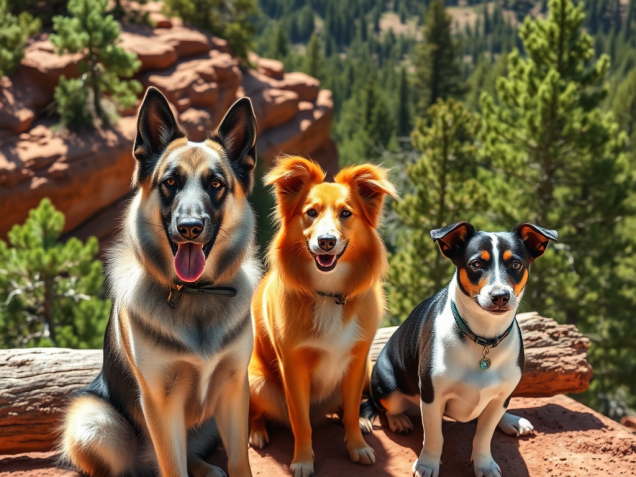
Bruiser, Oggy and Jackie, three friends that protected Benji.
It was Three O’clock in the morning before the Doctor arrived at Benji’s home. The Doctor had been tied up delivering twin babies out in the country, 12 miles south of town. When he returned to his office, his night nurse instructed him to go to Benji’s house for an emergency. The Doctor hadn’t wasted any time. Benji’s parents led the Doctor down the hall to Benji’s room. Benji’s mother explained in detail to the Doctor. She shared that Benji has had a 106-degree temperature.
“I haven’t managed to get it to break. I have tried everything I know to use.”
The Doctor took a look at Benji, who was mumbling. Shining a light into Benji’s pupils, they were dilated and fixed, something the Doctor didn’t like. He took his temperature, and it read 107. He checked the inside of Benji’s mouth. He saw what looked like the start of mouth blisters caused by the temperature. Oddly, Benji’s ears were clear. The Doctor turned to Benji’s parents, Mr. and Mrs. Roff.
“I’m not at liberty to reveal what it is. Is it is an allergic reaction to something the boy found in the forest? Possible. Is it a splinter infection we can’t see. Or it is a virus. Plenty of those are circulating these days. The important thing for us to do is get him cooled down.”
The Doctor instructed Benji’s mother to soak him in a bathtub filled with cold water and ice.
“He needs ice baths every hour. He’ll start fighting it. I would, too. But, we need to lower the temperature to at least 100. Then, we can give him some over-the-counter medication to help from there. Plus, while you are soaking him, be sure to watch his feet for thorns or splinters he has. Do the same with the legs, arms, and hands. Check any part of his body for that matter. We want to make sure he hasn’t got some foreign item infecting him.”
Madge, Benji’s mother, was quick to start running cold tap water into the tub. She emptied ice trays and sent Jake to the store to buy bags of ice. Benji’s temperature continued to rise. It climbed to 109. The Doctor was sitting in the kitchen. He had a cup of coffee. He said,
“I don’t like this one bit. If it goes up much further, we are going to have to put him in a hospital. I know it is costly and a ways from home. But, we need access to fluids and IVs that only a hospital can offer. Continue bathing him and try to see if we can lower the temperature.”
As Benji’s parents moved him from the bed to the bath, he talked about feral hogs. He also mentioned wildcats and bottomless pits. Benji’s mother asked her husband, Jake, if he had any idea what he was talking about. Jake, scratching his head, replied wearily,
“Not – A- Clue! I have never heard him talk of any of them, and we ain’t got that thing around here.”
Madge asked Jake if he had wandered into No Man’s Land and got the ideas from there. Jake replied,
“I don’t see how. All that is back there is old scrub brush and blackjack trees. Maybe a few bobcats and a coyote or two. Our cows won’t even go in there. The most he’d get if he went in there is dirty.”
Benji kept having visions of Bruiser standing in front of him. Bruiser was fighting off a feral hog. Oggy distracted a second hog. Then, Jackie barked at a third. Then, his vision went black. And a cold wash went over him. SPLASH! Next, he was in a cave. He heard a scream and looked around for its source. He felt the dogs surrounding him. Again, a Cold wash went over him, and it went dark again. SPLASH! Next, he was near the Bottomless Pit. He looked around and saw the straight-down drop-off. His stomach became unsettled. Then, another cold wash, SPLASH! He was at the clearing with his parents. This time, they were drying him off. Benji began struggling and squealing -––– yelling out,
“Oh, please tell me I didn’t fall into the Bottomless Pit! “
Madge and Jake, both happy that he was awake and the temperature appeared to have broken, called to him. Madge, hugging him, cried.
“Benji, Benji, can you hear us? You have been so sick, son.”
Jake wanted to know what Benji had been talking about. He asked,
“What is all this talk about? You mentioned feral hogs, wildcats, and bottomless pits. You had us all going for a minute. That must’ve been some dream!”
Benji said it wasn’t a dream; it happened. He knew it did. He wanted to know how are Bruiser, Oggy, and Jackie? Jake assured him they were fine. They had all been fed. They were sleeping on their pads by the door. They were being lazy. Benji asked if Bruiser had to have stitches. Jake laughed, asking,
“What are you talking about? Bruiser is fine; he has been playing with Oggy out in the front yard all afternoon. But I can tell they all three are missing you being out there with them.”
Benji couldn’t figure out how this could all be just a dream. It had to be real. It had to have been something he did. He stopped elaborating on the story. He was cautious because he didn’t want his parents to limit where he go. After a week of healing and receiving the Doctor’s approval, Benji was back to his regular habits. The Doctor suspected he must’ve had some spoiled food. The last thing Benji remembers eating before getting sick was canned Vienna Sausages. They had stayed in a pack in a locked car in the sun’s heat for some time. He and his pals were on the fringes of the yard, playing rescue. It required rations of sorts to get back to home base. So, Benji used cans of Vienna Sausages. He had been carrying them with him for a year or longer. He had left them in his backpack in locked cars throughout the summer and winter months. The Doctor guessed. Those things must have marinated well over sixty times. They probably tasted like prime rib to Benji. After a week and a half, Benji was back to his regular self, as were the dogs. Leading and trailing the youngster wherever he went.
Benji promised himself he had to know. He got down on one knee before leaving the house that day. He told Bruiser, Oggy, and Jackie,
“You guys don’t have to come with me. I know in my dream, if that was what it was, you almost got hurt badly. Especially you, Bruiser. It is okay if you want to stay home and sit this one out. I understand!”
The three pooches glanced at each other. It seemed like they were taking a moral inventory. Then they looked back at Benji. In unison, they all barked -––
“We’re in!”
They were all off to the Hollow that led to the area Benji called “No Man’s Land.”
This time, they got there early in the morning, just after 7:00 a.m. Benji called his trio of pals and said –––
“Here we go, guys! A, One, a two, and a three.”
With that, the four crossed the imaginary line Benji had always set for “No Man’s Land.” They hiked, scampering through underbrush and thick overgrowth for thirty minutes when they came to a clearing. One clearing matched where the feral hogs had attacked. But on this day, it was peaceful. No critters were around. His three dogs’ ears were all on alert. Their eyes scanning the trees around them, but they found nothing to be alarmed over. Benji sat on a log, Bruiser, Oggy and Jackie circled him for a pep talk.
“So far, so good. We’ve been enjoying our beef jerky up to this point, so here are your pieces.”
Benji looked east, feeling out of sequence with his dream. He saw the Bottomless Pits. He decided to walk over to the drop-off. As Bruiser, Oggy, and Jackie looked over the cliff at the water below, it was just like Benji’s dream. Now, Benji started to question whether he had a dream. How did I know what this would look like if I had never been here? He didn’t have an answer, but he still wanted to go further and see what was deeper inside.
As he and the three dogs crept through the brush, another clearing came. As Benji got to the center, he looked up, and there were Sandrock cliffs all around him. On one side was a cave. It seemed like the cave he had spent a night in with his three dogs. Had it been a dream, or was it real? He and the dogs walked up to the cave. It didn’t look as if anything had disturbed the soil in a very long time. No animals, no person, not even a bird. Which Benji thought to be odd.
Benji wanted to examine the watering hole where the Wildcat had been spotted the night of his ‘dream.’ When he got to it, he saw that it was clear as day and ice cold. It was a natural spring. You can drink from this Spring without getting ill. It was not contaminated. The Spring fed a creek; Benji looked at the creek flowing north. It was one of the few creeks in the county to do so. The creek is on his Dad’s farm. He always wondered where the creek water flowed from. Now he knew. And he knew it was Spring fed—another interesting fact.
Benji turned to take the path he and the dogs used to enter the opening. Surprising him, there stood an older man. He wore a white shirt with suspenders paired with pants tucked into knee-high boots and a floppy hat. Behind him stood a mule saddled.
“Young man, you lost?”
He asked.
“No, I don’t think so,”
Benji replied.
“This is on my father’s farm. I have never been brave enough to venture into these parts. I’m here to take a look around.”
The older man laughed.
“Well, my name is Elmer. I have lived out here in these parts all my life. And there ain’t nothing to be afraid of. But, this is the second time you’ve been here with your buddies. I helped you out of here the other night. I was afraid for all four of you. You and your dogs looked like you had stopped and eaten loco weed. That’s the devil, weed, boy; it will make your head spin.”
Benji, looking confused, asked Elmer,
“You said Loco Weed? What is that?”
Elmer rubbed his mule’s head. He propped his hat back on his head. He let out a breath. –
It looks like Polk Salad. That is what gets many people to mistake it for Polk. But it is LOCO. I’ve seen horses and cows do all kinds of crazy on the stuff. I tried to kill it all off my place. But it keeps finding its way back; birds, animals, and such have a way of replanting things.
Benji then asked,
“So, you helped me out of here? “
Elmer was quick to oblige –
“Yep, me and old Sara here; that’s my mule’s name. We were over here trying to find a couple of my hogs that got loose. They retreat to the Blackjack Trees and wallow in the cool soil. Anyway, we were trying to find our hogs, and we came across you guys trying to fight them. You thought they were some third-world alien implant. I got a big laugh out of that.”
Benji, scratching his head, looked at Elmer.
“I don’t remember that part, and I don’t remember meeting you.”
Elmer said he doubted that he would. He was surprised to see the boy back out there ever again. You were having a tough time. I have no idea what drove you to eat loco weed. Benji explained that he was trying to live off the land. He wanted to be a true backwoodsman. He thought he’d be eating something like Polk. He had never heard of loco weed. Elmer told me he’d know, and he’d be smart to stay clear of it. Benji said the dogs ate when Benji wrapped it around a Vienna Sausage.
Elmer said,
‘Now I have heard everything.’
Elmer explained to Benji he was in “No Man’s Land” all of two hours that night.
“I loaded you on old Sara. I took you down to your parents. I told them I found you and the dogs in the woods very sick. I was hoping I wouldn’t have to do it again tonight. Benji said no, now that I know what I did, I won’t do it again. Thank you for talking to me.”
Elmer said your big dog there looks like he’s got into some briers. Benji looked, and it appeared just as it had when the injuries from the boars were inflicted on Bruiser. Benji said I need to get him home. He needed to take care of the injury. Benji also need to make sure the other two were okay. Benji thanked Elmer for telling him about what happened. Elmer flashed a peace sign to Benji and told him,
“Well, son, just you and I know. That is all that matters. Of course, these three friends of yours know, but they won’t say anything. Just remember to be careful about chasing make-believe.”
That night, Benji sat on the porch. A bandaged Bruiser rested at his feet. Oggy curled up on the welcome mat. Jackie sat beside him, her eyes watchful and wise. His father stepped outside.
“Heard some wild barking earlier. Everything okay?”
Benji smiled.
“Better than okay. Oggy warned us. Bruiser protected me. And Jackie brought us home.”
Jake scratched Bruiser’s ear.
“Looks like we’ve got ourselves three of the best dogs in the county!”
From that day on, every afternoon, the school bus came to a halt at 3:35. Three dogs waited at the gate. They were ready for the next trail, the next challenge, and the next memory to be made. Because no matter how wild the world became, Benji never hiked alone.
Let’s get back to our story. –– Benji stood in the middle of the woods, heart racing, with three feral hogs growling and snorting nearby. Jackie had lost the scent trail. She couldn’t find the way home. Benji had just thrown away his only peace offering: the beef jerky. The hogs tore through the jerky in seconds. Benji and the three dogs tried to figure out what direction to go. But, now those hogs had regained interest in something more satisfying—the boy.
Oggy circled and snapped at the first boar, trying to keep it distracted. Jackie stood stiff and alert. She barked furiously at the second one. Her tail was rigid and her fur was raised. She positioned herself between the beast and Benji.
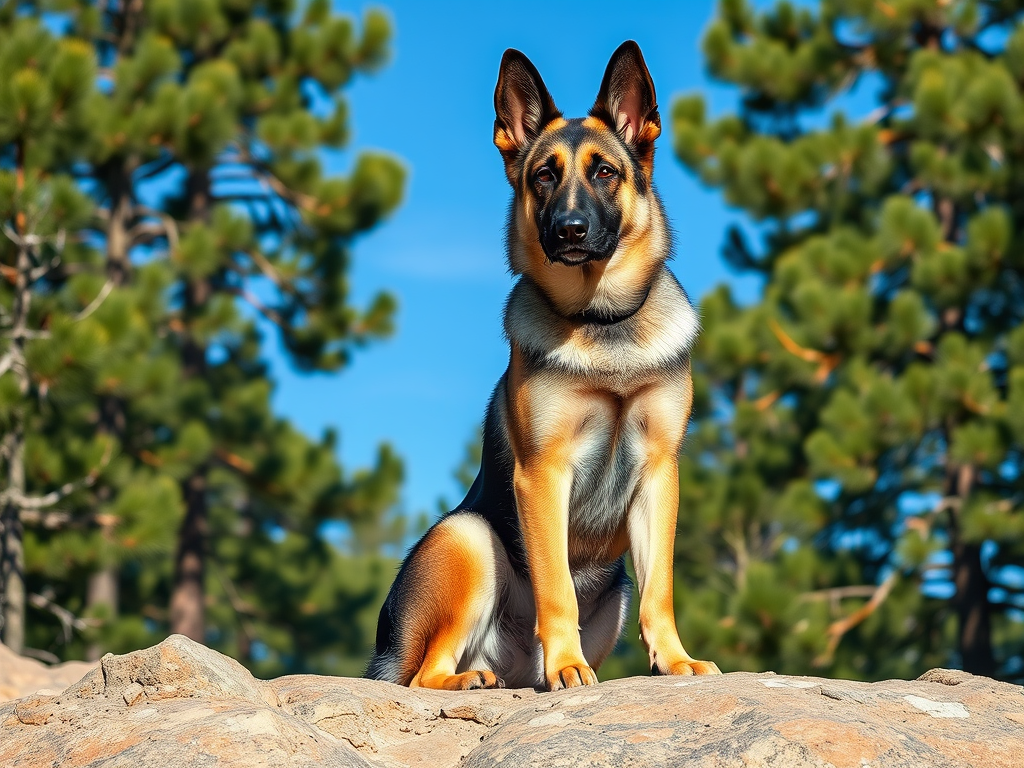
Bruiser, Dad’s Shadow
But it was Bruiser who took the lead.
With a thunderous bark, he lunged at the second boar. The clash was brutal. Bruiser’s sheer size and strength gave him an edge. Still, the wild boar was enraged and dangerous. It slashed with its tusks.
Benji screamed,
“No! Bruiser!”
But Bruiser didn’t back down. He planted his feet and forced the boar back with muscle and fury. Oggy darted in to nip at the animal’s hind legs while Jackie’s relentless barking finally drove the creature into retreat.
Within moments, the two remaining boars, startled and overwhelmed, turned tail and vanished into the trees.
Bruiser limped back, a fresh gash on his shoulder. Benji dropped to his knees and wrapped his arms around him, whispering,
“You saved us. You’re the bravest dog in the world.”
The three dogs surrounded Benji, panting heavily—not from fear, but from duty fulfilled. They had done their job.
The sun had dipped lower now, and the smell of distant cooking reminded Benji of home. He hoped Jackie would catch a scent that would guide them back—but no such luck.
They were still stuck in No Man’s Land.
Benji sighed and looked at his companions.
“Well, boys… looks like we’re gonna be here for a while. As well find a safe place to rest.”
The fading daylight painted the woods in long shadows. The path behind them had become a confusing tangle of trees and underbrush.
“I don’t know where we are,”
Benji admitted.
Oggy was licking his sore paws. Bruiser winced with every step. Jackie stood alert—ears perked, head rotating like a radar dish, listening for signs of danger.
Benji reached into his backpack and pulled out his trusty binoculars. Scanning the area, he spotted something—a cave etched into the canyon wall, not far off. It resembled an ancient hollow carved out of sandstone by the water long ago. If they can reach it safely, it can make a decent shelter for the night.
He pulled out a handkerchief. He tore it in half. He tied one piece to a high branch to mark the location.
Oggy took point. Bruiser limped beside Benji. Jackie stuck close this time and carefully marked her trail. They made their way to the cave.
Ten minutes later, they arrived at the entrance. The cave was shallow and quiet, with no signs of animal tracks inside. It looked safe—for now.
Benji gathered dead wood from the forest floor and built a small fire at the cave’s entrance. As the flickering flames grew, casting dancing shadows, the four of them settled in.
But Benji had a surprise.
He hadn’t given all the food to the hogs. He had two cans of Vienna sausages tucked in his backpack. They were beneath a rolled-up poncho. His dad always said to keep them in case of emergencies.
He popped open a can. Instantly, three sets of ears perked up.
Benji smiled and shared the sausages with the dogs, eating slowly and grateful that they had something to eat. But he couldn’t help wondering: How are we going to get out of this mess?
As night fell, the forest faded into darkness. The stars lit up the sky, and the wind rustled the trees outside. The cave offered shelter from the breeze, and the dogs took turns keeping watch while Benji dozed beside the fire.
At around three in the morning, a sharp, blood-curdling scream echoed through the canyon.
All three dogs leaped up, growling and tense. Benji jolted awake. The fire had burned down to glowing coals.
Another scream—closer this time.
Benji grabbed a long stick and jabbed it into the embers, trying to spark a flame. The dogs stood bristling, their fur raised, eyes locked on the darkness beyond.
This is the most dangerous moment yet—except maybe for the hogs.
Benji fumbled through his backpack and found a small flashlight. He switched it on and swept the beam across the canyon.
There, near a shallow watering hole, stood two full-grown wildcats—the biggest Benji had ever seen. Easily 130 pounds each. But the barking, the firelight, and the beam of the flashlight startled them. They bolted, disappearing into the trees.
Benji sat back down, heart pounding. Sleep was impossible now.
Thinking to himself –––
Was something else out there?
Has anyone even started looking for him yet?
He’d never been gone this long.
He sighed and pulled the blanket around him tighter.
“When I get back,”
he whispered to himself
“I’m gonna be in big trouble. For good this time.”
But for now, he is still in No Man’s Land.
And he is lost.
They called it No Man’s Land for a reason. Legend has it, no man who ever entered those woods was seen again. That little detail? It’s something Benji overlooked when planning his latest adventure. Rumor has it. No search party will go in after him. No one’s willing to take the chance they will not come back either. So maybe Benji ought to start thinking about an extended stay. Is anyone even organizing a search? Or will they just do a flyover, check a few boxes, and call it good? Check back tomorrow as the story continues—because things in No Man’s Land are only getting stranger.
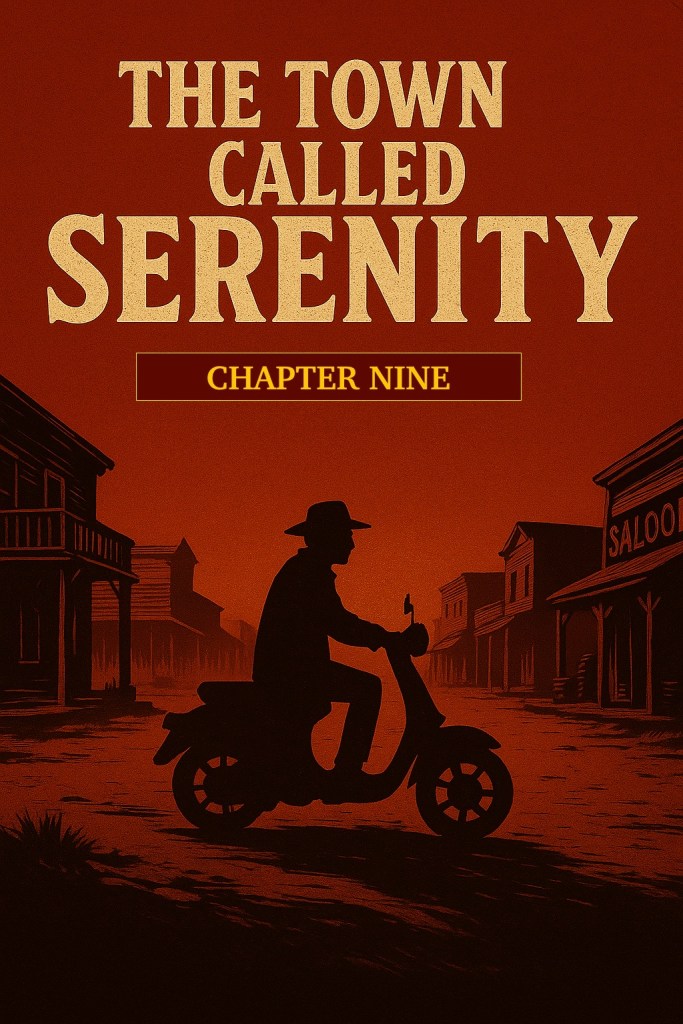
Chapter Ten: Stand Still, and the Dust Will Bury You
By dawn, the desert wind carried more than heat. It took silence—the kind that comes before thunder.
Chester Finch stood on the steps of the half-burned church at the edge of Serenity’s main street. His badge was pinned high and proud. His ribs ached. His coat was torn. But his eyes were sharp, and the ledger in his hands could end a dynasty.
The Marshal had pulled his moped from hiding and had it juiced up for duty. The Vespa GTS (300cc) moped shone as slick as the day it was new. It had US Marshal emblems on it and had been stowed inside the jail’s secret compartment. A hiding place that Chester designed the night he arrived in town.
Chester looked out over the gathering.
Wren was there, her arm in a sling, a rifle strapped across her back.
Petal stood beside her, bruised but alive, clutching a satchel full of Cain’s secrets.
Julep Jake leaned against the doorframe, sharpening his miniature whittled guillotine.
“A town’s only worth the blood it takes to keep it,”
He said.
“Reckon we’re due.”
Even Buck Harlan was the old stagecoach driver who hadn’t spoken more than ten words in a decade. He stood with a shotgun across his knees.
And behind him came the others—storekeepers, grooms, forgotten women, broken men.
Cain had ruled them. Gallow had hunted them.
But now –– now they remembered their names.
Chester raised his voice.
“I’m no savior. I’m no sheriff. I’m just the last man they sent when no one else would come.”
He held up the badge.
“But I say this badge still means something. Not because it’s brass. Not because the government gave it to me. But because I’m willin’ to bleed for it.”
He threw the ledgers down onto the church steps.
“These are Cain’s sins. Every payment, every name, every blackmail note, every fix. And when this town turns that over to the federal office, I just wired—they’re gonna come. Not with a whisper. With subpoenas and dogs.”
A beat of silence.
Then a single voice called out:
“And Gallow?”
Chester turned.
“He’ll come. Tonight, maybe. It could be sooner. He’ll bring fire.”
He looked to Wren.
“But fire don’t mean nothin’ if you’ve got water and grit.”
Wren nodded once.
“We stand.”
The townsfolk murmured.
Then they shouted.
Then they began to build.
Barricades. Traps. Makeshift outposts from overturned wagons and scrap wood. Petal turned the saloon into a war room. Julep Jake strung piano wire across alleys. Even the bell tower rang for the first time in years, warning off the vultures.
The Last Hour
Cain, watching from The Assembly, saw the town rise against him and knew he’d lost the crown.
He poured a final drink, set it aside, and vanished through a trapdoor in the fireplace, bound for nowhere.
The Arrival
Gallow came at sunset, just as expected.
He walked straight down the main street—unarmed, unhurried—like he owned time.
But this time, time fought back.
The first tripwire knocked him off balance. A spotlight lit him up. A warning shot clipped his boot.
He crouched, ready to vanish into shadow—until he saw Chester.
Standing in the street. Moped beside him. Rifle in hand.
“You’re outgunned,”
Gallow called.
“Nope,”
Chester said.
“I’m out-cowed.”
The townsfolk emerged—on roofs, behind crates, on balconies.
Gallow took a step. Then another.
Chester held firm.
And Wren, from the bell tower, raised her rifle.
The shot rang out.
Gallow stumbled. Not dead. Just marked.
He turned—bleeding, seething—and ran.
He vanished into the dust from which he’d come.
And the town never saw him again.
Epilogue: A New Kind of Quiet
Serenity changed.
The ledgers made it to Washington. Petal was deputized. Wren chose to stay and built the first real school the town had seen in thirty years. Julep Jake finally finished his guillotine and gave it to a museum in Tulsa.
As for Chester Finch?
He stayed, too.
He never left Serenity.
Not because he had to.
But sometimes, the worst places can create the most profound kind of peace.
Even if you get there on a moped.
The Town Called Serenity
A hero did not save it.
It was saved by the last man willing to stay when everyone else ran.
So the moped was hidden away in the jail’s secret spot—one no one else even knew existed. Good thing Chester made it out alive, or that Vespa would’ve turned into a time capsule! More importantly, this story is a great reminder: the bad guys never truly win.
Braddock Cain sat alone in The Assembly, a chessboard in front of him, half-played.
It was something he did when the whiskey wore off, and the world got too quiet. He played both sides of the board. He always made sure black lost.
Tonight, black wasn’t losing.
He moved a knight, sat back, and scowled.
The vault trap should have buried Finch and the girl. He’d received no word from Poke, which was unusual. Too unusual.
A low, sharp knock came at the door—three short raps.
Then silence.
His eyes narrowed.
“Enter,”
He growled.
The door creaked open, and the man who stepped inside wasn’t Poke. Wasn’t anyone from Serenity? His clothes were clean, military-cut. His boots were dustless. He didn’t wear a hat—but his shadow felt longer than the room allowed.
“Mr. Cain,”
The stranger said.
“I presume.”
Cain stood, hand already on the grip of his pistol.
“You don’t walk into this room without an invitation.”
“I didn’t walk,”
The man replied.
“I arrived.”
He stepped ahead and set a file down on Cain’s table. The name ASHWOOD was stamped in red across the top.
Cain didn’t move to open it.
“You’re Gallow,”
He said flatly.
“That’s what they used to call me,”
The man replied.
“In certain circles. Not the ones you buy into.”
Cain sat back slowly.
“What do you want?”
Gallow smiled faintly.
“Let’s call it… clarity. You’ve grown fat on rot, Cain. But rot attracts insects. I’m here to burn the carcass clean.”
Cain let out a cold laugh.
“You think you can walk into my town and—”
Gallow was suddenly in front of him.
Cain hadn’t even seen the movement.
A knife gleamed under Cain’s chin.
“I don’t think,”
Gallow whispered.
“I replace. You’ve become a liability to men far above either of us. The vault was never your property. The tapes, the ledgers, the names—you were supposed to manage them, not flaunt them.”
Cain’s eyes narrowed.
“You’re not just here for Finch.”
“I’m not here for Finch at all,”
Gallow said softly.
“He’s just a broken piece. You’re the engine.”
He pulled the knife away and tucked it back into his sleeve.
“I won’t kill you tonight. That would be –– premature. But I will leave you with a choice.”
Gallow tapped the Ashwood file.
“Burn this. Leave town. Or wait for me to come back.”
Then he was gone.
Cain sat still for a long time, listening to the echo of Gallow’s departure. When his hand finally moved, it wasn’t for his gun.
It was for the bottle.
Elsewhere in Serenity
Poke’s body was found behind the saloon—face down, no bullet wound, no blood.
Just two coins were placed over his eyes.
Wren and Chester stood over him in silence.
“Gallow’s here,”
Wren said.
“And he’s not working for Cain. He’s cleaning the house.”
Chester looked toward the west horizon, where dust clouds rolled in from the direction of the rail line.
He pulled the badge from his coat and stared at it.
“Time to decide,”
He muttered.
“Do I play Marshal—or outlaw?”
Well now, Gallow is certainly making his presence known! And Cain clearly has a big decision to make—but will he actually leave town? If so, he better start packing snacks for the road. But if he’s thinking about staying, he’ll want to give Jonathan Lawson a call. He should secure himself a Colonial Penn Life Insurance policy. It’s unfortunate Poke didn’t think ahead. Maybe those two coins over his eyes are enough to cover a plot in the nearest potter’s field.
As for Marshal Chester Finch, he’s defied the odds and made it to Chapter Ten. And it looks like this final chapter will finally answer the big mystery: the moped. Where has it been? Who hid it? Why wasn’t it tampered with? What was it originally bought for? And when did Chester decide it would be his official Marshal’s ride?
All of this—and more—will be revealed in Chapter Ten. ~ WE Hope ~
By noon the next day, the heat in Serenity had risen to an oppressive boil. The town smelled of dry rot, sweat, and gun oil. Somewhere in the distance, a fiddle played off-key. Somewhere closer, someone was being punched.
Chester Finch stepped out of the rickety sheriff’s office he had claimed, swatting at flies with his hat. His left eye was bruised from a scuffle the night before, and he had re-holstered his sidearm four times that morning alone—once while buying coffee, once while crossing the street, once during a handshake, and once because a six-year-old pointed a slingshot at him and said,
“Bang.”
Serenity wasn’t just lawless—it was allergic to rules.
A woman named Petal ran the general store and apothecary. She greeted Chester with an arched brow, and a cigarette clung in the corner of her mouth.
“You’re still alive,”
She said, counting change.
“Didn’t expect that.”
“Thanks for the confidence,”
Chester replied, tipping his hat.
She shrugged.
“Ain’t personal. We don’t usually see second sunrises on lawmen.”
Chester had started to respond when a shadow fell across the dusty street. Four men approached—spaced out like predators, walking with the purpose that made children vanish and shutters slam.
The Gentlemen had arrived.
The one in front was tall, clean-shaven, and wore a preacher’s collar over a duster that flared in the wind. A thick Bible was tucked under one arm. His name was Silas Crane, but most folks called him Reverend Knuckle. He smiled with too many teeth.
“Marshal,”
He said.
“We heard you were new in town. Thought we’d come to say hello proper-like.”
Behind him stood the other three:
Dutch, a former bare-knuckle boxer with hands like cinder blocks and a voice like gravel being chewed.
Miles, a one-eyed fiddler with a twitchy finger, never stopped humming.
And Jonas, the silent butcher-aproned brute who carried a wood-chopping ax like it was a handshake waiting to happen.
Chester stayed calm. He’d dealt with worse—once, a rogue bootleg militia in Nevada. Another time, a cult leader in Kentucky had a fondness for snakes and a penchant for blackmail. These four? They were just another test. Or so he hoped.
“I appreciate the hospitality,”
Chester said, thumb resting on his belt.
“But I’m here on business.”
Silas opened his Bible, then punched Chester square in the jaw. The Marshal hit the dirt hard.
“Chapter One,”
Silas said, closing the book.
“Verse one: The meek get stomped.”
Dutch cracked his knuckles.
“You wanna deliver the sermon, or should we take it from here?”
Chester wiped the blood from his lip and sat up.
“You fellas always greet visitors with scripture and assault?”
“Wegreet threats,”
Silas replied, crouching.
“You’re Cain’s business now. That means you’re ours.”
Behind them, the few townsfolk watching began to edge away, some disappearing entirely. Petal stayed, lighting a second cigarette from the first.
Chester stood up slowly.
“You done?”
Silas raised an eyebrow.
Because that’s when the door behind them swung open, and out walked Julep Jake, shirtless, handcuffed, and barefoot.
“Marshal,”
Jake yelled, grinning wildly,
“you left the cell unlocked again! I declare myself free! By raccoon law!”
Everyone froze.
Even Jonas blinked.
Silas turned slightly.
“What is—?”
And that’s when Chester moved. Fast.
He used the distraction to land a gut punch on Dutch. He spun around Silas. Then, he kicked Miles’ fiddle clean across the street. Jonas came at him like a wrecking ball, but Chester ducked and flipped a barrel in the way. The brute went tumbling.
It wasn’t a win. It was a delay.
But it was enough.
When the dust settled, Chester stood there, breathing hard, badge still gleaming. Around him, the Gentlemen nursed bruises and bruised pride.
“You tell Cain,”
Chester said, voice steady,
“that if he wants me gone, he better send a storm. Because the breeze just isn’t cuttin’ it.”
Silas stared at him, blood on his lip. Then he smiled that too-wide smile again.
“This is gonna be fun,”
He whispered.
They left him standing there, Jake still rambling behind him about his re-election campaign.
Later That Night ––
From a rooftop, a girl no older than fourteen watched the fight unfold. Her name was Wren. She didn’t talk much and didn’t smile either. But she watched everything. She scribbled something in a notebook.
The new Marshal wasn’t like the last dozen.
This one fought back.
Well now—what a predicament! After crossing paths with The Gentlemen, will the Marshal still be standing? Or will he end up being used to mop the floor by the end of Chapter Four? And as for his trusty moped… is it safe around this unruly bunch? Check here tomorrow for more and Chapter Four of this very exciting story!
The night shift at Ridgewood Corporate Plaza was supposed to be quiet. Ten floors of empty offices, humming servers, and fluorescent lights dimmed for the janitors’ comfort. The tenants had gone home. The day’s buzz was replaced by the solemn hum of vending machines. There was also the distant thrum of traffic.
That’s when the trouble started.
At exactly 11:42 PM, a woman from the 8th floor called 911. Her voice trembled as she whispered into the phone from behind a copier machine:
“It’s the security guard. He’s –– drunk. He has a gun, and he’s playing with it.”
“Officer intoxicated w/ a gun!”
Officer Marquez and his partner were already in the area and responded within minutes. They pulled up to the building’s glassy facade. They saw the guard—an older man with a thick mustache and sun-lathered skin. His uniform hung loose on his wiry frame. He stood under the lobby lights like he was in a stage play.
He spun a revolver on his index finger like an old-time cowboy. His other hand clutched a bottle of whiskey that sloshed wildly with each twirl.
“Pow!“
He shouted, aiming at an invisible outlaw in the corner.
“You see that, Tex? That’s the ol’ Ridgewood Quickdraw!”
Inside, a cluster of overnight IT workers and janitors peeked nervously from the elevator bank. Some held phones. Others gripped cleaning poles like makeshift weapons.
“Sir,”
Officer Marquez called out, stepping carefully from the squad car.
“Let’s talk. Put the gun down, okay?”
The guard, whose name tag read “Terry,” stopped spinning the weapon. He looked over as if noticing the world around him.
“Well, I’ll be,”
He slurred.
“Company’s here.”
He saluted with the barrel of the gun, then promptly dropped it. The weapon clattered to the floor. It spun in a circle like a coin. Finally, it came to a rest near a vending machine.
Marquez’s hand was already on his holster, but he didn’t draw. His partner approached slowly from the other side.
“Mr. Terry,”
She said, calm but firm.
“You’re scaring people. Can we take a seat over here and talk things through?”
Terry blinked at her, then at the people behind the glass, the ones he was supposed to protect.
“They don’t trust me,”
He muttered.
“Not anymore. It used to be a man with a badge, and a sidearm meant something.”
He took another swig from the bottle, winced, and gave a soft, hollow chuckle.
“Guess all that’s old-fashioned now.”
Marquez knelt beside the dropped gun and slid it back with his foot.
“It’s not about trust,”
He said.
“It’s about safety. Yours and theirs.”
Terry looked down at his trembling hands. The whiskey sloshed in the bottle, no longer steady. Finally, he let it drop, too, and it landed with a dull thunk.
He sat heavily on the bench by the entrance, slumping over like a man who hadn’t rested in decades. The officers approached, cuffed him gently, and led him out into the cool night.
As the police cruiser pulled away, the building behind him exhaled a collective sigh of relief.
Inside, someone from IT muttered,
“I never want to see another cowboy movie again.”
But for years afterward, whenever a door creaked open late at night, or the lights flickered for no reason, the cleaning crew would joke:
“That’s just Terry, doing one last patrol.”
And everyone would pause. They were half amused and half uneasy. They remembered the night the security guard became the danger he was supposed to guard against.
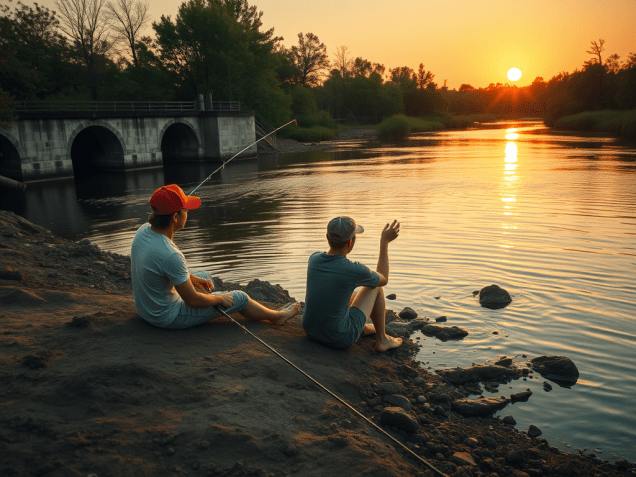
It was a humid summer evening. The air clung to your skin. The world glowed gold in the last light of day. My friend Bub and I stood at the edge of the old creek, just downstream from the dam. The concrete wall loomed behind us. Its spillway trickled like a broken faucet, feeding the deep pool below. The water turned slow and murky there. This was our favorite spot, a secret place we called “The Backside.”
Bub handed me a bank pole he’d rigged himself. It was a sturdy sapling shaved smooth. A heavy line was tied at the end. A fat hook was baited with a chunk of cut shad. We drove it into the muddy bank. We angled it over the swirling water. We tied it off with an extra rope to a thick root jutting out of the ground. Across the creek, Bub set another pole, whistling as he worked, his boots sinking deep into the silt.
We settled onto the bank, backs against the grass, watching the poles bend and sway with the current. The sounds of the night crept in: frogs croaking, cicadas humming, the occasional splash of a carp rolling. Somewhere distant, a train rumbled across the trestle.
“Think they’ll bite tonight?”
Bub asked, tossing a pebble into the water.
“They always do back here,”
I said, grinning.
“Big ones like the deep pool. They come up from the river, get trapped behind the dam.”
We waited in comfortable silence. Just as the moon began to rise, one of the poles gave a sudden, violent lurch.
“There!”
Bub shouted, scrambling to his feet.
I grabbed the pole, feeling the weight and fight of something strong on the other end. The bank pole bent double, creaking against the strain. Bub rushed over to steady the base. I worked the line by hand. I pulled and gave slack as the fish surged beneath the surface. The water boiled and flashed, silver scales catching the moonlight.
“It’s a big one!”
I gasped.
Together we fought it, step by muddy step. At last, Bub plunged his hand into the water. He grabbed the fish just behind the gills, hauling it onto the bank. It was a channel cat, fat and whiskered, easily ten pounds. We stood over it, grinning like fools, watching it thrash in the mud.
“Told you they always bite back here,”
I said.
Bub laughed and clapped me on the back.
“Best pole fishing spot in the county.”
We reset the pole. We rinsed our hands in the creek. Then, we sat back down under the stars. The dam hummed softly behind us. We didn’t talk much after that. We didn’t need to. The night surrounded us. The water flowed gently. The old dam spoke for us. They weaved our friendship into the quiet rhythm of the creek, one fish at a time.
I have many stories about growing up. Sometimes, I wonder how I fit everything I did into the years leading to where I am now. As a young teen, I always felt my family was boring. We never seemed to do anything special. But when I share our family stories today, people tell me they spark their forgotten memories. They bring back moments they thought were lost.
One such story involves our neighbors, Bill and his wife, Marie. They rescued every stray dog they found and invited each one into their growing pack.
I first met Bill while riding my bike home from a friend’s house. He had stopped his car to get the mail from his old roadside mailbox. I couldn’t help but stop and say hello. I asked him where he lived. He pointed across the road toward a distant antenna. It stood tall above the trees. “Right under that antenna,” he said with a smile. I had watched that antenna for years. It was massive. It perched on rotating poles to turn the shortwave and CB radio antennas in any direction he wanted. Seeing my interest, Bill invited me to visit the next day—but told me to check with my parents first.
I didn’t know it then, but Bill had been instrumental in bringing electricity to our area through a rural cooperative. He’d helped light up countless homes across several counties. My parents permitted me to visit but warned me not to overstay my welcome.
The next day after school, I finished my chores and pedaled toward Bill and Marie’s. As I left the paved road and turned onto the dirt path, barking erupted. A pack of dogs rushed to greet me, but they wagged their tails instead of attacking and licked my hands. It was like I was the first human they’d seen in years. They crowded around me, gently herding me up the porch steps. I reached for the doorbell, but before pressing it, the dogs nudged me ahead, practically carrying me into the house.
“Hello? Anyone home?”
I called out.
Marie’s sweet voice answered from the kitchen,
“I bet you’re JD’s boy. Bill told me you’d be stopping by. He’ll be out in a minute—say hello to the family.”
She gestured toward the dogs as she named them individually, expecting me to remember each name. There had to be twenty dogs in that living room alone. As I looked around, another thought puzzled me: how did she know I was my dad’s son? I hadn’t even introduced myself yet. A moment later, Bill entered, smoking his pipe, followed by four more dogs circling his legs. He shook my hand warmly and led me into his den, where I would spend hours learning from him. Bill introduced me to the world of shortwave radio and explained how to get a license. He even lent me a Morse code training record to help me prepare for the exam.
But radios were just the beginning. Bill showed me his greenhouse, where he taught me how starting seedlings early gives a head start in spring. One day, he took me to another outbuilding—a woodworking shop filled with the scent of freshly cut lumber. There, he showed me how he crafted furniture and home goods, staining and treating each piece with care.
When I was almost sixteen, Bill revealed yet another surprise: a mechanic’s shop hidden behind his house. Inside sat an old Datsun pickup.
“I haven’t driven it in years,”
Bill admitted,
“but it’s still here.”
I could feel the gears turning in my head. I was about to get my driver’s license, and that old truck looked like the perfect first car. Before I said anything, I knew I had to check with my dad. When I asked, my dad said,
“We can look at it.”
To me, that was a yes.
The next day, I returned to Bill’s and asked if he might be interested in selling the truck. Bill chuckled.
“I never thought about selling it—but if the price is right, maybe.”
“I’ll need a car when I get my license,”
I told him.
“And my dad said we could take a look.”
“Bring your dad down,”
Bill grinned,
“and we’ll talk.”
Dad and I stood in Bill’s mechanic shop a week later, looking over the Datsun. Bill puffed his pipe thoughtfully.
“It ran fine when I parked it. Might go ten miles, might go another hundred thousand. Hard to say with an old truck.”
He smiled at Dad.
“You know how it is with cars.”
Then Bill turned to me.
“I’ll talk price with the boy. You’re too good a horse trader for me to haggle with.”
My dad laughed.
“You know what you’ve got in your savings,”
he told me.
“Don’t spend more than that—and don’t forget tax, title, and insurance.”
At that moment, I felt the weight of adulthood settling on my shoulders. I bartered with Bill for ten minutes, careful with every dollar. Later, I discovered an interesting fact about Bill and my dad. They had been late-night radio buddies for years. They even arranged for a state newspaper courier to toss them papers at a secret highway drop each morning.
I kept visiting Bill and Marie for years. As I grew older, I began to understand Marie’s quiet burdens. They were things I wish I’d been capable of helping with then. I only understood them now, knowing what I know. Bill and his beloved dogs carried on their calm, legendary life on the edge of town.
No one else ever visited them—not like I did. And sometimes, I wonder if that had been the plan all along.
Bill and Marie passed away in the 1990s. Per their wishes, their property was sold to help the local community center. Their home, once full of vibrant life with voices, radio signals, and loyal dogs, became part of something greater. It was destined to be that way.
Every time I turn on a radio, I still feel them with me. When I smell fresh-cut wood or see an old pickup truck, I also think of them. Their stories live on—in mine.
“How Earl Survived the End of the World (Three Times In One Week)”
It all started on Monday when the news said the world was ending. Again.
“Experts warn: AI, killer bees, and rising sea levels converge by Wednesday,” read the headline on Earl’s phone. He sighed, sipped his lukewarm coffee (the microwave broke last week—tragic), and Googled “How to survive multiple apocalypses.”
Step one: hoard supplies.
Earl ran to the grocery store, but unfortunately, so did the entire neighborhood. All that was left on the shelves were 37 cans of creamed spinach and one gluten-free hot dog bun. He grabbed both. Earl wasn’t proud.
Step two: fortify your home.
This was trickier. Earl’s DIY skills peaked at assembling an IKEA lamp in 2014 (and even that leans a little). He taped bubble wrap over the windows. He stacked his furniture into a makeshift barricade. He hung a sign on the door that read: “Beware of Dog (or raccoon—honestly not sure anymore).”
By Tuesday, the threat had shifted. AI wasn’t trying to destroy us; it just wanted us to finish a customer satisfaction survey. Earl politely declined. The bees were delayed due to weather conditions. The sea levels were rising slowly. Earl figured he had time to finish his Netflix backlog.
Then came Wednesday.
That’s when the real disaster struck:
🚨 The Wi-Fi went out. 🚨
Earl sat there, blinking into the void, unsure how to continue. How does one live without memes? How do you know what to be outraged about if you can’t check Twitter?
Earl tried reading a book. (Printed words? On paper? Barbaric.) He tried talking to my houseplants. Phil the fern judged him silently.
Finally, Earl ventured outside — mask on, hand sanitizer holstered like a gunslinger — only to discover ––
The neighborhood kids had set up a barter system.
“Two rolls of toilet paper for a bottle of sriracha!”
One kid yelled.
“Half a pack of Oreo’s for an iPhone charger!”
Another bargained.
Earl traded three cans of creamed spinach for a Wi-Fi hotspot code—the best deal of his life.
By Thursday, the headlines read: “World Fine (For Now).”
Earl sighed in relief –– until he heard a knock at the door.
A drone hovered outside, lowering a package. Earl opened it to find:















 benandsteve.com