
How did we arrive at our current state? It is a question a lot of people are asking. It didn’t happen all at once. Getting to where we are, was forever in the making. Before anyone alive today was here. There have been people making decisions, some not so great. Life happens. It is a popular saying for some people. And as you can tell through this date in history. October 10th was a great day for history to be set. It doesn’t explain everything that has happened. But it does give one an idea of how history can pile up on any given day.
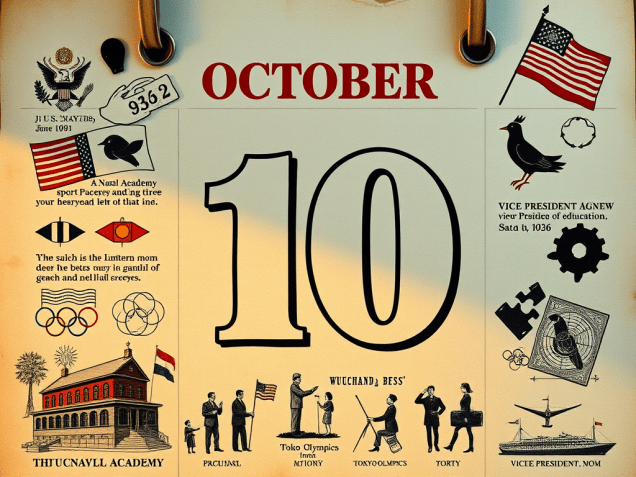
Here’s an evocative image of a calendar marking October 10. It serves as a visual prompt for a day rich in history. This day includes milestone events and global observances.
October 10: A Crossroads of History, Culture, and Global Awareness
A Time-Honored Legacy
- 1845 – U.S. Naval Academy Founded
- In Annapolis, Maryland, the Naval School opens with its first class of 50 midshipmen. This event lays the foundation for the modern U.S. Naval Academy.(1)
- 1911 – Wuchang Uprising Ignites Revolution This bold move sets the stage for the fall of China’s Qing dynasty. It also leads to the emergence of the Republic of China.(2)
- 1935 – ‘Porgy and Bess’ Debuts on Broadway
- George Gershwin’s groundbreaking opera, featuring an all-Black cast, premieres to widespread acclaim.(3)
- 1964 – Tokyo Olympics Start: A Global Broadcast
- Making history, these Summer Games are the first to be televised live worldwide.(4)
- 1973 – Vice-President Agnew’s Resignation
- Spiro Agnew steps down amid tax evasion charges, a rare and dramatic political moment in U.S. history.(5)
October 10, 1973: A Domino That Changed the Presidency
On October 10, 1973, U.S. Vice President Spiro T. Agnew resigned in disgrace. He pleaded no contest to tax evasion charges. These charges stemmed from a bribery scandal dating back to his time as Maryland’s governor. A sitting Vice President had never stepped down under criminal accusations before. This event sent shockwaves through American politics.
The resignation created an immediate power vacuum. Under the 25th Amendment, passed just six years earlier, President Richard Nixon was capable of nominating a new Vice President. His choice was Michigan Congressman Gerald R. Ford, a steady Republican leader respected across party lines. Congress confirmed him in December 1973, setting in motion a sequence of events no one predicted.
Only months later, the Watergate scandal deepened. Nixon’s credibility unraveled under the weight of investigations into the cover-up of the break-in at the Democratic National Committee headquarters. With impeachment looming, Nixon resigned on August 9, 1974—the first U.S. president to ever do so.
In that instant, Gerald Ford became president. He told the American people in his swearing-in speech:
“Our long national nightmare is over.”
Ford’s ascent to the Oval Office was accidental. He became the only person to serve as both Vice President and president without being elected to either office.
Looking back, it’s clear that Agnew’s resignation on October 10 wasn’t just a scandal. It was a turning point in American history. Had he remained Vice President, Agnew—not Ford—would have been next in line when Nixon resigned. The nation, already reeling from Watergate, faced the reality of a president tainted by his own corruption charges. Instead, Ford’s calm, if brief, presidency offered a bridge back to stability.
👉 OCTOBER 10, 1973 stands as proof of how a single resignation reshaped the presidency. It altered the line of succession. It changed the course of American political history.
October 10 is more than a date—it’s a living mosaic of pivotal moments, human emotion, progress, and remembrance. It reflects how history shapes us and how we, in turn, continue writing it.
By Benjamin GroffMedia© | benandsteve.com | ©2025
 benandsteve.com