“Buying Warner Bros: The GoFundMe Heard ’Round the World”

2–3 minutes

by Benjamin Groff II – this is a fictional story. It was created by the space in my head. In this space, various ideas loom when I read news articles. This makes them more enjoyable.


A GOFUNDME to buy Warner Brothers?

It started as a joke. It was one of those offhand remarks tossed out online. You’ve had just enough coffee and cable-news frustration to believe you do better than a billion-dollar studio.

“Why don’t we just buy Warner Bros.?” I said. “We’ll start a GoFundMe.”

Within minutes, the idea took on a life of its own. A few shares, a few memes, and by nightfall, the campaign had raised $437.17 — most of it from people who thought they were donating to rescue Bugs Bunny.

Of course, the real Warner Bros. — now a corporate hydra known as Warner Bros. Discovery — is valued somewhere north of $20 billion, give or take a Batman sequel. That means we’d need approximately 500 million people donating $40 each to make an offer. A few folks online said that it was doable “if we all skipped Starbucks for a month.”

I’m not saying I was confident, but I did start designing logos: “People’s Pictures Presents…” and “A Groff–Swint Production.” I figured we’d restore Saturday morning cartoons. We would bring back The Bugs Bunny/Road Runner Show. We should stop rebooting the same superhero franchise every six months.

Within days, the comments on the GoFundMe page turned into a movement. Someone pledged $10 and demanded we greenlight Smokey and the Bandit 2: The Electric Pontiac. Another offered $25 “if y’all promise to fire whoever keeps canceling good shows after one season.”

The campaign hit $3,000. Then I got my first call from a lawyer. Apparently, corporate takeovers by crowdfunding are “not standard procedure.” I told him, “Neither is releasing Space Jam 2, but that didn’t stop you.”

Before long, our story went viral. CNN called it “the most optimistic hostile takeover in entertainment history.” One late-night host joked that Americans had finally united. They did not unite to choose a president. Instead, they united to save Looney Tunes.

We never got close to $20 billion. We didn’t even reach the amount needed for one Warner Bros. parking pass. But something magical happened. Fans from around the world flooded the comments. They shared memories of Saturday morning cereal and cartoons that made them laugh before school. For a moment, it wasn’t about money. It was about taking back a piece of joy that corporations can’t own.

So no, we didn’t buy Warner Bros. But in a way, we did something better. We reminded the world who really owns the stories. They are owned by the people who remember them.

As for me, I left the GoFundMe page up. In case Elon or Oprah feels nostalgic.

Still I have a question. If Fans Owned Hollywood — What Would Change First?


By Benjamin GroffMedia© | benandsteve.com | ©2025 

The Secret to Mr. Dink’s Disguise Adventures

2–3 minutes

Mr. Dink and the Secret Agent’s Beard

Mr. Dink had always dreamed of growing a grand, bushy beard. He wanted more than a scruffy patch or stubble. He desired the beard that inspired respect. It was like the beard of a ship’s captain or a wise old philosopher. For years he tried: tonics, oils, even rubbing garlic on his chin (his grandmother’s advice). Nothing worked. At best, he muster a shadow of stubble that made him look perpetually halfway through shaving.

One lazy afternoon, flipping through a magazine, something caught his eye: an ad for “Undercover Agent Supplies.” The list included fake passports, invisible ink, and, most importantly, false facial hair kits. Mr. Dink’s heart skipped. At last, a way to see himself with a beard! He sent in his order, expecting a modest beginner’s kit.

But somewhere in the warehouse, a mistake was made. Instead of the novice set, Mr. Dink received a professional-grade disguise kit—the very same used by secret service agents. When he opened it, the contents dazzled him. There were full beards in every style imaginable. Mustaches curled or drooped. Eyebrows that changed a man’s entire face. There were wigs, glasses, voice changers, even adhesive skin molds.

Mr. Dink began experimenting right away. In one disguise, he was a grizzled lumberjack. In another, a mysterious professor. And when he wore the gray beard and cap, not even his closest neighbors recognized him. To his shock, the disguises worked so well that people began speaking freely around him. He heard what they really thought about Mr. Dink—sometimes kind, sometimes critical, sometimes hilariously wrong.

At first it stung. But as he listened, he realized how little people truly saw of him, how much they judged by appearances. And oddly, this knowledge freed him. He began wearing the disguises not to hide, but to understand. And the beard—the one he never grew—became a symbol of all the lives he slip into.

In the end, Mr. Dink discovered he hadn’t needed a beard to be respected. He needed confidence, curiosity, and a little humor. Still, he kept the kit. There were times when being a secret agent was just too much fun. The allure of having a glorious beard was hard to resist.


By Benjamin GroffMedia© | benandsteve.com | ©2025

The Day the Johnson’s Mimic Bird Flew the Coop And Flew Throughout Johnson City, Kansas

3–4 minutes

The Day the Mimic Bird Flew the Coop

Earl and Mabel Thompson were a quiet couple in their seventies. They lived on Maple Street in a small white house with blue shutters. Most evenings were spent watching the news or sipping tea on the porch. Their pride and joy, though, wasn’t a grandchild or a garden, but a bird—a rare mime bird. Unlike parrots, which repeated words, this bird can mimic voices perfectly. You’d swear the real person was in the room.

They named him Charlie.

One summer morning, Mabel was dusting the birdcage. Earl was fumbling with the Sunday crossword. Charlie spotted the cage door ajar. With a gleeful flap, he darted out the window and into the open sky. Earl dropped his pencil. “Mabel, the bird’s loose!”

But by then, Charlie was already over Johnson City, Kansas Main Street, testing his repertoire of voices.


Trouble Takes Flight

Charlie’s first stop was the Jenkins’ house. Hovering outside the kitchen window, he called out in Mr. Jenkins’ voice:


“Darlin’, I burned the roast again!”

Mrs. Jenkins stormed into the kitchen, waving a wooden spoon, ready for a fight. Poor Mr. Jenkins had been quietly napping in his recliner. He nearly fell over when she accused him of ruining dinner. He hadn’t even touched it.

From there, Charlie zipped down to O’Malley’s Bar. Perched on the ceiling fan, he crooned in half a dozen voices: “Put that on my tab!” “You call that a drink?” and, worst of all, in the barkeep’s own gruff tone: “Next round’s free, boys!” Chaos erupted as patrons demanded their “free round,” and fists began flying before anyone realized the voice was coming from above.


Civic Mischief

Not content with bars and kitchens, Charlie wheeled into the Johnson City police station. He perched outside the dispatcher’s window. He barked in Officer Daniels’ exact voice:
“Unit 12, urgent back-up on Fifth and Main!”

Three patrol cars roared away with sirens blaring. The station was left in confusion. The real Officer Daniels walked out of the bathroom holding a sandwich. One County Unit, A State Patrol Car and the city’s only other active patrol unit.

Later that same afternoon, Charlie wandered into Johnson City’s Hospital. There, using a spot-on imitation of the head doctor, he announced over the intercom:


“Paging Dr. Howard, please report to Room 207. Emergency tonsil transplant, stat!”

Patients and nurses alike scrambled in a tizzy, while Dr. Howard was still in the cafeteria with a mouthful of Jell-O. He nearly joked. Squirming to get up his belly got wedged beneath the table and chair. A colleague that was with Doctor Howard, began laughing so hard he nearly passed out from the added action.

Charlie flew down to Johnson City John Deere. He landed in their parts department. There, he began calling out engine parts numbers from bin numbers. This drove the parts clerks absolutely crazy.


The Chase and the Capture

Word spread of a mysterious troublemaker around town. By that time, Earl and Mabel were chasing after Charlie with a birdcage. They called sweetly, “Here, Charlie! Come home, dear!”

The town’s patience was running thin, though most couldn’t help but laugh at the absurdity. Charlie was exhausted from a day of impersonations. Finally, he landed right back on Earl’s shoulder with a satisfied squawk:


“Well, that was fun!”

—in Earl’s exact voice.

Earl sighed, Mabel shook her head, and the crowd around them burst into laughter.


Aftermath

From that day on, Charlie’s cage was fitted with a brand-new lock. Earl swore it would never happen again.

Still, every now and then, when the wind blew just right across Maple Street, folks swore they heard Charlie. He was practicing a new trick. The voices varied—sometimes the mayor, sometimes the school principal—but the laughter it brought the town was always the same.


By Benjamin GroffMedia© | benandsteve.com | 2025 

The Haunting Experience of a Small Town Funeral Home

2–4 minutes

The Dead Has Gone – A Night Call to the Funeral Home

Jake Roff was a man of routine. Up before the sun, station lights on by 4:30, coffee brewed by 4:35. He liked the quiet hours before the town woke up. There was no traffic and no gossip. Just the hum of the soda cooler and the smell of gasoline.

That’s when the hearse pulled in.

The local funeral director appeared. He was a man who had perfected the art of wearing a solemn face. He maintained this expression even when discussing baseball scores. He leaned out the window and said,

“Jake… I can use an extra set of hands unloading a client.”

Jake wasn’t sure “client” was the right word, but he was too polite to argue. He locked the station door and climbed into the passenger seat. The ride was short. It was a ride where the air feels colder than it should. You can’t shake the notion that someone in back is listening.

At the funeral home, the place was dark. A single light illuminated the hallway. It was the light that leaves more shadows than it removes. The two men wheeled their passenger toward the prep room, the floor squeaking under the gurney wheels.

That’s when Jake’s hip clipped something.

The “something” was another gurney, parked just out of sight. The bump sent the sheet sliding to the floor in slow, terrible motion. It was like a curtain rising before a play no one wants to see.

Underneath was a woman. Her hair was a halo of white, frizzed and jutting out like she’d been caught mid-scream in a lightning storm. Her eyes were wide and glassy, locked on Jake as if she’d been waiting for him specifically. Her jaw hung slack. Her teeth were just visible. It was an open-mouthed stare that made him wonder if she was about to say something.

Jake didn’t stick around to find out. He backpedaled so fast he nearly tipped the “client” he’d come to help with. His heart was pounding. He mumbled something about

“forgetting to check the oil at the station.”

Then, he made a break for the door.

The funeral director called after him. By then, Jake was halfway down the block. He vowed never to set foot in that place again. For the rest of his days, he’d open his station early. Yet, if a hearse rolled in before sunrise, Bill always ensured he had a sudden, urgent appointment anywhere else.

The Sonoran Desert’s Buck Milford – Chapter 10: Cooler Heads (and Sandwiches) Prevail

Reclaiming Ajo, Arizona!

Dawn broke over a transformed Ajo. The Mexican beagle crickets, now thoroughly stuffed with peanut butter goodness, retreated to the desert brush. The crickets appeared content. It was as if the agreement had fulfilled their mission. A sense of calm, albeit a wry and weary one, settled over the town.

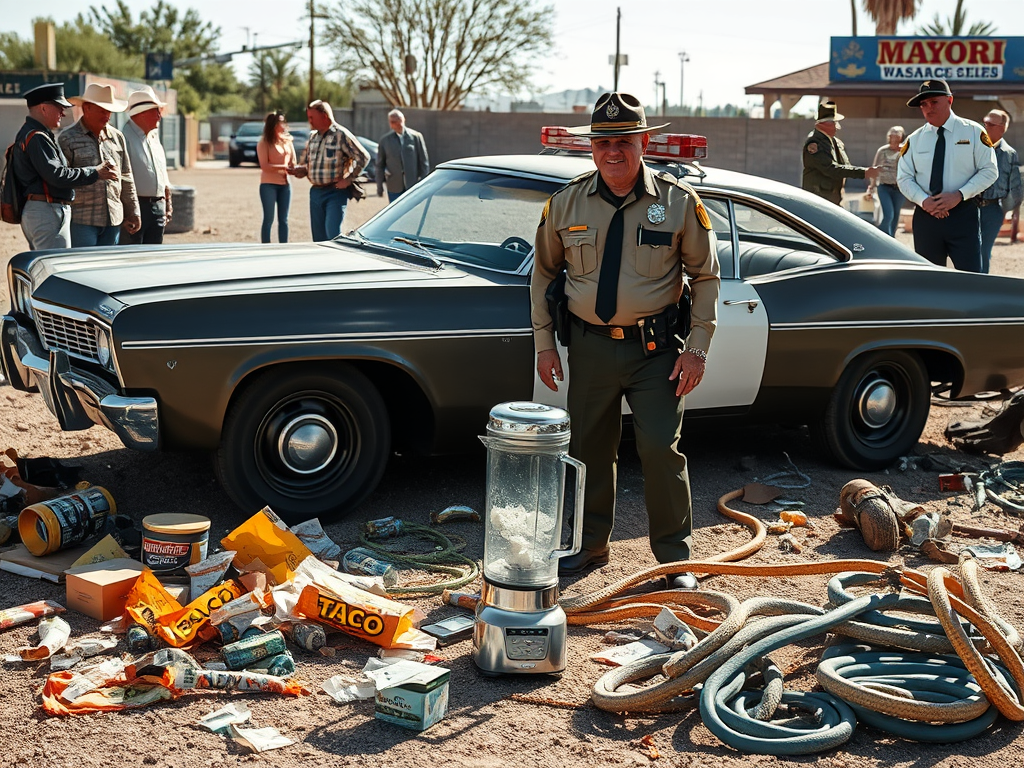
Buck found himself standing amid the remnants of last night’s epic showdown. Discarded taco wrappers were all around. A few broken garden hoses added to the debris. An old margarita blender lay as if a token of an absurd battle. The Mayor, still in full “wartime” regalia, shook hands with retirees. He even gave a slight nod of respect to Carl for his unorthodox diplomacy.

At the gas station, the local newspaper was already printing the headline:

“PEANUT BUTTER PACIFIST: HOW BUCK MILFORD CALMED THE CRICKET STORM”

— Ajo Today, alongside a coupon for “Buy One, Get One Free – Peace of Mind.”

Buck, ever the humble hero, tipped his hat.

“Sometimes, all it takes is cooler heads…and a couple of sandwiches,”

he remarked dryly.

The final act of the evening unfolded with a local radio show, hosted by Marty the janitor. Marty, now reformed, played a slow, soulful tune. The music blended cowboy ballads with cricket chirps in the background. Buck’s patrol car, dusty and battered, stood as a symbol of resilience against absurdity.

As the sun climbed higher in the sky the next morning, Ajo prepared for another day in the desert. Danger and humor mingled that day. There was also the possibility of another bizarre escapade in the shimmering heat. And Buck, always ready, knew that in a town like this, adventure was never too far away.

~THE END~

The Sonoran Desert’s Buck Milford – Chapter 9: Showdown at Sunset

By Benjamin GroffMedia© | benandsteve.com | 2025 Truth Endures©

2–3 minutes

Catching Heat In Ajo, Arizona

The sun dipped low. It cast long shadows over the scorched earth of Ajo. The stage was set for the ultimate confrontation. Every faction had gathered. Mayor Gonzalez stood with her fleet of feisty seniors armed with flyswatters. Carl Sandlin rode his tinfoil-covered dune buggy, banjo in hand. A defiant Barney Fife-lookalike still clutched his oversized ticket book. Buck was caught in the middle, displaying a mixture of resignation and amusement.

Across the dusty open space, the beagle crickets aligned themselves in rows that shimmered in the golden glow. Their usual hum was replaced by a rising, almost militant chorus of chirps. It was a rallying cry that sent a shiver down everyone’s spine (or was it just the cool desert breeze?).

Mayor Gonzalez stepped up, megaphone in hand, and declared,

“Today, we settle this once and for all! You bugs have terrorized our town long enough, and you’re coming to justice!

At the same time, Carl revved his banjo as if it were a trigger. He let out a wild, improvised yodel. This merged into a banjo riff—a challenge thrown down in musical form. The tension was palpable.

Then came the unexpected moment. Buck acted on pure instinct. His genius shone brightly from a half-forgotten lunch order. He pulled out a thermos of peanut butter sandwiches.

“Folks, and… critters,”

he announced, his voice steady.

“Sometimes all you need is a little tad of nourishment. It’s a reminder of simpler days.”

He scattered the sandwiches across the open space. The crickets, baffled by the offering (and even enticed by the rich aroma), paused their chorus. Slowly, as if savoring each bite, they began to nibble at the offerings. One by one, the insects lowered their guard. In that surreal instant, music and mayhem faded into an almost peaceful tableau.

Barney Fife-like hollered,

“This is it—the bug truce is on!”

While Mayor Gonzalez’s frown slowly morphed into a reluctant smile as her deputies put down their flyswatters.

For a heartbeat, the desert held its breath.

How long can everyone hold their breath? Too long, and we’ll have folks fainting in the streets—because that’s what happens when you forget to breathe! We hope the Mayor will remind the crowd to inhale. Barney Fife or Buck himself might do that too. We need this reminder before we move on to Chapter 10—the final installment of this wild ride.

If you’ve been reading since Chapter 1, you already know how it started. It began with unidentified flying toilets. Additionally, there was a full-blown invasion of Mexican Beagle Crickets across Southern Arizona’s Sonoran Desert. But if you just tuned in now… do yourself a favor—go back to the beginning. Otherwise, you’ll be as lost as the lady in the blue ’74 Buick LeSabre. She’s still sitting at the stop sign outside Ajo. She’s waiting for directions that may never come.

The Sonoran Desert’s Buck Milford – Chapter 8: Misting Stations and Mistrust

By Benjamin GroffMedia© | benandsteve.com | 2025 Truth Endures©

2–3 minutes

The Mexican Beagle Crickets Hum “Play Misty For Me?

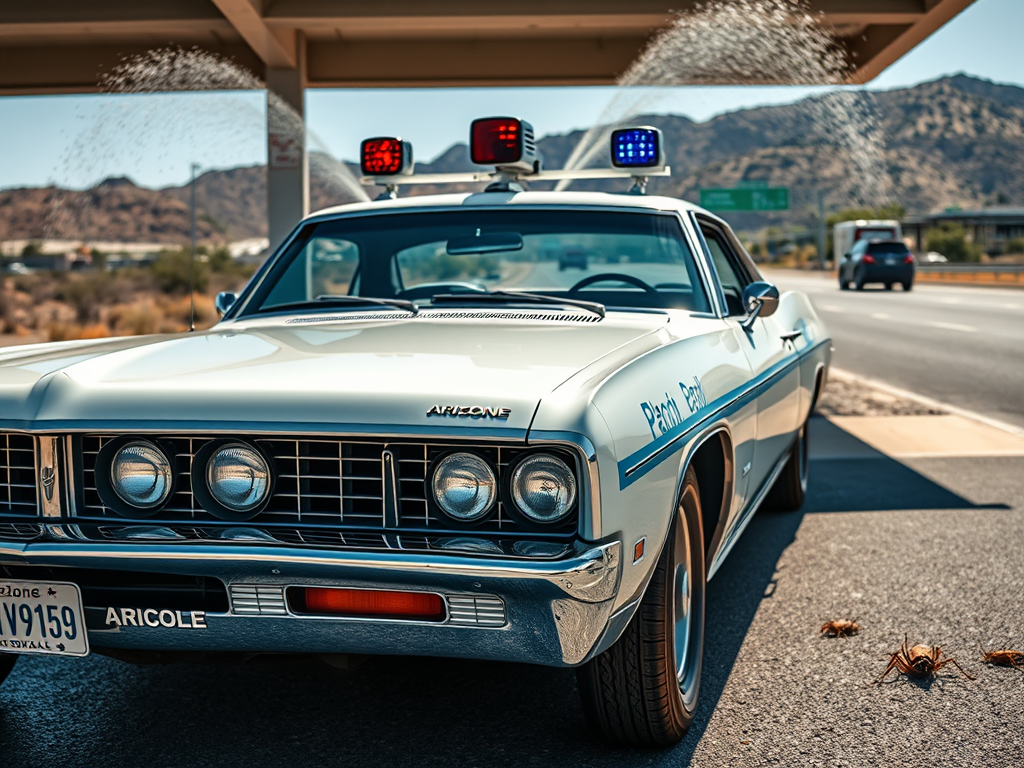
As news of the impromptu peace talks spread, another mystery began simmering like the endless desert heat. The highway crew’s newly installed solar-powered misting stations were intended to cool workers. They were also meant for eager beagle crickets. Nonetheless, they were causing far more problems than anticipated.

While Buck was patrolling near a row of these glistening stations, he noticed something amiss. Where the mist should have provided relief, it instead made the crickets multiply. A bizarre swarm of shiny, water-dappled insects was now marching in almost perfect formation.

Investigating further, Buck discovered that the misting stations weren’t a product of innovative engineering at all. They were part of a shady government contract mixed with local corruption. Additionally, there was a janitor who seemed to know every secret corridor in the county. The janitor was a quiet, stooped fellow known as Marty. He confessed that he had been “tinkering” with the control systems. He did this in exchange for a steady supply of his favorite snack: spicy cactus crisps.

“This here mist is subsidizing a bug bonanza!”

Buck grumbled as he took notes in a dog-eared notebook, the pages fluttering in the arid wind.

Suspicions mounted. Someone is using the misting stations to create a perfect breeding ground for the cricket phenomenon. This move would be designed to turn Ajo into a quirky tourist trap. It also would be a covert experiment in behavioral acoustics. Trust, it seemed, was as scarce as shade in the desert.

Before Buck confronts Marty with a ticket, the misting systems churned out another puff of fog. It sent confused retirees and cricket mediators scattering in every direction. Buck still intended to give Marty a stern talking-to.

Those misting machines didn’t cool things down—they cranked the chaos up a notch! Now, Mexican Beagle Crickets are swarming Ajo and its neighboring towns faster than you can shake a jalapeno-laced stick. Somewhere in the background, the ghostly voice of Karl Malden echoes. It is from a dusty 1978 American Express commercial. “What will you do? What will you do?” That, dear reader, is the burning question for Chapter Nine… and trust us, the heat is just getting started.

Happening Now: Monitor Lizard Not Actually T-Rex in Disguise

Jurassic Farce: When Lizards Go Rogue

By Benjamin GroffMedia© | benandsteve.com | 2025 Truth Endures©

1–2 minutes

A while back, WordPress Community Members discussed a curious topic. They wondered whether it was possible to bring back a dinosaur. If so, they questioned which dinosaur it would be.

An attempt to do so may have been underway recently. This became obvious when a monitor lizard screamed and ran for its life. It crashed out of a second-floor window. It then proceeded to lead authorities through a multi-state chase. People were urged to protect their gardens, poodles, and pus— ugh, cats.

Anyways, it is making National News. And I fear that other lizards, regardless of their variety, will start trying the same thing. Suddenly Boom! There will be someone who succeeds, and their progress will be shared with like-minded individuals. Soon we will have a full-throated invasion of body-snatching giant lizards running around telling everyone they are dinosaurs.

Here is breaking news for when they do! HEADLINE: No, Monitor Lizards Are Not in The Dinosaur Family. They are a type of lizard belonging to the family Varanidae. While both dinosaurs and monitor lizards are reptiles, they diverged from a common ancestor long ago. Dinosaurs are part of the archosaur lineage, which also includes birds and crocodiles. Monitor lizards are part of the squamata lineage, which includes other lizards and snakes. 

The Sonoran Desert’s Buck Milford – Chapter 7: Buck Joins the Bug Peace Talks

By Benjamin GroffMedia© | benandsteve.com | 2025 Truth Endures©

2–3 minutes

Salsa Dancing To A Deal With The Mexican Beagle Crickets

The escalating cricket crisis soon took a bizarre turn. After the Mayor declared martial law, Buck inexplicably found himself roped into a ceasefire negotiation. It was by invitation and circumstance, not entirely by choice.

Under the twilight sky, Buck set up a pair of folding chairs near the old taco stand. It was now decked out as a makeshift negotiation table. He sat alongside Carl Sandlin, who was still sporting his sequined –––

“diplomatic vest.”

An unexpected guest joined them: Gladys “The Negotiator” Ramirez. She is a spry 82-year-old with a background in community organizing and a penchant for peanut butter.

A gentle breeze stirred the desert sand as dozens of beagle crickets gathered in a semicircle. Their chirps and hums intermingled with the soft strumming of Carl’s banjo. It was not a formal diplomatic session at all. Instead, it was a surreal backyard barbecue meeting. Buck found himself as the unintended mediator.

Carl, with a dramatic flourish, announced,

“I propose we work together! You bugs, you stop the invasions, and we guarantee a steady supply of fresh, organic salsa.”

The crickets, of course, did not respond with words, but their synchronized humming seemed to offer a tentative –––

“aye.”

Then, Gladys cleared her throat.

“Now listen here, critters. We are not capable to talk your language, but I do know a thing or two about compromise. How ’bout a trade?”

There was a pause that lasted nearly two seconds in cricket time. A single cricket marched ahead. It tapped an abandoned sombrero with its leg, as if in silent agreement.

Buck, rubbing the bridge of his nose, grinned. He thought,

“I have to admit, this is just the most peculiar peace talk.”

It was indeed the most peculiar peace talk this side of a cactus convention.

The ceasefire was as fragile as the morning dew on the desert floor. For one mystical, humid moment, man and cricket reached an understanding.

Will this agreement hold? The Mexican Beagle Crickets and man—finally in harmony? Or will the crickets grow weary of salsa and develop a taste for avocado dip instead? Will a sudden craving for classic TV jingles like Sanford and Son or The Beverly Hillbillies derail the peace? And what happens when today’s senior citizens pass on—will the next generation need to renegotiate the whole deal? With only a few chapters left, Buck better hustle—answers aren’t going to find themselves!

The Sonoran Desert’s Buck Milford – Chapter 6: The Mayor Declares War

By Benjamin GroffMedia© | benandsteve.com | 2025 Truth Endures©

1–2 minutes

ONE STEP TOO FAR – TAKING OVER OF A TACO STAND

Mayor DeeDee Gonzalez wasn’t one to take a half-measure. Her town’s only claim to fame was a bug outbreak with a penchant for humming and line-dancing. Mexican beagle crickets had commandeered a taco stand once more. They also interrupted a high-stakes karaoke contest at the community center. She had had enough.

The emergency meeting took place in the town hall. Chairs were hastily arranged in a circle. The table was littered with half-eaten enchiladas. The Mayor banged her gavel with a determined clatter.

“Enough is enough!” 

She declared.

“These pests have overstepped their bounds. As of now, martial law is declared on all cricket activity in Ajo!”

In a matter of minutes, local retirees received “bug defense kits.” These kits featured oversized flyswatters and garden hoses. They also included homemade “cricket deterrent” spray (an odd blend of cactus juice and a hint of mint). The newly minted “deputies” marched down Main Street. The Beagle Cricket Brigade paused their evening serenade. It was as if to say, “They brought reinforcements!”

Buck, watching from the window of the Impala, smirked.

“Now that’s what you call bugging out,”

He muttered. He anticipated the chaos. It would ensue when a troop of seniors met a swarm of rhythmic insects.

How dare they! A Taco Stand? Those evil Beagle Crickets! It is only a matter of time before someone is called to main street for a shootout at high noon. But, will Buck’s aim hit something as small as a cricket in a shootout? Would the crime fighter be outmatched by crickets? Or will they challenge him to Karaoke sing off?

The Sonoran Desert’s Buck Milford – Chapter 5: Heatstroke and Hallucinations

By Benjamin GroffMedia© | benandsteve.com | 2025 Truth Endures©

2–4 minutes

Other Strange Sightings In The Desert

Buck Milford wasn’t the type to complain. He’d driven through sandstorms. He had broken up fistfights at quilt raffles. Once, he gave a field sobriety test to a goat wearing sunglasses. That day was different. The Arizona sun scorched the earth like a microwave set on vengeful. Even Buck was close to breaking.

The heat index had hit 127. A road sign melted. Melted. The “SLOW CHILDREN AT PLAY” sign now reads “OW.”

Buck had parked his cruiser under the only tree between Ajo and Yuma. It was a desperate little mesquite. It looked like it had made some poor life choices. He sipped water from his melted ice chest and tilted his hat over his forehead.

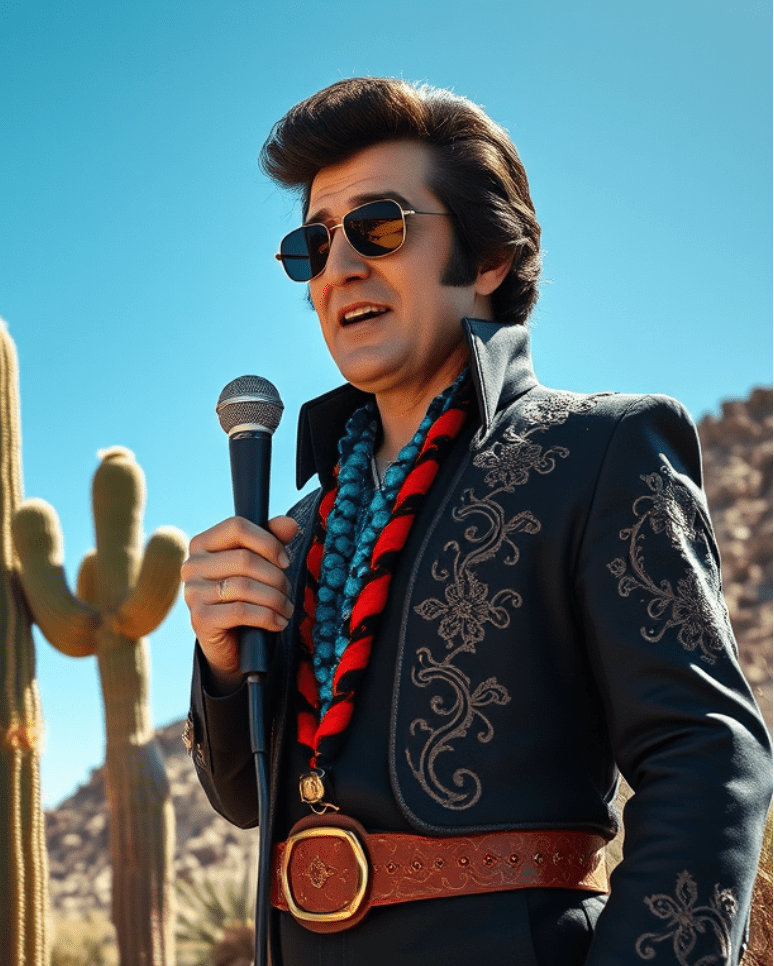
That’s when he saw Elvis.

Plain as day.

Standing next to the patrol car, wearing a powder-blue jumpsuit and holding a chili dog.

“Elvis?”

Buck mumbled.

“That you?”

Elvis gave him a nod. 

“It’s hot out here, hoss.”

Buck blinked. 

“I must’ve been out in the sun too long…”

Suddenly, another figure emerged from behind the tree.

Skinny. Nervous. Clutching a clipboard and a sheriff’s badge held on by Scotch tape.

“Buck! Buck, there’s been a violation!” 

The man squeaked. 

“A code triple-seven! Unlicensed harmonica discharge in a non-musical zone!”

Buck sat up straight. 

“Barney Fife?”

It was indeed Barney Fife. Or instead, it was someone who looked, sounded, and panicked exactly like Don Knotts. This person was holding a ticket book the size of a Bible.

Barney fumbled with his pen. 

“Now, now, Buck, I don’t want any trouble, but this whole desert’s outta code. These crickets! The yodeling! There’s dancing! Dancing, Buck! It’s indecent!”

Buck stood up, swaying slightly. 

“Barney, are you… real?”

Barney narrowed his eyes. 

“As real as a jelly doughnut on a Wednesday morning, Trooper. Now I’m gonna need you to confiscate Carl Sandlin’s banjo and suspend his taco license—right away!”

Behind them, Elvis leaned against the cruiser and took a bite of his chili dog. 

“Let the boy yodel, Barney.”

“I will not!”

Barney barked. 

“This is law and order, not Hee Haw Live!”

At that moment, Carl himself drove by in a dune buggy. It was covered in tinfoil and wind chimes. He waved like a parade marshal.

“I’m playin’ at dawn!”

Carl shouted. 

“Bring earplugs or bring maracas!”

Barney turned purple. 

“I’ll have his badge!”

Buck stared in stunned silence.

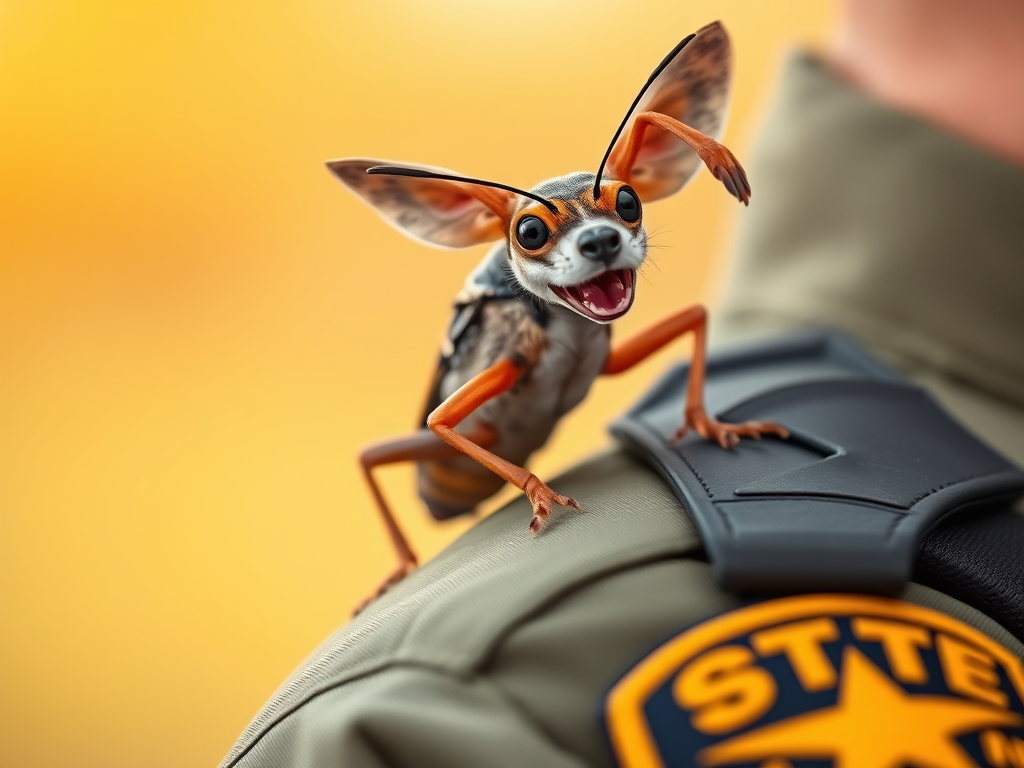
A cricket landed on his shoulder and began humming ––

“Love Me Tender.”

The next thing Buck remembered was being propped up in a folding chair outside the Ajo gas station. A bag of frozen peas was on his forehead. He had a bottle of Gatorade in each hand.

“You passed out cold.”

Said Melba, the station clerk, who also claimed to be a licensed Reiki therapist. 

“Said something about Elvis, Barney Fife, and indecent line dancing.”

Buck blinked. 

“I didn’t… wrestle Carl off a unicycle, did I?”

“Not today.”

Buck took a long drink, sighed, and muttered, 

“I’m starting to think this desert has a sense of humor.”

A Desert with a sense of humor? Barney Fife? Elvis? Our Crime Fighter has been out in the nether regions of the Sonoran Desert too long. That, or he sees dead people. Whatever it’s going to lead to, it’s another exciting story of Arizona’s most famous crime fighter, Buck Milford! That Mexican Beagle Cricket is sorta cute, isn’t it?

The Sonoran Desert’s Buck Milford – Chapter 3: The Great Desert Bacon Fire

By Benjamin GroffMedia© | benandsteve.com | 2025 Truth Endures©

2–3 minutes

The Ring of Fire

If there was one thing Arizona didn’t need more of, it was heat.

But if there was one thing Arizonans couldn’t resist, it was a challenge.

Influencer Lacey Blu—a 24-year-old “solar chef” with 1.2 million followers and zero life experience—announced she’d be filming a bacon-cooking demonstration. Doing so on the hood of her Tesla at high noon. Trooper Buck Milford knew it was going to be a long day. Especially since Teslas were along way off from being invented.

“Cooking with the sun is so sustainable,”

she chirped into her phone.

“And so am I! #SizzleWithLace #SolarSnackQueen”

She parked off Highway 85 near a dead saguaro. She laid out her cookware—an iron skillet, three strips of thick-cut hickory bacon, and a side of emotional entitlement.

Buck arrived just as the bacon began to curl. He was curious about the cell phone since those too were new to this century. They were at least twenty five years from being even a brick phone.

“I’m gonna need you to step away from the car, ma’am,”

he said, tipping his hat.

“It’s 119 degrees, and your bacon grease just started a brush fire the size of a toddler’s birthday party.”

Lacey didn’t look up.

“Sir, this is my content.”

Behind her, a small flame began creeping across the sand toward a long-abandoned outhouse that somehow also caught fire. A confused jackrabbit ran out holding what looked like a burning flyer for a 1997 monster truck rally.

“Content’s one thing,”

Buck said, reaching for his fire extinguisher,

“but that yucca plant’s fixin’ to blow like a Roman candle.”

Just then, Carl Sandlin appeared on an electric scooter with a garden hose coiled like a lasso.

“I saw the smoke!”

he cried.

“Is it aliens again? Or someone makin’ fajitas?”

Buck didn’t answer. He was too busy putting out the bacon blaze while Lacey livestreamed the whole thing.

“Look, everyone!”

she squealed to her followers.

“This is Officer Cowboy. He’s putting out the fire I started! So heroic!”

Carl joined in, spraying more bystanders than actual flames.

“We got trouble, Buck! The beagle crickets are back. They were hummin’ ‘Jailhouse Rock’ this time!”

Buck finished dousing the car. He shook the foam off his arms. He wiped a trail of sweat from his forehead. It had been working its way toward his belt buckle since 10 a.m.

“Well, Carl, if the crickets are Elvis fans now, we’re all in trouble.”

The bacon was ruined. The hood of the Tesla had buckled like a soda can. And the only thing Lacey cared about was that the foam had splattered her ring light.

“You just cost me a brand deal!”

she snapped at Buck.

“I was working with MapleFix! It’s the official bacon of heatwave influencers!”

Buck gave her a long, flat stare.

“You can mail your complaints to the Arizona Department of Common Sense.”

That night, the local paper ran the headline:

INFLUENCER IGNITES BACON BLAZE; TROOPER BUCK SAVES CACTUS AND PRIDE
— Saguaro Sentinel, pg. 3 next to coupon for 2-for-1 tarpaulin boots.

The Mexican beagle crickets showed up that night, as always. This time, they hummed Ring of Fire.

The Sonoran Desert’s Buck Milford – Chapter 2: Carl and the UFO Porta-Potty

By Benjamin GroffMedia© | benandsteve.com | 2025 Truth Endures©

2–3 minutes

Buck’s Response To Mile Marker 88

Buck had just finished adjusting the old police scanner. It had been playing reruns of Hee Haw for the last hour. Suddenly, his radio crackled to life.

“Unit 12, please respond. Caller at mile marker 88 reports a suspicious hovering object. Caller believes it is extraterrestrial. Or a reflective commode. Please advise.”

Buck sighed and reached for his hat, which had molded to the dashboard like a forgotten tortilla.

“Lord help us,”

he muttered.

“If this is Carl again, I’m asking for hazard pay.”

Carl Sandlin, local yodeler and self-certified UFOlogist, had a unique reputation. It’s one you earn from a lifetime of heatstroke. Add to that expired beef jerky. Lastly, he had a mother who named him after her favorite brand of tooth powder.

Buck shifted the Impala into drive and pulled away from the shade of a sagging mesquite tree. The tires made a sound like frying bacon as they peeled off the scorched asphalt.

When he reached mile marker 88, Carl stood there. He was shirtless, shoeless, and sunburned. Carl was waving a fishing net wrapped in tin foil like a broken butterfly catcher.

“There it is, Buck!”

Carl bellowed.

“Hoverin’ just above my taco stand for forty-five minutes. Scared off my lunchtime crowd. Even the iguanas cleared out!”

Buck squinted toward the horizon. Sure enough, something metallic shimmered in the distance. It wobbled slightly in the heatwaves, casting a strange, shiny glow.

“You mean that thing?”

Buck asked, pointing.

Carl nodded so hard his hat flew off.

“Absolutely. That’s either an alien escape pod or a deluxe Porta-John.”

Buck pulled binoculars from his glove compartment, which were so fogged up with heat condensation they doubled as kaleidoscopes. After rubbing them on his sleeve, he focused in.

“…That’s a new solar-powered PortaCooler,”

he said finally.

“The highway crew’s been installing them for the road workers. It’s got misting fans, Bluetooth, and a cactus-scented air freshener.”

Carl squinted, unimpressed.

“You sure it ain’t Martian technology? Smells like sassafras and bad decisions over there.”

Buck stepped out of his patrol car, the soles of his boots sticking to the pavement with every step.

“Carl, unless the Martians are unionized and drive state-issued work trucks, I’m pretty sure they’re not putting in restrooms. Those restrooms aren’t off Route 85.”

Just then, as if to punctuate the point, a group of Mexican beagle crickets marched across the road. All in unison. All humming the Andy Griffith Show theme at exactly 2:15 p.m.

Carl froze.

Buck froze.

Even the misting PortaCooler froze up and made a high-pitched wheeze like it, too, was creeped out.

Carl whispered,

“You reckon they’re trying to send a message?”

Buck tipped his hat back and said,

“Only message I’m gettin’ is that we need stronger bug spray… and fewer heat hallucinations.”

The crickets finished their tune, executed a perfect pivot, and disappeared into the desert brush.

Carl crossed his arms.

“I still say that cooler’s alien.”

Buck opened the door to his cruiser and called over his shoulder.

“Well, if they are aliens, they’re better at plumbing than our city council.”

He chuckled as he pulled away, leaving Carl saluting the shimmering cooler like it was the mother ship.

Breaking Habits: Harold Wexley’s Journey

Benjamin GroffMedia© | benandsteve.com | 2025 Truth Endures©

2–3 minutes

Harold Wexley meets Clara.
Harold Wexley Meets Clara And Breaks A Lifetime Habit.

Harold Wexley had long been known as a man of chance, a stochastic gentleman in the truest sense. Every decision he made was determined by a roll of the dice. It is also a flip of a coin, or even the pull of a card from his always on-hand deck. From his morning coffee to his afternoon walk, these decisions were all governed by chance. He couldn’t help himself; he believed the universe spoke best through randomness.

Harold’s peculiar habits started in childhood, much to the frustration of his parents. When asked whether he wanted vanilla or chocolate ice cream, he had a peculiar method. He would spin a top to let its direction decide his fate. By adulthood, his stochastic tendencies had taken total hold of his life. He never planned meetings but let a shuffled calendar decide his day. His wardrobe choices were dictated by pulling slips of paper from a hat. Even Harold’s relationships were governed by chance. If a coin landed on heads, he’d go on a second date. If it landed on tails, he’d never call again.

One day, Harold found himself at an unfamiliar café. That morning, he drew a card from his well-worn deck. It led him three blocks further than his usual haunt. He sat down with his coffee—black, no sugar. The choice was dictated by the number he rolled. He noticed a woman sitting across from him, watching with curiosity. She had auburn hair, a sharp gaze, and a half-smile that suggested amusement.

“You look like a man who just lost a bet,”

She said, sipping her latte.

“Not lost,”

Harold corrected, pulling a die from his pocket and rolling it across the table.

“Just after fate.”

She watched as the die landed on a four. Harold nodded. He reached for a muffin from the café’s showcase. It was as if he had just received permission from the universe.

“And if it had been a five?”

She asked, tilting her head.

“No muffin,”

He replied, taking a bite.

She chuckled.

“So, does chance decide everything for you?”

Harold hesitated. For the first time in years, he found himself unsure. The habit had become so ingrained that Harold had never considered questioning it. But as he met her gaze, something unfamiliar stirred—a wish to choose, not just to follow.

“Not everything,” he admitted, slipping the die back into his pocket.

“At least… not today.”

And for the first time in as long as he remembered, Harold decided without rolling, flipping, or shuffling. He asked for her name.

She smiled.

“Clara.”

He extended a hand.

“Harold.”

The universe held its breath, waiting. But for once, Harold ignored it.

Quiet Reflections: Harold Whitman’s Final Moments

GROFF MEDIA 2024© TRUTH ENDURES IMDBPRO

Presented by benandsteve.com By: Benjamin Groff II©

2–3 minutes

The Last Day

Harold Whitman woke before dawn, just as he had done for countless mornings. He stretched his aching limbs, feeling the stiffness permanently occupying his bones. The old house was quiet. Only the refrigerator’s soft hum and the occasional creak of settling wood were heard. This familiar symphony accompanied his every awakening.

He shuffled to the kitchen, brewed a pot of coffee, and sat at the window. He watched the sunrise paint the morning sky in shades of orange and pink. He savored the moment. The cup’s warmth was in his hands, and the faint aroma of the beans filled the air. His late wife had always loved those beans.

Today, he decided, would be a good day.

After breakfast, Harold walked to the park, as he had done for decades. He fed the ducks at the pond. He nodded to the joggers and dog walkers. They had become familiar faces over the years. These interactions, though brief, were like tiny rays of sunshine in his otherwise solitary life. A young boy, no older than six, waved at him from the swings. Harold smiled and waved back.

At the corner store, he bought a piece of his favorite caramel candy and an extra for the cashier. Marisol, a sweet girl, constantly reminded him of his granddaughter.

“You spoil me, Mr. Whitman,”

she said, laughing as she unwrapped the treat.

“Someone’s got to,”

he replied with a wink.

In the afternoon, he visited the cemetery. He sat on the bench beside his wife’s headstone, tracing her name with his fingers. The silence of the place soothed his soul. He felt a strange comfort thinking about joining his wife.

“I think I’ll be seeing you soon,”

he murmured.

“Maybe later tonight.”

There was no fear in him—just a quiet knowing.

Before heading home, he stopped by the diner, ordering a slice of apple pie and a cup of black coffee. The waitress, Lucy, patted his shoulder.

“You always get the same thing,”

she teased.

“Because I know what’s good,”

he said with a grin.

That evening, Harold sat in his favorite chair by the window, where the sunset bathed the room in golden light. He opened a book, though he barely read the words and content to hold it.

When sleep came, it was gentle, like slipping into a warm embrace.

Harold’s heart gave its final beat, and he sighed with quiet satisfaction. His last day had been good, a testament to the peace and acceptance that filled his heart.

Harold Fenton: The Salesman Who Won Hearts

GROFF MEDIA 2024© TRUTH ENDURES IMDBPRO

Presented by benandsteve.com By: Benjamin Groff II©

3–4 minutes

Harold Fenton was not the world’s most excellent salesman. If there were an award for persistence without progress, Harold would have won it year after year. His thick glasses always slid down his nose. He carried a briefcase that had seen better days. An ever-lasting mustard stain marked his tie. He wandered the same neighborhoods week after week. He sold an assortment of household knickknacks that nobody needed, but they bought them anyway.

“Good afternoon, Mrs. Jenkins!” 

Harold greeted cheerfully as he stepped onto the well-trodden path to her front door. 

“I have a brand-new shipment of vegetable peelers today! They’re sharper, sleeker, and—”

Mrs. Jenkins, a kindly woman in her sixties, smiled warmly. 

“Why, Harold, I still have the five you sold me last month. But you know, one can never have too many peelers. Come on in.”

Harold beamed and entered, opening his battered case to show an array of matching peelers. Mrs. Jenkins sighed as she handed him a few bills. She tucked the latest addition into her kitchen drawer. The drawer now resembled a peeler museum.

Down the street, Mr. Thompson, a retired mechanic, nodded at Harold as he approached. 

“Harold, my boy, back again? What do you have today?”

–––

“A fantastic deal on rubber jar openers!”

Harold declared with gusto. 

“These bad boys can grip the tightest lids with ease.”

Mr. Thompson scratched his head. 

“Well, I reckon I have about twenty of those in my drawer already, but why not?” 

He chuckled, handing Harold a crumpled bill. 

“You’re a persistent fella, I’ll give you that.”

Each household in the neighborhood had its own Harold collection. The Henderson’s had a mountain of Harold’s lint rollers stacked neatly in their laundry room. The Patel family had so many of his never-fail can openers that their entire garage shelf was dedicated to them. And the Cranstons? They jokingly called their basement “Harold’s Home Shopping Network.” It was filled with enough potato mashers to start a catering business.

But no one ever turned Harold away.

“He’s got such heart,”

Mrs. Jenkins often said over tea with the neighbors. 

“Bless him. He tries so hard.”

One day, Harold arrived with a new product—a miracle mop he couldn’t figure out how to show. 

“This mop… uh… well, you see, it swivels… I think. Or it wrings itself. Hold on, I had a pamphlet here somewhere…” 

He fumbled with his case, papers spilling onto the sidewalk.

Mrs. Jenkins and Mr. Thompson exchanged a glance and quickly stepped in. 

“We’ll take a few!” 

They chimed in unison.

Harold left the neighborhood beaming, waving to everyone as he wheeled his suitcase down the block. He whistled a tune with the satisfaction of a man who believed in his mission.

And so the cycle continued. Week after week, Harold brought the same products with the same pitches. The residents kept buying. They did this not out of necessity but of fondness for the bumbling salesman. He brought a little charm and harmless chaos to their otherwise predictable days.

One day, as Harold left Mrs. Jenkins’ house, she whispered to Mr. Thompson, 

“I sure hope he never realizes we’ve got enough peelers to last a lifetime.”

“He won’t,”

Mr. Thompson grinned. 

“And even if he did, I’d still buy another one next week.”

With that, Harold walked down the road. He was ready to bring his boundless enthusiasm. He also carried a suitcase full of peelers to the next unsuspecting yet ever-welcoming home.

Everyone needs to meet a Harold in life.

The Third Night. “That’s The SOB!”

Groff Media 2024© Truth Endures IMDbPro

Presented by benandsteve.com By: Benjamin Groff II©

3–5 minutes

On my third night in the patrol division, a sense of foreboding hung over me. I couldn’t explain it. Maybe it was the intensity of the past two nights or the instincts honed over years in other divisions. Something felt off. I kept this unease to myself—I didn’t want Lt. Wheeler thinking I was jittery about the job. I wasn’t. It was just that sixth sense I’d learned to trust, the one that sometimes whispered when trouble was brewing.

At 2000 hours, we rolled out of headquarters, heading west along Old Route 66, now Third Street in our city. Before we made it far, dispatch radioed in: the Oklahoma Highway Patrol needed us to respond to a Signal 82—an injury accident—since their units were tied up. The details were scarce, but we learned an Elk City ambulance was already en route.

We reached the outskirts about three miles from town when the ambulance reported on-scene: a single-car slide-off with no injuries needing investigation. Routine stuff. Then, the airwaves exploded with an alert: Officer Down. The call came from ten miles further west. A semi-truck pulling a lowboy trailer was reported fleeing the scene.

Adrenaline surged. I radioed the sheriff’s department, letting them know our position and offering to assist. They authorized us to operate in their jurisdiction—a necessary formality. We sped west, scanning every shadow and turn.

Minutes later, a semi barreled out of Berlin Road, ignoring the stop sign as it merged onto Highway 6. I didn’t need to think twice.

“That’s the son of a bitch!”

I yelled, heart pounding.

Lt. Wheeler swung our Ford Crown Victoria into a hard U-turn, tires screaming. The truck’s hydraulic hoses flapped loose, whipping in the wind, as though the trailer had been hastily unhooked. Wheeler hit the lights and siren. The truck swerved to the shoulder but didn’t stop. I grabbed the shotgun as Wheeler directed the spotlight, illuminating the truck’s cab and surrounding darkness. I slipped into the bar ditch, invisible in the shadows, covering Wheeler as he approached.

The driver finally exited and handed over an expired license. Something felt off—more than just the expired ID. Radio chatter hinted at potential damage to the truck’s undercarriage, but we still didn’t know what had happened to the downed officer. Wheeler told the driver to stay put while he inspected the vehicle.

Then it happened.

The driver propped his foot on our patrol unit’s bumper and reached toward his pants leg. My instincts screamed.

“Hands on the hood! Feet on the ground!”

I ordered, the shotgun steady at his head. He froze, and Wheeler shot me a look—half surprise, half reproach—but patted the man down and cuffed him.

By now, a Beckham County deputy arrived. As the suspect squirmed in our back seat, I kept a close watch, retrieving his details for the report. His movements grew erratic, twisting and jerking. I yanked the door open.

“Knock it off!” I barked.

It felt like hours had passed, though it had been only minutes. Finally, the chilling news crackled over the radio: Trooper Guy David Nalley had been shot in the back of the head during a traffic stop. The suspect’s valid driver’s license had been found in Nalley’s hand.

The gravity of the situation hit like a gut punch.

As we transferred the suspect to the deputy’s vehicle, he managed to slip a gun from his boot, kicking it beneath the seat—a grim reminder of the Supreme Court ruling restricting how far we could search without probable cause. Had we known his connection to Nalley, we could have searched him thoroughly.

Soon after, an ambulance carrying Nalley approached, and we provided an emergency escort to the hospital twenty miles away. Inside the ER, chaos reigned. I found myself at the head of Nalley’s stretcher, squeezing an airway bag while nurses and doctors scrambled to save him. Despite their frantic efforts, I knew it was too late.

Outside, the air was heavy with sorrow. Trooper Nalley was gone—a devoted husband, a proud family man, and a true giant in every sense. He was the kind of man you thought of when hearing Jimmy Dean’s “Big John.”

The suspect’s story ended in tragedy too. During a mental evaluation, he took hostages with a gun smuggled in by his wife. He was killed during the standoff. His name isn’t worth remembering.

But Nalley’s is. He served with honor and left a legacy of kindness and courage. That night, I realized something: no amount of training or preparation can truly prepare you for moments like these.

Barry’s Trip To Space To Rescue Boeing’s Starliner

A Story By: Benjamin Groff© Groff Media 2024© Truth Endures

Barry Figg, renowned for his practicality and unconventional approach, was on the brink of an interstellar journey. His mind was ignited with possibilities as he readied his trusty 1968 Ford pickup truck. He had hauled many things in his lifetime, from trailers to farm equipment, but a Boeing Starliner? This was uncharted territory. The fact that no one else had dared to use a pickup truck for such a task only fueled Barry’s determination, a determination that was unwavering in the face of skepticism.

“Beau, you ready for a road trip? Or should I say space trip?”


Beau cocked his head, giving his usual “I’m not sure about this” Look. But he followed Barry, hopping into the passenger seat as Barry checked his supplies. Duct tape, check. Extra gas cans, check. A spare tire, in case outer space, had potholes—check. He’d even brought along an old CB radio, thinking it might work in zero gravity, though he had no clue how radio waves worked in space. Barry didn’t care; he figured he’d wing it like most things.

Once NASA learned of Barry’s mission, skepticism was immediate. Experts in aerodynamics and astrophysics laughed but turned to dead silence when Barry’s truck, rigged to a makeshift launch system, somehow lifted off without a hitch.

“Well, that wasn’t so bad,” Barry muttered as he and Beau cruised past the stratosphere.

“This ol’ girl’s still got it.”

Barry marveled at the view as the Ford ascended through the layers of atmosphere. Earth, a glowing blue marble beneath him, seemed serene. And there, floating ahead, was the broken-down Boeing Starliner its silver hull gleaming in the sunlight. Inside the Starliner, astronauts Mike and Sarah, who had been stranded for days, stared in disbelief as the pickup truck came into view, their shock and awe palpable even from a distance.

“You seeing what I’m seeing?” Mike asked over the radio.
“Is that a pickup truck?” Sarah’s voice crackled over the radio, disbelief evident in her tone. “Did NASA send a guy in a truck?”

As Barry carefully maneuvered the truck closer to the shuttle, he saw their faces peering through the small windows, wide-eyed and in shock.

“Do you need a lift?”

Barry asked through the CB, unaware it was probably not connected to any NASA frequency. Luckily, the two astronauts got tuned in to a general frequency, and Mike responded,

“Uh… yes. Yes, we do.”

Barry pulled alongside the shuttle and threw his hook—a custom-made towing rig he’d welded together using old chains and farm parts—around the back of the spacecraft. The starliner got securely latched to his truck with a few hard pulls.

“Hold tight, fellas. We’re goin’ home,”

Barry said, grinning from ear to ear as Beau barked in approval.

Barry set his course for Earth with the astronauts safely aboard and the spacecraftin tow. The news of this unprecedented rescue spread like wildfire, catching the attention of NASA, SpaceX, and Boeing engineers. Always hungry for a good story, the media began reporting on the ‘Miracle Towman’ who was bringing the astronauts home.

The shuttle’s re-entry into Earth’s atmosphere was tense. The heat shields were supposed to disintegrate, but they managed to hold with Barry’s truck pulling it at just the right angle and speed. Barry Figg was a hero when the Ford’s tires hit the ground, rolling onto the Kennedy Space Center runway.

The crowd went wild. Reporters rushed to the scene, cameras flashing, as Barry and Beau stepped out of the truck. The two astronauts emerged next, dazed but alive.

The media was abuzz with the story of the ‘Miracle Towman,’ who had defied all odds to bring the astronauts home, and the story was soon making headlines around the world.

“Barry, how did you do it?”

A reporter asked, thrusting a microphone in his face.

Barry scratched his head, looked down at Beau, and then back at the reporter.

“I dunno. I just did what I always do—haul stuff. It didn’t matter if it was a broken tractor or a spacecraft. You hook it up, pull it, and ensure it doesn’t fall apart.”

NASA and Boeing executives stood in the crowd, their faces a mixture of awe and disbelief. Melon Lusk tweeted,

“Sometimes the simplest solution is the most unexpected. Well done, Barry.”

Barry couldn’t believe the attention. He had never asked for fame but was a national sensation here. As the praise rolled in, he felt a mix of pride and humility. He thought,

“Maybe space haulin’ ain’t so bad after all.”

But deep down, he knew that he was just a small-town hauler who had done what he thought was right.
Later that evening, after all the interviews and handshakes, Barry climbed back into his pickup with Beau and started the engine. As he pulled out of the space center parking lot, he turned to his loyal dog.

“Well, Beau, we’re not just small-town haulers anymore, are we?”

Beau barked once, agreeing they now head for more than just earthbound odd jobs. The Beau began to speak human, saying


“You are one lucky son-of-a-bitch, Barry!”

Then, he began barking using his dog voice—Wolf, Wolf, Wolf, Wolf, Wolf. This caused Barry to wake up from the most incredible dream he had ever experienced!

When Barry woke up, he realized he had to go to work at the job he had been doing for the last 18 years, 11 months, 14 days, and 16 hours: folding boxes at a candy-making company. ––– The End.

Jamie: The New Face of Laughter in the Land of Sorrow

In a land where laughter was the currency of happiness, the funniest person on earth was Charlie, “Buckles” McGuffin –– who reigned supreme. His wit was sharper than the finest blade, and his laughter was contagious enough to cure the deepest sorrows. As everyone fondly called him, Buckles had the uncanny ability to turn the gloomiest days into festivals of joy with just a word or a gesture.


Then, one fateful day, Buckles was found lifeless in his cozy little cottage. The news spread like wildfire, and an unimaginable hush fell across the country. Once bustling with joy and merriment, the towns and cities became silent, their streets echoing with the void left by his absence. Even the skies seemed to mourn, covered with a blanket of gray clouds that mirrored the people’s collective sorrow.


The days turned weeks and weeks into years, but the silence persisted. The theaters, once filled with roaring laughter, were now empty. The cafes, where friends gathered to share jokes and stories, were now quiet. The country’s heart had stopped beating, its lifeblood of laughter drained with the passing of Buckles. No one could fill the void he left behind, and the silence was a constant reminder of the irreplaceable loss.


Years later, a child named Jamie was born in a small, forgotten village on the outskirts of the country. From the moment he could speak, it was clear that Jamie had a gift. His first word wasn’t “Mama” or “Dada,” but a hilarious mispronunciation of “banana” that had his parents in stitches. As he grew, his knack for humor became more evident. He had an innate ability to see the world in a light that others couldn’t, turning mundane situations into comedic gold.


By the time Jamie was a teenager, his reputation had spread. People would travel from far and wide to hear him speak. His humor was fresh, and his perspective was unique. He didn’t mimic Buckles; he brought something new to the table. His jokes blended innocence and cleverness, and his laughter was a beacon of hope in a land shrouded in sorrow.


Jamie’s rise to fame was meteoric. His performances began to draw crowds that were more significant than any seen since Buckles’ time. Theaters filled with fans once more, and the streets echoed with laughter. It wasn’t long before Jamie’s influence spread beyond his village, reaching the farthest corners of the country. The silence that had gripped the land for years dissipated, replaced by the joyous sound of laughter and celebration.


The people, initially hesitant, found themselves embracing this new wave of humor. Jamie’s presence was a breath of fresh air, a reminder that while no one could ever replace Buckles’, the spirit of laughter and joy could live on. The country began to heal. The wounds became soothed by the gift that Jamie brought. He wasn’t a replacement for Buckles but a new chapter in the book of laughter.


Jamie’s name became synonymous with joy in time, just as Buckles’ had been. Once plunged into darkness, the light of his humor now illuminated the nation. The silence became broken, and in its place, a new era of laughter and happiness began. Buckles’ legacy lived on, not in the form of a shadow but as a foundation upon which Jamie built his own unique brand of comedy, forever changing the land and restoring the laughter that was its lifeblood.