Orange Noise II: Revenge Unleashed

3–4 minutes

Orange Noise (By Pets Demand.)

By popular demand, this follow-up dives deeper into how the Orange Noise machines ended up producing such deadly results. Here’s the story.

It began as a fad.

“Orange Noise Therapy — the next step in restful sleep. Scientifically engineered to calm your mind and gently drift you into the deepest dreams.”
The commercials showed happy couples. There were slow-motion scenes of blissful smiles beneath soft blankets. In the background, a low, warm hum laced with delicate chimes sounded. It was hypnotic in a way you couldn’t quite describe. It made you want to close your eyes.

And so the orders poured in.

At first, it seemed perfect. People reported sleeping deeper than they had in years. Doctors praised it. Sleep scientists called it “a breakthrough.” Sales skyrocketed.

But then, somewhere in the shadows, something shifted.

A young woman in Warsaw woke to find her bird dead in its cage. The bars bent as if from desperate thrashing. A man in Toronto woke up with deep, bleeding scratches down his legs. He had no memory of how they got there. Reports trickled in, never connected — until they were too many to ignore.

Couples, families, entire households found dead. No signs of forced entry. No fingerprints. No footprints. Just wounds — savage, animal wounds.

But still, no one suspected the pets.

The killings always happened at night. Always when the chimes were playing. And the footage — when it existed — was either corrupted or mysteriously missing. Except for one file.

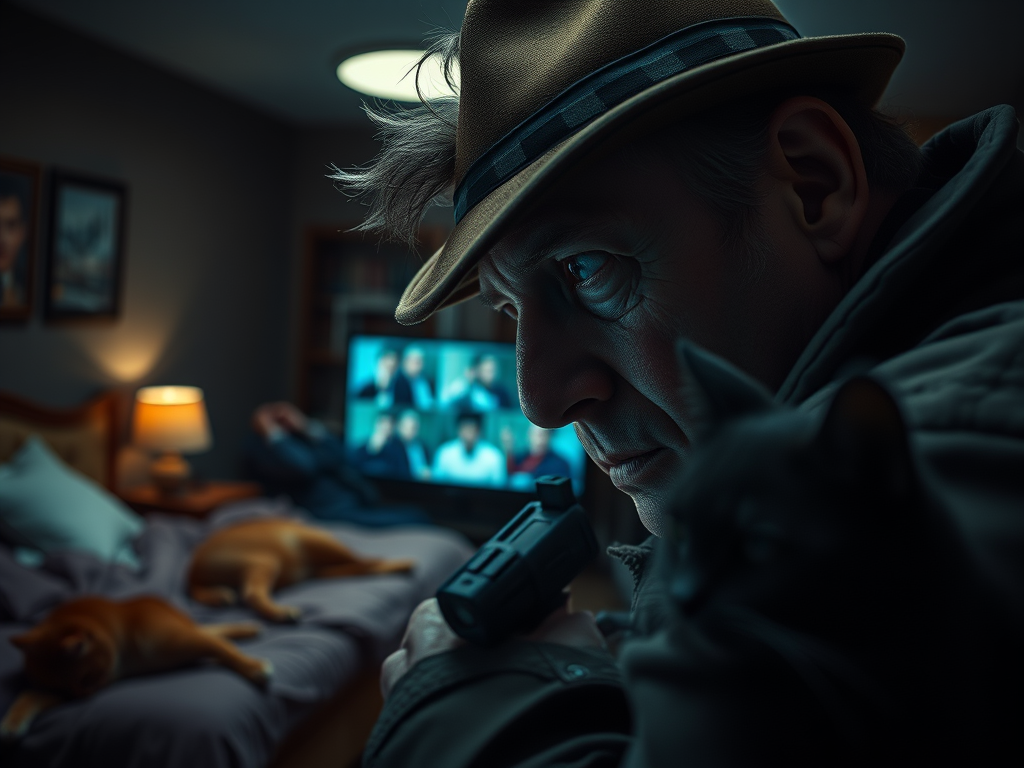
Detective Randall Kerrigan found it in a police evidence server, buried under mislabeled case notes. He watched it alone, the faint hiss of the playback filling his dim office. A couple lay in bed, breathing slow and deep. The chimes played softly in the background.

Then their cat jumped onto the bed. Kerrigan leaned up. The animal froze in place, eyes wide, pupils blown black. Its tail twitched once, twice — and then it lunged.

Kerrigan stopped the video, the cursor trembling in his hand. He replayed it. Again. And again. Each time, the truth pressed heavier on his chest: the Orange Noise wasn’t just calming humans. It was triggering something in animals. Something primal.

By morning, he’d traced dozens of similar cases — all linked to the therapy. The broadcasts were still going out, millions of households unknowingly inviting their killers into their bedrooms each night.

He took the evidence to his superiors. They dismissed it. “Mass hysteria,” they said. “A coincidence.” No one wanted to pull a billion-dollar product off the shelves. No one wanted to admit that bedtime bliss had become a death sentence.

Kerrigan tried to go public, but the networks shut him down. Lawsuits loomed. His badge was taken.

That night, he sat alone in his apartment. He heard it faint at first, then louder. It was the warm hum and the delicate chimes.

They weren’t coming from his speakers. They were coming from outside. From every apartment, every home in the city.

His own dog padded into the room, eyes fixed on him in a way they never had before.

Kerrigan stared back, a sick mix of fear and grief twisting in his gut. He reached slowly for the pistol on the table. Knowing that if he was right, this was the only chance he had. But a part of him hesitated. Because if he was wrong, he’d be killing the last friend he had left.

The dog took a step ahead.

And in that moment, hope and despair became the same thing. It was the hope that he can save himself. It was also the despair of knowing what it would cost him.

In The City Of Echoes Finding Where You Are Going Can Be Elusive

By Benjamin GroffMedia© | benandsteve.com | 2025 Truth Endures©

2–3 minutes

The City of Echoes

They told him Newvale was easy to navigate—just a grid of neatly intersecting streets, all named with letters and numbers. A1 to Z26, crosscut by 1st to 99th. Clean. Logical. Unmistakable.

That’s what made it so disorienting when Jonah realized he was lost.

He turned down H12 Street, or maybe it was H21. The signage shimmered under a weak afternoon sun. Every block held the same slate-gray buildings with mirrored windows. Every corner had a coffee shop called “BeanSync,” identical inside and out. The same barista. The same music looping—something jazzy and off-tempo that made his nerves vibrate.

He pulled out his phone to get his bearings. No signal.

No GPS. No bars. Just a cheerful little message:
“Welcome to Newvale! You are here.”
The map spun in place, mocking him.

He asked a woman passing by, dressed in a green trench coat.

“Excuse me, which way to Central Station?”

She stopped, smiled with blank politeness, and said,

“Just follow H Street until you reach 12.”

“I’ve already passed twelve blocks.”

She nodded, like that made perfect sense, then walked off.

He turned the corner again—there was “BeanSync,” again. The same man spilled his coffee at the same outside table. The same dog barked twice, then ran to the same hydrant.

Jonah checked the street sign: H12.

He spun around.

So was the last corner.

He began to walk faster, then jog. He changed directions at random—A Street to W Street to Q16. All the same buildings. Same people, repeating like shadows in a broken projector.

Finally, panting, he stopped inside yet another BeanSync.

“Do you serve anything besides Americano?”

He asked the barista.

She smiled.

“Just follow H Street until you reach 12.”

His heart sank.

Behind the counter, a door creaked open. A man stepped out—rumpled, eyes twitching, holding a half-empty cup.

“You’re new?”

the man said.

“Lost?”

“Yes! How do I get out of here?”

The man leaned close.

“You don’t.”

Jonah backed away.

“What do you mean?”

“The city loops. It doesn’t end. It just resets.”

“That’s not possible.”

“Neither is ten identicalbaristas named Kira.”

Jonah turned to look. The barista waved cheerfully.

Back outside, he ran. He tried screaming. No one noticed. Or rather, they all noticed in the same way—heads turned in perfect rhythm, brows raised identically, disinterest coordinated like choreography.

It was dark by the time Jonah found a bench.

Across the street, a woman in a green trench coat asked a passerby,

“Excuse me, which way to Central Station?”

Jonah watched the man smile politely and answer,

“Just follow H Street until you reach 12.”

The woman nodded and walked off.

The bench creaked beside him.

A man sat down. Rumpled. Cup half-full.

“You’re new?”

he asked.

Jonah nodded slowly.

The man sighed, sipping.

“It’s not a city. It’s a maze. It just wears the mask of civilization.”

Jonah looked up. Above the buildings, a flickering billboard blinked to life:

“Welcome to Newvale! You are here.”

Still. Always. Unchanging.

And somewhere, jazz played again.

Looping. Forever.

Professor Incredible: The Accidental Peacemaker

By Benjamin GroffMedia© | benandsteve.com | 2025 Truth Endures©

2–3 minutes

Professor Incredible and the Formula of All Things

Nobody paid much attention to Professor Incredible.

He was a quiet, peculiar man with wild hair and socks that rarely matched. He taught chemistry at the Third-Rate University of Northern Something. His lectures were confusing. His labs were explosive. His office smelled faintly of lemon cake and regret.

One Tuesday afternoon, Professor Incredible was mixing compounds to cure hiccups in parakeets (don’t ask). He tripped over his cat and accidentally spilled three unlabeled vials into a teacup. When he came to after the small puff of smoke cleared, he sipped the tea. Of course, he did. He then scribbled down what he felt was a rather pleasant aftertaste.

That night, he slept peacefully for the first time in years. His arthritis vanished. So did his neighbor’s yappy dog’s aggression. So did the neighborhood’s potholes. So did his runny nose. Something was… different.

The next day, two bickering students visited his office arguing over which was better—crunchy or creamy peanut butter. Absentmindedly, the professor handed them a flask of the leftover formula and said,

“Here. Split this and shake hands.”

They did.

Instantly, they blinked, smiled, and calmly agreed that both were wonderful in different ways. Then they shared a sandwich.

The formula, it turned out, only worked if applied by two people in conflict—who disagreed with equal passion. It didn’t pick a side. It didn’t declare a winner. Instead, it softened anger, lifted empathy, and melted stubbornness into understanding. It didn’t erase problems; it made people care enough to solve them together.

Soon, world leaders were sipping the formula while discussing borders. Rival fans hugged at sporting events. Siblings divided closets in peace. Traffic moved smoother. Even social media got a little less… cruel.

Professor Incredible was offered a Nobel Prize, but declined.

“The formula was an accident,”

he said.

“What matters is what people do with it.”

And so, the world changed—not because the formula was magic, but because people finally heard one another. Understood each other. Worked side by side.

All it took was a little chemistry—and two people willing to try.

For Your Entertainment And More…