One of The Most Powerful Farming Recovery Stories Of This Day

It came only after failing, suicide and horror. A true story. That matters!

The Tragic True Story of Jean-Michel “Michou” — A Farmer’s Silent Cry

Location: Loire-Atlantique, France
Year: 2011
Category: Real Farmer Story | Mental Health | Agriculture Crisis

🌱 Chapter 1: Born in the Soil

Jean-Michel, lovingly called Michou by his village neighbors, was born into a family of farmers in the rural province of Loire-Atlantique, France. His family had been farming for three generations — milking cows, sowing wheat, harvesting barley, and living off the land.

From a young age, Michou learned how to wake before sunrise, milk the cows, repair fences, and drive tractors.
Farming wasn’t a job for him — it was identity, love, and legacy.

“City people see cows as business. For us, they are family.” – Michou

🐄 Chapter 2: A Life of Relentless Labor

Michou managed a small dairy farm with 47 cows. He woke every day at 5:00 AM, fed his cattle, and milked them before the sky even turned blue. After that, he toiled in the fields, checking irrigation, sowing seeds, fixing old machines.

He worked 365 days a year — no holidays, no weekends.

Everyone saw him as the “hardworking farmer of the region,” always smiling, always moving.

But inside, Michou was collapsing.

📉 Chapter 3: The Economic Collapse

After 2008, the dairy industry in Europe began to spiral downward.

Milk prices dropped from €0.32/liter to €0.22/liter

Cost of production was €0.30/liter

Michou was losing money with every drop of milk

He took a loan of €24,000. Then another €18,000. Then mortgaged his tractor.
Still, the bills kept piling up: electricity, fodder, tractor repairs, fertilizers.

“I’m no longer a farmer. I’ve become a machine that produces milk… and debt.” – from Michou’s diary

💔 Chapter 4: When Support Fades

His wife, Lucie, fell ill — stress and fatigue.
His only son, Julien, moved to the city for work.

Michou was left completely alone — with cows and his memories.
His best friend Jacques, also a farmer, had taken his own life just a year before. Another neighbor followed the same path.

The village got quieter. Michou got quieter.

🧠 Chapter 5: Silent Depression

One day, Michou wrote:

“One of my cows was sick today. I cried. Maybe because I am sick too.”

He never shared his pain.
He would feed the cows and whisper to them… but talk to no one else.
Evenings were spent staring at the barn walls, thinking if all his life had been for nothing.

⚰️ Chapter 6: The Last Morning – Continue reading the story click here. The original posting continues with the rest of the story and a turning point that you won’t expect. I wanted to direct you to the original post where you can leave any comments for the author.

Memories and Mischief: The Summer of 1980

GROFF MEDIA 2024© TRUTH ENDURES IMDBPRO

Presented by benandsteve.com By: Benjamin Groff II©s

2–4 minutes

The Summer of 1980

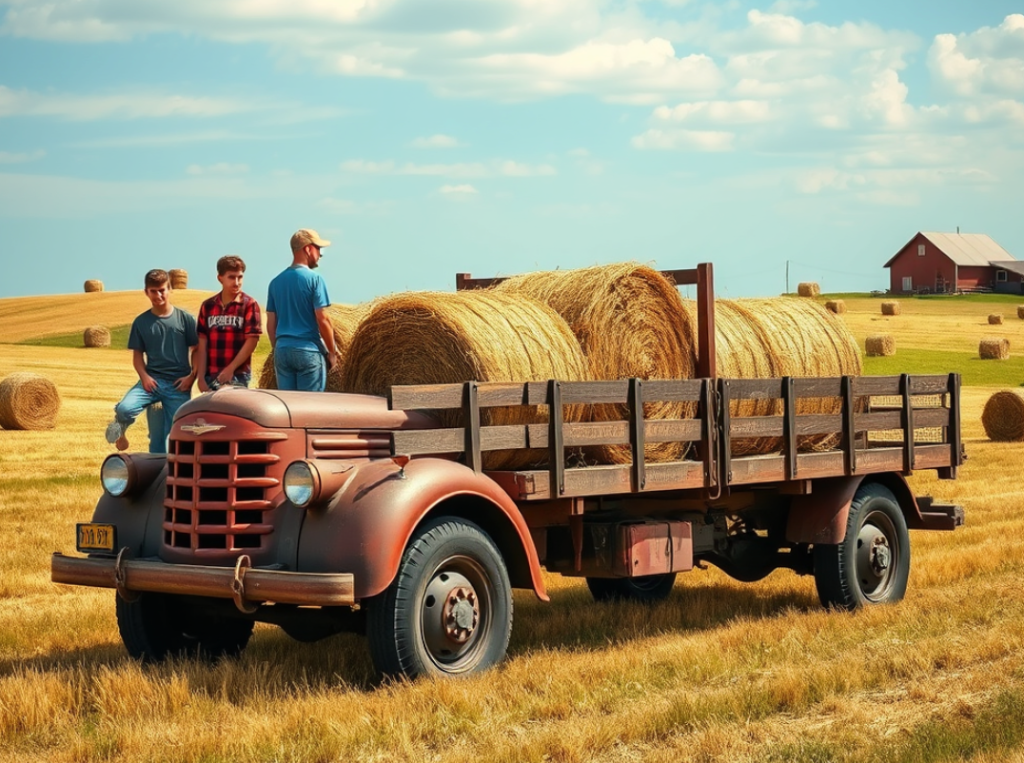
The summer of 1980 would be remembered forever. It was the year three friends—Bub, Johnny, and Clem—took to the hayfields, hauling bales for farmers across the county.

They set out to help the local farmers with two old flatbed farm trucks. The farmers struggled to find enough hands to get their hay cuttings into the barn. What started as a way to earn cash quickly became much more significant.

The boys took turns driving. Two worked at the back of the truck, stacking and securing the bales. They did this while bumping along dirt roads. When they reached a barn, all three pitched in to unload. It was grueling work. It was hot, dusty, and backbreaking. They made a decent sum at fifteen cents per bale when split three ways. More importantly, they earned something money couldn’t buy: the respect of an entire community. Their work ethic, reliability, and bargain rates made them invaluable, and grateful farmers often sweetened the deal with generous tips.

Word spread fast. Soon, the boys had more work than they handled. They got their hands on a third truck and fixed it up. Each took charge of their own rig. They hired extra help to keep up with demand. By summer’s end, the three had hauled an unprecedented amount of hay. No one remembered seeing so much in the valley.

But it wasn’t all work.

The boys had a playful streak, and the town delighted in their antics. One night, Clem slept soundly in their makeshift bunkhouse. Bub got the idea to spread hair remover gel over Clem’s hairy legs. Hours later, Clem woke to a strange smell. He wrinkled his nose. He assumed one of the others had eaten something bad. He groggily rolled over and went back to sleep, unaware of the smooth patches forming on his legs. The next day, Clem discovered the damage in the shower. He saw the damage and heard Bub and Johnny howling with laughter outside the bathroom door.

Clem didn’t get mad. He got even.

At noon, he played the perfect gentleman. He told Bub and Johnny that he held no grudges. He wanted to treat them to lunch. They stayed behind at the barn. He ran to the burger joint and ordered the most enormous double cheeseburgers. There was also a mountain of fries and chocolate malts. For himself, he ordered vanilla. Before returning, he slipped some laxatives into the chocolate malts.

The unsuspecting pair devoured their meal, thanking Clem for his generosity, utterly unaware of the payback coming their way. Four hours later, they were running to the bathroom non-stop, clutching their stomachs, confused and miserable. Clem stood back, arms crossed, grinning. Their “cleaning out” lasted for days. When the town caught wind of the prank, it only added to the growing legend of the hay-hauling boys.

The mischief didn’t stop there.

There were ambushes, booby traps, and endless laughter. Even with their busy schedule, they found time to fish. They caught some of the biggest catfish the town had ever seen.

By summer’s end, they had built more than a successful hay-hauling business—they had created memories that would last a lifetime. Long after the last bale was stacked, folks in town would still talk about the summer of 1980. During that summer, three hardworking boys became the heart and humor of the valley.

The Great Bison Incident: A True Survival Story

GROFF MEDIA 2024© TRUTH ENDURES IMDBPRO

Presented by benandsteve.com By: Benjamin Groff II©s

3–4 minutes

The Great Bison Incident (A True Story)

Carney had no idea what his neighbor, Ted Ortiz, had done. Ted had recently purchased what everyone around here called a buffalo—though, technically, they were bison. His grand idea? Cross-breeding the massive bull with his cattle. What is there to go wrong?

That morning, Carney had spent hours plowing one of his fields. When he finally finished, he hopped down from his tractor. He stretched his back and pulled out his packed lunch—a simple sandwich and a thermos of water. After a few quick gulps, he was ready to tackle the next field.

He set off across the pasture, taking his usual shortcut. Halfway across, he heard a deep, rumbling snort behind him. At first, he figured it was just one of Ted’s cows and kept walking. But then he noticed something—the snorting sound was moving with him.

Carney turned around and froze.

A massive, very annoyed bull bison stood just a few yards away. And Carney had unknowingly interrupted the beast’s afternoon of affection.

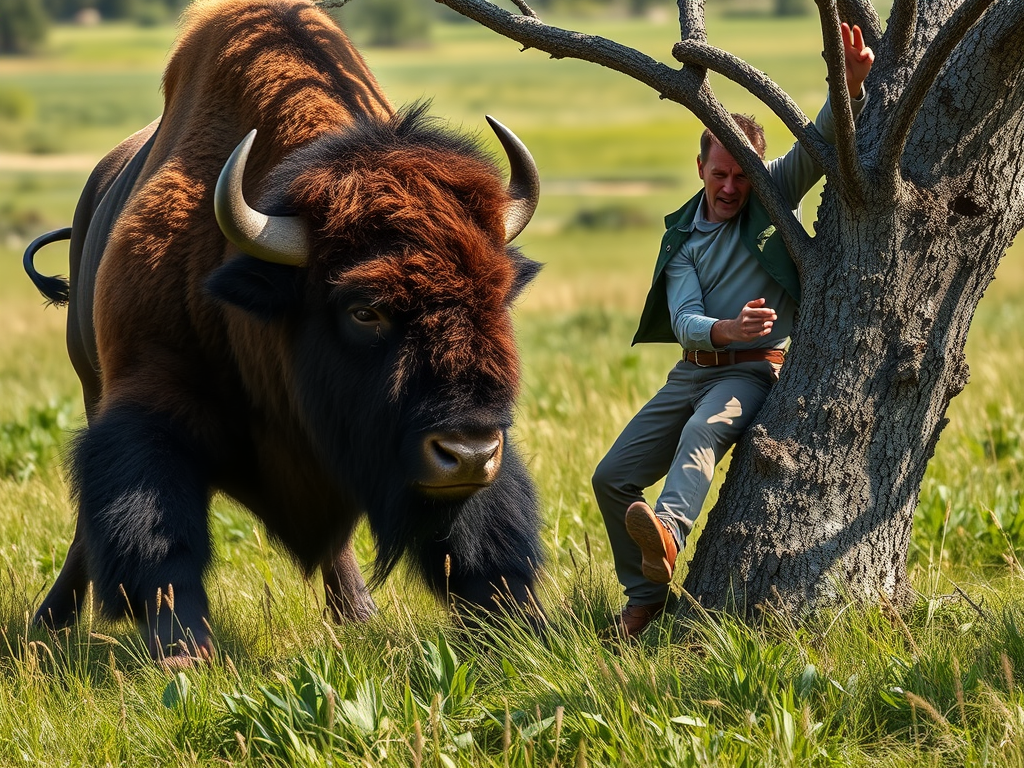
The bison pawed the ground, snorted louder, and locked eyes with Carney. He had seconds to decide—fall, play dead, or run like hell. He chose the latter.

Now, Carney was in his fifties. He was not exactly a sprinter, but he moved like an Olympic athlete when faced with a furious bison. His only hope was a nearby tree. He scrambled up, arms and legs flailing, barely reaching a branch as the bull slammed into the trunk below.

Unfortunately, Carney had picked the wrong tree.

It was dead.

The bison rammed it again. The whole thing groaned and wobbled. Carney had two choices—jump and run or ride the tree down like a doomed cowboy in a slow-motion disaster.

So he jumped. And ran.

And here’s where things took an unexpected turn.

Carney swears he made it to the fence, jumped over, and escaped without a scratch. But according to the newspaper, the story went a little differently.

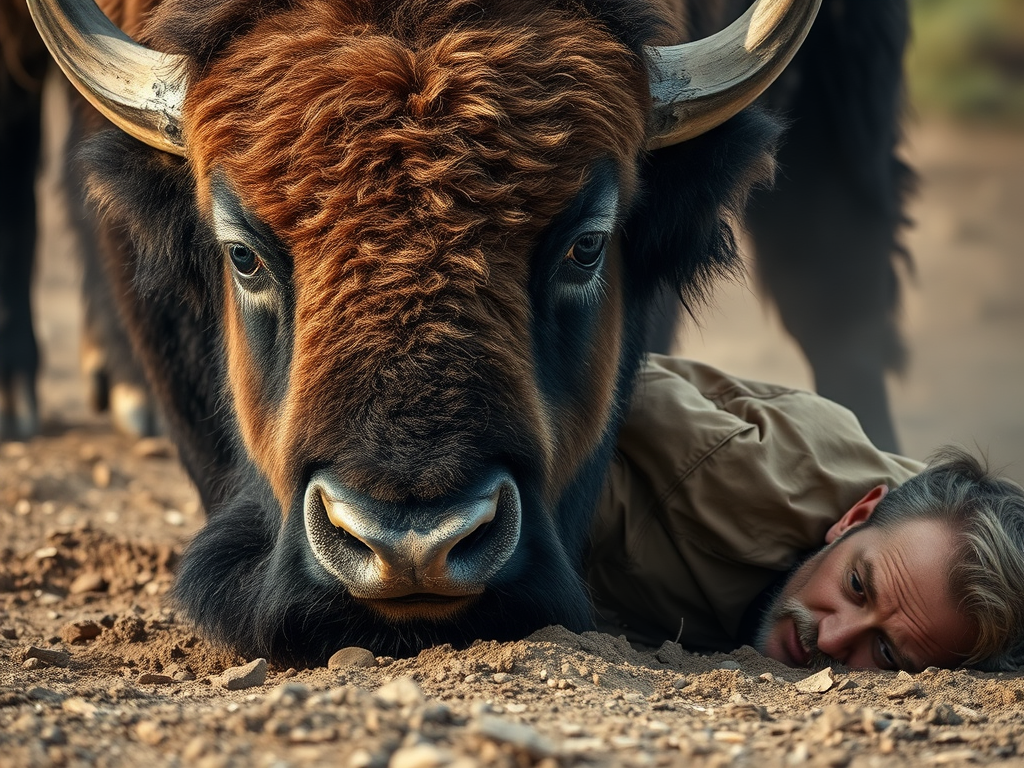
The article claimed that the bison knocked the tree over after Carney hit the ground. Then it turned its fury back on him. Carney had no other options. He did the only thing he thought possible. He dropped to the ground. His face was down in the dirt, and he played dead.

The bison approached, snorting, its heavy breath huffing across Carney’s back. It sniffed his head. His shoulders. His boots. Then, it reached his backside—and suddenly, something changed.

The bull gagged.

Its eyes watered, and its massive body trembled. The mighty beast gave a final snort of disgust. It turned its tail and bolted. The beast ran away as fast as its hooves carried it.

Carney, shaking but victorious, got to his feet and went to the other field. Before plowing, he had to detour into the nearest creek. He needed to scrub off whatever offended that bison so severely.

The newspaper never revealed its source for this version of events, but everyone had their suspicions. Most believed the town barber had something to do with it. After all, most of the town’s best stories started in his shop.

To this day, the Great Bison Incident resurfaces whenever the local men need a good laugh. It is a legendary reminder that sometimes survival comes down to sheer luck, including an unfortunate choice in lunch. It’s a tale that never fails to entertain.

This is a true story. The names have been changed to protect the privacy of those in real life.

A Journey Through Fields: Life Lessons from Uncle Neb

GROFF MEDIA 2024© TRUTH ENDURES IMDBPRO

Presented by benandsteve.com By: Benjamin Groff II©

2–3 minutes

An Uncle’s Field of Memories

The older man rocked back and forth on the porch swing, the wood creaking under his weight. His nephew, Jake, sat cross-legged on the wooden planks, listening intently. The evening sun stretched its shadows long across the yard, the golden light flickering through the trees.

“You ever run through a plowed field, boy?” 

Uncle Neb asked, a slow grin spreading across his weathered face.

Jake wrinkled his nose. 

“Why would I do that?”

Ole Neb chuckled.

“Ah, you don’t know what you’re missin’. When I was your age, runnin’ through a fresh-plowed field was the best thing in the world. The dirt was soft, the furrows deep. Felt like jumpin’ across waves in the ocean—only, it was earth beneath your feet, not water.”

Jake smirked. 

“Sounds messy.”

“Sure was!”

Uncle Neb laughed. 

“And I’d get a good whuppin’ from your grandma for trackin’ mud in the house, too.”

He leaned back, sighing. 

“Every spring, my daddy plowed and prepared the land to plant maize and oats. That was our winter feed for the livestock. Down at the bottom of our place, we had an alfalfa field. Grew some of the best in the county, thanks to the floods from the neighbor’s lake.”

“Wait—you let your field flood on purpose?”

Jake asked, wide-eyed.

“Didn’t have a choice, boy! The heavy spring rains would swell that lake, and the water would just roll over into our land. But let me tell you, that soaked ground made the alfalfa thick and green. We never had to worry about our cattle goin’ hungry.”

Jake traced a knot in the porch wood with his finger. 

“You had cattle?”

“Sure did. Horses and chickens, guineas, goats—you name it. Had a big ol’ barn on the west side of the place where we kept ’em. But there was one animal I couldn’t go near—one of our milk cows. It is the meanest thing you have ever seen. That cow would lower her head and charge at me as soon as she spotted me.”

Jake grinned. 

“You were scared of a cow?”

Uncle Neb narrowed his eyes playfully. 

“You woulda been too, boy! Kids had tormented that cow before she came to us. Made her mad as a hornet. Your grandpa had to milk her himself ’cause she wouldn’t let nobody else close.”

Jake laughed. 

“Sounds like she had a grudge.”

“That she did. But that was life on the farm, son. You learned to work with what you had, respect the land, and steer clear of mad cows.”

Ole Neb winked. 

“Now come on, let’s go walk that field out back. Maybe you’ll see why runnin’ through dirt felt like flyin’ to a boy like me.”

Jake hesitated, then hopped up.

“Alright, Uncle Neb. But if I trip, you owe me ice cream.”

Neb laughed, his voice warm as the setting sun. 

“Deal, boy. Deal.”

And together, they walked toward the fields, the past and gift blending with every step.

An Old Truck For The Twins – A Promise From The Farm

A Story By: Benjamin Groff© Groff Media 2024© Truth Endures

Jessie and Frank, twin brothers, were not just ordinary farm boys. They were the backbone of their father’s farm, taking on the most challenging tasks that even grown men often avoided. They hauled hay, built fences, chopped wood, and tended to the livestock. Their relentless dedication and resilience inspired all who knew them. As they reached high school, they dreamt of a future beyond the farm, envisioning themselves attending an out-of-state university on agriculture scholarships.

At 17, the twins were nearly indistinguishable in appearance, voice, and mannerisms. Their mother, Ann, often found herself confused by their playful antics, while their father, James, could always tell them apart with a steely blue-eyed gaze that seemed to pierce straight through to their souls.

The boys had always known that their father had set a challenge for them: the one who excelled in school, worked hardest on the farm, stayed out of trouble by the time they turned 18, and would inherit their grandfather’s old truck. This truck, a symbol of their grandfather’s dedication to the farm, had been kept out of sight, locked away in a shed the boys were forbidden to enter. James had made it clear that if they ever crossed that line, the promise of the truck would vanish.

The truck was not extravagant, just an old farm pickup—a 1972 Chevrolet Cheyenne. Yet, in its prime, it was the epitome of rugged style, loaded with air conditioning, an AM radio, tilt steering, and optional cruise control. The dimmer switch was a silver push knob, and the wipers had three speeds: delay, slow, and fast. Its 350-horsepower engine with a four-barrel carburetor and dual exhaust pipes made it rumble in a way that the twins found irresistibly cool.

The story goes that their grandfather bought a brand-new truck when the twins were still in grade school. Disappointed, he told James to lock it away for one of the boys and returned to his old Cheyenne, never repurchasing another vehicle. He swore that nothing could replace the reliability and charm of that old truck.

As graduation approached, Jessie and Frank received their final transcripts and were thrilled to learn they both got accepted to their dream college. They had met all of James and Ann’s conditions, and the day of reckoning arrived on a Sunday before Memorial Day. The family gathered for a noon meal when Frank, unable to contain his excitement, suggested they finally see who would inherit the shed’s contents. Little did they know, the surprise of a lifetime was waiting for them.

James, with a knowing smile, opened both transcripts. –––

“Boys, you’ve always given your best on the farm and never brought shame to our family. But as you grow older, you’ll realize that in an instant, you can destroy everything your name stands for. You must protect it with everything you have by always being your best. Now, about these school results…”

Jessie and Frank exchanged curious glances. They knew they had done well in school, but their father’s words left them on edge. As James continued, his grin widened, and he looked at Ann and their grandfather. –––

“Damn it, I told both of you this would happen. I knew it!”

Ann, perplexed, interrupted. –––

“What are you talking about, James? You knew what?”

James continued with his monologue –––

“Ten years ago, when we locked that shed, I told you this would end in a tie. Those boys are identical in everything they do, even when they take different courses. And sure enough, they tied on their transcripts!”

Their grandfather chuckled. –––

“Well, it’s good I had another shed at my place, too. I knew they’d tie, and what was in that one shed wouldn’t be enough for both of them.

Jessie and Frank, quietly processing the unfolding events, began to understand the lesson their family had taught them all these years—hard work, equality, and family values.

James asked, –––

“Ann, did you know Pop had another shed down at his place?”

Ann shook her head, still in disbelief. –––

“No one told me a thing! You’d think someone would, but no—never a single word.”

James, towering over the dining table, spread his arms wide and declared, –––

“Let’s put an end to this and see what’s in the shed.”

Their grandfather suggested waiting until morning, but James insisted –––

“No, Pop. Let’s show the boys what’s in my shed. It may not be what they’re expecting, but it is what it is.”

The twins were baffled, unsure of what to expect. At the shed, James paused before unlocking the door and turning to Ann. –––

“What if they aren’t pleased? We’ve only fed, schooled, clothed, and sheltered them for 18 years. What if they don’t like what’s inside?”

Jessie, ever the joker, quipped, –––

“Well, only one of us will be disappointed, so you’ve got that going for you.”

As the shed door creaked open, lights flickered on inside, and their grandfather exclaimed, –––

“Hey! You’ve brought the stuff from my shed down here! How’d you do that?”

Inside were the old truck and two brand-new pickups—precisely like the ones Jessie and Frank had admired recently at a local dealership. The old truck, as promised, would go to both boys on one condition: they had to promise to keep farming the land when they returned from college.


True to their word, Jessie and Frank returned after college, not just as graduates, but as committed farmers. They continued the legacy of their family, working the land with the same dedication and resilience they had shown in their youth. They went into business together, selling signature meats and grains. The old truck became the symbol of their brand, preserved in pristine condition in a showroom at their farm headquarters. With under thirty miles on the odometer, it remains as good as new, touched only by the twins. Anyone else wanting that privilege must work on their farm for over ten years without complaint, earn top grades, and uphold the family’s good name.