Every year when All Hallows’ Eve rolls around, I think about a specific night. I remember it vividly. It was when I was sixteen. I was getting ready to go out with friends—excited, dressed up, and ready for a night of harmless fun. As I reached for the door, my father stopped me with a hand on my arm.
He’d never done that before. I was the youngest of six children. By the time I reached my teens, my parents had weathered every imaginable crisis. Their only standing rule was simple: “Be safe and be home before daylight.” But that night was different. Dad’s grip was firm, his eyes serious.
He said quietly, “Look—your Uncle Bennie came upon a man whose head had been cut off and left on a dirt road near our house when I was about your age. They never found who did it.”
I froze. Uncle Bennie had passed away before I was born, so I never had the chance to ask him about it. Dad didn’t offer more details. He only mentioned that Bennie had called the deputies. Bennie told them everything he knew. Then he lived with that memory for the rest of his life.
My father’s next words have stayed with me for decades: “I just want you to be safe. Don’t go where you don’t know where you’re at.”
Those words became a rule for me, a compass I’ve carried ever since. If my gut or my soul told me something wasn’t safe, I backed away. That simple warning guided me through my teenage years. It also helped me during my law enforcement career. Instincts and situational awareness can mean the difference between life and death in that field.
Even today, I don’t know much more than that chilling story about the headless man. But my father’s advice has saved me countless times. It’s taught me that safety isn’t just about the rules of the road. Safety is not limited to the places on a map. It’s about trusting the quiet warnings within yourself.
I share this story with you because maybe it can help someone else, just as it helped me. We live in a world full of distractions, routes we don’t know, and situations that feel uncertain. If you find yourself heading into something that doesn’t feel right, listen to that inner voice. Step back. Choose another path.
Because sometimes, the oldest lessons are the truest: Don’t go where you don’t know where you’re at. Your instincts know the terrain long before your eyes do. And that wisdom—passed from a father to a son—can save your life, too.
The little boy tugged at his father’s sleeve as they walked home one quiet evening. The sky stretched wide above them, painted in soft shades of pink and gold. After a long silence, the boy asked a question that seemed to hang as heavy as the clouds.
“Dad… how far is Heaven?”
The father slowed his steps, looking down at his son. For a moment, he didn’t answer. Then he smiled gently.
“That’s a big question, son. And the truth is—I don’t know.”
The boy’s brow furrowed.
“Don’t know? Isn’t it up there?”
He pointed toward the fading light above the rooftops.
“Well,”
his father began,
“that depends on what you believe Heaven is. For some people, Heaven is a faraway place where souls go when life here is over. For others, Heaven is closer than you think.”
He stooped down so they were eye to eye.
“Heaven can be the feeling of home when everyone’s together at the dinner table. It can be walking into your grandparents’ house and smelling fresh pies cooling on the counter. It can be the peace of sitting in a quiet cabin deep in the woods. There is no noise but the trees and the wind.”
The boy listened, his eyes wide, as though trying to imagine all those Heavens at once.
“You see, son,”
his father continued,
“Heaven doesn’t have just one location. It can mean different things to different people, at different times in their lives. Sometimes it’s a place, sometimes it’s a feeling. And sometimes, people think of it as a reward beyond this life. But no matter what, it’s something we long for—a place where we belong, where everything feels right.”
The boy was quiet, mulling it over. Then he looked back up at the sky.
“So… Heaven isn’t always far away?”
His father smiled, squeezing his hand.
“No, son. Sometimes, Heaven is right here—closer than we ever imagine.”
As they walked the rest of the way home, the boy noticed the laughter of his mother. She was waiting at the door. He smelled the supper drifting through the air. He felt the warmth of his father’s hand in his own. And for that moment, he decided, Heaven was not far at all.
Reflection
How Far Is Heaven?
By Benjamin Groff II
A boy once asked his father, “How far is Heaven?”
The father said, “That depends. For some, it’s beyond the stars where souls go when life is done. For others, it’s much closer. It is found in the smell of pies at Grandma’s. It is in the quiet of a cabin in the woods or the laughter of family at the dinner table.”
He paused and added, “Heaven is different for everyone, son. Sometimes it’s a dream, sometimes a memory, and sometimes it’s right here, in the moments we hold close.”
The boy thought for a while, then smiled. Heaven, he decided, was not so far away after all.
There’s a story my dad loved to tell. It was one of his favorites. He told it often to friends, family, and customers in his barber shop. He shared it with anyone who needed a good tale. He and his friend GH rode out on horseback one afternoon. They went to a little rise in northern Caddo County called Ghost Mound.
Ghost Mound – Caddo County – Oklahoma
Ghost Mound is one of those landmarks that doesn’t quite belong to any one town. It’s south of Hydro, north of Eakly, east of Colony, and west of the Sickles community. It’s a rocky, oddly-shaped hill. It looks like a miniature volcano. It is steep on one side and more gradual on the other. Back in the 1930s, it was open country. Kids would ride or walk out there on lazy afternoons. They climbed the rocks, explored the cracks, and wasted time in the best way.
On that particular day, my dad, JD, and GH set out. They had nothing more in mind than a good ride. They were also looking for a little adventure. GH had just celebrated a birthday and was proudly carrying a brand-new wallet in his back pocket. Before they saddled up, he showed JD the five-dollar bill. It was tucked inside and was quite a lot of money for a kid in those days.
Once they reached the Mound, the boys began to climb, making a show of how tough it was. About halfway up, GH lagged behind. Suddenly, he shouted:
“HELP! I’ve lost it!”
JD turned and saw GH crouched down, peering into a narrow crack in the rocks. Sliding back to him, he asked what was going on.
GH pointed. He said his birthday wallet had slipped out of his pocket and fallen deep into the crack. The wallet was whole with the five-dollar bill. The boys tried everything to retrieve it. They rolled up their sleeves, dug around, tried moving rocks, even tried widening the gap—but nothing worked. The wallet was gone.
From that moment on, the story of the wallet lost in Ghost Mound became family legend. I grew up hearing about it. Over and over, my dad would retell the tale. Sometimes it was a quick story; other times it grew with detail. Always, it ended the same way. The wallet was still there. It was wedged in the rocks with a crisp 1930s five-dollar bill, waiting to be discovered. He told it with such conviction, I was sure it had to be true. Dad told people whose hair he cut. Keeping an entire room of waiting customers spellbound. Sometimes GH would be there to re-enforce what dad was telling.
The day of my father’s funeral arrived. It was deeply emotional. The house was full of people who had known and loved him. Among them was GH. I had a chance to sit with him, and naturally, I asked him about the wallet. He threw his head back and laughed.
“Yeah,” he said, “the wallet did fall out of my pocket. But your dad was the only one with arms skinny enough to reach in and get it. We got it back that same day.”
I was stunned.
“Then why did you say it was still up there?” I asked.
GH grinned and said, “Because your dad was the biggest joker in the world. He made me promise not to tell anyone the truth. After that, we’d ride our horses out. We would just sit back and watch folks climb all over that Mound looking for that five-dollar bill. We’d laugh and laugh. If anyone had found it, they wouldn’t have brought it back to us anyway!”
And suddenly, a memory clicked. Every time we’d drive past Ghost Mound, we’d see someone out there climbing. It was usually someone who had been in my dad’s barber chair just days before. My dad would start laughing to himself. I never understood why. Not until GH let me in on the real story.
So maybe there’s no wallet up there after all. But the legend my dad spun from that day? That’s still very real. And just like Ghost Mound itself, it’s stuck with me for good.
When I was a child, my dad and I did countless things together.
We rode horses nearly every weekend if not every evening. We went to rodeos and parades—not just as spectators but as participants. We traveled to horse sales, chasing his dreams of new bloodlines, no matter how far away they seemed. Of course, I realized when I grew up that they weren’t all that far.
A lake at the south end of our property teased me year-round. I saw cars creeping across its dam, people scrambling down its rocky banks, casting lines into its blue water. I dreamed of fishing with my dad. But he never seemed interested.
We had more important things to do. We needed to haul feed for the horses, cut hay, stack bales in the barn, and care for the animals. The farm and all our other activities consumed all our time. There was no time for anything else. School and sleep were crammed in the margins of my day.
Eventually, I grew up and moved away. After a chlorine gas leak injured my dad, he had to sell the last of his horses. He became tethered to the living room; his body slowed, but his mind sharpened. On my days off, I would come home. We would sit on the back patio, drinking iced tea and talking. We watched that same blue lake that had taunted me for so long.
One afternoon, while I was visiting, he said,
“Come look at what I found in the storage shed.”
Out back, he pulled a polished rod from a rack. It was old but cared for. The line had to be a 100-pound test.
“Used to fish with this before you were born,”
He said.
“Put it away after you come along. So many kids were drowning in lakes back then… I couldn’t take the chance.”
And now, decades later, he held it out like an invitation.
“Will you take me fishing?”
“Of course,”
I said.
He smiled, took a puff from his nebulizer, and told me to wait while he got his hat.
“Dad, you need a fishing license.”
I reminded him, hoping it would buy me time. I needed to figure out how to care for him in a setting I didn’t control.
From the kitchen, Mom called out,
“He got one last week! He’s been waiting for you to come home. Can’t drive that far by himself.”
That settled it. I grabbed my gear from behind the seat of my truck. Then, I loaded Dad up. Finally, I drove us to my secret fishing spot.
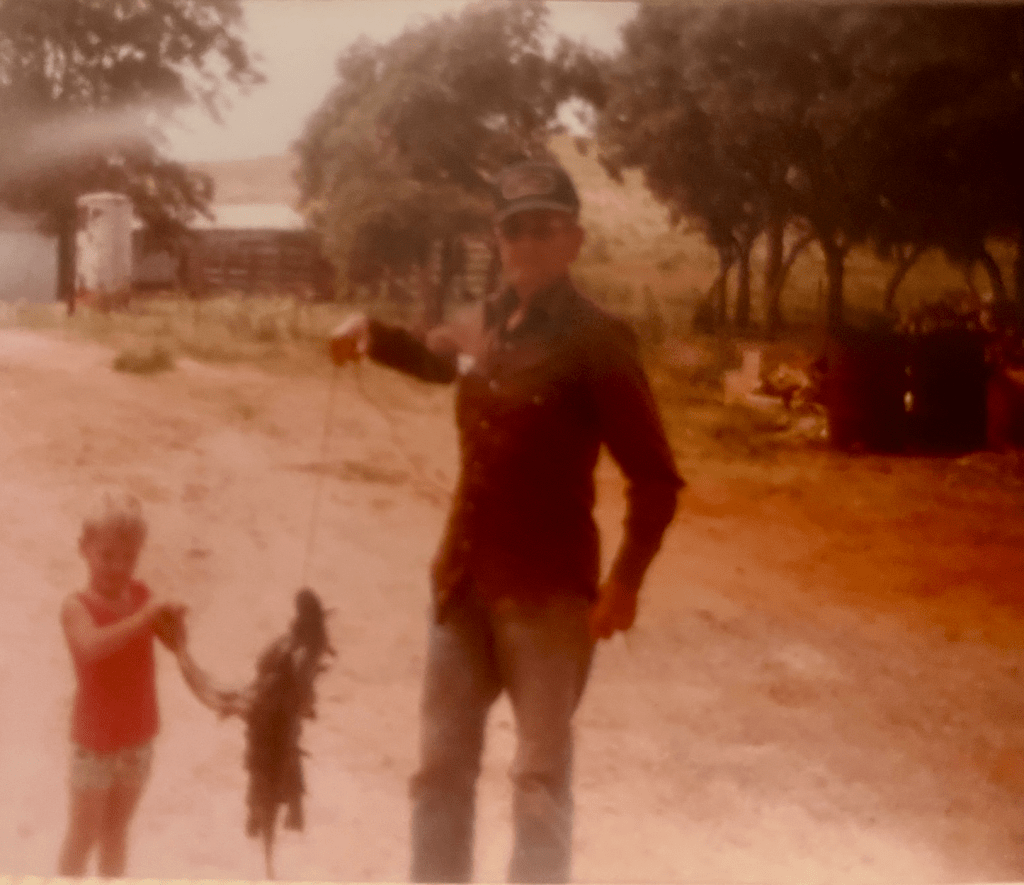
The fish were practically leaping from the water. Dad was giddy, casting with the energy of a man half his age.
He kept asking how I found such a remote place and marveling at the size of the fish we caught.
I thought I had waited 24 years to go fishing with my dad. I didn’t want to use up all my time in one afternoon.
Eventually, the stringer was full, and the sun started slipping.
“We’d better get you home,”
I said.
“Mom said you’ve got to be back by two for a breathing treatment.”
He frowned but nodded, and we packed up our catch.
When we got home, the house was empty.
“Was Mom going out today?”
I asked.
“I think your sister was taking her shopping,”
He said, unconcerned.
I got Dad set up with his treatment. The hum of the machine had just started when the phone rang.
“Hello?”
“Benji?”
A familiar voice—my sister’s mother-in-law. Using my childhood name.
“Where have you and your daddy been? We’ve been trying to find you.”
“We went fishing.”
“Fishing? You took JD fishing?”
“Yeah—we caught a nice stringer full.”
There was a pause.
“You’d better put them on ice. Your mother and sister were in a bad accident. A truck hit them head-on out on the bridge. They’re at the hospital in Chickasha. You need to get your daddy down there.”
I turned to him and broke the news gently. He took it quietly, still holding onto the joy of our day. Maybe it hadn’t fully sunk in, or he didn’t want to let go of the moment.
At the hospital, Dad was the first to go in and check on Mom. My sister waited in the hall, shaken but okay. When Dad came out, he looked as calm as ever.
“She’s going to be fine.”
He said.
“They’ve got her so doped up she thinks she’s on the moon.”
Catch of The Day
Then someone asked him where he’d been. He grinned.
“Fishing. Caught the biggest fish you’ve ever seen. I swear, some were as long as my arm!”
Everyone laughed.
“That’s a fish story if I’ve ever heard one!”
“Sure, JD. Whatever you say.”
I backed him up, grinning.
“We’ve got them at home. Put them on ice. Big stringer full.”
My oldest sister chimed in, skeptical.
“No, you didn’t.”
“Yes, I did. Slid them into a plastic bag first, then put them in the freezer.”
It was true.
Grandson Raymond, and JD Groff
And that fishing trip wasn’t the last. That summer—his last summer—I ensured we went out as often as possible. Sometimes, it was just the two of us. I had always dreamed of this as a boy, watching the lake from our back porch. Other times, I brought my brother and my nephews along. Dad would hold court on the bank. He told stories and gave advice. He cast his line with the patience of someone who knew the water well. He knew the time was short.
We laughed, caught fish, and built memories like campfires—small moments that glowed long after sunrise.
That summer was magical.
It was the summer, and I finally got to take my dad fishing. And it was everything I had waited for.
My Dad was a man of fierce independence and deep protective instincts. He and my mom practiced defensive maneuvers as the days of aging grew—he had a plan. She would drop to the ground, and he would shoot over her, neutralizing any imagined threat. This was his way of ensuring our safety, a comforting thought for all of us. Of course, during practice, the gun was always unloaded. But as they grew older, my sisters became worried. Dad was on medication. It sometimes clouded his thinking. They feared he might one day forget to remove the bullets.
Years before, he had suffered a devastating injury. While inspecting a swimming pool facility, a large chlorine container malfunctioned, releasing a gas blast into a control room. He inhaled the toxic cloud, severely damaging his lungs. From that day onward, his breathing was labored, his movements slow and painful. The injury gradually robbed him of his strength until, eventually, he became bedridden.
As his physical strength faded, his concern for my mother’s safety grew stronger. He was terrified that they were vulnerable to burglars or intruders. And so, he devised a plan—an extension of the old drills. My mom would guide them to a specific location if someone ever forced their way into the house. He saw this spot clearly. She would drop to the floor just like in the old days, and he would be ready to fire.
That’s when my sisters turned to me. I’m a law enforcement officer, and they hoped I could safely remove the firearm from his possession. But that was easier said than done. When I spoke to him, he saw what I was thinking. Even in his weakened state, he firmly grasped his beliefs and authority. His determination was palpable. He made it clear that this was his home and responsibility. It was his plan to protect his wife.
But he also took the time to explain how seriously he took the safety of it all. His explanation wasn’t reckless or confused; it was thoughtful. He was rational and transparent in his thinking. In the end, I agreed. He was doing what he believed was best for them.
Still, I wanted to do something more—something that would help ease everyone’s minds. That day, I installed a motion detection system in the house. It covered the living and dining rooms, alerting them if anyone approached. Every door was now an alarm. It gave them peace of mind and ended the dramatic drop-and-shoot rehearsals.
Dad & Buck
Eventually, Dad was unable to get out of bed. He was confined to a hospital-style bed in a small office near their bedroom. His gun was out of reach, and it tore at him. One day, he felt sorrow and frustration. He asked for it not to defend the home. He wanted it to end his pain.
Two weeks later, my mother called an ambulance to rush my Dad to the hospital. They sedated Dad as fluid built up in his lungs, and he passed away there. Quietly, heavily, and—if I’m honest—less on his terms than he would have wanted.
I often think of the day he asked for the gun and couldn’t reach it. Part of me believes it would’ve been a more dignified end. He had spent his life in control. He always defended his family and lived by principle. But the law is clear, and so is the burden of those left behind. As much as it hurt, I nor anyone could hand it to him.
I think about my life and often find myself lost in daydreams. I think about what I have done, what I have left undone, and what I have never said. Among those lingering thoughts, my Father stands at the center of many. There is a growing list of moments I wish I had shared with him. Time always held me back. Fear held me back, too. Sometimes, stubbornness was also to blame.
Every child keeps secrets from their parents. It’s an unspoken rule of growing up, a silent understanding that some things are best left unsaid. Some secrets were harmless. Others were reckless. I believed a few were withheld to protect us from disappointment, confrontation, or painful truths.
I never told my dad I put frogs in my sister’s bed. They were scattered all over her room. He didn’t need to be a detective to know who the culprit was, but I never admitted it. It was a childish prank, one of many that shaped my mischievous youth.
I never told my dad I took his prized pickup truck for a drag race down the state highway. I was old enough to drive but not wise enough to make good decisions. By the time I got home that night, I had already faced my punishment. I felt humiliated for losing the race. There was also the quiet shame of knowing I had betrayed his trust. He never confronted me about it, but I suspect he knew. Fathers often do.
I never told my dad this story. One afternoon after school, I thought I had the rare gift of a chore-free evening. Then I opened the refrigerator and found a note beside the cola cans. His handwriting instructed me to bring the tractor to the meadow to help him build a fence.
Frustrated, I stomped outside, my young temper flaring. In my haste, I spun around and dented the fender of his truck. Later, he assumed someone had hit it with a car door while he was in town. I let him believe that. I convinced myself I’d tell him we’d laugh–– when the time was right. That moment never came. And until now, I’ve never told another soul.
But the most significant thing I never told my Father was how much he meant to me. He was my hero. His wisdom shaped me in ways I never fully understood until adulthood. I always thought there would be time to say those words. Yet, life has a cruel way of taking time away before we realize its worth.
I never told my dad that. As I stood before his casket, I saw not just the man who raised me. He was the embodiment of dignity, integrity, and strength. I wanted to tell him then, but it was too late.
But I can tell you.
“I’ll be dead, but the older you get, the wiser I’ll be!” – JD Groff.
JD Groff was the epitome of a great father. He had his flaws, as all men do. Nevertheless, his presence and character were a foundation. His unwavering values were something I always relied on. And though I never spoke the words to him, I hope Dad knew. I hope he felt it in the way I listened. I hope he recognized it in the way I followed his example. I hope he saw it in the life I have tried to live in his honor.
Some things stay unspoken, but they are never forgotten.
The old pickup truck rattled down the highway, packed tight with the Miller family. The father, Dale, gripped the steering wheel, his sharp eyes scanning the road ahead. Beside him, their mother, Janice, balanced a warm dish of sweet potatoes wrapped in a towel on her lap. Every thirty seconds she would let out a ‘hiss,’ and reach for the dash, her only comment to Dale’s driving. In the same seat, the children jostled for space. Clayton, the eldest at twenty-two, leaned against the window with his arms crossed. His younger sisters, Maggie and Rachel, squeezed in beside him. Then there was little Jack. He was the baby of the family, barely eight, and sat between his sisters. His feet barely touched the floor.
It was the same every year. They drove forty miles on bumpy roads. Gravel spat against the undercarriage. The chilly air sneaked in through cracks in the old truck’s frame. The family’s first stop was Janice’s side, the sprawling Henderson clan, where a sea of cousins, aunts, and uncles waited. The noon meal would be loud, laughter filling the air along with the scent of roasted turkey and homemade pies.
Clayton was ever the quiet one. He watched the open fields pass by. Meanwhile, Maggie chattered about the games she’d play with her cousins. Rachel checked the food in the back. She made sure nothing had tipped over. Meanwhile, Jack, restless, kicked his feet. He asked every ten minutes, “How much longer?”
When they finally pulled into the driveway of Janice’s childhood home, they heard the noise instantly. It hit them before they even got out of the truck. Kids ran around the yard. Adults stood in clusters laughing. The kitchen was an organized chaos of steaming dishes and busy hands. The family squeezed through the door, greeted by warm hugs, as coats were peeled off and plates were filled.
After lunch, games and stories took up the afternoon. Clayton found himself talking with an uncle about work on the ranch, while Maggie and Rachel gossiped with their cousins. Jack, after an impressive three plates of food, ran outside to join a game of tag. Dale was talking to his favorite brother-in-law, about a horse he was bringing along.
But there was no time to linger too long. As the sun began to sink, Dale gave the usual call: “Time to load up! We still got another stop!” They groaned and said their farewells. Everyone piled back into the truck with full stomachs. Hands waved through the window.
The second stop was Dale’s side, a quieter gathering with just his sister’s family. Fewer cousins, a calmer atmosphere, and jokes cracking from Bus and Virgil. Aunt Sis served coffee and pie, and the talk was slower, nostalgic—old family stories, memories of Christmases past.
Rachel curled up in a chair with a book while Maggie helped Aunt Sis in the kitchen. Jack, fighting off sleep, leaned against his mother, his eyes drooping. Clayton sat with his dad and uncle, talking about the year’s crops and the price of cattle.
By the time they left, the truck was much quieter. The ride home was filled with drowsy murmurs, Jack fast asleep against his mother’s side. Rachel and Maggie leaned on each other, the warmth of the long day still lingering. Dale, was dreaming of all the memories he had been reminded of while seeing his folks and kin.
As the headlights cut through the darkness, Dale glanced in the rear view mirror at his family. It was a long trip every year. Yet, as he looked at his wife and children—fed, happy, and together—he knew it was always worth it.
The holidays weren’t about the miles traveled, but the moments shared. He never had a million dollars, but he sure felt like it.
The last of the guests had left. A heavy silence remained, seeming to fill every corner of the house. It had been a long day. Victor placed his hands over his face. He tried to collect himself from everything that had happened in the last few days. His father had passed, and the funeral had brought together friends and family he had not seen in years. Once filled with laughter and conversation, the house now stood eerily silent.
He walked to the refrigerator for a cold glass of water. Something caught his eye—a wooden cigar box atop a cabinet. It was the old kind –– the type that hadn’t been made in years. It was a mystery, a relic from a bygone era. His father must have been holding onto it.
Curious, Victor set his glass on the kitchen table and reached for the box. He found letters bundled with a rubber band as he pried it open. The postmark on the top envelope was dated 1942. He ran his fingers over the stack, noticing the new rubber band. His father had handled these recently.
Victor’s mother, Emily, had passed nearly seven years ago. Since then, his father, Bob, has never been the same. He continued with life, but something had changed—like a light had dimmed.
He carefully removed the band and unfolded the first letter. A small tobacco sack slipped out as he did, landing softly on the table. It felt empty, save for dust. Pushing it aside, Victor began to read.
My Dearest Emily,
Today, we are adrift going “over there.” I don’t know what we will find when or if we wash ashore. Yet, I know one thing—I wish to get back to you more than anything. You are my love, my most faithful and one and only! I promise with all my heart to survive this mission and see you again! I have to make this quick to get to the mail plane before it takes off.
Love, Bob
Letter after letter, Victor saw the same unwavering devotion. His hands trembled as he read the words, feeling the weight of his father’s love and sacrifice. Then, one in particular caught his attention:
My Dearest Emily,
We ran into trouble and had to fight the Japanese in the middle of the ocean. We won. The chiefs say it will be a decisive battle in the war. I certainly hope so. We took losses. Some of my buddies are gone. But I am still here, as I promised you I would be. I love you and can only count the days until this war ends, and I am back home with you. I promise I will never leave your side again once I return!
Love, Bob
Victor looked at the date on the letter and the weight of his father’s words. Could Bob have been in the Battle of Midway? He had never spoken much about his military service. The letters seemed to carry the burden of his unspoken past.
No kid should have to be a killer of another. It is the most horrible thing you can imagine.
Those were the only words his father had ever spoken about the war.
Victor leaned back in his chair, staring at the letters before him. His father had seen horrors he had never spoken of and endured trials he had buried deep. Yet, through it all, the one thing that had kept him going was his profound and unwavering love for Emily.
He suddenly understood why, after her passing, his father had never quite been the same. Bob had kept his promise—he had never left her side. And when Emily was gone, so too, in a way, was Bob.
A lump began to form in Victor’s throat. He had always known his parents’ love was strong, but he had never truly grasped its depth until now. He had a newfound appreciation for the man his father had been. He gently and reverently returned the letters to the cigar box. Each one was a testament to his father’s enduring love.
As he placed the box back on the cabinet, he felt something shift within him. Grief remained, but now it was accompanied by a deep admiration. His father had lived and loved with an intensity few understood.
And finally, after all these years, he was with Emily again.
The small town of Boone, nestled in the valley of snow-capped peaks, was no stranger to winter storms. But this one was different. The storm rolled in with icy winds that seemed to pierce every wall and seep through every seam. It coated the town in a thick, glittering layer of ice. The power lines sagged and snapped under the weight. This plunged Boone into darkness. The town’s survival hung in the balance, with temperatures plummeting to subzero.
The urgency of the situation was palpable. Dan Hayes, a seasoned electrician and father of two, was preparing for a quiet evening with his family. His phone buzzed incessantly. Calls came in from neighbors, then from Boone’s mayor himself. The town’s substation, already overwhelmed by the demand for heat, had succumbed to the relentless freeze. Ice had formed on critical equipment, blowing fuses and wiring, leaving the entire town powerless.
“Jimmy, grab my tool bag!”
Dan hollered to his teenage son, who quickly obeyed, bundling up in layers against the cold.
“We’re heading to the substation.”
Driving through the storm in his old but reliable truck, Dan and Jimmy barely see beyond the hood. Fallen branches and icy roads made the journey treacherous. When they finally reached the substation, the sight was worse than Dan expected. The entire structure got encased in ice. Its wires snapped like brittle twigs.
“Jimmy, this is going to take everything we’ve got,”
Dan said, his breath forming clouds in the freezing air.
“I’ll need your help every step of the way.”
Dan quickly assessed the situation, identifying the most critical damage. The main transformer was overloaded, and its fuses were blown. Wires leading to key circuits were severed, and ice threatened to collapse a vital power relay. Dan began carefully thawing the most delicate components using a portable heater from the truck. Meanwhile, Jimmy set up emergency lights and handed his dad tools as he worked.
Word spread that Dan was at the substation. Soon, a small group of townsfolk arrived. This group included the fire chief and a few volunteers. They formed a chain to bring sandbags and materials to reinforce the ice-laden structure. This was a testament to the resilience and unity of the community. One by one, Dan replaced the fried fuses and spliced wires, his fingers numb but his determination unshaken.
Hours passed, and the storm showed no mercy. Dan finished repairing the transformer. Then, the wind knocked a massive branch onto the newly restored lines. This snapped them again.
Dan didn’t flinch.
“We’ve got one shot to do this right,”
He muttered. Calling on his years of experience, he rigged a temporary bypass, rerouting power from a less-affected part of the grid. The fix have been made better, but it would hold until morning.
Finally, as dawn broke and the first rays of sunlight pierced the storm clouds, the lights flickered across Boone. Cheers erupted from the gathered crowd, but Dan was yet to finish. He double-checked every connection, ensuring no one would lose power again that day.
Jimmy looked at his dad with newfound admiration.
“You saved the whole town, Dad.”
Dan smiled, his face weary but proud.
“We did it together, son. Boone’s got a lot of heart, and so do its people. That’s what keeps us warm.”
Back home, Dan and Jimmy were comforted with hot cocoa and blankets from a grateful Mrs. Hayes. Outside, the storm subsided. It left behind a town that had endured the worst. This was thanks to the quiet heroics of a father who wouldn’t let the cold win.










 benandsteve.com