How Far Is Heaven? A Reflection on Belonging

2–3 minutes

How Far Is Heaven?

The little boy tugged at his father’s sleeve as they walked home one quiet evening. The sky stretched wide above them, painted in soft shades of pink and gold. After a long silence, the boy asked a question that seemed to hang as heavy as the clouds.

“Dad… how far is Heaven?”

The father slowed his steps, looking down at his son. For a moment, he didn’t answer. Then he smiled gently.

“That’s a big question, son. And the truth is—I don’t know.”

The boy’s brow furrowed.

“Don’t know? Isn’t it up there?”

He pointed toward the fading light above the rooftops.

“Well,”

his father began,

“that depends on what you believe Heaven is. For some people, Heaven is a faraway place where souls go when life here is over. For others, Heaven is closer than you think.”

He stooped down so they were eye to eye.

“Heaven can be the feeling of home when everyone’s together at the dinner table. It can be walking into your grandparents’ house and smelling fresh pies cooling on the counter. It can be the peace of sitting in a quiet cabin deep in the woods. There is no noise but the trees and the wind.”

The boy listened, his eyes wide, as though trying to imagine all those Heavens at once.

“You see, son,”

his father continued,

“Heaven doesn’t have just one location. It can mean different things to different people, at different times in their lives. Sometimes it’s a place, sometimes it’s a feeling. And sometimes, people think of it as a reward beyond this life. But no matter what, it’s something we long for—a place where we belong, where everything feels right.”

The boy was quiet, mulling it over. Then he looked back up at the sky.

“So… Heaven isn’t always far away?”

His father smiled, squeezing his hand.

“No, son. Sometimes, Heaven is right here—closer than we ever imagine.”

As they walked the rest of the way home, the boy noticed the laughter of his mother. She was waiting at the door. He smelled the supper drifting through the air. He felt the warmth of his father’s hand in his own. And for that moment, he decided, Heaven was not far at all.


Reflection

How Far Is Heaven?

By Benjamin Groff II

A boy once asked his father, “How far is Heaven?”

The father said, “That depends. For some, it’s beyond the stars where souls go when life is done. For others, it’s much closer. It is found in the smell of pies at Grandma’s. It is in the quiet of a cabin in the woods or the laughter of family at the dinner table.”

He paused and added, “Heaven is different for everyone, son. Sometimes it’s a dream, sometimes a memory, and sometimes it’s right here, in the moments we hold close.”

The boy thought for a while, then smiled. Heaven, he decided, was not so far away after all.


By Benjamin GroffMedia© | benandsteve.com | 2025 

Elmer’s Tough Ride: A Journey Through the Dust Bowl

GROFF MEDIA 2024© TRUTH ENDURES IMDBPRO

Presented by benandsteve.com By: Benjamin Groff II©s

4–6 minutes

Pa Elmer’s Ride

The winter had been relentless. The worst sandstorm in memory had swept through the region the year before. It buried the land in towering drifts of dust and sand. In some places, these drifts were waist-deep.

It marked the beginning of the Dust Bowl. This was a devastating era of dust storms. These storms crippled agriculture and reshaped life across the American and Canadian prairies in the 1930s.

Few families had stored enough food from the past year’s harvest. Even fewer were sure how long this disaster would last.

They say two things in life are certain: death and taxes. And for Elmer, tax time had come knocking. He had no choice but to ride nearly forty miles to the courthouse. He needed to pay his property taxes in person. He risked default if he didn’t. Despite the hard times, he had always kept his land in good standing. He intended to do so now, even with their dwindling savings. With three young children to feed, responsibility was heavily on his shoulders. His two sons and daughter were too young to fully grasp the hardship that had taken hold of the land. The struggle was real for Elmer and his wife, Ma Ma.

The night before his journey, Elmer told Ma Ma,

“I’ll be up by 3:30 and gone before sunrise. There’s no need to let anyone know I’m carrying money. Hard times make people desperate.”

While he trusted his neighbors, he wasn’t about to take unnecessary risks. He planned to make it halfway and camp near the Washita River before reaching the courthouse the next day.

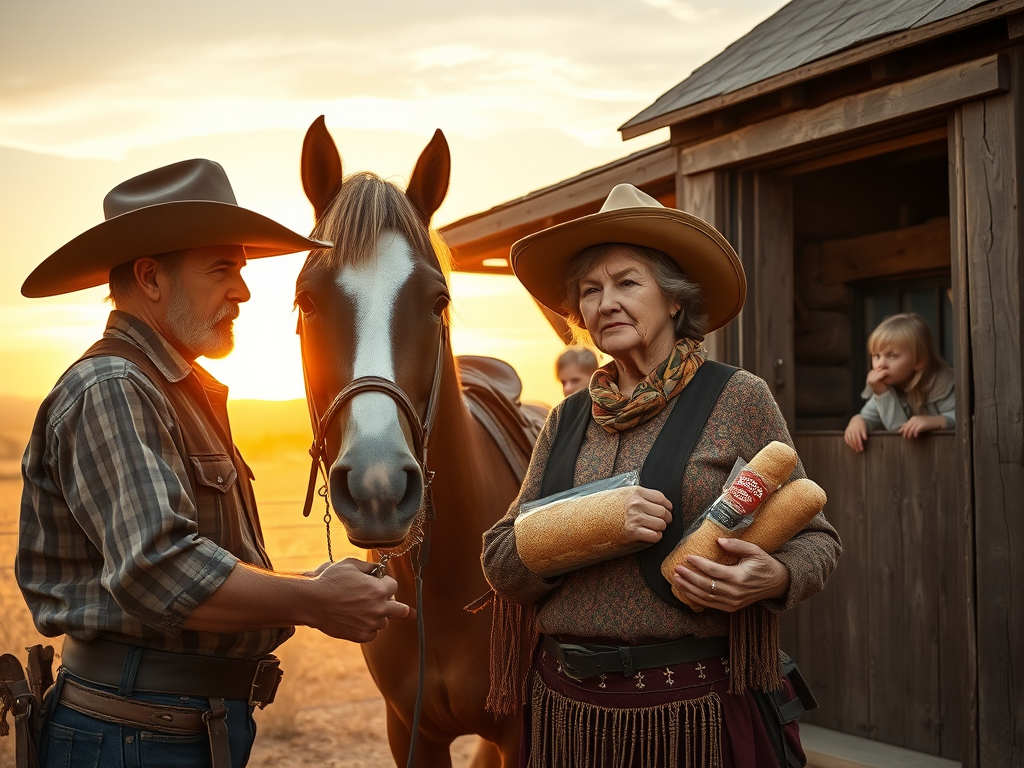
At dawn, Pa Elmer saddled his pony, Smokey. Ma Ma handed him a small bundle—a few slices of fresh bread and beef jerky from the smokehouse.

“It’s not much,”

she said, touching his knee as he mounted up,

“but it’ll hold you over till you’re back. Ride safe, and don’t take any risks. Smokey can outrun any trouble that comes your way.”

Pa Elmer bent down in the saddle and kissed her.

“Two days there, a day and a half back. I’ll be fine.”

The parents didn’t know it. Their three children watched from behind the screen door, their little faces pressed against the mesh. As Ma-Ma gave Smokey a firm slap on the hip, Pa clicked his tongue and hollered,

“Yaw!”

The journey had begun.

Back inside, Ma Ma found the children still watching. She shooed them back to bed. Then she settled into her rocking chair with the Bible. It was her source of comfort through times of uncertainty.

The Ride to Town

Pa made good time. Smokey, eager for the open trail, trotted strong beneath him. By evening, they had covered thirty miles. Elmer found a spot near the Washita River where the grass was matted down—a daytime swimming hole. He unsaddled Smokey. Then, he tied him to a long rope to graze. Elmer stretched out beneath a tree, using his saddle as a pillow.

Sleep took him fast; it was a blessing he had dozed off facing east. The first light of dawn warmed his face, stirring him awake. After a quick breakfast of beef jerky, he saddled Smokey and continued.

By mid-morning, he reached the county seat. He tied Smokey to the hitching rail and strode into the courthouse. The county clerk barely glanced up from her papers.

“You here to ask for an extension on your taxes like everyone else?”

she asked.

Elmer tipped his hat.

“No, ma’am. I’m here to pay my taxes for this year and next.”

The clerk blinked, then scribbled out a receipt, her expression unreadable.

Paid this date: $28.33 for two years of property taxes.

Elmer folded the receipt and tucked it into the same safe spot where his money had been. Simply saying ––––

“Thank you, Mam!”

Pa had finished his business.

Trouble in Town

As he walked back to Smokey, a man loitering nearby gave a slow nod.

“That’s a fine-looking horse you got there. I’d buy him off you for $25.”

Elmer stiffened.

“No, you wouldn’t.”

The man’s eyes darkened, and his tone shifted.

“Maybe I just take the horse for nothin’.”

Elmer didn’t flinch. He met the man’s stare with steely resolve.

“No, you’d be lyin’ dead if you tried.”

A tense silence hung between them before the man forced a crooked smile.

“Mister, I was just jokin’.” 

He backed away.

“You have yourself a nice day.”

Elmer wasted no time. He swung into the saddle and galloped out of town.

The Journey Home

The Journey Home

Elmer has made the ride back in a day. Still, he took his time. He stopped by a few relatives along the way. In this part of the country, it was tradition—when you passed by kin, you paid a visit.

Late in the afternoon, as he approached home, he saw Ma Ma and the kids waiting at the gate. The children ran to meet him, full of questions.

“Well, Pa? How’d it go?” 

Ma Ma asked, relief washing over her face.

Elmer grinned and swung down from Smokey.

“Would’ve been home sooner,” 

he said, stretching his legs,

“but I kept runnin’ out of pipe tobacco.”

Ma Ma shook her head with a chuckle. As the family led him inside, the weight of the journey melted away. Home had never felt so good.

The Concept of a ‘Chosen People’ and Modern Political Dominance

By: Benjamin Groff© Groff Media 2024© Truth Endures

When Did God Decide to Have ‘A Chosen People’?

The concept of a “chosen people” has sparked debates throughout history, especially when tied to moral, societal, and political questions. In modern times, the idea of being “chosen” is often reimagined or repurposed to justify decisions that affect minority groups.

Recently, the U.S. House Committee on Education and the Workforce advanced a controversial bill, H.R. 736, that aims to force schools to out transgender students to their guardians. The bill, titled the “PROTECT Kids Act,” requires schools receiving federal funding to notify guardians if a student wishes to change their gender markers, pronouns, or preferred names. The legislation also seeks to dictate which school facilities these students can use, including bathrooms and locker rooms.

This legislative action raises an important question: who gets to decide the fate of vulnerable groups, and under whose authority do they claim this right? Much like the ancient notion of being “chosen” by God, this modern political move asserts dominance over others, deciding for them what is best based on a rigid set of beliefs.

The bill passed the House in 2023 as part of the “Parents Bill of Rights Act” (H.R. 5) but faced bipartisan solid opposition. Every Democrat and five Republicans voted against it, while most supported it. Despite the potential for this bill to move through the House, it is unlikely to pass the Senate or gain approval from President Joe Biden.

Opponents of the legislation, including the Congressional Equality Caucus, condemned it as an attack on transgender students’ safety. Chair Mark Pocan highlighted how, in the wake of a tragic school shooting, Republicans chose to focus on targeting vulnerable students instead of addressing genuine safety concerns.

The question of who is “chosen” can be expanded beyond ancient religious contexts to current identity, rights, and protection issues. The targeting of trans students under the guise of protecting children raises more profound philosophical questions about power, authority, and the consequences of imposing one’s beliefs on others.

The biblical idea of a “chosen people” once symbolized favor and responsibility, but that label often becomes a tool to exclude and control in modern times. This recent bill serves as a reminder that decisions made in the name of protection or moral righteousness can have far-reaching, often damaging, effects on those they claim to protect.

In the end, it is crucial to ask when the power to choose the fate of others—whether through divine claim or political force—became justified. And who truly benefits from these decisions?

The Prayer For Peace Finally Answered!

A Story By: Benjamin Groff© Groff Media 2024© Truth Endures

An older man, who had prayed for peace since he was a young child, lived a life of selflessness. His mother’s words, that God would answer his prayer if he kept his life clean of sin and did what was best for others, became his guiding principle. He never put himself first, always putting the lives of others before his own needs.

So, the older man went without when he could have lived a comfortable life. He gave to others and kept a solitary life when he could have had a home filled with love and a family. The city he lived in had the highest crime rates in the world, and the country in which the older man lived was worn in battles between battles with other nations and individual groups. He was a victim of crime repeatedly when he could have had protection provided.

The man became wealthy without trying, thanks to inheritances from family and friends and business interactions he had made without intending to see a return. When he turned 80, he prayed one night, asking why God hadn’t answered his prayer.

The older man’s prayer echoed through the quiet of his small, humble home. He sat at the edge of his bed, his hands clasped tightly together, his heart heavy with years of unanswered longing. The world outside his window was no different than it had been decades ago—still filled with strife, suffering, and humankind’s relentless cruelty.

A deep voice resonated as he closed his eyes, seeking the peace he had always desired. It wasn’t a voice he heard with his ears but one that spoke directly to his soul.

“My son,”

The voice began, calm and compassionate.

“My son, you have lived a life of unwavering faith, sacrifice, and selflessness. But true peace is not the absence of conflict in the world around you. It is the serenity within your heart, the understanding that you have done all you can for others, and the acceptance that the world’s burdens do not solely rest upon your shoulders.”

The man’s breath caught as the realization began to dawn on him.

“Peace is not something one gets as a reward for their deeds,”

the voice continued,

“but something that grows within you, cultivated by your actions, thoughts, and love. You have touched countless lives, offered solace to those in need, and lived your life according to the highest ideals. The peace you seek has been with you all along, not in the world outside, but within the purity of your heart and the love you have shown others.”

Tears welled in the older man’s eyes as he understood. He had spent his life searching for peace in the world while nurturing it within himself. The crimes, wars, and suffering were not his to control.

His prayer had been answered most profoundly: by giving him the strength to endure, the compassion to love, and the wisdom to understand that peace is not an external gift but an internal state of grace.


As the older man lay back on his bed, a warm, gentle calm washed over him. He closed his eyes, not in despair but in contentment. For the first time in his life, he felt at peace—not because the world had changed, but because he had finally understood the true nature of his prayer.

And with that peace, he drifted into a restful sleep, his heart light, his soul fulfilled, and his spirit finally at ease.

Enlightenment: Unveiling the True Origins of the Bible for a United Future

In the year 2542, humanity had reached an age of enlightenment, where technology and knowledge had advanced to levels previously unimaginable.

Amidst the bustling metropolis of Neo-Tokyo, two men stood apart from the crowd, their expressions grave and determined. They were Dr. Elias Hartman, a renowned historian, and Kael Renwick, a brilliant physicist.

Their mission was as crucial as it was unprecedented: they had to travel back to the early 21st century to avert a catastrophe, a global war rooted in a millennia-old misunderstanding of religious texts that threatened to wipe out the progress of the enlightened age.
Elias and Kael had spent years researching the origins of religious texts, particularly the Bible.

Their findings were both groundbreaking and alarming. The Bible, revered by billions, was not a divine prophecy but a collection of embellished reports from historians of long ago.

These historians, lacking a comprehensive understanding and accurate recording methods, had chronicled events that occurred tens of thousands of years prior. Over time, their writings got misinterpreted and deified, leading humanity astray.

The duo stepped into the time portal, their hearts heavy with the weight of their mission. They emerged in the year 2024, a time when religious fervor was still potent, and the world was on the brink of environmental and societal collapse. The air was thick with pollution, and the political climate was rife with tension and division.

Their first destination was a conference on religious studies in New York City. With his scholarly demeanor, Elias took the stage amidst curious and skeptical academics.

“Ladies and gentlemen,” he began, his voice steady and authoritative, “I come from a future where we have uncovered the true origins of the Bible. It is not a prophecy or a divine mandate but a series of embellished reports from ancient historians who chronicled events inaccurately. These events occurred thousands of years ago and have no bearing on our future.”

The audience was stunned into silence, then erupted into a cacophony of disbelief and anger. Kael stepped forward, his presence commanding and reassuring.

“We understand this is difficult to accept,” Kael said, “but we have irrefutable evidence. The misinterpretations of these texts have led humanity down a dangerous path. If we do not correct our course, we will self-destruct.”

They presented their evidence: ancient manuscripts, carbon-dated artifacts, and advanced simulations showing the actual timeline of historical events. These artifacts and simulations, based on the latest scientific methods and technologies of the 26th century, provided a clear and irrefutable picture of the true origins of the Bible, shifting the room’s atmosphere from hostility to curiosity.

As their journey continued, Elias and Kael faced fierce opposition from religious leaders and institutions that saw their revelations as threatening. They were branded heretics and faced numerous attempts to discredit their work, including public denouncements, smear campaigns, and even physical threats. However, they also found allies in unexpected places—scientists, open-minded theologians, and everyday people who saw the truth in their words.

In a small town in the Midwest, they met Sarah, a young pastor who had long questioned the traditional interpretations of the Bible. She invited them to speak to her congregation, a modest group yearning for answers in an uncertain world.

Elias spoke passionately,

“The Bible’s true value lies in its moral and ethical teachings, not in its historical accuracy. We must embrace its wisdom while understanding that it is not a roadmap for our future.”

Kael added,

“Science and spirituality can coexist. We must use our knowledge to heal our planet and unite as a species, not divide ourselves based on ancient misunderstandings.”

Slowly but surely, their message began to spread. More people started questioning long-held beliefs, seeking knowledge and understanding over blind faith.

Grassroots movements for environmental preservation, social justice, and scientific advancement gained momentum.

Their journey was arduous, filled with moments of despair and hope. But Elias and Kael knew that the future depended on their success. As they stood on the steps of the United Nations, addressing the world for the first time, they felt a sense of destiny.

“Our future was not recorded or written in ancient texts,”

Elias declared.

“It is shaped by our actions today. Let us forge a path of understanding, compassion, and progress.”

Kael concluded,

“We have the power to change our destiny. Let us choose wisely and ensure a future where humanity thrives in sinc with our planet and one another.”

The world watched, listened, and began to change. The seeds of enlightenment they planted grew into a global movement, steering humanity away from the brink of disaster and towards a brighter, more united future. Elias and Kael fulfilled their mission, not by erasing the past but by illuminating the truth and guiding humanity toward a new dawn.

Is Mental Health Help & Legal advice An Answer For Those Who Talk To God?

Getting Help For Your Fix On Faith Based Hate.

Why aren’t mental health promotions displayed on billboards near places of worship, including churches, synagogues, and grand arenas where tele-evangelists solicit donations from vulnerable individuals? It’s perplexing why legal representatives don’t advertise near such venues, highlighting issues like false representation, fraud, and misrepresentation. The transformation of ancient tales shared among nomadic shepherds, later manipulated by rulers to instill fear and exert control over the populace, remains a baffling concept for those who adhere to the belief in a divine being. The notion of a selective higher power, arbitrarily favoring one individual over another, is particularly confounding to those who attribute life events to divine intervention.