The Secret Santa of Cordell, Oklahoma

Groff Media 2024© Truth Endures IMDbPro

Presented by benandsteve.com By: Benjamin Groff II©

3–4 minutes

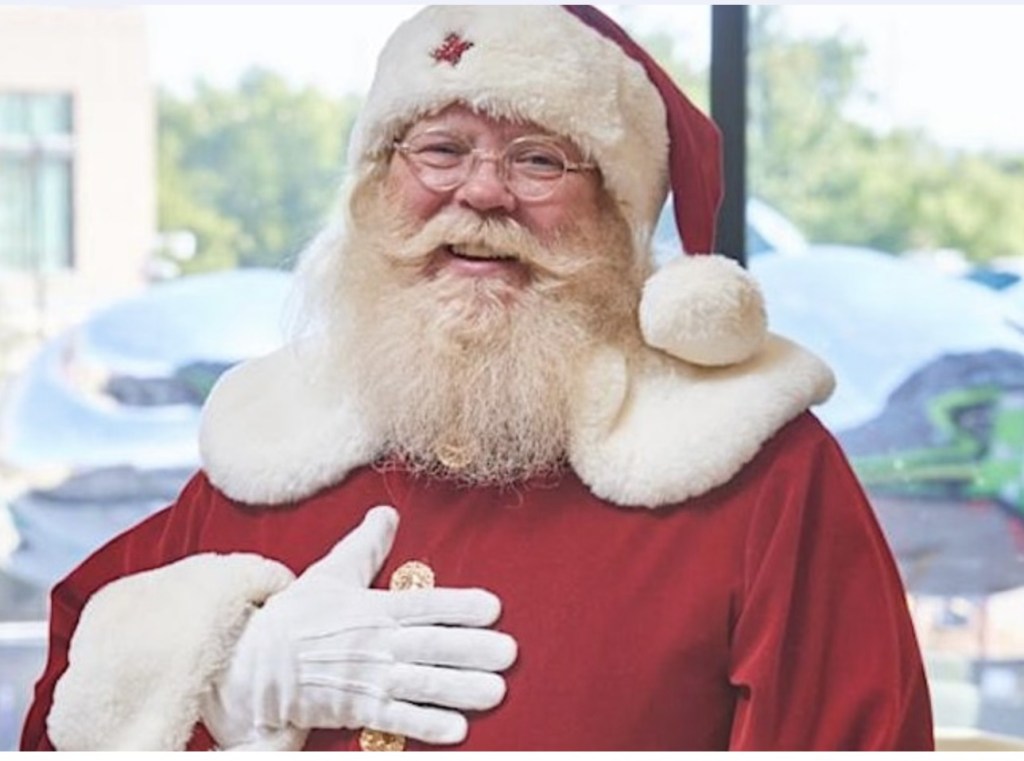
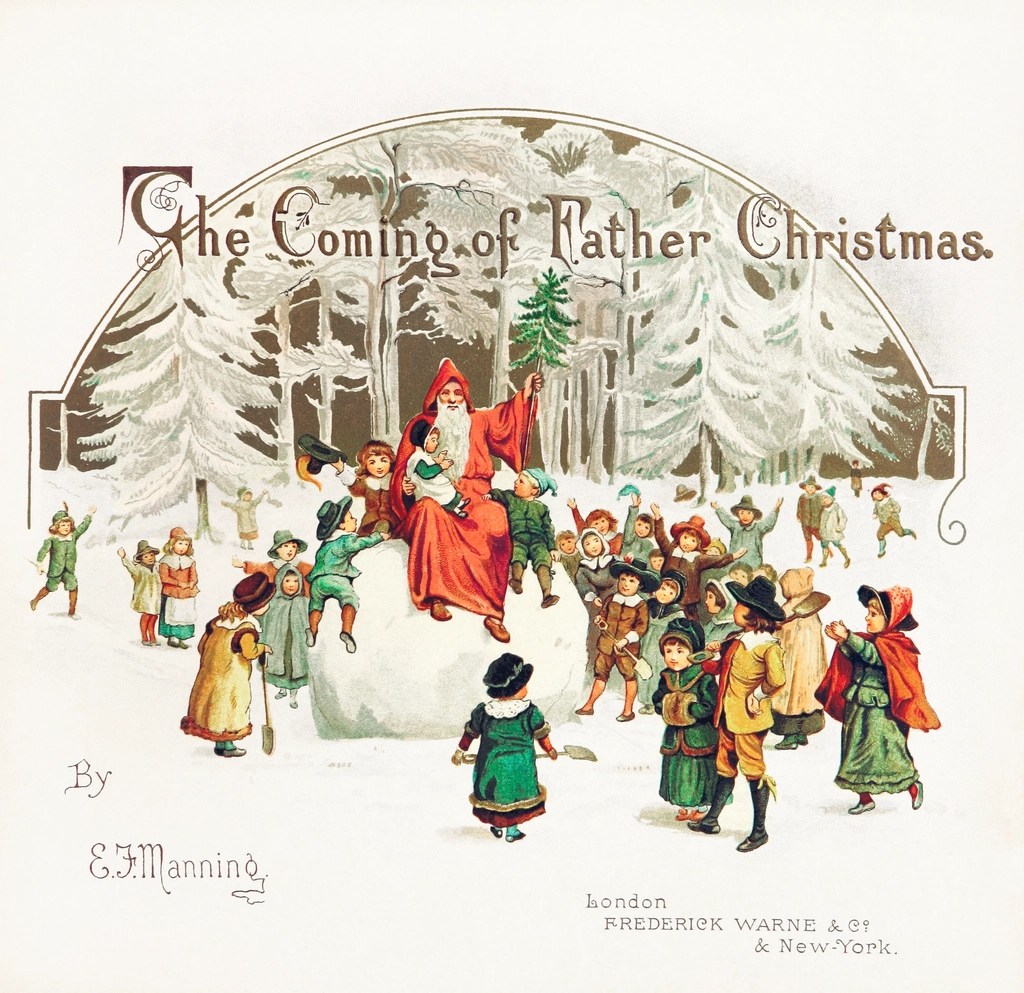
In the small, snow-covered town of Cordell, Oklahoma, Police Chief Eby Don Walters had a secret. Every December, the frost painted the windows and the smell of pine and cinnamon filled the air. During this time, he would don a plush red suit and strap on a padded belly. He transformed into the town’s beloved Santa Claus.

Decades ago, a young Eby Don joined the force. The town’s Santa fell ill just days before the annual Christmas Eve festival. Eby Don, with his deep, booming laugh, twinkling eyes, and short, round build, stepped in. The kids adored him, and the tradition was born, bringing enduring joy to the community.

The children of Cordell adored Santa. They poured their hearts into their whispered wishes. They handed him carefully drawn pictures. They giggled when he joked about knowing if they’d been naughty or nice. Eby Don never broke character. He stayed in character even when his nieces and nephews sat on his lap. Their eyes were wide with wonder.

As the years passed, the children grew up, never suspecting that Santa was their own Chief Walters. Many returned with their kids, eager to introduce them to the magical figure from their childhoods. Eby Don played along. He listened with a warm smile as grown adults recounted their cherished memories of Santa. He waited for the moment when they would discover the truth. Their surprise and delight added to the magic of Christmas.

One Christmas Eve, nearing his sixties, Eby Don felt the weight of the years. The suit fit slightly tighter, and his knees creaked as he crouched to hug the smallest children. Yet, he couldn’t bear the thought of passing the torch. This was his gift to the town, his way of keeping its spirit alive. The Santa suit took a physical toll on him. Despite this, Eby Don continued to wear it. He knew the joy it brought to the children and the community.

That night, a little girl named Emma tugged at his sleeve, her big blue eyes searching his face.

“Santa, will you be here forever?”

she asked.

Eby Don knelt, his voice gentle.

“Santa’s spirit is always here, sweetheart, as long as people keep believing in the magic of Christmas.”

He knew that the belief in Santa was not just about a man in a red suit. It was about the spirit of giving, love, and hope that Christmas symbolizes. It was this belief that kept the Secret Santa tradition alive in Cordell.

The festival ended with the usual fanfare: carols, laughter, and the lighting of the town tree. Eby Don slipped to the small changing room behind the stage, trading his Santa suit for his police uniform. He stepped out into the cold night. The snow fell softly around him. He overheard a group of parents. Some of them were his former ‘kids’. They were talking about how lucky Cordell was to have a Santa who never missed a year. It was a warm and nostalgic end to the festive evening.

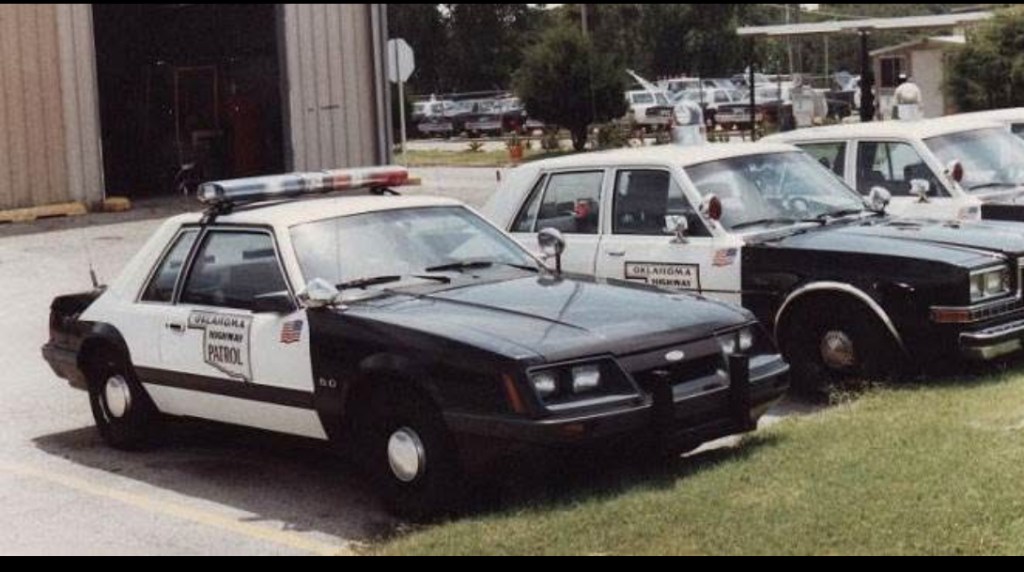
Eby Don smiled to himself. They would never know how much those words meant to him. He returned to his patrol car. His heart was as full as the sack of presents he had left under the tree. Chief Eby Don Walters cherished the greatest gift. It was knowing he had brought a little magic into the lives of everyone in Cordell. It was knowing he had brought a little magic into the lives of everyone in Cordell. They never knew the man behind the beard.

The Guardians of Christmas Eve

Groff Media 2024© Truth Endures IMDbPro

Presented by benandsteve.com By: Benjamin Groff II©

3–4 minutes

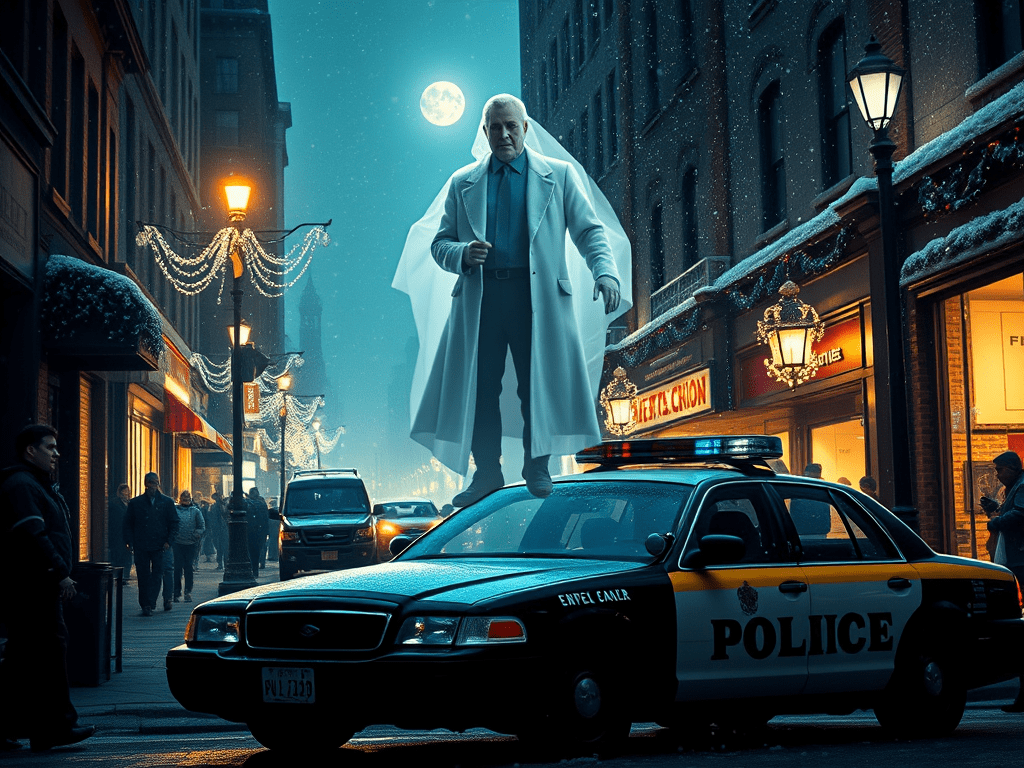
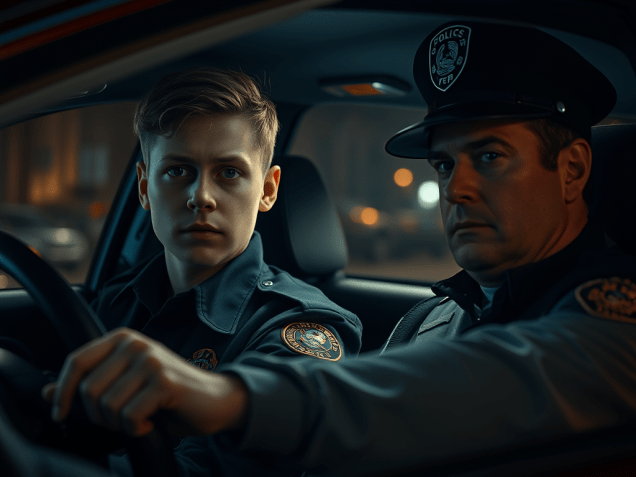
In the heart of the bustling city, the frigid December air carried the soft hum of holiday cheer. Festive lights adorned streetlamps, casting warm glows onto the snow-dusted streets. For the officers of the 8th Precinct, Christmas Eve was far from quiet. Calls came in relentlessly: domestic disputes, stranded travelers, and even a wayward reindeer reported near the city park. These dedicated officers were on duty, ready to serve and protect.

What the officers didn’t know was that they had three spectral protectors watching over them—The Guardians of Christmas Eve.

Each of these ghostly policemen had once served the city. They were bound by duty. A deep sense of loyalty held their spirits. They lingered to make sure that no harm would come to those who now walked the beat.


Inspector Miles Hanley

Miles Hanley was a tall and imposing figure. He had been the precinct’s first chief when the station was founded in the late 1800s. Known for his wisdom, he fiercely protected his officers. He carried his ghostly silver pocket watch. He used it to guide the others through the city. On this night, Hanley floated above a lone patrol car. It was parked at the edge of a dark alley. His translucent form shimmered in the moonlight.

“Johnson’s heading into a bad spot,”

Hanley muttered, watching the young officer approach a shadowy figure rummaging through garbage bins. With a flick of his watch, he whispered through the veil of time, nudging Johnson’s instincts. The officer hesitated, then called for backup—averting a potential ambush. Hanley grinned.

“Still got it.”


Officer Rosie McKinney

Rosie, affectionately called “Mama Mac” by her peers, had patrolled the city during the 1940s. She had an uncanny knack for reading people, even in death. Tonight, she hovered near a busy intersection where Officer Emily Torres was directing traffic midst a chaotic pile-up.

“Stay sharp, Emily,”

Rosie murmured, spotting a distracted driver barreling toward the scene. With a wave of her ethereal baton, she sent a gust of icy wind straight into the driver’s face. The man slammed on his brakes just in time, his car skidding to a halt inches from the officer. Rosie chuckled, tipping her ghostly hat. “That’s one less hospital visit tonight.”


Detective Lou Vargas

Lou had been a beloved detective in the 1970s, known for his quick wit and unshakable resolve. He now roamed the precinct’s cold case archives, whispering clues to frustrated officers. But tonight, Lou focused on Officer Brandon Lee. Officer Lee had just been called to investigate a suspicious package left near a crowded shopping district.

As Brandon approached the package, Lou materialized briefly behind him, a shadowy whisper in the winter night. “Check the wires, kid. Look left before you kneel.” Obeying the faint warning in his gut, Brandon discovered the package was harmless—a forgotten Christmas gift. Still, he felt the hairs on his neck stand like someone had been there with him.


A Christmas Morning Promise

As dawn broke over the city, the officers returned to the precinct, exhausted but safe. Unseen by human eyes, Miles, Rosie, and Lou gathered on the station’s rooftop, gazing at the snow-covered streets below.

“We did good,”

Lou said, leaning on his ghostly cane.

“Not a single officer lost,” Rosie added softly.

Miles held up his pocket watch, the spectral clock hands freezing as the sun rose. “Until next year,” he said, and the three faded into the morning mist.

Below, Officer Torres rubbed her arms against the chill. “Did you feel that?” she asked Officer Lee.

“Yeah,” he replied, staring at the horizon. “Like someone was watching over us.”

And so they were.

Old-School Policing: Stories From the Days Before Body Cameras

By Benjamin GroffMedia© | benandsteve.com | ©2025

3–5 minutes

Going Into Service

Police work operated on instinct, humor, and gritty common sense before body cameras. Every arrest didn’t turn into a viral upload back then. This approach belonged to another era. Officers learned from veterans who passed down unwritten rules — some practical, some questionable, and some downright hilarious. These stories aren’t a manual. They’re memories from a world that helped shape the officers we later became.


Don’s Lessons for Rookie Officers

Don was a seasoned officer whose wisdom mixed patience with a dry, knowing humor. He often told rookies about the prisoners who would scream for an entire transport ride. These are the same kind you see in fifteen-minute viral videos today.

He’d tell the infamous alum-powder story with a wink.

“Keep a plastic bag of it in your shirt pocket.

If you get a screamer, take a pinch and flick it – they will shut up!”

This always left rookies unsure whether he was pulling their leg. Or, was he sharing some relic from an era with fewer rules and more noise? His message was never about techniques. It was about the mindset: don’t let chaos set the tone. And always keep your humor intact.


The “Dog!” Brake Test

Another bit of old-school folklore involved the rowdy back-seat prisoner who wouldn’t stop cussing or kicking. Officers had a classic trick:

Get the patrol car up to about forty-five miles an hour.

Slam on the brakes.

Yell,

“Dog!”

The prisoner would slam into the cage divider and go silent. This silence would last until the second dog ran across the road. By the time they arrived at the jail, the only thing left in them was concern for the imaginary dogs.

It wasn’t policy. It wasn’t pretty. It was one of those stories officers shared over coffee. They shook their heads at “the way things used to be.”


The Gilligan’s Island Sobriety Test

DUI stops had their own brand of comedy. When you already knew the drunk driver was going to jail, the roadside field tests became… creative.

The “Gilligan’s Island Test” was a favorite:

Place your left hand over your head. Hold your right ear with your right hand. Balance on one foot. Sing the theme to Gilligan’s Island.

Most never made it past “a three-hour tour.”

It broke the tension. And after a long, cold night, sometimes everyone needed that.


Jurisdiction and the Art of Paperwork Avoidance

Jurisdiction lines used to shift like sand depending on who wanted — or didn’t want — the call. If the incident required endless paperwork, officers suddenly cared very deeply about city-limit boundaries, council-meeting notes, and outdated maps.

Veterans avoided calls they weren’t dispatched to, knowing the penalty: days off lost to court subpoenas. Midnight-shift officers often clocked out at dawn. They then sat in a courtroom until midafternoon. They did this while waiting for cases where they never said a word.

It was exhausting, but it was part of the rhythm of old-school policing.


These stories sound wild today, but much of policing back then was driven by common sense and community trust. People knew officers, and officers knew their people.

Citizens were often the first to speak up if an officer crossed a line. This happened long before social media or body cams existed. Even without technology, accountability came from individuals who believed in keeping standards high.

Most officers didn’t stop someone without a genuine reason. Those who abused that privilege rarely lasted. It was an unwritten rule — understood, enforced, and expected.


Closing Reflection

Old-school policing wasn’t perfect — not by a long shot. But it existed in a different world with different expectations. Humor softened harder edges. Community relationships carried more weight. And the job, for better or worse, relied on improvisation.

Today’s policing is built on transparency and technology, and that’s a good evolution. But these stories stay important. They are reminders of the human side of the badge, the long nights, and the strange solutions. These stories also recall the characters who trained us and the moments that shaped us along the way.

One persistent problem is untruths. Misinformation continues to mislead the public. These actions make the police look unfavorable.


Groff Media ©2025 benandsteve.com Truth Endures By: Benjamin Groff

About the Author:

Benjamin Groff is a former police officer and radio news anchor. He has hosted programs for CNN and ABC News affiliates in Colorado and Wyoming. His career in law enforcement began in 1980 and lasted more than two decades. This gave him firsthand insight into the criminal mind and public safety. Moreover, it provided him with an understanding of the human stories that often go untold. His writing draws on these experiences, blending street-level truth with a journalist’s eye for the bigger picture.

From the Plains to the Pavement: Agent Bill Johns’ Journey from the Wild West to Philadelphia’s Dark Alleys

4–5 minutes

Bill Johns: The Bureau’s Man in the 1940s

It was the 1940s, and the Bureau had just transferred Bill Johns to the Philadelphia office. He arrived with a reputation built out west. The cases there were more challenging. The distances were longer, and the suspects were meaner. Officially, he was sent to cover Oklahoma, Texas, and New Mexico. Unofficially, he’d become “the best investigating chicken thief agent in the West.” His fellow agents gave him this nickname with a wink.

But Bill Johns had investigated far more than stolen hens. His most significant case had been in Osage County, Oklahoma: three Indian women, each murdered after marrying into money. For nearly three years, Johns chased a trail of false alibis, hidden bank accounts, and hired killers. He and another agent narrowly escaped ambushes five different times. By constantly dropping low and drawing faster than the men who wanted them dead.

Johns wasn’t flashy, but he had something rare—an intuition that couldn’t be taught. He would size up a suspect the way a rancher sizes up a horse. He knew when someone was lying about a bloodstain on a shirt. He knew this the same way he knew when a horse trader was covering up a limp. He followed the tiny clues that led from stolen goods to the back rooms where the real deals happened. He also traced a murder weapon to the man who’d hidden it.

What the Bureau didn’t understand—and still doesn’t—is that this ability isn’t in a handbook. It isn’t taught at the Academy. It’s a gift, as fragile as it is powerful. Use it or lose it. And only a few men like Johns ever had it.

In Philadelphia, this instinct would serve him just as well. He found himself involved with city syndicates. He encountered labor racketeering and noticed spies slipping through the docks at night. The same gut feeling had kept him alive in Osage County. Now it helped him spot the double-talkers in the bars. It also identified the men who lingered just a second too long at a back door.

Johns became known for something unusual—he rarely needed his gun. He’d walk into a situation, lean against a doorway, and just talk. By the time he left, the suspect had revealed more than he intended. John had already secured the evidence. He was no saint. He wasn’t perfect either. Nonetheless, he was a quiet professional in an era when crime was changing. The country was changing too.

The Last Case in Philadelphia

It was a rainy October night in 1947 when Johns’ instincts jolted him awake. An informant had whispered about a shipment coming into the Delaware River docks. This shipment was not whiskey or smuggled textiles. It was microfilm from Europe that would compromise national security. By dawn, he was leaning against a warehouse door. He pulled his collar up against the mist. He watched the shadows move across the slick cobblestones.

Later, back at the Bureau’s office, his supervisor shook his head. “How’d you know?” Johns simply shrugged. He never talked about instinct. He never mentioned gifts. He didn’t say how he’d been listening to his gut since his days chasing killers in Osage County. But he knew this: it wasn’t about being the fastest shot or the toughest agent. It was about reading people, seeing the truth they were trying to hide, and moving before they did.

When the men finally appeared, Johns didn’t draw his gun. Instead, he stepped into the light. Placing his hands in his overcoat pockets. He spoke in the calm, level tone that had unnerved more suspects than handcuffs ever would. One man slipped, trying to hide a satchel, and Johns pounced on him. In seconds, the microfilm was in his hand. The men, rattled and unsure how he’d seen through their plan, dropped their smokes and bolted.

That was Bill Johns’ legacy — an unassuming agent who became legendary not for force, but for foresight. His name rarely made headlines. Still, his quiet successes became the stories younger agents told each other. They shared these stories when they needed courage. Stories that remind you some people are born to find the truth, no matter where it hides.

Even today, his old case files are dusty, brittle, and overlooked. They still read like short stories of the American frontier meeting the modern city. Behind each one is the same simple truth. There’s no substitute for knowing people. No training can replace genuine instinct.


By Benjamin GroffMedia© | benandsteve.com | ©2025 

About the Author:

Benjamin Groff is a former police officer and radio news anchor. He has hosted programs for CNN and ABC News affiliates in Colorado and Wyoming. His career in law enforcement began in 1980 and lasted more than two decades. This gave him firsthand insight into the criminal mind and public safety. Moreover, it provided him with an understanding of the human stories that often go untold. His writing draws on these experiences, blending street-level truth with a journalist’s eye for the bigger picture.


Henry’s Midnight Firestorm A Cloud Of Dust And Mistrust

2–3 minutes

Henry’s Midnight Firestorm

Henry had been laying low for months. He wasn’t exactly on the best terms with the brass at his small police department. He’d been on the midnight shift so long, most people in town barely remembered he worked there. To entertain himself, he left funny notes about the place signed “John Henry.” The detective division took six months to figure out who was behind the jokes. They learned the truth only by accident.

Henry confessed to one of the detectives during a neighborly beer session. The young detective was desperate for some action. He had gone a year without a single arrest. He thought maybe Henry can teach him a thing or two. Henry didn’t hold back: “For starters, I’m not sitting on my ass in the office for eight hours.” It stung. The detective had only one unit in his division. His wet-hen supervisor kept him glued to a desk. Henry, on the other hand, led the department in felony arrests for two years straight. His bluntness was legendary, especially among supervisors who loved to hate him.

But it was what happened at 3:00 a.m. one night that sealed Henry’s reputation. He pulled his black-and-white patrol unit up to the north entry door of the station. He wanted to check his oil. He also wanted to check his transmission fluid. Both were low. As he topped the transmission, some spilled onto the exhaust pipes and burst into flames. In seconds, the underside of the cruiser was lit up like a bonfire. Henry shouted, “Shit! Shit! Shit!” sprinted inside, grabbed the fire extinguisher, and went to work.

The flames went out. A massive cloud of extinguisher powder billowed everywhere—under the car, across the pavement, and straight into the police department itself. The breathalyzer, computers, and half the office equipment were dusted in a fine white film. To anyone walking in, it looked like a cocaine snowstorm had blown through the station.

Henry realized it would take 18 hours to clean, and he wasn’t about to spend his shift playing janitor. He called to a cat he saw over in a alley way. It came to him. He picked it up and threw it into the station. Then he rolled the extinguisher across the floor causing it to seem that it had knocked over. He dusted off his hands and thought: “Shit happens. Things happen. And I’ll be in the far south district when they find this mess.” shut and locked the door and headed south. And that is where he was at 0800. Day shift radioed saying they were 10-8. Henry replied, good I am Ten Dash Seven!

To this day, no one ever heard the story—until now. The Cat? No one ever mentioned it again!


By Benjamin GroffMedia© | benandsteve.com | 2025 

The Sonoran Desert’s Buck Milford – Chapter 9: Showdown at Sunset

By Benjamin GroffMedia© | benandsteve.com | 2025 Truth Endures©

2–3 minutes

Catching Heat In Ajo, Arizona

The sun dipped low. It cast long shadows over the scorched earth of Ajo. The stage was set for the ultimate confrontation. Every faction had gathered. Mayor Gonzalez stood with her fleet of feisty seniors armed with flyswatters. Carl Sandlin rode his tinfoil-covered dune buggy, banjo in hand. A defiant Barney Fife-lookalike still clutched his oversized ticket book. Buck was caught in the middle, displaying a mixture of resignation and amusement.

Across the dusty open space, the beagle crickets aligned themselves in rows that shimmered in the golden glow. Their usual hum was replaced by a rising, almost militant chorus of chirps. It was a rallying cry that sent a shiver down everyone’s spine (or was it just the cool desert breeze?).

Mayor Gonzalez stepped up, megaphone in hand, and declared,

“Today, we settle this once and for all! You bugs have terrorized our town long enough, and you’re coming to justice!

At the same time, Carl revved his banjo as if it were a trigger. He let out a wild, improvised yodel. This merged into a banjo riff—a challenge thrown down in musical form. The tension was palpable.

Then came the unexpected moment. Buck acted on pure instinct. His genius shone brightly from a half-forgotten lunch order. He pulled out a thermos of peanut butter sandwiches.

“Folks, and… critters,”

he announced, his voice steady.

“Sometimes all you need is a little tad of nourishment. It’s a reminder of simpler days.”

He scattered the sandwiches across the open space. The crickets, baffled by the offering (and even enticed by the rich aroma), paused their chorus. Slowly, as if savoring each bite, they began to nibble at the offerings. One by one, the insects lowered their guard. In that surreal instant, music and mayhem faded into an almost peaceful tableau.

Barney Fife-like hollered,

“This is it—the bug truce is on!”

While Mayor Gonzalez’s frown slowly morphed into a reluctant smile as her deputies put down their flyswatters.

For a heartbeat, the desert held its breath.

How long can everyone hold their breath? Too long, and we’ll have folks fainting in the streets—because that’s what happens when you forget to breathe! We hope the Mayor will remind the crowd to inhale. Barney Fife or Buck himself might do that too. We need this reminder before we move on to Chapter 10—the final installment of this wild ride.

If you’ve been reading since Chapter 1, you already know how it started. It began with unidentified flying toilets. Additionally, there was a full-blown invasion of Mexican Beagle Crickets across Southern Arizona’s Sonoran Desert. But if you just tuned in now… do yourself a favor—go back to the beginning. Otherwise, you’ll be as lost as the lady in the blue ’74 Buick LeSabre. She’s still sitting at the stop sign outside Ajo. She’s waiting for directions that may never come.

The Sonoran Desert’s Buck Milford- Chapter 1 -Hotter Than Hades – A Hot Day Fighting Beatle Crickets In Arizona

Arizona State Trooper Buck Milford From Ajo Dispatched To One Of The Hottest Calls Of The Summer

By Benjamin GroffMedia© | benandsteve.com | 2025 Truth Endures©

3–4 minutes

A Hot Day Fighting Beagle Crickets In Arizona

It had been a hot day in the Arizona Desert. The sun had sizzled the sands in the Sonoran Desert for the last month. High temperatures reached over 115 degrees for each day during the past seven days. The weather forecast warned of night temperatures reaching 120°F or higher in the days ahead. Arizona State Trooper Wayne Milford had his 1968 Chevrolet Impala Patrol car parked outside Ajo. He had filled the fuel tank with fuel. An ice chest was filled with water. This was in case motorists or hikers needed rescue in the barren desert regions. Buck was known for his mishaps.

Trooper Milford was widely appreciated for his sense of humor. He would show community members safety tips during public meetings when he had spare time. He also attended public events during his off-duty time. He was respected by those even that received traffic tickets from and who had been arrested by the state trooper. Because he was known as a fair individual.

That summer was challenging. The extreme heat and the invasion of the Mexican beagle cricket placed the whole state under stress. Trooper Milford became essential because there would be more surprises than one could shake a stick at. And Buck had ton’s of sticks!

The Mexican beagle cricket wasn’t actually from Mexico. It didn’t bark like a beagle. Yet, it did hum the theme song to The Andy Griffith Show at exactly 2:15 a.m., every night, in unison. No one knew why. Some said it was a mating call. Others blamed radiation. Buck didn’t care. He kept a fly swatter in the glove box and an old harmonica to confuse them.

On this particular Thursday, Buck had just finished explaining the dangers of cooking bacon on your car hood. This activity was a popular desert pastime. He was speaking to a group of overheated tourists from Connecticut when his police radio crackled.

“Unit 12, we’ve got a report of a suspicious object at mile marker 88. The caller says it might be a UFO or possibly a very shiny porta-potty. Please respond.”

Buck took a sip from his melted water bottle, sighed, and muttered, 

“Well, that’s probably just Carl again.” 

Carl Sandlin is a local conspiracy theorist and professional yodeler. He had been filing UFO reports ever since a silver taco truck passed him on I-10 doing 95.

Still, the procedure was the procedure. Buck fired up the Impala. He turned on the siren, which sounded more like a kazoo than a siren thanks to a duct-tape repair. Then, he rumbled down the dusty road.

When he reached mile marker 88, he saw Carl. Carl was shirtless and shoeless. He was holding up what appeared to be a fishing net wrapped in aluminum foil.

“There it is, Buck!”

Carl shouted, pointing to a shimmering metal shape in the distance. 

“That thing’s been hovering over my taco stand for an hour. My queso is boiling itself!”

Buck squinted. The heatwaves shimmered, giving everything a wobbly, dreamlike quality.

“Carl… that’s a new solar-powered PortaCooler. The highway crew just installed it yesterday. It’s got a misting feature and Wi-Fi.”

Carl blinked. 

“You mean I can update my blog from out here now?”

“Yes, Carl.”

“Well, dang.”

Just then, a convoy of beagle crickets marched across the road in front of them, humming their nightly tune.

Buck and Carl watched in silence. 

Carl finally said,

“You reckon they take requests?”

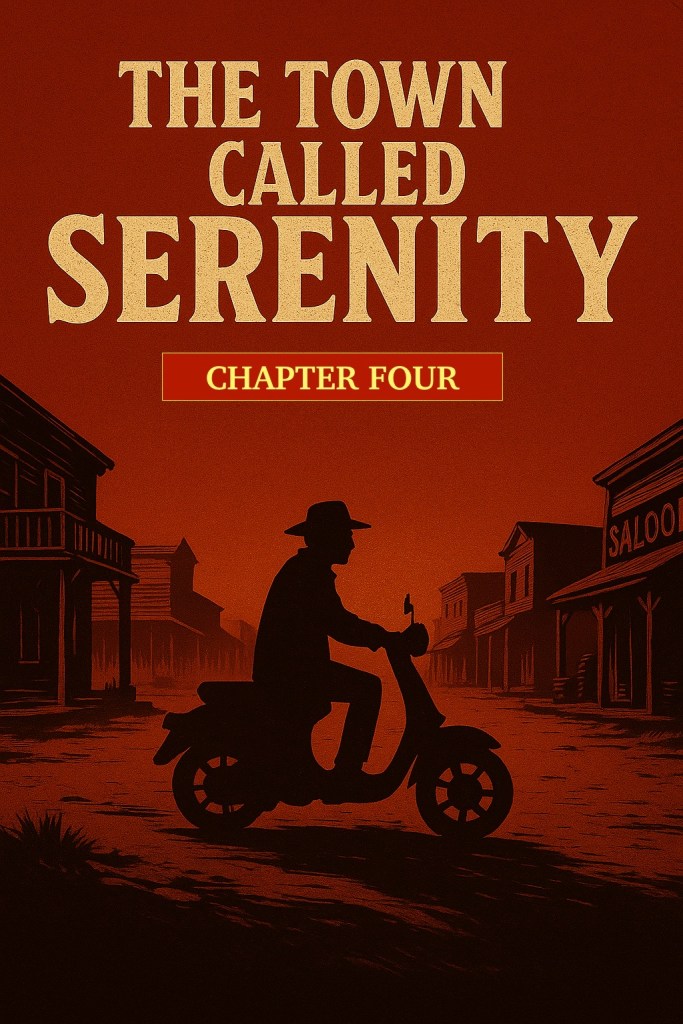
The Town Called Serenity – Chapter Four – Pieces on the Board

By Benjamin GroffMedia© | benandsteve.com | 2025 Truth Endures©

3–5 minutes

Chapter Four: Pieces on the Board

Braddock Cain stood in front of a pool table inside The Assembly, lining up a shot with surgical calm. His eyes didn’t leave the cue ball even as Poke relayed the report.

“He bloodied Silas’s nose, bruised Dutch’s ribs, broke Miles’ fiddle, and made Jonas fall on his ass,” 

Poke said, leaning against a cracked marble column. 

“Didn’t even draw his gun.”

Cain took the shot. The cue ball clicked sharply and sank the eight-ball in the corner pocket.

He stood slowly, placed the cue stick back on the rack, and poured himself a drink.

“And the town?”

“They watched,” 

Poke replied. 

“They didn’t help, but they didn’t laugh either. Some of ’em even looked –– curious.”

Cain stirred his drink with one finger. 

“That’s the worst part.”

Poke blinked. 

“Sir?”

Cain turned toward the window. 

“Fear keeps Serenity in check. When people get curious, they start to hope. And hope’s just a prettier way of saying ‘trouble.'”

He walked back to his velvet chair, every step echoing in the hollow room.

“I want to know everything about Marshal Finch. Where he came from. What he’s running from. Who sent him? And,”

He added, narrowing his eyes, 

“who he’s willing to die for.”

Poke nodded and disappeared.

Cain sipped his drink and muttered to the empty room,

“Let’s see what kind of man rides into Hell on a scooter.”

Across the Rooftops

Wren sat cross-legged on the corrugated roof of what had once been Serenity’s schoolhouse. The sun was setting in a blood-orange smear across the sky. She held a spyglass in one hand and a half-sharpened pencil in the other. A leather-bound journal rested in her lap.

Inside were names. Maps. Notes.

She turned to a fresh page and wrote:

Chester Finch – Marshal – Took a hit, didn’t fall. I watched the Gentlemen leave bruised. He won’t last a month. He might last longer.

Beside her sat a worn revolver wrapped in canvas, untouched. Wren didn’t shoot unless necessary. 

Observation was safer.

She reached into her coat and pulled out a folded piece of paper. It was a newspaper clipping, old and faded:

“LOCAL DEPUTY DIES IN FIRE — WIDOW, CHILD UNACCOUNTED FOR”

She stared at it for a long moment before tucking it away again.

Wren wasn’t born in Serenity. She was left here. Left during the chaos, after the fire, after the men in black suits came and went. Cain had taken her in—not out of kindness but calculation. He saw her silence, her memory, her talent for hiding in plain sight.

He never asked questions. Neither did she.

Until now.

She looked back toward the jailhouse, where Chester Finch was lighting a lantern in the window. He moved stiffly, but there was something in the way he held himself. Like a man who wasn’t afraid to die—but was trying real hard not to.

She flipped back through her notebook. She found a sketch she’d drawn weeks ago. It was a map of Serenity. The map had dotted lines marking the tunnels under the old mines. It showed the abandoned telegraph station and the hidden entrance to Cain’s private vault room.

Wren circled Chester’s name, then drew a faint arrow pointing to the vault.

It was almost time.

Elsewhere in Serenity ––

  • Petal wiped the dust from her apothecary shelves. She stared at a cracked photo of her brother. He was killed by Cain’s men for refusing to cook meth in the back room. She kept smiling, but her smile was starting to slip.
  • Julep Jake, now back in his cell by choice, was building something with matchsticks and chewing gum. “Civic infrastructure,” he explained to no one.
  • Silas Crane dipped his bleeding knuckle into holy water and laughed softly. “He’s gonna make me preach,” he whispered. “And I do love a sermon.”

Back in The Assembly, Cain sat alone in the dim light, polishing a gold coin between his fingers. One side bore the symbol of the old U.S. Marshal’s badge. The other side? Blank.

“Flip it,”

He whispered. 

“Heads, he burns. Tails, he breaks.”

He flipped the coin into the air and caught it.

But he didn’t look.

Not yet.

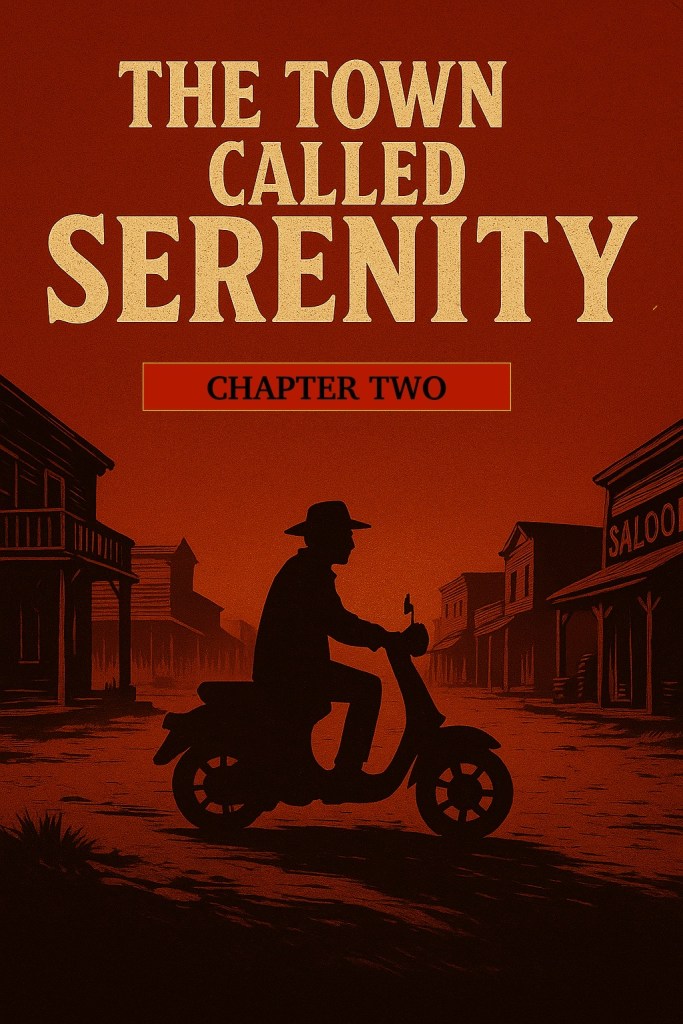
The Town Called Serenity – Chapter Two ~ The Man In The Velvet Chair ~

By Benjamin GroffMedia© | benandsteve.com | 2025 Truth Endures©

3–4 minutes

Chapter Two: The Man in the Velvet Chair

Braddock Cain held court in what used to be Serenity’s town hall. It has been redubbed The Assembly. This tongue-in-cheek title amused him to no end. The building’s original seal featured a gavel and olive branch. It had been charred. A mural of a coiled snake wrapped around a set of broken scales replaced it.

Cain reclined in a velvet chair salvaged from an old theater. His legs were crossed and his boots polished. A glass of brandy swirled in his hand. He dressed like a gentleman, but everything about him screamed predator. His jaw bore a faded scar shaped like a question mark, and his eyes—green, sharp, reptilian—missed nothing.

He was listening to the daily reports from his lieutenants. These included moonshine shipments and bribe tallies. They discussed who’d been bought and who needed reminding. It was during this time that the news came in.

“Marshal rode in today,” 

Said a wiry man named Poke, who hadn’t blinked since 1989. 

“Little fella on a moped. Arrested Julep Jake, if you can believe it.”

Cain’s eyebrow lifted slightly.

“Didn’t shoot him?” 

He asked, his voice smooth as oiled leather.

“No, sir. I hauled him off. Jake’s in the old jailhouse right now. He’s hollerin’ about election fraud. He’s claimin’ he’s immune to state law because of a sacred raccoon spirit.”

Cain chuckled, swirling his drink.

Side Note:

Julep Jake was a Yale-educated botanist. He loved whiskey-fueled nonsense. He habitually wore a sash that read “Honorary Mayor 4 Life.” Despite all this, he had a breakdown during a lecture on invasive species. He ended up in Serenity after wandering the desert in a bathrobe. He decided, on divine instruction, that this was where civilization needed his governance. The raccoon spirit came later, after a bad batch of moonshine.

Cain leaned forward, elbows on his knees. 

“So. The law’s back in town.”

Poke nodded. 

“Says he’s here to clean up.”

Cain smiled faintly. 

“Then let’s give him something to mop up.”

He rose, slow and deliberate. Every movement was calculated with the same precision he used to carve out his little empire. Cain wasn’t just a criminal—he was a tactician. He knew that fear didn’t come from bloodshed alone. It came from control. Predictability. Making people believe that resistance was a form of suicide.

“Send word to the Gentlemen,”

Cain said.

The Gentlemen weren’t gentlemen at all. They were Cain’s enforcers—four men, each with a particular specialty. One was a former preacher who liked to break fingers while quoting scripture. Another was a silent giant who wore a butcher’s apron even on Sundays.

“Tell them I want to meet our new Marshal. Kindly, of course. Offer him a warm Serenity welcome.”

Poke nodded and vanished.

Cain turned to the shattered windows behind him, looking out over his kingdom. Dust swirled in the streets. Somewhere, a gunshot echoed, followed by laughter.

“I do enjoy it when they come in idealistic,”

Cain murmured, sipping his drink. 

“They bleed slower.”

Coming Friday The Ten Part Story Begins On The Town Called Serenity

By Benjamin GroffMedia© | benandsteve.com | 2025 Truth Endures©

1–2 minutes

Summary:

The Town Called Serenity

A town lies in the lawless fringes of the state. It is so dangerous and rotten that only the most desperate or the most damned ever call it home. Serenity—where outlaws drink with murderers, where honest men bleed before their second breath, and where fear rides in daylight.

Enter Chester Finch, a disgraced Deputy U.S. Marshal with a forgotten past and a laughable ride—a moped. But Serenity’s not a place that cares about appearances. It cares about power. And when Chester arrives, he’s not just up against crooked sheriffs, backroom executions, and townsfolk too scared to speak. He’s walking into the jaws of Braddock Cain—a kingpin with an empire built on blackmail and buried secrets.

Chester uncovers the layers of corruption. He discovers a larger threat: Gallow. Gallow is a ghost from his past with no badge, no mercy, and no leash. When Gallow comes to cleanse Serenity in fire, Chester must rally the few brave enough to fight. He must stand in the middle of a street where justice hasn’t walked in years.

This is a tale of grit, guilt, redemption—and standing tall when hell itself tells you to kneel.

Watch for the first Chapter in a series of 10! You can find them here beginning May 30th, 2025!

When Radios Fell Silent: The 1978 Trooper Tragedy

By Benjamin GroffMedia© | benandsteve.com | 2025 Truth Endures©

4–6 minutes

The Day the Radios Fell Silent: A Personal Account of May 26, 1978

It was a warm May morning in 1978. I was 15 years old, working the phones at my dad’s office at Camp Red Rock in western Oklahoma. For several days, law enforcement radio traffic had been intense—more active than usual, more urgent. Something serious was happening.

An All-Points Bulletin had been issued statewide: two inmates had escaped from the Oklahoma State Prison in McAlester. They were described as extremely dangerous men, capable of committing horrific crimes. The Oklahoma Highway Patrol (OHP) and local authorities launched a massive manhunt, focusing on the southeastern region of the state. While there were scattered reports from other areas, the belief was that the fugitives remained nearby and on foot.

Trooper Houston F. “Pappy” Summers,
Motor Vehicle Inspection (MVI) Division in Enid.

Still, troubling reports emerged—houses broken into, firearms stolen, and even a car gone missing. An army of troopers scoured the countryside. The fugitives had to move carefully, methodically, to avoid detection. The search had only been underway for days, but it felt like weeks.

May 26, 1978, arrived. It would become one of the darkest days in the history of the Oklahoma Highway Patrol.

Although I was hundreds of miles away from the action, the search was broadcast live to my ears. The ranger office where I worked was equipped with radios that picked up all law enforcement frequencies. I heard it all: the calls, the coordination, the chaos.

Trooper Billy G. Young, Woodward MVI detachment.

That morning, a somber message came over the radio from Highway Patrol District Headquarters:

“Attention all stations and units: All nets are 10-63 until further notice.”

In plain terms, this meant that the radio network was reserved exclusively for emergency traffic related to the escapees. No unnecessary chatter. But maintaining a “10-63 net” requires constant reinforcement. Officers rotate shifts. New dispatchers come on duty. Without reminders, the rule starts to fade, and soon enough, radio traffic returns to normal. That’s exactly what happened.

As the air unit tried to communicate with ground teams, their messages were drowned out by unrelated conversations. Then, something chilling unfolded.

Lieutenant Pat Grimes,
Internal Affairs.

I listened in real time. The air unit tried to warn a team of troopers. They had approached a area. The escapees were hiding—just beyond the trees, lying in wait. The troopers, thinking it was a routine check, got out of their car casually. Suddenly, gunfire erupted. It was an ambush.

One of the troopers managed to retreat to his vehicle and tried to call for backup. The air unit, having seen everything from above, struggled to get through. The radio frequencies were jammed with idle chatter. It was a communications nightmare that have cost lives.

I sat there, helpless, listening to the air unit reporting the tragedy to headquarters. The dispatcher pleaded for all units to clear the net so emergency aid is dispatched. I was stunned—devastated. This moment became a lasting lesson in why radio discipline can be a matter of life and death.

Later that day, I was shocked again—two more troopers had been shot in the same area. And then, I heard the message that signaled the manhunt was over:

“Be advised, the search for the escapees is over. All units and stations can return to regular assignments.”

That phrase said it all. The escapees were no longer a threat. They hadn’t been captured—they were dead. Had they been taken alive, the dispatch would have named the unit responsible for their arrest.

The Fallen

Three troopers lost their lives that day:

  • Trooper Houston F. “Pappy” Summers, 62, a 32-year veteran stationed with the Motor Vehicle Inspection (MVI) Division in Enid.
  • Trooper Billy G. Young, 50, with 25 years of service, attached to the Woodward MVI detachment.
  • Lieutenant Pat Grimes, 36, from Internal Affairs, nearing his 12th year with the Patrol.

Summers and Young died in a gunfight on a rural road near Kenefic. This occurred after the escapees stole a farmer’s truck and weapons. The troopers, unaware of what they were driving into, were ambushed.

Later that day, in the small town of Caddo, Lt. Grimes and his partner, Lt. Hoyt Hughes, were searching a residential area when they, too, came under fire. Grimes was fatally shot. Hughes was wounded but managed to exit the vehicle and return fire at close range, killing one of the fugitives.

Just moments later, Lt. Mike Williams of the Durant detachment arrived. He fatally shot the second escapee. This action brought an end to a 34-day reign of terror that had stretched across six states.

The two escapees caused the deaths of eight people. This number includes the three troopers. They also injured at least three others during their violent run from justice.


Final Thoughts

What I heard that day shaped me. During my time in the police academy, I learned something important. My account of the events closely aligned with what was eventually confirmed. The tragedy of May 26, 1978, became a case study. It highlighted the importance of radio discipline. The event also emphasized operational coordination and situational awareness.

But for me, it was more than that. It was personal. I was there—listening. And I will never forget the sound of silence that followed.

Lessons from the street: Shattered Expectations

By Benjamin GroffMedia© | benandsteve.com | 2025 Truth Endures

3–4 minutes

“Shattered Expectations”

The night was calm in that tense, waiting way cops get used to. It was the quiet that makes your stomach coil. You know it won’t last. I was still new then, riding with my training officer. He was a crusty, seen-it-all type who barely spoke unless it was to point out something I’d done wrong. If I ever earned his approval, it’d be the same day pigs sprouted wings and took to the skies.

We cruised down a dark side street when I spotted a car weaving just enough to catch my attention. I hit the lights. It was a rust-bucket sedan packed with teenagers—maybe five of them, wide-eyed and frozen as I approached. My training officer stayed in the car. That was his style: throw the rookie in the water and see if he sank.

I had the driver step out. He was lanky, maybe seventeen. He wore his coat like a belt, tied around his waist. It seemed too warm for sleeves but too cool to ditch. As he stepped out, the hem of the coat caught on something. Then—clink clink clink—CRASH. Three or four bottles of beer tumbled from under the coat like traitors abandoning ship. They hit the pavement. The bottles shattered in an amber mess around our feet.

The kid froze. I froze. Then we both looked at the puddle between us. From where my training officer sat, it probably looked like I’d lost my temper and smashed the bottles myself. Great.

Before I processed the situation, the radio crackled with a priority call—armed robbery. We were the closest unit.

“Back in the car,”

Came the voice from the patrol unit.

I turned to the kids, who now looked ready to faint.

“Go to the police station. Wait there. I’ll meet you after this call.”

They didn’t argue. They didn’t run. I just nodded in frightened unison, which, in hindsight, has been the most surprising part of the whole thing.

We sped off. The call was a blur—adrenaline, sirens, controlled chaos. When it wrapped, I reminded my training officer about the teens.

“We need to swing by the station. The kids should be there.”

He gave me a skeptical glance.

“Right…”

But sure enough, there they were when we rolled up to the front of the station. All of them were sitting on the bench outside like they were waiting for a ride to Sunday school. Nobody had moved. Nobody had tried to hide or ditch the evidence.

I had them step inside one at a time. No citations. No handcuffs. It was just a firm talk I remembered getting when I was about their age. I laid it on thick—the “blood on the highway” speech, consequences, how lucky they were, all of it. They nodded solemnly. They got the message.

As we returned to the patrol car, my training officer gave me a sideways look.

“You know,”

He said,

“you didn’t have to bust the beer bottles like that. That was an asshole move.”

I laughed.

“That wasn’t me. The kid’s coat dragged them out. Total accident.”

He squinted at me like I was trying to sell him beachfront property in Kansas.

“Uh-huh,”

he said.

“Sure.”

I never did convince him. But a week later, during roll call, he told another officer I had

“a decent head on my shoulders.”

Coming from him, that was a standing ovation.

And me? I still smile every time I think of those kids. They sat quietly in front of the station, smelling like cheap beer and bad decisions. They were waiting for the rookie cop who didn’t quite screw it all up.

The Last Post: A Security Nightmare at Ridgewood

By Benjamin GroffMedia© | benandsteve.com | 2025 Truth Endures©

3–4 minutes

“The Last Post”

The night shift at Ridgewood Corporate Plaza was supposed to be quiet. Ten floors of empty offices, humming servers, and fluorescent lights dimmed for the janitors’ comfort. The tenants had gone home. The day’s buzz was replaced by the solemn hum of vending machines. There was also the distant thrum of traffic.

That’s when the trouble started.

At exactly 11:42 PM, a woman from the 8th floor called 911. Her voice trembled as she whispered into the phone from behind a copier machine:

“It’s the security guard. He’s –– drunk. He has a gun, and he’s playing with it.”

“Officer intoxicated w/ a gun!”

Officer Marquez and his partner were already in the area and responded within minutes. They pulled up to the building’s glassy facade. They saw the guard—an older man with a thick mustache and sun-lathered skin. His uniform hung loose on his wiry frame. He stood under the lobby lights like he was in a stage play.

He spun a revolver on his index finger like an old-time cowboy. His other hand clutched a bottle of whiskey that sloshed wildly with each twirl.

Pow! 

He shouted, aiming at an invisible outlaw in the corner.

“You see that, Tex? That’s the ol’ Ridgewood Quickdraw!”

Inside, a cluster of overnight IT workers and janitors peeked nervously from the elevator bank. Some held phones. Others gripped cleaning poles like makeshift weapons.

“Sir,” 

Officer Marquez called out, stepping carefully from the squad car. 

“Let’s talk. Put the gun down, okay?”

The guard, whose name tag read Terry,” stopped spinning the weapon. He looked over as if noticing the world around him.

“Well, I’ll be,” 

He slurred. 

“Company’s here.” 

He saluted with the barrel of the gun, then promptly dropped it. The weapon clattered to the floor. It spun in a circle like a coin. Finally, it came to a rest near a vending machine.

Marquez’s hand was already on his holster, but he didn’t draw. His partner approached slowly from the other side.

“Mr. Terry,” 

She said, calm but firm. 

“You’re scaring people. Can we take a seat over here and talk things through?”

Terry blinked at her, then at the people behind the glass, the ones he was supposed to protect.

“They don’t trust me,” 

He muttered. 

“Not anymore. It used to be a man with a badge, and a sidearm meant something.” 

He took another swig from the bottle, winced, and gave a soft, hollow chuckle. 

“Guess all that’s old-fashioned now.”

Marquez knelt beside the dropped gun and slid it back with his foot.

“It’s not about trust,” 

He said. 

“It’s about safety. Yours and theirs.”

Terry looked down at his trembling hands. The whiskey sloshed in the bottle, no longer steady. Finally, he let it drop, too, and it landed with a dull thunk.

He sat heavily on the bench by the entrance, slumping over like a man who hadn’t rested in decades. The officers approached, cuffed him gently, and led him out into the cool night.

As the police cruiser pulled away, the building behind him exhaled a collective sigh of relief.

Inside, someone from IT muttered, 

“I never want to see another cowboy movie again.”

But for years afterward, whenever a door creaked open late at night, or the lights flickered for no reason, the cleaning crew would joke:

“That’s just Terry, doing one last patrol.”

And everyone would pause. They were half amused and half uneasy. They remembered the night the security guard became the danger he was supposed to guard against.

Inside the Attic: Capturing a Dangerous Fugitive

By Benjamin GroffMedia© | benandsteve.com | 2025 Truth Endures©

2–3 minutes

Early in my law enforcement career, I rode with some of the best in the business. These included David “Booty” Ware, Bruce Poolaw, Junior Toehay, Don Gabbard, and Buttin Williams. All were Native American except for Gabbard, a character in his own right.


By the time I was 19, I had experienced more than most people do in a lifetime. I was just getting started.


One day, nearly every law enforcement officer in the county joined a search. They were looking for a man named Virgil Bass. He had a felony warrant and was considered dangerous. Virgil had vowed he wouldn’t go to jail without a fight. If anyone tried to arrest him, he’d either kill them or die trying.


We started early that morning, sweeping from one end of the county to another. By evening, we reached Virgil’s parents’ house on the county’s west side. We surrounded the place, each of us watching for any sign of an escape.


Bruce and I approached the door and stepped inside. His parents claimed they hadn’t seen him, but they kept glancing up at the ceiling.


Bruce, all 6’6″ of him, said firmly,

“We need to check everywhere.”


We made a show of slamming doors, stomping around, acting like we’d searched every corner. Then we got to the attic.


Bruce looked at me.

“You’re the only one who’ll fit up there. I’ll give you a boost.”


Before I knew it, my head was poking through the attic opening. It was pitch black. I called down,

“I need a flashlight!”


I was half-expecting a two-by-four to come crashing down on me—or worse. If Virgil was up there, he saw me silhouetted by the light from below.


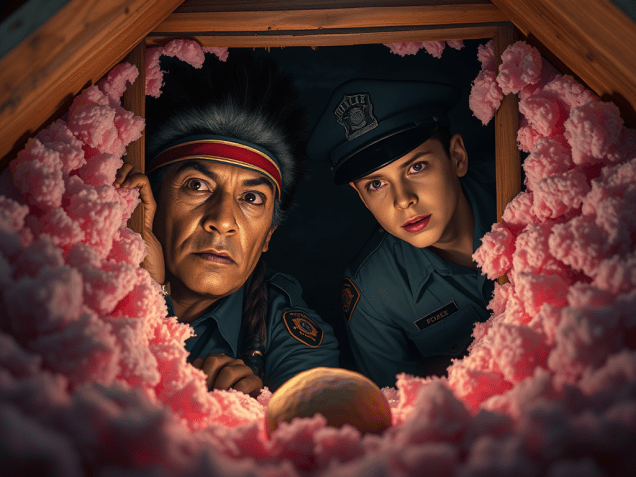
Bruce handed me his flashlight. I pulled myself up until my arms were entirely inside the attic and swept the beam around. The attic was filled with fluffy pink insulation. One spot was different. A trail led from the opening to a lumpy insulation patch. About five feet away, the insulation looked disturbed.


I looked down at Bruce.

“I need a poker iron.”


I heard Bruce ask the family if they had one, and he handed it to me within seconds. I jabbed the iron into the lump, then thought better of it and started whacking the hell out of it.


Suddenly, there was yelling and cursing, and Virgil burst out of the insulation.


“Stop it! Stop it! I give up!”

he hollered.


I ordered him to follow me down, and once he was out, we cuffed him. We took him outside to Booty’s patrol car. Booty looked at the lump rising over Virgil’s eye. He asked,

“How’d that happen?”


I shrugged.

“He fell on a poker iron.”


The whole crew burst out laughing. After all, it’s easy to fall on a poker iron. This is especially true when hiding in an attic after threatening to die before going to jail.

Kidnap Attempt Foiled: A Cop’s Gripping Night Shift

By Benjamin GroffMedia© | benandsteve.com | 2025 Truth Endures©

4–6 minutes

It had been a strange, unsettling night.

Officer Tim Roff
Tim Roff

The mid-shift clocked out at 0200 hours. Officer Tim Roff was left alone on the graveyard shift. He was the only officer covering the North and South Districts. Every radio call felt heavier. Every silence stretched longer. He hoped the mutual aid agreement with neighboring jurisdictions would hold if things spiraled beyond his reach. But for now, it was just him, his determination a steady flame in the darkness.

Alone.

Roff approached every call with a practiced urgency. He arrived fast, assessed fast, and moved on fast. Each moment was calculated to cover as much ground as one man can.

At 0330 hours, the dispatch’s voice crackled over the radio, sharp and urgent:

“Tim, we’ve got a report. The male suspect drove an older blue Chevy Monte Carlo, heading to 230 North Madison Street. Planning to kidnap a child from the grandmother watching them tonight.”

A chill settled in Roff’s chest. Alone or not, this couldn’t wait. Dispatch gave him a phone number for more intel.

Patrol Division Night Duty
On Patrol

He stopped briefly at the north division substation and called the number. The story spilled out: Robert Sams, 38 years old, white male, born February 20th, was not alone—he was bringing others. He didn’t have custody of the children, but he was coming to take them anyway. He was planning to run, wanting to force the mother’s hand.

Roff parked his cruiser near the house and waited. Time slowed. Every passing headlight made his pulse jump. Then—there it was. Like clockwork, the Monte Carlo crept down NW 23rd and turned onto Madison. Roff pulled in behind. He hit the emergency lights and followed as the car swung into the driveway. The tension in the air was palpable.

Before Roff even opened his door, the driver bolted for the house.

“Damn it,”

Roff muttered, keying the mic.

“Need backup.”

But the nearest unit was a reserve officer, miles away, filling in from another city—not tonight.

Roff watched the front door swallow the man and grimaced.

“What is this?” he muttered bitterly. “National Take-the-Night-Off Day for cops—and no one told me.”

When backup finally arrived, Roff pointed to the car’s occupants.

“Watch them—don’t let anyone leave.”

Then he approached the front door and knocked.

A woman opened it, anxious, shifting on her feet.

“He ran out the back,”

she said.

Roff’s instincts flared. He circled to the rear, scanning the rain-soaked earth outside the back door. Not a single footprint. Untouched. She’d lied.

He jogged back around. His heart pounded harder now—not from the chase. It was from the relentless math of being outnumbered and alone. The fear was a heavy burden on his shoulders.

He called to the backup officer, loud enough for the woman to hear:

“If anyone comes out the back—shoot!”

He knew it wouldn’t happen, but fear was leverage.

Facing the woman again, he leveled his voice.

“I know you’re lying. If you don’t come clean, I’ll take you in for harboring a fugitive.”

It wasn’t airtight, but it was enough.

Her shoulders sagged.

“He’s in the garage,”

she admitted.

“Under the table.”

She led him through the house. At the garage door, Roff drew his sidearm. Alone again, with no cover. His stomach clenched.

“Come out,”

he commanded,

“or I’ll shoot.”

A shaky voice from under the table:

“Don’t shoot! I’m coming out!”

Roff cuffed Sam and walked him to the cruiser. He identified the other passengers and radioed dispatch for warrant checks. One by one, the answers came: felony warrant. Felony warrant. Felony warrant. Every single one.

Four prisoners. One patrol car. A 25-mile drive to the county jail. And no one else to cover his city.

Roff radioed neighboring agencies asking them to cover calls if any came in. Then he called the sheriff’s office for the official notification ––

“County, be advised I am 10-15 four times to your location. If there are any calls for my area, ask area units to cover calls per the mutual aid compact.”

He locked them in, buckled them tight, and checked the restraints twice. Just as he closed the last door, a car pulled behind him. A woman stepped out, flashing her ID—the child’s mother.

“It’s over,” Roff told her. “We stopped it.”

She followed him inside and retrieved her child. Relief flooded her face as she hugged her baby, her tears a testament to the fear she had endured. She left, her steps lighter, her burden lifted.

Roff radioed the sheriff’s office,

As Roff pulled onto the highway toward the jail, the prisoners chatted pleasantly in the back seat. Their casual demeanor was unsettling, given the gravity of their crimes. But Roff’s nerves stayed taut. His eyes flicked to the mirror every few seconds. He was alone with four felons and had 25 miles of dark road ahead.

At the jail, the booking officer whistled when he saw them.

“You win tonight’s prize, Roff. Biggest catch I’ve seen from one guy in a long time. Hell it will probably hold as a record for a month or two.”

Roff just nodded, the weight of the night still pressing against his chest. The adrenaline was fading, leaving a hollow feeling. He was alone again, with the echoes of the night’s events reverberating in his mind.

Small Acts of Kindness: A Legacy of Compassion

By Benjamin GroffMedia© | benandsteve.com | 2025 Truth Endures©

3–4 minutes

Francis
Pope Francis

Today, the world said goodbye to Pope Francis. I was reminded of the man who called for compassion among the masses. He urged us to find understanding and acceptance in whatever ways we can. He believed that small steps lead to greater paths. Simple, quiet acts of goodness build a better world.

Altruism was instilled in me from an early age. Through my personal experiences, I’ve come to understand its true meaning. I instinctively understood the Pope’s message and often wished more people worldwide would embrace it as profoundly as I had.

For me, kindness has always been second nature, a lesson I learned from my father. I knew from childhood that even the smallest gestures mattered. It is holding a door open for someone. It is offering a word of acknowledgment or helping a stranger in need. My father, a man of few words but profound actions, taught me this.

Each Sunday morning, the sun rose. He and I would then load our truck with fresh produce from our farm. This was done before the first car appeared on Main Street. We would quietly deliver baskets of food to low-income families across town. It was a ritual performed with no expectation of thanks, no wish for recognition. My father made it clear: this was our shared mission, something sacred, something we did simply because it was right. The smiles on the faces of those families showed the impact of our small acts of kindness. The relief in their eyes was a testament to the difference we made.

Altruism can take on many faces—kindness, decency, a willingness to see others’ needs. Years ago, we visited Las Vegas with my better half and two fellow law enforcement officers. We stopped for a quick meal at a small pizza shop. I noticed an older man lying beneath a tree across the parking lot as we ate. He looked frail and vulnerable—homeless, clearly unwell.

Throughout the meal, I couldn’t shake the image of him. When we finished, I gathered our untouched slices into a to-go box. I told the others I would offer it to him. It didn’t feel right to leave that food behind, not when someone nearby desperately needs it.

As I approached, I saw fear and uncertainty in his eyes. But when I gently asked how he was doing and whether he had eaten, his expression softened. I handed him the pizza and a bottle of water. His hands trembled as he accepted them, tears welling in his eyes.

We spoke briefly. He told me it had been days since he last ate. He had been surviving on whatever water he found. He hadn’t asked for anything—but his gratitude was overwhelming.

Then, quietly, we went our separate ways.
That moment has stayed with me, just as those early Sunday mornings with my father have stayed with me. Compassion doesn’t have to be loud. Kindness doesn’t always wait to be invited. Sometimes, it’s simply about noticing—and acting.

I never saw that man again. I like to believe that the small act of kindness I showed him helped him feel seen and valued. It made him feel stronger for the journey ahead. It’s a testament to the power of small acts of kindness. It gives me hope for a more compassionate world.

As Pope Francis often reminded us, the world doesn’t change through grand gestures alone. It changes one small act of love at a time. And so, in his memory, I urge you, the reader. Please continue noticing. Keep caring and acting—quietly, humbly, and with open hearts. Each of us has the power to make a difference.

Lloyd Bickerstaff: The Steady Voice of Elk City Police

By Benjamin GroffMedia© | benandsteve.com | 2025 Truth Endures©

3–4 minutes

The Quiet Backbone

Lt. Lloyd J. ‘Bick’ Bickerstaff E.C.P.D.

I keep a photo in a drawer in my desk. It is tucked beneath an old leather-bound notebook and a yellowing map of Beckham County. It’s a photo of Lloyd Joe “Bick” Bickerstaff. The image was taken about a month before his promotion to Captain with the Elk City, Oklahoma Police Department.

In the picture, Bick sits in his unit, his uniform crisp in the late autumn light. The shadows are long. The wind has just started to turn cold. That unmistakable Oklahoma sky behind him stretches flat and wide. It is quiet, open, and full of secrets. He wears a half-smile that says, 

“I’ve seen things, but I’ll carry them quietly.”

Bick and his brother were born in Sentinel, Oklahoma. I only heard his brother’s name once in passing. Sentinel is a patch of land barely big enough to hold the stories it carries. They began their careers as State Troopers with the Oklahoma Highway Patrol. The two brothers wore matching uniforms and chased something bigger than themselves.

But by the time I knew Bick, he rarely mentioned his siblings. I assumed time had done what it often does to families. Maybe there was a falling out—just distance. I never asked, and he never offered.

I knew he had a wife who baked cinnamon rolls on Sundays. He also had two children. One child was off in Sayre, chasing classes at a junior college. The other was a veterinarian who had graduated from Oklahoma State University. His life beyond the badge was quiet but rich. He even operated a small answering service—its operators worked right from his living room. You knew that life grounded him.

Nevertheless, Bick was more than just a veteran officer inside the department. He was the compass.

When rookies came in shaken from their first domestic call, Bick was the one who handed them a cup of bad coffee and said,

“It gets better if you let it.”

He never lectured. He just listened. And when he spoke, it was always worth hearing.

I remember the weeks leading up to his promotion. The department was shifting—a new Chief was being promoted, and a Major was moving up from Captain. Everyone felt the tremors of change. But Bick? He was steady and unmoved. I asked if he was nervous about entering a bigger role during such a turbulent time.

He just smiled that same quiet smile.

“Storms pass,” 

He said.

“Someone’s gotta keep the porch light on.”

He did more than that.

He held the whole house together.

Years passed. And then, like storms do, time took Bick from us. When the news came, I expected many familiar faces at the service. Officers from every corner of the state would be paying their respects. But they didn’t come. Time had moved on, and so had they. Somehow, the news of Bickerstaff’s passing hadn’t brought them back.

Elk City Police Chief Bill Putman did what mattered. He escorted Bick’s casket from Elk City to the Old Soldiers Cemetery in Oklahoma City. That quiet, deliberate ride said more than any ceremony. It was loyalty. It was respect. It was love.

I was there, too, standing back in the shadows as the service ended. I didn’t speak. Didn’t approach the family. I just paused long enough to leave a final tribute at the edge of his resting place. It was a farewell from someone who had seen firsthand what quiet strength looks like.

Maybe Bickerstaff would’ve preferred it this way. No fanfare. There is no parade of names—just those who mattered most.

I like to think I was one of them.

Bick was never the loudest voice in the room. He didn’t need to be.

But when he spoke, the room listened.

And when he left, the silence he left behind was deafening.

The echo he once carried over the radio has gone quiet. And somewhere out in Western Oklahoma, no one will ever hear that calm, steady voice call out again—

“Attention, all stations and units; stand by for a broadcast.”

From Cotton Fields to Sheriff: The Story of Jess Bowling

By Benjamin GroffMedia© | benandsteve.com | 2025 Truth Endures©

4–5 minutes

Sheriff Jess “Pooch” Bowling, Jr.: From Cotton Fields to County Leader

Jess ‘Pooch’ Bowling

Jess Bowling, Jr. was born in Binger, Oklahoma, on August 23, 1924. At just 11 years old, he left behind half his family. He also left the dusty plains of Oklahoma. He sought a new beginning in California. With his father and brother, young Jess traveled west in a weathered 1929 Buick. They finally settled in the small agricultural town of Dos Palos. His mother, two sisters, and another brother stayed behind in Oklahoma—a family split by circumstance but not by love.

Life in California was anything but easy. Jess Jr. rose with the sun. He toiled in the cotton fields until it set. He contributed what he could to help his family survive. It was hard work—grueling and endless—but there was resilience in the struggle. Sheriff later joked, “We did live in the biggest tent in Dos Palos!”

His father, Jess Sr., quickly became a cornerstone of the growing town. He opened a grocery store, invested in rental properties, and became active in local politics. His leadership and business savvy earned him a seat on the city council and, eventually, the title of Mayor.

Jess Jr. worked in the family store while attending school. He graduated from Dos Palos High School with a reputation for dependability and quiet strength. Not long after, fate stepped in when he met Darlene, a young woman from Iowa visiting relatives. The two married in 1945 and raised three children—Sharlynn, Shirley, and Michael.

The Badge and the Beat

Simulated Photo

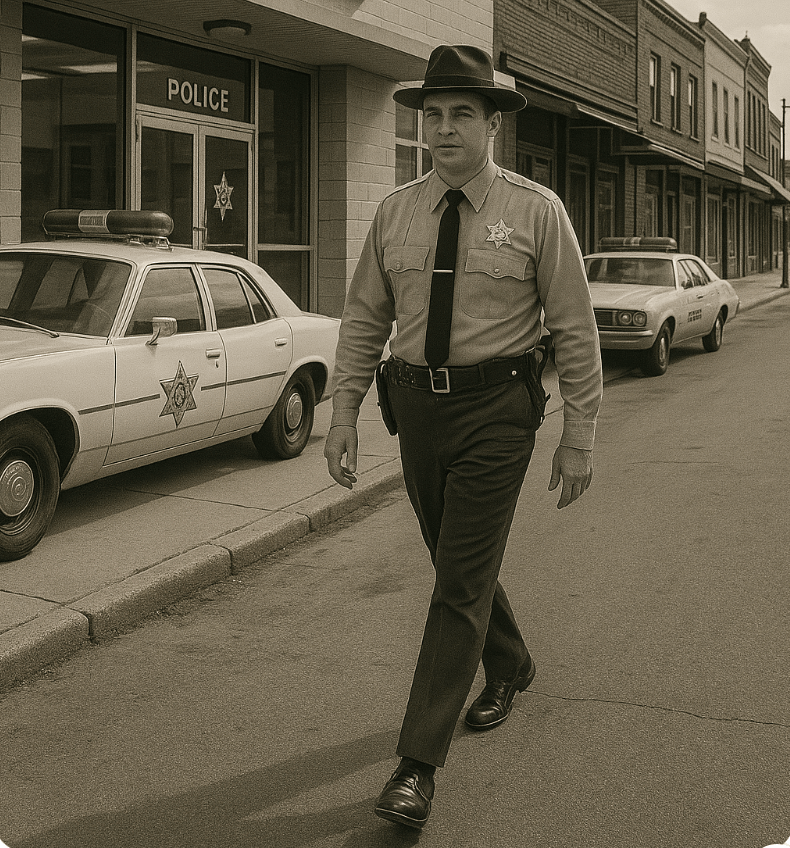
Jess Bowling’s journey into law enforcement began in 1953 when he joined the Dos Palos Police Department. His first assignment? Tackling the town’s parking problem. Officer Bowling issued dozens of citations, doing so with a steady hand and a sense of duty. He even issued one to his father, the Mayor. Years later, he found that very ticket among his father’s possessions, a keepsake of humor and integrity.

Although that first stint in law enforcement was brief, it planted a seed. After returning to the family store, Bowling joined the Atwater Police Department in 1956. In 1958, he made the move that would define his career: joining the Merced County Sheriff’s Department.

Simulated Photo

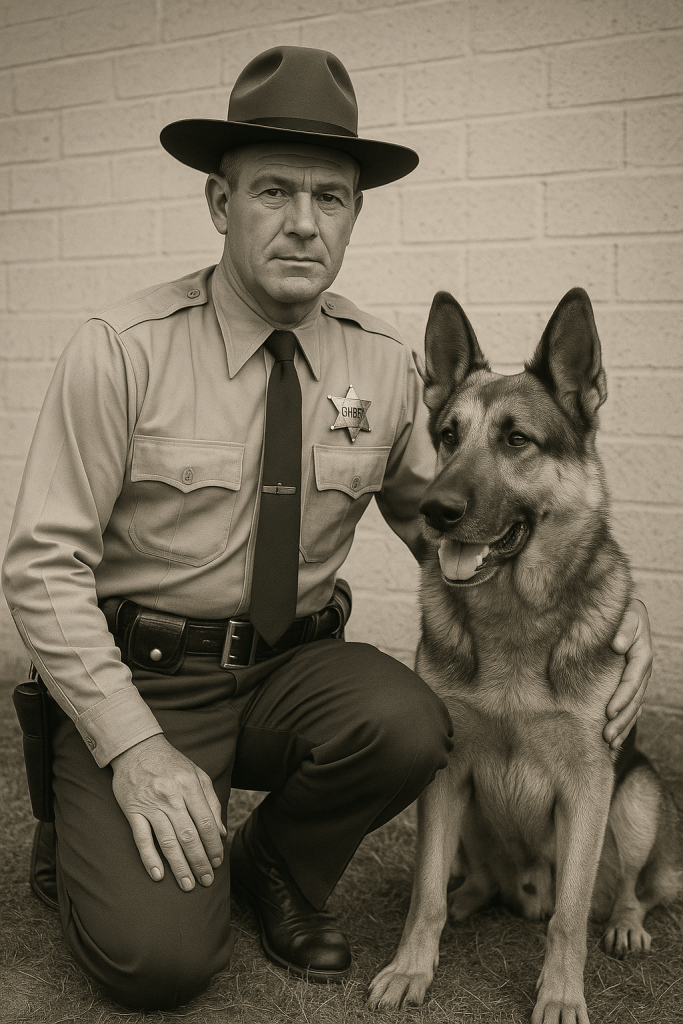
In 1963, Bowling became the department’s first-ever canine handler, partnered with a large, loyal German Shepherd named Jim. Together, they helped pioneer a new era of policing.

By 1974, Jess Bowling had risen to the rank of Lieutenant when tragedy struck—the sudden passing of Sheriff Earl McKeown. In the aftermath, Bowling was appointed interim Sheriff. The people had already decided by the time the special election rolled around in May 1975. Bowling’s steady leadership and quiet competence earned him the Sheriff’s badge in his own right.

Reformer, Leader, Trailblazer

Sheriff Bowling led the department through six transformative years. He spearheaded major innovations that professionalized law enforcement in Merced County. Under his administration:

  • The Corrections Division was established, moving jail staffing from deputies to trained corrections officers.
  • Dispatch services were assigned to civilian professionals, freeing up sworn deputies for fieldwork.
  • He launched the county’s first-ever 24-hour patrol, marking the end of the “resident deputy” model.
  • He hired Merced’s first female deputy, breaking gender barriers in local law enforcement.
  • The department acquired its first handheld radios, enabling Bowling to reintroduce the classic “walking beat cop” in areas like Winton.

These weren’t just administrative changes but foundational shifts that shaped the Sheriff’s Department into a modern, responsive force.

His achievements were not only admired—they were preserved. Jess “Pooch” Bowling’s remarkable career is documented in a collection. His family lovingly maintains it as a tribute to a life of service.

Legacy and Final Salute

I had the privilege of knowing the Bowling family. One of my sisters even married Jess’s nephew. Every time he returned to town, Sheriff Bowling brought a yearbook from the department he once led. He proudly pointed out the growth and accomplishments of his former team. The department’s scope, the number of divisions, and the professionalism he helped instill always struck me, as did his accomplishments.

1974 – The first female deputy was sworn in

1974 – First portable transceivers issued to deputies

1974 – The first 24-hour patrol begins

1977 – First Special Emergency Response Team (SERT) organized

1977 – Marshal’s Office established

1980 – Hostage negotiators were trained and included on the SERT team

Merced County Sheriff’s Office, California

But behind the badge was a man who never forgot where he came from. Before the titles and the accolades, Jess “Pooch” Bowling was a boy in a Buick. He was a cotton picker working under the sun. He was a young man doing what he could to help his family survive.

After a doctor advised him to retire due to a serious heart condition, Sheriff Bowling stepped down in 1980. He lived to celebrate his 80th birthday during Merced County’s 150th anniversary in 2005. This honor was fitting for a man who helped shape its modern history.

Jess “Pooch” Bowling passed away on April 18, 2007. He was laid to rest beside his beloved Darlene in Dos Palos Cemetery.

His story is one of grit, integrity, and service. It is a journey from the cotton fields to the highest badge in the county.

Reflecting on the Oklahoma City Bombing: 30 Years Later

By Benjamin GroffMedia© | benandsteve.com | 2025 Truth Endures©

2–4 minutes

Thirty Years Ago Today

Thirty years ago, today, I was standing in a Federal Building when my pager went off. The screen lit up with all 9s—a code used to signal an emergency assignment. I needed to contact headquarters right away.

I had just stepped out of a federal courtroom in Denver, Colorado. Moments earlier, I had been inside, preparing to testify in a significant case involving a syndicated burglary operation. I’d been working undercover, embedded deep within their ranks. The courtroom was tense, but a recess had been called, and a few of us decided to grab coffee downstairs.

As we stepped into the elevator, my pager buzzed. I glanced around—no one else’s device had gone off. A sinking feeling set in, but I said nothing. When we reached the first floor, I peeled away from the group and went to a pay phone. I called my office.

My supervisor’s voice was grim on the other end of the line. A bombing had just occurred in downtown Oklahoma City. It was devastating—an entire city block destroyed, surrounding buildings heavily damaged. The scope of it was hard to fathom.

My first words were my gut instinct.
If they’re still alive, the person who did this is already on the road, on one of the Interstates. They’re putting as much distance as possible between themselves and the blast. They’ll go until they feel safe, then hunker down and watch.

Shortly after that call, my pager buzzed again—this time from the Federal Prosecutor’s Office. They informed me that all federal court proceedings were being canceled nationwide. I wouldn’t be needed back in court that day.

With nothing more to do, I contacted relatives in Oklahoma to ensure their safety. Then, like so many others, I returned to my room. I sat glued to the television and watched the horror unfold in real time.

The next day, I waited to hear if I’d stay in Denver. I wondered whether I would be reassigned. Another page came in from my office. A state trooper had made a traffic stop north of Oklahoma City. The individual taken into custody matched a profile. My instincts had been right.

In the weeks that followed, the nation learned his name. I choose not to say it now. Some people deserve to be remembered. He is not one of them.

Now, on this Saturday, April 19th, 2025, it’s been thirty years. Half of the people living in Oklahoma City today were either not born or didn’t live there in 1995. The memory of that day is fading, becoming a chapter in history instead of a scar felt daily.

Many survivors have since passed. Families of the victims have grown older, some have gone entirely. Some of those in the building that day were too young to remember it now. The face of that tragedy has changed, but its weight remains.

The Oklahoma City Bombing was the first of two national tragedies I learned about while standing in an elevator. The second came years later, on a crisp September morning—9/11. I remember thinking about stairs a lot after that. Elevators started to feel cursed.

But I never gave in to fear. I always got back in and waited for the doors to close. I figured if I didn’t, they would win.

And I wasn’t about to let that happen.

The Real Badge 714: Jack Webb’s Impact on Police Representation

Benjamin GroffMedia© | benandsteve.com | 2025 Truth Endures©

1–2 minutes

Earning the Badge: How Jack Webb Won the Respect of the L.A.P.D.

Gaining the gratitude of the Los Angeles Police Department is no small accomplishment, especially for a television creator. Yet, after nearly two decades of portraying law enforcement with integrity and realism, Jack Webb did just that.

Best known as the mind behind groundbreaking crime dramas Dragnet and Adam-12. Webb distinguished himself from other producers and directors. He excelled in an industry often criticized for sensationalism. 

Rather than relying on over-the-top drama to capture ratings, he took a different approach: authenticity. Webb regularly consulted real-life officers, ensuring his shows reflected the true spirit and procedures of police work.

That commitment to realism earned him more than high ratings—it won him the deep admiration of the L.A.P.D. itself.

In 1968, the department honored Webb with a unique and heartfelt gesture. They presented him with the original Badge 714, famously worn by Sgt. Joe Friday in Dragnet. It was a symbolic gift that carried the full weight of the department’s appreciation.

“This is only a small token of our appreciation to you, Jack, and for all the things you have done for our department dating back to when Dragnet first went on the radio in 1949,” 

Said then-L.A.P.D. Chief Thomas Reddin during the presentation. 

“This badge has never been issued to anyone else; the entire force feels it belongs to you.”

The moment left Webb deeply moved.

“For one of the very few times in my life,” he said, “I’m at a loss for words. I can’t express my feelings.”

According to The Cumberland News, the L.A.P.D. viewed the gift as more than just a gesture of thanks. It was also a tribute to Webb’s enduring impact on the public image of police officers. This image is not defined by glamour or exaggeration. Instead, it is characterized by honesty and respect.

Reruns of the Dragnet Show can still be watched on television channels like MeTV.