Until Death, Never Did They Part – Thomas & Mary Ellen Souder

In 1921, Thomas and Mary Ellen Souder of Texas proved love doesn’t end at goodbye.

1–2 minutes

A Story of Devotion: Thomas Jefferson Souder & Mary Ellen

In the gentle stillness of Hurst, Texas, Thomas Jefferson Souder and Mary Ellen East Souder shared a quiet love. It spanned six decades. They were married for 60 years. They raised a family and cultivated a home. They remained inseparable through every upturn and downturn of life.
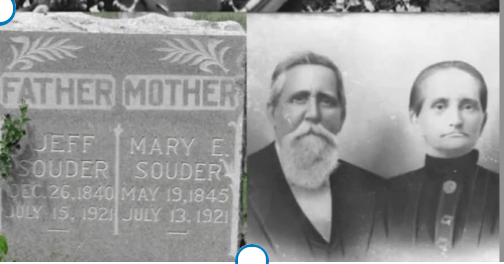
July 1921 brought a cruel twist. Both fell victim to “the flux.” It was a brutal wave of gastroenteritis. It was so swift that it swept Mary Ellen away first, on July 13. Thomas Jefferson, already weakened, succumbed to grief and illness just two days later on July 15.

The community mourned—especially those who believed no bond was stronger than theirs. So it was decided: they would rest together, side by side, in a unique double coffin. Their shared burial echoed their life—inseparable, even in death.

Newspapers of the day captured the sentiment well. The Fort Worth Star-Telegram, on July 16, headlined their story: “Death fails to Separate Couple Wed 60 Years.” They honored not just the passing of two individuals. It was a love that truly endured it all.

More than a century later, their story endures. It is not a tragedy but a testament. True devotion can span lifetimes. It quietly reminds us that love, in its purest form, touches eternity.

Fact-Checked Details

  • Thomas Jefferson Souder and Mary Ellen East Souder were married for about 60 years. They passed within a couple of days of one another in July 1921 (1).
  • Mary Ellen died on July 13, 1921, and Thomas Jefferson followed two days later, on July 15, 1921 (2).
  • Their cause of death was identified as dysentery. It was referred to at the time as “the flux.” This is a severe form of gastroenteritis (3).
  • Both were well-known pioneers of Hurst in Tarrant County, Texas. They were buried together in a double coffin. It was a striking symbol of their lifelong unity (4).
  • Their joint burial made front-page news in the Fort Worth Star-Telegram on July 16, 1921, under a headline expressing how “Death fails to Separate Couple Wed 60 Years”

By Benjamin GroffMedia© | benandsteve.com | 2025 
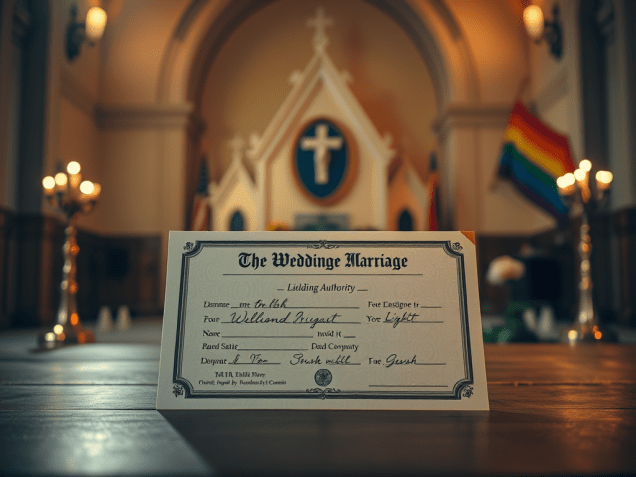
We Shall Come Rejoicing Marrying Only The He’s And The She’s

By Benjamin GroffMedia© | benandsteve.com | 2025 Truth Endures©

1–2 minutes

The Baptists are at it again. They are raising a protest over who should be allowed to marry. It is as though they alone have the final word.
Yet, let us be clear: They are opposing who can walk into a county or state office. They do not want everyone to ask for a marriage license or enter into a legally recognized civil contract. That is not a religious rite. It is a legal agreement—filed, signed, and validated by the state. What the Baptists are trying to do is assert control over who can enter into that civil contract. Moreover, that is where their argument starts to fall apart.


One can understand a church’s wish to define marriage for its faith tradition. For example, it only performs holy matrimony for male-female couples. That is their theological prerogative. Furthermore, the LGBTQI+ community is better served by choosing faith institutions that embrace and affirm their unions. Those places do exist. They conduct beautiful, sacred ceremonies filled with love and meaning.


The Baptists alleged to be upset over same-sex couples marrying are not fighting for “Holy Sanctioned” marriage. Their effort is a thinly veiled effort to legislate bias. They aim to stir up fear and rally support for political agendas. When the current battle over trans rights no longer generates the same heat, they will seek another issue. This will be the next fire they try to stoke. It will be another wedge to deepen divisions. They will build up the offering plate and feed the partisan machine.


Trying to impose a ceremony on a church that fundamentally rejects it leads to resentment. Such an action only reinforces division. It is counterproductive. The real problem arises when religious institutions try to dictate who can access civil marriage through the state. That is not about faith. That is about politics, prejudice, and, frankly, power.

The Grand Tour of Heartbreak and Hope: A Country Ballad in the Courtroom

By Benjamin GroffMedia© | benandsteve.com | 2025 Truth Endures©

3–4 minutes

That just about does it, don’t it? Step Right up Come On In!

The Honorable Judge Bledsoe peered over his glasses, clearly unimpressed. “Mr. Rawlins, you understand this is a legal proceeding, not the Grand Ole Opry?”

“Yes, Your Honor,”

Said Henry Rawlins. He stood tall in his dusty boots and bolo tie. One hand rested on a weathered Bible. The other clutched a crumpled lyric sheet.

Across the courtroom, his soon-to-be ex-wife, Sherry Lynn, sat rigid in her seat, her lawyer whispering furiously in her ear. Henry’s lawyer had already given up and was sitting down, his face red, wiping his forehead with a handkerchief.

Henry cleared his throat.

“But if the court will allow, I’d like to offer my final statement in my own words. I would also like to include the words of a few gentlemen. They helped me understand what went wrong.”

A murmur passed through the courtroom.

Judge Bledsoe sighed.

“Mr. Rawlins, continue—briefly.”

Henry nodded, unfolding the page.

“Your Honor, I ain’t a lawyer. But I know pain, regret, and how a man can lose his way. And those feelings are best told not in legal briefs but in country songs. So I offer my case—in three verses and a broken heart.”

He stepped ahead.

He turned to Sherry Lynn.

“I didn’t fight. I figured I’d already lost. And I didn’t blame her—not entirely. I hadn’t been easy to love.”

The courtroom was silent. Even the bailiff looked up from his crossword.

“Then,” Henry continued,

“I walked through what George Jones called ‘The Grand Tour.’ I opened the closet and saw her dresses hangin’ like ghosts. Our baby’s room still had the mobile spinnin’ slow. The smell of her perfume lingered like a memory that didn’t know how to leave.”

Judge Bledsoe adjusted in his seat, then motioned for him to finish.

“But, Your Honor, here’s the thing. I almost didn’t show up here today. I nearly signed the papers and walked away. But then I heard Randy Travis singing. He was singing ‘On the Other Hand… there’s a golden band.’ It reminded me of someone who would not understand.”

Henry looked again at Sherry Lynn, softer now.

“On one hand, I messed up. I got too comfortable. I stopped listening. I stopped holding her when she needed to be held. But on the other hand, I still believe in us. That golden band still means something to me. Maybe I’m a fool for sayin’ this here in court. I’d rather fight to fix it. I won’t stand here and let it all go to hell while quoting country songs.”

He folded the paper, tucked it into his jacket, and looked down.

“I rest my case.”

A pause. Then Judge Bledsoe leaned back in his chair.

“Well,” 

he said slowly,

“I’ve been on this bench for twenty-three years. I’ve heard lawyers argue using everything from scripture to Shakespeare. But, I’ve never heard anyone use Vern Gosdin.”

The judge turned to Sherry Lynn.

“Mrs. Rawlins, do you still wish to continue with the divorce?”

She was silent for a moment. Her expression softened as she looked at Henry—looked at him—for the first time in months.

“I… I don’t know,” 

She said, her voice barely above a whisper.

“But maybe we should talk. Not here. Somewhere real.”

Judge Bledsoe smiled faintly.

But, on the other hand…The George, Vern and Randy Plea.

“Court is adjourned.”

As the gavel fell, Henry turned to Sherry Lynn.

“There’s a little diner down the road,” 

He said.

“We used to get cherry pie there after church.”

She nodded.

“Maybe one slice… on the other hand.”