
Words Matter: 10 Phrases We Should Rethink in Events—and Beyond
(inspired by Daria Knupp’s piece at Personify)
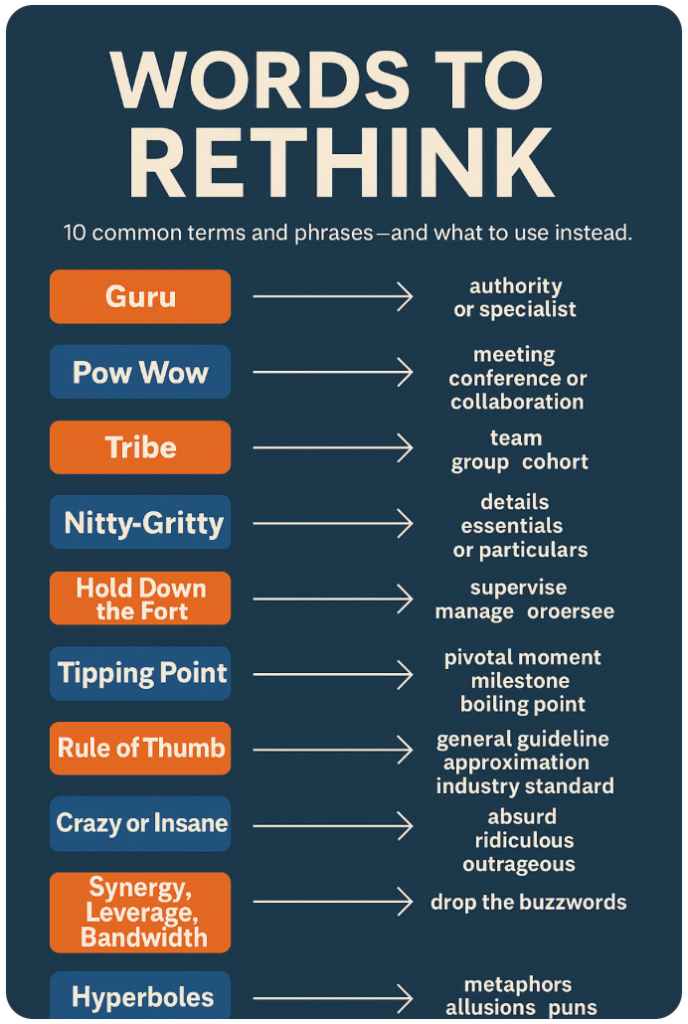
We all know words can inspire, connect, and excite—but they can also alienate, offend, or sound tired. Daria Knupp, Sr. Content Marketing Manager at Personify, recently published a thoughtful article. It lists 10 words and phrases we should stop using in the events industry. We should consider avoiding them everywhere. Her list stopped me in my tracks—and it will surprise you, too.
We use these terms often at conferences, in meetings, and in our everyday work to convey intelligence, wit, and creativity. Nevertheless, some have roots in stereotypes, outdated social theories, or even deeply offensive historical contexts. Here are highlights from Knupp’s list. I also include my own reflections on why they matter. Additionally, I explore how we can do better.
Phrases Worth Rethinking
- “Guru” Originally, the title of the highest spiritual leaders in Hinduism and Buddhism. Using it casually—“event planning guru”—can trivialize a sacred role. Try “expert” or “specialist” instead.
- “Pow Wow” is not just a “quick meeting.” It’s a sacred Native American gathering of community and celebration. Try “meeting” or “collaboration.”
- “Tribe” is often used to describe a network or support, but it is tied to outdated and harmful stereotypes. Swap in “team,” “group,” or “cohort.”
- “Nitty Gritty” Commonly meant “the essentials,” but it was rooted in references to the slave trade. Use “details” or “essentials” instead.
- “Hold Down the Fort” Seems harmless, but it was initially tied to colonial conflicts with Native Americans. Consider “supervise” or “manage.”
- “Tipping Point” was popularized by Malcolm Gladwell, but historically referred to racial “thresholds” in neighborhoods. Try “pivotal moment” or “milestone.”
- “Rule of Thumb” Linked—to wife-beating folklore. Safer to say “general guideline” or “industry standard.”
- “Crazy” or “Insane” Using mental illness terms casually undermines efforts to destigmatize. Replace with “absurd,” “outrageous,” or “ridiculous.”
- Buzzwords like “Synergy,” “Leverage,” and “Bandwidth” Overuse makes you sound like a cliché. Switch it up with plainer language.
- Hyperboles. Nothing wrong with exaggeration—but when overdone, it can make you less credible. Mix in metaphors or puns for variety.
Personal Reflection: A Lifelong Connection
I’ve had very close Native American friends who have been like family to me for nearly fifty years. Through countless conversations, shared meals, and life’s ups and downs, similar concerns about language never arose. We always spoke openly and comfortably with one another, and I thought we understood each other fully.
Now, reading about the origins of these words and their potential to harm, I have to ask myself—was I wrong? Did I unintentionally cause pain, even to the people I love and respect? This personal reflection can make the audience feel empathetic and introspective. Did my long-held assumptions give me a sense of being “above” the issue when in reality I wasn’t?
This is why articles like Daria Knupp’s matter. They challenge us to reevaluate. They help us check our blind spots. They make us confront how easy it is to inherit language without questioning it. This can make the audience feel motivated and empowered. I hope that in sharing this, readers will pause. I hope they think: if language is so powerful, what can we do to use it better?
Why This Matters
As Knupp points out, we interact with thousands of attendees, exhibitors, colleagues, and friends. Every word choice carries weight. Being mindful of language isn’t about being “too sensitive”; it’s about making sure everyone feels respected and included. And honestly? It makes us sound more intelligent and up-to-date.
For me, this list was surprising because so many of these phrases have been normalized. Seeing their origins laid out in one place makes me rethink my own habits. It also makes me curious—what other everyday expressions are we using without realizing their history?
The Takeaway
Language evolves, and so can we. By phasing out these outdated or offensive terms, we show ourselves as thoughtful professionals and better human beings. Words shape experiences. They can also change them—for the better.
By Benjamin GroffMedia© | benandsteve.com | ©2025
NOTE: We live in a time when there’s a relentless push to roll back equality. Efforts aim to undo hard-won progress toward balancing the scales between the haves and the have-nots. Reports like this stand as a vital reminder. There will always be voices, somewhere, willing to rise for decency, fairness, and moral courage.


 benandsteve.com