Welcome to Chiawuli Tak, Arizona—a sun-drenched speck of a census-designated place nestled in Pima County. The town had just 48 residents in 2020. It has risen to an estimated 112 today. It’s the town where “small population” doesn’t even start to cover it. (And yes, that growth rate of about 6.7% annually is basically like adding a few family reunions per year.) (1)
The Town So Quiet…
Once upon a Sunday, locals cheered when a tumbleweed gently tapped on the general store window. They marveled at it, of course. The nearest neighbor hosts alone can use the company. With a population density of around 20 people per square mile, it’s quieter than most people’s living rooms. If you shout “Howdy!” in Chiawuli Tak, you’ll hear your own echo. You also hear the echoes of three generations of family dogs responding in kind. (2)
Despite its tiny size, 19 households call Chiawuli Tak home. Nearly five people per house live there on average. There are a handful of single dads. They are brimming with dad jokes. There are also single moms who know the power of multitasking. Enough cousins exist to start a family band. Everyone’s related, and everyone knows the town gossip by breakfast. (3)
A Name With Flair
The name Chiawuli Tak comes from the O’odham language and means “the barrel cactus sits.” It is the only town in America deliberately named after a cactus that sat down. This cactus thereby became the most laid-back plant in the desert. (4)
Why We Love This Place
Chiawuli Tak reminds us that it doesn’t take big cities to tell good stories. Sometimes, you just need a handful of folks, a trusty barrel cactus, and a whole lot of unexpected charm. So raise your morning coffee high. Do it for the towns that make you smile. These towns only show up on very sparse maps.
The Dead Has Gone – A Night Call to the Funeral Home
Jake Roff was a man of routine. Up before the sun, station lights on by 4:30, coffee brewed by 4:35. He liked the quiet hours before the town woke up. There was no traffic and no gossip. Just the hum of the soda cooler and the smell of gasoline.
That’s when the hearse pulled in.
The local funeral director appeared. He was a man who had perfected the art of wearing a solemn face. He maintained this expression even when discussing baseball scores. He leaned out the window and said,
“Jake… I can use an extra set of hands unloading a client.”
Jake wasn’t sure “client” was the right word, but he was too polite to argue. He locked the station door and climbed into the passenger seat. The ride was short. It was a ride where the air feels colder than it should. You can’t shake the notion that someone in back is listening.
At the funeral home, the place was dark. A single light illuminated the hallway. It was the light that leaves more shadows than it removes. The two men wheeled their passenger toward the prep room, the floor squeaking under the gurney wheels.
That’s when Jake’s hip clipped something.
The “something” was another gurney, parked just out of sight. The bump sent the sheet sliding to the floor in slow, terrible motion. It was like a curtain rising before a play no one wants to see.
Underneath was a woman. Her hair was a halo of white, frizzed and jutting out like she’d been caught mid-scream in a lightning storm. Her eyes were wide and glassy, locked on Jake as if she’d been waiting for him specifically. Her jaw hung slack. Her teeth were just visible. It was an open-mouthed stare that made him wonder if she was about to say something.
Jake didn’t stick around to find out. He backpedaled so fast he nearly tipped the “client” he’d come to help with. His heart was pounding. He mumbled something about
“forgetting to check the oil at the station.”
Then, he made a break for the door.
The funeral director called after him. By then, Jake was halfway down the block. He vowed never to set foot in that place again. For the rest of his days, he’d open his station early. Yet, if a hearse rolled in before sunrise, Bill always ensured he had a sudden, urgent appointment anywhere else.
This is a true story as told to the author. JD Groff experienced it first-hand. He passed it down through generations. Other family members kept it alive over the years. JD had a flair for telling this tale at family gatherings—something this written piece can only hope to capture. One thing’s certain. After that night, he never again helped unload another “client.” That was the case for as long as he lived in Cordell, Oklahoma.
About the Author:
Benjamin Groff is a former police officer and radio news anchor. He has hosted programs for CNN and ABC News affiliates in Colorado and Wyoming. His career in law enforcement began in 1980 and lasted more than two decades. This gave him firsthand insight into the criminal mind and public safety. Moreover, it provided him with an understanding of the human stories that often go untold. His writing draws on these experiences, blending street-level truth with a journalist’s eye for the bigger picture.
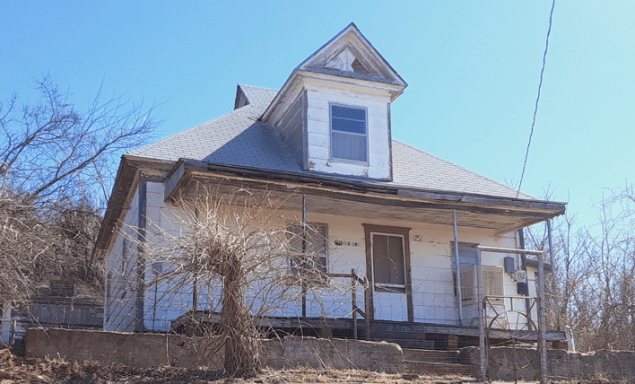
The Groff House, first moved to Binger from Anadarko.
Our move to the farm east of Binger, Oklahoma marked a drastic change in life. It was vastly different from our life in Cordell. My dad had bought a house set on a modest foundation. A propane stove heated it. There was no running water. We had no telephone. The electricity worked until a snowstorm or thunderstorm blew through and took it down. In time, things would improve, but first, we had to learn a new way of living.
Each evening, my dad brought home two five-gallon containers of water and set them on the kitchen floor. Hanging above them was a metal ladle, which we all used to scoop ourselves a drink. It was a crude method, but it worked—and we didn’t think twice about it.
Going to the restroom was another matter. Several attempts had been made to drill wells, but all came up dry. My dad had the holes filled in, except one. Over that one, he placed an old-fashioned outhouse—worn, sun-bleached, and splintered. It looked fifty years old, and maybe it was. But he fitted it with a new toilet seat, and we used it like it was brand new. The worst part? The yellow jacket wasps that swarmed it in summer. They built their cones overnight, and chasing them off was a risky job that none of us looked ahead to.
This story isn’t about the outhouse or the water jugs. It’s about the town’s Main Street during that time. The impression it left on me was significant. I was only five years old, but the images are burned into my memory.
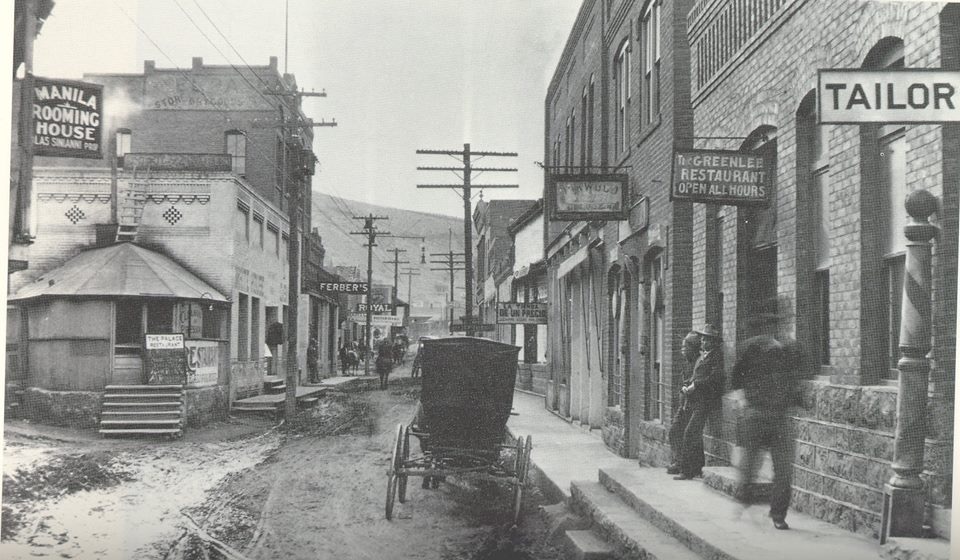
My dad was the town barber. His shop sat on a steep sidewalk, at least three feet above the street. Set into the concrete were old metal rings. For the longest time, I had no idea what they were for. One spring morning, I was playing on the sidewalk. I was flipping one of the rings back and forth. An old timer stopped and looked down at me.
“Do you know what that ring is for, Sonny?”
He asked.
I shook my head.
“No.”
He grinned.
“Those were for tying up horses and wagons. Back in the day, folks would come to town on Saturdays—buggies and wagons lined this whole street. Horses everywhere.”
That answered a mystery I’d long wondered about. But there were more to come—and like those rings, they’d slowly be explained to me, one by one.
That same sidewalk saw a lot of stories. I remember one day. A slick Chevrolet four-door pulled up. Two men and their children—a boy and a girl—went into the drugstore next to Dad’s barbershop. My oldest brother had come into town to visit and was sitting in the shop when someone waiting for a haircut suddenly shouted,
“FIRE! FIRE! THAT CAR IS ON FIRE!”
The man bolted into the drugstore to alert the others. Someone must’ve called the fire department—but “fire department” was a stretch. The town had a 1945 fire truck with a rusted tank and an engine that wouldn’t start. They had to tow it with another truck to get it to the fire. My brother ran to the car and had one of the men pop the hood. Without hesitation, he ripped off his shirt and began beating out the flames around the carburetor.
The twins—those two kids—stood next to me on the sidewalk, watching. They would later become my classmates and lifelong friends. That introduction during the chaos would forge a connection we kept through the years.
My brother eventually put out the fire. The fire truck, still leaking water, finally rolled to a stop behind the car—just as the tank began to empty. The scene would’ve been funny if it hadn’t been so sad. Laughter erupted from my dad’s shop. The volunteer firefighters were embarrassed, and I remember feeling bad for them.
It wasn’t the last mishap. Months later, a house caught fire just behind the fire station. The truck’s wheels locked up that time, and it couldn’t even be towed out. The town then decided it was time for a new truck.
Through donations and fundraisers, they finally got one. The arrival of the new fire truck was a significant moment in our town’s history. It was a testament to our resilience and the importance of community support. It was a real point of pride—a saving grace when it finally arrived.
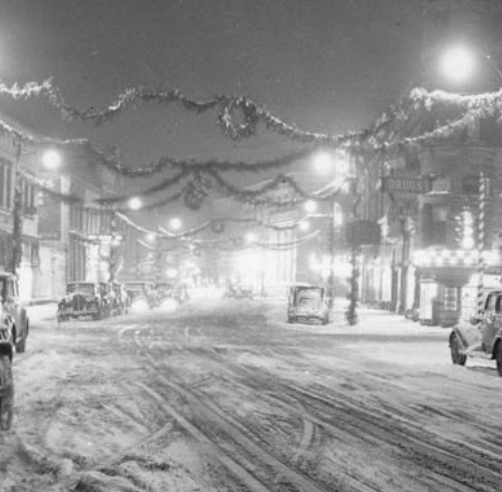
Main Street had its beautiful moments, too, especially at Christmas. The decorations draped across the street like something out of It’s a Wonderful Life. Seeing them lit up at night turned Main Street into a glowing wonderland.
One Christmas, the town threw a parade. The governor came. And so did our hometown hero, Johnny Bench, riding in the back of a convertible. I stood beside my dad in front of his barbershop, watching as they passed by. It was one of the biggest things to happen to our little town of 750 souls.
Main Street had different values back then, too. I remember a funeral procession once drove through town. My dad stopped cutting hair and closed the shop until the last car had passed. Other businesses did the same. That quiet gesture of respect left an impression on me that’s never gone away.
Looking back now, I realize that old Main Street was more than just a stretch of asphalt and storefronts. It was the heartbeat of a simpler time. Life was slower and more mindful then. It taught me about community, kindness, hard work, and the small moments that shape our lives. Those sidewalk rings, flickering Christmas lights, and clunky fire trucks are gone, but the memories stay. And in my heart, Main Street still stands—just as it was.
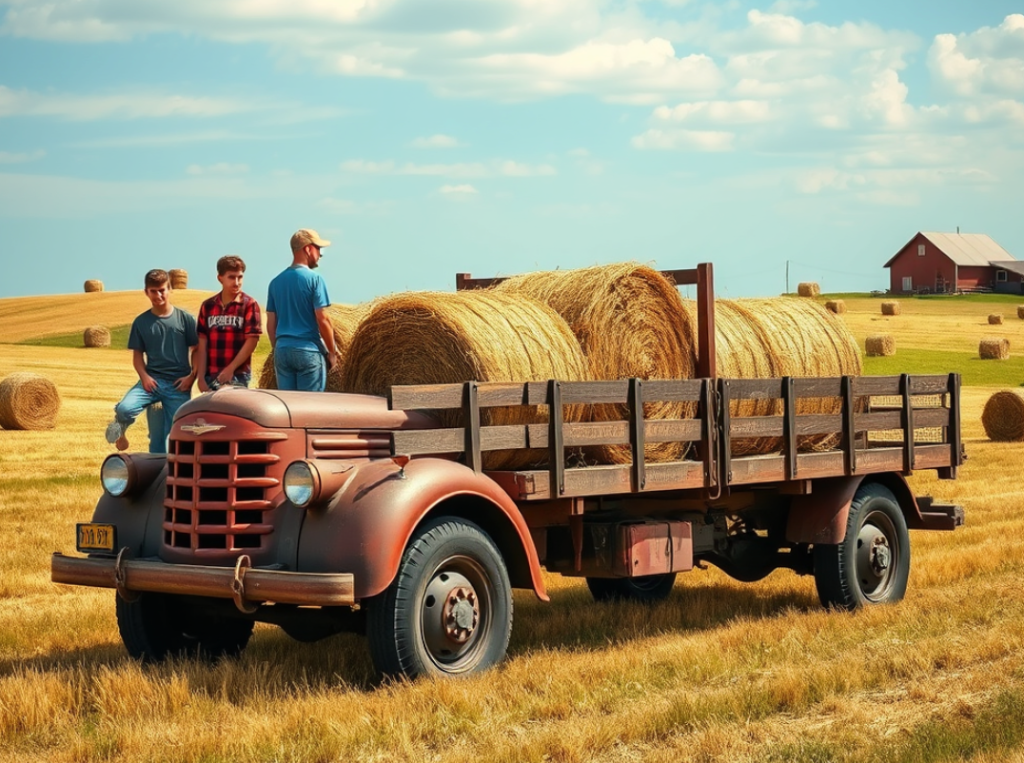
The summer of 1980 would be remembered forever. It was the year three friends—Bub, Johnny, and Clem—took to the hayfields, hauling bales for farmers across the county.
They set out to help the local farmers with two old flatbed farm trucks. The farmers struggled to find enough hands to get their hay cuttings into the barn. What started as a way to earn cash quickly became much more significant.
The boys took turns driving. Two worked at the back of the truck, stacking and securing the bales. They did this while bumping along dirt roads. When they reached a barn, all three pitched in to unload. It was grueling work. It was hot, dusty, and backbreaking. They made a decent sum at fifteen cents per bale when split three ways. More importantly, they earned something money couldn’t buy: the respect of an entire community. Their work ethic, reliability, and bargain rates made them invaluable, and grateful farmers often sweetened the deal with generous tips.
Word spread fast. Soon, the boys had more work than they handled. They got their hands on a third truck and fixed it up. Each took charge of their own rig. They hired extra help to keep up with demand. By summer’s end, the three had hauled an unprecedented amount of hay. No one remembered seeing so much in the valley.
But it wasn’t all work.
The boys had a playful streak, and the town delighted in their antics. One night, Clem slept soundly in their makeshift bunkhouse. Bub got the idea to spread hair remover gel over Clem’s hairy legs. Hours later, Clem woke to a strange smell. He wrinkled his nose. He assumed one of the others had eaten something bad. He groggily rolled over and went back to sleep, unaware of the smooth patches forming on his legs. The next day, Clem discovered the damage in the shower. He saw the damage and heard Bub and Johnny howling with laughter outside the bathroom door.
Clem didn’t get mad. He got even.
At noon, he played the perfect gentleman. He told Bub and Johnny that he held no grudges. He wanted to treat them to lunch. They stayed behind at the barn. He ran to the burger joint and ordered the most enormous double cheeseburgers. There was also a mountain of fries and chocolate malts. For himself, he ordered vanilla. Before returning, he slipped some laxatives into the chocolate malts.
The unsuspecting pair devoured their meal, thanking Clem for his generosity, utterly unaware of the payback coming their way. Four hours later, they were running to the bathroom non-stop, clutching their stomachs, confused and miserable. Clem stood back, arms crossed, grinning. Their “cleaning out” lasted for days. When the town caught wind of the prank, it only added to the growing legend of the hay-hauling boys.
The mischief didn’t stop there.
There were ambushes, booby traps, and endless laughter. Even with their busy schedule, they found time to fish. They caught some of the biggest catfish the town had ever seen.
By summer’s end, they had built more than a successful hay-hauling business—they had created memories that would last a lifetime. Long after the last bale was stacked, folks in town would still talk about the summer of 1980. During that summer, three hardworking boys became the heart and humor of the valley.
It happened at precisely 3:17 p.m. on a warm autumn afternoon. The town of Briar Hollow had always been a quiet place. The most exciting event of the week was the arrival of fresh pies at Millie’s Diner. But on this particular day, something changed. Time stopped.
No one saw it happen. There was no flash of light, and there was no tremor in the ground. One moment, the clock on the courthouse tower was ticking as usual, and the next, its hands were frozen. Birds hung motionless in the sky, leaves hovered mid-fall, and the wind seemed trapped.
At first, the townsfolk didn’t notice. Old Mr. Grady blinks in confusion halfway through handing change to a customer, as the coins refuse to drop from his fingers. Sarah Porter had been driving to the grocery store. She finds her car inexplicably locked in place. The engine still hums. Children at the playground hang in mid-swing, their laughter caught in their throats.
And then, they noticed each other. Wide eyes met, tentative steps were taken, and panicked voices rose into the still air. The world had paused, yet they remained unstuck, the only things moving in a town frozen in time.
The local librarian, Maggie Holcomb, was the first to suggest that something bigger was at play.
“This isn’t just a power outage,”
she murmured, staring at the unmoving second hand of her wristwatch.
“This is…impossible.”
Hours passed, though the sky did not change. The sun remained where it was, suspended in golden radiance. Some tried to leave town, only to find that the roads looped them back to the center. Others attempted to wake those frozen, but their efforts were in vain. The townsfolk, once filled with panic, began to feel a creeping sense of fear. Fear turned to despair, and then—acceptance. Their emotional journey mirrored the strange stillness that had befallen their town.
The people of Briar Hollow, despite the unchanging world around them, learned to adapt. They still spoke, ate, laughed, and cried. Days passed, though they had no real way to count them. And just when they resigned to this strange eternity, the clocks began to tick again. Their resilience in the face of the unknown was a testament to the human spirit.
It was as sudden as it had started. The coins fell from Mr. Grady’s hand, Sarah’s car lurched ahead, and the children’s laughter resumed mid-breath. The world snapped back into motion, unaware that it had ever paused.
Yet, the people of Briar Hollow knew. They would never forget that strange day when time stopped. It was an even stranger feeling that just, it had been watching them.






 benandsteve.com