
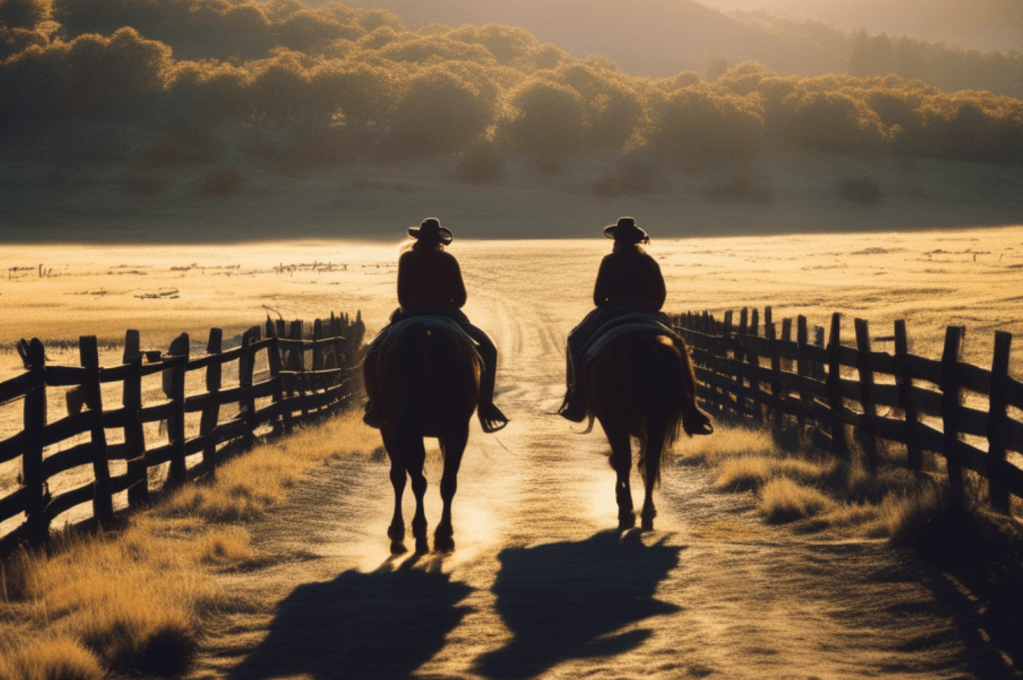
In the late 1890s, the vast expanse of the American West stretched endlessly, a sea of golden plains and towering mountains. Two cowgirls named Mae and Rosie, not just friends but soulmates, called home in a remote corner of this wild land. Mae, with her fiery red hair and fierce spirit, and Rosie, with her raven-black braids and gentle demeanor, were an inseparable pair, bound by a love that defied the conventions of their time. In a world where their love was deemed unconventional, they found solace and strength in each other.
One crisp autumn morning, they saddled their horses and rode out, the sun casting long shadows across the rolling hills. Their journey led them to an old wooden fence gate, weathered by years of harsh winds and blazing sun. They spurred their horses forward with a shared glance and a mischievous smile, pushing the gate open and galloping through.
As they rode, the familiar landscape began to change. The dirt road beneath their horses’ hooves transformed into smooth pavement. The rolling hills flattened, and in the distance, a faint hum grew louder, evolving into the roar of engines. The world around them seemed to blur and shift, the sky darkening and then brightening again until suddenly, they found themselves on the edge of a bustling highway. In the face of this bewildering transformation, Mae and Rosie’s courage and resilience shone through, inspiring all who witnessed their journey.
The year was no longer 1898 but 1972. Mae and Rosie reined in their horses, staring in awe at the sight before them. Towering skyscrapers pierced the sky, cars zipped by at dizzying speeds, and people hurried along sidewalks, oblivious to the two cowgirls who had just crossed time itself.
Confusion and excitement swirled within them. They rode cautiously along the highway, their horses nervously stepping onto the strange new surface. They marveled at the colorful billboards advertising things they’d never seen before and the neon lights that promised adventure. It was a journey that was not just physical but emotional, as they navigated the unfamiliar terrain of a world that was changing at a rapid pace.
As they entered the city, the clamor of modern life enveloped them. Mae’s eyes sparkled with curiosity while Rosie gazed wonderfully at the people dressed in fashions so alien to their own. They stopped outside a diner, its large windows showcasing a scene of laughter and warmth. The sign above the door read “Betty’s Diner.”
Mae and Rosie dismounted, tethering their horses nearby. They walked into the diner, the door jingling as they stepped inside. Heads turned, and the chatter ceased momentarily as the patrons saw the two cowgirls, their clothes and demeanor a stark contrast to the modern setting. Some stared in curiosity, others in judgment, but a few smiled warmly, recognizing the courage it took for them to be there.
Betty, the diner’s owner, approached them with a friendly smile. “Welcome, ladies! What brings you to these parts?” she asked, her eyes twinkling with curiosity.
Mae and Rosie exchanged a glance, unsure of how to explain their journey. “We’re just passing through,” Mae said, her voice steady.
Betty nodded, sensing there was more to their story. She led them to a booth and handed them menus. As they sat, they began to notice the small but significant changes around them—the music playing from a jukebox, the variety of food on the menu, the freedom in the air. Mae and Rosie exchanged a glance, their eyes filled with wonder and a hint of apprehension, as they realized they were witnessing a world that was vastly different from the one they had left behind.
Over the next few days, Mae and Rosie explored the city, learning about the incredible advancements and the cultural shifts that had occurred in the seventy-four years they had seemingly leaped over. They discovered a vibrant community of people who defied conventions and lived openly and proudly like them. They learned about the women’s suffrage movement, the civil rights movement of 1964, and the sexual revolution, all of which had reshaped the society they now found themselves in.
One evening, they attended a gathering at a local community center. It was a celebration of love and identity, filled with people from all walks of life. Mae and Rosie felt a deep connection to the stories they heard, the struggles and triumphs resonating with their own experiences.
As they danced under the disco ball, surrounded by newfound friends, they were overwhelmed with a sense of joy and liberation. They realized that they had found a place where their love was not only accepted but celebrated. With all its noise and chaos, the city had given them a glimpse of a future they had never imagined, a future filled with hope and optimism for societal change.

Mae and Rosie decided to stay, embracing the new world with open hearts. They found work, made friends, and built a life together. Their love story began in the wild, untamed West and flourished in the bustling, vibrant city of the 1970s. It was a decision that was not without its challenges, but they were willing to face them for the chance to live and love freely in a world that was slowly but surely becoming more accepting.
Years later, as they sat together on a bench overlooking the skyline, they often spoke of that old wooden fence gate and the magical journey it had taken them on. The city had become their home, where they could live and love freely, forever grateful for the lucky ride that had led them to this extraordinary new chapter in their lives. They reminisced about the changes they had witnessed, the challenges they had overcome, and the love that had remained constant throughout it all.
 benandsteve.com