About that dinner on The River Banks At THe Olympics…A rednecks explanation of what was going on…

Up and dated by the weekend guy B.S. Daily.
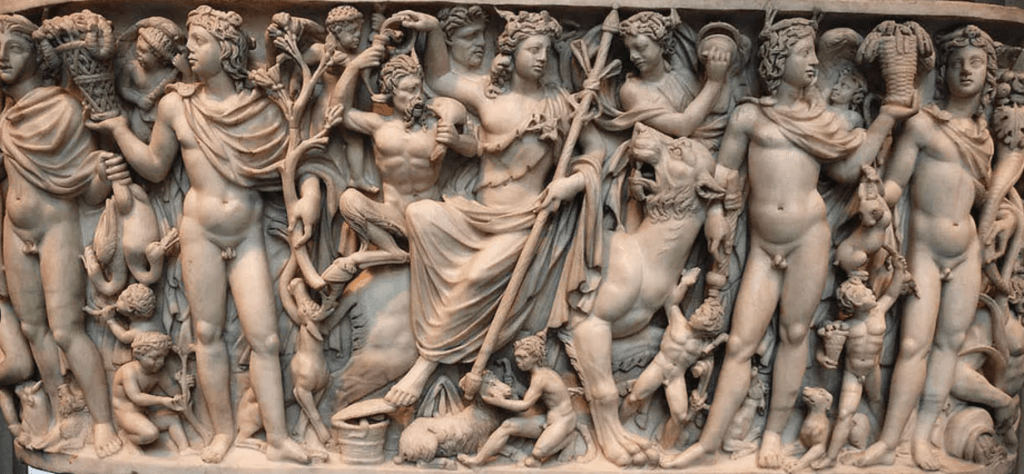
Roman sarcophagus depicting the Triumph of Dionysus and the Seasons
Jug used for cooling water into wine.

Well, let me tell you about Dionysus (y’all can just say “D”) in a way that’s as plain as a hog on ice. Dionysus (D) isn’t just some fancy-pants Greek fella; he’s the god of wine, parties, and having a good ol’ time. U know ‘getting shitfaced.’ Picture him like that one buddy who’s always ready to crack open a cold one and throw a rager out by the bonfire. Take it easy; you might think you be at your last supper, especially is shootin’ starts!

da man in stone

Now, Dionysus (D) ain’t just about drinkin’; he’s got a wild side too. He’s all ’bout lettin’ loose, dancin’ like nobody’s watchin’, and just forgettin’ all your troubles. He’s the life of the party, makin’ sure everyone’s havin’ a blast and feelin’ free as a bird. He’s got that divine touch, turnin’ water into wine and makin’ sure there’s always a good time to be had, showin’ his transformative power in every revelry, getting laid. He will have a long table so all his buds can be bellied up.

Many paintings in Renaissance art depict similar scenes of dudes and chicks gathered around a table for a feast. Many polaroids (photos) do the same in America, we call ’em bar-b-ques. ’em guys on the river bank didn’t have many ticks to get their point across, time was spiraling, especially if you’s a Badtist in Texas watchin’ da’t on TV or if you ain’t in jail – you phone.

So, if you ever wonder why folks love to gather around and get drunk, think of Dionysus (D). The French and Greek’s amit do it more than us’n’s. But if you don’t runn offt before the story is ended you’ll hear he’s the spirit of all those good times, reminding us that every now and then, it’s okay to cut loose, have a nip, fetch u a snort-full and enjoy the ride. Cheers to Dionysus (D), the god of gettin’ down and having a heck of a time. Just remember the gathering is not the last supper, no matter how many bubba’s you have. Some say it was just not clear it was a ho-down, and that was Aunt France’s greatest sin!

A-dam-d-en-dum: NEWS MAKES HEADLINES! MEDIATE NEWS WEBSITE CONFIRMED JUST THIS INFORMATION. BUT USING MORE LIVE BODIES TO CONFIRM DETAILS.

Addendum-update edited by Benjamin Groff© Groff Media2024 ©Truth Endures

Friday night’s Paris Olympics opening ceremony angered people across the world as many interpreted it as a mockery of Leonardo da Vinci’s “The Last Supper ” but the man who organized it said it was actually a nod to Greek mythology.

A portion of the ceremony featured semi-nude drag queen performers around a table, which was immediately interpreted by many — particularly on the right — as an attack on Christianity. The man who choreographed the tableau claimed it was anything but on Sunday morning.

Thomas Jolly, the ceremony’s artistic director, claimed to the French media on Sunday that he was not mocking anyone but merely putting on a “celebration of Greek mythology.”

“There is Dionysus who arrives on this table. He is there because he is the God of celebration in Greek mythology,” Jolly told BFMTV, according to an interpretation from NBC News. “The idea was to have a pagan celebration connected to the gods of Olympus. You will never find in me a desire to mock and denigrate anyone.”

The Paris Olympics X account shared the Dionysus portion of the show Friday, describing it as “interpretation of the Greek God Dionysus” which the organizers said “makes us aware of the absurdity of violence between human beings.However, the scene identified as a parody of “The Last Supper” and the appearance of the blue-painted Dionysus were 44 minutes apart in the ceremony.

While Jolly distanced himself from the controversy, TheWrap and many other outlets reported on an official statement from the Olympics which clearly stated Jolly took his inspiration in that scene directly from Da Vinci.

“For the ‘Festivities’ segment, Thomas Jolly took inspiration from Leonardo Da Vinci’s famous painting to create the setting,” the statement read. “Clearly, there was never an intention to show disrespect towards any religious group or belief.”

Two days and one American company’s boycott of the Olympics later and the controversy has yet to die down. As of Sunday, there were still calls to boycott the Olympics.

UPDATE: This story has been updated with a comment from officials with the Paris Olympics, who said Jolly was inspired by da Vinci’s “The Last Supper” mural. Read the report at Mediate here

After He Died, He became The Most Popular Educator In Town.

A Fictional Story By: Benjamin Groff© Groff Media2024© Truth Endures

In the small town of Fairview, the school principal, Mr. Harold Beasley, stood as a pillar of consistency and unwavering commitment. He wasn’t tall or short and carried a bit of a pot belly, always framed by his neatly pressed suits. His wire-rimmed glasses perched precariously on his nose, magnifying the keen intellect behind them.

Mr. Beasley was a whiz in math and science. He was often spotted in his office poring over the latest educational journals or solving complex equations just for fun. His passion for these subjects was palpable, spilling over into every interaction he had with his students and staff. But his brilliance in academia was matched by his unique sense of humor.

Mr. Beasley’s office was often filled with the sound of his hearty laughter, a testament to his unique sense of humor. His responses to students’ grumbles and grievances were always the same, laced with a touch of wit and understanding.

Rubbing his thumb and finger together and holding it up for a student to see after being asked for some special request he’d hold out his hand saying ––

“You know what that is? That is the world’s tiniest record player –– playing ‘My heart cries for you.”

He would then burst into hearty laughter, his belly shaking nearly busting the buttons on his shirt.

His responses to students’ grumbles and grievances were always the same.

“I can’t set up the schedule to please 250 students,”

He would say with a shrug.

And homework?

“It makes school days shorter.”

While his words might seem brusque, they were rooted in wisdom and fairness. Mr. Beasley knew that life wasn’t always about comfort; it was about learning and growing.

Over the decades, his straightforwardness and dedication earned him a mix of respect and frustration from students and fellow teachers alike. They might not always have liked his methods, but they couldn’t deny the results. Under his leadership, Fairview High consistently produced top-notch graduates who excelled in colleges and careers far beyond the town’s modest borders.

As the years passed, Mr. Beasley became a fixture at Fairview High, symbolizing stability in an ever-changing world. He celebrated countless graduations, always giving the same advice to departing seniors:

“Keep learning, keep questioning, and remember, the only limits are the ones you set for yourself.”

One crisp autumn morning, after fifty years of dedicated service, Mr. Beasley passed away peacefully. The news of his death spread quickly, casting a somber shadow over the town. The weight of his absence was felt by all who had been touched by his presence.

Even those who had butted heads with him over homework or school policies foun themselves reminiscing fondly about his impact on their lives.

Former students across the decades returned to Fairview, each carrying their treasured memory of Mr. Beasley. They spoke of his brilliant mind, quirky humor, and the lessons that had stayed with them long after leaving the school. John credited Mr. Beasley for his love of astronomy, and Maria credited him for inspiring him to become a mathematician because of his encouragement.

The school’s auditorium began filling with former students, teachers, and community members at the memorial service. As they shared their stories, one theme emerged: Mr. Beasley had not just been an educator but a mentor, guide, and friend. His legacy was not in the grades or the test scores but in the lives he had touched and the minds he had sparked.

In the end, Mr. Harold Beasley was remembered not just for his sharp mind and his tiny record player joke but also for his unwavering dedication to his students. He had spent his life teaching them not just about math and science but also about resilience, curiosity, and the importance of a good laugh. And that, more than anything, was his greatest lesson.

The Preacher Who Didn’t Believe In God

A Story By Benjamin Groff© Groff Media2024© Truth Endures

Frank Johnson was not your run-of-the-mill pastor. He delivered sermons each Sunday that never bored his parishioners. Never since being hired by the Shady Grove Baptist Church Governing Body had they been so excited about their evangelical image having such a trophy behind the altar. Pride be damned, they couldn’t take another year of losing members to the metro church in the nearby city.

There was one more thing about Frank Johnson that was not typical: He didn’t believe in God. He felt the bible was dogma, the souls tossing their money in the offering plate fools, and Frank felt that one might have issues if they thought they would join their loved ones in the hereafter. If they said it was because God didn’t think their sin was no longer a big deal, he felt them to be mental. He tried to preach that prayer wasn’t an answer to your needs but to your peace.

Frank’s unconventional sermons attracted even more attention as the weeks passed. Though veiled in traditional language, his messages subtly nudged the congregation towards introspection rather than blind faith. He spoke of personal responsibility, community power, and compassion’s importance. Shady Grove Baptist Church members started to see their faith not as a means to an end but as a guide for living a meaningful life.
One Sunday, Frank decided it was time to reveal his true beliefs. He stood at the pulpit, looking at the faces that had come to trust and respect him. Taking a deep breath, he began.

“My dear friends, I need to share something deeply personal with you today. It’s something that has weighed on my heart for a long time. I do not believe in God. I never have, and I never will. This confession, though it may shock some of you, comes from a place of deep conviction and honesty. I hope you can see the courage it took for me to share this with you.


A gasp rippled through the congregation, but Frank continued, his voice steady and calm.


“I know this might come as a shock to many of you. You may feel betrayed or confused. But I ask you to hear me out. My disbelief in God does not diminish the value of the lessons we’ve explored together. If anything, it enhances them. For I believe that the true power of our faith lies not in the promise of an afterlife, but in the strength and kindness we show one another in this life.”


He paused, letting his words sink in. The silence was palpable, but no one left their seat.


“Think about the times you’ve felt most connected to your faith. Was it in moments of quiet prayer or in the acts of love and service you performed for others? Was it in the rituals or the genuine care you showed to a needy neighbor? Faith, to me, is not about believing in something unseen. It’s about believing in each other. It’s about creating a community where we support and uplift one another.”


Frank could see the wheels turning in their minds. He pressed on, his conviction growing stronger.


“I challenge you all to consider this: What if we took the principles we hold dear – love, compassion, kindness – and applied them not because we seek divine approval but because we know it makes the world a better place? What if our faith was a commitment to each other rather than an unseen deity? This challenge is not meant to undermine your beliefs, but to encourage you to think critically about the role of faith in our lives.”

Murmurs of agreement began to spread through the congregation. Frank knew he had to drive the point home.


“We don’t need to believe in God to be good people. We don’t need the promise of heaven to motivate us to do what’s right. We can find strength and purpose in each other, in our shared humanity. So, will you join me on this journey? Will you help me build a community based on trust, respect, and love without the need for divine justification?”

One by one, the members of the congregation stood up, some with tears in their eyes, others with resolute expressions. They walked to the front of the church, forming a circle around Frank. In this moment, we were not a group of individuals with differing beliefs, but a united community, bound by our shared values and commitment to each other.


In that moment, Shady Grove Baptist Church transformed. It became a place where faith in humanity, rather than God, was the cornerstone. Frank had not only shared his truth but also inspired his congregation to see the power within themselves and in each other. In doing so, he had created a new kind of faith—one that was grounded in the reality of human connection and the potential for goodness in everyone.

The Secret of Willow Woods

A Story By Benjamin Groff© Groff Media2024© Truth Endures

Tommy was a curious little boy who loved exploring. One summer afternoon, he ventured deep into Willow Woods, a place he had always wondered about. As he wandered through the dense trees, he stumbled upon something extraordinary: a hidden community of miniature people no more significant than his pinky finger.

They lived in tiny homes nestled in the roots of trees, complete with a store, a church, and a post office. There were no cars, for they had not mastered making them so small. Instead, they traveled on foot or used small carts pulled by squirrels.

Tommy was amazed and approached cautiously. The miniature people, initially startled, soon realized he meant no harm. Among them was a little person named Nolin, who became fast friends with Tommy. They spent hours together, sharing stories and learning about each other’s worlds.

One day, Tommy had an idea. He brought a toy car from home and showed it to Nolin. The little vehicle fascinated the miniature people. With Tommy’s help, they began to design tiny vehicles that ran on water. Using miniature engines and the natural resources around them, they created a fleet of small, eco-friendly cars.

The community also harnessed wind and solar power to produce electricity. Tiny windmills spun in the breeze, and miniature solar panels soaked up the sun’s rays. The town flourished, becoming a model of sustainable living.

Their actions not only protected their community but also had a positive impact on the environment, inspiring others to follow their lead.

However, Tommy knew he had to keep their secret safe. He feared that if the grown-ups found out, they might destroy everything the miniature people had accomplished. This responsibility weighed heavily on him.

One day, as he was leaving the woods, he overheard some adults talking about expanding the nearby town, which would infringe on the woods. Tommy’s heart sank. He knew he had to act.

Tommy went back to the miniature town and shared his worries with Nolin. Together, they devised a plan. They would build a protective barrier of thorny bushes around the community, making it difficult for anyone to venture close. The miniature people worked tirelessly, and a dense wall of thorns soon surrounded their town.

The adults did start to clear some of the woods, but they stopped short when they encountered the thorny barrier. Declaring it too much trouble, they left that part of the forest untouched.

Tommy was relieved but knew the barrier was only a temporary solution. He solemnly promised Nolin and the miniature people that he would always protect their secret. This promise was not just a word, but a commitment that he upheld throughout his life, visiting them often but never telling anyone about the wonders hidden in Willow Woods.

In the end, there were no winners and no losers. The miniature community continued to thrive, hidden from the world. Tommy grew up, but he always remembered his tiny friends and the promise he made. His word was his bond, shielding the secret community, allowing it to remain a beacon of what the world could be—sustainable, harmonious, and thriving—hidden safely in the heart of Willow Woods. This story is a testament to the power of promises and the impact of small actions on a larger scale. 

The story would have ended there if not for the promise so many years ago. The one Tommy gave said he would always shield the little people from the significant adults and intruders wanting the land for greed. Tommy, a successful businessman who had made millions in his dealings, bought the little people’s world’s land and built a protective barrier around the property. He then placed the property in a revolving Trust that would remain untouched, assuring the little people’s world would always be safe from intruders. This time, Tommy returned to tell Nolan, now an elder of the community getting to say,

“WE WON!”

The ENDING – Monday Morning Was A Killer For One Neighborhood – Ding Dong

A Story By Benjamin Groff© Groff Media2024© Truth Endures

It was a Monday morning, and everyone was starting their week. Neighbors were running about getting to their cars to hit the road and begin to work. John and Mary Wagner were still at home. Both had stayed in their vehicles since arriving home for the weekend, but no one noticed. It wasn’t unusual. They were known for locking their doors on weekends and never leaving the house, so staying home all weekend didn’t signal any concerns.

However, on Monday morning, John was usually the first to leave. He was out of the house and on the road by 6:00 AM to beat rush hour traffic, and Mary would leave by 7:00 AM with their two children, Max and Terri. So what was happening that day? The neighbor two doors down was a lady named Alice Morgan. She watched the neighborhood, curious about the Wagners’ home. 

Why aren’t they moving about this Monday? She asked herself

As the neighborhood drivers leaving for work thinned out, Alice meandered to the Wagners. Walking to the front door, she peered through the front bay window and saw no one inside. She went on up to the door and rang the bell, 

DING DONG, BING, BING, DING, DING, BONG

Alice thought to herself, what a weird doorbell ring. She rang it again to listen to the rhythm,

DING, DONG, BING, BING, DING, DING, BONG

No one came to the door. Curious about the cars remaining in the drive, Alice went to look inside them to see if there was anything strange about them.

Walking under an A-Frame carport, she saw two people in each car. She went up to the first vehicle, a 2017 Ford Pickup, and started to knock on the window before seeing that John Wagner appeared to be stone dead sitting behind its driver’s wheel. He had what looked like a gunshot to his forehead, and a trail of dried blood ran down his head to his chest. Startled, she ran over to Mary’s vehicle to find that Mary also appeared to have been shot in the same manner. The two kids lay dead in the back seat of Mary’s car, a blue 2020 Volvo XC60. Seeing this, Alice began screaming bloody murder and ran down the street, screaming louder and louder as she went toward her home. 

Once inside her home, Alice called 911 and told the operator that she had just found four dead people at her neighbor’s house, and she thought someone murdered four people. The 911 operator asked why she felt someone murdered the four people, and she said they had all had a single gunshot to the forehead and laid over in a car at their home.

Within two minutes, the City of Appleton Police Department had police officers on the scene. Alice Morgan was in the middle of the crime scene, pointing to the dead bodies and explaining the ding-dong doorbell to police officers. They asked her to sit in a patrol unit so they could get a statement from her in writing and a recording of her saying how and what she had discovered. They put her in the back of a patrol unit while she was still talking non-stop, closed the door, and walked away.

Burt Johnson was the lead detective assigned to investigate what had happened to the family. 

A seasoned detective with a knack for piecing together even the most cryptic of puzzles, Burt Johnson arrived on the scene shortly after the first responders. He assessed the surroundings with a practiced eye, noting the position of the vehicles, the broken glass, and the eerie stillness that hung over the Wagner household.

The forensics team was already at work, taking samples and photographing the scene. Burt walked over to the patrol unit where Alice Morgan sat, her face pale and her hands trembling. He opened the door and crouched down to her level.

“Alice, I’m Detective Johnson. Can you walk me through what you saw this morning?”

Alice took a deep breath and recounted her morning, the odd stillness, the peculiar doorbell chime, and the horrifying discovery of the bodies. Burt listened intently, nodding occasionally.

“Thank you, Alice. You’ve been accommodating,” he said, gently patting her hand. “We’ll get someone to take you home soon. For now, try to relax.”

Burt then moved to the vehicles, examining the positions of the bodies. The gunshot wounds were precise, execution-style. These shootings were not random acts of violence; someone put planning into carrying them out. He noted the positions of the vehicles, the lack of struggle, and the fact that the shooter targeted both parents and children.

A uniformed officer approached Burt. “Detective, we found something in the mailbox. It’s an envelope addressed to you.”

Burt’s eyebrows shot up. He took the envelope, carefully opened it, and pulled out a letter. The handwriting was neat, almost meticulous.

“Detective Johnson, You’re getting warmer. This family was just the beginning. Find me before I find my next target.

  • “The Avenger”

Burt felt a chill run down his spine. The Avenger was a name he was all too familiar with – a shadowy figure who had been linked to several high-profile murders, always leaving behind cryptic notes and taunting the police.

Back at the precinct, Burt convened his team. They pored over the evidence, looking for clues that might lead them to the Avenger. The forensic team reported that no fingerprints or DNA were left behind, but they had found traces of a rare chemical compound used in industrial cleaning agents.

Burt’s mind raced. He remembered a case from years ago involving a disgruntled former employee of an industrial cleaning company. The man, Thomas Greene, had a history of mental instability and a vendetta against those he felt had wronged him. Could Thomas be the Avenger?

With a possible suspect in mind, Burt and his team delved into Thomas Greene’s past, uncovering a pattern of behavior that matched the Avenger’s MO. They also discovered that Thomas recently had been in Appleton.

A breakthrough came when a witness reported seeing a man matching Thomas’s description near the Wagner’s home on Sunday night. Burt mobilized his team, and they tracked Thomas’s movements through security footage and witness statements.

Their efforts paid off. They found Thomas hiding in an abandoned warehouse on the outskirts of town. Burt and his team moved in and apprehended him without incident.

Back at the precinct, under intense interrogation, Thomas eventually broke down. He confessed to the murders, revealing that he had been following the Wagner family for weeks, meticulously planning their deaths. He saw himself as an avenger, righting perceived wrongs with his twisted sense of justice.

The Appleton community breathed a sigh of relief as news of Thomas Greene’s arrest spread. Burt, exhausted but relieved, knew there would be more work to ensure Thomas was prosecuted and put away for good. But for now, he could take comfort in justice being served for the Wagner family.

Still shaken but grateful, Alice Morgan found solace in knowing that her vigilance had played a crucial role in solving the case. The neighborhood, once again, felt safe.

And as Burt Johnson left the precinct that night, he couldn’t help but think about the families still haunted by the Avenger’s previous crimes. He promised to continue his pursuit of justice, no matter where it led him.

The First Man To Buy A Car In Town – The Model T Pioneer of Binger, Oklahoma

A Story by Benjamin Groff©II – Groff Media2024© Truth Endures

He was the first to buy a Model T in a town east of his farm. I am referring to Benjamin Groff I. The guy everyone called “Pop” was my grandfather. He was not a flashy guy. He wasn’t wealthy. He was a farmer on the lower plains who had survived the Dust Bowl and made a living on the scant meager crops that grew in the 1930s; he battled through the shortages of provisions to provide for his family from 1911 to when his wife died in 1975.

Sometime before 1920, he rode a draft (draught) horse to a small town where a horse trader had just opened a Ford dealership. His mission was not to get a car. It was to sell his horse, get items for the farm, and maybe a pony in trade.

My grandfather was a talker just as quick in his elder years. He must have been a whiz when he was young. He could quietly engage you in a conversation and have you change your view on a subject without knowing how or when you did. And he was good at it. He must have done some slick horse trading because he left the Ford dealership with a New Model T, $100, and an unrestricted driver’s lesson.

He was the first to buy a Model-T in Binger, Oklahoma, and drive to a farm West of Eakly, Oklahoma, in Caddo County. His wife, Florence, who everyone affectionately referred to as “Mom,” stepped out of their kitchen door and pouted out,

“Oh Lord, what have you done now, Pop?”

Replying proudly, Pop said –––

“Ma Ma Mom, I went and traded that dead head for us a motorized buggy and a way to get around where we will be warm and dry!”

News of Pop’s new car spread like wildfire in the countryside. Their kids had already dashed out of the house and clambered into the vehicle. The oldest had sprinted down the road to the neighbors, proudly announcing their newfound ‘riches ‘. As the news rippled from home to home, a sense of shared excitement and anticipation filled the air. Everyone wanted Pop to accompany them for horse trading, to help them secure a car. It was the start of a bustling Spring, filled with shared goals and a united sense of purpose.

The request for bartering went on for months, and finally, Pop had to stop people coming over and say look, I have to get my crops in for the summer; if you want to help me plow my fields and get my livestock ready for sales I will be glad to catch your bartering, but I am so far behind I won’t be able to feed my family. So when do you want to come over? The calls stopped except for one.

A lady named Loranne had six children and was single. The oldest child was a boy about 15, then a girl about 13, another boy about 10, a boy about 8, a boy about 6, and a baby girl about 2. Her husband had died in a farming accident two years ago. She lived alone with them and had no means of support except for the work she took in from neighbors, such as ironing, washing, helping with food, watching children for families, etc.

Loranne said –––

“If you can help me get a car, I will plant your fields and care for your animals. You won’t have to do anything.”

Pop said to her –––

“You won’t do no such thing; your two oldest boys and mine and I will get the crops and livestock taken care of; you can help Mom around the house and do whatever you need for your home. You take care of your children!”

Loranne was grateful for the opportunity and agreed to begin working bright and early the following day.
Pop’s farm, once a quiet expanse of land, now buzzed with life and activity. Loranne’s boys, alongside Pop’s children, worked tirelessly in the fields. Their laughter and shared experiences brought a renewed sense of hope and camaraderie to the farm. Under Pop’s wise guidance, the boys learned the intricacies of farming, infusing the farm with fresh energy and determination. The farm had transformed into a vibrant community hub, a testament to the power of collaboration and shared goals.

Mom and Loranne quickly formed a close bond. While the boys were out in the fields, the women would work together in the house, preparing meals, mending clothes, and sharing stories. Mom’s gentle nature complemented Loranne’s resilience; together, they created a warm and welcoming home for all the children.

Days turned into weeks, and the farm began to flourish. Pop and the boys plowed the fields and planted the crops, and the livestock was well cared for. The hard work and cooperation paid off, and the farm soon thrived once again. Pop kept his promise to help Loranne get a car. After a successful summer harvest, he took her to the Ford dealership, and with his keen negotiating skills, he secured a reliable Model T for her and her children.

The day Loranne drove her new car back to her home was a moment of triumph for everyone involved. The children cheered and joy filled Loranne’s eyes as she thanked Pop and Mom for their generosity and support.

Pop smiled and said, ––––
“We’re all in this together, Loranne. That’s what neighbors are for.”

As the years passed, the bond between the two families grew stronger. The children grew up, and the farm continued to prosper. Pop’s act of kindness had a lasting impact, changing the lives of Loranne and her children. It also brought the community closer together. His legacy of compassion, hard work, and generosity lived on through the stories passed down by those who knew him, a beacon of hope and inspiration for future generations.

And so, the tale of Pop, the first man in town to buy a Model T, became more than just a story about a car. It was a testament to the power of community, the strength of the human spirit, and the enduring impact of one man’s kindness.

Riding For Their Lives, Two Cowboys Find One Another On The Way Home

A Story By Benjamin Groff© Groff Media2024©. Truth Endures

In the rugged expanse of the 1870s, the badlands of old Mexico were no place for the faint of heart. The sun beat down relentlessly on the arid landscape, casting long shadows as two figures galloped toward the distant border of the United States. Dust rose in their wake, marking their desperate flight from a fate they did not deserve.


Thomas “Tommy” Bellamy and Javier “Javi” Morales were not hardened outlaws, but the cards got dealt against them. In a dimly lit cantina, they had accused two desperados of cheating at poker—a claim that sparked a barfight and ended in gunfire. The local sheriff, a man of questionable integrity, saw an opportunity to pin the shootout on Tommy and Javi, branding them as evil men. With the threat of hard labor or the horrors of Mexican prisons looming, their only hope lay in reaching the safety of the U.S. border.


The journey was fraught with challenges. The badlands were an unforgiving terrain with little water and less mercy. Their horses, Midnight and Sol, were their only companions in the vast, empty wilderness. Days blended into nights as they pushed on, driven by the fear of capture and the promise of freedom.


As the miles stretched on, so did Tommy and Javi’s bond. In the quiet moments between the relentless pursuit, they found solace in each other’s company. Around the campfire, under a canopy of stars, they shared stories of their pasts—Tommy, the son of a Tennessee farmer, and Javi, the orphaned child of a Mexican peasant. Their differences faded in the face of their shared struggle, and a deep, unspoken connection began to blossom.


One night, as the embers of their fire glowed softly, Tommy glanced over at Javi. The flickering light cast shadows across Javi’s face, highlighting the weariness and determination etched into his features. Tommy felt a pang of emotion he could not quite place—a mix of admiration, respect, and more.


“Javi,” Tommy began hesitantly, “I don’t know what I’d do without you out here.”
Javi looked up, his dark eyes reflecting the flames. “We’re in this together, Tommy. Always have been, always will be.”


Their eyes locked, and the world around them seemed to fade away at that moment. Tommy reached out, his hand trembling slightly, and Javi met his touch with a quiet intensity. It was a tentative gesture, a bridge between fear and hope, and it spoke volumes more than words ever could.


As the days turned into weeks, their bond grew more pungent, transcending the physical hardships they faced. They encountered hostile landscapes, battled exhaustion, and evaded pursuers while drawing strength from each other. In a land where trust was scarce and betrayal familiar, they had found something rare and precious—unwavering loyalty and love.
One evening, as they neared the border, they found a small, abandoned shack. Exhausted and hungry, they decided to take shelter for the night. Inside, the air was cool, and the silence was broken only by the distant howls of coyotes. They sat close, their shoulders touching, as they shared a meager meal.


“Tommy,” Javi said softly, “do you ever think about what we’ll do once we cross the border?”
Tommy nodded, his gaze fixed on the horizon. “Yeah, I do. We’ll find a place to start fresh. Somewhere we can be free.”


Javi smiled, a rare sight that lit up his face. “As long as we’re together, we’ll make it.”
The border was within reach, but the journey was far from over. The two men knew the dangers that awaited them on the other side, but they faced them with a newfound determination. They were not just running from a past they did not deserve but running toward a future they could build together.


As dawn broke, they saddled their horses and got ready for the final leg of their ride. Tommy glanced at Javi, his heart swelling with pride and affection. They were outlaws by circumstance, but they had found something true and pure in each other.


With a shared nod, they spurred their horses forward, leaving behind the badlands of old Mexico and riding toward the promise of a new life. Their path was uncertain, but their bond was unbreakable, forged in the fires of adversity and tempered by the strength of their love.

A Sacrifice for the Nation ~ A True Patriot

A Story By Benjamin Groff© Groff Media 2024© Truth Endures

The day had been incredibly long, the weight of it pressing down on President Thompson. Meetings had stacked back to back, leaving him barely a moment to breathe. As he finally sat down at his desk, his phone rang. Picking up the extension, he spoke with a firm, authoritative tone, 

“Yes, Bill, what do we have?”

Bill, the President’s unwavering right hand, had been the first assistant to hold the position since day one. He always attended a meeting, a news conference, or an appearance. 

He was always there, ready to serve. Bill replied, 

“Mr. President, a gaggle of news reporters is waiting outside the news pit. They want to know about your decision.”

President Thompson sighed, a deep weariness in his voice. 

“My decision? Which is that, the dog, the house, the dinner menu, my son, and what time is it?”

Bill returned with patience and clarity, 

“Sir, they want to know whether or not you’ve decided to remain in the presidential re-election campaign.”

The President leaned back in his chair, staring at the ceiling as the enormity of the situation weighed on him. He had spent countless hours deliberating, balancing the nation’s needs with his ambitions. The country was at a crossroads, facing unprecedented challenges that required steadfast leadership. His heart was torn between his love for the nation and his aspirations.

“Bill,” 

He said softly,

“I’ve given this much thought. The country is in a fragile state, and it needs unity and stability. It’s time to put the nation’s needs before my aspirations.

Bill listened intently, sensing the gravity of the President’s words. 

“Are you saying you will withdraw from the race, sir?”

“Yes,”

President Thompson replied with resolve. 

“I am. I will support Senator Adams. She has the vision and the strength to lead us through these turbulent times. My focus now will be on ensuring a smooth transition and doing everything I can to help her succeed.”

Bill nodded, understanding the magnitude of the decision. 

“I’ll prepare the statement for the press, Mr. President. Withdrawing from the race will shock many, but it’s a selfless act that people will remember throughout history.”

As Bill left to handle the media, President Thompson took a moment to reflect. He had dedicated his life to serving his country; now, he was making the ultimate sacrifice for its future. It wasn’t an easy decision, but it was the right one.

When the time came, President Thompson stood before the nation, his voice steady and his gaze unwavering. 

“My fellow Americans,” he began, “after much contemplation and discussion with my closest advisors, I have decided to withdraw from the presidential reelection campaign. Our country needs unity, and I believe Senator Adams is the right leader for this critical time. I will dedicate my efforts to supporting her and ensuring we progress together.”

The news reverberated across the country, a mixture of surprise and admiration. President Thompson’s decision was a testament to his character and commitment to the nation’s well-being. As he stepped aside, he felt a sense of peace, knowing that he had placed his country before himself, making the ultimate sacrifice for its future. A bittersweet feeling of relief and sadness washed over him, but he knew he had done the right thing.

A Select Article from One of Our Trusted Sources ~ What Makes Chicken Noodle Soup the Ultimate Comfort Soup! ~

It’s not just the tender chicken, the perfectly cooked noodles, or the savory broth that make it special; it’s the way this humble soup stirs memories of cherished family moments, rainy days spent indoors, and the simple, comforting presence of loved ones.

Visit the Rise and Inspire Blog to learn more about this article click here!

TAKING A STAND. PROVIDING A VOICE FOR THOSE WHO MIGHT OTHERWISE GO UNHEARD!

A Story By Benjamin H Groff© Groff Media Copyright 2024©

At Groff Media, we dedicate our efforts to making a statement and standing up for those less fortunate. Our mission is to provide a powerful voice for those who might otherwise go unheard, championing their stories and advocating for their rights. Through compassionate storytelling, fearless journalism, and an unwavering commitment to social justice, we strive to amplify marginalized voices, foster empathy, and drive meaningful change. We are optimistic about our goal to create a more inclusive and equitable society, and we appreciate your support in valuing and hearing everyone’s story.

Recent legislative actions in Congress have raised significant concerns among proponents of LGBTQ equality. Extreme opponents of LGBTQ rights are using federal government funding bills to introduce harmful provisions, commonly referred to as “poison pills,” which specifically target the civil liberties of LGBTQ individuals, with a particular focus on the transgender community. These measures threaten to undermine the rights and dignity of LGBTQ people and restrict access to essential, life-saving care for trans individuals.

Current Legislative Landscape: In recent months, several bills that fund various federal government operations have included provisions that:

  • Ban access to gender-affirming healthcare for transgender individuals, which is recognized by major medical associations as life-saving and essential.
  • Introduce measures that broadly attack the rights and dignity of LGBTQ individuals, potentially reversing decades of progress in the fight for equality and civil rights.

Impact on Transgender People: The inclusion of these poison pills in government funding bills is particularly alarming for the transgender community. Gender-affirming care, which includes hormone therapy, mental health services, and surgical interventions, is critical for the well-being and survival of many transgender individuals. Banning access to this care not only jeopardizes the health of trans people but also exacerbates mental health issues, leading to higher rates of depression, anxiety, and suicidal ideation.

Broader Implications for LGBTQ Rights: Beyond the transgender community, these legislative measures threaten the broader LGBTQ population by:

  • Reinforcing stigma and discrimination, which can lead to increased rates of hate crimes and societal exclusion.
  • Undermining legal protections that have been established to ensure equal treatment and prevent discrimination based on sexual orientation and gender identity.
  • Sending a message that the rights and dignity of LGBTQ individuals are negotiable and can be sacrificed for political gain.

Call to Action: It is imperative that we, as concerned citizens, take a stand against these harmful legislative tactics. We must let our leaders in Congress know that we do not support efforts to undermine the civil liberties of LGBTQ individuals. Specifically, we urge members of Congress to:

  • Oppose any government funding bill that includes provisions attacking the rights and dignity of LGBTQ people.
  • Reject any measures that ban access to life-saving gender-affirming care for transgender individuals.
  • Stand firm in the commitment to equality and justice for all, ensuring that the rights of LGBTQ individuals are protected and upheld.

Conclusion: The fight for LGBTQ equality is far from over, and current legislative actions pose a serious threat to the progress that has been made. It is crucial for advocates, allies, and concerned citizens to remain vigilant and vocal in opposing these regressive measures. By urging our representatives to reject any government funding bills containing poison pills, we can help safeguard the rights and dignity of LGBTQ individuals and continue the march toward a more just and inclusive society.

 A Blinding Prank That Wasn’t FoolProof

A Story By Benjamin H Groff© Groff Media Copyright 2024©

In the small town of Havenbrook, two blind men, Al and Bert, were renowned for their cunning and mischievous antics. Despite their lack of sight, they possessed a sharp wit and an uncanny ability to navigate the world around them. They orchestrated elaborate practical jokes daily, relishing in the townspeople’s reactions.

Yesterday, Al and Bert made an unusual purchase: a driverless car. They had saved up for months, and now their latest scheme was about to unfold. The sleek, shiny vehicle arrived at their doorstep, and the two friends couldn’t contain their excitement.

“This is going to be legendary!” Al exclaimed, his face lighting up.

Bert nodded, grinning from ear to ear. “Let’s give Havenbrook a show they won’t forget.”

That morning, Al and Bert put on a show. They dressed in a deliberately disheveled manner, with their clothes inside out and their hair tousled. They staggered down the street, feigning confusion and disorientation. The townspeople looked on in bewilderment as the two blind men stumbled around, bumping into things and seeking directions.

“Excuse me, can you help us? We seem to have lost our way,” Bert asked a passerby, his voice trembling with fake desperation.

The kind-hearted woman pointed them in the right direction, her face filled with concern. Al and Bert thanked her profusely before stumbling off in the opposite direction, leaving the woman and the other townspeople in a state of amused bewilderment.

Their antics continued throughout the day, with Al and Bert putting on an Oscar-worthy performance. They wandered into shops, interrupted conversations, and generally caused chaos wherever they went. Each time someone offered help, the duo responded with exaggerated confusion, leaving the townspeople scratching their heads and bursting into laughter at the same time.

By midday, they decided it was time to unveil the pièce de résistance. Al and Bert climbed into their driverless car, pretending to argue about who should take the wheel.

“You drive, Al! I can’t see a thing!” Bert insisted, his voice rising in mock panic.

“Neither can I, you fool! We’re both blind!” Al shot back, throwing his hands up in frustration.

The car, programmed to respond to voice commands, smoothly pulled out of the driveway and began its route through town. The sight of two blind men driving a car sent shockwaves through Havenbrook. People gawked, some laughed, and others chased after the vehicle, shouting warnings and pleas for them to stop, adding to the chaotic and humorous scene.

Inside the car, Al and Bert were beside themselves with laughter. They marveled at the chaos unfolding outside, their faces aching from so much smiling.

“Look at them! They think we’re driving!” Al gasped, clutching his sides.

Bert nodded, tears of joy streaming down his cheeks. “Best prank ever!”

The car continued its journey, obediently following its pre-programmed path. Realizing they got duped again, the townspeople couldn’t help but chuckle at the elaborate ruse. Al and Bert’s reputation as the town’s resident tricksters became cemented even further.

As the day drew close, the car returned to their home, and the two friends climbed out, exhausted but exhilarated. They high-fived each other, basking in the success of their latest prank.

“Well, Bert, we’ve done it again,” Al said, a satisfied smile on his face.

Bert nodded in agreement. “Indeed we have, Al. Indeed we have.”

In the days that followed, the story of the blind men and their driverless car became the stuff of legend in Havenbrook. Al and Bert continued their daily pranks, always finding new ways to keep the townspeople on their toes. And though their sightless eyes never saw the results of their efforts, their hearts were full of the joy and laughter they brought to their beloved town.

Being Blindsided By Two Of The Craziest Drivers In Town ––– Leaves Everyone Jumping Out Of The Way.

A Story By Benjamin H Groff© Groff Media Copyright 2024©

In the quaint town of Willow Springs, the residents were known for their simple and predictable way of life. It was a place where everyone knew everyone, and the townspeople tended to accept change skeptically. That is, until the day Leonard and Frank, two elderly blind men, decided to shake things up with an adventure that would change the town forever.


Leonard and Frank, with their mischievous humor and lighthearted attitudes, had been best friends for decades, bonded by their shared experiences and a mutual love for adventure. Despite their blindness, they were known for their spirited attitudes and naughty humor. So, when they heard about the new self-driving car, they were immediately intrigued.


“Frank, can you believe it?”

Leonard exclaimed one morning over tea.

“A car that drives itself! Imagine the freedom it would give us!”


Frank, equally excited, nodded vigorously.

“Let’s do it, Leonard. Let’s buy one!”


The townsfolk of Willow Springs were accustomed to the sight of Leonard and Frank navigating the streets with their canes, always laughing and chatting animatedly. So, the entire town was curious when a shiny, futuristic self-driving car appeared in front of their modest home.


“Have you heard? Leonard and Frank got one of those new self-driving cars!”

Mrs. Thompson whispered to her neighbor.


“Those two? In a car? The two driving, I’ve got to see,”

her neighbor replied.


On a sunny Saturday morning, Leonard and Frank decided to take their new car, which they affectionately named “Freedom,” for its maiden voyage through town. As they settled into the plush seats, the car’s AI voice greeted them.


“Good morning, Leonard and Frank. Where would you like to go today?”


“To the park, please,”

Leonard said confidently.


As “Freedom” smoothly pulled away from the curb, the neighbors watched in a mix of astonishment and amusement. Some cheered, others gasped, and a few crossed themselves, praying for the safety of everyone involved. A dog barked, a child pointed, and a few people even dropped their groceries in shock.


The car moved gracefully through the streets, impeccably adhering to all traffic laws. Leonard and Frank laughed heartily, relishing the novelty of their adventure. They waved to passersby, who stared in disbelief at the sight of two blind men being chauffeured by a car without a driver.


However, things turned unexpectedly when “Freedom” encountered a detour due to road construction. The car, programmed to follow alternative routes, led Leonard and Frank on a scenic drive through the unfamiliar backstreets of Willow Springs. The residents, already on edge, began to panic.


“Where are they going? They don’t know those roads!”

Mr. Jenkins shouted, hopping on his bicycle to follow them.


As word spread, more townspeople joined the impromptu parade, trailing behind Leonard and Frank’s self-driving car. Some were on foot, others on bikes, and a few even in their cars, all trying to keep up with the unexpected journey.


Oblivious to the commotion behind them, Leonard and Frank were having the time of their lives. “Freedom” took them past the old mill, the blooming orchards, and even down the riverbank. It was a tour of Willow Springs like they had never experienced before.


Meanwhile, the crowd grew more extensive and more frantic. Children pointed and laughed, dogs barked, and a few people even attempted to flag the car down, worried about the safety of their beloved town characters. The mayor, Mr. Roberts, received dozens of calls and texts demanding he do something about the situation.


Finally, “Freedom” brought Leonard and Frank to the town square, where the weekly farmer’s market began. As the car came to a gentle stop, the two friends stepped out, greeted by a mixture of cheers, applause, and sighs of relief.


“What a ride!” Frank exclaimed, grinning from ear to ear.


Leonard nodded, equally ecstatic.

“I haven’t had this much fun in years!”


The mayor approached them, catching his breath from running to the square.

“Gentlemen, you certainly know how to cause a stir,”

he said, trying to suppress a smile.


Leonard and Frank looked at each other and burst into laughter.

“We didn’t mean to cause any trouble,”

Leonard said.

“We just wanted to explore a bit.”


“And explore you did,”

The mayor replied.

“But perhaps giving us a little warning would be appreciated next time.”


From that day on, Leonard and Frank became local legends. The story of the two blind men and their self-driving car spread far and wide, bringing a newfound sense of pride and unity to Willow Springs. Initially thrown into chaos, the community embraced the spirit of adventure and innovation, inspired by their two beloved residents.


And Leonard and Frank? They continued to explore, always ready for their next adventure, with “Freedom” leading the way and a town full of friends cheering them on.

Political Mission Set In Fictional future Yet Sparks Of Reality Shines Through!

A Story By Benjamin H Groff© Groff Media Copyright 2024©

The tides of change swept through every street, home, and heart in the nation’s heart. It was an era marked by uncertainty and tension as a rising conservative movement began to reshape the very fabric of society. The once-balanced scales of politics now tipped heavily in favor of those who believed in tradition, order, and a return to what they called “the good old days.”

~
Emma Caldwell, a liberal activist and journalist, sat in her small apartment, the glow of her laptop illuminating her worried face. She had spent years fighting for progress—campaigning for equal rights, environmental protection, and social justice. But now, every headline seemed to bring another blow to the causes she held dear, intensifying the urgency of her mission.

~


The latest news was the most disturbing yet: a proposed amendment to the constitution that would severely restrict freedom of speech and assembly, effectively silencing dissent and opposition. Emma’s fingers flew across the keyboard as she typed out an article, her words mixing passion and desperation. She knew that getting the truth out was more important than ever.


Across town, in a grand office overlooking the city, Senator Marcus Reid, a leading figure in the conservative movement, reviewed the day’s agenda. He believed sincerely in his cause, convinced the country had lost its way in a maze of liberal policies and needed to return to its core values. To him, the changes were necessary, even if they were painful.


As the days passed, protests erupted across the nation. Streets filled with a sea of faces—young and old, united by a shared fear of losing their rights. Emma was among them, her camera capturing the raw emotions of the crowd. She interviewed people from all walks of life: the single mother worried about her children’s future, the college student anxious about the loss of academic freedom, the elderly couple who had fought for civil rights decades ago and now saw history repeating itself.


Despite the growing unrest, the conservative agenda pushed forward relentlessly. The lawmakers passed laws at a dizzying pace, each chipping away at the freedoms many had taken for granted. These laws included [specific laws], which directly affected [specific groups of people]. The country seemed to be spiraling into a new era of authoritarianism, and the hope that once burned brightly in the hearts of liberals began to dim.


Emma found herself at a crossroads. Her work was censored, and her voice was stifled by the very government she had once trusted to protect her freedoms. But she refused to give up. Gathering a small group of like-minded individuals, she formed an underground network dedicated to preserving and disseminating information. Their determination was a silent but powerful force, inspiring others with their unwavering resolve.


Senator Reid, now one of the most powerful men in the country, began to sense the growing resistance. He dismissed it at first, confident that his vision was the right path. However, as the underground movement gained momentum, Senator Reid realized that silencing dissent was more complex than passing laws. The human spirit, he discovered, was not so quickly subdued.
One evening, Emma received a message from an anonymous source—a high-ranking government official who had grown disillusioned with the conservative regime. The source provided her with classified documents detailing the administration’s plans to tighten their grip on power further.

These documents revealed [specific details], a dangerous revelation, but Emma knew it was the spark needed to ignite a more significant movement.


She leaked the documents to the public with the help of her network. The revelations shook the country, and the streets again filled with protesters. This time, their numbers were more significant, and their resolve was more robust, demonstrating the potential impact of collective action. The conservative government, facing unprecedented pressure, began to falter.


Senator Reid watched as the country he had tried to reshape slipped from his grasp. He had underestimated the people’s power and ability to unite and fight for their rights. As the conservative movement began to crumble, a new era of political awakening dawned.


Emma stood on the capitol’s steps, her camera in hand, capturing the momentous events unfolding before her. She knew the battle was far from over, but she felt a glimmer of hope for the first time in a long while. The changing times had tested the nation’s spirit, but in the end, its people’s resilience and determination prevailed.

The Comm Commander’s Typical Night In Communications At The Police Department

A Story By Benjamin H Groff© Groff Media Copyright 2024©

The Comm Commander had been very busy at 2 AM. After telling the girls his war stories from his previous assignment at a different department, his shift became busy booking prisoners. Officers began bringing in subjects they arrested for Driving Under The Influence and Public Intoxication following the closing of several nightclubs and bars in the city.

As prisoners piled up in the booking area, one of the girls who had stayed over from an earlier shift moved the booking typewriter over on the book-in counter to open a ledger to log in prisoners’ names. As she was moving the typewriter, a prisoner became offensive and began fighting with the police officers, and two officers had to lift and plant his body down on the counter to get control of him. As they were putting handcuffs back on the man, the officer’s physical strength caused the man’s head to face plant into the typewriter.

The Comm Commander continued to ask book-in questions ––

“do you have any health concerns we should know about?

Prisoner ––––

“I probably do now, with my head in this machine!”

Comm Commander –––

“I will note that you have a typewriter about your head when booking.”

The night was busy until dawn, and there were still officers bringing prisoners in as the day shift began to arrive to start their duties.

As the light of day became brighter, a call came into Communications about a severe auto accident on Interstate 40 east of the city near an overpass involving several vehicles. Dispatch responded to a fire department rescue, fire truck, two ambulances, and two police units. The Comm Commander contacted the Oklahoma Highway Patrol on a point-to-point frequency, requesting they send a state trooper; the first arriving police unit reported back that there were two confirmed fatalities in a burning vehicle. The accident was in Washita County. The Comm Commander notified the Washita County Sheriff’s Office in Cordell, Oklahoma, to send a coroner, and they advised they also had a deputy en route. Such accidents were common in the area, and the department regularly responded to them as a mutual aid agreement with area jurisdictions.

These activities were shared during a night for the Comm Commander during his shift in Communications.

The Comm Commander Tells About Jailing His First Arrest

A Story By Benjamin H Groff© Groff Media Copyright 2024©

It was slightly after 2 AM, and the calls had slowed to officers making traffic stops. They were watching for drunk drivers. The local bars closed then, and the streets would fill with drivers hitting light posts and speed signs.


Keeping track of their locations was a breeze, and the Comm Commander kept a log with details, including every detail radioed over the airwaves. The gals had been egging the Comm Commander to tell them one of his stories about his time at the other departments he had worked at. With a lull in activity, he thought, well, now is as good a time as any.

Edna and Gail had stayed over from their earlier shifts for the occasion. They were both much older than the Comm Commander, and he liked to tease them whenever he could pull a good trick on them. They, in turn, returned the favor. Edna, a divorcee, was snappy and wise. Gail was from the deep South and had a twang in her voice. Plus, she talked of her roots and Alabama every chance she got.

Well, ladies, the Comm Commander began,
“my first arrest was when I was barely 17. I arrested a man known as 15,000. The nickname 15,000 had been given him for the many times he had been arrested for public intoxication. Anyway, he walked into the police department and nearly fell over the dispatch desk. I told him he was going to the tank, and he thanked me. Then he tried to resist arrest when I got the door to the drunk tank open. I got him in there, and he went to sleep. A few days later, after seeing the judge, he was sentenced to two weeks in jail. I was checking on him, and he was having D.T.’s Delirium Tremens”

“Yes, we know what they are Comm Comm.” The ladies interrupted.

The Communications Commander continued,

“Well, I told our Chief JR Toehay, and he said give him a cup of liquor. So, I went to the evidence vault and found the alcohol bottle with the lowest proof that wasn’t evidence for court. I poured a shot into a cup and went to his cell. I opened the door and said hey Wallace, I have a drink for you. He lapped it up. Within a few minutes, he settled down. Over a week, I did that until he was clean, and when he left jail, he was sober. He stayed sober for the first time in years; he had never taken another drink, and he would come by the police department and thank me every night when I was working. He would thank me for being kind to him and helping him. That was when I thought I had finally reached someone doing this job.”

The next guy I arrested came into the police department like that; I had to fight and call for help. He started throwing things over the counter at me and going wild. When we got him into the cell, the Chief told me he was the suspect believed to have beaten a man to death behind the jail not long before I went to work for the department. There wasn’t enough evidence to support an arrest, and he would never have admitted to doing it. I asked if anyone had ever asked him when he was drunk and got told anything he admitted to being intoxicated wouldn’t hold up as a confession. The girl’s eyes were wide and expecting something more, so I said the biggest thing that happened was when the Chief and I helped in a kidnapping.

WHAT? The two ladies both said?

The Comm Commander explained it was under pretenses that a judge got brought to the jail. Five people with Federal Identifiers and Bureau of Indian Affairs Police Badges brought a lady to the town’s jail; the jail was contracted with the BIA as a facility for their agency. They provided legal paperwork authorizing the detention of a lady they had in custody as a material witness. She was to have no visitor, and no one was to know she was in our protective custody. The police department secured her in a female cell with the paperwork signed and sealed by a judge. She did not talk to anyone at the police department.

Two days later, while the Communications Commander was working, he happened to read in the paper that unknown people had kidnapped a federal judge from the Commanche Indian Tribal Headquarters. It also showed the picture of the lady we had in custody. He went to the Chief and told him to show him the newspaper article. The Chief said several colorful words and then called the city attorney. The Chief and Comm Comm, went to the cell, removed the lady, and told her they believed they knew who she was and that she was safe. They also said she could make a phone call and encouraged her to call anyone she thought she could trust. She could stay with the police department and only leave once she knew who she was going with could be trusted. Eventually, the Oklahoma Highway Patrol and a Federal Bureau of Investigation Agent arrived. The Communications Commander explained he stayed by the radio. And said he knew she left with a massive group of people around her, which shows how easy it can be for someone to be falsely locked up in a small town.

The ladies said –– “all this happened in that small town where you came from?”

The Comm Commander said ––

“oh, there was much more that happened while I was there. These are just a few of the things that happened at the jail. We did so much more out on the street. I will have to save for another time because I have three units bringing in prisoners, and I have to go to book them!”

Night Shift, And Getting Behind The Radio

A Story By Benjamin H Groff© Groff Media Copyright 2024©

It was time to begin his night shift, and now the boy known as the Comm Commander by the ladies he worked with and his Captain who worked the day shift was about to take the helm, operating the phones, radio, and teletype.

The Comm Commander’s mastery of the system was a feat that only a select few could achieve. He was among the elite, efficiently managing five or more radio cars and several county and state patrol units on different radio frequencies. His use of a foot pedal to operate the radio microphone set him apart, allowing him to handle phone calls and type information into the telecommunications system with his hands-free.

He could track information on vehicles that officers were making contact with and let them know if a car was stolen or not before they ever left their vehicle. A treatment they become spoiled by when he is on duty.

His ability to check vehicle registrations and local warrants, and his quick response to requests for driver’s license checks or background and warrant checks, was instrumental in providing critical information to officers in the field, significantly enhancing their operational efficiency and safety.

His experience and interactions with law enforcement agencies around where he grew up, which spanned years, were the foundation of his expertise. This was evident when officers would make vehicle stops, and he would send them back up before giving them a coded message of 10-48, an alert that the vehicle they were stopping in the National Crime Information Computer was a wanted felony subject.

He had volunteered as a youth in his hometown when the town was given an old radio and placed a short antenna outside their city hall. He would get his dad to drive him to town, where he’d sit in the evenings and dispatch calls from the phone to the local police unit. Sometimes, there would be no one call, but the interaction with the law enforcement community that came through would gift him with bits of information he stowed away. Later, during that Senior year of high school, when he went to work for the police department, he met the police chief, JR Toehay, at a gas well blowout he attended with an area police officer. The introduction led to the dispatching and jailing position. JR became a lifelong coach and confidant. He was a Kiowa Indian and Chief of a 9-man police department. His guidance and trust in the boy guided the way for the path that had led to the Comm Commander being in his seat operating so well.

The ladies he worked with had questions and wanted to know where he came from, who he was, and what brought him out west. Those stories were there to tell, and he had them; some, however, he wondered if it would be safe. Officers he had worked with told him to be careful; one of the stories could get him in a fix if the wrong people heard about it and wanted to settle any score they felt needed to be. He told them, I’ll let you know all about me, but first, it needs to be when this radio traffic slows down because you guys will be in for a story of your lives.

Taking A Seat At The Police Department

It was late spring when the boy took his seat behind the radio at the communications center for the first time. The Dispatch Center, located just inside the lobby’s front entry, led to a stairway that accessed the firefighters’ sleeping quarters, the chief’s and detectives’ offices, and the jail cells.

The city was a blend of lifetime residents with deep roots, newcomers raising families amidst burgeoning industry, and transients. Housing was scarce for recent arrivals. When available, it was expensive and often beyond the reach of a single income, leading to overcrowded living conditions. This frequently caused disputes.

A person might lease a property and sublet to ten or fifteen others. When conflicts arose and one tenant was asked to leave, the police were often called. Each time, officers had to explain it was a civil matter; the leaseholder needed a court order for eviction. Police couldn’t simply eject someone because of a sudden change in the leaseholder’s terms. However, if an arrest was made due to a disturbance, officers could advise the leaseholder to restrict the arrested individual from returning. Openings in housing were rare unless someone died, and there were plenty of deaths in the coming years.

A local motorcycle gang, known for drug dealing and various crimes, frequently had members as guests in our jail. Their threats were often more comical than serious, but every raid on their dens brought more threats. It wasn’t uncommon for lone riders to shoot out the windows of the dispatch center late at night.

After several incidents, the chief began posting officers on the roof with automatic rifles. This tactic worked, as the shootings ceased during their watch.

The boy worked well with a rotating line of female communications officers. The Captain worked the day shift, while the boy was assigned to nights. The women rotated between days and nights each month.

Soon, the boy became known as the Comm Commander for his authoritative style on the radio and in operating the jail. Edna, Gail, Linda, Pam, Patty, and Sheila were the women who became part of his years at Elk City, each leaving a personal mark on his story.

Yet, the Captain was the most significant influence during those dispatch days. It’s clear that the Comm Commander remembered these individuals throughout his life as he journeyed along many paths. More to follow.

A Young Officer Finding Law Enforcement

A Story By Benjamin H Groff© Groff Media Copyright 2024©

It was the early 1980s, and he rolled into the city from the South. The police department was easy to find. The radio tower extended high above the building and be seen from miles away. Pulling up in front for the first time as an officer gave him a true sense of purpose. He felt independence because he was on his own for the first time since graduating.

He entered the building to be fitted for uniforms. He also received his equipment there. During this time, he met two officers who would feature prominently in his future years. One he met right away. His name was Lee. Lee provided him with a resource for his first housing solution. This was in a town that the oil boom had overrun. People lived in tents in the town park and alongside the road. The other officer was Eddie. He was a Deputy from Cheyenne. Eddie had the actual house, a three-bedroom mobile home in a city-owned trailer court. The jurisdiction provided this to city employees to live. The rent was cheap by local standards and answered an immediate need. It did, though, come with a police K9 and two roommates who have been more neat and orderly.

The police department operated out of a building shared with the fire department. The jail was on the second floor above the communications center. The fire crew slept across from the jail cells on the second level. This raised issues for a city that had doubled in population and area due to annexation. Voters approved a tax proposal to build a new police station and jail. They also planned to rebuild the fire station. Blueprints for the new station were in place, though its construction was several years away.

In court cases, Chicago judges had pointed to the city defendants. Elk City, Oklahoma was a place where they can get a one-way bus ticket. Or pick the choice to get six months in jail. Most people opted to take the bus ticket. The type of characters sent to the area ranged from criminals to mentally unstable to socially dysfunctional. It would be years before the area recovered from the judge’s poor decisions in making such a move. Before then, there would be murders, rapes, and worse.

The city was busy 24 hours a day. Calls for patrol unit service were backed up by three to four calls at a time. When calls did get caught up, it didn’t last long. The shifts were rotational. In that, there was never an entire shift on and off at the same time. Night shifts changed at 6 AM and 8 AM, and Day shifts changed at 4 PM and 8 PM. A mid-shift operated from 2 PM to 2 AM. Each officer worked ten-hour shifts with three days off. The schedule permitted officers to work extra assignments at security posts. This was necessary when gas wells blew their tops out. Roadblocks also had to go in place out in the county. Officers earn as much as $300 on their days off, pulling such assignments. And if there weren’t such assignments, you always pull OT. You take comp time. An officer used this later instead of vacation or sick days. An advantage that the city offered other municipalities didn’t.

The allure of lights, excitement, and action made Elk City, Oklahoma’s bustling oil town so attractive. It captivated an 18-year-old just out of high school. It also kept him there for many years, leading him through years of service. The young officer had already been briefed well in law enforcement with his earlier departments. There are histories from those days. They will come alive in the future. They will tell of his Elk City Days and how he became known throughout western Oklahoma.

In the next few weeks, he will watch the front door. He needs to see if he must duck bullets coming through the station’s windows.

The Move Into My LawMans Career

A Story By Benjamin H Groff© Groff Media Copyright 2024©

In his senior year of high school, he went to work at a neighboring police department thirty miles from where they lived. He worked as a jailer-dispatcher. He had just turned 17 years old, and His dad provided authorization from the school and local city government to go to work. Once he had been hired, there was no stopping his progress. He had listened to the police scanner for years and even volunteered at our local police department as a dispatcher and ambulance driver. He was only 16 then. This, to him, was the big time he was getting paid—the town at a rough character about it. A man had been killed behind the police department in the alley not too long before I went to work there. The killer was still at large.

He excelled in his duties. The chief appreciated his attendance record and punctual arrival to shifts. The assistant chief requested he be the only dispatcher assigned to his shift. He gained a reputation throughout the western state for His broadcasting style and etiquette—application of the police 10-code and professional stature that he applied in the tone of his broadcast. He was known as a no-nonsense type of communications officer. If he gave a call, the information was correct, and the officers could be sure he would stay with them through their response. If they needed help and he lost contact with them, neighboring agencies knew he could pull back up out of the blue. And they respected the ability.

Change is inevitable, and when he graduated high school, a neighboring agency offered me a position that would allow me to broaden his skills. It allowed him to gain telecommunication abilities and work with a county-wide agency, and he still had contact with his old pals at the smaller agency, just less often. The training opportunity exposed him to new experiences, and he was closer to home, but he lacked a feeling of being fulfilled. Something was missing that he couldn’t place my finger on. The period was during the oil boom in Oklahoma, and there was a flurry of activity everywhere. It was not uncommon that he held down employment in other adventures while working for these agencies. One had to. The pay needed to be better for making a serious living. He got offers from colleges and employers the first month after graduating high school. I had planned to work through school, so he planned to keep working at one of my jobs. Plans change. One hundred miles away, a city was beaming on the horizon. They had put a notice out they were hiring a crew of new communication officers and would be building a new administration building to host the center. It appeared intriguing. A visit to their department one morning caused further interest.


When a very experienced face met me at the door and asked how they could help me, He recognized it immediately from a statewide broadcast when he heard the voice. As soon as he spoke, they recognized mine. He explained he had word that they were hiring and that he wanted to spread his wings, move away from home, and get out on his own. The boy was also looking for a larger organization with which to become affiliated. The Captain had an application in the boy’s hand and sat in the chief office within thirty minutes. He accepted an offer within the hour and left town within two hours of arriving, trying to think of how to express my two-week notice to his current employer. Even worse, the boy was working out how he would tell my mom and dad he would be moving out. Not that he had not been gone most of the time with my jobs, but it is the idea that their youngest child was moving out and going on his own.


He went to work the following day. Things changed rapidly in law enforcement, now as they did then. The chief had quit after a heated argument with the mayor over funding, and in his boyish manner, he thought it was as good a time as any to throw his hat in the ring to make a statement. Knowing he already had a job made it much easier, so the boy gave his notice. Now, he just had Mother and Dad to tell. He told my dad first. It wasn’t the worst news Pop had by the mood he was already in, but it may have come close. After he went for a ride on his horse and came back in, he said to wait to tell the boy’s mother for a few days and catch her in a good mood. The kid’s mother reminded him of Eunice, off the Carol Burnett show. Or was it that Eunice reminded him of his mother? She always made him laugh doing the funniest of things.

Today, we briefly describe his first year of official employment in law enforcement and how the boy got started. Each stage is more detailed, and there are many more incidental stories about events that would take place in each department. The writer may tell you the stories in a different order, but as they are related to other incidents, those are coming soon.