I often go back through the archives and reread old stories I reported on. Some are small, dusty pieces that barely made a ripple. Others grab you by the collar and refuse to let go. This is one of those stories.
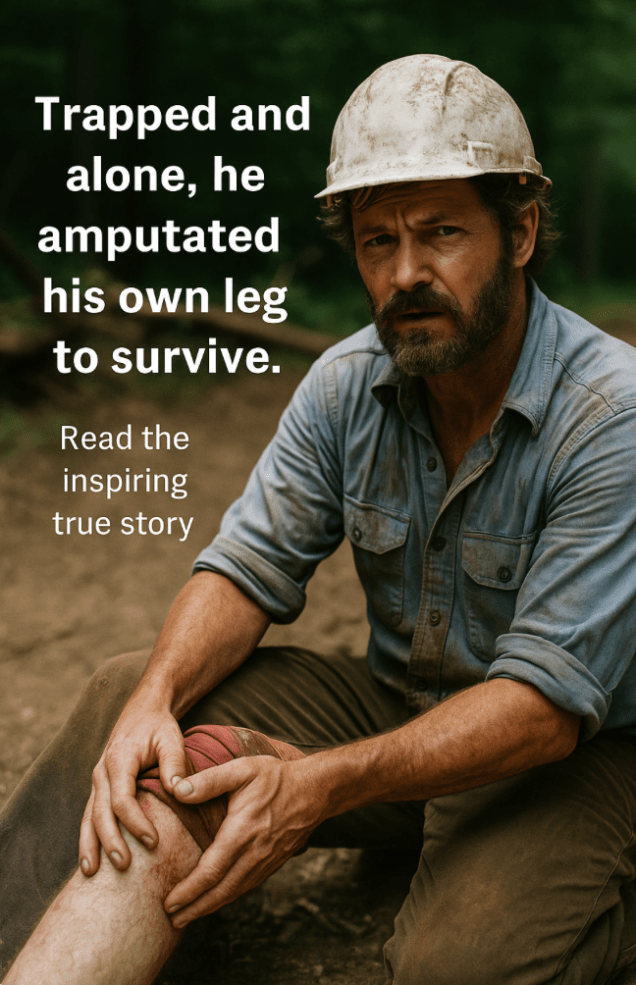
On a summer day in 1993, construction worker Donald Wyman, 37, found himself trapped. He was in the woods of Jefferson County, Pennsylvania. A fallen tree had crushed his leg so severely that he couldn’t free himself. After an hour of pain and helpless screaming, Wyman realized time was running out.
With no other choice, he made a tourniquet out of a shoelace and a wrench from his power saw. Then, with a courage most of us can barely imagine, he amputated his own leg. Using a seven-inch pocketknife—cutting through muscle, skin, and nerves to seize his survival.
Digital Illustration
Badly wounded, he dragged himself to his bulldozer, and drove—bleeding—to his pickup. Once in his truck he managed to reach a neighbor’s farm half a mile away. The neighbor, John Huber, called rescuers, who later found Wyman’s leg still pinned under the tree, boot and all. Thanks to his grit and quick medical response, Wyman survived and was upgraded from critical to stable within days.
Had he hesitated, his story would have been reduced to a one-paragraph obituary in his hometown paper. But Wyman wasn’t a victim—he was a survivor. He did what had to be done.
And that’s the lesson. You may never face a tree crushing your leg. Yet, you may face toxic relationships. You might meet negative influences or habits that hold you back. Sometimes survival means cutting away the very thing that’s dragging you down. You may face a country that has appeared to have turned against you. It won’t be easy. It may hurt. But in the long run, it can save your life—so you can live fully with those you love.
Not long ago, I was reminded of a question I was asked when I was younger. What is the single most important thing an individual can do today to protect themselves for the future?
The answer can vary depending on whether you’re considering finances, health, or personal growth. But if I had to distill it into one single most important thing, it would be –
Invest in Your Own Resilience
1. Health
Take care of your body—exercise, eat well, and emphasize sleep. Without health, everything else becomes harder. Your body is the foundation for your future self.
2. Mind
Keep learning. Read widely, ask questions, and develop skills that won’t become obsolete as the world changes. A flexible, curious mind is your best insurance policy against uncertainty.
3. Finances
Save consistently, even in small amounts. Building a safety net gives you the freedom to make choices later on and protects you when life throws surprises.
4. Relationships
Nurture authentic connections. Family, friends, mentors, and communities are often the strongest form of protection in a crisis.
5. Purpose
Know what matters to you. A sense of meaning provides direction and clarity to decisions when the future feels uncertain.
📌 If I had to choose one phrase to sum it up:
“Build resilience today—through health, knowledge, savings, and relationships—so tomorrow you’re strong enough to face whatever comes. If you keep your body, mind, and soul, they will sustain you.
Avoid The Big Three– Lust, Greed, and Complacency are the three factors that contribute to the destruction of any individual.
I was watching an old Western on television this past weekend. You know, the kind—cowboys and Indians. Or, as we might say today, American Ranchers and Indigenous Peoples.
The film, likely made in the 1950s, had the signature gloss of that era’s post-war cinema. Still, something about it suggested it was possibly shot even earlier, maybe in the 1940s. It was only later spliced, refitted, and packaged for the screen. The costumes, dialogue, and scenery all hinted at a time when the stereotypes were deeply ingrained in the script. They weren’t even questioned.
I probably watched that movie as a kid. I was sitting next to my father, not giving it a second thought. Back then, it was just another Western. But this time around, with a different set of eyes, what I saw was jarring.
It followed the predictable narrative: the cavalry riding in to tame the West and keep the “Indians” under control. Two delicately dressed white heroines were caught in the middle of a brewing conflict. A white doctor stood out as the lone character who dared to see Native people as human beings. He was mocked and ostracized for his compassion. This was especially true when a malaria outbreak swept through the tribe. He insisted they deserved treatment.
At one point, he stood in a room full of fellow whites. He asked,
“Do you think Indians are not human beings? Human beings like you and me, who deserve to live and be healthy?”
And one of the prim ladies, her hair perfect and her face untouched by empathy replied:
“I don’t know… how could they be?”
To which others in the room nodded and added,
“That’s right.”
“Of course, they’re not!”
“No way, in God’s name.”
I sat there stunned, wondering:
“How did a line like that ever make it into a movie script?”
Even more troubling:
“How did it get past editors, producers, censors—only to be broadcast, repeated, and absorbed by generations?”
It wasn’t just offensive. It was abusive. And it made me sad.
Is there a historical context to such language? Possibly. But what would a young Native American child feel sitting in front of that screen? Would they see their life reflected as something lesser—something not worthy of protection or dignity? Listening to the white characters, it certainly felt that way.
And it took me back to where I grew up.
I’m from the Kiowa and Comanche Counties area in Oklahoma—Caddo County, specifically. I was raised alongside Native American children, many of whom I called friends.
Later in life, I worked in law enforcement and came to know tribal members through both personal and professional relationships. I learned a great deal from them—about their culture, their pride, their pain.
When I started in law enforcement, the department had an initiation ritual. It involved arresting a man nicknamed Fifteen Thousand. He was a Native man, around 50 years old, who’d been detained countless times—hence the name. His real name was Thomas Kamaulty Sr.
He was the first person I ever arrested as an officer.
And, in time, Thomas became the first person I ever saw get sober. That meant something.
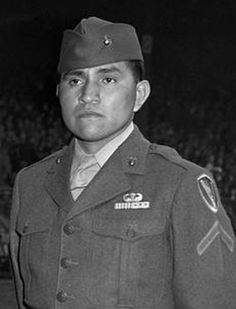
Ira Hayes
I also think about people like Ira Hayes. He was a Pima Indian from Arizona. Ira helped raise the flag at Iwo Jima during World War II. A hero by every standard. And yet, like Thomas, Ira suffered. Both carried the scars of discrimination and trauma. Both turned to alcohol as a way to numb the soul-deep wounds this country handed them.
We often ask why these cycles exist—but we rarely admit the truth: it’s because we’ve designed them to. We’ve placed people like Thomas, like Ira, into roles and systems. Their suffering can be managed. Their voices are diminished. Their lives are controlled. That was always the plan. And until we stop pretending it wasn’t, the script will keep playing—over and over again.
When I began my career in law enforcement, I experienced many “firsts.” One of the earliest was being assigned to a beat. I patrolled the alleys and streets of downtown, checking businesses and parks at night. The darkness was deep and constant. If fear crept in, the silence can feel almost haunting at times.
But I never let the shadows spook me. Not the sudden dash of a stray cat nor the wind rattling loose tin from an awning overhead. For a long time, I found nothing out of the ordinary. That is, until one night.
It happened in the park, beneath a pavilion by the river’s edge. I noticed someone lying across a picnic table. At nearly 2 a.m., the park was supposed to be empty. I stayed alert as I approached. I was constantly aware that people didn’t always travel alone. I didn’t want to be caught off guard.
As I approached, I spotted a can of spray paint beside her. A streak of glossy red paint coated her nose and mouth, dripping down her chin. She was a woman, and visibly pregnant, nearly full-term by the look of her.
I tried to wake her, but she didn’t respond. Her pulse was faint. Luckily, I had just been issued a portable radio—until recently, we’d relied on call boxes for communication. The radio gave me direct access to headquarters.
I keyed the mic and said,
“I need an ambulance under the pavilion at the river’s edge entrance. I have an unconscious female subject who appears to have been huffing paint. She’s approximately nine months pregnant.”
Headquarters confirmed and dispatched an ambulance promptly. Once it arrived, I assisted the paramedics. The woman was transported to a local hospital and then transferred to a larger facility for specialized care.
While searching the area, I found someone nearby who had passed out by the riverbank. I managed to rouse him. He was a man, around 32 years old, clearly intoxicated and unsteady. I placed him under arrest for public intoxication.
As I helped him up to the road, he turned to me and asked quietly,
“Is she going to be okay? I told her not to do that–– but she wouldn’t listen. That’s my baby, you know? I hope she’s alright.”
“Yes,”
I said.
I said,
“I hope the baby is okay, too. I’ve arranged a ride and a safe place for you to sleep tonight.”
The transport unit pulled up. As he climbed in, he paused, looked at me, and said,
“I’m glad you found us. It has saved both of us. Thank you!”
I nodded and replied,
“You’re welcome, try to get some sleep.”
It was one of the few times someone going to jail thanked me for stepping into their life. There would be other moments like this, but not many involving an unborn child.
I later learned the mother’s actions had not affected the baby. She had been admitted for addiction treatment, and hopefully, she stayed through the delivery and beyond. I never saw her again. I often think of that night. I think of how close things came to ending differently. Sometimes, just showing up can change everything.
Groff Media is sharing this piece unedited from Foxes Den. The next is the introduction to the piece. The link to the writers’ pages is posted near the end so you can go to the original site’s writing.
FROM THE FOXES DEN – (unedited)
If you could un-invent something, what would it be?
I’ve browsed around some of the replies to this prompt and I must say I’m quite surprised. Surprised to see so many people wishing that social media could be un-invented. Now I am with these people 100%, I agree it’s a breeding ground for hatred and vitriol, however as so many are already mentioning social media I feel I should suggest something else because to not do so would make this post quite repetitive and boring.
Well it will probably still be boring but here goes.
Addiction. If only there wasn’t such a thing. Again it’s one of those things that is good to have in certain scenarios but an absolute nightmare to have in others. Let’s talk about the nightmare scenarios.




 benandsteve.com