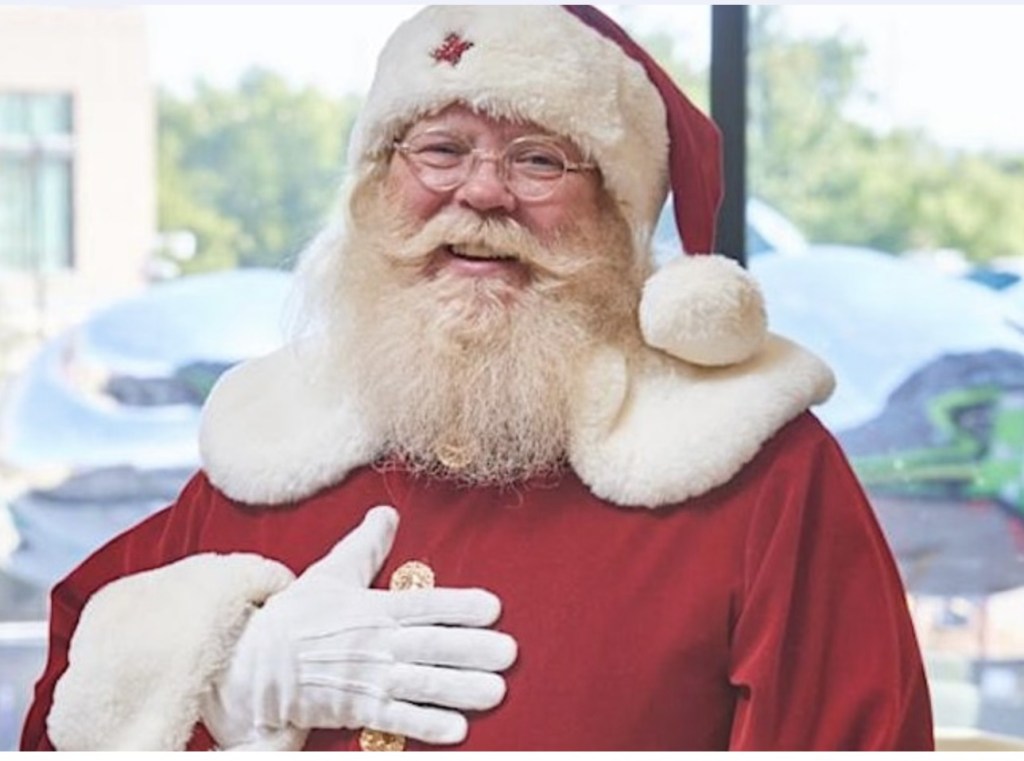
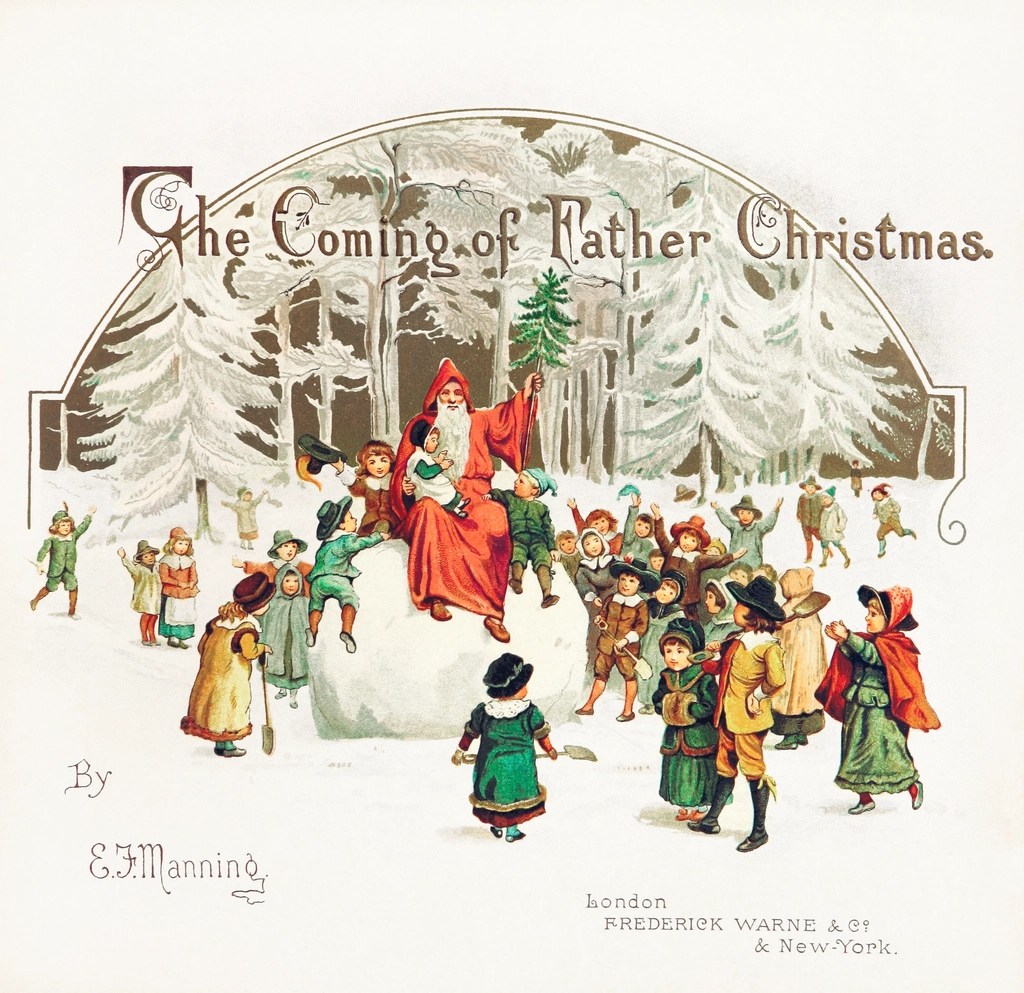
Santa’s Time-Warped Christmas

The current image has no alternative text. The file name is: as-santa-claus-guided-his-sleigh-over-the-north-pole.png
It Is Only Six Days Until Christmas Eve!

This story is pulled from the archives as a celebration for the season edition.

Groff Media 2024© Truth Endures IMDbPro

Presented by benandsteve.com By: Benjamin Groff II©

3–4 minutes

As Santa Claus guided his sleigh over the North Pole, the stars shimmered brighter than ever. It was Christmas Eve, and his magic sleigh, loaded with gifts for children worldwide, zipped through the frosty air. But something strange happened as he crossed a shimmering aurora—an inexplicable jolt rattled the sleigh.

“Dasher, what was that?”

Santa muttered, steadying his hold on the reins. The reindeer snorted in reply, uneasy.

The aurora enveloped him before he gathered his thoughts, and time seemed to twist and fold around him. When the light dissipated, the world below him was not the one he knew. Snow-covered cottages and horse-drawn carriages replaced the bustling cities of 2024.

Santa realized he had been thrown back in time to the mid-1800s. He recognized the period instantly from the distinct architecture of a village below. It was a Christmas during a dark chapter in history. A devastating plague had gripped the land. It forced him to cancel his rounds that year.

“Great gumdrops!”

Santa exclaimed.

“What are the odds?”

He gazed at the sleigh’s cargo. By a twist of fate, it had been stocked with emergency medical supplies. These were intended for a charity hospital in the modern era. Among the crates were antibiotics, syringes, and boxes of penicillin.

As he landed his sleigh in the village square, the grim reality of the situation became clear. Emaciated villagers huddled near fires, their coughs echoing through the silent night. Santa’s heart ached as he walked among them, his red suit standing out against the bleak surroundings.

A child approached him, her face pale and gaunt.

“Who are you?”

She asked, her voice weak.

Santa knelt, his jolly demeanor softening.

“I’m Santa Claus, my dear. And I’ve brought –– hope.”

He opened a crate, revealing the miracle medicines of the future. Doctors, initially skeptical, were astonished by how quickly the penicillin began to heal their sickest patients. Word spread, and soon, Santa was inundated with requests for help.

But as he worked tirelessly through the night, a troubling thought weighed heavily on him. He altered the course of history by introducing modern medicine to the past. He remembered the first rule of time travel: do not interfere. Yet how he stand by and let so many suffer?

Santa consulted his reindeer, who were no strangers to magical predicaments.

“What do you think, Comet? If we save them now, what happens to the future?”

Comet stamped his hoof thoughtfully as if to say,

The heart often knows what the mind can’t reason.

Santa decided to take the risk.

“If kindness is a mistake, then I’ll gladly make it,”

He said aloud.

By dawn, the village was transformed. People sang carols, their strength returning. They looked at Santa with gratitude and wonder as he prepared to leave.

“Thank you, sir,”

said the village doctor.

“You’ve given us a miracle.”

Santa nodded, but his heart was heavy with uncertainty. As he guided the sleigh back into the sky, the aurora reappeared, pulling him back to his own time.

When he returned to the North Pole, he checked the world’s records, bracing for the consequences of his actions. To his amazement, the plague of the 1800s had been recorded as miraculously subsiding in one particular region. Yet, history did not explain this occurrence. Furthermore, the trajectory of medicine had advanced more quickly than he remembered. The saved lives gave rise to several key figures. These figures contributed significantly to society.

Santa smiled, chuckling saying,

“History has a way of balancing itself after all.”

Santa pondered the night’s events on Christmas Eve as he settled into his chair by the fire. Sometimes, he thought, doing the right thing means accepting the unknown. In the spirit of Christmas, a little magic can change the world for the better. A lot of kindness can also make a difference, no matter the time.

The Hot Dog Santa Which Warms Children’s Hearts

This story is pulled from the archives as a celebration for the season edition.

Groff Media 2024© Truth Endures IMDbPro

Presented by benandsteve.com By: Benjamin Groff II©

~ When Santa Claus Stopped Coming To Town ~

From the original Hot Dog Santa Brings Christmas Cheer to Children, originally posted on December 10, 2024, by Jenny Ashcraft

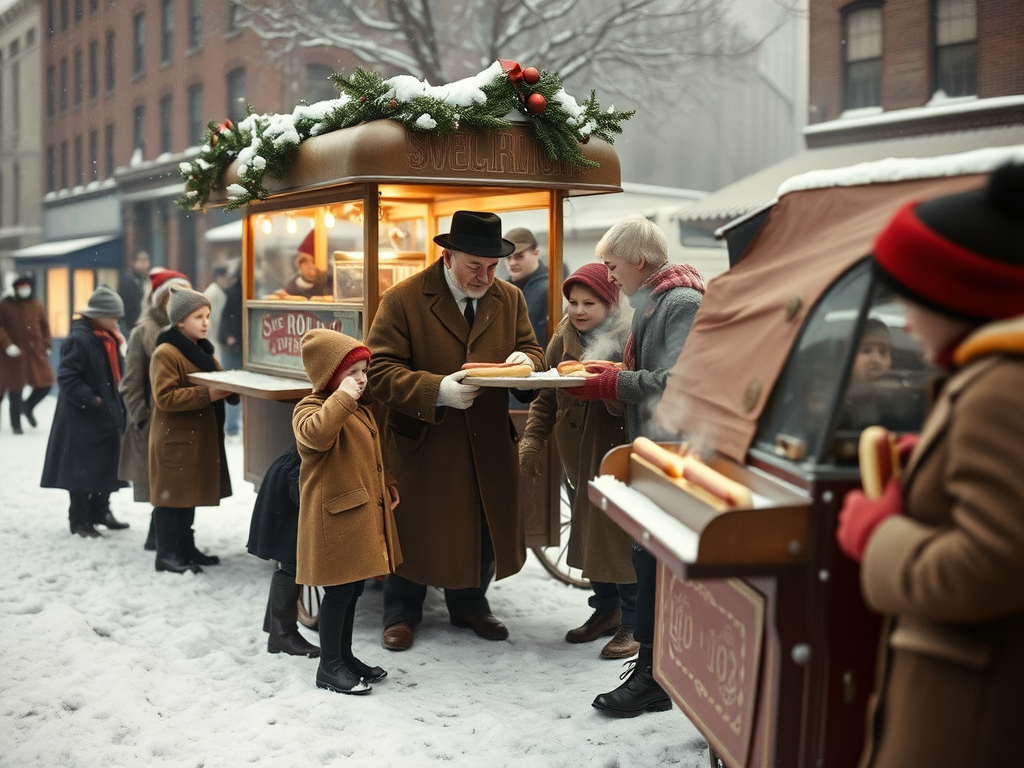
On Christmas Day in 1921, a Swedish immigrant named Axel Bjorklund quietly pushed his hot dog cart to a corner in Boston’s North End. There, he handed out 500 steaming hot dogs to cold and hungry children, a simple act of kindness that would leave a lasting legacy.

Axel knew what it meant to struggle. He barely scraped by himself, but his heart ached for the impoverished children he saw daily. Hundreds of children, some as young as five, lined up in their threadbare clothes that chilly Christmas morning, shivering against the cold.

Despite their hunger and hardship, their faces lit up with joy as Axel handed each one a hot dog. Though the food quickly ran out, Axel’s resolve did not. He was determined to make this a yearly tradition. Over the next eight years, he gave away an astonishing 10,000 hot dogs before passing in 1930.

Axel was born on August 6, 1869, in Gothenburg, Sweden. In 1889, he immigrated to America and eventually settled in Boston’s North End, a neighborhood brimming with immigrants striving to build better lives.

Yet, poverty was rampant, especially after the devastating Spanish Flu pandemic left many families destitute and orphaned children wandering the streets. Amid this suffering, Axel’s generosity shone like a beacon of hope.

After a brief and unhappy marriage, Axel lived alone and decided to start a hot dog stand at the busy corner of Blackstone and Hanover Streets. The simple job gave him a sense of purpose, but seeing the hunger around him determined him to do more. He vowed that no child would go hungry if he had food to offer. His first Christmas giveaway in 1921 was a success, and he expanded the effort the following year, doubling the number of hot dogs to 1,000.

His annual giveaway grew as word of Axel’s kindness spread, eventually reaching 3,000 hot dogs yearly. The children affectionately began calling him “Hot Dog Santa.” Newspapers from across the United States and even Sweden shared his story, celebrating his selfless tradition.

Over time, Axel moved his hot dog giveaway to New Year’s Day, but the event remained a cherished occasion for the children who eagerly awaited it. However, Axel’s health began to deteriorate. Rheumatism caused frequent hospital visits, and his financial situation worsened. Struggling to pay his rent, Axel reached out to the public for help, determined to continue his tradition despite his hardships.

In December 1928, just before the giveaway, Axel’s landlady evicted him for failing to pay rent. The Salvation Army provided temporary support, but Axel’s circumstances grew increasingly dire. Over the next two years, he bounced between shelters, the poorhouse, and the Cambridge Home for the Aged, relying on the generosity of strangers. Even so, in 1929, he hosted one final hot dog giveaway.

On November 10, 1930, Axel Bjorklund passed away in a Massachusetts hospital, penniless and alone. He had no family and was destined for a pauper’s grave until news of his death reached the public. Outraged by his fate, citizens rallied together to give the man they called “Hot Dog Santa” a proper burial. Axel Bjorklund’s legacy of compassion and selflessness reminds us of the power of small acts of kindness during difficult times.

Remember, this holiday season, while times may feel joyful and bright for you, they could be challenging and somber for someone else. Offering a helping hand isn’t always a handout—it’s a gesture of humanity and compassion. Let’s take a moment to consider the needs of our fellow human beings, not just during the holidays but every day of the year.

Read original story about the Hotdog Santa Claus Here

Santa’s Mission of Love

This story is pulled from the archives as a celebration for the season edition.

Groff Media 2024© Truth Endures IMDbPro

Presented by benandsteve.com By: Benjamin Groff II©

3–4 minutes

In the heart of a frosty December, Santa Claus sat in his workshop. His eyes scanning the pages of his magical list. It was a heavy year; kindness seemed scarce, and the world became fractured in ways he hadn’t seen before. One town in particular tugged at his heartstrings—Silver Pines, nestled in the Appalachian Mountains. Its beauty hid a darker reality. The LGBTQ+ community, especially gay individuals, faced judgment and outright abuse. Yet, in the face of such adversity, they showed remarkable courage. Letters from people in Silver Pines painted a picture of sorrow, isolation, and a longing yet to be seen.

Santa set down the list with a deep sigh. “No mistakes,” he whispered, stroking his snowy beard. It was a mantra he had held onto since the dawn of time. Every soul was crafted perfectly. Its existence was a thread in the fabric of humanity. His mission was to remind others of this truth.

The night of Christmas Eve was crisp, the air biting but alive with the hum of anticipation. Santa’s sleigh cut through the sky, its bells jingling softly. His bag was lighter than usual. It was not because he carried fewer gifts. His offerings weren’t wrapped in paper this year.

He landed in Silver Pines just past midnight, his boots crunching on the snow-covered streets. Despite the hour, the town was still. He began his journey with his signature magic. He quietly stepped into homes where letters had been written. He spread warmth and comfort to those who needed it most.

At the tiny home, Santa left a handwritten note. Liam and Paul were a gay couple who had faced the brunt of the town’s scorn. It read:

“You are seen. You are loved. You are perfect as you are.”

In another house, a young teen named Oliver found a shimmering snow globe under his tree. He had been wrestling with the fear of coming out. When he shook it, it revealed a rainbow that shimmered against the glass, and inside, a message:

“Your truth is your strength. The world needs your light.”

Throughout the night, Santa wove love into every corner of Silver Pines. He touched the hearts of allies, planting seeds of courage to stand against hatred. He left dreams of acceptance in the minds of those who harbored prejudice. His gifts weren’t toys or trinkets. They were powerful reminders of humanity’s shared essence. Each one carried the potential to transform hearts and minds.

By dawn, the town began to stir. Liam and Paul awoke to find the note, their hearts swelling with hope they hadn’t felt in years. Oliver clutched his snow globe, feeling a new resolve to embrace who he was. The day unfolded slowly. The spirit of Santa’s gifts began to ripple. This ripple ignited a wave of change. This wave would soon engulf the entire town.

People who had once turned away from their neighbors now questioned their biases. Conversations began, tentative at first but growing bolder with time. Acts of kindness, like inviting a marginalized individual to a community event, replaced judgment, and barriers began to crumble.

Santa watched from a distance, his eyes twinkling. The journey wasn’t over—true change would take time—but the seeds had been planted. As he climbed back into his sleigh, he whispered into the cold morning air:

“There are no mistakes in my Father’s design. Love is the gift I give, but it is also the gift you must carry ahead.”

And with that, Santa soared into the sky, his mission not finished but well underway.

The Blizzard of ’78 and the Chetwood 500

This story is pulled from the archives as a celebration for the season edition.

Groff Media 2024© Truth Endures IMDbPro

Presented by benandsteve.com By: Benjamin Groff II©

3–4 minutes

The Blizzard of ’78 was no ordinary snowstorm. It howled through North America, blanketing rooftops and highways, erasing the horizon in a swirling fury of white. Santa Claus sat in his workshop. He held his red velvet hat in his hands. He stared solemnly at the weather reports brought in by the Weather Elves.

“It’s no use,” 

Santa said, his voice heavy. 

“We can’t fly in this. It’s too dangerous. The snow is too thick, and even Rudolph’s nose won’t cut through this blinding storm. I have to call off deliveries.”

Gasps filled the workshop. Elves dropped their tools, and Mrs. Claus paused her cookie baking. Cancel Christmas? It was unthinkable.

But one elf, a tinker named Chetwood, didn’t gasp. He didn’t drop his tools. Instead, he dashed to his workshop in the far corner of the North Pole. Odds and ends of toys from Christmases past piled high in organized chaos.

Chetwood had been working on a secret invention for years. He used discarded parts from electronic toys no child had wanted. These parts included remote-controlled cars, walkie-talkies, old circuit boards, and an outdated Etch A Sketch. He believed there had to be a way to guide Santa’s sleigh through anything, even the thickest fog or snowstorm.

Tonight was his chance.

For hours, Chetwood worked feverishly, soldering wires, tweaking circuits, and adjusting dials. The other elves whispered about his eccentricity. 

“Chetwood’s always been a dreamer,” 

One said.

“What could he possibly be doing now?”

At midnight, the storm raged on outside. Chetwood burst into the main workshop. He was holding a contraption resembling a patchwork of wires, gears, and blinking lights. He had painted it candy-cane red with a shiny silver antenna on top.

“Santa!”

He cried.

“I call it the Chetwood 500. A radar system can guide the sleigh through total darkness, blizzards, and even the densest fog. I made it from old toys that no one wanted—because one elf’s trash is another elf’s treasure!”

Santa raised an eyebrow but smiled warmly. 

“Chetwood, are you sure this will work?”

“With 100 percent accuracy,” 

Chetwood replied proudly.

The elves gathered around as Chetwood mounted the device on the sleigh. The radar emitted a soft, rhythmic beep, lighting up a screen that displayed glowing outlines of obstacles in their path.

Rudolph gave an experimental snort and trotted to the front of the sleigh, curious about the gadget. Santa climbed into the driver’s seat, gripping the reins tightly.

“All right, Chetwood,” 

Santa said. 

“Let’s see if your invention can save Christmas.”

The sleigh took off into the Blizzard, disappearing into the swirling snow. The elves held their breath, watching the radar screen from the workshop.

Minutes turned into hours. Soon, reports came in from children across the globe. Santa had arrived, gifts were under the tree, and stockings were filled. The Chetwood 500 had guided the sleigh flawlessly, even through the most treacherous conditions.

When Santa returned to the North Pole just before dawn, he lifted Chetwood onto his shoulders. 

“You didn’t just save Christmas, Chetwood. You’ve created something that will change the world. One day, your radar will guide airplanes and ships where they’ve never dared to go before!”

From that day on, Chetwood’s invention became a staple of Christmas lore. Every Christmas Eve, the Chetwood 500 sat proudly atop Santa’s sleigh. It served as a reminder. Even the most unwanted things can shine with purpose in the hands of a true believer.

How Santa Tackles a Sky Jam in Los Angeles

This story is pulled from the archives as a celebration for the season edition.

Groff Media 2024© Truth Endures IMDbPro

Presented by benandsteve.com By: Benjamin Groff II©

2–3 minutes

Santa Arrives In Los Angeles To A Bustling Scene:

Santa is cruising through a starry night, his sleigh packed with presents. The reindeer are soaring with precision, Rudolph’s nose shining bright as they approach the bustling skies over Los Angeles. Santa remarks on how the city glows more colorful each year, marveling at the dazzling lights below.

The Problem Arises:

Santa checks his list. He guides the sleigh toward his next stop. Suddenly, he encounters a startling sight: a line of airplanes backed up in the sky. The sleigh slows as Rudolph blinks in confusion, and Santa pulls out his magic map to see what’s going on.

The airspace gets crowded with jets circling LAX, cargo planes, and private airplanes. Santa tries to weave through the gridlock but quickly realizes he’s stuck in a “sky jam.”

Santa’s Reaction:

Santa, determined to overcome this unexpected obstacle, starts to worry. He’s never faced air traffic congestion before! His magical sleigh, while nimble, still must adhere to the rules of the sky to avoid being spotted. He radios an air traffic controller using a unique device from his sleigh—something he rarely needs to do.

The controller is startled but professional.

“Uh… Santa? Is that you?”

“Ho ho ho! Yes, indeed! And I’m afraid I need some assistance navigating this mess!”

A Helping Hand:

The air traffic controller, Mia, quickly gathers her colleagues. They realize the only way to clear Santa’s path is to redirect some planes. Mia cleverly uses holiday magic and persuasion to coordinate a temporary gap in the airspace.

Meanwhile, Santa and the reindeer entertain themselves by performing aerial stunts. They draw candy canes in the sky. They share cookies with passing pilots who radio in. Their voices are filled with disbelief and joy.

A Creative Solution:

Santa, ever resourceful, taps into his bag of tricks to make up for lost time. He uses his magic to make his sleigh move twice as fast once the path clears. He asks for help from local elves stationed in Los Angeles. They zip around on drones to deliver some gifts while he’s getting delayed.

Santa’s Resolution:

The airspace clears, and Santa takes off like a rocket. With a heartfelt

“Thank you!”

To Mia and the air traffic team, he speeds into the night. He catches up on his deliveries with minutes to spare.

Ending:

As Santa finishes his rounds, he reflects on the night’s chaos. He chuckles, imagining the stories pilots will tell about seeing a sleigh stuck in traffic.

“Ho ho ho!” 

He bellows as he heads back to the North Pole.

“Next year, I will just get a flight plan!”

The Christmas Eve Babbs Switch School Fire

This story is pulled from the archives as a celebration for the season edition.

Groff Media 2024© Truth Endures IMDbPro

Presented by benandsteve.com By: Benjamin Groff II©

3–5 minutes

Every year at this time, I am reminded of a harrowing story. It is deeply etched into Oklahoma’s collective memory: the Babbs Switch School Fire of Christmas Eve, 1924. It stands as a tragic lesson in safety, humanity, and resilience.

The Fire

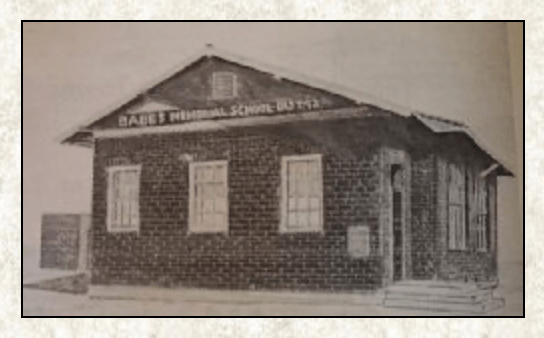
On that bitterly cold night, with heavy snow and sub-zero temperatures, 200 residents gathered. They met in Babbs Switch’s one-room schoolhouse for a Christmas Eve program. The school was tightly packed with engaged couples, grandparents, mothers, fathers, and children. The building’s windows were secured with wire mesh to deter intruders from the nearby railroad tracks. The sole exit—a door that opened inward—would soon become a deadly trap.

The program concluded with a teenage boy dressed as Santa Claus. He handed out toys and candy beneath a cedar Christmas tree. The tree was decorated with paper, tinsel, and lit candles. One of these candles brushed against the tree’s dry needles, igniting it instantly. Mrs. W.G. Boland, whose three children perished that night, later recounted the horror. 

“I tried to beat it out with a paper sack,”

she said, 

“but it did no good.” 

Initially, the crowd laughed, believing the small blaze was being contained. But within moments, the flames engulfed the tree, the ceiling, and the entire structure.

Panic erupted.

The sole exit became a bottleneck as the crowd surged toward the door. Those at the back pushed forward, while the unlucky at the front got crushed in the chaos. Some attempted to pry open the wired windows, but their efforts were futile. Trapped inside, children, parents, and neighbors succumbed to the smoke and flames. Witnesses recalled the horrifying scene of people clawing at the exit. Bodies piled atop one another, and the acrid stench of burning flesh.

The Survivors

Among those who escaped was Lillie Biggers. She crawled out from under a desk clutching a doll she had just received. Her mother, Margaret, managed to get out but suffered severe burns to her hands and arms. Tragically, Lillie’s brothers, William, 9, and Walter, 15, did not survive. The Biggers family’s grief mirrored that of the entire community, where 36 lives were lost—half of them children. The belongings later identified the bodies of William and Walter. They carried a toy gun and a belt buckle.

The injured and deceased were transported to Hobart, the nearest town, where makeshift morgues were set up. The community’s response, known as the “Hobart Spirit,” saw residents drop everything to give aid and comfort. Newspaper accounts likened this effort to the Oklahoma Standard that emerged decades later after the Oklahoma City bombing.

Julie Braun with Mother
Lillie’s Doll That Survived Fire

The Aftermath

The tragedy prompted a wave of reforms. Oklahoma legislators enacted fire safety laws requiring outward-opening doors, multiple exits, and accessible window screens in schools. Open flames were banned, and fire extinguishers became mandatory. The reforms eventually spread nationwide, though it would take more tragedies before they were fully adopted.

The morning after the Babbs Switch School Fire

A Missing Child

The story took a strange twist that turned it into a lingering mystery. Among the victims was three-year-old Mary Edens—or so it was believed. Her aunt, Alice Noah, escaped the building. She died days later. She claimed she had handed Mary to an unknown person outside the burning building. Mary’s body was never recovered, leading her family to hope she had survived.

In 1957, decades after the fire, a woman named Grace Reynolds came forth. She was from Barstow, California. She claimed to be the long-lost Mary. The Edens family reunited with her on Art Linkletter’s House Party television program, believing their prayers had been answered. Reynolds even wrote a book about her experiences. It is titled Mary, Child of Tragedy: The Story of the Lost Child of the 1924 Babbs Switch Fire.

But only some were convinced. A local newspaper editor who investigated the claim questioned its validity. 

Skeptics noted inconsistencies in Reynolds’s story, but no definitive evidence confirmed or debunked her identity. To this day, the truth remains elusive.

Legacy

The Babbs Switch School Fire is remembered as one of the deadliest school fires in U.S. history. A stone monument now stands where the schoolhouse once stood, a quiet marker of lives lost and lessons learned. The physical scars of the tragedy have faded. Yet, its memory endures. It serves as a poignant reminder of the fragility of life and our enduring hope for safety and change.

References for this writing can be found at – 

https://blogoklahoma.us/place/394/kiowa/site-of-babbs-switch-tragic-school-fire

https://www.thesirenspodcast.com/post/case-files-babbs-christmas-fire

https://genealogytrails.com/oka/kiowa/babbsfire.html

https://en.wikipedia.org/wiki/Babbs_Switch_fire

The Year Joey And Jimmy Saved Christmas

This story is pulled from the archives as a celebration for the season edition.

Groff Media 2024© Truth Endures IMDbPro

Presented by benandsteve.com By: Benjamin Groff II©

3–5 minutes

Joey and Jimmy McAllister were known in the little town of Maple Hollow for their endless mischief. Like clockwork, Santa’s naughty list bore their names in bold, red ink every year. The brothers raided the cookie jar before dinner. They set off firecrackers in the backyard. They also sneaked frogs into their teacher’s desk drawer. The brothers always found trouble. Trouble always found them.

But this year was different. Something strange was happening in the McAllister household. Joey and Jimmy were behaving like angels. They shared their toys, completed their chores without being asked, and even helped old Mrs. Henshaw carry her groceries home. The town was surprised as the boys’ antics disappeared like melting snow. It wasn’t long before whispers reached the North Pole.

Santa Claus, peering over his list in his workshop, rubbed his spectacles in disbelief. 

“Joey and Jimmy?”

He muttered. 

“Good? All year?” 

He scribbled a note to Mrs. Claus. 

“Something isn’t right. I need to investigate.”

So, with Christmas Eve approaching, Santa decided to do undercover work. Disguised as a kindly repairman, he appeared at the McAllister’s doorstep one frosty afternoon.

Joey answered the door, his face pale with worry.

“Hello, sir,” 

He said politely. 

“Can I help you?”

“Just checking the neighborhood for chimneys in need of repair,” 

Santa said, glancing around. 

“I couldn’t help but notice you and your brother have been outstanding this year. What’s brought about the change?”

Joey’s face fell. 

“We just wanted to make sure we were good enough to get what we wished.”

Santa’s heart warmed. 

“Well, that sounds lovely. What did you wish for?”

Jimmy appeared behind Joey, his voice barely a whisper. 

“We don’t want toys or anything like that. We want Mom to get better.”

Santa’s heart ached. He noticed their pale and frail mother sitting by the fireplace. Her knitting needles trembled in her hands. He realized the boys’ sudden good behavior wasn’t driven by selfishness, love, and desperation. As only children can, they believed. If they were perfect, their Christmas wish would come true. Their mother’s illness would vanish like the morning frost.

Back at the North Pole, Santa sat in his armchair that evening, deep in thought. 

“How do I tell them?” 

he murmured. 

“How do I explain that even the magic of Christmas can’t fix everything?”

Mrs. Claus placed a hand on his shoulder. 

“Remind them of what Christmas truly means,” 

she said softly. 

“It’s not about making everything perfect. It’s about love, hope, and being together, even in the hardest times.”

Christmas Eve arrived, and Santa climbed down the McAllisters’ chimney. He found Joey and Jimmy waiting by the tree, their eyes wide with hope. Santa knelt before them, his eyes twinkling but serious.

“Joey, Jimmy,” he began, “I know what you’ve wished for, and I need you to understand something significant. Your love for your mother is the most powerful gift you can give her. It’s stronger than anything I can put in my sack.”

Tears welled in Joey’s eyes. “But we thought if we were good, you’d save her. Isn’t that how it works?”

Santa pulled the boys close. 

“Sometimes, even the best magic can’t stop someone we love from becoming an angel. Your mother’s journey is not something you can control, but your love will make every moment she has brighter. And no matter what happens, she will always be with you.”

The boys sobbed quietly, and Santa held them until their tears slowed. Then he reached into his sack and pulled out a small, glowing star ornament. 

“Hang this on your tree. It’s a reminder that the people we love are never truly gone. They watch over us like stars in the night sky.”

When Christmas morning came, the McAllister family gathered around the tree. Weak but smiling, their mother held the glowing ornament in her hands. The boys’ hearts felt heavy but full, knowing their love was the best gift they gave her.

That year, Joey and Jimmy stayed off the naughty list for good. Though their mother passed the next spring, her love and courage became the foundation of their lives. Every Christmas, they hung Santa’s star on their tree. It was a beacon of hope, love, and the enduring magic of family.

The Christmas Bells of Valley Brook

Groff Media 2024© Truth Endures IMDbPro

Presented by benandsteve.com By: Benjamin Groff II©

3–4 minutes

Every Christmas Eve, the quiet village of Valley Brook transformed into a magical tableau. As snow blanketed the streets, an ethereal ringing of bells echoed through the valley. The sound was sweet and haunting, like a melody from another world. The villagers marveled at the phenomenon for decades, yet no one knew where the bells came from.

The mystery was part of Valley Brook’s charm. Some claimed the bells were angels’ gifts, while others swore they were the spirits of Christmases past. But to Ethan, a curious young man with a heart full of wonder, the mystery demanded answers.

Ethan had lived in Valley Brook his entire life. Each Christmas, he stood at the frozen brook’s edge. He strained to hear even the faintest hint of the bells’ origin. Now 19 and filled with determination, Ethan resolved that this year would be different.

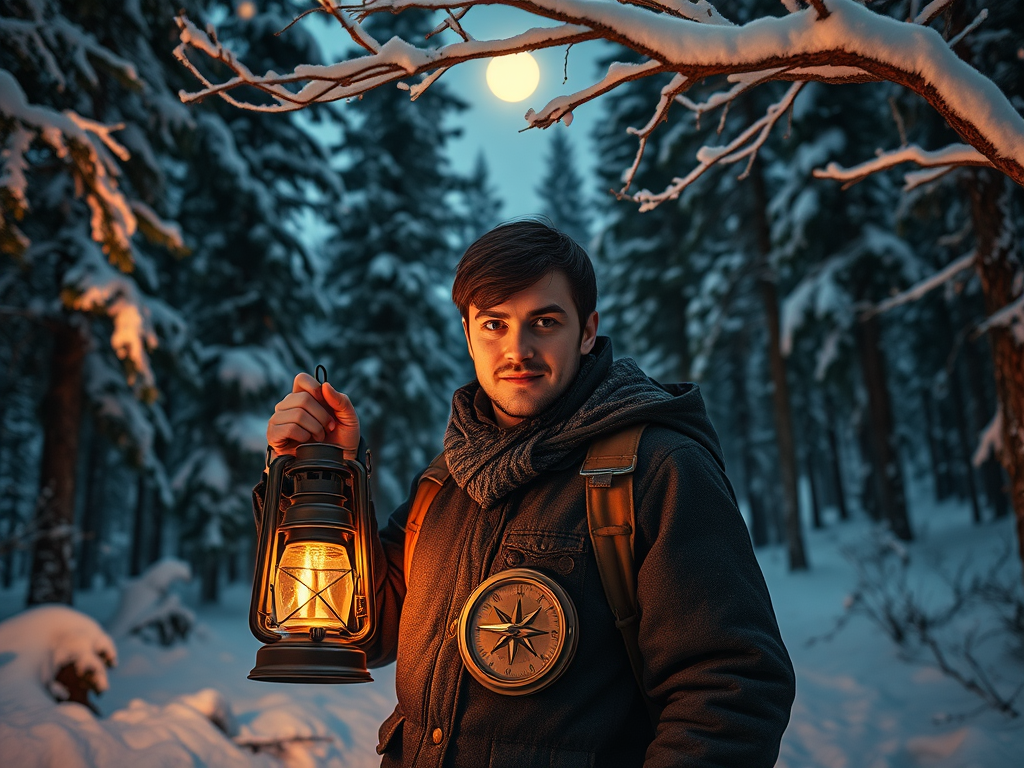
On Christmas Eve, armed with a lantern and his father’s old compass, Ethan entered the night. The air was crisp, and the snow crunched beneath his boots. As the bells began their enchanting tune, he paused to listen.

“North,” he whispered to himself, turning toward the sound.

The first stretch of his journey led him to the forest bordering the village. The tall pines were heavy with snow, their branches arching over him like cathedral ceilings. The bells grew louder as he walked deeper into the woods. Then, they seemed to shift direction, drawing him toward the hills.

Ethan climbed steadily, his lantern casting long shadows against the rocks. At the top of the hill, he paused to catch his breath. The bells sounded closer now, but their source still eluded him. His compass needle jittered as if caught in some unseen magnetic pull.

After the sound, Ethan descended into a hidden ravine. At the bottom, he discovered an ancient stone bridge, its surface worn smooth by time. Beneath it, the brook that gave the village its name flowed silently, its surface coated in thin ice. Ethan crouched and pressed his ear to the stones. The bells resonated through the bridge itself.

“This must be it!”

he exclaimed, but as soon as the thought formed, the melody shifted again, beckoning him onward.

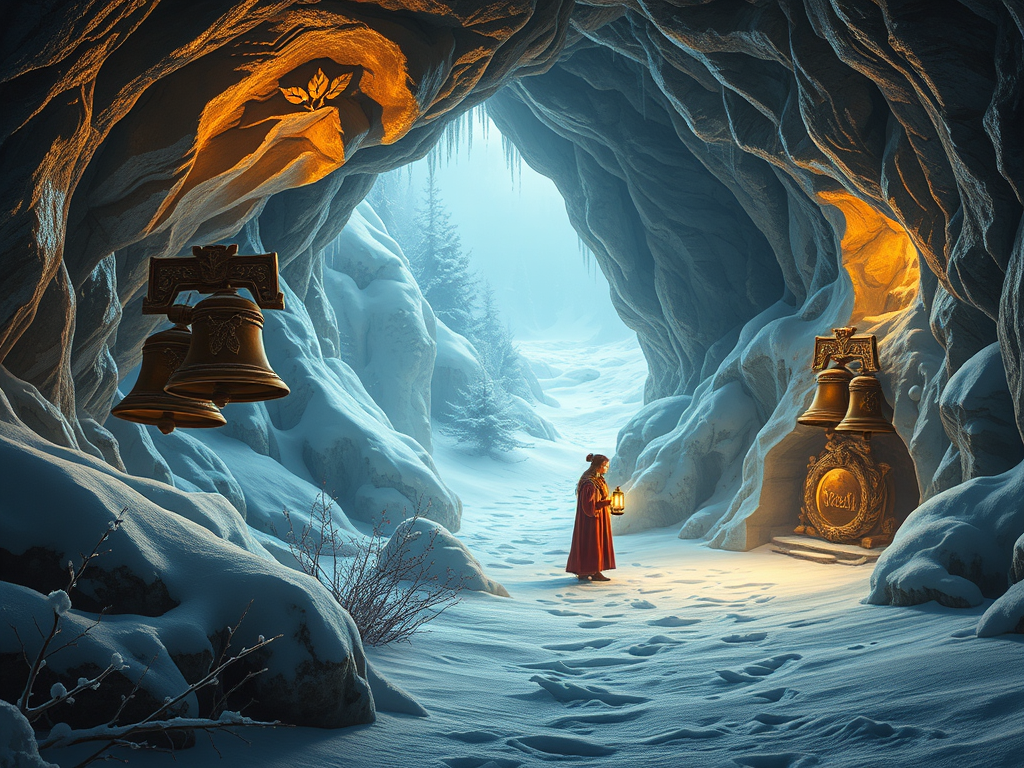
Ethan continued his pursuit for hours, weaving through snow-covered meadows and icy trails. Finally, the first light of Christmas morning touched the horizon. He arrived at the mouth of a cavern nestled in the cliffs at the valley’s edge.

Inside, the bells chimed more clearly than ever. He entered cautiously, the glow of his lantern illuminating crystalline walls that shimmered like diamonds. He found them at the cavern’s heart. Rows of bronze bells were suspended in midair. Their surfaces were adorned with intricate carvings of holly and ivy.

Ethan approached in awe, reaching out to touch one of the bells. When his fingers brushed the metal, a warm light enveloped the cavern. A figure appeared—a woman in flowing robes, her face serene and timeless.

“Who are you?”

Ethan asked, his voice trembling.

“I am the Keeper of the Bells,”

she replied.

“These bells have rung for centuries to remind Valley Brook of the spirit of Christmas—hope, love, and unity. Only those who seek their origin with a pure heart will find them.”

“Why me?” 

Ethan whispered.

“Because you dared to wonder,”

 she said with a smile.

“Now, you must decide: will you keep their secret or share their magic with the world?”

Ethan thought of his village and how the bells brought everyone together each Christmas. Their mystery was part of what made them special. He nodded.

“I’ll keep the secret.”

The Keeper’s smile widened.

“Then the bells will continue to ring, their magic preserved for all who believe.”

When Ethan returned to Valley Brook, the bells still rang as they always had, their melody echoing through the valley. But now, when he stood at the edge of the brook, he smiled. He knew he was part of their timeless magic. He was a secret keeper of the Christmas Bells of Valley Brook.

“Herbie” ––– The Tiny Christmas Tree Searches For A Family

This story is pulled from the archives as a celebration for the season edition.

Groff Media 2024© Truth Endures IMDbPro

Presented by benandsteve.com By: Benjamin Groff II©

3–4 minutes

In a quiet forest stood a skinny cedar tree, so different from all the others. The tall, majestic cedars around him stretched their lush branches high. In contrast, the little tree looked scrawny. It had sparse needles and a slightly crooked trunk.

People often came to the forest to select the perfect Christmas tree, always passing him by.

The other trees whispered and rustled in the wind, teasing him.

“Look at you, Herbie,”

They said, giving him the nickname that stuck.

“No one’s ever going to want you.”

Herbie tried to stand tall, but he knew they were right. Year after year, Herbie remained as the big, beautiful trees were chosen and taken away. The forest changed around him. He stayed in his lonely spot. He dreamed of what it would feel like to be wanted.

Then, one crisp winter morning, the tree cutters came again, their saws buzzing. Herbie didn’t expect to get noticed, but this time, something different happened. As they cleared their path, one of the workers stopped, scratched his head, and said,

“Well, let’s take this little one, too. Someone might like it.”

Herbie felt the sharp blade cut through his trunk. Before he could fully understand what was happening, he was bundled with the others and taken to the city.

A sea of magnificent Christmas trees surrounded Herbie at the tree lot. Their branches glistened with dew, and they stood tall and proud. Compared to them, Herbie felt even smaller, and his crooked trunk made him look even more awkward.

Shoppers strolled by, admiring the grand trees and taking them home individually. Herbie overheard a nearby pine whisper,

“Face it, Herbie, you’re not cut out for this. No one’s going to pick you.”

The lot grew emptier daily, and Herbie’s hope dwindled. By Christmas Eve, he was the only tree left, standing under the dim glow of a street lamp. The wind whistled through his sparse branches, and Herbie prepared for the inevitable—being tossed away, unloved.

But just as Herbie’s spirits hit their lowest, a tiny voice broke through the cold night air.

“Mama, look! That one’s perfect!”

Herbie lifted his branches slightly in surprise. A little boy with messy hair and bright, eager eyes was pointing at him.

“Are you sure, Tommy?”

His mother asked, crouching beside him,

“This tree is so small. And, well, it’s not exactly full.”

––––

“Exactly!”

Tommy said with a grin.

“It’s different, just like me. We’ll make it the best Christmas tree ever!”

Herbie’s heart soared as Tommy and his mother carefully carried him home. Tommy got to work in their cozy living room, stringing popcorn and cranberries across Herbie’s branches. His mother tucked shiny ornaments into every gap, and finally, they placed a glowing star on top.

Herbie couldn’t believe it. For the first time, he felt truly beautiful. He wasn’t just a funny-looking tree anymore—a Christmas tree.

On Christmas morning, Herbie watched with joy as Tommy tore through his presents, his laughter filling the room. The warmth of the fire danced on Herbie’s branches, and he realized he had never felt so happy.

When the holiday ended, Herbie feared getting thrown out like many trees before him. But instead, Tommy’s family carried him to their backyard.

Tommy said, patting his trunk as they planted him firmly in the soil.

“You’re part of our family now, Herbie,”

Year after year, as Herbie grew taller and fuller, Tommy would decorate him anew, even in the coldest winters.

Herbie learned that it wasn’t about how perfect he looked or how he compared to the other trees. The love and care he received—and gave—made him truly special.

And so, Herbie stood proudly, knowing he would always be part of something wonderful: a family.

Santa Claus And The Tree In Apartment 828B

This story is pulled from the archives as a celebration for the season edition.

Groff Media 2024© Truth Endures IMDbPro

Presented by benandsteve.com By: Benjamin Groff II©

3–5 minutes

An apartment in a towering complex held a remarkable secret. It was located in the heart of a sprawling New York where high-rise buildings scraped the skies. Neon lights flickered day and night. Apartment 828B on Floor 39 was home to a Christmas tree unlike any other. The tree had glistening emerald branches. Its ornaments seemed to hum with a soft, otherworldly glow. This tree had the power to light up the entire city. It illuminated not just with light but with warmth, hope, and joy.

The tree belonged to an elderly widow named Mrs. Clarabelle, a retired teacher with a kind smile and a knack for storytelling. She had decorated the tree for decades. Her collection of ornaments included a porcelain angel from her childhood. She also had a wooden sled carved by her late husband. Former students gifted her glittering baubles. Each ornament carried a story. When the tree had its lights on, it radiated a magic that reached far beyond her tiny apartment.

The tree’s light flickered to life as Christmas Eve descended upon the city. Golden beams streamed through the apartment’s windows, spilling onto the streets below. Strangers paused to gaze upward. Their hurried steps slowed. The tree’s glow softened the sharp edges of their busy lives. For one night, the relentless hum of the city seemed to quiet.


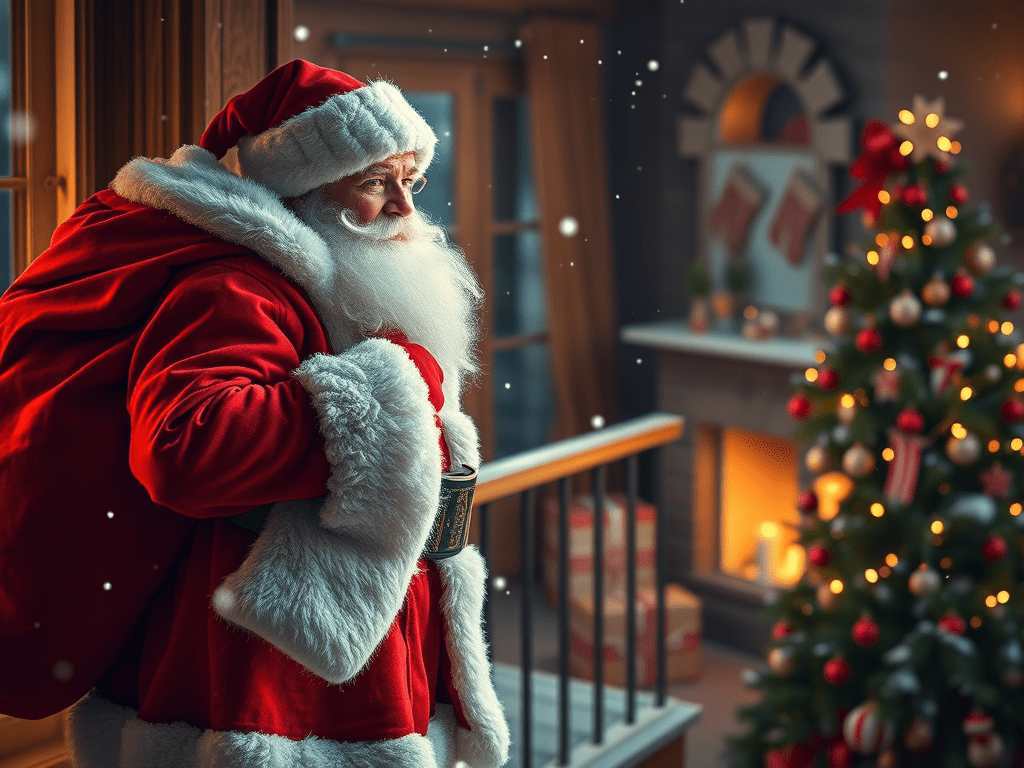
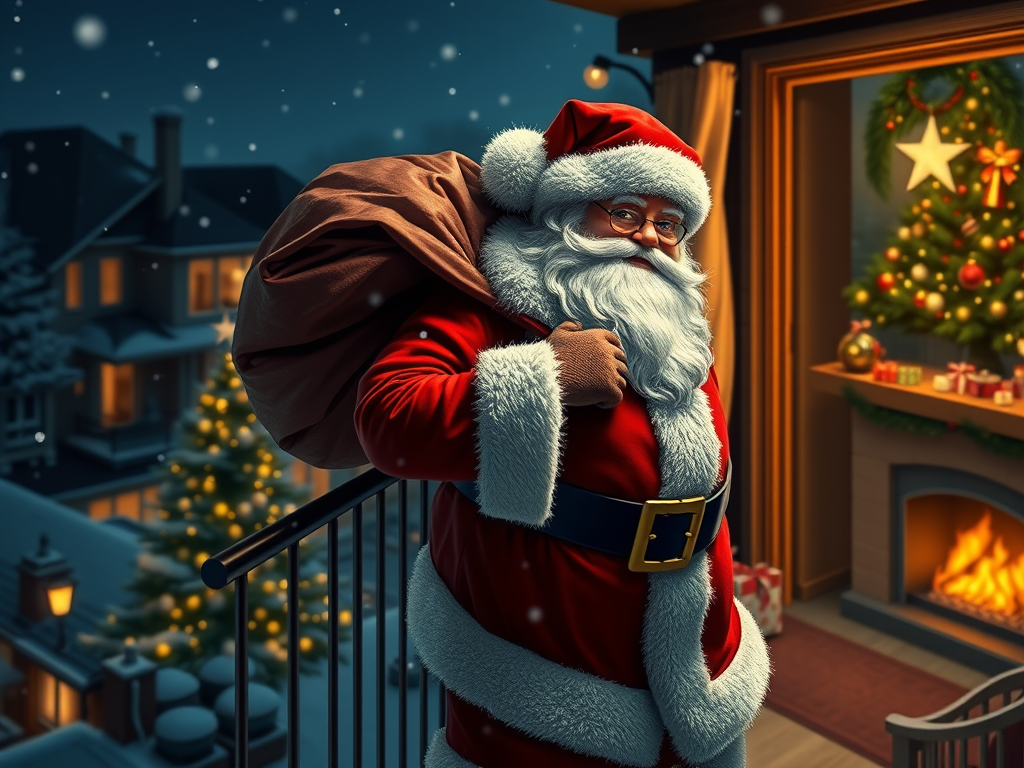
Late that night, a figure appeared on Mrs. Clarabelle’s balcony as snowflakes began to fall. Santa Claus was dressed in red. A twinkle was in his eye. He had a heavy sack slung over his shoulder. He stepped into the cozy living room. The tree’s magic had drawn him there, as it had every Christmas Eve for years.

“Ah, my old friend,”

Santa said, touching the tree’s sturdy trunk.

“How bright you shine, even in a world that’s grown so dim.”

The tree’s ornaments twinkled, and its branches swayed gently as if responding to Santa’s words. The tree couldn’t speak like humans. Its magic allowed it to communicate with Santa. He understood its every rustle and shimmer.

“Yes, I know,”

Santa said, settling into Mrs. Clarabelle’s armchair.

“People have forgotten the spirit of Christmas. Fewer homes are decorated, and fewer hearts are open. It’s as if they’ve lost their way.”

The tree’s lights dimmed momentarily, mirroring Santa’s sadness.

“Do you remember,”

Santa continued,

“When was every street filled with twinkling lights? When children left milk and cookies by the fireplace, and families gathered to sing carols by the fire?”

He sighed, his shoulders drooping.

“Now, so many homes are dark. It’s harder to find my way. And harder still to find the joy I once felt.”

The tree’s glow brightened as if to comfort him. Its magic reached out, filling the room with warmth. It reminded Santa of the countless small acts of kindness that still existed. A child shared their toys with a friend. A neighbor shoveled snow for an elderly couple. A stranger paid for someone’s coffee. Though the world seemed dim, the light of Christmas still flickered in the hearts of many.

Santa smiled, his spirits lifting.

“You’re right,”

He said, his voice steady.

“The spirit of Christmas isn’t gone. It’s just harder to see. But it’s there, in the small, quiet moments of love and generosity.”

He stood, his boots crunching softly on the rug.

“Thank you, old friend. Your light reminds me of why I do this, year after year.”

The tree’s lights shimmered, a silent acknowledgment of Santa’s words.

Before leaving, Santa placed a small, wrapped package beneath the tree. It glowed faintly, infused with his magic.

“For Mrs. Clarabelle,”

He said.

“A thank-you for keeping the spirit of Christmas alive.”

With a final nod to the tree, Santa stepped onto the balcony, his sleigh waiting above. The tree’s golden light followed him, illuminating the city as he soared into the night sky. For a brief moment, every window glowed with its reflection. The people below felt a spark of warmth they couldn’t quite explain.

In Apartment 828B on Floor 39, the tree’s light continued to shine. It served as a beacon of hope in New York City. The city needed it more than ever. And in the hearts of those who paused to look up, the spirit of Christmas found a home once again.

A Christmas of Unexpected Gifts

This story is pulled from the archives as a celebration for the season edition.

Groff Media 2024© Truth Endures IMDbPro

Presented by benandsteve.com By: Benjamin Groff II©

3–4 minutes

The snow fell gently outside Tom Whitaker’s cabin, blanketing the woods in a serene hush. Inside, the fireplace cast a warm glow, flickering and dancing, casting long shadows on the walls. The smell of pine from the small, undecorated tree in the corner filled the room with a comforting aroma. It was Christmas Eve. Tom, a retired schoolteacher, sat in his favorite armchair. He had a mug of cocoa in hand and a book he couldn’t quite focus on. For the first time in decades, he was spending Christmas alone.

His wife, Evelyn, had passed away three years ago. His grown children were scattered across the country. They were tied up with their own families and commitments. Tom didn’t blame them, but the ache of solitude was undeniable. He declined their offers to join them, insisting he’d be fine alone. He wasn’t.

A knock at the door startled him as he gazed into the fire. Who would visit on a night like this? He opened the door. He found a boy no older than ten. The boy was bundled up in a red coat. He was holding a scraggly puppy with floppy ears.

“Hi, mister,”

the boy said, shivering uncontrollably.

“I found this puppy in the snow. My mom said we can’t keep him, but maybe you can.”

Tom stared at the boy and the trembling pup.

“Come inside before you freeze,”

he said, taking the puppy in his arms.

The boy declined, pointing to a car waiting at the edge of Tom’s driveway.

“Merry Christmas!”

he called as he dashed off.

Tom closed the door, holding the puppy close. The little dog’s brown eyes looked up at him with fear and hope.


“Well, you’re an unexpected guest,”

Tom murmured. He fetched a blanket and some leftover chicken for the pup, who wagged its tail furiously.

Later that evening, as Tom felt less lonely, another knock came. This time, it was Mrs. Abernathy, his elderly neighbor. She held a tin of cookies and a thermos of cider.

“I noticed your lights on,”

she said.

“Thought you like some company.”

She handed him the thermos, and the warm, comforting scent of cider filled the air.

They shared the cookies and cider, laughing about old times and neighbors long gone. Mrs. Abernathy left after an hour, but only after gifting Tom a hand-knitted scarf she had made.

As the clock struck midnight, Tom prepared for bed, his heart a little warmer. The puppy, now curled up in an old basket, barked softly. Another knock came.

“Who now?”

Tom muttered, opening the door.

A group of carolers stood outside, bundled against the cold, their voices harmonizing in “Silent Night.” Behind them was a man from a local grocery store holding a box.

“We’ve got extra holiday meals,”

the man explained after the carolers finished.

“Thought you might enjoy one.”

Tom accepted the box, his throat tight with emotion. Inside were a roast chicken, mashed potatoes, cranberry sauce, and a pie.

As the night wore on, Tom marveled at the change. A Christmas he had dreaded became one filled with unexpected kindness. He sat by the fire with the puppy on his lap. The scarf was around his neck. He held a plate of warm food.

“Merry Christmas,”

he whispered to the little dog, who wagged its tail in agreement. Tom no longer felt alone. His cabin became filled with the spirit of the season through strangers, neighbors, and a small, scruffy pup. The pup found him when he needed it most.

Christmas the Cat: That Lost The Day Of Christmas And Found It All Over Again For Good!

This story is pulled from the archives as a celebration for the season edition.

Groff Media 2024© Truth Endures IMDbPro

Presented by benandsteve.com By: Benjamin Groff II©

3–4 minutes

Christmas was a sleek, white cat with a bright red collar and a tiny bell. He sported one green eye. One eye blue. Christmas twinkles the kids called them. He got his name because he was born on Christmas Eve. Since then, his life revolved around the festive season. He loved the glittering lights and the scent of pine. He enjoyed the rustling of wrapping paper. He cherished the joy he saw in his family’s faces.

Christmas morning, the children had excitedly unwrapped their gifts. Afterward, the family went off to visit relatives. Christmas the Cat had wandered into the pantry. Curious, he batted at a loose box of crackers, which tipped over with a crash. Startled, he darted behind a stack of canned goods. In the commotion, someone closed the pantry door, locking him inside.

At first, Christmas thought this was just an oversight. Someone would open the door soon and scoop him up for a cuddle. But the minutes stretched into hours, and the house grew silent. Panic set in. 

He imagined the family around the table, sharing laughter, turkey, and pie. He pictured the children playing with their new toys. The warmth of the fireplace filled the room. Soft carols were in the air. And here he was, trapped in the dark, with only a box of crackers for company. 

Christmas, becoming convinced it was too late until the family returned that evening. His heart sank as he heard the keys jingle and the front door creak. He sat dejectedly on the pantry floor, his tail curled around him.

“Christmas! Where are you, buddy?” 

Called the youngest child, Emily.

The pantry door swung open, and a flood of light spilled in. Christmas blinked and looked up. Emily scooped him into her arms, covering him in kisses.

“We were so worried!” 

She exclaimed. 

“We couldn’t find you anywhere.”

The rest of the family gathered around, showering him with attention. Despite their love, Christmas couldn’t shake his gloom. He meowed mournfully, his usual purr absent.

“What’s wrong, Christmas?” 

Emily asked, stroking his fur. 

“You’re safe now.”

Her father, overhearing, knelt beside her.

“I think Christmas thinks he missed Christmas Day.” 

He said with a chuckle.

Emily’s eyes widened. 

“Oh no! That isn’t very good. We need to tell him it’s okay.”

She cradled Christmas close and said softly,

“You didn’t miss Christmas, silly kitty. Even if the day is over, Christmas isn’t just one day. It’s about love, kindness, and being together. We can celebrate Christmas every single day.”

He looked up at her, his green eyes shining. The bell on his collar jingled as he rubbed his head against her cheek.

That night, Emily insisted they set up a special celebration for him. They lit the tree again. They brought out leftover turkey for a feast. They even gave him a shiny bow to play with. As Christmas sat in Emily’s lap, batting at the bow, he realized she was right. Christmas wasn’t just about one day. It was about the joy and love that filled the house every day of the year.

Christmas the Cat didn’t fret about the calendar from that moment on. Whether it was July or December, he purred as loudly when the family was together. After all, every day is Christmas as long as there was love.

The Secret Santa of Cordell, Oklahoma

Groff Media 2024© Truth Endures IMDbPro

Presented by benandsteve.com By: Benjamin Groff II©

3–4 minutes

In the small, snow-covered town of Cordell, Oklahoma, Police Chief Eby Don Walters had a secret. Every December, the frost painted the windows and the smell of pine and cinnamon filled the air. During this time, he would don a plush red suit and strap on a padded belly. He transformed into the town’s beloved Santa Claus.

Decades ago, a young Eby Don joined the force. The town’s Santa fell ill just days before the annual Christmas Eve festival. Eby Don, with his deep, booming laugh, twinkling eyes, and short, round build, stepped in. The kids adored him, and the tradition was born, bringing enduring joy to the community.

The children of Cordell adored Santa. They poured their hearts into their whispered wishes. They handed him carefully drawn pictures. They giggled when he joked about knowing if they’d been naughty or nice. Eby Don never broke character. He stayed in character even when his nieces and nephews sat on his lap. Their eyes were wide with wonder.

As the years passed, the children grew up, never suspecting that Santa was their own Chief Walters. Many returned with their kids, eager to introduce them to the magical figure from their childhoods. Eby Don played along. He listened with a warm smile as grown adults recounted their cherished memories of Santa. He waited for the moment when they would discover the truth. Their surprise and delight added to the magic of Christmas.

One Christmas Eve, nearing his sixties, Eby Don felt the weight of the years. The suit fit slightly tighter, and his knees creaked as he crouched to hug the smallest children. Yet, he couldn’t bear the thought of passing the torch. This was his gift to the town, his way of keeping its spirit alive. The Santa suit took a physical toll on him. Despite this, Eby Don continued to wear it. He knew the joy it brought to the children and the community.

That night, a little girl named Emma tugged at his sleeve, her big blue eyes searching his face.

“Santa, will you be here forever?”

she asked.

Eby Don knelt, his voice gentle.

“Santa’s spirit is always here, sweetheart, as long as people keep believing in the magic of Christmas.”

He knew that the belief in Santa was not just about a man in a red suit. It was about the spirit of giving, love, and hope that Christmas symbolizes. It was this belief that kept the Secret Santa tradition alive in Cordell.

The festival ended with the usual fanfare: carols, laughter, and the lighting of the town tree. Eby Don slipped to the small changing room behind the stage, trading his Santa suit for his police uniform. He stepped out into the cold night. The snow fell softly around him. He overheard a group of parents. Some of them were his former ‘kids’. They were talking about how lucky Cordell was to have a Santa who never missed a year. It was a warm and nostalgic end to the festive evening.

Eby Don smiled to himself. They would never know how much those words meant to him. He returned to his patrol car. His heart was as full as the sack of presents he had left under the tree. Chief Eby Don Walters cherished the greatest gift. It was knowing he had brought a little magic into the lives of everyone in Cordell. It was knowing he had brought a little magic into the lives of everyone in Cordell. They never knew the man behind the beard.

Santa Christ – Faith, Fantasy, and Tradition: Do Churchgoers Believe in Santa Claus?

Groff Media 2024© Truth Endures IMDbPro

Presented by benandsteve.com By: Benjamin Groff II©

Faith, Fantasy, and Tradition: Do Churchgoers Believe in Santa Claus?

Faith is often regarded as the cornerstone of religious belief, encompassing elements of the unseen, the unknowable, and the divine. Yet, the figure of Santa Claus gets nestled within the realm of modern Christian culture. Most believe Santa Claus is a mythical character who, though secular, occupies a sacred space in many homes during Christmas. This essay examines the relationship between faith and fantasy in a critical manner. It asks a provocative question:

Do churchgoers who actively engage in Christian religious services also believe in Santa Claus?

The Coexistence of Faith and Fantasy

With his roots in the historical St. Nicholas, Santa Claus has evolved into a cultural icon who embodies generosity, joy, and the season’s magic. Churchgoers, particularly those steeped in Christian tradition, often embrace Santa alongside their religious celebrations. But does this blending of faith and fantasy dilute the essence of religious belief, or does it complement it?

For many, Santa symbolizes the wonder and innocence of childhood. He exists not as a deity but as a symbol of kindness and giving, traits consistent with Christian teachings. Yet, the theological implications of believing—or perpetuating belief—in Santa Claus among devout churchgoers raise critical questions. Is it contradictory to teach children to believe in an omniscient God? Is teaching about a jolly figure who rewards good behavior with material gifts also contradictory?

Theological Tensions and Cultural Adaptation

Theologically, the Santa narrative can be seen as problematic. Santa’s omniscience—knowing when children are ‘naughty or nice’—mimics divine qualities attributed to God. For devout Christians, this parallel is viewed as trivializing the sacred attributes of their deity. Additionally, Santa’s rewards depend on behavior. This conditional nature starkly contrasts with the Christian doctrine of grace, which emphasizes unconditional love and forgiveness. These tensions stem from God and the principles of the Christian faith. They raise questions about the compatibility of Santa Claus with religious beliefs.

On the other hand, the inclusion of Santa in Christmas traditions reflects a broader cultural adaptation. Churchgoers, like the wider society, are products of their environment. Santa Claus’s commercial and cultural saturation makes him almost inescapable. For many Christians, incorporating Santa into holiday traditions helps bridge the secular and the sacred. This creates a more inclusive celebration and resonates across different belief systems.

The Role of Myth in Faith Development

Belief in Santa Claus can also be seen as an early form of faith training. Santa embodies the power of belief for children—trusting in something unseen and expecting its fruition. In this way, Santa serves as a precursor to more mature forms of faith. The eventual realization that Santa is a myth does not necessarily undermine belief in God. Instead, it can reinforce the idea of a deeper, more profound belief in the divine. Transitioning from belief in a myth to belief in a higher power can be crucial for a child’s faith. It shapes their understanding of the unseen. It also builds their ability to trust the divine.

Critics argue, nonetheless, that perpetuating the Santa myth risks fostering cynicism. When children discover Santa isn’t real, they question the truth of other intangible beliefs, including God. This potential disillusionment challenges religious parents, raising concerns about the impact on their children’s faith. They must carefully navigate the transition from childhood fantasy to mature faith.

Reclaiming the Meaning of Christmas

The integration of Santa Claus into Christian homes invites churchgoers to consider the true meaning of Christmas. Is it about celebrating the birth of Christ and the message of salvation? Or has it become overshadowed by consumerism and secular traditions? For many churchgoers, the challenge is to reclaim the sacred aspects of the holiday. They also want to allow room for the cultural joy Santa brings.

Balancing these elements requires intentionality. Churchgoers are crucial in emphasizing Santa’s values—generosity, kindness, and joy—while grounding these traits in their faith. By framing Santa as a symbol, Christians can preserve the integrity of their beliefs. They can still enjoy the cultural richness of the holiday. This underscores the importance of their role in this balance.

Conclusion

Whether churchgoers believe in Santa Claus touches on more significant themes of faith, tradition, and cultural adaptation. Santa initially appears to conflict with Christian doctrine. Yet, he also offers an opportunity to engage with the season’s spirit of giving and wonder. Churchgoers need to discover how to integrate this cultural icon into their faith practices. They must achieve this without compromising their beliefs.

The coexistence of Santa Claus and churchgoers shows how people can balance faith and fantasy. Each aspect contributes to our understanding of the world. They also shape our place within it. Santa Claus does not need to diminish the sacredness of Christmas. Instead, he can symbolize the joy and generosity central to the season. Yet, some find it difficult to reconcile a fictional figure with their spiritual beliefs. This tension arises when they apply the same evaluative framework to religious doctrine, revealing a deeper reliance on external authority. For many, this dependence stems from an unwillingness to embrace personal accountability fully. They seek a Santa-like figure year-round—someone or something to guide their choices and confirm their actions. They continue to believe in Santa Claus, though under a different guise.

The Season of Light

A December Story for Every Heart, Every Home, Every Tradition

By Benjamin GroffMedia© | benandsteve.com | ©2025 

3–4 minutes

In the little town of Mesa Ridge, the December sky seemed to hold every dream ever whispered. This town was tucked between a quiet stretch of desert. December didn’t arrive with just one story. It came with hundreds.

Not everyone called this time “Christmas.” Some families lit candles and spoke of miracles. Others gathered for feasts that marked the turning of the year. Some spent the month in quiet reflection, while others burst through the season with celebration and song.

But one thing was always the same: the light.

It started with a single lantern placed outside the old community center on the first day of December. No one remembered who began the tradition, but every night the lantern burned, its small glow chasing back the darkness. By the second evening, another family placed a candle beside it. Then the kids down the block added a tiny string of lights. A paper star was made by the third-grade class. The elders contributed a jar filled with sand and a tea light, remembering doing the same in their youth.

Within a week, the once-plain walkway to the center shone with a thousand shapes of light. These represented different traditions, different meanings, and different languages of hope. They were all gathered in the same place.

One chilly evening, as neighbors drifted in to admire the growing show, an elderly woman named Mrs. Cordero said softly,

“This is what the season is supposed to look like. All of us… together, not the same, but warm in the same glow.”

A teenager beside her shrugged.

“But what does it celebrate? Which holiday?”

Mrs. Cordero smiled the smile that had seen many Decembers.


“It celebrates us,”

She said.

“Us choosing to be a little softer with one another. A little kinder. A little more willing to look someone in the eye and say, ‘You matter to me.’ If the lights have a job, it’s simply to remind us that we’re better when we brighten one another.”

Word spread quickly, as all good messages do.

Light has no doctrine, and kindness has no borders.
In December, we simply shine a little brighter—together.

Soon, families who had never spoken found themselves sharing warm drinks and stories. The bakery owner delivered sweet rolls just because it felt right. A newcomer from across the country found herself wrapped in community she hadn’t expected. Even the grouchy widower who lived on the corner had not decorated for anything in decades. He quietly placed a single white lantern at the end of his driveway. No explanation needed.

On December 24th—whatever that date meant to each household—a gentle hush fell across Mesa Ridge. People walked the lantern path not as one faith or another, but simply as neighbors. The lights flickered, danced, and whispered the same message in a hundred different languages:

Goodwill belongs to everyone.
Kindness is not seasonal, but December is a good place to start.
And light—no matter where it comes from—shines brightest when shared.

When the last lantern was lit that night, the community didn’t cheer. They simply breathed in the moment, letting the warmth settle into their bones.

Some carried the glow home.
Some carried it into the New Year.
Some carried it for a lifetime.

And in the little town of Mesa Ridge, the tradition continued. It wasn’t because anyone told them to. It was because they remembered how it felt to step into the light together.


By Benjamin GroffMedia© | benandsteve.com | ©2025 

It Is Well After The American Turkey Day – So I am Going To Say It… Happy Christmas, Merry Holidays!

By Benjamin GroffMedia© | benandsteve.com | ©2025 

1–2 minutes

I’ve always felt that Hawaii is a state too often overlooked. I make it a point to include them whenever I’m searching for stories or news pieces. This Christmas—whatever your holiday season looks like—is no exception.

In times of uncertainty, we search for our better angels. We hope for a gentler tomorrow. I often turn to those who left us examples of grace, comfort, and tradition. There were people we once depended on to show up every Christmas. They became woven into the fabric of our holidays—at least for those of us in the United States.

To my friends outside the U.S., and to those who be too young to remember, I offer my apologies—this memory comes from another era. But I invite you along anyway. What I want to share is a small holiday wish from my own past.

It’s a moment wrapped in nostalgia, carried to us by a familiar voice: Bing Crosby.


By Benjamin GroffMedia© | benandsteve.com | ©2025