The Silence About Straight Shooters

2–3 minutes

Double Standards – Plain Prejudices!

When a massacre occurs, we rush to ask why. We sift through social media posts, interviews, and histories, desperate for something that explains the unexplainable. But what’s telling is not just the reasons we find—it’s the reasons we don’t look for.

The overwhelming majority of mass shooters in the United States are heterosexual men. That’s not speculation; it’s data. Yet how often do you see headlines dissecting a killer’s heterosexuality as the cause of their violence? How often do pundits rush online? They demand to see if the shooter once posted about a girlfriend or wore a wedding ring. They use that as “proof” that straight men are dangerous by design. The answer is simple: never.

And yet, when a shooter identifies as LGBTQ+, or is even rumored to, it suddenly becomes fair game for speculation. Sexuality or gender identity—factors with no proven connection to violence—are treated as the smoking gun. It’s as if identity itself becomes a scapegoat, a convenient villain for people already inclined to mistrust it.

This double standard reveals a lot about our cultural biases. Straight people are allowed complexity. They can be troubled, mentally ill, politically radicalized, or angry at the world. They can also be a hundred other things. But LGBTQ+ people are flattened into caricatures, their entire identities blamed for tragedies they commit. Violence is driven by opportunity, ideology, and access to weapons. It is also driven by often untreated pain—not by who someone loves or how they define themselves.

Maybe the question isn’t why people commit atrocities. Instead, we should ask why we frame some people’s motives through the lens of prejudice. Meanwhile, we let others keep their humanity. Until we answer that honestly, we’ll keep mistaking bigotry for truth—and keep missing the real reasons behind the violence.

Benjamin Groff is a former police officer and radio news anchor. He has hosted programs for CNN and ABC News affiliates in Colorado and Wyoming. His career in law enforcement began in 1980 and lasted more than two decades. This gave him firsthand insight into the criminal mind and public safety. Moreover, it provided him with an understanding of the human stories that often go untold. His writing draws on these experiences, blending street-level truth with a journalist’s eye for the bigger picture.

By Benjamin GroffMedia© | benandsteve.com | 2025 

GARY INDIANA CRIME RATES HIGHER THAN CHICAGO

4–5 minutes

Indiana Governor Michael Braun

Why Isn’t Indiana Governor Mike Braun

Being Given National Guard Help?

Chicago is often spotlighted for its crime statistics. Yet, Gary, Indiana consistently ranks higher in many key crime metrics. This is true even when compared on a per-capita basis.

Chicago often dominates headlines for crime. Yet, FBI data and neighborhood crime indexes reveal a different story. Residents in Gary, Indiana, face significantly higher per-capita risks of violent and property crimes. According to NeighborhoodScout, Gary’s violent crime rate stands at roughly 1,180 per 100,000 residents—nearly double Chicago’s rate of 673.5.

President Trump reportedly plans to send National Guard troops to Chicago to tackle crime. If crime is really the concern, those service members should go just across the border to Gary. Decades of statistics show even higher rates staring them in the face. This report includes the data and sources to prove it. So the real question is: why isn’t the Guard going to Indiana? Maybe they know they can’t go back there.


  • Violent crime in Gary is approximately 11.8 per 1,000 residents, or 1,180 per 100,000, significantly above national averages and surpassing Chicago’s violent crime rate of 673.5 per 100,000.ReolinkNiche
  • Your odds of being a victim of violent crime in Gary are about 1 in 112. This is compared to Chicago’s overall violent crime rate.NeighborhoodScout
  • Property crimes are also markedly higher: a 1 in 35 chance in Gary versus substantially lower in Chicago.NeighborhoodScout

Gary’s elevated crime levels have been well-documented over the years. These range from a ‘1993 Murder Capital’ billboard warning to recent statistics. Recent data shows some of the highest violence and theft rates in the nation.The TraceMacrotrends
Despite improvements in some categories, Gary remains one of Indiana’s most dangerous cities. It often exceeds Chicago in both violent and property crime rates.


CityViolent Crime (per 100,000)Property Crime Odds
Gary, IN~1,1801 in 35 victims
Chicago, IL673.5Lower than Gary’s rate

Yes—Gary, Indiana, a smaller city just southeast of Chicago, has higher crime rates than Chicago on a per-capita level. Though Chicago may grab more headlines, Gary’s challenges with both violent and property crime are even more severe.

  • Violent Crime Rate: Gary records approximately 11.8 incidents per 1,000 residents, making it the highest violent crime rate in the state Reolink+1.
  • Property Crime Chance: On an individual level, the chance of being a victim in Gary is 1 in 112 for violent crime. The odds are 1 in 35 for property crime. NeighborhoodScout.
  • Daily Crime Risk: Overall, you face a 1 in 27 chance per year of becoming a crime victim in Gary. Check more on Areavibes.
  • Safety Map Insights: Neighborhood safety varies widely. In central areas, residents face up to a 1 in 67 chance of violent crime. In safer southwestern zones, that drops to 1 in 137 Reddit.
  • Citywide Crime Index: Gary’s total crime rate runs at about 59.75 incidents per 1,000 residents, compared to roughly 33.37 nationally nextdoor.com.
  • Recent Trends: Encouragingly, Gary’s Police Department reported a notable drop in violent crime and fatal traffic accidents in 2024. They also noted increased proactive patrols in Gary, Indiana.

  • Comparative Crime Index (Gary vs. Chicago):
    • Violent Crime: Chicago reports about 21% more violent crime overall. Still, because of its much higher population, the individual risk remains lower than in Gary BestPlaces.
    • Property Crime: Chicago’s rate is approximately 30% lower than Gary’s  BestPlaces.
  • Detailed Numbers (NeighborhoodScout): The chance of being a victim of violent crime in Chicago is about 1 in 167. In Gary, it is 1 in 112. Property crime risk in Chicago is about 1 in 29, slightly better than Gary’s 1 in 35 NeighborhoodScoutAreavibes.

  • Lake County averages around 395 violent crimes per 100,000 residents. This figure is slightly higher than national averages near 360 per 100,000. Axios+1Wikipedia+1.
  • Economic Impact: Crime-related costs, including emotional and tangible losses, are significant across the county.

Quick Comparison Table

LocationViolent Crime RiskProperty Crime RiskNotes
Gary, IN1 in 112 (high risk)1 in 35 (high risk)Among “most dangerous” cities in Indiana
Chicago, ILLower individual riskSlightly lower than GaryLarger scale but safer per capita
Lake County, INSlightly above averageMixedCrime concentrated in urban pockets like Gary

  • Gary, Indiana, has significantly higher violent and property crime rates—both per-capita—than Chicago. Despite Chicago’s national notoriety, individuals face greater personal risk in Gary.
  • Lake County overall carries elevated crime levels, but the burden is not uniform—it’s concentrated in areas like Gary.
  • Positive note: There are signs of progress, especially in Gary. Proactive policing has reduced violent crime. It has also improved safety initiatives.

By Benjamin GroffMedia© | benandsteve.com | ©2025 

About the Author:

Benjamin Groff is a former police officer and radio news anchor. He has hosted programs for CNN and ABC News affiliates in Colorado and Wyoming. His career in law enforcement began in 1980 and lasted more than two decades. This gave him firsthand insight into the criminal mind and public safety. Moreover, it provided him with an understanding of the human stories that often go untold. His writing draws on these experiences, blending street-level truth with a journalist’s eye for the bigger picture.

The Anatomy of a Shooter – Part Five: What We Can Actually Do About It

“Monsters aren’t born overnight. They’re made—in silence, in shadows, in places we refuse to look.”

By Benjamin GroffMedia© | benandsteve.com | 2025 Truth Endures©

3–5 minutes

Part Five: What We Can Actually Do About It

Let’s get one thing straight:
Mass shootings aren’t random.
They’re predictable.
Not in the “we know when and where” way. It is predictable in the “we’ve seen this play before” way. And we’ve seen it enough to know how it ends.

So the question becomes:
What do we do now—actually do?

If all we’ve got are thoughts, prayers, and hashtags, then outrage will burn out in a news cycle. We’re just spectators in someone else’s tragedy.


Enough With the Helplessness

It’s easy to feel like there’s nothing we can do.
But that’s a lie we’ve been sold to stay comfortable.
The truth is, we can’t stop every shooting—but we can reduce them.
We can spot the signs earlier.
We can intervene before someone crosses that line.
And yes, we can have uncomfortable conversations about guns, mental health, and social breakdown without turning it into political theater.

But first, we have to stop pretending we’re powerless.

Photo by MART PRODUCTION on Pexels.com

Real Things That Actually Help

Here’s a short, imperfect list. Not theory—practice.

🔹 1. Speak up—even when it’s awkward.

That kid, coworker, or neighbor who’s spiraling? Say something. Not on Facebook. Not behind their back. To someone who can act. Don’t wait until it’s too late.

🔹 2. Take threats seriously.

If someone is joking about violence, don’t assume they’re kidding. Shooters often telegraph their intentions—sometimes with neon signs.

🔹 3. Support red flag laws that work.

Yes, they’re controversial. But when implemented carefully, they’ve saved lives by allowing courts to temporarily remove firearms from people in crisis.

🔹 4. Don’t give platforms to the shooters.

No names. No manifestos. No fame. Let them fade into anonymity—don’t let them become anti-heroes.

🔹 5. Build better reporting systems.

We need clear, safe ways to report dangerous behavior—at schools, jobs, online—and a system that doesn’t bury it in bureaucracy.

🔹 6. Reinvest in human connection.

Isolation is gasoline for this fire. People with strong relationships, support systems, and a sense of belonging are less to fall into these dark holes. Community isn’t a luxury—it’s a safeguard.


Not Just a Policy Problem—A Culture Problem

Legislation matters. But culture matters, too.

We live in a society that celebrates violence, glorifies vengeance, and teaches boys that emotions are weakness.
We scroll past pain and reward provocation.
We share stories of destruction more than recovery.
We confuse attention with validation.

We can change laws. But until we change us, the cycle will continue.


Final Thought: The Story Isn’t Over—Unless We Let It Be

Photo by Mikhail Nilov
on Pexels.com

This five-part series wasn’t meant to explain every angle of mass shootings.
It was meant to start a conversation. To take you out of the numbness and into the uncomfortable places where change begins.

We don’t need heroes.
We need people who are willing to pay attention, speak up, and give a damn.

Because we’re not just analyzing shooters here.

We’re deciding what kind of society we want to live in.

Closing Note to My Readers

Thank you for walking with me through this five-part series.
I know it hasn’t been easy to read—hell, it wasn’t easy to write. But maybe that’s the point.

This isn’t just about shooters.
It’s about all of us.
What we tolerate. What we ignore. What we pretend not to see until it’s too late.

My hope is that these words spark more than discomfort.
Maybe they spark reflection. Maybe action. Maybe one conversation that changes something.

We want a world where mass shootings stop becoming headlines. To achieve this, we can’t just sit back and consume the story.

We have to be part of rewriting it.

—Benjamin Groff

About the Author:

Benjamin Groff is a former police officer and radio news anchor. He has hosted programs for CNN and ABC News affiliates in Colorado and Wyoming. His career in law enforcement began in 1980 and lasted more than two decades. This gave him firsthand insight into the criminal mind and public safety. Moreover, it provided him with an understanding of the human stories that often go untold. His writing draws on these experiences, blending street-level truth with a journalist’s eye for the bigger picture.

The Town Called Serenity – Chapter Ten: Stand Still, and the Dust Will Bury You

By Benjamin GroffMedia© | benandsteve.com | 2025 Truth Endures©

3–5 minutes

Chapter Ten: Stand Still, and the Dust Will Bury You

By dawn, the desert wind carried more than heat. It took silence—the kind that comes before thunder.

  • Chester Finch stood on the steps of the half-burned church at the edge of Serenity’s main street. His badge was pinned high and proud. His ribs ached. His coat was torn. But his eyes were sharp, and the ledger in his hands could end a dynasty. 
  • The Marshal had pulled his moped from hiding and had it juiced up for duty. The Vespa GTS (300cc) moped shone as slick as the day it was new. It had US Marshal emblems on it and had been stowed inside the jail’s secret compartment. A hiding place that Chester designed the night he arrived in town. 

Chester looked out over the gathering.

Wren was there, her arm in a sling, a rifle strapped across her back.

Petal stood beside her, bruised but alive, clutching a satchel full of Cain’s secrets.

Julep Jake leaned against the doorframe, sharpening his miniature whittled guillotine. 

“A town’s only worth the blood it takes to keep it,” 

He said. 

“Reckon we’re due.”

Even Buck Harlan was the old stagecoach driver who hadn’t spoken more than ten words in a decade. He stood with a shotgun across his knees.

And behind him came the others—storekeepers, grooms, forgotten women, broken men.

Cain had ruled them. Gallow had hunted them.

But now –– now they remembered their names.

Chester raised his voice.

“I’m no savior. I’m no sheriff. I’m just the last man they sent when no one else would come.”

He held up the badge.

“But I say this badge still means something. Not because it’s brass. Not because the government gave it to me. But because I’m willin’ to bleed for it.”

He threw the ledgers down onto the church steps.

“These are Cain’s sins. Every payment, every name, every blackmail note, every fix. And when this town turns that over to the federal office, I just wired—they’re gonna come. Not with a whisper. With subpoenas and dogs.”

A beat of silence.

Then a single voice called out:

“And Gallow?”

Chester turned. 

“He’ll come. Tonight, maybe. It could be sooner. He’ll bring fire.”

He looked to Wren.

“But fire don’t mean nothin’ if you’ve got water and grit.”

Wren nodded once. 

“We stand.”

The townsfolk murmured.

Then they shouted.

Then they began to build.

Barricades. Traps. Makeshift outposts from overturned wagons and scrap wood. Petal turned the saloon into a war room. Julep Jake strung piano wire across alleys. Even the bell tower rang for the first time in years, warning off the vultures.

The Last Hour

Cain, watching from The Assembly, saw the town rise against him and knew he’d lost the crown.

He poured a final drink, set it aside, and vanished through a trapdoor in the fireplace, bound for nowhere.

The Arrival

Gallow came at sunset, just as expected.

He walked straight down the main street—unarmed, unhurried—like he owned time.

But this time, time fought back.

The first tripwire knocked him off balance. A spotlight lit him up. A warning shot clipped his boot.

He crouched, ready to vanish into shadow—until he saw Chester.

Standing in the street. Moped beside him. Rifle in hand.

“You’re outgunned,” 

Gallow called.

“Nope,” 

Chester said. 

“I’m out-cowed.”

The townsfolk emerged—on roofs, behind crates, on balconies.

Gallow took a step. Then another.

Chester held firm.

And Wren, from the bell tower, raised her rifle.

The shot rang out.

Gallow stumbled. Not dead. Just marked.

He turned—bleeding, seething—and ran.

He vanished into the dust from which he’d come.

And the town never saw him again.

Epilogue: A New Kind of Quiet

Serenity changed.

The ledgers made it to Washington. Petal was deputized. Wren chose to stay and built the first real school the town had seen in thirty years. Julep Jake finally finished his guillotine and gave it to a museum in Tulsa.

As for Chester Finch?

He stayed, too.

He never left Serenity.

Not because he had to.

But sometimes, the worst places can create the most profound kind of peace.

Even if you get there on a moped.

The Town Called Serenity

A hero did not save it.

It was saved by the last man willing to stay when everyone else ran.

So the moped was hidden away in the jail’s secret spot—one no one else even knew existed. Good thing Chester made it out alive, or that Vespa would’ve turned into a time capsule! More importantly, this story is a great reminder: the bad guys never truly win.

THE TOWN OF SERENITY – Chapter Nine: A Predator in the Garden

By Benjamin GroffMedia© | benandsteve.com | 2025 Truth Endures©

3–4 minutes

Chapter Nine: A Predator in the Garden

Braddock Cain sat alone in The Assembly, a chessboard in front of him, half-played.

It was something he did when the whiskey wore off, and the world got too quiet. He played both sides of the board. He always made sure black lost.

Tonight, black wasn’t losing.

He moved a knight, sat back, and scowled.

The vault trap should have buried Finch and the girl. He’d received no word from Poke, which was unusual. Too unusual.

A low, sharp knock came at the door—three short raps. 

Then silence.

His eyes narrowed.

“Enter,”

He growled.

The door creaked open, and the man who stepped inside wasn’t Poke. Wasn’t anyone from Serenity? His clothes were clean, military-cut. His boots were dustless. He didn’t wear a hat—but his shadow felt longer than the room allowed.

“Mr. Cain,”

The stranger said. 

“I presume.”

Cain stood, hand already on the grip of his pistol.

“You don’t walk into this room without an invitation.”

“I didn’t walk,” 

The man replied. 

“I arrived.”

Cain didn’t move to open it.

“You’re Gallow,”

He said flatly.

“That’s what they used to call me,”

The man replied. 

“In certain circles. Not the ones you buy into.”

Cain sat back slowly. 

“What do you want?”

Gallow smiled faintly.

“Let’s call it… clarity. You’ve grown fat on rot, Cain. But rot attracts insects. I’m here to burn the carcass clean.”

Cain let out a cold laugh. 

“You think you can walk into my town and—”

Gallow was suddenly in front of him.

Cain hadn’t even seen the movement.

A knife gleamed under Cain’s chin.

“I don’t think,”

Gallow whispered. 

“I replace. You’ve become a liability to men far above either of us. The vault was never your property. The tapes, the ledgers, the names—you were supposed to manage them, not flaunt them.”

Cain’s eyes narrowed. 

“You’re not just here for Finch.”

“I’m not here for Finch at all,”

Gallow said softly.

“He’s just a broken piece. You’re the engine.”

He pulled the knife away and tucked it back into his sleeve.

“I won’t kill you tonight. That would be –– premature. But I will leave you with a choice.”

Gallow tapped the Ashwood file.

“Burn this. Leave town. Or wait for me to come back.”

Then he was gone.

Cain sat still for a long time, listening to the echo of Gallow’s departure. When his hand finally moved, it wasn’t for his gun.

It was for the bottle.

Elsewhere in Serenity

Poke’s body was found behind the saloon—face down, no bullet wound, no blood.

Just two coins were placed over his eyes.

Wren and Chester stood over him in silence.

“Gallow’s here,” 

Wren said. 

“And he’s not working for Cain. He’s cleaning the house.”

Chester looked toward the west horizon, where dust clouds rolled in from the direction of the rail line.

He pulled the badge from his coat and stared at it.

“Time to decide,” 

He muttered. 

“Do I play Marshal—or outlaw?”

Well now, Gallow is certainly making his presence known! And Cain clearly has a big decision to make—but will he actually leave town? If so, he better start packing snacks for the road. But if he’s thinking about staying, he’ll want to give Jonathan Lawson a call. He should secure himself a Colonial Penn Life Insurance policy. It’s unfortunate Poke didn’t think ahead. Maybe those two coins over his eyes are enough to cover a plot in the nearest potter’s field.

As for Marshal Chester Finch, he’s defied the odds and made it to Chapter Ten. And it looks like this final chapter will finally answer the big mystery: the moped. Where has it been? Who hid it? Why wasn’t it tampered with? What was it originally bought for? And when did Chester decide it would be his official Marshal’s ride?

All of this—and more—will be revealed in Chapter Ten. ~ WE Hope ~

The Town Called Serenity – Chapter Eight – The Devil Knows The Way Out

By Benjamin GroffMedia© | benandsteve.com | 2025 Truth Endures©

3–4 minutes

Chapter Eight: The Devil Knows the Way Out

The blast had sealed the main vault door and collapsed part of the tunnel behind them. Smoke choked the air. Brick and metal groaned under stress. Chester blinked through blood and dust, pulling Wren up from the rubble.

“You alright?”

He asked, coughing.

“Been worse,” 

Wren muttered, cradling her left arm. 

“Dislocated, not broken. I’ll pop it back.”

Chester pulled out a penlight and scanned the room. 

“No exit. That was the only way in.”

Wren smiled through the pain. 

“You thought it was.”

She limped to the far wall. A section of decorative tiling was there—old, Spanish-style. It jutted out from the stone like it didn’t belong. She knocked three times in a rhythm that echoed deeper than it should have.

A hollow click responded.

“Cain didn’t build the vault himself. He took it from a man who did. The original owner had escape routes.”

She traced a tile shaped like a broken star and twisted it counterclockwise. With a faint hiss, the tile wall slid inward, revealing a narrow stone chute, half-collapsed and riddled with centipedes.

Chester stared into the black.

“I don’t suppose you brought rope,”

He said.

“Nope.”

“Alright then,”

He grunted, and they vanished into the dark.

In the Streets Above

Petal stood at her shop counter grinding roots when the front door exploded inward.

She ducked instinctively, drawing her old revolver, but it was too late.

Two men in black tactical gear moved in fast, grabbed her arms, and yanked her across the counter. The third figure entered last—calm, silent.

Mr. Gallow.

He picked up a vial from the shelf, sniffed it, and set it down.

“I’ve read your name,”

He said, voice flat. 

“You’re a known associate of Wren. Harboring her. Aiding a rogue federal.”

Petal spat blood and smiled. 

“You got a badge?”

“No. I have jurisdiction.”

He signaled.

The men dragged her out.

They disappeared down the street. Julep Jake watched from his cell window. He was whittling a miniature guillotine from an old broom handle. 

“And now the harvest begins,”

He muttered.

The Long Climb

Chester and Wren emerged two hours later through a rusted maintenance grate behind the abandoned Serenity Theater. They were scratched, covered in brick dust, and exhausted—but alive.

Wren wiped grime from her face. 

“He set us up. Knew we were coming.”

Chester nodded grimly. 

“Means we rattled him.”

She held up the two ledgers she’d saved—one in each hand.

“He loses if these go public.”

Chester took them, tucking them into his coat. 

“Then let’s make sure they do.”

Suddenly—gunfire cracked in the distance. Three pops.

Wren froze. 

“That was near Petal’s.”

Chester’s face hardened. 

“We’re not the only ones he’s playing.”

They moved quickly down the alleys. Even as they ran, Wren stopped cold. She saw the mark scorched onto the alley wall: a circle with a horizontal line through it.

She grabbed Chester’s arm. 

“That’s not Cain’s symbol.”

“What is it?”

Wren’s voice dropped to a whisper. 

“It’s Gallow’s.”

Chester turned, scanning the rooftops.

“Then we’re out of time.”

What exactly did the symbol mean? Chester had the answer—or at least a regulation book with the answer—tucked away in the saddlebags on his moped. The problem? He didn’t bring it with him. And it’s too far to walk back now. Truth is, he hasn’t laid eyes on that moped since he rolled into town. So, is it hidden so well that he forgot where it is? Or is he protecting a strategic location he’s not ready to reveal? With only two chapters left, the Marshal better get moving!

The Town Called Serenity – Chapter Seven – The Hollow Vault

By Benjamin GroffMedia© | benandsteve.com | 2025 Truth Endures©

2–3 minutes

Chapter Seven: The Hollow Vault

Two nights later, Chester and Wren moved through the back alleys of Serenity like smoke.

The plan was simple: infiltrate the vault below The Assembly using the abandoned mine shaft Wren had mapped out. Inside, Cain kept more than just gold and guns—he kept records. Blackmail. Ledgers. Evidence.

Evidence that could break him!

Wren led them to a rusted grate hidden behind the collapsed ruins of an old hardware store. Beneath it: a shaft covered in rotted boards and bad intentions.

“Down there?” 

Chester asked.

“Unless you’d rather try the front door.”

They climbed down slowly, their boots sinking into decades of dust and discarded bones. Lantern light flickered over graffiti scratched into the stone. Old names. Gang signs. Some symbols are older than either of them recognized.

They crawled through two hundred yards of tight rock. They ducked under fallen beams and crossed a flooded tunnel chest-deep in cold water. Finally, they came to a narrow corridor with smooth brick walls.

“This was built after the mine closed,” 

Chester said.

“Cain built it,” 

Wren confirmed. 

“To smuggle in shipments during the lockdown years. It goes straight to his vault room.”

Chester’s hand rested on his revolver. 

“We go in quiet. No guns unless we’re cornered.”

They reached the door—an iron-bound, reinforced, and sealed structure with an old code lock. Wren pulled a tiny folded paper from her coat.

“Petal gave me this,” 

She said.

“It’s the combination. She wrote it down after Cain got drunk and showed off.”

Chester raised an eyebrow. 

“I’m beginning to like that woman.”

Wren punched in the numbers. The lock hissed. The door creaked open.

Inside, the vault glimmered like a serpent’s nest: stacks of cash, boxes of documents, safes within safes.

But the prize wasn’t money.

It was the black books.

Wren went for the ledgers. Chester opened a crate and pulled out a collection of old film reels labeled with names—judges, mayors, even a U.S. senator.

“This is it,”

He whispered.

“This is Cain’s Kingdom in a box!

“This is Cain’s kingdom in a box.”

But then, from behind them—a faint click.

Wren froze. 

“Did you hear—”

Chester tackled her just as the explosion hit.

The vault door slammed shut.

Dust and debris rained down. A trap. It had been rigged.

From above, in a hidden observation room, Braddock Cain watched through a spyglass.

He turned to Poke and said, 

“Let them cook. They wanted into my house. Now they can die in it.”

But neither he—nor Chester—knew that Wren had already mapped another way out.

And worse, Mr. Gallow had just entered Serenity.

Cain’s Kingdom In A Box? Sounds like evidence that sews up this case! But, now Mr. Gallow is in town, and this brings a whole new suggestion for more trouble. Or a solution. It is too early to tell. Maybe Mr Gallow came for the moped. What if the Marshal’s service issued the moped to Chester, and they want it back?

The Town Called Serenity – Chapter Six – Ashwood

By Benjamin GroffMedia© | benandsteve.com | 2025 Truth Endures©

1–2 minutes

Chapter Six: Ashwood

The file on Chester Finch wasn’t stored in any digital archive. It was handwritten, double-sealed, and stored in a fireproof vault in Washington, D.C., under a codename known only to four men who still remembered it.

Operation Ashwood.

Eight years ago, Chester was part of a black-bag unit inside the U.S. Marshal Service—officially unrecognized, unofficially unstoppable. The team was created to root out systemic corruption in rural American towns with privatized law enforcement and cartel-backed leadership. The mission was simple: infiltrate, destabilize, expose.

Ashwood’s first three targets were textbook. The fourth—Gulch County, Texas—was different.

Chester had made the call. He exposed the sheriff, three council members, and a judge and brought them down with a clean sweep.

But the blowback was lethal.

Three of Chester’s team were ambushed at the exit. A safe house was burned down—with a whistleblower’s daughter inside. The press got hold of fragments, but the whole truth? That was buried in a sealed report and heavily redacted.

Chester took the blame. Not officially. But quietly. They let him keep the badge—under the condition that he’d never be given another high-profile operation again.

Until now.

Serenity was never meant to be his assignment. Someone had slipped his name into the dispatch. Someone with a more extended memory than the agency admitted to.

And now Gallow, the last surviving Ashwood “fixer,” was on the trail.

Now, remember this is only a pause between Chapters Five and Seven. This moment is to clarify what was happening. It serves to show what brought Chester Finch to these parts. When Chapter Seven opens, it will seem like only a few days have passed. That will be just enough time for Finch to remember his past, whether he likes it or not. Still, there is no word where he has left the moped. Surely, it would have been used as a bargaining chip with him by now.

The Town Called Serenity – Welcome Committee

By Benjamin GroffMedia© | benandsteve.com | 2025 Truth Endures©

3–5 minutes

Chapter Three: Welcome Committee.

A town allergic to rules.

The Town Called Serenity

By noon the next day, the heat in Serenity had risen to an oppressive boil. The town smelled of dry rot, sweat, and gun oil. Somewhere in the distance, a fiddle played off-key. Somewhere closer, someone was being punched.

Chester Finch stepped out of the rickety sheriff’s office he had claimed, swatting at flies with his hat. His left eye was bruised from a scuffle the night before, and he had re-holstered his sidearm four times that morning alone—once while buying coffee, once while crossing the street, once during a handshake, and once because a six-year-old pointed a slingshot at him and said, 

“Bang.”

Serenity wasn’t just lawless—it was allergic to rules.

A woman named Petal ran the general store and apothecary. She greeted Chester with an arched brow, and a cigarette clung in the corner of her mouth.

“You’re still alive,”

She said, counting change. 

“Didn’t expect that.”

“Thanks for the confidence,” 

Chester replied, tipping his hat.

She shrugged. 

“Ain’t personal. We don’t usually see second sunrises on lawmen.”

Chester had started to respond when a shadow fell across the dusty street. Four men approached—spaced out like predators, walking with the purpose that made children vanish and shutters slam.

The Gentlemen had arrived.

The one in front was tall, clean-shaven, and wore a preacher’s collar over a duster that flared in the wind. A thick Bible was tucked under one arm. His name was Silas Crane, but most folks called him Reverend Knuckle. He smiled with too many teeth.

“Marshal,” 

He said. 

“We heard you were new in town. Thought we’d come to say hello proper-like.”

Behind him stood the other three:

  • Dutch, a former bare-knuckle boxer with hands like cinder blocks and a voice like gravel being chewed.
  • Miles, a one-eyed fiddler with a twitchy finger, never stopped humming.
  • And Jonas, the silent butcher-aproned brute who carried a wood-chopping ax like it was a handshake waiting to happen.

Chester stayed calm. He’d dealt with worse—once, a rogue bootleg militia in Nevada. Another time, a cult leader in Kentucky had a fondness for snakes and a penchant for blackmail. These four? They were just another test. Or so he hoped.

“I appreciate the hospitality,” 

Chester said, thumb resting on his belt. 

“But I’m here on business.”

Silas opened his Bible, then punched Chester square in the jaw. The Marshal hit the dirt hard.

“Chapter One,”

Silas said, closing the book. 

“Verse one: The meek get stomped.”

Dutch cracked his knuckles. 

“You wanna deliver the sermon, or should we take it from here?”

Chester wiped the blood from his lip and sat up. 

“You fellas always greet visitors with scripture and assault?”

“We greet threats,”

Silas replied, crouching. 

“You’re Cain’s business now. That means you’re ours.”

Behind them, the few townsfolk watching began to edge away, some disappearing entirely. Petal stayed, lighting a second cigarette from the first.

Chester stood up slowly. 

“You done?”

Silas raised an eyebrow.

Because that’s when the door behind them swung open, and out walked Julep Jake, shirtless, handcuffed, and barefoot.

“Marshal,” 

Jake yelled, grinning wildly, 

“you left the cell unlocked again! I declare myself free! By raccoon law!”

Everyone froze.

Even Jonas blinked.

Silas turned slightly. 

“What is—?”

And that’s when Chester moved. Fast.

He used the distraction to land a gut punch on Dutch. He spun around Silas. Then, he kicked Miles’ fiddle clean across the street. Jonas came at him like a wrecking ball, but Chester ducked and flipped a barrel in the way. The brute went tumbling.

It wasn’t a win. It was a delay.

But it was enough.

When the dust settled, Chester stood there, breathing hard, badge still gleaming. Around him, the Gentlemen nursed bruises and bruised pride.

“You tell Cain,”

Chester said, voice steady, 

“that if he wants me gone, he better send a storm. Because the breeze just isn’t cuttin’ it.”

Silas stared at him, blood on his lip. Then he smiled that too-wide smile again.

“This is gonna be fun,” 

He whispered.

They left him standing there, Jake still rambling behind him about his re-election campaign.

Later That Night ––

From a rooftop, a girl no older than fourteen watched the fight unfold. Her name was Wren. She didn’t talk much and didn’t smile either. But she watched everything. She scribbled something in a notebook.

The new Marshal wasn’t like the last dozen.

This one fought back.

The Town Called Serenity – Chapter Two ~ The Man In The Velvet Chair ~

By Benjamin GroffMedia© | benandsteve.com | 2025 Truth Endures©

3–4 minutes

Chapter Two: The Man in the Velvet Chair

Braddock Cain held court in what used to be Serenity’s town hall. It has been redubbed The Assembly. This tongue-in-cheek title amused him to no end. The building’s original seal featured a gavel and olive branch. It had been charred. A mural of a coiled snake wrapped around a set of broken scales replaced it.

Cain reclined in a velvet chair salvaged from an old theater. His legs were crossed and his boots polished. A glass of brandy swirled in his hand. He dressed like a gentleman, but everything about him screamed predator. His jaw bore a faded scar shaped like a question mark, and his eyes—green, sharp, reptilian—missed nothing.

He was listening to the daily reports from his lieutenants. These included moonshine shipments and bribe tallies. They discussed who’d been bought and who needed reminding. It was during this time that the news came in.

“Marshal rode in today,” 

Said a wiry man named Poke, who hadn’t blinked since 1989. 

“Little fella on a moped. Arrested Julep Jake, if you can believe it.”

Cain’s eyebrow lifted slightly.

“Didn’t shoot him?” 

He asked, his voice smooth as oiled leather.

“No, sir. I hauled him off. Jake’s in the old jailhouse right now. He’s hollerin’ about election fraud. He’s claimin’ he’s immune to state law because of a sacred raccoon spirit.”

Cain chuckled, swirling his drink.

Side Note:

Julep Jake was a Yale-educated botanist. He loved whiskey-fueled nonsense. He habitually wore a sash that read “Honorary Mayor 4 Life.” Despite all this, he had a breakdown during a lecture on invasive species. He ended up in Serenity after wandering the desert in a bathrobe. He decided, on divine instruction, that this was where civilization needed his governance. The raccoon spirit came later, after a bad batch of moonshine.

Cain leaned forward, elbows on his knees. 

“So. The law’s back in town.”

Poke nodded. 

“Says he’s here to clean up.”

Cain smiled faintly. 

“Then let’s give him something to mop up.”

He rose, slow and deliberate. Every movement was calculated with the same precision he used to carve out his little empire. Cain wasn’t just a criminal—he was a tactician. He knew that fear didn’t come from bloodshed alone. It came from control. Predictability. Making people believe that resistance was a form of suicide.

“Send word to the Gentlemen,”

Cain said.

The Gentlemen weren’t gentlemen at all. They were Cain’s enforcers—four men, each with a particular specialty. One was a former preacher who liked to break fingers while quoting scripture. Another was a silent giant who wore a butcher’s apron even on Sundays.

“Tell them I want to meet our new Marshal. Kindly, of course. Offer him a warm Serenity welcome.”

Poke nodded and vanished.

Cain turned to the shattered windows behind him, looking out over his kingdom. Dust swirled in the streets. Somewhere, a gunshot echoed, followed by laughter.

“I do enjoy it when they come in idealistic,”

Cain murmured, sipping his drink. 

“They bleed slower.”

When Radios Fell Silent: The 1978 Trooper Tragedy

By Benjamin GroffMedia© | benandsteve.com | 2025 Truth Endures©

4–6 minutes

The Day the Radios Fell Silent: A Personal Account of May 26, 1978

It was a warm May morning in 1978. I was 15 years old, working the phones at my dad’s office at Camp Red Rock in western Oklahoma. For several days, law enforcement radio traffic had been intense—more active than usual, more urgent. Something serious was happening.

An All-Points Bulletin had been issued statewide: two inmates had escaped from the Oklahoma State Prison in McAlester. They were described as extremely dangerous men, capable of committing horrific crimes. The Oklahoma Highway Patrol (OHP) and local authorities launched a massive manhunt, focusing on the southeastern region of the state. While there were scattered reports from other areas, the belief was that the fugitives remained nearby and on foot.

Trooper Houston F. “Pappy” Summers,
Motor Vehicle Inspection (MVI) Division in Enid.

Still, troubling reports emerged—houses broken into, firearms stolen, and even a car gone missing. An army of troopers scoured the countryside. The fugitives had to move carefully, methodically, to avoid detection. The search had only been underway for days, but it felt like weeks.

May 26, 1978, arrived. It would become one of the darkest days in the history of the Oklahoma Highway Patrol.

Although I was hundreds of miles away from the action, the search was broadcast live to my ears. The ranger office where I worked was equipped with radios that picked up all law enforcement frequencies. I heard it all: the calls, the coordination, the chaos.

Trooper Billy G. Young, Woodward MVI detachment.

That morning, a somber message came over the radio from Highway Patrol District Headquarters:

“Attention all stations and units: All nets are 10-63 until further notice.”

In plain terms, this meant that the radio network was reserved exclusively for emergency traffic related to the escapees. No unnecessary chatter. But maintaining a “10-63 net” requires constant reinforcement. Officers rotate shifts. New dispatchers come on duty. Without reminders, the rule starts to fade, and soon enough, radio traffic returns to normal. That’s exactly what happened.

As the air unit tried to communicate with ground teams, their messages were drowned out by unrelated conversations. Then, something chilling unfolded.

Lieutenant Pat Grimes,
Internal Affairs.

I listened in real time. The air unit tried to warn a team of troopers. They had approached a area. The escapees were hiding—just beyond the trees, lying in wait. The troopers, thinking it was a routine check, got out of their car casually. Suddenly, gunfire erupted. It was an ambush.

One of the troopers managed to retreat to his vehicle and tried to call for backup. The air unit, having seen everything from above, struggled to get through. The radio frequencies were jammed with idle chatter. It was a communications nightmare that have cost lives.

I sat there, helpless, listening to the air unit reporting the tragedy to headquarters. The dispatcher pleaded for all units to clear the net so emergency aid is dispatched. I was stunned—devastated. This moment became a lasting lesson in why radio discipline can be a matter of life and death.

Later that day, I was shocked again—two more troopers had been shot in the same area. And then, I heard the message that signaled the manhunt was over:

“Be advised, the search for the escapees is over. All units and stations can return to regular assignments.”

That phrase said it all. The escapees were no longer a threat. They hadn’t been captured—they were dead. Had they been taken alive, the dispatch would have named the unit responsible for their arrest.

The Fallen

Three troopers lost their lives that day:

  • Trooper Houston F. “Pappy” Summers, 62, a 32-year veteran stationed with the Motor Vehicle Inspection (MVI) Division in Enid.
  • Trooper Billy G. Young, 50, with 25 years of service, attached to the Woodward MVI detachment.
  • Lieutenant Pat Grimes, 36, from Internal Affairs, nearing his 12th year with the Patrol.

Summers and Young died in a gunfight on a rural road near Kenefic. This occurred after the escapees stole a farmer’s truck and weapons. The troopers, unaware of what they were driving into, were ambushed.

Later that day, in the small town of Caddo, Lt. Grimes and his partner, Lt. Hoyt Hughes, were searching a residential area when they, too, came under fire. Grimes was fatally shot. Hughes was wounded but managed to exit the vehicle and return fire at close range, killing one of the fugitives.

Just moments later, Lt. Mike Williams of the Durant detachment arrived. He fatally shot the second escapee. This action brought an end to a 34-day reign of terror that had stretched across six states.

The two escapees caused the deaths of eight people. This number includes the three troopers. They also injured at least three others during their violent run from justice.


Final Thoughts

What I heard that day shaped me. During my time in the police academy, I learned something important. My account of the events closely aligned with what was eventually confirmed. The tragedy of May 26, 1978, became a case study. It highlighted the importance of radio discipline. The event also emphasized operational coordination and situational awareness.

But for me, it was more than that. It was personal. I was there—listening. And I will never forget the sound of silence that followed.

From Cotton Fields to Sheriff: The Story of Jess Bowling

By Benjamin GroffMedia© | benandsteve.com | 2025 Truth Endures©

4–5 minutes

Sheriff Jess “Pooch” Bowling, Jr.: From Cotton Fields to County Leader

Jess ‘Pooch’ Bowling

Jess Bowling, Jr. was born in Binger, Oklahoma, on August 23, 1924. At just 11 years old, he left behind half his family. He also left the dusty plains of Oklahoma. He sought a new beginning in California. With his father and brother, young Jess traveled west in a weathered 1929 Buick. They finally settled in the small agricultural town of Dos Palos. His mother, two sisters, and another brother stayed behind in Oklahoma—a family split by circumstance but not by love.

Life in California was anything but easy. Jess Jr. rose with the sun. He toiled in the cotton fields until it set. He contributed what he could to help his family survive. It was hard work—grueling and endless—but there was resilience in the struggle. Sheriff later joked, “We did live in the biggest tent in Dos Palos!”

His father, Jess Sr., quickly became a cornerstone of the growing town. He opened a grocery store, invested in rental properties, and became active in local politics. His leadership and business savvy earned him a seat on the city council and, eventually, the title of Mayor.

Jess Jr. worked in the family store while attending school. He graduated from Dos Palos High School with a reputation for dependability and quiet strength. Not long after, fate stepped in when he met Darlene, a young woman from Iowa visiting relatives. The two married in 1945 and raised three children—Sharlynn, Shirley, and Michael.

The Badge and the Beat

Simulated Photo

Jess Bowling’s journey into law enforcement began in 1953 when he joined the Dos Palos Police Department. His first assignment? Tackling the town’s parking problem. Officer Bowling issued dozens of citations, doing so with a steady hand and a sense of duty. He even issued one to his father, the Mayor. Years later, he found that very ticket among his father’s possessions, a keepsake of humor and integrity.

Although that first stint in law enforcement was brief, it planted a seed. After returning to the family store, Bowling joined the Atwater Police Department in 1956. In 1958, he made the move that would define his career: joining the Merced County Sheriff’s Department.

Simulated Photo

In 1963, Bowling became the department’s first-ever canine handler, partnered with a large, loyal German Shepherd named Jim. Together, they helped pioneer a new era of policing.

By 1974, Jess Bowling had risen to the rank of Lieutenant when tragedy struck—the sudden passing of Sheriff Earl McKeown. In the aftermath, Bowling was appointed interim Sheriff. The people had already decided by the time the special election rolled around in May 1975. Bowling’s steady leadership and quiet competence earned him the Sheriff’s badge in his own right.

Reformer, Leader, Trailblazer

Sheriff Bowling led the department through six transformative years. He spearheaded major innovations that professionalized law enforcement in Merced County. Under his administration:

  • The Corrections Division was established, moving jail staffing from deputies to trained corrections officers.
  • Dispatch services were assigned to civilian professionals, freeing up sworn deputies for fieldwork.
  • He launched the county’s first-ever 24-hour patrol, marking the end of the “resident deputy” model.
  • He hired Merced’s first female deputy, breaking gender barriers in local law enforcement.
  • The department acquired its first handheld radios, enabling Bowling to reintroduce the classic “walking beat cop” in areas like Winton.

These weren’t just administrative changes but foundational shifts that shaped the Sheriff’s Department into a modern, responsive force.

His achievements were not only admired—they were preserved. Jess “Pooch” Bowling’s remarkable career is documented in a collection. His family lovingly maintains it as a tribute to a life of service.

Legacy and Final Salute

I had the privilege of knowing the Bowling family. One of my sisters even married Jess’s nephew. Every time he returned to town, Sheriff Bowling brought a yearbook from the department he once led. He proudly pointed out the growth and accomplishments of his former team. The department’s scope, the number of divisions, and the professionalism he helped instill always struck me, as did his accomplishments.

1974 – The first female deputy was sworn in

1974 – First portable transceivers issued to deputies

1974 – The first 24-hour patrol begins

1977 – First Special Emergency Response Team (SERT) organized

1977 – Marshal’s Office established

1980 – Hostage negotiators were trained and included on the SERT team

Merced County Sheriff’s Office, California

But behind the badge was a man who never forgot where he came from. Before the titles and the accolades, Jess “Pooch” Bowling was a boy in a Buick. He was a cotton picker working under the sun. He was a young man doing what he could to help his family survive.

After a doctor advised him to retire due to a serious heart condition, Sheriff Bowling stepped down in 1980. He lived to celebrate his 80th birthday during Merced County’s 150th anniversary in 2005. This honor was fitting for a man who helped shape its modern history.

Jess “Pooch” Bowling passed away on April 18, 2007. He was laid to rest beside his beloved Darlene in Dos Palos Cemetery.

His story is one of grit, integrity, and service. It is a journey from the cotton fields to the highest badge in the county.

Reflecting on the Oklahoma City Bombing: 30 Years Later

By Benjamin GroffMedia© | benandsteve.com | 2025 Truth Endures©

2–4 minutes

Thirty Years Ago Today

Thirty years ago, today, I was standing in a Federal Building when my pager went off. The screen lit up with all 9s—a code used to signal an emergency assignment. I needed to contact headquarters right away.

I had just stepped out of a federal courtroom in Denver, Colorado. Moments earlier, I had been inside, preparing to testify in a significant case involving a syndicated burglary operation. I’d been working undercover, embedded deep within their ranks. The courtroom was tense, but a recess had been called, and a few of us decided to grab coffee downstairs.

As we stepped into the elevator, my pager buzzed. I glanced around—no one else’s device had gone off. A sinking feeling set in, but I said nothing. When we reached the first floor, I peeled away from the group and went to a pay phone. I called my office.

My supervisor’s voice was grim on the other end of the line. A bombing had just occurred in downtown Oklahoma City. It was devastating—an entire city block destroyed, surrounding buildings heavily damaged. The scope of it was hard to fathom.

My first words were my gut instinct.
If they’re still alive, the person who did this is already on the road, on one of the Interstates. They’re putting as much distance as possible between themselves and the blast. They’ll go until they feel safe, then hunker down and watch.

Shortly after that call, my pager buzzed again—this time from the Federal Prosecutor’s Office. They informed me that all federal court proceedings were being canceled nationwide. I wouldn’t be needed back in court that day.

With nothing more to do, I contacted relatives in Oklahoma to ensure their safety. Then, like so many others, I returned to my room. I sat glued to the television and watched the horror unfold in real time.

The next day, I waited to hear if I’d stay in Denver. I wondered whether I would be reassigned. Another page came in from my office. A state trooper had made a traffic stop north of Oklahoma City. The individual taken into custody matched a profile. My instincts had been right.

In the weeks that followed, the nation learned his name. I choose not to say it now. Some people deserve to be remembered. He is not one of them.

Now, on this Saturday, April 19th, 2025, it’s been thirty years. Half of the people living in Oklahoma City today were either not born or didn’t live there in 1995. The memory of that day is fading, becoming a chapter in history instead of a scar felt daily.

Many survivors have since passed. Families of the victims have grown older, some have gone entirely. Some of those in the building that day were too young to remember it now. The face of that tragedy has changed, but its weight remains.

The Oklahoma City Bombing was the first of two national tragedies I learned about while standing in an elevator. The second came years later, on a crisp September morning—9/11. I remember thinking about stairs a lot after that. Elevators started to feel cursed.

But I never gave in to fear. I always got back in and waited for the doors to close. I figured if I didn’t, they would win.

And I wasn’t about to let that happen.

Unraveling Family Ties: A Crime Scene Journey

Benjamin GroffMedia© | benandsteve.com | 2025 Truth Endures©

4–6 minutes

“The Andersons”

Tim Roff Meets The Andersons
Tim Roff The Andersons Assignment

It was supposed to be a quick assignment.

Officer Tim Roff was headed to a remote corner of the county to interview a key witness. This witness was a young girl named Cissy, the only eyewitness to a serious crime.

Nothing about it sounded very difficult. It was a straightforward drive, with a few questions, and Tim wanted to return for lunch.

He fueled his cruiser and pulled out of Delk View, heading west on the highway. The farther he drove, the thinner the traffic got. Eventually, it was just him and the radio. A long ribbon of blacktop stretched toward the horizon.

Forty miles later, he turned off at a row of faded, leaning mailboxes. They looked like they’d been abandoned decades ago.

A dirt road led up a shallow ridge, ending at a rusted metal gate with a handmade sign nailed to it:

“IF U R HEar TO C the Anderson Folks, U-will walk up here.”

Tim squinted at it.

“Charming.”

He parked the cruiser on the shoulder and climbed the gate, boots crunching dry gravel as he started the walk. It was unusually quiet—no dogs barking, livestock, or even a bird in the trees. That struck him as odd for a farm.

The shack was sagging. It stood at the end of the trail, leaning slightly. It looked like it had given up on fighting gravity. Tim knocked. After a few moments, the door creaked open, revealing a woman standing in shadow.

“Ma’am,” Tim said, flashing his badge. “Officer Roff, Delk View PD. I’m here to speak with Cissy.”

The woman gave him a long, assessing look before replying, 

“I’m her mother. But Cissy ain’t here. She’s up at my great-grandparents’ place.”

Of course, she was.

The woman stepped outside and pointed behind the shack.

“You’ll wanna follow the trail goin’ north. Not northeast, not northwest—north. Climb the hill. When you hit the first house, keep going. That ain’t it. Go around back and find the east trail. That’ll get you to Great-Grand Pap’s.”

Tim nodded, trying to chart the path mentally. 

“Appreciate it,”

He said. 

“Wish I’d worn jeans.”

The trail was steep and rocky, winding uphill through thickets and trees. After nearly an hour of hiking, sweat soaking through Tim’s dress shirt, he reached a cabin. An elderly couple sat out front on mismatched chairs, sipping something cold.

“You lost?”

The old man called out.

Tim waved.

“Looking for Great-Grand Pap’s place. Cissy’s supposed to be there.”

The woman laughed. 

“You’re close. Just head east from here. And watch out for bees—they’ve been feisty.”

Tim scratched his neck, thinking out loud ––

“Bees? Terrific.”

Tim trudged on and eventually reached a much nicer house between two ridgelines. Two cars were parked out back.

“You’ve got to be kidding me,” 

He muttered.

“They have a driveway.”

A white-haired man and woman sat on the stoop, smiling like they’d been expecting him.

“Howdy!”

They chimed in unison.

“Howdy,”

Tim replied, a little breathless.

“I’m Officer Roff. I need to speak with Cissy.”

The couple exchanged a look.

“She’s over at Grand-Uncle Maxwell’s place.”

The old man said.

Tim sighed. 

“Grand-Uncle?”

“Yup. Her grandfather’s brother. She’s watchin’ him today while his wife’s out shoppin’.”

Tim, peeking through his sunglasses, looks up –

“Watching him?”

The great-grandfather nodded. 

“Ain’t much to it. Maxwell’s tied to a tree out front. Forty-foot chain. Keeps him from wanderin’ off.”

Tim blinked. 

“I—what?

“Yeah,”

The old man said. 

“See, Maxwell was showin’ his boy how to clean a rifle last year—told him you never clean a loaded gun. The boy asked why. So Maxwell loaded it up, held the barrel to his head like he was cleanin’ it. And said, ‘Because if you pull the trigger, this could hap—’ And bam. Shot himself right through the nose and out the top of his skull.”

The woman nodded solemnly. 

“He ain’t been the same since. I can’t trust him to stay put. We lost three family members to gun cleanin’ accidents.”

“And y’all still own guns?”

Tim asked.

“Well, of course,”

The old man said. 

“But we’re real careful now.”

Tim rubbed the back of his neck. 

“So… why is he her Grand-Uncle and not a Great-Uncle?”

The old man sat up a little straighter. 

“Well, see, Cissy’s mama’s brothers are her uncles. Her mama’s parents are her grandparents. You followin’? But Maxwell’s her grandfather’s brother—so he’s a grand-uncle—different branch. You followin’? My brothers are Great uncles, just like I am a Great Grandpa.You followin’?

“I think so,”

Tim said. 

“But I’m pretty sure Ancestry.com would call him a great-uncle.”

“City folks,”

The old man muttered, shaking his head.

Eventually, they led Tim to Cissy. She was a wide-eyed girl with a thick accent. Her vocabulary included terms Tim had never heard. She explained what she saw, pointing to where it happened, who was there, and what she heard. Tim took meticulous notes. He jotted down not just the events but also the phrases she used. Some of these need translating in court.

He chuckled softly in the cruiser as he rewound his way to civilization. He thought about the chains and the bees. The hand-drawn family tree in his mind intrigued him. He pondered the odd logic of backwoods kinship.

And he couldn’t help but remember what the old man had told him as he left:

“Cousins are once or twice removed, then after that, well… you can marry ’em.”

Tim hoped the DA had a good sense of humor—and a good translator.

Sgt. Steve Mahan: A Line of Duty Sacrifice

Benjamin GroffMedia© | benandsteve.com | 2025 Truth Endures©

4–6 minutes

The Sgt. Steve Mahan StoryElk City, Oklahoma

Sgt. Steven L Mahan

Steve Mahan was a laid-back guy — the sleepy type. He rarely overreacted, and getting him excited about anything was hard. One day, Sgt. Mahan responded to a bomb threat at a local school. When he found the suspicious device, he calmly picked it up. He put it in the trunk of his patrol car. Then he drove it back to the police station.

He carried it inside without much fuss and placed it on the booking counter.

I had never seen the top brass lose it all at the same time. The Chief, the Major, and the Captain were all upset at once. They cussed and yelled in perfect unison, ordering Mahan to promptly take the device back outside. Then they called the fire department, which, ironically, was located right next door.

The fire department’s first response? 

“Have him bring it over.”

The Chief shut that idea down on the spot.

If I remember right, Mahan took it to the shooting range. The three top brass joined him there with rifles in hand. They tried to get it to explode.

It turned out to be a dummy.

Thankfully, it was because I was working on the other side of that booking counter the whole time.

Sgt. Steven Mahan was killed in the line of duty on January 5, 1983. That night, his girlfriend was working at the police department. Another female dispatcher was also there. He drove upon an armed robbery in progress at a local hotel. Unbeknownst to him, he was moving into an ambush.

After handing over the cash, the hotel clerk ducked behind the counter and observed the unfolding scene. She promptly called the police, reporting that an officer had been shot in the head. She couldn’t recognize the unit number but noted the word “Supervisor” on the vehicle’s front panel.

Upon realizing it was him, Sgt. Mahan’s girlfriend became understandably distraught. The other dispatcher maintained composure under extreme pressure. She coordinated response units. She relayed critical information from the hotel clerk to surrounding agencies. The suspects were taken into custody within the hour thanks to swift action and coordination.

Sgt. Mahan had been overpowered and shot in the head with a .25 caliber pistol, then fatally shot again in the back of the head with his service weapon. The officers rushed him to the local hospital in the back of a patrol unit. Dense fog made air transport impossible. An ambulance was then dispatched for the nearly three-hour drive to the nearest trauma center. It traveled through whiteout conditions with visibility near zero.

I arrived at the station about an hour after the shooting. I was designated as the point of contact for media outlets. They were calling nonstop. I remained in contact with the ambulance, his girlfriend, and a fellow officer riding alongside Sgt. Mahan. The driver reported struggling to reach even 35 mph on the fog-covered interstate.

Steven L. Mahan
Killed In The Line Of Duty – Elk City, Oklahoma

Roughly thirty miles from the trauma hospital, I heard the ambulance driver radio for local police assistance. They needed help to reach the nearest hospital. The ambulance had to exit the highway. I knew what that meant. I called the Chief’s office. I delivered the news. We had just lost our first officer in the line of duty.

  • Official Summary –

Bobby Lynn Ross was convicted of the 1983 murder of Elk City Police Sgt. Steve Mahan, who was 30 years old at the time. Two co-defendants were also convicted of second-degree murder in connection with the case.

On January 5, 1983, Sgt. Mahan was conducting a routine check when he drove up to the Los Quartos Inn in Elk City, Oklahoma. Unbeknownst to him, an armed robbery was already in progress. Mahan interrupted the robbery, during which Bobby Lynn Ross had already threatened to kill the motel clerk.

Ross disarmed Sgt. Mahan and ordered him to lie on the ground. Although the officer complied, Ross shot him multiple times at close range with a .25-caliber pistol—then took Mahan’s service weapon and shot him again.

Ross was convicted of first-degree murder and robbery with firearms on October 21, 1983.

During a failed clemency hearing before the Oklahoma Pardon and Parole Board on November 19, Ross asked for forgiveness. He addressed Mahan’s family. He claimed he had changed. Sgt. Mahan’s daughter, who was only 18 months old when her father was killed, submitted a heartfelt letter to the board:

“I missed out on all the opportunities that most children had. My father was stolen from me before I even had a chance to know him. My father was doing his job, not out trying to disrupt people’s lives. All I ask for is justice to be served.”

That night, Elk City police detective Jim LaFarlette sped through the darkness. His dying colleague was in the back of a patrol car. A family lost a son. A child lost her father. A community lost a hero.

“We all under the badge were deprived of a brother,”

LaFarlette said of the murder of Elk City police Sgt. Steven Mahan on Jan. 5, 1983. Ross was put to death by lethal injection on December 9th, 1999. Ross had lived 11 years longer than Mahan was allowed.

It was the day of Bobby Lynn Ross’s execution. I called Elk City Police Chief Bill Putman to confirm that the execution was moving ahead. He assured me that it was. He informed me that he and Officer Jim LaFarlette would attend to witness it themselves. Indeed, they did.

The Mayor Who Helped Kill Women

GROFF MEDIA 2024© TRUTH ENDURES IMDBPRO

Presented by benandsteve.com By: Benjamin Groff II©s

6–8 minutes

Jethro’s patrol car rounded the corner in the middle of the night. He had been around the block once before. His patrol practices always involved retracing where he had been. Burglars would often wait for a police car to pass and then start their craft. This practice by Jethro helped him lead the department in felony arrests for two years. 

Half-dressed a week earlier, he had come across the Town’s Mayor. The Mayor, Tim Awning, was running across the front lawn of a residence. Jethro had to calm him down. He then heard a story that the Mayor had been a victim of a holdup. Reportedly, a group of thugs had taken his car. The Mayor’s story was in bits and disoriented. Oddly, Mayor Awning said he only wanted to go home. He didn’t want to file a report. 

While driving the Mayor to his home, they came upon his car less than a block away, and Mayor Awning said –

“Stop here; I have an extra set of keys; I will drive it home myself.”

Jethro thought it odd that the Mayor didn’t want to file a report. Even more suspicious, the Mayor insisted that looking inside was useless. He said whatever the hooligans may have done was not an issue. Mayor Awning went even further, insisting Officer Jethro not look into his vehicle. The Mayor claimed his right to privacy through search and seizure rights. 

Now, Jethro was patrolling the same area. He cruised slowly. His patrol car’s lights were turned off, and the windows were rolled down so he hear. Near where Jethro had come upon the Mayor a week earlier, he went to a near stop. The hair on his neck started to rise; his sixth instinct was telling him something, but what? He crept his patrol unit further when he heard a lady screaming. He stopped and tried to find where the screams were coming from.

He looked over his right shoulder. He saw a lady in night clothes running across the front lawn of a home. The same home he had come across the Mayor. He radioed his headquarters his location and told the operator he was out with a distressed resident. The operator sent an extra unit as a precautionary measure. As Jethro exited his unit, he turned on his overhead red and blues, and the lady ran to him screaming –––

“Officer, it isn’t good. I can’t believe it. I just got home and changed for the night. I went in to say goodnight to my roommates. They are all dead. Blood is everywhere!”

Officer Jethro wasn’t sure what to make of the hysterics. But he asked her to catch her breath. And told her another unit was responding. Understanding that whatever she sees is in the house was dramatic he told her they are safe outside. He made sure she had a seat in his unit. Then, he waited for the backup officer to go into the home to see what she had reported. 

The backup arrived. Her name was Officer Jilly. Jethro and she worked together in the South Division for over a year. As they entered the home with their weapons drawn, they went from room to room, securing it. Finally, in the back of the house, they came to the bedroom where the carnage was found. Three women were found slashed to death.

Jethro’s gut twisted at the sight before him. Blood filled the room with a metallic stench. The dim light from the bedside lamp cast eerie shadows over the bodies. The women sprawled across the bed and floor, their nightclothes soaked in deep crimson. Jilly covered her mouth, swallowing the bile rising in her throat.

Jethro took a deep breath and turned to Jilly. 

“Call it in. We need the homicide unit and CSU here now.”

Jilly nodded and stepped into the hallway to radio for assistance. Jethro scanned the room, taking in every detail. There were no signs of forced entry. The door had been unlocked, and there was no shattered glass or overturned furniture. This wasn’t a robbery gone wrong. This was something else—something far more sinister.

Then, he noticed it: A single business card on the nightstand, smeared with blood. He pulled out a glove from his belt, careful not to contaminate any evidence, and picked it up. 

The card read:

Timothy Awning – Mayor

Jethro’s jaw tightened. His mind flashed back to the Mayor’s bizarre behavior a week earlier. He remembered the frantic running across the lawn. There was also the refusal to report the car theft. The Mayor insisted that Jethro does not look inside.

Jethro was a thorough officer. He made notes of everything, time-stamped his reports, and carried a voice-activated tape recorder in his patrol unit. Anything said inside the vehicle was considered public, and Officer Jethro had recorded the entire meeting with Mayor Awning. Now, he had a reason to review it.

“Jilly!” 

He called.

She reentered the room, her face pale. 

“What is it?”

Jethro held up the card. 

“We need to talk to the Mayor. Now.”

——

Mayor Tim Awning sat in his lavish den when Jethro and Jilly arrived. He held a tumbler of whiskey in his hand. 

His eyes flicked toward them, momentarily startled, before he forced a grin.

“Well, Officers, this is a surprise,” he said, shifting in his chair. “What brings you to my home at this hour?”

Jethro stepped ahead, tossing the bloodied business card onto the coffee table. 

“We just left a crime scene. Three women were murdered in the same house where we found you last week.”

Awning’s face paled, but he quickly regained his composure. 

“That’s—terrible. But I don’t see what that has to do with me.”

Jilly folded her arms. 

“Your business card was found at the scene.”

Awning scoffed. 

“I’ve given out thousands of those over the years. That proves nothing.”

Jethro leaned in.

“Your behavior last week was unusual. You were running half-dressed across the lawn. You claimed your car was stolen but refused to file a report. What happened that night, Mayor?”

Awning’s grip on the tumbler tightened. 

“I told you what happened.”

Jethro’s voice dropped. 

“No, you told me a story. But the real story is that you were at that house that night. You saw or did something that made you run. And I think whatever happened, it’s connected to what we found tonight.”

Awning’s jaw clenched. Beads of sweat formed at the Mayor Awning’s temples. Jilly took a step closer. 

“Where were you tonight, Mayor?”

Awning exhaled sharply and downed the rest of his whiskey. He set the glass down with a sharp clink. 

“At home. Alone.”

Jethro exchanged a glance with Jilly. They had him.

——

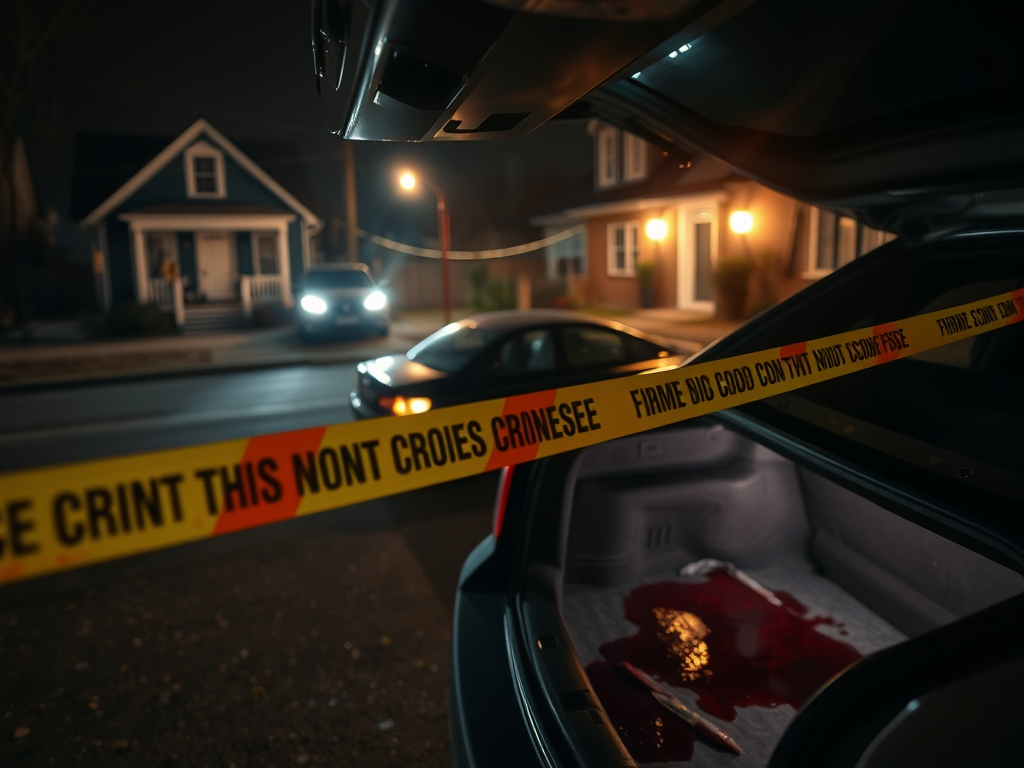
The crime scene investigators recovered more evidence. Fibers from the Mayor’s vehicle matched traces found in the victims’ home. Security footage showed his car in the vicinity the night of the murders. And then there was the most damning piece of evidence—blood found in the trunk of his car.

Faced with overwhelming proof, Mayor Awning finally broke. He confessed that he had been involved in a secret arrangement with influential figures in town. The house was where illegal dealings occurred—deals that had gone wrong. That night a week ago, he had seen a gruesome execution. He panicked and fled, leaving behind his car. The killers, nonetheless, had unfinished business.

By the time Jethro and Jilly had put the pieces together, it was too late for the three women. But it wasn’t too late for justice.

Tim Awning was arrested, and his political career ended in disgrace. As he got led out of his mansion in handcuffs, the weight of his crimes hung heavy in the air. Jethro knew this case would haunt him. Nonetheless, at least now, the Mayor would finally pay for his sins. This Mayor had helped kill women.

Uncovering Crime: The Relentless Pursuit of Justice

It was a typical summer night in western Oklahoma, and Officer Ben Groff enjoyed a rare night off. He planned to eat at a restaurant on the city’s west side. He drove there in his newly purchased 1985 Dodge Ram. Gaming gold and black under the streetlights, the pickup was his pride and joy. As he cruised along old Route 66, he rolled down the window to enjoy the cool evening breeze.

At an intersection, a red Jeep pulled up beside him. Its driver, a man about Groff’s age, turned down his radio and hollered over the traffic.

“I like your truck; that is slick, man!

Groff grinned.

“Thanks! Your Jeep’s pretty nice too!”

The man motioned toward the Sonic drive-in up ahead.

“Pull over. Let’s talk!”

Curious and lacking close friends outside the police department, Groff agreed. They parked at Sonic, grabbed burgers, and swapped stories about their vehicles and work. The man introduced himself as Lenny and said he had a knack for making fast friends. Groff, still, couldn’t ignore the possibility that this chance meeting lead to more than small talk. Lenny’s interest in trucks worried Groff. His easy charm also raised Groff’s suspicion.

That night, over beers at Groff’s house, a tentative friendship began to form. But Groff had a strategy. He suspected Lenny was his way into a group linked to a string of thefts plaguing the city. The Chief of Police gave a cautious blessing. Groff embedded himself in this new circle of acquaintances. He balanced camaraderie with the thin line of professional detachment.

Walking the Tightrope


The deeper Groff immersed himself, the more skeptical his fellow officers became. Some resented his approach, accusing him of consorting with known criminals. Others were envious of how the community responded positively to Groff’s efforts. For Groff, the criticism was a necessary price. He knew abandoning the operation would make months of effort meaningless.

By late November 1985, Groff’s relentless work—juggling undercover meetings, regular patrol shifts, and state-mandated training—was starting to pay off. A critical breakthrough came unexpectedly when one of Lenny’s associates sold Groff a set of truck railings. The thrill of the chase was palpable as Groff made the buy and then cross-referenced recent police reports. Sure enough, a burglary at Bill’s Auto listed truck railings among the stolen items.

It was the break he’d been waiting for.

Closing the Net


The next day, Groff burst into the Chief’s office, his excitement barely contained.

“I’ve got them, Chief! One of them sold me stolen property. If I press him, I can flip him and take down the whole operation!”

The Chief, weary but intrigued, leaned ahead.

“Are you serious? You’re sure this will work?”

Groff nodded.

“I’m sure. But I need to move fast before they catch wind of it.”

“Not alone,”

the Chief said firmly.

“We’ll grab a detective. Let’s do this right.”

The weight of responsibility was heavy on Groff’s shoulders. He agreed but insisted on leading the first confrontation alone. He wanted to avoid spooking the suspect. The Chief and the detective parked discreetly down the street as Groff pulled into the suspect’s driveway.

Groff agreed but insisted on leading the first confrontation alone to avoid spooking the suspect. The Chief and the detective parked discreetly down the street as Groff pulled into the suspect’s driveway.

The suspect, Joey, took his time answering the door. His surprise was clear when he saw Groff in uniform.

“Joey,”

Groff began, his voice steely,

“I know everything—the railings, the bumpers, all of it. This is your one shot to come clean before this place gets torn apart. Don’t blow it.”

Joey’s defiance crumbled.

“How’d you find out?”

he stammered.

Groff played it cool.

“You sold me stolen property. It wasn’t hard to figure out.”

Joey hesitated, then blurted,

“There’s more—way more.”

The Haul


Inside Joey’s attic, Groff and the suspect found a treasure trove of stolen goods. They discovered jewelry, electronics, vehicle accessories, and a firearm. Over $40,000 in items were recovered from Joey’s residence alone. Joey’s confession led to six extra arrests, dismantling a theft ring that had operated for three years.

But the investigation didn’t end there. Interviews with the subjects hinted at more profound corruption, implicating former high-ranking officers in a grocery robbery scheme. Groff pressed for a deeper probe, but political resistance and departmental politics hampered his efforts.

Despite these setbacks, Groff’s work earned him a reputation as a relentless investigator. He was willing to make personal sacrifices to serve justice. The satisfaction of justice served was palpable. Groff’s relentless pursuit of the truth led to the dismantling of a major theft ring. That summer night on Route 66 started a chain of events. It led to one of the most significant cases of his career.

The Day Communications Sent the Cavalry to My Rescue ––– Thanks To Chester

Groff Media 2024© Truth Endures IMDbPro

Presented by benandsteve.com By: Benjamin Groff II©

3–5 minutes

It was one of those perfect spring days in April when everything felt right. The sun warmed the air to a comfortable 70 degrees. I rolled down my cruiser’s windows for the first time in months. I patrolled the streets of Elk City. That morning, the west side was my focus, a quiet stretch where anything unusual instantly stood out. That’s where I spotted Chester Hessman.

Ah, Chester Hessman. Everyone in Elk City knew him. Born and raised here, Chester was as much a part of the town as its aging brick buildings. He shared the unofficial title of “town drunk.” Another character held this title, too, whose story fills its chapter. Chester, though, was unique. He had a charm akin to Otis Campbell from The Andy Griffith Show. Otis was a regular at the jail with a presence so familiar that he also had his key.

Chester was skinny and of medium height. He was always disheveled. If he was out in public, he was most certainly drunk. Today, he was directing traffic in the middle of a bustling four-lane intersection, completely ignoring the functioning traffic light overhead.

I flipped on my red-and-blue lights and eased my cruiser into the intersection, pulling up beside him. Stepping out, I called him ––––

“Chester, you’re going to put me out of a job! How about I give you a ride home instead?”

Chester turned toward me, swaying on unsteady legs. He gave me a gummy smile—he hadn’t had teeth for years—and replied, –––

“I’d love ya for it!”

I chuckled, helped him into the passenger seat, and gave him a friendly warning. –––

“Now listen, Chester. I need you to sit tight and behave. Don’t think about jumping out or causing trouble, or it’s straight to jail. Got it?”

“I plomise!”

he slurred, laughing and babbling as I buckled him in.

Pulling away, I turned off the lights and debated whether to radio in the meeting. Chester had just been released from jail that morning. I hoped he would stay out of trouble if I got him home—at least for the day. I decided to keep it off the books. What would go wrong?

Well, a lot, as it turned out.


We were only a few blocks from Chester’s house when a priority call came over the radio.

Unit 3, Unit 4, Unit 2, and Unit 6: Report of six individuals behind Braum’s on 3rd Street. They are shooting at each other with a gun.

I was the closest unit, just a block away. Chester looked at me, confused as I explained the situation. –––

“Chester, you’ve ridden along before. You know the drill—stay in the car, keep your head down, and don’t touch anything for the love of God. Got it?”

He nodded solemnly, briefly giving the impression he was sober.

“I’ll watch out for ya, Officer Ben. Don’t worry.”

As I pulled up to Braum’s, I spotted six figures loitering near the back of the building. I radioed in,

“Unit 3: Headquarters, I’m 10-97 with six 10-12s. I’ll be out with them.”

Communication was acknowledged, and I stepped out to approach the group. But as I got closer, my portable radio began emitting a garbled, high-pitched noise. Annoyed, I assumed it was interference and turned the volume down.

The six “suspects” were kids playing with a toy air gun. We had a brief chat about how their game looked to the public. I suggested they move their play to a less conspicuous location. They nodded, embarrassed but cooperative.


As I headed back to my cruiser, I heard sirens approaching from all directions. Confused, I quickened my pace and opened the car door to find Chester holding my radio mic.

“Chester,”

I said, trying to process the scene.

“What are you doing?”

He grinned at me like a naughty child caught red-handed. –––

“Just makin’ some sounds, Officer Ben. Ain’t it funny?”

It wasn’t. The “interference” I’d heard earlier was Chester making garbled noises on my radio. When I turned my portable’s volume down, Communications assumed the worst. They thought I was injured. Worse, they thought I was trying to signal for help. They’d dispatched every available unit, fire, and ambulance to my location.

Chester’s laughter echoed as the reality of the situation sank in. What was supposed to be a quiet favor for Chester had turned into a full-blown emergency response.


I drove Chester straight to jail. He laughed the entire ride, still holding the microphone like his toy. I went to radio headquarters. I needed to explain to my supervisor how Elk City’s most infamous drunk had hijacked my radio, sparking chaos.

As I left the station that day, I still heard Chester laughing from his cell. I didn’t find it nearly as amusing.

Justice Served: Stolen Vehicle Chase in Elk City

Groff Media 2024© Truth Endures IMDbPro

Presented by benandsteve.com By: Benjamin Groff II©


3–4 minutes

Officer Ben Groff had just started his shift at the Elk City Police Department when the call came through dispatch:

“Units should be advised of a report of a stolen vehicle spotted heading north on Main Street. It collided with several vehicles in front of the theater and continued. The suspect is a white Dodge Charger. All units respond.”

Ben’s patrol car roared to life as he drove through Third and Madison Avenue to intercept the vehicle on Main Street. Ben hit the lights and siren, merging into the city’s bustling evening traffic. Main Street was alive with its usual commotion—families grabbing dinner, teens cruising, and trucks rumbling through on their way to the interstate. The Charger weaved recklessly through it all, its driver seemingly unfazed by the chaos.

Ben’s adrenaline surged as he radioed in.

“Unit 3 in pursuit. The suspect vehicle appears to be trying to head towards Washington Street through alleyways.”

As the stolen vehicle blew past a red light, narrowly missing a minivan, Ben deftly maneuvered around other cars, keeping his pursuit controlled but relentless. He’d chased suspects before, but this one felt different—the driver was audacious and desperate, taking wild risks that jeopardized everyone on the road. The danger was palpable, the stakes high, and the adrenaline was pumping.

When the Charger made a sharp turn onto a quieter side street, Ben followed, his tires screeching on the asphalt. For a moment, the streetlights flickered off the Charger’s rear window, and Ben caught a glimpse of the driver—a young woman, her face twisted with determination.

Finally, the suspect tried to cut through an alley too narrow for her car’s speed. The Charger clipped a dumpster and spun out, slamming into a utility pole. Smoke billowed from the crumpled hood.

Ben skidded to a stop, jumping out with his weapon drawn.

“Show me your hands! Out of the car, now!”

The woman hesitated before stepping out, her hands trembling but raised. She was strikingly familiar—Lisa Rhodes, the girlfriend of the auto magnate and social media influencer John DeLorean. The revelation sent a shockwave through the scene, a twist in the narrative that no one, not even Ben, saw coming.

“You’ve got to be kidding me,”

Ben muttered under his breath.

Lisa tried to talk her way – out of it, her voice honeyed but shaky.

“Officer, I didn’t steal this car. It’s one I borrowed. A man, let me borrow it—this is just a misunderstanding!”

Ben wasn’t buying it. As he cuffed her, he noticed her purse on the passenger seat. When he peeked inside, his suspicions were confirmed—a substantial stash of drugs, including pills and small baggies of powder.

Backup arrived moments later, securing the scene. Lila’s protests grew louder as the reality of her arrest sank in.

“You don’t know who you’re messing with! John will have his attorneys save me and get your badge for this!”

Ben smirked as he read her rights.

“Maybe he will, but not before I make sure you face the consequences of tonight’s little joyride.”

Ben’s determination was unwavering, and his commitment to upholding the law was resolute, making it clear that justice would prevail.

Back at the station, the news spread like wildfire. Lila Rhodes, the woman frequently seen on John DeLorean’s arm at high-profile events, was booked for possession and vehicle theft. Reporters swarmed the station, eager for a statement. As she promised, high-profile attorneys showed up the following day to post bail and escort her back to California.

Later, as Ben completed his report, his sergeant clapped him on the shoulder.

“Hell of a job tonight, Ben. You nabbed someone who thought she was untouchable.”

Ben nodded, exhausted but satisfied. In Elk City, justice didn’t care about status or connections—it only cared about the law. This matter would become evident as Ben brought in well-known individuals on burglary, auto theft, and other felony charges. That is a story coming soon.

NOTE: Some names, locations, and information are changed or edited to contain alternate identifications for privacy reasons.

Navigating Ethics in Law Enforcement

Groff Media 2024© Truth Endures IMDbPro

Presented by benandsteve.com By: Benjamin Groff II©


4–5 minutes

After completing my training, I got assigned to a two-person unit for part of my shift. Unfortunately, this arrangement led to the exposure of my partner’s extramarital affair with a young woman who worked at a nightclub on the city’s east side. His behavior was hard to ignore. Night after night, he would leave the patrol unit to spend hours inside the club, leaving me alone to monitor radio calls. Each absence grew longer and my frustration deeper.


The city grappled with a surge in burglaries targeting vehicles, garages, homes, and businesses. As crime reports piled up, the department needed to be closer to solving the problem. Sitting in the patrol car logging incidents while my partner dallied at the bar weighed heavily on me. Worse, my delayed response times to calls had begun to draw attention, placing me in a difficult position.

Addressing the issue felt like navigating a minefield. On one hand, I had a duty to uphold the integrity of our patrol duties. On the other, reporting my concerns to a sergeant or lieutenant risked exposing my partner’s personal life, which I preferred to avoid. Going over their heads to the Captain or Major felt equally precarious. However, during my travels to pistol shooting competitions, I established a good rapport with the Chief of Police. I decided to take a chance.


One afternoon, I invited the Chief for coffee to discuss an upcoming qualification event. Once seated, I confessed my more profound concerns. I told him about my partner’s absences, the nightclub, and the woman I suspected was involved. I explained why I had yet to go through the chain of command and emphasized that my primary concern was the integrity of our patrol duties. To my relief, the Chief not only understood but also reassured me that I had made the right choice. His promise to handle the situation discreetly was a weight off my shoulders.


A week later, the schedule was released, and to my disappointment, I again got paired with the same partner. The pattern continued, with him vanishing into the nightclub and leaving me to manage radio calls alone. Frustration mounted, but I stayed focused on my responsibilities.
At the following briefing, Lieutenant Wheeler announced a significant change: I would get assigned to a solo unit. My former partner, now in a solo unit, would no longer work with me. Other patrol officers, except the K9 unit, were paired up. The decision felt like a small but meaningful vindication, a recognition of my commitment to upholding the integrity of our patrol duties.


Working solo was a challenge. Within my first three days, I responded to two fatal calls—more than many officers encounter in a month. However, I was not alone. I appreciated the support of my fellow officers, who often checked in during traffic stops or guided me through the intricacies of field reporting. Their support was a testament to the camaraderie in law enforcement and the importance of teamwork.


One night, around 1:00 AM, I intercepted a burglary alarm call at a sporting goods store. I was close to the location and informed dispatch I would respond. Oddly, my former partner claimed the call, though he was across town. Dispatch redirected him to return to headquarters instead. I only thought of it once I reached the station later.


The pieces fell into place. The Chief observed my partner’s behavior, noting how long his patrol unit lingered at the nightclub each night. The Chief orchestrated a fake alarm call to confirm his suspicions and monitored my partner’s response time. This thorough investigation led to the end of my partner’s career; he resigned the following day.


The aftermath was messy. My former partner left town with the barmaid and her four children, abandoning his wife of many years. She was devastated and began calling the department, requesting me by name to visit her. I got met with her anguish and accusations each time: “Why didn’t you tell me?” At just 21 years old, I struggled to understand why she held me responsible for policing her husband’s fidelity.


While I tried to console her, the experience left a deep impression. It wasn’t just a lesson about personal integrity and the far-reaching consequences of a lack of it. From then on, I made it a point to know my partners better, ensuring they had solid personal ethics or no attachments that could spill into their professional lives.


This early chapter of my career shaped my approach to law enforcement. It reminded me that while we wear a badge to uphold the law, we also carry the weight of trust—not just from the public but from those who depend on us, on and off duty. The importance of personal integrity in law enforcement cannot be overstated. It is not just about following the rules, but about the impact of our actions on the lives of others.