No Virginia, “Immigrants Can’t Get Foodstamps, Welfare Or Free Healthcare”

© Benjamin H. Groff II — Truth Endures / benandsteve.com

4–7 minutes

With the 2026 U.S. election season soon underway, you’ll hear a significant amount of disinformation. One major strand targets immigrants in a wholly prejudicial way. It treats them as one homogenous group of “illegal” residents. It claims they all take “welfare benefits,” “food stamps,” or “public assistance programs.” These terms are used as triggers to motivate a particular set of voters. This is a tactic well understood by the most bigoted of candidates.

In reality, U.S. federal law places strict limits on non-citizens’ access to most benefit programs. Among the relevant statutes is the Personal Responsibility and Work Opportunity Reconciliation Act (PRWORA) of 1996. This act sets the baseline framework that governs immigrant eligibility for federal means-tested benefits. (1)


Key Facts

Undocumented immigrants — those who entered without inspection or overstayed visas — are generally ineligible for most federal public benefits. According to the National Conference of State Legislatures (NCSL), people without authorization in the United States can’t access federal public benefits. People who lack authorization in the United States are unable to access federal public benefits. People without authorization in the United States cannot access federal public benefits. Exceptions exist for certain emergency assistance, disaster relief, and non-cash community-level services. (2)

These benefits include major programs. Examples are the Supplemental Nutrition Assistance Program (SNAP, or “food stamps”). Another example is the Temporary Assistance for Needy Families (TANF) cash-assistance program. They also include non-emergency Medicaid. (3)


Lawfully present immigrants, including lawful permanent residents (green-card holders), face further restrictions. Most must wait five years after achieving “qualified immigrant” status before becoming eligible for many federally funded means-tested benefit programs. (4)

Criminal convictions may further affect eligibility. Individuals convicted of a drug–related felony after August 22, 1996 may be barred from receiving SNAP benefits. This is the case in many states. (5)

State-level variation: Federal law sets the baseline. However, individual states may use state funds to extend certain benefits. These benefits are for immigrants who are otherwise ineligible under federal rules. (6)

Quick Facts:
📌 Law: Personal Responsibility and Work Opportunity Reconciliation Act (PRWORA) of 1996
📌 Undocumented Immigrants: Ineligible for SNAP, TANF, and non-emergency Medicaid
📌 Legal Immigrants: Usually face a 5-year waiting period
📌 State Variations: Some states fund limited local programs
📌 Citizen Children: Eligible for benefits if they meet program rules
📌 Exceptions: Refugees, asylees, trafficking victims are exempt from waiting periods

Benefits for U.S. citizen children: A key exception ensures that children born in the U.S. can receive federal benefits, such as SNAP and Medicaid. This is true regardless of their parents’ immigration status, provided they meet all other eligibility requirements. The parents’ immigration status does not disqualify the U.S. citizen child. (7)

Specific exempt categories: Some immigrants are exempt from certain waiting periods or restrictions. These include refugees, asylees, victims of human trafficking, and certain others. (8)


In Summary

The U.S. benefit system places tight limitations on which non-citizens can receive publicly funded assistance. Eligibility depends heavily on:

  • the individual’s immigration status (unauthorized vs. qualified)
  • how long they’ve been residing legally
  • the particular rules of the specific assistance program.

In short: undocumented immigrants have virtually no access to standard federal welfare programs. They also lack access to food-assistance programs, especially if they have a criminal record. Many legal permanent residents must wait years. There are state-funded alternatives and exceptions. However, the broad public claim that “immigrants all use welfare/food stamps” is factually false. This claim serves as a misleading narrative.


Why this matters

When you hear a politician or political advertisement claim that immigrants are draining public benefits, you’re hearing a distorted narrative. It’s a message crafted to provoke emotional responses. It appeals to anxieties. It does not truthfully engage with the specifics of immigration law and benefit eligibility.

Bookmark this post for future reference—especially in the coming campaign months, when such claims will be ramped up. Having the facts on hand helps you call out hyperbole. It separates rhetoric from reality. This keeps the public conversation grounded in truth.

Constitutional Rights of Immigrants

Despite differences in citizenship status, the U.S. Constitution guarantees core rights to all persons within its jurisdiction — including immigrants, regardless of legal status. The Fifth and Fourteenth Amendments protect every “person” (not merely “citizens”) from deprivation of life, liberty, or property. Due process of law is required. They also protect from denial of equal protection under the law. The First Amendment also ensures freedom of speech, religion, and peaceful assembly for all. These guarantees extend to everyone on U.S. soil, whether they are citizens, lawful residents, or undocumented immigrants.

The Supreme Court has repeatedly affirmed these principles — most notably in Plyler v. Doe (1982). It held that undocumented children are entitled to the same public education rights as others. This is echoed in Zadvydas v. Davis (2001), which found that indefinite detention of immigrants violated constitutional due process. While immigration status can affect eligibility for government benefits, it does not erase the fundamental rights guaranteed by the Constitution.


References

  • U.S. Constitution, Fifth Amendment – Protects all persons from deprivation of life, liberty, or property without due process of law.
  • U.S. Constitution, Fourteenth Amendment, Section 1 – Ensures equal protection and due process for “any person” within the United States.
  • U.S. Constitution, First Amendment – Guarantees freedom of religion, speech, press, and peaceful assembly to all persons.
  • Plyler v. Doe, 457 U.S. 202 (1982) – Supreme Court ruled that denying public education to undocumented children violates the Equal Protection Clause.
  • Zadvydas v. Davis, 533 U.S. 678 (2001) – Affirmed that immigrants, even undocumented, are protected by the Due Process Clause against indefinite detention.
  • Yick Wo v. Hopkins, 118 U.S. 356 (1886) – Early Supreme Court case establishing that equal protection applies to non-citizens as well as citizens.

🗳️ Call to Action: Truth Over Talk

In the months ahead, political noise will grow louder, and facts will often take a back seat to fear. Before sharing or believing any claim about immigrants, take a moment to fact-check it. Look for verifiable data. Check reputable sources and legal references. Misinformation thrives when good people stay silent.

Share true information. Challenge falsehoods when you see them.
By doing so, you defend the truth. You also uphold the American promise of fairness and equality under the law.


By Benjamin GroffMedia© | benandsteve.com | ©2025 
Top Financial Worries in 2025: What You Need to Know

2–3 minutes

The Biggest Concern Facing People Today

We live in a world filled with constant change and uncertainty. One theme keeps bubbling to the surface no matter where you look: economic anxiety. Money-related worries top the charts of what keeps people awake at night. These concerns range from the price of groceries to the dream of owning a home.


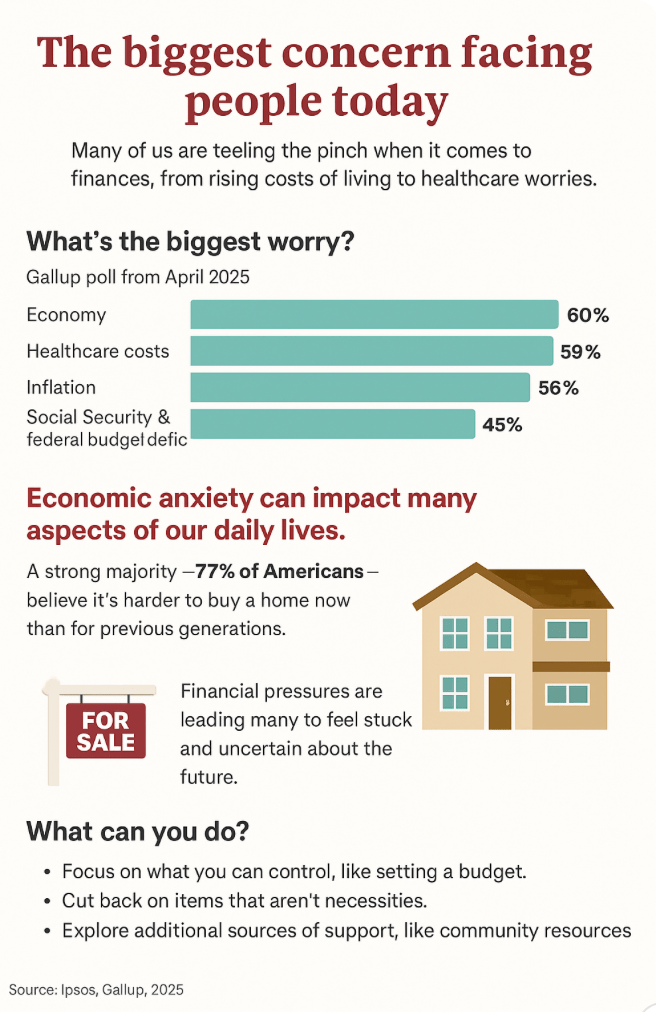
Gallup poll from April 2025 found that:

  • 60% of Americans worry “a great deal” about the economy.
  • 59% lose sleep over healthcare costs.
  • 56% are stressed about inflation.
  • Nearly half worry about Social Security and the federal budget deficit.

Globally, it’s no different. According to Ipsos, the leading concerns include inflation (30%)poverty (29%)unemployment (28%), and corruption (26%).

To make matters feel even heavier, 77% of Americans believe it’s harder to buy a home today. They feel it’s more difficult than it was for past generations. That frustration touches nearly every household—young people trying to buy, older adults trying to downsize, and families squeezed in between.


Staying together through rough times!

This isn’t just about numbers—it’s about people. Rising rent, higher grocery bills, climbing medical costs—each of these chip away at security. Families cut corners, young people delay milestones like marriage or kids, and many retirees wonder if their savings will last.

Economic stress also spills into mental health, relationships, and communities. When you feel like you’re always one paycheck away from disaster, it’s hard to focus on thriving—you’re stuck surviving.


While we can’t solve inflation or rewrite housing policy alone, there are small, powerful steps we can take:

The Mysteries of Financial Security.
  • Focus on control: Create a budget and stick to it. Even small wins matter.
  • Cut back strategically: Trim unnecessary expenses, but give yourself permission to keep the things that bring you joy.
  • Tap into resources: Community groups, food banks, and local organizations often have programs to ease the burden.
  • Stay connected: Talking about financial stress reduces shame. You’re not alone.

The economy, healthcare, inflation—they’re big, intimidating problems. But your response doesn’t have to be. Focus on what you can control. Find support in your community. Remember: sometimes resilience comes not from having more, but from facing less with wisdom, planning, and hope.


By Benjamin GroffMedia© | benandsteve.com | ©2025 

What Will Happen If PLANS To End Social Security Happens?

3–4 minutes

If Social Security were eliminated, the effects would be wide-ranging. It would touch nearly every part of American life. This is especially true for retirees, people with disabilities, and survivors of deceased workers. Here’s how it would unfold:


Social Security now provides monthly benefits to over 70 million Americans, including retirees, disabled individuals, and surviving spouses or children. Without it, many of these households would lose their main or only source of income overnight.

  • Retirees: Many older Americans rely on Social Security for the bulk of their income—especially those without significant savings or pensions.
  • Survivors: Widows, widowers, and children who now get survivor benefits would lose critical support.
  • Disabled workers: People incapable of work due to disability would lose a major safety net.

Before Social Security, poverty among the elderly was extremely high—estimates put it at around 35–50%. The program cut that rate dramatically. Without it, poverty rates among older Americans will return to pre-1935 levels.


The financial burden of caring for elderly or disabled relatives would shift heavily to families. Those without family support be forced into underfunded state programs or charitable care.

  • Families need to delay retirement, take on extra jobs, or house multiple generations under one roof.
  • Local charities and churches would see rising demand for basic necessities like food and shelter.

Social Security benefits aren’t just “checks”—they fuel spending in local economies. Without those payments:

  • Rural and small-town economies (which often have higher percentages of retirees) see sharp declines in consumer spending.
  • Certain industries—especially healthcare, retail, and housing—would feel immediate impacts.

Because Social Security is one of the most popular federal programs, ending it would be politically explosive. It would lead to intense public backlash, large-scale protests, and significant shifts in voter behavior.

  • States try to create their own replacement programs, but poorer states struggle to fund them.
  • The wealth gap would widen sharply. Those without private retirement savings would be left with little to no safety net.

By Benjamin GroffMedia© | benandsteve.com | 2025 

August 2025 commemorates its 90th anniversary. It marks its unwavering commitment to the financial security and dignity of millions of Americans. President Franklin D. Roosevelt signed the Social Security Act into law on August 14, 1935. Since then, the program has grown into one of the most successful and trusted institutions in American history.

“For 90 years, Social Security has stood as a promise kept. It ensures that older Americans have the support they need. It also aids people with disabilities, as well as families facing loss,”

said Commissioner Frank J. Bisignano.

“As we honor this legacy, we are also building a future. This future is where service is faster, smarter, and more accessible than ever before. Through President Trump’s vision, we are protecting and preserving Social Security. We achieve this by delivering extraordinary customer service through technological improvements. Enhanced process engineering also plays a crucial role.”

In an open letter to the American people, Commissioner Bisignano emphasized the importance of Social Security. He highlighted his commitment to strengthening the agency. He also mentioned the significant improvements to customer service achieved in his first 100 days in office.

Read the Letter:  Commissioner Bisignano’s Open Letter to the American People

Today, Commissioner Bisignano also joined President Donald J. Trump at the White House. The President issued a presidential proclamation. He recommitted to always defend Social Security. He recognized the countless contributions of every American senior. They have invested their time, talent, and resources into our Nation’s future. 

Read the Proclamation: Presidential Proclamation: 90th Anniversary of the Social Security Act

Don’t Wait To Die When You Retire – If You Are 55+ The Time To Do It Is Now

By Benjamin GroffMedia© | benandsteve.com | 2025 Truth Endures©

3–4 minutes

Life, Sirens, and a 55+ Sense of Humor

As I write this, I am still in recovery—at least, I hope I am. Truthfully, this post was written before my surgery, so I can’t yet say how it all turned out. By the time you read this, several weeks will have passed since the procedure took place. It was scheduled to publish automatically, so here we are. If the doctors didn’t nick a major artery, I’ll be fine. If they didn’t accidentally close me up with a coffee lid inside, I’ll be okay. I will eventually get back to writing these posts daily. Until then, I’ve got a few stories lined up and ready to go.

The other day, I heard a siren blaring in my right ear. That startled me, since my left ear—damaged years ago in a police shooting—usually just rings nonstop. But this sound was sharp, insistent, and real. It kept getting louder, and I was sure it was headed into our neighborhood. I turned to my better half and said:

“Sounds like a house is about to go up for sale.”

He replied:

“Nope. I’m watching a police pursuit on YouTube.”

And we laughed—and I mean, really laughed. That’s the kind of exchange you’ll hear often in a 55+ community. Especially among those of us in the 55–65 age range, and certainly from our older friends beyond that. Because when sirens echo through the streets here, the conversation usually shifts to:

“Did you hear who it was?”

And yes, sadly, “was” is often the operative word. Sirens and flashing lights tend to signal more than just a medical emergency. They also draw a small parade of concerned neighbors. Curious drive-by observers and the always-early realtor, already imagining the next listing, gather quickly.

Now, don’t mistake this for a lack of respect for the sick or the departed. It’s really about staying informed. In a 55+ community, if you miss a couple of days, you could easily fall behind on who passed away. You might not know when the services are. This could affect your pickleball schedule. You could be waiting to play a doubles match that will never happen. The other team has quite literally checked out.

Even the golf course has its quirks. The back nine may suddenly open up if someone didn’t quite finish the front five. It’s the kind of morbid practicality that comes with age—and a bit of wit.

Social gatherings here often revolve around food, especially the cherished potluck lunch. And trust me, in a 55+ community, when they say potluck, they mean luck. You just hope enough actual pots show up to make it a meal by the time noon rolls around.

But all joking aside, living here has been one of the best choices we’ve ever made. Will Rogers once said, “If you don’t like the weather in Oklahoma, just wait a minute.” Well, in a 55+ community, the same could be said about neighbors.

We love this place. In the twelve years we’ve lived here, we’ve only lost three neighbors. This is a testament to the spirit and vitality of this community. Funny enough, when we first moved in, we were technically too young to qualify. But we were here to care for my then 83-year-old mother. After she moved in with my sister and never came back, we decided to stay. Eventually, we aged into the group ourselves and bought a home right here in the neighborhood.

It’s clean, quiet, and secure. There’s 24-hour security. Many of our needs are covered through a very affordable HOA. Less than $100 a month covers trash service, gym access, swimming and tennis. It also includes pickleball courts, a dog park, clubhouse use, and even a monthly newspaper.

So, if you’re nearing that point in life—my advice? Raise the kids and get them out of the house. Then consider moving to a 55+ community as soon as you can. The sooner you arrive, the more life you’ll have to enjoy it. You don’t have to work yourself into the grave. You can laugh your way there instead—one siren, one potluck, one sunrise at a time.

Reflections on the COVID-19 Pandemic and Its Legacy

By Benjamin GroffMedia© | benandsteve.com | 2025 Truth Endures©

3–4 minutes

A Note from the Pandemic

I was being driven to an appointment earlier this week when a reminder flashed on my phone. It was one of those “On This Day” memories—a flashback from five years ago. It was a note I had posted on social media during one of the darkest times I can remember.

It read:

Today, the national death toll in the United States reached 80,000. In the state where I live, the deaths are many. They have brought in refrigerated trailers to hold the bodies. The mortuaries have more bodies than they can carry. The coroner’s office is over capacity. It is being reported that 100 people died in the city where I live yesterday alone.

People separated by COVID-19. Pinterest

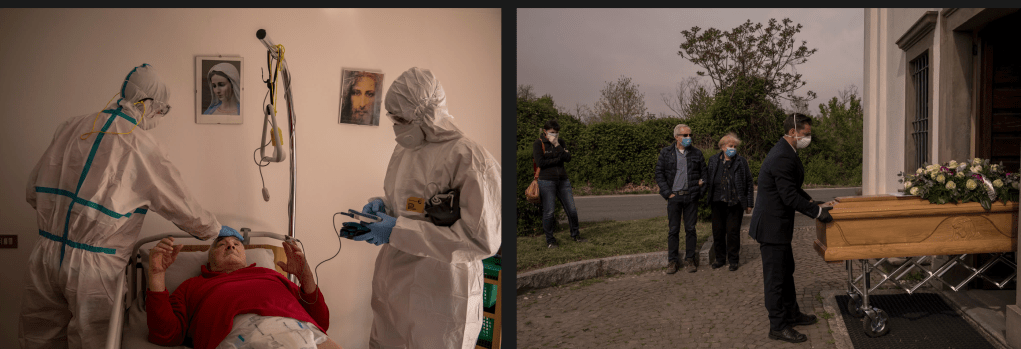
That note was one of millions posted by people around the world that day. It was part of a collective cry for help. It was a shared testimony during a global crisis. The crisis tested the very core of our humanity. The COVID-19 pandemic wasn’t just a health emergency—it was a historical reckoning.

The novel coronavirus (SARS-CoV-2), first identified in late 2019, swept through cities and countries with terrifying speed. It took the lives of the elderly and the young. It didn’t care about borders or status. It wasn’t limited by language, ideology, or belief. It was an indiscriminate invader—silent, invisible, and merciless.

Pinterest

Hospitals filled to capacity. ICUs ran out of beds and ventilators. Nurses worked 12–16 hour shifts in full protective gear. They returned the next day knowing more patients would be gone. They feared coworkers would be gone too. Some had to reuse PPE, others never had proper protection at all. Entire medical teams were decimated. The faces behind the masks—so many of them never seen again by their loved ones.

In some areas, morgues overflowed, and refrigerated trucks became temporary storage for the deceased. Funeral homes struggled to keep up. Families said goodbye to loved ones through screens or from behind glass, incapable of touching them one last time.

Pinterest

Masks became a symbol—of protection, of politics, of protest. While many wore them out of care for others, others rejected them, fueled by fear, misinformation, or political agendas. What should have been a unified public health response fractured along ideological lines.

The spread of disinformation only made things worse. Some media personalities claimed the virus was “just a flu.” Other public figures suggested it was a hoax designed for political or financial gain. Some of those very same people later contracted the virus. A few died from it—some reportedly urging others to take it seriously with their final breaths.

Pinterest

For me, it was personal. I knew approximately twenty—or more—people I had known for most of my life who died from COVID-19. Every day brought another notice: a friend from childhood, a neighbor, someone from church, a former coworker. Sometimes I would hear from relatives who lost someone. Other times, I’d check news from back home and learn that yet another familiar name had been claimed. In places I had once lived, people I had once shared moments and memories with—gone. The virus wasn’t abstract. It carved itself into the story of my life, my family, my friends, and their families.

Pinterest

Vaccines would eventually arrive, faster than any in modern history. But by then, millions had died, and countless others were left with long-term effects—some still suffering today. As of mid-2025, more than 1.1 million Americans have died from COVID-19. Globally, the death toll has surpassed 7 million, though some estimates suggest the real numbers were even higher.

That reminder on my phone was more than just a memory. It was a marker—a scar from a time we lived through together, yet each experienced in our own way.

Pinterest

Let it be said clearly: the virus was real. The loss was real. And for many, the grief still is.

Let that note stand as a record not just of tragedy, but of resilience. Of what we went through—and of what we must remember. Because forgetting invites the risk of repeating it all over again.

Going Into A Restricted Area While Wearing Metal – An MRI Nightmare

A Man Entered An MRI Room That He Was Not Approved To Enter. It Nearly Killed Him.

By Benjamin GroffMedia© | benandsteve.com | 2025 Truth Endures©

2–3 minutes

“Do you have any metal on your body?”

It’s a question you’ve probably heard before entering a medical imaging room. It might sound routine—almost too simple to matter. But as one man in Westbury, New York, learned the hard way, ignoring that question can be deadly.

Earlier this week, a 61-year-old man walked into an MRI suite at Nassau Open MRI. He wasn’t a patient—he was a visitor. And according to reports, he entered without permission, unaware (or perhaps unconcerned) about the danger waiting behind the door.

Around his neck hung a heavy metal necklace.

That necklace would soon become a missile.

As the MRI machine powered up, the magnetic field—a force thousands of times stronger than Earth’s natural magnetism—ripped the necklace forward, pulling the man violently toward the magnet. The result was catastrophic. He suffered critical injuries and was rushed to the hospital.

You can read the full report here from the Miami Herald:

🔗 Visitor wearing necklace critically injured inside New York MRI room

MRI machines are marvels of modern medicine. They allow doctors to see deep into the body without needing to cut it open. Yet, the science that powers them relies on an immense magnetic force.

That’s why medical staff ask the same questions again and again:

  • Do you have any metal implants?
  • Are you wearing jewelry?
  • Have you removed your belt, watch, or hairpin?

These aren’t suggestions. They’re essential precautions to prevent precisely what happened in Westbury.

The necklace that injured this man was an everyday item—something many of us wear without a second thought. 

But in the MRI room, it was anything but ordinary.

This tragic incident serves as a sobering reminder:

Always follow MRI safety guidelines. Always respect warning signs. Never assume a machine like this can be taken lightly.

The man who wore the necklace didn’t mean to cause harm. The laws of physics don’t care about intent. In an MRI suite, metal is never safe unless it’s been declared and cleared.

So next time someone asks you,

“Do you have any metal on your body?”

Don’t shrug it off.

Your answer will save your life!

You can read the full report here from the Miami Herald:

~ The Hardest Decision ~

In the quiet corners of her home, Sarah sat her mind adrift in a sea of conflicting emotions. Her mother, once vibrant and robust, now frail and in need of constant care, sat in the living room, a mere shadow of her former self. It had been a long and arduous journey, filled with sleepless nights and endless worry. But now, Sarah faced the most challenging decision of all – the decision to place her mother in a nursing home.

“Mom, I need to talk to you about something important!”

“What is it Dear” Her Mother Asked?

The idea had lingered in Sarah’s mind for months, whispered in hushed tones by concerned family members and well-meaning friends. Each time, she pushed it away, unwilling to confront the reality of the situwation. But as her mother’s needs grew more demanding, Sarah knew she could no longer ignore the inevitable.

With a heavy heart, Sarah approached her mother, her hands trembling with uncertainty. “Mom,” she began softly, “I need to talk to you about something important.”

Her mother looked up, her eyes clouded with confusion. “What is it, dear?” she asked, her voice tinged with worry.

Taking a deep breath, Sarah explained the situation as gently as possible. She spoke of the challenges they faced and the toll it was taking on them. She spoke of the nursing home – a place where her mother could receive the round-the-clock care she needed, where she would be safe and well looked after.

Her mother listened quietly, her expression unreadable. When Sarah finished, there was a long silence, broken only by the clock ticking on the wall.

Finally, her mother spoke, her voice barely above a whisper. “I understand, dear,” she said, her words heavy with resignation. “I know you’re doing what’s best for me.”

Tears welled up in Sarah’s eyes as she embraced her mother tightly. “I love you, Mom,” she whispered, her voice choked with emotion.

“I love you too, dear,” her mother replied, returning the embrace with feeble arms.

In the following days, Sarah worked tirelessly to find the perfect nursing home for her mother. She visited countless facilities, asking questions, taking notes, and carefully weighing her options. When she finally found the right one—a place that felt warm and inviting, with caring staff and a peaceful atmosphere—she knew she had made the right choice.

On the day of the move, Sarah held her mother’s hand tightly as they walked through the doors of the nursing home together. There were tears and moments of doubt, but through it all, Sarah remained steadfast in her decision.

As she watched her mother settle into her new surroundings, Sarah felt a sense of relief wash over her. It wasn’t an easy decision, nor one she had ever imagined having to make, but in the end, it was the right one – for both her and her mother.

And as she kissed her mother goodbye, promising to visit often and never forget her, Sarah knew that, even though their journey had taken an unexpected turn, they would face it together, with love and understanding guiding their way.