🎬 The Emperor of the North (1973)

By Benjamin GroffMedia© | benandsteve.com | ©2025 

2–3 minutes

Original title: Emperor of the North Pole

Running time: 1h :58m Rating: PG Genre: Period Drama / Thriller

Director: Robert Aldrich Writers: Christopher Knopf, inspired by the works of Jack London

A Ride Through the Great Depression — and Through Human Grit

The film is set in 1933. The Emperor of the North takes place against the backdrop of the Great Depression. During this time, the rails served as a lifeline for the desperate. They also became a battlefield for survival. Ernest Borgnine plays Shack. He is a brutal railroad conductor. Shack rules his train—the Number 19—with an iron fist and a hammer to match. His sworn enemy is the legendary hobo A No. 1, portrayed by Lee Marvin. A No. 1 rides the rails with the confidence of a man. He is cunning and refuses to be beaten by either poverty or authority.

The story becomes a symbolic duel between two men: the enforcer of order and the champion of freedom. Their rivalry becomes a metaphor for a country divided. Some cling to what little control they have. Others have lost everything but their pride.

A Director Who Keeps the Train on Track

Director Robert Aldrich (The Dirty DozenWhatever Happened to Baby Jane?) gives the film a muscular rhythm—every whistle blast and rattling wheel pulse with tension. When you think the film will slow, Aldrich revs it up with a fight. He adds a chase or introduces a moment of quiet resolve. His pacing keeps Emperor of the North from ever running off the rails. It balances moments of raw brutality with haunting glimpses of camaraderie among the downtrodden.

A Cast as Strong as Steel

Lee Marvin and Ernest Borgnine headline a powerhouse ensemble. The cast also includes a young Keith Carradine as Cigarette. He plays the eager, inexperienced hobo who idolizes A No. 1 but still has much to learn about survival and respect. The supporting cast, featuring Malcolm Atterbury, Simon Oakland, Sid Haig, Matt Clark, Elisha Cook Jr., and others, adds authenticity to the Depression-era world. Each actor feels carved from the same rough wood as the era itself—grimy, determined, and vividly alive.

A Story About Class, Pride, and the Price of Survival

Though marketed as an adventure, the movie is a study in pride and power. Shack’s tyranny is born out of fear and obsession; A No. 1’s rebellion comes from principle. The screenplay is inspired by Jack London’s tales of survival and the human spirit. It weaves geography and movement into a dance. This dance stretches across boxcars, over bridges, and into the soul of a broken nation.

“Only one man rides the rails — the other rules them.”

By the film’s climax, we’re left asking who truly wins. Is it the man who guards the system, or the man who defies it? Both emerge scarred by the journey. That’s the real message of Emperor of the North. Survival during desperate times demands both strength and sacrifice.

Verdict: ★★★★☆

A rugged, violent, and beautifully shot Depression-era thriller. Borgnine and Marvin deliver performances as fierce as the clanging of the rails themselves. It’s a story about pride and power. It also explores the peril of trying to be “Emperor” when the world has nothing left to give.


By Benjamin GroffMedia© | benandsteve.com | ©2025 

The Legend of Bick Bickerstaff: Ticketing Liberace in Oklahoma

Benjamin GroffMedia© | benandsteve.com | 2025 Truth Endures©

3–4 minutes

The Man Who Wrote Liberace a Speeding Ticket

Lloyd Joe “BICK” Bickerstaff

When I was young, I had the privilege of working alongside some genuinely seasoned police officers. These were men who had been in the profession for decades. They carried with them a wealth of stories and experience. One of the most unforgettable among them was my Captain, Loyd “Bick” Bickerstaff.

Captain Bickerstaff was the first person I met when I interviewed for the job. He pulled for me to get hired, though I never quite knew why. Maybe he saw himself in me. He was around sixty when we met. At the time, I didn’t know much about his background. I quickly learned through stories from others that he was a legend in Oklahoma law enforcement.

Officers came from various places. If they stopped by our agency, they either knew Bickerstaff or had heard of him. He had that reputation. And if he happened to be off-duty during their visit, they left visibly disappointed.

I remember one particular day when I was on desk duty. A reporter from Time-Life came in. He said he was working on a piece about Route 66. He asked if he could interview Captain Bickerstaff. I told him to wait while I went to get the Captain.

Now, Bick wasn’t the type to jump at the chance to talk to the press—unless he had something to say. But when I mentioned a Time-Life reporter was here to see him, he promptly came out into the booking lobby and, in classic Bick fashion, boomed:

“I bet you want to ask me about that son of a bitch I wrote a ticket to back in the 1950s!”

At that moment, I thought, Well, this will be a PR nightmare. But to my surprise, he and the reporter hit it off. They wandered around the station talking and laughing. They even went outside. The photographer snapped pictures of Bick behind the wheel of a patrol car.

Maybe this won’t turn out so bad after all, I thought.

Still, I couldn’t help but wonder. What kind of ticket did someone get back in the ’50s? It still had reporters chasing the story.

When Bick returned, he shook the reporter’s hand, sent him off, and then strolled back to where I was working.

“I can tell your brain’s buzzing,” he said with a grin. “You want to know what that was all about?”

I nodded.

“Yeah, I’d say so. Stuff like this doesn’t happen every day.”

And so he told me.

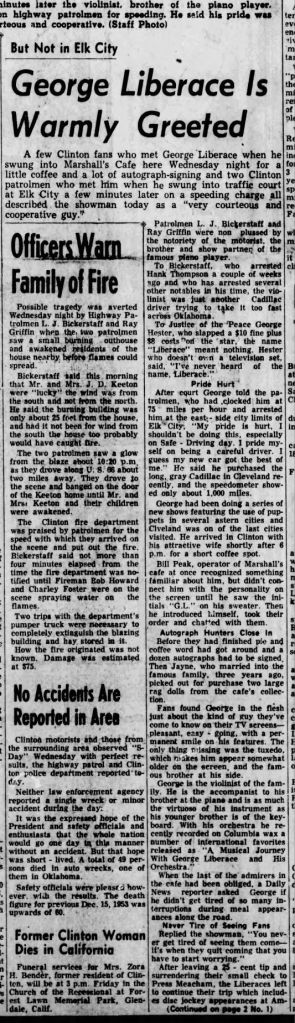
In the 1950s, Bick was a trooper with the Oklahoma Highway Patrol. In those early days, he patrolled on a motorcycle. One night, near Elk City, Oklahoma, a flashy car with California plates sped by him on Old 66. It was doing over 75 miles per hour or more.

He took off after it and got the car pulled over. It was late, and as he walked up to the driver’s window, the man inside said:

“Surely, you’re not going to write me a ticket. Don’t you know who I am?”

To which Bick famously replied:

“I don’t care if you’re Liberace—you’re driving like a bat out of hell. Yes, I’m writing you a ticket!”

And as it turned out, it was a Liberace. Liberace’s Brother George!

Bick wrote the ticket anyway. George Liberace followed Bick to the courthouse, paid it on the spot, and went on his way.

A few weeks later, Bick’s supervisor got a call from one of Liberace’s agents. They wanted to fly Bick to Hollywood to be on The Liberace Show. They thought it would be significant: the highway patrolman who dared to ticket a star. Bick said he couldn’t say no. The department thought it was good publicity, and it was.

Years later, people still talk about it. Unknowingly, I worked with the man who once wrote Liberace’s brother a speeding ticket. Bick told me –––


“Liberace brought me out on stage. He announced that I was the highway patrolman who wrote his Brother George a speeding ticket!”

Robert Machray-May 4, 1945 – Jan. 12, 2025

GROFF MEDIA 2024© TRUTH ENDURES IMDBPRO

Presented by benandsteve.com By: Benjamin Groff II©

2–3 minutes

Obituary: Robert Machray––– May 4, 1945 – January 12, 2025

Robert Machray IMDb

Robert Machray (Ward) was a talented and versatile stage and television actor. He passed away on January 12, 2025, in Los Angeles, California. He was 79 years old. Many remember him for his memorable role as Fire Marshal Captain Dobbins in the iconic sitcom Cheers. Machray left an indelible mark on the world of entertainment. His career spanned more than three decades.

Born in San Diego, California, on May 4, 1945, Machray displayed a passion for performing arts from a young age. He pursued a vibrant stage career. He brought characters to life in major productions at Shakespeare festivals. Esteemed venues like the Los Angeles Civic Light Opera, Hartford Stage, and Playwrights Horizons hosted these performances. His dedication to the craft of acting earned him respect and admiration in the theatrical community.

In 1977, Machray transitioned to film and television, debuting in the television film Panic in Echo Park. He quickly gained recognition for his comedic timing and adaptability, leading to roles in series like Operation Petticoat. Over the years, he became a familiar face on many popular programs. These included Roseanne, Life Goes On, The Drew Carey Show, Suddenly Susan, Profiler, and Three’s Company. His film credits include Cutting Class, where he portrayed Mr. Conklin and The Master of Disguise.

Machray’s career highlights included a summer stage production of My Fair Lady in 1983. This production showcased his vocal talents. It also highlighted his theatrical talents. In his later years, he delighted audiences with a guest appearance in the beloved satirical sitcom Parks and Recreation. He retired in 2011 after a fulfilling and impactful career.

Outside of his professional achievements, Machray was known for his wit, kindness, and love of storytelling. He cherished time spent with friends and family, often sharing humorous anecdotes from his life in the entertainment industry.

Robert Machray (Ward) is survived by his extended family. A wide circle of friends and colleagues will remember him fondly. They cherish his warmth, talent, and enduring contributions to the arts.

Instead of flowers, the family asks for donations. Please contribute to organizations supporting aspiring actors and artists. This honors Robert’s lifelong dedication to nurturing creativity and performance.

A private memorial service will be held in Los Angeles to celebrate his life and legacy.