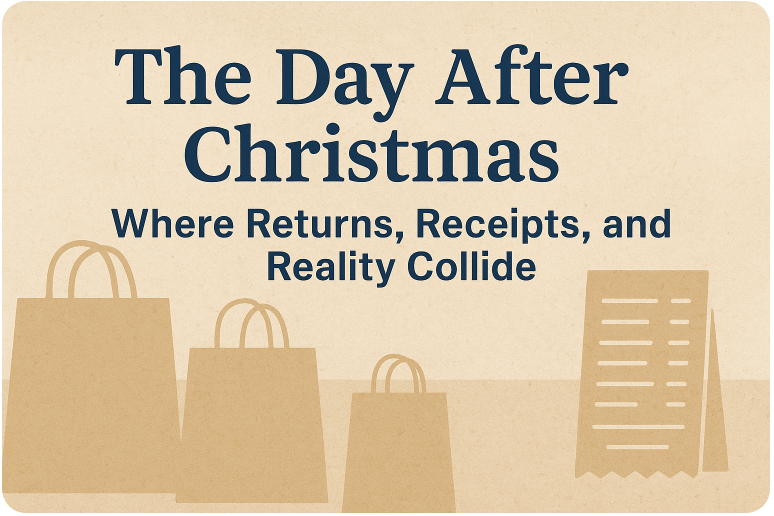
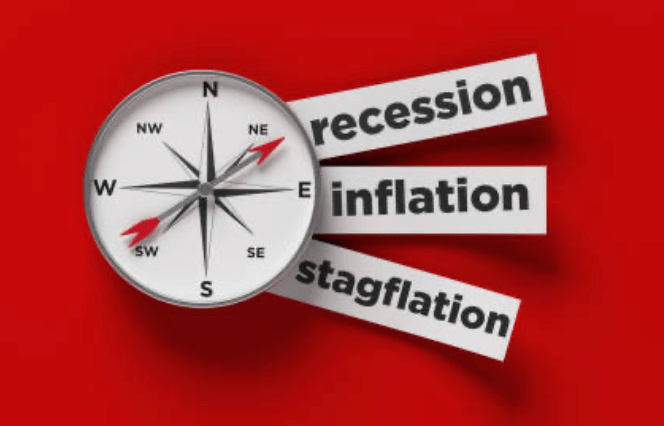
The holidays end. The bills arrive. Suddenly, the return line reveals more about our country than any economist ever can! Inflation, Stagnation, Slugflation, Depression.
It is the day after Christmas, and we all knew it would unfold exactly like this—a madhouse. Every store in town feels like it’s hosting its own miniature stampede. People rush in with returns clutched under their arms. These include sweaters that didn’t fit, gadgets they didn’t want, and décor that clashed with the kitchen. There are also duplicates of things they never needed one of in the first place. Others, running just as fast, are there for the sales—snatching up the merchandise that didn’t move before December 25.
Can you relate to this scene? If you’re in the checkout line with a cart full of discounts, you are one of the lucky ones. You are not carrying a stack of bills. You are not yet crushed by what this economy has become. Some call it stagflation. Others, half-jokingly but not entirely incorrectly, call it slugflation. Depending on where you stand, your job, your savings, and your prospects, your perception differs. You feel like we’re living through something that looks and sounds an awful lot like a depression.
“The glow of the holidays fades quickly. Yet, the truth we uncover in the days afterward often shows us who we are. It also reveals what we are still trying to endure.”
Stagflation, properly defined, is that painful moment when the economy stops moving, yet prices keep climbing. Wages stall, groceries rise, and efforts to fix things seem to vanish into a fog of economic stubbornness. For those without employment, the future feels dimmer than ever. For those nearing retirement, dreams of quitting work drift further out of reach. Families survive paycheck to paycheck. Some juggle bills so tightly that “robbing Peter to pay Paul” isn’t a saying. It’s a monthly way of life. They pray for health, because one unexpected medical bill breaks what’s left of their fragile stability.
Slugflation isn’t an economic term from textbooks—it’s a social one whispered in frustration. It describes households where the cost of living is so crushing that escape becomes a priority. Even temporary escape takes precedence over responsibility. The father who buys a beer before buying groceries. The single worker who stops at the bar on payday because the rent is already too high to manage anyway. It’s not irresponsibility. It’s more about resignation. People try to numb the hopelessness that elected officials promise to fix but never do.
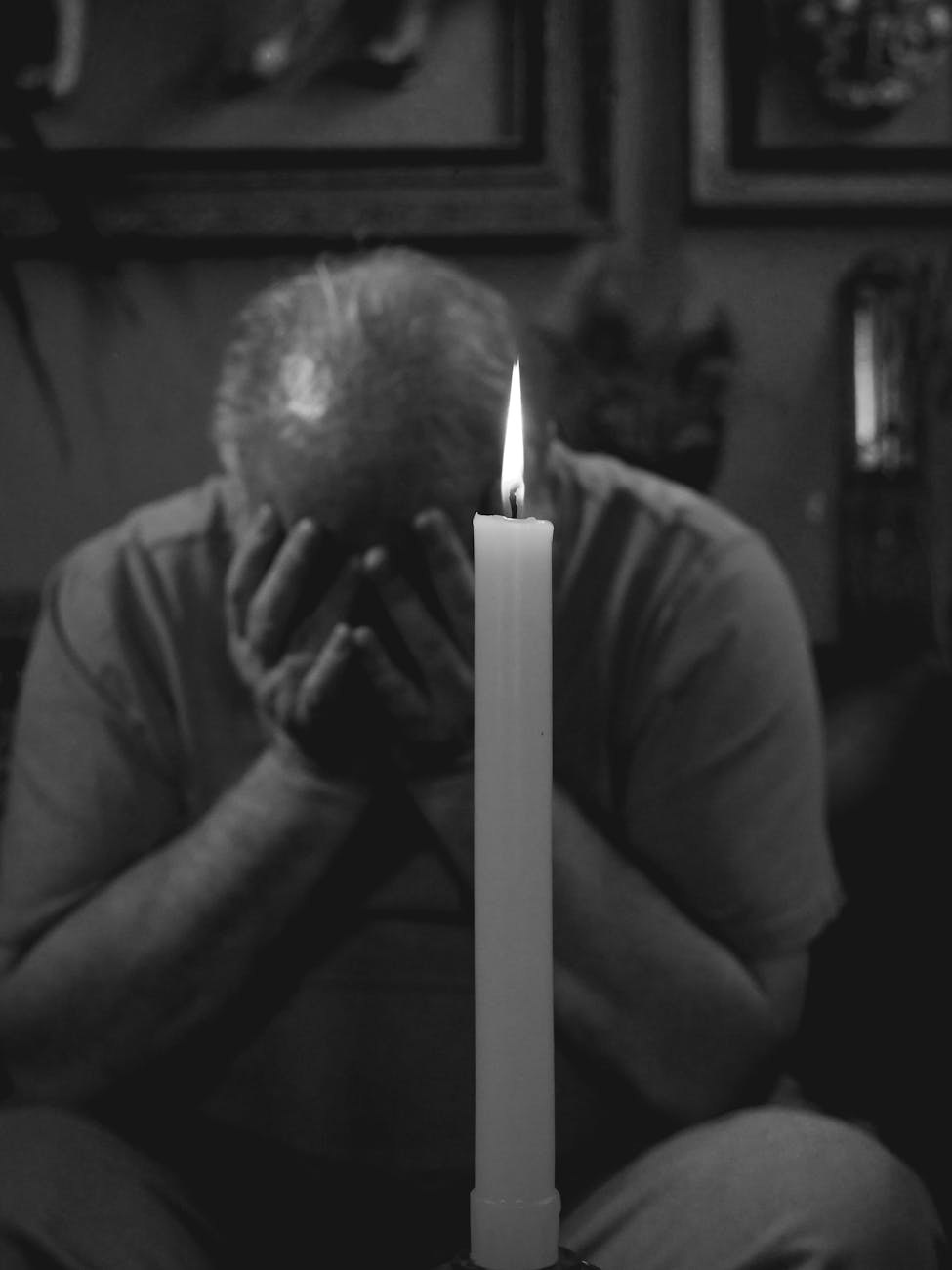
And then there’s Depression—the word that carries both economic weight and personal weight. Economists use it to compare modern troubles to the Great Depression of the 1930s. They examine the stock market collapse, the Dust Bowl, and the poverty that blanketed the nation. But there’s another depression, quieter and far more personal: the emotional one. The kind that settles into a person’s bones, whispering that today is as well be tomorrow, because neither holds hope. It’s the feeling of sinking in deep water, kicking tirelessly, yet never breaking the surface for air.
Crowds push through automatic doors post-Christmas. Return lines snake around the aisles. Some people see chaos. Others see bargains. But some feel something heavier. They have the unmistakable realization that the holiday glow dies fast. The struggles waiting outside never take a day off.
I often go back through the archives and reread old stories I reported on. Some are small, dusty pieces that barely made a ripple. Others grab you by the collar and refuse to let go. This is one of those stories.
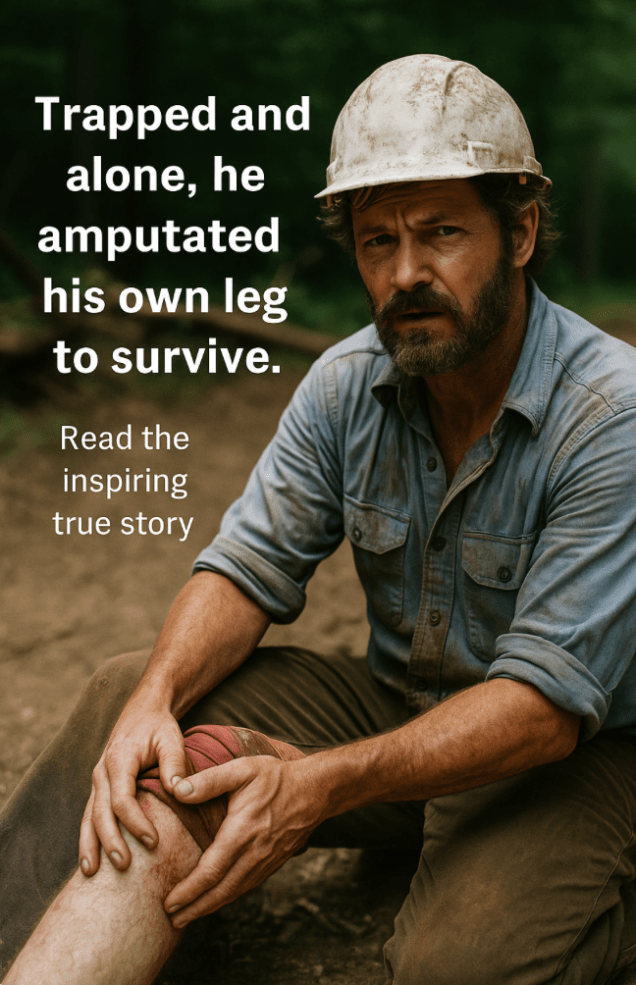
On a summer day in 1993, construction worker Donald Wyman, 37, found himself trapped. He was in the woods of Jefferson County, Pennsylvania. A fallen tree had crushed his leg so severely that he couldn’t free himself. After an hour of pain and helpless screaming, Wyman realized time was running out.
With no other choice, he made a tourniquet out of a shoelace and a wrench from his power saw. Then, with a courage most of us can barely imagine, he amputated his own leg. Using a seven-inch pocketknife—cutting through muscle, skin, and nerves to seize his survival.
Digital Illustration
Badly wounded, he dragged himself to his bulldozer, and drove—bleeding—to his pickup. Once in his truck he managed to reach a neighbor’s farm half a mile away. The neighbor, John Huber, called rescuers, who later found Wyman’s leg still pinned under the tree, boot and all. Thanks to his grit and quick medical response, Wyman survived and was upgraded from critical to stable within days.
Had he hesitated, his story would have been reduced to a one-paragraph obituary in his hometown paper. But Wyman wasn’t a victim—he was a survivor. He did what had to be done.
And that’s the lesson. You may never face a tree crushing your leg. Yet, you may face toxic relationships. You might meet negative influences or habits that hold you back. Sometimes survival means cutting away the very thing that’s dragging you down. You may face a country that has appeared to have turned against you. It won’t be easy. It may hurt. But in the long run, it can save your life—so you can live fully with those you love.
Ethan was only a few miles from home when it happened. A sudden dizziness swept over him, the road blurred, and he pulled his car to the side. When the fog lifted, he realized he couldn’t remember who he was, or where he had been going. All he had was a backpack, a half-filled journal, and the overwhelming instinct that he needed to find shelter.
He wandered until he reached Brookfield Lane, where an old house loomed against the evening sky. As a child, Ethan had feared this place. It was where shadows seemed darker, where kids whispered about ghosts and curses. Though he didn’t remember that fear, his body did—a chill ran through him as he stepped onto the porch. Still, with nowhere else to go, he knocked.
An elderly woman opened the door. “Come in, child,” she said softly, as though she had been expecting him. Ethan stayed, helping with small chores, sharing meals, and slowly growing comfortable in the quiet warmth of the house. In the evenings, they talked. She asked about his life. Even though he couldn’t remember, fragments began returning. He recalled his laughter with friends, the smell of campus coffee shops, and the long nights of studying. Then, something deeper surfaced. It was the secret he had held since high school. He thought he’d never say it aloud. He told her he was gay. Instead of fear or judgment, she smiled. “Love,” she said, “is never something to be ashamed of. It’s what keeps this house alive.”
When his memory finally returned, it shocked everyone. Ethan’s parents had always thought of Brookfield Lane as cursed, a place to avoid. They couldn’t understand how the son they worried about had found comfort, truth, and acceptance there. For Ethan, though, the house became more than a place of fear. It became the place where he embraced who he was. He learned that what we fear most sometimes holds the power to set us free.
When most people think of phobias, the usual suspects come to mind: spiders, heights, flying, or public speaking. But the human mind is infinitely complex, and so are the fears it produces. Beyond the common anxieties, there are phobias so rare and oddly specific. They almost sound made up, yet they’re very real for those who experience them.
1. Arachibutyrophobia – Fear of Peanut Butter Sticking to the Roof of the Mouth
It sounds funny at first, but this phobia can cause genuine distress. For those who suffer from it, even the thought of peanut butter clinging to their mouth can spark panic. It often extends to sticky foods in general.
2. Nomophobia – Fear of Being Without a Cell Phone
A very modern fear, nomophobia describes the anxiety people feel when separated from their phones. This can occur when the battery dies, the signal drops, or when the device is misplaced. In an age where smartphones are lifelines, this phobia has become increasingly common.
3. Xanthophobia – Fear of the Color Yellow
While most associate yellow with warmth and cheer, some people experience overwhelming anxiety when exposed to the color. It can be triggered by objects, clothing, or even sunshine itself.
4. Papaphobia – Fear of the Pope
Unusual, yes, but historically documented. For those with papaphobia, even images or references to the Pope can cause panic. It’s believed to stem from a mix of religious trauma and authority-based fears.
5. Pogonophobia – Fear of Beards
In some cases, beards are more than just a fashion statement—they’re a trigger. This phobia can cause sufferers to avoid contact with people who have facial hair. This avoidance is rooted in past negative experiences or simply an overwhelming sense of discomfort.
6. Hippopotomonstrosesquipedaliophobia – Fear of Long Words
Ironically named, this phobia is real and involves anxiety around long, complex words. Sufferers feel uneasy in academic or professional settings where such terms are common.
7. Eisoptrophobia – Fear of Mirrors
This phobia goes beyond superstition. For some, looking into mirrors triggers deep anxiety. This anxiety is linked to fears of self-perception. It is also connected to superstition. There is also the uncanny feeling of seeing one’s reflection.
Why These Fears Matter
While some of these phobias sound absurd to outsiders, they are real, debilitating conditions for those who experience them. They highlight the diverse ways our minds process fear. These remind us that what seems laughable to one person feel life-altering to another.
There are stories worth telling—stories shaped by the countless experiences we collect in life. In mine, there have been unforgettable moments. I visited with friends, shared laughter, and exchanged hugs. Then I returned home—only to learn the next day that they were gone. No warning. No signs. One moment, they were part of my world; the next, they had vanished from it.
Those moments taught me a truth that often goes unspoken: nothing in life is definite.
Even when it feels like we’re stuck—repeating the same routines, going through the same motions—life is still moving. The world shifts beneath our feet, often without our awareness, certainly without our consent. Change is not something we invite; it’s something that happens. It shows itself in every breath we take. It appears with every face that enters or leaves our lives. It influences every decision made far beyond our control—from government chambers to hospital rooms.
Change is the only constant.
Sometimes, a change is so small it goes unnoticed—until its effects stretch across history. On February 2, 1959, Waylon Jennings gave up his seat on a chartered airplane to the Big Bopper, J.P. Richardson, who was feeling ill. The plane also carried Buddy Holly and Ritchie Valens. It crashed in an Iowa field just minutes after takeoff. Everyone aboard died.
Waylon Jennings
That one seat swap—an act of kindness, -–– saved Jennings’s life. No one was at fault. But that simple moment, that ordinary change in plan, altered the course of music history and Jennings’s own future. He carried the weight of that change for the rest of his life. And yet, that change gave him more years, more music, more life.
That is how change works. Quiet. Sudden. Unfair. Unpredictable. But real.
When everything feels bleak, we must remember: change is still at work. When loss feels unbearable or the path ahead seems hidden, we must remember: change is still at work. What feels like the end today reveals itself as the beginning of something new tomorrow.
Time moves. People change. Life adapts. Always.
And in that, we find our only real choice: acceptance.
Accepting change—no matter how painful—does not mean surrendering to it. It means choosing to live with eyes open, hearts ready, and spirits willing to grow from what has been lost. We don’t have to like every change. But by accepting it, we start to transform with it—and even rise because of it.
Postscript:
After a tragic 1991 plane crash claimed the lives of several members of Reba McEntire’s band, it was Waylon Jennings—haunted by his own near-miss decades earlier—who offered her a few words she never forgot:
“Reba, you’ll never get over it, but you’ll get through it.”
And that’s the final truth about change. We don’t get over it—we live through it. And somehow, life keeps going.
Not the peace that lives only in headlines or history books—the grand treaties, the ceasefires, the official proclamations. I’m talking about the peace we build in our daily lives. This peace begins around kitchen tables. It is found in community meetings. It happens in the quiet moments when we choose to listen rather than shout.
What would it take to create a more peaceful world? That question sits heavy on my heart.
I don’t pretend to have all the answers, but I believe peace isn’t something we wait for others to deliver. It’s something we shape, step by step, together. And maybe, just maybe, it starts with a plan. Its not a perfect plan, but it’s a real one. It’s something we can reach for and return to, like a compass in uncertain times.
Step One: Start With Listening
Peace begins with the willingness to hear someone else’s story—especially when it challenges our own. We don’t have to agree on everything, but we do have to care enough to listen.
Imagine what would change if we listened without preparing to argue back. If we asked “What is it like to be you?” and waited long enough for a real answer.
Step Two: Make Room for Justice
There can be no true peace where injustice lives unchecked. That means looking closely at the systems around us—schools, courts, hospitals, policing, housing—and asking, “Who is being left behind? Who is being harmed? And what can we do to fix it?”
Justice isn’t about blame. It’s about repair. Peace doesn’t ask us to forget the past. It asks us to heal from it—together.
Step Three: Practice Kindness Like It’s a Skill
We talk about kindness like it’s something we either have or don’t. But I think it’s more like a muscle. You build it every day—with patience, with humility, and with a little humor when things get hard.
Sometimes, peace looks like biting your tongue. Sometimes, it looks like reaching out. And sometimes, it’s just not walking away.
Step Four: Educate for Empathy
To give the next generation a better shot at peace, we must teach them differently. Not just math and reading—but empathy, conflict resolution, critical thinking, and how to talk across differences without losing our humanity.
We should teach history honestly, too—not just the polished parts, but the painful truths that still echo today. Healing begins with honesty.
Step Five: Be Brave Enough to Hope
Hope can be a radical thing. Especially when the news is bleak and the divisions feel endless. But hope is not weakness. It’s strength disguised as belief. It’s faith in what we can build, even if we haven’t seen it yet.
A plan for peace isn’t a single event. It’s not something we sign and file away. It’s a lifelong effort. It’s showing up, over and over, with open hands and an open heart.
We will never achieve a perfect peace. But if we can bring peace into one more conversation, one more neighborhood, one more generation—then it’s worth everything.
So here’s my plan. It starts with me. It starts with you. And it keeps going—as long as we keep walking ahead, one small, hopeful step at a time.
Navigating the Crossroads: Challenges and Resilience in the LGBTQI+ Community
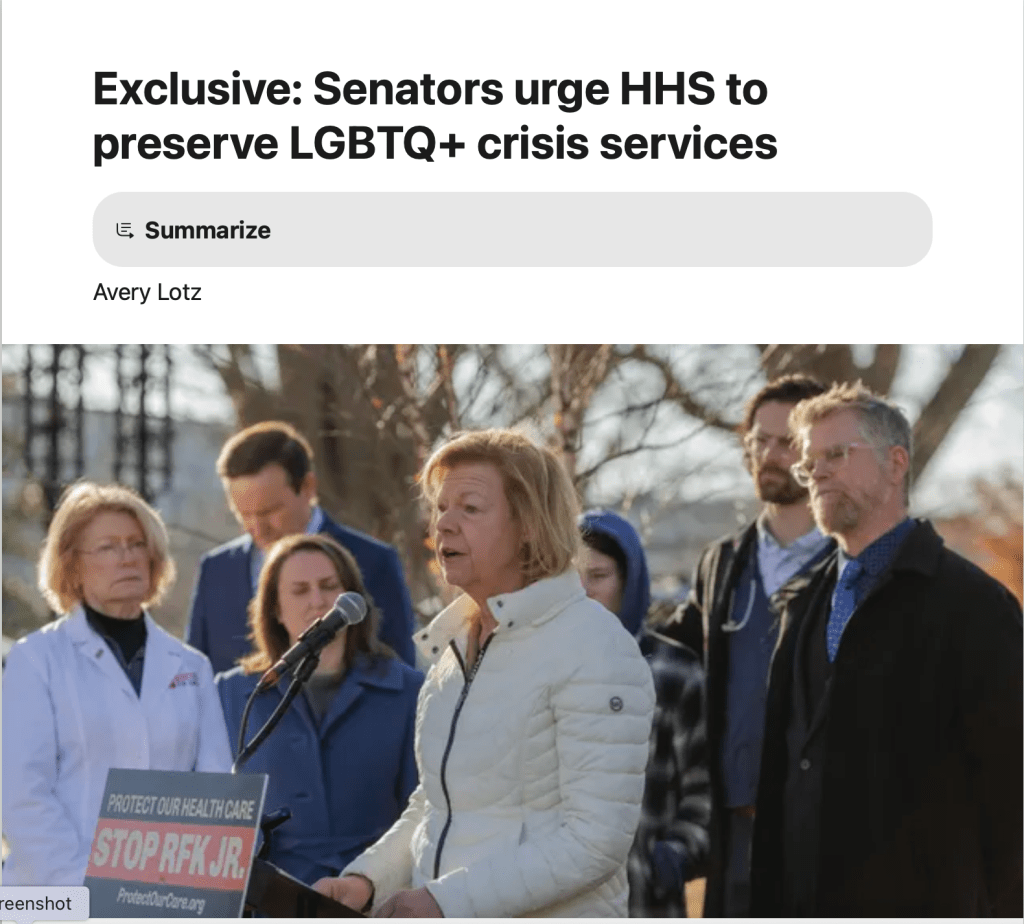
In recent years, the LGBTQI+ community has observed both significant strides toward equality and alarming setbacks that threaten these advancements. As societal acceptance grows in some areas, legislative and social challenges persist, underscoring the need for continued advocacy and awareness.
Mental health disparities continue to be a critical issue within the LGBTQI+ community. According to The Trevor Project’s 2024 National Survey, 39% of LGBTQ+ youth seriously considered attempting suicide in the past year. The rates rise to 46% among transgender and nonbinary youth. Factors contributing to this crisis include discrimination, lack of access to affirming care, and societal stigma. (1)
Intersex youth face even more pronounced challenges. A study highlighted troubling findings about intersex respondents. It showed that 77% had someone try to change their sexuality or gender identity. Over 10% had undergone conversion therapy. (2)
Access to quality healthcare is a fundamental right, yet many LGBTQI+ individuals face significant obstacles. The Center for American Progress reported that in 2024, 45% of transgender adults postponed medical care due to affordability issues. Additionally, 60% of intersex adults faced the same issue. Additionally, 37% of transgender adults avoided seeking care out of fear of discrimination. (3)
The political landscape further complicates access to necessary care. A survey by FOLX Health revealed that 90% of trans and nonbinary Americans feared the 2024 presidential election. They were concerned it would negatively impact their healthcare access. Notably, 20% had already lost access due to anti-LGBTQ policies. (4)
Legislation plays a pivotal role in shaping the experiences of LGBTQI+ individuals. In 2024, nearly 500 anti-LGBTQ+ bills were proposed across the United States, with 46 enacted into law. These laws have had profound effects, with over 70% of LGBTQ+ adults reporting negative impacts on their mental health.
Conversely, there have been positive legislative developments. Thirty-seven pro-equality bills were signed into law, focusing on areas like parenting rights and health and safety. (5)
Amid these challenges, community-led initiatives have emerged as beacons of hope. In Connecticut, drag performances educate on health and suicide prevention. They create inclusive spaces for dialogue and support. (6)
The introduction of the Pride in Mental Health Act aims to bolster mental health resources for LGBTQ+ youth. It recognizes the unique challenges they face. The act highlights the importance of affirming care. (7)
The LGBTQI+ community continues to navigate a complex landscape of progress and adversity. While strides have been made in visibility and rights, significant work remains. We need to guarantee fair access to healthcare. Protection under the law is also necessary. Furthermore, societal acceptance must be achieved.
Allies, policymakers, and community members must advocate for inclusive policies. They should support mental health initiatives. It’s essential to foster environments where LGBTQI+ individuals can thrive without fear of discrimination or harm.
Recent Developments Impacting the LGBTQI+ Community
Posted by Movie and Television Show Writer and Actor Del Shores on Facebook –
LGBTQ+ Rights Under Attack in 2025 — And the Fight Continues! But we, as a community, stand firm and resilient.
I posted it many years ago before we could legally marry someone we loved. Before United States v. Windsor struck down DOMA in 2013, and before Obergefell v. Hodges in 2015, we finally gave our love full legal recognition nationwide.
And it became one of the most shared things I’ve ever posted.
WHERE WE ARE NOW, 2025!
2025 has seen an alarming surge in anti-LGBTQ+ bills, with over 500 introduced in the U.S. alone.
Over 774 are specifically anti-trans, and 700 of those are still active.
Texas leads the charge with 127 of these hate-fueled bills.
Many of these bills are pushed by the GOP, wrapped in the Bible, and weaponized with false righteousness. It’s the same tactic — just a different year with more hateful rhetoric than ever.
When I wrote “Southern Baptist Sissies” in 2000. I dreamed it would one day feel like a period piece — a snapshot of a fight we’d won. And yet, in 2025, my character Mark’s words still guide me as I fight for and with my LGBTQ+ family and our beautiful allies:
“Sometimes I close my eyes, and I create a perfect world. A world of acceptance and understanding and love. A world where there’s hope. Even if the hope is just whispered, I hear it.”
To the trans community: we see you, love you, and stand with you in unwavering solidarity.
To the so-called Christians using the Bible to harm: you’re using it wrong.
Romans 13:10 — “Love does not harm its neighbor; therefore, love is the fulfillment of the law.”
Let’s love louder, let’s love more, and let’s love without boundaries.
Let’s keep whispering — and shouting — that hope.
“Dear friends, let us love one another, for love comes from God. Everyone who loves has been born of God and knows God. Whoever does not love does not know God because. God is love.” 1 John 4: 7-8.
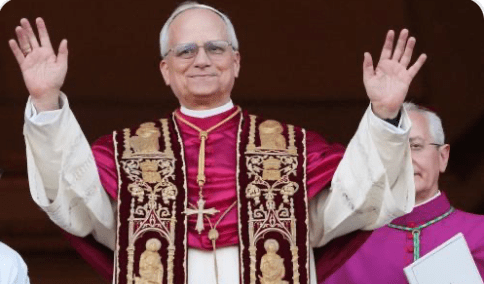
The election of Pope Leo XIV—formerly Cardinal Robert Francis Prevost—marks a historic moment. He becomes the first American to lead the Catholic Church. His choice follows the death of Pope Francis. Pope Francis was noted for his progressive stances on social issues. These included LGBTQ+ inclusion .(1)
Implications for the LGBTQI Community
Pope Leo XIV’s past statements suggest a more conservative approach to LGBTQ+ issues compared to his predecessor. In 2012, he expressed concern about popular culture. He believed it was fostering “sympathy for beliefs and practices that are at odds with the Gospel.” He specifically cited the “homosexual lifestyle” and “alternative families comprised of same-sex partners and their adopted children.” He has opposed the inclusion of teachings on gender in schools. He describes the promotion of gender ideology as confusing. (2)
Pope Leo XIV has not publicly addressed LGBTQ+ issues since his election. His earlier positions show a potential shift from the more inclusive tone set by Pope Francis. Pope Francis had endorsed civil unions for same-sex couples. He also allowed blessings for same-sex unions. This signaled a more welcoming approach. (3)
Awaiting Future Developments
As Pope Leo XIV begins his papacy, the global Catholic community will be observing his leadership closely. This includes LGBTQ+ members. They will watch how it will shape the Church’s stance on inclusion and diversity. His actions in the coming months will offer clearer insights. His statements will reveal the direction he intends to take on these critical issues.
Grief is one of the most powerful and complex emotions we can experience. Yet, it’s often the least talked about, especially in front of children. But we must do it. Parents, grandparents, uncles, aunts, caregivers—everyone has a role in helping younger generations understand and process loss in healthy, open ways.
Why This Matters Now Is More Important Than Ever
I recently came across a meaningful article on the Modern Parenting Hub. The article offered guidance on how to talk to children. It also included advice on discussing grief with other family members. This instantly struck a chord with me. These conversations are difficult, yes, but incredibly important. This topic has come up often in my family. My father’s death nearly forty years ago has brought it up many times over the decades.
Despite the passage of time, some of my relatives are still coping with the ripple effects of that loss. It’s a reminder that unspoken grief doesn’t simply go away—it lingers, often silently, until we confront it.
The First Time I Saw My Father Cry
I’ll never forget the first time I saw my father cry. It wasn’t during a national tragedy or a close friend’s funeral. It was when we got the call that my grandmother, his mother, had passed away.
He and I were the first to arrive at my grandparents’ home. My grandfather sat slumped in his favorite chair, overcome with sorrow. My father leaned down and embraced him. Through his sobs, my grandfather whispered:
“We lost Ma Ma.”
My father’s tears came swiftly—tears of deep, unfiltered grief. Until then, I had only seen him cry from laughing too hard at his jokes. This was something entirely different. Something raw. And it changed the way I viewed him.
Grief in Unexpected Places
Years later, when my uncle died in a tragic car and train accident, I saw my parents overwhelmed again. It wasn’t until my father’s funeral that I fully grasped the impact grief can have. Children must witness honest expressions of grief.
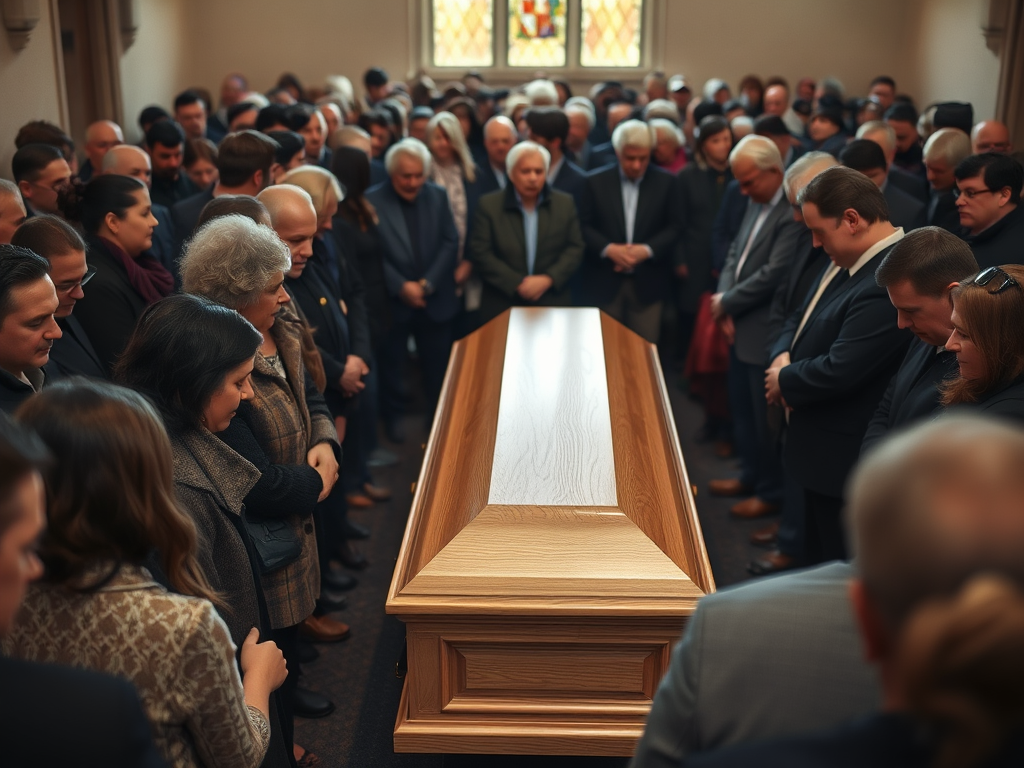
My father was a deeply loved man. He had a large circle of close friends. We chose fourteen pallbearers. This number was still too small to honor everyone who had loved him.
The group included cowboys, law enforcement officers, linemen, ranchers, farmers, and local business owners. These men were known for being tough, stoic, and strong. Only family and pallbearers remained in the church during a private moment after the public service. I watched those same hardened men. They broke down in tears.
They weren’t quietly dabbing their eyes. They were crying. Fully, openly, and without shame.
The Lesson I’ll Never Forget
That moment stayed with me. It showed me that strength and vulnerability are not opposites. The ability to express emotion—especially grief—is one of the most courageous things we can do.
I often say that my father’s funeral was the day I learned it was okay for grown men to cry. And I believe that’s a lesson we need to pass down. Our children need to see that real strength includes compassion and empathy. It also consists of the willingness to mourn openly when we’ve lost someone we love.
Bringing Grief Into the Conversation
Grief is universal and should be discussed across all generations. When we make space for these emotions, we also make space for healing. Children gain from understanding that sadness is a natural response to loss. It doesn’t need to be hidden or avoided.
Resources like the Modern Parenting Hub are essential in guiding families through these complex moments. I’ll share their piece with my readers and loved ones, and I encourage you to do the same.
Final Thoughts
Grief doesn’t follow a timeline. It doesn’t play by the rules. We can talk about it. We can face it together. We can help each other navigate the path it carries through our lives. Let’s teach our children that tears are not signs of weakness—they are signs of love, humanity, and deep connection.
Writing the most sincere self-analysis is no small undertaking. It asks something of us that we’re not always ready to give. It demands honesty, and not just the kind we wear on our sleeves when trying to be humble or modest. It demands the raw kind. The kind that doesn’t flatter or soften but still doesn’t condemn. A self-analysis worth anything must go beyond the stories we’ve rehearsed for friends. It must also reach deeper than the traits we like to highlight on good days. It must ask: Am I willing to know myself, truly? And, more difficult still: Am I willing to share that knowledge with others, even if it unsettles or embarrasses me?
There’s always a temptation to curate the truth—to include only what paints us in a light we can tolerate. We must focus on growth, accomplishments, and kind-heartedness. We should downplay the envy, impatience, and regrets that tug at us when we’re alone. But sincerity demands more. It asks for balance. The glad moments don’t mean as much without the unhappiness that gives them context. Our kindness shines brighter when we own the times we’ve neglected to be kind. Our strength becomes more meaningful when we admit we’ve been weak.
A true self-analysis is like holding up a mirror. It’s not the forgiving kind in your hallway that you glance at before heading out. It’s the close-up, unfiltered reflection you find under harsh light. There, we meet the layers. First, there’s the child we were. Then, comes the adult we became. Finally, there’s the person we are still trying to be. We see the love we gave and the love we withheld. We know the courage and the fear, the moments of pride and the nights of doubt. And in that space, there is room for grace—because sincerity isn’t about judgment but clarity.
So when you write your self-analysis, ask yourself: will I tell it all? Or just the things I like? Will I dare trace the lines that run through my contradictions, triumphs, and failures? The work isn’t in choosing between the good and the bad. It’s in holding them together and saying,
This is who I am—flawed and hopeful, broken in places but still reaching toward something better.
That’s when you know it’s sincere—not because it sounds perfect, but because it doesn’t try to be.
Growing up, it often felt like there wasn’t much to do. With six siblings and a life rooted on the farm, family trips or outside adventures seemed few and far between. But looking back now, I see how much my parents did to involve us in meaningful experiences.
They took us to local places of interest. They spent time with each of us in ways many parents couldn’t. At the time, I thought we were the ultimate close-knit family. My dad and I shared rodeos, horse sales, parades, and trail rides. He and my mother supported my sister’s love for basketball, attended games, and nurtured her talent. Another sister was given a piano, music lessons, and encouragement toward college. One of my brothers was allowed to buy into the farm and build a home. The two oldest boys had long since charted their paths. One went into the Marines. The other entered a world that eventually led to affluence. But no matter how far they went, they always came home for the holidays.
My mom’s youngest brother—my uncle—was a bonus sibling. He’d been born late in my grandparents’ lives, and as a teen and young adult, he often lived with us. He’d served in Vietnam. Though he was quiet about it, he carried a weight we all respected—even if we didn’t understand it fully.
One weekend, something unexpected happened. When I was 9, my uncle and brothers convinced my dad to take us to the lake. It was a rare outing, especially with all of us. I’d heard stories of him taking the family boating at lakes years before I was born. Yet, he had stopped going by the time I came along.
This lake trip, still, wasn’t a return to those stories. It was just up the road—Sayler’s Lake. It wasn’t much to look at. An old log cabin marked the entrance. The water looked murky and unsettling—it resembled a scene from a horror movie. Locals whispered that the lake had claimed lives—more than a few. It didn’t seem right, but the place had a reputation.
We arrived around 10 a.m. I was eager to get in the water, but my mother insisted I wear a life vest. I didn’t know how to swim, and she wasn’t taking any chances. I hated the bulky vest, but hated the thought of drowning more. My sisters had taken swimming lessons when we lived in town—those services didn’t exist where we were.
I paddled around, watching others enjoy themselves.
Across the water, people were diving from a rocky cliff. Some men dove headfirst, then climbed back up and did it again. It looked reckless, almost like a dare to death. Then, one of them dove in—and didn’t come back up.
I’ll never forget the girl on the cliff yelling,
“Where is he?”
People jumped into action. After five or ten long minutes, someone pulled his body from the water and dragged him to shore. The owner of the lake raced down in a pickup and began CPR. I stood there, stunned. It was the first time I’d ever seen someone dead—or nearly dead—pulled from water.
Then, the town ambulance arrived. It wasn’t like the ones you see on TV—it was a white Buick station wagon. An old man climbed out carrying an oxygen tank. When the victim’s friends saw him, they shook their heads and told him it was too late.
“You need a body bag.”
One of them said.
I didn’t know what a body bag was. But I figured it out when the old man pulled a stretcher from the back of the car. With the help of bystanders, he loaded the man’s body. Out of compassion, he turned on the red lights and the siren. Then he drove off.
I returned to where our family had set up a picnic. I don’t remember what I said—maybe something a little too grown-up or too curious—but I remember my father flicking me on the ear and speaking sharply,
“You aren’t quite that old yet.”
I’ve often wondered what that moment meant to him. Maybe he wasn’t angry—he was just shaken. Perhaps he didn’t want me to see what I had seen. That day made me grow up faster than he wanted. He liked to keep things under control, and this wasn’t one of those things.
Life doesn’t always allow us to choose the lessons we learn. Sometimes, they arrive uninvited on an ordinary day by a haunted lake.
When we arrived home that evening, the television was on in the living room. The news was starting. And there it was—Sayler’s Lake. A reporter stood near the very spot we’d been earlier, microphone in hand, delivering details about the drowning. I sat in disbelief, watching the event replay like it belonged to someone else’s world, not ours.
I remember thinking: How did they find out so fast? How had the news team gotten there?How did they film the scene, return to the station, and prepare the report all before dinner? It made the whole thing feel surreal—too real but somehow distant. The reporter confirmed what we had already feared. The man had died.
That moment glued itself to my memory. The sound of the television stayed with me, and the familiar living room around me lingered in my thoughts. The weight of what we had observed just hours earlier was still there. It layered into a quiet understanding. The world outside our farm can change in an instant. Sometimes, there are no answers—just echoes left behind by events too big to fully grasp.
Harold Wexley Meets Clara And Breaks A Lifetime Habit.
Harold Wexley had long been known as a man of chance, a stochastic gentleman in the truest sense. Every decision he made was determined by a roll of the dice. It is also a flip of a coin, or even the pull of a card from his always on-hand deck. From his morning coffee to his afternoon walk, these decisions were all governed by chance. He couldn’t help himself; he believed the universe spoke best through randomness.
Harold’s peculiar habits started in childhood, much to the frustration of his parents. When asked whether he wanted vanilla or chocolate ice cream, he had a peculiar method. He would spin a top to let its direction decide his fate. By adulthood, his stochastic tendencies had taken total hold of his life. He never planned meetings but let a shuffled calendar decide his day. His wardrobe choices were dictated by pulling slips of paper from a hat. Even Harold’s relationships were governed by chance. If a coin landed on heads, he’d go on a second date. If it landed on tails, he’d never call again.
One day, Harold found himself at an unfamiliar café. That morning, he drew a card from his well-worn deck. It led him three blocks further than his usual haunt. He sat down with his coffee—black, no sugar. The choice was dictated by the number he rolled. He noticed a woman sitting across from him, watching with curiosity. She had auburn hair, a sharp gaze, and a half-smile that suggested amusement.
“You look like a man who just lost a bet,”
She said, sipping her latte.
“Not lost,”
Harold corrected, pulling a die from his pocket and rolling it across the table.
“Just after fate.”
She watched as the die landed on a four. Harold nodded. He reached for a muffin from the café’s showcase. It was as if he had just received permission from the universe.
“And if it had been a five?”
She asked, tilting her head.
“No muffin,”
He replied, taking a bite.
She chuckled.
“So, does chance decide everything for you?”
Harold hesitated. For the first time in years, he found himself unsure. The habit had become so ingrained that Harold had never considered questioning it. But as he met her gaze, something unfamiliar stirred—a wish to choose, not just to follow.
“Not everything,” he admitted, slipping the die back into his pocket.
“At least… not today.”
And for the first time in as long as he remembered, Harold decided without rolling, flipping, or shuffling. He asked for her name.
She smiled.
“Clara.”
He extended a hand.
“Harold.”
The universe held its breath, waiting. But for once, Harold ignored it.
Everett Langston was trapped in a perpetual orbit. He had been walking in circles for as long as he remembered. It wasn’t a choice, but a fate that had befallen him. Seeing a circular object, even if insignificant, would betray his feet. This sight led him into an endless loop.
Doctors had puzzled over his condition. Some called it a compulsion, others a neurological disorder. But Everett knew the truth: it was a curse.
It started when he was a boy. One autumn afternoon, he saw a pumpkin on his grandmother’s porch. Without realizing it, he walked around it once. Then again. And again. His grandmother, amused at first, soon grew concerned when he wouldn’t stop. His father physically picked him up and carried him inside to break the spell.
As he grew older, the compulsion became more disruptive. A simple trip to the grocery store became an ordeal. Aisles stocked with oranges would catch his eye. The wheels on carts made him spin them in his mind. The bakery’s showcase of bagels would pull him into endless rotations. He learned to avoid certain places. He refused to go near playgrounds. Merry-go-rounds were his nemesis. He avoided tire shops. He walked with his head down in parking lots to keep from spotting hubcaps.
But the world was an entire circle.
One day, Everett found himself in the city’s heart, caught in a storm of misfortune. A coin flipped onto the pavement—a round-the-clock hanging above a storefront. A drain cover was embedded in the sidewalk. He circled each one, his breath coming faster, his steps quick and mechanical. Passersby stared. Some chuckled. Others whispered.
Then he saw it.
In the middle of the city square stood an enormous fountain, its base a perfect, unbroken circle. Panic gripped him. His legs moved before he resisted, pulling him into a slow, deliberate orbit—once, twice, ten times. A police officer approached, asking if he was lost. But Everett only mutter, “I just have to finish.”
The sun dipped below the skyline. His legs ached. His vision blurred. But still, he walked.
And then—just as exhaustion took hold, something remarkable happened.
For the first time in his life, he stopped.
In the fountain’s reflection, he saw the stars above, scattered across the sky in celestial loops, infinite and unending. A smile of understanding crept onto his face. The world had been walking in circles all along, and he was just a part of it.
And so, he kept walking—not because he had to.
He continued to walk. It was not out of compulsion but from a newfound understanding. He accepted his place in the world.
Every morning, the sun rose over Willow Creek. Clara Jackson would pour herself a cup of coffee. She would then sit by the window and scroll through the news on her phone. Headlines blared with despair. Civil rights were being denied. People were being removed from their families because of their citizenship status. There were natural disasters, economic struggles, and political turmoil. It seemed as if the world was unraveling thread by thread. Each day felt heavier than the last, and Clara found it harder to believe in a brighter tomorrow.
One cold morning, as the weight of the world’s problems sat on her chest, she noticed her elderly neighbor, Mr. Thompson, hobbling down the sidewalk with a broom in hand. His frail figure moved with purpose. He swept the fallen leaves away from everyone’s doorstep. As he worked, he whistled a tune that carried a sense of ease Clara hadn’t felt in a long time.
Curious, she stepped outside and called out,
“Mr. Thompson, what are you doing out here so early?”
The old man looked up and smiled warmly.
“Clearing the way, my dear. It’s a little thing, but it makes the morning brighter for everyone.”
Clara laughed softly.
“With all that’s happening in the world, does this really make a difference?”
Mr. Thompson leaned on his broom and nodded.
“Oh, it does, Clara. You see, the world’s got its troubles, but right here, right now, we can still bring goodness. You can’t control the storms outside, but you can light a candle inside.”
His words settled into Clara’s heart like a gentle breeze pushing away the clouds. That afternoon, instead of drowning in the news, she baked cookies and shared them with neighbors. She took her old paintbrushes out of the closet and added splashes of color to the worn fence outside. And as she handed out treats to passing children, she felt something stir inside her—hope.
Days turned into weeks, and Clara found that small acts of kindness helped her navigate the darkness in the world. She volunteered at the local shelter. She also planted flowers along the sidewalks. Clara spent more time listening to the laughter of children at the park. The news was still grim, but Clara had found something stronger—hope born from action, not fear.
One evening, she closed her book and looked out at the quiet street. She realized the world hadn’t changed overnight. But she had. And that was enough to believe in a brighter tomorrow.
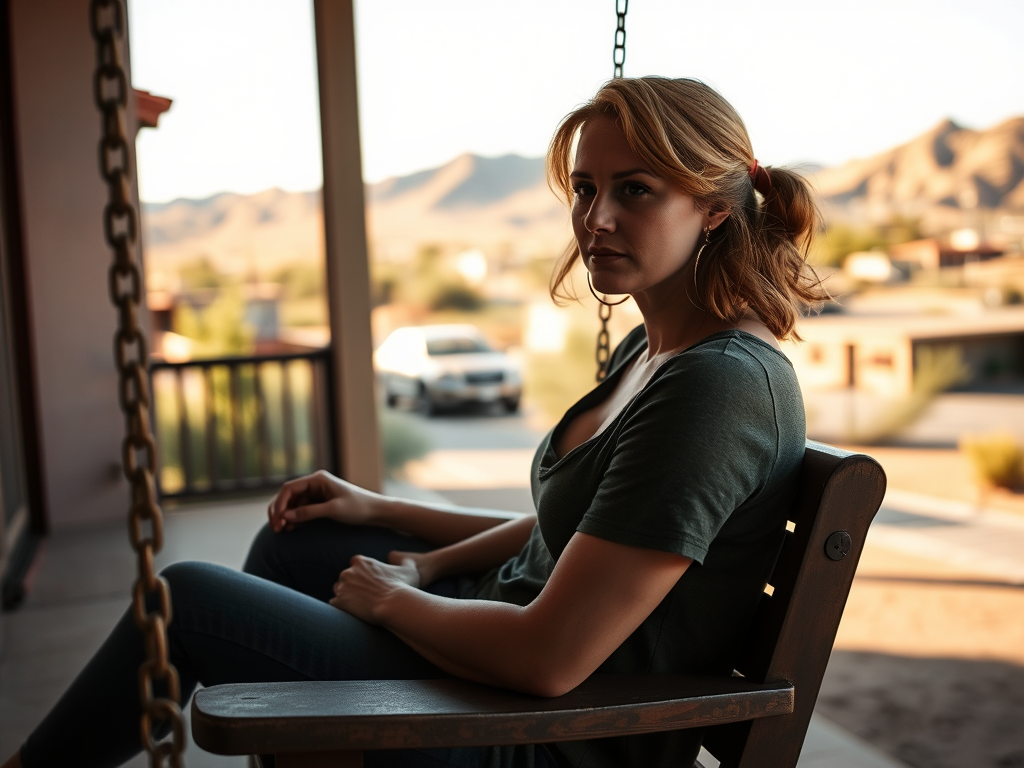
Maggie sat on her porch swing. The soft creak of the old chains was the only sound in the still afternoon air. The sun hung low, casting golden hues across her small Arizona town, but inside her chest, a storm raged. The day had been a whirlwind of mishaps. She missed deadlines at work. She had an argument with her sister. She also nagged worry about her aging father’s health. Each problem was stacked like bricks on her shoulders, weighing her with unresolved concern. She was in the midst of a battle for her Peace.
She sipped her tea. She hoped the warmth would soothe the ache. Yet, peace felt distant, like a mirage on the desert horizon. Her mind churned with “what-ifs” and “should-haves,” a relentless cycle that robbed her of the quiet she desperately craved.
Maggie took a deep breath and closed her eyes. She listened to the distant rustling of mesquite trees. Occasionally, she heard the bark of a neighbor’s dog. The natural sounds around her conveyed a message of resilience and adaptability. Slowly, she exhaled, reminding herself of her grandmother’s words: “You can’t stop the wind, but you can learn to bend.”
She stood and walked to the edge of her yard. Her fingers brushed over the delicate petals of the wildflowers. They had sprung up after last month’s rare rain. Their resilience struck her—fragile yet persistent, thriving even in the harsh desert soil.
Realizing she couldn’t control everything, Maggie focused on the now. She let the day’s stress settle, acknowledging it but not giving it power. She watched the sky darken into twilight. The first stars peeked through. She felt a little lighter with each breath. It was the power of being here, of living in the moment, that brought her Peace.
She realized Peace wasn’t about escaping the chaos but finding a quiet place. And tonight, as the desert cooled and the cicadas began their evening song, she finally let herself rest. The relief was palpable, like a weight lifted from her shoulders, as she surrendered to the tranquility of the night.
As the sun rises on another day, many Americans face questions about navigating a future that feels uncertain and, at times, challenging. With new policies, social shifts, and changes in government practices, it’s natural to wonder: How can we make peace with what tomorrow might bring?
Embracing Life as It Is
The journey forward begins by accepting life as it is. This acceptance isn’t about resigning ourselves to every challenge but acknowledging what is beyond our control. By shifting our focus inward, we can cultivate a balanced and manageable life, regardless of external circumstances.
This approach involves creating a routine—a set of daily habits and practices that we control and are structured to ensure Stability. When we establish a routine that aligns with our values and goals, we take ownership of our lives, making our days feel fulfilling and predictable, even when the world around us may feel anything but. This sense of control and predictability can empower us to face the uncertainties of the future with confidence.
Designing a Routine that Works for you. Focusing on what matters most to us individually will be essential to develop this routine. By centering our lives around personal choices and needs, we shape a daily rhythm whose influences aren’t getting pushed by the ever-shifting demands of society or government policies. Here are vital aspects to consider:
Personal Autonomy: Build a day-to-day lifestyle that allows for independence. This involves selecting tasks, schedules, and activities that feel true to who you are and are within your control.
Stability Through Simplicity: Keep routines simple and consistent. External events can derail complex plans; simplicity provides a foundation for adaptability and peace of mind.
Harmony with Society: While focusing on our lives, aligning our activities with society’s laws and norms is essential. By following guidelines and remaining respectful of others, we minimize the risk of disruption and interference.
Living Without Unnecessary Interference
By developing a sustainable, uncontroversial, and law-abiding routine, we create space for ourselves to live relatively unaffected by the broader tides of political or social change. This sense of security and peace of mind allows us to focus on our personal growth and well-being, even in the face of external uncertainties.
Moving Forward Together
Ultimately, as individuals adopt this mindset, communities also benefit. When people find Stability within themselves, they become pillars of support to others, fostering collective resilience. In times of uncertainty, this shared calm, mutual respect, and individual responsibility can carry Americans forward together, one day at a time. This sense of community and shared responsibility can provide a strong support system in times of uncertainty.
In this approach, tomorrow’s challenges become more manageable, and with a foundation of self-guided routine, we discover that moving forward is not only possible but peaceful.
During the run-up to any election, families play a pivotal role in supporting and understanding one another. This period, filled with political debates, media coverage, and public discourse, can stir emotions and create an intensely charged atmosphere. The emotional toll of election season can affect even the most resilient individuals, making the support of one’s family crucial and invaluable. Families are the core unit, providing a comforting and reassuring presence. It is essential that the role model (be it a father, older sibling, uncle, or aunt,) when possible, show support, care, and empathy. Doing so should be cultivated, and providing emotional backing and physical presence can help members navigate the turmoil of an upcoming election.
Election seasons amplify the daily stressors people face. Whether it is work pressure, financial struggles, or personal challenges, these become compounded by the uncertainty of political outcomes. Each family member may carry their political convictions, hopes, and anxieties, and these can sometimes clash with those of others. This emotional burden often deepens as people speculate about the possible outcomes—who they hope will win, who they fear will lose, and how the results will shape their future. The thought of losing an election can become so overwhelming that it leads to despair, disappointment, or even anger. For some, this emotional strain can develop into mental health issues, making it vital for families to remain vigilant about one another’s well-being during this time and to seek professional help if needed.
In the most extreme cases, the stress associated with an election’s outcome can drive individuals to become a threat to themselves or others. This is especially true when political messaging often stokes fear, resentment, and division. Individuals who place too much faith in a particular candidate or political party may feel personally attacked when that candidate loses. The sense of loss may not just be political; it can be internalized as a personal failure, leaving individuals feeling disillusioned or even desperate. Families must observe signs of distress, such as prolonged periods of sadness or withdrawal, recognize potential harmful behavior, like verbal or physical aggression, and intervene when necessary. It is crucial to remain proactive, offering emotional support and, if needed, involving professionals or authorities to prevent escalation.
The role of misinformation and campaigns lies in discussing election-induced emotional volatility. Many political campaigns thrive on pushing false narratives, spreading misleading information to sway voters. Misinformation, which includes false or inaccurate information that is spread deliberately to deceive, can reinforce individuals’ beliefs to dangerous levels. The spread of misinformation fuels emotional intensity and gives people a sense of justification for actions that, under normal circumstances, would seem unreasonable or extreme. When individuals have been repeatedly exposed to incorrect information, their convictions can become so ingrained that they believe their behavior—whether confrontation, violence, or drastic action—is justified.
In such situations, the line between reason and irrationality blurs. What may begin as passionate support for a candidate can spiral into dangerous behavior if an individual believes they are defending a “truth” that is, in fact, built on lies. This is why it is imperative for families to communicate openly about politics, encouraging fact-checking and critical thinking. Recognizing when a loved one’s emotional engagement has become unhealthy is not just crucial, but empowering. In these moments, reporting potentially dangerous behavior to the appropriate authorities is not an act of betrayal but one of care and protection for the individual and others around them, reinforcing the sense of responsibility and control within the family.
As elections approach, the pressure intensifies, with it, the emotional strain on families. However, families can also be a force for positive change, weathering the storm of political tension together by staying connected, offering support, and observing each other’s mental health. It is essential to create a space where emotions can be expressed freely but responsibly and where misinformation is challenged rather than accepted at face value. In doing so, families not only protect one another but also contribute to a more balanced and less volatile society during the electoral process, fostering a sense of hope and optimism for a brighter future.
Why aren’t mental health promotions displayed on billboards near places of worship, including churches, synagogues, and grand arenas where tele-evangelists solicit donations from vulnerable individuals? It’s perplexing why legal representatives don’t advertise near such venues, highlighting issues like false representation, fraud, and misrepresentation. The transformation of ancient tales shared among nomadic shepherds, later manipulated by rulers to instill fear and exert control over the populace, remains a baffling concept for those who adhere to the belief in a divine being. The notion of a selective higher power, arbitrarily favoring one individual over another, is particularly confounding to those who attribute life events to divine intervention.




















 benandsteve.com