Meet Benji and His Canine Companions: A Heartwarming Tale

By Benjamin GroffMedia© | benandsteve.com | 2025 Truth Endures©

2–3 minutes

In the quiet stretch of Oklahoma back-country, the hills roll gently. The wind carries the scent of cedar and earth. A school bus door creaks open every afternoon at 3:35 p.m. Out steps a boy named Benji. He is full of curiosity and grit. He loves the wild places that lie just beyond the fence line. But he’s not alone. Waiting faithfully at the gate are his three loyal companions—Oggy, Bruiser, and Jackie.

To most folks, they’re just dogs. But to Benji—and anyone lucky enough to witness them in action—they’re guardians. Each has a purpose. Each with a soul as big as the land they roam.

Oggy is the scout. He is a lightning-fast border collie. His job is to stay out front. He sniffs out threats and leads the way with sharp instinct. Bruiser, the muscle-bound mastiff mix with a thunderous bark and a heart of gold, never strays from Benji’s side. He is the protector. And Jackie, the wise and steady golden retriever, always takes the rear. She remembers every twist and turn in the woods. She is the quiet navigator. She ensures they always find their way back home.

What begins as a simple after-school tradition—just a boy and his dogs hiking the countryside—becomes something far greater. These four face the untamed wilderness. They discover the secrets of the land. They defend each other against the dangers that lurk in the shadows. These include wild boars, treacherous terrain, and even the unpredictable spirit of nature itself.

But this story isn’t just about survival—it’s about trust and purpose. It’s about the powerful bond that exists between a child and the animals who would give anything to protect him. It’s about finding your place in the world, knowing your role, and honoring it with everything you’ve got. It’s about how the world can feel vast and uncertain. Having the right ones by your side can make all the difference.

The Trail Guardians is a heartwarming, adventurous tale set against the backdrop of rural America. It is perfect for readers who believe in the magic of animals. It also appeals to those who appreciate the courage of kids and the timeless rhythm of life in the country.

Watch for the first of five exciting chapters. Enjoy this engaging short read as we count down to the first day of summer!

Join Benji, Oggy, Bruiser, and Jackie on their journey. They explore wild places where memories are made. Loyalty is tested, and legends are born.

This is only the beginning.

Starting Tuesday June 17th, 2025!
Discovering Lake Tenkiller: A Journey of Self-Discovery

By Benjamin GroffMedia© | benandsteve.com | 2025 Truth Endures©

2–4 minutes

Finding Home at Lake Tenkiller

One man’s journey through Oklahoma’s parks led him somewhere unexpected—and unforgettable.

When I graduated high school, I was no stranger to the outdoors. My dad was a park ranger, so much of my youth was spent in the Oklahoma parks where he worked. But let’s be honest. My version of “camping” came with cabins and beds. I always had the choice to stay inside if the weather got bad. I didn’t venture far into the woods unless I had to. That was just the way it was.

As I entered adulthood, though, something shifted. I started craving a deeper experience with nature, something less structured and more raw. I planned to visit every state park in Oklahoma. I aimed to camp at each one—no cabins—just me, a tent, and the open sky.

That plan lasted exactly five stops.

On my sixth visit, I reached Lake Tenkiller—and everything changed. The water was clear and clean, the air calm, sheltered from Oklahoma’s notorious winds. It was unlike anything I’d experienced. I pitched my tent and knew, deep down, I wouldn’t need to search any further. I had found my place.

Stormy Nights and Quiet Joys

I returned often, even through thunderstorms. While other campers packed up or ran to their cars at the first crack of thunder, I stayed. I watched lightning dance across the water. Thunder rolled through the hills. Rain swept across the lake. These moments became one of my life’s most calming experiences. Tenkiller is situated north of Gore, Oklahoma, in the Cookson Hills. It also feeds the Lower Illinois River, which contributes to the Arkansas River.

In those younger years, full of energy and a touch of recklessness, I embraced the wilderness. I was there for all the peace, the storms, and the quiet lessons only nature can teach.

Evolving Comforts

Eventually, the novelty of sleeping on the ground wore off. The cold felt colder, and the earth felt harder. That’s when I discovered a few rental cabins tucked near a cove. I asked around and spoke to the owner. They explained how they customized cabins for guests. They even hung a shingle with my name on the front.

Suddenly, a fireplace, stove, refrigerator, and absolute beds transformed my experience. It was still my beloved lake—but now with a touch of comfort. When friends heard about it, they wanted in. Soon, I was making the trip with six or eight others. We built a tradition of campfires, storytelling, and fish tales. These tales only grew bigger over time.

Moving On, But Never Forgetting

As the years passed, life caught up with me. Work, family, and obligations—they pulled me in new directions. My visits to Tenkiller slowed, then stopped. One day, I realized it had been years since I’d last seen that clear water.

But that’s the way of things. The lake had given me what I needed when I needed it—freedom, peace, community, clarity. And though I will not return as often, the memories are stitched into who I am. When life gets noisy, I remember those quiet storms. I think of the glassy mornings. I recall the crackle of fire in a lakeside cabin.

Some places stay with you, even after you’ve left them.

Lake Tenkiller is that place for me

A Memorable Day: Taking My Dad Fishing

Benjamin GroffMedia© | benandsteve.com | 2025 Truth Endures©

4–6 minutes

Taking Dad Fishing

When I was a child, my dad and I did countless things together.

We rode horses nearly every weekend if not every evening. We went to rodeos and parades—not just as spectators but as participants. We traveled to horse sales, chasing his dreams of new bloodlines, no matter how far away they seemed. Of course, I realized when I grew up that they weren’t all that far.

A lake at the south end of our property teased me year-round. I saw cars creeping across its dam, people scrambling down its rocky banks, casting lines into its blue water. I dreamed of fishing with my dad. But he never seemed interested.

We had more important things to do. We needed to haul feed for the horses, cut hay, stack bales in the barn, and care for the animals. The farm and all our other activities consumed all our time. There was no time for anything else. School and sleep were crammed in the margins of my day.

Eventually, I grew up and moved away. After a chlorine gas leak injured my dad, he had to sell the last of his horses. He became tethered to the living room; his body slowed, but his mind sharpened. On my days off, I would come home. We would sit on the back patio, drinking iced tea and talking. We watched that same blue lake that had taunted me for so long.

One afternoon, while I was visiting, he said,

“Come look at what I found in the storage shed.”

Out back, he pulled a polished rod from a rack. It was old but cared for. The line had to be a 100-pound test.

“Used to fish with this before you were born,” 

He said. 

“Put it away after you come along. So many kids were drowning in lakes back then… I couldn’t take the chance.”

And now, decades later, he held it out like an invitation.

“Will you take me fishing?”

“Of course,” 

I said.

He smiled, took a puff from his nebulizer, and told me to wait while he got his hat.

“Dad, you need a fishing license.” 

I reminded him, hoping it would buy me time. I needed to figure out how to care for him in a setting I didn’t control.

From the kitchen, Mom called out,

“He got one last week! He’s been waiting for you to come home. Can’t drive that far by himself.”

That settled it. I grabbed my gear from behind the seat of my truck. Then, I loaded Dad up. Finally, I drove us to my secret fishing spot.

The fish were practically leaping from the water. Dad was giddy, casting with the energy of a man half his age. 

He kept asking how I found such a remote place and marveling at the size of the fish we caught.

I thought I had waited 24 years to go fishing with my dad. I didn’t want to use up all my time in one afternoon.

Eventually, the stringer was full, and the sun started slipping.

“We’d better get you home,” 

I said. 

“Mom said you’ve got to be back by two for a breathing treatment.”

He frowned but nodded, and we packed up our catch.

When we got home, the house was empty.

“Was Mom going out today?” 

I asked.

“I think your sister was taking her shopping,” 

He said, unconcerned.

I got Dad set up with his treatment. The hum of the machine had just started when the phone rang.

“Hello?”

“Benji?” 

A familiar voice—my sister’s mother-in-law. Using my childhood name.

“Where have you and your daddy been? We’ve been trying to find you.”

“We went fishing.”

“Fishing? You took JD fishing?”

“Yeah—we caught a nice stringer full.”

There was a pause.

“You’d better put them on ice. Your mother and sister were in a bad accident. A truck hit them head-on out on the bridge. They’re at the hospital in Chickasha. You need to get your daddy down there.”

I turned to him and broke the news gently. He took it quietly, still holding onto the joy of our day. Maybe it hadn’t fully sunk in, or he didn’t want to let go of the moment.

At the hospital, Dad was the first to go in and check on Mom. My sister waited in the hall, shaken but okay. When Dad came out, he looked as calm as ever.

“She’s going to be fine.” 

He said. 

“They’ve got her so doped up she thinks she’s on the moon.”

Catch of The Day

Then someone asked him where he’d been. He grinned.

“Fishing. Caught the biggest fish you’ve ever seen. I swear, some were as long as my arm!”

Everyone laughed.

“That’s a fish story if I’ve ever heard one!”

“Sure, JD. Whatever you say.”

I backed him up, grinning.

“We’ve got them at home. Put them on ice. Big stringer full.”

My oldest sister chimed in, skeptical.

“No, you didn’t.”

“Yes, I did. Slid them into a plastic bag first, then put them in the freezer.”

It was true.

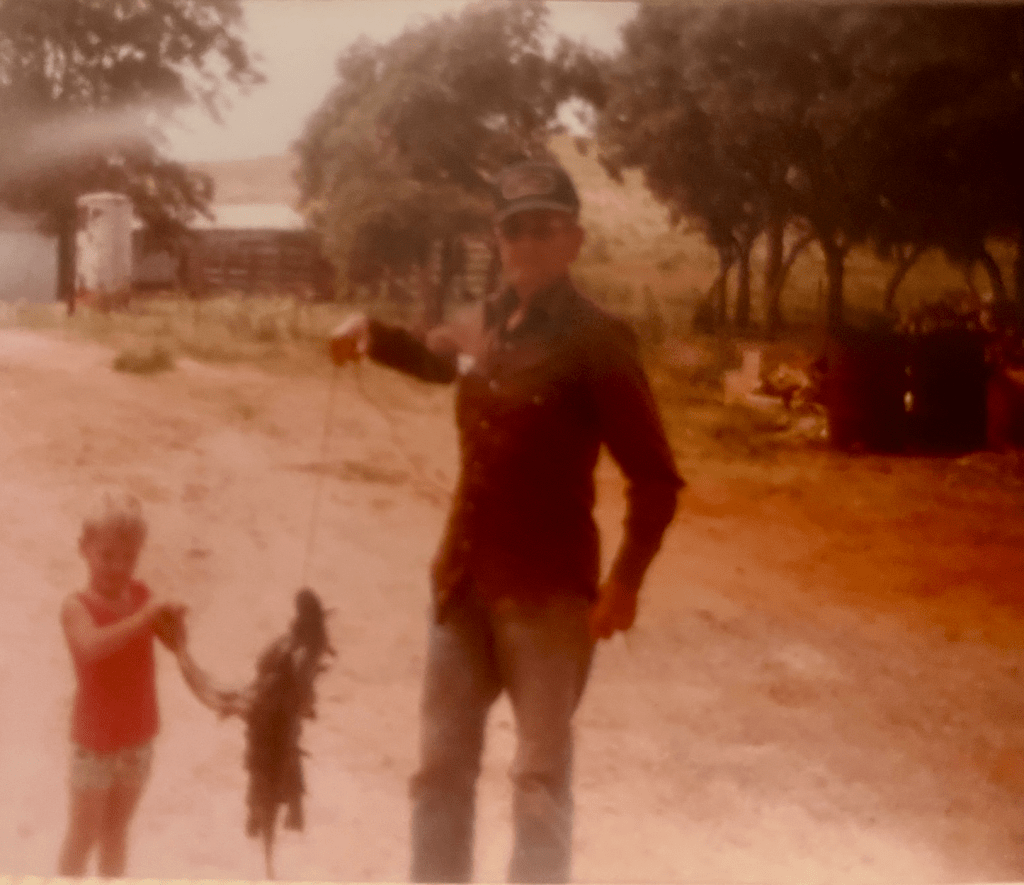
Grandson Raymond, and JD Groff

And that fishing trip wasn’t the last. That summer—his last summer—I ensured we went out as often as possible. Sometimes, it was just the two of us. I had always dreamed of this as a boy, watching the lake from our back porch. Other times, I brought my brother and my nephews along. Dad would hold court on the bank. He told stories and gave advice. He cast his line with the patience of someone who knew the water well. He knew the time was short.

We laughed, caught fish, and built memories like campfires—small moments that glowed long after sunrise.

That summer was magical.

It was the summer, and I finally got to take my dad fishing. And it was everything I had waited for.

Elmer’s Tough Ride: A Journey Through the Dust Bowl

GROFF MEDIA 2024© TRUTH ENDURES IMDBPRO

Presented by benandsteve.com By: Benjamin Groff II©s

4–6 minutes

Pa Elmer’s Ride

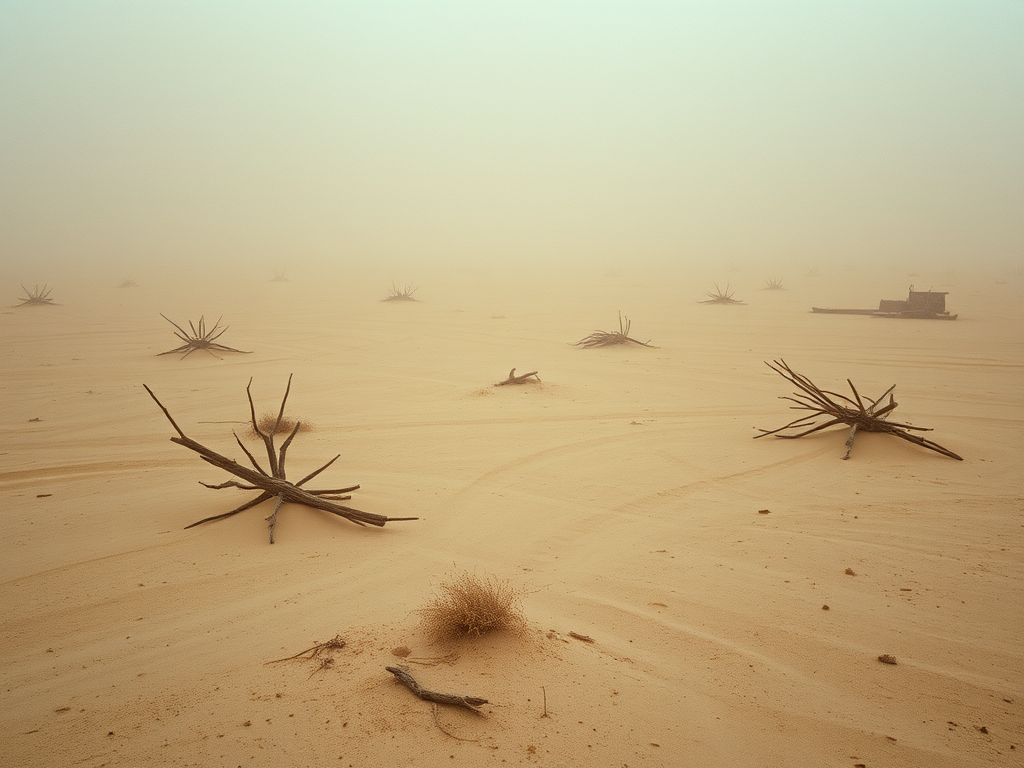
The winter had been relentless. The worst sandstorm in memory had swept through the region the year before. It buried the land in towering drifts of dust and sand. In some places, these drifts were waist-deep.

It marked the beginning of the Dust Bowl. This was a devastating era of dust storms. These storms crippled agriculture and reshaped life across the American and Canadian prairies in the 1930s.

Few families had stored enough food from the past year’s harvest. Even fewer were sure how long this disaster would last.

They say two things in life are certain: death and taxes. And for Elmer, tax time had come knocking. He had no choice but to ride nearly forty miles to the courthouse. He needed to pay his property taxes in person. He risked default if he didn’t. Despite the hard times, he had always kept his land in good standing. He intended to do so now, even with their dwindling savings. With three young children to feed, responsibility was heavily on his shoulders. His two sons and daughter were too young to fully grasp the hardship that had taken hold of the land. The struggle was real for Elmer and his wife, Ma Ma.

The night before his journey, Elmer told Ma Ma,

“I’ll be up by 3:30 and gone before sunrise. There’s no need to let anyone know I’m carrying money. Hard times make people desperate.”

While he trusted his neighbors, he wasn’t about to take unnecessary risks. He planned to make it halfway and camp near the Washita River before reaching the courthouse the next day.

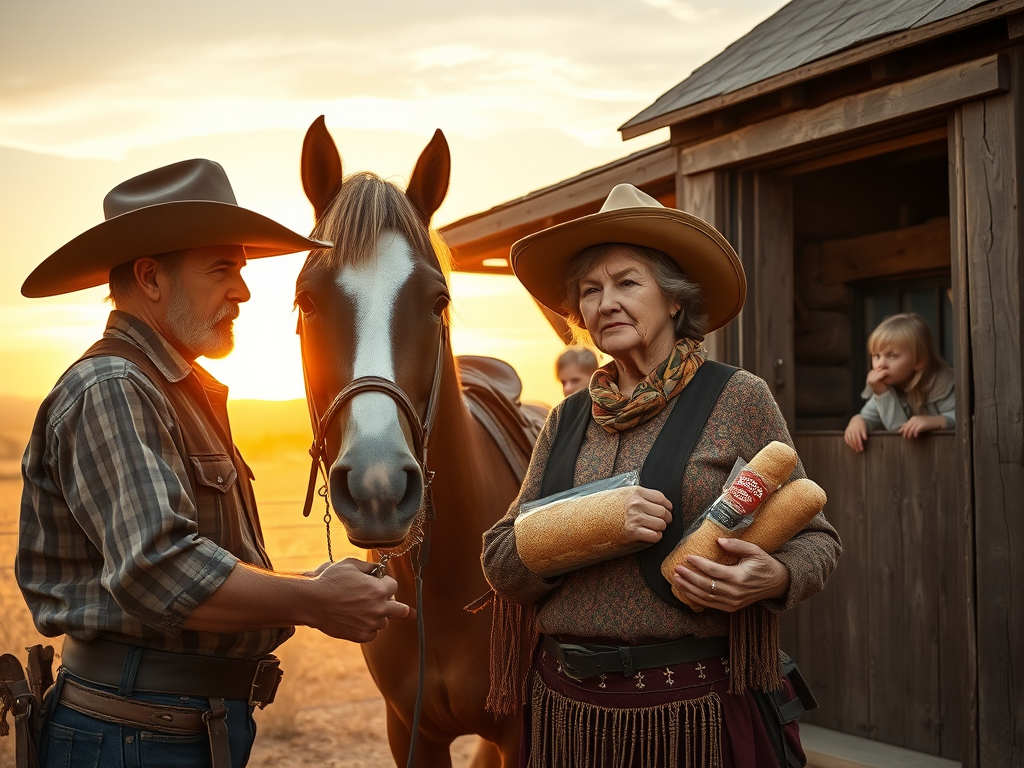
At dawn, Pa Elmer saddled his pony, Smokey. Ma Ma handed him a small bundle—a few slices of fresh bread and beef jerky from the smokehouse.

“It’s not much,”

she said, touching his knee as he mounted up,

“but it’ll hold you over till you’re back. Ride safe, and don’t take any risks. Smokey can outrun any trouble that comes your way.”

Pa Elmer bent down in the saddle and kissed her.

“Two days there, a day and a half back. I’ll be fine.”

The parents didn’t know it. Their three children watched from behind the screen door, their little faces pressed against the mesh. As Ma-Ma gave Smokey a firm slap on the hip, Pa clicked his tongue and hollered,

“Yaw!”

The journey had begun.

Back inside, Ma Ma found the children still watching. She shooed them back to bed. Then she settled into her rocking chair with the Bible. It was her source of comfort through times of uncertainty.

The Ride to Town

Pa made good time. Smokey, eager for the open trail, trotted strong beneath him. By evening, they had covered thirty miles. Elmer found a spot near the Washita River where the grass was matted down—a daytime swimming hole. He unsaddled Smokey. Then, he tied him to a long rope to graze. Elmer stretched out beneath a tree, using his saddle as a pillow.

Sleep took him fast; it was a blessing he had dozed off facing east. The first light of dawn warmed his face, stirring him awake. After a quick breakfast of beef jerky, he saddled Smokey and continued.

By mid-morning, he reached the county seat. He tied Smokey to the hitching rail and strode into the courthouse. The county clerk barely glanced up from her papers.

“You here to ask for an extension on your taxes like everyone else?”

she asked.

Elmer tipped his hat.

“No, ma’am. I’m here to pay my taxes for this year and next.”

The clerk blinked, then scribbled out a receipt, her expression unreadable.

Paid this date: $28.33 for two years of property taxes.

Elmer folded the receipt and tucked it into the same safe spot where his money had been. Simply saying ––––

“Thank you, Mam!”

Pa had finished his business.

Trouble in Town

As he walked back to Smokey, a man loitering nearby gave a slow nod.

“That’s a fine-looking horse you got there. I’d buy him off you for $25.”

Elmer stiffened.

“No, you wouldn’t.”

The man’s eyes darkened, and his tone shifted.

“Maybe I just take the horse for nothin’.”

Elmer didn’t flinch. He met the man’s stare with steely resolve.

“No, you’d be lyin’ dead if you tried.”

A tense silence hung between them before the man forced a crooked smile.

“Mister, I was just jokin’.” 

He backed away.

“You have yourself a nice day.”

Elmer wasted no time. He swung into the saddle and galloped out of town.

The Journey Home

The Journey Home

Elmer has made the ride back in a day. Still, he took his time. He stopped by a few relatives along the way. In this part of the country, it was tradition—when you passed by kin, you paid a visit.

Late in the afternoon, as he approached home, he saw Ma Ma and the kids waiting at the gate. The children ran to meet him, full of questions.

“Well, Pa? How’d it go?” 

Ma Ma asked, relief washing over her face.

Elmer grinned and swung down from Smokey.

“Would’ve been home sooner,” 

he said, stretching his legs,

“but I kept runnin’ out of pipe tobacco.”

Ma Ma shook her head with a chuckle. As the family led him inside, the weight of the journey melted away. Home had never felt so good.

Loneliness and Connection: The Maple and the Crow

GROFF MEDIA 2024© TRUTH ENDURES IMDBPRO

Presented by benandsteve.com By: Benjamin Groff II©

2–3 minutes

The Maple and the Crow

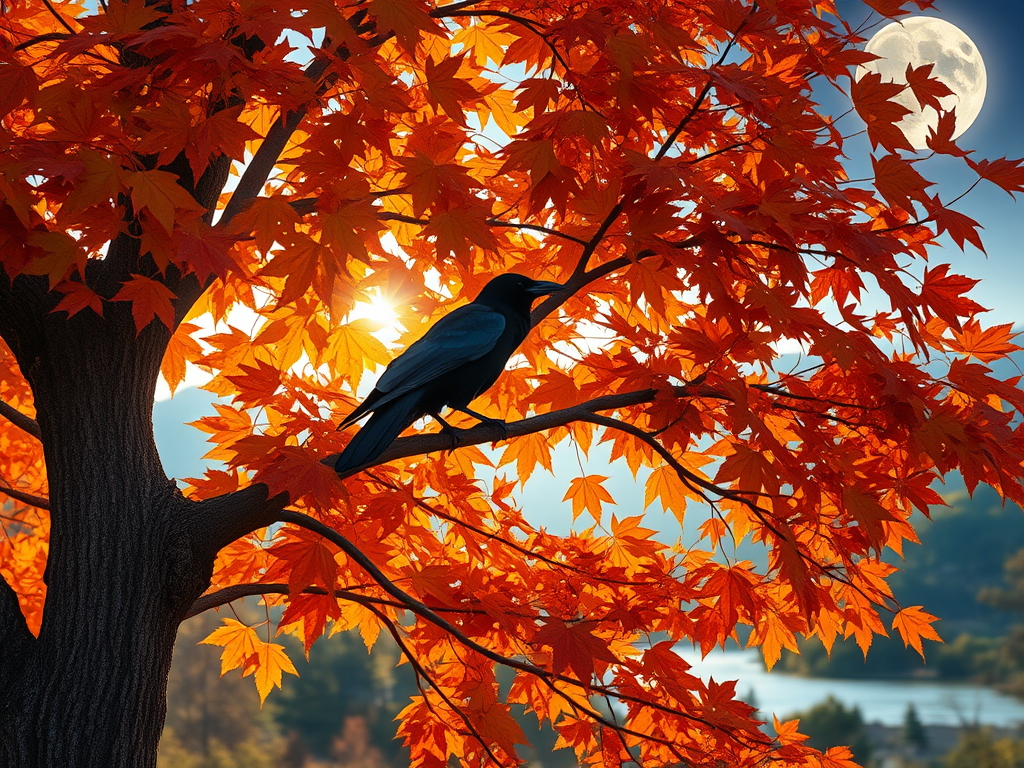
In the quiet corner of Oakridge Park stood an old maple tree. Its branches stretched wide, offering shade to picnickers in the summer and a golden glow in the fall. 

It had seen many seasons pass and many creatures come and go, yet it always felt lonely. It never had a friend to share its days with.

Then came the crow.

The bird arrived one blustery afternoon, perching on the maple’s lowest branch with a ruffled look. Its wing drooped slightly, and its usual subdued sharp claws.

“Shoo!” 

The tree whispered as the wind rustled through its leaves. It was not quite ready to accept this new presence in its life.

But the crow did not move.

Day after day, the crow lingered. 

Caw Caw!

It hopped from branch to branch, picking at the bark, watching the world below. It cawed at passing dogs and tilted its head at children chasing kites.

“Why are you still here?” 

The maple finally asked.

“Nowhere else to go,” the crow replied. Its voice carried a hint of resilience. The tree had never heard this before.

The crow replied.

For the first time, the tree understood what it meant to be lonely. The Maple had never considered this feeling before. The sun rose, the rain fell, and its roots dug deep. But watching the crow, it felt something new—a quiet companionship.

The maple began to enjoy the crow’s presence. It let its leaves shiver in the wind to make music for the bird. When the crow felt strong enough to fly, it still returned, perching in the same spot.

Seasons passed. The maple grew older, and its branches were not as strong as they once were. But the crow remained. It brought stories of faraway places. These places had mountains that touched the sky and rivers that sang in the moonlight.

And when winter came, and the tree stood bare, the crow nestled close against its trunk.

“I will stay,”

 The crow promised.

“I know,”

The maple replied.

And so they remained, an old tree and a watchful crow, an unlikely friendship rooted in time.

Dan the Electrician Saves Boone

Groff Media 2024© Truth Endures IMDbPro

Presented by benandsteve.com By: Benjamin Groff II©

3–4 minutes

The small town of Boone, nestled in the valley of snow-capped peaks, was no stranger to winter storms. But this one was different. The storm rolled in with icy winds that seemed to pierce every wall and seep through every seam. It coated the town in a thick, glittering layer of ice. The power lines sagged and snapped under the weight. This plunged Boone into darkness. The town’s survival hung in the balance, with temperatures plummeting to subzero.

The urgency of the situation was palpable. Dan Hayes, a seasoned electrician and father of two, was preparing for a quiet evening with his family. His phone buzzed incessantly. Calls came in from neighbors, then from Boone’s mayor himself. The town’s substation, already overwhelmed by the demand for heat, had succumbed to the relentless freeze. Ice had formed on critical equipment, blowing fuses and wiring, leaving the entire town powerless.

“Jimmy, grab my tool bag!”

Dan hollered to his teenage son, who quickly obeyed, bundling up in layers against the cold.

“We’re heading to the substation.”

Driving through the storm in his old but reliable truck, Dan and Jimmy barely see beyond the hood. Fallen branches and icy roads made the journey treacherous. When they finally reached the substation, the sight was worse than Dan expected. The entire structure got encased in ice. Its wires snapped like brittle twigs.

“Jimmy, this is going to take everything we’ve got,”

Dan said, his breath forming clouds in the freezing air.

“I’ll need your help every step of the way.”

Dan quickly assessed the situation, identifying the most critical damage. The main transformer was overloaded, and its fuses were blown. Wires leading to key circuits were severed, and ice threatened to collapse a vital power relay. Dan began carefully thawing the most delicate components using a portable heater from the truck. Meanwhile, Jimmy set up emergency lights and handed his dad tools as he worked.

Word spread that Dan was at the substation. Soon, a small group of townsfolk arrived. This group included the fire chief and a few volunteers. They formed a chain to bring sandbags and materials to reinforce the ice-laden structure. This was a testament to the resilience and unity of the community. One by one, Dan replaced the fried fuses and spliced wires, his fingers numb but his determination unshaken.

Hours passed, and the storm showed no mercy. Dan finished repairing the transformer. Then, the wind knocked a massive branch onto the newly restored lines. This snapped them again.

Dan didn’t flinch.

“We’ve got one shot to do this right,”

He muttered. Calling on his years of experience, he rigged a temporary bypass, rerouting power from a less-affected part of the grid. The fix have been made better, but it would hold until morning.

Finally, as dawn broke and the first rays of sunlight pierced the storm clouds, the lights flickered across Boone. Cheers erupted from the gathered crowd, but Dan was yet to finish. He double-checked every connection, ensuring no one would lose power again that day.

Jimmy looked at his dad with newfound admiration.

“You saved the whole town, Dad.”

Dan smiled, his face weary but proud.

“We did it together, son. Boone’s got a lot of heart, and so do its people. That’s what keeps us warm.”

Back home, Dan and Jimmy were comforted with hot cocoa and blankets from a grateful Mrs. Hayes. Outside, the storm subsided. It left behind a town that had endured the worst. This was thanks to the quiet heroics of a father who wouldn’t let the cold win.

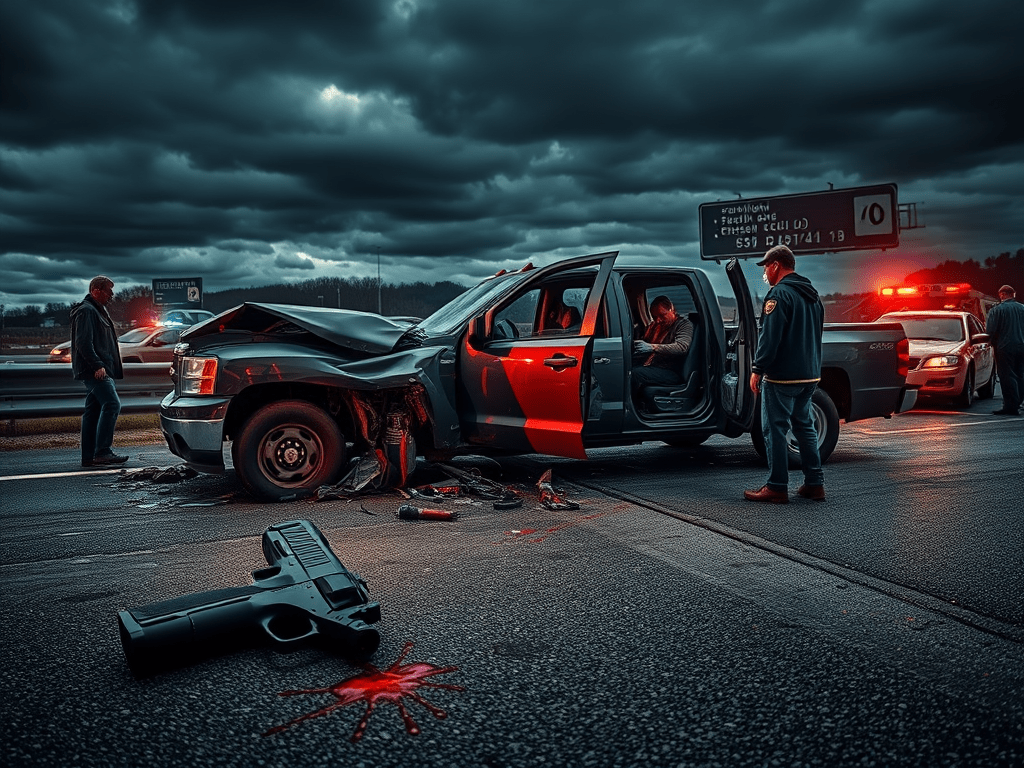
Highway Reckoning – When There Is Real Blood On The Highway ––– “He said we were both going to die!”

Groff Media 2024© Truth Endures IMDbPro

Presented by benandsteve.com By: Benjamin Groff II©

3–5 minutes

Officer Ben Groff had been juggling back-to-back court appearances at the Beckham County courthouse all morning. The docket was full of traffic violations and a few petty crimes, each case chewing away precious hours he would rather spend patrolling Elk City streets. 

The courtroom’s musty air and the monotony of testimonies felt like a prison until his radio crackled to life with a voice that cut through the monotony like a razor.

“Priority call for Elk City PD. Possible domestic disturbance turned vehicle crash at Interstate 40 and State Highway 6. Ambulances en route. Officers needed to secure the scene. Witnesses report shots fired. Groff and Wheeler, you’re closest.”

Groff glanced at his fellow officer, Lieutenant Wheeler, seated across the room as a witness for a separate case. Wheeler’s eyes mirrored the same urgency. Without needing words, both men left the courthouse, striding quickly to their cruisers.

Moments later, Groff sped East on Interstate 40 toward the reported scene, the shrill wail of his siren slicing through the rural quiet. The chaos became evident as he neared the overpass where Interstate 40 crossed Old Highway 66.

A mangled pickup truck rested askew across the interstate median, its engine smoking and horn blaring. A crushed sedan lay twenty yards away, its front end obliterated. Skid marks and shattered glass littered the asphalt like jagged scars. Traffic had stopped, and several drivers had exited their vehicles to rubberneck or assist.

Groff slowed only enough to navigate the melee before parking behind Wheeler’s cruiser. As Groff exited his vehicle, he took in the scene—a woman, visibly distraught, sat against the guardrail, holding a bloodied handgun. Paramedics surrounded her, carefully taking the weapon from her trembling hands.

“Groff, over here!” 

Wheeler shouted, pointing toward the pickup.

Inside, a man slumped lifelessly in the driver’s seat, a gunshot wound to his head. His hands still gripped the steering wheel, frozen in what seemed to be the final moment of his fatal decision. He had experienced the syndrome known in police work as having a Cadaveric Spasm or Instantaneous Rigor. 

“She shot him, Ben,” 

Wheeler said grimly. 

“Witnesses say he tried to crash the truck into the underpass while she fought him off.”

Groff nodded, taking in Wheeler’s words while scanning for immediate threats. 

“What caused the head-on with the sedan?”

“When she shot him, the truck swerved across the median into oncoming traffic,”

Wheeler explained. 

“A family of three was in that car. Paramedics say they’re alive, but it’s bad.”

“He said we were both going to die!”

Groff approached the woman at the guardrail, her tear-streaked face contorted in anguish. 

“Ma’am, I’m Officer Groff. I need you to tell me what happened.”

Through sobs, she explained the escalating argument at a gas station on Old Highway 66. Her husband, enraged over perceived slights, had driven recklessly onto the interstate, swerving wildly. When she tried to grab the wheel to prevent him from crashing into the underpass, he attacked her. In desperation, she retrieved the handgun from the glovebox and fired.

“He said we were both going to die!”

She whispered, her voice quaking. 

“I didn’t want to hurt him, but I couldn’t let him kill us.”

Groff nodded solemnly, trying to balance empathy with the need for clarity. 

“You did what you thought was necessary to survive. Right now, our focus is ensuring you’re safe and getting everyone the help they need.”

As he spoke, highway patrol officers arrived to assist with traffic control. Paramedics transported the injured family to the hospital, and the medical examiner began their grim work on the deceased husband.

Groff and Wheeler pieced together the scene as investigators. The domestic dispute was the tragic catalyst but also underscored the unpredictable volatility of police and emergency calls.

Hours later, Groff sat on the hood of his cruiser, staring at the fading sunlight over Interstate 40. Wheeler joined him, his expression weary. 

“Another senseless tragedy,” 

Wheeler said.

“Yeah,”

Groff replied, the day’s weight pressing down. 

“But at least she survived.”

The call would haunt them both for a long time, a stark reminder of the thin line officers walk between preserving life and untangling the wreckage of human conflict. For Groff, it was just another chapter in a small-town officer’s unpredictable, often harrowing life.

COYOTES CAUSING TROUBLE IN METRO AREAS

Groff Media 2024© Truth Endures IMDbPro

Presented by benandsteve.com By: Benjamin Groff II© 


The overpopulation of coyotes in many metropolitan areas, including Arizona, California, and Nevada, is a severe issue. This poses a threat to our pets and disrupts the balance of the local ecosystem, leading to potential conflicts with humans and other wildlife.

  • Bring Pets Indoors: When a coyote is spotted nearby, the most effective action is immediately bringing pets inside. Never leave small pets, like dogs or cats, unattended outdoors, especially at night, as they are at high risk. This simple step can significantly reduce the chances of a coyote attack, giving you control over your pet’s safety.Make Noise: If you can do so safely, use loud noises to scare the coyote away. Yelling, clapping, or banging objects can be effective, as coyotes tend to be skittish around loud sounds.
  • Use Water or Bright Lights: If accessible, spray water or turn on outdoor lights to deter the coyote from staying near your property. Many coyotes dislike sudden light exposure or water splashes.
    • Secure Food Sources: Coyotes are drawn to food left outdoors, such as pet food, garbage, or bird feeders. Remove these attractants by keeping pet food indoors, securing trash bins, and cleaning up fallen fruit or food from patios.
    • Fence Your Yard: Installing a tall, solid fence (at least 6 feet high) with a roller at the top can prevent coyotes from jumping over. A ‘coyote roller’ is a simple yet effective device that one can add to the top of a fence. It consists of a PVC pipe or metal rod that spins freely, making it difficult for coyotes to gain a foothold. Use Coyote Repellents: Commercial coyote repellents around the yard. These products typically use strong odors to discourage coyotes from venturing too close.
      • Consult Arizona Wildlife Authorities: For ongoing issues, contacting local wildlife or animal control agencies can help address concerns about coyote activity. In Arizona, the Arizona Game and Fish Department offers guidance on wildlife management.

        Organizing neighborhood awareness of wildlife encounters is crucial in building a united approach to preventing conflicts with coyotes. Sharing best practices and staying alert about sightings will benefit other pet owners and encourage community-wide efforts to limit coyote activity. Educating the community can all play a part in keeping our pets and properties safe.

        Why Being Different is Special: Spot’s Lesson

        A Story By: Benjamin Groff© Groff Media 2024© Truth Endures

        Once upon a time on Cloverfield Farm, there was a little dog named Spot. Despite his name, he didn’t have a single spot on his smooth, white coat. All the other animals had their own unique markings—some had spots, some had stripes, and even Patch the cat had a patch over one eye. Spot often felt left out, especially when the other animals teased him.

        “Hey, Spot! Where are your spots?”

        the goats would bleat, snickering amongst themselves.

        “Spot doesn’t even look like a Spot,”

        the chickens clucked, pecking around the yard as Spot’s ears drooped in embarrassment.

        Tired of feeling like he didn’t belong, Spot decided he’d make his own spots. One day, he found some mud by the pond and rolled around in it, making little brown splotches all over himself. He trotted proudly into the barn, thinking he looked just like everyone else.

        But the cows mooed with laughter.

        “Those spots don’t look real, Spot,”

        they teased.

        “You’re still plain!”

        Spot tried again the next day, sneaking into the farmer’s house and dipping his paws in paint from an art set left out on the porch. This time, he dotted his fur with black paint, carefully pressing little paw prints all over his coat. Spot thought he looked quite spotty now, but as he strutted around the barnyard, the animals just laughed louder.

        One day, feeling disheartened, Spot wandered to the edge of the pasture and lay down beneath a big shady tree. Just then, a large bull—well, he looked like a bull—ambled over and lay beside him.

        “What’s the matter, Spot?”

        asked the bull.

        “Oh, everyone teases me because I don’t have any spots,”

        Spot sighed.

        “I’ve tried everything to fit in, but they always laugh.”

        The bull nodded thoughtfully.

        “You know, Spot, they laugh because they don’t understand. And by the way, I’m not a bull—I’m a steer.”

        Spot’s eyes widened.

        “A steer?”

        The steer chuckled.

        “Yes. I may look like a bull, but I’m not. And that’s okay. I learned a long time ago that who you are inside doesn’t need to match what everyone thinks they see on the outside. And it doesn’t have to match what they want, either.”

        Spot tilted his head, listening.

        “You see, Spot,”

        continued the steer,

        “everyone has something that makes them different. And sometimes, animals make fun of others because they don’t want their own differences noticed. It’s easier for them to point at you than to face their own insecurities. But those differences are what make each of us unique.”

        Spot thought about this for a moment.

        “So… you think it’s okay that I don’t have spots?”

        “More than okay,”

        said the steer with a warm smile.

        “You don’t need spots to be special. Being you is what matters. When you’re proud of who you are, those who tease you may just stop because they’ll see that you don’t need their approval.”

        Spot felt something warm and happy inside. For the first time, he realized that maybe being himself was enough.

        After that, Spot didn’t roll in mud or try to paint on spots. Instead, he ran and played with the animals, joining in with confidence. He still got a few teasing remarks, but now he just wagged his tail and smiled.

        And little by little, the other animals started to see Spot differently. The cows noticed how fast he could run, the goats admired his cleverness, and even Patch the cat stopped by to share stories with him under the big shady tree. Spot was no longer “the dog without spots”—he was simply Spot, the friend who was comfortable being himself.

        And from then on, Cloverfield Farm was a happier place for everyone.

        The Legend of Arizona’s Red Ghost Faris And His Caravan Of Former Calvary

        Presented by benandsteve.com By: Benjamin Groff II© Groff Media 2024© Truth Endures IMDbPro

        Sailors and an Arab camel herder load
        a Bactrian camel aboard the USS Supply
        during one of the two expeditions to
        procure camels – National Archives

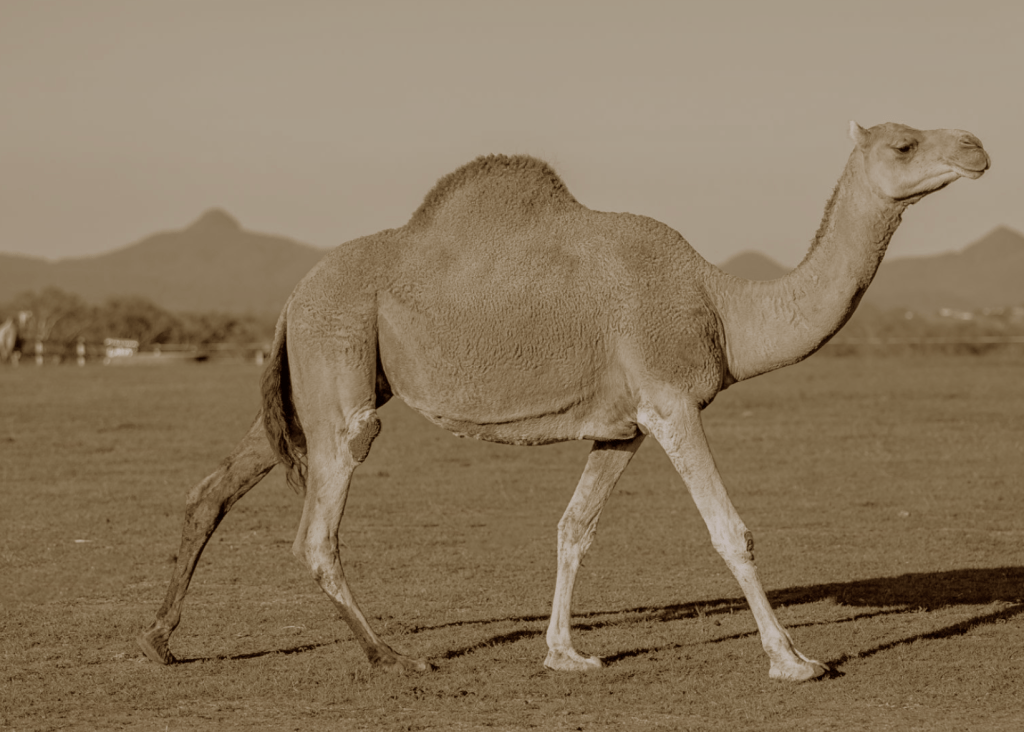
        In the sun-scorched deserts of Arizona, the vast emptiness was once filled with the pounding hooves of horses and the steady march of soldiers from the United States Cavalry. But for a brief moment in history, an unlikely companion joined their ranks—the camel. Brought from distant lands, these towering creatures with their humped backs and long legs had intended to be the army’s answer to the challenges of traversing the rugged terrain of the Wild West.

        A/I Created Photo

        In the mid-1800s, under the guidance of Secretary of War Jefferson Davis, the U.S. government embarked on a truly unique experiment-the ‘Camel Corps’. Camels, renowned for their endurance in desert conditions, were imported to America and tasked with the challenging job of carrying supplies across the barren landscapes where wagons and horses often struggled. The soldiers stationed at the forts in Arizona and New Mexico were initially skeptical. They were baffled by the strange creatures that spit and moaned, their massive feet gliding over the desert sands as if weightless.

        Among the camels, one stood out—a massive bull camel named Faris. He had traveled across the seas from the deserts of Egypt, his broad hump towering over his fellow camels. With piercing eyes and a personality as stubborn as the most seasoned cavalrymen, Faris became the pack’s leader, guiding the other camels through endless miles of scorching desert, carrying their loads without complaint.

        Library of Congress

        But the experiment was short-lived. As the Civil War loomed, funding for the Camel Corps dried up, and the forts in the Arizona desert began to close one by one. With the forts gone and no practical use for the camels, the military made a fateful decision: they turned them loose, setting them free in the vast desert wilderness. The soldiers and settlers who remained watched with mixed emotions as the camels slowly strode off into the horizon, their long necks and humps silhouetted against the setting sun.

        Library of Congress

        Faris led the herd, now wild, into the vast stretches of land where no human tread. Once tethered and burdened with human supplies, the camels embraced their freedom, roaming the desert, their calls echoing in the canyons and across the mesas.

        For years, sightings of the camels became the stuff of legend. Travelers and settlers spoke of giant creatures wandering the wilderness, spooking horses, and disappearing into the dunes as quickly as they were seen. Stories of ‘The Red Ghost’ surfaced, a phantom camel said to be terrorizing ranchers, with strange tracks left in the dust after raids on isolated farms. The mystery deepened with some claiming to see a human skeleton strapped to the back of one rogue camel, but no one knew for sure whether this was fact or fiction.

        Library of Congress

        Faris, now older but still commanding, led his herd deeper into the desert as the years passed. The camels, with no soldiers to guide them, learned to live off the sparse vegetation, adapting as always. They became masters of the land, surviving where few others could, a testament to their remarkable adaptability.

        Generations of Arizonans grew up hearing tales of the camels. Old ranchers would sit by the fire, recounting when they saw a lone camel watching them from the top of a ridge, its eyes gleaming in the moonlight before they vanished into the desert night. Cowboys whispered of Faris, the great camel leader, still roaming the wild, the last of a forgotten army, king of the untamed desert.

        So, the camels of the Wild West became more than just a footnote in history—they became legends, ghosts of a time when even the most foreign creatures found a place in the rugged and unforgiving land of the Arizona desert.

        A released camel or a descendent of one is believed to have inspired the Arizonan legend of the Red Ghost.

        One of the few camel drivers whose name survives was Hi Jolly. He lived out his life in the United States. After his death in 1902, he was buried in Quartzsite, Arizona. His grave is marked by a pyramid-shaped monument topped with a metal profile of a camel.