The Great Bison Incident: A True Survival Story

GROFF MEDIA 2024ยฉ TRUTH ENDURES IMDBPRO

Presented by benandsteve.com By: Benjamin Groff IIยฉs

3โ€“4 minutes

The Great Bison Incident (A True Story)

Carney had no idea what his neighbor, Ted Ortiz, had done. Ted had recently purchased what everyone around here called a buffaloโ€”though, technically, they were bison. His grand idea? Cross-breeding the massive bull with his cattle. What is there to go wrong?

That morning, Carney had spent hours plowing one of his fields. When he finally finished, he hopped down from his tractor. He stretched his back and pulled out his packed lunchโ€”a simple sandwich and a thermos of water. After a few quick gulps, he was ready to tackle the next field.

He set off across the pasture, taking his usual shortcut. Halfway across, he heard a deep, rumbling snort behind him. At first, he figured it was just one of Ted’s cows and kept walking. But then he noticed somethingโ€”the snorting sound was moving with him.

Carney turned around and froze.
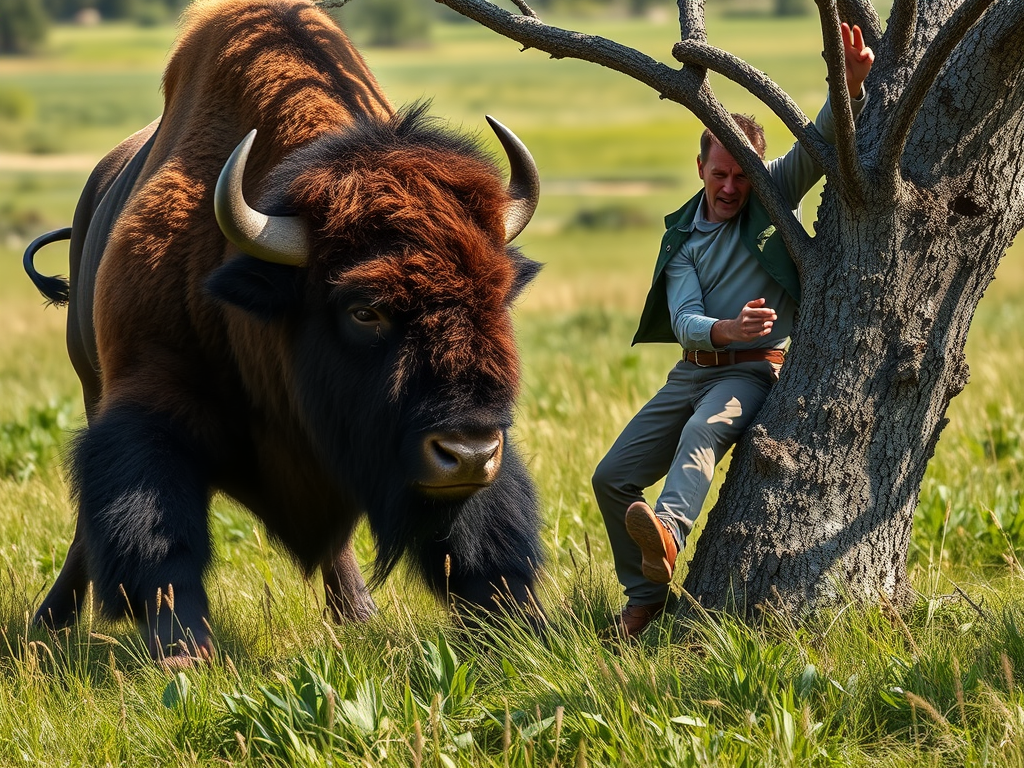
A massive, very annoyed bull bison stood just a few yards away. And Carney had unknowingly interrupted the beast’s afternoon of affection.

The bison pawed the ground, snorted louder, and locked eyes with Carney. He had seconds to decideโ€”fall, play dead, or run like hell. He chose the latter.

Now, Carney was in his fifties. He was not exactly a sprinter, but he moved like an Olympic athlete when faced with a furious bison. His only hope was a nearby tree. He scrambled up, arms and legs flailing, barely reaching a branch as the bull slammed into the trunk below.

Unfortunately, Carney had picked the wrong tree.

It was dead.

The bison rammed it again. The whole thing groaned and wobbled. Carney had two choicesโ€”jump and run or ride the tree down like a doomed cowboy in a slow-motion disaster.

So he jumped. And ran.

And here’s where things took an unexpected turn.

Carney swears he made it to the fence, jumped over, and escaped without a scratch. But according to theย newspaper,ย the story went a little differently.

The article claimed that the bison knocked the tree over after Carney hit the ground. Then it turned its fury back on him. Carney had no other options. He did the only thing he thought possible. He dropped to the ground. His face was down in the dirt, and he played dead.
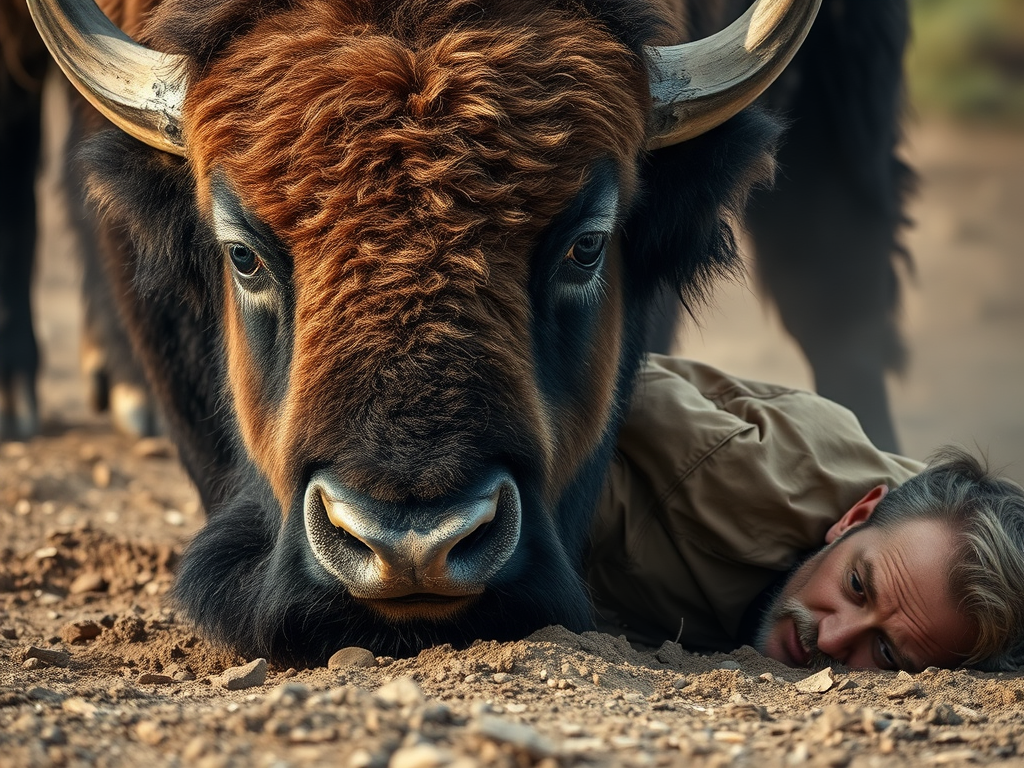
The bison approached, snorting, its heavy breath huffing across Carney’s back. It sniffed his head. His shoulders. His boots. Then, it reached his backsideโ€”and suddenly, something changed.

The bull gagged.

Its eyes watered, and its massive body trembled. The mighty beast gave a final snort of disgust. It turned its tail and bolted. The beast ran away as fast as its hooves carried it.

Carney, shaking but victorious, got to his feet and went to the other field. Before plowing, he had to detour into the nearest creek. He needed to scrub off whateverย offendedย that bison so severely.

The newspaper never revealed its source for this version of events, but everyone had their suspicions. Most believed the town barber had something to do with it. After all, most of the town’s best stories started in his shop.

To this day, the Great Bison Incident resurfaces whenever the local men need a good laugh. It is a legendary reminder that sometimes survival comes down to sheer luck, including anย unfortunateย choice in lunch. It’s a tale that never fails to entertain.

This is a true story. The names have been changed to protect the privacy of those in real life.

Maintaining Integrity Amidst Conflict

GROFF MEDIA 2024ยฉ TRUTH ENDURESย IMDBPRO

Presented by benandsteve.com By: Benjamin Groff IIยฉs

2โ€“3 minutes

Keeping Your Side of the Street Clean

The smell of fresh rain lingered as Mark walked down Elm Street toward his favorite cafรฉ. It was his usual morning routine, a quiet moment before the day unraveled. He reached the entrance. Then he saw himโ€”Greg Turner. Greg was leaning against a lamppost, arms crossed. He was watching him with a smirk that dripped with disdain.

Greg had never made it a secret that he disliked Mark. Their history goes back to a business deal gone wrong. Mark handled it ethically, but Greg saw it as a betrayal. Since then, Greg had made it his mission to smear Mark’s name. He spread rumors and whispered doubts into the ears of anyone who would listen.

Mark adjusted his posture, exhaled slowly, and kept walking. He knew better than to engage.

“Hey, Mark,”ย 

Greg called out loud enough for people at the cafรฉ’s outdoor tables to turn their heads.

“Still fooling people into thinking you’re the good guy?”

A few customers looked up from their coffee, eyes shifting between them, waiting for a response. Mark felt the moment’s weight pressing against his back, the temptation to defend himself bubbling under the surface.

But he had learned something long agoโ€”some battles weren’t worth fighting. Not in the mud. Not at the expense of his peace.

He turned slightly, just enough to meet Greg’s gaze, and nodded.

“Good morning, Greg.”ย 

His voice was even, void of malice, but firm. Then, without another word, he stepped inside the cafรฉ.

The barista, Sarah, greeted him with a warm smile. 

“The usual?”

Mark nodded as he took out his wallet.

“Yep. And maybe an extra shot of patience today.”

Sarah chuckled as she prepared his coffee. 

“Don’t let him get to you.”

He shook his head. 

“I won’t.”

Moments later, as he stirred his coffee, he glanced outside. Greg was still there, now talking to someone else, his hands animated, spinning another version of his tired tale. Mark took a sip, savoring the rich warmth of his drink, and let the moment pass.

There was no need to wade into the mess or wrestle with the bitterness that wasn’t his to carry. His conscience was clear. His integrity was intact.

He walked out of the cafรฉ with his head high. His side of the street was clean. Mark was guilt-free and ready to face his day. He had not gotten down to Greg’s level; even better, he showed respect for doing so. 

Life Lessons from a Skunk: Trust and Taking Chances

GROFF MEDIA 2024ยฉ TRUTH ENDURES IMDBPRO

Presented by benandsteve.com By: Benjamin Groff IIยฉs

3โ€“5 minutes

It was an old house on the southeast side of town. The floorboards creaked. The front porch sagged just a little in the middle. Jeb and Lorine lived there with their giant Boxer. The dog was as broad as a barrel. He was just as heavy when he flopped into your lap.

At five years old, Tim sometimes spent his afternoons there, waiting for his dad to pick him up. He had just started kindergarten and hated schoolโ€”not just kindergarten, but the whole idea for the next twelve years. The only good thing was that, for now, Tim only had to go until noon. Then, most days, he’d end up at Jeb and Lorine’s, where things were much more enjoyable.

One thing about their house always intrigued Tim: the mysterious knocking and pounding under the floor. It was a constant occurrence as if somethingโ€”or someoneโ€”was moving beneath them. Tim had been taught not to be rude and ask questions in other people’s homes. He sat quietly, but his mind was buzzing with curiosity.

Maybe it was the bees. Jeb had a beehive in the backyard and collected honey from it. Tim imagined a massive honeycomb hidden under the house, so big that its weight made the boards creak. He pictured golden honey dripping through the cracks in the floor. But no, that didn’t explain the noise. The sound traveled, shifting from one end of the house to the other.

One afternoon, while playing in the backyard, Tim noticed a small fence blocking off a crawl space beneath the house. It was big enough to hold an animalโ€”maybe even a dog. But why would Jeb fence it off? Was he trying to keep something out? Or โ€“โ€“โ€“ keep something in?

Curious, Tim dropped to his hands and knees, peering into a dark hole in the foundation. He squinted, trying to make sense of the shadows. Suddenly, two glassy eyes stared back at him. A jolt of surprise went through his body.

Tim let out a startled yelp and scrambled backward his heart racing. He barely managed to stop himself from swearing in shock.

“WHOA! HOLY COW!”

The eyes moved closer, emerging from the darkness. Tim’s breath caught as the creature stepped into the light.

“A SKUNK!”

He shot to his feet and bolted inside, bursting into the living room where Jeb and Lorine sat.

“There’s a skunk under your house!” he gasped. “You gotta get a shovelโ€”hit it over the head! It’s living under there!”

Jeb and Lorine burst into laughter.

“You met Johnny,” Jeb said, shaking his head. “He’s a buddy of mine. Come on, I’ll let you hold him.”

Tim’s eyes widened.

“Hold him?! Are you crazy? He’ll spray us!”

Jeb chuckled.

“No, he won’t. Johnny had his scent glands removed when he was a baby. He can’t spray.”

His words were like a soothing balm, calming Tim’s nerves.

Tim hesitated, his skepticism clear.

“How can you be so sure?”

He asked, his voice tinged with doubt.

“Because I raised him,” Jeb said, standing up. “Found him in my barn after his mama got hit by a car on the highway. Watched that nest for days, but she never came back. He would’ve died if I hadn’t taken him in.”

Tim followed Jeb outside, still wary. The last thing he wanted was to go home reeking of skunk.

Jeb knelt by the crawl space and softly said,

“Johnny, Johnny, come on out, boy.”

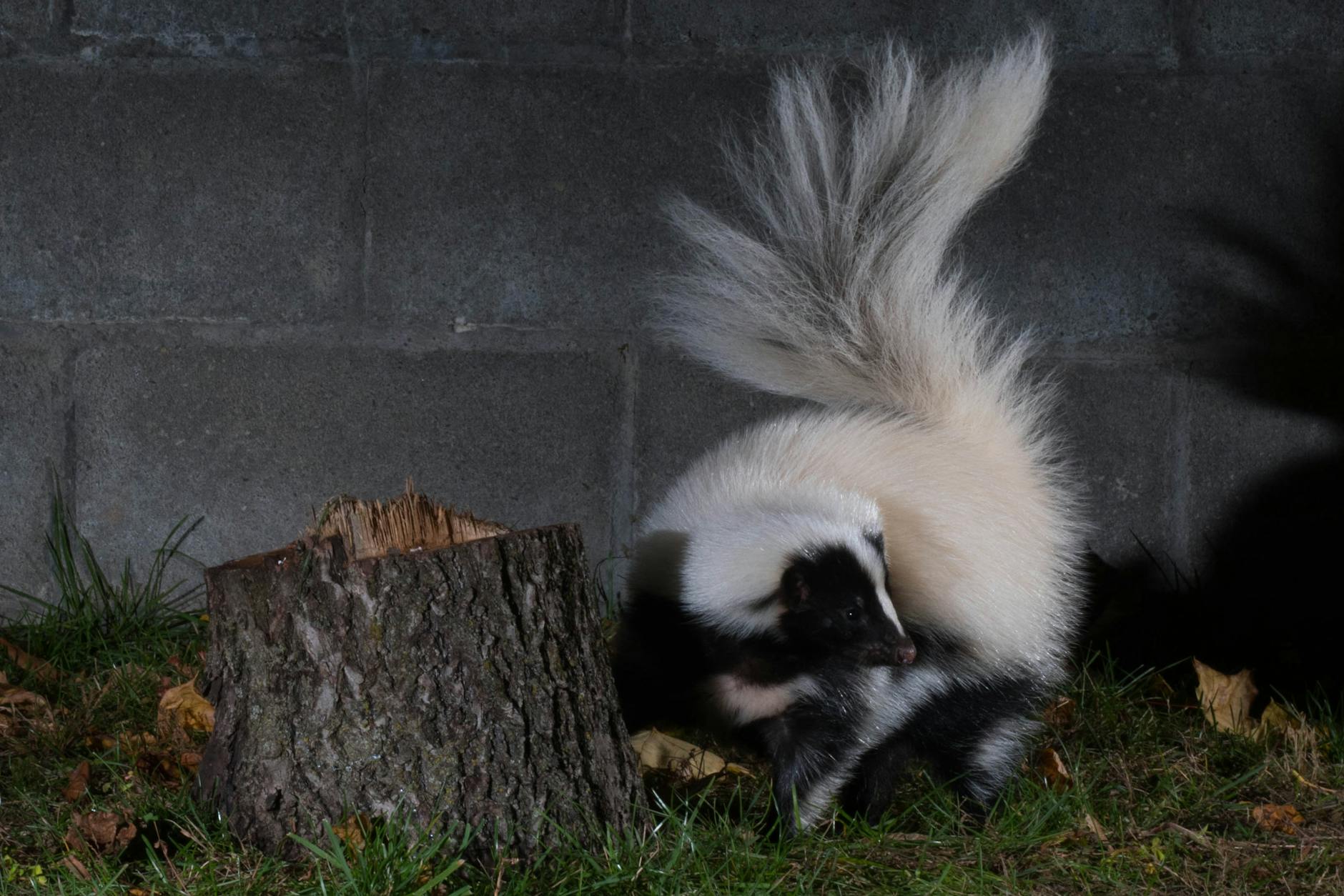
Tim tensed as the skunk waddled into view, its black-and-white fur gleaming in the afternoon sun.

Jeb looked at Tim and grinned.

“Son, I know what you’re thinking. Life’s about trust, taking chances, and finding things out for yourself. You can do all three right now.”

Tim swallowed hard, debating. Does he trust this?

Taking a deep breath, he held out his arms.

Jeb carefully placed Johnny in his hands, and Tim braced himself for the worst. Johnny curled against his chest, nestling under his chin like a kitten. His friendly demeanor melted Tim’s apprehensions.

Tim stood there, stiff at first, then slowly relaxed. The skunk was warm, soft, and oddly โ€“โ€“โ€“ pleasant.

After a few minutes, Jeb patted Tim’s shoulder.

“That’s good now. Johnny must return inside, and your daddy’ll be here soon.”

Tim handed Johnny back and followed Jeb into the house. As he sat on the couch, he waited for his dad. He thought about what Jeb had said. It was about trust, taking chances, and learning things for yourself.

When his dad pulled up, Tim climbed into the truck. As they pulled away, his father wrinkled his nose.

“What have you been doing?”

He asked.

“You smell like a skunk!”

Tim just grinned. And said โ€“โ€“โ€“

“I’ve been taking a chance on trusting people and other things and learning things for myself.”

Mabel the Cow: A Unique Weather Oracle

GROFF MEDIA 2024ยฉ TRUTH ENDURES IMDBPRO

Presented by benandsteve.com By: Benjamin Groff IIยฉ

2โ€“4 minutes

THE COW THAT FACED EAST AND WEST

Mabel The Cow
Mabel The Cow That Stood East and West

Mabel was no ordinary cow. Unlike her bovine companions, most faced north or south due to the Earth’s magnetic field. She alone possessed the uncanny ability to sense the shifting seasons. Her unique gift made her a figure of fascination and wonder in the town. If she stood facing due west upon stepping from her barn, an early spring was certain. But if she turned east, the town braced itself for six more weeks of winter’s harsh grip.

The people’s trust in Mabel was unwavering. She had consistently met their expectations. She had never let them down. This held true since old Farmer Ed Boyd’s grandfather first noticed her peculiar habit. To them, she was more than just a cowโ€”an oracle of the changing seasons, a symbol of nature’s quiet wisdom. Their collective belief in her was a bond that united the entire community.

On this particular February 2nd, 2025, the excitement was palpable. The air was crisp. The sky was cloudless. The crowd murmured in hushed voices as they watched Farmer Ed lead Mabel from the barn. She had just finished her morning hay and grain, and Ed had completed the daily milking. Now, all eyes were on the old cow.

Mabel stepped into the winter sunlight, surveyed the expectant faces before her, and let out a deep, resonant moo. Then, to everyone’s shock, she did something she had never done before.

She laid down.

Not facing west. Not facing east. But southwest.

A stunned silence fell over the crowd. Uncertainty hung in the air, and people exchanged nervous glances.

“What does it mean?”

whispered Mrs. Thatcher, pulling her shawl tighter around her shoulders.

Farmer Ed scratched his head, bewildered.

“Well, folks, I reckon Mabel’s got somethin’ new to tell us this year.”

Sheriff Dobbs adjusted his hat.

“Maybe it means we’ll have a little of bothโ€”some winter, some spring?”

Standing on tiptoe beside his father, Young Tommy Jenkins piped up,

“Or maybe she’s just tired!”ย 

His innocent humor brought a wave of laughter, momentarily easing the tension.

The laughter helped ease the tension, but the mystery remained. Some of the older farmers nodded knowingly. It was as if they were saying that nature always had its way of keeping folks guessing.

And sure enough, in the next weeks, the weather seemed as indecisive as Mabel had been. One day, warm breezes carried the scent of budding trees. The next day, an icy wind howled through town. It coated the fields with frost. The seasons wrestled for control, neither willing to yield entirely.

By March’s arrival, the town understoodโ€”Mabel had been right all along. That year, winter and spring refused to play by the usual rules. It was a season of in-between, cold mornings followed by warm afternoons, snow melting too soon only to return overnight.

From that year onward, the town no longer saw Mabel’s predictions as simple answers. They realized that nature didn’t always give clear signs. It spoke in whispers, patterns, and subtle shifts. Only those who truly paid attention understood these messages.

And so, every February 2nd, the people still gathered at Ed Boyd’s farm. They came not just to see where Mabel would stand. They attended to be reminded of life’s one true certaintyโ€”change is always coming.

Mabel, as always, remained the one true expert.

Quiet Reflections: Harold Whitman’s Final Moments

GROFF MEDIA 2024ยฉ TRUTH ENDURES IMDBPRO

Presented by benandsteve.com By: Benjamin Groff IIยฉ

2โ€“3 minutes

The Last Day

Harold Whitman woke before dawn, just as he had done for countless mornings. He stretched his aching limbs, feeling the stiffness permanently occupying his bones. The old house was quiet. Only the refrigerator’s soft hum and the occasional creak of settling wood were heard. This familiar symphony accompanied his every awakening.

He shuffled to the kitchen, brewed a pot of coffee, and sat at the window. He watched the sunrise paint the morning sky in shades of orange and pink. He savored the moment. The cup’s warmth was in his hands, and the faint aroma of the beans filled the air. His late wife had always loved those beans.

Today, he decided, would be a good day.

After breakfast, Harold walked to the park, as he had done for decades. He fed the ducks at the pond. He nodded to the joggers and dog walkers. They had become familiar faces over the years. These interactions, though brief, were like tiny rays of sunshine in his otherwise solitary life. A young boy, no older than six, waved at him from the swings. Harold smiled and waved back.

At the corner store, he bought a piece of his favorite caramel candy and an extra for the cashier. Marisol, a sweet girl, constantly reminded him of his granddaughter.

“You spoil me, Mr. Whitman,”

she said, laughing as she unwrapped the treat.

“Someone’s got to,”

he replied with a wink.

In the afternoon, he visited the cemetery. He sat on the bench beside his wife’s headstone, tracing her name with his fingers. The silence of the place soothed his soul. He felt a strange comfort thinking about joining his wife.

“I think I’ll be seeing you soon,”

he murmured.

“Maybe later tonight.”

There was no fear in himโ€”just a quiet knowing.

Before heading home, he stopped by the diner, ordering a slice of apple pie and a cup of black coffee. The waitress, Lucy, patted his shoulder.

“You always get the same thing,”

she teased.

“Because I know what’s good,”

he said with a grin.

That evening, Harold sat in his favorite chair by the window, where the sunset bathed the room in golden light. He opened a book, though he barely read the words and content to hold it.

When sleep came, it was gentle, like slipping into a warm embrace.

Harold’s heart gave its final beat, and he sighed with quiet satisfaction. His last day had been good, a testament to the peace and acceptance that filled his heart.

Harmony in Chaos: Finding Peace in Urban Sanctuaries

GROFF MEDIA 2024ยฉ TRUTH ENDURES IMDBPRO

Presented by benandsteve.com By: Benjamin Groff IIยฉ

3โ€“4 minutes

In a bustling city, alive with clashing opinions and hurried lives, everyone respected an unspoken rule. Your space is yours, and in it, you reign supreme. It didnโ€™t matter if it was a sprawling penthouse overlooking the skyline. It is a cozy corner in a crowded apartment. Or it is a patch of pavement under a tattered umbrella. Whatever boundaries you claimed, those were the limits of your kingdom.

Take Mrs. Hargrove, for instance. Behind her red-painted door in a quiet cul-de-sac, the world was a sanctuary of classical music. Fragrant lavender candles filled the air with their scent, and books were piled high in every corner. Her rules were simple: shoes off at the door, cats welcome, and no conversation louder than a murmur. Beyond her door, the city roar with chaos, but inside, her sanctuary hummed with the warmth of gentle living.

A few blocks away, Alejandro held court on a sidewalk square. He was nestled between a lamppost and the entrance of a busy coffee shop. His throne was a battered lawn chair, and his walls were chalk-drawn lines on the pavement. Within those lines, Alejandro was both king and philosopher. Passersby often stopped to chat, offering a coffee or sandwich in exchange for his wisdom. His space, though humble, operated on principles he cherished, like kindness first, stories over silence, and always having respect.

Meanwhile, on the tenth floor of a downtown high-rise, siblings Jordan and Tamara lived in a small two-bedroom apartment. They turned it into a vibrant world of their own making. The walls were covered in murals painted by friends who visited. Their home was a haven of creativity where every night was a celebration of life. โ€œNo negativity allowedโ€ was their unspoken law, and those who entered left their worries at the threshold.

Even in the less obvious corners of the city, the principle held firm. Marcy, a young artist, had claimed an unused stretch of wall as her gallery. It was down an alley shaded by fire escapes. She painted over it weekly, layering it with bold, defiant colors. Though the cityโ€™s rules forbade graffiti, this was Marcyโ€™s domain, where her voice never gets muted. Locals respected her unwritten sovereignty, even the city workers, who cleaned around her artwork but left it untouched.

The beauty of the unwritten code was not just in the freedom it offered. It was also in the mutual understanding that accompanied it. Disagreements in the public square? Common. Heated debates at the park? Inevitable. But everyone knew that you honored their rules when you stepped into someone elseโ€™s space. You argue politics at the corner diner or challenge worldviews in the library. Still, you wouldnโ€™t dare speak out of turn in Alejandroโ€™s chalk-drawn palace or disrespect the tranquility of Mrs. Hargroveโ€™s quiet retreat.

This tacit agreement turned the city into a patchwork quilt of safe havens. Each space was unique. It reflected the ideals and beliefs of its occupant. Together, they wove a sense of unity that was stronger than the chaos beyond their boundaries.

One day, a storm swept through the city, bringing rain that soaked Alejandroโ€™s chalk lines and threatened Marcyโ€™s murals. As the wind howled, neighbors opened their doors to one another. Mrs. Hargrove invited Alejandro into her book-filled retreat. Jordan and Tamara turned their living room into an impromptu art studio for Marcy. Even unlikely alliances formed in those moments. They understood that when someoneโ€™s space was threatened, the rest of the city stood ready. They were committed to protect it.

When the skies cleared, the city was quieter, and its people were more thoughtful. The storm had reminded everyone of the fragility of their spaces. It highlighted the strength in preserving themโ€”not just their own but those of their neighbors, too.

And so, the unwritten rule endured. Within your space, you were sovereign. You were free to live, believe, and dream as you saw fit. The city remained a cacophony of voices and lives. Yet, it thrived by quietly revering the small sanctuaries that made it whole.

Harold Fenton: The Salesman Who Won Hearts

GROFF MEDIA 2024ยฉ TRUTH ENDURES IMDBPRO

Presented by benandsteve.com By: Benjamin Groff IIยฉ

3โ€“4 minutes

Harold Fenton was not the world’s most excellent salesman. If there were an award for persistence without progress, Harold would have won it year after year. His thick glasses always slid down his nose. He carried a briefcase that had seen better days. An ever-lasting mustard stain marked his tie. He wandered the same neighborhoods week after week. He sold an assortment of household knickknacks that nobody needed, but they bought them anyway.

“Good afternoon, Mrs. Jenkins!”ย 

Harold greeted cheerfully as he stepped onto the well-trodden path to her front door. 

“I have a brand-new shipment of vegetable peelers today! They’re sharper, sleeker, andโ€””

Mrs. Jenkins, a kindly woman in her sixties, smiled warmly. 

“Why, Harold, I still have the five you sold me last month. But you know, one can never have too many peelers. Come on in.”

Harold beamed and entered, opening his battered case to show an array of matching peelers. Mrs. Jenkins sighed as she handed him a few bills. She tucked the latest addition into her kitchen drawer. The drawer now resembled a peeler museum.

Down the street, Mr. Thompson, a retired mechanic, nodded at Harold as he approached. 

“Harold, my boy, back again? What do you have today?”

โ€“โ€“โ€“

“A fantastic deal on rubber jar openers!”

Harold declared with gusto. 

“These bad boys can grip the tightest lids with ease.”

Mr. Thompson scratched his head. 

“Well, I reckon I have about twenty of those in my drawer already, but why not?”ย 

He chuckled, handing Harold a crumpled bill. 

“You’re a persistent fella, I’ll give you that.”

Each household in the neighborhood had its own Harold collection. The Henderson’s had a mountain of Harold’s lint rollers stacked neatly in their laundry room. The Patel family had so many of his never-fail can openers that their entire garage shelf was dedicated to them. And the Cranstons? They jokingly called their basement “Harold’s Home Shopping Network.” It was filled with enough potato mashers to start a catering business.

But no one ever turned Harold away.

“He’s got such heart,”

Mrs. Jenkins often said over tea with the neighbors. 

“Bless him. He tries so hard.”

One day, Harold arrived with a new productโ€”a miracle mop he couldn’t figure out how to show.ย 

“This mop… uh… well, you see, it swivels… I think. Or it wrings itself. Hold on, I had a pamphlet here somewhere…”ย 

He fumbled with his case, papers spilling onto the sidewalk.

Mrs. Jenkins and Mr. Thompson exchanged a glance and quickly stepped in. 

“We’ll take a few!”ย 

They chimed in unison.

Harold left the neighborhood beaming, waving to everyone as he wheeled his suitcase down the block. He whistled a tune with the satisfaction of a man who believed in his mission.

And so the cycle continued. Week after week, Harold brought the same products with the same pitches. The residents kept buying. They did this not out of necessity but of fondness for the bumbling salesman. He brought a little charm and harmless chaos to their otherwise predictable days.

One day, as Harold left Mrs. Jenkins’ house, she whispered to Mr. Thompson, 

“I sure hope he never realizes we’ve got enough peelers to last a lifetime.”

“He won’t,”

Mr. Thompson grinned. 

“And even if he did, I’d still buy another one next week.”

With that, Harold walked down the road. He was ready to bring his boundless enthusiasm. He also carried a suitcase full of peelers to the next unsuspecting yet ever-welcoming home.

Everyone needs to meet a Harold in life.

The Man’s Journey For Two People Who Agree On Everthing

GROFF MEDIA 2024ยฉ TRUTH ENDURES IMDBPRO

Presented by benandsteve.com By: Benjamin Groff IIยฉ

2โ€“3 minutes

A man named Walter Henshaw lived in a small town. This town was nestled between rolling hills. Walter was known for his insatiable curiosity, always pondering life’s mysteries. One evening, as he sat on his front porch watching the sunset, he wondered aloud,

“Is it possible to find two people in this world who agree on everything?”

The thought consumed him, and soon, Walter embarked on a journey around the world to find the answer. He packed his belongings, bid farewell to his friends and family, and set off on his quest.

Walter’s first stop was Paris, where he met a pair of artists who were painting by the Seine. They seemed in perfect harmony, laughing and finishing each other’s sentences. But when Walter asked them if they agreed on everything, they chuckled.

“Of course not,”

One replied.

“He thinks Monet is the greatest, but I prefer Van Gogh.”

Undeterred, Walter traveled to India, where he visited a monastery high in the Himalayas. There, he met two monks who had lived in silence for decades. Walter was sure he had found his answer, but when he posed his question, one monk smiled and said,

“I prefer tea; he prefers coffee.”

Walter traveled onward. He visited the bustling streets of New York City. Then he experienced the serene countryside of Japan. Finally, he explored the vast plains of Africa. He encountered lifelong friends. He met devoted couples. He even found identical-twins everywhere he went. Nonetheless, no two people ever claimed to agree on everything.

After years of traveling, Walter found himself in a small village in South America. He met an elderly couple who had been together for over seventy years. Patiently, they listened as Walter told them about his journey.

The older man chuckled and said,

“Young man, love is not about agreeing on everything. It’s about embracing differences and finding common ground.”

Walter sat in silence, absorbing the wisdom. He realized then that his journey had taught him more than he ever imagined. The beauty of human connection lies not in absolute agreement but in understanding, compromise, and the joy of diversity.

It also reminded him of one chap he had met in the United States who said to him โ€“โ€“โ€“

“Show me any two people who agree on everything, sir, and I will show you a pair of liars!”

Returning home, Walter shared his experiences with his friends and family. He had not found two people who agreed on everything. Still, he discovered something even more valuable. He gained an appreciation for the uniqueness that made each person unique.

Once a seeker of perfect agreement, Walter Henshaw sought harmony. He became a storyteller. He wove tales of his adventures and the lessons he had learned. He realized that life wasn’t about finding someone who thinks as you do. Instead, it is about learning to cherish the differences. These differences make life enjoyable and meaningful.

In the end, Walter’s journey had been about connection, not conformity. He found peace knowing that the world was more prosperous because of its endless variety.

The Fall and Rise of David Caine

GROFF MEDIA 2024ยฉ TRUTH ENDURES IMDBPRO

Presented by benandsteve.com By: Benjamin Groff IIยฉ

2โ€“3 minutes

David Caine was a man who seemed to have it all. His sprawling estate overlooked the city, a tangible reminder of his success. He owned a fleet of luxury cars. He mingled with the elite. He was celebrated as a visionary in the tech world. At 42, he had reached heights most can only dream of. But in a single day, it all crumbled.

It started with a phone call. A risky investment had failed spectacularly. The bank froze David’s accounts. His business partner vanished, taking what was left of their company’s assets. By the evening, creditors were knocking, and the media painted him as a cautionary tale of hubris.

Within weeks, David had lost everythingโ€”his mansion, cars, friends who had once hung on his every word. He was left with a single suitcase, crashing on the couch of a former employee who pitied him. But even in this dire situation, David’s resilience shone through.

David was once a figure of power and influence. Now, he walked the city streets for the first time in years without recognition. He bought coffee with coins from his pocket and scoured job boards at the local library. The life he had meticulously built felt like a distant dream, a stark contrast to his current reality.

But starting over gave David something he hadn’t had in years: clarity.

As he wandered the city one morning, he noticed a small bakery with a “Help Wanted” sign in the window. He stepped in, drawn by the scent of fresh bread. The owner, a kind woman named Maria, hired him on the spot. The work was simpleโ€”baking, cleaning, running deliveries. It was a far cry from the boardrooms he once commanded. But it was honest, grounding work. His days were filled with the aroma of freshly baked bread and the warmth of human connection.

David began to change. He rediscovered the joy of simplicity, the value of community, and the satisfaction of a hard day’s work. Baking bread was a simple act. The warmth of the oven comforted him. The laughter of the regulars at the bakery brought him a joy he had long forgotten.

Months turned into years. David saved enough to rent a modest apartment. Impressed by his dedication, Maria offered him a bakery partnership. Together, they expanded, opening two more locations. This time, David didn’t chase grandeur. He focused on creating jobs, helping others, and finding balance.

One crisp fall morning, David stood outside his bakery, watching customers laugh and chat as they sipped coffee. He had no mansion or luxury cars. His wealth was no longer measured in dollars but in smiles and connections.

David had lost everything, but he found what truly mattered in the process.

And for the first time in years, he felt rich beyond measure.

The Island of No Return

GROFF MEDIA 2024ยฉ TRUTH ENDURES IMDBPRO

Presented by benandsteve.com By: Benjamin Groff IIยฉ

3โ€“4 minutes

Three men sat at the edge of a dock. Each was worn down by the ceaseless hum of modern life. Their gazes were fixed on a small, uninhabited island that shimmered in the midday sun. A mile off the coast, the island was lush with palm trees, surrounded by crystal-clear water, and untouched by civilization. It was perfect, a blank canvas for a life free from the chaos they had come to despise.

The trio’s leader, Warren, a former corporate executive, was the mastermind behind the escape. To buy the island, he’d sold everythingโ€”his penthouse, yacht, and stock portfolio.
“Gentlemen,”

he said, gesturing at the island,

“we’re about to start over. No emails, no alarms, no societal nonsense. Just us and the land.”

Tom, a rugged carpenter with calloused hands, nodded.

“I’ll build us the finest cabins you’ve ever seen. Give me trees and tools, and we’ll have a paradise.”

The third man, Elliott, a quiet botanist, adjusted his glasses and smiled faintly.

“And I’ll make sure we know which plants are safe to eat. Nature will supply for us if we respect it.”

They packed their small boat with essentials: tools, seeds, books, and fishing gear. They agreed to leave their phones behind, cutting ties with the rest of the world. “Once we’re there,” Warren declared, “there’s no turning back.”

Arrival

The island greeted them with pristine beaches and a dense jungle that hummed with life. They worked tirelessly in the first weeks. Tom constructed three sturdy cabins near the shoreline. Warren rigged up a rudimentary system for collecting rainwater. Elliott explored the interior, cataloging edible plants and marking trails.

At night, they sat by a fire, listening to the waves and reveling in the simplicity of their new existence.

“This is freedom,”

Warren said one evening.

“We’ve escaped the madness.”

But as the weeks turned to months, cracks began to form in their idyllic retreat.

Isolation

Elliott was the first to show signs of unease.

“The flora here is fascinating,”

he said one night, staring at the fire,

“but I miss my research. Sharing discoveries with othersโ€ฆ it gave my work purpose.”

Tom, who had poured his energy into the building, grew restless after the cabins were completed.ย 

“There’s only so much wood to chop, so many things to fix. I feelโ€ฆ stagnant.”

Warren dismissed their concerns.

“We didn’t come here for purpose or projects. We came to live. You’ve forgotten why we left.”

But Warren, too, struggled. He’d envisioned a utopia, a life stripped of complications, but the endless quiet gnawed at him. Without the structure of his old life, he felt adrift.

The Turning Point

One stormy night, a ship appeared on the horizon. Its lights pierced the darkness, a beacon of their forsaken world.

“Do we signal it?”

Tom asked, his voice wavering.

Warren’s face hardened.

“No. We agreed: no contact.”

Elliott hesitated.

“What if they’re in trouble? Or what ifโ€ฆ what if we are?”

The men argued for hours as the storm raged. Ultimately, they let the ship pass without making contact. But the moment lingered, a reminder of the life they’d left behindโ€”and the choice they’d made to stay.

Conclusion

In time, the men adapted. They found a rhythm in the island’s isolation, but each carried a quiet longing for the world they’d abandoned. They didn’t regret their choice, but they understood it now for what it was: a trade, not an escape.

Years later, the island was still theirs, but they were no longer the same men who had arrived. They had built a new life, not without struggles or sacrifices, but one that was undeniably theirs.

They never saw another ship. They often looked out at the horizon. They wondered what have been if they’d signaled that one stormy night.

The Opinionated Gentleman: “I used to like him before I heard what he had to say.”

GROFF MEDIA 2024ยฉ TRUTH ENDURES IMDBPRO

Presented by benandsteve.com By: Benjamin Groff IIยฉ

2โ€“3 minutes

Richard Pearce considered himself a fair man, a gentleman of discernment. His friendships were plentiful, his network expansive, and his reputation as a conversationalist well-earned.

He had a knack for summing people up with a single statement, a phrase he used so often it had become a trademark:

“I used to like him before I heard what he had to say.”

It wasn’t meant to be cruelโ€”at least, Richard didn’t think so. It was his way of assessing character, of sorting wheat from chaff. But those who knew him best saw it differently.

One sunny afternoon, Richard found himself at a small cafรฉ in the park. A friend of a friend, Henry Townsend, joined him unexpectedly. Henry, a boisterous man with a ready laugh, was a newcomer to their social circle.

“I hear you’re a man of strong opinions, Richard,”

Henry said as he stirred his coffee.

Richard tilted his head, amused.

“I suppose you can say that. I have a good read on people.”

“Well, let’s see then. What do you think of me?”

Richard smiled politely, his eyes narrowing.

“You’re affable, sharp-wittedโ€ฆ but prone to over-explanation.”

Henry laughed heartily.

“Fair enough! And what do you think about James Potter?”

Richard leaned back, swirling his tea.

“Ah, James. I used to like him before I heard what he had to say.”

Henry’s smile faltered.

“What did he say?”

“Oh, something about how he sees charity as a personal failing in those who accept it. Can you imagine? A man with such shallow views.”

Henry’s brows furrowed.

“Did you ask him why he thought that? Maybe he has a deeper story.”

Richard waved the thought away.

“One’s words show their heart, Henry. Why dig further?”

~

Months passed, and Richard’s circle seemed to shrink. The people he dismissed began avoiding him, and conversations grew shorter. Henry, nevertheless, remained a steadfast presence. One day, Richard couldn’t help but ask.

“Why do you stay, Henry? Surely, I’ve said something to offend you by now.”

Henry grinned.

“Oh, plenty of times! But if I left, you would not get the chance to hear what you haven’t heard yet.”

Richard frowned.

“What do you mean?”

“You write people off after hearing one thing. But people aren’t books you can skim, Richard. They’re libraries. If you only read one page, you miss the whole story.”


That evening, as Richard walked home alone, Henry’s words lingered. The cafรฉ, once bustling with friendly faces, seemed quieter now. For the first time, Richard wondered if he’d been too quick with his judgment, too harsh with his words. He couldn’t help but think, —-

And he couldn’t help but think, โ€“โ€“โ€“โ€“

And he couldn’t help but think, that he had been too quick to judge, too eager to dismiss. He couldn’t help but think โ€“โ€“โ€“โ€“

I used to like myself before I heard what I had to say.

And, before I realized the impact of my words and the depth of my own biases.

The Little Puppy That Was Capable To Do What Others Said Thought He Couldn’t

Groff Media 2024ยฉ Truth Endures IMDbPro

Presented by benandsteve.com By: Benjamin Groff IIยฉ

2โ€“3 minutes

A small town was nestled by rolling hills and surrounded by fields of wildflowers. In it, there lived a scrappy little puppy named Patches. He was a mix of this and that, with one ear that stood up and the other that flopped down. Patches was small for his age. But, he had something that set him apart. He leaped higher than any dog anyone had ever seen.

At first, no one noticed Patches’ gift. He spent his days chasing butterflies and rolling in the grass like any other puppy. It was a sunny afternoon. The town’s children were setting up a lemonade stand. A gust of wind came through and carried their banner high into the branches of an old oak tree.

“Oh no!”

“How will anyone know about our lemonade?”

Cried Emily, the youngest of the children.

Patches, who had been snoozing nearby, perked up. He tilted his head, wagged his tail, and, without hesitation, bounded toward the tree. He made a mighty leap and soared through the air. He snatched the banner in his teeth. Then, he landed gracefully on the ground.

The children cheered.

“Patches saved the day!”

From that moment on, Patches became the town’s little hero. Patches fetched lost kites from rooftops. He rescued baby birds from precarious ledges. Simply bringing smiles with his high-flying antics was enough to prove his worth. Patches proved that being small didn’t mean you couldn’t do big things.

One day, during the annual Harvest Festival, a gust of wind toppled the mayor’s prized pumpkin from the display podium. The enormous gourd rolled straight toward a table of pies, threatening to ruin the event. The crowd gasped.

Without a moment’s hesitation, Patches darted into action. He landed on the pumpkin with a mighty leap, planting his tiny paws firmly to slow its roll. The pumpkin came to a stop just inches from the table. The crowd erupted into applause, and the mayor declared Patches the town’s official mascot.

From then on, Patches wore a little red cape stitched by Emily’s grandmother. Wherever he went, he reminded everyone that sometimes, the smallest among us can do the most extraordinary things.

The Last to Fall

Groff Media 2024ยฉ Truth Endures IMDbPro

Presented by benandsteve.com By: Benjamin Groff IIยฉ

3โ€“5 minutes

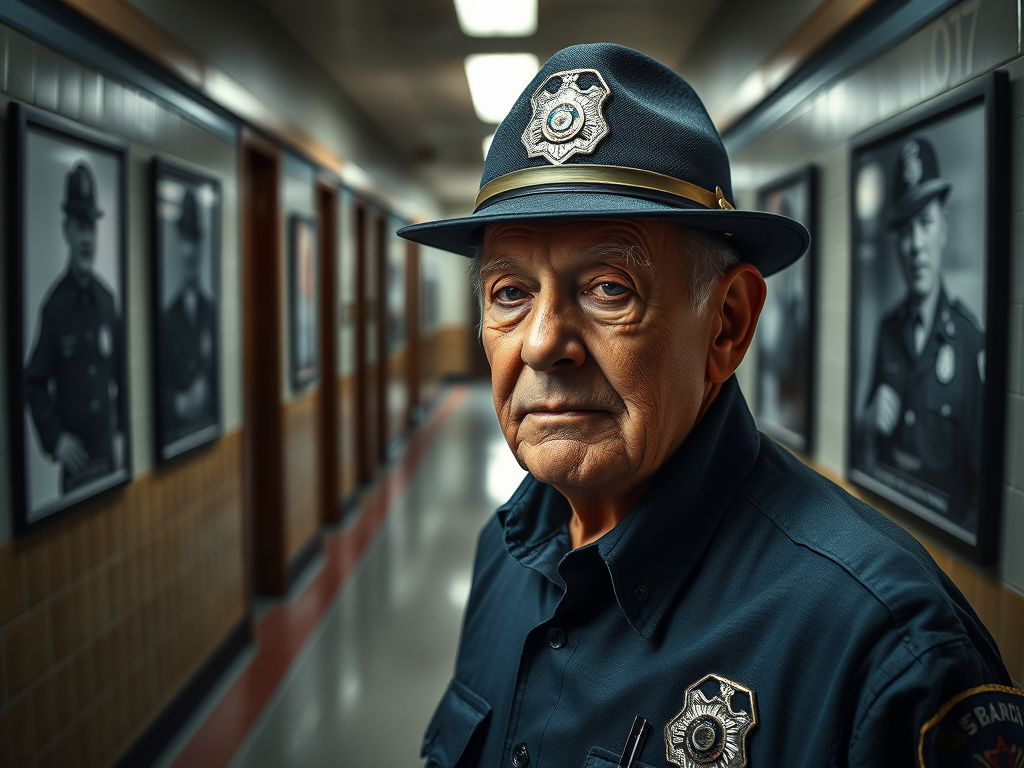
The stories of “The Magnificent Seven” were told with reverence in the small, aging town of Canadian. It nestles in the shadow of a mountain range near the Comanche Indian Reservations. They were not just police officers. They were beacons of bravery. Each one was a sentinel of justice. They had shaped the history of law enforcement in the area. Their tales of courage, integrity, and unyielding commitment to the badge echoed in the walls of the old precinct. Black-and-white photos of the seven adorned the main hallway.

Now, only one of them remained.

Thomas “Tommy” Wade was the last to fall. At 82, he still carried himself with the dignity that had defined his career. Time had dulled the sharpness of his features. Nonetheless, his piercing blue eyesโ€”eyes that had stared down criminals and shielded victimsโ€”had not lost their fire. Tommy had outlived his brothers-in-arms. It was not because he was the strongest or the fastest. It was because, as he often quipped, โ€“โ€“โ€“

“I was just lucky.”

Yet, his legacy, his unwavering commitment to service, and his enduring impact on the community, was far from luck.

It was more than luck, though. Tommy had survived gunfights, ambushes, and even a close call with a car bomb planted by a vengeful felon. But his survival wasn’t the story. The story was about how he and his six comrades had redefined serving and protecting.

The Legends

Each member of the Magnificent Seven had a chapter in the book of Canadian history.

  • James “Big Jim” Hawthorne was the largest and strongest of the group. He was known for breaking up a bar brawl single-handedly. He tossed men around like rag dolls without ever drawing his weapon. He always said โ€“โ€“โ€“
    • “Strength is knowing when not to use it.”
  • Eddie Diaz, the marksman, had ended a three-day hostage standoff with a single, precise shot that saved a child’s life. He was quiet and almost shy, but his calm precision made him a hero when danger arose.
  • “Doc” Peterson, the team medic, was a genius at keeping people alive in harrowing circumstances. A former Army medic, he carried his battlefield skills into the streets of Canadian.

Walter “Walt” Grayson, the thinker, used his sharp intellect to outwit criminal masterminds. He often ended conflicts before they began by anticipating a felon’s next move.

Frankie “Spitfire” McNeil, the youngest, was impulsive but had a heart as big as the town. He chased down burglars on foot and once shielded a family from gunfire with his own body.

Samuel “Sam” Colton, the leader, brought them all together. Sam’s vision for law enforcement was rooted in community service and compassion. He was a mentor, a father figure, and a friend.

And then there was Tommy Wade, the glue that held them together. He was the everyman who listened, mediated disputes, and ensured the team had each other’s backs.

A Legacy Remembered

On the day of Tommy’s memorial, the whole town gathered. The mayor spoke, recounting the officers’ countless acts of heroism. Citizens shared personal stories. They spoke of how one of the Seven had saved their lives. Others talked about how the Seven brought justice to their families.

But Tommy’s granddaughter, Emily, delivered the most poignant eulogy. She stood before the crowd, holding the silver badge her grandfather had carried for over thirty years.

“My grandfather used to tell me stories of these men,”

she began, her voice trembling.

“He told me that each carried a burdenโ€”of duty, danger, and sacrifice. They didn’t wear capes or fly through the air. They walked the streets, often alone, and faced fear head-on so the rest of us didn’t have to.”

Emily paused, holding the badge close to her chest.

“He also told me that they weren’t perfect. They made mistakes and carried regrets. But what set them apart was their unwavering moral compass. They believed in justice, fairness, and the value of every life.”

As the crowd listened, she added,

“They were the best of us. My grandfather was the last to fall. He always said it wasn’t about the badge or the recognition. It was about the people they served.”

The Eternal Flame

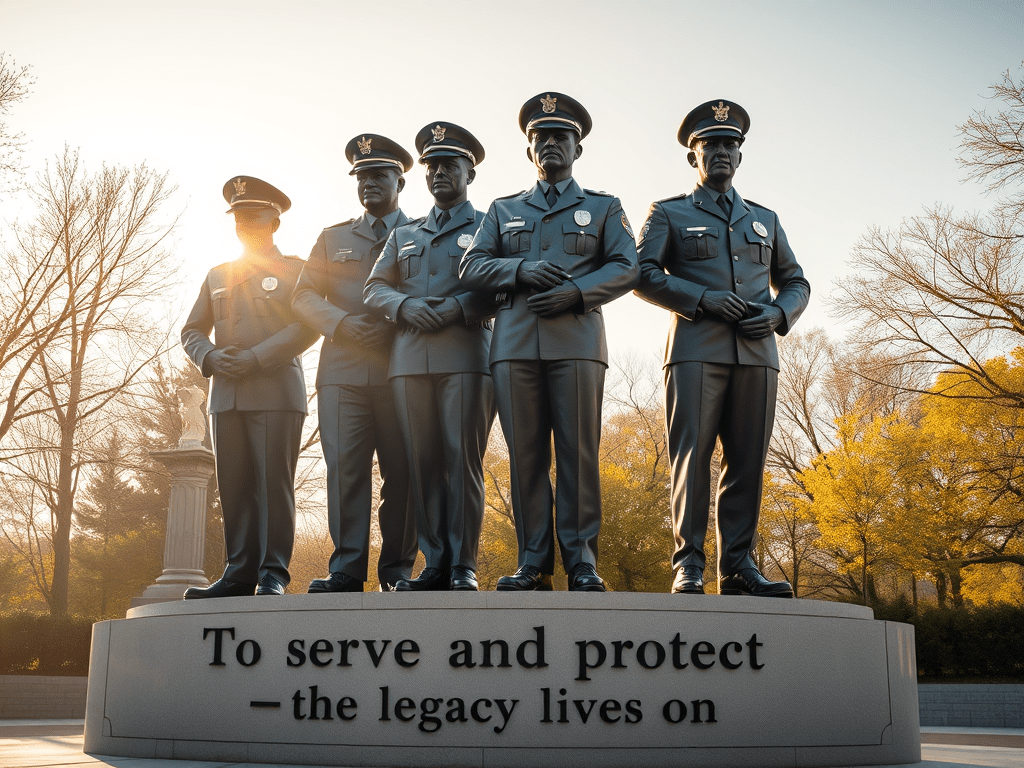
A statue now stands in the Canadian central park: seven figures, shoulder to shoulder, their badges gleaming in the sunlight. Inscribed at the base are the words: “To serve and protectโ€”the legacy lives on.”

The Magnificent Seven are gone, but their stories endure. These tales are whispered in classrooms and retold at family dinners. They are honored in the lives of the officers who came after them. Tommy Wade have been the last to fall, but the spirit of his team will never fade.

Standing Watch At A Western Oklahoma Oil Well Blowout.

Groff Media 2024ยฉ Truth Endures IMDbPro

Presented by benandsteve.com By: Benjamin Groff IIยฉ

3โ€“5 minutes

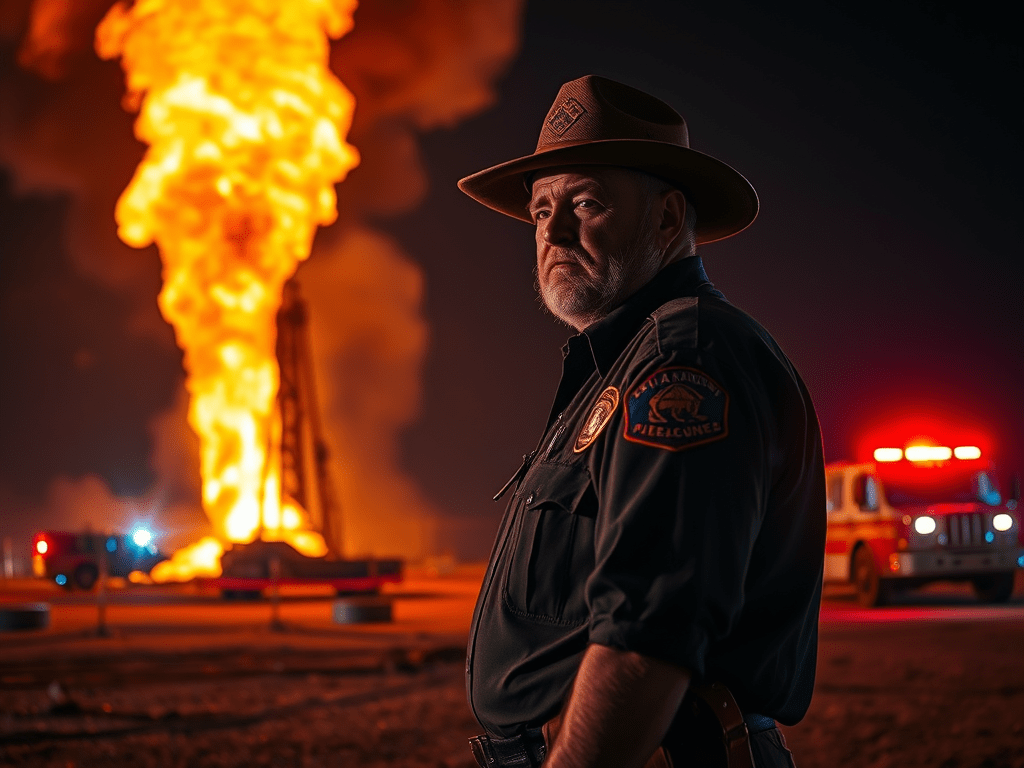
The midnight wind howled across the open plains of Elk City, Oklahoma. It carried with it the acrid stench of crude oil. Officer Ben Groff sensed the urgency of the situation. He adjusted his hat and squinted into the orange glow from the ruptured well. The blowout had sent a geyser of oil and gas roaring skyward earlier that evening. Now it loomed like a ticking time bomb. Nearby tanks, filled with thousands of gallons of oil, were dangerously close to the chaotic inferno.

Ben’s radio crackled to life.

“Unit 3, you still holding up out there?

Came Chief Smith’s voice, heavy with concern.

“Yeah, Chief,”

Ben replied, his tone steady but cautious.

“Still no sign of the fire spreading, but the pressure’s climbing. The oil company’s crew says it will be hours before they can cap this.”

“Good. Keep everyone clear. If those tanks go โ€“โ€“ Well, you know.”

The Chief replied.

Ben glanced over his shoulder toward the blockade he’d set up a quarter-mile away. Emergency lights from firetrucks and patrol cars painted the dark sky red and blue. Despite the late hour, onlookers had gathered, their curiosity undeterred by the danger.

“Roger that,”

he said.

He turned back to the scene. Flames licked the blackened steel of the wellhead, dancing with reckless abandon. He felt the heat even from his position, a hundred yards away. His job was simple, yet it was a constant reminder of the imminent danger. He had to make sure no one came close enough to worsen things. Simple, but nerve-wracking.

Suddenly, a sharp sound pierced the nightโ€”a metallic creak followed by the unmistakable hiss of escaping gas. Ben’s heart raced as he angled his unit’s spotlight, sweeping it toward the tanks. One of the smaller storage units had started to swell, its walls bulging under the pressure.

“Unit 3 to Unit 1 – Chief, we’ve got a problem,”

Ben said on his radio.

“We see it,”

Smith replied.

“Fire team’s moving in to cool it down. Stay put, Groff.”

Stay put. The phrase echoed in Ben’s mind. It was his job, but standing watch over a potential explosion felt like waiting for lightning to strike. He tightened his grip on his duty belt and exhaled a long, steady breath.

Out of the corner of his eye, a sudden movement caught Ben’s attention. A shadow darted near the edge of the well site, and in that split second, Ben’s heart skipped a beat. The potential danger was now tangible.

“Hey!”

Ben shouted, drawing his sidearm.

“Who’s there?”

The figure froze, then turned toward himโ€”a teenager, wide-eyed and terrified.

“My dad works out here!”

The boy yelled.

“I think he’s still at the tanks!”

Ben’s stomach sank. He knew most of the local oilfield workers and their families. If the boy was right, someone’s life was on the line.

“Stay back! You want to get blow’d up?”

Ben ordered, with his Okie drawl, sprinting toward the tanks. The boy tried to follow, but Ben’s stern glare stopped him.

Reaching the tanks, Ben shouted over the roar of the fire.

“Anybody here? Call out!”

A faint cough answered him. Ben scanned the area with his flashlight and spotted a man slumped near the base of one of the tanks. The man’s face smeared with soot.

“Hang on!”

Ben yelled, holstering his weapon and grabbing the man under the arms. The heat was nearly unbearable as he dragged the worker away, his boots slipping in the slick oil-coated ground.

Behind him, a loud bang split the airโ€”a pressure-release valve venting gas. The flames flared brighter, hungrily reaching toward the tanks.

Ben hauled the man to safety, where fire crews took over, administering oxygen and checking for injuries. The teenager rushed ahead, tears streaming down his face as he embraced his father.

Ben stepped back, his breath coming in ragged gasps. He looked toward the wellhead, where firefighters were now dousing the tanks with foam. The danger wasn’t over; the worst had been averted thanks to the fire department. The relief was palpable, not just for Ben, but for the boy and his family.

“Good work, Guys,”

Smith’s voice crackled over the radio.

Ben waited to reply. He stood there, sweat mixing with the grime on his face. Watching the flames fight their losing battle against the relentless efforts of the fire crew. His role in the emergency response was crucial, and he acted bravely and quickly.

Another night in Elk City. Another close call.

Justice Served: Stolen Vehicle Chase in Elk City

Groff Media 2024ยฉ Truth Endures IMDbPro

Presented by benandsteve.com By: Benjamin Groff IIยฉ


3โ€“4 minutes

Officer Ben Groff had just started his shift at the Elk City Police Department when the call came through dispatch:

“Units should be advised of a report of a stolen vehicle spotted heading north on Main Street. It collided with several vehicles in front of the theater and continued. The suspect is a white Dodge Charger. All units respond.”

Ben’s patrol car roared to life as he drove through Third and Madison Avenue to intercept the vehicle on Main Street. Ben hit the lights and siren, merging into the city’s bustling evening traffic. Main Street was alive with its usual commotionโ€”families grabbing dinner, teens cruising, and trucks rumbling through on their way to the interstate. The Charger weaved recklessly through it all, its driver seemingly unfazed by the chaos.

Ben’s adrenaline surged as he radioed in.

“Unit 3 in pursuit. The suspect vehicle appears to be trying to head towards Washington Street through alleyways.”

As the stolen vehicle blew past a red light, narrowly missing a minivan, Ben deftly maneuvered around other cars, keeping his pursuit controlled but relentless. He’d chased suspects before, but this one felt differentโ€”the driver was audacious and desperate, taking wild risks that jeopardized everyone on the road. The danger was palpable, the stakes high, and the adrenaline was pumping.

When the Charger made a sharp turn onto a quieter side street, Ben followed, his tires screeching on the asphalt. For a moment, the streetlights flickered off the Charger’s rear window, and Ben caught a glimpse of the driverโ€”a young woman, her face twisted with determination.

Finally, the suspect tried to cut through an alley too narrow for her car’s speed. The Charger clipped a dumpster and spun out, slamming into a utility pole. Smoke billowed from the crumpled hood.

Ben skidded to a stop, jumping out with his weapon drawn.

“Show me your hands! Out of the car, now!”

The woman hesitated before stepping out, her hands trembling but raised. She was strikingly familiarโ€”Lisa Rhodes, the girlfriend of the auto magnate and social media influencer John DeLorean. The revelation sent a shockwave through the scene, a twist in the narrative that no one, not even Ben, saw coming.

“You’ve got to be kidding me,”

Ben muttered under his breath.

Lisa tried to talk her way – out of it, her voice honeyed but shaky.

“Officer, I didn’t steal this car. It’s one I borrowed. A man, let me borrow itโ€”this is just a misunderstanding!”

Ben wasn’t buying it. As he cuffed her, he noticed her purse on the passenger seat. When he peeked inside, his suspicions were confirmedโ€”a substantial stash of drugs, including pills and small baggies of powder.

Backup arrived moments later, securing the scene. Lila’s protests grew louder as the reality of her arrest sank in.

“You don’t know who you’re messing with! John will have his attorneys save me and get your badge for this!”

Ben smirked as he read her rights.

“Maybe he will, but not before I make sure you face the consequences of tonight’s little joyride.”

Ben’s determination was unwavering, and his commitment to upholding the law was resolute, making it clear that justice would prevail.

Back at the station, the news spread like wildfire. Lila Rhodes, the woman frequently seen on John DeLorean’s arm at high-profile events, was booked for possession and vehicle theft. Reporters swarmed the station, eager for a statement. As she promised, high-profile attorneys showed up the following day to post bail and escort her back to California.

Later, as Ben completed his report, his sergeant clapped him on the shoulder.

“Hell of a job tonight, Ben. You nabbed someone who thought she was untouchable.”

Ben nodded, exhausted but satisfied. In Elk City, justice didn’t care about status or connectionsโ€”it only cared about the law. This matter would become evident as Ben brought in well-known individuals on burglary, auto theft, and other felony charges. That is a story coming soon.

NOTE: Some names, locations, and information are changed or edited to contain alternate identifications for privacy reasons.

Gerald The Goose Goes Mad On Park Goers Until He Finds Officer Tom A Friend For Life.

Groff Media 2024ยฉ Truth Endures IMDbPro

Presented by benandsteve.com By: Benjamin Groff IIยฉ


In the heart of a bustling city, there was a quaint park known for its serene beauty and vibrant wildlife. Among the ducks and swans was one particularly notorious residentโ€”a mad goose named Gerald. Gerald had a reputation for chasing unsuspecting park-goers, honking furiously and flapping his wings in a display of avian aggression.

One sunny afternoon, the park was filled with families enjoying picnics and children playing games. A commotion erupted as Gerald began his usual antics, sending people scattering in all directions. Exasperated by the chaos, the park’s caretaker decided it was time to call for help. Enter Officer Tom, a kind-hearted police officer known for his patience and love for animals.

Officer Tom arrived at the park, his calm demeanor contrasting sharply with the commotion around him. As he approached Gerald, the goose stopped, tilting his head curiously. Something about Officer Tom intrigued Gerald. Instead of chasing him away, Gerald shuffled to the officer and nuzzled his leg affectionately.

Seeing the unexpected bond forming, Officer Tom decided to take Gerald home. He became the goose’s sole caretaker, and they developed a deep friendship. A gentle loyalty to Tom replaced Gerald’s wild antics, and the two became inseparable. They were a familiar sight around town, with Gerald waddling faithfully beside Tom on his daily patrols.

As the years passed, Officer Tom grew older, and his hair turned silver. Gerald, too, showed signs of aging, but their bond remained as strong as ever. The townspeople grew fond of the duo, often stopping to chat with Tom and feed Gerald treats. They became beloved characters in the town’s story, symbolizing friendship and loyalty.

One day, the town was struck by the sad news of Officer Tom’s passing. The townspeople mourned the passing of their beloved officer, but their hearts also went out to Gerald, who was now alone. Concerned about the old goose, the townspeople gathered to decide what to do.

In a touching display of unity, the town took turns caring for Gerald. Each day, a different family welcomed him into their home, ensuring he was well-fed and loved. Though he missed his dear friend, Tom, Gerald found comfort in the townspeople’s kindness.

And so, Gerald lived out his days surrounded by the love and care of the community. The story of the mad goose and the kind-hearted officer became a cherished legend, reminding everyone of the power of friendship and the importance of looking out for one another.

Leave a comment

This site uses Akismet to reduce spam. Learn how your comment data is processed.

Moving Forward: Finding Stability in a Changing World

Groff Media 2024ยฉ Truth Endures IMDbPro

Presented by benandsteve.com By: Benjamin Groff IIยฉ

As the sun rises on another day, many Americans face questions about navigating a future that feels uncertain and, at times, challenging. With new policies, social shifts, and changes in government practices, it’s natural to wonder: How can we make peace with what tomorrow might bring?

Embracing Life as It Is

The journey forward begins by accepting life as it is. This acceptance isn’t about resigning ourselves to every challenge but acknowledging what is beyond our control. By shifting our focus inward, we can cultivate a balanced and manageable life, regardless of external circumstances.

This approach involves creating a routineโ€”a set of daily habits and practices that we control and are structured to ensure Stability. When we establish a routine that aligns with our values and goals, we take ownership of our lives, making our days feel fulfilling and predictable, even when the world around us may feel anything but. This sense of control and predictability can empower us to face the uncertainties of the future with confidence.

Designing a Routine that Works for you. Focusing on what matters most to us individually will be essential to develop this routine. By centering our lives around personal choices and needs, we shape a daily rhythm whose influences aren’t getting pushed by the ever-shifting demands of society or government policies. Here are vital aspects to consider:

  1. Personal Autonomy: Build a day-to-day lifestyle that allows for independence. This involves selecting tasks, schedules, and activities that feel true to who you are and are within your control.
  2. Stability Through Simplicity: Keep routines simple and consistent. External events can derail complex plans; simplicity provides a foundation for adaptability and peace of mind.
  3. Harmony with Society: While focusing on our lives, aligning our activities with society’s laws and norms is essential. By following guidelines and remaining respectful of others, we minimize the risk of disruption and interference.

Living Without Unnecessary Interference

By developing a sustainable, uncontroversial, and law-abiding routine, we create space for ourselves to live relatively unaffected by the broader tides of political or social change. This sense of security and peace of mind allows us to focus on our personal growth and well-being, even in the face of external uncertainties.

Moving Forward Together

Ultimately, as individuals adopt this mindset, communities also benefit. When people find Stability within themselves, they become pillars of support to others, fostering collective resilience. In times of uncertainty, this shared calm, mutual respect, and individual responsibility can carry Americans forward together, one day at a time. This sense of community and shared responsibility can provide a strong support system in times of uncertainty.

In this approach, tomorrow’s challenges become more manageable, and with a foundation of self-guided routine, we discover that moving forward is not only possible but peaceful.

Otis The Dog That Trouble Finds

Groff Media 2024ยฉ Truth Enduresย IMDbPro.

Presented by benandsteve.com By: Benjamin Groff IIยฉ 


One sunny morning, Otis, a slick Jack Russell Terrier with a gleam in his eyes

and mischief in his heart, woke up. His fur was a brilliant shade of gold, shimmering in the sunlight, and his tail wagged with such enthusiasm that it could power a windmill. The day started innocently enough; we had breakfast at our favorite restaurant and came home. With his wagging tail and big, innocent eyes, Otis welcomed us home and helped us as we tidied up around the house. But Otis is no ordinary dogโ€”trouble seems to find him as a squirrel finds an acorn. He gets these spurts of energy known well as zoomies.

It’s like he’s a magnet for mishaps, a walking comedy show. Wherever he goes, calamity follows. He’s so adorable that it’s impossible not to chuckle when his wrecking ball hits.

It wasn’t long before Otis’s nose led him to the kitchen. The scent of freshly baked bread cooling on the counter was just too tempting. He stood on his hind legs, stretching his neck as far as it would go. Just then, a slight breeze blew through an open window, knocking a paper off the fridge and startling Otis. He yelped and bumped into the counter in a flurry of fur and paws. The bread tumbled down, landing squarely on the floor.

When we walked in, Otis stood over the fallen loaf, his big, brown eyes looking up at us with a mix of innocence and apology. His expression seemed to say, “I didn’t mean to!” It’s hard not to forgive him when he looks at you like that.

We sighed but couldn’t help the tiny smile tugging at your lips. Before picking up the bread, Otis had darted out of the room, ears flapping, tail wagging like a flag, and disappeared into the yard.

As the day went on, Otis’s streak of bad luck continued. While exploring under the porch, he got tangled in a ball of twine that a handyman had left behind. Emerging from the shadows, he looked wide-eyed and confused, like a dog-sized spider web. The neighbors couldn’t help but chuckle when they saw him, tangled and guilty-looking. One even offered to help untangle him, but Otis, being Otis, managed to free himself in a comical fashion.

Capping off his day – Otis’s curiosity got the best of him once more when he found a potted plant by the front door. It only took a nudge from his nose for the pot to tip over, spilling soil all over the welcome mat. He sniffed the dirt, sneezed, and left tiny paw prints leading to his bed, where he flopped down, exhausted.

When found, he looked up with that sweet, guilty face as if saying, I swear, I don’t know how it happened!

Despite the chaos, we knelt and scratched behind his ears. Otis nuzzled into my hand, eyes closing in contentment. As much trouble as he got into, he was ours, and those mishaps only make our days a little more memorableโ€”and a lot more fun. His presence, filled with joy, even amid his mischievous adventures, is a constant reminder of the happiness pets bring into our lives.

Unpacking ‘Make America Great Again’: What MAGA Overlooks in Its Vision of the Past

Presented by benandsteve.com By: Benjamin Groff IIยฉ

Groff Media 2024ยฉ Truth Enduresย IMDbPro


The fall of 2024 found a vibrant small community town hall filled with locals from every walk of life. The walls became lined with a diverse array of familiar faces of the neighborhoodโ€”retired teachers, young activists, military veterans, and longtime friends who had lived through decades of change, some of it hard-won, others bittersweet. On the stage, with a sign readingย “Let’s Talk About Greatness,”ย stood a panel, each holding their idea of what that greatness looked like.

Jared, a man in his late sixties with a MAGA hat perched atop his head, leaned forward as he spoke, โ€“โ€“โ€“

“I want my kids and grandkids to grow up in a country that feels strong, proud, and unitedโ€”like it was back then. We all knew our neighbors. Families were close-knit. There was a sense of American unity.”

Dolores, a retired history teacher, nodded beside him. But as the crowd listened, some exchanged looks. โ€“โ€“โ€“

“So, Jared, I get what you’re saying,” a young local journalist interrupted Lena. But when we say ‘back then,’ do we mean the same thing?”

Jared paused, looking thoughtful, as Dolores took the microphone. โ€“โ€“โ€“

“We tend to remember the good and forget the rest,” she said gently. I remember growing up in the fifties and sixties. It was stable and ideal for some of us, but not everyone. This ‘great’ past we want to go back to meant certain people couldn’t vote. Others had to hide who they loved. And womenโ€”our dreams were seen as distractions to a family.”

There was a hush as Dolores’s words hung in the air.

“I don’t think Jared meant that,”

โ€“โ€“โ€“ came a soft voice from the audience. It was Naomi, a single mother and community organizer.

“But when we say we want to ‘Make America Great Again,’ we have to askโ€”for whom?ย The history we’re returning to was not the same experience for everyone.”

The community members exchanged glances. Jared turned back to the crowd. โ€“โ€“โ€“

“I respect what you’re saying, Naomi,”

he replied, genuinely thoughtfully. โ€“โ€“โ€“

“When I say ‘greatness,’ I’m not talking about racism or inequality. I’m talking about hard work, pride, patriotismโ€”things that feel like they’re slipping away.”

Naomi nodded understanding, fostering a sense of mutual respect and value for each other’s perspectives, highlighting the importance of open and respectful dialogue in the community.

“But the wordย againย implies that we want to go backward,”

โ€“โ€“โ€“ Lena pointed out.

“And, for me, that’s concerning. I love this country and respect what’s gone into making it better. I mean, we have interracial marriage, legal protections for LGBTQ+ people, voting rights for everyone.”

โ€“โ€“โ€“ Lena paused, looking at Jared.

“To me, that’s American greatnessโ€”now.”

As the meeting unfolded, the debate deepened. Various members shared stories of progress and hardships. Kayla, a small business owner, spoke about her pride in balancing work and motherhood.

“When I hearย traditional values, I think of something different than my grandmother might have,”

โ€“โ€“โ€“ she said.

“My values include family, hard work, women’s rights, and equal opportunities.”

Another voice said,

“Look, I served in the military, and I believe in protecting this country,”

โ€“โ€“โ€“ said Tom, a retired Marine and a man with a thick gray beard.

“I fought for an America that moves forward and doesn’t leave anyone behind. ‘Greatness’ is complexโ€”strong enough to protect everyone’s rights.”

The meeting wrapped up with the group realizing that “greatness” was many things, each person’s version holding personal meaning. Dolores took the microphone one last time:

“Maybe we can remember thisโ€”our vision of a truly great America embraces both the good of the past and the advancements we’ve made. To build greatness, we don’t go backward. We keep moving and evolving, ensuring that each generation has the opportunity to contribute to a better America, instilling a sense of hope and optimism in the audience for the future.”

The room echoed with nods of agreement, and as the townspeople filed out, they carried forward a renewed understanding: that the road to greatness was not paved with nostalgia alone but with a willingness to grow beyond it.

Why Being Different is Special: Spot’s Lesson

A Story By: Benjamin Groffยฉ Groff Media 2024ยฉ Truth Endures

Once upon a time on Cloverfield Farm, there was a little dog named Spot. Despite his name, he didnโ€™t have a single spot on his smooth, white coat. All the other animals had their own unique markingsโ€”some had spots, some had stripes, and even Patch the cat had a patch over one eye. Spot often felt left out, especially when the other animals teased him.

โ€œHey, Spot! Where are your spots?โ€

the goats would bleat, snickering amongst themselves.

โ€œSpot doesnโ€™t even look like a Spot,โ€

the chickens clucked, pecking around the yard as Spotโ€™s ears drooped in embarrassment.

Tired of feeling like he didnโ€™t belong, Spot decided heโ€™d make his own spots. One day, he found some mud by the pond and rolled around in it, making little brown splotches all over himself. He trotted proudly into the barn, thinking he looked just like everyone else.

But the cows mooed with laughter.

โ€œThose spots donโ€™t look real, Spot,โ€

they teased.

โ€œYouโ€™re still plain!โ€

Spot tried again the next day, sneaking into the farmerโ€™s house and dipping his paws in paint from an art set left out on the porch. This time, he dotted his fur with black paint, carefully pressing little paw prints all over his coat. Spot thought he looked quite spotty now, but as he strutted around the barnyard, the animals just laughed louder.

One day, feeling disheartened, Spot wandered to the edge of the pasture and lay down beneath a big shady tree. Just then, a large bullโ€”well, he looked like a bullโ€”ambled over and lay beside him.

โ€œWhatโ€™s the matter, Spot?โ€

asked the bull.

โ€œOh, everyone teases me because I donโ€™t have any spots,โ€

Spot sighed.

โ€œIโ€™ve tried everything to fit in, but they always laugh.โ€

The bull nodded thoughtfully.

โ€œYou know, Spot, they laugh because they donโ€™t understand. And by the way, Iโ€™m not a bullโ€”Iโ€™m a steer.โ€

Spotโ€™s eyes widened.

โ€œA steer?โ€

The steer chuckled.

โ€œYes. I may look like a bull, but Iโ€™m not. And thatโ€™s okay. I learned a long time ago that who you are inside doesnโ€™t need to match what everyone thinks they see on the outside. And it doesnโ€™t have to match what they want, either.โ€

Spot tilted his head, listening.

โ€œYou see, Spot,โ€

continued the steer,

โ€œeveryone has something that makes them different. And sometimes, animals make fun of others because they donโ€™t want their own differences noticed. Itโ€™s easier for them to point at you than to face their own insecurities. But those differences are what make each of us unique.โ€

Spot thought about this for a moment.

โ€œSoโ€ฆ you think itโ€™s okay that I donโ€™t have spots?โ€

โ€œMore than okay,โ€

said the steer with a warm smile.

โ€œYou donโ€™t need spots to be special. Being you is what matters. When youโ€™re proud of who you are, those who tease you may just stop because theyโ€™ll see that you donโ€™t need their approval.โ€

Spot felt something warm and happy inside. For the first time, he realized that maybe being himself was enough.

After that, Spot didnโ€™t roll in mud or try to paint on spots. Instead, he ran and played with the animals, joining in with confidence. He still got a few teasing remarks, but now he just wagged his tail and smiled.

And little by little, the other animals started to see Spot differently. The cows noticed how fast he could run, the goats admired his cleverness, and even Patch the cat stopped by to share stories with him under the big shady tree. Spot was no longer โ€œthe dog without spotsโ€โ€”he was simply Spot, the friend who was comfortable being himself.

And from then on, Cloverfield Farm was a happier place for everyone.