Santa Christ – Faith, Fantasy, and Tradition: Do Churchgoers Believe in Santa Claus?

Groff Media 2024© Truth Endures IMDbPro

Presented by benandsteve.com By: Benjamin Groff II©

Faith, Fantasy, and Tradition: Do Churchgoers Believe in Santa Claus?

Faith is often regarded as the cornerstone of religious belief, encompassing elements of the unseen, the unknowable, and the divine. Yet, the figure of Santa Claus gets nestled within the realm of modern Christian culture. Most believe Santa Claus is a mythical character who, though secular, occupies a sacred space in many homes during Christmas. This essay examines the relationship between faith and fantasy in a critical manner. It asks a provocative question:

Do churchgoers who actively engage in Christian religious services also believe in Santa Claus?

The Coexistence of Faith and Fantasy

With his roots in the historical St. Nicholas, Santa Claus has evolved into a cultural icon who embodies generosity, joy, and the season’s magic. Churchgoers, particularly those steeped in Christian tradition, often embrace Santa alongside their religious celebrations. But does this blending of faith and fantasy dilute the essence of religious belief, or does it complement it?

For many, Santa symbolizes the wonder and innocence of childhood. He exists not as a deity but as a symbol of kindness and giving, traits consistent with Christian teachings. Yet, the theological implications of believing—or perpetuating belief—in Santa Claus among devout churchgoers raise critical questions. Is it contradictory to teach children to believe in an omniscient God? Is teaching about a jolly figure who rewards good behavior with material gifts also contradictory?

Theological Tensions and Cultural Adaptation

Theologically, the Santa narrative can be seen as problematic. Santa’s omniscience—knowing when children are ‘naughty or nice’—mimics divine qualities attributed to God. For devout Christians, this parallel is viewed as trivializing the sacred attributes of their deity. Additionally, Santa’s rewards depend on behavior. This conditional nature starkly contrasts with the Christian doctrine of grace, which emphasizes unconditional love and forgiveness. These tensions stem from God and the principles of the Christian faith. They raise questions about the compatibility of Santa Claus with religious beliefs.

On the other hand, the inclusion of Santa in Christmas traditions reflects a broader cultural adaptation. Churchgoers, like the wider society, are products of their environment. Santa Claus’s commercial and cultural saturation makes him almost inescapable. For many Christians, incorporating Santa into holiday traditions helps bridge the secular and the sacred. This creates a more inclusive celebration and resonates across different belief systems.

The Role of Myth in Faith Development

Belief in Santa Claus can also be seen as an early form of faith training. Santa embodies the power of belief for children—trusting in something unseen and expecting its fruition. In this way, Santa serves as a precursor to more mature forms of faith. The eventual realization that Santa is a myth does not necessarily undermine belief in God. Instead, it can reinforce the idea of a deeper, more profound belief in the divine. Transitioning from belief in a myth to belief in a higher power can be crucial for a child’s faith. It shapes their understanding of the unseen. It also builds their ability to trust the divine.

Critics argue, nonetheless, that perpetuating the Santa myth risks fostering cynicism. When children discover Santa isn’t real, they question the truth of other intangible beliefs, including God. This potential disillusionment challenges religious parents, raising concerns about the impact on their children’s faith. They must carefully navigate the transition from childhood fantasy to mature faith.

Reclaiming the Meaning of Christmas

The integration of Santa Claus into Christian homes invites churchgoers to consider the true meaning of Christmas. Is it about celebrating the birth of Christ and the message of salvation? Or has it become overshadowed by consumerism and secular traditions? For many churchgoers, the challenge is to reclaim the sacred aspects of the holiday. They also want to allow room for the cultural joy Santa brings.

Balancing these elements requires intentionality. Churchgoers are crucial in emphasizing Santa’s values—generosity, kindness, and joy—while grounding these traits in their faith. By framing Santa as a symbol, Christians can preserve the integrity of their beliefs. They can still enjoy the cultural richness of the holiday. This underscores the importance of their role in this balance.

Conclusion

Whether churchgoers believe in Santa Claus touches on more significant themes of faith, tradition, and cultural adaptation. Santa initially appears to conflict with Christian doctrine. Yet, he also offers an opportunity to engage with the season’s spirit of giving and wonder. Churchgoers need to discover how to integrate this cultural icon into their faith practices. They must achieve this without compromising their beliefs.

The coexistence of Santa Claus and churchgoers shows how people can balance faith and fantasy. Each aspect contributes to our understanding of the world. They also shape our place within it. Santa Claus does not need to diminish the sacredness of Christmas. Instead, he can symbolize the joy and generosity central to the season. Yet, some find it difficult to reconcile a fictional figure with their spiritual beliefs. This tension arises when they apply the same evaluative framework to religious doctrine, revealing a deeper reliance on external authority. For many, this dependence stems from an unwillingness to embrace personal accountability fully. They seek a Santa-like figure year-round—someone or something to guide their choices and confirm their actions. They continue to believe in Santa Claus, though under a different guise.

🐕‍🕯️ The Legend of the Kyrkogrim — Sweden’s Black Guardian of the Church

By Benjamin H. Groff II | Truth Endures | The Story Teller

2–3 minutes

Tales are whispered across the cold stones of Scandinavia. They speak of an “evil dog” that once haunted the churches of Sweden. But those who truly know the legend say the creature was never evil at all. It was the kyrkogrim — a guardian spirit born not of sin, but of sacrifice.

A Dog Buried Beneath Holy Ground

In the centuries when churches first rose across the Nordic lands, builders followed a chilling custom. To guarantee their new sanctuaries would stand against evil, they buried a living creature beneath the cornerstone. This creature was often a black dog. Its final, terrified breath was thought to bind its soul to the ground, forming a spiritual sentinel.

That spirit became the kyrkogrim: the Church Grim. It was always black as midnight. It was condemned to patrol the churchyard. Its duty was to watch over the graves and keep the devil himself from defiling holy ground.

The Protector and the Omen

By day, the kyrkogrim was invisible. But when night fell and candles flickered low, villagers spoke of seeing the great black hound. It was pacing near the church doors. Its eyes glowed like coals in the dark. It was said to snarl at grave robbers and frighten off witches. Yet, for all its protection, it carried a darker burden.

To see the kyrkogrim was to get a warning. The watcher’s death, it was said, would soon follow. The same spirit shielded the church from evil. It also bore the scent of the grave. This grim paradox kept villagers both thankful and fearful of its presence.

The First Soul of the Graveyard

Long before Christianity spread through Scandinavia, ancient peoples offered animal sacrifices to bless new structures and sacred sites. Early Christian builders, inheriting these customs, altered them to fit their faith. The dog buried beneath the first church became “the first soul” in the graveyard. This ensured that no human would have to linger eternally as the church’s guardian.

Thus, the kyrkogrim was not a monster. Instead, it was a martyr. It symbolized the uneasy blend of pagan ritual and Christian devotion. It was the bridge between two worlds: the old gods of the land and the new God of the heavens.

Echoes Through Time

Even today, stories of the kyrkogrim persist in Swedish folklore. Some say the black dog still walks among the headstones on stormy nights, especially near churches centuries old. Others claim that every church has its own silent watcher — unseen, but always there.

What began as a superstition has evolved into something deeper. It reflects the human need to guard what we hold sacred. The kyrkogrim, once buried in darkness, lives on in story — a faithful spirit that never abandoned its post.


By Benjamin GroffMedia© | benandsteve.com | ©2025 

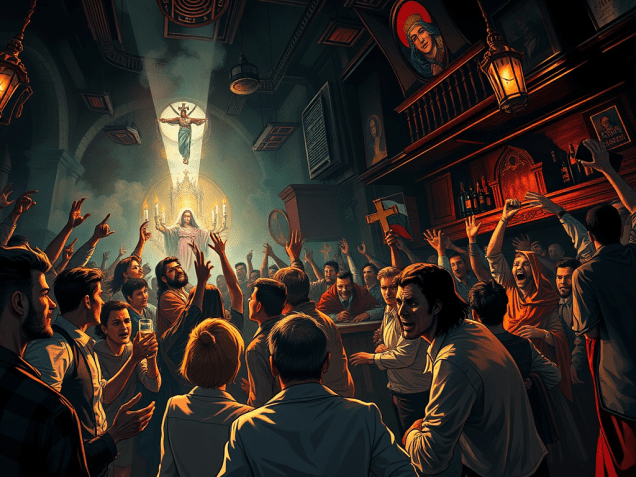
The Sunday When Everyone Raised Hell

3–5 minutes

“The Sunday When Everyone Raised Hell”
July 13th,1982

They say the weather talks—but on Sunday, July 13th, it screamed. It moaned, cracked, hissed, and growled. And the whole town of Split Rock hollered right back, like a pack of sinners on Judgment Day.

That Sunday began not in peace, but in conflict. Beer drinkers stumbled out of back porches. Whiskey drinkers followed, squinting into a sky. The sky couldn’t decide between fire or frost. Bible thumpers buttoned up their Sunday best only to find it soaked in sweat—or stiff with ice.

Normally, these folks would be separated by buildings, beliefs, and a healthy dose of silence. But not this time. The Earth tilted at just the wrong angle that morning. It mixed them all together—like oil and water in a cracked jar. Something had to give.


It started at sunrise.

Reverend Dellman, god-fearing and mild-mannered, stepped out with his usual coffee and a copy of The Daily Hymnal. He took one look at his back garden and nearly dropped both coffee and songbook.

“Merciful Lord!”

cried, pointing at the silver glint of frost on his tomatoes.

“It’s July! I rebuke thee!”

By mid-morning, the farmers were in full-blown panic mode. It was cold—then suddenly sweltering. Then cold again. Pete Hargis’ chickens laid hard-boiled eggs, and the pigs were either sunburnt or shivering. Mabel over at the diner attempted to fry bacon on the sidewalk. By 10:03, it had flash-frozen solid. The sizzle was replaced by the crack of ice.

Inside the café, the thermostat spun like a roulette wheel. People gave up trying to adjust. Some came out in denim shorts and fur coats. Others in long johns with flip-flops. A few just wrapped themselves in quilts and wandered the streets like dusty prophets.

At noon, the town square transformed into a chaos carnival. The mayor—Bert Franks, known for his enthusiasm and poor timing—grabbed a megaphone and tried to declare order.

“Citizens! Let us embrace the unexpected! I hereby declare this—”

THWACK!

He was cut off by a slushball to the forehead. Then a flying hot dog bun. And then, mysteriously, a snow shovel.

The townspeople laughed, shouted, moaned, and argued. It wasn’t long before someone pulled out a banjo and another hauled out a cooler. The chaos, like the temperature, escalated fast.


At 2:07 p.m., the sky went black—but not from clouds.

Steam fog rolled in so thick it swallowed up everything past arm’s length. Lightning cracked in one corner. A rainbow arched over the feed store. The wind howled in two directions at once. Cows began to moo in protest—one poor soul spontaneously delivered a churned pat of butter. Children screamed. Not in fear, but in delight. Adults followed suit, except their screams were more… existential.

Dogs barked furiously at the sky. One climbed halfway up a tree before realizing dogs weren’t built for altitude.


Then came Miss Lydia.

Quiet librarian. Never cursed. Never shouted. Never late with a book return. That day she marched down Main Street like a thundercloud in sneakers. Her outfit included a pair of galoshes. She wore a tank top that read “Don’t Test Me.” A neon scarf completed the look. These elements only added to the sense that judgment had arrived.

“THIS IS NONSENSE!” she bellowed. “I WANT A HOT-DAMN GOD DAMN-IT!”

The town gasped.

She wasn’t talking about temperature.

She wanted schnapps. On a Sunday.

Bart, who ran The Dusty Jug Saloon, saw an opportunity. He rolled a brand-new bottle of Hot Damn Schnapps down the sidewalk toward her like it was the holy grail. She caught it, popped the cap, took a long pull—and offered it to the goat tied outside the courthouse. The goat accepted.

By then, no one knew if the town had gone to hell or was simply passing through it.


At sunset, the weather made its final move—brutal heat. A wall of humidity as thick as gravy. People peeled off layers and sweated out their differences on the courthouse lawn. A Bluetooth speaker started playing “Ring of Fire.”

No one stopped it.

A spontaneous conga line formed. The sheriff—usually stiff as a shovel handle—joined in, hat and all. No one judged. Everyone was too dizzy from heatstroke or schnapps.


That night, a sudden cool breeze swept in. The stars blinked into view. The town sat still for the first time all day.

On porches. On sidewalks. Some just lay on the grass, sipping iced tea and fanning themselves with church bulletins.

“It was the damnedest Sunday we ever had,” someone whispered.

And nobody disagreed.


From that Sunday on, every July 13th in Split Rock became Raise Hell for the Weather Day. No matter the forecast, folks gathered to scream at the sky, pass a bottle, and laugh at the madness.

Because when nature throws a tantrum, the people of Split Rock know exactly what to do:

Yell right backYell right back!

We Shall Come Rejoicing Marrying Only The He’s And The She’s

By Benjamin GroffMedia© | benandsteve.com | 2025 Truth Endures©

1–2 minutes

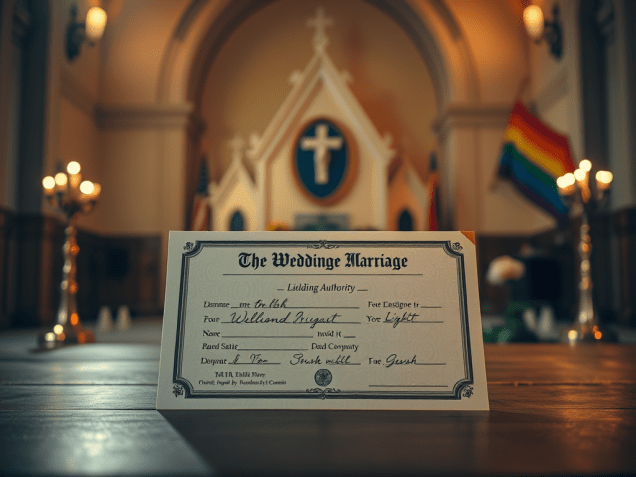
The Baptists are at it again. They are raising a protest over who should be allowed to marry. It is as though they alone have the final word.
Yet, let us be clear: They are opposing who can walk into a county or state office. They do not want everyone to ask for a marriage license or enter into a legally recognized civil contract. That is not a religious rite. It is a legal agreement—filed, signed, and validated by the state. What the Baptists are trying to do is assert control over who can enter into that civil contract. Moreover, that is where their argument starts to fall apart.


One can understand a church’s wish to define marriage for its faith tradition. For example, it only performs holy matrimony for male-female couples. That is their theological prerogative. Furthermore, the LGBTQI+ community is better served by choosing faith institutions that embrace and affirm their unions. Those places do exist. They conduct beautiful, sacred ceremonies filled with love and meaning.


The Baptists alleged to be upset over same-sex couples marrying are not fighting for “Holy Sanctioned” marriage. Their effort is a thinly veiled effort to legislate bias. They aim to stir up fear and rally support for political agendas. When the current battle over trans rights no longer generates the same heat, they will seek another issue. This will be the next fire they try to stoke. It will be another wedge to deepen divisions. They will build up the offering plate and feed the partisan machine.


Trying to impose a ceremony on a church that fundamentally rejects it leads to resentment. Such an action only reinforces division. It is counterproductive. The real problem arises when religious institutions try to dictate who can access civil marriage through the state. That is not about faith. That is about politics, prejudice, and, frankly, power.

The Sunday School President – THAT THE RELIGIOUS RIGHT WASTED AND IGNORED.

Groff Media 2024© Truth Endures IMDbPro

Presented by benandsteve.com By: Benjamin Groff II©

2–3 minutes

A warm Sunday morning in Plains, Georgia seemed tailor-made for reflection. At the Maranatha Baptist Church, a small congregation gathered in quiet anticipation. This wasn’t an ordinary Sunday service—it was one led by Jimmy Carter, the 39th President of the United States.

Even decades after leaving the White House, Carter stayed true to the values that shaped his life. These values were faith, humility, and service. Carter taught Sunday School to anyone who wanted to listen every Sunday that he was capable. Visitors from all over the world made the pilgrimage to Plains. Some traveled thousands of miles to hear wisdom. This wisdom was not shared in a grand hall. Instead, it was delivered in a modest church that held no more than a couple hundred people.

Jimmy Carter, then in his 90s, shuffled to the front of the sanctuary, a quiet determination in his step. He greeted the crowd with a humble smile, his voice steady and welcoming. His lesson was simple yet profound: loving your neighbor, no matter their background or beliefs.

“When Jesus said to love your neighbor,”

Carter explained, his blue eyes twinkling,

“He didn’t put any conditions on it. He didn’t say only if they look like you or vote like you. He meant everyone.”

The audience was a mix of locals and travelers. They hung on his every word. Their hearts and minds were stirred by the profound simplicity of his message. The room was filled with a palpable sense of awe. This was not due to the titles Carter once held. Instead, it was because of his unwavering commitment to living the values he taught.

When the lesson ended, Carter didn’t rush off. Instead, he stayed to shake hands, take photos, and share stories. These personal moments hold the most significant importance for him. He listened as much as he spoke. This is especially meaningful for a man who had once navigated the complexities of global politics.

One visitor, a young man from Chicago, nervously approached.

“President Carter, what made you keep teaching Sunday School after everything you’ve accomplished?”

Carter smiled warmly.

“I’ve been a farmer, a naval officer, a governor, and a president. But teaching Sunday School reminds me of who I truly am—a servant of God. Titles come and go, but the love we share with others lasts forever.”

That was Jimmy Carter. He believed that service didn’t end with a term in office. He thought that humility wasn’t weakness. Even the simplest acts of kindness can ripple through the world. For Carter, life’s most outstanding achievement wasn’t in power or prestige. It was in the quiet and steady work of lifting others up. He demonstrated this belief through his work with Habitat for Humanity. He also promoted peace and human rights. Additionally, he was committed to public service long after his presidency.

As the church emptied, a sense of peace lingered in the air. This was a testament to the legacy of a man who lived his faith with every breath.