The Day Jimmy Carter Came To Town

One year ago former U.S. President Jimmy Carter passed away. We close this year with a celebration to his life. Recognizing his many accomplishments. Here is one, a promise he had made on the campaign trail before he was elected to office. That if he won the presidency, he would return to Elk City, Oklahoma and thank them. He upheld that promise, as well as many others he made. A man with true humility, honesty and principles. Sorely missed as an example to others. We honor a true a leader by remembering his life!

Groff Media 2024© Truth Endures IMDbPro

Presented by benandsteve.com By: Benjamin Groff II©

3–5 minutes

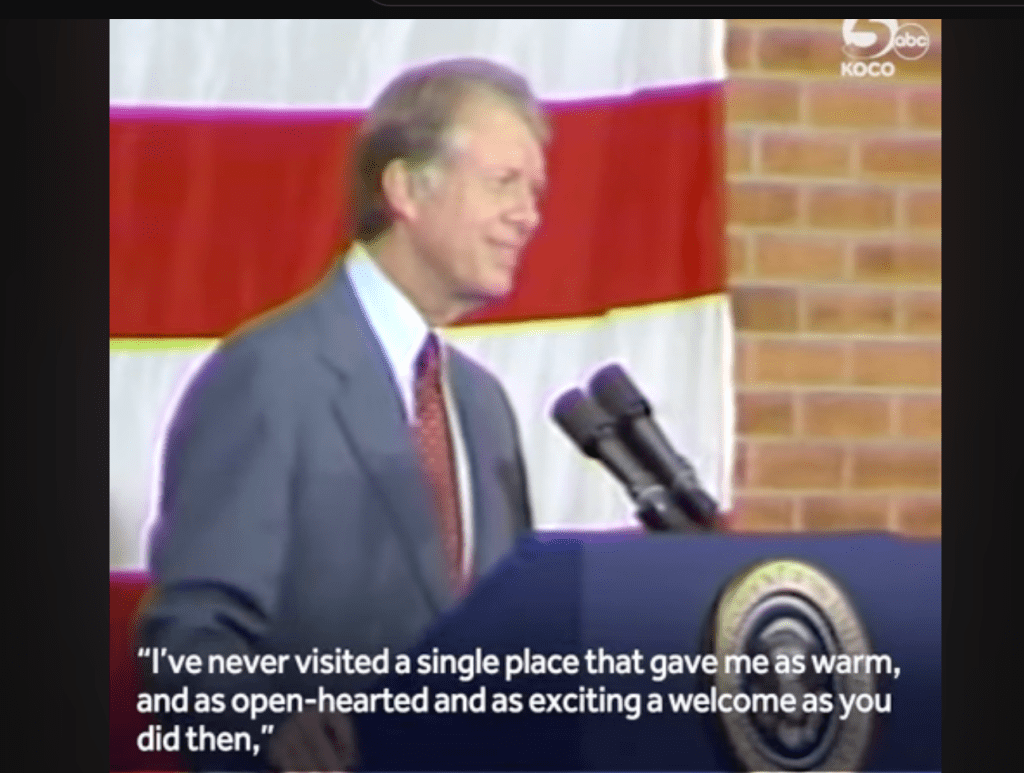
On March 24th, 1979, President Jimmy Carter returned to Oklahoma. He came to fulfill a campaign promise he had made during his first run for office. While campaigning, he passed through Elk City, Oklahoma, and vowed that if elected, he would return as President. True to his word, he came back to this small western Oklahoma town to connect with its residents.

By then, the memory of President Ford’s near-assassination and other threats against public figures lingered in the national consciousness. Carter was a peanut farmer from Plains, Georgia. He resonated with Oklahoma Citizens through his humility and shared values. This included his Democratic Party affiliation. First Lady Rosalynn Carter was accompanying him. Her warmth and grace complemented her husband. She left a positive impression on the locals.

At the time, Oklahoma’s Governor George Nigh was a celebrated figure in state politics. George Nigh was elected Lieutenant Governor more times than anyone else. He briefly served as Governor multiple times. This occurred when his predecessors resigned to take other offices. Despite some legal challenges about his eligibility, the State Supreme Court affirmed his ability to serve. He was now in his first full term as Governor. His presence at Carter’s visit added to the significance of the occasion.

The visit brought much excitement and preparation to Elk City, a town of about 12,000. The oil boom had not yet transformed the region. The high school’s field house was the largest venue available for the gathering. Elk City did not have an airport that accommodates Air Force One. Thus, the nearby Clinton-Sherman Airbase in Burns Flat, 15 miles east, was reactivated for the President’s arrival. A motorcade transported President Carter and his entourage to Elk City.

The event attracted widespread attention, with media outlets from a five-state area descending on the town. Governor Nigh, Oklahoma’s First Lady, U.S. Senators, Representatives, and many state officials joined the crowd. The field house overflowed with locals eager to witness history.

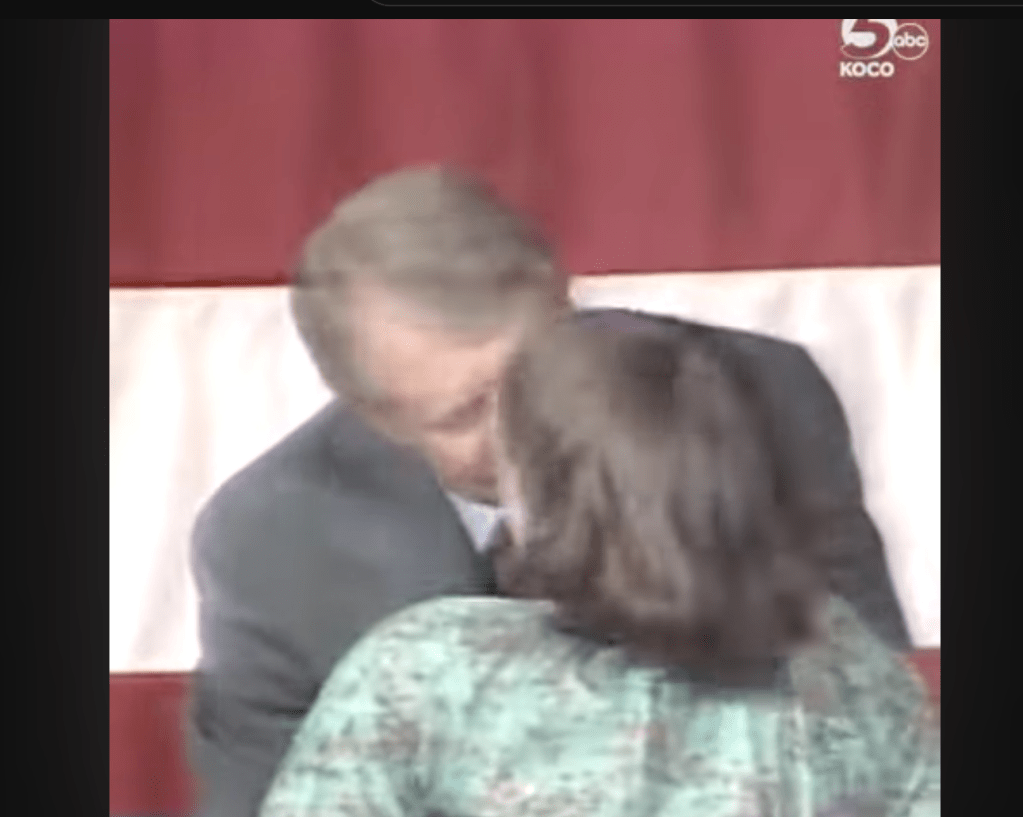
President Carter took the stage after introductions by various community leaders. His speech was marked by humility, sincerity, and a willingness to engage directly with the audience. During a question-and-answer session, a young girl boldly asked for a kiss. The President graciously obliged. This act endeared him further to the crowd.

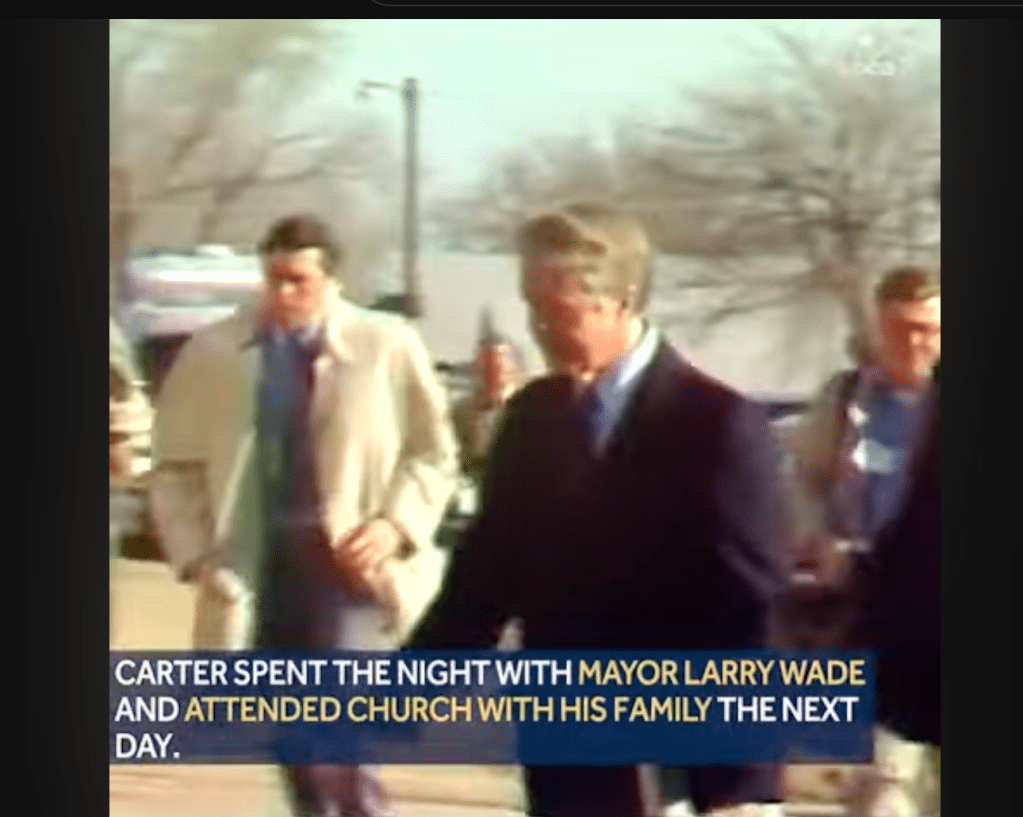
Unlike many politicians who have returned to the comfort of Washington, D.C., President Carter chose to stay overnight at the home of Elk City Mayor Larry Wade. While he and Rosalynn rested, Elk City police officers securely guarded their limousine. It was stored in the fire department’s bay. The fire trucks were temporarily parked on the street. This allowed room for the vehicle. The bay doors were locked to make sure its secure.

The next morning, the Secret Service inspected and prepared the limousine for the journey back to the Clinton-Sherman Airbase. At 7:00 AM, President and Mrs. Carter were to be escorted by a motorcade that included local police and the Oklahoma Highway Patrol. But the Carters had been invited to church. And to church they would go. The President’s and First Lady’s Church attendance was unannounced and brief. Two routes were used to guarantee security, though the President’s exact route remains uncertain. By 8:15 AM, all vehicles converged at the church. The Carters left church and went to the Clinton – Sherman Airfield, near Burns Flat. “Nothing is to schedule” one news reporter was noted as saying. And, for the Secret Service, they appreciated it wasn’t. The changes in the planned activity helped create enough of a distraction.

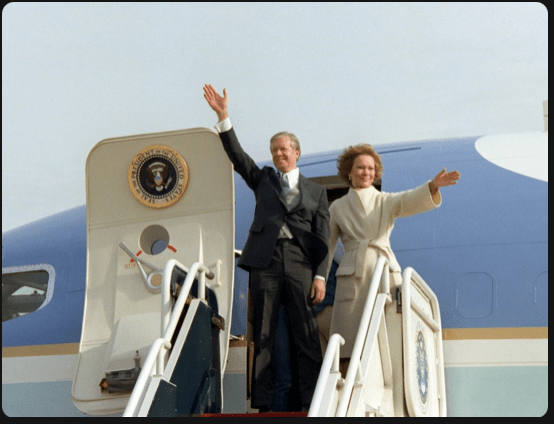
As Air Force One prepared for departure, President Carter and Rosalynn climbed the stairway. They turned to wave goodbye to the assembled crowd. Then, they boarded the plane. Within minutes, the jet’s engines roared to life. It ascended into the blue Oklahoma sky. The departure left behind a community that felt valued and appreciated.

Jimmy Carter’s visit to Elk City exemplified his commitment to keeping promises and connecting with everyday Americans. Years after making his pledge, he returned to this western Oklahoma town. This return reflected the integrity and personal touch that characterized his presidency.

The Assignment ~ The Last Three Days ~ A Mission To Keep You Alive For 2025!

This Story From The Classics. Posted Originally in 2024 it is Reposted this year as part of the best of the best stories benandsteve.com are sharing at years end.

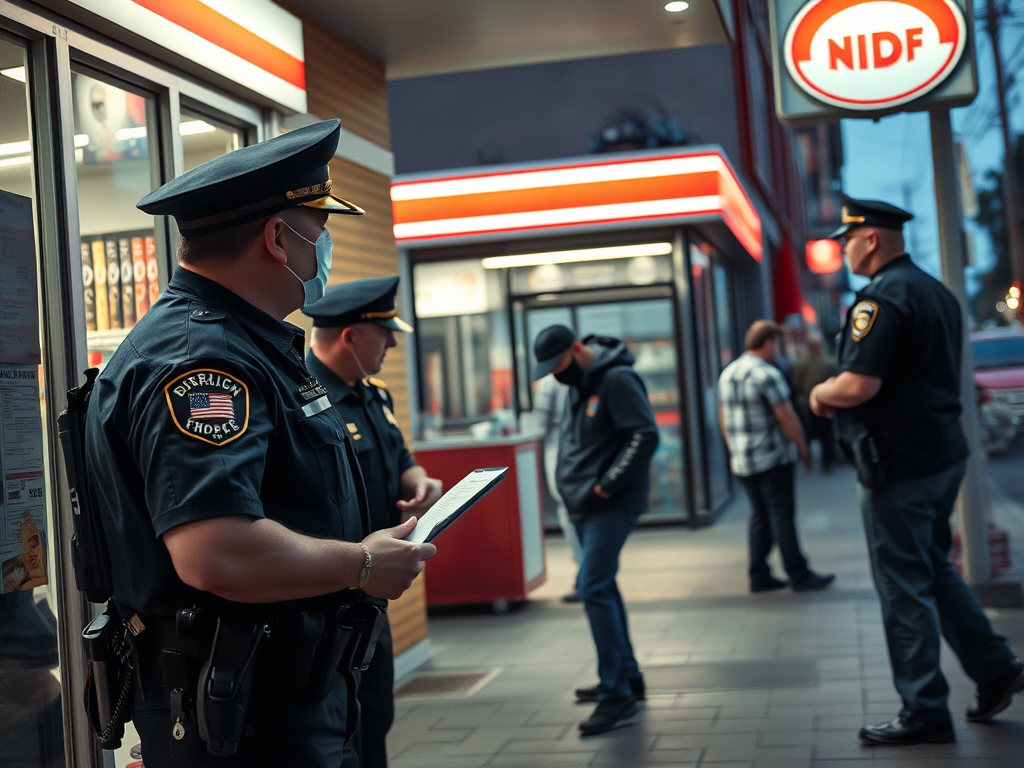
The last three days of the year often get overlooked. During this time, services go unnoticed around the average town or city. This well can be the case where you live. Police, Fire, Ambulance, and 911 Operators all do an incredible job. They work tirelessly in the build up to the New Year Eve Celebration and all the socializing involved. All the socializing is not celebratory, and the people they deal with are not all friendly.

Groff Media 2024© Truth Endures IMDbPro

Presented by benandsteve.com By: Benjamin Groff II©

3–5 minutes

As the year drew close, the city was abuzz with anticipation for the New Year’s celebrations. But for the fire, police, and ambulance services, the last three days of the year were anything but quiet. These dedicated men and women often worked long shifts. They sacrificed their own celebrations. They were on the front lines, ensuring the community’s safety and well-being.

Day One: December 29th

The fire department received a call about a house fire in the early morning hours. Flames engulfed the old wooden structure, and the firefighters worked tirelessly to control the blaze. They managed to rescue a family trapped inside, their faces covered in soot but grateful to be alive. Investigators later determined that a faulty space heater caused the fire. This serves as a stark reminder of the dangers of winter.

Meanwhile, the police were called to a domestic disturbance in a quiet suburban neighborhood. A heated argument escalated. Officers arrived with their professional demeanor and calm approach. They managed to defuse the situation. This ensured that both parties were safe and had a chance to cool down.

The ambulance service was dispatched to a car accident on the icy roads. A young driver had lost control of his vehicle and skidded into a tree. Paramedics worked quickly to stabilize him and transport him to the hospital. Despite the crash’s seriousness, the driver was expected to fully recover.

Day Two: December 30th

The fire department responded to a call about a gas leak in an apartment building. Residents were evacuated as firefighters located the source of the leak and shut it off. Their quick response and decisive action prevented a potential explosion. This reassured the residents. They were allowed to return to their homes once it was deemed safe.

The police were called to a robbery at a local convenience store. The suspect had fled the scene, but officers gathered evidence and track him down. The thief was apprehended and taken into custody, and the stolen goods were returned to the relieved store owner.

The ambulance service received a call about an elderly woman who had fallen in her home. Paramedics arrived to find her in pain and incapable of moving. They carefully lifted her onto a stretcher. They transported her to the hospital. At the hospital, she was treated for a broken hip. Her family was grateful for the swift and compassionate care she received.

Day Three: December 31st

On New Year’s Eve, the fire department was on high alert as fireworks lit up the night sky. They responded to several small fires caused by stray sparks, but thankfully, none resulted in severe damage. Firefighters patrolled the city, ensuring that everyone enjoyed the celebrations safely despite the potential dangers they faced.

The police were busy with calls about noise complaints and public intoxication. Officers maintained a visible presence in the city center, where crowds had gathered to watch the fireworks show. They worked to keep the peace and make sure everyone rang in the new year without incident.

The ambulance service was called to help a young woman who had collapsed at a New Year’s party. Paramedics quickly assessed her condition and determined that she had consumed too much alcohol. They provided her with the necessary care and transported her to the hospital for further observation.

When the clock struck midnight, the city erupted in cheers and celebrations. The fire, police, and ambulance services continued their vigilant watch, ready to respond to emergencies. For them, the end of the year was just another day. They served and protected their community. This often came at the cost of their own family celebrations.

The Hot Dog Santa Which Warms Children’s Hearts

This story is pulled from the archives as a celebration for the season edition.

Groff Media 2024© Truth Endures IMDbPro

Presented by benandsteve.com By: Benjamin Groff II©

~ When Santa Claus Stopped Coming To Town ~

From the original Hot Dog Santa Brings Christmas Cheer to Children, originally posted on December 10, 2024, by Jenny Ashcraft

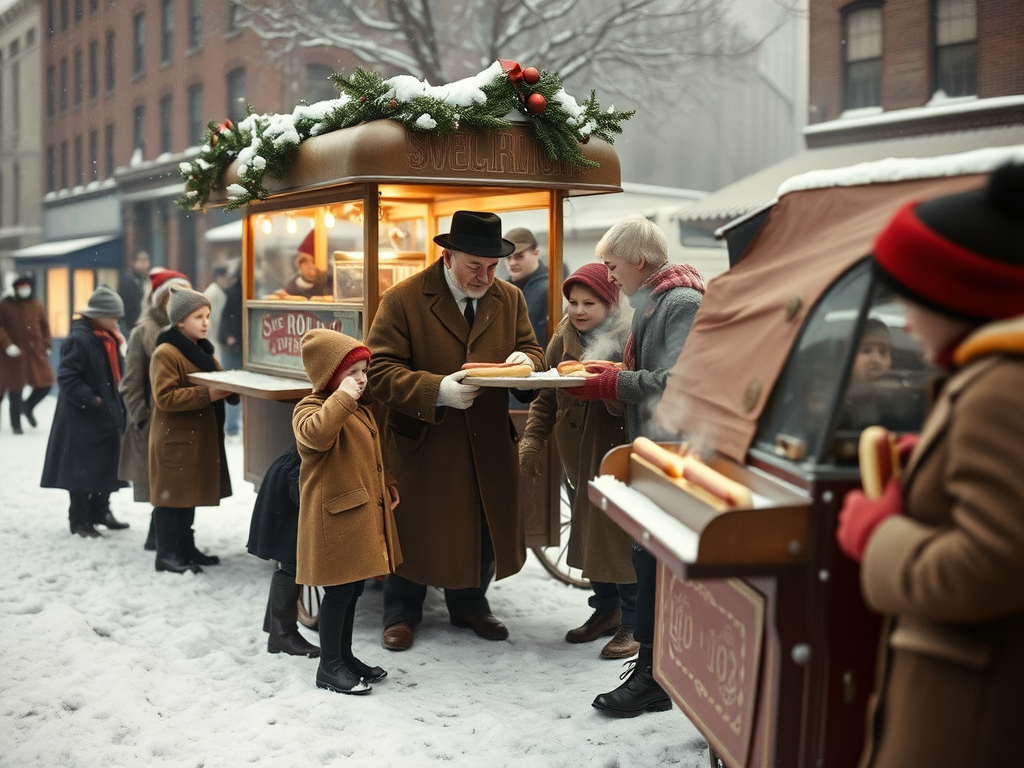
On Christmas Day in 1921, a Swedish immigrant named Axel Bjorklund quietly pushed his hot dog cart to a corner in Boston’s North End. There, he handed out 500 steaming hot dogs to cold and hungry children, a simple act of kindness that would leave a lasting legacy.

Axel knew what it meant to struggle. He barely scraped by himself, but his heart ached for the impoverished children he saw daily. Hundreds of children, some as young as five, lined up in their threadbare clothes that chilly Christmas morning, shivering against the cold.

Despite their hunger and hardship, their faces lit up with joy as Axel handed each one a hot dog. Though the food quickly ran out, Axel’s resolve did not. He was determined to make this a yearly tradition. Over the next eight years, he gave away an astonishing 10,000 hot dogs before passing in 1930.

Axel was born on August 6, 1869, in Gothenburg, Sweden. In 1889, he immigrated to America and eventually settled in Boston’s North End, a neighborhood brimming with immigrants striving to build better lives.

Yet, poverty was rampant, especially after the devastating Spanish Flu pandemic left many families destitute and orphaned children wandering the streets. Amid this suffering, Axel’s generosity shone like a beacon of hope.

After a brief and unhappy marriage, Axel lived alone and decided to start a hot dog stand at the busy corner of Blackstone and Hanover Streets. The simple job gave him a sense of purpose, but seeing the hunger around him determined him to do more. He vowed that no child would go hungry if he had food to offer. His first Christmas giveaway in 1921 was a success, and he expanded the effort the following year, doubling the number of hot dogs to 1,000.

His annual giveaway grew as word of Axel’s kindness spread, eventually reaching 3,000 hot dogs yearly. The children affectionately began calling him “Hot Dog Santa.” Newspapers from across the United States and even Sweden shared his story, celebrating his selfless tradition.

Over time, Axel moved his hot dog giveaway to New Year’s Day, but the event remained a cherished occasion for the children who eagerly awaited it. However, Axel’s health began to deteriorate. Rheumatism caused frequent hospital visits, and his financial situation worsened. Struggling to pay his rent, Axel reached out to the public for help, determined to continue his tradition despite his hardships.

In December 1928, just before the giveaway, Axel’s landlady evicted him for failing to pay rent. The Salvation Army provided temporary support, but Axel’s circumstances grew increasingly dire. Over the next two years, he bounced between shelters, the poorhouse, and the Cambridge Home for the Aged, relying on the generosity of strangers. Even so, in 1929, he hosted one final hot dog giveaway.

On November 10, 1930, Axel Bjorklund passed away in a Massachusetts hospital, penniless and alone. He had no family and was destined for a pauper’s grave until news of his death reached the public. Outraged by his fate, citizens rallied together to give the man they called “Hot Dog Santa” a proper burial. Axel Bjorklund’s legacy of compassion and selflessness reminds us of the power of small acts of kindness during difficult times.

Remember, this holiday season, while times may feel joyful and bright for you, they could be challenging and somber for someone else. Offering a helping hand isn’t always a handout—it’s a gesture of humanity and compassion. Let’s take a moment to consider the needs of our fellow human beings, not just during the holidays but every day of the year.

Read original story about the Hotdog Santa Claus Here

“Herbie” ––– The Tiny Christmas Tree Searches For A Family

This story is pulled from the archives as a celebration for the season edition.

Groff Media 2024© Truth Endures IMDbPro

Presented by benandsteve.com By: Benjamin Groff II©

3–4 minutes

In a quiet forest stood a skinny cedar tree, so different from all the others. The tall, majestic cedars around him stretched their lush branches high. In contrast, the little tree looked scrawny. It had sparse needles and a slightly crooked trunk.

People often came to the forest to select the perfect Christmas tree, always passing him by.

The other trees whispered and rustled in the wind, teasing him.

“Look at you, Herbie,”

They said, giving him the nickname that stuck.

“No one’s ever going to want you.”

Herbie tried to stand tall, but he knew they were right. Year after year, Herbie remained as the big, beautiful trees were chosen and taken away. The forest changed around him. He stayed in his lonely spot. He dreamed of what it would feel like to be wanted.

Then, one crisp winter morning, the tree cutters came again, their saws buzzing. Herbie didn’t expect to get noticed, but this time, something different happened. As they cleared their path, one of the workers stopped, scratched his head, and said,

“Well, let’s take this little one, too. Someone might like it.”

Herbie felt the sharp blade cut through his trunk. Before he could fully understand what was happening, he was bundled with the others and taken to the city.

A sea of magnificent Christmas trees surrounded Herbie at the tree lot. Their branches glistened with dew, and they stood tall and proud. Compared to them, Herbie felt even smaller, and his crooked trunk made him look even more awkward.

Shoppers strolled by, admiring the grand trees and taking them home individually. Herbie overheard a nearby pine whisper,

“Face it, Herbie, you’re not cut out for this. No one’s going to pick you.”

The lot grew emptier daily, and Herbie’s hope dwindled. By Christmas Eve, he was the only tree left, standing under the dim glow of a street lamp. The wind whistled through his sparse branches, and Herbie prepared for the inevitable—being tossed away, unloved.

But just as Herbie’s spirits hit their lowest, a tiny voice broke through the cold night air.

“Mama, look! That one’s perfect!”

Herbie lifted his branches slightly in surprise. A little boy with messy hair and bright, eager eyes was pointing at him.

“Are you sure, Tommy?”

His mother asked, crouching beside him,

“This tree is so small. And, well, it’s not exactly full.”

––––

“Exactly!”

Tommy said with a grin.

“It’s different, just like me. We’ll make it the best Christmas tree ever!”

Herbie’s heart soared as Tommy and his mother carefully carried him home. Tommy got to work in their cozy living room, stringing popcorn and cranberries across Herbie’s branches. His mother tucked shiny ornaments into every gap, and finally, they placed a glowing star on top.

Herbie couldn’t believe it. For the first time, he felt truly beautiful. He wasn’t just a funny-looking tree anymore—a Christmas tree.

On Christmas morning, Herbie watched with joy as Tommy tore through his presents, his laughter filling the room. The warmth of the fire danced on Herbie’s branches, and he realized he had never felt so happy.

When the holiday ended, Herbie feared getting thrown out like many trees before him. But instead, Tommy’s family carried him to their backyard.

Tommy said, patting his trunk as they planted him firmly in the soil.

“You’re part of our family now, Herbie,”

Year after year, as Herbie grew taller and fuller, Tommy would decorate him anew, even in the coldest winters.

Herbie learned that it wasn’t about how perfect he looked or how he compared to the other trees. The love and care he received—and gave—made him truly special.

And so, Herbie stood proudly, knowing he would always be part of something wonderful: a family.

A Christmas of Unexpected Gifts

This story is pulled from the archives as a celebration for the season edition.

Groff Media 2024© Truth Endures IMDbPro

Presented by benandsteve.com By: Benjamin Groff II©

3–4 minutes

The snow fell gently outside Tom Whitaker’s cabin, blanketing the woods in a serene hush. Inside, the fireplace cast a warm glow, flickering and dancing, casting long shadows on the walls. The smell of pine from the small, undecorated tree in the corner filled the room with a comforting aroma. It was Christmas Eve. Tom, a retired schoolteacher, sat in his favorite armchair. He had a mug of cocoa in hand and a book he couldn’t quite focus on. For the first time in decades, he was spending Christmas alone.

His wife, Evelyn, had passed away three years ago. His grown children were scattered across the country. They were tied up with their own families and commitments. Tom didn’t blame them, but the ache of solitude was undeniable. He declined their offers to join them, insisting he’d be fine alone. He wasn’t.

A knock at the door startled him as he gazed into the fire. Who would visit on a night like this? He opened the door. He found a boy no older than ten. The boy was bundled up in a red coat. He was holding a scraggly puppy with floppy ears.

“Hi, mister,”

the boy said, shivering uncontrollably.

“I found this puppy in the snow. My mom said we can’t keep him, but maybe you can.”

Tom stared at the boy and the trembling pup.

“Come inside before you freeze,”

he said, taking the puppy in his arms.

The boy declined, pointing to a car waiting at the edge of Tom’s driveway.

“Merry Christmas!”

he called as he dashed off.

Tom closed the door, holding the puppy close. The little dog’s brown eyes looked up at him with fear and hope.


“Well, you’re an unexpected guest,”

Tom murmured. He fetched a blanket and some leftover chicken for the pup, who wagged its tail furiously.

Later that evening, as Tom felt less lonely, another knock came. This time, it was Mrs. Abernathy, his elderly neighbor. She held a tin of cookies and a thermos of cider.

“I noticed your lights on,”

she said.

“Thought you like some company.”

She handed him the thermos, and the warm, comforting scent of cider filled the air.

They shared the cookies and cider, laughing about old times and neighbors long gone. Mrs. Abernathy left after an hour, but only after gifting Tom a hand-knitted scarf she had made.

As the clock struck midnight, Tom prepared for bed, his heart a little warmer. The puppy, now curled up in an old basket, barked softly. Another knock came.

“Who now?”

Tom muttered, opening the door.

A group of carolers stood outside, bundled against the cold, their voices harmonizing in “Silent Night.” Behind them was a man from a local grocery store holding a box.

“We’ve got extra holiday meals,”

the man explained after the carolers finished.

“Thought you might enjoy one.”

Tom accepted the box, his throat tight with emotion. Inside were a roast chicken, mashed potatoes, cranberry sauce, and a pie.

As the night wore on, Tom marveled at the change. A Christmas he had dreaded became one filled with unexpected kindness. He sat by the fire with the puppy on his lap. The scarf was around his neck. He held a plate of warm food.

“Merry Christmas,”

he whispered to the little dog, who wagged its tail in agreement. Tom no longer felt alone. His cabin became filled with the spirit of the season through strangers, neighbors, and a small, scruffy pup. The pup found him when he needed it most.

The Season of Light

A December Story for Every Heart, Every Home, Every Tradition

By Benjamin GroffMedia© | benandsteve.com | ©2025 

3–4 minutes

In the little town of Mesa Ridge, the December sky seemed to hold every dream ever whispered. This town was tucked between a quiet stretch of desert. December didn’t arrive with just one story. It came with hundreds.

Not everyone called this time “Christmas.” Some families lit candles and spoke of miracles. Others gathered for feasts that marked the turning of the year. Some spent the month in quiet reflection, while others burst through the season with celebration and song.

But one thing was always the same: the light.

It started with a single lantern placed outside the old community center on the first day of December. No one remembered who began the tradition, but every night the lantern burned, its small glow chasing back the darkness. By the second evening, another family placed a candle beside it. Then the kids down the block added a tiny string of lights. A paper star was made by the third-grade class. The elders contributed a jar filled with sand and a tea light, remembering doing the same in their youth.

Within a week, the once-plain walkway to the center shone with a thousand shapes of light. These represented different traditions, different meanings, and different languages of hope. They were all gathered in the same place.

One chilly evening, as neighbors drifted in to admire the growing show, an elderly woman named Mrs. Cordero said softly,

“This is what the season is supposed to look like. All of us… together, not the same, but warm in the same glow.”

A teenager beside her shrugged.

“But what does it celebrate? Which holiday?”

Mrs. Cordero smiled the smile that had seen many Decembers.


“It celebrates us,”

She said.

“Us choosing to be a little softer with one another. A little kinder. A little more willing to look someone in the eye and say, ‘You matter to me.’ If the lights have a job, it’s simply to remind us that we’re better when we brighten one another.”

Word spread quickly, as all good messages do.

Light has no doctrine, and kindness has no borders.
In December, we simply shine a little brighter—together.

Soon, families who had never spoken found themselves sharing warm drinks and stories. The bakery owner delivered sweet rolls just because it felt right. A newcomer from across the country found herself wrapped in community she hadn’t expected. Even the grouchy widower who lived on the corner had not decorated for anything in decades. He quietly placed a single white lantern at the end of his driveway. No explanation needed.

On December 24th—whatever that date meant to each household—a gentle hush fell across Mesa Ridge. People walked the lantern path not as one faith or another, but simply as neighbors. The lights flickered, danced, and whispered the same message in a hundred different languages:

Goodwill belongs to everyone.
Kindness is not seasonal, but December is a good place to start.
And light—no matter where it comes from—shines brightest when shared.

When the last lantern was lit that night, the community didn’t cheer. They simply breathed in the moment, letting the warmth settle into their bones.

Some carried the glow home.
Some carried it into the New Year.
Some carried it for a lifetime.

And in the little town of Mesa Ridge, the tradition continued. It wasn’t because anyone told them to. It was because they remembered how it felt to step into the light together.


By Benjamin GroffMedia© | benandsteve.com | ©2025 

Why Language Choice Is Crucial in Events

3–5 minutes

(inspired by Daria Knupp’s piece at Personify)

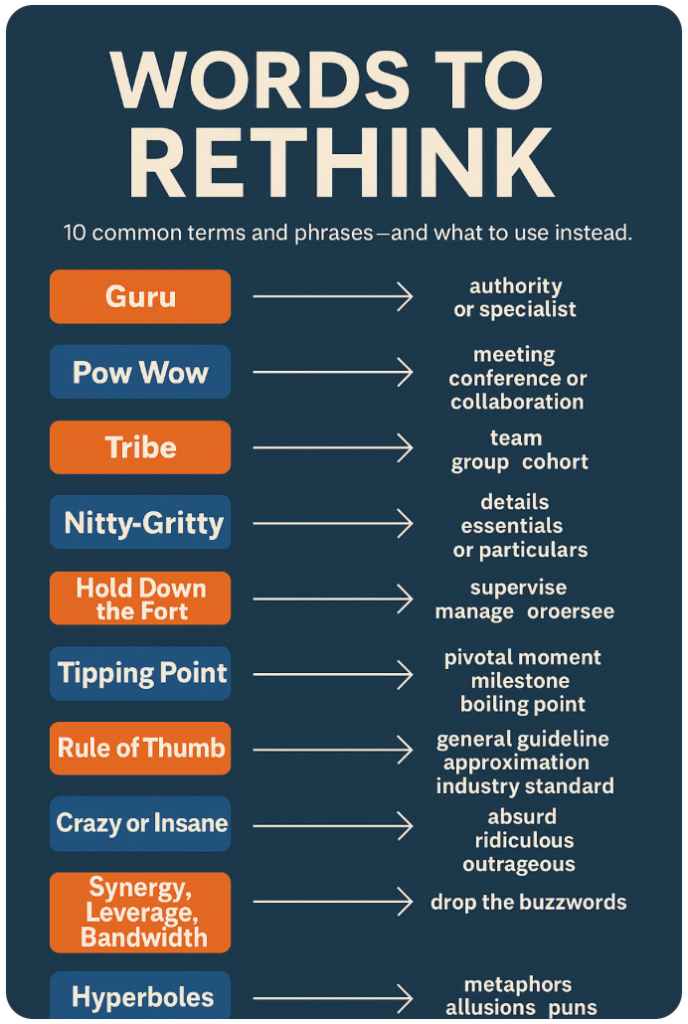
We all know words can inspire, connect, and excite—but they can also alienate, offend, or sound tired. Daria Knupp, Sr. Content Marketing Manager at Personify, recently published a thoughtful article. It lists 10 words and phrases we should stop using in the events industry. We should consider avoiding them everywhere. Her list stopped me in my tracks—and it will surprise you, too.

We use these terms often at conferences, in meetings, and in our everyday work to convey intelligence, wit, and creativity. Nevertheless, some have roots in stereotypes, outdated social theories, or even deeply offensive historical contexts. Here are highlights from Knupp’s list. I also include my own reflections on why they matter. Additionally, I explore how we can do better.

  • “Guru” Originally, the title of the highest spiritual leaders in Hinduism and Buddhism. Using it casually—“event planning guru”—can trivialize a sacred role. Try “expert” or “specialist” instead.
  • “Pow Wow” is not just a “quick meeting.” It’s a sacred Native American gathering of community and celebration. Try “meeting” or “collaboration.”
  • “Tribe” is often used to describe a network or support, but it is tied to outdated and harmful stereotypes. Swap in “team,” “group,” or “cohort.”
  • “Nitty Gritty” Commonly meant “the essentials,” but it was rooted in references to the slave trade. Use “details” or “essentials” instead.
  • “Hold Down the Fort” Seems harmless, but it was initially tied to colonial conflicts with Native Americans. Consider “supervise” or “manage.”
  • “Tipping Point” was popularized by Malcolm Gladwell, but historically referred to racial “thresholds” in neighborhoods. Try “pivotal moment” or “milestone.”
  • “Rule of Thumb” Linked—to wife-beating folklore. Safer to say “general guideline” or “industry standard.”
  • “Crazy” or “Insane” Using mental illness terms casually undermines efforts to destigmatize. Replace with “absurd,” “outrageous,” or “ridiculous.”
  • Buzzwords like “Synergy,” “Leverage,” and “Bandwidth” Overuse makes you sound like a cliché. Switch it up with plainer language.
  • Hyperboles. Nothing wrong with exaggeration—but when overdone, it can make you less credible. Mix in metaphors or puns for variety.

I’ve had very close Native American friends who have been like family to me for nearly fifty years. Through countless conversations, shared meals, and life’s ups and downs, similar concerns about language never arose. We always spoke openly and comfortably with one another, and I thought we understood each other fully.

Now, reading about the origins of these words and their potential to harm, I have to ask myself—was I wrong? Did I unintentionally cause pain, even to the people I love and respect? This personal reflection can make the audience feel empathetic and introspective. Did my long-held assumptions give me a sense of being “above” the issue when in reality I wasn’t?

This is why articles like Daria Knupp’s matter. They challenge us to reevaluate. They help us check our blind spots. They make us confront how easy it is to inherit language without questioning it. This can make the audience feel motivated and empowered. I hope that in sharing this, readers will pause. I hope they think: if language is so powerful, what can we do to use it better?

As Knupp points out, we interact with thousands of attendees, exhibitors, colleagues, and friends. Every word choice carries weight. Being mindful of language isn’t about being “too sensitive”; it’s about making sure everyone feels respected and included. And honestly? It makes us sound more intelligent and up-to-date.

For me, this list was surprising because so many of these phrases have been normalized. Seeing their origins laid out in one place makes me rethink my own habits. It also makes me curious—what other everyday expressions are we using without realizing their history?

Language evolves, and so can we. By phasing out these outdated or offensive terms, we show ourselves as thoughtful professionals and better human beings. Words shape experiences. They can also change them—for the better.


By Benjamin GroffMedia© | benandsteve.com | ©2025 

NOTE: We live in a time when there’s a relentless push to roll back equality. Efforts aim to undo hard-won progress toward balancing the scales between the haves and the have-nots. Reports like this stand as a vital reminder. There will always be voices, somewhere, willing to rise for decency, fairness, and moral courage.


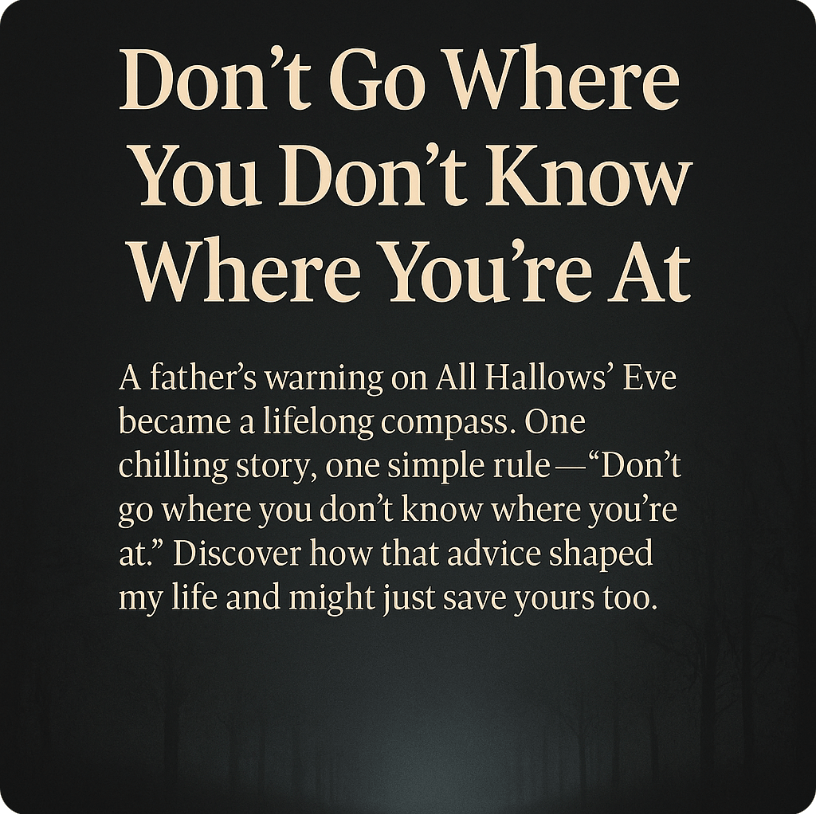
“Don’t Go Where You Don’t Know Where You’re At” — A Lesson from My Father

2–3 minutes

A Memory That Ignites Each Year

Every year when All Hallows’ Eve rolls around, I think about a specific night. I remember it vividly. It was when I was sixteen. I was getting ready to go out with friends—excited, dressed up, and ready for a night of harmless fun. As I reached for the door, my father stopped me with a hand on my arm.

He’d never done that before. I was the youngest of six children. By the time I reached my teens, my parents had weathered every imaginable crisis. Their only standing rule was simple: “Be safe and be home before daylight.” But that night was different. Dad’s grip was firm, his eyes serious.

He said quietly, “Look—your Uncle Bennie came upon a man whose head had been cut off and left on a dirt road near our house when I was about your age. They never found who did it.”

I froze. Uncle Bennie had passed away before I was born, so I never had the chance to ask him about it. Dad didn’t offer more details. He only mentioned that Bennie had called the deputies. Bennie told them everything he knew. Then he lived with that memory for the rest of his life.

My father’s next words have stayed with me for decades: “I just want you to be safe. Don’t go where you don’t know where you’re at.”

Those words became a rule for me, a compass I’ve carried ever since. If my gut or my soul told me something wasn’t safe, I backed away. That simple warning guided me through my teenage years. It also helped me during my law enforcement career. Instincts and situational awareness can mean the difference between life and death in that field.

Even today, I don’t know much more than that chilling story about the headless man. But my father’s advice has saved me countless times. It’s taught me that safety isn’t just about the rules of the road. Safety is not limited to the places on a map. It’s about trusting the quiet warnings within yourself.

I share this story with you because maybe it can help someone else, just as it helped me. We live in a world full of distractions, routes we don’t know, and situations that feel uncertain. If you find yourself heading into something that doesn’t feel right, listen to that inner voice. Step back. Choose another path.

Because sometimes, the oldest lessons are the truest: Don’t go where you don’t know where you’re at. Your instincts know the terrain long before your eyes do. And that wisdom—passed from a father to a son—can save your life, too.


By Benjamin GroffMedia© | benandsteve.com | ©2025 

FALL INTO benandsteve.com THIS AUTUMN

1–2 minutes

🍂  You’re in the Right Place This Fall! 🍂

As autumn rolls in, we want to thank every one of you for stopping by BenAndSteve.com. By coming here, you’ve chosen more than just another news site. You’ve found a space where information, perspective, and community come together.

Here you’ll find a variety of voices, stories, and updates. Plus, it’s a place to connect and share opinions. You can also see how others think. Whether you’re here for fresh news, or thoughtful commentary, we’re proud to offer you fresh news every day. We also give thoughtful commentary. You will find a little inspiration here too.

So grab your favorite fall drink, explore the latest posts, and join the conversation. We’re thrilled you’re part of our growing community—and this October is only the beginning of what’s ahead!


By Benjamin GroffMedia© | benandsteve.com | ©2025 

Where the Barrel Cactus Sits: Visiting Chiawuli Tak, Arizona

1–2 minutes

Welcome to Chiawuli Tak, Arizona—a sun-drenched speck of a census-designated place nestled in Pima County. The town had just 48 residents in 2020. It has risen to an estimated 112 today. It’s the town where “small population” doesn’t even start to cover it. (And yes, that growth rate of about 6.7% annually is basically like adding a few family reunions per year.) (1)


Once upon a Sunday, locals cheered when a tumbleweed gently tapped on the general store window. They marveled at it, of course. The nearest neighbor hosts alone can use the company. With a population density of around 20 people per square mile, it’s quieter than most people’s living rooms. If you shout “Howdy!” in Chiawuli Tak, you’ll hear your own echo. You also hear the echoes of three generations of family dogs responding in kind. (2)


Despite its tiny size, 19 households call Chiawuli Tak home. Nearly five people per house live there on average. There are a handful of single dads. They are brimming with dad jokes. There are also single moms who know the power of multitasking. Enough cousins exist to start a family band. Everyone’s related, and everyone knows the town gossip by breakfast. (3)


The name Chiawuli Tak comes from the O’odham language and means “the barrel cactus sits.” It is the only town in America deliberately named after a cactus that sat down. This cactus thereby became the most laid-back plant in the desert. (4)


Chiawuli Tak reminds us that it doesn’t take big cities to tell good stories. Sometimes, you just need a handful of folks, a trusty barrel cactus, and a whole lot of unexpected charm. So raise your morning coffee high. Do it for the towns that make you smile. These towns only show up on very sparse maps.


By Benjamin GroffMedia© | benandsteve.com | ©2025 

The Healing Impact of Simple Acts: A Hug Can Change Everything

2–3 minutes

The Hug That Changed Everything

Mina at the Farmer's Market
Mina hugging at the Market

It was about five weeks after my back surgery when Steve and I went shopping at our farmers’ market. Normally, Saturdays are our day, but since he had volunteered the day before, we made our visit on Sunday instead. That simple change in schedule turned into something unexpected and heartwarming.

We ended up in the checkout lane of one of our favorite “checkout girls,” as we call her. Mina. She hadn’t seen me since before my surgery, and when she spotted us, her face lit up. She came running from behind the register. She wrapped her arms around both of us and hugged us tight. It felt like a son coming home from college after a long absence. She even insisted we give her our address so she can invite us to a family event she was planning. We’re still not sure what event it will be, but the invitation itself felt like a gift.

That hug reminded me of something simple yet profound. It showed the power of being openly accepting. Let people into your life regardless of who they are, what they look like, or where they come from. In Mina’s hug, I felt seen, valued, and welcomed back into the community.

It brought to mind another story—one shared with me for this blog.

It was 3 a.m. in a quiet hospital corridor when a young musician, newly diagnosed with leukemia, sat in fear and loneliness. The sterile lights and hum of machines gave her no comfort. She cried quietly, believing no one noticed.

But someone did.

A nurse named Ben saw her distress and asked, “Are you okay?” He didn’t prescribe medicine or adjust a machine—he offered a hug. That single gesture, simple as it was, gave her strength. It reminded her she wasn’t just a patient but a person worth comforting. She later said that hug stayed with her long after the treatments, even into remission.


Kindness has a transformative power. It’s impactful whether shown by a nurse in a hospital or a cashier in a farmers’ market. It can change moments and sometimes lives. We often think it has to be grand or costly. The truth is, the simplest acts—a hug, a smile, an invitation—can ripple far beyond what we imagine.

Mina’s hug will not make the news. Nurse Ben’s probably didn’t either. But for the people who received them, they became unforgettable.


  • When was the last time a small act of kindness made a real difference in your day?
  • Have you offered something that felt ordinary to you but has meant the world to someone else?
  • What small kindness can you extend today to be someone’s “Mina” or “Nurse Ben”?

Life is full of struggles and invisible battles, but kindness—especially when it surprises us—has the power to heal. A hug. A smile. An invitation. They seem small, but they carry extraordinary weight.

You never know whose burden you’ll lighten or whose courage you’ll restore. Sometimes the smallest things are the biggest miracles. And without even realizing it, you are the miracle-giver.


By Benjamin GroffMedia© | benandsteve.com | ©2025 

From Hauling Oranges to Inspiring a Movement

2–3 minutes

The Brothers and the Orange Truck

Groff Media2025© BrotherTruckers

Eddie and Carl had always been close, but nothing tied them together like their truck. A massive eighteen-wheeler, shining chrome dulled by road dust, it was both their livelihood and their burden. They’d gone deep into debt to buy it. They hoped to build their hauling business around orange deliveries from the groves in California.

But the payments ate away at every mile they drove.

Even with steady work, the numbers never added up. So they tried to get clever. They began running side jobs—hauling crates of produce, lumber, even furniture—between their orange routes. One drove while the other slept. Their heads were propped against the hard cab window. They woke with stiff necks that seemed to worsen each week. 

“Just a few more years,” 

Carl would mutter. 

“We’ll get ahead.” 

Eddie always nodded, though neither believed it completely.

Then the crisis hit. On a rain-slicked highway outside Phoenix, a sudden shudder ran through the truck. Eddie, at the wheel, felt the steering go slack. He fought the wheel, but the trailer jackknifed, scattering oranges across three lanes of traffic. By some miracle, no one was killed—but the damage was catastrophic. Their load was ruined, the rig torn apart, and the trucking company that contracted them pulled their work instantly.

The brothers sat on the shoulder. They were soaked in the rain. They watched cars crunch over the fruit they had worked so hard to deliver. They thought it was the end.

But in the weeks that followed, something unexpected happened. Photos of the accident—highways littered with smashed oranges, drivers climbing out to help clean up—went viral. 

Reporters picked up the story of the brothers who worked around the clock. Their necks were stiff, and their wallets were thin. They were just trying to get ahead. 

Sympathy poured in. A crowdfunding campaign was launched. And soon, Eddie and Carl weren’t just hauling oranges anymore. They were speaking about small-town grit and about persistence. They talked about what it meant to keep pushing ahead when the load was too heavy.

The truck nearly broke them. The crisis almost ruined them. In losing everything, they discovered something bigger. They found a community that believed in them more than they had ever felt in themselves.


By Benjamin GroffMedia© | benandsteve.com | ©2025 

Riding The Lie Down The Elevator

1–2 minutes

The Lie in the Elevator

It began as nothing more than a joke. A character on television—smug, ridiculous—coasted down an elevator while declaring something so absurd that everyone laughed. It was too silly to be taken seriously, too exaggerated to live beyond the moment.

But no one challenged it. And why would they? It was just a laugh, a one-liner, a small puff of smoke that seemed harmless. Yet smoke drifts. It clings. The joke became a line repeated at dinner tables, then in office chatter, then across social media. What started as comedy grew like a weed, tangled and persistent.

You knew it was a lie. You knew from the very beginning. But saying something meant being the one to ruin the joke, the one to argue when everyone else was smiling. It was easier to let it go. Easier to think, Surely this will fade away.

Except it didn’t. The lie ballooned. It threaded itself into conversations, policies, schools, and pulpits. Suddenly your neighbors were quoting it as if it explained the world. Your family repeated it without hesitation. They did not repeat it because they believed it. They found it easier than fighting for the truth.

And now here you are. Watching as the lie isn’t just smoke anymore—it’s a fire, raging and indiscriminate, swallowing millions in its path. The streets fill with people repeating the words that started as a smirk on an elevator ride. And they look to you, because they trust you. Because they think you see what they see.

But you don’t. You know better.

The question is no longer whether the lie is funny. The question is whether you will stand against it now. It is late, but not too late. Otherwise, silence will make you part of it.

What would you do?


By Benjamin GroffMedia© | benandsteve.com | ©2025

The Day the Johnson’s Mimic Bird Flew the Coop And Flew Throughout Johnson City, Kansas

3–4 minutes

The Day the Mimic Bird Flew the Coop

Earl and Mabel Thompson were a quiet couple in their seventies. They lived on Maple Street in a small white house with blue shutters. Most evenings were spent watching the news or sipping tea on the porch. Their pride and joy, though, wasn’t a grandchild or a garden, but a bird—a rare mime bird. Unlike parrots, which repeated words, this bird can mimic voices perfectly. You’d swear the real person was in the room.

They named him Charlie.

One summer morning, Mabel was dusting the birdcage. Earl was fumbling with the Sunday crossword. Charlie spotted the cage door ajar. With a gleeful flap, he darted out the window and into the open sky. Earl dropped his pencil. “Mabel, the bird’s loose!”

But by then, Charlie was already over Johnson City, Kansas Main Street, testing his repertoire of voices.


Trouble Takes Flight

Charlie’s first stop was the Jenkins’ house. Hovering outside the kitchen window, he called out in Mr. Jenkins’ voice:


“Darlin’, I burned the roast again!”

Mrs. Jenkins stormed into the kitchen, waving a wooden spoon, ready for a fight. Poor Mr. Jenkins had been quietly napping in his recliner. He nearly fell over when she accused him of ruining dinner. He hadn’t even touched it.

From there, Charlie zipped down to O’Malley’s Bar. Perched on the ceiling fan, he crooned in half a dozen voices: “Put that on my tab!” “You call that a drink?” and, worst of all, in the barkeep’s own gruff tone: “Next round’s free, boys!” Chaos erupted as patrons demanded their “free round,” and fists began flying before anyone realized the voice was coming from above.


Civic Mischief

Not content with bars and kitchens, Charlie wheeled into the Johnson City police station. He perched outside the dispatcher’s window. He barked in Officer Daniels’ exact voice:
“Unit 12, urgent back-up on Fifth and Main!”

Three patrol cars roared away with sirens blaring. The station was left in confusion. The real Officer Daniels walked out of the bathroom holding a sandwich. One County Unit, A State Patrol Car and the city’s only other active patrol unit.

Later that same afternoon, Charlie wandered into Johnson City’s Hospital. There, using a spot-on imitation of the head doctor, he announced over the intercom:


“Paging Dr. Howard, please report to Room 207. Emergency tonsil transplant, stat!”

Patients and nurses alike scrambled in a tizzy, while Dr. Howard was still in the cafeteria with a mouthful of Jell-O. He nearly joked. Squirming to get up his belly got wedged beneath the table and chair. A colleague that was with Doctor Howard, began laughing so hard he nearly passed out from the added action.

Charlie flew down to Johnson City John Deere. He landed in their parts department. There, he began calling out engine parts numbers from bin numbers. This drove the parts clerks absolutely crazy.


The Chase and the Capture

Word spread of a mysterious troublemaker around town. By that time, Earl and Mabel were chasing after Charlie with a birdcage. They called sweetly, “Here, Charlie! Come home, dear!”

The town’s patience was running thin, though most couldn’t help but laugh at the absurdity. Charlie was exhausted from a day of impersonations. Finally, he landed right back on Earl’s shoulder with a satisfied squawk:


“Well, that was fun!”

—in Earl’s exact voice.

Earl sighed, Mabel shook her head, and the crowd around them burst into laughter.


Aftermath

From that day on, Charlie’s cage was fitted with a brand-new lock. Earl swore it would never happen again.

Still, every now and then, when the wind blew just right across Maple Street, folks swore they heard Charlie. He was practicing a new trick. The voices varied—sometimes the mayor, sometimes the school principal—but the laughter it brought the town was always the same.


By Benjamin GroffMedia© | benandsteve.com | 2025 

Simple Moments: How a Bench Transformed a Neighborhood

1–2 minutes

The Bench by the Willow Tree

On the edge of town, near a quiet creek, there’s an old willow tree. Beneath its sweeping branches sits a wooden bench—simple, weather-worn, and unremarkable to anyone passing by. Yet, for the people who live nearby, it has become something more: a gathering place of unexpected kindness.

It started with an elderly woman who came to rest her legs each morning. One day, a teenager walking his dog sat down beside her. They began talking. By the time the boy left, she was smiling in a way her neighbors hadn’t seen in years. The next day, the boy came back—with coffee in hand for her.

Word spread. Soon, others began stopping at the bench. A widower brought extra tomatoes from his garden. A young mom offered homemade muffins. A pair of joggers left fresh flowers tucked into the slats. Strangers became neighbors, and neighbors became friends—all because of an old bench no one ever noticed before.

The willow still stands, and so does the bench. It hasn’t been polished, painted, or rebuilt—it doesn’t need to be. Its gift is not in how it looks. Its gift is in what it holds: conversations, kindness, and the small reminders. Even in a world that feels divided, we can still find each other in the simplest of places.


 The Takeaway: Sometimes hope and connection aren’t found in grand gestures. They aren’t always in perfect plans. Instead, these are found in an ordinary spot where people choose to show up for one another.


By Benjamin GroffMedia© | benandsteve.com | 2025 

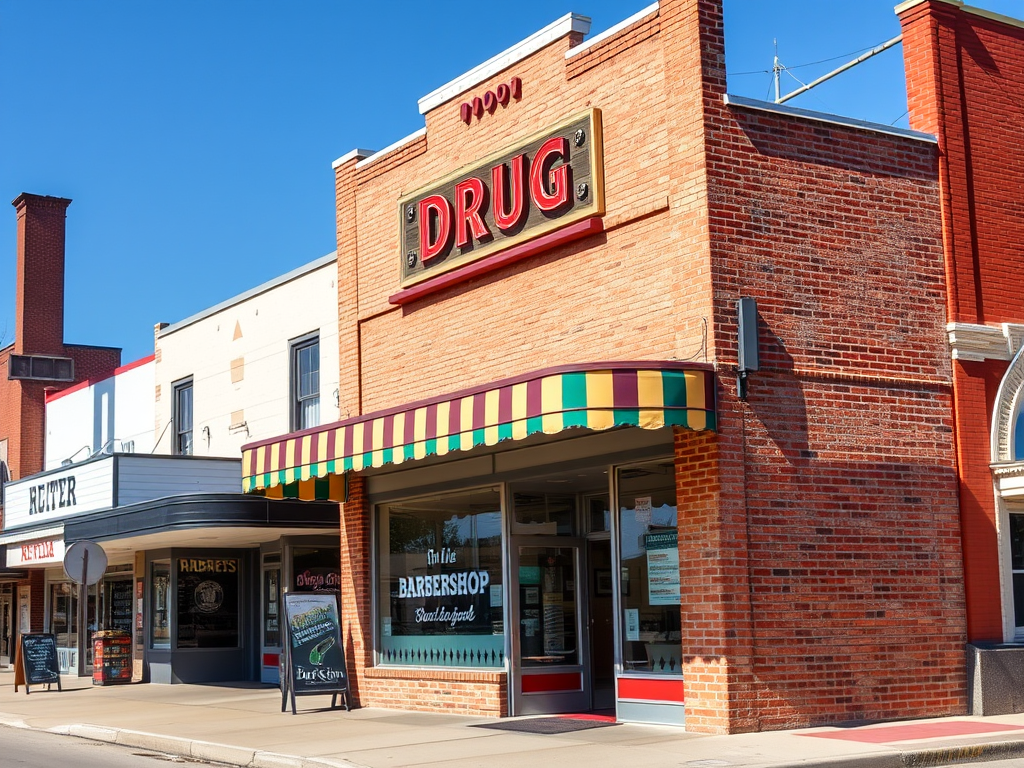
Back-to-School Memories at the Local Drug Store

2–3 minutes

Back-to-School at the Drug Store

In our little town, back-to-school season wasn’t marked by glossy superstore aisles or online orders delivered in cardboard boxes. No, it happened right on Main Street. It was at the drug store tucked neatly between the barber shop and the movie theater.

That drug store was a place all its own. A long soda fountain stretched nearly the length of one wall. It had red-topped stools that spun in slow circles when you climbed onto them. Folks would stop in for a cherry Coke or a vanilla phosphate. The hum of the soda jerk’s mixer became as familiar as the sound of church bells on Sunday morning. On the north end of the store, up near the front window, stood a glass display case. Behind it sat neat stacks of paper bags. Each bag was carefully filled with the exact school supplies a child would need for a given grade.

Every August, families filed in, children buzzing with nervous excitement. You only needed to walk up to the counter. Puff out your chest and tell the lady behind it your grade number. With a kind smile, she’d hand over a brown paper bag with your future sealed inside. The bag contained pencils, crayons, rulers, and erasers. For the younger grades, it included that wide-lined treasure known as the Big Chief Tablet.

Kindergarten through third grade was the golden stretch, when opening that bag felt like Christmas morning in August. We’d tear into the packages of crayons. We tested the sharpness of new pencils. We imagined all the things we’d draw and write. But as the years went on, the thrill wore off. By fourth grade, the magic faded. We realized those paper bags didn’t just hold supplies. They carried us straight back into the dreaded routine of homework. There were also spelling tests and teachers who never gave you quite enough recess.

Still, that ritual mattered. The drug store had a soda fountain fizzing. Its shelves were lined with shiny notebooks. It gave us a sense of belonging. It tied the town together. The barber cut hair next door. The movie theater marquee changed weekly. Parents shepherded kids through one more milestone.

Every bag marked a fresh start, even if we grumbled about it. None of us would have admitted it then. Yet, there was comfort in knowing that behind that glass display case was a little brown sack of sharpened pencils. It was waiting for us every year with brand-new beginnings.


By Benjamin GroffMedia© | benandsteve.com | 2025 

Rethinking the National Guard: A Return to Local Focus

6–9 minutes

What if the National Guard went “back to basics”? 

Instead of roaming the country as a military force, it can return to its roots. It should focus on protecting communities, fighting disasters, and standing ready at home. This was how it was initially intended.

Traditionally, the National Guard is a reserve part of the U.S. Armed Forces with a dual state and federal mission. Its primary duties include:

  • Disaster response: helping with hurricanes, floods, wildfires, tornadoes, and other natural disasters.
  • Civil support: assisting with search and rescue, law enforcement support, and humanitarian aid.
  • Community protection: maintaining order during emergencies like riots or public unrest (when activated by a governor).
  • Military readiness: training to serve as backup for overseas missions if federally activated.

In recent years, the Guard has been used much more often as a deployable military force nationwide and abroad. Instead of focusing mainly on disaster relief and state emergencies, units have often been:

  • Sent overseas for long deployments (Iraq, Afghanistan, and other global missions).
  • Deployed domestically for extended periods to reinforce border security.
  • Called into action for large-scale protests or high-profile events (sometimes more as a security force than a disaster-relief one).

This “running about the country” role shows the impact of federal activation. It often overrides the state-level, community-first role the Guard was created for.

If the Guard were not being tasked so heavily with nationwide or military-style deployments, they would be more focused on:

  • Local readiness involves staying in their communities and training for natural disasters and emergency responses.
  • Rapid-response teams: being first on the ground for wildfires, floods, and major storms.
  • Community integration: building stronger ties with local emergency agencies, fire, police, and hospitals.
  • Relief from strain: soldiers wouldn’t be stretched between frequent national missions and their civilian lives (jobs, families).

In short, without the current expanded use, the Guard would essentially serve as a state-based safety net. It would not work as a roaming military or quasi-police force.

Back to Basics: Rethinking the Role of the National Guard

The National Guard has long been the “citizen-soldier” force of the United States, built to serve both State and country. In recent decades, its role has changed. It has drifted toward functioning as a national military extension. It is constantly deployed across the country and overseas. What if, instead, the Guard returned to its roots?

1. Local First: Anchored in Communities

At its best, the Guard is a local safety net. Guardsmen live, work, and raise families in the same communities they serve. Units should primarily focus on state-based missions. This focus ensures the Guard would be ready to respond within hours to natural disasters. They would also be prepared for civil emergencies or infrastructure crises. Imagine a Guard that spends more time training with local fire departments, EMTs, and hospitals than on federal deployments.

2. Disaster Response as the Core Mission

Hurricanes, floods, tornadoes, wildfires—these are the events that disrupt American lives far more often than foreign conflict. A back-to-basics Guard would prioritize:

  • Maintaining rapid-response disaster teams in every State.
  • Stockpiling equipment is tailored for local threats. This includes boats in flood zones, fire suppression gear in the West, and snow mobility in the North.
  • Conducting community disaster drills ensures that both citizens and Guardsmen are equally prepared.

Units would no longer be pulled away for distant missions. They would focus on being the first and best resource for emergencies at home.

3. Training for Peace, Not Just War

Right now, Guard training often mirrors active-duty military requirements, preparing for combat tours. In a reset model, training would also emphasize:

  • Engineering & rebuilding skills (bridges, roads, communications).
  • Medical readiness to help hospitals in crises.
  • Cybersecurity units to defend state and municipal systems.
  • Community relations, so Guardsmen stay trusted neighbors rather than distant enforcers.

This would shift the Guard’s culture back toward being helpers before fighters.

4. Federal Role: Truly Exceptional, Not Routine

Of course, the Guard must stay capable of federal service in extreme situations—war, national catastrophe, or extraordinary need. Yet, deployments abroad or cross-country should be rare exceptions, not the default. By limiting federalization, Guardsmen can balance their civilian careers and military service, reducing burnout and attrition.

5. Why It Matters

A back-to-basics Guard would mean fewer fatigued families. It would result in stronger ties to local communities. This approach ensures a quicker, more reliable response when disaster strikes. America’s Guard would not be stretched thin across the globe. It would once again stand where it was meant to: in the towns and states it calls home.

What if you read notices in your local news that read?

PRESS RELEASE

FOR IMMEDIATE DISTRIBUTION

Governor Announces New “Back to Basics” Model for the National Guard

Kansas, June 32, 1901 — Governor Sample, today, announced a renewed vision for the role of the National Guard. He prioritized disaster response, community protection, and local readiness. These take precedence over routine national or overseas deployments.

“For too long, our Guard has been stretched thin. They have been asked to serve as a roaming military force. Their greatest value lies right here at home,” said Governor Sample. “This back-to-basics approach ensures readiness. When disaster strikes—whether it’s a wildfire, flood, storm, or cyberattack—the Guard will be here for the people of Kansas.”

The new model emphasizes:

  • Local Focus: Units stay in-state and train alongside fire, police, and emergency services.
  • Disaster Response Core: Stockpiles of equipment tailored to regional needs (boats, fire suppression, snowmobiles).
  • Civil Support: Enhanced training in medical aid, engineering, and cybersecurity.
  • Federal Deployment Limits: Guard units will be reserved for exceptional national missions, not routine overseas tours.

“Our citizen-soldiers are not only protectors—they are neighbors, coworkers, and family members,” The Governor added. 

“By keeping them rooted in our communities, we strengthen both readiness and trust.”

The announcement received praise from emergency officials. Guard families also praised it. They say the plan reduces the strain on soldiers. These soldiers balance military duties with civilian life. 

“This will make the Guard what it was always meant to be—a safety net for the people. It was not meant to be a shadow army,” said Major General Example, Adjutant General of the Kansas National Guard.

  • OR –

National Guard to Refocus on Community, Disaster Relief Under New State Plan

Pingpong, CA. Feb.30th, 1901 — The National Guard in California will soon change their focus. They will be trading extended deployments and national security missions for a renewed focus closer to home. In a press conference yesterday, Governor Pixel outlined a “back-to-basics” approach. This approach emphasizes disaster response, community support, and local readiness as the Guard’s primary mission.

The plan follows many years of frequent Guard call-ups across the country. These call-ups range from border security and protest response to overseas rotations. Critics have long argued these duties stretch citizen-soldiers too thin, pulling them away from their families, jobs, and communities.

Under the new model, Guard units would focus on in-state needs, like wildfire suppression, flood response, and medical assistance. Specialized equipment would be stockpiled based on regional threats. Training would shift toward engineering, emergency medicine, and cybersecurity. The focus would be less on combat deployments. Federal missions wouldn’t disappear, but would be reserved for “extraordinary circumstances.”

“This change will transform the Guard. It will achieve its true purpose,” said Major General Mission, Adjutant General of the California National Guard. “It will become a force that’s ready to protect and serve right where its soldiers live.”

Community leaders praised the proposal, noting the Guard’s quick local response during past disasters. Families of Guardsmen also welcomed the change, saying the plan reduces the strain of juggling civilian and military life.

The proposal has yet to be tested. It signals a shift in priorities. The Guard is rooted not in constant deployments. Its foundation lies in its mission as a local safety net for the people of California.

Returning the Guard to its original purpose –

📌 Top 3 Changes in the Guard’s Role

1. Local First

Guard units will stay primarily in-state, training with fire, police, and emergency services for quicker disaster response.

2. Disaster Response Core

Specialized equipment stockpiles—boats, wildfire gear, snowmobiles—tailored to each region will be prioritized over combat readiness.

3. Federal Deployment Limits

Units will only be sent on national or overseas missions for extraordinary emergencies, not as a routine practice.

That day will probably never come for a great many who read this report. For others who do, it serves as a goal. It becomes something to aim for when trying to look to a brighter future.


By Benjamin GroffMedia© | benandsteve.com | 2025 

The Idiocy Of Name Calling – Woof Whistles And Such!

1–2 minutes

The Great Name-Calling Open

The morning was sunny on the golf course. A group of doctors noticed a team of nurses playing a round a few holes over. One of the doctors cupped his hands and hollered across the fairway:

“Hey! When you walked by the gate, the watchdog said WOOF! WOOF!”

The nurses froze, glaring back. One of them raised her club like a microphone and shouted,

“Oh yeah? When you all walked by the pond, the ducks went QUACK! QUACK!”

The golf course grew quiet. A couple of retirees nearby peeked out of their carts to see what the commotion was. The trash talk had officially begun.

Just then, a police officer—off duty but still in uniform for reasons only he knew—wandered up and added his grievance.

“That’s nothing! I went into a restaurant today and a bunch of teenagers started going OINK! OINK! OINK! at me!”

The doctors and nurses nodded sympathetically, but before long they were all laughing. It seemed no profession was safe from ridicule.

“Well,” said one of the nurses, grinning. “If we’re going to keep score, I went to a rock concert last week. The singer stopped mid-song, pointed straight at the crowd, and called us every name in the book. I felt like I’d paid extra for the insults.”

By now, the golfers had abandoned their shots. The officer had parked his cart. The conversation had spiraled into a full-blown “who got called what” competition. Farmers chimed in about “moo” jokes. Teachers griped about “boring” chants. A barber also complained about being called “clip-clop” at the horse races.

The sun dipped lower, balls went unhit, and nobody remembered the score of the game. One thing was certain: the Great Name-Calling Open had been played on that course. Every profession—dog, duck, pig, or otherwise—walked away laughing.


By Benjamin GroffMedia© | benandsteve.com | 2025 

Finding Common Ground: Building Bridges in Polarized Times

1–2 minutes

Photo by cottonbro studio on Pexels.com

Finding Common Ground in a Divided Nation

Everywhere we look, the signs of division are clear. Our conversations have turned into shouting matches, our communities into factions, and even the smallest differences into battle lines. A nation divided can’t stand strong. But there is another path. It does not ask us to agree on everything. Instead, it asks us to bring ourselves into spaces that center peace and shared purpose.


The Power of a Centered Community

When we step away from division and enter a group that is centered and peaceful, something remarkable happens. The noise quiets down. Respect returns to the conversation. We start to see each other not as opponents. Instead, we see each other as fellow human beings. We recognize struggles, joys, and hopes that are more alike than different. These kinds of communities create an environment where empathy can thrive—and empathy is the root of unity.


A Call to Unite Around a Common Cause

Now more than ever, we need to reclaim what unites us. Not political slogans, not party lines—but a shared wish for dignity, fairness, and belonging. The call is simple: bring yourself, with open hands and an open heart, to a group that fosters peace. Choose to engage in a way that builds bridges instead of burning them. Let’s unite around the common cause of healing our communities, so that we can heal our nation.


Closing Thought

Division is loud, but peace is stronger. Every voice that chooses compassion over conflict adds weight to the side of unity. The choice begins with each of us—will we contribute to the noise, or to the harmony?


By Benjamin GroffMedia© | benandsteve.com | 2025 
THE TRUTH IS THE HARDEST THING TO LOOK AT AND ACCEPT

When I first wrote this piece during election season, I thought it spoke to a particular moment. But the truth has a way of staying relevant. Looking around today, it feels just as necessary—maybe even more so.

1–2 minutes

THE TRUTH IS THE HARDEST THING TO LOOK AT AND ACCEPT

There was a time in American politics. Back then, slinging mud was considered the lowest, most dishonorable act a candidate would commit. Those who spread lies were branded untrustworthy. Decent people would never cast a vote for them. Back then, communities had a different rhythm. You knew your neighbors. You checked on the widow down the street. You went out of your way to support local businesses because of family ties. Courtesy was second nature. You didn’t blare your horn because someone hesitated at a stop sign. You didn’t sneer at people who looked different from you. When you traveled to another town for a ballgame, you were respectful. You treated their facilities with the same respect you expected for your own.

Politics, too, carried that sense of respect. When someone won an election—whether at the local, state, or national level—it wasn’t the end of the world. It simply meant they had earned the right to represent their community for a set term. Neighbors didn’t conspire to punish one another for “voting the wrong way.” They did not claim elections were fraudulent just because their candidate lost. They accepted the truth, even when it was difficult, because truth was what held the fabric of the community together.

What’s striking is that no one sought to destroy the lives of those who disagreed with them. Debate can be sharp, but it stopped short of hatred. People understood that democracy required trust. It required trust in the process. It required trust in one another. It also required trust that truth—no matter how uncomfortable—would endure. That same truth remains today. Still, it asks something of us. It requires the courage to look it in the eye. We must accept it and live by it.

By Benjamin GroffMedia© | benandsteve.com | 2025