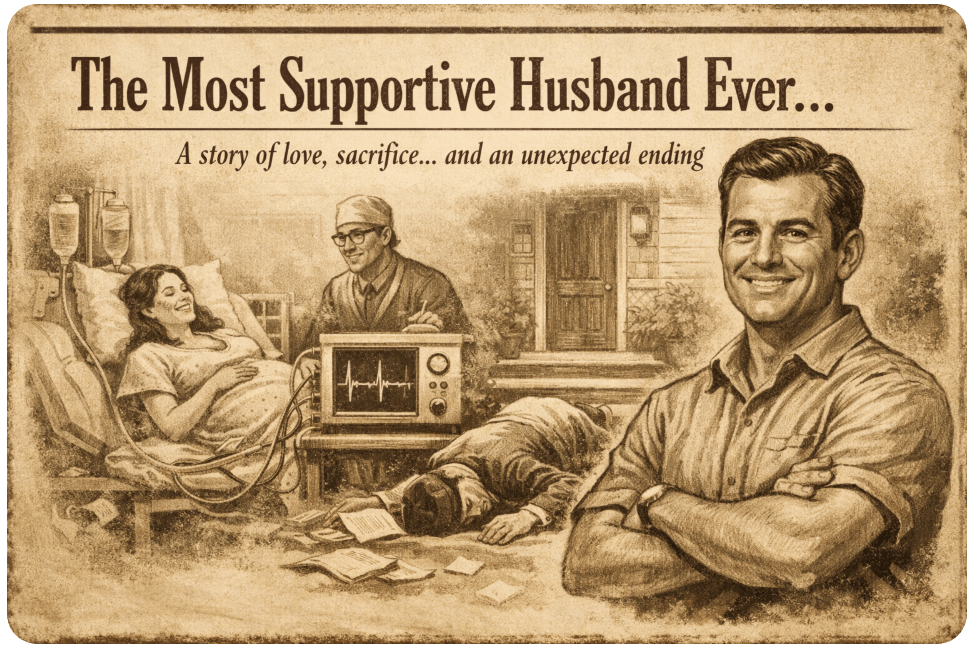
The Most Supportive Husband Ever… Or So He Thought
A man rushed his very pregnant wife to the hospital as her labor pains began.
After examining her, the doctor looked up with a serious expression. “This is going to be a difficult delivery,” he said. “But… there is an experimental choice.”
The couple leaned in.
“There’s a machine,” the doctor explained, “that can transfer a part of the mother’s pain to the father. It would significantly reduce what she feels during labor.”
Without hesitation, the husband said, “Hook me up.”
The doctor raised a cautious finger.
“There’s one small issue… a flaw in the mechanism. The pain transferred to you is amplified—up to ten times stronger than what she experiences. If it becomes too much, you must tell me at once.”
The husband nodded confidently. “I can handle it.”
The machine was connected.
The doctor started at 10%.
“How do you feel?” he asked.
“Honestly?” the husband said. “I don’t feel a thing.”
Curious, the doctor increased it to 30%… then 50%… then 80%.
Still nothing.
The doctor was amazed. He pushed it all the way to 100%. Due to the flaw, this meant the husband was now receiving ten times the full intensity of labor pain.
He stood there calmly.
No grimace. No flinch. Not even a bead of sweat.
Meanwhile, his wife delivered the baby with remarkable ease.
The doctor, stunned, turned to the husband. ““I have never seen anything like this in my entire career.”
Proud, the couple gathered their newborn and headed home, marveling at what had just happened.
But when they arrived…
There, on the front doorstep…
Lay the mailman.
Dead.
I am only retelling this story. I am not responsible for the contents. Just for the ending. Which I had nothing to do with.
In emergency services there is a moment most people never see.
It usually happens sometime after midnight, when the world is quiet and the station lights are dim. The calls have slowed down just enough that someone finally drifts off in the Bunkroom.
Then the tones drop.
Within seconds the calm disappears. Boots hit the floor, radios crackle to life, and another emergency begins.
For many first responders, that moment repeats itself again and again over the course of a shift. Sleep comes in fragments—ten minutes here, twenty minutes there—if it comes at all.
Yet the work still has to be done.
Patients still need treatment. Ambulances still need to move quickly and safely through traffic. Decisions still have to be made in seconds.
So how do first responders manage when sleep is scarce?
The answer, in many cases, is a combination of training, teamwork, and habits built over years of long nights.
Coffee: The Unofficial Fuel of Emergency Services
Walk into almost any firehouse, EMS station, or dispatch center. You will find a coffee pot that never truly turns off.
Caffeine has become the unofficial fuel of emergency work. It sharpens focus, pushes back fatigue, and gives providers the extra edge they need when exhaustion begins to creep in.
But caffeine is a temporary solution, not a cure. It can help providers stay alert for short periods, but it cannot replace the restorative effects of real sleep.
Still, for many crews working through the night, that cup of coffee becomes a small but necessary ally.
The Power of the Partner Check
Another important defense against fatigue is something emergency services have relied on for decades—watching out for each other.
In EMS and law enforcement alike, partners often double-check each other’s work when exhaustion sets in.
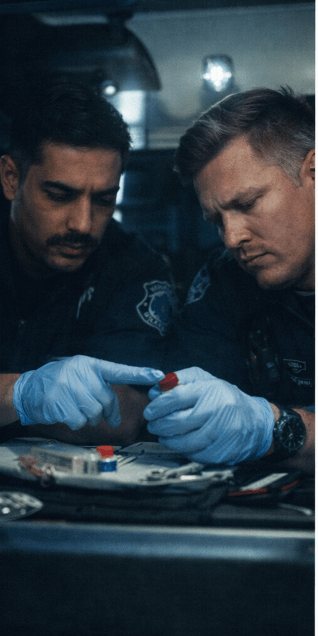
One medic confirms a medication dose while the other prepares it. A partner reviews a treatment decision before it is carried out. A tired driver is reminded to pull over or slow down when fatigue becomes obvious.
These small moments of teamwork are often invisible to the public. Still, they are an important safety net inside the profession.
Experience and Muscle Memory
Years of training also play a role in helping providers function when they are tired.
Many of the most critical skills in emergency medicine are practiced repeatedly until they become almost automatic. Starting an IV, assessing a patient’s airway, or reading a cardiac monitor are actions that experienced providers perform almost instinctively.
That muscle memory helps bridge the gap when fatigue clouds thinking.
But even the most experienced provider is still human. Fatigue eventually catches up with everyone.
Humor in the Middle of the Night
One of the most common coping tools in emergency services may surprise outsiders: humor.
First responders have a long tradition of gallows humor. It’s a way of releasing tension, staying connected with coworkers, and pushing through difficult moments.
A quiet station at three in the morning may suddenly erupt in laughter. It might be over a joke, a story from a previous call, or something completely ridiculous.
That humor isn’t about disrespect. It’s about survival.
Sometimes laughter is the only thing that keeps a tired crew moving through the night.
The Quiet Drive Back to the Station
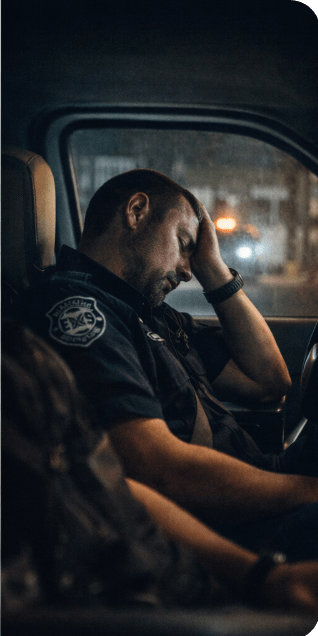
After the sirens fade, the patient is delivered to the hospital. There is often a quiet drive back to the station.
For many providers, that ride is the moment when exhaustion becomes most noticeable.
The adrenaline of the call is gone. The road stretches ahead. The body begins to remember how tired it really is.
Those moments are why conversations about fatigue are becoming more important within emergency services.
First responders have always found ways to push through exhaustion. However, the goal should never be simply to endure it.
The goal should be to manage it.
A Profession Built on Dedication
The reality is that fatigue has always been part of emergency services.
Long shifts and unpredictable calls are part of the job. The responsibility of protecting the public adds to it. This means the job will never fit neatly into a normal sleep schedule.
But despite those challenges, first responders continue to answer the call.
They rely on training, teamwork, and professionalism to carry them through the long nights.
And when the tones drop again—whether it’s midnight, three in the morning, or just before sunrise—they get up and go.
An International Discussion For Police,Fire, EMT’s, Dispatch and You!
WHEN EMERGENCIES ARRISE AND THOSE RESPONDING ARE TOO TIRED TO BE THERE
For paramedics, EMTs, and first responders, sleep often becomes the one thing emergency medicine never seems to deliver. The science is clear—fatigue affects judgment, safety, and patient care. Yet the process still runs on sleepless shifts.
When the Tones Drop at 3 A.M.: Fatigue and the Reality of EMS Life
For EMS providers, fatigue isn’t just an inconvenience or a badge of honor. It’s a real operational risk that affects patient care, provider safety, and the long-term health of the workforce. Research over the past several decades has repeatedly shown that lack of sleep slows reaction time. It interferes with judgment. It also increases the likelihood of mistakes and accidents.
You understand something the general public rarely sees if you’ve ever been jolted awake in a station Bunkroom. This happens when the shrill sound of dispatch tones rings at 2:47 in the morning. In emergency medical services, sleep often feels like something promised but rarely delivered.
Anyone who has worked long shifts in emergency services knows exactly what that looks like in the real world. The medic drives back from a call, fighting heavy eyelids. The paramedic double-checks medication calculations at four in the morning because the numbers won’t quite settle in the brain. The crew member stares at a cardiac screen, trying to push through mental fog.
Before we talk about solutions, it helps to understand how EMS developed this culture of chronic sleep deprivation. It’s also important to know why meaningful rest can be so difficult to find on the job.
Sleep isn’t a luxury. It’s a biological need that allows the brain and body to recover and operate properly. Most adults need somewhere between seven and nine hours of restorative sleep within a 24-hour period.
For EMS providers, reaching even half that amount during a shift can feel like a victory.
Research shows that the effects of sleep deprivation can be dramatic:
• After approximately 17 hours awake, a person’s cognitive performance declines significantly. It begins to resemble someone with a blood alcohol concentration around 0.05%. • After 24 hours without sleep, impairment can resemble a 0.10% BAC, well above the legal driving limit in most states. • Fatigue affects reaction speed, memory, and the ability to make complex decisions—all critical skills in emergency medicine.
Studies examining EMS providers have also revealed troubling patterns. Many report experiencing severe fatigue regularly. A significant number acknowledge that they have fallen asleep behind the wheel after finishing a shift.
For providers in the field, these statistics aren’t abstract numbers. They show up in everyday moments:
• struggling to concentrate on a pediatric medication calculation • catching yourself drifting at a stoplight on the way back to the station • taking longer than usual to interpret patient data during a call
The long-term consequences of chronic sleep deprivation can also be severe. Poor sleep has been linked with higher risks of heart disease, diabetes, obesity, depression, and anxiety. Over time, fatigue contributes to burnout and drives experienced providers away from the profession.
Ironically, other industries that rely on safety-critical decision making—like aviation and commercial trucking—strictly regulate work hours and rest periods. EMS, nonetheless, often operates under schedules that allow providers to stay on duty for 24 hours or longer.
How EMS Ended Up With 24-Hour Shifts
Many EMS scheduling practices trace their roots to the fire service.
When modern EMS systems began developing in the 1960s and 1970s, many ambulance operations were integrated into fire departments. Firefighters traditionally worked 24 hours on duty. They followed this with 48 hours off. This schedule was manageable when fire calls were relatively infrequent.
EMS adopted this structure, even though medical call volumes soon far exceeded those of fire responses.
There were several reasons the schedule remained popular:
Staffing efficiency Long shifts need fewer personnel to keep coverage.
Fewer commutes Working a 24-hour shift means fewer trips to and from work during the week. This is something many providers appreciate, especially those in rural areas.
Overtime opportunities Long shifts make it easier to pick up extra work. This increases income for providers. It also reduces hiring pressure on agencies.
Tradition Like many aspects of emergency services culture, once a system becomes established it tends to stay that way.
Other Scheduling Models
Although the 24-hour shift remains common in many departments, other models are used as well.
12-hour shifts Common in high-volume urban EMS systems. They reduce extreme fatigue but need more staff and more frequent shift changes.
Kelly schedules A modified version of the 24/48 rotation that periodically adds an extra day off for recovery.
48/96 rotations Two days on duty followed by four days off. Some providers enjoy the extended time off, but fatigue can become severe if call volume is high.
Peak-hour staffing Extra crews are scheduled during the busiest times of day to reduce workload during overnight hours.
Each system has advantages and disadvantages. The challenge for agencies is balancing staffing levels, budgets, and provider well-being.
The Reality of Multiple Jobs
Another factor contributing to fatigue is the financial reality of EMS work.
Many providers hold second—or even third—jobs to make ends meet. A medic often finishes a 24-hour shift at one service. Then, they report to another agency for extra hours.
In some cases, providers stay awake and working for 48 hours or longer. While overtime can be financially appealing, the physical and mental toll can be enormous.
Why Sleep Is So Difficult in EMS
Even when schedules theoretically allow for rest, real-world conditions often make sleep difficult.
Unpredictable call volume One shift is quiet, while the next produces a constant stream of calls.
Station environments Bunkrooms are noisy, crowded, or poorly designed for restorative sleep.
Cultural expectations In some departments, daytime naps are still discouraged despite overnight calls.
Stigma surrounding fatigue Many providers hesitate to admit exhaustion for fear of appearing weak.
The result is a workforce that often operates on minimal rest while still being expected to deliver high-level medical care.
What Agencies Are Trying
Across the United States and internationally, EMS organizations have begun experimenting with strategies to tackle fatigue.
Fatigue management programs Training and policies designed to recognize fatigue as a safety hazard.
Improved sleep spaces Some agencies are redesigning stations to create quieter, darker rest areas for crews.
Adjusted shift schedules Shorter shifts or hybrid scheduling models may reduce extreme fatigue.
Data-driven staffing Deploying extra units during peak call hours can reduce workload during overnight periods.
None of these solutions is perfect. Budget constraints, staffing shortages, and operational demands make large changes difficult for many agencies.
Still, awareness of the issue is growing.
Personal Responsibility Matters Too
While system design plays a major role, providers also have some responsibility for managing fatigue.
That means prioritizing sleep on off-days, maintaining healthy routines, and recognizing when exhaustion affect performance.
Emergency services professionals often pride themselves on toughness, but fatigue is not a personal weakness—it’s a biological reality. Recognizing its effects is part of professional responsibility.
When fatigue becomes normalized within a profession, the consequences ripple outward.
Operational efficiency declines. Morale suffers. Experienced providers leave the field.
Most importantly, fatigue can affect the quality of care patients get.
Communities depend on EMS professionals to respond quickly and make critical decisions under pressure. Those responsibilities need clear thinking and alertness—something difficult to keep without adequate rest.
Moving Forward
Fatigue will always be part of emergency services to some degree. The unpredictable nature of the job makes perfect schedules impossible.
But acknowledging the problem is an important first step.
Agencies can explore smarter scheduling, better rest environments, and policies that recognize fatigue as a safety issue. Providers can take steps to manage their own sleep habits and recovery time.
The tones will still drop in the middle of the night. That’s part of the job.
The profession can continue working toward systems. These systems protect both the providers who answer those calls. They also protect the communities they serve.
Tomorrow Part II – Running on Coffee and Commitment: How First Responders Survive Fatigue
References
Williamson AM, Feyer AM. Moderate sleep deprivation produces impairments in cognitive and motor performance equivalent to legally prescribed levels of alcohol intoxication. Occup Environ Med. 2000 Oct;57(10):649-55. doi: 10.1136/oem.57.10.649. PMID: 10984335; PMCID: PMC1739867.
Billings JM. Firefighter sleep: a pilot study of the agreement between actigraphy and self-reported sleep measures. J Clin Sleep Med. 2022 Jan 1;18(1):109-117. doi: 10.5664/jcsm.9566. PMID: 34314350; PMCID: PMC8807900.
Patterson PD, Martin SE, Brassil BN, Hsiao WH, Weaver MD, Okerman TS, Seitz SN, Patterson CG, Robinson K. The Emergency Medical Services Sleep Health Study: A cluster-randomized trial. Sleep Health. 2023 Feb;9(1):64-76. doi: 10.1016/j.sleh.2022.09.013. Epub 2022 Nov 10. PMID: 36372657.
Cox M, Cramm H. Laying the foundation: exploring the family impact of public safety personnel sleep health. FACETS. 2025;10:1-14. doi: 10.1139/facets-2025-0081
Holland-Winkler AM, Greene DR, Oberther TJ. The Cyclical Battle of Insomnia and Mental Health Impairment in Firefighters: A Narrative Review. J Clin Med. 2024 Apr 9;13(8):2169. doi: 10.3390/jcm13082169. PMID: 38673442; PMCID: PMC11050272.
Marvin G, Schram B, Orr R, Canetti EFD. Occupation-Induced Fatigue and Impacts on Emergency First Responders: A Systematic Review. Int J Environ Res Public Health. 2023 Nov 12;20(22):7055. doi: 10.3390/ijerph20227055. PMID: 37998287; PMCID: PMC10671419.
Huang G, Lee TY, Banda KJ, Pien LC, Jen HJ, Chen R, Liu D, Hsiao SS, Chou KR. Prevalence of sleep disorders among first responders for medical emergencies: A meta-analysis. J Glob Health. 2022 Oct 20;12:04092. doi: 10.7189/jogh.12.04092. PMID: 36269052; PMCID: PMC9585923.
Billings JM, Jahnke SA. Effects of a 24/48 to 48/96 Shift Schedule Change on Firefighter Sleep and Health: Short-Term Improvements and Six-Month Stability. Int J Environ Res Public Health. 2025 Nov 5;22(11):1678. doi: 10.3390/ijerph22111678. PMID: 41302624; PMCID: PMC12652382.
Be sure to follow up on emergency news and information at JEMS.
The mother of Groff-Media’s Benjamin Groff has passed away at the age of 95. Marjorie Bernice McWhirter Groff died in Burns Flat Oklahoma on the 19th of January 2026. She was raised on her father’s farm in Southwest Oklahoma during the Great Depression.
Marjorie Bernice McWhirter Groff, age 95, of Burns Flat, Oklahoma, passed away on January 19, 2026. She was the beloved mother of Groff-Media’s Benjamin Groff. Her life reflected perseverance. She was devoted to family and demonstrated quiet strength.
Marjorie Bernice (McWhirter) Groff was born on August 21, 1930, to G.W. and Bernice McWhirter on the McWhirter homestead near Sentinel, Oklahoma. She was raised on her father’s farm in southwest Oklahoma during the Great Depression. She learned early the values of hard work. She also developed self-reliance and resilience. She attended school in Sentinel, graduating in 1949. With characteristic humor, she often recalled being held back in first grade by Ms. Thomas. This was an event never fully explained, but she later attributed it to her grit and orneriness. These qualities remained with her throughout life.
She later married JD Groff in Arapaho, Oklahoma. Together, they formed a blended family of “yours, mine, and soon ours.” They raised six children. They built a life rooted in commitment and unconditional love. The family lived in Clinton, Cordell, and Binger, Oklahoma. Wherever they resided, Marjorie ensured her family had food on the table, clean clothes, and a warm home. She faithfully followed JD wherever his work and calling led, embodying the meaning of partnership and devotion.
Marjorie worked for many years in grocery and retail service. She held positions at Puckett’s Grocery in Cordell. She also worked at United Supermarkets in Clinton and Cordell. Additionally, she worked at Loren’s Grocery in Binger. She was employed at the former Humpty Dumpty store in Anadarko as well. In the mid-1970s, she managed a store for the late Dr. Henry Phifer. She assisted her husband in the care of Camp Red Rock. Helping with the operation of the Girl Scout camp from the 1970s through the mid-1980s. Many residents of Caddo, Kiowa, and Washita Counties came to know Marjorie through her work as a census demographic assistant. They relied on her for accuracy and trustworthiness. Later in life, she devoted herself to caring for others in different roles. She worked as a group-home caregiver. She was also a personal care assistant for individuals with developmental challenges.
In 2010, Marjorie moved from Binger to her son’s ranch near Phoenix, Arizona. In 2013, she returned to Oklahoma to live with her daughter Twila in Edmond. They later moved to Burns Flat. She resided there until her passing.
Marjorie was preceded in death by her parents. Her husband, JD Groff, also passed before her. She lost two sons, Sheldon Groff and Dennis Groff. She was also preceded in death by her brothers and sisters and their spouses. They were Robert Glen McWhirter, George McWhirter, David McWhirter, Richard McWhirter, Opal Burke, Nancy Dew, and Carolyn Overton. Her sisters-in-law were Mary McWhirter from Wichita Falls, Texas. Another one was Irene McWhirter from Oklahoma City. The third sister-in-law was Dortha Groff Downing from Weatherford, Oklahoma. Her brothers-in-law were Bennie Groff of Oklahoma City and Virgil Downing of Weatherford, Oklahoma. Others included Herb Burke of Mustang, Oklahoma, and Raymond Dew of Guthrie, Oklahoma.
She is survived by her children: Terry L. Groff and his wife, Paula, of Binger, Oklahoma. Juli Hall resides in Fort Cobb, Oklahoma. Twila Bowling lives in Burns Flat, Oklahoma. Benjamin Groff and Steven Swint, are from Mesa, Arizona. She is also survived by her sister, Shirley Lawson of Oklahoma City. She leaves behind many nieces and nephews. Many extended family members, friends, and neighbors remained in contact and offered care and companionship over the years.
Marjorie leaves behind a large and loving family, including thirteen grandchildren, thirteen great-grandchildren, and six great-great-grandchildren. She is also remembered by three adopted grandchildren—Benny, George, and Vojta—and their families in Germany and the Czech Republic.
She is also survived by her grandchildren: Tommy Groff, Robert Groff, Jay Dee Groff, and Raymond Groff. Florence Lynn (Groff), Amanda Bowling, Blake Bowling, and Natasha Garrison. Nathan Smith, Michael Smith, Tracey Groff, Ryan Groff, and Sisney Groff.
The love and support she received from those who stood by her until the end speak volumes. They highlight her husband’s enduring values. This is a testament to his character. These values were instilled by JD Groff. She never lost their dedication, trust, or love. This reflects the respect for family and elders that JD taught his children. Marjorie lived this respect every day.
Private family services will be held at Marjorie’s wish in the Spring Time.
A journey is beginning, not yet fully mapped. We wanted to share where our thoughts are headed next.
Some plans start as ideas, not itineraries. This is one of those moments.
Steven And Benjamin
I wanted to share a brief but meaningful update with those of you who read, follow, and support this site. Over the years, this space has become more than a place to publish stories—it has become a point of connection. Because of that, it feels right to let you know something. We are quietly and thoughtfully planning it for the months ahead.
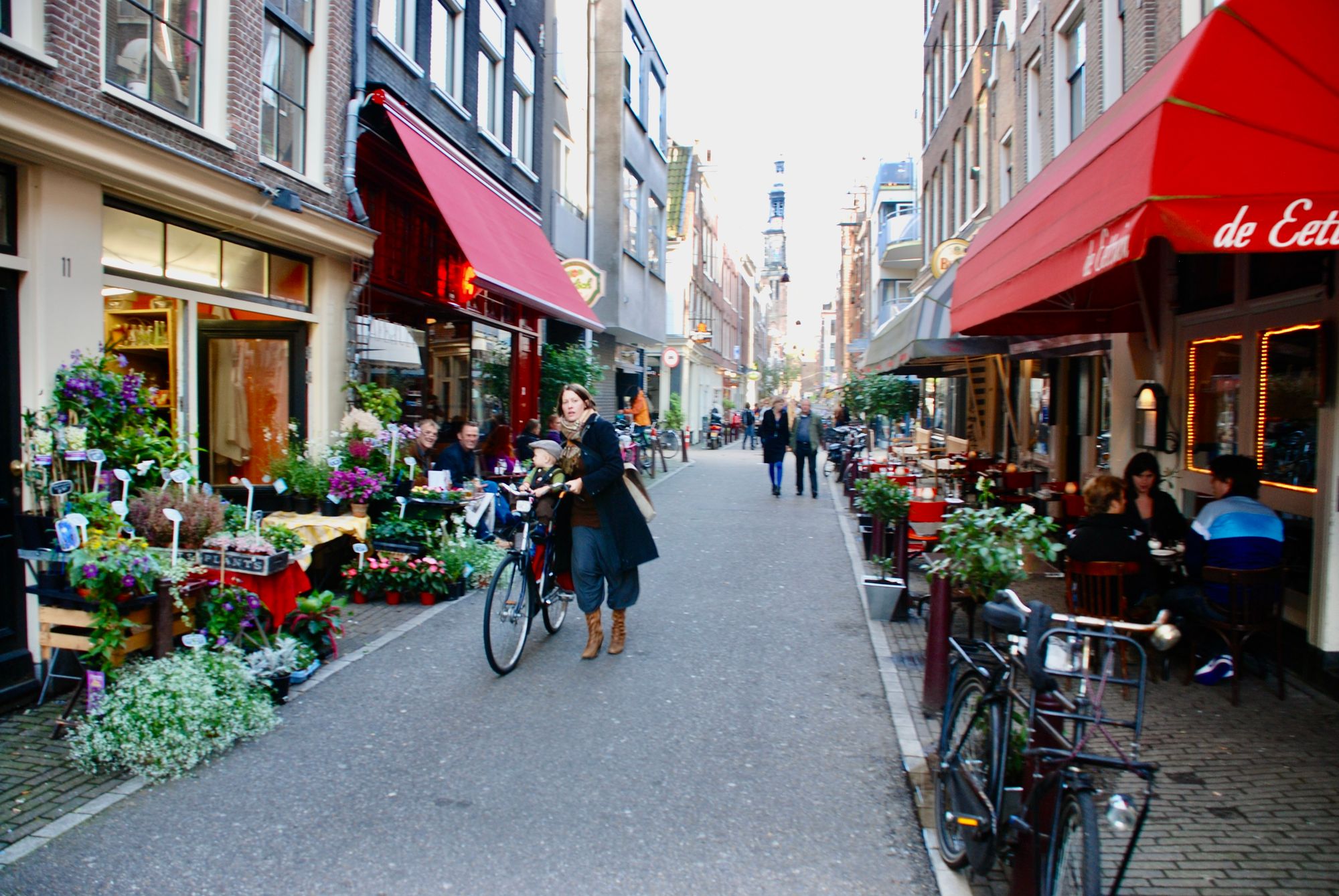
My husband and I have started planning. We are in the early stages of what we hope will be a once-in-a-lifetime trip to Europe. At this stage, everything is tentative and flexible, but the intention is sincere. Our route would take us from Phoenix to Salt Lake City. We would then travel to New York. Next, we would cross the Atlantic to Amsterdam, and continue on to Berlin. From there, we hope to spend time traveling through Germany. We also plan to visit neighboring countries. Prague is one place high on our list.
The time-frame we are considering is September, though no dates are locked in yet. This trip is not about just checking destinations off a list. It’s more about slowing down. We want to see places with intention and appreciate the history, culture, and everyday life of the regions we visit. Germany, in particular, feels like a place where time deserves to be taken. This is true whether in cities, small towns, or the countryside in between.
This isn’t an announcement—just a looking ahead. A few early plans, and an open door for conversation.
The journey brings one of the most meaningful hopes. It is the possibility of meeting people I’ve come to know through writing over the years. Words have a way of building bridges, and in some cases, those connections feel more like extended family than acquaintances. If you are in or near Berlin, Prague, or Amsterdam, I would genuinely welcome your thoughts. I would also appreciate your insights if you know those places well.
If you have advice on places that shouldn’t be missed, I would be grateful to hear them. Share routes worth taking or quieter corners that offer something special. Practical tips for traveling through these areas are also welcome. And if our paths happen to cross along the way, that would be a gift in itself.
More details will come as plans take shape. For now, this is simply a look ahead. We invite you to share your thoughts, insights, and recommendations in the comments below.
We’re only at the beginning of 2026, yet many of us already feel the weight of events unfolding around us. Some disappointments are loud and public, others quieter and deeply personal. They come from headlines. Leadership is a source. Disappointments arise from a loss of trust. It is simply the sense that we keep revisiting the same struggles under new names.
This space isn’t about arguments or absolutes—it’s about honest reflection. Your perspective matters here, whether it’s something global or something close to home. Sometimes naming a concern is the first step toward understanding it.
What is the most disappointing concern you feel 2026 has already brought into the world?
6 responses to “Your Voice Matters: What’s the Most Disappointing Part of 2026 So Far?”
Hello to my loyal readers and visitors—this note will be brief, but heartfelt. Over the next few months, you may notice fewer stories appearing here. Please know this isn’t goodbye or silence; it’s simply a shift in rhythm.
I’m taking this time to focus on editing and publishing two books that have been waiting patiently for their moment. Writing new stories while preparing these projects feels like juggling reading, writing, and proofreading all at once. One task has to slow down. This way, the work can be done right. I’ll still share updates along the way, just not always on a daily schedule.
So if things feel a little quieter than usual, don’t worry. I haven’t decided to stay permanently in last year. I also haven’t skipped ahead without you into 2026. I’m still here… somewhere. I’m just surrounded by drafts and red ink. Stories are getting ready to find their way into the world.
Gregory de Polnay was born on 17 October 1943 in Chelsea, London, England, UK. He was an actor, known for Mansfield Park (1999), Doctor Who (1963) and Dixon of Dock Green (1955). He was married to Candice Caroline White. He died on 1 January 2026 in Poitiers, France.Some reports have listed as 2 January, 2026.
Big Finish Productions confirmed Gregory de Polnay’s death. He was known and respected there for his contributions to audio drama. News of his passing was met with sadness by colleagues, listeners, and admirers of his work.
Gregory de Polnay built a career defined by presence and voice. These qualities served him especially well in the world of recorded performance. Through his work with Big Finish, he became part of a storytelling tradition that values nuance, imagination, and character. He brought scripts to life for audiences. These audiences knew him primarily through sound rather than stage or screen.
De Polnay was not a household name. Yet, his work left a lasting impression within the creative communities he served. Fellow performers and producers remembered him as a dedicated professional. He matched his seriousness of craft with a deep respect for storytelling and collaboration.
Gregory de Polnay is survived by friends, colleagues, and listeners who continue to enjoy the performances he left behind. His voice endures in the stories he helped tell. This ensures that his contribution to the art of audio drama will not be forgotten.
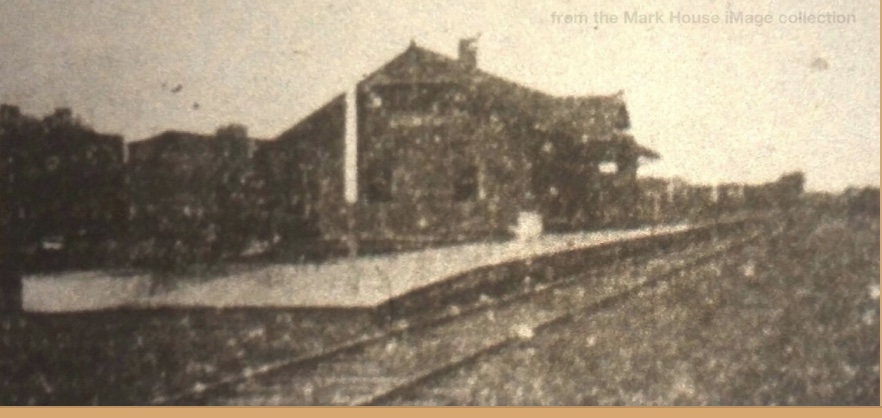
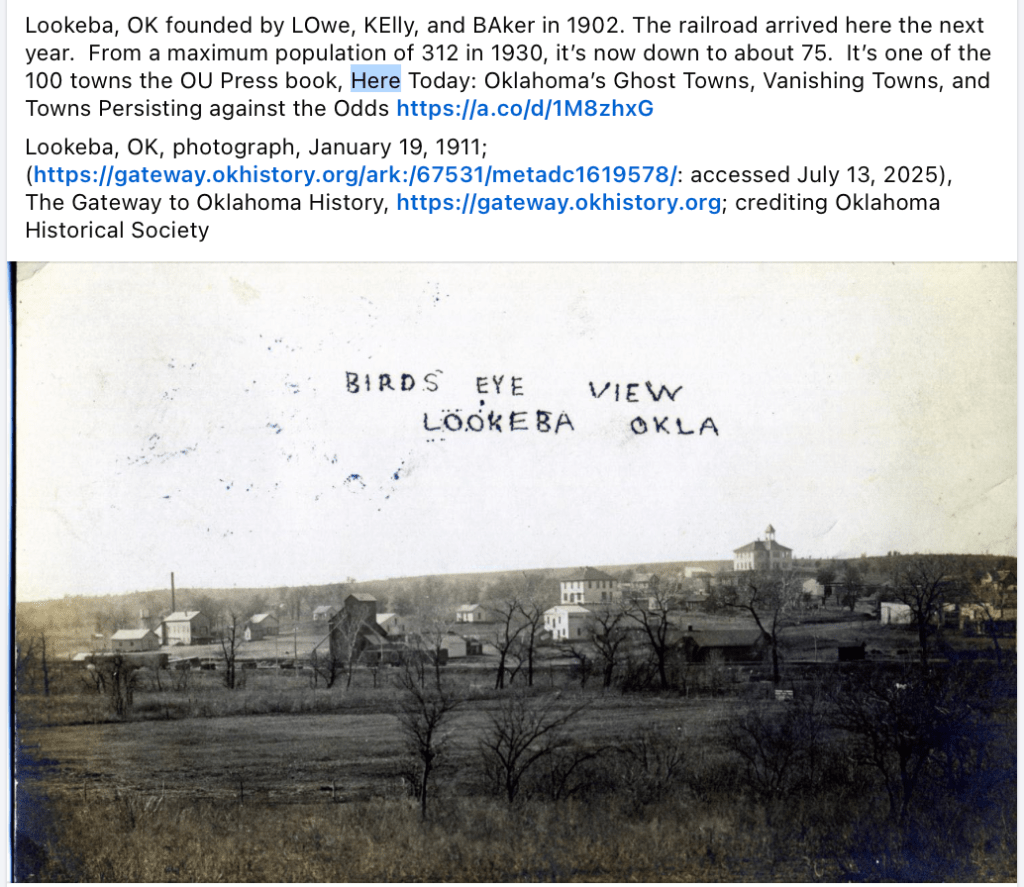
Most folks drive along the stretch of Oklahoma highway between Binger and Anadarko. They roll past Lookeba without ever knowing they’ve entered a place. This place is built on three simple names—Lowe, Kelly, and Baker. These names are stitched together like a handshake. Lookeba. A name that sounds almost tribal or mythic. Yet it originated from the ordinary people. They did what settlers always did in early-day Oklahoma: carved a life out of red soil and hope.
Lookeba Rock Island Depot 1904
Lookeba began as a crossroads community. It was a depot stop on the journey between larger towns. It was a place where wagons once creaked through cottonwood shade. Dust settled on the porch rails of the general store. Early schoolhouses rattled with the laughter of children carrying family names that would define the region for generations. The town’s claim to fame wasn’t oil or railroads or long sweeping history—it was quiet endurance. The land rolled gently. Storms gathered thick on the horizon. People stayed because they felt stitched to it.
Just down the way sat Sickles. It was often written as “Sickless” in old letters and memories. The name came from Hiram Sickles, a farmer. His influence stretched further than the little community ever did on a map. Sickles was more minor—more crossroads than village. Yet, it had what every reasonable Oklahoma settlement needed. This included a school, a store, and neighbors who shared tools and gossip. They also offered weather predictions no weather forecaster can match.
For decades, the two towns lived like siblings. Lookeba was the older and slightly larger child with a stronger sense of identity. Sickles was the quieter shadow tucked between wheat fields and pastures. Students from both communities would merge into the Lookeba-Sickles School District. They formed friendships and rivalries. These bonds outlasted the buildings that once separated them. Generations of ballplayers, farm kids, and rodeo hopefuls came together under one mascot. They were often unaware of the deep connections spanning miles of family history. This history converged whenever the gymnasium lights buzzed to life for Friday night basketball.
Ingram Grocery Lookeba
Time, as it always does in rural Oklahoma, thinned the businesses and emptied the old stores. The Sickles school population lowered long before its name faded from county conversations. Lookeba’s Main Street slowed to a pace that matched the prairie winds. But something remained—something that belongs only to towns like these.
A sense that history is not made by headlines but created by the people who refuse to disappear. Families make history. Their names still ring out in church directories, land deeds, and the memories of class reunions.
Stand in Lookeba today at dusk. The sun lays gold across the wheat. The cicadas start their evening hymns. You can still feel them: Lowe. Kelly. Baker. Sickles. The founders, the farmers, the families whose footprints shaped the land long before highway maps tried to catch up.
Somewhere between Lookeba and where Sickles still stands, you hear echoes of school bells if the wind is right. You also hear screen doors slamming. You hear the voices of children running toward a future. A future no one knew. But, it was a future built on names still remembered.
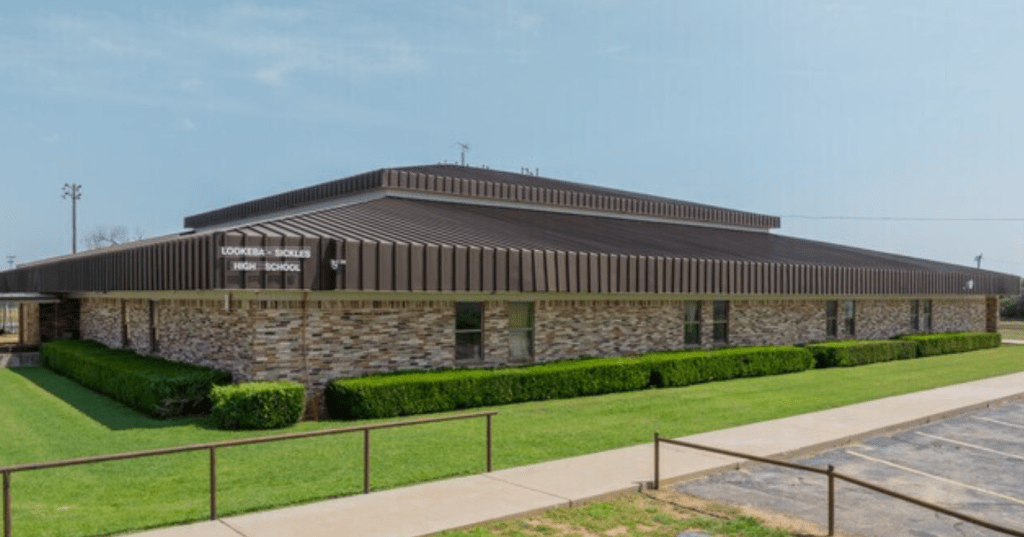
Lookeba-Sickles High School Current Day
Lookeba-Sickles High School is where I graduated many years ago. And, I still remember walking down the hallway and out the doors the last day of school. The thought of entering adulthood was on my mind. As I got to my car, I made a once glance back. A final goodbye, and I was gone.
I was five or six years old in 1968. That is the thought I had at midnight when I couldn’t fall asleep. I tried counting sheep to fall asleep. Nevertheless, every time one got over the fence, I thought of the Pink Panther cartoon. There was an episode where that cool pink cat finally got all the sheep counted onto one side. Then, they stampeded back and trampled him in bed. I worried that happen to me. So I paused.
By then, I’d lost my place anyway. Was I on thirty-five? Or forty-five? I laughed quietly to myself and started thinking about where I first saw that Pink Panther episode. Ah, yes—the living room floor at my grandparents’ house. I had to have been five or six.
That memory sent me down an entirely different path. I started thinking about my grandparents—Mom and Pop, as I always called them in my stories. Mom was in her seventies, Pop in his eighties. Their home was my escape on many weekends and long summer days. Life there felt simple, steady, and safe.
Mom kept a half-gallon tin can filled with treasures. It contained an old set of dominoes, tiny farm animals, and a little truck. I imagined it hauled just about anything. On the linoleum floor of their den, I spent hours building domino fences to keep the animals contained. Sometimes I hauled them off to market. Other times, I stacked the dominoes carefully into what I imagined was an oil derrick. In 1968, an imagination was powerful. An incomplete set of dominoes became anything a kid wanted it to be.
While I worked, Mom rocked gently in her chair, watching me with a smile as her bird, Billy, sang nearby. Pop sat with his pipe, sending out a steady stream of smoke from his Prince Albert tobacco. That bucket of toys kept me busy all day—or so it seemed. I never thought about the world changing beyond that setting.
If I ever got tired of farming, there was something else waiting in that tin can: a long cotton rope. It was also there if I got tired of building oil wells. And the rope was always for one thing—getting hogtied.
The rules were simple. I had to lie still. No kicking. Pop would tie my hands and feet together behind my back. Then wait until the clock on the china cabinet struck the top of the hour. Only then I tried to get loose. I couldn’t kick myself free—I had to work the knots with my hands. It usually took a good hour, but I always managed to escape.
It wasn’t unusual for neighbors to stop by while the grandson was hogtied on the floor. Jimmy Schriver, who lived across the street and stopped in nearly every day, sometimes offered advice. He even tried to help once or twice, which earned him a sharp rebuke from both Mom and Pop.
“No,”
They’d say.
“He must learn to escape from being hogtied. It’s crucial in case his horse gets stolen. And he gets tied up on the trail.”
To a five-year-old, that sounded perfectly reasonable. My dad and I rode horses often. I watched plenty of Roy Rogers, Dale Evans, Rawhide, and Gunsmoke. This showed me that such things happen. In reality, I’ve never been hogtied by anyone other than my grandparents—but back then, it felt like practical training.
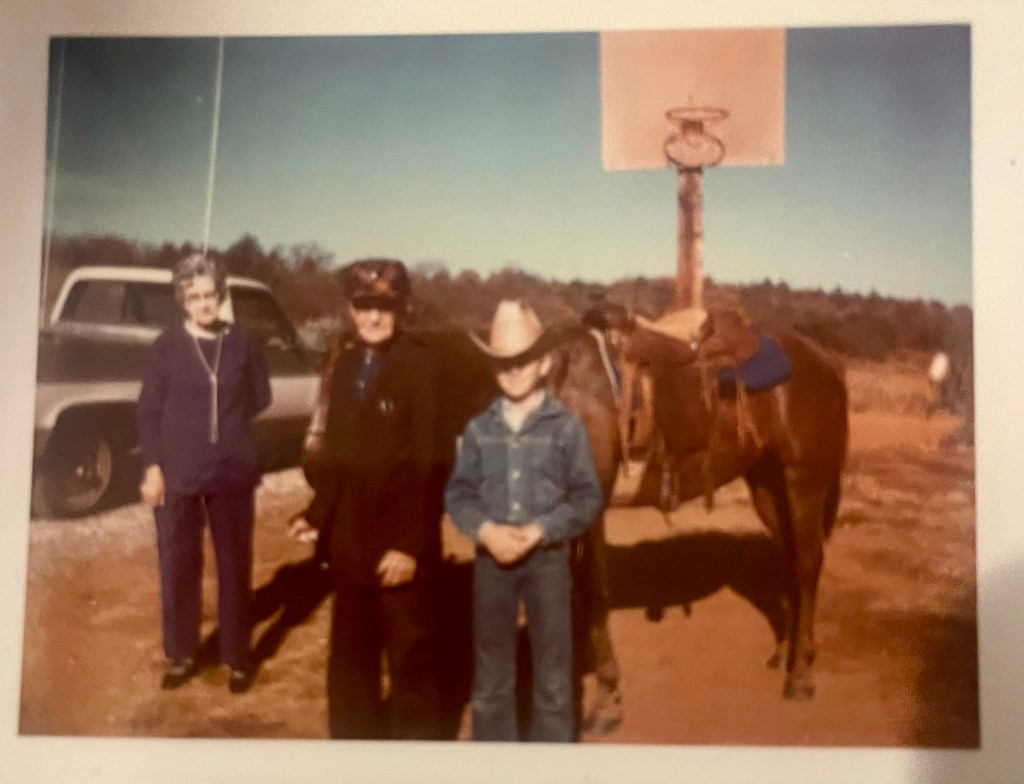
Mom, Pop, & Benjamin age 9,horses name is Sam.
Lying awake that night, I decided not to count sheep or cattle anymore—no sense risking a stampede. Instead, I wondered how my grandparents would be viewed today. What would someone think if they walked in and saw a child tied up on the floor? The child would be working knots while waiting for the clock to chime.
The more I thought about it, the smarter those two old-timers seemed. They discovered how to channel the boundless energy of a child. They couldn’t outrun or outplay the child. Instead, they turned that energy into patience, problem-solving, and imagination.
We played other games—wahoo, dominoes, bingo—but hogtying is the one that stayed with me. I’d look ridiculous asking for it now. If I see Mom and Pop again someday, I’d know which game to play first.
What I understand now is far more clear to me than it ever was back then. They were not really teaching me how to escape a knot. They were teaching me trust. Trust that I was safe. Trust that I could struggle and still be watched over. Trust that someone would always be nearby. They let me work it out on my own. They never let harm come to me. Being hogtied on that linoleum floor wasn’t about restraint. It was about freedom within boundaries. It was about confidence built quietly. It was the unspoken assurance that I was loved enough to be protected while learning how to untangle myself. That kind of trust, once given, stays with you for life. And today, would probably cause you to lose custody of your children.
You have chosen to follow my work. I’ve found my way to yours. Or we’ve somehow crossed paths through shared stories and curiosity. Regardless, I’m grateful you’re here. benandsteve.com is a place built on memory and reflection. We believe every life has value. Every voice deserves to be heard.
Here you’ll find personal stories, history, observations, tributes, and occasional wanderings into humor or wonder. Some pieces are quiet. Some are reflective. Some surprise you. All are written with intention and respect for the human experience we share.
benandsteve.com is a storytelling space built on memory, curiosity, and the belief that ordinary lives carry extraordinary meaning. Here you’ll find personal essays, family and local history, tributes, reflections, and observations drawn from lived experience.
This site isn’t about perfection or performance—it’s about honesty, connection, and preserving moments that otherwise be lost. Stories are shared not to impress. They are shared to remember and think. They remind us that we’re not alone in what we carry.
You’re invited to read, wander, think, and return whenever something calls you back.
Thank you for taking the time to read, follow, and engage. I hope something here resonates with you. It can steady you. Or if it reminds you that you’re not alone in this wide, complicated world. You’re always welcome back—and I’m glad you found your way here.
A Warm Welcome to New Subscribers
If you’re new here—welcome. Several reasons you are here. (1.) You have subscribed by choice. (2.) You discovered this site through a shared story. (3.) We have found one another through mutual curiosity. Regardless, I’m genuinely glad you’re here.
benandsteve.com is a place for storytelling in many forms. These include personal reflections, family and local history, and tributes. It also encompasses observations and the occasional moment of humor or wonder. Some posts are quiet and reflective. Others lean into memory, loss, resilience, or simple human connection. All are written with care and intention.
Thank you for reading, subscribing, and spending your time here. I hope something you find steadies you, sparks a memory, or reminds you that stories—especially ordinary ones—still matter. You’re always welcome back.
A fellow blogger brought up a concern about the difficulties faced throughout the year. They discussed how they met those challenges. Sometimes those challenges are so big they pull one down. Making life’s trials more meaningful is the person one becomes by succeeding.
There’s an old Christmas song. It starts with the words, “Put one foot in front of the other.” Soon, you’ll be walking across the floor. It’s always been a pick-me-up for me this time of year. While it’s meant for children, I believe the child in us all still needs lifting up occasionally.
Hard times in life often seem to arrive when we’re already struggling, or at least that’s how it feels. Looking back on my own experiences, those moments have pushed me to become a better version of myself. Overcoming our shortcomings during difficult seasons speaks quietly to others who are watching. This happens even when we don’t realize we’re setting an example. Sometimes, it’s deeply needed.
Sometimes our hardships end up serving others just as much as they serve us. This response wrote itself, and I’m not entirely sure where it came from—but maybe that’s the point.
I’m curious. What song, moment, or quiet reminder has helped you? How did it help you put one foot in front of the other when life felt heavy?
For a lift of the holiday spirit ~ here is the instructions on putting one foot in front of the other.
The Blizzard of ’78 was no ordinary snowstorm. It howled through North America, blanketing rooftops and highways, erasing the horizon in a swirling fury of white. Santa Claus sat in his workshop. He held his red velvet hat in his hands. He stared solemnly at the weather reports brought in by the Weather Elves.
“It’s no use,”
Santa said, his voice heavy.
“We can’t fly in this. It’s too dangerous. The snow is too thick, and even Rudolph’s nose won’t cut through this blinding storm. I have to call off deliveries.”
Gasps filled the workshop. Elves dropped their tools, and Mrs. Claus paused her cookie baking. Cancel Christmas? It was unthinkable.
But one elf, a tinker named Chetwood, didn’t gasp. He didn’t drop his tools. Instead, he dashed to his workshop in the far corner of the North Pole. Odds and ends of toys from Christmases past piled high in organized chaos.
Chetwood had been working on a secret invention for years. He used discarded parts from electronic toys no child had wanted. These parts included remote-controlled cars, walkie-talkies, old circuit boards, and an outdated Etch A Sketch. He believed there had to be a way to guide Santa’s sleigh through anything, even the thickest fog or snowstorm.
Tonight was his chance.
For hours, Chetwood worked feverishly, soldering wires, tweaking circuits, and adjusting dials. The other elves whispered about his eccentricity.
“Chetwood’s always been a dreamer,”
One said.
“What could he possibly be doing now?”
At midnight, the storm raged on outside. Chetwood burst into the main workshop. He was holding a contraption resembling a patchwork of wires, gears, and blinking lights. He had painted it candy-cane red with a shiny silver antenna on top.
“Santa!”
He cried.
“I call it the Chetwood 500. A radar system can guide the sleigh through total darkness, blizzards, and even the densest fog. I made it from old toys that no one wanted—because one elf’s trash is another elf’s treasure!”
Santa raised an eyebrow but smiled warmly.
“Chetwood, are you sure this will work?”
“With 100 percent accuracy,”
Chetwood replied proudly.
The elves gathered around as Chetwood mounted the device on the sleigh. The radar emitted a soft, rhythmic beep, lighting up a screen that displayed glowing outlines of obstacles in their path.
Rudolph gave an experimental snort and trotted to the front of the sleigh, curious about the gadget. Santa climbed into the driver’s seat, gripping the reins tightly.
“All right, Chetwood,”
Santa said.
“Let’s see if your invention can save Christmas.”
The sleigh took off into the Blizzard, disappearing into the swirling snow. The elves held their breath, watching the radar screen from the workshop.
Minutes turned into hours. Soon, reports came in from children across the globe. Santa had arrived, gifts were under the tree, and stockings were filled. The Chetwood 500 had guided the sleigh flawlessly, even through the most treacherous conditions.
When Santa returned to the North Pole just before dawn, he lifted Chetwood onto his shoulders.
“You didn’t just save Christmas, Chetwood. You’ve created something that will change the world. One day, your radar will guide airplanes and ships where they’ve never dared to go before!”
From that day on, Chetwood’s invention became a staple of Christmas lore. Every Christmas Eve, the Chetwood 500 sat proudly atop Santa’s sleigh. It served as a reminder. Even the most unwanted things can shine with purpose in the hands of a true believer.
Santa is cruising through a starry night, his sleigh packed with presents. The reindeer are soaring with precision, Rudolph’s nose shining bright as they approach the bustling skies over Los Angeles. Santa remarks on how the city glows more colorful each year, marveling at the dazzling lights below.
The Problem Arises:
Santa checks his list. He guides the sleigh toward his next stop. Suddenly, he encounters a startling sight: a line of airplanes backed up in the sky. The sleigh slows as Rudolph blinks in confusion, and Santa pulls out his magic map to see what’s going on.
The airspace gets crowded with jets circling LAX, cargo planes, and private airplanes. Santa tries to weave through the gridlock but quickly realizes he’s stuck in a “sky jam.”
Santa’s Reaction:
Santa, determined to overcome this unexpected obstacle, starts to worry. He’s never faced air traffic congestion before! His magical sleigh, while nimble, still must adhere to the rules of the sky to avoid being spotted. He radios an air traffic controller using a unique device from his sleigh—something he rarely needs to do.
The controller is startled but professional.
“Uh… Santa? Is that you?”
“Ho ho ho! Yes, indeed! And I’m afraid I need some assistance navigating this mess!”
A Helping Hand:
The air traffic controller, Mia, quickly gathers her colleagues. They realize the only way to clear Santa’s path is to redirect some planes. Mia cleverly uses holiday magic and persuasion to coordinate a temporary gap in the airspace.
Meanwhile, Santa and the reindeer entertain themselves by performing aerial stunts. They draw candy canes in the sky. They share cookies with passing pilots who radio in. Their voices are filled with disbelief and joy.
A Creative Solution:
Santa, ever resourceful, taps into his bag of tricks to make up for lost time. He uses his magic to make his sleigh move twice as fast once the path clears. He asks for help from local elves stationed in Los Angeles. They zip around on drones to deliver some gifts while he’s getting delayed.
Santa’sResolution:
The airspace clears, and Santa takes off like a rocket. With a heartfelt
“Thank you!”
To Mia and the air traffic team, he speeds into the night. He catches up on his deliveries with minutes to spare.
Ending:
As Santa finishes his rounds, he reflects on the night’s chaos. He chuckles, imagining the stories pilots will tell about seeing a sleigh stuck in traffic.
This piece is a beautiful reminder that there are countless reasons to smile and listen. No matter your language, its music will leave you yearning for more.
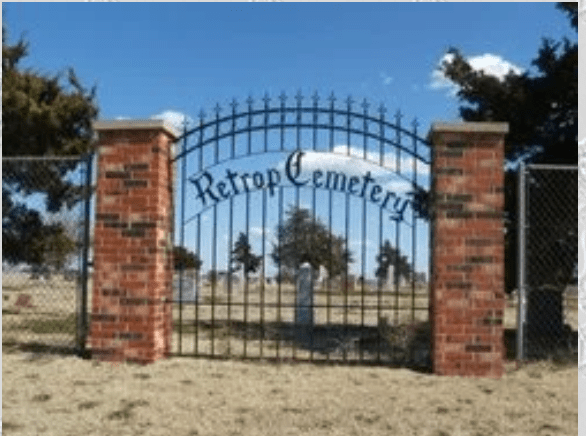
Most people driving the stretch between Granite and Elk City never realize they’re passing over a ghost. The four-lane highway hums along smoothly. Underneath its concrete spine once stood a town with a name born from a clever workaround. The town was called Retrop, simply Porter spelled backward.
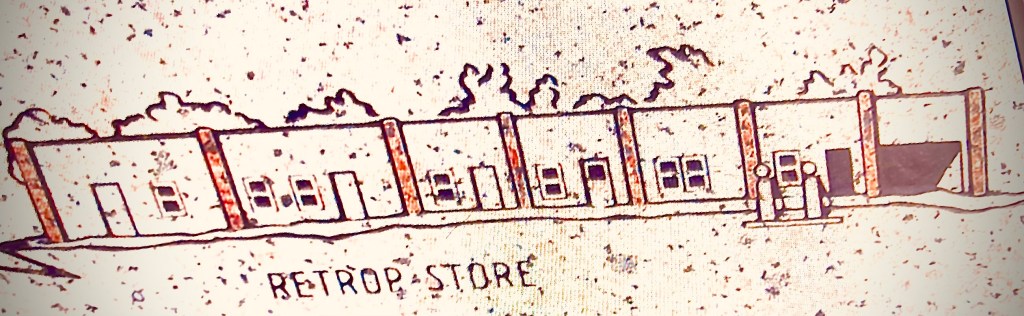
Back in the early 1900s, the community wanted its own post office. But Oklahoma already had a Porter, and the postal authorities weren’t about to sort through that confusion. So the folks along the dusty road west of Sentinel shrugged, flipped the name around, and mailed in the paperwork. Retrop got its post office, its school, and its place on the map—at least for a while.
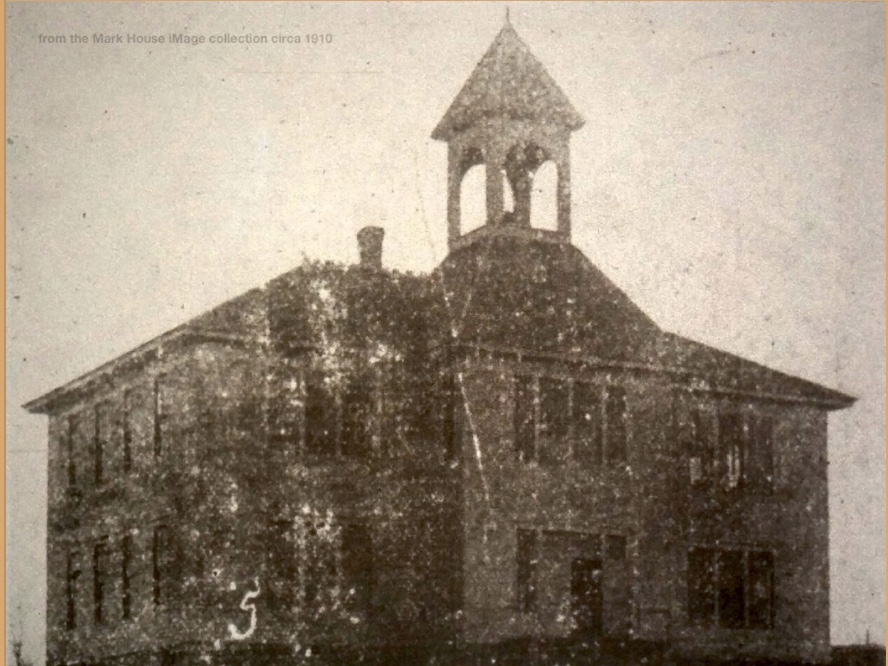
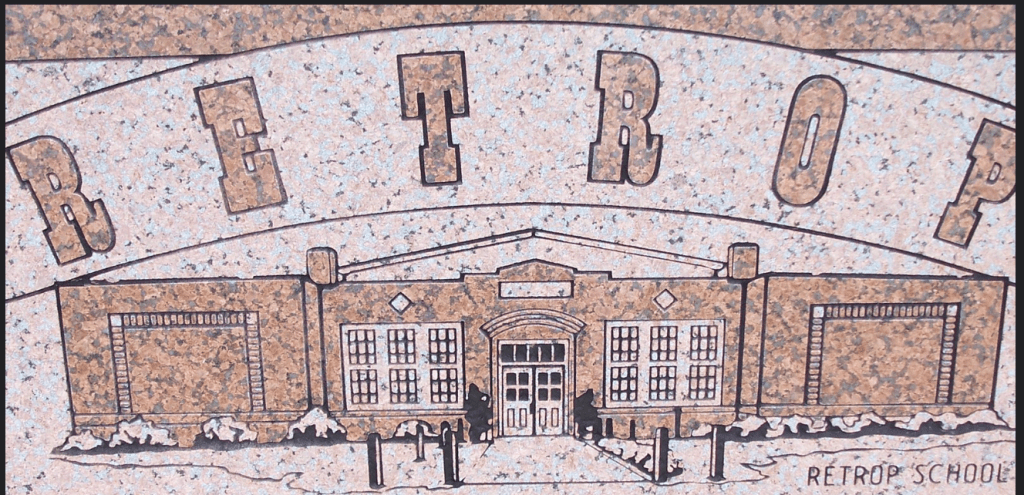
The school sat at the center of it all. A sturdy brick building with wide windows and a playground carved out by decades of small feet. Children rode in from miles around, their lunches wrapped in wax paper, their futures unwritten. There were stories—quiet ones—of students who went on to big cities and bigger lives. A doctor in Chicago. An engineer for NASA. A novelist whose pen never found its way back home. They carried Retrop inside them, even after the town itself faded away.
But Retrop’s beginning was clever. Its ending was swift.
When the new highway came through, the town didn’t stand a chance. Businesses folded. Families moved. The school closed its doors. The post office was shuttered. One by one, the foundations cracked and the roofs caved until only fields remained—fields pretending nothing had ever stood there.
Except for one detail people still talk about, though no one can confirm it anymore: the missing bell.
Retrop had its own Masonic Lodge in the 1940s
The school’s bell had hung proudly in the tower for decades. It called children in from recess and sent them home at day’s end. Then one year—a generation before the school closed—it vanished. Not stolen, exactly. Just gone. People assumed it had been taken for safekeeping. They thought it was stored in somebody’s barn for future repairs. Others believed it had been hauled away accidentally during a renovation.
The last families left Retrop. Then, bulldozers finally erased the last bricks of the school. Yet, the bell was still missing.
Some say the bell found another tower along the prairie. Others swear it sits buried beneath the highway, trapped in silence under thousands of cars a day. A few whisper that the bell rings on its own now and then—never heard, but felt. A tug in the chest. A memory rising like dust in a beam of sunlight. A sound from a place people forgot existed.
Most modern maps don’t show Retrop anymore.
But every once in a while, someone driving that long Oklahoma stretch will slow down for no reason at all. They will stare out toward the open fields. They swear they can sense something that has no business being there.
A town that isn’t. A school that was. And a bell—somewhere—still waiting to be found.
The Bell on County Road 7
No one knew who put the bell there. The old timers from the old school days at Retrop had all gone. Buried. The generation had died off. The families had sold their farms. Or, the farms had been handed down through generations. The old school bell had been forgotten. Until…
It appeared one Tuesday morning. It stood silent, rusted, and leaning a little to the left. The scene was at the far end of County Road 7, right where the asphalt surrendered to red dirt. The bell looked ancient, the kind you’d expect to find hanging outside a one-room schoolhouse or a long-gone prairie church. But there it stood, bolted to a cedar post that hadn’t been there the day before.
Folks in town had theories, of course. In places like Washita County, theories sprout faster than wheat after a spring rain.
Old Mrs. Peabody said it was a sign from the Lord. Hank Ballard at the feed store claimed it was an art project. College kids with too much time and not enough sense created it. Deputy Collins figured someone dumped it there after cleaning out a barn.
But no one claimed responsibility. And no one can explain what started happening a week later.
Every morning at exactly 5:17 a.m.—never a minute sooner, never a minute later—the bell rang.
Just one tone.
Clear. Strong. Impossible to ignore.
At first people thought it was a prank. Someone out there at dawn, pulling a rope and having a good laugh. But when a few curious souls drove out at that hour, no one was ever there. They’d wait in their cars or stand beside the fence line with coffee steaming in cold hands. The prairie would hold its breath. Coyotes would go quiet.
And then the bell would ring.
The sound didn’t vibrate through the metal—folks swore it vibrated through them. It was as if it reached down and stirred up something old they’d forgotten. It is a memory, a regret, or a promise left sitting too long on a dusty shelf.
For some, the mornings changed them.
Mr. Conway, who hadn’t spoken to his brother in twenty years, drove to Elk City and patched things up. Annie Lucas finally mailed the letter she’d been writing and rewriting for a decade. Deputy Collins insisted the whole thing was nonsense. Despite this, he found himself stopping by a certain headstone in Sentinel more often.
But on the eighth morning, the bell didn’t ring.
Not at 5:17. Not at all.
When people went to check, the bell was gone—post and all. As if erased. Only a square of red earth remained. It was freshly disturbed. It was like someone had quietly lifted a piece of the world and carried it away.
The next day, life went on. Coffee brewed, trucks rumbled to work, and theories fluttered around like tumbleweeds. But every now and then, people found themselves glancing toward County Road 7, half-expecting a sound that no longer came.
Still, there are some who swear, when the wind blows just right across the prairie, they can hear it faintly in the distance:
One clear, steady ring.
A reminder of something they’re still meant to do.
Police work operated on instinct, humor, and gritty common sense before body cameras. Every arrest didn’t turn into a viral upload back then. This approach belonged to another era. Officers learned from veterans who passed down unwritten rules — some practical, some questionable, and some downright hilarious. These stories aren’t a manual. They’re memories from a world that helped shape the officers we later became.
Don’s Lessons for Rookie Officers
Don was a seasoned officer whose wisdom mixed patience with a dry, knowing humor. He often told rookies about the prisoners who would scream for an entire transport ride. These are the same kind you see in fifteen-minute viral videos today.
He’d tell the infamous alum-powder story with a wink.
“Keep a plastic bag of it in your shirt pocket.
If you get a screamer, take a pinch and flick it – they will shut up!”
This always left rookies unsure whether he was pulling their leg. Or, was he sharing some relic from an era with fewer rules and more noise? His message was never about techniques. It was about the mindset: don’t let chaos set the tone. And always keep your humor intact.
The “Dog!” Brake Test
Another bit of old-school folklore involved the rowdy back-seat prisoner who wouldn’t stop cussing or kicking. Officers had a classic trick:
Get the patrol car up to about forty-five miles an hour.
Slam on the brakes.
Yell,
“Dog!”
The prisoner would slam into the cage divider and go silent. This silence would last until the second dog ran across the road. By the time they arrived at the jail, the only thing left in them was concern for the imaginary dogs.
It wasn’t policy. It wasn’t pretty. It was one of those stories officers shared over coffee. They shook their heads at “the way things used to be.”
The Gilligan’s Island Sobriety Test
DUI stops had their own brand of comedy. When you already knew the drunk driver was going to jail, the roadside field tests became… creative.
The “Gilligan’s Island Test” was a favorite:
Place your left hand over your head. Hold your right ear with your right hand. Balance on one foot. Sing the theme to Gilligan’s Island.
Most never made it past “a three-hour tour.”
It broke the tension. And after a long, cold night, sometimes everyone needed that.
Jurisdiction and the Art of Paperwork Avoidance
Jurisdiction lines used to shift like sand depending on who wanted — or didn’t want — the call. If the incident required endless paperwork, officers suddenly cared very deeply about city-limit boundaries, council-meeting notes, and outdated maps.
Veterans avoided calls they weren’t dispatched to, knowing the penalty: days off lost to court subpoenas. Midnight-shift officers often clocked out at dawn. They then sat in a courtroom until midafternoon. They did this while waiting for cases where they never said a word.
It was exhausting, but it was part of the rhythm of old-school policing.
A Time Before Cameras — And a Time With More Witnesses
These stories sound wild today, but much of policing back then was driven by common sense and community trust. People knew officers, and officers knew their people.
Citizens were often the first to speak up if an officer crossed a line. This happened long before social media or body cams existed. Even without technology, accountability came from individuals who believed in keeping standards high.
Most officers didn’t stop someone without a genuine reason. Those who abused that privilege rarely lasted. It was an unwritten rule — understood, enforced, and expected.
Closing Reflection
Old-school policing wasn’t perfect — not by a long shot. But it existed in a different world with different expectations. Humor softened harder edges. Community relationships carried more weight. And the job, for better or worse, relied on improvisation.
Today’s policing is built on transparency and technology, and that’s a good evolution. But these stories stay important. They are reminders of the human side of the badge, the long nights, and the strange solutions. These stories also recall the characters who trained us and the moments that shaped us along the way.
One persistent problem is untruths. Misinformation continues to mislead the public. These actions make the police look unfavorable.
Benjamin Groff is a former police officer and radio news anchor. He has hosted programs for CNN and ABC News affiliates in Colorado and Wyoming. His career in law enforcement began in 1980 and lasted more than two decades. This gave him firsthand insight into the criminal mind and public safety. Moreover, it provided him with an understanding of the human stories that often go untold. His writing draws on these experiences, blending street-level truth with a journalist’s eye for the bigger picture.
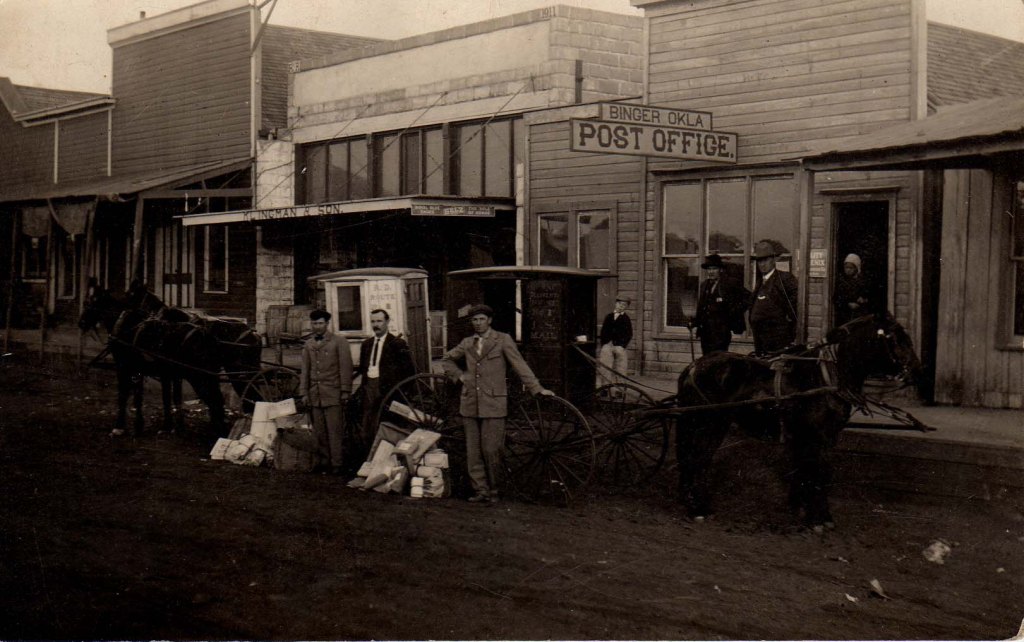
The next photographs depict an small town in Oklahoma from its birth through current day.
Going to town. Getting groceries, supplies and other needed items were essential trips in the late 1800s and early 1900s. Towns like Binger, Oklahoma were places where such trading centers would become popular. Train depots and later bus lines would bring needed connections to the area.
The above photos capture buildings that no longer stand. They were lost in one of the early fires that shaped the town’s history. The original downtown was once located near the area now known as the Johnny Bench Ball Park. This is at the Fair Grounds. After each fire, the town slowly shifted north. It rebuilt itself one block at a time. Eventually, it settled into its current location. The Post Office was a major accomplishment for any community to achieve. When a post office came, it marked the community’s success. The community became a reliable base for investors, visitors, and tourists.
State Highway 152 now runs through the center of town. Locals know it as Main Street. This familiar stretch has quietly observed generations pass through. This place is not what I call my hometown. But, it remains part of my associations. It is woven into the landscape of where I grew up and the memories that shaped me. During the 1950s to 1980s, hundreds of teenagers gathered on Binger’s Main Street. They saw it as the Main Drag on Friday and Saturday nights. It was as hot as a radio station spinning its latest hit. Both tunes filled the air from the City Hall. Tires spun all the way to the east end by the CO-OP. Button Williams, the towns Police Chief, watching carefully over the towns teen as he had since God’s creation. His Assistant Chief Jerry Wright there to catch calls on off nights.
Binger has always felt like one of those places where sports held the town together. The fields and courts were filled with tough farm kids. They were shaped by long days and dusty roads. Life taught them strength early. Many came from the Caddo and Kiowa Nations. People from other tribes joined them. Together they formed a close-knit spirit. This made every game feel like a community event.
From those humble beginnings came Johnny Bench. He was a local boy who carried his talent all the way to the Cincinnati Reds. He proudly wore number 5. The town still honors him with a small museum. It serves as a quiet reminder of how far a dream can travel from a place like this. And then there was Robert Johnson Jr., who tasted professional baseball but chose the familiar comfort of small-town life instead. In these memories, the heart of Binger lives on. It resides not just in its history. It also lies in the way it shaped those who once called it home. My grandfather bought the first Model T Ford from the town of Binger’s Ford dealership. They came to town to sell them when the Model T’s came out. “Pop” described the Ford outfit as being near where an old Caddo Electric building sets today. If you drive through the town, you will see the big white building. It’s on the corner near US281 and SH-152.
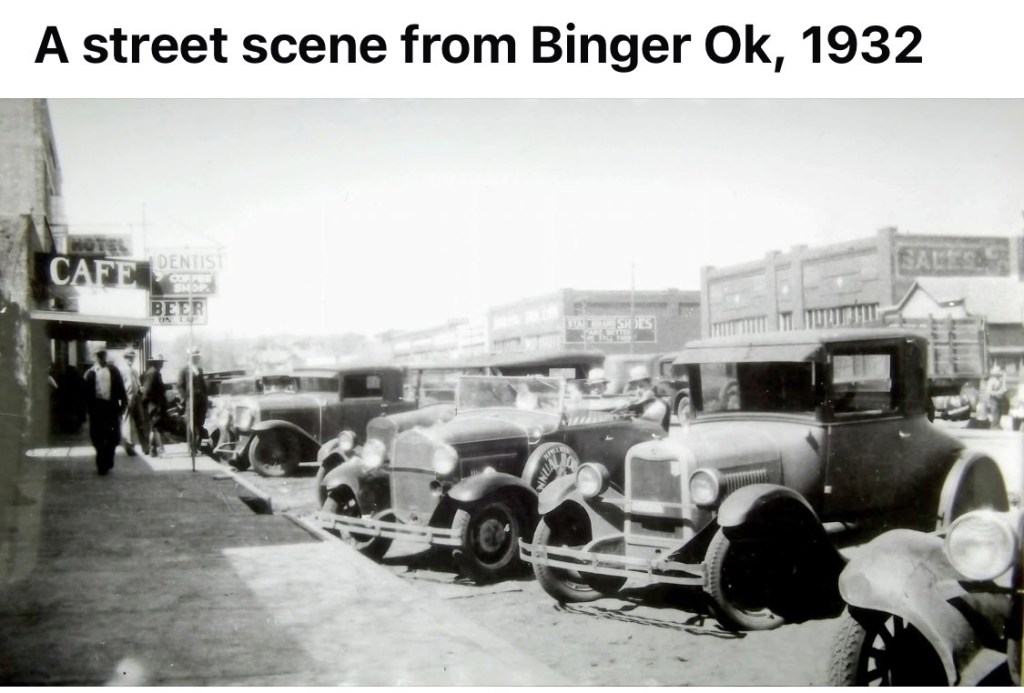
The above photo shows Main Street in Binger, Oklahoma, in 1932. It captures a quiet moment frozen in time. After the town burned twice, it rose again each time. It was rebuilt about a block north of its original location. This carried with it the stubborn spirit of those who refused to let it disappear. This image shows what became the final resting place of that rebuilt heart of town. When the sidewalks were poured, metal rings were set into the concrete. They were meant to tether horses and wagons. Townsfolk stepped inside to conduct their daily business. For decades, those rings remained. They served as humble reminders of a slower pace and simpler life. In the mid-1970s, new federal accessibility requirements called for lower ramps and fresh pavement. With that change, the old sidewalks were replaced. The iron echoes of the past quietly vanished. Now, only memory and photographs tell their story.
This photo was found behind a old counter in the back of a business in the 1970s. Its dated as being in the 1920s. Which is a possibility. The name of the business is unknown. Yet longtime residents at the time did recognize the business as belonging to the town.
Binger once hosted three cafes and a hardware store. It also had two barber shops, a bar, and a propane company. There was a drug store, a movie theater, and two grocery stores. Additionally, it featured two laundries, a plumbing company, and a funeral home. The town included a post office, an electrical repair shop, a junk-pawn shop, and a pool hall. Binger also had two dry goods stores and a Western Auto. It had a Chevrolet Dealership, a TV Repair Service, and Three Service Stations. These were a Sinclair, a Gulf, and a Git-N-Go. There was also a dress shoppe. There was even a healthy farmer’s Co-Op. There were many other businesses that came and went in between the years. The public school was well respected in the County and had been given financial support to meet its needs.
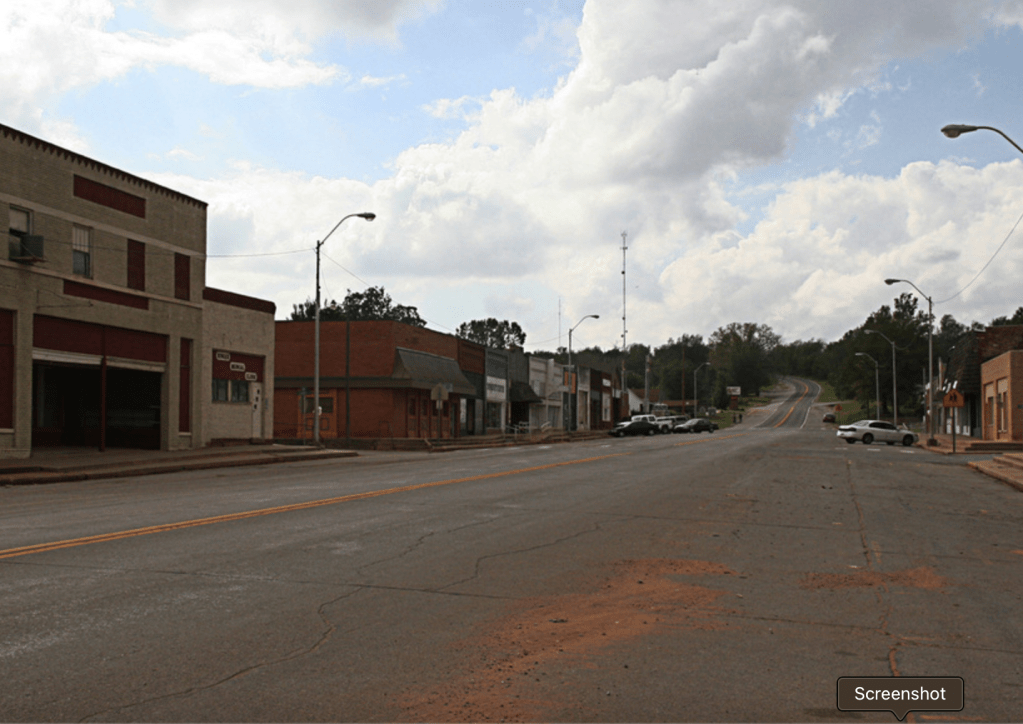
This is a photo of the buses traveling both directions along Main Street in Binger. I’ve carried it with me for years. I have shared it many times. It always stirs the same familiar sense of remembering. This photo was taken while looking west. It captures the gentle rise at the end of the street — Binger Hill. For generations, this slope has slowed heavy trucks. It becomes unforgiving during icy winter storms.
On the right side, the white building stands just before the line of trees begins. It once served as City Hall. Inside were the fire department, water department, and city clerk. The building also housed a small police office. There was a jail that I can assure you no one was eager to test. The bars were thick, cold steel, reinforced and unyielding. I saw more than a few individuals placed there by the town’s two-man police force. This pair quietly carried more responsibility than most ever realized.
This photograph isn’t just about traffic or buildings. It holds a piece of a time when Binger moved at a gentler pace. The town watched over its own. Every corner held a story waiting to be remembered.
Johnny Bench rode home with the Binger High School baseball team on April 1, 1965. They had just played a game in nearby Riverside. This was a routine trip. It would become a moment forever etched into the town’s history. As the bus crested a hill, the coach suddenly realized the brakes had failed. The vehicle couldn’t slow down. It careened into a curve at dangerous speed. It burst through the guardrail and plunged nearly fifty feet into a ravine below.
The accident claimed the lives of two young teammates, Harold Sims and Billy Joe Wylie. This loss rippled through a small community that mourned deeply. Amid the chaos, Bench survived. He was guided by advice once given by his father. His father was a propane truck driver who understood the dangers of the road. He had told his son that in such a situation, the safest place was the floor of the vehicle. Remembering those words, Johnny dropped down. He instinctively pulled teammate David Gunter with him. This act well have saved both of their lives.
What followed was not just a tale of tragedy. It was also a story of instinct and survival. There was a quiet strength carried forth from a small Oklahoma town into the story of a legendary career.
Johnny Bench, the legendary Cincinnati Reds catcher, was known for the remarkable size and strength of his hands. Many claim he can palm as many as five baseballs in one hand. He famously demonstrated this skill on the television program This Is Your Life in the early 1970s. This moment is still remembered by many longtime fans.
Today the state highway runs right through the town’s middle section. What once was a Main Street with shops and store fronts bustling with shoppers and townspeople is now empty. It is nearly deserted.
Opitz Cotton Gin is no longer open
Cart’s Lumber on the Town’s East side is one of the few businesses providing services to the town.
The Medical Center reportedly closed some years ago.
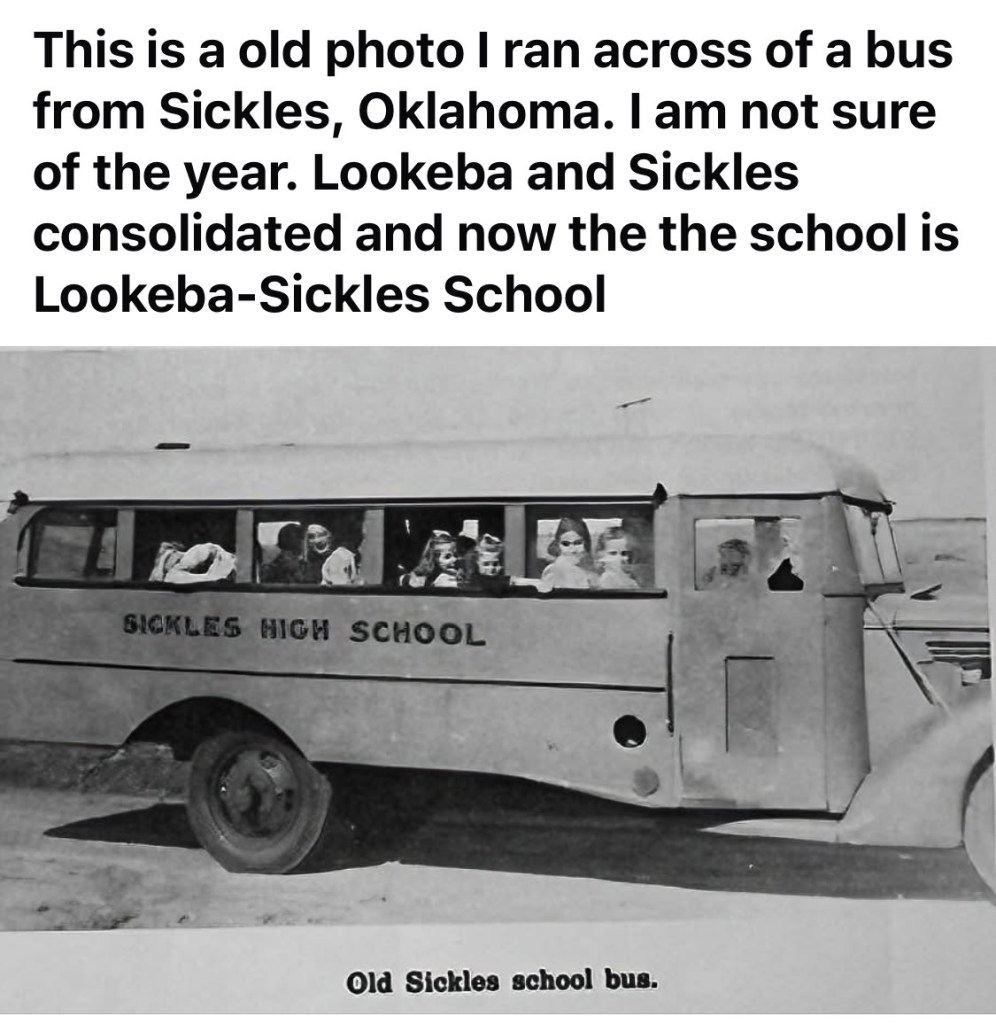
There are a few businesses still open in the town. A dollar store, a satellite bank of a local branch is located on the hill. There is one diner. A convenience store. A bar and the Post Office. But for most part, the buildings you find will be empty, boarded up and closed. In the 1970s, the town’s streets were packed with people parking to go shopping on Main Street. Now, the streets are wide open. Many contribute the towns rundown to the Caddo Electric Headquarters moving it’s headquarters three miles east of town. It caused many doing business with the Electric Cooperative to avoid stopping in Binger. It was the first set of nails in the towns casket. The others were placed there when too much faith was placed in the oil industry. Then as shops began to close, people began to move, and the towns center stopped functioning. I know because I was there and watched it. This was the town closest to our farm. I graduated from a school some fifteen minutes away, a place called Lookeba-Sickles. And that place is story for another day!
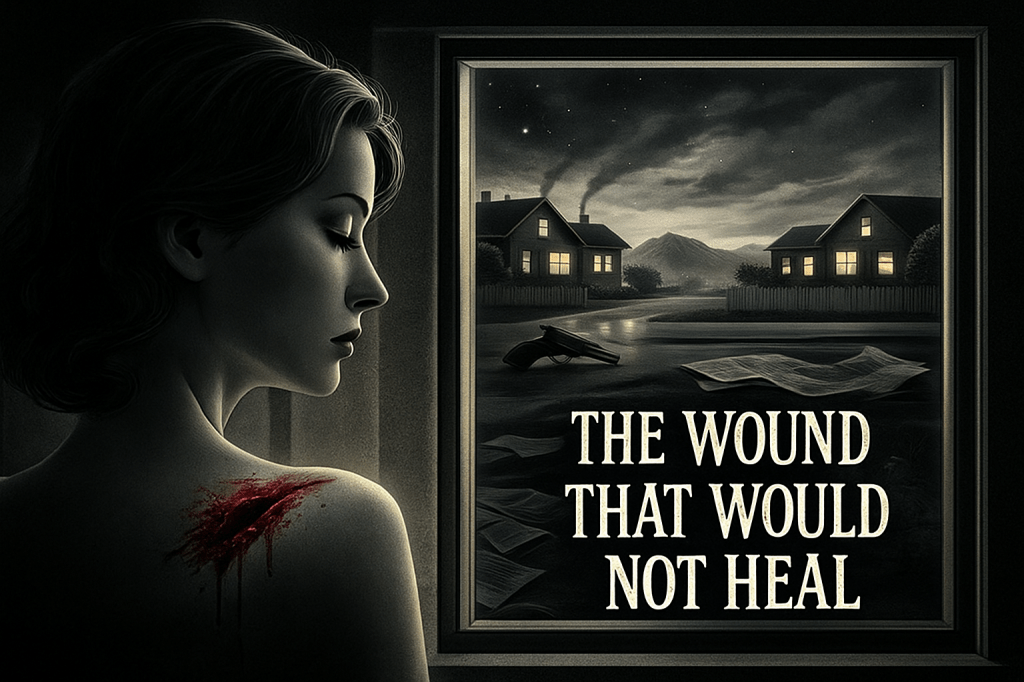
No one remembers precisely when the truth first slipped away. They only knew it had happened quietly. It occurred somewhere between the gunshot and the bandage.
Mara Ellison had lived beside Harold Pike for seven years without incident. They exchanged polite nods, sometimes a forced smile across the narrow strip of gravel separating their properties. So when the bullet tore into her foot one late afternoon — fired inexplicably from Harold’s back porch — she assumed the world would respond with reason.
It did not.
The police arrived within minutes, yet their questions drifted strangely away from the obvious. Why had she been standing there? Had she provoked him? Were there prior disagreements she had neglected to mention? Harold, calm and unsettlingly sincere, claimed the gun had “gone off on its own.” Soon, the incident was reclassified as an unfortunate misunderstanding.
Mara limped through the next weeks on swelling and disbelief. Her foot healed slowly. But the real pain settled elsewhere. It lingered in the way neighbors crossed the street to avoid her. It was noticeable in the whispers that followed her like dust. She was suddenly labeled unstable. Dramatic. A troublemaker.
She filed complaints. She documented every detail.
Each report vanished like breath on cold glass.
Harold began mowing his yard at odd hours, staring straight ahead, humming tunelessly as though nothing had happened. His friends brought casseroles. People clapped him on the back. Someone even hung a banner on his fence that read:
WE STAND WITH HAROLD.
Mara woke one morning to discover a court summons slid beneath her door. Harold claimed she had injured herself deliberately. He said it was to ruin his reputation.
The town agreed.
Reality itself began to warp. The scar on her foot throbbed while local newsletters praised Harold for his patience and “strength of character.” A small feature in the paper framed Mara as a disturbed woman seeking attention. Her own name felt foreign in print, warped by accusation.
Street signs near her home began to shift. Directions pointed nowhere. Familiar shops closed overnight. Conversations dissolved mid-sentence when she approached.
One night, she saw herself on the evening news. She looked laughing, cheerful, and perfectly fine. In reality, she sat alone. She stared at the bandage that never quite came off.
The bullet wound refused to disappear.
Nor did the silence that followed everyone’s denial of it.
On the final day anyone heard from her, Mara stood before the cracked mirror of her hallway. She whispered,
“If the world insists I am wrong, then what am I supposed to become?”
Outside, Harold watered his flowers with careful devotion.
Inside, Mara stepped into a reality no longer willing to recognize her. She vanished into a story written by others. This story never spoke the truth. Yet it was repeated loudly enough to become law.
Some said the house stood empty.
Others swore that if you passed it at dusk, you hear the faint echo of limping footsteps. They claimed to hear a voice pleading, again and again, to simply be believed.
Harold, meanwhile, withdrew mysteriously from society after Mara disappeared. He became a recluse, a shadow of the man the town once defended so fiercely.
Mara, in time, became folklore — “the woman no one believed.” Some claimed she had simply self-immolated. Others said she cried herself into nothing. A few insisted they saw her walking away from her home. She moved slowly toward the setting sun. She never once looked back.
Then, exactly ten years to the day of Mara’s shooting, Harold was found dead.
His body bore the evidence of prolonged torment . — Gunshot wounds in both feet, knees, hips, abdomen, hands, elbows, and upper arms. Each injury, save for the final one, had healed. The coroner confirmed a chilling pattern: Harold had been shot, treated, allowed to recover ––and shot again. Repeatedly, over the span of a decade.
The final bullet entered the right side of his head.
Nearby, written in a trembling hand, were the words: “I can’t take it anymore.”
Had Harold been punishing himself for the truth he buried? Had Mara’s spirit delivered a slow and deliberate reckoning? Or had she never left at all — only waited?
Silence and shadows enveloped the town. It learned a lesson far too late: When truth is denied long enough, it finds other ways to speak.
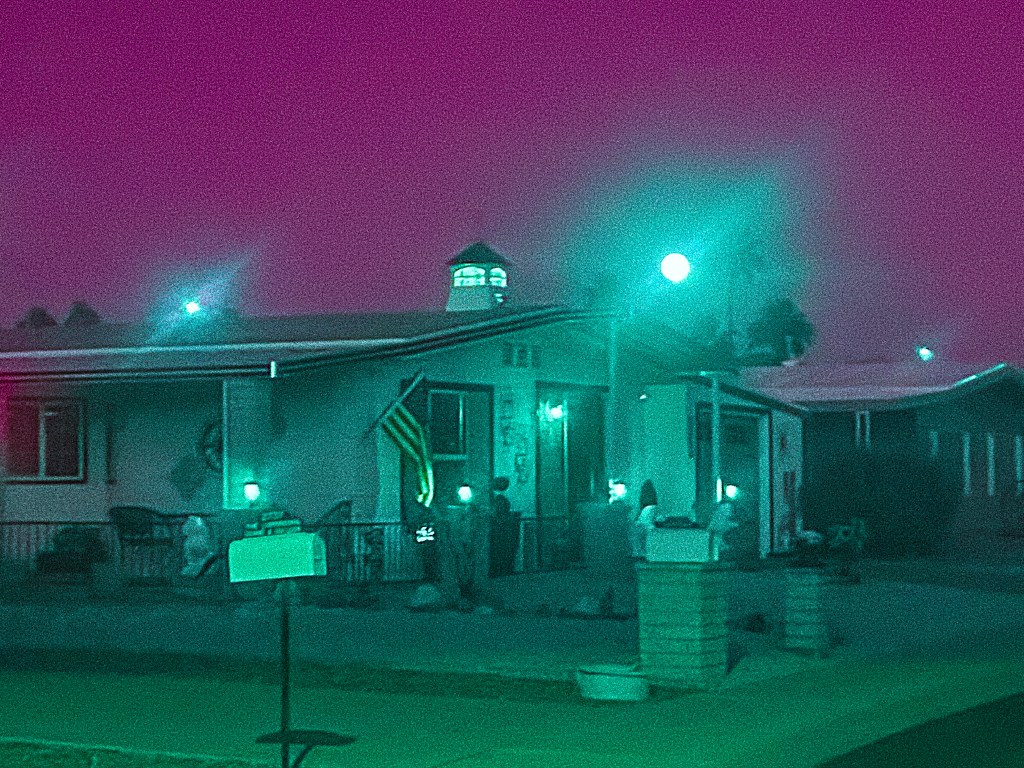
This ditty is possible using a lighting trick. A photo of our home in Arizona on a full moon night in October 2025
Over the years, I’ve taken countless photographs during my travels across the United States. They are not professional grade. Together they tell a story of moments, places, and memories I felt worth sharing. This is the first collection I’m beginning with, and over time I will add more as the journey continues. Depending on how these are received, future sets will follow. For now, I invite you to enjoy this glimpse through my lens.
THE COURT HOUSE
The Washita County Court House. In Cordell, Oklahoma where my Grandparents hailed fromwhen I was a child.
The Washita County Courthouse, located in Courthouse Square in New Cordell, is the county courthouse serving Washita County, Oklahoma. The Classical Revival courthouse was built in 1910. It was added to the National Register of Historic Places on August 24, 1984. Wikipedia
I first attended holiday events with my grandparents here. Later as a police officer I testified at murder trials in the historic court room.
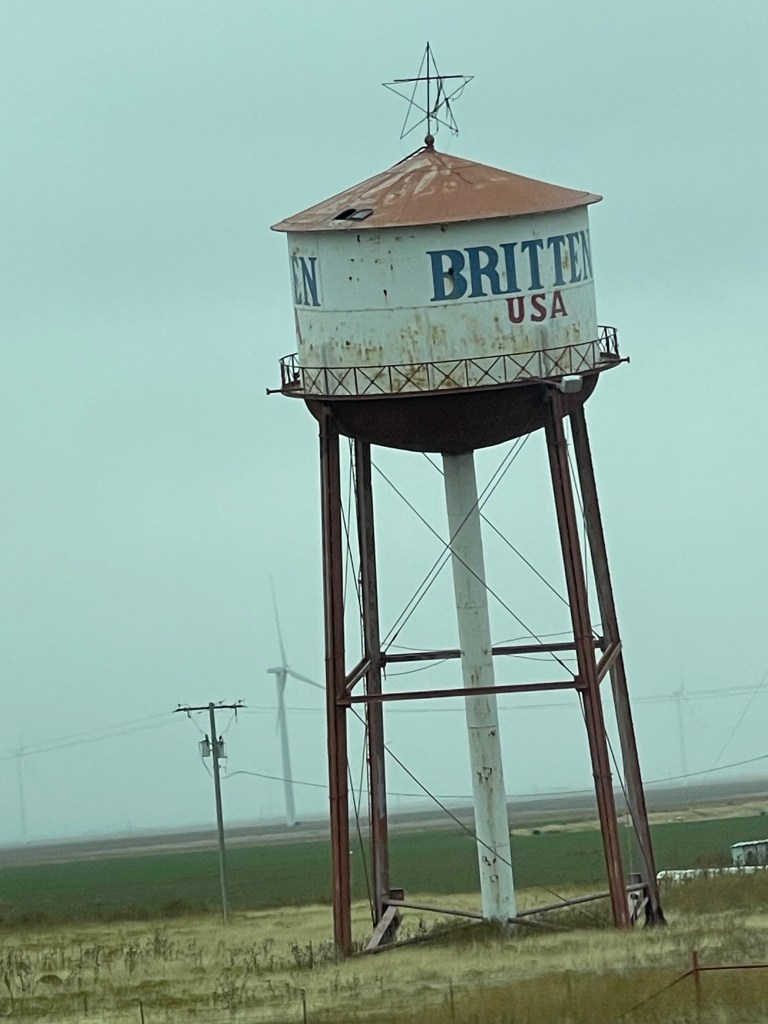
Britten USA
Every time we travel east to visit relatives we pass this landmark in Groom Texas. On this particular day we were heading west hurrying home. A ice storm had been predicted and we were trying to beat it over the mountains.
“Britten USA” most commonly refers to the Britten U.S.A. Leaning Tower of Texas in Groom, Texas, a roadside attraction on Route 66 created by Ralph Britten. Alternatively, it can also refer to Britten Inc., a marketing and branding company that specializes in visual engagement solutions for events and advertising.
The Leaning Tower of Texas
Current status: It remains a popular tourist attraction and a landmark on historic Route 66.
What it is: A roadside water tower that is tilted about five degrees from vertical.
Location: Groom, Texas, along the westbound frontage road of Interstate 40 near the historic Route 66 path.
History: Ralph Britten bought the tower from a nearby town. He installed it as a marketing tool for his truck stop and restaurant in the early 1980s. An electrical fire later destroyed the buildings, leaving only the tower.
Oklahoma Windmills
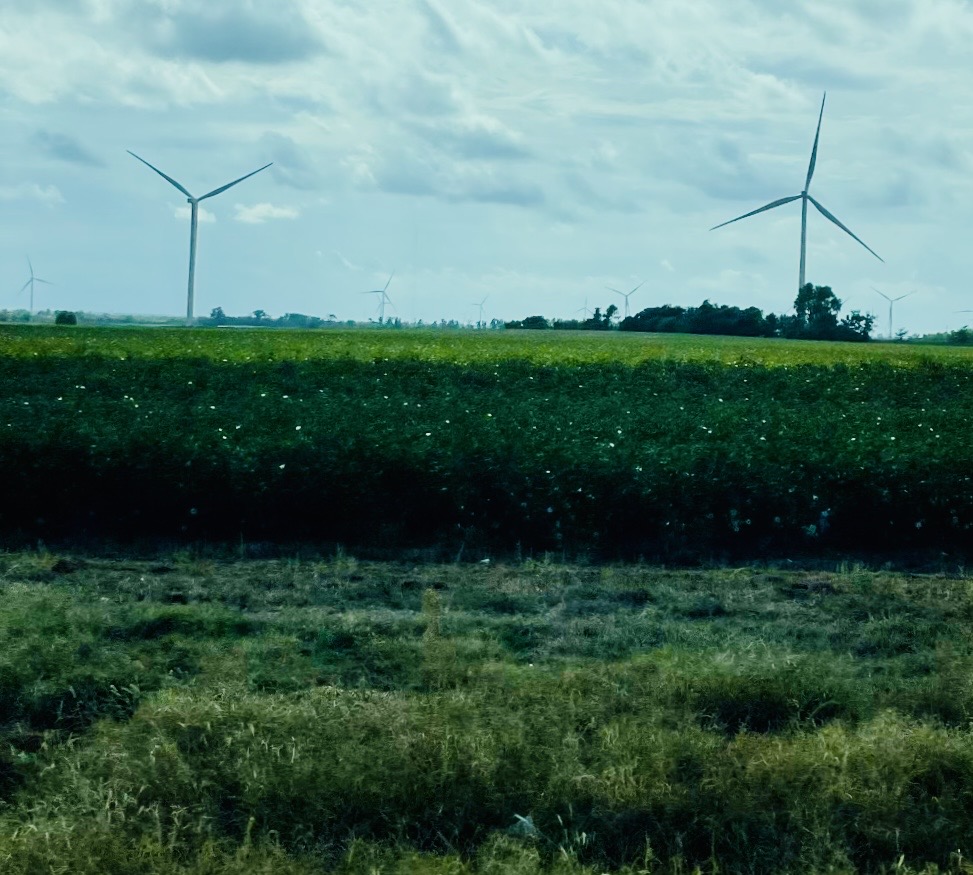
Windmills in Oklahoma. A field in Western Oklahoma to be exact.
Windmills stretch across the American landscape. They stand quietly in a field of Western Oklahoma — steady sentinels of what renewable energy can represent. Yet in the current political climate, the future of clean energy in the United States feels increasingly uncertain. Progress once promised innovation and leadership. Now, it risks being slowed by shifting priorities. Resistance at the highest levels of government contributes to this challenge, particularly within the current administration and Republican leadership.
Each pause in advancing renewable energy costs more than time; it costs momentum, opportunity, and global standing. Other nations continue to move ahead. They invest in sustainable solutions and future infrastructure. Meanwhile, America risks falling further behind. This gap is not by years, but by decades. Every delay today echoes as missed potential tomorrow.
MOUNTAINS OF UTAH
This black-and-white industrial scene was captured many years ago. I was accompanying my better half on a business trip to Salt Lake City, Utah. Somewhat surprisingly, the photo was taken from the third-floor window of our modest motel room.
As I looked out, the contrast of rigid industry against the soft sweep of snow-capped mountains stirred something in me. It was a moment that begged to be preserved. It served as a quiet reminder of winter’s presence. This was rare compared to the sun-baked valley we call home near Phoenix. Instinct took over, and I froze the memory in time with a simple click.
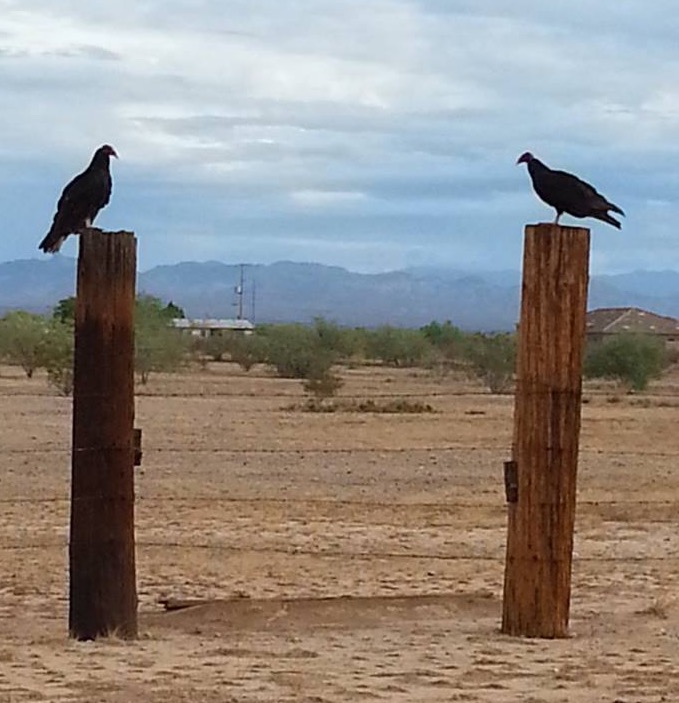
The photo above comes from a much earlier time. It is a fleeting capture of two vultures perfectly perched on weathered fence posts. This scene is in the desert near our old Road’s End Ranch, west of Phoenix, Arizona. We lived there for nearly eleven years, and it remains one of the richest chapters of our lives. Open range, endless sky, and a wildness that felt both rugged and beautiful.
Cattle wandered freely into our yard, trailing no rules but their own. Coyotes called at dusk. Javelina passed through like restless shadows. Rattlesnakes reminded us daily that we were sharing their world. The Western Diamondback (Crotalus atrox) was among the most common. The Mojave Rattlesnake (Crotalus scutulatus) and the Sidewinder (Crotalus cerastes) were also frequent visitors. They were constant guardians of the desert floor.
This particular moment was captured on the fly — literally. We sped through the desert in a golf cart. I clung to the passenger seat. At the same time, I attempted to steady a camera. The vultures sat motionless, almost statuesque, watching over some unseen feast just beyond the fence line. A raw, unplanned moment — and yet one that perfectly reflects the untamed spirit of the life we cherished there.
Sunset at Road’s End Ranch. It was one of the last we were fortunate enough to witness before selling our desert home. We moved to the city in 2013. The White Tank Mountains stretch softly across the western horizon. They catch the fading light in a way only the desert can offer.
This marks the close of the current collection. Many more photographs will be shared in the days, weeks, and months ahead. Thank you for your thoughtful comments, memories, and kind suggestions along the way.















































 benandsteve.com
Leave a comment