The trees hummed with the wind in the Whispering Woods’s heart. The moon painted silver on the forest floor. There lived a fox named Juniper. She was sleek, clever, and always alone. Other animals whispered about her, calling her a trickster, a thief. She had learned that being alone was more manageable than fighting their expectations.
One evening, a tiny glow flickered near her nose as she padded along the riverbank. A firefly, tiny and trembling, hovered in the air.
“You’re in my way,”
Juniper said, flicking her tail.
“I’m lost,”
The firefly admitted its light dimming.
Juniper sighed.
“Lost? How do you lose your way when you can fly?”
The firefly hesitated.
“I followed my friends, but the wind carried me away.”
Juniper should have walked on. She wasn’t the type to help. She had grown used to being alone, and companionship was foreign to her. But something about the firefly’s quivering glow made her pause.
“Fine,”
She said,
“I’ll help you, but only because I know these woods better than anyone.”
The firefly buzzed with gratitude.
“Thank you! I’m called Luma.”
For the first time in a long while, Juniper felt a glimmer of companionship. As they traveled together, Luma lit the dark paths. She guided Juniper through the thickest parts of the forest. Juniper used her sharp nose to avoid danger.
They spent the night talking. Luma didn’t fear or expect her to be anything other than what she was.
By dawn, they reached a clearing filled with twinkling lights—Luma’s family.
“Stay,”
Luma said.
Juniper almost did. But she was a fox, a creature of the earth, and Luma belonged to the sky.
Still, as she turned to leave, Luma promised,
“Whenever you walk the woods at night, look for my light. You’ll never be alone.”
And so, every night, as Juniper wandered, a tiny flickering glow followed her—an unlikely friendship that lit the darkness forever.
The Groff House first moved to Binger from Anadarko, Ok
The old farmhouse was to be our new home. Moving from the city to the farm felt like an adventure, but the others didn’t share my enthusiasm. They struggled with giving up indoor plumbing, a telephone, and dependable electricity.
For my father, though, this was the beginning of a dream—a quarter-horse ranch of his own. The house had been moved from another town and placed onto a block foundation. Uneven concrete blocks, haphazardly arranged, served as makeshift steps leading up to the front door. The door was old, with a large square glass pane in the upper half and weathered wood below. Layers of peeling white paint flaked away inside and out, revealing the scars of time.
But what stood out most was the screen door. It had a single spring that pulled it shut with a sharp clap. This sound still echoes in my memory. Above it, a simple porch overhang provided some protection from the rain. It offered slightly less protection from the sun. The overhang always seemed too small for its purpose.
I was the youngest of six children—or seven, depending on how you counted. My mother’s youngest brother, Uncle Ricky, practically lived with us. He had been raised alongside my older brothers, and I always considered him one of us. These memories of our close-knit family bring a sense of nostalgia and warmth.
My sisters and I stayed close to the house initially. Our parents were wary of hidden dangers lurking in the fields and pastures. Rusted cans, barbed wire, and remnants of years gone by littered the property. My brothers were tasked with clearing the land, ensuring no horse would stumble upon a forgotten hazard. But even without the safety excuse, the grown-ups didn’t need us underfoot as they worked to build barns and fences.
The house felt enormous to my sisters and me. It had only four rooms downstairs. There was one large room upstairs. The ground floor had interconnected doorways. These doorways allowed us to run in endless circles around the stairwell. The kitchen, with its worn linoleum floor and a large propane stove, was the heart of the home. The living room had threadbare furniture. Its windows had seen better days. It was where we gathered in the evenings. We were expected to behave when our parents were home, but the house became our playground when they weren’t.
One evening, my oldest sister shared a story she had heard at school. A man, unknown to us, had been found dead in the upstairs room. Hung himself, they said. His wife had passed away downstairs, and he had followed soon after. My younger sister and I absorbed the tale. We were unsure whether it was truth or fiction. Nonetheless, it rooted itself in our minds.
My parents’ conversations surfaced bits and pieces of the house’s history. They assured us no one had died there—at least, not to their knowledge. But then came the phrase that stuck with us:
“But if they did, there’s nothing to worry about.”
It was as if they had confirmed it without confirming it. They planted just enough doubt to keep our imaginations running wild.
And then, one night, something happened that we would never forget.
It had been an unbearably hot day, the humidity clinging to us like a second skin. We had no air conditioning. We relied on a single box fan upstairs for the boys at night. During the day, we moved it downstairs. As evening fell, a storm rolled in. The sky darkened, thunder rumbled, and the first lightning strike knocked out our power.
We huddled by the screen door, watching the storm unfold. Rain poured down in sheets, lightning flashing every few seconds. We saw him in one brilliant burst of light—a rider on a white horse just beyond our fence.
My oldest sister called for our mother.
“There’s a man out on the road! Should we call him in?”
The lightning illuminated him again. The horse and rider are stark white, motionless against the downpour. They turned into our driveway and stopped at the yard gate. The rider tilted his head, water spilling off the brim of his hat, but he did not move.
We yelled for our parents, urging them to look. The rain intensified, drumming against the roof. And then, in the next flash of lightning—he was gone. No retreating figure, no horse galloping away. Just empty, rain-slicked ground where he had stood.
That wasn’t the last strange occurrence. The memory of the white horse and its rider haunted us, lingering in the corners of our minds. We couldn’t shake the feeling that we were not alone in the house. We felt that unseen presences were walking the same halls.
The dirt roads in Oklahoma turn sandy in the summer. They capture every footprint—deer, bobcat, rabbit, and occasional lost traveler. One morning, waiting for the school bus, we saw her. A tiny older woman walked at a steady pace past our house. We called out a greeting, but she didn’t acknowledge us. The school bus approached from behind, and I considered asking the driver to stop and offer her a ride.
But when we reached the road, she was gone.
What we didn’t see was more unsettling than her disappearance—tracks. There were no prints in the soft sand, no sign that anyone had walked there.
I looked at my sisters. One of them whispered,
“Don’t say anything. They’ll think we’re crazy.”
Later, an old-timer visited us often. He told us about a train depot standing across the road long before we arrived. He suspected that some soldiers returning from World War I, whose bodies were unclaimed, never left that station. He spoke of ghostly figures wandering the fields at night. Strange sounds echoed from the direction of the old depot. His stories added another layer of mystery to our already haunted farmhouse.
Over the years, my father and I rode our horses through the backcountry. We found old graves. Some were Indian graves, others belonged to settlers, and some were marked only by time-worn stones. One day, I asked my father if it was sad that they had been forgotten.
He looked at me thoughtfully.
“They’re remembered the way they’re meant to be. You don’t need a grave to be remembered. It’s what you do while you’re alive that matters.”
I understood what he meant, but some of me still felt sorrow for those lost souls. Maybe they weren’t as alone as I thought. They still walked in the rain, strolled along dirt roads, or found another way to be remembered. The mystery of their existence lingers, leaving us with more questions than answers.
Carney had no idea what his neighbor, Ted Ortiz, had done. Ted had recently purchased what everyone around here called a buffalo—though, technically, they were bison. His grand idea? Cross-breeding the massive bull with his cattle. What is there to go wrong?
That morning, Carney had spent hours plowing one of his fields. When he finally finished, he hopped down from his tractor. He stretched his back and pulled out his packed lunch—a simple sandwich and a thermos of water. After a few quick gulps, he was ready to tackle the next field.
He set off across the pasture, taking his usual shortcut. Halfway across, he heard a deep, rumbling snort behind him. At first, he figured it was just one of Ted’s cows and kept walking. But then he noticed something—the snorting sound was moving with him.
Carney turned around and froze.
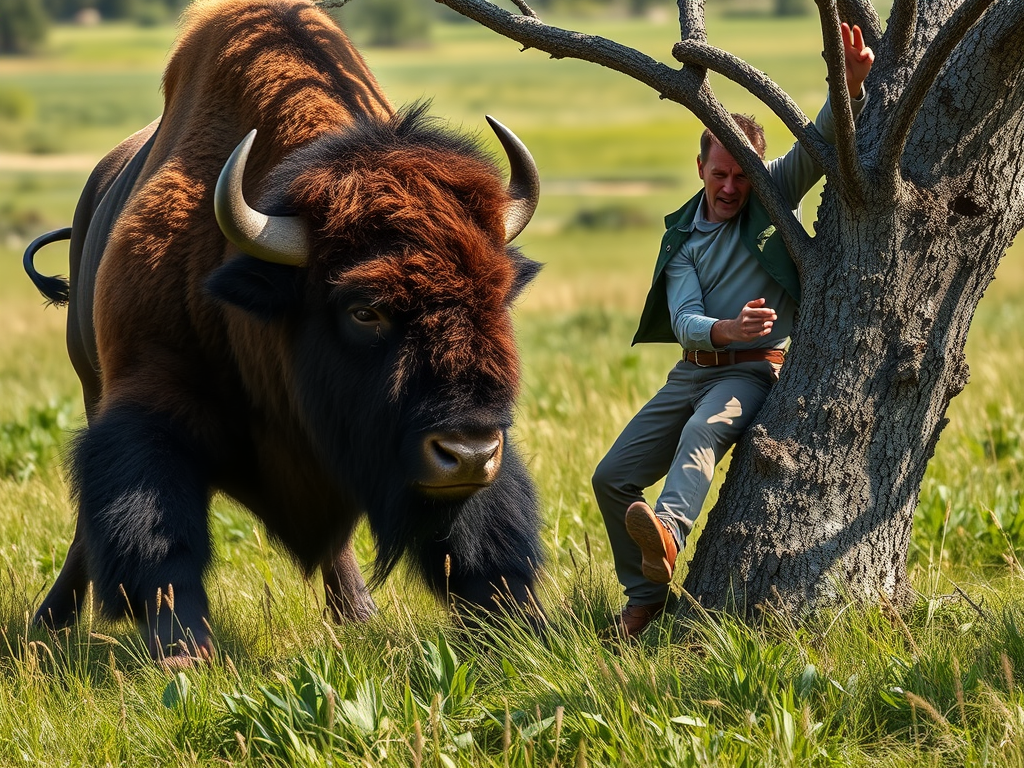
A massive, very annoyed bull bison stood just a few yards away. And Carney had unknowingly interrupted the beast’s afternoon of affection.
The bison pawed the ground, snorted louder, and locked eyes with Carney. He had seconds to decide—fall, play dead, or run like hell. He chose the latter.
Now, Carney was in his fifties. He was not exactly a sprinter, but he moved like an Olympic athlete when faced with a furious bison. His only hope was a nearby tree. He scrambled up, arms and legs flailing, barely reaching a branch as the bull slammed into the trunk below.
Unfortunately, Carney had picked the wrong tree.
It was dead.
The bison rammed it again. The whole thing groaned and wobbled. Carney had two choices—jump and run or ride the tree down like a doomed cowboy in a slow-motion disaster.
So he jumped. And ran.
And here’s where things took an unexpected turn.
Carney swears he made it to the fence, jumped over, and escaped without a scratch. But according to the newspaper, the story went a little differently.
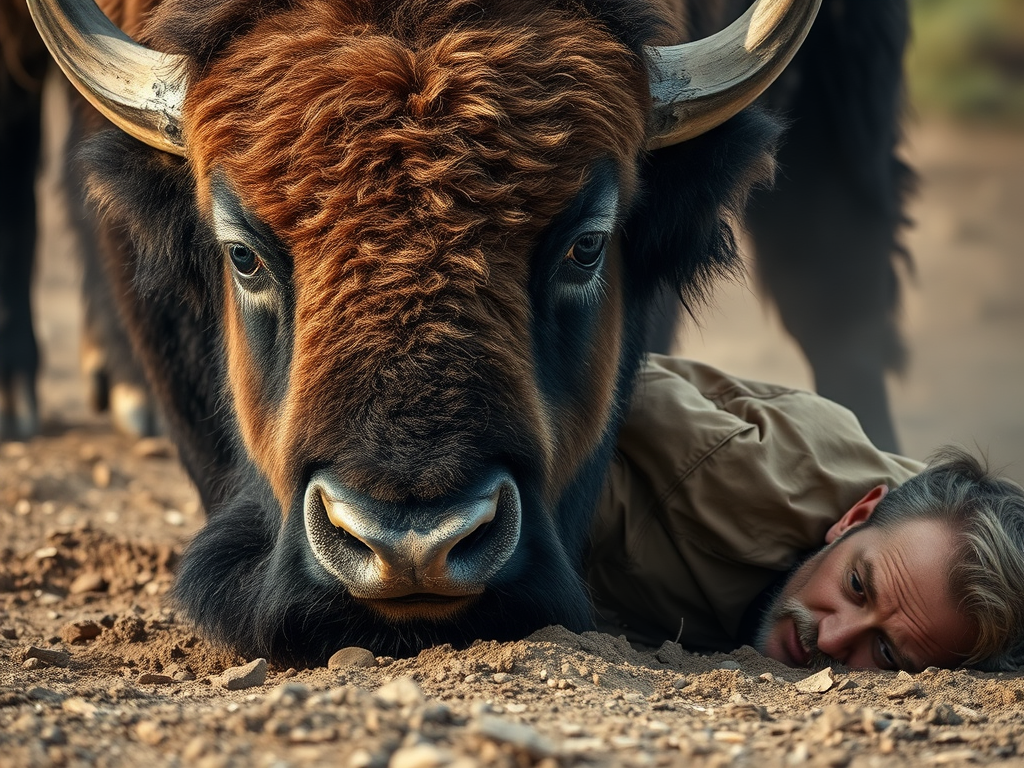
The article claimed that the bison knocked the tree over after Carney hit the ground. Then it turned its fury back on him. Carney had no other options. He did the only thing he thought possible. He dropped to the ground. His face was down in the dirt, and he played dead.
The bison approached, snorting, its heavy breath huffing across Carney’s back. It sniffed his head. His shoulders. His boots. Then, it reached his backside—and suddenly, something changed.
The bull gagged.
Its eyes watered, and its massive body trembled. The mighty beast gave a final snort of disgust. It turned its tail and bolted. The beast ran away as fast as its hooves carried it.
Carney, shaking but victorious, got to his feet and went to the other field. Before plowing, he had to detour into the nearest creek. He needed to scrub off whatever offended that bison so severely.
The newspaper never revealed its source for this version of events, but everyone had their suspicions. Most believed the town barber had something to do with it. After all, most of the town’s best stories started in his shop.
To this day, the Great Bison Incident resurfaces whenever the local men need a good laugh. It is a legendary reminder that sometimes survival comes down to sheer luck, including an unfortunate choice in lunch. It’s a tale that never fails to entertain.
This is a true story. The names have been changed to protect the privacy of those in real life.
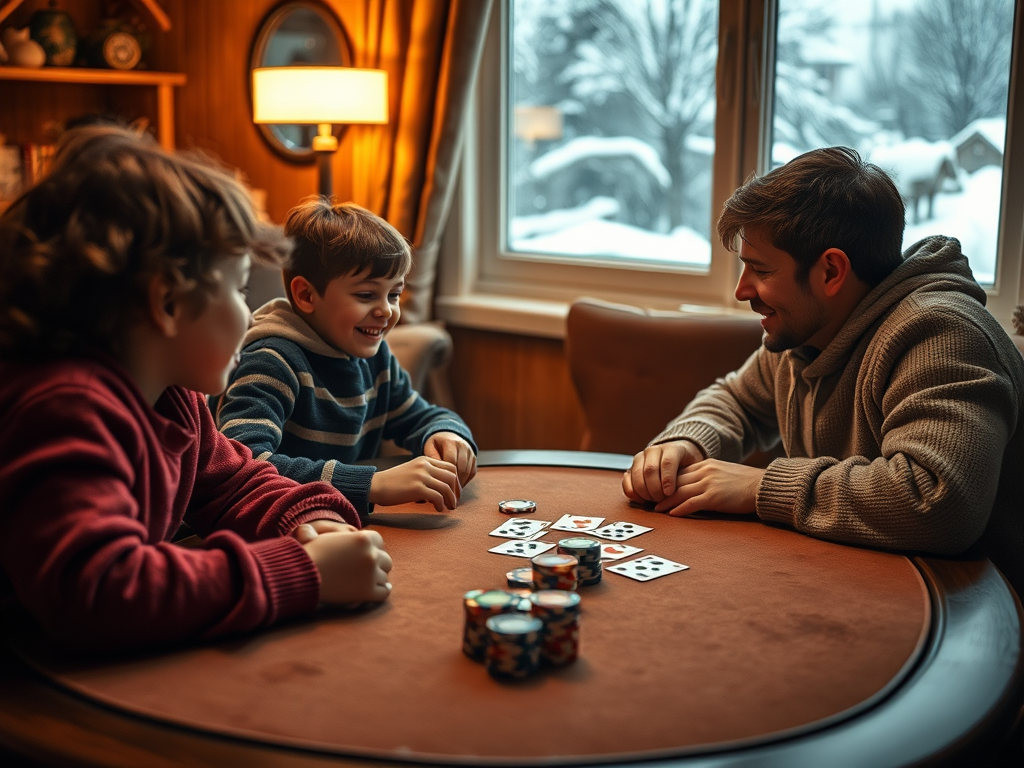
It was cold and snowing the day my dad decided to teach my sister and me how to play poker. We set up a card table in the living room. He brought out his cherished poker chips and cardholder. He placed them carefully in the center.
The chips were red, white, and blue. Dad told us not to worry about their dollar value. White was the least expensive. Red was worth more. Blue held the highest value, at least for this game. Then, with a practiced hand, he shuffled the deck and dealt the cards, and our lesson began.
I can’t recall exactly which variation of poker we played. It was Seven Card Stud, Texas Hold’Em, or Five Card Draw. But I remember the three of us sitting around that table. Each had a tall glass of iced tea. The snow piled up outside. With every inch of snowfall, I grew more hopeful that school would get canceled the next day. In my mind, I was already winning.
I caught on quickly, learning to hold onto high-value cards and giving myself a decent advantage. But the real edge came from my dad. He wasn’t just teaching us poker. He was teaching us something more. This lesson would stay with me long after the cards were put away.
A fire crackled in the fireplace, filling the room with warmth, and for a moment, life felt perfect. That house, that evening, that love—it’s a place I often dream of returning to. Yet, it no longer exists beyond memory. And in that memory, my dad shared something else with us. It was a poem—a warm blanket of words that wrapped us in comfort.
It was nonsensical and crude, but it belonged to him, and now it belonged to me. Decades later, I still carry it with me:
DAD’S POEM
I Woke Up Just This Morning
And I Looked Upon The Wall
The Roaches And The Bedbugs
Were Playing A Game Of Ball
The Score Was Six To Nothing
The Roaches Were Ahead
I Got So Doggone Excited
I Jumped Right Out Of Bed
I Ran Downstairs to Breakfast
But The Coffee Was So Stale
It Tastes Just Like Tobacco Juice
Right Out Of The County Jail.
Dad said he wasn’t sure where he’d first heard it—maybe in school as a boy. He had just always known it. And now, it was mine to carry on.
That silly little poem has come in handy more times than I can count. It has bailed me out when I’ve been put on the spot and asked to speak publicly. When I needed to write something quickly for school, it found its way onto my paper. It has brought laughter to gatherings and lightened tense moments. Somehow, it has traveled with me through time. It serves as a testament to the enduring power of shared memories. It is just like the memory of that snowy afternoon.
I never became a poker player, but I went on to work with words, write, and tell stories. I believe it started with that poem.
Henry and Harry met by accident one evening when Henry was riding with Harry’s roommate and fellow police officer, Teddy. Henry and Teddy stopped by Teddy’s house to pick up the legal papers Teddy needed for a court filing. He invited Henry in to meet his roommate, Harry.
When they entered the door, Harry was getting ready for his shift. He walked down a hallway wearing only his trousers and no shirt. Henry and Harry’s eyes locked onto each other as Teddy introduced them. Neither knew the other’s intentions or interests; they nodded and said hello, an electric charge lingering between them.
Harry worked at the police station’s front desk and communications center. Suddenly, Henry worked for the local radio station. He began coming to the station instead of calling on the phone for the day’s latest police activity. Henry would sit patiently. He went through the radio and comment logs. He looked for items to place in his news reports on the radio. Then, he would make small talk with Harry, their conversations stretching a little longer each time.
One day, Henry asked Harry if the officer was off the next weekend. Harry confirmed that he was. Henry explained that his boss wanted him to travel to Loca City. He needed to pick up his son and return him to Elm City. Harry said he’d love to go along for the adventure. Henry explained they go there on Saturday and return on Sunday. This way, he would be there to get the youngster after he got out of church.
When Saturday came, the two left Elm City for the nearly two-hour drive to Loca City. During the drive, they talked, learning more about each other’s pasts, dreams, and fears. At times, their arms brushed against each other on the armrest of Henry’s Ford Thunderbird. Unknown to each were the butterflies fluttering in their stomachs as the pair drove down the highway.
Upon arriving in Loca City, the pair stopped for burgers. Across the street, there was a movie theater. And, of course, they would take in a movie— Friday the 13th: Season of the Witch.
By all standards, the movie was a flop. But the film still had spooky moments, especially for Harry, who jumped and yelped throughout. It was ironic—him being the one who worked for the police department. Afterward, the two laughed at how jumpy Harry had been, and Harry was embarrassed.
It was getting late, and they decided to find a motel for the night. The two found a Holiday Inn Holidome. Henry said he would take care of the room. Harry was asked to watch the car. Harry complied. A few minutes later, Henry returned with room keys and said—
“I’m sorry about this. The hotel only had one room, and it had a queen bed.”
Harry’s reply was accepting.
“I don’t have a problem with it. I slept with my best friends all through hay harvest.”
Once in the room, the television came on. Of all things, it was a rerun of The Tonight Show with Joan Rivers. The two settled in with Joan Rivers rattling on. At some point, one of their elbows flinched into the other. Then, a tickling match ensued. The tickling led to rolling around in the bed, which led to a still moment.
Henry reached up and kissed Harry. That was in 1982. And in 2024, that kiss still lasts.
They demonstrated remarkable courage, enduring the hardships of hiding their relationship to protect their careers. They faced moments of having to pretend to be twin brothers to avoid violent repercussions. They even experienced the loss of family members who couldn’t accept their love. But through it all, they clung to each other, a testament to their resilience and the power of their love.
They were finally capable of marrying. They did so without fanfare—just them and a few close friends. There was a quiet understanding that this was always meant to be. But even then, their love faced challenges. They faced the threat of losing their rights as a married couple. Additionally, there was the ever-existing worry of discrimination in housing, employment, and medical care.
After over forty years together, they pridefully ponder on their journey. The fights, love, laughter, and pain were all part of their story. If anything, the years only strengthened their love. Their relationship is a beacon of hope for enduring love in a world that often challenges it.
Henry reaches for Harry’s hand as they sit on their porch, watching the sun set over their quiet neighborhood. His grip is weaker than it used to be, but the warmth is still the same.
“No matter what they take from us,” Henry says softly, “they can’t take this.”
Harry smiles, his thumb brushing over Henry’s knuckles.
“No, they can’t.”
After all, it is where they began—and will always belong. Their home is their sanctuary. It is where their love has blossomed and endured. Their home is a testament to their resilience and the power of love.
This is a true story. The names and places have been changed to protect the identities of those lives involved.
The last of the guests had left. A heavy silence remained, seeming to fill every corner of the house. It had been a long day. Victor placed his hands over his face. He tried to collect himself from everything that had happened in the last few days. His father had passed, and the funeral had brought together friends and family he had not seen in years. Once filled with laughter and conversation, the house now stood eerily silent.
He walked to the refrigerator for a cold glass of water. Something caught his eye—a wooden cigar box atop a cabinet. It was the old kind –– the type that hadn’t been made in years. It was a mystery, a relic from a bygone era. His father must have been holding onto it.
Curious, Victor set his glass on the kitchen table and reached for the box. He found letters bundled with a rubber band as he pried it open. The postmark on the top envelope was dated 1942. He ran his fingers over the stack, noticing the new rubber band. His father had handled these recently.
Victor’s mother, Emily, had passed nearly seven years ago. Since then, his father, Bob, has never been the same. He continued with life, but something had changed—like a light had dimmed.
He carefully removed the band and unfolded the first letter. A small tobacco sack slipped out as he did, landing softly on the table. It felt empty, save for dust. Pushing it aside, Victor began to read.
My Dearest Emily,
Today, we are adrift going “over there.” I don’t know what we will find when or if we wash ashore. Yet, I know one thing—I wish to get back to you more than anything. You are my love, my most faithful and one and only! I promise with all my heart to survive this mission and see you again! I have to make this quick to get to the mail plane before it takes off.
Love, Bob
Letter after letter, Victor saw the same unwavering devotion. His hands trembled as he read the words, feeling the weight of his father’s love and sacrifice. Then, one in particular caught his attention:
My Dearest Emily,
We ran into trouble and had to fight the Japanese in the middle of the ocean. We won. The chiefs say it will be a decisive battle in the war. I certainly hope so. We took losses. Some of my buddies are gone. But I am still here, as I promised you I would be. I love you and can only count the days until this war ends, and I am back home with you. I promise I will never leave your side again once I return!
Love, Bob
Victor looked at the date on the letter and the weight of his father’s words. Could Bob have been in the Battle of Midway? He had never spoken much about his military service. The letters seemed to carry the burden of his unspoken past.
No kid should have to be a killer of another. It is the most horrible thing you can imagine.
Those were the only words his father had ever spoken about the war.
Victor leaned back in his chair, staring at the letters before him. His father had seen horrors he had never spoken of and endured trials he had buried deep. Yet, through it all, the one thing that had kept him going was his profound and unwavering love for Emily.
He suddenly understood why, after her passing, his father had never quite been the same. Bob had kept his promise—he had never left her side. And when Emily was gone, so too, in a way, was Bob.
A lump began to form in Victor’s throat. He had always known his parents’ love was strong, but he had never truly grasped its depth until now. He had a newfound appreciation for the man his father had been. He gently and reverently returned the letters to the cigar box. Each one was a testament to his father’s enduring love.
As he placed the box back on the cabinet, he felt something shift within him. Grief remained, but now it was accompanied by a deep admiration. His father had lived and loved with an intensity few understood.
And finally, after all these years, he was with Emily again.
The smell of fresh rain lingered as Mark walked down Elm Street toward his favorite café. It was his usual morning routine, a quiet moment before the day unraveled. He reached the entrance. Then he saw him—Greg Turner. Greg was leaning against a lamppost, arms crossed. He was watching him with a smirk that dripped with disdain.
Greg had never made it a secret that he disliked Mark. Their history goes back to a business deal gone wrong. Mark handled it ethically, but Greg saw it as a betrayal. Since then, Greg had made it his mission to smear Mark’s name. He spread rumors and whispered doubts into the ears of anyone who would listen.
Mark adjusted his posture, exhaled slowly, and kept walking. He knew better than to engage.
“Hey, Mark,”
Greg called out loud enough for people at the café’s outdoor tables to turn their heads.
“Still fooling people into thinking you’re the good guy?”
A few customers looked up from their coffee, eyes shifting between them, waiting for a response. Mark felt the moment’s weight pressing against his back, the temptation to defend himself bubbling under the surface.
But he had learned something long ago—some battles weren’t worth fighting. Not in the mud. Not at the expense of his peace.
He turned slightly, just enough to meet Greg’s gaze, and nodded.
“Good morning, Greg.”
His voice was even, void of malice, but firm. Then, without another word, he stepped inside the café.
The barista, Sarah, greeted him with a warm smile.
“The usual?”
Mark nodded as he took out his wallet.
“Yep. And maybe an extra shot of patience today.”
Sarah chuckled as she prepared his coffee.
“Don’t let him get to you.”
He shook his head.
“I won’t.”
Moments later, as he stirred his coffee, he glanced outside. Greg was still there, now talking to someone else, his hands animated, spinning another version of his tired tale. Mark took a sip, savoring the rich warmth of his drink, and let the moment pass.
There was no need to wade into the mess or wrestle with the bitterness that wasn’t his to carry. His conscience was clear. His integrity was intact.
He walked out of the café with his head high. His side of the street was clean. Mark was guilt-free and ready to face his day. He had not gotten down to Greg’s level; even better, he showed respect for doing so.
It was an old house on the southeast side of town. The floorboards creaked. The front porch sagged just a little in the middle. Jeb and Lorine lived there with their giant Boxer. The dog was as broad as a barrel. He was just as heavy when he flopped into your lap.
At five years old, Tim sometimes spent his afternoons there, waiting for his dad to pick him up. He had just started kindergarten and hated school—not just kindergarten, but the whole idea for the next twelve years. The only good thing was that, for now, Tim only had to go until noon. Then, most days, he’d end up at Jeb and Lorine’s, where things were much more enjoyable.
One thing about their house always intrigued Tim: the mysterious knocking and pounding under the floor. It was a constant occurrence as if something—or someone—was moving beneath them. Tim had been taught not to be rude and ask questions in other people’s homes. He sat quietly, but his mind was buzzing with curiosity.
Maybe it was the bees. Jeb had a beehive in the backyard and collected honey from it. Tim imagined a massive honeycomb hidden under the house, so big that its weight made the boards creak. He pictured golden honey dripping through the cracks in the floor. But no, that didn’t explain the noise. The sound traveled, shifting from one end of the house to the other.
One afternoon, while playing in the backyard, Tim noticed a small fence blocking off a crawl space beneath the house. It was big enough to hold an animal—maybe even a dog. But why would Jeb fence it off? Was he trying to keep something out? Or ––– keep something in?
Curious, Tim dropped to his hands and knees, peering into a dark hole in the foundation. He squinted, trying to make sense of the shadows. Suddenly, two glassy eyes stared back at him. A jolt of surprise went through his body.
Tim let out a startled yelp and scrambled backward his heart racing. He barely managed to stop himself from swearing in shock.
“WHOA! HOLY COW!”
The eyes moved closer, emerging from the darkness. Tim’s breath caught as the creature stepped into the light.
“A SKUNK!”
He shot to his feet and bolted inside, bursting into the living room where Jeb and Lorine sat.
“There’s a skunk under your house!” he gasped. “You gotta get a shovel—hit it over the head! It’s living under there!”
Jeb and Lorine burst into laughter.
“You met Johnny,” Jeb said, shaking his head. “He’s a buddy of mine. Come on, I’ll let you hold him.”
Tim’s eyes widened.
“Hold him?! Are you crazy? He’ll spray us!”
Jeb chuckled.
“No, he won’t. Johnny had his scent glands removed when he was a baby. He can’t spray.”
His words were like a soothing balm, calming Tim’s nerves.
Tim hesitated, his skepticism clear.
“How can you be so sure?”
He asked, his voice tinged with doubt.
“Because I raised him,” Jeb said, standing up. “Found him in my barn after his mama got hit by a car on the highway. Watched that nest for days, but she never came back. He would’ve died if I hadn’t taken him in.”
Tim followed Jeb outside, still wary. The last thing he wanted was to go home reeking of skunk.
Jeb knelt by the crawl space and softly said,
“Johnny, Johnny, come on out, boy.”
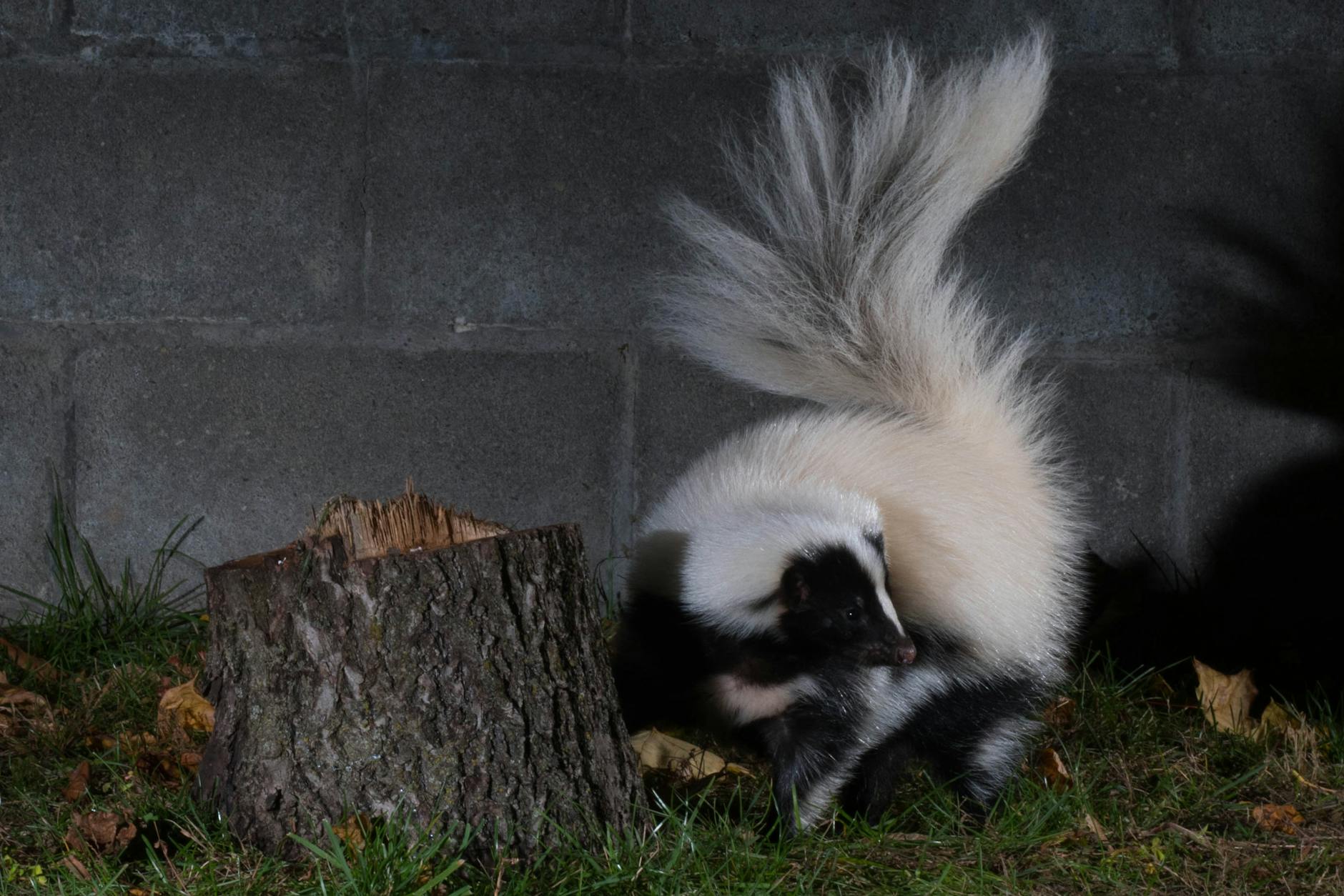
Tim tensed as the skunk waddled into view, its black-and-white fur gleaming in the afternoon sun.
Jeb looked at Tim and grinned.
“Son, I know what you’re thinking. Life’s about trust, taking chances, and finding things out for yourself. You can do all three right now.”
Tim swallowed hard, debating. Does he trust this?
Taking a deep breath, he held out his arms.
Jeb carefully placed Johnny in his hands, and Tim braced himself for the worst. Johnny curled against his chest, nestling under his chin like a kitten. His friendly demeanor melted Tim’s apprehensions.
Tim stood there, stiff at first, then slowly relaxed. The skunk was warm, soft, and oddly ––– pleasant.
After a few minutes, Jeb patted Tim’s shoulder.
“That’s good now. Johnny must return inside, and your daddy’ll be here soon.”
Tim handed Johnny back and followed Jeb into the house. As he sat on the couch, he waited for his dad. He thought about what Jeb had said. It was about trust, taking chances, and learning things for yourself.
When his dad pulled up, Tim climbed into the truck. As they pulled away, his father wrinkled his nose.
“What have you been doing?”
He asked.
“You smell like a skunk!”
Tim just grinned. And said –––
“I’ve been taking a chance on trusting people and other things and learning things for myself.”
The winter had been relentless. The worst sandstorm in memory had swept through the region the year before. It buried the land in towering drifts of dust and sand. In some places, these drifts were waist-deep.
It marked the beginning of the Dust Bowl. This was a devastating era of dust storms. These storms crippled agriculture and reshaped life across the American and Canadian prairies in the 1930s.
Few families had stored enough food from the past year’s harvest. Even fewer were sure how long this disaster would last.
They say two things in life are certain: death and taxes. And for Elmer, tax time had come knocking. He had no choice but to ride nearly forty miles to the courthouse. He needed to pay his property taxes in person. He risked default if he didn’t. Despite the hard times, he had always kept his land in good standing. He intended to do so now, even with their dwindling savings. With three young children to feed, responsibility was heavily on his shoulders. His two sons and daughter were too young to fully grasp the hardship that had taken hold of the land. The struggle was real for Elmer and his wife, Ma Ma.
The night before his journey, Elmer told Ma Ma,
“I’ll be up by 3:30 and gone before sunrise. There’s no need to let anyone know I’m carrying money. Hard times make people desperate.”
While he trusted his neighbors, he wasn’t about to take unnecessary risks. He planned to make it halfway and camp near the Washita River before reaching the courthouse the next day.
At dawn, Pa Elmer saddled his pony, Smokey. Ma Ma handed him a small bundle—a few slices of fresh bread and beef jerky from the smokehouse.
“It’s not much,”
she said, touching his knee as he mounted up,
“but it’ll hold you over till you’re back. Ride safe, and don’t take any risks. Smokey can outrun any trouble that comes your way.”
Pa Elmer bent down in the saddle and kissed her.
“Two days there, a day and a half back. I’ll be fine.”
The parents didn’t know it. Their three children watched from behind the screen door, their little faces pressed against the mesh. As Ma-Ma gave Smokey a firm slap on the hip, Pa clicked his tongue and hollered,
“Yaw!”
The journey had begun.
Back inside, Ma Ma found the children still watching. She shooed them back to bed. Then she settled into her rocking chair with the Bible. It was her source of comfort through times of uncertainty.
The Ride to Town
Pa made good time. Smokey, eager for the open trail, trotted strong beneath him. By evening, they had covered thirty miles. Elmer found a spot near the Washita River where the grass was matted down—a daytime swimming hole. He unsaddled Smokey. Then, he tied him to a long rope to graze. Elmer stretched out beneath a tree, using his saddle as a pillow.
Sleep took him fast; it was a blessing he had dozed off facing east. The first light of dawn warmed his face, stirring him awake. After a quick breakfast of beef jerky, he saddled Smokey and continued.
By mid-morning, he reached the county seat. He tied Smokey to the hitching rail and strode into the courthouse. The county clerk barely glanced up from her papers.
“You here to ask for an extension on your taxes like everyone else?”
she asked.
Elmer tipped his hat.
“No, ma’am. I’m here to pay my taxes for this year and next.”
The clerk blinked, then scribbled out a receipt, her expression unreadable.
Paid this date: $28.33 for two years of property taxes.
Elmer folded the receipt and tucked it into the same safe spot where his money had been. Simply saying ––––
“Thank you, Mam!”
Pa had finished his business.
Trouble in Town
As he walked back to Smokey, a man loitering nearby gave a slow nod.
“That’s a fine-looking horse you got there. I’d buy him off you for $25.”
Elmer stiffened.
“No, you wouldn’t.”
The man’s eyes darkened, and his tone shifted.
“Maybe I just take the horse for nothin’.”
Elmer didn’t flinch. He met the man’s stare with steely resolve.
“No, you’d be lyin’ dead if you tried.”
A tense silence hung between them before the man forced a crooked smile.
“Mister, I was just jokin’.”
He backed away.
“You have yourself a nice day.”
Elmer wasted no time. He swung into the saddle and galloped out of town.
The Journey Home
The Journey Home
Elmer has made the ride back in a day. Still, he took his time. He stopped by a few relatives along the way. In this part of the country, it was tradition—when you passed by kin, you paid a visit.
Late in the afternoon, as he approached home, he saw Ma Ma and the kids waiting at the gate. The children ran to meet him, full of questions.
“Well, Pa? How’d it go?”
Ma Ma asked, relief washing over her face.
Elmer grinned and swung down from Smokey.
“Would’ve been home sooner,”
he said, stretching his legs,
“but I kept runnin’ out of pipe tobacco.”
Ma Ma shook her head with a chuckle. As the family led him inside, the weight of the journey melted away. Home had never felt so good.
Daniel stepped into the old movie theater, greeted by the warm, buttery aroma of freshly popped popcorn. It was the same scent from childhood when he remembered Saturday matinees with his father. His fingers were sticky from too much caramel corn. He heard the comforting rustle of a paper bag in his lap.
Tonight, the theater was nearly empty. A black-and-white classic was playing, something from Daniel’s father’s era. Daniel barely glanced at the screen. As he moved to the concession stand, the current blurred with the past in his mind.
“Large popcorn, extra butter,”
he said out of habit.
The teenage worker scooped the golden kernels into a striped bag, the scent thick and intoxicating. The warm, buttery aroma enveloped Daniel, transporting him back in time. He inhaled deeply. For a moment, he was seven years old again. He held his father’s hand as they walked down the carpeted aisles. They found their usual seats in the middle row.
“You always gotta have popcorn, kid,”
his father had said, grinning.
“It’s part of the experience.”
Daniel took his seat and set the bag beside him. His father should have been sitting there, too. The empty chair, a stark reminder of his absence, felt heavier than it should.
The smell of popcorn filled the air, wrapping around him like a familiar embrace. He closed his eyes, listening to the distant crackle of the projector. He almost heard his father’s voice, whispering about the film’s history like Daniel always did.
Daniel reached into the bag with a soft smile and tossed a handful of popcorn into his mouth. The taste was salty and warm, each kernel bursting with flavor. The theater didn’t feel so empty for the first time in years.
For many, the good times meant youth spent without barriers. Kids rode bicycles freely around town or through the countryside. They explored wherever curiosity led. They just had to be home before dark or by 10 p.m. It was when running to a friend’s house, unannounced was safe. It felt just as natural for them to show up at yours. We all cherish that time of freedom and spontaneity.
Your version of the good times began when you got first place as a young adult. You also got hooked up to cable television. Gone were the days of only three channels. Now, there were forty or more. Channels like MTV, HBO, and SHOWTIME offered endless entertainment. Some kept their televisions locked on MTV 24/7, not wanting to miss the latest music video premiere. The phrase “I want my MTV” wasn’t just a slogan; it was a way of life.
Icons like Downtown Julie Brown, Max Headroom, Randy of the Redwoods, and JJ Jackson became daily companions. They guided audiences through interviews and music video countdowns. These shows entertained us and shaped our memories, creating connection and nostalgia.
Yet, while MTV rocked for many, others fondly recall Saturday mornings. They spent time with classic cartoon characters. They watched Bugs Bunny, Elmer Fudd, Daffy Duck, and Yosemite Sam. Or they enjoyed Speedy Gonzales, the Flintstones, or the Jetsons. These beloved characters live on today, often appearing in rebranded forms and often in commercials that spark nostalgia.
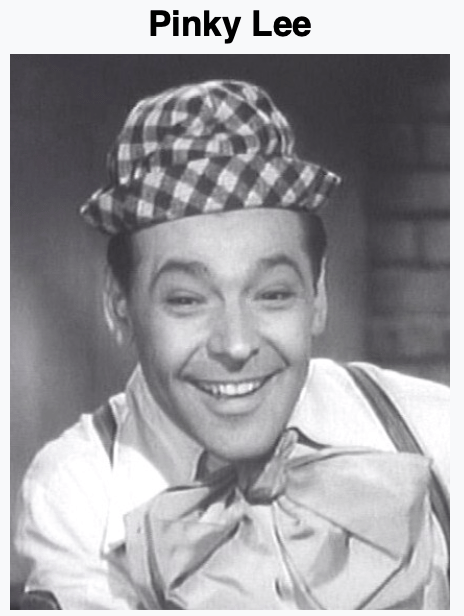
For earlier and later generations, laughter came from entertainers like Pinky Lee or Pee-wee Herman. In the 1950s, Pinky Lee brought his lively antics to television. He appeared first in a primetime variety show. Later, he starred in a children’s program sponsored by Tootsie Roll. His Emmy-nominated show paved the way for future quirky entertainers. Pee-wee Herman was one of them. His distinctive gray Glen plaid suit, red bow tie, and eccentric persona owed much to Lee’s energetic style.
Beyond television, the good times existed in life’s simple pleasures. One was the crackle of a baseball game on the radio during a warm summer evening. Another was the scent of fresh popcorn at a drive-in theater. The excitement of getting that first car was thrilling. Sheer will and a little duct tape held it together.
For some, the best times were spent playing Pac-Man and Donkey Kong in arcade halls. They also glided across the roller rink beneath spinning disco lights. Others made mixtapes from the radio. They hoped the DJ wouldn’t talk over the intro of a favorite song. Others remember cruising on a Saturday night, windows down, music blasting, with no destination—just the pure joy of freedom. The good times were about more than the entertainment we consumed. They were about the people we shared them with. Families gathered around holiday meals. Friends packed into a car for a spur-of-the-moment road trip. Conversations under a star-filled sky became treasured late-night memories.
Each generation has its version of the good times. These moments shape us and leave lasting impressions. They bring smiles long after they’ve passed. No matter what era you look back on, one thing is sure. The good times do not last forever. But they always roll on in our hearts. They create a sense of continuity and belonging.
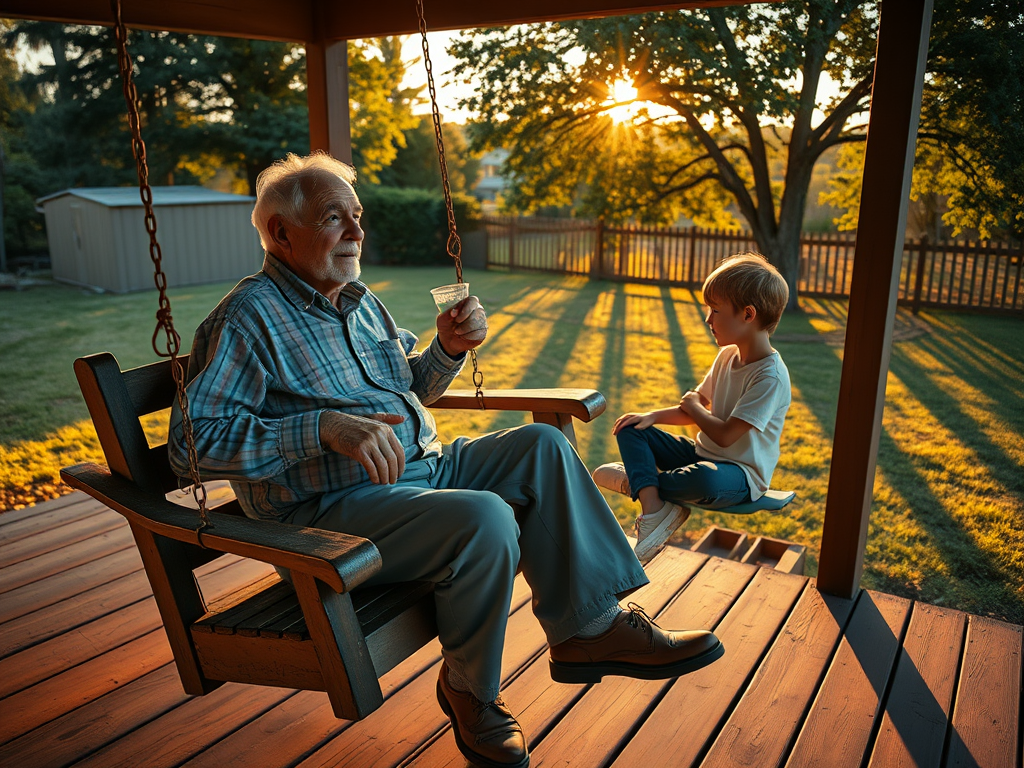
The older man rocked back and forth on the porch swing, the wood creaking under his weight. His nephew, Jake, sat cross-legged on the wooden planks, listening intently. The evening sun stretched its shadows long across the yard, the golden light flickering through the trees.
“You ever run through a plowed field, boy?”
Uncle Neb asked, a slow grin spreading across his weathered face.
Jake wrinkled his nose.
“Why would I do that?”
Ole Neb chuckled.
“Ah, you don’t know what you’re missin’. When I was your age, runnin’ through a fresh-plowed field was the best thing in the world. The dirt was soft, the furrows deep. Felt like jumpin’ across waves in the ocean—only, it was earth beneath your feet, not water.”
Jake smirked.
“Sounds messy.”
“Sure was!”
Uncle Neb laughed.
“And I’d get a good whuppin’ from your grandma for trackin’ mud in the house, too.”
He leaned back, sighing.
“Every spring, my daddy plowed and prepared the land to plant maize and oats. That was our winter feed for the livestock. Down at the bottom of our place, we had an alfalfa field. Grew some of the best in the county, thanks to the floods from the neighbor’s lake.”
“Wait—you let your field flood on purpose?”
Jake asked, wide-eyed.
“Didn’t have a choice, boy! The heavy spring rains would swell that lake, and the water would just roll over into our land. But let me tell you, that soaked ground made the alfalfa thick and green. We never had to worry about our cattle goin’ hungry.”
Jake traced a knot in the porch wood with his finger.
“You had cattle?”
“Sure did. Horses and chickens, guineas, goats—you name it. Had a big ol’ barn on the west side of the place where we kept ’em. But there was one animal I couldn’t go near—one of our milk cows. It is the meanest thing you have ever seen. That cow would lower her head and charge at me as soon as she spotted me.”
Jake grinned.
“You were scared of a cow?”
Uncle Neb narrowed his eyes playfully.
“You woulda been too, boy! Kids had tormented that cow before she came to us. Made her mad as a hornet. Your grandpa had to milk her himself ’cause she wouldn’t let nobody else close.”
Jake laughed.
“Sounds like she had a grudge.”
“That she did. But that was life on the farm, son. You learned to work with what you had, respect the land, and steer clear of mad cows.”
Ole Neb winked.
“Now come on, let’s go walk that field out back. Maybe you’ll see why runnin’ through dirt felt like flyin’ to a boy like me.”
Jake hesitated, then hopped up.
“Alright, Uncle Neb. But if I trip, you owe me ice cream.”
Neb laughed, his voice warm as the setting sun.
“Deal, boy. Deal.”
And together, they walked toward the fields, the past and gift blending with every step.
Harold Whitman woke before dawn, just as he had done for countless mornings. He stretched his aching limbs, feeling the stiffness permanently occupying his bones. The old house was quiet. Only the refrigerator’s soft hum and the occasional creak of settling wood were heard. This familiar symphony accompanied his every awakening.
He shuffled to the kitchen, brewed a pot of coffee, and sat at the window. He watched the sunrise paint the morning sky in shades of orange and pink. He savored the moment. The cup’s warmth was in his hands, and the faint aroma of the beans filled the air. His late wife had always loved those beans.
Today, he decided, would be a good day.
After breakfast, Harold walked to the park, as he had done for decades. He fed the ducks at the pond. He nodded to the joggers and dog walkers. They had become familiar faces over the years. These interactions, though brief, were like tiny rays of sunshine in his otherwise solitary life. A young boy, no older than six, waved at him from the swings. Harold smiled and waved back.
At the corner store, he bought a piece of his favorite caramel candy and an extra for the cashier. Marisol, a sweet girl, constantly reminded him of his granddaughter.
“You spoil me, Mr. Whitman,”
she said, laughing as she unwrapped the treat.
“Someone’s got to,”
he replied with a wink.
In the afternoon, he visited the cemetery. He sat on the bench beside his wife’s headstone, tracing her name with his fingers. The silence of the place soothed his soul. He felt a strange comfort thinking about joining his wife.
“I think I’ll be seeing you soon,”
he murmured.
“Maybe later tonight.”
There was no fear in him—just a quiet knowing.
Before heading home, he stopped by the diner, ordering a slice of apple pie and a cup of black coffee. The waitress, Lucy, patted his shoulder.
“You always get the same thing,”
she teased.
“Because I know what’s good,”
he said with a grin.
That evening, Harold sat in his favorite chair by the window, where the sunset bathed the room in golden light. He opened a book, though he barely read the words and content to hold it.
When sleep came, it was gentle, like slipping into a warm embrace.
Harold’s heart gave its final beat, and he sighed with quiet satisfaction. His last day had been good, a testament to the peace and acceptance that filled his heart.
Jane and Mark lived in a cozy little house on a quiet street in nowhere. The house had a white picket fence. A porch swing creaked with every breeze was also part of the house. Life was simple and predictable—until the night the sky split open.
It happened just after dinner. A brilliant ray of golden light shot down from the heavens. It struck the roof of their home with a silent flash. Jane screamed, dropping her fork, while Mark rushed to the window, heart pounding, their minds filled with fear and confusion.
“What was that?” Jane whispered, staring at the glowing beam. It pulsed briefly, then faded away, leaving no trace but a faint shimmer.
They inspected the house, finding no damage, burns, or explanation. But they soon discovered the truth in the strangest way possible.
The next day, Mark walked out to grab the newspaper, and when he stepped back inside, Jane gasped. Jane saw a man in medieval armor standing in the doorway. His eyes were wide with confusion. It wasn’t her husband in his sweatpants and T-shirt.
“Mark?” she stammered.
“Jane! What –– what happened?” Mark looked down at the polished steel covering his chest and arms. “I was outside, and when I came back ––– this happened!”
Jane grabbed his hand and pulled him in. “We need to call someone.”
But before they could dial, their neighbor, Mrs. Clarkson, walked in uninvited, as she often did. When she crossed the threshold, her modern blouse and skirt changed into a flapper dress. Her gray hair was pinned into 1920s finger waves. “My word!” she exclaimed, waving a cigarette holder she didn’t own.
Mark and Jane exchanged terrified glances. Their house was cursed or enchanted or something far beyond their understanding.
Over the next few days, they experimented with the strange phenomenon. Stepping outside and re-entering would send them hurtling through time. Sometimes, they found themselves in ancient Rome. Other times, they landed in the Wild West. Occasionally, they encountered an unsettlingly dystopian future. Even Otis, their golden retriever, came trotting back inside with a Victorian-era bonnet tied to his head.
Jane kept a notebook. “Day three: Entered as myself, exited as a 1970s disco queen. Mark walked in as a cowboy. Not great.”
Eventually, they learned some rules. The effect only lasted while they were inside. Stepping back outside would revert them to their usual selves. But the moment anyone crossed the threshold again, the house chose another era at random.
It wasn’t long before the military took notice. When government agents approached their door, Jane panicked and tried to warn them. “Please, don’t come in!”
Too late. Five suited men instantly transformed into Renaissance courtiers with feathered hats and ruffled collars. “What sorcery is this?” one muttered, spinning in circles.
Mark sighed. “You’re gonna want to take this one up with NASA.”
Despite the chaos, they refused to leave. Strange as it was, the house was still their home. They learned to adapt. They stored era-appropriate clothing in a chest by the door. They prepared themselves for anything from caveman furs to futuristic bodysuits. This showed their resilience and courage in the face of the unknown.
In time, they found unexpected joys in their predicament. They hosted Gatsby-style parties, had tea with Victorian neighbors, and experienced life in eras they never imagined. Their sense of wonder and adventure grew with each new experience.
The little house with the picket fence became legendary. It served as a portal through time. In this house, history was just a step away. Mark and Jane embraced the adventure. After all, who wouldn’t want to live in a place where every day was a different century?
Harold Fenton was not the world’s most excellent salesman. If there were an award for persistence without progress, Harold would have won it year after year. His thick glasses always slid down his nose. He carried a briefcase that had seen better days. An ever-lasting mustard stain marked his tie. He wandered the same neighborhoods week after week. He sold an assortment of household knickknacks that nobody needed, but they bought them anyway.
“Good afternoon, Mrs. Jenkins!”
Harold greeted cheerfully as he stepped onto the well-trodden path to her front door.
“I have a brand-new shipment of vegetable peelers today! They’re sharper, sleeker, and—”
Mrs. Jenkins, a kindly woman in her sixties, smiled warmly.
“Why, Harold, I still have the five you sold me last month.But you know, one can never have too many peelers. Come on in.”
Harold beamed and entered, opening his battered case to show an array of matching peelers. Mrs. Jenkins sighed as she handed him a few bills. She tucked the latest addition into her kitchen drawer. The drawer now resembled a peeler museum.
Down the street, Mr. Thompson, a retired mechanic, nodded at Harold as he approached.
“Harold, my boy, back again? What do you have today?”
–––
“A fantastic deal on rubber jar openers!”
Harold declared with gusto.
“These bad boys can grip the tightest lids with ease.”
Mr. Thompson scratched his head.
“Well, I reckon I have about twenty of those in my drawer already, but why not?”
He chuckled, handing Harold a crumpled bill.
“You’re a persistent fella, I’ll give you that.”
Each household in the neighborhood had its own Harold collection. The Henderson’s had a mountain of Harold’s lint rollers stacked neatly in their laundry room. The Patel family had so many of his never-fail can openers that their entire garage shelf was dedicated to them. And the Cranstons? They jokingly called their basement “Harold’s Home Shopping Network.” It was filled with enough potato mashers to start a catering business.
But no one ever turned Harold away.
“He’s got such heart,”
Mrs. Jenkins often said over tea with the neighbors.
“Bless him. He tries so hard.”
One day, Harold arrived with a new product—a miracle mop he couldn’t figure out how to show.
“This mop… uh… well, you see, it swivels… I think. Or it wrings itself. Hold on, I had a pamphlet here somewhere…”
He fumbled with his case, papers spilling onto the sidewalk.
Mrs. Jenkins and Mr. Thompson exchanged a glance and quickly stepped in.
“We’ll take a few!”
They chimed in unison.
Harold left the neighborhood beaming, waving to everyone as he wheeled his suitcase down the block. He whistled a tune with the satisfaction of a man who believed in his mission.
And so the cycle continued. Week after week, Harold brought the same products with the same pitches. The residents kept buying. They did this not out of necessity but of fondness for the bumbling salesman. He brought a little charm and harmless chaos to their otherwise predictable days.
One day, as Harold left Mrs. Jenkins’ house, she whispered to Mr. Thompson,
“I sure hope he never realizes we’ve got enough peelers to last a lifetime.”
“He won’t,”
Mr. Thompson grinned.
“And even if he did, I’d still buy another one next week.”
With that, Harold walked down the road. He was ready to bring his boundless enthusiasm. He also carried a suitcase full of peelers to the next unsuspecting yet ever-welcoming home.
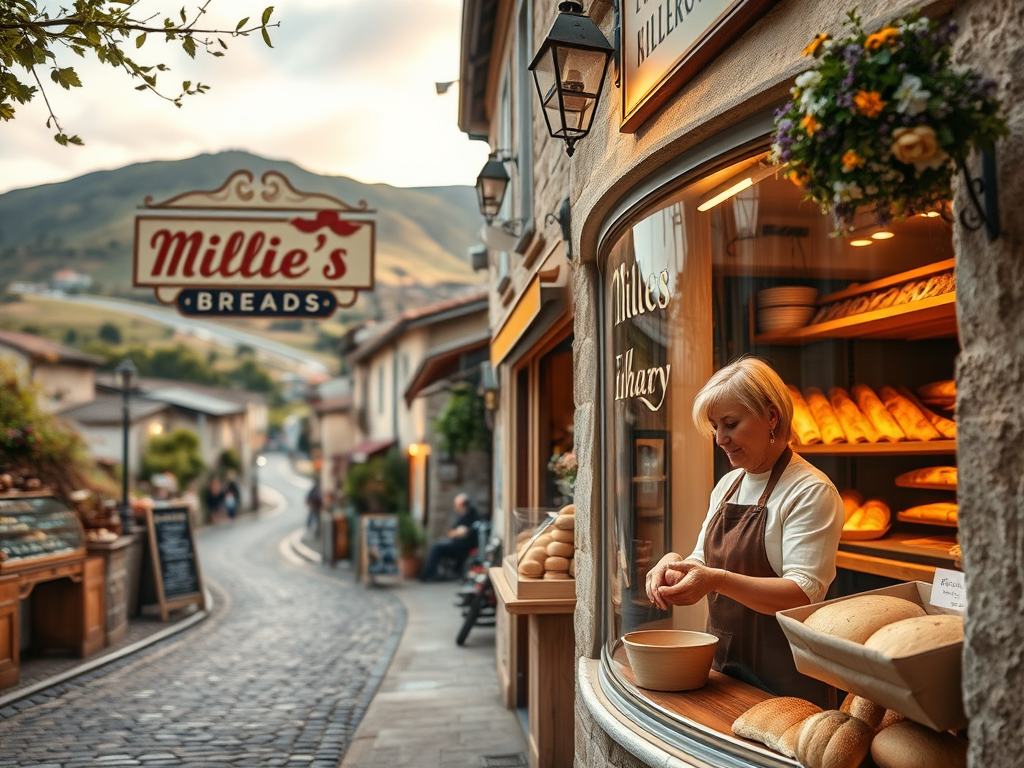
Willowbrook was a quaint town nestled between rolling hills and winding cobblestone streets. In this charming setting, a little bakery called Millie’s Breads stood. Millie, the baker, had spent decades perfecting her craft. She kneaded dough with love, and the air filled with the comforting aroma of fresh bread.
Every morning, without fail, Millie would bake precisely enough loaves to meet the demands of her customers—except for one. Each day, she would bake an extra loaf. The townsfolk often wondered why, but Millie never spoke of it. The extra loaf sat on the counter until closing time. It remained untouched and unnoticed. By morning, it would quietly disappear, adding to the mystery.
Speculations floated through the town. Some believed Millie kept it for herself. She always said she had little appetite for bread after a long baking day. Others whispered that she was feeding a stray cat or a secret admirer. But no one knew the truth.
One chilly winter evening, young Emma, the florist’s daughter, stayed behind after closing. She wanted to help her mother pick up an order of pastries for a town event. As they waited, Emma noticed Millie wrapping the extra loaf in brown paper and slipping out the back door. Emma felt curious, so she decided to follow at a distance. Her eyes were keen, and her heart was open to the possibility of a heartwarming discovery.
Hidden in the shadows, Emma saw Millie stop by an old wooden bench. An elderly man sat on it, wrapped in a tattered coat. His face was weathered, and his hands trembled from the cold. Millie handed him the loaf with a warm smile, exchanging a few kind words before returning to her shop.
Emma’s heart swelled with admiration. The extra loaf wasn’t a mystery after all. It was an act of quiet kindness. A small gesture of compassion that no one ever knew about. The man, known simply as Mr. Thomas, had once been a beloved schoolteacher but had fallen hard after losing his family.
The next day, Emma shared what she had seen with her mother. Word spread through the town, and the townspeople, inspired by Millie’s act of kindness, found their ways to contribute. Some would leave warm clothing on the bench. Others discreetly added a little extra to their purchases at Millie’s bakery. They knew it would go to someone in need.
One evening, as Millie once again delivered the extra loaf, she found Mr. Thomas sitting on the bench with a new coat draped over his shoulders and a gentle smile. He looked at her with gratitude and said,
“Your kindness has brought more than just bread, Millie. You’ve brought me hope.”
His words echoed the profound impact of Millie’s simple act of kindness.
Millie patted his hand, offering her usual warm smile, and returned to her bakery. She never needed recognition, for she believed that kindness, like bread, was best when shared freely.
The baker continued to bake an extra loaf each day. The town of Willowbrook learned that sometimes, the smallest gestures hold the most significant meaning. Millie’s simple act of kindness brought hope to Mr. Thomas and inspired the townspeople to look out for each other, fostering a sense of community and shared responsibility.
In the spring of 1942, the Krieger family vanished from the small town of Marburg, or so their neighbors believed. The truth, though, was a testament to their resilience. Ernst and Klara Krieger lived concealed behind a false wall. Their teenage daughter Lotte was with them in the attic of their modest home. They clung to a fragile existence beneath the ever-watchful eyes of the Nazi regime.
Before the war, Ernst had been a respected tailor, his shop bustling with customers seeking fine suits and dresses. The war machine tightened its grip on Germany, and Jewish families like the Kriegers became targets. They had no choice but to vanish from public view. Ernst’s friend, Herr Becker, was a trusted carpenter. He had built a hidden compartment in their attic. It was a space just large enough for the three of them to survive.
Each day, Klara prepared sparse meals from the dwindling stock of supplies. She rationed every crumb with the precision of a soldier. Lotte, once full of life and laughter, now spent her days in silence. She read the few books they had managed to take with them. Ernst, ever resourceful, repaired uniforms in secret. He exchanged this favor with Herr Becker for smuggled food. They also shared whispers of news from the outside world.
Life under the radar was a delicate balancing act, but the Kriegers refused to let go of hope. They learned to move only when the town slept, their footsteps carefully muffled. They endured bitter winters without fire, their breath hanging in the frozen air like ghosts. Klara kept their spirits up with whispered stories of better days. She spoke of summers at the lake and the scent of fresh bread filling their home. They lived in fear but also in quiet defiance, their hope a beacon in the darkness.
One night, in late 1944, as the war neared its end, a knock at the door sent their hearts racing. Herr Becker’s hushed voice broke through the silence.
“The Americans are coming,”
he whispered through the floorboards.
“Stay hidden a little longer.”
Days passed like years until, at last, the sound of foreign voices filled the streets. The Kriegers dared to peek from their hidden vantage point. What they saw made their hearts swell with cautious hope. They observed Allied soldiers marching through the town. Their uniforms were different, and their faces were filled with determination rather than cruelty.
The danger had finally passed. Ernst and Klara stepped out into the light of a new morning. They held Lotte’s trembling hand. Their survival was a quiet miracle. It was a testament to the resilience, cunningness, and kindness of those who risked it all to help them. Their hearts were filled with gratitude for these unsung heroes.
Life was difficult in the next years, but the Kriegers rebuilt what they had lost. Ernst reopened his shop. Klara baked bread that once again filled their home with warmth. Lotte found her laughter in the sunlight. Though they had lived in the shadows for so long, they emerged stronger and free.
And in the attic, behind the false wall, they left a small inscription:
Every morning, the sun rose over Willow Creek. Clara Jackson would pour herself a cup of coffee. She would then sit by the window and scroll through the news on her phone. Headlines blared with despair. Civil rights were being denied. People were being removed from their families because of their citizenship status. There were natural disasters, economic struggles, and political turmoil. It seemed as if the world was unraveling thread by thread. Each day felt heavier than the last, and Clara found it harder to believe in a brighter tomorrow.
One cold morning, as the weight of the world’s problems sat on her chest, she noticed her elderly neighbor, Mr. Thompson, hobbling down the sidewalk with a broom in hand. His frail figure moved with purpose. He swept the fallen leaves away from everyone’s doorstep. As he worked, he whistled a tune that carried a sense of ease Clara hadn’t felt in a long time.
Curious, she stepped outside and called out,
“Mr. Thompson, what are you doing out here so early?”
The old man looked up and smiled warmly.
“Clearing the way, my dear. It’s a little thing, but it makes the morning brighter for everyone.”
Clara laughed softly.
“With all that’s happening in the world, does this really make a difference?”
Mr. Thompson leaned on his broom and nodded.
“Oh, it does, Clara. You see, the world’s got its troubles, but right here, right now, we can still bring goodness. You can’t control the storms outside, but you can light a candle inside.”
His words settled into Clara’s heart like a gentle breeze pushing away the clouds. That afternoon, instead of drowning in the news, she baked cookies and shared them with neighbors. She took her old paintbrushes out of the closet and added splashes of color to the worn fence outside. And as she handed out treats to passing children, she felt something stir inside her—hope.
Days turned into weeks, and Clara found that small acts of kindness helped her navigate the darkness in the world. She volunteered at the local shelter. She also planted flowers along the sidewalks. Clara spent more time listening to the laughter of children at the park. The news was still grim, but Clara had found something stronger—hope born from action, not fear.
One evening, she closed her book and looked out at the quiet street. She realized the world hadn’t changed overnight. But she had. And that was enough to believe in a brighter tomorrow.
George Kalinsky was born in 1936 in Hempstead, New York. He was a renowned American photographer. His work captured some of the most iconic moments in sports and entertainment history. Finding Aids
His photography journey began serendipitously in the mid-1960s. He noticed Muhammad Ali entering the 5th Street Gym while on vacation in Miami. Intrigued, Kalinsky followed and was allowed to photograph Ali after a brief exchange with trainer Angelo Dundee. These images marked the start of his illustrious career. Interview Magazine
In 1966, Kalinsky became the official photographer for Madison Square Garden, a position he held for nearly six decades. He documented over 10,000 events throughout his tenure. He captured legendary figures like Frank Sinatra, Elvis Presley, and Pope John Paul II. His work has been featured in major publications like Sports Illustrated, People, Newsweek, and The New York Times. Kalinsky authored ten books. His photographs were exhibited in esteemed institutions, including the Museum of Modern Art and the Metropolitan Museum of Art. – From The Lens of George Kalinsky
Over the years, Kalinsky has received many accolades for his contributions to photography. In 2001, the PhotoImaging Manufacturers and Distributors Association named him International Photographer of the Year. He was inducted into the New York City Basketball Hall of Fame in 2010. He received the Pratt Institute’s Legends Award in 2017. Wikipedia
George Kalinsky passed away on January 16, 2025, at the age of 88. His legacy endures through the timeless images he captured. These images continue to inspire. They evoke memories of significant moments in sports and entertainment history. Wikipedia
To Stay or Go: Evaluating the Benefits of Remaining on Facebook in Light of Controversial Changes
Social media platforms have become integral to modern life, offering communication, connection, and community building avenues. Nevertheless, as these platforms evolve, so do their policies and practices, often sparking debate about their social and ethical implications. Facebook, a leading social media giant, has recently faced criticism. This criticism is due to changes in its policies on hate speech, bigotry, and LGBTQI support. For individuals making the decision about staying on or leaving Facebook, they hold the power to be informed. Weighing the benefits of both options is essential for this empowerment.
The Case for Staying on Facebook
Maintaining Connections: Facebook remains a vital tool for staying in touch with family. It also helps keep connections with friends and acquaintances, particularly those spread across different regions or countries. For many, it is a lifeline to relationships that would otherwise be difficult to nurture.
Community and Advocacy Opportunities: Despite policy changes, Facebook still hosts several groups and communities that support marginalized voices. These include LGBTQI organizations, social justice movements, and local advocacy efforts. By staying, individuals can continue amplifying positive messages and supporting important causes.
Access to Events and Local Updates: Facebook excels as a hub for event coordination and news dissemination. Whether it’s discovering community gatherings, charity events, or public discussions, the platform enables users to stay engaged with their surroundings.
Platform for Countering Negativity: Staying active on Facebook allows users to directly challenge hate speech and bigotry. Individuals can use their presence to make a positive impact through reporting mechanisms, creating supportive content, and fostering constructive dialogues.
Professional Networking and Opportunities: Beyond personal connections, Facebook provides professional opportunities through networking, business pages, and advertising. Leaving the platform will limit exposure to these tools, which can be crucial for entrepreneurs, freelancers, or small business owners.
The Case for Leaving Facebook
Moral and Ethical Stance: Users can take a stand by leaving Facebook. They do this against policies they perceive as harmful or contrary to their values. This protest can send a powerful message to the platform and its advertisers, influencing change.
Reducing Exposure to Toxic Content: With the relaxation of hate speech policies, users face more harmful content. They become increasingly exposed to offensive material. Removing oneself from the platform eliminates the mental and emotional toll of encountering such material.
Privacy and Data Concerns: Facebook has faced ongoing scrutiny over its handling of user data. Leaving the platform reduces one’s vulnerability to data misuse, targeted advertising, and potential privacy breaches.
Encouraging Other Platforms: Exiting Facebook can prompt individuals to explore different social media platforms that better align with their values. Platforms like Mastodon, MeWe, or local community forums offer a more supportive environment.
Reclaiming Time and Focus: Many users realize an unexpected advantage when they leave Facebook. They find they have more time for hobbies, personal growth, and face-to-face interactions. The departure can foster a sense of liberation from the constant pull of notifications and algorithm-driven content.
Finding a Middle Ground
For those hesitant to make a definitive choice, there are ways to balance the benefits of staying and leaving. Users can regain a sense of control over their Facebook experience by reducing engagement. They can also limit time spent on the platform. Unfollowing toxic pages or users and curating a positive feed helps as well. Additionally, prioritizing different platforms for personal or professional connections while maintaining a minimal Facebook presence can further enhance this control.
Conclusion
The decision to stay on or leave Facebook is very personal. It depends on one’s values, priorities, and tolerance for the platform’s evolving policies. Staying permits individuals to keep connections. They can use their presence for positive change. Leaving can signify a powerful ethical stance. It can lead to personal growth. Regardless of one’s choice, it is essential to evaluate Facebook’s role in one’s life. People should make a decision that aligns with their values and well-being.



























 benandsteve.com