Santa’s Time-Warped Christmas

The current image has no alternative text. The file name is: as-santa-claus-guided-his-sleigh-over-the-north-pole.png
It Is Only Six Days Until Christmas Eve!

This story is pulled from the archives as a celebration for the season edition.

Groff Media 2024© Truth Endures IMDbPro

Presented by benandsteve.com By: Benjamin Groff II©

3–4 minutes

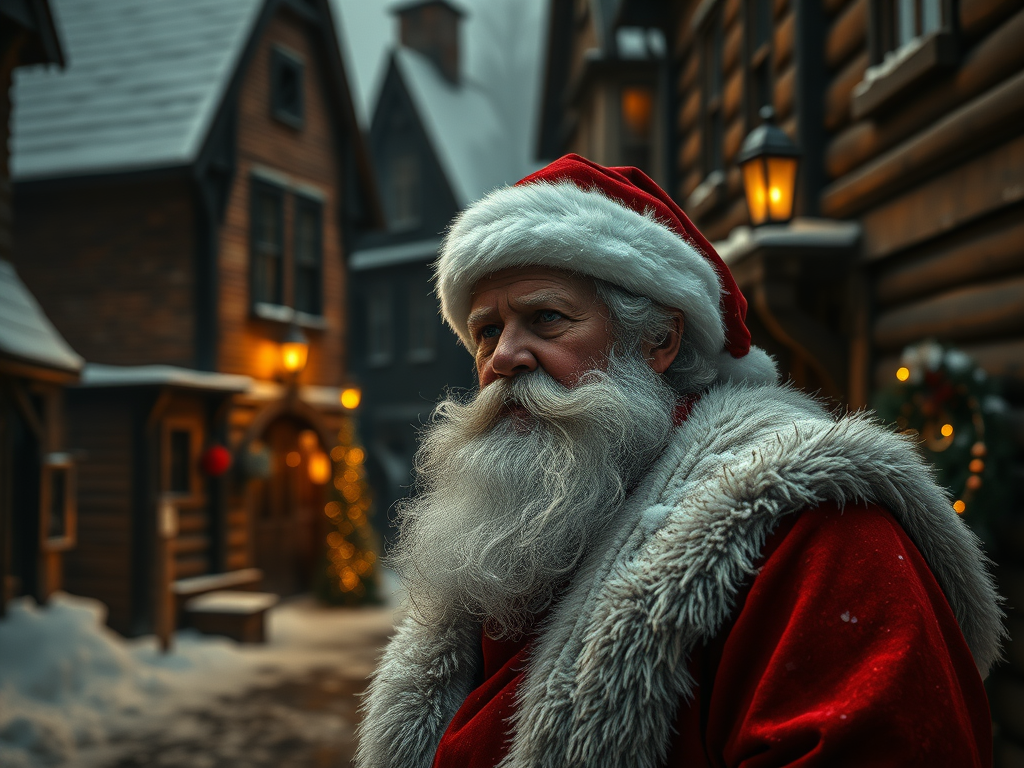
As Santa Claus guided his sleigh over the North Pole, the stars shimmered brighter than ever. It was Christmas Eve, and his magic sleigh, loaded with gifts for children worldwide, zipped through the frosty air. But something strange happened as he crossed a shimmering aurora—an inexplicable jolt rattled the sleigh.

“Dasher, what was that?”

Santa muttered, steadying his hold on the reins. The reindeer snorted in reply, uneasy.

The aurora enveloped him before he gathered his thoughts, and time seemed to twist and fold around him. When the light dissipated, the world below him was not the one he knew. Snow-covered cottages and horse-drawn carriages replaced the bustling cities of 2024.

Santa realized he had been thrown back in time to the mid-1800s. He recognized the period instantly from the distinct architecture of a village below. It was a Christmas during a dark chapter in history. A devastating plague had gripped the land. It forced him to cancel his rounds that year.
“Great gumdrops!”

Santa exclaimed.

“What are the odds?”

He gazed at the sleigh’s cargo. By a twist of fate, it had been stocked with emergency medical supplies. These were intended for a charity hospital in the modern era. Among the crates were antibiotics, syringes, and boxes of penicillin.

As he landed his sleigh in the village square, the grim reality of the situation became clear. Emaciated villagers huddled near fires, their coughs echoing through the silent night. Santa’s heart ached as he walked among them, his red suit standing out against the bleak surroundings.

A child approached him, her face pale and gaunt.

“Who are you?”

She asked, her voice weak.

Santa knelt, his jolly demeanor softening.

“I’m Santa Claus, my dear. And I’ve brought –– hope.”

He opened a crate, revealing the miracle medicines of the future. Doctors, initially skeptical, were astonished by how quickly the penicillin began to heal their sickest patients. Word spread, and soon, Santa was inundated with requests for help.

But as he worked tirelessly through the night, a troubling thought weighed heavily on him. He altered the course of history by introducing modern medicine to the past. He remembered the first rule of time travel: do not interfere. Yet how he stand by and let so many suffer?

Santa consulted his reindeer, who were no strangers to magical predicaments.

“What do you think, Comet? If we save them now, what happens to the future?”

Comet stamped his hoof thoughtfully as if to say,

The heart often knows what the mind can’t reason.

Santa decided to take the risk.

“If kindness is a mistake, then I’ll gladly make it,”

He said aloud.

By dawn, the village was transformed. People sang carols, their strength returning. They looked at Santa with gratitude and wonder as he prepared to leave.

“Thank you, sir,”

said the village doctor.

“You’ve given us a miracle.”

Santa nodded, but his heart was heavy with uncertainty. As he guided the sleigh back into the sky, the aurora reappeared, pulling him back to his own time.

When he returned to the North Pole, he checked the world’s records, bracing for the consequences of his actions. To his amazement, the plague of the 1800s had been recorded as miraculously subsiding in one particular region. Yet, history did not explain this occurrence. Furthermore, the trajectory of medicine had advanced more quickly than he remembered. The saved lives gave rise to several key figures. These figures contributed significantly to society.

Santa smiled, chuckling saying,

“History has a way of balancing itself after all.”

Santa pondered the night’s events on Christmas Eve as he settled into his chair by the fire. Sometimes, he thought, doing the right thing means accepting the unknown. In the spirit of Christmas, a little magic can change the world for the better. A lot of kindness can also make a difference, no matter the time.
When Ghosts Were Celebrated in Homes

By Benjamin H. Groff II

2–3 minutes

There was a time when ghosts were not feared, but welcomed. Long before the plastic skeletons and fog machines, the presence of the departed inside a home was seen as sacred. It was viewed as even comforting. Hollywood later turned spirits into screams.

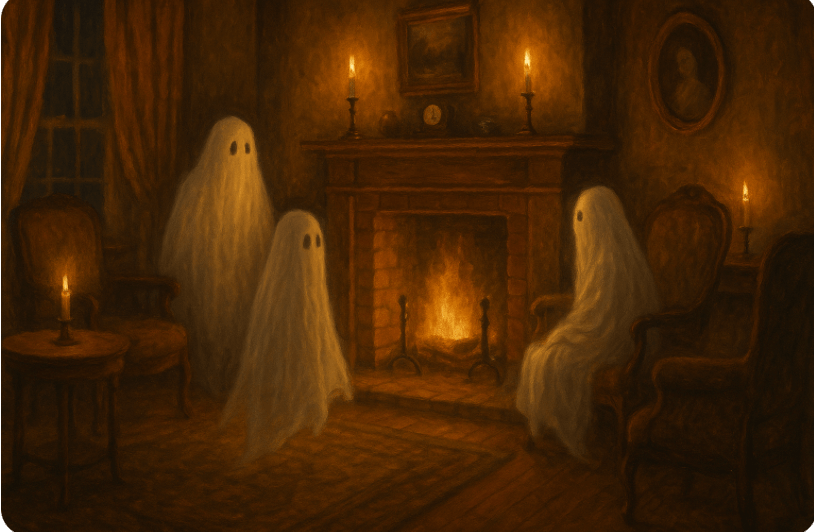
In old America, the line between the living and the dead was not sharply drawn. Much earlier in Europe, this line was also blurred. Families left chairs empty at the table for those who had passed. Candles flickered in windows not to frighten away spirits, but to guide them home. A draft whispered through the house. The hallway creaked, or the boards settled. These sounds were spoken of with gentle reverence: “It’s only Mother checking on us.”

Autumn, of course, was the favored season for such visitations. The harvest was done. The air turned cool and thin. This is a time believed to make the veil between worlds soft as gauze. Many homes, especially in rural places, held small gatherings to honor those who came before. Food was left out overnight. The family Bible was opened to the names of the dead. In some corners, the very hearth hosted a spirit or two. They lingered close to the warmth that once gave them life.

Ghosts were part of the household, not intruders. They were reminders — that life continues, even in unseen ways. The wind brushing the curtains or the rocker swaying gently on its own didn’t make people scream. They didn’t call for help. They smiled. They believed their ancestors had found their way home.

It wasn’t until the age of electricity and industrial noise that ghosts were driven out — or at least, ignored. Modern light replaced candlelight, and superstition was traded for science. Yet, as every October rolls around, the scent of woodsmoke returns to the air. We still sense something ancient moving among us. Maybe that’s why we decorate with skeletons and glowing pumpkins — a way, even now, to say: we remember you.

So the old ways weren’t so strange after all. Maybe ghosts were never meant to be feared. Maybe they were simply waiting to be invited back in.


© Benjamin H. Groff II — Truth Endures / benandsteve.com

The world is going to POT, and we are watching it go!

A view of the world as it is today by: Benjamin Groff II© Groff Media 2024© Truth Endures IMDbPro

My dad and grandfather are gone now, but neither would support a liar, cheat, rapist, insurrectionist, dictator, or someone who supports one, or generally speaking, a creep or ‘weirdo.’ 

There are other reasons you can look at as well. For instance, a candidate such has a sexual offense judgment against him, and he is under indictment for countless federal crimes; in the last year, one of the candidates was in the air, flying, on their way to being arrested, just as much as he was campaigning at one point. 

One or more of those reasons would have been reason enough to consider looking into the person’s background. And three to four, would have been reason enough to reject a person all together. Someone who was strongly running for public office would have been rejected. Now, the GOP considers it a qualification required for all Republican candidates.

The candidates have endorsements from KKK members. They boast about, a presidential politician having endorsements from dictators. They wallow in such markings, and candidates publicly brag about laws they will violate first, if elected. And this makes them the most qualified candidate. Going as far as boasting about becoming a dictator. Going about telling people this is the last election they will have to worry about voting in. 

Why? Does that mean the Constitution is going to get ripped apart, shredded, and there will no longer be a United States where the people choose its leaders? It appears it doesn’t matter to the people who are numb and following this character. They appear to have zoned out of reality. 

My grandfather, father, uncles, aunts, and even a few dogs and horses I’ve had would not have allowed the goings on to persist. The greatest generation has died chiefly off; fewer of them now than ever are living, which sadly shows in our world. They were the ones who knew what happens when the world that falls to fascism. When reality hits and the world dies. It is beginning as America will turn grey; it will become a black-and-white construct of anything anyone remembers of its being, if these destructionists are permitted to have their way with the country. We only hope enough voters come to the polls and and vote, and save our America!

My dad had a favorite saying: the older I got, the wiser he’d get. And he was right; I wish he were here to help us out of this madness!

JD Groff At Rest And Getting Wiser Every Day!

The Intestate Legacy of John Ellis, Esq.

A Glimpsing Report By: Benjamin Groff© Groff Media 2024© Truth Endures

The name John Ellis, Esq. still echoes in the rolling hills and creeks of Deep River, North Carolina. To those who knew him, he was a stern yet fair Justice of the Peace, ruling his township with a measured hand, holding court in his modest home, and settling disputes with the wisdom of a man who had seen both war and peace. However, there was one mystery about John Ellis that no one could quite explain. For all his legal prowess and the order he brought to his community, John Ellis died without leaving a will—a fact unsettled his descendants for years to come and continues to intrigue history enthusiasts and those interested in legal history.

The year was 1812, and a biting winter frost clung to the edges of the Ellis estate, an imposing tract of land the Earl of Granville granted to John fifty years earlier. John’s death cast a long shadow on the west side of Deep River, where his 520 acres stretch over the rugged terrain. His wife, Mary Quinn Ellis, now widowed and frail, remained in their home in Fort Mill, York County, South Carolina, surrounded by memories of their eleven children and the life they had built together. John’spassing was not unexpected—he was 83—but the silence he left behind was.

It wasn’t just his absence that haunted those around him. It was the absence of something else—his final words, his will. John had settled countless estates during his time as Justice of the Peace, ensuring families were provided for, debts were settled, and the land was distributed correctly. And yet, he left no such document for his own family. Eighteen years would pass before his estate got probated in 1831, long after his burial in the family cemetery at Jumping Branch Creek. The delay gnawed at the Ellis children, especially William Quinn, the eldest son, who should have inherited the bulk of the estate. But the land was silent, locked in bureaucratic limbo.

In the years following John’s death, whispers swelled through the small towns of North Carolina and South Carolina, where his family had deep roots. The family cemetery where John and Mary would get buried became a place of whispered tales. Some said that John had left instructions hidden somewhere on his land—perhaps in a letter or beneath a cornerstone in his house. His children, it was said, spent months after his death combing through every inch of the property but found nothing. These rumors and folklore added a layer of fascination to the mystery of John Ellis’s intestate legacy.

The most curious rumor concerned the woods that bordered the Ellis estate. Hunters and travelers passing through Rowan and Tryon Counties spoke of a strange figure—an older man who resembled John Ellis, seen walking among the trees, sometimes at dusk, sometimes at dawn. This figure, they claimed, seemed to be searching for something, bending low to inspect the ground or pausing by the river as if lost in thought. Others said the older man appeared near the family cemetery, wandering among the graves silently.

By 1831, when the estate was finally resolved and divided among the children, most of these tales had faded into local folklore. But there was one final piece of the story that remained unexplained. One autumn afternoon, shortly after the estate gets settled, a group of workers clearing trees from the property stumbled upon a small, hidden clearing by the river. There, beneath a heavy stone, they found a weathered leather-bound book half-buried in the soil. This discovery added a new chapter to the mystery of John Ellis’s intestate legacy, sparking curiosity and speculation.

“To those who come after, let the land be their guide. All answers will be revealed in the river’s flow and the earth’s turning. I leave my legacy to the water, where I once made peace.”

No one knew what John had meant, but the discovery only deepened the mystery surrounding his death. Had John left his will in the elements, knowing it would be lost to time? Or had he chosen, in his final years, to let go of the very legal structures he had spent his life upholding?

The land remained, of course, just as the family stayed. However, the legend of John Ellis, Esq. grew with each passing year. And those who ventured near Deep River, when the mist was thick and the air still, would sometimes swear they heard a voice, carried on the wind, speaking words too faint to be understood.

Perhaps, they said, John Ellis had finally found his will—hidden somewhere between the river and the earth, waiting for those brave enough to listen.
 

The End.