
By Benjamin GroffMedia© | benandsteve.com | ©2025
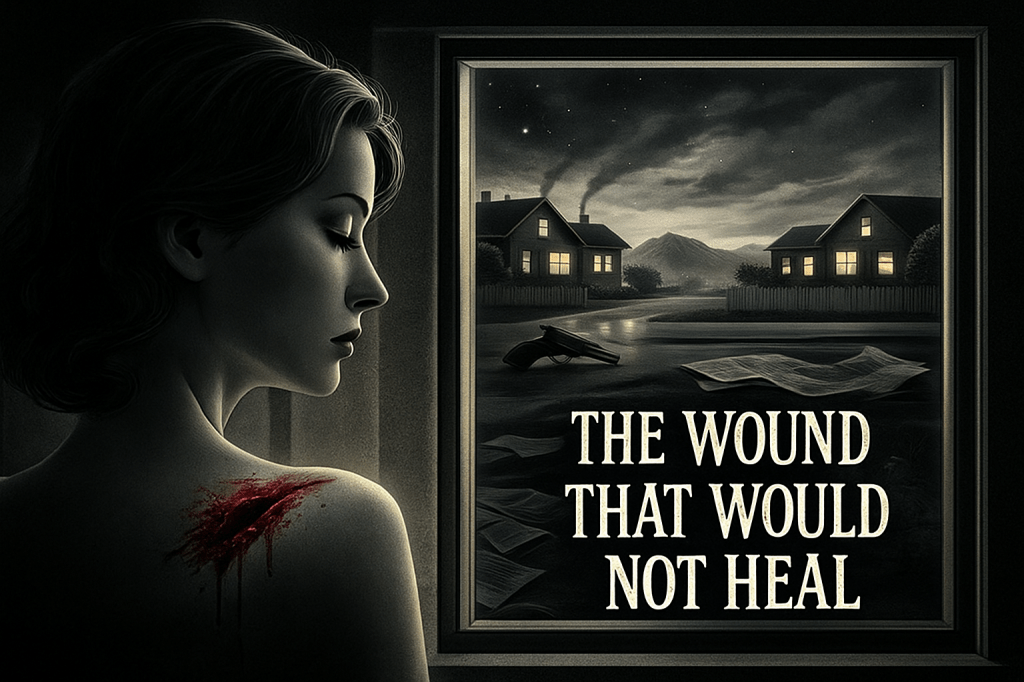
No one remembers precisely when the truth first slipped away. They only knew it had happened quietly. It occurred somewhere between the gunshot and the bandage.
Mara Ellison had lived beside Harold Pike for seven years without incident. They exchanged polite nods, sometimes a forced smile across the narrow strip of gravel separating their properties. So when the bullet tore into her foot one late afternoon — fired inexplicably from Harold’s back porch — she assumed the world would respond with reason.
It did not.
The police arrived within minutes, yet their questions drifted strangely away from the obvious. Why had she been standing there? Had she provoked him? Were there prior disagreements she had neglected to mention? Harold, calm and unsettlingly sincere, claimed the gun had “gone off on its own.” Soon, the incident was reclassified as an unfortunate misunderstanding.
Mara limped through the next weeks on swelling and disbelief. Her foot healed slowly. But the real pain settled elsewhere. It lingered in the way neighbors crossed the street to avoid her. It was noticeable in the whispers that followed her like dust. She was suddenly labeled unstable. Dramatic. A troublemaker.
She filed complaints. She documented every detail.
Each report vanished like breath on cold glass.
Harold began mowing his yard at odd hours, staring straight ahead, humming tunelessly as though nothing had happened. His friends brought casseroles. People clapped him on the back. Someone even hung a banner on his fence that read:
WE STAND WITH HAROLD.
Mara woke one morning to discover a court summons slid beneath her door. Harold claimed she had injured herself deliberately. He said it was to ruin his reputation.
The town agreed.
Reality itself began to warp. The scar on her foot throbbed while local newsletters praised Harold for his patience and “strength of character.” A small feature in the paper framed Mara as a disturbed woman seeking attention. Her own name felt foreign in print, warped by accusation.
Street signs near her home began to shift. Directions pointed nowhere. Familiar shops closed overnight. Conversations dissolved mid-sentence when she approached.
One night, she saw herself on the evening news. She looked laughing, cheerful, and perfectly fine. In reality, she sat alone. She stared at the bandage that never quite came off.
The bullet wound refused to disappear.
Nor did the silence that followed everyone’s denial of it.
On the final day anyone heard from her, Mara stood before the cracked mirror of her hallway. She whispered,
“If the world insists I am wrong, then what am I supposed to become?”
Outside, Harold watered his flowers with careful devotion.
Inside, Mara stepped into a reality no longer willing to recognize her. She vanished into a story written by others. This story never spoke the truth. Yet it was repeated loudly enough to become law.
Some said the house stood empty.
Others swore that if you passed it at dusk, you hear the faint echo of limping footsteps. They claimed to hear a voice pleading, again and again, to simply be believed.
Harold, meanwhile, withdrew mysteriously from society after Mara disappeared. He became a recluse, a shadow of the man the town once defended so fiercely.
Mara, in time, became folklore — “the woman no one believed.” Some claimed she had simply self-immolated. Others said she cried herself into nothing. A few insisted they saw her walking away from her home. She moved slowly toward the setting sun. She never once looked back.
Then, exactly ten years to the day of Mara’s shooting, Harold was found dead.
His body bore the evidence of prolonged torment . — Gunshot wounds in both feet, knees, hips, abdomen, hands, elbows, and upper arms. Each injury, save for the final one, had healed. The coroner confirmed a chilling pattern: Harold had been shot, treated, allowed to recover ––and shot again. Repeatedly, over the span of a decade.
The final bullet entered the right side of his head.
Nearby, written in a trembling hand, were the words:
“I can’t take it anymore.”
Had Harold been punishing himself for the truth he buried?
Had Mara’s spirit delivered a slow and deliberate reckoning?
Or had she never left at all — only waited?
Silence and shadows enveloped the town. It learned a lesson far too late: When truth is denied long enough, it finds other ways to speak.
By Benjamin GroffMedia© | benandsteve.com | ©2025


 benandsteve.com