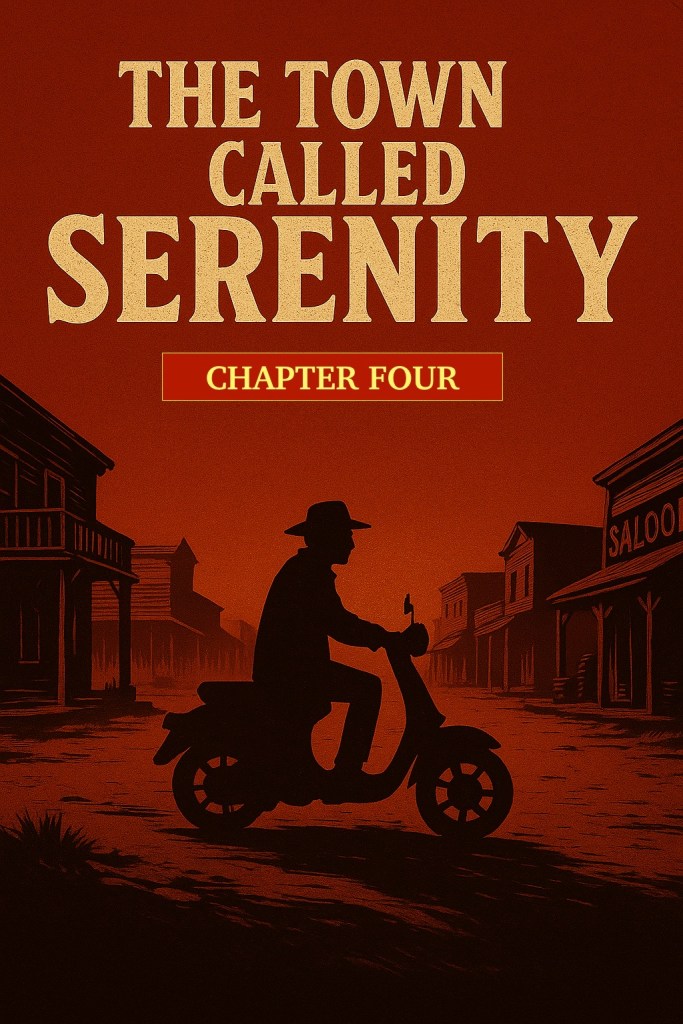
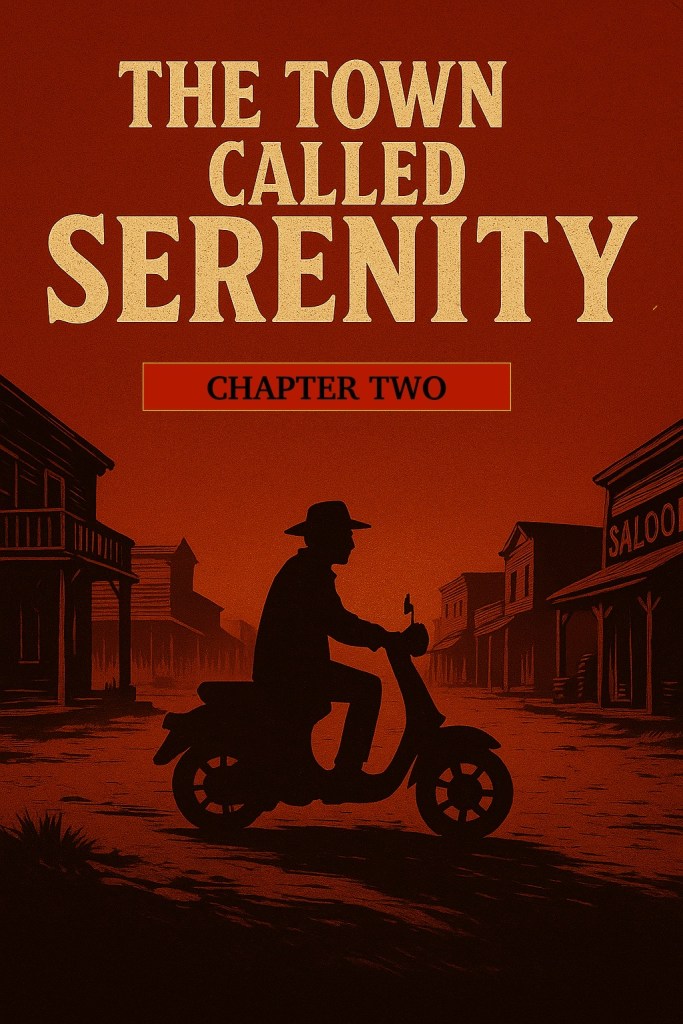
Title: The Trail Guardians – Chapter Two: Into the Hollow

By Benjamin GroffMedia© | benandsteve.com | 2025 Truth Endures©

2–4 minutes

The trail that day led into Cottonwood Hollow. It was a deep gully nestled between two ridges. The area was thick with ancient trees and the scent of cool, damp earth. Benji had finally summoned the courage to enter what the kids around the farm called “No Man’s Land.”

oggy doggy
Oggy Doggy, The Best Friend A Family Ever Had

Oggy darted ahead, barking sharply as he flushed out a covey of quail.

“Good boy!” 

Benji laughed, breaking into a jog behind him.

Bruiser trotted beside him, his heavy paws crunching over dry leaves. Every time a twig snapped, his muscular body tensed. If the wind shifted, he was ready to protect until he decided there was no danger.

Jackie moved like a ghost, glancing back from time to time, her black-and-white tail swaying gently. She paused here and there to mark tree trunks, just in case they needed help finding the way back.

About halfway through the Hollow, Oggy let out a sharp yip and froze—body crouched low, fur bristling.

Benji halted.

“What is it, boy?”

Then he saw it. A feral boar was rooting near the creek bed. Its coarse hair rose. Its tusks caught the last golden light of the afternoon. Oggy growled, weaving left and right, trying to distract it.

Bruiser stepped in front of Benji and barked once—low and commanding. The boar noticed the big dog and paused, nostrils flaring.

“Back up… slowly,” 

Benji whispered.

They had only taken a few steps when Jackie barked behind them. Benji spun around.

A second boar had crept up from the rear.

Trapped.

Benji’s heart pounded. Feral hogs? He’d never seen any this close to the farm before. His dad’s hogs were penned and docile. These? These had tusks. And just as panic set in, a third hog emerged from the brush, snorting and stomping.

Think, Benji. Think.

He reached into his pocket and pulled out a pouch of beef jerky—the snack he’d saved for later. Tearing it open, he waved a piece in the air.

The hogs’ heads turned toward the scent. Without wasting a second, Benji hurled the entire pouch as far as he can into the underbrush.

It worked.

All three hogs charged the pouch, squealing and shoving as they fought over the jerky.

Benji snapped his fingers. The dogs hustled back to his side, and together, they crept away.

But now, the sun was dipping low behind the ridge. Shadows stretched across the Hollow, and the light had grown dim. In the chaos, Benji had lost track of their path.

Everything looked the same.

He called softly,

“Jackie, take us home.”

Jackie trotted out, sniffing at nearby logs and bushes, searching for the scent trail she had left. But her markings were gone—wiped away. The boars, rubbing against the trunks and rolling in the undergrowth, had erased everything she’d left behind.

She circled wider, nose to the ground—but still, nothing.

Benji stood in the middle of the woods. Three feral hogs were still growling and grunting in the distance. They were gathered around a torn bag of jerky.

Title: The Trail Guardians – Chapter One: The Afternoon Call

Title: The Trail Guardians

By Benjamin GroffMedia© | benandsteve.com | 2025 Truth Endures©

3–4 minutes

Bruiser, Oggy and Jackie
Bruiser, Oggy and Jackie, three friends that protected Benji.

Every day at exactly 3:35 p.m., the yellow school bus rumbled down the dusty country road. Its brakes squealed in protest. It stopped at the gate of the Miller farm. Waiting by the fence—tails wagging, ears alert—stood three loyal dogs: Oggy, Bruiser, and Jackie.

Oggy, a wiry shepherd-collie mix, zipped back and forth like a bolt of lightning, always the first to move. Bruiser was a proud and imposing German shepherd. His stare could make thunder retreat. He sat like a sentry. His eyes were fixed on the distant tree line. Jackie was a small but wise rat terrier. She lay in the shade, her head tilted. It was as if she was listening to the wind for stories.

Benji stepped off the bus. His backpack bounced and his heart was full of energy. He called out,

“Who’s ready for a hike?”

The dogs barked in harmony. Their daily ritual had begun—school ended, and the adventure began.

The woods, hills, and winding creeks beyond the Miller farm stretched wild and untamed. They were alive with beauty and mystery. There was a kind of danger only country kids and creatures could sense. Benji’s father trusted the dogs with more than just companionship. They each had a job:

Oggy, ever eager, raced ahead to flush out snakes, spook wild hogs, or alert the team to anything unusual. Bruiser stayed at Benji’s side, calm and formidable—his job was protection. Jackie had a sharp nose and clever instincts. She always brought up the rear. She tracked every step and memorized the path home.

Together, they were more than a team. They were guardians: a boy and his dogs, bound by loyalty, instinct, and love.

They had explored nearly every trail across the farm. But there was one place they had never dared to enter.

Benji called it No Man’s Land.

Even the cattle avoided it. Horses snorted and veered away from its edges. Dense with tangled brush, towering trees, and sheer, jagged cliffs, it lay beyond the farthest bend of the creek. You couldn’t see more than a few yards into it, even when standing on the embankment across the water. It was as if the woods had secrets they weren’t ready to share.

Sometimes, the team would gather at that high bank and stare into the thicket. Benji would speak softly as if trying not to disturb whatever is listening.

“What’s back there?”

he’d wonder aloud.

“Nobody’s ever gone in. But one day, we’ll be brave enough to cross that creek and find out.”

He told the dogs his plan: the safest way in would be through Cottonwood Hollow. If they cut through the grove, they would reach No Man’s Land without being seen from the road—or the house.

Before they set off, a familiar sound echoed across the pasture—the dinner bell.

Its clang was sharp and sure, and the dogs didn’t need to be told twice. The four companions turned for home. They momentarily forgot their trail. The promise of a warm meal and kind voices led them back.

They didn’t cross into No Man’s Land that day.

But they would.

And when they did, they’d uncover something none of them would ever have imagined.

Meet Benji and His Canine Companions: A Heartwarming Tale

By Benjamin GroffMedia© | benandsteve.com | 2025 Truth Endures©

2–3 minutes

In the quiet stretch of Oklahoma back-country, the hills roll gently. The wind carries the scent of cedar and earth. A school bus door creaks open every afternoon at 3:35 p.m. Out steps a boy named Benji. He is full of curiosity and grit. He loves the wild places that lie just beyond the fence line. But he’s not alone. Waiting faithfully at the gate are his three loyal companions—Oggy, Bruiser, and Jackie.

To most folks, they’re just dogs. But to Benji—and anyone lucky enough to witness them in action—they’re guardians. Each has a purpose. Each with a soul as big as the land they roam.

Oggy is the scout. He is a lightning-fast border collie. His job is to stay out front. He sniffs out threats and leads the way with sharp instinct. Bruiser, the muscle-bound mastiff mix with a thunderous bark and a heart of gold, never strays from Benji’s side. He is the protector. And Jackie, the wise and steady golden retriever, always takes the rear. She remembers every twist and turn in the woods. She is the quiet navigator. She ensures they always find their way back home.

What begins as a simple after-school tradition—just a boy and his dogs hiking the countryside—becomes something far greater. These four face the untamed wilderness. They discover the secrets of the land. They defend each other against the dangers that lurk in the shadows. These include wild boars, treacherous terrain, and even the unpredictable spirit of nature itself.

But this story isn’t just about survival—it’s about trust and purpose. It’s about the powerful bond that exists between a child and the animals who would give anything to protect him. It’s about finding your place in the world, knowing your role, and honoring it with everything you’ve got. It’s about how the world can feel vast and uncertain. Having the right ones by your side can make all the difference.

The Trail Guardians is a heartwarming, adventurous tale set against the backdrop of rural America. It is perfect for readers who believe in the magic of animals. It also appeals to those who appreciate the courage of kids and the timeless rhythm of life in the country.

Watch for the first of five exciting chapters. Enjoy this engaging short read as we count down to the first day of summer!

Join Benji, Oggy, Bruiser, and Jackie on their journey. They explore wild places where memories are made. Loyalty is tested, and legends are born.

This is only the beginning.

Starting Tuesday June 17th, 2025!

The Grand Tour of Heartbreak and Hope: A Country Ballad in the Courtroom

By Benjamin GroffMedia© | benandsteve.com | 2025 Truth Endures©

3–4 minutes

That just about does it, don’t it? Step Right up Come On In!

The Honorable Judge Bledsoe peered over his glasses, clearly unimpressed. “Mr. Rawlins, you understand this is a legal proceeding, not the Grand Ole Opry?”

“Yes, Your Honor,”

Said Henry Rawlins. He stood tall in his dusty boots and bolo tie. One hand rested on a weathered Bible. The other clutched a crumpled lyric sheet.

Across the courtroom, his soon-to-be ex-wife, Sherry Lynn, sat rigid in her seat, her lawyer whispering furiously in her ear. Henry’s lawyer had already given up and was sitting down, his face red, wiping his forehead with a handkerchief.

Henry cleared his throat.

“But if the court will allow, I’d like to offer my final statement in my own words. I would also like to include the words of a few gentlemen. They helped me understand what went wrong.”

A murmur passed through the courtroom.

Judge Bledsoe sighed.

“Mr. Rawlins, continue—briefly.”

Henry nodded, unfolding the page.

“Your Honor, I ain’t a lawyer. But I know pain, regret, and how a man can lose his way. And those feelings are best told not in legal briefs but in country songs. So I offer my case—in three verses and a broken heart.”

He stepped ahead.

He turned to Sherry Lynn.

“I didn’t fight. I figured I’d already lost. And I didn’t blame her—not entirely. I hadn’t been easy to love.”

The courtroom was silent. Even the bailiff looked up from his crossword.

“Then,” Henry continued,

“I walked through what George Jones called ‘The Grand Tour.’ I opened the closet and saw her dresses hangin’ like ghosts. Our baby’s room still had the mobile spinnin’ slow. The smell of her perfume lingered like a memory that didn’t know how to leave.”

Judge Bledsoe adjusted in his seat, then motioned for him to finish.

“But, Your Honor, here’s the thing. I almost didn’t show up here today. I nearly signed the papers and walked away. But then I heard Randy Travis singing. He was singing ‘On the Other Hand… there’s a golden band.’ It reminded me of someone who would not understand.”

Henry looked again at Sherry Lynn, softer now.

“On one hand, I messed up. I got too comfortable. I stopped listening. I stopped holding her when she needed to be held. But on the other hand, I still believe in us. That golden band still means something to me. Maybe I’m a fool for sayin’ this here in court. I’d rather fight to fix it. I won’t stand here and let it all go to hell while quoting country songs.”

He folded the paper, tucked it into his jacket, and looked down.

“I rest my case.”

A pause. Then Judge Bledsoe leaned back in his chair.

“Well,” 

he said slowly,

“I’ve been on this bench for twenty-three years. I’ve heard lawyers argue using everything from scripture to Shakespeare. But, I’ve never heard anyone use Vern Gosdin.”

The judge turned to Sherry Lynn.

“Mrs. Rawlins, do you still wish to continue with the divorce?”

She was silent for a moment. Her expression softened as she looked at Henry—looked at him—for the first time in months.

“I… I don’t know,” 

She said, her voice barely above a whisper.

“But maybe we should talk. Not here. Somewhere real.”

Judge Bledsoe smiled faintly.

But, on the other hand…The George, Vern and Randy Plea.

“Court is adjourned.”

As the gavel fell, Henry turned to Sherry Lynn.

“There’s a little diner down the road,” 

He said.

“We used to get cherry pie there after church.”

She nodded.

“Maybe one slice… on the other hand.”

Braums Dairy’s Bold Move: Embracing Pride with Unexpected Gains

By Benjamin GroffMedia© | benandsteve.com | 2025 Truth Endures©

2–3 minutes

🌈 How Braums Dairy Supported Pride — Weathered Criticism, Reaped Major Rewards

1. Context: Logo on Plaza Sponsorship

In June 2025, Braums Dairy was unexpectedly in the spotlight. It is a beloved Oklahoma-based chain of ice cream shops, fast-food restaurants, and grocery markets. Their logo appeared on promotional flyers for “Pride on the Plaza,” a local Pride celebration in Oklahoma City (1). It served as part of a broader “Live on the Plaza” sponsorship package.

2. Initial Backlash

Conservative commentator and former state lawmaker Gabe Woolley reacted to the logo’s appearance. He tweeted that he would boycott Braums for allegedly funding a drag event. (2). His claims quickly gained traction among right-leaning Oklahomans, prompting calls for political reaction to this perceived advocacy.

3. Rebuttal & Clarification

Soon, voices with marketing skill pushed back. Braums was not directly sponsoring the Pride party. Instead, they were supporting the venue’s broader summer programming. Further investigation revealed that their sponsorship covered the entire weekend. This included the LGBTQ+ event. Still, it was not explicitly targeted at Pride.

This nuance shifted the framing dramatically: what was initially cast as a partisan act became clear as simple venue support.

4. The Social Media Surge

After the dust settled, reactions flipped. Social media buzz exploded on TikTok:

“@Braums could not have ENGINEERED this kind of positive publicity if they tried #oklahoma #braums #braumsicecream #drama” (3)

Citizens applauded the company’s unintended but visible support, demonstrating powerful brand alignment.

5. Tangible Business Upside

This wave of exposure translated into real-world gains:

  • Brand lift & awareness: Braums featured in news cycles, social feeds, and community conversations—as a business unafraid to be inclusive.
  • Customer engagement: LGBTQ+ supporters and allies publicly shared plans to patronize Braums. As a result, many new customers discovered the brand. Community loyalty soared.
  • Earned PR: Local outlets like The Lost Ogle covered the story. They humorously defended Braums. They also criticized the boycott efforts (4).

It became a textbook example of inclusive marketing with unexpected ROI.

6. Takeaways for Brand Strategy

Insight Lesson

Intersectional sponsorships matter. Even general licensing contracts (e.g., “Live on the Plaza”) can effectively link your brand to meaningful causes.

Backlashes can pivot positively When critics amplify your message, clear and direct messaging helps turn controversy into resonance.

Public support matters TikTok, and community praise can vastly outperform first negative attention.

Organic PR beats paid media. Media coverage and word-of-mouth about your brand can have a lasting impact and longevity that outlasts short campaigns.

7. Conclusion

Braums experience offers a powerful case study for businesses. Even inadvertent support of social causes can yield significant goodwill. It also brings loyalty and profitability. Through smart, clear communication and customer engagement, you can transform backlash into business-building buzz.

Building Peace: Steps Toward a Better Tomorrow

By Benjamin GroffMedia© | benandsteve.com | 2025 Truth Endures©

2–4 minutes

A Plan for Peace: One Step at a Time

I’ve been thinking a lot about peace lately.

Not the peace that lives only in headlines or history books—the grand treaties, the ceasefires, the official proclamations. I’m talking about the peace we build in our daily lives. This peace begins around kitchen tables. It is found in community meetings. It happens in the quiet moments when we choose to listen rather than shout.

What would it take to create a more peaceful world? That question sits heavy on my heart.

I don’t pretend to have all the answers, but I believe peace isn’t something we wait for others to deliver. It’s something we shape, step by step, together. And maybe, just maybe, it starts with a plan. Its not a perfect plan, but it’s a real one. It’s something we can reach for and return to, like a compass in uncertain times.

Step One: Start With Listening

Peace begins with the willingness to hear someone else’s story—especially when it challenges our own. We don’t have to agree on everything, but we do have to care enough to listen.

Imagine what would change if we listened without preparing to argue back. If we asked “What is it like to be you?” and waited long enough for a real answer.

Step Two: Make Room for Justice

There can be no true peace where injustice lives unchecked. That means looking closely at the systems around us—schools, courts, hospitals, policing, housing—and asking, “Who is being left behind? Who is being harmed? And what can we do to fix it?”

Justice isn’t about blame. It’s about repair. Peace doesn’t ask us to forget the past. It asks us to heal from it—together.

Step Three: Practice Kindness Like It’s a Skill

We talk about kindness like it’s something we either have or don’t. But I think it’s more like a muscle. You build it every day—with patience, with humility, and with a little humor when things get hard.

Sometimes, peace looks like biting your tongue. Sometimes, it looks like reaching out. And sometimes, it’s just not walking away.

Step Four: Educate for Empathy

To give the next generation a better shot at peace, we must teach them differently. Not just math and reading—but empathy, conflict resolution, critical thinking, and how to talk across differences without losing our humanity.

We should teach history honestly, too—not just the polished parts, but the painful truths that still echo today. Healing begins with honesty.

Step Five: Be Brave Enough to Hope

Hope can be a radical thing. Especially when the news is bleak and the divisions feel endless. But hope is not weakness. It’s strength disguised as belief. It’s faith in what we can build, even if we haven’t seen it yet.

A plan for peace isn’t a single event. It’s not something we sign and file away. It’s a lifelong effort. It’s showing up, over and over, with open hands and an open heart.

We will never achieve a perfect peace. But if we can bring peace into one more conversation, one more neighborhood, one more generation—then it’s worth everything.

So here’s my plan. It starts with me. It starts with you. And it keeps going—as long as we keep walking ahead, one small, hopeful step at a time.

What the world needs now? Is Love Sweet Love! It isn’t too late for the United States?

By Benjamin GroffMedia© | benandsteve.com | 2025 Truth Endures©

2–3 minutes

The most significant cultural threat to occur in my lifetime is occurring as I write today. It deals with our nations stability. The threat to our democracy doesn’t come from a single event—it happens every day. It happens when we ignore what’s unfolding in our city councils, our state legislatures, and in the halls of Congress. It happens when we assume that honorable people are safeguarding our federal institutions.

That complacency is how we arrived at the crisis point we face in 2025.


In the early 1970s, President Richard Nixon was implicated in one of the greatest political scandals in U.S. history: Watergate. His aides admitted to orchestrating a break-in at the Democratic National Committee headquarters. They attempted to steal information to sabotage a political opponent. The House of Representatives held impeachment hearings. Nixon was on the brink of being impeached. He resigned before the Senate took up the case. He was never prosecuted—pardoned instead by his successor, Gerald Ford. That decision set a precedent: presidents commit crimes without real consequence.


Had Nixon faced justice, we wouldn’t be watching the unraveling of the United States today. In 2025, we are witnessing a troubling surge of pro-white nationalist influence within our government. Supremacist ideologies are fueling misinformation campaigns and choking the truth that help heal and unite our country. This is one of the most perilous chapters in our nation’s history. It spells the end of the United States as we have known it.

Ulrich Groff I.


Ironically, the Groff family once fled an oppressive regime in the 1850s, seeking liberty and justice in America. Now, in a cruel twist of history, a direct descendant of Ulrich Groff I —faces a difficult consideration. Will he see himself returning to the very region his ancestors left in search of freedom. Or hope for a miracle. We must not allow the hard-won promises of our democracy to slip away through silence and inaction.

What the world—and especially the United States—needs now is love, sweet love. Not the kind that’s fleeting or sentimental. It should be the steady, courageous kind that listens more than it lectures. It seeks understanding over dominance. Our nation was once bound together by a shared belief in the promise of unity. Now, it is splintered by division. Mistrust and fear further divide us. Political rage, social distrust, and cultural isolation have made enemies of neighbors and strangers of friends.

But love, in its truest form, has the power to mend what anger tears apart. It begins with kindness in daily life—treating others with respect, even when they disagree with us. It grows in empathy—stepping into anothers shoes rather than judging them from afar. If we can choose love over fear, we can start to heal this fractured country. Hope must prevail over hate. Connection should be preferred over separation. This healing won’t happen overnight. It will occur heart by heart, one act at a time.

Understanding U.S. Immigration Raids: Obama vs. Trump

By Benjamin GroffMedia© | benandsteve.com | 2025 Truth Endures©

2–4 minutes

I received a question yesterday about the United States. They asked why so many people are up in arms over the current immigration raids taking place across the country. Especially after President Obama, during his term in office, removed over 3 million undocumented individuals. Many of whom they claimed never had a hearing. 

I wanted to conduct some research to learn more about it for myself. 

Understanding Immigration Enforcement: Obama vs. Trump

During his eight years in office (2009–2017), President Barack Obama led an administration that deported over 3 million noncitizens. These deportations were conducted through formal removal proceedings. A formal removal involves a legal process. This process results in a court order for deportation from the United States.

If we include “returns”, the total number of departures exceeds 5 million under the Obama administration. These returns are cases where individuals either voluntarily left the country or were denied entry at the border. They agreed to withdraw their application to enter. Many of those individuals were turned away at the border before ever entering the U.S. Because they were not formally admitted into the country, they were not entitled to a court hearing. These actions, while recorded as enforcement events, differ significantly from deportations after internal apprehensions.

It’s important to note that Obama’s enforcement focused heavily on border security. It prioritized the removal of individuals with serious criminal records. Despite this, he faced criticism from immigrant rights advocates for the high number of deportations. At the same time, Republicans attacked him for not doing enough to secure the border.

In contrast, the Trump administration adopted a far more aggressive and indiscriminate approach. Immigration and Customs Enforcement (ICE) agents under Trump routinely apprehended individuals from homes. They were also taken from workplaces, schools, churches, or even while walking with family. Many were detained without prompt access to legal counsel. They were transferred long distances from their communities. In some cases, they were deported without ever appearing before a judge. This represented a sharp departure from the enforcement priorities of earlier administrations.

It’s worth remembering that President Obama did not pursue mass interior deportations without due process. He implemented programs like DACA (Deferred Action for Childhood Arrivals). These programs offer relief to specific undocumented individuals who were brought to the U.S. as children.

Obama never had to use the military. He deported nearly 8 million non-documented individuals. This includes those he sent back and others never allowed in through customs at airports, ports of entry and borders. He used the border patrol and immigration officials on a budget provided by Congress. Trump has spent more on advertising. He talks about what he is going to do or what he has done. This spending is more than any earlier administration spent deporting a person. He has had to send in the National Guard and Marines. As of this report, 118 immigrants have been apprehended in Los Angeles. It is true they will not get a hearing if their incarceration follows the path of others.

I want to thank the person who asked to stay anonymous for bringing this issue to our attention. It’s vital to understand the differences in immigration enforcement approaches. While no administration is perfect, how a President handles immigration reflects not just policy but a nation’s values.

There has to be a better way!

The Story Behind Operation Lawn Flamingo

By Benjamin GroffMedia© | benandsteve.com | 2025 Truth Endures©

2–3 minutes

“Operation Lawn Flamingo”

Photo by Jeffry S.S. on Pexels.com

In the summer of 1963, the hottest thing in the small town of Hickory Bluff wasn’t the weather—it was Mrs. Bonnie Ledbetter’s yard.

She’d just returned from a week in Florida. She unveiled her latest acquisition with grand ceremony. In one hand, she held a glass of instant iced tea. Her latest acquisition was a pair of bright pink plastic flamingos. They were staked proudly beside her birdbath like sentinels of suburbia.

“They’re classy,”

she declared.

“Very Palm Beach.”

This declaration ignited a cold war of lawn decor on Dogwood Lane.

Mr. Gilmore, her neighbor, responded with a gnome holding a fishing pole. Mrs. Thornton countered with a ceramic frog playing a banjo. By August, the entire block looked like a cross between a garden center clearance bin and a fever dream.

But it was eleven-year-old Joey Timmons who took things to the next level.

Armed with a flashlight, a wagon, and a deep appreciation for chaos, Joey launched what he called “Operation Lawn Flamingo.” On a moonless night, he crept from house to house, relocating Mrs. Ledbetter’s flamingos in increasingly absurd places. One was discovered straddling the mailbox. The other was found lounging in the birdbath, wearing doll sunglasses.

Photo by Guillaume Meurice on Pexels.com

Mrs. Ledbetter was baffled but undeterred. She blamed squirrels.

Joey’s nightly missions escalated. The flamingos were soon photographed perched on the church steeple, tied to Mr. Gilmore’s TV antenna, and once—legend says—riding tandem on a neighbor’s Schwinn. Each time, they were quietly returned to the yard by sunrise.

But one morning, they were gone.

Panic swept Dogwood Lane. Mrs. Ledbetter posted hand-drawn fliers. Mr. Gilmore offered a $5 reward. The town paper ran a headline: “Fowl Play Suspected in Flamingo Heist.”

Days later, on Labor Day, the mystery was solved. A float in the town parade rolled by, sponsored by the hardware store. There they were—Bonnie’s flamingos—crowned with tinsel, waving from a kiddie pool atop a hay wagon.

Joey Timmons was soaked in sweat and joy. He rode behind them in a cowboy hat. He was grinning like a kid who had just outwitted the world.

Mrs. Ledbetter crossed her arms and muttered,

“Well, I suppose they are getting some sun.”

After the parade, she let Joey keep one of the flamingos. The other still stood guard in her yard until the day she died.

Joey’s been mayor of Hickory Bluff for twelve years now.

Some say he still keeps the flamingo in his office.

The Town Called Serenity – Chapter Ten: Stand Still, and the Dust Will Bury You

By Benjamin GroffMedia© | benandsteve.com | 2025 Truth Endures©

3–5 minutes

Chapter Ten: Stand Still, and the Dust Will Bury You

By dawn, the desert wind carried more than heat. It took silence—the kind that comes before thunder.

  • Chester Finch stood on the steps of the half-burned church at the edge of Serenity’s main street. His badge was pinned high and proud. His ribs ached. His coat was torn. But his eyes were sharp, and the ledger in his hands could end a dynasty. 
  • The Marshal had pulled his moped from hiding and had it juiced up for duty. The Vespa GTS (300cc) moped shone as slick as the day it was new. It had US Marshal emblems on it and had been stowed inside the jail’s secret compartment. A hiding place that Chester designed the night he arrived in town. 

Chester looked out over the gathering.

Wren was there, her arm in a sling, a rifle strapped across her back.

Petal stood beside her, bruised but alive, clutching a satchel full of Cain’s secrets.

Julep Jake leaned against the doorframe, sharpening his miniature whittled guillotine. 

“A town’s only worth the blood it takes to keep it,” 

He said. 

“Reckon we’re due.”

Even Buck Harlan was the old stagecoach driver who hadn’t spoken more than ten words in a decade. He stood with a shotgun across his knees.

And behind him came the others—storekeepers, grooms, forgotten women, broken men.

Cain had ruled them. Gallow had hunted them.

But now –– now they remembered their names.

Chester raised his voice.

“I’m no savior. I’m no sheriff. I’m just the last man they sent when no one else would come.”

He held up the badge.

“But I say this badge still means something. Not because it’s brass. Not because the government gave it to me. But because I’m willin’ to bleed for it.”

He threw the ledgers down onto the church steps.

“These are Cain’s sins. Every payment, every name, every blackmail note, every fix. And when this town turns that over to the federal office, I just wired—they’re gonna come. Not with a whisper. With subpoenas and dogs.”

A beat of silence.

Then a single voice called out:

“And Gallow?”

Chester turned. 

“He’ll come. Tonight, maybe. It could be sooner. He’ll bring fire.”

He looked to Wren.

“But fire don’t mean nothin’ if you’ve got water and grit.”

Wren nodded once. 

“We stand.”

The townsfolk murmured.

Then they shouted.

Then they began to build.

Barricades. Traps. Makeshift outposts from overturned wagons and scrap wood. Petal turned the saloon into a war room. Julep Jake strung piano wire across alleys. Even the bell tower rang for the first time in years, warning off the vultures.

The Last Hour

Cain, watching from The Assembly, saw the town rise against him and knew he’d lost the crown.

He poured a final drink, set it aside, and vanished through a trapdoor in the fireplace, bound for nowhere.

The Arrival

Gallow came at sunset, just as expected.

He walked straight down the main street—unarmed, unhurried—like he owned time.

But this time, time fought back.

The first tripwire knocked him off balance. A spotlight lit him up. A warning shot clipped his boot.

He crouched, ready to vanish into shadow—until he saw Chester.

Standing in the street. Moped beside him. Rifle in hand.

“You’re outgunned,” 

Gallow called.

“Nope,” 

Chester said. 

“I’m out-cowed.”

The townsfolk emerged—on roofs, behind crates, on balconies.

Gallow took a step. Then another.

Chester held firm.

And Wren, from the bell tower, raised her rifle.

The shot rang out.

Gallow stumbled. Not dead. Just marked.

He turned—bleeding, seething—and ran.

He vanished into the dust from which he’d come.

And the town never saw him again.

Epilogue: A New Kind of Quiet

Serenity changed.

The ledgers made it to Washington. Petal was deputized. Wren chose to stay and built the first real school the town had seen in thirty years. Julep Jake finally finished his guillotine and gave it to a museum in Tulsa.

As for Chester Finch?

He stayed, too.

He never left Serenity.

Not because he had to.

But sometimes, the worst places can create the most profound kind of peace.

Even if you get there on a moped.

The Town Called Serenity

A hero did not save it.

It was saved by the last man willing to stay when everyone else ran.

So the moped was hidden away in the jail’s secret spot—one no one else even knew existed. Good thing Chester made it out alive, or that Vespa would’ve turned into a time capsule! More importantly, this story is a great reminder: the bad guys never truly win.

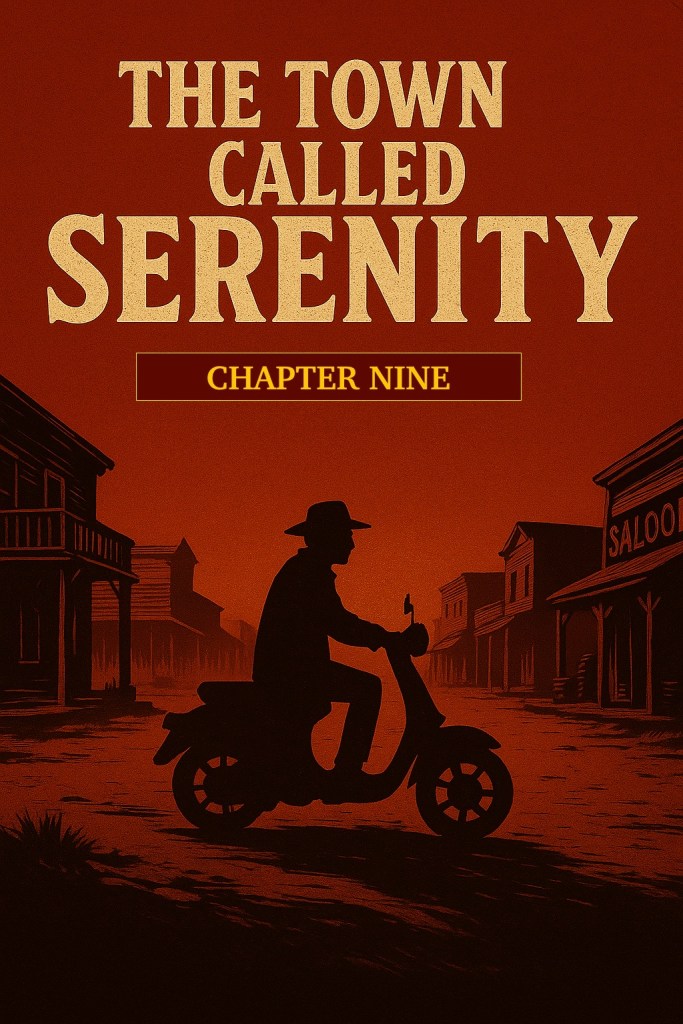
THE TOWN OF SERENITY – Chapter Nine: A Predator in the Garden

By Benjamin GroffMedia© | benandsteve.com | 2025 Truth Endures©

3–4 minutes

Chapter Nine: A Predator in the Garden

Braddock Cain sat alone in The Assembly, a chessboard in front of him, half-played.

It was something he did when the whiskey wore off, and the world got too quiet. He played both sides of the board. He always made sure black lost.

Tonight, black wasn’t losing.

He moved a knight, sat back, and scowled.

The vault trap should have buried Finch and the girl. He’d received no word from Poke, which was unusual. Too unusual.

A low, sharp knock came at the door—three short raps. 

Then silence.

His eyes narrowed.

“Enter,”

He growled.

The door creaked open, and the man who stepped inside wasn’t Poke. Wasn’t anyone from Serenity? His clothes were clean, military-cut. His boots were dustless. He didn’t wear a hat—but his shadow felt longer than the room allowed.

“Mr. Cain,”

The stranger said. 

“I presume.”

Cain stood, hand already on the grip of his pistol.

“You don’t walk into this room without an invitation.”

“I didn’t walk,” 

The man replied. 

“I arrived.”

Cain didn’t move to open it.

“You’re Gallow,”

He said flatly.

“That’s what they used to call me,”

The man replied. 

“In certain circles. Not the ones you buy into.”

Cain sat back slowly. 

“What do you want?”

Gallow smiled faintly.

“Let’s call it… clarity. You’ve grown fat on rot, Cain. But rot attracts insects. I’m here to burn the carcass clean.”

Cain let out a cold laugh. 

“You think you can walk into my town and—”

Gallow was suddenly in front of him.

Cain hadn’t even seen the movement.

A knife gleamed under Cain’s chin.

“I don’t think,”

Gallow whispered. 

“I replace. You’ve become a liability to men far above either of us. The vault was never your property. The tapes, the ledgers, the names—you were supposed to manage them, not flaunt them.”

Cain’s eyes narrowed. 

“You’re not just here for Finch.”

“I’m not here for Finch at all,”

Gallow said softly.

“He’s just a broken piece. You’re the engine.”

He pulled the knife away and tucked it back into his sleeve.

“I won’t kill you tonight. That would be –– premature. But I will leave you with a choice.”

Gallow tapped the Ashwood file.

“Burn this. Leave town. Or wait for me to come back.”

Then he was gone.

Cain sat still for a long time, listening to the echo of Gallow’s departure. When his hand finally moved, it wasn’t for his gun.

It was for the bottle.

Elsewhere in Serenity

Poke’s body was found behind the saloon—face down, no bullet wound, no blood.

Just two coins were placed over his eyes.

Wren and Chester stood over him in silence.

“Gallow’s here,” 

Wren said. 

“And he’s not working for Cain. He’s cleaning the house.”

Chester looked toward the west horizon, where dust clouds rolled in from the direction of the rail line.

He pulled the badge from his coat and stared at it.

“Time to decide,” 

He muttered. 

“Do I play Marshal—or outlaw?”

Well now, Gallow is certainly making his presence known! And Cain clearly has a big decision to make—but will he actually leave town? If so, he better start packing snacks for the road. But if he’s thinking about staying, he’ll want to give Jonathan Lawson a call. He should secure himself a Colonial Penn Life Insurance policy. It’s unfortunate Poke didn’t think ahead. Maybe those two coins over his eyes are enough to cover a plot in the nearest potter’s field.

As for Marshal Chester Finch, he’s defied the odds and made it to Chapter Ten. And it looks like this final chapter will finally answer the big mystery: the moped. Where has it been? Who hid it? Why wasn’t it tampered with? What was it originally bought for? And when did Chester decide it would be his official Marshal’s ride?

All of this—and more—will be revealed in Chapter Ten. ~ WE Hope ~

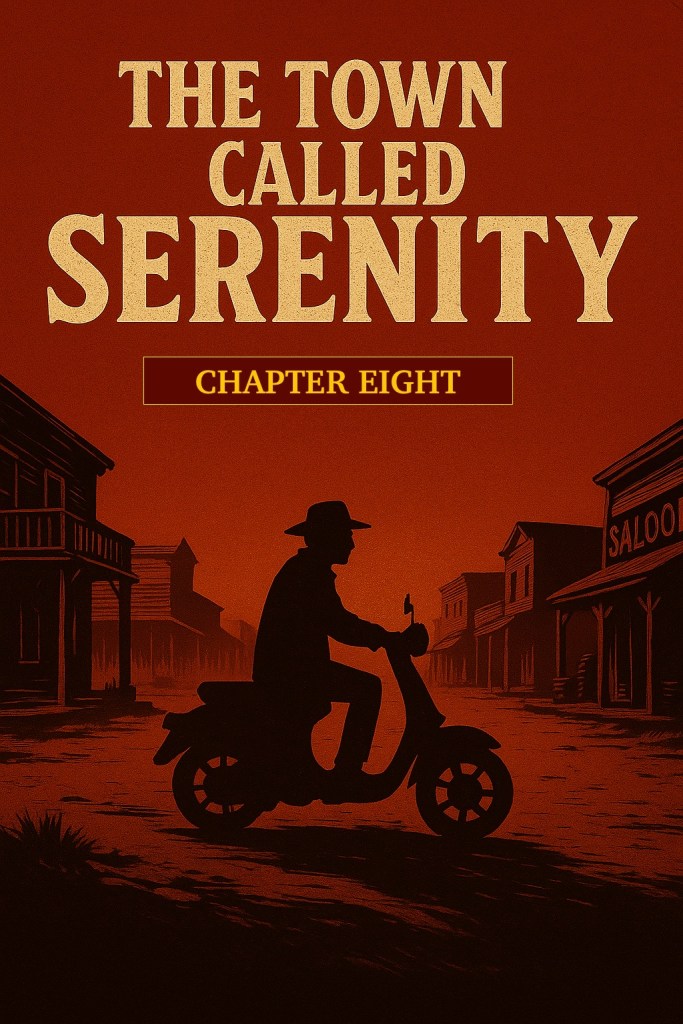
The Town Called Serenity – Chapter Eight – The Devil Knows The Way Out

By Benjamin GroffMedia© | benandsteve.com | 2025 Truth Endures©

3–4 minutes

Chapter Eight: The Devil Knows the Way Out

The blast had sealed the main vault door and collapsed part of the tunnel behind them. Smoke choked the air. Brick and metal groaned under stress. Chester blinked through blood and dust, pulling Wren up from the rubble.

“You alright?”

He asked, coughing.

“Been worse,” 

Wren muttered, cradling her left arm. 

“Dislocated, not broken. I’ll pop it back.”

Chester pulled out a penlight and scanned the room. 

“No exit. That was the only way in.”

Wren smiled through the pain. 

“You thought it was.”

She limped to the far wall. A section of decorative tiling was there—old, Spanish-style. It jutted out from the stone like it didn’t belong. She knocked three times in a rhythm that echoed deeper than it should have.

A hollow click responded.

“Cain didn’t build the vault himself. He took it from a man who did. The original owner had escape routes.”

She traced a tile shaped like a broken star and twisted it counterclockwise. With a faint hiss, the tile wall slid inward, revealing a narrow stone chute, half-collapsed and riddled with centipedes.

Chester stared into the black.

“I don’t suppose you brought rope,”

He said.

“Nope.”

“Alright then,”

He grunted, and they vanished into the dark.

In the Streets Above

Petal stood at her shop counter grinding roots when the front door exploded inward.

She ducked instinctively, drawing her old revolver, but it was too late.

Two men in black tactical gear moved in fast, grabbed her arms, and yanked her across the counter. The third figure entered last—calm, silent.

Mr. Gallow.

He picked up a vial from the shelf, sniffed it, and set it down.

“I’ve read your name,”

He said, voice flat. 

“You’re a known associate of Wren. Harboring her. Aiding a rogue federal.”

Petal spat blood and smiled. 

“You got a badge?”

“No. I have jurisdiction.”

He signaled.

The men dragged her out.

They disappeared down the street. Julep Jake watched from his cell window. He was whittling a miniature guillotine from an old broom handle. 

“And now the harvest begins,”

He muttered.

The Long Climb

Chester and Wren emerged two hours later through a rusted maintenance grate behind the abandoned Serenity Theater. They were scratched, covered in brick dust, and exhausted—but alive.

Wren wiped grime from her face. 

“He set us up. Knew we were coming.”

Chester nodded grimly. 

“Means we rattled him.”

She held up the two ledgers she’d saved—one in each hand.

“He loses if these go public.”

Chester took them, tucking them into his coat. 

“Then let’s make sure they do.”

Suddenly—gunfire cracked in the distance. Three pops.

Wren froze. 

“That was near Petal’s.”

Chester’s face hardened. 

“We’re not the only ones he’s playing.”

They moved quickly down the alleys. Even as they ran, Wren stopped cold. She saw the mark scorched onto the alley wall: a circle with a horizontal line through it.

She grabbed Chester’s arm. 

“That’s not Cain’s symbol.”

“What is it?”

Wren’s voice dropped to a whisper. 

“It’s Gallow’s.”

Chester turned, scanning the rooftops.

“Then we’re out of time.”

What exactly did the symbol mean? Chester had the answer—or at least a regulation book with the answer—tucked away in the saddlebags on his moped. The problem? He didn’t bring it with him. And it’s too far to walk back now. Truth is, he hasn’t laid eyes on that moped since he rolled into town. So, is it hidden so well that he forgot where it is? Or is he protecting a strategic location he’s not ready to reveal? With only two chapters left, the Marshal better get moving!

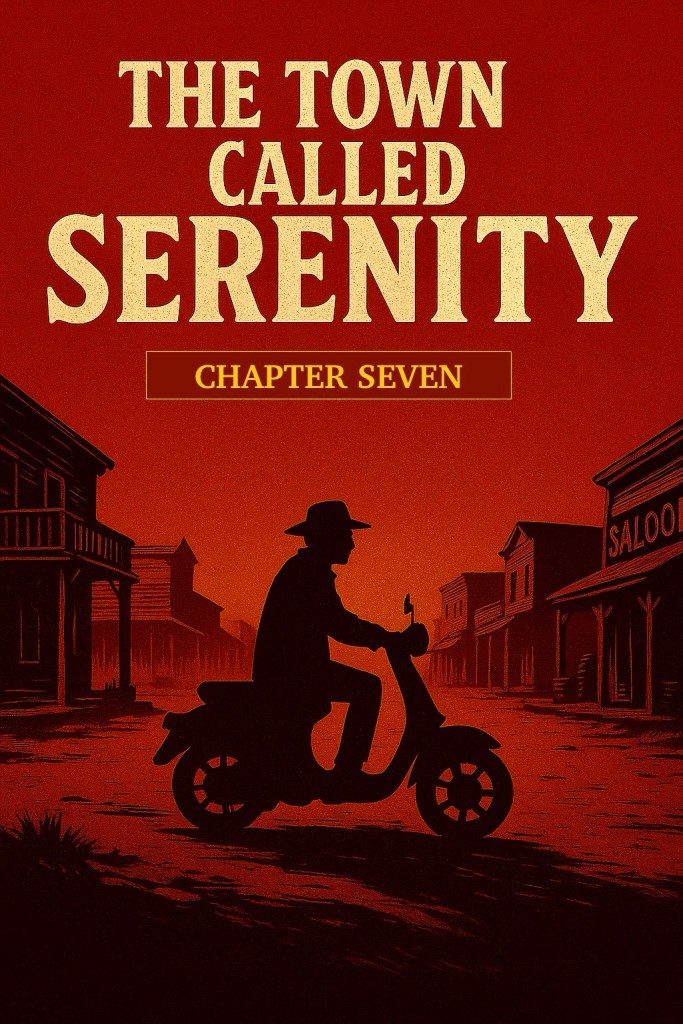
The Town Called Serenity – Chapter Seven – The Hollow Vault

By Benjamin GroffMedia© | benandsteve.com | 2025 Truth Endures©

2–3 minutes

Chapter Seven: The Hollow Vault

Two nights later, Chester and Wren moved through the back alleys of Serenity like smoke.

The plan was simple: infiltrate the vault below The Assembly using the abandoned mine shaft Wren had mapped out. Inside, Cain kept more than just gold and guns—he kept records. Blackmail. Ledgers. Evidence.

Evidence that could break him!

Wren led them to a rusted grate hidden behind the collapsed ruins of an old hardware store. Beneath it: a shaft covered in rotted boards and bad intentions.

“Down there?” 

Chester asked.

“Unless you’d rather try the front door.”

They climbed down slowly, their boots sinking into decades of dust and discarded bones. Lantern light flickered over graffiti scratched into the stone. Old names. Gang signs. Some symbols are older than either of them recognized.

They crawled through two hundred yards of tight rock. They ducked under fallen beams and crossed a flooded tunnel chest-deep in cold water. Finally, they came to a narrow corridor with smooth brick walls.

“This was built after the mine closed,” 

Chester said.

“Cain built it,” 

Wren confirmed. 

“To smuggle in shipments during the lockdown years. It goes straight to his vault room.”

Chester’s hand rested on his revolver. 

“We go in quiet. No guns unless we’re cornered.”

They reached the door—an iron-bound, reinforced, and sealed structure with an old code lock. Wren pulled a tiny folded paper from her coat.

“Petal gave me this,” 

She said.

“It’s the combination. She wrote it down after Cain got drunk and showed off.”

Chester raised an eyebrow. 

“I’m beginning to like that woman.”

Wren punched in the numbers. The lock hissed. The door creaked open.

Inside, the vault glimmered like a serpent’s nest: stacks of cash, boxes of documents, safes within safes.

But the prize wasn’t money.

It was the black books.

Wren went for the ledgers. Chester opened a crate and pulled out a collection of old film reels labeled with names—judges, mayors, even a U.S. senator.

“This is it,”

He whispered.

“This is Cain’s Kingdom in a box!

“This is Cain’s kingdom in a box.”

But then, from behind them—a faint click.

Wren froze. 

“Did you hear—”

Chester tackled her just as the explosion hit.

The vault door slammed shut.

Dust and debris rained down. A trap. It had been rigged.

From above, in a hidden observation room, Braddock Cain watched through a spyglass.

He turned to Poke and said, 

“Let them cook. They wanted into my house. Now they can die in it.”

But neither he—nor Chester—knew that Wren had already mapped another way out.

And worse, Mr. Gallow had just entered Serenity.

Cain’s Kingdom In A Box? Sounds like evidence that sews up this case! But, now Mr. Gallow is in town, and this brings a whole new suggestion for more trouble. Or a solution. It is too early to tell. Maybe Mr Gallow came for the moped. What if the Marshal’s service issued the moped to Chester, and they want it back?

The Town Called Serenity – Chapter Six – Ashwood

By Benjamin GroffMedia© | benandsteve.com | 2025 Truth Endures©

1–2 minutes

Chapter Six: Ashwood

The file on Chester Finch wasn’t stored in any digital archive. It was handwritten, double-sealed, and stored in a fireproof vault in Washington, D.C., under a codename known only to four men who still remembered it.

Operation Ashwood.

Eight years ago, Chester was part of a black-bag unit inside the U.S. Marshal Service—officially unrecognized, unofficially unstoppable. The team was created to root out systemic corruption in rural American towns with privatized law enforcement and cartel-backed leadership. The mission was simple: infiltrate, destabilize, expose.

Ashwood’s first three targets were textbook. The fourth—Gulch County, Texas—was different.

Chester had made the call. He exposed the sheriff, three council members, and a judge and brought them down with a clean sweep.

But the blowback was lethal.

Three of Chester’s team were ambushed at the exit. A safe house was burned down—with a whistleblower’s daughter inside. The press got hold of fragments, but the whole truth? That was buried in a sealed report and heavily redacted.

Chester took the blame. Not officially. But quietly. They let him keep the badge—under the condition that he’d never be given another high-profile operation again.

Until now.

Serenity was never meant to be his assignment. Someone had slipped his name into the dispatch. Someone with a more extended memory than the agency admitted to.

And now Gallow, the last surviving Ashwood “fixer,” was on the trail.

Now, remember this is only a pause between Chapters Five and Seven. This moment is to clarify what was happening. It serves to show what brought Chester Finch to these parts. When Chapter Seven opens, it will seem like only a few days have passed. That will be just enough time for Finch to remember his past, whether he likes it or not. Still, there is no word where he has left the moped. Surely, it would have been used as a bargaining chip with him by now.

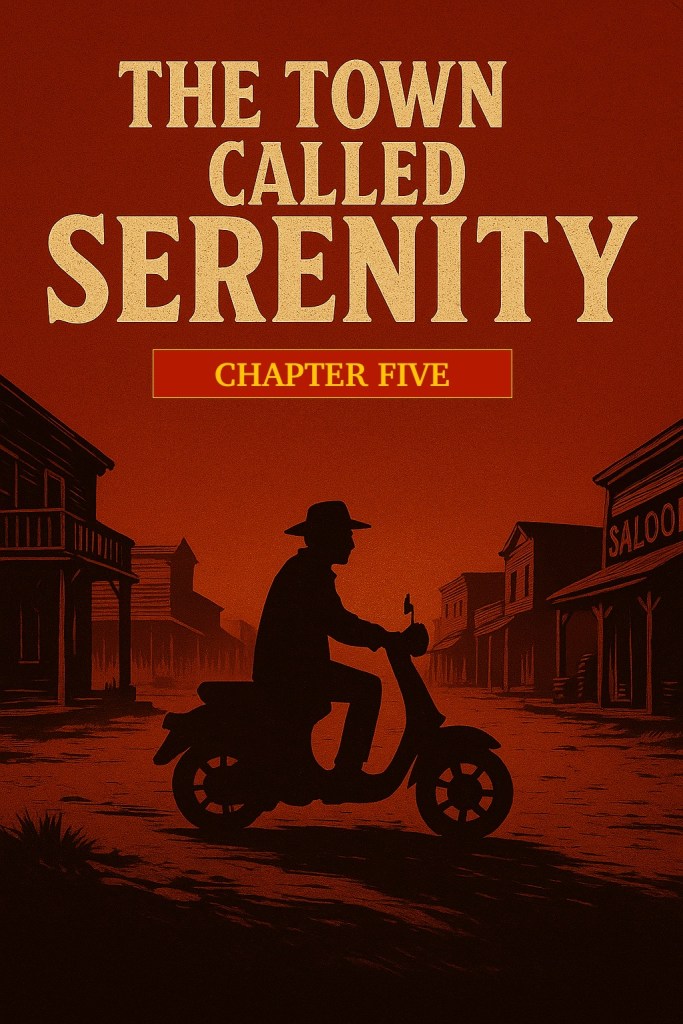
The Town Called Serenity – Chapter Five – The Clock In The Dust

By Benjamin GroffMedia© | benandsteve.com | 2025 Truth Endures©

3–5 minutes

Chapter Five: The Clock in the Dust

The bell above Petal’s shop rang twice—slow and deliberate.

That was the signal.

Wren waited until the third cloud passed over the moon before sliding off the schoolhouse roof. She moved like a whisper down the alleyway, avoiding the creaky boards and broken glass with practiced ease. She paused behind the horse trough near the sheriff’s office and whistled once—two notes, flat and low.

Chester was sitting inside the dim jailhouse with his boots propped up on a barrel. His bruised rib was bandaged with a strip of curtain. He heard the sound and stood up.

He opened the door.

Wren stepped into the lamplight. She was small and wiry, wrapped in an oversized coat that had seen better days. Her eyes were dark and deliberate, scanning the room, the exits, the Marshal.

“I watched you fight the Gentlemen,”

She said without greeting.

Chester gave her a nod, cautious but not cold. 

“You’re the girl from the roof.”

“I’m the girl from everywhere,”

She replied.

He gestured to a stool. 

“You hungry?”

She hesitated, then sat. 

“I want something else.”

“Alright.”

“I want Cain gone.”

Chester leaned back against the wall, arms crossed. 

“That makes two of us. But wantin’ it and surviving it are two different things.”

Wren pulled her notebook from her coat and opened it. She showed him a crude map—of underground tunnels, secret entrances, schedules.

“I’ve been tracking his movements for six months,”

She said. 

“He’s gotten sloppy. He trusts the wrong people. There’s a weak point—down in the old mines under the vault. He thinks no one remembers it exists.”

Chester raised an eyebrow. 

“And you want to hit him there?”

“I want to expose him first. Show Serenity what he is. Not just a tyrant. A liar. A coward. I can get you inside. You have to decide if you’re willing to break the rules you came here to enforce.”

He looked at her for a long moment. 

“You ever worked with a marshal before?”

“No,” 

Wren replied. 

“You ever work with a kid who knows where all the bodies are buried?”

Chester smiled. 

“Can’t say that I have.”

She closed the notebook. 

“Then we’re even.”

They shook hands—hers small and cold, his calloused and warm. In that moment, something changed. Not in Serenity. Not yet.

But it had started.

Meanwhile –––

Five miles west of Serenity, in a ravine that didn’t show on most maps, a boxcar shuddered to a halt. It stopped on rusted rails.

A figure stepped out—tall, dressed in black, face hidden beneath a wide-brimmed hat. Beside him, four others disembarked—mercenaries, by the look of them. Not local. Not from this state. Not from this country, maybe.

They called him Mr. Gallow.

No one knew if that was his real name. He didn’t speak often, but when he did, people obeyed—or disappeared.

Gallow held up a leather-bound dossier stamped with the faded seal of the Bureau of Internal Affairs. Inside was a photo of Chester Finch, clipped to a thick file marked:

“CLASSIFIED – OPERATION ASHWOOD.”

He flipped the page and revealed a second file—one that bore the name Braddock Cain.

And then a third.

Subject: WREN (Alias Unknown).

Status: Missing / Witness Protection Violation.

Gallow smiled faintly.

He turned to his team and said only two words.

“Kill quietly.”

They vanished into the desert night like wolves on the scent.

Back in Serenity

Petal watched the train lights fade on the horizon, her face tense.

She reached behind the counter, pulled out a dusty revolver, and said to herself, 

“They’re all waking up now.”

And somewhere, far below, in the tunnels beneath Serenity, a clock that had long stopped ticking began to turn again.

The Town Called Serenity – Chapter Four – Pieces on the Board

By Benjamin GroffMedia© | benandsteve.com | 2025 Truth Endures©

3–5 minutes

Chapter Four: Pieces on the Board

Braddock Cain stood in front of a pool table inside The Assembly, lining up a shot with surgical calm. His eyes didn’t leave the cue ball even as Poke relayed the report.

“He bloodied Silas’s nose, bruised Dutch’s ribs, broke Miles’ fiddle, and made Jonas fall on his ass,” 

Poke said, leaning against a cracked marble column. 

“Didn’t even draw his gun.”

Cain took the shot. The cue ball clicked sharply and sank the eight-ball in the corner pocket.

He stood slowly, placed the cue stick back on the rack, and poured himself a drink.

“And the town?”

“They watched,” 

Poke replied. 

“They didn’t help, but they didn’t laugh either. Some of ’em even looked –– curious.”

Cain stirred his drink with one finger. 

“That’s the worst part.”

Poke blinked. 

“Sir?”

Cain turned toward the window. 

“Fear keeps Serenity in check. When people get curious, they start to hope. And hope’s just a prettier way of saying ‘trouble.'”

He walked back to his velvet chair, every step echoing in the hollow room.

“I want to know everything about Marshal Finch. Where he came from. What he’s running from. Who sent him? And,”

He added, narrowing his eyes, 

“who he’s willing to die for.”

Poke nodded and disappeared.

Cain sipped his drink and muttered to the empty room,

“Let’s see what kind of man rides into Hell on a scooter.”

Across the Rooftops

Wren sat cross-legged on the corrugated roof of what had once been Serenity’s schoolhouse. The sun was setting in a blood-orange smear across the sky. She held a spyglass in one hand and a half-sharpened pencil in the other. A leather-bound journal rested in her lap.

Inside were names. Maps. Notes.

She turned to a fresh page and wrote:

Chester Finch – Marshal – Took a hit, didn’t fall. I watched the Gentlemen leave bruised. He won’t last a month. He might last longer.

Beside her sat a worn revolver wrapped in canvas, untouched. Wren didn’t shoot unless necessary. 

Observation was safer.

She reached into her coat and pulled out a folded piece of paper. It was a newspaper clipping, old and faded:

“LOCAL DEPUTY DIES IN FIRE — WIDOW, CHILD UNACCOUNTED FOR”

She stared at it for a long moment before tucking it away again.

Wren wasn’t born in Serenity. She was left here. Left during the chaos, after the fire, after the men in black suits came and went. Cain had taken her in—not out of kindness but calculation. He saw her silence, her memory, her talent for hiding in plain sight.

He never asked questions. Neither did she.

Until now.

She looked back toward the jailhouse, where Chester Finch was lighting a lantern in the window. He moved stiffly, but there was something in the way he held himself. Like a man who wasn’t afraid to die—but was trying real hard not to.

She flipped back through her notebook. She found a sketch she’d drawn weeks ago. It was a map of Serenity. The map had dotted lines marking the tunnels under the old mines. It showed the abandoned telegraph station and the hidden entrance to Cain’s private vault room.

Wren circled Chester’s name, then drew a faint arrow pointing to the vault.

It was almost time.

Elsewhere in Serenity ––

  • Petal wiped the dust from her apothecary shelves. She stared at a cracked photo of her brother. He was killed by Cain’s men for refusing to cook meth in the back room. She kept smiling, but her smile was starting to slip.
  • Julep Jake, now back in his cell by choice, was building something with matchsticks and chewing gum. “Civic infrastructure,” he explained to no one.
  • Silas Crane dipped his bleeding knuckle into holy water and laughed softly. “He’s gonna make me preach,” he whispered. “And I do love a sermon.”

Back in The Assembly, Cain sat alone in the dim light, polishing a gold coin between his fingers. One side bore the symbol of the old U.S. Marshal’s badge. The other side? Blank.

“Flip it,”

He whispered. 

“Heads, he burns. Tails, he breaks.”

He flipped the coin into the air and caught it.

But he didn’t look.

Not yet.

The Town Called Serenity – Welcome Committee

By Benjamin GroffMedia© | benandsteve.com | 2025 Truth Endures©

3–5 minutes

Chapter Three: Welcome Committee.

A town allergic to rules.

The Town Called Serenity

By noon the next day, the heat in Serenity had risen to an oppressive boil. The town smelled of dry rot, sweat, and gun oil. Somewhere in the distance, a fiddle played off-key. Somewhere closer, someone was being punched.

Chester Finch stepped out of the rickety sheriff’s office he had claimed, swatting at flies with his hat. His left eye was bruised from a scuffle the night before, and he had re-holstered his sidearm four times that morning alone—once while buying coffee, once while crossing the street, once during a handshake, and once because a six-year-old pointed a slingshot at him and said, 

“Bang.”

Serenity wasn’t just lawless—it was allergic to rules.

A woman named Petal ran the general store and apothecary. She greeted Chester with an arched brow, and a cigarette clung in the corner of her mouth.

“You’re still alive,”

She said, counting change. 

“Didn’t expect that.”

“Thanks for the confidence,” 

Chester replied, tipping his hat.

She shrugged. 

“Ain’t personal. We don’t usually see second sunrises on lawmen.”

Chester had started to respond when a shadow fell across the dusty street. Four men approached—spaced out like predators, walking with the purpose that made children vanish and shutters slam.

The Gentlemen had arrived.

The one in front was tall, clean-shaven, and wore a preacher’s collar over a duster that flared in the wind. A thick Bible was tucked under one arm. His name was Silas Crane, but most folks called him Reverend Knuckle. He smiled with too many teeth.

“Marshal,” 

He said. 

“We heard you were new in town. Thought we’d come to say hello proper-like.”

Behind him stood the other three:

  • Dutch, a former bare-knuckle boxer with hands like cinder blocks and a voice like gravel being chewed.
  • Miles, a one-eyed fiddler with a twitchy finger, never stopped humming.
  • And Jonas, the silent butcher-aproned brute who carried a wood-chopping ax like it was a handshake waiting to happen.

Chester stayed calm. He’d dealt with worse—once, a rogue bootleg militia in Nevada. Another time, a cult leader in Kentucky had a fondness for snakes and a penchant for blackmail. These four? They were just another test. Or so he hoped.

“I appreciate the hospitality,” 

Chester said, thumb resting on his belt. 

“But I’m here on business.”

Silas opened his Bible, then punched Chester square in the jaw. The Marshal hit the dirt hard.

“Chapter One,”

Silas said, closing the book. 

“Verse one: The meek get stomped.”

Dutch cracked his knuckles. 

“You wanna deliver the sermon, or should we take it from here?”

Chester wiped the blood from his lip and sat up. 

“You fellas always greet visitors with scripture and assault?”

“We greet threats,”

Silas replied, crouching. 

“You’re Cain’s business now. That means you’re ours.”

Behind them, the few townsfolk watching began to edge away, some disappearing entirely. Petal stayed, lighting a second cigarette from the first.

Chester stood up slowly. 

“You done?”

Silas raised an eyebrow.

Because that’s when the door behind them swung open, and out walked Julep Jake, shirtless, handcuffed, and barefoot.

“Marshal,” 

Jake yelled, grinning wildly, 

“you left the cell unlocked again! I declare myself free! By raccoon law!”

Everyone froze.

Even Jonas blinked.

Silas turned slightly. 

“What is—?”

And that’s when Chester moved. Fast.

He used the distraction to land a gut punch on Dutch. He spun around Silas. Then, he kicked Miles’ fiddle clean across the street. Jonas came at him like a wrecking ball, but Chester ducked and flipped a barrel in the way. The brute went tumbling.

It wasn’t a win. It was a delay.

But it was enough.

When the dust settled, Chester stood there, breathing hard, badge still gleaming. Around him, the Gentlemen nursed bruises and bruised pride.

“You tell Cain,”

Chester said, voice steady, 

“that if he wants me gone, he better send a storm. Because the breeze just isn’t cuttin’ it.”

Silas stared at him, blood on his lip. Then he smiled that too-wide smile again.

“This is gonna be fun,” 

He whispered.

They left him standing there, Jake still rambling behind him about his re-election campaign.

Later That Night ––

From a rooftop, a girl no older than fourteen watched the fight unfold. Her name was Wren. She didn’t talk much and didn’t smile either. But she watched everything. She scribbled something in a notebook.

The new Marshal wasn’t like the last dozen.

This one fought back.

The Town Called Serenity – Chapter Two ~ The Man In The Velvet Chair ~

By Benjamin GroffMedia© | benandsteve.com | 2025 Truth Endures©

3–4 minutes

Chapter Two: The Man in the Velvet Chair

Braddock Cain held court in what used to be Serenity’s town hall. It has been redubbed The Assembly. This tongue-in-cheek title amused him to no end. The building’s original seal featured a gavel and olive branch. It had been charred. A mural of a coiled snake wrapped around a set of broken scales replaced it.

Cain reclined in a velvet chair salvaged from an old theater. His legs were crossed and his boots polished. A glass of brandy swirled in his hand. He dressed like a gentleman, but everything about him screamed predator. His jaw bore a faded scar shaped like a question mark, and his eyes—green, sharp, reptilian—missed nothing.

He was listening to the daily reports from his lieutenants. These included moonshine shipments and bribe tallies. They discussed who’d been bought and who needed reminding. It was during this time that the news came in.

“Marshal rode in today,” 

Said a wiry man named Poke, who hadn’t blinked since 1989. 

“Little fella on a moped. Arrested Julep Jake, if you can believe it.”

Cain’s eyebrow lifted slightly.

“Didn’t shoot him?” 

He asked, his voice smooth as oiled leather.

“No, sir. I hauled him off. Jake’s in the old jailhouse right now. He’s hollerin’ about election fraud. He’s claimin’ he’s immune to state law because of a sacred raccoon spirit.”

Cain chuckled, swirling his drink.

Side Note:

Julep Jake was a Yale-educated botanist. He loved whiskey-fueled nonsense. He habitually wore a sash that read “Honorary Mayor 4 Life.” Despite all this, he had a breakdown during a lecture on invasive species. He ended up in Serenity after wandering the desert in a bathrobe. He decided, on divine instruction, that this was where civilization needed his governance. The raccoon spirit came later, after a bad batch of moonshine.

Cain leaned forward, elbows on his knees. 

“So. The law’s back in town.”

Poke nodded. 

“Says he’s here to clean up.”

Cain smiled faintly. 

“Then let’s give him something to mop up.”

He rose, slow and deliberate. Every movement was calculated with the same precision he used to carve out his little empire. Cain wasn’t just a criminal—he was a tactician. He knew that fear didn’t come from bloodshed alone. It came from control. Predictability. Making people believe that resistance was a form of suicide.

“Send word to the Gentlemen,”

Cain said.

The Gentlemen weren’t gentlemen at all. They were Cain’s enforcers—four men, each with a particular specialty. One was a former preacher who liked to break fingers while quoting scripture. Another was a silent giant who wore a butcher’s apron even on Sundays.

“Tell them I want to meet our new Marshal. Kindly, of course. Offer him a warm Serenity welcome.”

Poke nodded and vanished.

Cain turned to the shattered windows behind him, looking out over his kingdom. Dust swirled in the streets. Somewhere, a gunshot echoed, followed by laughter.

“I do enjoy it when they come in idealistic,”

Cain murmured, sipping his drink. 

“They bleed slower.”

The Town Called Serenity – Chapter One

By Benjamin GroffMedia© | benandsteve.com | 2025 Truth Endures©

3–4 minutes

The Town Called Serenity

In a remote corner of the state, the roads grow narrow. The trees lean in like they’re sharing secrets. There lies a town called Serenity. The name is a cruel joke—there’s nothing serene about it. This is a place where street signs double as target practice. The law has long since departed. No one has noticed. The welcome sign on the outskirts used to say, Population: 312. Someone scratched it out and replaced it with Too Many.

In Serenity, bars outnumber churches, and the only thing thinner than a promise is a badge. It’s where outlaws hide not from the law but from one another. It’s a haven for grifters, gunmen, and ghosts of good men who didn’t make it out.

And into this outlaw’s paradise rolled Chester Finch.

Deputy U.S. Marshal Chester Finch was not the image of frontier justice. He didn’t ride in on a stallion or a dusty pickup truck. No, Chester arrived in Serenity on a cherry-red moped. It’s the kind you’d see zipping through suburbs. You also find it parked at a vegan coffee shop. He wore regulation boots, a broad-brimmed hat, and a badge that gleamed as if it still held some hope.

The moped sputtered as it crossed the town’s crooked boundary, its two-cycle engine whining like a mosquito. Chester parked outside the Rusted Spur Saloon. It was half brothel, half bar, and all trouble. Eyes were already watching him from behind dusty windows and cracked doors.

On the porch, an older man with a shotgun across his knees spat into a tin can and said, 

“That there’s the funniest damn thing I’ve seen all week.”

Chester dismounted, kicked the stand down, and brushed the dust off his badge. 

“I’m lookin’ for the sheriff,”

He said.

The older man cackled. 

“Ain’t had a sheriff since Mad-Eye Morgan got shot for winnin’ too many poker hands. That was six months back.”

“Then I suppose I’m it now,” 

Chester replied, squinting at the sun. 

“By order of the U.S. Marshal Service, I’m here to restore order.”

The laughter that followed came from more than just the porch. It drifted from second-story windows and behind swinging doors. It came from a town. The town believed the law was something you threw in a ditch. It was buried with the rest of your conscience.

Chester knew this wouldn’t be easy. He knew his badge would draw more bullets than respect. But he also knew Serenity was on the brink of something worse. The federal files hinted at growing ties to outlaw syndicates. There were whispers of gun-running. A name kept popping up: Braddock Cain.

Cain ran Serenity like a private kingdom. Tall, scarred, and charming as a rattlesnake in a bowtie, he was the unspoken king of vice. No one crossed him unless they wanted to disappear.

Chester had crossed worse. Or so he told himself.

His first night in Serenity ended with a knife fight. There was a horse in a bar. The moped was set on fire by a drunk named Julep Jake, who claimed to be the mayor. Chester arrested him anyway. This unpopular move earned him a cracked rib and a bloodied lip. It also earned him the first sliver of respect from the few decent souls still buried in Serenity’s mess.

By morning, Chester had taken over an old sheriff’s office. It was half caved in and smelled of rot and regret. He nailed his badge to the door. It was symbolic more than anything. And in this town, symbols were dangerous.

He had come for peace, riding on two wheels and carrying a quiet resolve. He found a town at war with itself. It was a fight that takes more than a badge to win.

But Chester Finch wasn’t here for symbolism. He was here to end the laughing.