

By Benjamin GroffMedia© | benandsteve.com | ©2026
There’s a question that sounds simple on the surface, but carries a lot of weight underneath it:
Is it illegal to pay someone to infiltrate a group?
The answer isn’t a clean yes or no.
WASHINGTON — The Southern Poverty Law Center was indicted Tuesday April 21st, 2026 on federal fraud charges alleging it improperly raised millions of dollars to pay informants to infiltrate the Ku Klux Klan and other extremist groups, acting Attorney General Todd Blanche said.
The Justice Department alleges the civil rights group defrauded donors by using their money to fund the very extremism it claimed to be fighting, with payments of at least $3 million between 2014 and 2023 to people affiliated with the Ku Klux Klan, the United Klans of America, the National Socialist Party of America and other extremist groups.
“The SPLC was not dismantling these groups. It was instead manufacturing the extremism it purports to oppose by paying sources to stoke racial hatred,” Blanche said.
You can read NPR’s Article Here.
The question many are asking is who is at fault, and is there a crime being committed? I took time to consider the law and what it had to say on the matter. This is what I found.
~~~ ~~~ ~~~
It depends on who is paying, why they’re doing it, and what happens once the infiltrator is inside.
Let’s strip it down to something plain and understandable.
The Part Most People Don’t Realize: It Happens All the Time
Law enforcement does this regularly.
Police departments and federal agencies pay:
- Informants
- Undercover officers
- Cooperating witnesses
They send people into criminal organizations to gather information, build cases, and prevent crimes.
That part? Completely legal.
But There’s a Line—and It Matters
The law draws a very clear boundary.
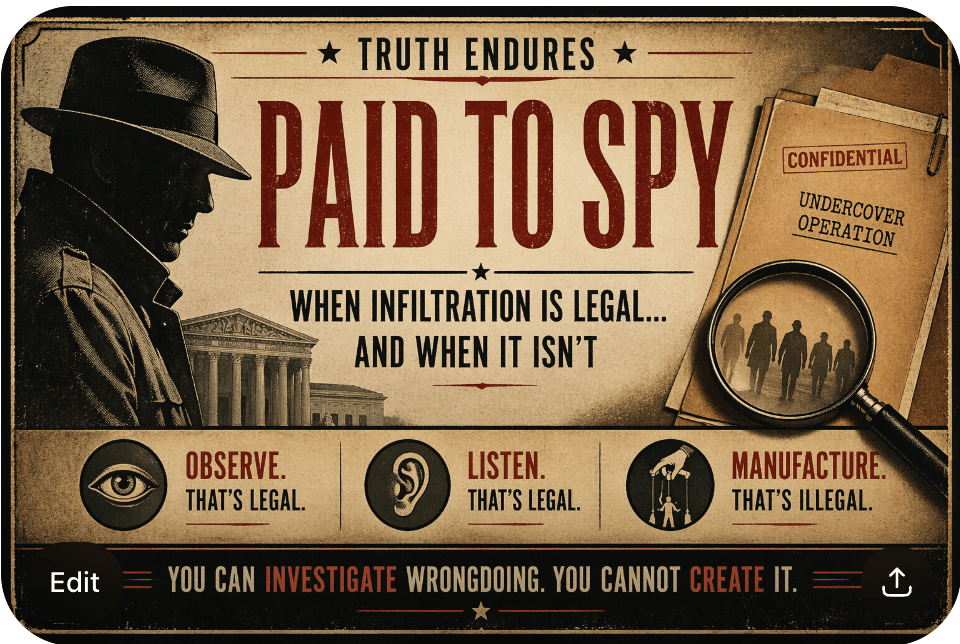
Authorities are allowed to:
- Watch
- Listen
- Document
- Blend in
What they are not allowed to do is create the crime themselves.
That’s where a concept called entrapment comes in.
A Real Case That Defines the Line
In Jacobson v. United States, the government spent over two years trying to convince a man to commit a crime.
They didn’t just observe him—they pushed him.
They sent repeated messages.
They applied pressure.
They nudged him toward a decision he hadn’t made on his own.
Eventually, he gave in.
The Supreme Court stepped in and said: That’s not justice—that’s manufacturing a crime.
The conviction was overturned.
The Rule in Plain English
Here it is, as simple as it gets:
- Legal: Infiltrating a group that is already doing something illegal
- Illegal: Pushing someone to commit a crime they weren’t already going to commit
That’s the dividing line.
What About Private Citizens?
This is where things get more dangerous—and more likely illegal.
If a private individual or organization pays someone to infiltrate a group, problems can stack up quickly:
- Lying to gain access can become fraud
- Recording people can violate privacy laws
- Gathering information can cross into harassment or surveillance
- Encouraging wrongdoing can turn into conspiracy
In short:
What law enforcement can legally do under rules and oversight, private individuals usually cannot.
Why This Matters More Than Ever
We live in a time where people are suspicious.
Of institutions.
Of politics.
Of each other.
Stories about infiltration—real or imagined—spread quickly because they tap into that distrust.
But the law hasn’t changed as much as the conversation has.
The same basic principle still applies:
You can investigate wrongdoing.
You cannot create it.
The Bottom Line
Paying someone to infiltrate a group is not automatically illegal.
But the moment that infiltration turns into:
- Pressure
- Manipulation
- Or manufactured crime
…it crosses a line the courts have been very clear about.
And once that line is crossed, the case—and sometimes the credibility of those behind it—falls apart.
Groff Media ©2026 benandsteve.com Truth Endures
 benandsteve.com
Truly, there are people who are force to claim the manufactured crime and it’s sad. Hope the illegal cases lessen. Informative post, Benjamin.
LikeLike