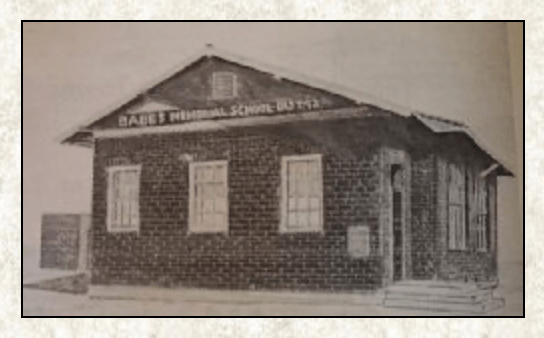
The Christmas Eve Babbs Switch School Fire

This story is pulled from the archives as a celebration for the season edition.

Groff Media 2024© Truth Endures IMDbPro

Presented by benandsteve.com By: Benjamin Groff II©

3–5 minutes

Every year at this time, I am reminded of a harrowing story. It is deeply etched into Oklahoma’s collective memory: the Babbs Switch School Fire of Christmas Eve, 1924. It stands as a tragic lesson in safety, humanity, and resilience.

The Fire

On that bitterly cold night, with heavy snow and sub-zero temperatures, 200 residents gathered. They met in Babbs Switch’s one-room schoolhouse for a Christmas Eve program. The school was tightly packed with engaged couples, grandparents, mothers, fathers, and children. The building’s windows were secured with wire mesh to deter intruders from the nearby railroad tracks. The sole exit—a door that opened inward—would soon become a deadly trap.

The program concluded with a teenage boy dressed as Santa Claus. He handed out toys and candy beneath a cedar Christmas tree. The tree was decorated with paper, tinsel, and lit candles. One of these candles brushed against the tree’s dry needles, igniting it instantly. Mrs. W.G. Boland, whose three children perished that night, later recounted the horror. 

“I tried to beat it out with a paper sack,”

she said, 

“but it did no good.” 

Initially, the crowd laughed, believing the small blaze was being contained. But within moments, the flames engulfed the tree, the ceiling, and the entire structure.

Panic erupted.

The sole exit became a bottleneck as the crowd surged toward the door. Those at the back pushed forward, while the unlucky at the front got crushed in the chaos. Some attempted to pry open the wired windows, but their efforts were futile. Trapped inside, children, parents, and neighbors succumbed to the smoke and flames. Witnesses recalled the horrifying scene of people clawing at the exit. Bodies piled atop one another, and the acrid stench of burning flesh.

The Survivors

Among those who escaped was Lillie Biggers. She crawled out from under a desk clutching a doll she had just received. Her mother, Margaret, managed to get out but suffered severe burns to her hands and arms. Tragically, Lillie’s brothers, William, 9, and Walter, 15, did not survive. The Biggers family’s grief mirrored that of the entire community, where 36 lives were lost—half of them children. The belongings later identified the bodies of William and Walter. They carried a toy gun and a belt buckle.

The injured and deceased were transported to Hobart, the nearest town, where makeshift morgues were set up. The community’s response, known as the “Hobart Spirit,” saw residents drop everything to give aid and comfort. Newspaper accounts likened this effort to the Oklahoma Standard that emerged decades later after the Oklahoma City bombing.

Julie Braun with Mother
Lillie’s Doll That Survived Fire

The Aftermath

The tragedy prompted a wave of reforms. Oklahoma legislators enacted fire safety laws requiring outward-opening doors, multiple exits, and accessible window screens in schools. Open flames were banned, and fire extinguishers became mandatory. The reforms eventually spread nationwide, though it would take more tragedies before they were fully adopted.

The morning after the Babbs Switch School Fire

A Missing Child

The story took a strange twist that turned it into a lingering mystery. Among the victims was three-year-old Mary Edens—or so it was believed. Her aunt, Alice Noah, escaped the building. She died days later. She claimed she had handed Mary to an unknown person outside the burning building. Mary’s body was never recovered, leading her family to hope she had survived.

In 1957, decades after the fire, a woman named Grace Reynolds came forth. She was from Barstow, California. She claimed to be the long-lost Mary. The Edens family reunited with her on Art Linkletter’s House Party television program, believing their prayers had been answered. Reynolds even wrote a book about her experiences. It is titled Mary, Child of Tragedy: The Story of the Lost Child of the 1924 Babbs Switch Fire.

But only some were convinced. A local newspaper editor who investigated the claim questioned its validity. 

Skeptics noted inconsistencies in Reynolds’s story, but no definitive evidence confirmed or debunked her identity. To this day, the truth remains elusive.

Legacy

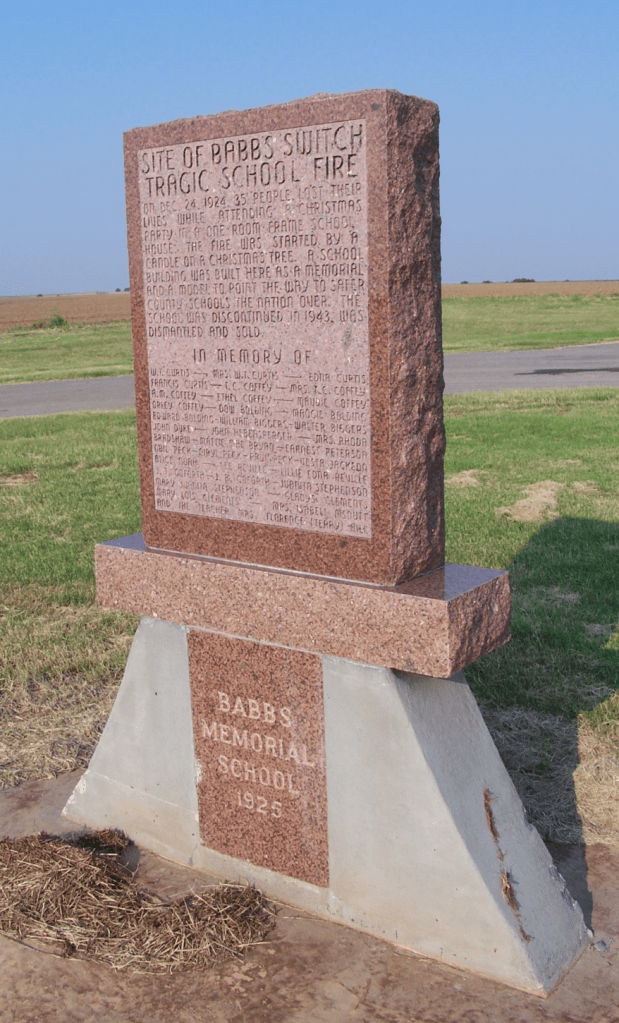
The Babbs Switch School Fire is remembered as one of the deadliest school fires in U.S. history. A stone monument now stands where the schoolhouse once stood, a quiet marker of lives lost and lessons learned. The physical scars of the tragedy have faded. Yet, its memory endures. It serves as a poignant reminder of the fragility of life and our enduring hope for safety and change.

References for this writing can be found at – 

https://blogoklahoma.us/place/394/kiowa/site-of-babbs-switch-tragic-school-fire

https://www.thesirenspodcast.com/post/case-files-babbs-christmas-fire

https://genealogytrails.com/oka/kiowa/babbsfire.html

https://en.wikipedia.org/wiki/Babbs_Switch_fire

The Bell That Retrop Forgot

By Benjamin GroffMedia© | benandsteve.com | ©2025 

4–7 minutes

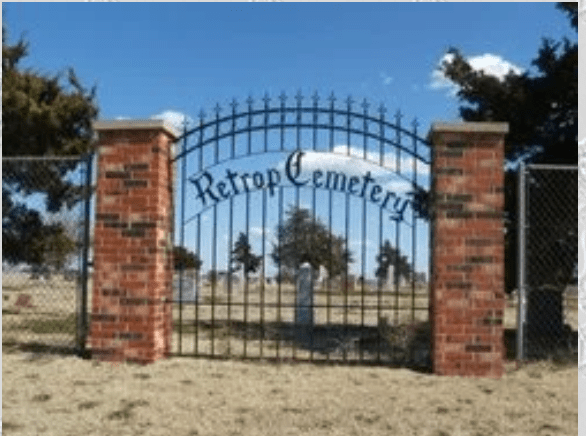
Most people driving the stretch between Granite and Elk City never realize they’re passing over a ghost. The four-lane highway hums along smoothly. Underneath its concrete spine once stood a town with a name born from a clever workaround. The town was called Retrop, simply Porter spelled backward.

Back in the early 1900s, the community wanted its own post office. But Oklahoma already had a Porter, and the postal authorities weren’t about to sort through that confusion. So the folks along the dusty road west of Sentinel shrugged, flipped the name around, and mailed in the paperwork. Retrop got its post office, its school, and its place on the map—at least for a while.

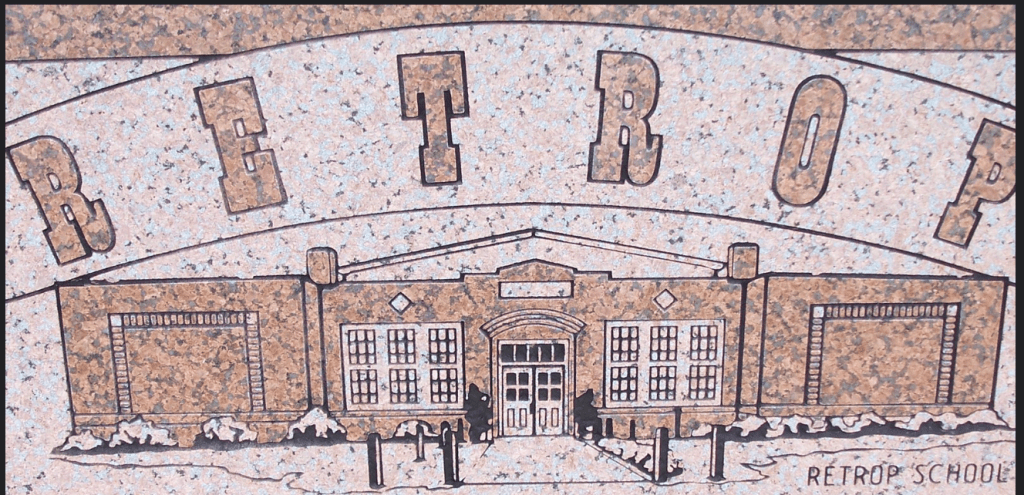
The school sat at the center of it all. A sturdy brick building with wide windows and a playground carved out by decades of small feet. Children rode in from miles around, their lunches wrapped in wax paper, their futures unwritten. There were stories—quiet ones—of students who went on to big cities and bigger lives. A doctor in Chicago. An engineer for NASA. A novelist whose pen never found its way back home.
They carried Retrop inside them, even after the town itself faded away.

But Retrop’s beginning was clever. Its ending was swift.

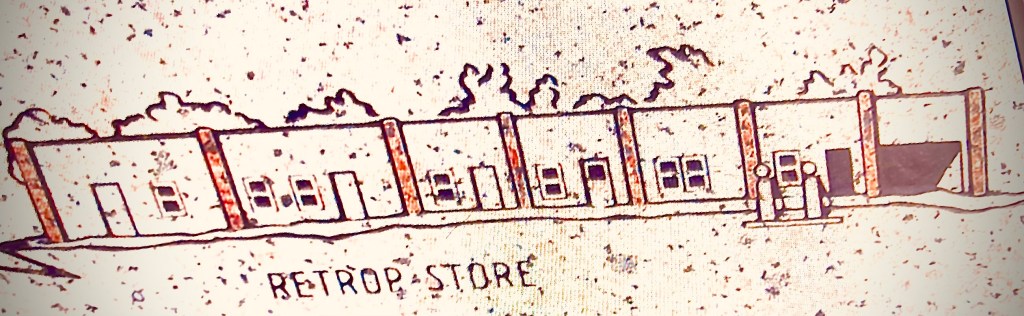
When the new highway came through, the town didn’t stand a chance. Businesses folded. Families moved. The school closed its doors. The post office was shuttered. One by one, the foundations cracked and the roofs caved until only fields remained—fields pretending nothing had ever stood there.

Except for one detail people still talk about, though no one can confirm it anymore: the missing bell.

Retrop had its own Masonic Lodge in the 1940s

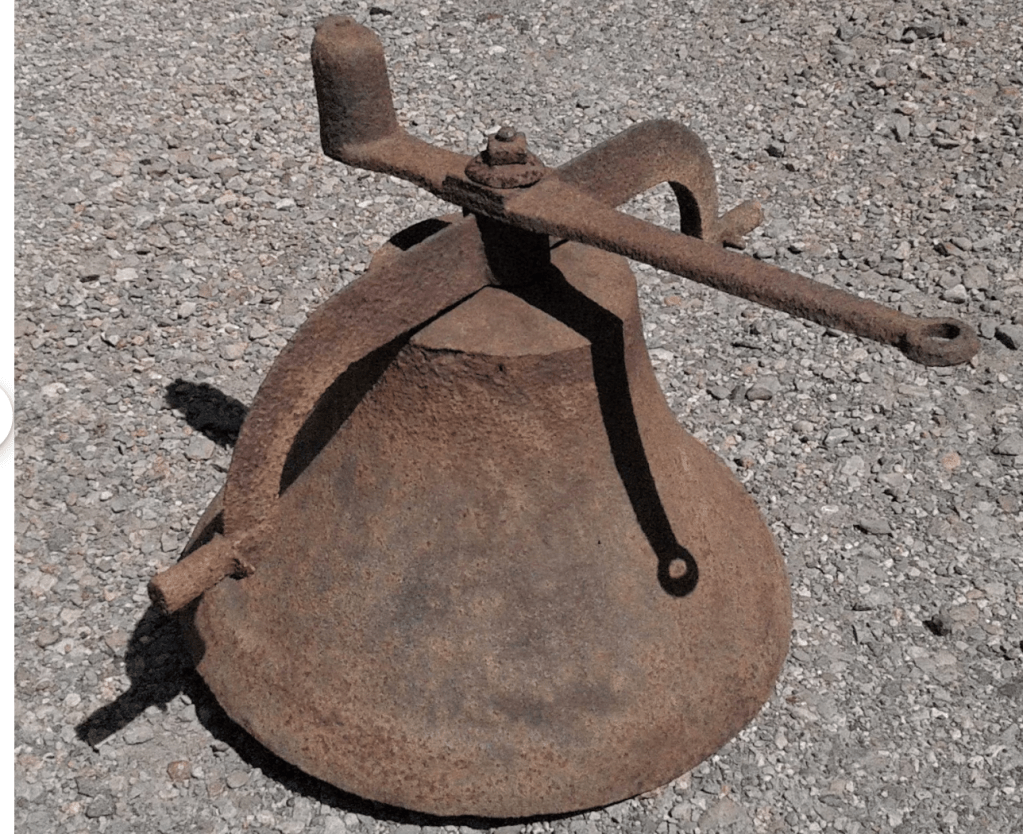
The school’s bell had hung proudly in the tower for decades. It called children in from recess and sent them home at day’s end. Then one year—a generation before the school closed—it vanished. Not stolen, exactly. Just gone. People assumed it had been taken for safekeeping. They thought it was stored in somebody’s barn for future repairs. Others believed it had been hauled away accidentally during a renovation.

The last families left Retrop. Then, bulldozers finally erased the last bricks of the school. Yet, the bell was still missing.

Some say the bell found another tower along the prairie. Others swear it sits buried beneath the highway, trapped in silence under thousands of cars a day. A few whisper that the bell rings on its own now and then—never heard, but felt. A tug in the chest. A memory rising like dust in a beam of sunlight. A sound from a place people forgot existed.

Most modern maps don’t show Retrop anymore.

But every once in a while, someone driving that long Oklahoma stretch will slow down for no reason at all. They will stare out toward the open fields. They swear they can sense something that has no business being there.

A town that isn’t.
A school that was.
And a bell—somewhere—still waiting to be found.

The Bell on County Road 7

No one knew who put the bell there. The old timers from the old school days at Retrop had all gone. Buried. The generation had died off. The families had sold their farms. Or, the farms had been handed down through generations. The old school bell had been forgotten. Until…

It appeared one Tuesday morning. It stood silent, rusted, and leaning a little to the left. The scene was at the far end of County Road 7, right where the asphalt surrendered to red dirt. The bell looked ancient, the kind you’d expect to find hanging outside a one-room schoolhouse or a long-gone prairie church. But there it stood, bolted to a cedar post that hadn’t been there the day before.

Folks in town had theories, of course. In places like Washita County, theories sprout faster than wheat after a spring rain.

Old Mrs. Peabody said it was a sign from the Lord. Hank Ballard at the feed store claimed it was an art project. College kids with too much time and not enough sense created it. Deputy Collins figured someone dumped it there after cleaning out a barn.

But no one claimed responsibility. And no one can explain what started happening a week later.

Every morning at exactly 5:17 a.m.—never a minute sooner, never a minute later—the bell rang.

Just one tone.

Clear. Strong. Impossible to ignore.

At first people thought it was a prank. Someone out there at dawn, pulling a rope and having a good laugh. But when a few curious souls drove out at that hour, no one was ever there. They’d wait in their cars or stand beside the fence line with coffee steaming in cold hands. The prairie would hold its breath. Coyotes would go quiet.

And then the bell would ring.

The sound didn’t vibrate through the metal—folks swore it vibrated through them. It was as if it reached down and stirred up something old they’d forgotten. It is a memory, a regret, or a promise left sitting too long on a dusty shelf.

For some, the mornings changed them.

Mr. Conway, who hadn’t spoken to his brother in twenty years, drove to Elk City and patched things up. Annie Lucas finally mailed the letter she’d been writing and rewriting for a decade. Deputy Collins insisted the whole thing was nonsense. Despite this, he found himself stopping by a certain headstone in Sentinel more often.

But on the eighth morning, the bell didn’t ring.

Not at 5:17. Not at all.

When people went to check, the bell was gone—post and all. As if erased. Only a square of red earth remained. It was freshly disturbed. It was like someone had quietly lifted a piece of the world and carried it away.

The next day, life went on. Coffee brewed, trucks rumbled to work, and theories fluttered around like tumbleweeds. But every now and then, people found themselves glancing toward County Road 7, half-expecting a sound that no longer came.

Still, there are some who swear, when the wind blows just right across the prairie, they can hear it faintly in the distance:

One clear, steady ring.

A reminder of something they’re still meant to do.

Never forger RETROP!


By Benjamin GroffMedia© | benandsteve.com | ©2025 

It Is Well After The American Turkey Day – So I am Going To Say It… Happy Christmas, Merry Holidays!

By Benjamin GroffMedia© | benandsteve.com | ©2025 

1–2 minutes

I’ve always felt that Hawaii is a state too often overlooked. I make it a point to include them whenever I’m searching for stories or news pieces. This Christmas—whatever your holiday season looks like—is no exception.

In times of uncertainty, we search for our better angels. We hope for a gentler tomorrow. I often turn to those who left us examples of grace, comfort, and tradition. There were people we once depended on to show up every Christmas. They became woven into the fabric of our holidays—at least for those of us in the United States.

To my friends outside the U.S., and to those who be too young to remember, I offer my apologies—this memory comes from another era. But I invite you along anyway. What I want to share is a small holiday wish from my own past.

It’s a moment wrapped in nostalgia, carried to us by a familiar voice: Bing Crosby.


By Benjamin GroffMedia© | benandsteve.com | ©2025 

This Is My Country – To Have and To Hold

A reflective story inspired by the timeless patriotic verse

By Benjamin GroffMedia© | benandsteve.com | ©202

3–4 minutes

This Is My Country

There are words that live on paper, and then there are words that settle into the bones of a people. The kind that echo from porch steps and courthouse lawns, from quiet cemeteries and loud parade routes. The kind drift through open windows on warm summer evenings. A flag whispers its slow conversation with the breeze.

“This is my country! Land of my birth!”

The old man had recited it repeatedly. The lines felt stitched into his memory. They were like a family quilt. He first heard the poem as a schoolboy in a one-room classroom. The chalk dust drifted like snow. Old Glory hung slightly worn but always proud above the blackboard. They had stood, hands pressed to hearts, small chests swelling with pride they did not yet fully understand.

And now, decades later, he stood on the same red Oklahoma soil. This was the ground that had raised him. It shaped him and anchored generations before him. He thought of his father plowing under wide skies. He remembered his mother hanging laundry that snapped sharply in the prairie wind. This was the same wind that lifted the flag into slow, flawless motion.

“This is my country! Land of my birth!”The old man had recited it so many times. The lines felt stitched into his memory like a family quilt. He first heard the poem as a schoolboy in a one-room classroom. Chalk dust drifted like snow. Old Glory hung slightly worn but always proud above the blackboard. They had stood, hands pressed to hearts, small chests swelling with pride they did not yet fully understand.And now, decades later, he stood on the same red Oklahoma soil. This ground had raised him and shaped him. It had anchored generations before him. He thought of his father plowing under wide skies. He remembered his mother hanging laundry that snapped sharply in the prairie wind. It was the same wind that lifted the flag into slow, flawless motion.

“What difference if I hail from the North or the South, the East or the West?”

He had traveled. He had met farmers in Iowa. He had met dockworkers in Louisiana. He encountered miners in West Virginia. He also met shopkeepers in Arizona who spoke with accents as varied as the landscape. They all shared an unspoken recognition. There was a quiet understanding that this vast, imperfect, beautiful land belonged to them all. Not in ownership, but in guardianship. In gratitude.

He remembered the first time he truly understood the weight of those words. It wasn’t in a classroom. He was in uniform, standing still beneath a lowering sun. He watched the flag rise slowly as taps echoed across the horizon. In that moment, the poem ceased to be something learned and became something lived.

“With hand upon heart, I thank the Lord for this, my native land…”

He whispered the words now as the breeze carried the scent of freshly cut grass and distant rainfall. His soul, like the poem said, was rooted deeply in the soil on which he stood. Every memory, every loss, every joyful celebration had unfolded beneath the same sky, under the same banner.

This was not blind loyalty. This was love shaped by history — by wars survived, hardships endured, and freedoms fiercely guarded. It was a love that understood flaws. Yet it still swelled with gratitude for the promise, the struggle, and the hope that had always defined America.

As the flag unfurled above him, catching the light in crimson and gold, he spoke the final lines not as a performance, but as a vow, as millions had before him and millions would after:

“This is my country! Land of my choice!
This is my country! Hear my proud voice!
I pledge thee my allegiance, America, the bold —
For this is my country, to have and to hold.”

In that quiet moment, the wind acted as a witness. Time stood briefly still. He knew something certain and unshakable.

This was his country.
Not perfect.
But deeply loved.
Forever his.


Groff Media ©2025 benandsteve.com Truth Endures

Binger Oklahoma Home Of Johnny Bench – The slow vanishing of the heartland!

By Benjamin GroffMedia© | benandsteve.com | ©2025 

7–10 minutes

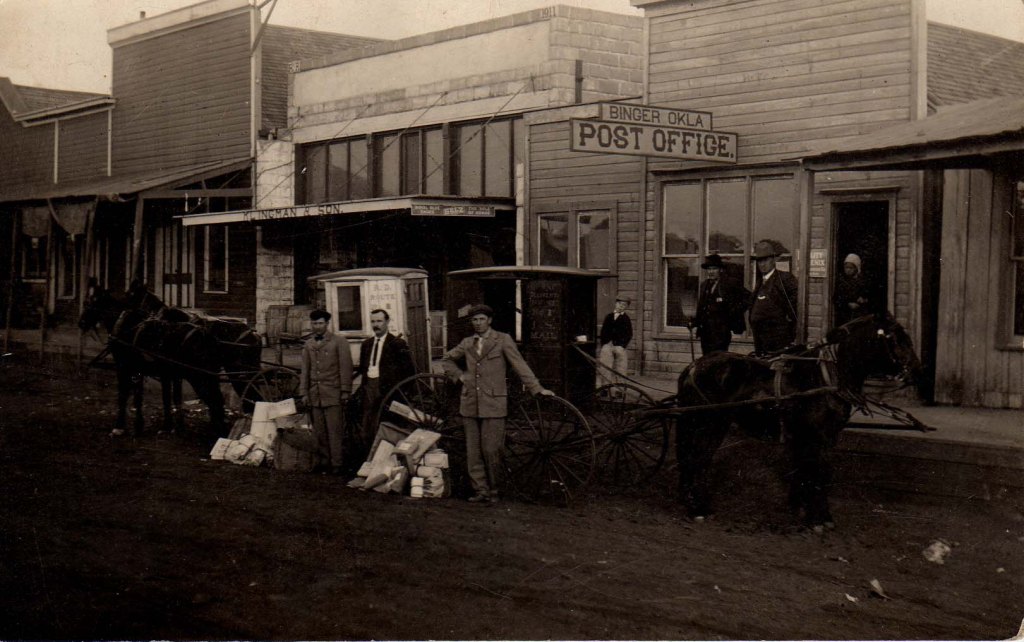
The next photographs depict an small town in Oklahoma from its birth through current day.

Going to town. Getting groceries, supplies and other needed items were essential trips in the late 1800s and early 1900s. Towns like Binger, Oklahoma were places where such trading centers would become popular. Train depots and later bus lines would bring needed connections to the area.

The above photos capture buildings that no longer stand. They were lost in one of the early fires that shaped the town’s history. The original downtown was once located near the area now known as the Johnny Bench Ball Park. This is at the Fair Grounds. After each fire, the town slowly shifted north. It rebuilt itself one block at a time. Eventually, it settled into its current location. The Post Office was a major accomplishment for any community to achieve. When a post office came, it marked the community’s success. The community became a reliable base for investors, visitors, and tourists.

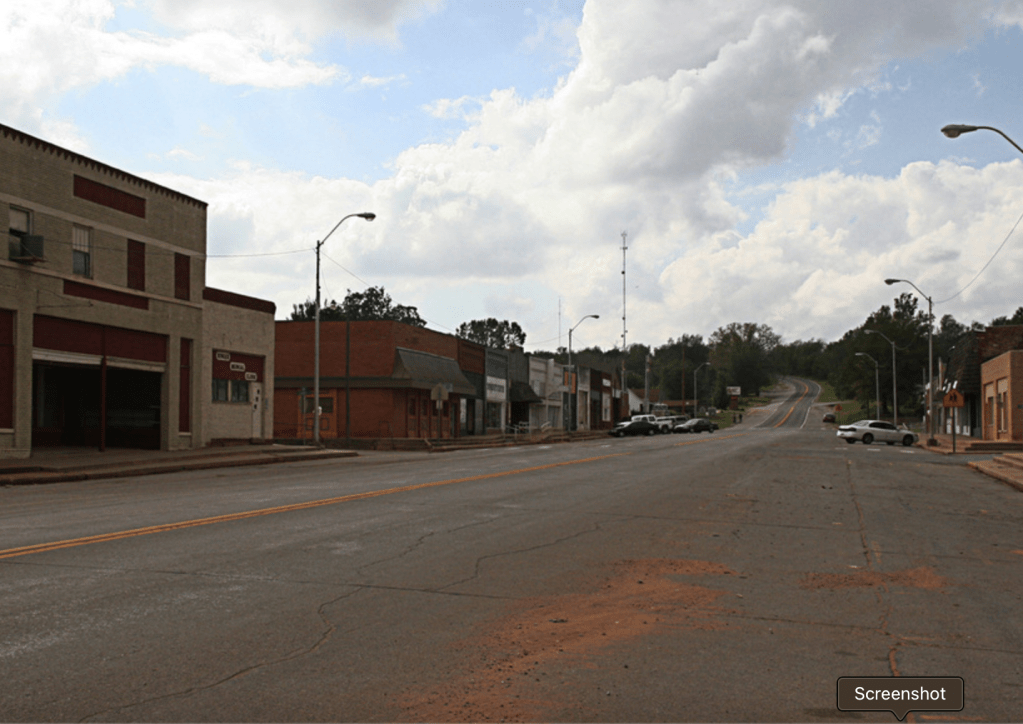
State Highway 152 now runs through the center of town. Locals know it as Main Street. This familiar stretch has quietly observed generations pass through. This place is not what I call my hometown. But, it remains part of my associations. It is woven into the landscape of where I grew up and the memories that shaped me. During the 1950s to 1980s, hundreds of teenagers gathered on Binger’s Main Street. They saw it as the Main Drag on Friday and Saturday nights. It was as hot as a radio station spinning its latest hit. Both tunes filled the air from the City Hall. Tires spun all the way to the east end by the CO-OP. Button Williams, the towns Police Chief, watching carefully over the towns teen as he had since God’s creation. His Assistant Chief Jerry Wright there to catch calls on off nights.

Binger has always felt like one of those places where sports held the town together. The fields and courts were filled with tough farm kids. They were shaped by long days and dusty roads. Life taught them strength early. Many came from the Caddo and Kiowa Nations. People from other tribes joined them. Together they formed a close-knit spirit. This made every game feel like a community event.

From those humble beginnings came Johnny Bench. He was a local boy who carried his talent all the way to the Cincinnati Reds. He proudly wore number 5. The town still honors him with a small museum. It serves as a quiet reminder of how far a dream can travel from a place like this. And then there was Robert Johnson Jr., who tasted professional baseball but chose the familiar comfort of small-town life instead. In these memories, the heart of Binger lives on. It resides not just in its history. It also lies in the way it shaped those who once called it home. My grandfather bought the first Model T Ford from the town of Binger’s Ford dealership. They came to town to sell them when the Model T’s came out. “Pop” described the Ford outfit as being near where an old Caddo Electric building sets today. If you drive through the town, you will see the big white building. It’s on the corner near US281 and SH-152.

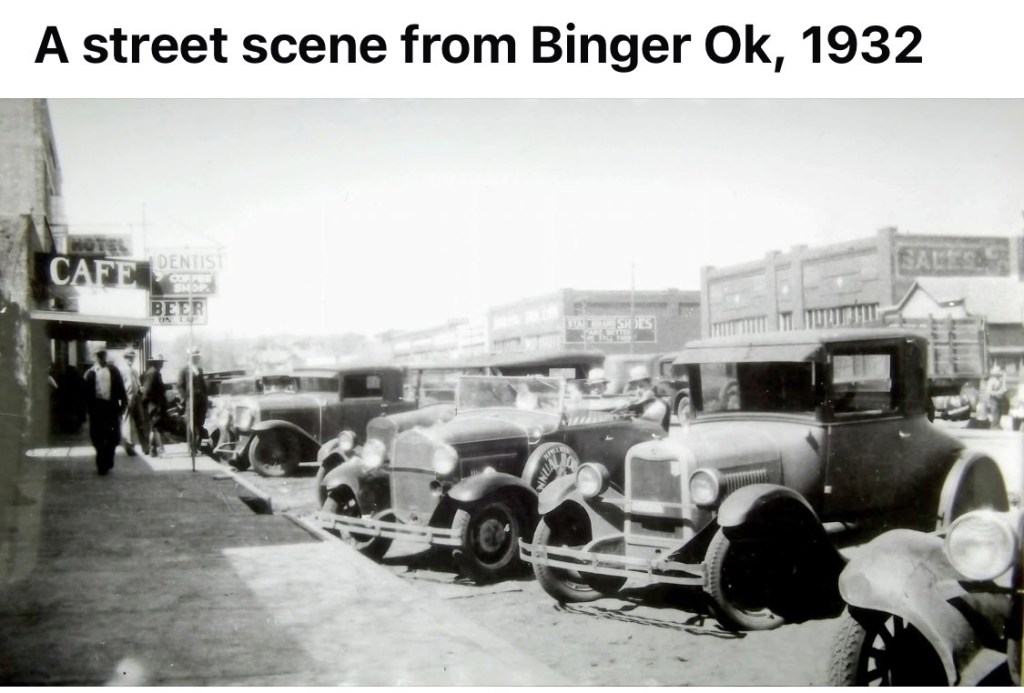
The above photo shows Main Street in Binger, Oklahoma, in 1932. It captures a quiet moment frozen in time. After the town burned twice, it rose again each time. It was rebuilt about a block north of its original location. This carried with it the stubborn spirit of those who refused to let it disappear. This image shows what became the final resting place of that rebuilt heart of town.
When the sidewalks were poured, metal rings were set into the concrete. They were meant to tether horses and wagons. Townsfolk stepped inside to conduct their daily business. For decades, those rings remained. They served as humble reminders of a slower pace and simpler life. In the mid-1970s, new federal accessibility requirements called for lower ramps and fresh pavement. With that change, the old sidewalks were replaced. The iron echoes of the past quietly vanished. Now, only memory and photographs tell their story.
This photo was found behind a old counter in the back of a business in the 1970s. Its dated as being in the 1920s. Which is a possibility. The name of the business is unknown. Yet longtime residents at the time did recognize the business as belonging to the town.
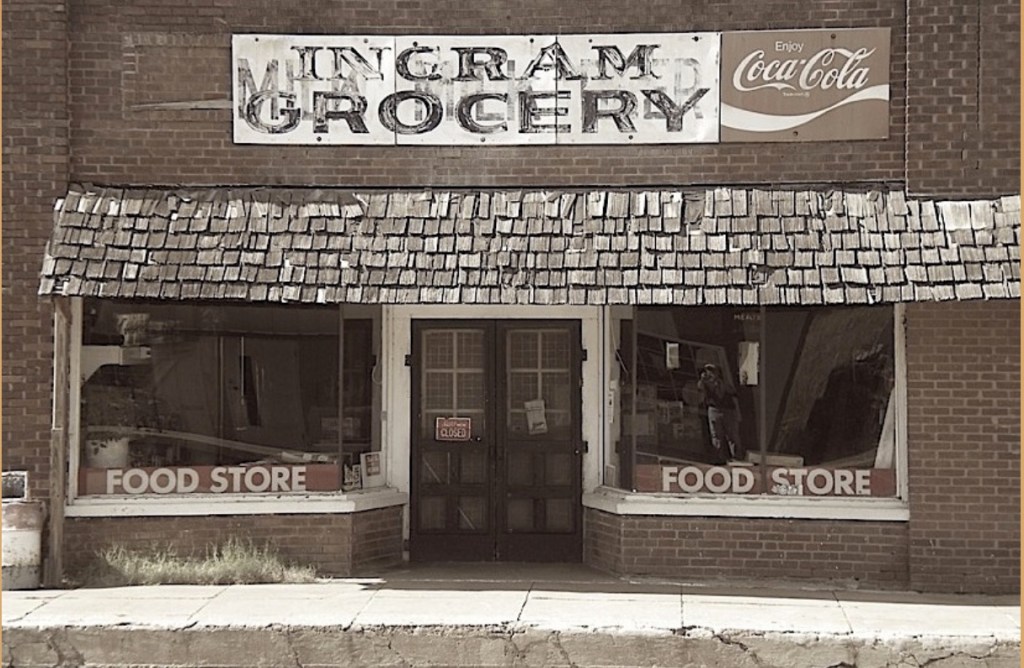
Binger once hosted three cafes and a hardware store. It also had two barber shops, a bar, and a propane company. There was a drug store, a movie theater, and two grocery stores. Additionally, it featured two laundries, a plumbing company, and a funeral home. The town included a post office, an electrical repair shop, a junk-pawn shop, and a pool hall. Binger also had two dry goods stores and a Western Auto. It had a Chevrolet Dealership, a TV Repair Service, and Three Service Stations. These were a Sinclair, a Gulf, and a Git-N-Go. There was also a dress shoppe. There was even a healthy farmer’s Co-Op. There were many other businesses that came and went in between the years. The public school was well respected in the County and had been given financial support to meet its needs.

This is a photo of the buses traveling both directions along Main Street in Binger. I’ve carried it with me for years. I have shared it many times. It always stirs the same familiar sense of remembering. This photo was taken while looking west. It captures the gentle rise at the end of the street — Binger Hill. For generations, this slope has slowed heavy trucks. It becomes unforgiving during icy winter storms.

On the right side, the white building stands just before the line of trees begins. It once served as City Hall. Inside were the fire department, water department, and city clerk. The building also housed a small police office. There was a jail that I can assure you no one was eager to test. The bars were thick, cold steel, reinforced and unyielding. I saw more than a few individuals placed there by the town’s two-man police force. This pair quietly carried more responsibility than most ever realized.

This photograph isn’t just about traffic or buildings. It holds a piece of a time when Binger moved at a gentler pace. The town watched over its own. Every corner held a story waiting to be remembered.


Johnny Bench rode home with the Binger High School baseball team on April 1, 1965. They had just played a game in nearby Riverside. This was a routine trip. It would become a moment forever etched into the town’s history. As the bus crested a hill, the coach suddenly realized the brakes had failed. The vehicle couldn’t slow down. It careened into a curve at dangerous speed. It burst through the guardrail and plunged nearly fifty feet into a ravine below.

The accident claimed the lives of two young teammates, Harold Sims and Billy Joe Wylie. This loss rippled through a small community that mourned deeply. Amid the chaos, Bench survived. He was guided by advice once given by his father. His father was a propane truck driver who understood the dangers of the road. He had told his son that in such a situation, the safest place was the floor of the vehicle. Remembering those words, Johnny dropped down. He instinctively pulled teammate David Gunter with him. This act well have saved both of their lives.

What followed was not just a tale of tragedy. It was also a story of instinct and survival. There was a quiet strength carried forth from a small Oklahoma town into the story of a legendary career.

Johnny Bench, the legendary Cincinnati Reds catcher, was known for the remarkable size and strength of his hands. Many claim he can palm as many as five baseballs in one hand. He famously demonstrated this skill on the television program This Is Your Life in the early 1970s. This moment is still remembered by many longtime fans.


Today the state highway runs right through the town’s middle section. What once was a Main Street with shops and store fronts bustling with shoppers and townspeople is now empty. It is nearly deserted.

Cart’s Lumber on the Town’s East side is one of the few businesses providing services to the town.
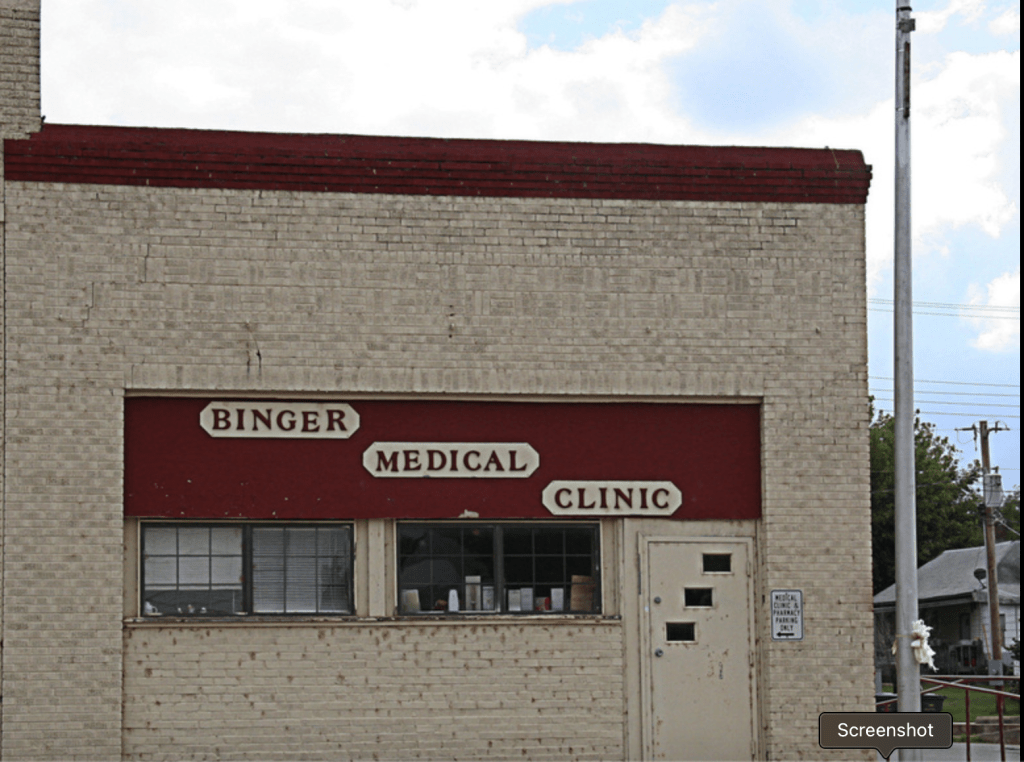
The Medical Center reportedly closed some years ago.

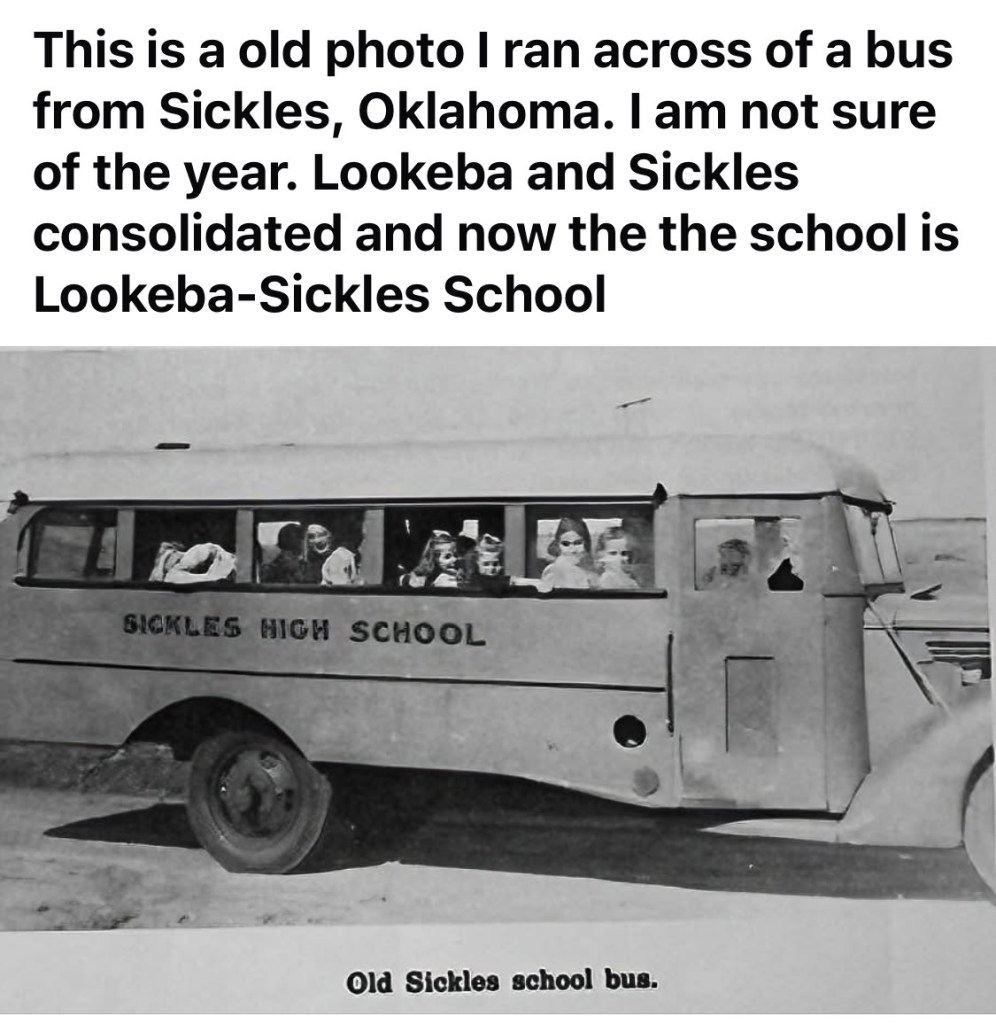
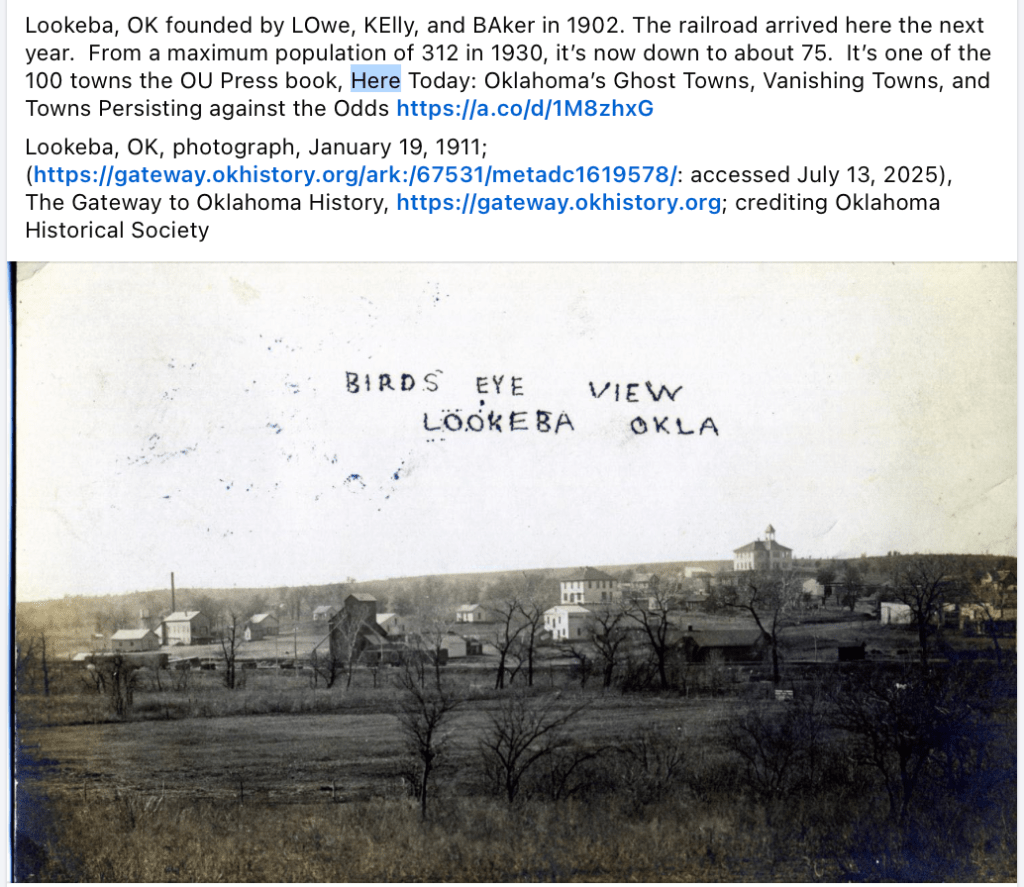
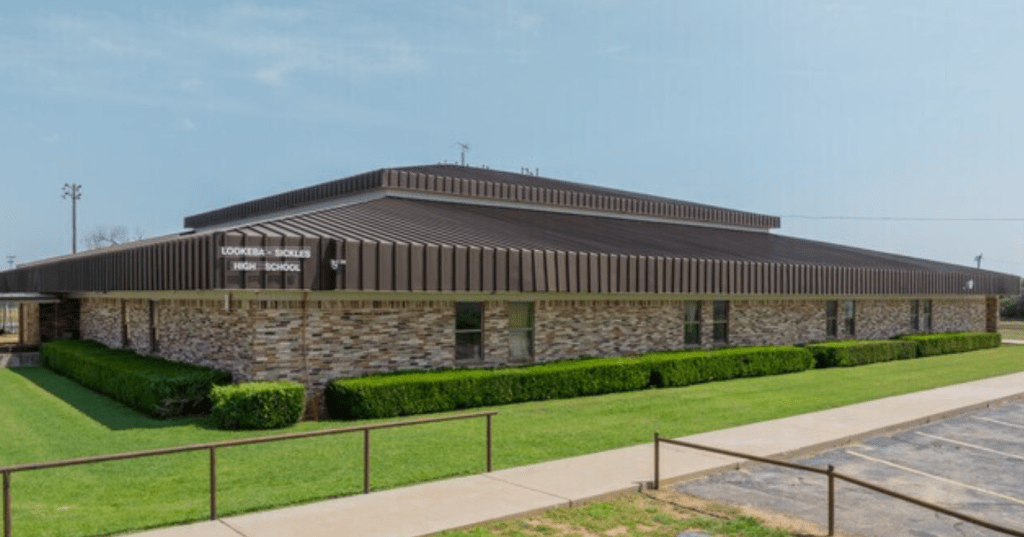
There are a few businesses still open in the town. A dollar store, a satellite bank of a local branch is located on the hill. There is one diner. A convenience store. A bar and the Post Office. But for most part, the buildings you find will be empty, boarded up and closed. In the 1970s, the town’s streets were packed with people parking to go shopping on Main Street. Now, the streets are wide open. Many contribute the towns rundown to the Caddo Electric Headquarters moving it’s headquarters three miles east of town. It caused many doing business with the Electric Cooperative to avoid stopping in Binger. It was the first set of nails in the towns casket. The others were placed there when too much faith was placed in the oil industry. Then as shops began to close, people began to move, and the towns center stopped functioning. I know because I was there and watched it. This was the town closest to our farm. I graduated from a school some fifteen minutes away, a place called Lookeba-Sickles. And that place is story for another day!


By Benjamin GroffMedia© | benandsteve.com | ©2025 

The Island – A Serialized Dystopian Story * Chapter Seven

2–3 minutes

Haven’s Reach: The Fracture Extended

By the time autumn winds rolled across Haven’s Reach, something in the air had shifted. The Council’s decrees were no longer whispered with unease. They were shouted from wooden platforms. The decrees were painted on walls and nailed to doors. “Obedience is Freedom,” one sign read. “Order Before All,” declared another. The rules had once been tolerated as minor irritations. Now, they pressed down like a boot on the neck of the people.

It began with curfews. Families were ordered indoors at dusk, lanterns extinguished by the ninth bell. Then came the bans. First, there was one on foreign books. Next, gatherings of more than five were forbidden. Finally, music played in public squares was banned. One by one, pieces of life that had once defined Haven’s Reach fell away. The Council insisted it was “for safety.” But everyone knew better—fear was safer for rulers than for the ruled.

Harper saw it most clearly when her younger brother, Eli, vanished. One evening, he was at the bakery kneading dough by her side. The next morning, his cot was empty. Blankets were folded neatly as though no one had ever lived there. Whispers reached her ears: Eli had spoken too freely about the Council in the market, and someone had reported him. Now he was “detained for questioning.” No one who had been questioned ever came home the same.

Harper’s grief sharpened into something more complex. She began wandering beyond her bakery’s door after curfew, listening at corners, watching shadows. That’s how she stumbled across The Quiet Ones. It was a ragtag circle of neighbors, merchants, and teachers. They took it upon themselves to preserve what the Council feared most: memory. They hid forbidden books in flour sacks. They scribbled children’s rhymes on the backs of ledgers. They whispered songs under their breath in defiance.

When Harper revealed her brother’s name, the Quiet Ones did not look away. An older man with ink-stained hands touched her shoulder and said, 

“You’re one of us now, whether you meant to be or not. The fight isn’t about one boy. It’s about all of us.”

The fracture had come—not just between ruler and ruled, but within the people themselves. Some chose silence and survival. Others, like Harper, chose risk and resistance. Haven’s Reach was no longer simply an island under rule. It was a tinderbox, waiting for a single spark to ignite.


By Benjamin GroffMedia© | benandsteve.com | ©2025

The Island – A Serialized Dystopian Story * Chapter Five 

1–2 minutes

Haven’s Reach: The Vanishing Voices

The island was quieter now. Too quiet.

After the whispers of resistance spread through hidden gatherings, Brant Harrow and his Council acted swiftly. 

One by one, the most outspoken citizens began to disappear. A fisherman dared to complain about rationing. A mother had asked too many questions at the weekly assembly. A teacher was rumored to keep forbidden books. They were gone.

No public trials. No explanations. Only empty chairs at family tables and unlit lanterns where homes once glowed in the night. The Council claimed these people had “chosen exile.” But no one had ever seen the boats return. Children asked where their neighbors had gone, and parents whispered a single warning: 

Don’t ask too loudly.

For those who remained, the silence was deafening. 

Even the ocean seemed to hush its waves against the shore, as if the island itself held its breath. Fear kept voices low. In the dark corners of Haven’s Reach, a few brave souls began to wonder. If the voices of truth were vanishing, who would speak for them when the Council came knocking next?


By Benjamin GroffMedia© | benandsteve.com | ©2025 

The Island – A Serialized Dystopian Story * Chapter Three

1–2 minutes

Haven’s Reach: The First Rules

The island had been buzzing with a quiet energy. Families were settling into huts near the shoreline. Farmers had begun turning fertile soil into gardens. Fishermen reported an abundance of food from the sea. For a brief time, it felt like paradise was within their grasp.

But no paradise, it seemed, live without Order.

The elected leader, Brant Harrow, stood on a makeshift platform in the town square. His voice carried over the crowd like the tide: calm, confident, and commanding.

“We are a community now,”

He declared, “and no community can survive without rules. These rules are not punishment, but protection. They will guide us. They will keep Haven’s Reach strong.”

The first rules were simple enough: no theft, no violence, no waste. At first, the people welcomed them. After all, who can argue against peace, honesty, and thrift? 

Yet Brant added one more: 

“All voices must flow through the Council before being spoken to the community. This ensures unity.”

Some shifted uneasily at that, but most nodded. They wanted peace. They wanted Order. And Brant gave them just that—or so they believed.

That night, lanterns glowed along the shoreline as fishermen mended their nets. Farmers laughed over bowls of stew. Children ran between the huts, playing games under the moonlight. The air was filled with a fragile joy.

But inside his quarters, Brant sat with a small group of men. 

“It begins here,” 

He told them. 

“Control the speech, control the thought. The rest will follow.”

Haven’s Reach was still blissfully unaware. It took its first quiet step toward becoming something far different. It was unlike the dream its people had imagined.


By Benjamin GroffMedia© | benandsteve.com | ©2025 

October 20th — A Day to Reflect on the Strength of Democracy in a Republic

1–2 minutes

October 20: A Day of Quiet Turning Points

Some days in history roar with drama. Others whisper their significance so softly we almost miss it. October 20 is one of those whispering days. Yet, it carries lessons about resilience. It also teaches about change and the long arc of progress.

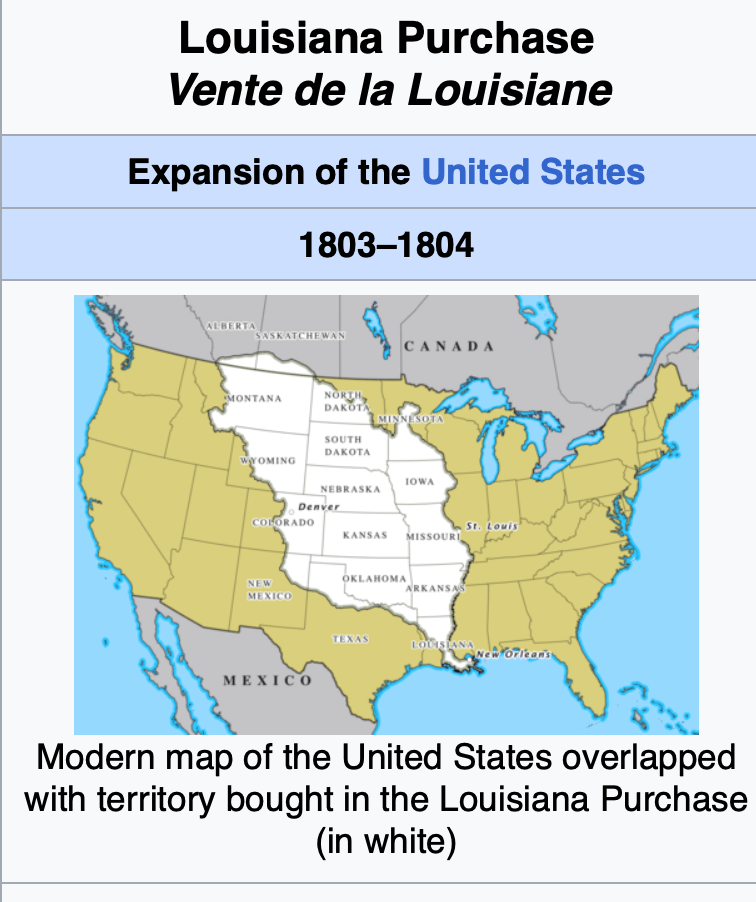
On October 20, 1803, the U.S. Senate ratified the Louisiana Purchase Treaty, doubling the size of a young America. It wasn’t just a land deal; it was a leap of faith in a still-unfolding national experiment. The deal shaped the destiny of millions who had not yet been born and transformed how people saw opportunity. That’s one perspective on October 20. It reminds us that big things often start quietly. They are inked onto paper while the world goes about its business.

Photo by Jacob Morch on Pexels.com

Fast-forward to October 20, 1973 — the “Saturday Night Massacre” during Watergate. The Attorney General and his deputy resigned rather than obey President Nixon’s order to fire the Watergate special prosecutor. It was a night of constitutional crisis, but also a night when individuals drew lines they would not cross. In retrospect, it became a defining moment of accountability, integrity, and public trust.

Even in culture, October 20 pops up. It’s the birthdate of artists, athletes, and ordinary people whose work changed lives. It’s also National Youth Confidence Day. It’s a chance to celebrate the courage of young people. They are forging their own paths, as each generation must.

Photo by Monstera Production on Pexels.com

So what does this all mean for us on October 20, 2025

Maybe it’s a nudge to honor the quiet decisions. It is about the unsigned papers and the moments of private courage. These shape our futures just as much as public fireworks. Maybe it’s a reminder to invest in tomorrow. Take the risk. Speak the truth. Double down on hope, even when nobody’s watching.

October 20 is not a “holiday” in the traditional sense. It is a hinge day. It is one of those unassuming points on the calendar. History reminds us that the choices we make today become the landmarks of tomorrow.


By Benjamin GroffMedia© | benandsteve.com | ©2025 

Where the Barrel Cactus Sits: Visiting Chiawuli Tak, Arizona

1–2 minutes

Welcome to Chiawuli Tak, Arizona—a sun-drenched speck of a census-designated place nestled in Pima County. The town had just 48 residents in 2020. It has risen to an estimated 112 today. It’s the town where “small population” doesn’t even start to cover it. (And yes, that growth rate of about 6.7% annually is basically like adding a few family reunions per year.) (1)


Once upon a Sunday, locals cheered when a tumbleweed gently tapped on the general store window. They marveled at it, of course. The nearest neighbor hosts alone can use the company. With a population density of around 20 people per square mile, it’s quieter than most people’s living rooms. If you shout “Howdy!” in Chiawuli Tak, you’ll hear your own echo. You also hear the echoes of three generations of family dogs responding in kind. (2)


Despite its tiny size, 19 households call Chiawuli Tak home. Nearly five people per house live there on average. There are a handful of single dads. They are brimming with dad jokes. There are also single moms who know the power of multitasking. Enough cousins exist to start a family band. Everyone’s related, and everyone knows the town gossip by breakfast. (3)


The name Chiawuli Tak comes from the O’odham language and means “the barrel cactus sits.” It is the only town in America deliberately named after a cactus that sat down. This cactus thereby became the most laid-back plant in the desert. (4)


Chiawuli Tak reminds us that it doesn’t take big cities to tell good stories. Sometimes, you just need a handful of folks, a trusty barrel cactus, and a whole lot of unexpected charm. So raise your morning coffee high. Do it for the towns that make you smile. These towns only show up on very sparse maps.


By Benjamin GroffMedia© | benandsteve.com | ©2025 

October 10 in History: Key Milestones and Cultural Impact

3–4 minutes

Oct 10th a good day for history
How history can pile up on any day of the year.

How did we arrive at our current state? It is a question a lot of people are asking. It didn’t happen all at once. Getting to where we are, was forever in the making. Before anyone alive today was here. There have been people making decisions, some not so great. Life happens. It is a popular saying for some people. And as you can tell through this date in history. October 10th was a great day for history to be set. It doesn’t explain everything that has happened. But it does give one an idea of how history can pile up on any given day.

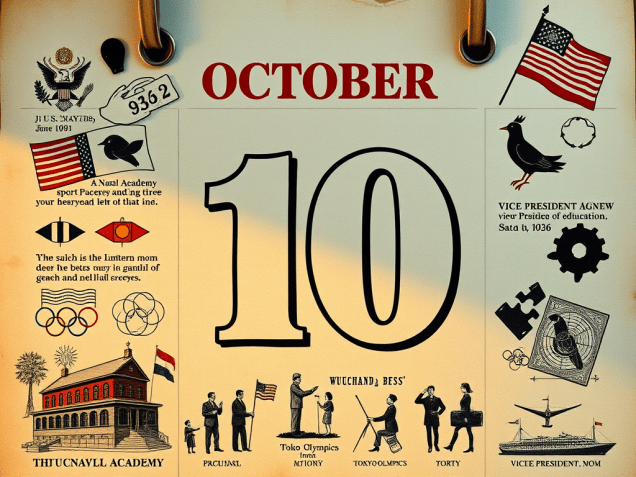
Here’s an evocative image of a calendar marking October 10. It serves as a visual prompt for a day rich in history. This day includes milestone events and global observances.

  1. 1845 – U.S. Naval Academy Founded
    • In Annapolis, Maryland, the Naval School opens with its first class of 50 midshipmen. This event lays the foundation for the modern U.S. Naval Academy.(1)
  2. 1911 – Wuchang Uprising Ignites Revolution This bold move sets the stage for the fall of China’s Qing dynasty. It also leads to the emergence of the Republic of China.(2)
  3. 1935 – ‘Porgy and Bess’ Debuts on Broadway
    • George Gershwin’s groundbreaking opera, featuring an all-Black cast, premieres to widespread acclaim.(3)
  4. 1964 – Tokyo Olympics Start: A Global Broadcast
    • Making history, these Summer Games are the first to be televised live worldwide.(4)
  5. 1973 – Vice-President Agnew’s Resignation
    • Spiro Agnew steps down amid tax evasion charges, a rare and dramatic political moment in U.S. history.(5)

October 10, 1973: A Domino That Changed the Presidency

On October 10, 1973, U.S. Vice President Spiro T. Agnew resigned in disgrace. He pleaded no contest to tax evasion charges. These charges stemmed from a bribery scandal dating back to his time as Maryland’s governor. A sitting Vice President had never stepped down under criminal accusations before. This event sent shockwaves through American politics.

The resignation created an immediate power vacuum. Under the 25th Amendment, passed just six years earlier, President Richard Nixon was capable of nominating a new Vice President. His choice was Michigan Congressman Gerald R. Ford, a steady Republican leader respected across party lines. Congress confirmed him in December 1973, setting in motion a sequence of events no one predicted.

Only months later, the Watergate scandal deepened. Nixon’s credibility unraveled under the weight of investigations into the cover-up of the break-in at the Democratic National Committee headquarters. With impeachment looming, Nixon resigned on August 9, 1974—the first U.S. president to ever do so.

In that instant, Gerald Ford became president. He told the American people in his swearing-in speech: 

“Our long national nightmare is over.” 

Ford’s ascent to the Oval Office was accidental. He became the only person to serve as both Vice President and president without being elected to either office.

Looking back, it’s clear that Agnew’s resignation on October 10 wasn’t just a scandal. It was a turning point in American history. Had he remained Vice President, Agnew—not Ford—would have been next in line when Nixon resigned. The nation, already reeling from Watergate, faced the reality of a president tainted by his own corruption charges. Instead, Ford’s calm, if brief, presidency offered a bridge back to stability.


👉 OCTOBER 10, 1973 stands as proof of how a single resignation reshaped the presidency. It altered the line of succession. It changed the course of American political history.

October 10 is more than a date—it’s a living mosaic of pivotal moments, human emotion, progress, and remembrance. It reflects how history shapes us and how we, in turn, continue writing it.

By Benjamin GroffMedia© | benandsteve.com | ©2025 

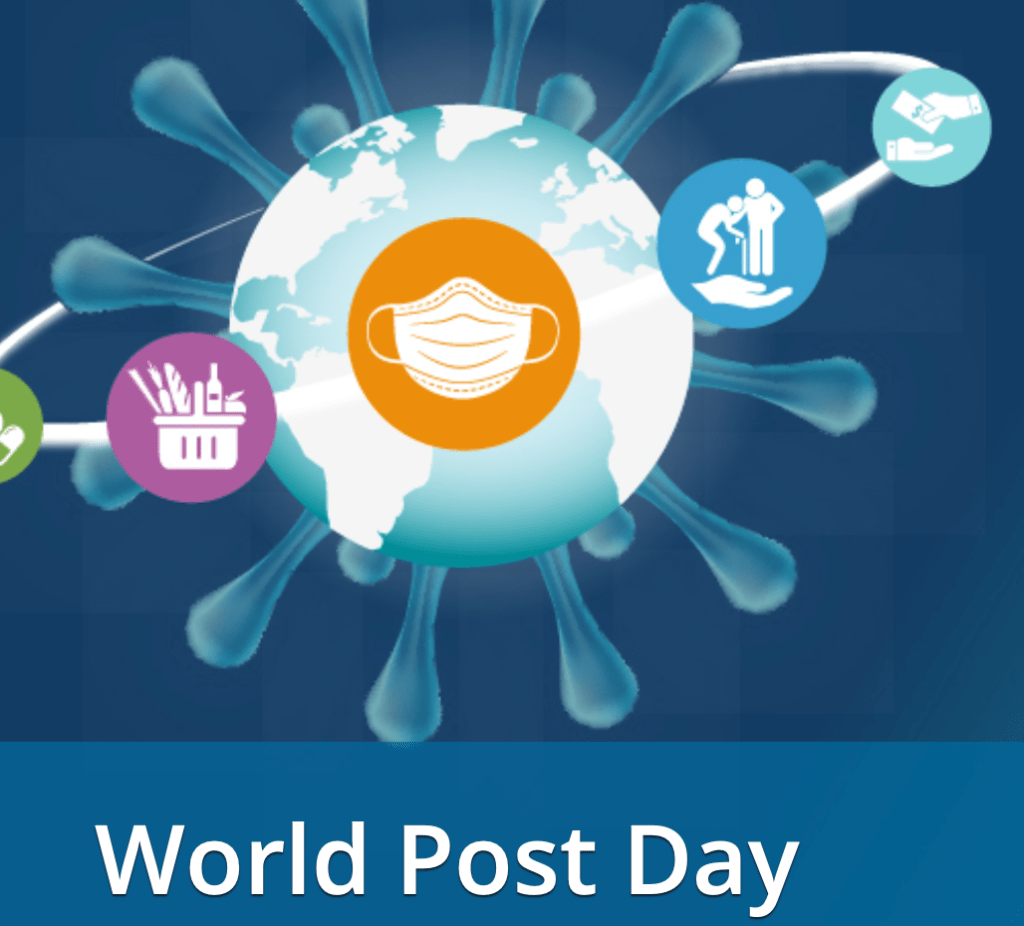
Leif Erikson Day: Honoring Exploration and Heritage and World Post Day Both From A Very Long Time Ago – Especially Now!

2–3 minutes

October 9 is more than just a date on the calendar. It’s a day rich with meaning. The day celebrates global communication. It also honors the spirit of exploration. Here are two powerful ways this day reminds us of human connection:


In 1874, the Universal Postal Union (UPU) was founded in Switzerland. This event marked the beginning of the modern era of global communication. Today—World Post Day—we honor the postal service’s vital role in connecting communities, families, and hearts across the globe. Post offices celebrate with stamp exhibits, open houses, and even letter-writing competitions for young people. (1)


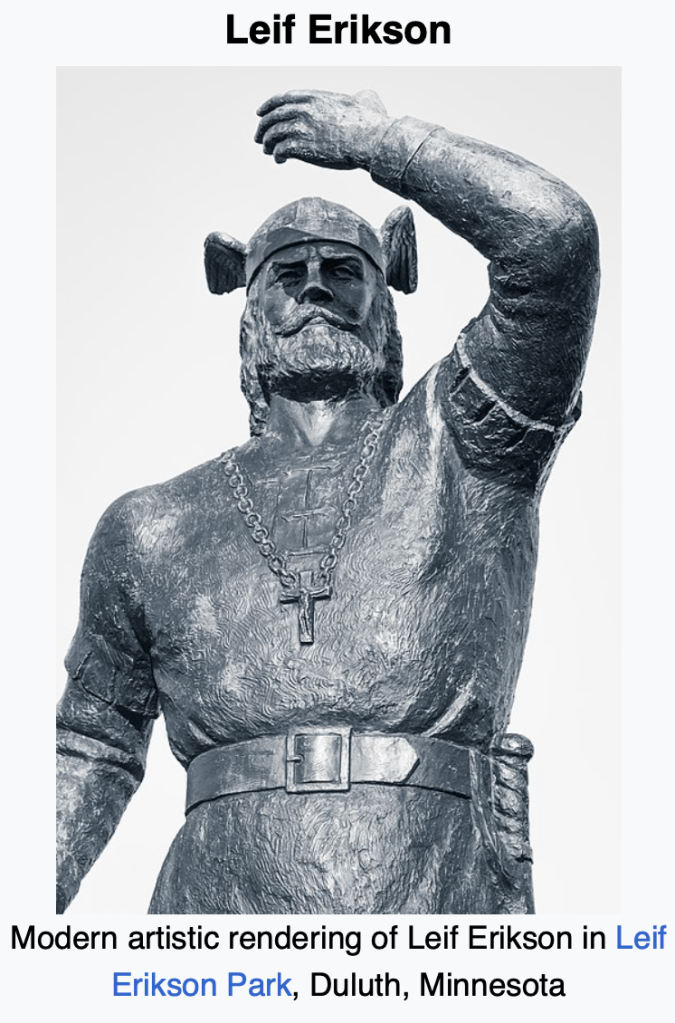
Leif Erikson Day is also celebrated today. This day honors the Norse explorer. He is believed to be the first European to reach North America. Established in the early 20th century and federally recognized in the U.S. in 1935, the day is especially cherished in communities of Nordic heritage. It’s a celebration of bravery, curiosity, and the timeless call of new frontiers.(2)

In 1929, the Wisconsin Legislature passed a bill to make 9 October “Leif Erikson Day” in the state. In the years after, several other states adopted laws to celebrate the day.[81] In 1935, legislation was introduced to the United States Congress requesting federal observance of the day. Before the legislation was passed, it was amended so that the observance would only occur in 1935. [82]  Which it was, after a proclamation that year by President President Franklin D. Roosevelt).[83] In future decades, many attempts to pass legislation were unsuccessful. They sought to have Leif Erikson Day proclaimed annually by the president.[84]Proponents eventually succeeded. In 1964, the Congress authorized and requested the president to proclaim 9 October of each year as “Leif Erikson Day”.[19]In the years since, each president has issued an annual proclamation calling for observance of the day.[85]. (3)


These historic observances brought to mind a personal story I experienced just last weekend:

Visiting the grocery store, I ran into a long-forgotten neighbor—someone I’d only exchanged waves with in passing. We chatted by the fruit stand for several minutes, sharing news, laughter, and even some life advice. When I left, I carried more than groceries. I carried renewed warmth. It was a reminder that connection doesn’t have to be epic to be meaningful.


  • Send a letter or thank-you note—traditional or digital. Let someone know how much they matter.
  • Reach out to someone you haven’t spoken to in a while. A simple chat can rekindle connection.
  • Think about exploration—big or small. Whether learning something new, trying a recipe, or visiting a new place, celebrate the courage that brought you there.

On this October 9, let’s honor our past. Let’s look ahead with open hearts. We will celebrate the small connections that make life rich and whole. Especially if countries around the world are shipping to America again. If not, keep an eye on history. It happened once. It will happen again. Maybe.


By Benjamin GroffMedia© | benandsteve.com | ©2025 

Rethinking the National Guard: A Return to Local Focus

6–9 minutes

What if the National Guard went “back to basics”? 

Instead of roaming the country as a military force, it can return to its roots. It should focus on protecting communities, fighting disasters, and standing ready at home. This was how it was initially intended.

Traditionally, the National Guard is a reserve part of the U.S. Armed Forces with a dual state and federal mission. Its primary duties include:

  • Disaster response: helping with hurricanes, floods, wildfires, tornadoes, and other natural disasters.
  • Civil support: assisting with search and rescue, law enforcement support, and humanitarian aid.
  • Community protection: maintaining order during emergencies like riots or public unrest (when activated by a governor).
  • Military readiness: training to serve as backup for overseas missions if federally activated.

In recent years, the Guard has been used much more often as a deployable military force nationwide and abroad. Instead of focusing mainly on disaster relief and state emergencies, units have often been:

  • Sent overseas for long deployments (Iraq, Afghanistan, and other global missions).
  • Deployed domestically for extended periods to reinforce border security.
  • Called into action for large-scale protests or high-profile events (sometimes more as a security force than a disaster-relief one).

This “running about the country” role shows the impact of federal activation. It often overrides the state-level, community-first role the Guard was created for.

If the Guard were not being tasked so heavily with nationwide or military-style deployments, they would be more focused on:

  • Local readiness involves staying in their communities and training for natural disasters and emergency responses.
  • Rapid-response teams: being first on the ground for wildfires, floods, and major storms.
  • Community integration: building stronger ties with local emergency agencies, fire, police, and hospitals.
  • Relief from strain: soldiers wouldn’t be stretched between frequent national missions and their civilian lives (jobs, families).

In short, without the current expanded use, the Guard would essentially serve as a state-based safety net. It would not work as a roaming military or quasi-police force.

Back to Basics: Rethinking the Role of the National Guard

The National Guard has long been the “citizen-soldier” force of the United States, built to serve both State and country. In recent decades, its role has changed. It has drifted toward functioning as a national military extension. It is constantly deployed across the country and overseas. What if, instead, the Guard returned to its roots?

1. Local First: Anchored in Communities

At its best, the Guard is a local safety net. Guardsmen live, work, and raise families in the same communities they serve. Units should primarily focus on state-based missions. This focus ensures the Guard would be ready to respond within hours to natural disasters. They would also be prepared for civil emergencies or infrastructure crises. Imagine a Guard that spends more time training with local fire departments, EMTs, and hospitals than on federal deployments.

2. Disaster Response as the Core Mission

Hurricanes, floods, tornadoes, wildfires—these are the events that disrupt American lives far more often than foreign conflict. A back-to-basics Guard would prioritize:

  • Maintaining rapid-response disaster teams in every State.
  • Stockpiling equipment is tailored for local threats. This includes boats in flood zones, fire suppression gear in the West, and snow mobility in the North.
  • Conducting community disaster drills ensures that both citizens and Guardsmen are equally prepared.

Units would no longer be pulled away for distant missions. They would focus on being the first and best resource for emergencies at home.

3. Training for Peace, Not Just War

Right now, Guard training often mirrors active-duty military requirements, preparing for combat tours. In a reset model, training would also emphasize:

  • Engineering & rebuilding skills (bridges, roads, communications).
  • Medical readiness to help hospitals in crises.
  • Cybersecurity units to defend state and municipal systems.
  • Community relations, so Guardsmen stay trusted neighbors rather than distant enforcers.

This would shift the Guard’s culture back toward being helpers before fighters.

4. Federal Role: Truly Exceptional, Not Routine

Of course, the Guard must stay capable of federal service in extreme situations—war, national catastrophe, or extraordinary need. Yet, deployments abroad or cross-country should be rare exceptions, not the default. By limiting federalization, Guardsmen can balance their civilian careers and military service, reducing burnout and attrition.

5. Why It Matters

A back-to-basics Guard would mean fewer fatigued families. It would result in stronger ties to local communities. This approach ensures a quicker, more reliable response when disaster strikes. America’s Guard would not be stretched thin across the globe. It would once again stand where it was meant to: in the towns and states it calls home.

What if you read notices in your local news that read?

PRESS RELEASE

FOR IMMEDIATE DISTRIBUTION

Governor Announces New “Back to Basics” Model for the National Guard

Kansas, June 32, 1901 — Governor Sample, today, announced a renewed vision for the role of the National Guard. He prioritized disaster response, community protection, and local readiness. These take precedence over routine national or overseas deployments.

“For too long, our Guard has been stretched thin. They have been asked to serve as a roaming military force. Their greatest value lies right here at home,” said Governor Sample. “This back-to-basics approach ensures readiness. When disaster strikes—whether it’s a wildfire, flood, storm, or cyberattack—the Guard will be here for the people of Kansas.”

The new model emphasizes:

  • Local Focus: Units stay in-state and train alongside fire, police, and emergency services.
  • Disaster Response Core: Stockpiles of equipment tailored to regional needs (boats, fire suppression, snowmobiles).
  • Civil Support: Enhanced training in medical aid, engineering, and cybersecurity.
  • Federal Deployment Limits: Guard units will be reserved for exceptional national missions, not routine overseas tours.

“Our citizen-soldiers are not only protectors—they are neighbors, coworkers, and family members,” The Governor added. 

“By keeping them rooted in our communities, we strengthen both readiness and trust.”

The announcement received praise from emergency officials. Guard families also praised it. They say the plan reduces the strain on soldiers. These soldiers balance military duties with civilian life. 

“This will make the Guard what it was always meant to be—a safety net for the people. It was not meant to be a shadow army,” said Major General Example, Adjutant General of the Kansas National Guard.

  • OR –

National Guard to Refocus on Community, Disaster Relief Under New State Plan

Pingpong, CA. Feb.30th, 1901 — The National Guard in California will soon change their focus. They will be trading extended deployments and national security missions for a renewed focus closer to home. In a press conference yesterday, Governor Pixel outlined a “back-to-basics” approach. This approach emphasizes disaster response, community support, and local readiness as the Guard’s primary mission.

The plan follows many years of frequent Guard call-ups across the country. These call-ups range from border security and protest response to overseas rotations. Critics have long argued these duties stretch citizen-soldiers too thin, pulling them away from their families, jobs, and communities.

Under the new model, Guard units would focus on in-state needs, like wildfire suppression, flood response, and medical assistance. Specialized equipment would be stockpiled based on regional threats. Training would shift toward engineering, emergency medicine, and cybersecurity. The focus would be less on combat deployments. Federal missions wouldn’t disappear, but would be reserved for “extraordinary circumstances.”

“This change will transform the Guard. It will achieve its true purpose,” said Major General Mission, Adjutant General of the California National Guard. “It will become a force that’s ready to protect and serve right where its soldiers live.”

Community leaders praised the proposal, noting the Guard’s quick local response during past disasters. Families of Guardsmen also welcomed the change, saying the plan reduces the strain of juggling civilian and military life.

The proposal has yet to be tested. It signals a shift in priorities. The Guard is rooted not in constant deployments. Its foundation lies in its mission as a local safety net for the people of California.

Returning the Guard to its original purpose –

📌 Top 3 Changes in the Guard’s Role

1. Local First

Guard units will stay primarily in-state, training with fire, police, and emergency services for quicker disaster response.

2. Disaster Response Core

Specialized equipment stockpiles—boats, wildfire gear, snowmobiles—tailored to each region will be prioritized over combat readiness.

3. Federal Deployment Limits

Units will only be sent on national or overseas missions for extraordinary emergencies, not as a routine practice.

That day will probably never come for a great many who read this report. For others who do, it serves as a goal. It becomes something to aim for when trying to look to a brighter future.


By Benjamin GroffMedia© | benandsteve.com | 2025 

The Consequences of Women Losing Voting Rights

2–3 minutes

What If Women Lost the Right to Vote Today?

Imagine waking up one day and discovering that half the population no longer has a voice in governance. It seems unimaginable. But, by exploring this dystopian scenario, we gain a clearer understanding. Women’s full participation is vital to a healthy democracy.


1. Democracy at Risk: Representation Crumbles

Eliminating women’s voting rights would erode democratic legitimacy. According to Pew Research, no nation has fully rescinded women’s suffrage after granting it. Afghanistan is a rare case. Instability there led to temporary rollbacks of voting rights for women (1).

Political representation would skew drastically without the inclusion of women. This would undermine policies related to education, healthcare, family leave, and equity. These are issues where women often drive progress (2). Removing half the electorate opens the door to unbalanced, unaccountable leadership that ignores countless lived experiences.


2. Social and Economic Inequities Would Widen

The ripple effect of eliminating women’s voting rights would be immediate and profound:

  • Policy Backslides: In response to women’s demands, early 20th-century legislation emerged. Acts like the Sheppard-Towner Act (maternity care), the Women’s Bureau, and the Cable Act were major milestones. They were built on women’s political influence (3). Lose voting rights, and such gains evaporate.
  • Stalled Progress for Women of Color: Even after the Nineteenth Amendment in 1920, women of color still faced systemic barriers. Voting was made difficult for them. These barriers persisted in many forms. This was especially true for Black, Native, Latinx, and Asian Americans. These barriers weren’t fully lifted until the Voting Rights Act of 1965 (4). Removing voting rights today would re-introduce even greater marginalization.

3. The 19th Amendment Is Not a Safety Net

The 19th Amendment constitutionally affirms women’s right to vote. Changing that would need another amendment. This presents an extraordinarily high legal and political hurdle. Legal scholars and court precedents affirm its permanence (5).

Still, we must stay vigilant. Recent developments remind us that the spirit of equality is always at risk. These include potential threats to voting access via legislation like the SAVE Act. There is also rhetoric from political figures undermining democratic foundations.  (6).


Final Thought

Losing the right to vote wouldn’t be just a policy shift—it’d be a moral and societal unraveling. Not only would women’s voices vanish from ballots, but the very foundations of inclusive democracy would start to crumble. That’s why protecting voting rights isn’t optional—it’s essential.


By Benjamin GroffMedia© | benandsteve.com | 2025 

Finding Common Ground: Building Bridges in Polarized Times

1–2 minutes

Photo by cottonbro studio on Pexels.com

Finding Common Ground in a Divided Nation

Everywhere we look, the signs of division are clear. Our conversations have turned into shouting matches, our communities into factions, and even the smallest differences into battle lines. A nation divided can’t stand strong. But there is another path. It does not ask us to agree on everything. Instead, it asks us to bring ourselves into spaces that center peace and shared purpose.


The Power of a Centered Community

When we step away from division and enter a group that is centered and peaceful, something remarkable happens. The noise quiets down. Respect returns to the conversation. We start to see each other not as opponents. Instead, we see each other as fellow human beings. We recognize struggles, joys, and hopes that are more alike than different. These kinds of communities create an environment where empathy can thrive—and empathy is the root of unity.


A Call to Unite Around a Common Cause

Now more than ever, we need to reclaim what unites us. Not political slogans, not party lines—but a shared wish for dignity, fairness, and belonging. The call is simple: bring yourself, with open hands and an open heart, to a group that fosters peace. Choose to engage in a way that builds bridges instead of burning them. Let’s unite around the common cause of healing our communities, so that we can heal our nation.


Closing Thought

Division is loud, but peace is stronger. Every voice that chooses compassion over conflict adds weight to the side of unity. The choice begins with each of us—will we contribute to the noise, or to the harmony?


By Benjamin GroffMedia© | benandsteve.com | 2025 

Has Anyone Ever Been Arrested For Violating Silly Laws?

4–6 minutes

No one has been arrested for any of the silly laws on the books in various states around the country. I conducted a deep dive into the internet, exploring the latest trends in innovative computing, AI, and ChatGPT. This suggests that most of these laws include strict provisions for enforcement. Nevertheless, they seem to be purely regulatory. There are no documented arrests or prosecutions for violation.

There are no recorded cases of arrests for purchasing Silly String. Authorities also report no arrests for whistling to Canaries. Moreover, no one has been arrested for allowing someone to eat them. According to officials, these laws and their enforcement are purely regulatory. There are no documented arrests or prosecutions for violations, as I said above.

The law seems to exist mainly to deter careless purchases. It also aims to prevent property damage. It does not primarily encourage criminal enforcement against children. Still, there were more questions, and that led to today’s report.

Fundamental Laws That Still Raise Eyebrows (and Sometimes Cause Trouble)

1. Civil Forfeiture: The Law That Targets Your Stuff

This isn’t a fictional plot device—it’s real and deeply troubling. In the U.S., police can seize property—cars, cash—even without charging the owner with a crime. Imagine your gold crucifix being named as the defendant in a court case e.g., State v. One Gold Crucifix. The government confiscates nearly half a million dollars from travelers at airports. This happens despite no evidence of wrongdoing. These actions are legally permitted. Often, there are no arrests or convictions. Individuals must fight a labyrinthine process to reclaim their property. (1)

2. Sovereign Citizens: When Laws Are “Optional”

The sovereign citizen movement has seen people file frivolous court documents. They use homemade license plates and claim federal laws do not bind them. Authorities take it seriously. Some adherents have been arrested for filing fake liens, orchestrating “common law courts,” and engaging in wire fraud. One such case was deemed a racketeering enterprise, with convictions earning individuals lengthy prison sentences. (2)

3. Silly String Restrictions – Enforced for Safety Over Fun

In Meriden, Connecticut, silly string can’t be sold to anyone under 18 unless a parent is nearby. It must also be stored securely and can’t be sprayed in public spaces. There’s no record of teens being arrested. Retailers can face fines, up to $99, for violations. This means enforcement is real, even if narrowly targeted. (3)

Why These Laws Matter — Beyond the Weirdness

These aren’t costumes—these laws have tangible consequences. Civil forfeiture can strip people of property without due process. Sovereign citizen actions clog courts and sometimes spiral into criminal schemes. And yes—even silly string bans illustrate how enforcement can reach unexpected corners of daily life.

In the deep dive this is what the results showed –

Here’s what I found on whether anyone has ever been arrested for violating these odd laws:


Arrests? Not Really—But Enforcement Exists

Delaware: Selling Dog Hair

Delaware law prohibits selling or bartering dog or cat hair or fur. The penalties can be up to a Class B misdemeanor. There is also a fine around $2,500 (b). There are no documented cases of arrests or prosecutions solely for selling pet hair. This law appears more preventive than actively enforced.

Berkeley, CA: Whistling for Your Canary Before 7 AM

Berkeley’s noise ordinance indeed bars whistling for a lost canary before 7 a.m. (a). Still, there’s no evidence anyone has ever been arrested or cited for doing so. This one remains a quirky legal tidbit more than a prosecutable offense.

Idaho: Cannibalism

Idaho’s law criminalizes cannibalism, even if consensual, with penalties up to 14 years in prison.  Despite its notoriety, there are no known prosecutions under this statute (2e).

Meriden, CT: Selling Silly String to Minors

Silly string in Meriden can’t be sold to anyone under 18 unless accompanied by a parent. It must be locked away. Violators can face a fine of up to $99 (1d). Yet there’s no record of minors ever being arrested or cited for this — enforcement applies to retailers, not children.

Baltimore: Scrubbing Sinks

Rumor has it you can’t scrub a sink in Baltimore – one of those strange local restrictions (1c). That said, there’s no credible record of enforcement or arrests, and the law is generally considered obsolete or never serious.

Utah: Whaling Ban

Utah doesn’t have whaling laws because it was a myth. Still, commercial whaling is prohibited federally via the Whaling Convention Act (1a). Enforcement takes place at the federal level. It does not occur at a state-specific level. Clearly, no one was ever arrested for whaling in landlocked Utah.

Bergen County, NJ: Blue Laws

Bergen County maintains strict blue laws. These laws prohibit retail sales of non-essential items on Sundays. The rules are still actively monitored (2a). Retailers have faced legal pushback for Sunday operations. Investigations, like those involving the mega American Dream mall, have occurred. Nonetheless, no high-profile criminal arrests are generally reported (2b)


Summary Table

LawArrests Reported?Enforcement Notes
Delaware dog hair banNoRarely enforced, no cases
Berkeley canary whistle banNoNo known citations or arrests
Idaho cannibalism lawNoNo reported prosecutions
Meriden silly string saleNoRetailer fines possible; no youth arrests
Baltimore sink scrubbing prohibitionNoMostly folklore, unenforced
Utah whaling mythNoFederal whale protections apply nationwide
Bergen County blue laws

About the Author:

Benjamin Groff is a former police officer and radio news anchor. He has hosted programs for CNN and ABC News affiliates in Colorado and Wyoming. His career in law enforcement began in 1980 and lasted more than two decades. This gave him firsthand insight into the criminal mind and public safety. Moreover, it provided him with an understanding of the human stories that often go untold. His writing draws on these experiences, blending street-level truth with a journalist’s eye for the bigger picture.

By Benjamin GroffMedia© | benandsteve.com | 2025 

Strange Laws Still on the Books in the US

2–3 minutes

Laughable Laws Still Technically Legal in the U.S.

Believe it or not, there are plenty of bizarre laws still sitting in state and local legal codes. Some are outdated, while others are downright absurd. Some rules originated to deal with bygone concerns. Others weren’t removed with the times. These rules range from amusing to downright perplexing.


A Few Noteworthy Oddities

  • No dog hair for sale in Delaware. If you collect your pet’s hair, and you try to sell it, you will face a hefty fine. The fine is up to $2,400. (1).
  • Do not whistle for your canary in Berkeley before 7 AM. Ornithophiles, beware. Making that whistle too early can land you in legal hot water. (2).
  • Cannibalism loophole in Idaho? — It sounds bizarre, but Idaho’s law specifies that non-consensual cannibalism is illegal. This implies that if someone consents, the law doesn’t technically apply (3).
  • Selling silly string in Meriden, Connecticut is regulated. It must be locked up in stores. Anyone under 18 can’t buy it (4).
  • Helium balloon limits also apply in Connecticut. You can earn a $75 fine. This fine is incurred by releasing more than 10 balloons in 24 hours. (5).
  • The “pickle must bounce” myth — This rule is touted as a real law. In reality, it is mostly an urban legend with no legal basis. (6).
  • Sink scrubbing is outlawed in Baltimore. Cleaning your sink is seen as pollution under local regulations. (7).
  • Saying goodbye to blue laws — In Bergen County, NJ, malls are shut on Sundays. This is due to strict retail blue laws. These laws are a holdover from colonial-era legislation (8).
  • Whaling ban in landlocked Utah — Yes, it was once illegal to hunt whales there—though that law was repealed (9).

Why They Still Exist

These odd laws often stem from cultural quirks or outdated public health concerns. Many are no longer enforced, existing more as quirky relics than current legal threats (10). But they serve as a humorous reminder: sometimes our legal system moves at a glacial pace.

About the Author:

Benjamin Groff is a former police officer and radio news anchor. He has hosted programs for CNN and ABC News affiliates in Colorado and Wyoming. His career in law enforcement began in 1980 and lasted more than two decades. This gave him first hand insight into the criminal mind and public safety. Moreover, it provided him with an understanding of the human stories that often go untold. His writing draws on these experiences, blending street-level truth with a journalist’s eye for the bigger picture.

By Benjamin GroffMedia© | benandsteve.com | 2025 

The Comfort of Routine: Breakfast in Mesa, Arizona

2–3 minutes

Breakfast, Community, and the Comfort of Routine

After weeks of rehab after my back surgery, I finally treated myself to breakfast at my favorite spot—Christina’s Wildberry Diner. It didn’t disappoint. It never does. The place is everything a diner should be. It’s a mix of friendly faces. The menu is full of home-cooked favorites. It has the atmosphere that makes first-timers wish they would come back again and again.

Of course, I ordered my usual. Our waitress Christine is our favorite server, not the owner. She knows my routine so well. She brings drinks to the table before we’ve even settled in. She’ll look at me with a grin and ask, “Having your normal with gravy this week?” And my answer is always the same: “Of course!”

My better-half, Steve, makes his order. But it is never quite as predictable. Pancakes one week, toast the next—it keeps Christine on her toes. But no matter what we order, our glasses are never empty. That’s part of what makes this place special. Christine remembers. The staff notices. After four years of showing up on weekends, the diner has come to expect us. If we’re going to be out of town, we let them know. Here, being seen and known is part of belonging.

After breakfast comes the next stop in our routine: Superstition Ranch Market. It’s a no-frills produce market where farmers bring in fresh fruits and vegetables by the bulk. We’ve honed our shopping to an art. We’re in and out in under ten minutes. The savings are worth the trip. The produce is second to none. The clerks know us, too. One cashier in particular likes us at her lane, and when she’s there, that’s where we go. They check on our health. They also check on our recovery. This care says everything about the community we’re lucky to live in.

What makes it remarkable is this: Mesa, Arizona, isn’t a small town. It’s the second-largest city in the state, part of a metro area of more than five million people. And yet, somehow, in the middle of all that, we’ve found a community that feels small, familiar, and deeply connected.

For more than 24 years, we’ve lived in Arizona, and the last 12 in Mesa. Of all the places we’ve called home, this city is one of the most special. It has a blend of people from everywhere. It has a rhythm of routines and unexpected kindness.

By Benjamin GroffMedia© | benandsteve.com | 2025 

What Will Happen If PLANS To End Social Security Happens?

3–4 minutes

If Social Security were eliminated, the effects would be wide-ranging. It would touch nearly every part of American life. This is especially true for retirees, people with disabilities, and survivors of deceased workers. Here’s how it would unfold:


Social Security now provides monthly benefits to over 70 million Americans, including retirees, disabled individuals, and surviving spouses or children. Without it, many of these households would lose their main or only source of income overnight.

  • Retirees: Many older Americans rely on Social Security for the bulk of their income—especially those without significant savings or pensions.
  • Survivors: Widows, widowers, and children who now get survivor benefits would lose critical support.
  • Disabled workers: People incapable of work due to disability would lose a major safety net.

Before Social Security, poverty among the elderly was extremely high—estimates put it at around 35–50%. The program cut that rate dramatically. Without it, poverty rates among older Americans will return to pre-1935 levels.


The financial burden of caring for elderly or disabled relatives would shift heavily to families. Those without family support be forced into underfunded state programs or charitable care.

  • Families need to delay retirement, take on extra jobs, or house multiple generations under one roof.
  • Local charities and churches would see rising demand for basic necessities like food and shelter.

Social Security benefits aren’t just “checks”—they fuel spending in local economies. Without those payments:

  • Rural and small-town economies (which often have higher percentages of retirees) see sharp declines in consumer spending.
  • Certain industries—especially healthcare, retail, and housing—would feel immediate impacts.

Because Social Security is one of the most popular federal programs, ending it would be politically explosive. It would lead to intense public backlash, large-scale protests, and significant shifts in voter behavior.

  • States try to create their own replacement programs, but poorer states struggle to fund them.
  • The wealth gap would widen sharply. Those without private retirement savings would be left with little to no safety net.

By Benjamin GroffMedia© | benandsteve.com | 2025 

August 2025 commemorates its 90th anniversary. It marks its unwavering commitment to the financial security and dignity of millions of Americans. President Franklin D. Roosevelt signed the Social Security Act into law on August 14, 1935. Since then, the program has grown into one of the most successful and trusted institutions in American history.

“For 90 years, Social Security has stood as a promise kept. It ensures that older Americans have the support they need. It also aids people with disabilities, as well as families facing loss,”

said Commissioner Frank J. Bisignano.

“As we honor this legacy, we are also building a future. This future is where service is faster, smarter, and more accessible than ever before. Through President Trump’s vision, we are protecting and preserving Social Security. We achieve this by delivering extraordinary customer service through technological improvements. Enhanced process engineering also plays a crucial role.”

In an open letter to the American people, Commissioner Bisignano emphasized the importance of Social Security. He highlighted his commitment to strengthening the agency. He also mentioned the significant improvements to customer service achieved in his first 100 days in office.

Read the Letter:  Commissioner Bisignano’s Open Letter to the American People

Today, Commissioner Bisignano also joined President Donald J. Trump at the White House. The President issued a presidential proclamation. He recommitted to always defend Social Security. He recognized the countless contributions of every American senior. They have invested their time, talent, and resources into our Nation’s future. 

Read the Proclamation: Presidential Proclamation: 90th Anniversary of the Social Security Act

Branded You Are Now – Marked!

When the law decides you no longer exist, freedom isn’t about where you live.

It’s about how far you’re willing to lose yourself to survive.

2–3 minutes

Getting Marked – Freedom at a cost

What if you belonged to a group that the government suddenly decided was a problem?

Not because of anything you did. Not because of a crime. Not even because of your beliefs. You were placed quietly and without your knowledge. The current leaders decided that the category was “unjust.”

Illegal.

It didn’t matter that you’d lived here your whole life. That your parents and grandparents had, too. It didn’t matter your race, your sex, your creed, your record. None of that mattered anymore. The only thing that mattered was that you had been identified.

The rules you thought protected you suddenly didn’t apply.

Your home wasn’t yours. Your job will vanish with a keystroke. The bank will empty your account without notice. You weren’t even a “person” anymore, not in the legal sense described by the Constitution you once believed in.

It happened so fast you couldn’t trace the moment when it began. At first, it was a news story about “reforms.” Then, “temporary measures.” Then, new identification cards, “to streamline services.” People told themselves it was nothing — until the cards became color-coded. Until the colors meant everything.

Now the world feels smaller every day. Friends stop calling, not because they don’t care, but because they’re afraid to be seen caring. Even strangers look at you differently, as if they’re silently choosing whether to turn away or turn you in.

You start making plans. Options. But they’re illusions. Leave the country? Borders are closed to you. Fight back? With what? Every avenue seems to end at the same locked door.

Then one night, in the quiet of your apartment, you find a letter slipped under your door. No name. No return location. Just a single sentence:

“There’s a way out, but you can’t take anything with you.”

Your heart pounds. Hope flares in your chest — real, breathing hope for the first time in months. You imagine stepping across a border, leaving all this behind, starting over somewhere no one knows your name.

But then the weight comes crashing back. You can’t take anything with you. Not your family, if they’re marked. Not your home. Not even the history that made you who you are.

The choice is yours. Stay and lose everything slowly, or leave and lose it all at once.

It’s hope. And it’s despair.

And tonight, both feel exactly the same.

By Benjamin GroffMedia© | benandsteve.com | 2025