The Guardians of Christmas Eve

Groff Media 2024© Truth Endures IMDbPro

Presented by benandsteve.com By: Benjamin Groff II©
3–4 minutes

In the heart of the bustling city, the frigid December air carried the soft hum of holiday cheer. Festive lights adorned streetlamps, casting warm glows onto the snow-dusted streets. For the officers of the 8th Precinct, Christmas Eve was far from quiet. Calls came in relentlessly: domestic disputes, stranded travelers, and even a wayward reindeer reported near the city park. These dedicated officers were on duty, ready to serve and protect.

What the officers didn’t know was that they had three spectral protectors watching over them—The Guardians of Christmas Eve.

Each of these ghostly policemen had once served the city. They were bound by duty. A deep sense of loyalty held their spirits. They lingered to make sure that no harm would come to those who now walked the beat.


Inspector Miles Hanley

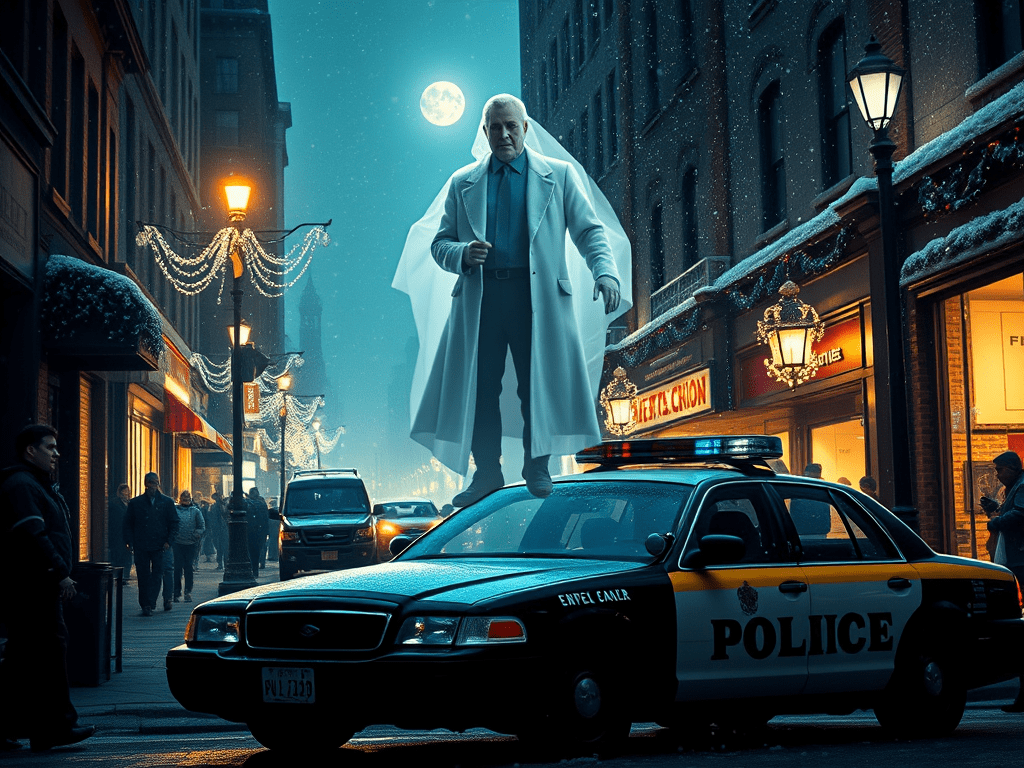
Miles Hanley was a tall and imposing figure. He had been the precinct’s first chief when the station was founded in the late 1800s. Known for his wisdom, he fiercely protected his officers. He carried his ghostly silver pocket watch. He used it to guide the others through the city. On this night, Hanley floated above a lone patrol car. It was parked at the edge of a dark alley. His translucent form shimmered in the moonlight.

“Johnson’s heading into a bad spot,”

Hanley muttered, watching the young officer approach a shadowy figure rummaging through garbage bins. With a flick of his watch, he whispered through the veil of time, nudging Johnson’s instincts. The officer hesitated, then called for backup—averting a potential ambush. Hanley grinned.

“Still got it.”


Officer Rosie McKinney

Rosie, affectionately called “Mama Mac” by her peers, had patrolled the city during the 1940s. She had an uncanny knack for reading people, even in death. Tonight, she hovered near a busy intersection where Officer Emily Torres was directing traffic midst a chaotic pile-up.

“Stay sharp, Emily,”

Rosie murmured, spotting a distracted driver barreling toward the scene. With a wave of her ethereal baton, she sent a gust of icy wind straight into the driver’s face. The man slammed on his brakes just in time, his car skidding to a halt inches from the officer. Rosie chuckled, tipping her ghostly hat. “That’s one less hospital visit tonight.”


Detective Lou Vargas

Lou had been a beloved detective in the 1970s, known for his quick wit and unshakable resolve. He now roamed the precinct’s cold case archives, whispering clues to frustrated officers. But tonight, Lou focused on Officer Brandon Lee. Officer Lee had just been called to investigate a suspicious package left near a crowded shopping district.

As Brandon approached the package, Lou materialized briefly behind him, a shadowy whisper in the winter night. “Check the wires, kid. Look left before you kneel.” Obeying the faint warning in his gut, Brandon discovered the package was harmless—a forgotten Christmas gift. Still, he felt the hairs on his neck stand like someone had been there with him.


A Christmas Morning Promise

As dawn broke over the city, the officers returned to the precinct, exhausted but safe. Unseen by human eyes, Miles, Rosie, and Lou gathered on the station’s rooftop, gazing at the snow-covered streets below.

“We did good,”

Lou said, leaning on his ghostly cane.

“Not a single officer lost,” Rosie added softly.

Miles held up his pocket watch, the spectral clock hands freezing as the sun rose. “Until next year,” he said, and the three faded into the morning mist.

Below, Officer Torres rubbed her arms against the chill. “Did you feel that?” she asked Officer Lee.

“Yeah,” he replied, staring at the horizon. “Like someone was watching over us.”

And so they were.

When Ghosts Were Celebrated in Homes

By Benjamin H. Groff II

2–3 minutes

There was a time when ghosts were not feared, but welcomed. Long before the plastic skeletons and fog machines, the presence of the departed inside a home was seen as sacred. It was viewed as even comforting. Hollywood later turned spirits into screams.

In old America, the line between the living and the dead was not sharply drawn. Much earlier in Europe, this line was also blurred. Families left chairs empty at the table for those who had passed. Candles flickered in windows not to frighten away spirits, but to guide them home. A draft whispered through the house. The hallway creaked, or the boards settled. These sounds were spoken of with gentle reverence: “It’s only Mother checking on us.”

Autumn, of course, was the favored season for such visitations. The harvest was done. The air turned cool and thin. This is a time believed to make the veil between worlds soft as gauze. Many homes, especially in rural places, held small gatherings to honor those who came before. Food was left out overnight. The family Bible was opened to the names of the dead. In some corners, the very hearth hosted a spirit or two. They lingered close to the warmth that once gave them life.

Ghosts were part of the household, not intruders. They were reminders — that life continues, even in unseen ways. The wind brushing the curtains or the rocker swaying gently on its own didn’t make people scream. They didn’t call for help. They smiled. They believed their ancestors had found their way home.

It wasn’t until the age of electricity and industrial noise that ghosts were driven out — or at least, ignored. Modern light replaced candlelight, and superstition was traded for science. Yet, as every October rolls around, the scent of woodsmoke returns to the air. We still sense something ancient moving among us. Maybe that’s why we decorate with skeletons and glowing pumpkins — a way, even now, to say: we remember you.

So the old ways weren’t so strange after all. Maybe ghosts were never meant to be feared. Maybe they were simply waiting to be invited back in.


© Benjamin H. Groff II — Truth Endures / benandsteve.com

Haunted Memories: The Ghosts of Groff House

GROFF MEDIA 2024© TRUTH ENDURES IMDBPRO

Presented by benandsteve.com By: Benjamin Groff II©s

5–7 minutes

The Old Groff House
The Groff House first moved to Binger from Anadarko, Ok

The old farmhouse was to be our new home. Moving from the city to the farm felt like an adventure, but the others didn’t share my enthusiasm. They struggled with giving up indoor plumbing, a telephone, and dependable electricity.


For my father, though, this was the beginning of a dream—a quarter-horse ranch of his own. The house had been moved from another town and placed onto a block foundation. Uneven concrete blocks, haphazardly arranged, served as makeshift steps leading up to the front door. The door was old, with a large square glass pane in the upper half and weathered wood below. Layers of peeling white paint flaked away inside and out, revealing the scars of time.


But what stood out most was the screen door. It had a single spring that pulled it shut with a sharp clap. This sound still echoes in my memory. Above it, a simple porch overhang provided some protection from the rain. It offered slightly less protection from the sun. The overhang always seemed too small for its purpose.


I was the youngest of six children—or seven, depending on how you counted. My mother’s youngest brother, Uncle Ricky, practically lived with us. He had been raised alongside my older brothers, and I always considered him one of us. These memories of our close-knit family bring a sense of nostalgia and warmth.


My sisters and I stayed close to the house initially. Our parents were wary of hidden dangers lurking in the fields and pastures. Rusted cans, barbed wire, and remnants of years gone by littered the property. My brothers were tasked with clearing the land, ensuring no horse would stumble upon a forgotten hazard. But even without the safety excuse, the grown-ups didn’t need us underfoot as they worked to build barns and fences.


The house felt enormous to my sisters and me. It had only four rooms downstairs. There was one large room upstairs. The ground floor had interconnected doorways. These doorways allowed us to run in endless circles around the stairwell. The kitchen, with its worn linoleum floor and a large propane stove, was the heart of the home. The living room had threadbare furniture. Its windows had seen better days. It was where we gathered in the evenings. We were expected to behave when our parents were home, but the house became our playground when they weren’t.


One evening, my oldest sister shared a story she had heard at school. A man, unknown to us, had been found dead in the upstairs room. Hung himself, they said. His wife had passed away downstairs, and he had followed soon after. My younger sister and I absorbed the tale. We were unsure whether it was truth or fiction. Nonetheless, it rooted itself in our minds.


My parents’ conversations surfaced bits and pieces of the house’s history. They assured us no one had died there—at least, not to their knowledge. But then came the phrase that stuck with us:

“But if they did, there’s nothing to worry about.”

It was as if they had confirmed it without confirming it. They planted just enough doubt to keep our imaginations running wild.


And then, one night, something happened that we would never forget.


It had been an unbearably hot day, the humidity clinging to us like a second skin. We had no air conditioning. We relied on a single box fan upstairs for the boys at night. During the day, we moved it downstairs. As evening fell, a storm rolled in. The sky darkened, thunder rumbled, and the first lightning strike knocked out our power.


We huddled by the screen door, watching the storm unfold. Rain poured down in sheets, lightning flashing every few seconds. We saw him in one brilliant burst of light—a rider on a white horse just beyond our fence.


My oldest sister called for our mother.

“There’s a man out on the road! Should we call him in?”


The lightning illuminated him again. The horse and rider are stark white, motionless against the downpour. They turned into our driveway and stopped at the yard gate. The rider tilted his head, water spilling off the brim of his hat, but he did not move.


We yelled for our parents, urging them to look. The rain intensified, drumming against the roof. And then, in the next flash of lightning—he was gone. No retreating figure, no horse galloping away. Just empty, rain-slicked ground where he had stood.


That wasn’t the last strange occurrence. The memory of the white horse and its rider haunted us, lingering in the corners of our minds. We couldn’t shake the feeling that we were not alone in the house. We felt that unseen presences were walking the same halls.


The dirt roads in Oklahoma turn sandy in the summer. They capture every footprint—deer, bobcat, rabbit, and occasional lost traveler. One morning, waiting for the school bus, we saw her.
A tiny older woman walked at a steady pace past our house. We called out a greeting, but she didn’t acknowledge us. The school bus approached from behind, and I considered asking the driver to stop and offer her a ride.


But when we reached the road, she was gone.


What we didn’t see was more unsettling than her disappearance—tracks. There were no prints in the soft sand, no sign that anyone had walked there.


I looked at my sisters. One of them whispered,

“Don’t say anything. They’ll think we’re crazy.”


Later, an old-timer visited us often. He told us about a train depot standing across the road long before we arrived. He suspected that some soldiers returning from World War I, whose bodies were unclaimed, never left that station. He spoke of ghostly figures wandering the fields at night. Strange sounds echoed from the direction of the old depot. His stories added another layer of mystery to our already haunted farmhouse.


Over the years, my father and I rode our horses through the backcountry. We found old graves. Some were Indian graves, others belonged to settlers, and some were marked only by time-worn stones. One day, I asked my father if it was sad that they had been forgotten.


He looked at me thoughtfully.

“They’re remembered the way they’re meant to be. You don’t need a grave to be remembered. It’s what you do while you’re alive that matters.”


I understood what he meant, but some of me still felt sorrow for those lost souls. Maybe they weren’t as alone as I thought. They still walked in the rain, strolled along dirt roads, or found another way to be remembered. The mystery of their existence lingers, leaving us with more questions than answers.

The world is going to POT, and we are watching it go!

A view of the world as it is today by: Benjamin Groff II© Groff Media 2024© Truth Endures IMDbPro

My dad and grandfather are gone now, but neither would support a liar, cheat, rapist, insurrectionist, dictator, or someone who supports one, or generally speaking, a creep or ‘weirdo.’ 

There are other reasons you can look at as well. For instance, a candidate such has a sexual offense judgment against him, and he is under indictment for countless federal crimes; in the last year, one of the candidates was in the air, flying, on their way to being arrested, just as much as he was campaigning at one point. 

One or more of those reasons would have been reason enough to consider looking into the person’s background. And three to four, would have been reason enough to reject a person all together. Someone who was strongly running for public office would have been rejected. Now, the GOP considers it a qualification required for all Republican candidates.

The candidates have endorsements from KKK members. They boast about, a presidential politician having endorsements from dictators. They wallow in such markings, and candidates publicly brag about laws they will violate first, if elected. And this makes them the most qualified candidate. Going as far as boasting about becoming a dictator. Going about telling people this is the last election they will have to worry about voting in. 

Why? Does that mean the Constitution is going to get ripped apart, shredded, and there will no longer be a United States where the people choose its leaders? It appears it doesn’t matter to the people who are numb and following this character. They appear to have zoned out of reality. 

My grandfather, father, uncles, aunts, and even a few dogs and horses I’ve had would not have allowed the goings on to persist. The greatest generation has died chiefly off; fewer of them now than ever are living, which sadly shows in our world. They were the ones who knew what happens when the world that falls to fascism. When reality hits and the world dies. It is beginning as America will turn grey; it will become a black-and-white construct of anything anyone remembers of its being, if these destructionists are permitted to have their way with the country. We only hope enough voters come to the polls and and vote, and save our America!

My dad had a favorite saying: the older I got, the wiser he’d get. And he was right; I wish he were here to help us out of this madness!

JD Groff At Rest And Getting Wiser Every Day!

Happy 240th Birthday To Marie Laveau

Posted by Benjamin Groff© Groff Media 2024© Truth Endures

One has undoubtedly heard the story about the great voodoo queen Marie Laveau from down in Louisiana. Bobby Bare sang about her in his hit song from 1973. The Lyrics were –––

  • The most famous of the voodoo queens that ever existed
  • Is Marie Laveau, down in Louisiana
  • There’s a lot of weird ungodly tales about Marie
  • She’s supposed to have a lot of magic potions, spells and curses
  • Down in Louisiana, where the black trees grow
  • Lives a voodoo lady named Marie Laveau
  • She got a black cat’s tooth and a Mojo bone
  • And anyone who wouldn’t leave her alone
  • She’d go-, another man done gone
  • She lives in a swamp in a hollow log
  • With a one-eyed snake and a three-legged dog
  • She’s got a bent, bony body and stringy hair
  • And if she ever seen why y’all messing ’round there
  • She’d go-, another man done gone
  • And then one night when the moon was black
  • Into the swamp come handsome Jack
  • A no good man like you all know
  • He was looking around for Marie Laveau
  • He said, “Marie Laveau, you handsome witch
  • Give me a little a little charm that’ll make me rich
  • Give me a million dollars and I tell you what I’ll do
  • This very night, I’m gonna marry you”
  • Then it’ll be, hmm, another man done gone
  • So Marie done some magic, and she shook a little sand
  • Made a million dollars and she put it in his hand
  • Then she giggled and she wiggled, and she said, “Hey, Hey
  • I’m getting ready for my wedding day”
  • But old handsome Jack, he said, “Goodbye Marie
  • You’re too damned ugly for a rich man like me”
  • Then Marie started mumbling, her fangs started gnashing
  • Her body started trembling and her eyes started flashing
  • And she went-, another man done gone
  • Oh, if you ever get down where the black trees grow
  • And meet a voodoo lady named Marie Laveau
  • If she ever asks you to make her your wife. Man, you better stay with her for the rest of your life
  • Alternatively, it will be another man done and gone.
  • Writer/s: Baxter Taylor, Shel Silverstein 
  • Publisher: T.R.O. INC.
  • Lyrics licensed and provided by LyricFind

Hell! Bobby Bare is taking off on his 1973 Hit Marie Laveau, courtesy of a YouTube posting. Following this sing-a-long, learn the factual story about the real Marie Laveau. As close as what people have been able to trace.

THE STORY ABOUT THE SONG ORIGINS – Supposedly…

On September 10, 2024, her 240th birthday is recognized, and while this will get published the day after it is getting done, so with the notion that it will get a presented avoiding any voo doo spells that could be associated with the partaking of celebrating a late witches birthday. There is more to the story than the song. The lyrics had a backstory that contained information about a man who was about to go on trial in New Orleans for murder. He was a wealthy business owner and had the means to buy the best attorney. However, the case appeared airtight, and his life looked to be going to the gallow. He visited a witch named Marie Laveau, who was known to cast spells on people and could control them. He told her he would give her his earnings for a year and even agreed to marry her if she could sway the jury to find him innocent. She collected items like a black cat’s tooth, a Mojo bone, and other questionable items from around the woods, placed them into a tobacco pouch, buried them beneath a tree for three nights, and then dug them up and gave them to the man. She told them not to go to court without them, and he would be found innocent. Sure enough, when the trial was over, despite the eyewitness’s murder weapon and even the man’s confession, the jury returned an innocent verdict. The man refused to pay Marie Laveau and refused to marry her and laughed at her when she told him he would die by the end of the week if he did not change his mind. It was Monday. On Friday, the man had not returned to pay Marie and was in a local tavern, bragging about his innocent verdict and how he got away with not paying the old lady. As he left his table to go to the bar for a drink, a chandelier fell from the ceiling and hit him, killing him instantly. 
Whether or not that story is true is still being determined. However, history has recorded Marie Laveau in other areas, has a lengthy record, and she appears to have had a healthy marital life. Bobby Bare has told a similar story during interviews. There have been similar accounts from people in New Orleans. However, fact-finders looked for records, and this is what they found for Ms. Laveau.

Marie Laveau

An Article by Frank Schneider

The enigmatic Marie Laveau (September 10, 1794 – June 15, 1881), the most famous voodoo queen in the South, has a background that still seems to be vastly under-researched. Her story of resilience begins with her grandmother, Catherine Henry, who, after a long procession of different owners, was finally emancipated by her last one, a free woman of color. Catherine’s original master was the white Creole Henry Roche Belaire, whom Catherine later took his name as her surname. Catherine’s daughter and Marie’s mother, Marguerite, remained with Roche until his death and was sold to another owner who then gave her freedom. After gaining independence, Marguerite became the placée of the Frenchman Henri D’Arcantel. The exact date that marks Marguerite’s relationship with Charles Laveaux is unknown, but the result of this couple was the birth of a daughter, Marie. On September 10, 1801, Marie was born as a ‘free mulatto.’ Her father, Charles Laveaux, is sometimes referred to as a wealthy white planter, but leaders had discovered he was a free person of color (gen de couleur libre) whose mother’s name was also Marie Laveaux. Nothing is certain of Marie’s childhood, but she may have lived in the St. Ann Street cottage with her maternal grandmother, Catherine Henry.

Marie was a striking figure dressed like a gypsy with a bandana on her head, flashy rings on her fingers and ear, and gold bracelets on her wrists. Her dress was always dark, long, and complete, hanging gracefully from her shoulders. Her eyes, which were large and hazel, sparked like emeralds against her dark skin. This unique appearance, along with her charming personality, contributed to her mystique and influence in New Orleans.

Archival records show that Marie Laveau entered into a marriage contract with Jacques Paris on July 27, 1819. They were married on August 4, 1819. It is widely believed and affirmed that no children came to the marriage. However, some discoveries suggest that two daughters were born of this union; these claims lack concrete verification. The fate of Jacques Paris remains unknown, and his death was never documented. Whatever truly happened to her husband, Marie was still officially known as the “widow Paris.” The marriage mass was performed by Father Antonio De Sadella, the Capuchin priest known as Pere Antonio. After becoming a widow, Laveau became a hairdresser who catered to wealthy white families.

After Jacques Paris, Marie began a relationship with Louis Christophe Dominic Duminy de Glapion that lasted until he died in 1885. All credible records indicate that he was born in Louisiana as the legitimate son of white parents and the descendant of an aristocratic French family. Christophe Glapion was a veteran of the Battle of New Orleans, which occurred below the city at Chalmette on January 8, 1815. It is unclear when or how these two met. Christophe Glapion died on June 26, 1855, and the cause of his death is unknown. Marie Laveau and Christophe Glapion were a together for nearly thirty years. Marie lived for another twenty-six years and is not known to have taken another partner. It is widely thought that fifteen children came from this union, but there is only records to confirm that there were seven. Marie and Christophe’s first child, Marie Heloise, was born on February 2, 1827. She is the daughter who became known as Marie II. At a young age, Marie II entered a relationship with Pierre Crokere, a free man of color. Pierre was a commission broker, builder, and architect. Pierre was twenty-four years older than Marie and died in 1857 at fifty-six. 

Voodoo thrived in Haiti and Louisiana, and over the years, it absorbed influences from French and Spanish Catholicism, American Indian spiritual practices, and even Masonic tradition. Voodoo is not just a religion. It is about finding ways to survive conflict and has yet to be verified. Voodoo involved singing, dancing, chanting, and drumming. Voodoo comes from enslaved people who brought it to the Americas from West Africa. Marie began her Voodoo (sometimes spelled Voudou) career sometime in the 1820s, and she is sometimes said to be a descendant of a long line of Voodoo priestesses, all named Marie Laveau. Marie is said to have given private consultations and made and sold gris-gris. Later in life, Marie turned away from her Voodoo practices to dedicate her life to the Church and charitable works, a decision that commands respect. However, it is affirmed by the scholarly community that Marie Laveau was a devout Catholic her entire life.

Marie continued her charitable work during her final years and surrounded herself with her family. One was her youngest daughter, Marie Philomene Glapion, and her children. Philomene entered a relationship with a white man, Emile Alexandre Legendre, who was thirty-two years older than her and married. Philomene and Emile had seven children together, all classified as “colored,” they remained a couple until he died in 1872. Marie died at home in her sleep on June 15, 1881, in her cottage on St. Ann Street, where she had spent more than half a century. Marie’s daughter Philomene made funeral arrangements for the following evening. Her funeral performance provided guidelines to the dignified structure of the Catholic Church without sign of any voodooist demonstration.

Where Will An Individual Be When They Get There?

An Insight By Benjamin Groff© Groff Media 2024© Truth Endures

Gregory Halloway, a man who had spent much of his life navigating a world filled with expectations and routines, found himself unable to shake a persistent question: “Do you know where you will be when you get to where you are going?” This question, seemingly simple at first, grew more complex and intriguing the more he pondered it.

One morning, he decided to take this question to the streets. He asked his co-workers, neighbors, and even strangers passing by in the park. Everyone offered a different answer, often shaped by their immediate concerns—a promotion, a dream home, or retirement. However, to Gregory, none of their answers captured the depth of what he sought.

As days went by, the question began to evolve. It was not about a physical location or a milestone. Gregory realized he was asking about something more profound: the essence of one’s journey in life. Did societal pressures predetermine it, or was there a self-will that guided each step? Were people truly aware of where their decisions were taking them, or were they drifting from one event to another on autopilot?

Gregory sat down with an old mentor, Mrs. Callahan, who had always seemed to possess a quiet wisdom. Over tea, he asked her the question. She looked at him thoughtfully and replied,

“Where I am going is not a place on a map but a state of mind. It is peace, it is fulfillment, it is the discovery of who they are beyond the roles I play. The ‘where’ is fluid and shaped by what they are willing to confront within themselves.”

Her answer struck Gregory deeply. Was this the missing piece? Realizing where they are going is not just external but internal—a product of understanding themselves, their desires, their fears, and their drive.

For the next few weeks, Gregory delved deep into his own life, questioning his motivations. Were they truly his, or were they borrowed from the expectations of others? He noticed how often he pursued goals without considering their significance, and how fear and insecurity often dictated his path, steering him away from uncomfortable but necessary choices.

And then, the revelation dawned on him: self-will. The ultimate destination was not just about achieving a tangible goal but about aligning with one’s inner purpose. Gregory’s understanding of life’s journey shifted. It was less about a final destination and more about the transformative process of becoming who one was meant to be.

Gregory returned to his question, but this time, he asked himself: 

“Do I know where I will be when I get to where I am going?”

Gregory smiled, realizing he did not need an answer. The beauty of the question was that it forced him to confront the process, not the end. It was a way of understanding that wherever Gregory ended up, it would be shaped by how consciously he lived each moment, how much of his true self Gregory brought into each decision, and how deeply he understood his drive.

The ultimate journey was not about getting to a place but about who Gregory would become.

The Prayer For Peace Finally Answered!

A Story By: Benjamin Groff© Groff Media 2024© Truth Endures

An older man, who had prayed for peace since he was a young child, lived a life of selflessness. His mother’s words, that God would answer his prayer if he kept his life clean of sin and did what was best for others, became his guiding principle. He never put himself first, always putting the lives of others before his own needs.

So, the older man went without when he could have lived a comfortable life. He gave to others and kept a solitary life when he could have had a home filled with love and a family. The city he lived in had the highest crime rates in the world, and the country in which the older man lived was worn in battles between battles with other nations and individual groups. He was a victim of crime repeatedly when he could have had protection provided.

The man became wealthy without trying, thanks to inheritances from family and friends and business interactions he had made without intending to see a return. When he turned 80, he prayed one night, asking why God hadn’t answered his prayer.

The older man’s prayer echoed through the quiet of his small, humble home. He sat at the edge of his bed, his hands clasped tightly together, his heart heavy with years of unanswered longing. The world outside his window was no different than it had been decades ago—still filled with strife, suffering, and humankind’s relentless cruelty.

A deep voice resonated as he closed his eyes, seeking the peace he had always desired. It wasn’t a voice he heard with his ears but one that spoke directly to his soul.

“My son,”

The voice began, calm and compassionate.

“My son, you have lived a life of unwavering faith, sacrifice, and selflessness. But true peace is not the absence of conflict in the world around you. It is the serenity within your heart, the understanding that you have done all you can for others, and the acceptance that the world’s burdens do not solely rest upon your shoulders.”

The man’s breath caught as the realization began to dawn on him.

“Peace is not something one gets as a reward for their deeds,”

the voice continued,

“but something that grows within you, cultivated by your actions, thoughts, and love. You have touched countless lives, offered solace to those in need, and lived your life according to the highest ideals. The peace you seek has been with you all along, not in the world outside, but within the purity of your heart and the love you have shown others.”

Tears welled in the older man’s eyes as he understood. He had spent his life searching for peace in the world while nurturing it within himself. The crimes, wars, and suffering were not his to control.

His prayer had been answered most profoundly: by giving him the strength to endure, the compassion to love, and the wisdom to understand that peace is not an external gift but an internal state of grace.


As the older man lay back on his bed, a warm, gentle calm washed over him. He closed his eyes, not in despair but in contentment. For the first time in his life, he felt at peace—not because the world had changed, but because he had finally understood the true nature of his prayer.

And with that peace, he drifted into a restful sleep, his heart light, his soul fulfilled, and his spirit finally at ease.

The Preacher Who Didn’t Believe In God

A Story By Benjamin Groff© Groff Media2024© Truth Endures

Frank Johnson was not your run-of-the-mill pastor. He delivered sermons each Sunday that never bored his parishioners. Never since being hired by the Shady Grove Baptist Church Governing Body had they been so excited about their evangelical image having such a trophy behind the altar. Pride be damned, they couldn’t take another year of losing members to the metro church in the nearby city.

There was one more thing about Frank Johnson that was not typical: He didn’t believe in God. He felt the bible was dogma, the souls tossing their money in the offering plate fools, and Frank felt that one might have issues if they thought they would join their loved ones in the hereafter. If they said it was because God didn’t think their sin was no longer a big deal, he felt them to be mental. He tried to preach that prayer wasn’t an answer to your needs but to your peace.

Frank’s unconventional sermons attracted even more attention as the weeks passed. Though veiled in traditional language, his messages subtly nudged the congregation towards introspection rather than blind faith. He spoke of personal responsibility, community power, and compassion’s importance. Shady Grove Baptist Church members started to see their faith not as a means to an end but as a guide for living a meaningful life.
One Sunday, Frank decided it was time to reveal his true beliefs. He stood at the pulpit, looking at the faces that had come to trust and respect him. Taking a deep breath, he began.

“My dear friends, I need to share something deeply personal with you today. It’s something that has weighed on my heart for a long time. I do not believe in God. I never have, and I never will. This confession, though it may shock some of you, comes from a place of deep conviction and honesty. I hope you can see the courage it took for me to share this with you.


A gasp rippled through the congregation, but Frank continued, his voice steady and calm.


“I know this might come as a shock to many of you. You may feel betrayed or confused. But I ask you to hear me out. My disbelief in God does not diminish the value of the lessons we’ve explored together. If anything, it enhances them. For I believe that the true power of our faith lies not in the promise of an afterlife, but in the strength and kindness we show one another in this life.”


He paused, letting his words sink in. The silence was palpable, but no one left their seat.


“Think about the times you’ve felt most connected to your faith. Was it in moments of quiet prayer or in the acts of love and service you performed for others? Was it in the rituals or the genuine care you showed to a needy neighbor? Faith, to me, is not about believing in something unseen. It’s about believing in each other. It’s about creating a community where we support and uplift one another.”


Frank could see the wheels turning in their minds. He pressed on, his conviction growing stronger.


“I challenge you all to consider this: What if we took the principles we hold dear – love, compassion, kindness – and applied them not because we seek divine approval but because we know it makes the world a better place? What if our faith was a commitment to each other rather than an unseen deity? This challenge is not meant to undermine your beliefs, but to encourage you to think critically about the role of faith in our lives.”

Murmurs of agreement began to spread through the congregation. Frank knew he had to drive the point home.


“We don’t need to believe in God to be good people. We don’t need the promise of heaven to motivate us to do what’s right. We can find strength and purpose in each other, in our shared humanity. So, will you join me on this journey? Will you help me build a community based on trust, respect, and love without the need for divine justification?”

One by one, the members of the congregation stood up, some with tears in their eyes, others with resolute expressions. They walked to the front of the church, forming a circle around Frank. In this moment, we were not a group of individuals with differing beliefs, but a united community, bound by our shared values and commitment to each other.


In that moment, Shady Grove Baptist Church transformed. It became a place where faith in humanity, rather than God, was the cornerstone. Frank had not only shared his truth but also inspired his congregation to see the power within themselves and in each other. In doing so, he had created a new kind of faith—one that was grounded in the reality of human connection and the potential for goodness in everyone.

The Unforgettable Story of Ethan: A Three-Legged Hero’s Courage and Sacrifice in Willowbrook

A Story By Benjamin H Groff© Groff Media Copyright 2024©

A man named Ethan lived in the quaint village of Willowbrook, nestled among rolling hills and serene landscapes. Ethan was unlike any other in the town; he was born with a third leg. Though some initially viewed him with curiosity and even pity, he became an integral part of the community, his unusual limb symbolizing resilience and strength.


The village cherished its traditions, and none was more beloved than the annual Christmas service held in the old stone church at the heart of Willowbrook. On Christmas Eve, every villager would gather for a night of songs, stories, and the sharing of a festive feast.
However, one fateful Christmas Eve, the peaceful village was disrupted by a band of ruthless hoodlums. Known for their brutal raids, they had been terrorizing nearby towns, leaving a trail of destruction in their wake. The villagers of Willowbrook had heard whispers of their approach but hoped their remoteness would spare them.


As the service commenced, distant hoofbeats grew louder, echoing ominously through the church. Panic spread among the villagers as the doors burst open, revealing the menacing figures of the hoodlums. They forced everyone into the central aisle, threatening violence and demanding valuables.


Ethan, seated near the back, watched the chaos unfold. His heart pounded, not out of fear for himself but for his friends and family. He knew he had to act. As the hoodlums corralled the villagers, Ethan stumbled and fell in the narrow central aisle, his third leg jutting out awkwardly.


Shouts of anger and confusion erupted from the hoodlums as they tripped over Ethan’s leg, one after another. Understanding Ethan’s silent signal, the villagers began to leap over his third leg with practiced ease. The invaders, unfamiliar with the anomaly, continued to fall, rendering themselves unconscious as they hit the stone floor.


Ethan’s bravery gave the villagers the precious moments they needed. The stronger men and women quickly disarmed the stunned hoodlums, binding them with whatever they could find. The church that had been a place of sanctuary became a fortress of courage and quick thinking.
In the aftermath, the village celebrated Ethan as a hero. His act of selflessness and his unique third leg had saved them all. Yet, Ethan, who had always been modest and kind-hearted, succumbed to injuries sustained in the struggle. He passed away that night, surrounded by those he had saved.


Ethan’s story became a legend, and when the townspeople spoke his name, it was done so with reverence and gratitude. A statue was erected in the village square, depicting him with his three legs, a testament to his bravery and the night he saved Willowbrook. Every Christmas Eve, the villagers would gather at the church, now with a plaque dedicated to Ethan, and recount the tale of the man whose unique gift had become their salvation.
The legend of Ethan, the three-legged savior of Willowbrook, lives on, symbolizing how even the most unexpected traits can be the greatest of blessings.

Solemn Reflections: Memorial Day and the Spirit of Sacrifice

As the sun rose over the small town of Oakwood, its warm rays illuminated the rows of white headstones in the Oakwood Cemetery. The city, steeped in a rich history of honoring fallen soldiers, had always observed Memorial Day with solemn pride. This day, originally known as Decoration Day, was established after the Civil War to commemorate the Union and Confederate soldiers who died in the war. It has since evolved to honor all Americans who have died in military service.

Sarah Thompson stood at the cemetery’s gate, holding a bouquet of red, white, and blue flowers. She was in her late thirties, her eyes reflecting sorrow and strength. Visiting the cemetery was her yearly ritual—a pilgrimage to visit the grave of her brother, Daniel, who had died in Afghanistan a decade ago.

As Sarah walked along the gravel path, she remembered the day they received the news. It had been a bright summer afternoon, much like today. Daniel had always been a source of light and joy in their family, with his infectious laughter and boundless energy. The knock on the door that day had shattered their world.

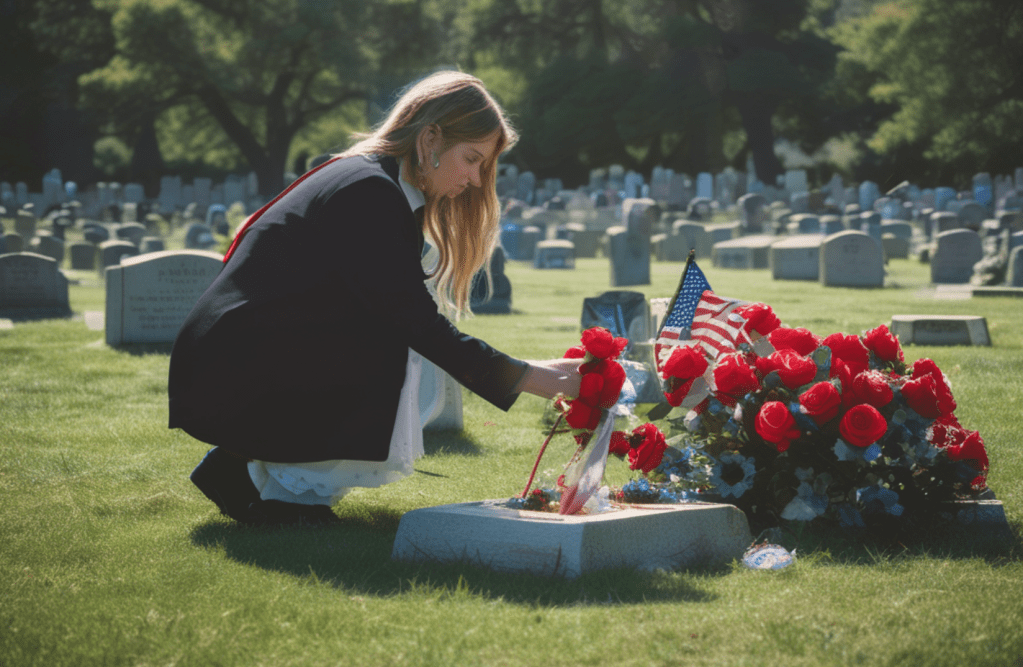
Sarah reached Daniel’s grave and knelt, gently placing the flowers in front of the headstone. She traced her fingers over his name etched in the cold stone and whispered a prayer. Memories flooded back—playing tag in the backyard, late-night talks about their dreams, and the tearful goodbye when he left for his final deployment.

The cemetery, a place of collective grief and remembrance, began to fill with others who had come to pay their respects. Families, friends, and fellow veterans moved among the graves, their shared sorrow palpable in the air. Some walked in silence, their thoughts a private tribute, while others shared stories, their voices a collective echo of the lives lost.

A familiar voice broke Sarah’s reverie. “Hey, Sarah.”

She turned to see Tom, one of Daniel’s best friends from high school, standing nearby. He held a small American flag, which he placed at the base of the headstone. Tom had served alongside Daniel and had been with him during his last moments.

“It’s good to see you, Tom,” Sarah said, her voice soft.

Tom nodded, his eyes filled with shared grief. “I come here every year. Feels like the least I can do.”

They stood in silence for a moment, their hearts heavy with the weight of their loss. Each lost in their thoughts, memories of Daniel flooding their minds. Then Tom began to speak, his voice steady but emotional, his words a testament to the bravery and selflessness of their fallen friend. ‘Daniel was the bravest person I knew,’ he said, his voice breaking with emotion. ‘He always put others before himself. Even in the end, he worried more about us than his safety.’

Sarah smiled through her tears. “That sounds like him.”

The morning wore on, and more people arrived, each carrying their own memories and gratitude. A group of children from the local school, accompanied by their teachers, placed flags on the graves of all the fallen soldiers, a symbol of their respect and understanding of the sacrifices made. The town’s mayor gave a short speech, his words echoing with the collective gratitude and remembrance of the community. A local choir sang ‘America the Beautiful,’ their voices a poignant reminder of the unity and strength that comes from shared values. The collective remembrance was a powerful testament to the sacrifices made by so many.

As the ceremony ended, Sarah and Tom lingered by Daniel’s grave a little longer. They shared stories, laughed, and cried, finding comfort in each other’s company.

“Thank you for being here,” Sarah said as they prepared to leave.

“Always,” Tom replied. “He was my brother, too.”

They returned to the cemetery gate together, the sun now high in the sky. As Sarah looked back one last time at the sea of white headstones, she felt a sense of peace. Memorial Day was not just about remembering the fallen; it was about celebrating their lives and the values they stood for.

Driving home, Sarah contemplated the significance of this day and how she would pass on its importance to her children. She understood that as long as they remembered, Daniel’s spirit would continue to live on. Every Memorial Day, she would return to this hallowed ground, ensuring that the memory of her brother and all those who had made the ultimate sacrifice for their country would never fade.

In checking references part of this story may include referencese similar to others found on the internet. The simularities are incidential and are not included intentional. You can find more these simularities RE: New York. Memorial Day. Monument. Dead Soldier. Wheelchair. Handicapped Boy. | Didier Ruef | Photography. https://www.didierruef.com/gallery-image/Aura/G0000Is39GN2Av9w/I0000aHlCvWVZLNc/C0000EU0LcXmMzWo/