Time-Travel Adventures in a Cozy Home

GROFF MEDIA 2024© TRUTH ENDURES IMDBPRO

Presented by benandsteve.com By: Benjamin Groff II©

3–4 minutes

Jane and Mark lived in a cozy little house on a quiet street in nowhere. The house had a white picket fence. A porch swing creaked with every breeze was also part of the house. Life was simple and predictable—until the night the sky split open.

It happened just after dinner. A brilliant ray of golden light shot down from the heavens. It struck the roof of their home with a silent flash. Jane screamed, dropping her fork, while Mark rushed to the window, heart pounding, their minds filled with fear and confusion.

“What was that?” Jane whispered, staring at the glowing beam. It pulsed briefly, then faded away, leaving no trace but a faint shimmer.

They inspected the house, finding no damage, burns, or explanation. But they soon discovered the truth in the strangest way possible.

The next day, Mark walked out to grab the newspaper, and when he stepped back inside, Jane gasped. Jane saw a man in medieval armor standing in the doorway. His eyes were wide with confusion. It wasn’t her husband in his sweatpants and T-shirt.

“Mark?” she stammered.

“Jane! What –– what happened?” Mark looked down at the polished steel covering his chest and arms. “I was outside, and when I came back ––– this happened!”

Jane grabbed his hand and pulled him in. “We need to call someone.”

But before they could dial, their neighbor, Mrs. Clarkson, walked in uninvited, as she often did. When she crossed the threshold, her modern blouse and skirt changed into a flapper dress. Her gray hair was pinned into 1920s finger waves. “My word!” she exclaimed, waving a cigarette holder she didn’t own.

Mark and Jane exchanged terrified glances. Their house was cursed or enchanted or something far beyond their understanding.

Over the next few days, they experimented with the strange phenomenon. Stepping outside and re-entering would send them hurtling through time. Sometimes, they found themselves in ancient Rome. Other times, they landed in the Wild West. Occasionally, they encountered an unsettlingly dystopian future. Even Otis, their golden retriever, came trotting back inside with a Victorian-era bonnet tied to his head.

Jane kept a notebook. “Day three: Entered as myself, exited as a 1970s disco queen. Mark walked in as a cowboy. Not great.”

Eventually, they learned some rules. The effect only lasted while they were inside. Stepping back outside would revert them to their usual selves. But the moment anyone crossed the threshold again, the house chose another era at random.

It wasn’t long before the military took notice. When government agents approached their door, Jane panicked and tried to warn them. “Please, don’t come in!”

Too late. Five suited men instantly transformed into Renaissance courtiers with feathered hats and ruffled collars. “What sorcery is this?” one muttered, spinning in circles.

Mark sighed. “You’re gonna want to take this one up with NASA.”

Despite the chaos, they refused to leave. Strange as it was, the house was still their home. They learned to adapt. They stored era-appropriate clothing in a chest by the door. They prepared themselves for anything from caveman furs to futuristic bodysuits. This showed their resilience and courage in the face of the unknown.
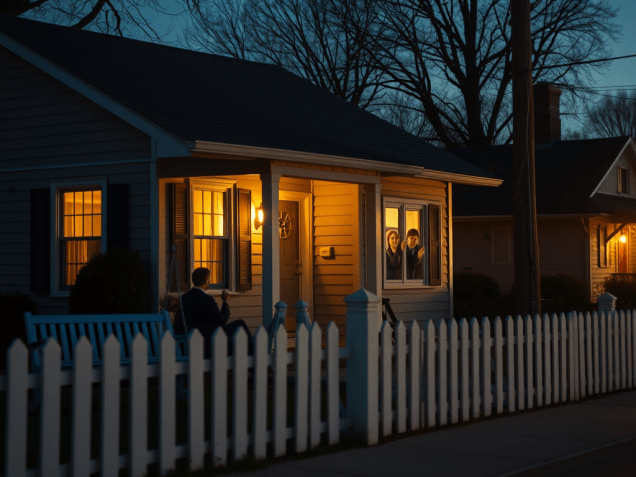
In time, they found unexpected joys in their predicament. They hosted Gatsby-style parties, had tea with Victorian neighbors, and experienced life in eras they never imagined. Their sense of wonder and adventure grew with each new experience.

The little house with the picket fence became legendary. It served as a portal through time. In this house, history was just a step away. Mark and Jane embraced the adventure. After all, who wouldn’t want to live in a place where every day was a different century?

Surviving the Darkness: The Krieger Family’s Courage – Shadows In The Dark

GROFF MEDIA 2024© TRUTH ENDURES IMDBPRO

Presented by benandsteve.com By: Benjamin Groff II©

2–3 minutes

In the spring of 1942, the Krieger family vanished from the small town of Marburg, or so their neighbors believed. The truth, though, was a testament to their resilience. Ernst and Klara Krieger lived concealed behind a false wall. Their teenage daughter Lotte was with them in the attic of their modest home. They clung to a fragile existence beneath the ever-watchful eyes of the Nazi regime.

Before the war, Ernst had been a respected tailor, his shop bustling with customers seeking fine suits and dresses. The war machine tightened its grip on Germany, and Jewish families like the Kriegers became targets. They had no choice but to vanish from public view. Ernst’s friend, Herr Becker, was a trusted carpenter. He had built a hidden compartment in their attic. It was a space just large enough for the three of them to survive.

Each day, Klara prepared sparse meals from the dwindling stock of supplies. She rationed every crumb with the precision of a soldier. Lotte, once full of life and laughter, now spent her days in silence. She read the few books they had managed to take with them. Ernst, ever resourceful, repaired uniforms in secret. He exchanged this favor with Herr Becker for smuggled food. They also shared whispers of news from the outside world.

Life under the radar was a delicate balancing act, but the Kriegers refused to let go of hope. They learned to move only when the town slept, their footsteps carefully muffled. They endured bitter winters without fire, their breath hanging in the frozen air like ghosts. Klara kept their spirits up with whispered stories of better days. She spoke of summers at the lake and the scent of fresh bread filling their home. They lived in fear but also in quiet defiance, their hope a beacon in the darkness.

One night, in late 1944, as the war neared its end, a knock at the door sent their hearts racing. Herr Becker’s hushed voice broke through the silence. 

“The Americans are coming,” 

he whispered through the floorboards. 

“Stay hidden a little longer.”

Days passed like years until, at last, the sound of foreign voices filled the streets. The Kriegers dared to peek from their hidden vantage point. What they saw made their hearts swell with cautious hope. They observed Allied soldiers marching through the town. Their uniforms were different, and their faces were filled with determination rather than cruelty.

The danger had finally passed. Ernst and Klara stepped out into the light of a new morning. They held Lotte’s trembling hand. Their survival was a quiet miracle. It was a testament to the resilience, cunningness, and kindness of those who risked it all to help them. Their hearts were filled with gratitude for these unsung heroes.

Life was difficult in the next years, but the Kriegers rebuilt what they had lost. Ernst reopened his shop. Klara baked bread that once again filled their home with warmth. Lotte found her laughter in the sunlight. Though they had lived in the shadows for so long, they emerged stronger and free.

And in the attic, behind the false wall, they left a small inscription: 

We survived. We endured. We are free.

Finding Hope in Difficult Times

GROFF MEDIA 2024© TRUTH ENDURES IMDBPRO

Presented by benandsteve.com By: Benjamin Groff II©

2–3 minutes

Every morning, the sun rose over Willow Creek. Clara Jackson would pour herself a cup of coffee. She would then sit by the window and scroll through the news on her phone. Headlines blared with despair. Civil rights were being denied. People were being removed from their families because of their citizenship status. There were natural disasters, economic struggles, and political turmoil. It seemed as if the world was unraveling thread by thread. Each day felt heavier than the last, and Clara found it harder to believe in a brighter tomorrow.

One cold morning, as the weight of the world’s problems sat on her chest, she noticed her elderly neighbor, Mr. Thompson, hobbling down the sidewalk with a broom in hand. His frail figure moved with purpose. He swept the fallen leaves away from everyone’s doorstep. As he worked, he whistled a tune that carried a sense of ease Clara hadn’t felt in a long time.

Curious, she stepped outside and called out,

“Mr. Thompson, what are you doing out here so early?”

The old man looked up and smiled warmly.

“Clearing the way, my dear. It’s a little thing, but it makes the morning brighter for everyone.”

Clara laughed softly.

“With all that’s happening in the world, does this really make a difference?”

Mr. Thompson leaned on his broom and nodded.

“Oh, it does, Clara. You see, the world’s got its troubles, but right here, right now, we can still bring goodness. You can’t control the storms outside, but you can light a candle inside.”

His words settled into Clara’s heart like a gentle breeze pushing away the clouds. That afternoon, instead of drowning in the news, she baked cookies and shared them with neighbors. She took her old paintbrushes out of the closet and added splashes of color to the worn fence outside. And as she handed out treats to passing children, she felt something stir inside her—hope.

Days turned into weeks, and Clara found that small acts of kindness helped her navigate the darkness in the world. She volunteered at the local shelter. She also planted flowers along the sidewalks. Clara spent more time listening to the laughter of children at the park. The news was still grim, but Clara had found something stronger—hope born from action, not fear.

One evening, she closed her book and looked out at the quiet street. She realized the world hadn’t changed overnight. But she had. And that was enough to believe in a brighter tomorrow.

The Man’s Journey For Two People Who Agree On Everthing

GROFF MEDIA 2024© TRUTH ENDURES IMDBPRO

Presented by benandsteve.com By: Benjamin Groff II©

2–3 minutes

A man named Walter Henshaw lived in a small town. This town was nestled between rolling hills. Walter was known for his insatiable curiosity, always pondering life’s mysteries. One evening, as he sat on his front porch watching the sunset, he wondered aloud,

“Is it possible to find two people in this world who agree on everything?”

The thought consumed him, and soon, Walter embarked on a journey around the world to find the answer. He packed his belongings, bid farewell to his friends and family, and set off on his quest.

Walter’s first stop was Paris, where he met a pair of artists who were painting by the Seine. They seemed in perfect harmony, laughing and finishing each other’s sentences. But when Walter asked them if they agreed on everything, they chuckled.

“Of course not,”

One replied.

“He thinks Monet is the greatest, but I prefer Van Gogh.”

Undeterred, Walter traveled to India, where he visited a monastery high in the Himalayas. There, he met two monks who had lived in silence for decades. Walter was sure he had found his answer, but when he posed his question, one monk smiled and said,

“I prefer tea; he prefers coffee.”

Walter traveled onward. He visited the bustling streets of New York City. Then he experienced the serene countryside of Japan. Finally, he explored the vast plains of Africa. He encountered lifelong friends. He met devoted couples. He even found identical-twins everywhere he went. Nonetheless, no two people ever claimed to agree on everything.

After years of traveling, Walter found himself in a small village in South America. He met an elderly couple who had been together for over seventy years. Patiently, they listened as Walter told them about his journey.

The older man chuckled and said,

“Young man, love is not about agreeing on everything. It’s about embracing differences and finding common ground.”

Walter sat in silence, absorbing the wisdom. He realized then that his journey had taught him more than he ever imagined. The beauty of human connection lies not in absolute agreement but in understanding, compromise, and the joy of diversity.

It also reminded him of one chap he had met in the United States who said to him –––

“Show me any two people who agree on everything, sir, and I will show you a pair of liars!”

Returning home, Walter shared his experiences with his friends and family. He had not found two people who agreed on everything. Still, he discovered something even more valuable. He gained an appreciation for the uniqueness that made each person unique.

Once a seeker of perfect agreement, Walter Henshaw sought harmony. He became a storyteller. He wove tales of his adventures and the lessons he had learned. He realized that life wasn’t about finding someone who thinks as you do. Instead, it is about learning to cherish the differences. These differences make life enjoyable and meaningful.

In the end, Walter’s journey had been about connection, not conformity. He found peace knowing that the world was more prosperous because of its endless variety.

Finding Peace in a Day of Upset

GROFF MEDIA 2024© TRUTH ENDURES IMDBPRO

Presented by benandsteve.com By: Benjamin Groff II©

2–3 minutes

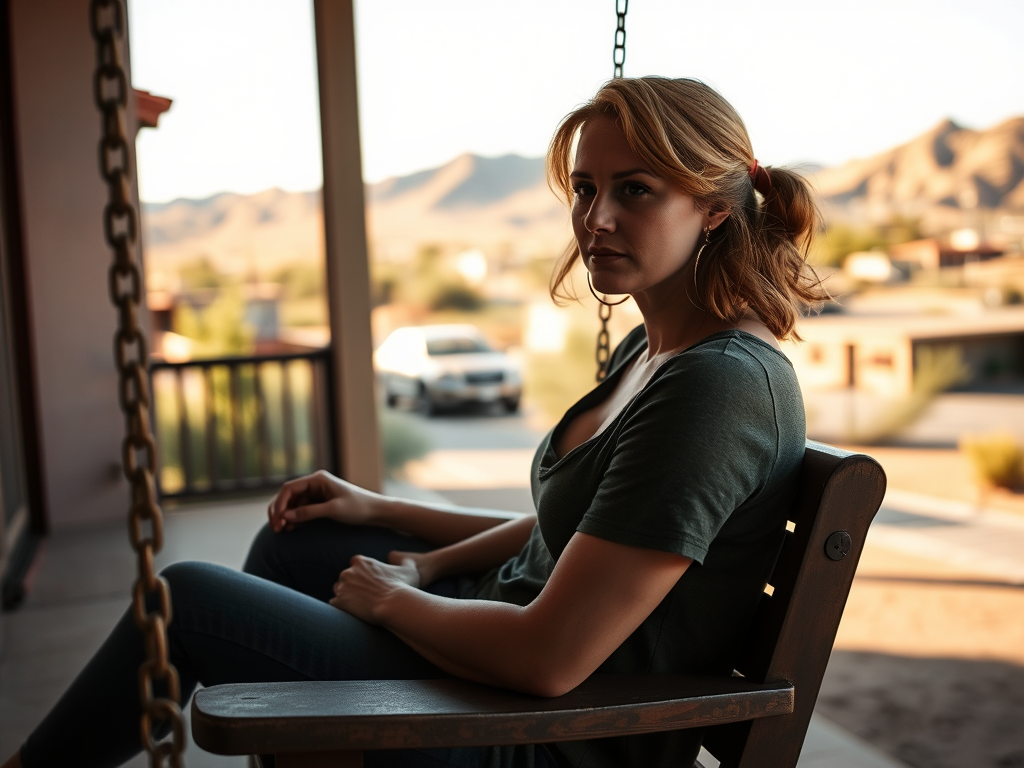
Maggie sat on her porch swing. The soft creak of the old chains was the only sound in the still afternoon air. The sun hung low, casting golden hues across her small Arizona town, but inside her chest, a storm raged. The day had been a whirlwind of mishaps. She missed deadlines at work. She had an argument with her sister. She also nagged worry about her aging father’s health. Each problem was stacked like bricks on her shoulders, weighing her with unresolved concern. She was in the midst of a battle for her Peace.

She sipped her tea. She hoped the warmth would soothe the ache. Yet, peace felt distant, like a mirage on the desert horizon. Her mind churned with “what-ifs” and “should-haves,” a relentless cycle that robbed her of the quiet she desperately craved.

Maggie took a deep breath and closed her eyes. She listened to the distant rustling of mesquite trees. Occasionally, she heard the bark of a neighbor’s dog. The natural sounds around her conveyed a message of resilience and adaptability. Slowly, she exhaled, reminding herself of her grandmother’s words: “You can’t stop the wind, but you can learn to bend.”

She stood and walked to the edge of her yard. Her fingers brushed over the delicate petals of the wildflowers. They had sprung up after last month’s rare rain. Their resilience struck her—fragile yet persistent, thriving even in the harsh desert soil.

Realizing she couldn’t control everything, Maggie focused on the now. She let the day’s stress settle, acknowledging it but not giving it power. She watched the sky darken into twilight. The first stars peeked through. She felt a little lighter with each breath. It was the power of being here, of living in the moment, that brought her Peace.

She realized Peace wasn’t about escaping the chaos but finding a quiet place. And tonight, as the desert cooled and the cicadas began their evening song, she finally let herself rest. The relief was palpable, like a weight lifted from her shoulders, as she surrendered to the tranquility of the night.

A Love That Endures

GROFF MEDIA 2024© TRUTH ENDURES IMDBPRO

Presented by benandsteve.com By: Benjamin Groff II©

2–3 minutes

Anna sat on the edge of her porch swing, the crisp autumn air wrapping around her like a familiar shawl. She cradled a weathered photo album filled with snapshots of a life well-lived with her husband, Thomas. Though he had passed a year ago, his presence lingered in every corner of their home. She noticed the faint scent of his aftershave in the closet. The carved wooden birdhouse he made hung by the garden. The laughter seemed to echo from the walls.

The sun dipped below the horizon. It painted the sky in hues of orange and violet. Anna whispered, “Death have taken your body, Thomas, but you’re still here.”

In the quiet, she remembered the words their pastor had spoken at his funeral: *Death takes the body. God takes the soul. Our minds hold the memories. Our hearts holds on to the love. Our spiritual beliefs let us know we will meet again.

Her memories of Thomas were not just memories, they were vibrant, living moments. They replayed in her mind like a cherished movie. She saw how his eyes crinkled when he smiled. She heard his deep belly laugh. She felt the strength of his hand in hers as they danced in the kitchen.

Though grief often pressed against her chest, her heart was not empty. It was full of love—a love that hadn’t dimmed with time. She placed a hand over her chest and smiled. She knew it was where Thomas still resided. He was a glowing ember that would never go out.

Every Sunday, Anna would visit the little white church where they had exchanged vows so long ago. She found not just solace, but peace there, her faith bridging the earthly and the divine. She believed Thomas was in God’s care now, his soul at peace, waiting patiently for her.

One evening, as she closed the photo album, she noticed the first star twinkling in the sky. She gazed upward and whispered, “I’ll see you again, Thomas. Until then, I’ll carry you here.” She touched her head. “Here.” She placed her hand on her chest. “And here.” She folded her hands in prayer.

At that moment, Anna felt a warmth envelop her. It seemed like Thomas himself was reminding her. Real, enduring love that never truly is separated by time or space.

She smiled and rocked gently on the swing, humming the melody of their favorite song. The stars above her were a quiet witness to the eternal connection between two hearts.

When You Fight For your Life Any Thing Is Fair! Lt Wheeler’s Advice Of A Lifetime

Groff Media 2024© Truth Endures IMDbPro

Presented by benandsteve.com By: Benjamin Groff II©


3–5 minutes
Officer Steve Mahan
Shot and Killed Jan 5. 1983

As I prepared for work, the memory of Officer Steve Mahan lingered heavily in my thoughts. He had been shot and killed on January 5th, 1983—a day etched in tragedy. That morning, a dense, unrelenting fog blanketed the world as if nature itself mourned the impending loss. I recalled how the rescue helicopter, grounded by the impenetrable fog, couldn’t transport him to a larger hospital equipped to treat his severe head trauma. Desperate, the doctors had no choice but to send him by ambulance over 100 miles away.


The ambulance crawled through the soupy mist, often unable to exceed 30 miles per hour. Time was slipping away, and the slow, arduous journey became a race against death. Despite their best efforts, he passed en route, his life extinguished before the fog could lift.


That day haunted me. As I pulled on my uniform, I reminded myself that tonight, I would be assigned to the very unit he had been using on the night he was executed. A weight settled on my shoulders—not fear but a solemn understanding of the risks we all faced. Yet, I felt a measure of reassurance knowing that Lt. Wheeler would be by my side, his steady guidance serving as both a compass and a shield against the uncertainty of the streets.

On my first day of patrol, the challenges of the job revealed themselves immediately, with a fatality marking my inaugural call. It was a sobering introduction to the weight of my duty. My Lieutenant, a seasoned mentor, shared his wisdom throughout the shift as we navigated the Oklahoma Statutes, Title 21. He precisely explained how every crime must meet specific legal criteria before being classified as such and emphasized the foundational principle that every suspect is presumed innocent until proven guilty. That early understanding of the law, I realized, was not just knowledge—it was a tool for justice and fairness, critical to our line of work.

The second day began differently. I was well-rested but curious about what this shift could bring. What could top the tragic death of the older woman the day before? The night unfolded quietly at first. My Lieutenant and I were patrolling the city’s southern section, with him now shifting the conversation to Title 47 of the Oklahoma Statutes, covering traffic laws and their nuances.

Then, without warning, the calm was shattered. The Lieutenant slammed our unit’s transmission into park and leapt out, his movements fluid and precise. Before I could react, he bolted to my side of the vehicle and tackled a man gripping his wife by the hair on the sidewalk. It had all happened instantly—I hadn’t even registered the altercation out of the corner of my eye. When I opened my door, Lieutenant Wheeler was already cuffing the suspect with practiced efficiency.

I stood momentarily frozen, feeling like I had failed to pull my weight. The Lieutenant’s decisive action was a masterclass in vigilance, and I resolved to sharpen my instincts.

After ensuring the woman was safe and gathering her statement, we booked the man into jail on charges of public intoxication, disorderly conduct, and assault and battery. The routine of patrol resumed, but the night had already taken on a different tone. During this lull, Lieutenant Wheeler imparted what I’ve come to regard as the most crucial lesson of my career.

He also stressed the importance of situational awareness and knowing the city like the back of my hand. While my previous experience in communications had given me a solid understanding of the city from a dispatcher’s perspective, patrolling the streets was entirely different.

He taught me to read the moving pieces of the urban puzzle—to develop a comprehensive view that encompassed the road ahead and the vast expanses on either side. Under his guidance, my observational skills sharpened, leading to accomplishments such as preventing a potential robbery and aiding in a successful arrest, which I could later be proud of.

It felt like I’d absorbed a semester’s criminal justice training in just two nights. But nothing could have prepared me for what was to come on the third night. Neither of us could have anticipated the events that would unfold, including a high-speed escort and a tense high profile traffic stop and truthfully, neither of us would have chosen to.

What happened next would change everything. Yet, in the end, it would pass unnoticed by the world—a fleeting moment in the grand scheme of our duty. This moment, however, was a stark reminder of the unpredictable nature of our work and the need for constant vigilance and resilience. That is the story which unfolded for day three.

Unpacking ‘Make America Great Again’: What MAGA Overlooks in Its Vision of the Past

Presented by benandsteve.com By: Benjamin Groff II©

Groff Media 2024© Truth Endures IMDbPro


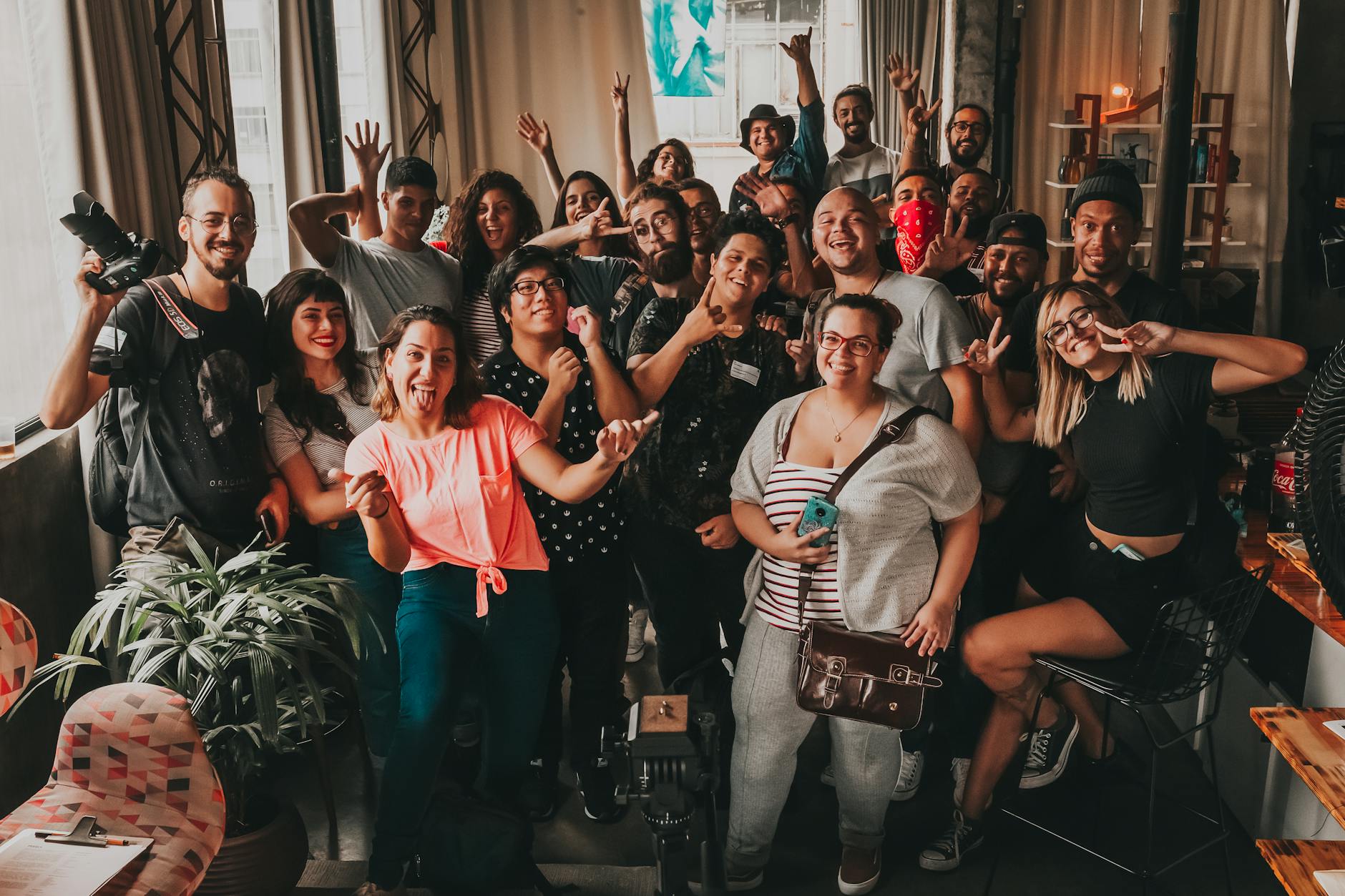
The fall of 2024 found a vibrant small community town hall filled with locals from every walk of life. The walls became lined with a diverse array of familiar faces of the neighborhood—retired teachers, young activists, military veterans, and longtime friends who had lived through decades of change, some of it hard-won, others bittersweet. On the stage, with a sign reading “Let’s Talk About Greatness,” stood a panel, each holding their idea of what that greatness looked like.

Jared, a man in his late sixties with a MAGA hat perched atop his head, leaned forward as he spoke, –––

“I want my kids and grandkids to grow up in a country that feels strong, proud, and united—like it was back then. We all knew our neighbors. Families were close-knit. There was a sense of American unity.”

Dolores, a retired history teacher, nodded beside him. But as the crowd listened, some exchanged looks. –––

“So, Jared, I get what you’re saying,” a young local journalist interrupted Lena. But when we say ‘back then,’ do we mean the same thing?”

Jared paused, looking thoughtful, as Dolores took the microphone. –––

“We tend to remember the good and forget the rest,” she said gently. I remember growing up in the fifties and sixties. It was stable and ideal for some of us, but not everyone. This ‘great’ past we want to go back to meant certain people couldn’t vote. Others had to hide who they loved. And women—our dreams were seen as distractions to a family.”

There was a hush as Dolores’s words hung in the air.

“I don’t think Jared meant that,”

––– came a soft voice from the audience. It was Naomi, a single mother and community organizer.

“But when we say we want to ‘Make America Great Again,’ we have to ask—for whom? The history we’re returning to was not the same experience for everyone.”

The community members exchanged glances. Jared turned back to the crowd. –––

“I respect what you’re saying, Naomi,”

he replied, genuinely thoughtfully. –––

“When I say ‘greatness,’ I’m not talking about racism or inequality. I’m talking about hard work, pride, patriotism—things that feel like they’re slipping away.”

Naomi nodded understanding, fostering a sense of mutual respect and value for each other’s perspectives, highlighting the importance of open and respectful dialogue in the community.

“But the word again implies that we want to go backward,”

––– Lena pointed out.

“And, for me, that’s concerning. I love this country and respect what’s gone into making it better. I mean, we have interracial marriage, legal protections for LGBTQ+ people, voting rights for everyone.”

––– Lena paused, looking at Jared.

“To me, that’s American greatness—now.”

As the meeting unfolded, the debate deepened. Various members shared stories of progress and hardships. Kayla, a small business owner, spoke about her pride in balancing work and motherhood.

“When I hear traditional values, I think of something different than my grandmother might have,”

––– she said.

“My values include family, hard work, women’s rights, and equal opportunities.”

Another voice said,

“Look, I served in the military, and I believe in protecting this country,”

––– said Tom, a retired Marine and a man with a thick gray beard.

“I fought for an America that moves forward and doesn’t leave anyone behind. ‘Greatness’ is complex—strong enough to protect everyone’s rights.”

The meeting wrapped up with the group realizing that “greatness” was many things, each person’s version holding personal meaning. Dolores took the microphone one last time:

“Maybe we can remember this—our vision of a truly great America embraces both the good of the past and the advancements we’ve made. To build greatness, we don’t go backward. We keep moving and evolving, ensuring that each generation has the opportunity to contribute to a better America, instilling a sense of hope and optimism in the audience for the future.”

The room echoed with nods of agreement, and as the townspeople filed out, they carried forward a renewed understanding: that the road to greatness was not paved with nostalgia alone but with a willingness to grow beyond it.

The Quiet Difference

A Story By: Benjamin Groff II© Groff Media 2024© Truth Endures IMDbPro

Levi grew up feeling different from his peers, struggling with his attraction towards boys amidst societal pressures. A formative encounter with Aaron led to a heartfelt kiss that marked a turning point for Levi. As they matured, their bond evolved into a deep friendship, helping Levi embrace his uniqueness throughout adulthood.

From a young age, Levi had always felt like there was something inside him that set him apart from the other boys. In grade school, while his friends chased girls, teased them, and laughed about crushes, Levi felt a quiet unease. He played along, trying to fit in, pretending to share the same interests. But deep down, something felt different, something he couldn’t quite put into words.

As Levi grew older and entered his teenage years, that difference became more defined. His friends would talk excitedly about the girls they liked—their eyes lighting up as they spoke of first dates, dances, and love letters. But Levi never shared in that excitement. He tried to force himself to like girls the way they did, to feel the same way, but no matter how hard he prayed, his feelings never changed. Levi would lie in bed at night, praying, asking God to make him normal. To take away the strange, confusing feelings he didn’t understand. His internal struggle was a constant companion, a silent battle that no one else could see.

But it wasn’t just his lack of attraction to girls that confused him. As Levi matured, he turned to dressing in modern menswear—sharp, tailored clothing, stylish undergarments, and the kinds of outfits no one in his small farming town ever discussed. His friends were indifferent to clothes, such as hand-me-downs or work overalls, but Levi found comfort in dressing differently. The way certain fabrics felt, the sleek designs, appealed to him in a way he couldn’t explain. He was terrified someone would find out about these thoughts, this quiet fascination, and mock him. But more than that, he didn’t know why it would matter so much to others. Why was his difference such a secret? Why did it feel dangerous to admit? The societal pressures to conform to a certain image were always there, lurking in the background, ready to pounce on any sign of deviation.

Deep inside, Levi knew he longed for something more than stylish clothes or acceptance. He yearned for a relationship with another boy—something that mirrored the love and companionship he saw between boys and girls. It wasn’t a desire he could fully explain, nor was it something anyone had ever taught him. It was natural to him, rising from some deep place in his heart. But even that natural feeling terrified him because he knew it wasn’t something people around him would accept.

One summer afternoon, when Levi was sixteen, a boy from a neighboring town came to visit the farm. His name was Aaron, and he was there with his father to discuss some work with Levi’s father. Aaron was taller than Levi, with a quiet confidence about him, and there was something about him that made Levi feel both nervous and excited. The two boys quickly became friendly, and after lunch, they decided to take a walk down to the lake that sat on the edge of Levi’s family’s land.

As they walked, the conversation flowed easily, and soon, they reached the clear, calm waters of the lake. The sun was hot, and Aaron suggested they go for a swim. Levi hesitated initially, feeling unsure, but the warmth of the day and Aaron’s easygoing nature won him over. Before long, they had stripped to nothing and jumped into the water, laughing and splashing like carefree children.

But as they swam and played, something unspoken hung between them. Levi could feel the subtle closeness of their glances at each other. They wrestled and splashed in the water, and then, almost without realizing it, they were close. The playful energy gave way to something more profound. Aaron’s hand lingered on Levi’s arm, and Levi felt his heartbeat quicken. In a moment that felt as natural as breathing, their lips met.

The kiss was soft and hesitant, but it felt right. For the first time in his life, Levi was clear-minded. This—this feeling—was what he had been searching for. It wasn’t wrong. It wasn’t strange. It was safe, it was natural, and it made perfect sense. The emotions welled up inside him, and before he could stop himself, tears began to fall down his cheeks. When he looked over, he saw Aaron was crying, too.

They both knew, in that quiet moment by the lake, that they had found something rare and precious in each other. But they also knew it would be fleeting. Their fathers’ farms were miles apart, and they would only see each other on rare occasions when their fathers met for work. It was a bittersweet realization, but it didn’t matter for the moment. They had found one another, and for the first time, Levi knew he wasn’t alone. As they dried off and dressed, the weight of the world seemed a little lighter on Levi’s shoulders. He felt a sense of peace and acceptance that he had never experienced before. The kiss had changed everything, and yet, it had changed nothing. They were still the same people, but now, they had a shared secret, a bond that transcended words.

As the years passed, Levi and Aaron grew older. They drifted apart romantically as life pulled them in different directions, but their bond remained strong. They stayed great friends, sharing the ups and downs of life and guiding one another through the challenges of adulthood. They never spoke about that summer kiss again, but it remained an unspoken memory that tied them together.

Levi never stopped feeling different, but he learned to embrace his uniqueness as he grew into adulthood. He found that love and connection could take many forms, and though his path wasn’t the same as others, it was his own. And he walked it proudly.

The End.

LGBT History Month is an annual month-long observance of lesbian, gay, bisexual and transgender history, and the history of the gay rights and related civil rights movements. It was founded in 1994 by Missouri high-school history teacher Rodney Wilson!

What Happens When the Country is Closed for Average Americans?

A Report By: Benjamin Groff© Groff Media 2024© Truth Endures

A Shift in the Landscape of Freedom

Amid political upheaval, the everyday American—who works a regular job, pays taxes, and seeks a life of routine and stability—may question their future in an increasingly polarized society. As extreme political movements push for agendas that center around ideas of “Project 25” or the return of Trump, advocating for a strict interpretation of Christianity, suppression of women’s rights, and an aggressive nationalistic framework, the real impact may be felt most by the “regular Joe”—the one who wants to live a quiet, predictable life.

For the average person, life may close in on them in such a scenario. The country may become unrecognizable, not in a dystopian fantasy, but in subtle, pervasive ways. It might start with the suppression of individual freedoms—targeting what people can say, wear, or how they worship. Religious dogma could permeate public life, not as a choice but as a mandate, affecting schools, workplaces, and government institutions. The Bible in every building might become symbolic and a requirement, with legal frameworks promoting a particular religious view while leaving others on the margins.

Erosion of Women’s Rights

Regular Americans might witness fundamental changes in the status of women while going about their daily lives. With growing pressure from ultra-conservative elements, efforts to curtail women’s autonomy could accelerate. The reversal of women’s rights, particularly reproductive rights, is already in motion. In this new political order, women might have even fewer choices about their bodies, careers, and participation in public life. For many, this will mark a turning point when personal freedom can no longer be taken for granted.

The Fear of the Unknown

Fear might become customary for those not part of this hard-right movement. The “regular Joe” will likely feel caught between competing narratives. On one side, there is the quiet desperation of wanting to hold on to their everyday life, and on the other, the nagging sense that the world is changing in ways that might soon render them powerless. Whether one is bisexual, straight, or simply someone with no interest in pushing their identity into the political arena, they might start feeling stalked by the system—monitored, judged, and left wondering if their way of life is still valid.

A New “American Dream?”

In this environment, the American Dream could become narrow. No longer about opportunity for all, it may become a dream only accessible to those who fit the suitable mold—racially, religiously, and socially. If one does not align with the ideals of whiteness or conservative sexuality, they could find themselves increasingly ostracized, with opportunities drying up. The path to success might depend less on hard work and more on conformity to ideals driven by far-right ideologues.

The reality could become darker for the person who comes home daily, pats their dog on the head, and watches the news. The content of that evening television might change, with media outlets pushing extreme viewpoints or censorship becoming the norm. Growing anxieties about what tomorrow holds could interrupt quiet moments of relaxation.

Where Do They Go?

If the country starts closing itself to all but those who align with this rigid agenda, the regular Joe may ask, “Where do I go?” It is hard to imagine a physical place for escape in a country that feels increasingly closed off to dissent. For many, the answer might not be in leaving the country but in finding a way to resist quietly—by forming communities with others who feel left behind, advocating for empathy and open-mindedness, and holding on to the idea that the heart of America lies not in exclusion but inclusion.

The danger is not just in the policies themselves but in the erosion of what makes America a place where people of all walks of life can live freely, with differences embraced rather than punished. When that idea is under attack, the question of “Where will you go?” takes on a much deeper meaning because the honest answer is about preserving a sense of home, not just for oneself but for everyone.

In this potential future, where does the regular Joe go? Perhaps they remain right where they are, standing in quiet defiance, continuing to pay their taxes, pat their dog, and live with the hope that balance will one day return to a nation at risk of losing itself.

New Haven: Rebuilding Humanity After the First Contact War

In 2147, the world was altered irrevocably by the catastrophic aftermath of the First Contact War, a conflict that erupted when humanity made its first contact with an alien civilization. This discovery, instead of being the peaceful meeting of cultures and ideas that many had hoped for, led to a devastating war that ravaged Earth, leaving it a shadow of its former self, with much of the planet in ruins.

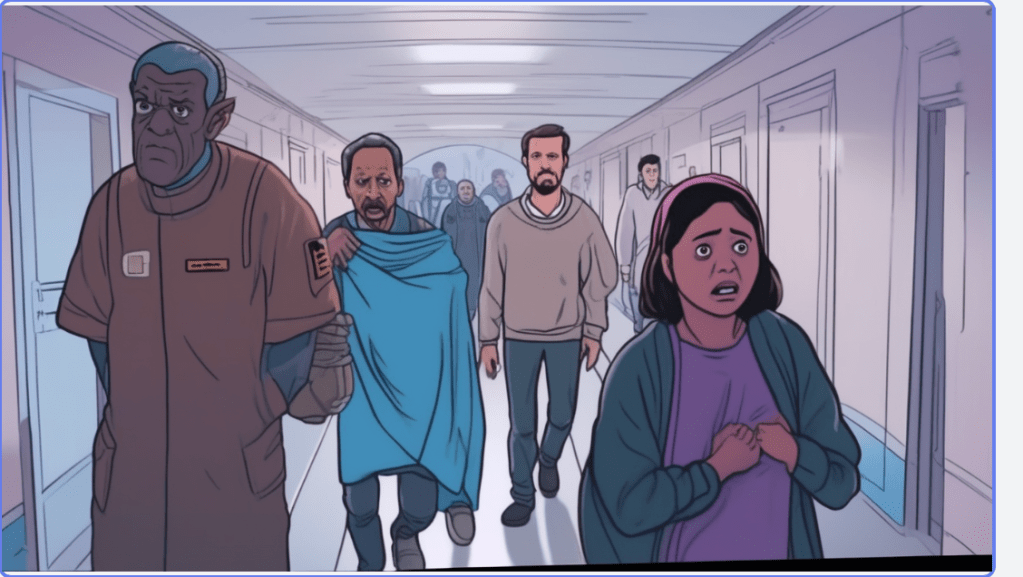
Amidst the desolation, small pockets of survivors, resilient and determined, tried to rebuild their lives. One such place was the settlement of New Haven, a converted underground research facility that provided refuge to humans and non-humans alike. In the dimly lit corridors of New Haven, it was here that a group of survivors, their spirits unbroken, made their way to the main meeting hall.

Leading the group was Dr. Rithian Torvak, a Xelorian biologist from a race that had formed a crucial alliance with humanity against the common enemy. The Xelorians, known for their green, textured skin, and elongated ears, were a race of peaceful scholars who had never engaged in warfare before. Despite the prosthetic arm—a reminder of the war’s brutal cost—he was a source of strength and wisdom, a testament to the unity forged in the face of adversity.

Anaya Patel, a young woman who had become a beacon of hope for many, closely followed Dr. Torvak’s research. Anaya had emerged as a natural leader, her compassionate heart and unyielding spirit rallying the survivors, united in their struggle, through their darkest days. Her parents had perished defending their home, but she had sworn to honor their memory by protecting those who remained.

Beside him, clutching a tattered blue blanket, was Samuel Grant, a former engineer who had lost his family in the initial invasion. Samuel’s eyes appeared haunted, but he found solace in aiding Dr. Torvak with his research, hoping their efforts might lead to a brighter future. His knowledge of pre-war technology was invaluable in keeping New Haven operational.

As they walked through the corridor, the walls echoed with the murmurs of the other residents, each carrying their own stories of loss and survival. The group was heading to a crucial meeting to discuss the latest developments in their efforts to reclaim the surface and search for other survivors.

The corridor opened into a large room filled with makeshift tables and chairs. On one wall, a digital display showed the map of their known world, with red zones marking areas still too dangerous to explore. These zones, remnants of the war, were filled with mutated creatures and unstable terrain, posing a constant threat to anyone who dared to venture into them. The air was thick with a mix of hope and desperation, as the survivors were acutely aware of the dangers that lurked just beyond their reach.

Dr. Torvak stepped forward to address the gathered crowd.

“We have received a transmission from what we believe to be another survivor enclave. This communication could mean there are more of us out there than we thought.”

The room buzzed with whispers. Anaya, her voice steady but filled with emotion, raised her hand, silencing the crowd.

“If there are more survivors, we must find them and bring them here. Every life matters, and together, we can rebuild.”

Her words, a testament to the hope that still burned within them, resonated with the survivors, filling the room with a renewed sense of purpose and determination.

Samuel nodded in agreement.

“We have the technology to send a team, but it will be dangerous. We must prepare for anything.”

Dr. Torvak glanced around the room, his eyes filled with determination.

“We have faced darkness and survived. Now, it is time to reclaim our world, to rebuild what we have lost, and to forge a future where all races can live in peace.”

His words, a rallying cry for the survivors, echoed in the room, filling them with a renewed sense of determination and unity.

As the meeting concluded, the survivors of New Haven felt a renewed sense of purpose. They knew the road ahead was perilous, but they believed, with a flicker of hope in their hearts, they could overcome any obstacle together. In the shadows of their broken world, they found the strength to hope, fight, and dream of a brighter, more peaceful tomorrow.

Despite their broken world, hope remained to rebuild even in the presence of a mixed culture of individuals—all who were put together not out of choice but out of a twist of fate!

Riverton Police: A Night in the Life of Detectives Jake and Sam

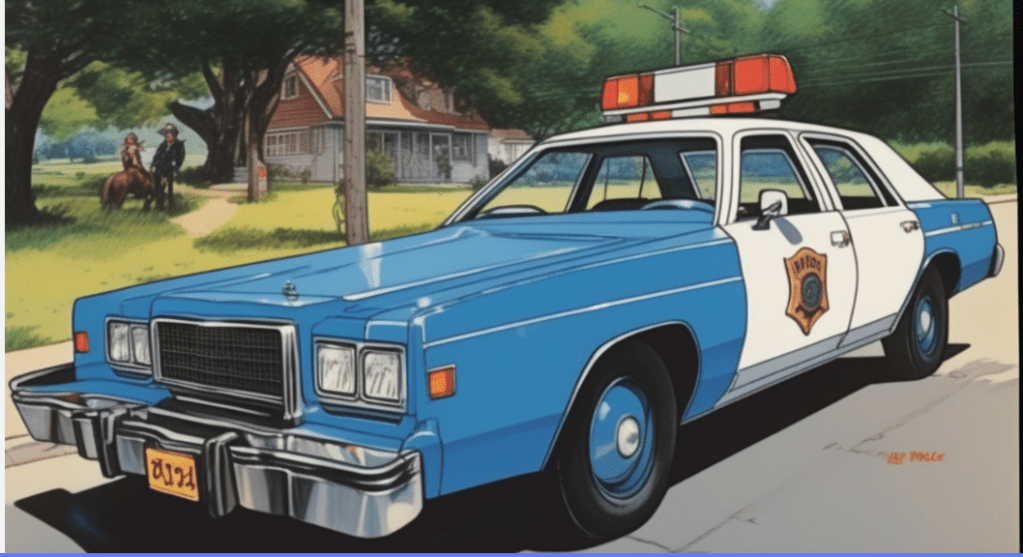
The city of Riverton never slept, nor did Detectives Jake Harris and Sam O’Reilly. Partners for over a decade roamed the nocturnal streets with the kind of synergy only best friends could muster. Their squad car, an unremarkable blue-and-white cruiser, was a beacon of hope for some and a symbol of fear for others.

Jake, with his gruff exterior and piercing blue eyes, was the kind of cop who could read a crime scene like a book. Sam, a lean figure with a quick wit and a knack for defusing tense situations, complemented Jake perfectly. Together, they led the department in felony arrests, arriving at calls faster than anyone else and building relationships with the community that others could only dream of.

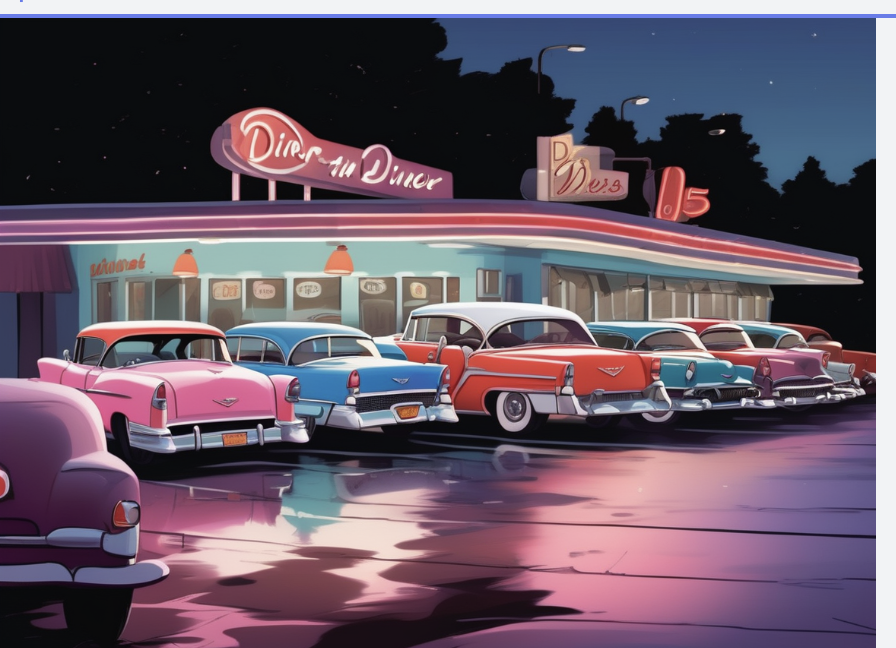
One brisk autumn night, their radio crackled to life with a call that made their hearts race: an armed robbery in progress at the 24-hour diner on 5th and Maple. Without a word, Jake hit the lights and sirens, and they sped through the dimly lit streets. They arrived in just under three minutes, a record even for them.

The diner was eerily quiet as they approached, save for the distant hum of neon lights. Inside, a masked man brandished a gun, demanding cash from the terrified cashier. Jake motioned for Sam to flank the back entrance while he took the front.

Jake entered slowly, his voice calm but authoritative. ––––

“Riverton PD, drop the weapon and come out with your hands up.”

The gunman whipped around, eyes wide with panic.

From the rear, Sam’s voice cut through the tension.

“No, you won’t. You don’t want to hurt anyone. Put the gun down, and we can talk.”

The gunman’s grip on the weapon faltered. In that split second, Jake lunged forward, disarming him with a swift, practiced motion. Sam was at his side instantly, cuffing the man and guiding him to the squad car.

As they processed the scene, the cashier, a young woman named Maria, approached them with tears in her eyes.

“Thank you. I don’t know what would’ve happened if you hadn’t come.”

Jake gave her a reassuring nod. “Just doing our job, ma’am.”

The rest of the night was a blur of paperwork and patrols. But their most memorable interaction came just before dawn. While cruising through a quieter part of town, they spotted a boy sitting alone on a bench, clutching a backpack to his chest. They pulled over, and Sam approached him gently.

“Hey there, buddy. Everything alright?”

The boy, who couldn’t have been more than ten, looked up with tear-streaked cheeks.

“I ran away from home. My parents are always fighting.”

Sam sat next to him, listening with the patience of a father and says –––

“I get it, kid. Sometimes, home can be tough. But running away won’t solve anything. Let’s get you back home and see if we can help sort things out.”

Jake contacted the boy’s parents while Sam spoke with him. The sun was peeking over the horizon when they returned the boy home. Now more worried than angry, the parents hugged their son tightly and thanked the officers.

As they drove back to the station, Jake glanced over at Sam, sighs then says –––

“Another night, another set of stories, huh?”

Sam chuckled. “Wouldn’t have it any other way.”

In Riverton, one could become a legend in the shadows, and for Jake and Sam, every night was another chance to protect and serve, forging connections and fighting crime in ways that others could only admire.

Verdantia: The Rainbow City and the Festival of Lumina

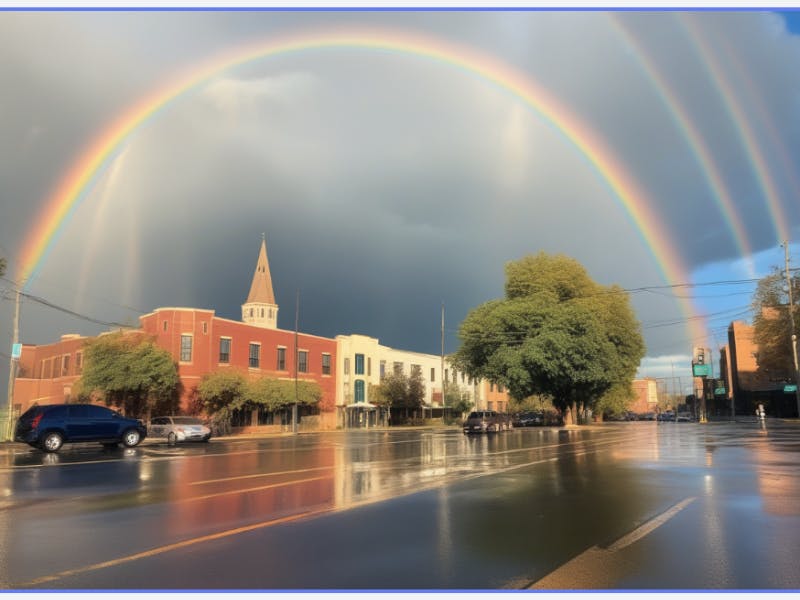
Once upon a time, in a small, unassuming town named Verdantia, an extraordinary phenomenon brought magic to the lives of its residents. Verdantia was known for its picturesque streets lined with red-brick buildings and verdant trees, but what truly set it apart was its ability to produce the most stunning rainbows anyone had ever seen.

One late afternoon, after a sudden downpour, the clouds parted, and the sun cast its golden rays across the wet streets. As the townsfolk went about their business, a magnificent rainbow began to form, arching over the town’s central square. It wasn’t just any rainbow; it was a double rainbow, with vibrant colors so vivid they seemed almost tangible.

The people of Verdantia, who had grown accustomed to the beauty of rainbows, stopped in their tracks, mesmerized by the sight. The rainbow appeared to touch down at two significant landmarks in the town—the spire of the old church and the ancient oak tree standing proudly at the intersection of Main Street and Elm.

As legend had it, Verdantia was a place where rainbows were believed to be portals to realms of wonder and enchantment. The townspeople knew this was no ordinary occurrence. The elders of the town, keepers of its history and secrets, gathered quickly. They had long awaited the appearance of such a rainbow, a sign foretold in their lore that marked the beginning of a special event known as the Festival of Lumina.

The Festival of Lumina was a rare celebration that took place once every hundred years, marked by a rainbow so grand that it stretched across the sky, connecting the past with the future, the ordinary with the extraordinary. This festival was a time when the boundaries between the human world and the world of magic blurred, allowing dreams and reality to intertwine.

As the double rainbow shimmered, a soft, melodic hum filled the air. Children giggled with delight, and adults felt a warm, nostalgic pull at their hearts. The air around the rainbow seemed to sparkle, and for a moment, time itself felt as if it had slowed down. From the base of the rainbow at the church, a figure emerged—a guardian of the ancient lore, known as Seraphina, the Keeper of Light.

Seraphina, with her radiant presence and flowing silver robes, held out a staff that glowed with the colors of the rainbow. She spoke in a voice that resonated like the soft chime of bells, “People of Verdantia, the time has come to celebrate the Festival of Lumina. Today, the veil between worlds is thin, and the magic of the rainbow is at your command.”

The town erupted in joyous celebration. Musicians played enchanting melodies, artisans displayed their finest crafts, and bakers offered sweet treats that seemed to shimmer with a magical glaze. Children ran around, chasing the elusive ends of the rainbow, hoping to find hidden treasures and secret wonders.

As evening fell, the rainbow’s glow intensified, casting a luminous light over Verdantia. The townspeople gathered under the ancient oak tree, where Seraphina led a ritual to honor the rainbow and its magic. She spoke of unity, hope, and the power of dreams, encouraging everyone to embrace the wonder within their hearts.

The Festival of Lumina continued through the night, with stories of old being shared around bonfires, and dances that seemed to weave through the very fabric of the rainbow’s light. As dawn approached, the double rainbow slowly faded, but the magic lingered in the hearts of the people.

Verdantia, forever touched by the beauty and enchantment of the rainbow, became a place where dreams were cherished, and the magic of the Festival of Lumina was remembered and celebrated in smaller ways every day. The rainbow city, as it came to be known, stood as a beacon of hope, joy, and the enduring power of wonder.

Midnight: Guardian of Secrets in Solstice Hollow

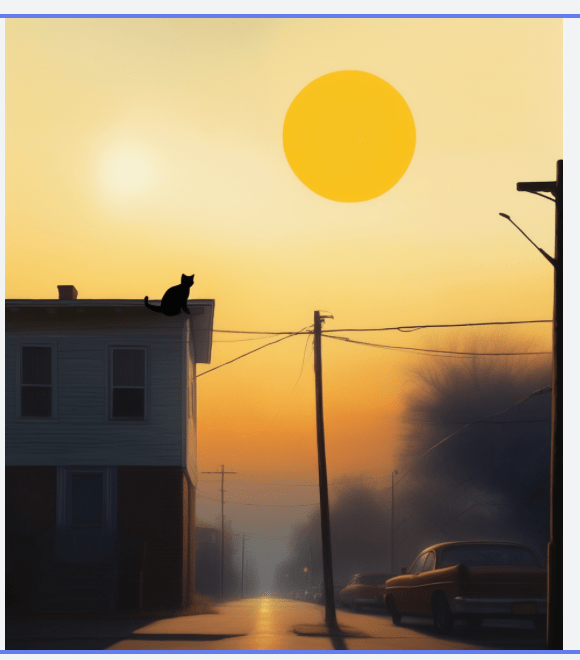
In the small, forgotten town of Solstice Hollow, days bled into each other with the relentless monotony of time. The sun hung heavy and perpetually on the horizon, a blazing sphere casting an otherworldly glow over the desolate streets. It was always twilight here, neither night nor day, as if the town existed in a pocket of suspended reality.

The alley in the photograph was known as Whispering Lane, a narrow pathway flanked by crumbling buildings that seemed to sigh with the weight of their own history. Shadows stretched long and lean across the cracked pavement, and the air was thick with the scent of old wood and dust. At the intersection of the lane and Main Street stood an old house, its paint peeling and windows dark, a silent sentinel in this forgotten part of the world.

On the roof of this house sat a black cat, its eyes glinting like emeralds in the perpetual twilight. The cat, known to the townsfolk as Midnight, had been there for as long as anyone could remember. Legend had it that Midnight was not an ordinary cat, but a guardian of secrets, a keeper of the town’s strange and sorrowful tales.

One such tale was that of Eleanor Weaver, a young woman who had lived in Solstice Hollow many decades ago. Eleanor was a spirited and curious soul, always wandering the boundaries of the town, seeking something beyond the endless dusk. She was fascinated by Whispering Lane, drawn to its eerie silence and the whispers that seemed to emanate from the very walls.

One evening, Eleanor ventured further down the lane than ever before. The sun, fixed in its eternal descent, bathed the alley in a warm, golden hue, casting long shadows that seemed to beckon her forward. As she walked, she heard faint murmurs, indistinct yet strangely comforting, as if the lane itself were sharing its secrets with her.

At the end of the lane, where the shadows were deepest, Eleanor discovered a hidden door set into the side of an old brick building. The door was ancient and weathered, its surface etched with cryptic symbols. With a mixture of trepidation and excitement, she pushed it open and stepped inside.

What Eleanor found beyond the door was a realm beyond her wildest imaginings—a place where time flowed differently, and the laws of reality were mere suggestions. She wandered through dreamlike landscapes, met beings of light and shadow, and learned the true nature of Solstice Hollow. She discovered that the town was a sanctuary, a refuge for those who had lost their way in the world. The perpetual twilight was a barrier, a protective veil that kept the town hidden from the rest of existence.

Days turned into weeks, and weeks into months, yet Eleanor felt no urge to return. She had found her place, her purpose, in this otherworldly dimension. But as with all who ventured too far into the unknown, a time came when she had to make a choice: remain in the dreamscape forever, or return to the world she had left behind.

Eleanor chose to return, carrying with her the knowledge and serenity she had gained. She emerged from the hidden door, back into the eternal twilight of Whispering Lane. The townsfolk noticed a change in her—a quiet wisdom in her eyes, a sense of peace that seemed to radiate from her very being. She never spoke of what she had seen, but Midnight, the ever-watchful cat, seemed to understand.

Years passed, and Eleanor’s tale became part of the whispered legends of Solstice Hollow. The hidden door was never found again, and some began to doubt it had ever existed. Yet, on still evenings when the sun cast its golden glow over Whispering Lane, the whispers could still be heard, faint but persistent, as if the alley itself remembered.

Midnight remained on the rooftop, a silent guardian, watching over the town and its secrets. And in the timeless twilight of Solstice Hollow, life continued, a delicate dance between reality and the unknown.

For Your Entertainment And More…

Tidbits, Snippets, & Flips!

flip.it/mMtmfy

A newspaper in 1924 predicted what life would be like in 2024 – we’re impressed

Hiyah ZaidiPublished Jan 23, 2024, 12:42pm|Updated Jan 24, 2024, 4:01pmComment

2024 predictions made in 1924 have been revealed
From horses going extinct to swapping engagement rings for sugar, 2024 could be interesting (Picture: Getty/Twitter)

Way back in 1924, a popular trend in newspapers was to predict what life would be like in 100 years’ time – i.e. today. 

And surprisingly, some are not too far from the truth. 

The sometimes accurate, sometimes outlandish clippings were shared on X by Paul Fairie, a researcher at the University of Calgary.

One that’s very recognisable is the city of the future.

‘Automobiles travelling on speedways through the centre of town’, ‘ever-moving sidewalks’ and ‘motorcars increasing and multiplying indefinitely’ all definitely came true.

Less so is the idea that those multiplying cars would bring about the extinction of the horse.

Newspaper clipping
This prediction is no where near true (Picture: X/ @paulisci)

Last year, a YouGov poll found that more than a quarter of people in the UK have tattoos. We reckon this one has come true, as it was anticipated that ‘debutantes will dye their skin all the colours of the rainbow’, with an expectation that hair would follow suit, much like a ‘Victorian debutante concealed her personality under voluminous hoops and draperies’. 

And pity those listening to the radio in 1924, when it was pretty dull apparently, because in another prediction, it was said ‘Americans will laugh at radios’. For 2024, it’s not just radio that bringing the LOLs, but also podcasts, which continue to soar in popularity. 

Newspaper clipping
Many Americans do laugh at something like a radio (Picture: X/@paulisci)

One that’s pretty much there is a longer life expectancy, where we would live to be 100 years old, and 75 years would be considered as young. 

zone post image for post 20153714

Major Gmail update sees millions of users get new function we’ve all been asking for

J. Rod the alien is one of the best Area 51 conspiracies out there. And it’s out there

Urgent warning for all iPhone owners: update now or risk attack

Dozens of new planets spark major breakthrough in search for alien lifeRead More Stories

Two that definitely came true are blocks of flats that are 100 stories tall, and family albums made of videos instead of photographs. 

A prediction that sadly hasn’t hit the mark – ‘movies will bring about world peace’ as people will establish a brotherhood but Hollywood has not yet accomplished a universal language or eliminated conflict from the civilised world. 

And while adorably optimistic, that is far from the most outlandish.

Newspaper clipping
Hollywood has not yet created a movie that brings world peace (Picture: X/@paulisci)

Some of the stranger predictions involve beds flinging children out of bed in the morning, people hopping from planet to planet as easily as we soar through the sky now (we wish), flying clothes and men’s legs withering away from underuse, Wall-E style. 

Newspaper clipping
Men do not live Wall-E style (Picture: X/@paulisci)

Oh, and diamond engagement rings should have lost their allure by now, being replaced with hundreds of pounds of sugar.

  1. A newspaper in 1924 predicted what life would be like in 2024 – we’re impressed
    1. MORE TRENDING
  1. A newspaper in 1924 predicted what life would be like in 2024 – we’re impressed
    1. MORE TRENDING