Santa’s Time-Warped Christmas

The current image has no alternative text. The file name is: as-santa-claus-guided-his-sleigh-over-the-north-pole.png
It Is Only Six Days Until Christmas Eve!

This story is pulled from the archives as a celebration for the season edition.

Groff Media 2024© Truth Endures IMDbPro

Presented by benandsteve.com By: Benjamin Groff II©

3–4 minutes

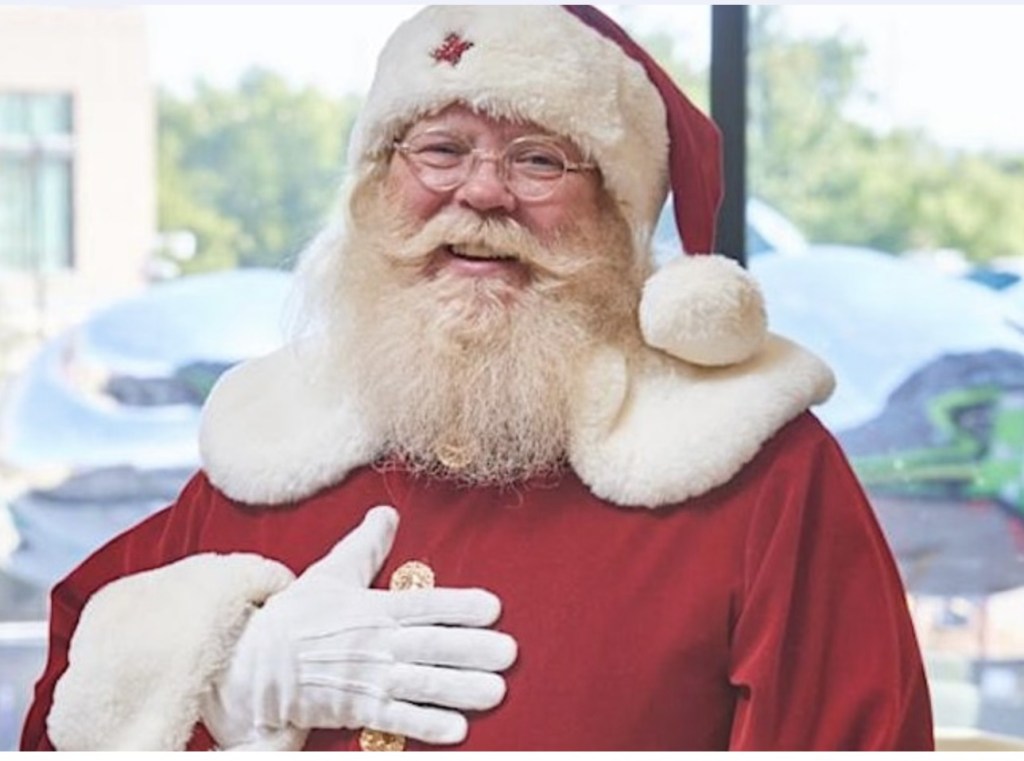
As Santa Claus guided his sleigh over the North Pole, the stars shimmered brighter than ever. It was Christmas Eve, and his magic sleigh, loaded with gifts for children worldwide, zipped through the frosty air. But something strange happened as he crossed a shimmering aurora—an inexplicable jolt rattled the sleigh.

“Dasher, what was that?”

Santa muttered, steadying his hold on the reins. The reindeer snorted in reply, uneasy.

The aurora enveloped him before he gathered his thoughts, and time seemed to twist and fold around him. When the light dissipated, the world below him was not the one he knew. Snow-covered cottages and horse-drawn carriages replaced the bustling cities of 2024.

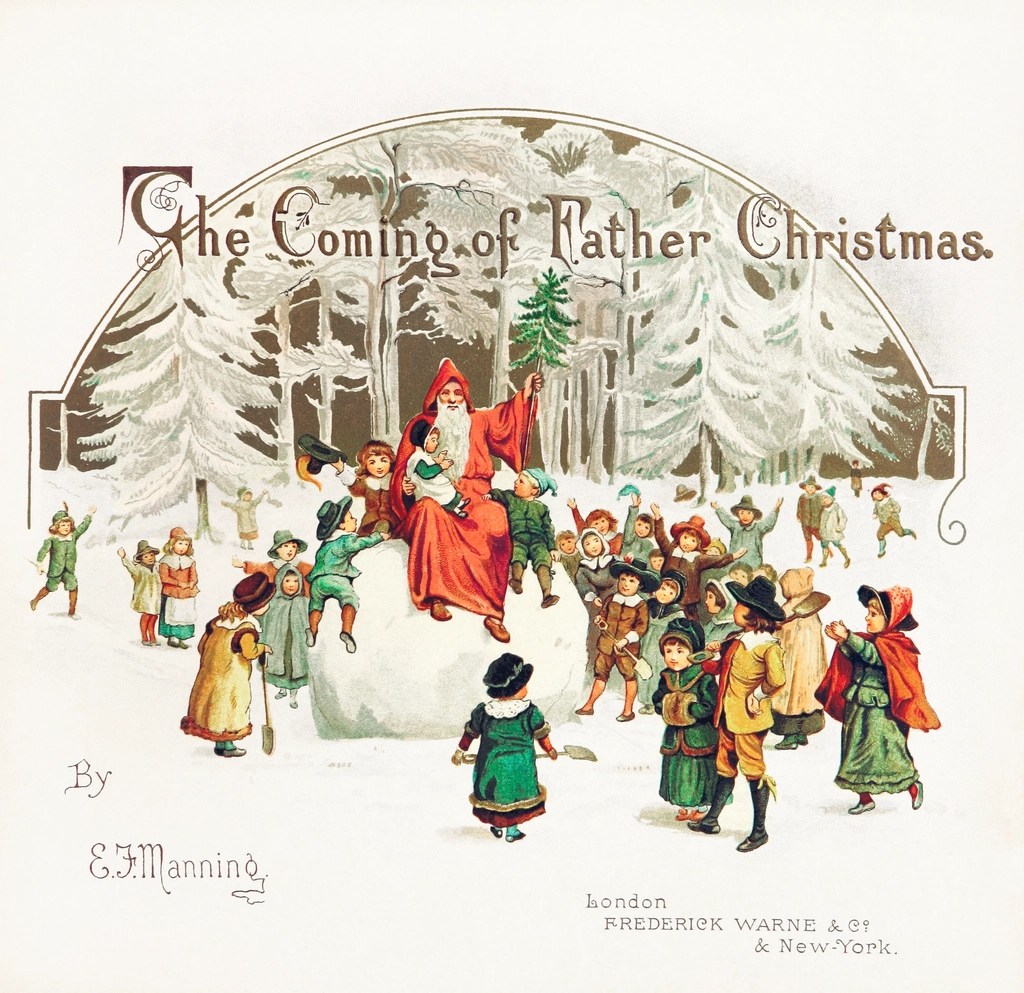
Santa realized he had been thrown back in time to the mid-1800s. He recognized the period instantly from the distinct architecture of a village below. It was a Christmas during a dark chapter in history. A devastating plague had gripped the land. It forced him to cancel his rounds that year.

“Great gumdrops!”

Santa exclaimed.

“What are the odds?”

He gazed at the sleigh’s cargo. By a twist of fate, it had been stocked with emergency medical supplies. These were intended for a charity hospital in the modern era. Among the crates were antibiotics, syringes, and boxes of penicillin.

As he landed his sleigh in the village square, the grim reality of the situation became clear. Emaciated villagers huddled near fires, their coughs echoing through the silent night. Santa’s heart ached as he walked among them, his red suit standing out against the bleak surroundings.

A child approached him, her face pale and gaunt.

“Who are you?”

She asked, her voice weak.

Santa knelt, his jolly demeanor softening.

“I’m Santa Claus, my dear. And I’ve brought –– hope.”

He opened a crate, revealing the miracle medicines of the future. Doctors, initially skeptical, were astonished by how quickly the penicillin began to heal their sickest patients. Word spread, and soon, Santa was inundated with requests for help.

But as he worked tirelessly through the night, a troubling thought weighed heavily on him. He altered the course of history by introducing modern medicine to the past. He remembered the first rule of time travel: do not interfere. Yet how he stand by and let so many suffer?

Santa consulted his reindeer, who were no strangers to magical predicaments.

“What do you think, Comet? If we save them now, what happens to the future?”

Comet stamped his hoof thoughtfully as if to say,

The heart often knows what the mind can’t reason.

Santa decided to take the risk.

“If kindness is a mistake, then I’ll gladly make it,”

He said aloud.

By dawn, the village was transformed. People sang carols, their strength returning. They looked at Santa with gratitude and wonder as he prepared to leave.

“Thank you, sir,”

said the village doctor.

“You’ve given us a miracle.”

Santa nodded, but his heart was heavy with uncertainty. As he guided the sleigh back into the sky, the aurora reappeared, pulling him back to his own time.

When he returned to the North Pole, he checked the world’s records, bracing for the consequences of his actions. To his amazement, the plague of the 1800s had been recorded as miraculously subsiding in one particular region. Yet, history did not explain this occurrence. Furthermore, the trajectory of medicine had advanced more quickly than he remembered. The saved lives gave rise to several key figures. These figures contributed significantly to society.

Santa smiled, chuckling saying,

“History has a way of balancing itself after all.”

Santa pondered the night’s events on Christmas Eve as he settled into his chair by the fire. Sometimes, he thought, doing the right thing means accepting the unknown. In the spirit of Christmas, a little magic can change the world for the better. A lot of kindness can also make a difference, no matter the time.

How Santa Tackles a Sky Jam in Los Angeles

This story is pulled from the archives as a celebration for the season edition.

Groff Media 2024© Truth Endures IMDbPro

Presented by benandsteve.com By: Benjamin Groff II©

2–3 minutes

Santa Arrives In Los Angeles To A Bustling Scene:

Santa is cruising through a starry night, his sleigh packed with presents. The reindeer are soaring with precision, Rudolph’s nose shining bright as they approach the bustling skies over Los Angeles. Santa remarks on how the city glows more colorful each year, marveling at the dazzling lights below.

The Problem Arises:

Santa checks his list. He guides the sleigh toward his next stop. Suddenly, he encounters a startling sight: a line of airplanes backed up in the sky. The sleigh slows as Rudolph blinks in confusion, and Santa pulls out his magic map to see what’s going on.

The airspace gets crowded with jets circling LAX, cargo planes, and private airplanes. Santa tries to weave through the gridlock but quickly realizes he’s stuck in a “sky jam.”

Santa’s Reaction:

Santa, determined to overcome this unexpected obstacle, starts to worry. He’s never faced air traffic congestion before! His magical sleigh, while nimble, still must adhere to the rules of the sky to avoid being spotted. He radios an air traffic controller using a unique device from his sleigh—something he rarely needs to do.

The controller is startled but professional.

“Uh… Santa? Is that you?”

“Ho ho ho! Yes, indeed! And I’m afraid I need some assistance navigating this mess!”

A Helping Hand:

The air traffic controller, Mia, quickly gathers her colleagues. They realize the only way to clear Santa’s path is to redirect some planes. Mia cleverly uses holiday magic and persuasion to coordinate a temporary gap in the airspace.

Meanwhile, Santa and the reindeer entertain themselves by performing aerial stunts. They draw candy canes in the sky. They share cookies with passing pilots who radio in. Their voices are filled with disbelief and joy.

A Creative Solution:

Santa, ever resourceful, taps into his bag of tricks to make up for lost time. He uses his magic to make his sleigh move twice as fast once the path clears. He asks for help from local elves stationed in Los Angeles. They zip around on drones to deliver some gifts while he’s getting delayed.

Santa’s Resolution:

The airspace clears, and Santa takes off like a rocket. With a heartfelt

“Thank you!”

To Mia and the air traffic team, he speeds into the night. He catches up on his deliveries with minutes to spare.

Ending:

As Santa finishes his rounds, he reflects on the night’s chaos. He chuckles, imagining the stories pilots will tell about seeing a sleigh stuck in traffic.

“Ho ho ho!” 

He bellows as he heads back to the North Pole.

“Next year, I will just get a flight plan!”

“Herbie” ––– The Tiny Christmas Tree Searches For A Family

This story is pulled from the archives as a celebration for the season edition.

Groff Media 2024© Truth Endures IMDbPro

Presented by benandsteve.com By: Benjamin Groff II©

3–4 minutes

In a quiet forest stood a skinny cedar tree, so different from all the others. The tall, majestic cedars around him stretched their lush branches high. In contrast, the little tree looked scrawny. It had sparse needles and a slightly crooked trunk.

People often came to the forest to select the perfect Christmas tree, always passing him by.

The other trees whispered and rustled in the wind, teasing him.

“Look at you, Herbie,”

They said, giving him the nickname that stuck.

“No one’s ever going to want you.”

Herbie tried to stand tall, but he knew they were right. Year after year, Herbie remained as the big, beautiful trees were chosen and taken away. The forest changed around him. He stayed in his lonely spot. He dreamed of what it would feel like to be wanted.

Then, one crisp winter morning, the tree cutters came again, their saws buzzing. Herbie didn’t expect to get noticed, but this time, something different happened. As they cleared their path, one of the workers stopped, scratched his head, and said,

“Well, let’s take this little one, too. Someone might like it.”

Herbie felt the sharp blade cut through his trunk. Before he could fully understand what was happening, he was bundled with the others and taken to the city.

A sea of magnificent Christmas trees surrounded Herbie at the tree lot. Their branches glistened with dew, and they stood tall and proud. Compared to them, Herbie felt even smaller, and his crooked trunk made him look even more awkward.

Shoppers strolled by, admiring the grand trees and taking them home individually. Herbie overheard a nearby pine whisper,

“Face it, Herbie, you’re not cut out for this. No one’s going to pick you.”

The lot grew emptier daily, and Herbie’s hope dwindled. By Christmas Eve, he was the only tree left, standing under the dim glow of a street lamp. The wind whistled through his sparse branches, and Herbie prepared for the inevitable—being tossed away, unloved.

But just as Herbie’s spirits hit their lowest, a tiny voice broke through the cold night air.

“Mama, look! That one’s perfect!”

Herbie lifted his branches slightly in surprise. A little boy with messy hair and bright, eager eyes was pointing at him.

“Are you sure, Tommy?”

His mother asked, crouching beside him,

“This tree is so small. And, well, it’s not exactly full.”

––––

“Exactly!”

Tommy said with a grin.

“It’s different, just like me. We’ll make it the best Christmas tree ever!”

Herbie’s heart soared as Tommy and his mother carefully carried him home. Tommy got to work in their cozy living room, stringing popcorn and cranberries across Herbie’s branches. His mother tucked shiny ornaments into every gap, and finally, they placed a glowing star on top.

Herbie couldn’t believe it. For the first time, he felt truly beautiful. He wasn’t just a funny-looking tree anymore—a Christmas tree.

On Christmas morning, Herbie watched with joy as Tommy tore through his presents, his laughter filling the room. The warmth of the fire danced on Herbie’s branches, and he realized he had never felt so happy.

When the holiday ended, Herbie feared getting thrown out like many trees before him. But instead, Tommy’s family carried him to their backyard.

Tommy said, patting his trunk as they planted him firmly in the soil.

“You’re part of our family now, Herbie,”

Year after year, as Herbie grew taller and fuller, Tommy would decorate him anew, even in the coldest winters.

Herbie learned that it wasn’t about how perfect he looked or how he compared to the other trees. The love and care he received—and gave—made him truly special.

And so, Herbie stood proudly, knowing he would always be part of something wonderful: a family.

The Secret Santa of Cordell, Oklahoma

Groff Media 2024© Truth Endures IMDbPro

Presented by benandsteve.com By: Benjamin Groff II©

3–4 minutes

In the small, snow-covered town of Cordell, Oklahoma, Police Chief Eby Don Walters had a secret. Every December, the frost painted the windows and the smell of pine and cinnamon filled the air. During this time, he would don a plush red suit and strap on a padded belly. He transformed into the town’s beloved Santa Claus.

Decades ago, a young Eby Don joined the force. The town’s Santa fell ill just days before the annual Christmas Eve festival. Eby Don, with his deep, booming laugh, twinkling eyes, and short, round build, stepped in. The kids adored him, and the tradition was born, bringing enduring joy to the community.

The children of Cordell adored Santa. They poured their hearts into their whispered wishes. They handed him carefully drawn pictures. They giggled when he joked about knowing if they’d been naughty or nice. Eby Don never broke character. He stayed in character even when his nieces and nephews sat on his lap. Their eyes were wide with wonder.

As the years passed, the children grew up, never suspecting that Santa was their own Chief Walters. Many returned with their kids, eager to introduce them to the magical figure from their childhoods. Eby Don played along. He listened with a warm smile as grown adults recounted their cherished memories of Santa. He waited for the moment when they would discover the truth. Their surprise and delight added to the magic of Christmas.

One Christmas Eve, nearing his sixties, Eby Don felt the weight of the years. The suit fit slightly tighter, and his knees creaked as he crouched to hug the smallest children. Yet, he couldn’t bear the thought of passing the torch. This was his gift to the town, his way of keeping its spirit alive. The Santa suit took a physical toll on him. Despite this, Eby Don continued to wear it. He knew the joy it brought to the children and the community.

That night, a little girl named Emma tugged at his sleeve, her big blue eyes searching his face.

“Santa, will you be here forever?”

she asked.

Eby Don knelt, his voice gentle.

“Santa’s spirit is always here, sweetheart, as long as people keep believing in the magic of Christmas.”

He knew that the belief in Santa was not just about a man in a red suit. It was about the spirit of giving, love, and hope that Christmas symbolizes. It was this belief that kept the Secret Santa tradition alive in Cordell.

The festival ended with the usual fanfare: carols, laughter, and the lighting of the town tree. Eby Don slipped to the small changing room behind the stage, trading his Santa suit for his police uniform. He stepped out into the cold night. The snow fell softly around him. He overheard a group of parents. Some of them were his former ‘kids’. They were talking about how lucky Cordell was to have a Santa who never missed a year. It was a warm and nostalgic end to the festive evening.

Eby Don smiled to himself. They would never know how much those words meant to him. He returned to his patrol car. His heart was as full as the sack of presents he had left under the tree. Chief Eby Don Walters cherished the greatest gift. It was knowing he had brought a little magic into the lives of everyone in Cordell. It was knowing he had brought a little magic into the lives of everyone in Cordell. They never knew the man behind the beard.

The Forgetful Pilot – Where Passengers May Land On Take-Off Like It Or Not!

2–3 minutes

The Forgetful Pilot And His Bruised Passengers

Most airline pilots have checklists that go something like this: flaps set, fuel topped, doors secured. But not Captain Earl “Forgetful” Finley. Earl had a knack for skipping one step in particular: buttoning down the rear cargo door.

The incident was first noticed in Burnt Corn, Alabama. The Hicks family boarded Earl’s plane for what they thought would be a scenic hop to Birmingham. At takeoff, the nose lifted off the runway. The rear door gave way. The Hicks family scooted right out like biscuits from a greased pan. They landed unhurt on the asphalt, dazed but alive, while their suitcases rolled to a neat stop beside them. Earl circled back, tipped his cap out the cockpit window, and hollered:

“Y’all hold on better next time!”

Word of Earl’s absent-minded ways spread, but strangely enough, passengers kept buying tickets. His next mishap was in Turkey, Texas. Earl had agreed to carry a package to Pie Town, New Mexico. He also agreed to let a fellow named Harlan Sanders (no relation to the famous chicken man) ride along. At about 1,000 feet, Harlan and the packages slid right out the back. Earl didn’t even flinch. By then, he’d become so used to it he was strapping parachute windshirts onto the parcels. Sanders walked away dusty but unharmed, grumbling about never getting frequent flyer miles.

What began as chaos somehow turned into a spectacle. Passengers developed a knack for bracing themselves near anything bolted down. Earl’s flights became less about getting somewhere. They became more about the thrill of not falling out. Photographers started gathering at small airports, cameras ready to capture people and parcels tumbling skyward. Some passengers even leaned into the fame—hollering and waving as they slid into the blue.

Captain Earl never made it big with the airlines. Yet, he sure made history as the only pilot whose passengers packed harnesses, not snacks.

When asked why he never bothered to secure the back gate, Captain Earl’s answer was as confident as it was ridiculous:

“If I close that gate, the wind can’t blow straight through, and that drag slows me down. With it open, the air just zips right on out the back and keeps me flying faster. Shut it tight, and I’d lose two hours off my daily routes!”


By Benjamin GroffMedia© | benandsteve.com | 2025 

The Illinois Folks Would Visit Cordell, Oklahoma Every Year…To See Family

By Benjamin GroffMedia© | benandsteve.com | 2025 Truth Endures©

4–6 minutes

Summer Roads to Oklahoma to Visit Uncle Ben and Aunt Florence

By Benjamin Groff II

Every summer—without fail—a car would ease out of the driveway in Olney, Illinois. It was packed tight with suitcases and ham sandwiches. Kids pressed against window glass. Stories were waiting to be lived again. The road ahead led straight to Cordell, Oklahoma. Uncle Ben and Aunt Florence kept the porch swept. They also kept the table set.

Olney was a quiet place, best known for something that always fascinated me as a child: white squirrels. My grandmother told me about them as if they were magical creatures. They were rare and watchful, darting through yards and city parks. I always hoped I’d see one myself, but somehow we always left too early or came back too late. Still, the idea of them stuck in my imagination like a bright stone in the pocket.

But the real adventure was always in Oklahoma.

Uncle Ben and Aunt Florence lived in a modest home in Cordell. There, the wind blew with purpose. Time slowed enough to sit and stay a while. The cousins from Caddo and Washita Counties began to arrive shortly after us. Many of them had been raised alongside the Illinois kin during the lean years of the 1920s and ’30s.

The car would keep rolling through Binger, Carnegie, Weatherford, and Colony. It traced out a web of family ties that never wore thin. There were hugs that lasted too long and pies that didn’t last long enough. Kids ran barefoot through the same red dirt that had once dusted our grandparents’ boots. The grownups told stories from both sides of the Dust Bowl.

“You remember when that storm blacked out the sky?”
“Your mama used to chase us out of the cellar with a broom!”


And everyone laughed, even if the memories came with a tear or two.

The trips began in the early 1960s. They stretched well into the 1980s. Each summer became a soft echo of the one before. Faces aged, but names stayed familiar. Porch swings creaked. Tin-roof rain was still the best music at night.

Eventually, the trips grew fewer, as the elders passed and the younger ones built lives farther away. But in my mind, a stretch of two-lane highway still runs from the white-squirrel town of Olney. It continues to the wide-open sky of Oklahoma. It’s a road paved with memory and love that survives distance, time, and even silence.

And one day, I still hope to see one of those white squirrels.

One cousin wrote a memory down in a letter to another -––

The tires hummed low against the highway as we crossed into Oklahoma, and I felt it—the shift. Not just in geography, but in memory. It had been years since we’d made this drive from Olney, Illinois. However, the road still felt familiar. It was like an old hymn you didn’t realize you remembered until you started humming along.

I leaned my head against the window, watching the land roll out in shades of tan and green. My thoughts rolled back too. I remembered the summers of my childhood. We’d pile into the car every year and head south to visit Uncle Ben and Aunt Florence in Cordell.

They were waiting when we arrived back then—porch light on, arms wide, iced tea already sweating on the kitchen table. The smell of fried chicken greeted us. We could hear the sound of someone laughing from the backyard before our feet ever hit the ground.

We’d stay for a week or more, using Cordell as home base. Then we’d branch out, visiting cousins scattered across Caddo and Washita Counties—Binger, Carnegie, Gotebo. Some were practically siblings. They were raised alongside our parents during the hard years of the 1920s and ’30s. Those were times when everyone shared everything. The stories from those days came freely over pie and coffee. They were told with the kind of clarity that only comes from having truly lived it.

But this trip—this time—was different.

There were no porch lights waiting. No tea glasses on the counter. Uncle Ben had been gone for years now. Aunt Florence too. And many of the cousins had passed, their homes quiet or sold. This time, we came to remember—not just to visit.

We stopped by the old places. Some were still standing, others just foundations and memories. We drove to the Cordell, Eakly, Colony and Alfalfa, cemeteries. I stood at the resting place of our folks I could remember seeing as if it was yesterday. I could still hear their voices in my head. I spoke softly, unsure if the wind could carry my words back to them, but I tried anyway.

Later that evening, we drove out to Binger. One of the cousins—now gray-haired and slow-moving—met us on the porch with a smile that hadn’t changed in 40 years.

“I didn’t think anyone remembered to come back,” she said.

“We never forgot,” I told her.

And we hadn’t.
Because the roots ran deep.
Deeper than distance.
Deeper than time.

So we returned to Oklahoma—not just to see the land or the gravestones, but to feel that presence again. To walk the same dusty paths, sit under the same wide skies, and remember who we are—and who we loved.

Some journeys are round trips.
Others are returns.
This was both.

As always time came when we had to return. And it always seemed longer going back to Illinois. It was sad to leave. Who would not be here next time we came to visit? Who on our crew would not make the trip next time? Uncle Ben always choked up when he said goodbye. He knew it could be the last time he saw us. Eventually, he was right.

Memorial Day: From Local Tribute to National Holiday

By Benjamin GroffMedia© | benandsteve.com | 2025 Truth Endures

2–3 minutes

The First Memorial Day: Honoring the Fallen After the Civil War

Photo by Jerry Butler Pexels.com

In the aftermath of the American Civil War—a conflict that claimed more lives than any other in U.S. history—communities across the nation were left mourning. By 1865, with the war concluded, families faced the grim task of honoring more than 600,000 soldiers who had died. This collective grief gave rise to a new tradition: a day of remembrance.

Many towns and cities began their own informal commemorations of fallen soldiers. An early observance of what would become Memorial Day occurred in Charleston, South Carolina. It happened on May 1, 1865. There, newly freed African Americans held a ceremony to honor Union soldiers. These soldiers had died in a Confederate prison camp.

During the war, Confederate forces converted the city’s Washington Racecourse. Today, it is known as Hampton Park. They turned it into a prison for Union soldiers. Over 260 Union troops died there from disease and exposure and were buried in unmarked graves. After the Confederacy’s defeat, Black residents of Charleston, many of them formerly enslaved, took action. They worked to give those soldiers a proper burial. They reinterred the bodies. They built a fence around the site. They marked it with a sign that read: “Martyrs of the Race Course.”

On May 1, a crowd of around 10,000 people—including freedmen, Union troops, and white missionaries—gathered for a solemn procession. The event included prayers, singing, speeches, and the laying of flowers. Children marched with armfuls of blossoms, and the day ended with picnics and patriotic performances. This Charleston observance was largely forgotten in the national narrative for decades. Now, many historians recognize it as the first Memorial Day.

Nonetheless, the tradition took broader root a few years later. In 1868, Union General John A. Logan, head of a veterans’ organization called the Grand Army of the Republic, issued a proclamation. He declared May 30 as Decoration Day, a time to decorate the graves of fallen soldiers with flowers. That year, ceremonies were held at over 100 cemeteries across the country. A major event took place at Arlington National Cemetery. Flowers were placed on the graves of both Union and Confederate soldiers.

Photo by Hub JACQU on Pexels.com

Over time, Decoration Day evolved into Memorial Day, gradually becoming a national holiday. After World War I, its purpose expanded to honor all Americans who died in military service. In 1971, Memorial Day was declared a federal holiday. It was moved to the last Monday in May. This change ensures a long weekend of remembrance.

Today, Memorial Day is a time for reflection. It is also a time for gratitude. It honors those who gave their lives in service to the United States—from the Civil War to the current day.


Discovering Lake Tenkiller: A Journey of Self-Discovery

By Benjamin GroffMedia© | benandsteve.com | 2025 Truth Endures©

2–4 minutes

Finding Home at Lake Tenkiller

One man’s journey through Oklahoma’s parks led him somewhere unexpected—and unforgettable.

When I graduated high school, I was no stranger to the outdoors. My dad was a park ranger, so much of my youth was spent in the Oklahoma parks where he worked. But let’s be honest. My version of “camping” came with cabins and beds. I always had the choice to stay inside if the weather got bad. I didn’t venture far into the woods unless I had to. That was just the way it was.

As I entered adulthood, though, something shifted. I started craving a deeper experience with nature, something less structured and more raw. I planned to visit every state park in Oklahoma. I aimed to camp at each one—no cabins—just me, a tent, and the open sky.

That plan lasted exactly five stops.

On my sixth visit, I reached Lake Tenkiller—and everything changed. The water was clear and clean, the air calm, sheltered from Oklahoma’s notorious winds. It was unlike anything I’d experienced. I pitched my tent and knew, deep down, I wouldn’t need to search any further. I had found my place.

Stormy Nights and Quiet Joys

I returned often, even through thunderstorms. While other campers packed up or ran to their cars at the first crack of thunder, I stayed. I watched lightning dance across the water. Thunder rolled through the hills. Rain swept across the lake. These moments became one of my life’s most calming experiences. Tenkiller is situated north of Gore, Oklahoma, in the Cookson Hills. It also feeds the Lower Illinois River, which contributes to the Arkansas River.

In those younger years, full of energy and a touch of recklessness, I embraced the wilderness. I was there for all the peace, the storms, and the quiet lessons only nature can teach.

Evolving Comforts

Eventually, the novelty of sleeping on the ground wore off. The cold felt colder, and the earth felt harder. That’s when I discovered a few rental cabins tucked near a cove. I asked around and spoke to the owner. They explained how they customized cabins for guests. They even hung a shingle with my name on the front.

Suddenly, a fireplace, stove, refrigerator, and absolute beds transformed my experience. It was still my beloved lake—but now with a touch of comfort. When friends heard about it, they wanted in. Soon, I was making the trip with six or eight others. We built a tradition of campfires, storytelling, and fish tales. These tales only grew bigger over time.

Moving On, But Never Forgetting

As the years passed, life caught up with me. Work, family, and obligations—they pulled me in new directions. My visits to Tenkiller slowed, then stopped. One day, I realized it had been years since I’d last seen that clear water.

But that’s the way of things. The lake had given me what I needed when I needed it—freedom, peace, community, clarity. And though I will not return as often, the memories are stitched into who I am. When life gets noisy, I remember those quiet storms. I think of the glassy mornings. I recall the crackle of fire in a lakeside cabin.

Some places stay with you, even after you’ve left them.

Lake Tenkiller is that place for me

A Memorable Day: Taking My Dad Fishing

Benjamin GroffMedia© | benandsteve.com | 2025 Truth Endures©

4–6 minutes

Taking Dad Fishing

When I was a child, my dad and I did countless things together.

We rode horses nearly every weekend if not every evening. We went to rodeos and parades—not just as spectators but as participants. We traveled to horse sales, chasing his dreams of new bloodlines, no matter how far away they seemed. Of course, I realized when I grew up that they weren’t all that far.

A lake at the south end of our property teased me year-round. I saw cars creeping across its dam, people scrambling down its rocky banks, casting lines into its blue water. I dreamed of fishing with my dad. But he never seemed interested.

We had more important things to do. We needed to haul feed for the horses, cut hay, stack bales in the barn, and care for the animals. The farm and all our other activities consumed all our time. There was no time for anything else. School and sleep were crammed in the margins of my day.

Eventually, I grew up and moved away. After a chlorine gas leak injured my dad, he had to sell the last of his horses. He became tethered to the living room; his body slowed, but his mind sharpened. On my days off, I would come home. We would sit on the back patio, drinking iced tea and talking. We watched that same blue lake that had taunted me for so long.

One afternoon, while I was visiting, he said,

“Come look at what I found in the storage shed.”

Out back, he pulled a polished rod from a rack. It was old but cared for. The line had to be a 100-pound test.

“Used to fish with this before you were born,” 

He said. 

“Put it away after you come along. So many kids were drowning in lakes back then… I couldn’t take the chance.”

And now, decades later, he held it out like an invitation.

“Will you take me fishing?”

“Of course,” 

I said.

He smiled, took a puff from his nebulizer, and told me to wait while he got his hat.

“Dad, you need a fishing license.” 

I reminded him, hoping it would buy me time. I needed to figure out how to care for him in a setting I didn’t control.

From the kitchen, Mom called out,

“He got one last week! He’s been waiting for you to come home. Can’t drive that far by himself.”

That settled it. I grabbed my gear from behind the seat of my truck. Then, I loaded Dad up. Finally, I drove us to my secret fishing spot.

The fish were practically leaping from the water. Dad was giddy, casting with the energy of a man half his age. 

He kept asking how I found such a remote place and marveling at the size of the fish we caught.

I thought I had waited 24 years to go fishing with my dad. I didn’t want to use up all my time in one afternoon.

Eventually, the stringer was full, and the sun started slipping.

“We’d better get you home,” 

I said. 

“Mom said you’ve got to be back by two for a breathing treatment.”

He frowned but nodded, and we packed up our catch.

When we got home, the house was empty.

“Was Mom going out today?” 

I asked.

“I think your sister was taking her shopping,” 

He said, unconcerned.

I got Dad set up with his treatment. The hum of the machine had just started when the phone rang.

“Hello?”

“Benji?” 

A familiar voice—my sister’s mother-in-law. Using my childhood name.

“Where have you and your daddy been? We’ve been trying to find you.”

“We went fishing.”

“Fishing? You took JD fishing?”

“Yeah—we caught a nice stringer full.”

There was a pause.

“You’d better put them on ice. Your mother and sister were in a bad accident. A truck hit them head-on out on the bridge. They’re at the hospital in Chickasha. You need to get your daddy down there.”

I turned to him and broke the news gently. He took it quietly, still holding onto the joy of our day. Maybe it hadn’t fully sunk in, or he didn’t want to let go of the moment.

At the hospital, Dad was the first to go in and check on Mom. My sister waited in the hall, shaken but okay. When Dad came out, he looked as calm as ever.

“She’s going to be fine.” 

He said. 

“They’ve got her so doped up she thinks she’s on the moon.”

Catch of The Day

Then someone asked him where he’d been. He grinned.

“Fishing. Caught the biggest fish you’ve ever seen. I swear, some were as long as my arm!”

Everyone laughed.

“That’s a fish story if I’ve ever heard one!”

“Sure, JD. Whatever you say.”

I backed him up, grinning.

“We’ve got them at home. Put them on ice. Big stringer full.”

My oldest sister chimed in, skeptical.

“No, you didn’t.”

“Yes, I did. Slid them into a plastic bag first, then put them in the freezer.”

It was true.

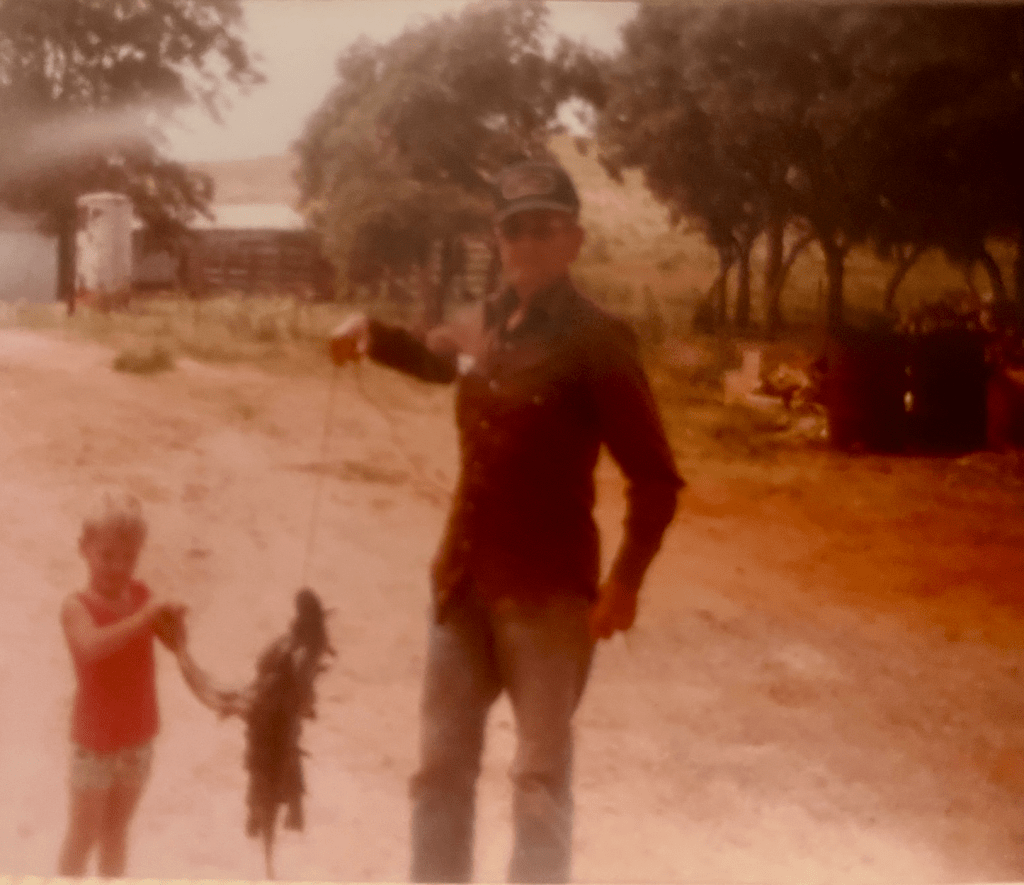
Grandson Raymond, and JD Groff

And that fishing trip wasn’t the last. That summer—his last summer—I ensured we went out as often as possible. Sometimes, it was just the two of us. I had always dreamed of this as a boy, watching the lake from our back porch. Other times, I brought my brother and my nephews along. Dad would hold court on the bank. He told stories and gave advice. He cast his line with the patience of someone who knew the water well. He knew the time was short.

We laughed, caught fish, and built memories like campfires—small moments that glowed long after sunrise.

That summer was magical.

It was the summer, and I finally got to take my dad fishing. And it was everything I had waited for.

The Legend of Bick Bickerstaff: Ticketing Liberace in Oklahoma

Benjamin GroffMedia© | benandsteve.com | 2025 Truth Endures©

3–4 minutes

The Man Who Wrote Liberace a Speeding Ticket

Lloyd Joe “BICK” Bickerstaff

When I was young, I had the privilege of working alongside some genuinely seasoned police officers. These were men who had been in the profession for decades. They carried with them a wealth of stories and experience. One of the most unforgettable among them was my Captain, Loyd “Bick” Bickerstaff.

Captain Bickerstaff was the first person I met when I interviewed for the job. He pulled for me to get hired, though I never quite knew why. Maybe he saw himself in me. He was around sixty when we met. At the time, I didn’t know much about his background. I quickly learned through stories from others that he was a legend in Oklahoma law enforcement.

Officers came from various places. If they stopped by our agency, they either knew Bickerstaff or had heard of him. He had that reputation. And if he happened to be off-duty during their visit, they left visibly disappointed.

I remember one particular day when I was on desk duty. A reporter from Time-Life came in. He said he was working on a piece about Route 66. He asked if he could interview Captain Bickerstaff. I told him to wait while I went to get the Captain.

Now, Bick wasn’t the type to jump at the chance to talk to the press—unless he had something to say. But when I mentioned a Time-Life reporter was here to see him, he promptly came out into the booking lobby and, in classic Bick fashion, boomed:

“I bet you want to ask me about that son of a bitch I wrote a ticket to back in the 1950s!”

At that moment, I thought, Well, this will be a PR nightmare. But to my surprise, he and the reporter hit it off. They wandered around the station talking and laughing. They even went outside. The photographer snapped pictures of Bick behind the wheel of a patrol car.

Maybe this won’t turn out so bad after all, I thought.

Still, I couldn’t help but wonder. What kind of ticket did someone get back in the ’50s? It still had reporters chasing the story.

When Bick returned, he shook the reporter’s hand, sent him off, and then strolled back to where I was working.

“I can tell your brain’s buzzing,” he said with a grin. “You want to know what that was all about?”

I nodded.

“Yeah, I’d say so. Stuff like this doesn’t happen every day.”

And so he told me.

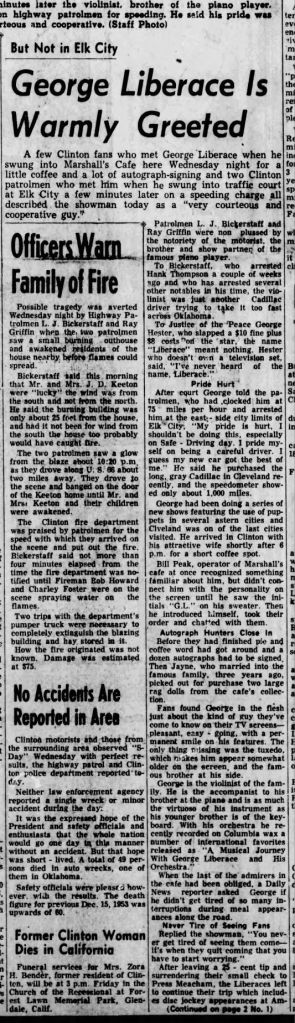
In the 1950s, Bick was a trooper with the Oklahoma Highway Patrol. In those early days, he patrolled on a motorcycle. One night, near Elk City, Oklahoma, a flashy car with California plates sped by him on Old 66. It was doing over 75 miles per hour or more.

He took off after it and got the car pulled over. It was late, and as he walked up to the driver’s window, the man inside said:

“Surely, you’re not going to write me a ticket. Don’t you know who I am?”

To which Bick famously replied:

“I don’t care if you’re Liberace—you’re driving like a bat out of hell. Yes, I’m writing you a ticket!”

And as it turned out, it was a Liberace. Liberace’s Brother George!

Bick wrote the ticket anyway. George Liberace followed Bick to the courthouse, paid it on the spot, and went on his way.

A few weeks later, Bick’s supervisor got a call from one of Liberace’s agents. They wanted to fly Bick to Hollywood to be on The Liberace Show. They thought it would be significant: the highway patrolman who dared to ticket a star. Bick said he couldn’t say no. The department thought it was good publicity, and it was.

Years later, people still talk about it. Unknowingly, I worked with the man who once wrote Liberace’s brother a speeding ticket. Bick told me –––


“Liberace brought me out on stage. He announced that I was the highway patrolman who wrote his Brother George a speeding ticket!”

Witnessing Tragedy: Lessons from a Highway Accident

Benjamin GroffMedia© | benandsteve.com | 2025 Truth Endures©

3–4 minutes

A Winter Night on the Highway

It was evening, and heavy traffic moved steadily along the narrow two-lane highway connecting small towns in the region. The road served as a lifeline, carrying motorists and buses through these quiet Oklahoma communities.

Law enforcement has fascinated me for as long as I can remember. My dad worked night shifts, patrolling the eastern region near the oil fields. In the summers, he served as a ranger at a nearby campsite. Winters drew him to different assignments, often more demanding and remote.

One of the state vehicles always remained parked at the ranger’s residence—our home—while my dad took the other on duty. That night felt like any other.

My bedroom was tucked into the back corner of the house. Even during winter, I often left the window cracked to let in the crisp night air. From there, I heard the distant hum of traffic about a mile to the south. 

As I lay on my bed studying for a test the next day, a sound split the quiet—a crash. Loud. Tires screeched. Then came the unmistakable bang of an impact.

It wasn’t the first time I’d heard it. A stretch of highway nearby had a reputation for accidents. Without hesitation, I grabbed my flashlight, told my mom there’d been a wreck, and jumped into the ranger truck. I had just earned my driver’s license, and the weight of responsibility was fresh on my shoulders.

Once on the road, I grabbed the radio and called it into the local police.

“It sounds bad—there have to be at least two vehicles involved.”

The Chief of Police from the nearest town confirmed he was en route. I pushed down the gas pedal and sped toward the highway. I noticed no cars coming eastbound as I turned onto it—an ominous sign. About two miles west, I saw the wreck.

A Greyhound bus had collided with a pickup truck. Both vehicles were mangled, partially in the ditch and partially blocking the road. The bus’s windshield was gone, and passengers were scattered everywhere—some dazed, others crying out.

The bus driver was lying in a yard 100 feet away. He was still strapped into his seat. The seat had been ejected from the bus. A man lay next to him. Both were dead. The bus had come to rest on the pickup truck, crushing its cab. 

Flames licked at the wreckage. There was no chance anyone inside the pickup had survived.

Before officers arrived, I radioed again:

“Get every ambulance in the county out here. This is bad.”

A bread truck delivery driver had just finished his route and stumbled upon the crash. Without hesitation, he unloaded his remaining bread onto the roadside. He began helping by filling his truck with victims to shuttle them to the hospital.

There had been thirty-two people on board. Survivors said a passenger had been drinking and became increasingly aggressive. The driver warned him to settle down, but the man charged ahead and grappled with the driver. That man now lay dead beside him in the yard.

The response was massive—five police agencies, three fire departments, and four ambulance services. That same night, a basketball tournament had drawn spectators to a nearby town. Many who had been on their way became unexpected witnesses to a horrific scene.

Inside the crushed pickup were two passengers—the aunt and uncle of a local fire chief. The tragedy hit close to home.

Years later, as a police officer, I would respond to countless serious accidents. But none would ever match that cold winter night’s scale. None equaled its raw emotion. It was the first crash I saw with my own eyes.

The Heartbeat of Small Towns: Lessons from Main Street

Benjamin GroffMedia© | benandsteve.com | 2025 Truth Endures©

4–6 minutes

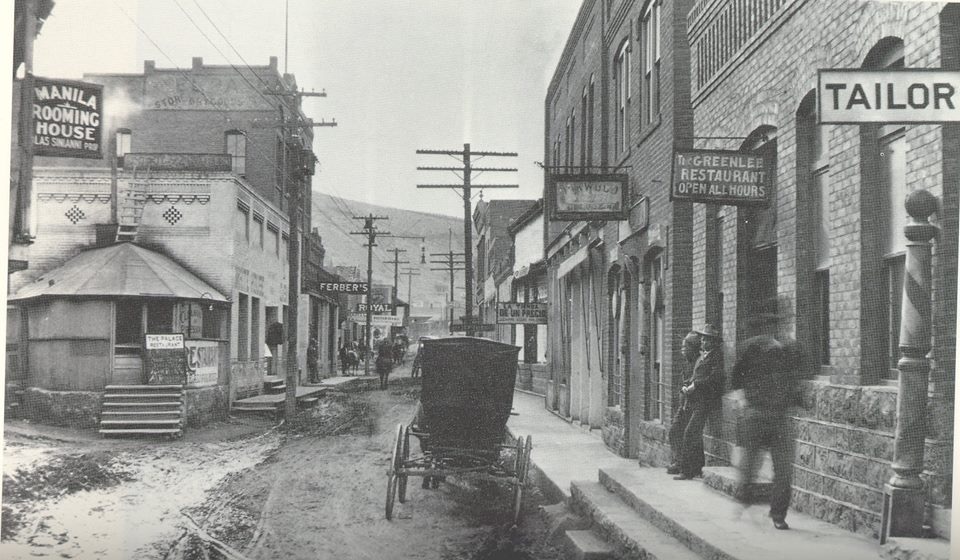
The Old Main Street

The Old Groff House
The Groff House, first moved to Binger from Anadarko.

Our move to the farm east of Binger, Oklahoma marked a drastic change in life. It was vastly different from our life in Cordell. My dad had bought a house set on a modest foundation. A propane stove heated it. There was no running water. We had no telephone. The electricity worked until a snowstorm or thunderstorm blew through and took it down. In time, things would improve, but first, we had to learn a new way of living.

Each evening, my dad brought home two five-gallon containers of water and set them on the kitchen floor. Hanging above them was a metal ladle, which we all used to scoop ourselves a drink. It was a crude method, but it worked—and we didn’t think twice about it.

Going to the restroom was another matter. Several attempts had been made to drill wells, but all came up dry. My dad had the holes filled in, except one. Over that one, he placed an old-fashioned outhouse—worn, sun-bleached, and splintered. It looked fifty years old, and maybe it was. But he fitted it with a new toilet seat, and we used it like it was brand new. The worst part? The yellow jacket wasps that swarmed it in summer. They built their cones overnight, and chasing them off was a risky job that none of us looked ahead to.

This story isn’t about the outhouse or the water jugs. It’s about the town’s Main Street during that time. The impression it left on me was significant. I was only five years old, but the images are burned into my memory.

My dad was the town barber. His shop sat on a steep sidewalk, at least three feet above the street. Set into the concrete were old metal rings. For the longest time, I had no idea what they were for. One spring morning, I was playing on the sidewalk. I was flipping one of the rings back and forth. An old timer stopped and looked down at me.

“Do you know what that ring is for, Sonny?” 

He asked.

I shook my head. 

“No.”

He grinned. 

“Those were for tying up horses and wagons. Back in the day, folks would come to town on Saturdays—buggies and wagons lined this whole street. Horses everywhere.”

That answered a mystery I’d long wondered about. But there were more to come—and like those rings, they’d slowly be explained to me, one by one.

That same sidewalk saw a lot of stories. I remember one day. A slick Chevrolet four-door pulled up. Two men and their children—a boy and a girl—went into the drugstore next to Dad’s barbershop. My oldest brother had come into town to visit and was sitting in the shop when someone waiting for a haircut suddenly shouted, 

“FIRE! FIRE! THAT CAR IS ON FIRE!”

The man bolted into the drugstore to alert the others. Someone must’ve called the fire department—but “fire department” was a stretch. The town had a 1945 fire truck with a rusted tank and an engine that wouldn’t start. They had to tow it with another truck to get it to the fire. My brother ran to the car and had one of the men pop the hood. Without hesitation, he ripped off his shirt and began beating out the flames around the carburetor.

The twins—those two kids—stood next to me on the sidewalk, watching. They would later become my classmates and lifelong friends. That introduction during the chaos would forge a connection we kept through the years.

My brother eventually put out the fire. The fire truck, still leaking water, finally rolled to a stop behind the car—just as the tank began to empty. The scene would’ve been funny if it hadn’t been so sad. Laughter erupted from my dad’s shop. The volunteer firefighters were embarrassed, and I remember feeling bad for them.

It wasn’t the last mishap. Months later, a house caught fire just behind the fire station. The truck’s wheels locked up that time, and it couldn’t even be towed out. The town then decided it was time for a new truck. 

Through donations and fundraisers, they finally got one. The arrival of the new fire truck was a significant moment in our town’s history. It was a testament to our resilience and the importance of community support. It was a real point of pride—a saving grace when it finally arrived.

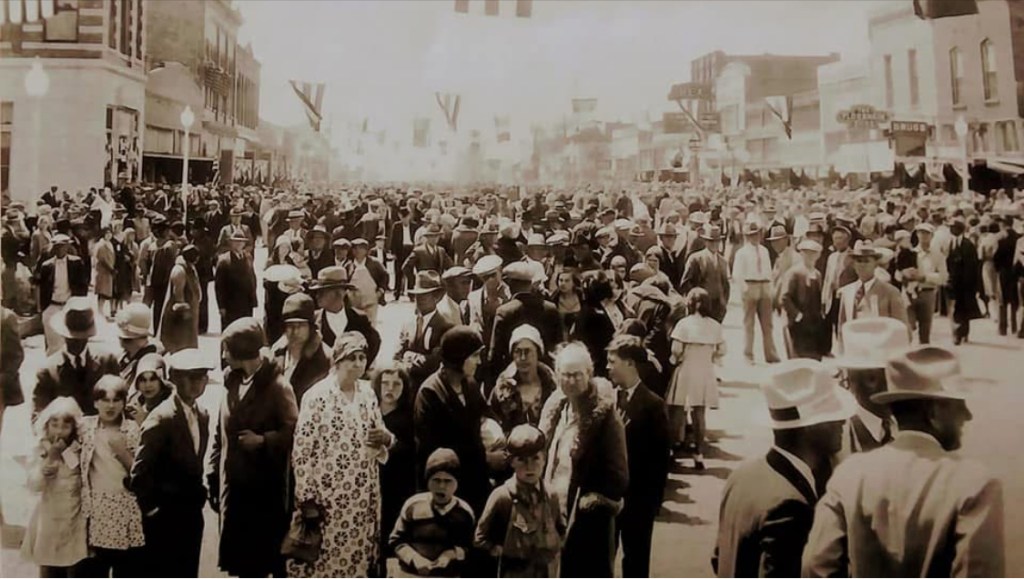
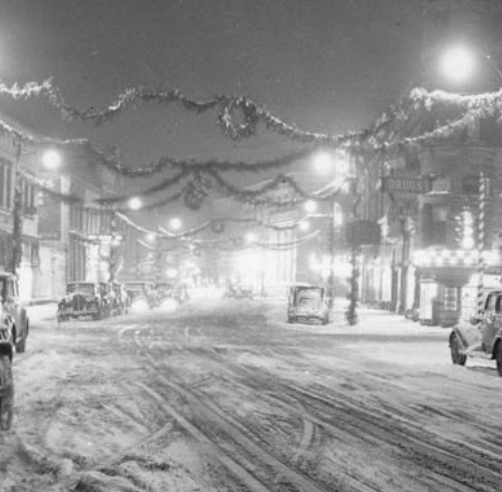
Main Street had its beautiful moments, too, especially at Christmas. The decorations draped across the street like something out of It’s a Wonderful Life. Seeing them lit up at night turned Main Street into a glowing wonderland.

One Christmas, the town threw a parade. The governor came. And so did our hometown hero, Johnny Bench, riding in the back of a convertible. I stood beside my dad in front of his barbershop, watching as they passed by. It was one of the biggest things to happen to our little town of 750 souls.

Main Street had different values back then, too. I remember a funeral procession once drove through town. My dad stopped cutting hair and closed the shop until the last car had passed. Other businesses did the same. That quiet gesture of respect left an impression on me that’s never gone away.

Looking back now, I realize that old Main Street was more than just a stretch of asphalt and storefronts. It was the heartbeat of a simpler time. Life was slower and more mindful then. It taught me about community, kindness, hard work, and the small moments that shape our lives. Those sidewalk rings, flickering Christmas lights, and clunky fire trucks are gone, but the memories stay. And in my heart, Main Street still stands—just as it was.

Lessons from a Fateful Day at Sayler’s Lake

Benjamin GroffMedia© | benandsteve.com | 2025 Truth Endures©

4–6 minutes

A Day at Sayler’s Lake

Sayler’s Lake, SH152 Binger, OK

Growing up, it often felt like there wasn’t much to do. With six siblings and a life rooted on the farm, family trips or outside adventures seemed few and far between. But looking back now, I see how much my parents did to involve us in meaningful experiences.

They took us to local places of interest. They spent time with each of us in ways many parents couldn’t. At the time, I thought we were the ultimate close-knit family. My dad and I shared rodeos, horse sales, parades, and trail rides. He and my mother supported my sister’s love for basketball, attended games, and nurtured her talent. Another sister was given a piano, music lessons, and encouragement toward college. One of my brothers was allowed to buy into the farm and build a home. The two oldest boys had long since charted their paths. One went into the Marines. The other entered a world that eventually led to affluence. But no matter how far they went, they always came home for the holidays.

My mom’s youngest brother—my uncle—was a bonus sibling. He’d been born late in my grandparents’ lives, and as a teen and young adult, he often lived with us. He’d served in Vietnam. Though he was quiet about it, he carried a weight we all respected—even if we didn’t understand it fully.

One weekend, something unexpected happened. When I was 9, my uncle and brothers convinced my dad to take us to the lake. It was a rare outing, especially with all of us. I’d heard stories of him taking the family boating at lakes years before I was born. Yet, he had stopped going by the time I came along.

This lake trip, still, wasn’t a return to those stories. It was just up the road—Sayler’s Lake. It wasn’t much to look at. An old log cabin marked the entrance. The water looked murky and unsettling—it resembled a scene from a horror movie. Locals whispered that the lake had claimed lives—more than a few. It didn’t seem right, but the place had a reputation.

We arrived around 10 a.m. I was eager to get in the water, but my mother insisted I wear a life vest. I didn’t know how to swim, and she wasn’t taking any chances. I hated the bulky vest, but hated the thought of drowning more. My sisters had taken swimming lessons when we lived in town—those services didn’t exist where we were.

I paddled around, watching others enjoy themselves. 

Across the water, people were diving from a rocky cliff. Some men dove headfirst, then climbed back up and did it again. It looked reckless, almost like a dare to death. Then, one of them dove in—and didn’t come back up.

I’ll never forget the girl on the cliff yelling, 

“Where is he?”

People jumped into action. After five or ten long minutes, someone pulled his body from the water and dragged him to shore. The owner of the lake raced down in a pickup and began CPR. I stood there, stunned. It was the first time I’d ever seen someone dead—or nearly dead—pulled from water.

Then, the town ambulance arrived. It wasn’t like the ones you see on TV—it was a white Buick station wagon. An old man climbed out carrying an oxygen tank. When the victim’s friends saw him, they shook their heads and told him it was too late. 

“You need a body bag.” 

One of them said.

I didn’t know what a body bag was. But I figured it out when the old man pulled a stretcher from the back of the car. With the help of bystanders, he loaded the man’s body. Out of compassion, he turned on the red lights and the siren. Then he drove off.

I returned to where our family had set up a picnic. I don’t remember what I said—maybe something a little too grown-up or too curious—but I remember my father flicking me on the ear and speaking sharply, 

“You aren’t quite that old yet.”

I’ve often wondered what that moment meant to him. Maybe he wasn’t angry—he was just shaken. Perhaps he didn’t want me to see what I had seen. That day made me grow up faster than he wanted. He liked to keep things under control, and this wasn’t one of those things.

Life doesn’t always allow us to choose the lessons we learn. Sometimes, they arrive uninvited on an ordinary day by a haunted lake.

When we arrived home that evening, the television was on in the living room. The news was starting. And there it was—Sayler’s Lake. A reporter stood near the very spot we’d been earlier, microphone in hand, delivering details about the drowning. I sat in disbelief, watching the event replay like it belonged to someone else’s world, not ours.

I remember thinking: How did they find out so fast? How had the news team gotten there? How did they film the scene, return to the station, and prepare the report all before dinner? It made the whole thing feel surreal—too real but somehow distant. The reporter confirmed what we had already feared. The man had died.

That moment glued itself to my memory. The sound of the television stayed with me, and the familiar living room around me lingered in my thoughts. The weight of what we had observed just hours earlier was still there. It layered into a quiet understanding. The world outside our farm can change in an instant. Sometimes, there are no answers—just echoes left behind by events too big to fully grasp.

A Close Encounter: Horseback Riding and a Snake Surprise

Benjamin GroffMedia© | benandsteve.com | 2025 Truth Endures©

3–5 minutes

When a Snake Crosses Your Path

Photo by Turuncu Sakal on Pexels.com

I was nine when my dad, sisters, and I rode horseback along the four-mile-long road circling our property. My dad liked the longer ride of four miles. He guided the horses through the deep sand that had accumulated in the red dirt of Western Oklahoma.

It was a bright, crisp spring afternoon. The season had warmed the land for several weeks. Still, I wore a light jean jacket to ward off the lingering chill.

Riding with my dad was always a solemn occasion. We never spoke much; we rode. Yet, when we returned home, we understood each other completely. Words weren’t necessary—the simple joy of riding together across the open land spoke directly to the soul.

Like my sisters, I had been on horseback since I could remember. My dad had propped me up in the saddle before I could sit upright. I considered myself a decent rider. Still, I was nowhere near my father’s skill. He seemed to move with his horse as though they were one being.

That afternoon, I sensed that my sisters were there more out of duty than enjoyment. Their smiles felt forced, their laughter shallow. Though they didn’t do it outright, I could tell their hearts were elsewhere. I didn’t think this would be the last time they rode with us. They were growing up. My sisters were drawn to other interests. They were leaving behind the horses that had once been a central part of our childhood.

Photo by Darya Sannikova on Pexels.com

I was the fourth rider in our single-file procession, coming behind my dad and sisters. We had traveled this route countless times. I knew the landmarks well. There was an oil well pump that sometimes startled the horses. Barking dogs lived at a neighbor’s line. A tattered rag flapped from a barbed-wire fence. These were the things that made a horse shy, and I took note of them with each ride.

We had covered nearly three miles when I noticed my dad and sisters had gained some distance ahead of me. It was just a few lengths, nothing unusual. But as I would later learn, riding close together has its benefits.

As we neared a mainly sandy stretch of road, my oldest sister turned in her saddle. She glanced back at me. Her expression was unreadable, but how she looked made my stomach tighten.

And then I saw it—a six-foot black bullsnake slithering onto the road.

It had watched the first three horses pass, believing the coast was clear. But I was still coming. Just as my eyes locked onto the snake, my horse saw it, too.

Photo by hayriyenur . on Pexels.com

His reaction was immediate—dodge and run.

My horse reared before I knew what was happening, jerking to the left while I pitched to the right. The world tilted, and sand rushed up to meet me. Then, there was an impact. I hit the ground hard, my breath escaping in a sharp gasp.

I hated snakes. At that age, I was convinced they were all out to kill me. I was lying in the dirt. My heart pounded as I scrambled to my feet, half-expecting the snake to strike. But my faithful horse hadn’t abandoned me. The horse trotted back, ears flicking, nostrils flaring with the same nervous energy I felt.

Ahead, my dad turned in the saddle, completely unaware of what had just happened. He saw me standing there, dust-covered and rattled, and called out in his usual no-nonsense tone:

“Would you quit fooling around and get back on your horse?”

Photo by Bozan Gu00fczel on Pexels.com

I was “fuming.” I muttered curses under my breath—at my horse, my dad, and that wretched snake. And at myself for not anticipating the spook that can send a horse sideways.

I climbed back into the saddle. I was convinced the snake would follow us up the road. It would try its luck again. It didn’t. But my horse remained, shying at every stick and shadow for the rest of the ride.

When we finally arrived home, I unsaddled and brushed him down, smoothing his coat and murmuring reassurances. He had been just as much a victim in the afternoon’s chaos as I had.

That afternoon was the second time I was ever thrown from a horse. The last time came when I was twenty. I was riding a high-spirited horse that my dad no longer handled. That horse was downright mean—no snakes needed to send him bucking.

Three Impacts of a Collision Explained

GROFF MEDIA 2024© TRUTH ENDURES IMDBPRO

Presented by benandsteve.com By: Benjamin Groff II©s

2–3 minutes

Understanding the Three Impacts in a Collision

Photo by Pixabay on Pexels.com

We often think there is just one impact when imagining an accident. Be this is a fall, a bicycle crash, or a car collision. Yet, physics and medical studies, based on rigorous research and analysis, show that every crash has three distinct impacts. Each one contributes to potential injury.

Let’s use a crash as an example, though the same principles apply to other accidents.

Impact #1: Vehicle Collision

This is the first crash. The moving vehicle collides with another object. Whether it is a wall or a stationary object. The force of this impact determines the severity of the accident.

Impact #2: Body Impact

Even after the vehicle stops or slows down, the occupants continue moving ahead due to inertia. This often causes a secondary impact. The person collides with the car’s interior, like the dashboard, windshield, airbag, or seatbelt. It’s important to note that seatbelts and airbags play a crucial role. They reduce injuries and make us feel safer on the road.

Impact #3: Internal Organ Impact

The most overlooked but critical impact happens within the body itself. Even after a person stops moving, their internal organs shift and collide with bones and other structures. This can lead to serious injuries like concussions, internal bleeding, and organ damage.

Delayed Symptoms and the Body’s 

Response Of The Body instantly after an accident, many people don’t feel the extent of their injuries. Adrenaline and shock mask the pain. The body naturally responds by triggering inflammation and swelling to protect damaged areas. Yet, once this response subsides—sometimes hours or even days later—the true severity of injuries becomes obvious.

The Delay Between Sight and Sound in a Crash

If you witness an accident from a distance, you notice another phenomenon. There is a delay between what you see and hear.

Because light travels faster than sound (186,000 miles per second vs. 1,125 feet per second), you will see a crash before you hear it. This creates a lag, where the sequence of events seems different from what happened.

Photo by Pixabay on Pexels.com

For example, if a plane crashes and explodes, a witness will report hearing multiple booms and assume three separate explosions. In reality, they are hearing the first impact, secondary collisions, and final resting impact—all of which happened quickly. The delay in sound reaching the observer can create confusion, especially during traumatic or high-stress situations.

Key Takeaways

  • Accidents involve three distinct impacts: vehicle collision, body impact, and internal organ impact.
  • Injuries are not always instantly clear, as the body’s natural mechanisms can mask symptoms.
  • Witnesses misinterpret the sequence of events because of the delay between light and sound. Hence, investigators must analyze physical evidence carefully.

Understanding these factors can help individuals recognize the risks involved in crashes. They can then make informed decisions about safety and medical attention.

The Long Holiday Journey: Family Moments on the Road

GROFF MEDIA 2024© TRUTH ENDURES IMDBPRO

Presented by benandsteve.com By: Benjamin Groff II©s

3–4 minutes

The Long Holiday Ride

Going Home
The Miller Family Going Home For the Holidays,

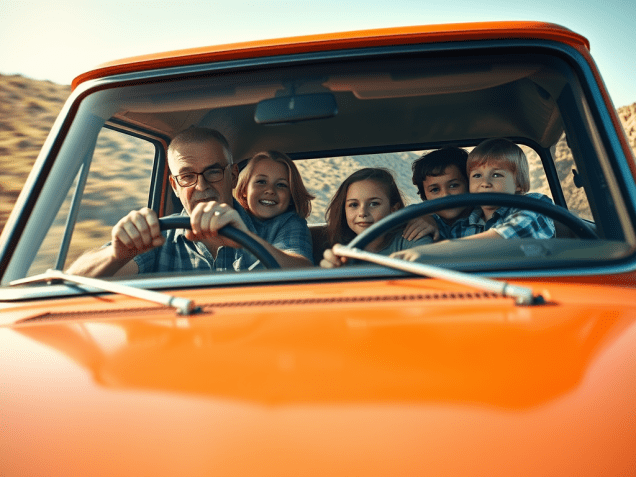
The old pickup truck rattled down the highway, packed tight with the Miller family. The father, Dale, gripped the steering wheel, his sharp eyes scanning the road ahead. Beside him, their mother, Janice, balanced a warm dish of sweet potatoes wrapped in a towel on her lap. Every thirty seconds she would let out a ‘hiss,’ and reach for the dash, her only comment to Dale’s driving. In the same seat, the children jostled for space. Clayton, the eldest at twenty-two, leaned against the window with his arms crossed. His younger sisters, Maggie and Rachel, squeezed in beside him. Then there was little Jack. He was the baby of the family, barely eight, and sat between his sisters. His feet barely touched the floor.


It was the same every year. They drove forty miles on bumpy roads. Gravel spat against the undercarriage. The chilly air sneaked in through cracks in the old truck’s frame. The family’s first stop was Janice’s side, the sprawling Henderson clan, where a sea of cousins, aunts, and uncles waited. The noon meal would be loud, laughter filling the air along with the scent of roasted turkey and homemade pies.

Clayton was ever the quiet one. He watched the open fields pass by. Meanwhile, Maggie chattered about the games she’d play with her cousins. Rachel checked the food in the back. She made sure nothing had tipped over. Meanwhile, Jack, restless, kicked his feet. He asked every ten minutes, “How much longer?”

When they finally pulled into the driveway of Janice’s childhood home, they heard the noise instantly. It hit them before they even got out of the truck. Kids ran around the yard. Adults stood in clusters laughing. The kitchen was an organized chaos of steaming dishes and busy hands. The family squeezed through the door, greeted by warm hugs, as coats were peeled off and plates were filled.

After lunch, games and stories took up the afternoon. Clayton found himself talking with an uncle about work on the ranch, while Maggie and Rachel gossiped with their cousins. Jack, after an impressive three plates of food, ran outside to join a game of tag. Dale was talking to his favorite brother-in-law, about a horse he was bringing along.

But there was no time to linger too long. As the sun began to sink, Dale gave the usual call: “Time to load up! We still got another stop!” They groaned and said their farewells. Everyone piled back into the truck with full stomachs. Hands waved through the window.

The second stop was Dale’s side, a quieter gathering with just his sister’s family. Fewer cousins, a calmer atmosphere, and jokes cracking from Bus and Virgil. Aunt Sis served coffee and pie, and the talk was slower, nostalgic—old family stories, memories of Christmases past.

Rachel curled up in a chair with a book while Maggie helped Aunt Sis in the kitchen. Jack, fighting off sleep, leaned against his mother, his eyes drooping. Clayton sat with his dad and uncle, talking about the year’s crops and the price of cattle.

By the time they left, the truck was much quieter. The ride home was filled with drowsy murmurs, Jack fast asleep against his mother’s side. Rachel and Maggie leaned on each other, the warmth of the long day still lingering. Dale, was dreaming of all the memories he had been reminded of while seeing his folks and kin.

As the headlights cut through the darkness, Dale glanced in the rear view mirror at his family. It was a long trip every year. Yet, as he looked at his wife and children—fed, happy, and together—he knew it was always worth it.

The holidays weren’t about the miles traveled, but the moments shared. He never had a million dollars, but he sure felt like it.

A Personal Journey Through America’s Must-See Cities

GROFF MEDIA 2024© TRUTH ENDURES IMDBPRO

Presented by benandsteve.com By: Benjamin Groff II©s

3–4 minutes

A Few Of The Places I’ve Been

Photo by Rajiv Krishnan on Pexels.com

A few places I’ve been are not just locations on a map. They are experiences, sensations, and moments that can’t be conveyed simply through words or photographs. You would have to have been there to understand.

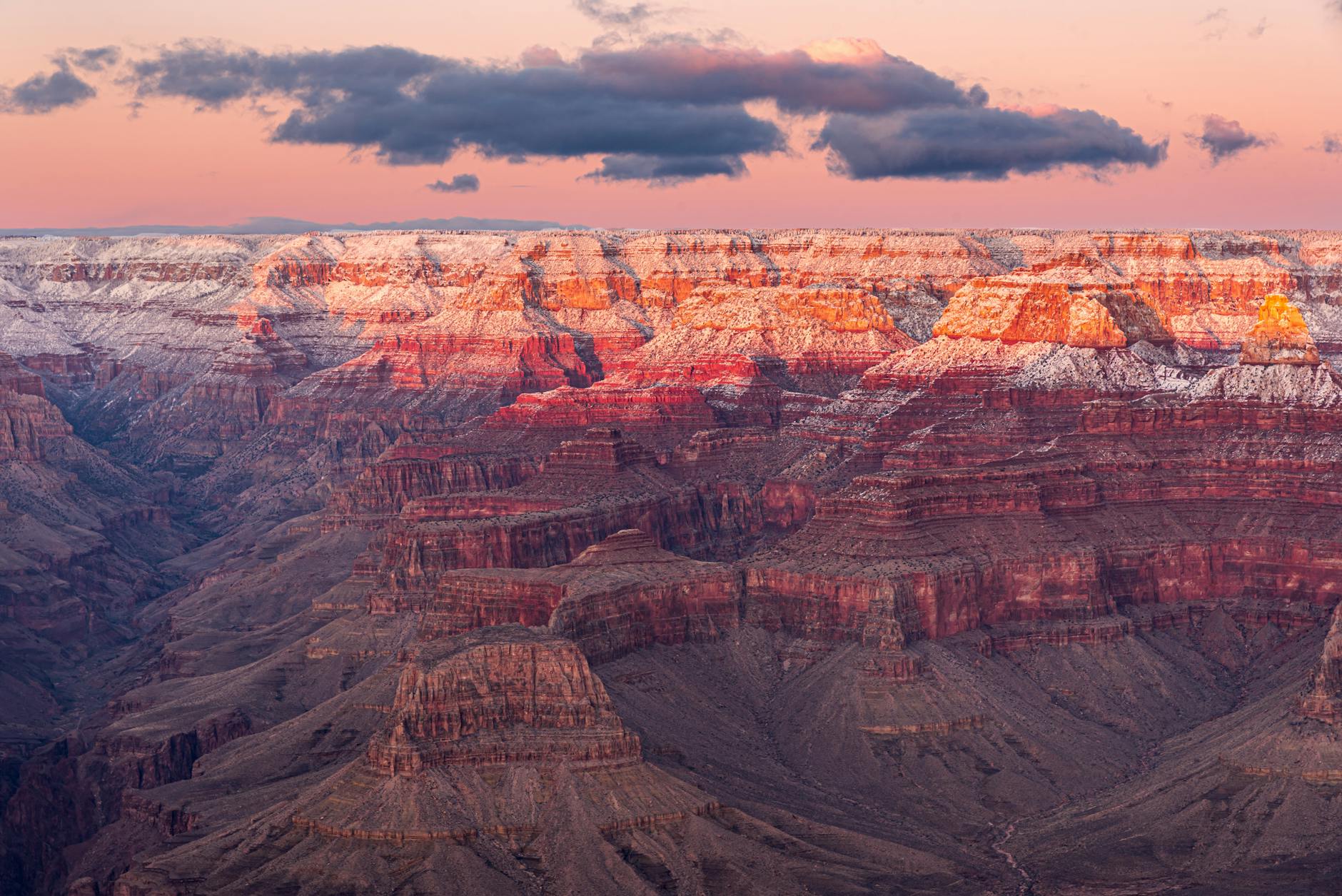
Take the Grand Canyon, for example. No photo can capture its overwhelming vastness. Standing on its rim, you stare into the depths of time carved into the earth. The wind carries whispers from a million years ago, and the sun paints ever-changing shadows along the canyon walls. To see a picture is to miss how the air smells. You miss how the silence hums. Your perspective on life shifts when faced with something so immense, leaving you in awe of nature’s grandeur.

Groff Media

Washington, D.C., is another place to experience and be understood. Walking among its monuments and institutions is like stepping into a living history book. The weight of past decisions and the ongoing creation of history are tangible. You stand where the nation’s most influential figures have walked. It fills you with a profound connection to the past. It also connects you to the current time. It makes you feel like a part of history.

Groff Media

Then resort cities like Palm Springs, California, Tampa, Florida, and Las Vegas, Nevada. Each city offers a unique atmosphere that cannot be fully captured without being there.

Palm Springs feels like a cinematic escape. It is where you can brush shoulders with a movie star. You will find yourself surrounded by towering mountains on one side. There is an endless sea of wind turbines on the other. It’s all swimming pools, sunshine, and Hollywood glamour between the two. It makes you feel like you’ve stepped into the pages of a luxury magazine.

Tampa, Florida, has its distinct charm. The old cigar district, Ybor City, takes you back in time with its historic brick streets and family-owned restaurants. It offers an eclectic mix of tattoo parlors, jewelry shops, and late-night clubs. Just a short drive away, the sun-drenched beaches of St. Pete offer the perfect contrast—soft sand, rolling waves, and the scent of saltwater in the air.

Fremont Street
Groff Media “A Night On The Town”

Las Vegas is a city of dual identities. The Strip dazzles with its colossal casinos, neon lights, and grand-scale entertainment, a modern marvel of excess and spectacle. But downtown, the Fremont Street Experience transports you to old Vegas. Here, the first hotels still stand beneath a digital canopy of flashing lights synchronized to music. Street performers, quirky shops, and hidden gems make it an adventure.

Salt Lake City, Utah, left an impression on me not just for its skyline but for its architecture. The intricate designs of its buildings make the city itself a work of art. The influence of the Mormon faith is woven into nearly every aspect of its layout and culture. This influence gives the town a sense of unity and purpose. It is both fascinating and humbling.

Oklahoma
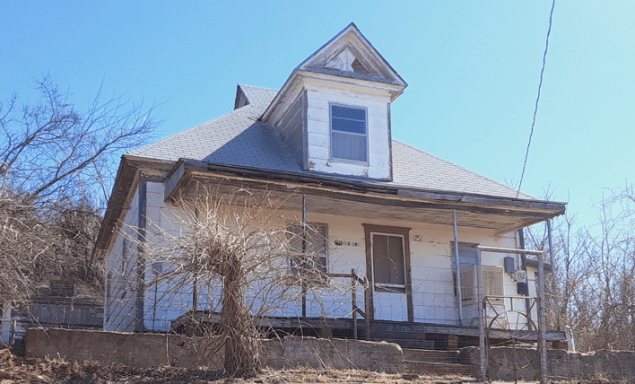
Oklahoma’s Last House Standing Groff Media

And then, there’s Oklahoma and Kansas—where the wind is an ever-constant force, shaping the land and the people. A 40-mph breeze is just another Tuesday, with gusts often reaching 70 mph. Tornadoes and earthquakes occur sometimes at the same time. Many people think Interstate 40 and Interstate 35 are the most significant things to come out of those states. These highways offer an escape route from the relentless winds sweeping across the plains.

Each of these places has left an imprint on me. It’s not just because of what they look like. It’s also because of what they feel like. And no matter how well I describe them, you’ll never truly know unless you’ve been there yourself.
Memories and Mischief: The Summer of 1980

GROFF MEDIA 2024© TRUTH ENDURES IMDBPRO

Presented by benandsteve.com By: Benjamin Groff II©s

2–4 minutes

The Summer of 1980

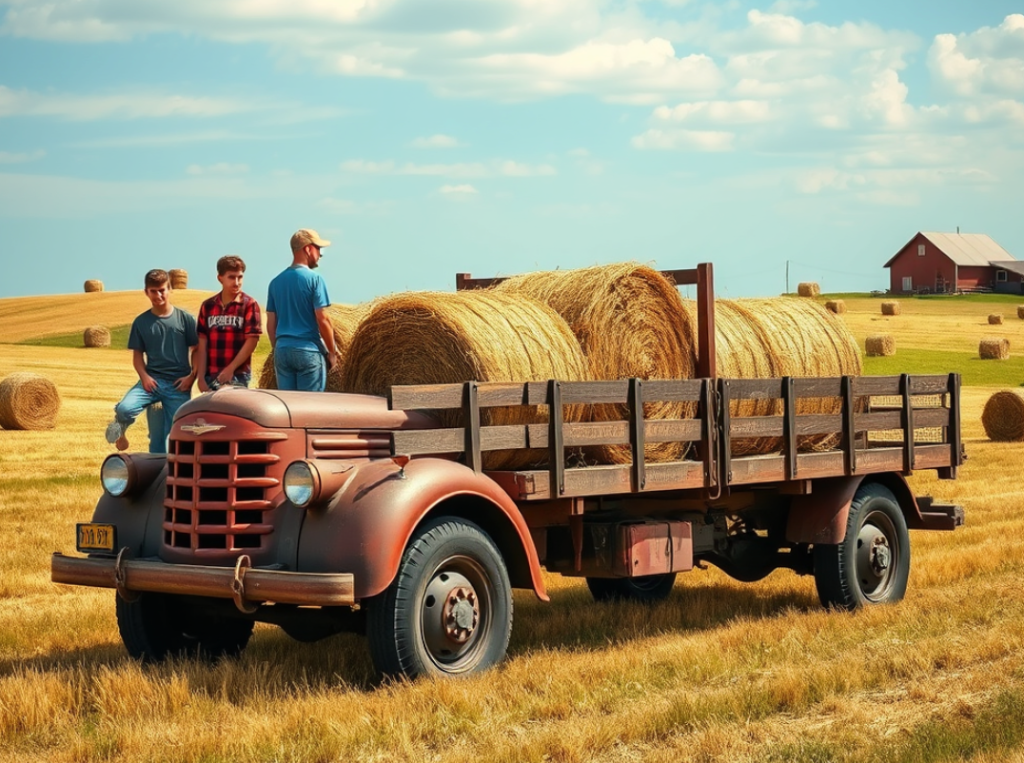
The summer of 1980 would be remembered forever. It was the year three friends—Bub, Johnny, and Clem—took to the hayfields, hauling bales for farmers across the county.

They set out to help the local farmers with two old flatbed farm trucks. The farmers struggled to find enough hands to get their hay cuttings into the barn. What started as a way to earn cash quickly became much more significant.

The boys took turns driving. Two worked at the back of the truck, stacking and securing the bales. They did this while bumping along dirt roads. When they reached a barn, all three pitched in to unload. It was grueling work. It was hot, dusty, and backbreaking. They made a decent sum at fifteen cents per bale when split three ways. More importantly, they earned something money couldn’t buy: the respect of an entire community. Their work ethic, reliability, and bargain rates made them invaluable, and grateful farmers often sweetened the deal with generous tips.

Word spread fast. Soon, the boys had more work than they handled. They got their hands on a third truck and fixed it up. Each took charge of their own rig. They hired extra help to keep up with demand. By summer’s end, the three had hauled an unprecedented amount of hay. No one remembered seeing so much in the valley.

But it wasn’t all work.

The boys had a playful streak, and the town delighted in their antics. One night, Clem slept soundly in their makeshift bunkhouse. Bub got the idea to spread hair remover gel over Clem’s hairy legs. Hours later, Clem woke to a strange smell. He wrinkled his nose. He assumed one of the others had eaten something bad. He groggily rolled over and went back to sleep, unaware of the smooth patches forming on his legs. The next day, Clem discovered the damage in the shower. He saw the damage and heard Bub and Johnny howling with laughter outside the bathroom door.

Clem didn’t get mad. He got even.

At noon, he played the perfect gentleman. He told Bub and Johnny that he held no grudges. He wanted to treat them to lunch. They stayed behind at the barn. He ran to the burger joint and ordered the most enormous double cheeseburgers. There was also a mountain of fries and chocolate malts. For himself, he ordered vanilla. Before returning, he slipped some laxatives into the chocolate malts.

The unsuspecting pair devoured their meal, thanking Clem for his generosity, utterly unaware of the payback coming their way. Four hours later, they were running to the bathroom non-stop, clutching their stomachs, confused and miserable. Clem stood back, arms crossed, grinning. Their “cleaning out” lasted for days. When the town caught wind of the prank, it only added to the growing legend of the hay-hauling boys.

The mischief didn’t stop there.

There were ambushes, booby traps, and endless laughter. Even with their busy schedule, they found time to fish. They caught some of the biggest catfish the town had ever seen.

By summer’s end, they had built more than a successful hay-hauling business—they had created memories that would last a lifetime. Long after the last bale was stacked, folks in town would still talk about the summer of 1980. During that summer, three hardworking boys became the heart and humor of the valley.

Boise City: The Unusual WWII Bombing Incident

GROFF MEDIA 2024© TRUTH ENDURES IMDBPRO

Presented by benandsteve.com By: Benjamin Groff II©s

2–3 minutes

You have heard the news. South Korean forces mistakenly bombed a civilian area, thinking it was a training site. You ask how such a mistake happened? But did you know it isn’t the first time it has happened?

It happened in the United States when the U.S. Army accidentally bombed Boise City, Oklahoma, on July 5, 1943, during World War II. The attack on the homeland wasn’t the only time the Army bombed the continental United States during the war. It was a friendly fire incident. There have been other cities bombed in the United States by mistake, in Texas and Nebraska. The United States has even accidentally bombed Switzerland during World War II, killing over 80 people. But this story is the one I have heard described with color and moments of community involvement.

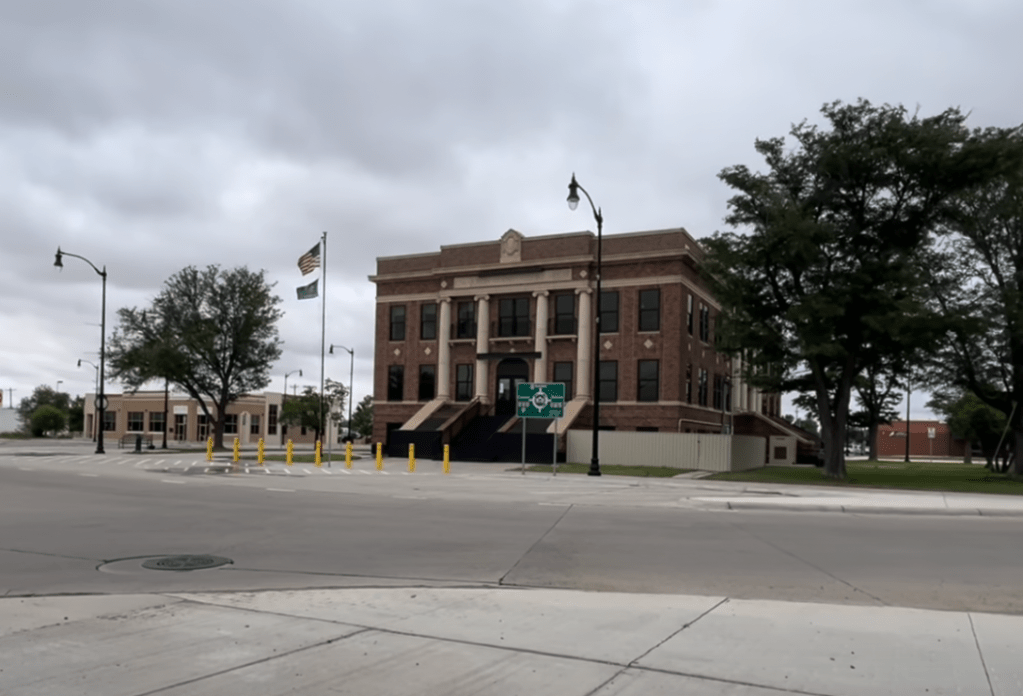
Cimarron County Court House
Cimarron County, Oklahoma

I have visited Boise City, and locals will tell you the pronunciation is, as you would say, “Boys City.” The town is small. You arrive at the courthouse circle as you enter from the east or north. A highway leads west into New Mexico. A trail takes you south toward Texas. The better highway is east of the town. Colorado is just up the road to the north. Kansas is just a jog to the Northeast. More of Oklahoma awaits out to the east. The community hasn’t grown much since it first sprung up.

Hearing locals tell of what happened in Boise City, Oklahoma, is somewhat comical. Nonetheless, it would not have been so funny to those who lived through the experience.

It happened on July 5, 1943.

A B-17 Flying Fortress bomber was on a nighttime training mission from Dalhart Army Air Base in Texas. It mistakenly dropped six practice bombs on Boise City’s town square. These bombs were mostly filled with sand and small charges.

What Happened?

  • The bomber crew was supposed to hit a designated target outside Conlen, Texas. They got lost and mistook Boise City’s well-lit downtown for their practice site.
  • At around 12:30 AM, the first bomb landed near a garage, shaking the town awake.
  • Five more bombs followed, hitting areas near businesses, a church, and a residential district.
  • Miraculously, no one was injured, and the damage was minimal.

Aftermath

  • The Army quickly apologized for the mistake.
  • The town embraced the incident as a quirky part of its history.
  • Today, Boise City proudly commemorates the event with a replica bomb displayed in the town square.

It remains one of the most unusual incidents in U.S. military training history! Would you like any more details?

If you ever go through Boise City, Oklahoma, stop and have a meal. As you travel west, you will hear more stories. These stories are about people living in what many consider the last town worth stopping in. Then, you move on to your next stop.

The Great Bison Incident: A True Survival Story

GROFF MEDIA 2024© TRUTH ENDURES IMDBPRO

Presented by benandsteve.com By: Benjamin Groff II©s

3–4 minutes

The Great Bison Incident (A True Story)

Carney had no idea what his neighbor, Ted Ortiz, had done. Ted had recently purchased what everyone around here called a buffalo—though, technically, they were bison. His grand idea? Cross-breeding the massive bull with his cattle. What is there to go wrong?

That morning, Carney had spent hours plowing one of his fields. When he finally finished, he hopped down from his tractor. He stretched his back and pulled out his packed lunch—a simple sandwich and a thermos of water. After a few quick gulps, he was ready to tackle the next field.

He set off across the pasture, taking his usual shortcut. Halfway across, he heard a deep, rumbling snort behind him. At first, he figured it was just one of Ted’s cows and kept walking. But then he noticed something—the snorting sound was moving with him.

Carney turned around and froze.

A massive, very annoyed bull bison stood just a few yards away. And Carney had unknowingly interrupted the beast’s afternoon of affection.

The bison pawed the ground, snorted louder, and locked eyes with Carney. He had seconds to decide—fall, play dead, or run like hell. He chose the latter.

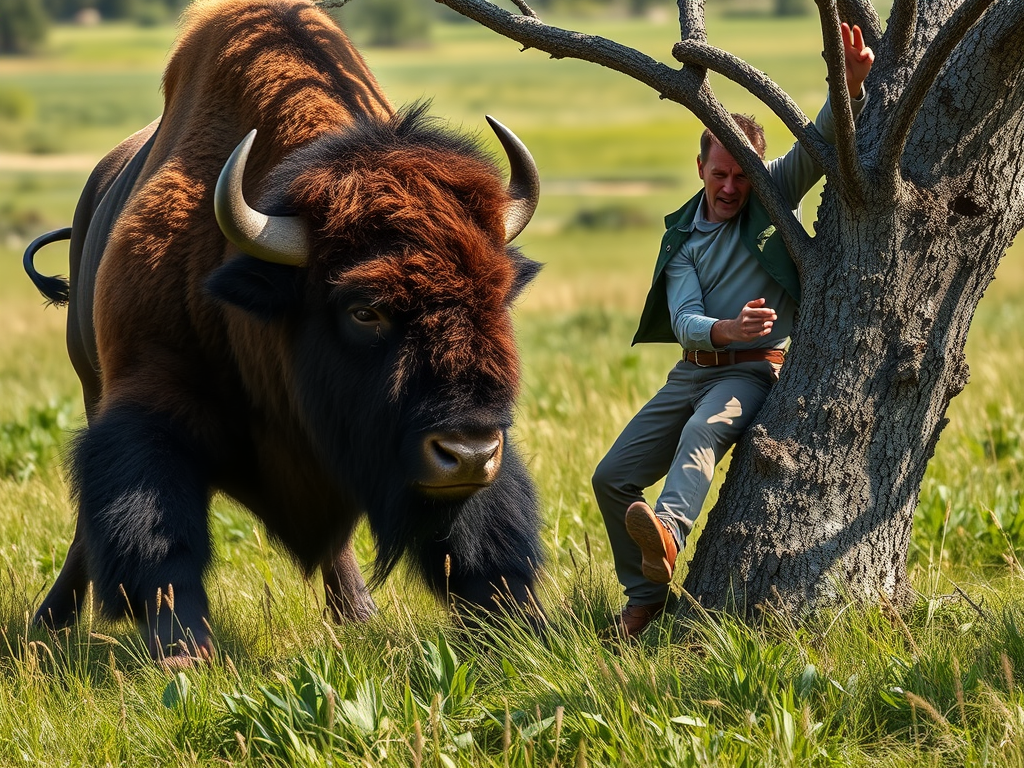
Now, Carney was in his fifties. He was not exactly a sprinter, but he moved like an Olympic athlete when faced with a furious bison. His only hope was a nearby tree. He scrambled up, arms and legs flailing, barely reaching a branch as the bull slammed into the trunk below.

Unfortunately, Carney had picked the wrong tree.

It was dead.

The bison rammed it again. The whole thing groaned and wobbled. Carney had two choices—jump and run or ride the tree down like a doomed cowboy in a slow-motion disaster.

So he jumped. And ran.

And here’s where things took an unexpected turn.

Carney swears he made it to the fence, jumped over, and escaped without a scratch. But according to the newspaper, the story went a little differently.

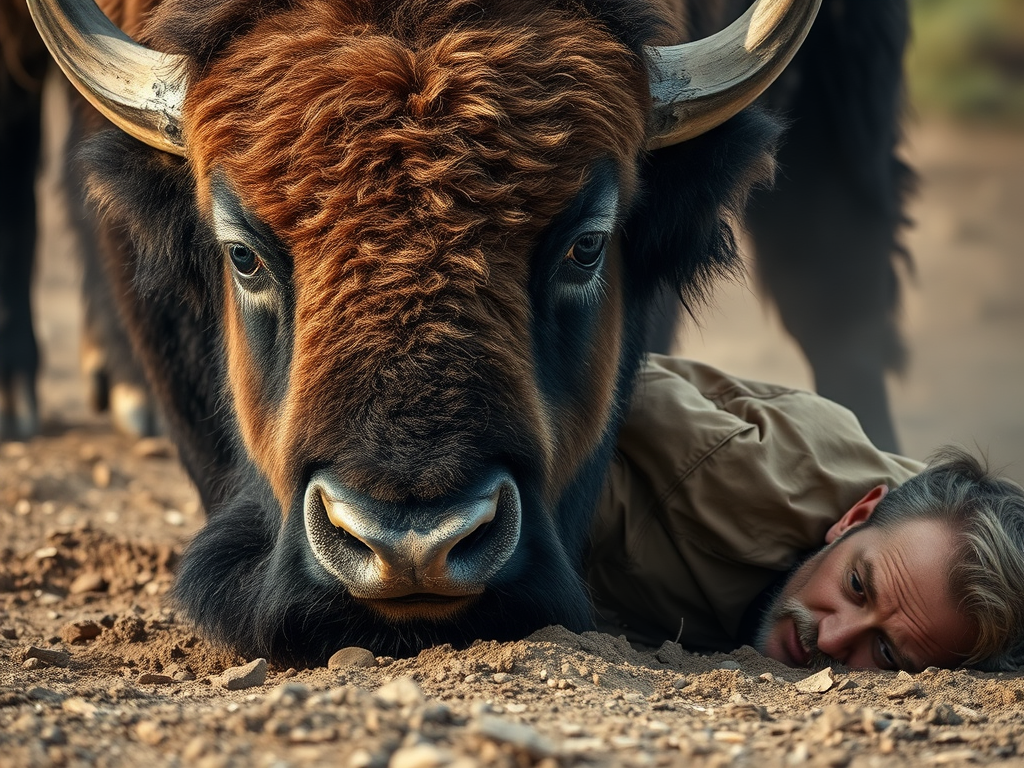
The article claimed that the bison knocked the tree over after Carney hit the ground. Then it turned its fury back on him. Carney had no other options. He did the only thing he thought possible. He dropped to the ground. His face was down in the dirt, and he played dead.

The bison approached, snorting, its heavy breath huffing across Carney’s back. It sniffed his head. His shoulders. His boots. Then, it reached his backside—and suddenly, something changed.

The bull gagged.

Its eyes watered, and its massive body trembled. The mighty beast gave a final snort of disgust. It turned its tail and bolted. The beast ran away as fast as its hooves carried it.

Carney, shaking but victorious, got to his feet and went to the other field. Before plowing, he had to detour into the nearest creek. He needed to scrub off whatever offended that bison so severely.

The newspaper never revealed its source for this version of events, but everyone had their suspicions. Most believed the town barber had something to do with it. After all, most of the town’s best stories started in his shop.

To this day, the Great Bison Incident resurfaces whenever the local men need a good laugh. It is a legendary reminder that sometimes survival comes down to sheer luck, including an unfortunate choice in lunch. It’s a tale that never fails to entertain.

This is a true story. The names have been changed to protect the privacy of those in real life.