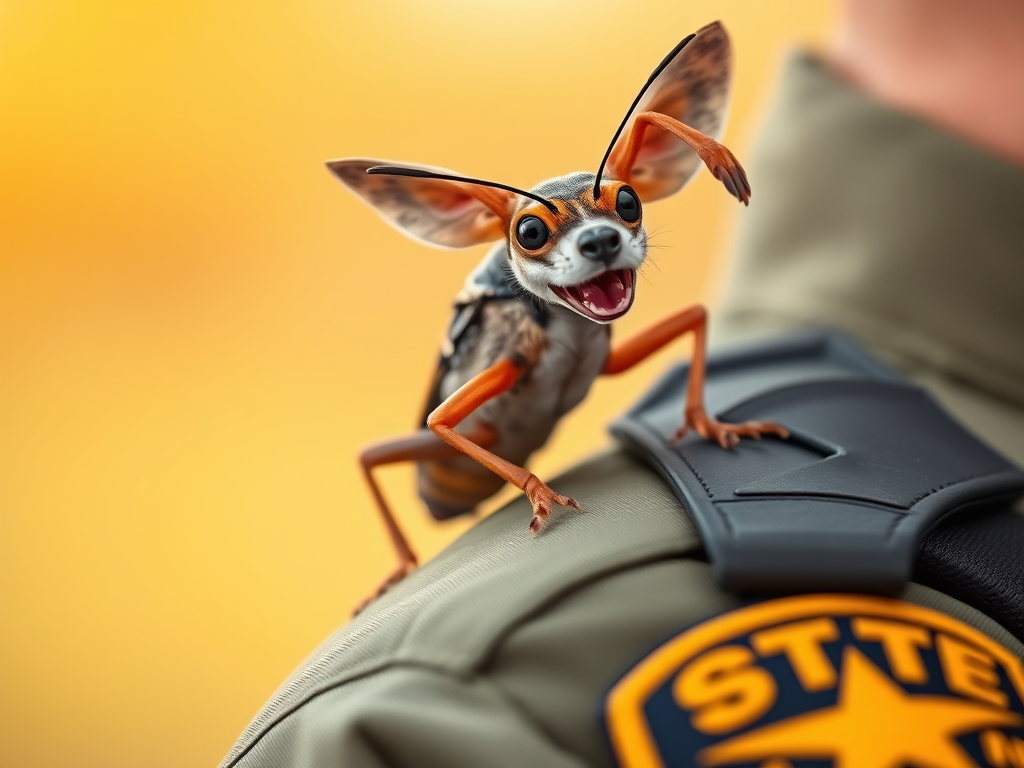
Mayor DeeDee Gonzalez wasn’t one to take a half-measure. Her town’s only claim to fame was a bug outbreak with a penchant for humming and line-dancing. Mexican beagle crickets had commandeered a taco stand once more. They also interrupted a high-stakes karaoke contest at the community center. She had had enough.
The emergency meeting took place in the town hall. Chairs were hastily arranged in a circle. The table was littered with half-eaten enchiladas. The Mayor banged her gavel with a determined clatter.
“Enough is enough!”
She declared.
“These pests have overstepped their bounds. As of now, martial law is declared on all cricket activity in Ajo!”
In a matter of minutes, local retirees received “bug defense kits.” These kits featured oversized flyswatters and garden hoses. They also included homemade “cricket deterrent” spray (an odd blend of cactus juice and a hint of mint). The newly minted “deputies” marched down Main Street. The Beagle Cricket Brigade paused their evening serenade. It was as if to say, “They brought reinforcements!”
Buck, watching from the window of the Impala, smirked.
“Now that’s what you call bugging out,”
He muttered. He anticipated the chaos. It would ensue when a troop of seniors met a swarm of rhythmic insects.
How dare they! A Taco Stand? Those evil Beagle Crickets! It is only a matter of time before someone is called to main street for a shootout at high noon. But, will Buck’s aim hit something as small as a cricket in a shootout? Would the crime fighter be outmatched by crickets?Or will they challenge him to Karaoke sing off?
Buck Milford wasn’t the type to complain. He’d driven through sandstorms. He had broken up fistfights at quilt raffles. Once, he gave a field sobriety test to a goat wearing sunglasses. That day was different. The Arizona sun scorched the earth like a microwave set on vengeful. Even Buck was close to breaking.
The heat index had hit 127. A road sign melted. Melted. The “SLOW CHILDREN AT PLAY” sign now reads “OW.”
Buck had parked his cruiser under the only tree between Ajo and Yuma. It was a desperate little mesquite. It looked like it had made some poor life choices. He sipped water from his melted ice chest and tilted his hat over his forehead.
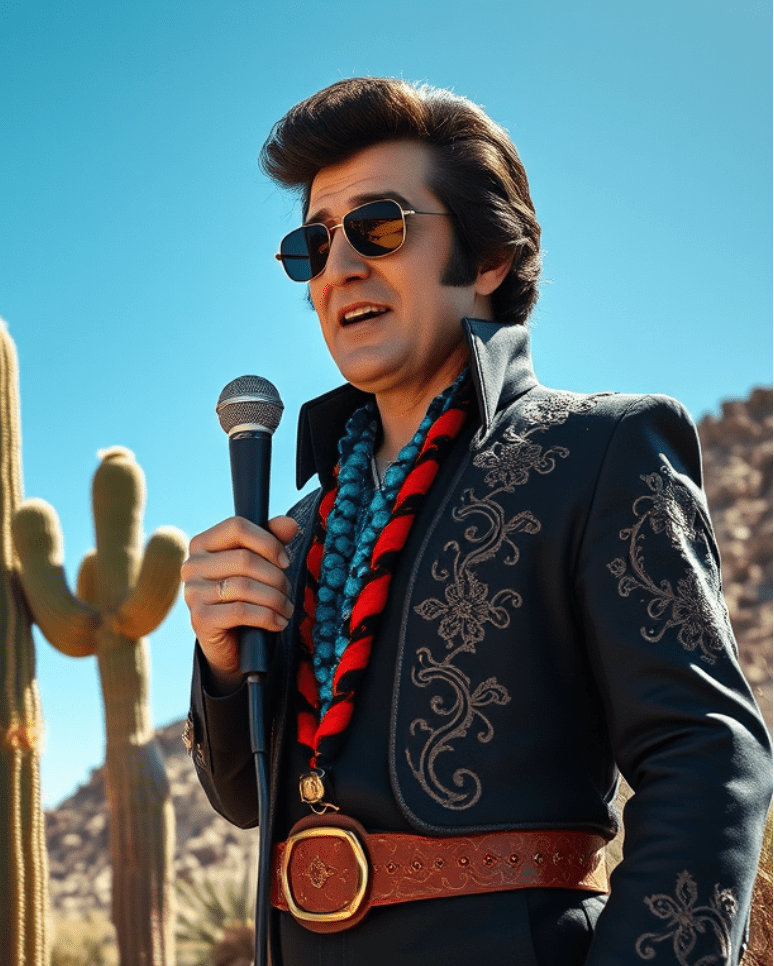
That’s when he saw Elvis.
Plain as day.
Standing next to the patrol car, wearing a powder-blue jumpsuit and holding a chili dog.
“Elvis?”
Buck mumbled.
“That you?”
Elvis gave him a nod.
“It’s hot out here, hoss.”
Buck blinked.
“I must’ve been out in the sun too long…”
Suddenly, another figure emerged from behind the tree.
Skinny. Nervous. Clutching a clipboard and a sheriff’s badge held on by Scotch tape.
“Buck! Buck, there’s been a violation!”
The man squeaked.
“A code triple-seven! Unlicensed harmonica discharge in a non-musical zone!”
Buck sat up straight.
“Barney Fife?”
It was indeed Barney Fife. Or instead, it was someone who looked, sounded, and panicked exactly like Don Knotts. This person was holding a ticket book the size of a Bible.
Barney fumbled with his pen.
“Now, now, Buck, I don’t want any trouble, but this whole desert’s outta code. These crickets! The yodeling! There’s dancing! Dancing, Buck! It’s indecent!”
Buck stood up, swaying slightly.
“Barney, are you… real?”
Barney narrowed his eyes.
“As real as a jelly doughnut on a Wednesday morning, Trooper. Now I’m gonna need you to confiscate Carl Sandlin’s banjo and suspend his taco license—right away!”
Behind them, Elvis leaned against the cruiser and took a bite of his chili dog.
“Let the boy yodel, Barney.”
“I will not!”
Barney barked.
“This is law and order, not Hee Haw Live!”
At that moment, Carl himself drove by in a dune buggy. It was covered in tinfoil and wind chimes. He waved like a parade marshal.
“I’m playin’ at dawn!”
Carl shouted.
“Bring earplugs or bring maracas!”
Barney turned purple.
“I’ll have his badge!”
Buck stared in stunned silence.
A cricket landed on his shoulder and began humming ––
“Love Me Tender.”
The next thing Buck remembered was being propped up in a folding chair outside the Ajo gas station. A bag of frozen peas was on his forehead. He had a bottle of Gatorade in each hand.
“You passed out cold.”
Said Melba, the station clerk, who also claimed to be a licensed Reiki therapist.
“Said something about Elvis, Barney Fife, and indecent line dancing.”
Buck blinked.
“I didn’t… wrestle Carl off a unicycle, did I?”
“Not today.”
Buck took a long drink, sighed, and muttered,
“I’m starting to think this desert has a sense of humor.”
A Desert with a sense of humor? Barney Fife? Elvis? Our Crime Fighter has been out in the nether regions of the Sonoran Desert too long. That, or he sees dead people. Whatever it’s going to lead to, it’s another exciting story of Arizona’s most famous crime fighter, Buck Milford!That Mexican Beagle Cricket is sorta cute, isn’t it?
The Mexican beagle crickets arrived five days ago. Already, the Arizona Department of Wildlife had received over 300 complaints. Not about damage, mind you—but about the music.
“They’re too dang punctual,”
one retiree griped.
“They hum like my mother-in-law when she’s judging me,”
wrote another.
One anonymous caller just yelled. “MAKE IT STOP!” for forty-two seconds before hanging up.
Buck Milford was used to desert weirdness. He’d once ticketed a man for driving a dune buggy made entirely of rattlesnake skins. But nothing prepared him for Carl Sandlins latest idea: The Great Cricket Peace Yodel.
“I’ve been listenin’ to ‘em closely,”
Carl explained, pacing in front of his yurt-slash-taco-stand.
“And I think they respond to pitch. What we got here is a musical species. They ain’t hostile—they just need harmony!”
Carl wore what he called his “diplomatic vest.” It was a sequined denim jacket with fringe. He also equipped himself with an old harmonica, a rusted washboard, and a five-gallon pickle bucket labeledAMBASSADOR DRUM.
Buck just stared at him.
“You sure you haven’t been drinking your aloe again, Carl?”
But Carl was undeterred. That night at 2:00 a.m., he set up two lawn chairs. Fifteen minutes before the crickets’ usual humming ritual, he arranged a battery-powered spotlight. He also prepared a megaphone duct-taped to a broomstick.
“Alright, fellas,”
he said into the megaphone.
“Let’s talk tunes!”
Buck sat in the cruiser, sipping lukewarm coffee, radio off. “This is going to end with him either arrested, abducted, or somehow elected,” he muttered.
At exactly 2:15 a.m., right on schedule, the desert came alive with humming.
But this time… Carl joined in.
He yodeled.
He drummed.
He played a harmonica solo that sounded like a walrus stepping on bubble wrap.
And for thirty glorious seconds… the crickets paused.
Then, they hummed louder than ever.
They didn’t just hum The Andy Griffith Show this time. They mashed it up with Achy Breaky Heart. It sounded suspiciously like a 1996 Taco Bell jingle.
Carl dropped his bucket.
“They answered me, Buck! I think we’re collaborating!”
Buck opened his door.
“Carl, I think they’re angry.”
Suddenly, thousands of beagle crickets surged toward the yurt, drawn to the sounds of tin, harmonica, and misguided ambition. They swarmed Carl’s taco stand, leapt onto the megaphone, and—somehow—turned on his margarita blender.
It spun wildly. Salsa flew.
The crickets began line-dancing.
Buck had seen a lot, but beagle crickets doing synchronized grapevines under a disco light powered by solar lawn gnomes? That was new.
The next morning, the bugs had gone quiet. Carl stood in the rubble of his salsa bar. He was shirtless and proud.
“We made contact,”
he said, eyes shining.
“They danced, Buck. They danced!”
Buck surveyed the scene: overturned lawn chairs, chewed speaker wire, a cricket still stuck in a jar of queso.
“Well, Carl,”
he said,
“either they liked your music—or they mistook you for a piñata.”
Carl smiled.
“Doesn’t matter. Tonight, I’m bringin’ in the banjo!”
SO! CARL. He is bringing in the Banjo! Will it be on his knee? And will someone named Ole Susanna show up in Chapter Five if Carl swings that Banjo too wildly? That is a story for tomorrow. So be sure to check back and see if the Mexican Beagle Crickets have segued into classical jazz. Also, will the Highway Patrol get Buck a larger fly swatter?
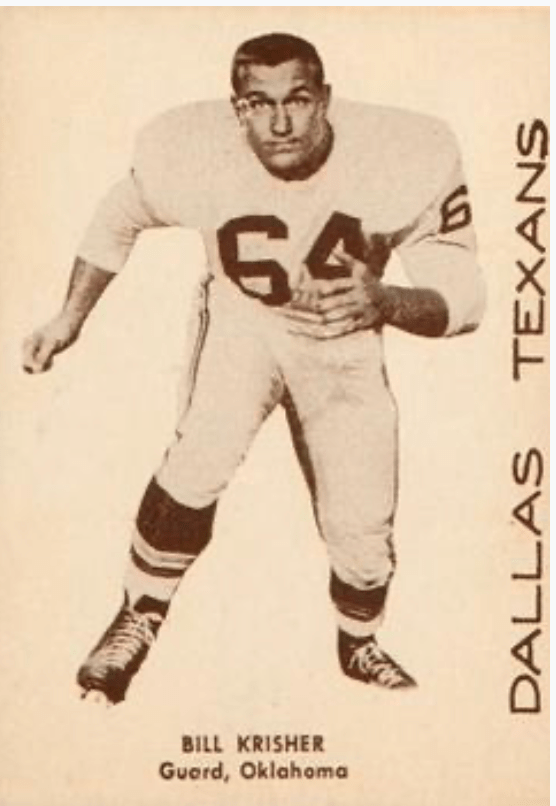
William Irwin “Bill” Krisher (September 18, 1935 – 2025, age 89)
William Irwin Krisher, known to football fans as Bill Krisher, passed away in 2025 at age 89 (1).
He was born on September 18, 1935, in Perry, Oklahoma. He grew up in Midwest City. He developed into a standout lineman for the University of Oklahoma under coach Bud Wilkinson (2).
Krisher’s college career was decorated. He earned consensus All-American honors in 1957. He helped the Sooner’s win consecutive national championships in 1955 and 1956 3.
Selected in the third round of the 1958 NFL draft, he played for the Pittsburgh Steelers before moving to the AFL’s Dallas Texans (now Kansas City Chiefs), where he was named to the All‑AFL Team in 1960 and honored as a division All‑Star in 1961 4
Off the field, Krisher dedicated himself to faith and mentorship. He was an active member of the Fellowship of Christian Athletes and served as its southwestern regional director by the mid‑1970s 5
Bill Krisher leaves behind a legacy of excellence in collegiate and pro football. He dedicated his life to uplifting others through faith and service.
He is remembered by family, teammates, and athletes inspired by his example.
If there was one thing Arizona didn’t need more of, it was heat.
But if there was one thing Arizonans couldn’t resist, it was a challenge.
Influencer Lacey Blu—a 24-year-old “solar chef” with 1.2 million followers and zero life experience—announced she’d be filming a bacon-cooking demonstration. Doing so on the hood of her Tesla at high noon. Trooper Buck Milford knew it was going to be a long day. Especially since Teslas were along way off from being invented.
“Cooking with the sun is so sustainable,”
she chirped into her phone.
“And so am I! #SizzleWithLace #SolarSnackQueen”
She parked off Highway 85 near a dead saguaro. She laid out her cookware—an iron skillet, three strips of thick-cut hickory bacon, and a side of emotional entitlement.
Buck arrived just as the bacon began to curl. He was curious about the cell phone since those too were new to this century. They were at least twenty five years from being even a brick phone.
“I’m gonna need you to step away from the car, ma’am,”
he said, tipping his hat.
“It’s 119 degrees, and your bacon grease just started a brush fire the size of a toddler’s birthday party.”
Lacey didn’t look up.
“Sir, this is my content.”
Behind her, a small flame began creeping across the sand toward a long-abandoned outhouse that somehow also caught fire. A confused jackrabbit ran out holding what looked like a burning flyer for a 1997 monster truck rally.
“Content’s one thing,”
Buck said, reaching for his fire extinguisher,
“but that yucca plant’s fixin’ to blow like a Roman candle.”
Just then, Carl Sandlin appeared on an electric scooter with a garden hose coiled like a lasso.
“I saw the smoke!”
he cried.
“Is it aliens again? Or someone makin’ fajitas?”
Buck didn’t answer. He was too busy putting out the bacon blaze while Lacey livestreamed the whole thing.
“Look, everyone!”
she squealed to her followers.
“This is Officer Cowboy. He’s putting out the fire I started! So heroic!”
Carl joined in, spraying more bystanders than actual flames.
“We got trouble, Buck! The beagle crickets are back. They were hummin’ ‘Jailhouse Rock’ this time!”
Buck finished dousing the car. He shook the foam off his arms. He wiped a trail of sweat from his forehead. It had been working its way toward his belt buckle since 10 a.m.
“Well, Carl, if the crickets are Elvis fans now, we’re all in trouble.”
The bacon was ruined. The hood of the Tesla had buckled like a soda can. And the only thing Lacey cared about was that the foam had splattered her ring light.
“You just cost me a brand deal!”
she snapped at Buck.
“I was working with MapleFix! It’s the official bacon of heatwave influencers!”
Buck gave her a long, flat stare.
“You can mail your complaints to the Arizona Department of Common Sense.”
That night, the local paper ran the headline:
INFLUENCER IGNITES BACON BLAZE; TROOPER BUCK SAVES CACTUS AND PRIDE — Saguaro Sentinel, pg. 3 next to coupon for 2-for-1 tarpaulin boots.
The Mexican beagle crickets showed up that night, as always. This time, they hummedRing of Fire.
Buck had just finished adjusting the old police scanner. It had been playing reruns of Hee Haw for the last hour. Suddenly, his radio crackled to life.
“Unit 12, please respond. Caller at mile marker 88 reports a suspicious hovering object. Caller believes it is extraterrestrial. Or a reflective commode. Please advise.”
Buck sighed and reached for his hat, which had molded to the dashboard like a forgotten tortilla.
“Lord help us,”
he muttered.
“If this is Carl again, I’m asking for hazard pay.”
Carl Sandlin, local yodeler and self-certified UFOlogist, had a unique reputation. It’s one you earn from a lifetime of heatstroke. Add to that expired beef jerky. Lastly, he had a mother who named him after her favorite brand of tooth powder.
Buck shifted the Impala into drive and pulled away from the shade of a sagging mesquite tree. The tires made a sound like frying bacon as they peeled off the scorched asphalt.
When he reached mile marker 88, Carl stood there. He was shirtless, shoeless, and sunburned. Carl was waving a fishing net wrapped in tin foil like a broken butterfly catcher.
“There it is, Buck!”
Carl bellowed.
“Hoverin’ just above my taco stand for forty-five minutes. Scared off my lunchtime crowd. Even the iguanas cleared out!”
Buck squinted toward the horizon. Sure enough, something metallic shimmered in the distance. It wobbled slightly in the heatwaves, casting a strange, shiny glow.
“You mean that thing?”
Buck asked, pointing.
Carl nodded so hard his hat flew off.
“Absolutely. That’s either an alien escape pod or a deluxe Porta-John.”
Buck pulled binoculars from his glove compartment, which were so fogged up with heat condensation they doubled as kaleidoscopes. After rubbing them on his sleeve, he focused in.
“…That’s a new solar-powered PortaCooler,”
he said finally.
“The highway crew’s been installing them for the road workers. It’s got misting fans, Bluetooth, and a cactus-scented air freshener.”
Carl squinted, unimpressed.
“You sure it ain’t Martian technology? Smells like sassafras and bad decisions over there.”
Buck stepped out of his patrol car, the soles of his boots sticking to the pavement with every step.
“Carl, unless the Martians are unionized and drive state-issued work trucks, I’m pretty sure they’re not putting in restrooms. Those restrooms aren’t off Route 85.”
Just then, as if to punctuate the point, a group of Mexican beagle crickets marched across the road. All in unison. All humming the Andy Griffith Show theme at exactly 2:15 p.m.
Carl froze.
Buck froze.
Even the misting PortaCooler froze up and made a high-pitched wheeze like it, too, was creeped out.
Carl whispered,
“You reckon they’re trying to send a message?”
Buck tipped his hat back and said,
“Only message I’m gettin’ is that we need stronger bug spray… and fewer heat hallucinations.”
The crickets finished their tune, executed a perfect pivot, and disappeared into the desert brush.
Carl crossed his arms.
“I still say that cooler’s alien.”
Buck opened the door to his cruiser and called over his shoulder.
“Well, if they are aliens, they’re better at plumbing than our city council.”
He chuckled as he pulled away, leaving Carl saluting the shimmering cooler like it was the mother ship.
It had been a hot day in the Arizona Desert. The sun had sizzled the sands in the Sonoran Desert for the last month. High temperatures reached over 115 degrees for each day during the past seven days. The weather forecast warned of night temperatures reaching 120°F or higher in the days ahead. Arizona State Trooper Wayne Milford had his 1968 Chevrolet Impala Patrol car parked outside Ajo. He had filled the fuel tank with fuel. An ice chest was filled with water. This was in case motorists or hikers needed rescue in the barren desert regions. Buck was known for his mishaps.
Trooper Milford was widely appreciated for his sense of humor. He would show community members safety tips during public meetings when he had spare time. He also attended public events during his off-duty time. He was respected by those even that received traffic tickets from and who had been arrested by the state trooper. Because he was known as a fair individual.
That summer was challenging. The extreme heat and the invasion of the Mexican beagle cricket placed the whole state under stress. Trooper Milford became essential because there would be more surprises than one could shake a stick at. And Buck had ton’s of sticks!
The Mexican beagle cricket wasn’t actually from Mexico. It didn’t bark like a beagle. Yet, it did hum the theme song to The Andy Griffith Show at exactly 2:15 a.m., every night, in unison. No one knew why. Some said it was a mating call. Others blamed radiation. Buck didn’t care. He kept a fly swatter in the glove box and an old harmonica to confuse them.
On this particular Thursday, Buck had just finished explaining the dangers of cooking bacon on your car hood. This activity was a popular desert pastime. He was speaking to a group of overheated tourists from Connecticut when his police radio crackled.
“Unit 12, we’ve got a report of a suspicious object at mile marker 88. The caller says it might be a UFO or possibly a very shiny porta-potty. Please respond.”
Buck took a sip from his melted water bottle, sighed, and muttered,
“Well, that’s probably just Carl again.”
Carl Sandlin is a local conspiracy theorist and professional yodeler. He had been filing UFO reports ever since a silver taco truck passed him on I-10 doing 95.
Still, the procedure was the procedure. Buck fired up the Impala. He turned on the siren, which sounded more like a kazoo than a siren thanks to a duct-tape repair. Then, he rumbled down the dusty road.
When he reached mile marker 88, he saw Carl. Carl was shirtless and shoeless. He was holding up what appeared to be a fishing net wrapped in aluminum foil.
“There it is, Buck!”
Carl shouted, pointing to a shimmering metal shape in the distance.
“That thing’s been hovering over my taco stand for an hour. My queso is boiling itself!”
Buck squinted. The heatwaves shimmered, giving everything a wobbly, dreamlike quality.
“Carl… that’s a new solar-powered PortaCooler. The highway crew just installed it yesterday. It’s got a misting feature and Wi-Fi.”
Carl blinked.
“You mean I can update my blog from out here now?”
“Yes, Carl.”
“Well, dang.”
Just then, a convoy of beagle crickets marched across the road in front of them, humming their nightly tune.
Buck and Carl watched in silence.
Carl finally said,
“You reckon they take requests?”
Well! You Reckon? They Take Request? We’ll have to wait until tomorrow. We need to find out if Buck will have to drive across the Grand Canyon State. He might be swatting at those Mexican Beagle Crickets. Or will the state hook a sprayer up to his unit? Check back tomorrow for another very exciting story, from the Valley of The Sun, where this story is being written!
I came across this news report and was genuinely impressed by its craftsmanship. The reporter doesn’t just tell the story. They show it. They use actuality reporting and a wraparound technique that gives the piece depth and authenticity. It’s the type of journalism that doesn’t just inform—it immerses you. This level of storytelling should be seen and appreciated by more people.
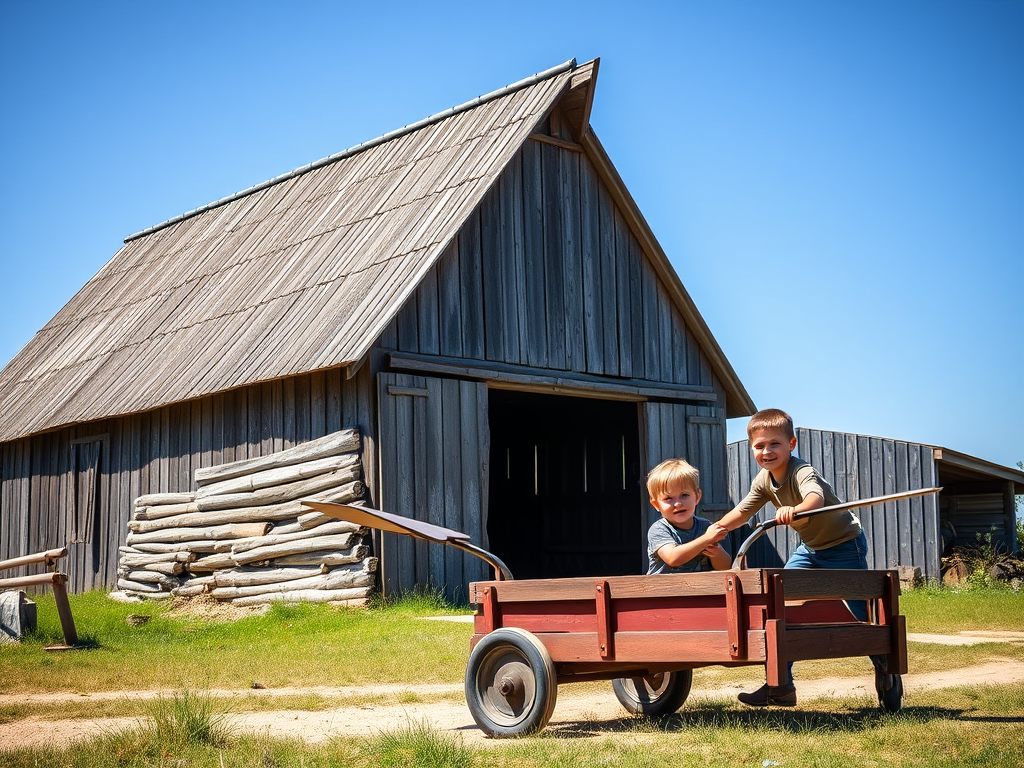
You’ve heard of the Wright Brothers, but you probably haven’t heard of the Groff Brothers—JD and Bennie. Two western Oklahoma boys growing up wild and dusty in the 1920s and ’30s. They didn’t have blueprints or flying machines. What they had was imagination, a tall barn, and a battered old wagon that Bennie believed could fly.
Bennie was the older one. He was full of ideas that didn’t always make sense. They always sounded like fun—at least to him. JD, the youngest, often found himself drafted into Bennie’s adventures under what you might call “big brother persuasion.” Bennie had a way of making cooperation seem more appealing. He would start listing all the minor sins JD had committed that week. JD wasn’t dumb. He knew how to pick his battles.
One summer day, Bennie got it in his head that their wagon could be made to fly. All it needed were wings—planks nailed out to the sides—and a launch platform. The barn roof, with its steep pitch and high drop, was just the place. Bennie did the math. He calculated it as only a 1930s farm kid could. He figured the wagon might be too heavy to lift both of them. So, of course, he chose JD to be the pilot.
JD protested. Loudly. But Bennie made his case and called in his leverage. They went up with the wagon. They dragged it onto the roof like a couple of cartoon inventors chasing the wind.
Perched high above the ground, JD sat nervously in the creaking wagon, holding on to the sides. The wings were loose, the wheels rattled, and JD knew better than anyone how this would end.
“Hold on tight and don’t jump out!” Bennie shouted.
“I won’t,” JD called back, “I’ll fall!”
And with that, Bennie gave the wagon a mighty shove.
It was right about then that their mother—Mom—looked out the kitchen window. She saw what no mother should ever see: her youngest son soaring off the roof in a makeshift flying contraption. She dropped what she was doing and ran out the door, just in time to witness gravity take over. The wagon left the barn roof for the briefest moment of flight—then fell straight down like a stone.
JD hit the ground in a cloud of dust and bent wood. Miraculously, he survived—more scared than scraped, and too winded to say anything right away. Bennie stood nearby, squinting at the wreckage like a disappointed engineer.
“Well,” Bennie muttered, “I guess there wasn’t enough lift.”
Mom had a different theory: they would never try that again.
JD agreed with Mom.
That was just one of many scrapes the Groff brothers got into over the years. Bennie had the ideas, and JD often paid the price. But through it all, they stuck together—laughing, fighting, inventing, surviving. That’s what brothers did.
The wild stunts and hijinks came to an end far too soon. Bennie passed away in his mid-forties, and with him, a certain spark left the family. One relative said the family had been “a little less jovial” ever since.
It’s true. A parent never fully recovers from losing a child. And a brother never fully recovers from losing his bud.
For a moment, a wagon flew on top of a barn in western Oklahoma. Two boys believed they could touch the sky.
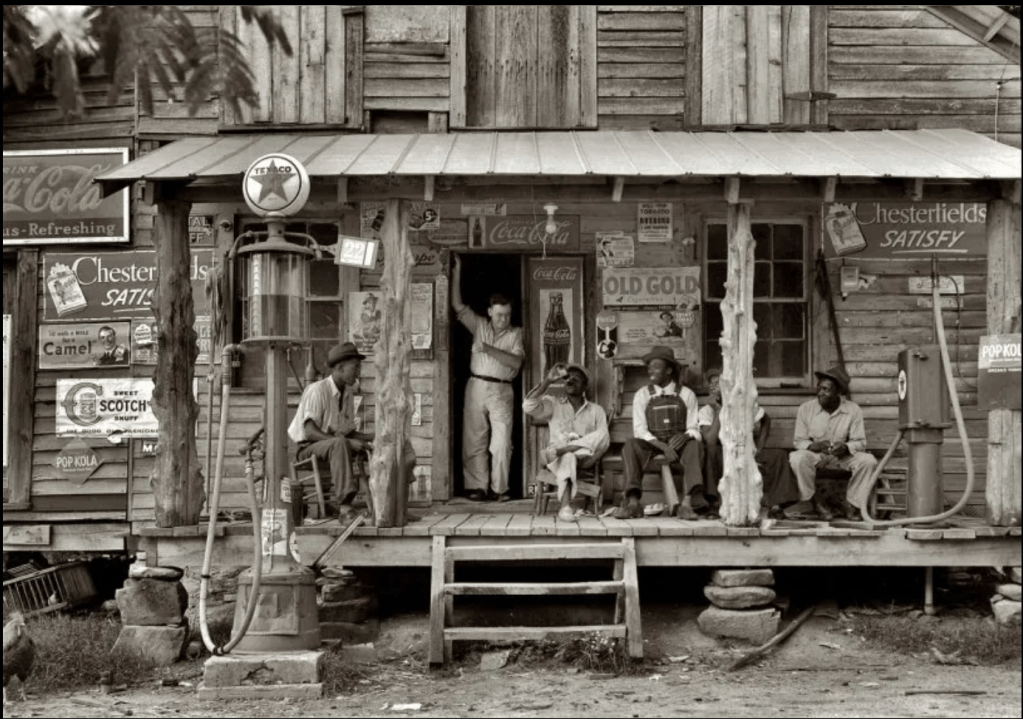
On July 25, 1939, Dorothea Lange was a renowned documentary photographer. She paused her busy travels across the American South. She stepped into a quiet moment just outside Gordonton, North Carolina. It was a humid summer Sunday. Through her lens, she discovered something golden: a rickety country store. Its wooden porch was dappled in shade. A few men sat comfortably in rocking chairs on it. The afternoon moved slowly around them.(1)
“Captured on July 25, 1939: a country store porch in rural North Carolina. Dorothea Lange found the perfect rendition of a lazy summer afternoon here. Let this moment remind you—it’s okay to choose rest today.”
Lange raised her camera and captured exactly what she saw: a peaceful summer tableau. The porch wasn’t staged—it was real life, real rest. The men lounged beside old kerosene and gas pumps, their chatter and quiet breaths blending with cicadas in the heat.
That moment—frozen in a gelatin silver print—became a small celebration of indolent joy. No agenda. No hurry. Just an afternoon spent doing exactly what summer begs you to do: nothing.
I was watching an old Western on television this past weekend. You know, the kind—cowboys and Indians. Or, as we might say today, American Ranchers and Indigenous Peoples.
The film, likely made in the 1950s, had the signature gloss of that era’s post-war cinema. Still, something about it suggested it was possibly shot even earlier, maybe in the 1940s. It was only later spliced, refitted, and packaged for the screen. The costumes, dialogue, and scenery all hinted at a time when the stereotypes were deeply ingrained in the script. They weren’t even questioned.
I probably watched that movie as a kid. I was sitting next to my father, not giving it a second thought. Back then, it was just another Western. But this time around, with a different set of eyes, what I saw was jarring.
It followed the predictable narrative: the cavalry riding in to tame the West and keep the “Indians” under control. Two delicately dressed white heroines were caught in the middle of a brewing conflict. A white doctor stood out as the lone character who dared to see Native people as human beings. He was mocked and ostracized for his compassion. This was especially true when a malaria outbreak swept through the tribe. He insisted they deserved treatment.
At one point, he stood in a room full of fellow whites. He asked,
“Do you think Indians are not human beings? Human beings like you and me, who deserve to live and be healthy?”
And one of the prim ladies, her hair perfect and her face untouched by empathy replied:
“I don’t know… how could they be?”
To which others in the room nodded and added,
“That’s right.”
“Of course, they’re not!”
“No way, in God’s name.”
I sat there stunned, wondering:
“How did a line like that ever make it into a movie script?”
Even more troubling:
“How did it get past editors, producers, censors—only to be broadcast, repeated, and absorbed by generations?”
It wasn’t just offensive. It was abusive. And it made me sad.
Is there a historical context to such language? Possibly. But what would a young Native American child feel sitting in front of that screen? Would they see their life reflected as something lesser—something not worthy of protection or dignity? Listening to the white characters, it certainly felt that way.
And it took me back to where I grew up.
I’m from the Kiowa and Comanche Counties area in Oklahoma—Caddo County, specifically. I was raised alongside Native American children, many of whom I called friends.
Later in life, I worked in law enforcement and came to know tribal members through both personal and professional relationships. I learned a great deal from them—about their culture, their pride, their pain.
When I started in law enforcement, the department had an initiation ritual. It involved arresting a man nicknamed Fifteen Thousand. He was a Native man, around 50 years old, who’d been detained countless times—hence the name. His real name was Thomas Kamaulty Sr.
He was the first person I ever arrested as an officer.
And, in time, Thomas became the first person I ever saw get sober. That meant something.
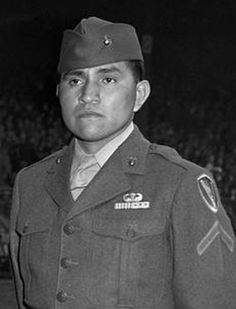
Ira Hayes
I also think about people like Ira Hayes. He was a Pima Indian from Arizona. Ira helped raise the flag at Iwo Jima during World War II. A hero by every standard. And yet, like Thomas, Ira suffered. Both carried the scars of discrimination and trauma. Both turned to alcohol as a way to numb the soul-deep wounds this country handed them.
We often ask why these cycles exist—but we rarely admit the truth: it’s because we’ve designed them to. We’ve placed people like Thomas, like Ira, into roles and systems. Their suffering can be managed. Their voices are diminished. Their lives are controlled. That was always the plan. And until we stop pretending it wasn’t, the script will keep playing—over and over again.
This post is going live as I am entering surgery. The surgery is for an Anterior Lumbar Interbody Fusion. I want to thank all of you for your support, prayers, and encouragement. Your kindness truly means the world to me.
During my recovery, you’ll still see new posts here on the blog. I’ve prepared content in advance. You can continue to enjoy the same quality stories and information. This is what you’ve come to expect from the benandsteve.com blog.
Thanks again for being part of this journey. I look forward to rejoining you soon. Another update will post later today to keep you informed.
By the time this post appears, I’ll be less than twenty-four hours from checking into the hospital. I have a scheduled lower back surgery. This operation was first approved in 2020. It was postponed due to the overwhelming strain COVID-19 placed on hospitals at the time.
Now, five years later, the time has come. The need for the surgery has grown unavoidable. It has reached a point where it significantly impacts not just my own quality of life. It also affects those around me—including our ever-faithful dog, Otis. After careful planning and the support of some very good people, the time feels right.
To keep the blog active, I’ve written and scheduled daily posts in advance. These will post – daily over the coming weeks as planned. Once I’m fully back to writing day-to-day pieces again, I’ll let everyone know. That said, if something urgent comes up, I will post an update. If it is of national interest and inspires me, I will do so before then. This is, of course, recovery allowing.
In the meantime, I’m grateful for the many kind gestures, well-wishes, and thoughtful messages already sent. That encouragement has made all the difference. I’m especially mindful of my partner, Steven. He will be holding down the fort. This will be happening while I’m in the care of a trusted medical team. He’ll be shuttling between the hospital and home, making sure Otis gets fresh air, snacks, and his favorite TV channel. We’ve jokingly planned it like a household awaiting a newborn—minus the diapers, thank goodness.
Dr. Christopher Yeung
The procedure itself will be performed by Dr. Christopher Yeung, a well-regarded spine surgeon whose experience includes working with multiple professional sports teams. After an in-depth consultation, I felt confident in both his knowledge and his approach. The surgery, known as an Anterior Lumbar Interbody Fusion, involves accessing the lower spine through the abdomen. An access surgeon helps to safely move internal structures aside. It’s a careful, technical procedure. The recovery is long. It begins with just a few steps on day one and builds slowly through physical therapy. This process continues in the weeks and months ahead.
So for now, I’m focused on the first step: getting checked in and moving ahead. I’m hoping for deep sedation, steady hands, and a smooth path to healing.
Thanks again for walking alongside me, even if just in spirit. I’ll be back in touch when the fog begins to lift.
There are stories worth telling—stories shaped by the countless experiences we collect in life. In mine, there have been unforgettable moments. I visited with friends, shared laughter, and exchanged hugs. Then I returned home—only to learn the next day that they were gone. No warning. No signs. One moment, they were part of my world; the next, they had vanished from it.
Those moments taught me a truth that often goes unspoken: nothing in life is definite.
Even when it feels like we’re stuck—repeating the same routines, going through the same motions—life is still moving. The world shifts beneath our feet, often without our awareness, certainly without our consent. Change is not something we invite; it’s something that happens. It shows itself in every breath we take. It appears with every face that enters or leaves our lives. It influences every decision made far beyond our control—from government chambers to hospital rooms.
Change is the only constant.
Sometimes, a change is so small it goes unnoticed—until its effects stretch across history. On February 2, 1959, Waylon Jennings gave up his seat on a chartered airplane to the Big Bopper, J.P. Richardson, who was feeling ill. The plane also carried Buddy Holly and Ritchie Valens. It crashed in an Iowa field just minutes after takeoff. Everyone aboard died.
Waylon Jennings
That one seat swap—an act of kindness, -–– saved Jennings’s life. No one was at fault. But that simple moment, that ordinary change in plan, altered the course of music history and Jennings’s own future. He carried the weight of that change for the rest of his life. And yet, that change gave him more years, more music, more life.
That is how change works. Quiet. Sudden. Unfair. Unpredictable. But real.
When everything feels bleak, we must remember: change is still at work. When loss feels unbearable or the path ahead seems hidden, we must remember: change is still at work. What feels like the end today reveals itself as the beginning of something new tomorrow.
Time moves. People change. Life adapts. Always.
And in that, we find our only real choice: acceptance.
Accepting change—no matter how painful—does not mean surrendering to it. It means choosing to live with eyes open, hearts ready, and spirits willing to grow from what has been lost. We don’t have to like every change. But by accepting it, we start to transform with it—and even rise because of it.
Postscript:
After a tragic 1991 plane crash claimed the lives of several members of Reba McEntire’s band, it was Waylon Jennings—haunted by his own near-miss decades earlier—who offered her a few words she never forgot:
“Reba, you’ll never get over it, but you’ll get through it.”
And that’s the final truth about change. We don’t get over it—we live through it. And somehow, life keeps going.
I was being driven to an appointment earlier this week when a reminder flashed on my phone. It was one of those “On This Day” memories—a flashback from five years ago. It was a note I had posted on social media during one of the darkest times I can remember.
It read:
Today, the national death toll in the United States reached 80,000. In the state where I live, the deaths are many. They have brought in refrigerated trailers to hold the bodies. The mortuaries have more bodies than they can carry. The coroner’s office is over capacity. It is being reported that 100 people died in the city where I live yesterday alone.
People separated by COVID-19.Pinterest
That note was one of millions posted by people around the world that day. It was part of a collective cry for help. It was a shared testimony during a global crisis. The crisis tested the very core of our humanity. The COVID-19 pandemic wasn’t just a health emergency—it was a historical reckoning.
The novel coronavirus (SARS-CoV-2), first identified in late 2019, swept through cities and countries with terrifying speed. It took the lives of the elderly and the young. It didn’t care about borders or status. It wasn’t limited by language, ideology, or belief. It was an indiscriminate invader—silent, invisible, and merciless.
Pinterest
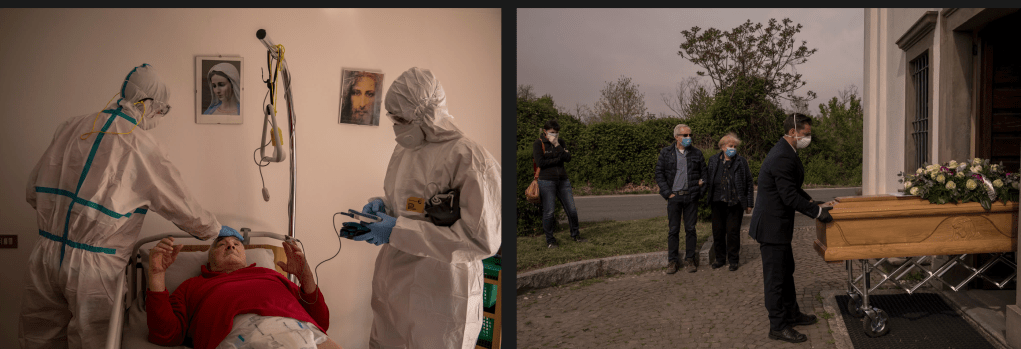
Hospitals filled to capacity. ICUs ran out of beds and ventilators. Nurses worked 12–16 hour shifts in full protective gear. They returned the next day knowing more patients would be gone. They feared coworkers would be gone too. Some had to reuse PPE, others never had proper protection at all. Entire medical teams were decimated. The faces behind the masks—so many of them never seen again by their loved ones.
In some areas, morgues overflowed, and refrigerated trucks became temporary storage for the deceased. Funeral homes struggled to keep up. Families said goodbye to loved ones through screens or from behind glass, incapable of touching them one last time.
Pinterest
Masks became a symbol—of protection, of politics, of protest. While many wore them out of care for others, others rejected them, fueled by fear, misinformation, or political agendas. What should have been a unified public health response fractured along ideological lines.
The spread of disinformation only made things worse. Some media personalities claimed the virus was “just a flu.” Other public figures suggested it was a hoax designed for political or financial gain. Some of those very same people later contracted the virus. A few died from it—some reportedly urging others to take it seriously with their final breaths.
Pinterest
For me, it was personal. I knew approximately twenty—or more—people I had known for most of my life who died from COVID-19. Every day brought another notice: a friend from childhood, a neighbor, someone from church, a former coworker. Sometimes I would hear from relatives who lost someone. Other times, I’d check news from back home and learn that yet another familiar name had been claimed. In places I had once lived, people I had once shared moments and memories with—gone. The virus wasn’t abstract. It carved itself into the story of my life, my family, my friends, and their families.
Pinterest
Vaccines would eventually arrive, faster than any in modern history. But by then, millions had died, and countless others were left with long-term effects—some still suffering today. As of mid-2025, more than 1.1 million Americans have died from COVID-19. Globally, the death toll has surpassed 7 million, though some estimates suggest the real numbers were even higher.
That reminder on my phone was more than just a memory. It was a marker—a scar from a time we lived through together, yet each experienced in our own way.
Pinterest
Let it be said clearly: the virus was real. The loss was real. And for many, the grief still is.
Let that note stand as a record not just of tragedy, but of resilience. Of what we went through—and of what we must remember. Because forgetting invites the risk of repeating it all over again.
A sad update, the man in a report here a few days ago has died.
61‑year‑old Keith McAllister died after being violently pulled into the MRI scanner at Nassau Open MRI in Westbury, Long Island. He entered the MRI room on Wednesday, July 16, while his wife was undergoing a knee scan. McAllister wore a heavy-weight-training chain (~9–20 lb/4–9 kg) around his neck. Despite prior discussions about the chain with staff, he was allowed in.
When he approached the machine, the strong magnetic field latched onto the chain, yanking him into the scanner. His wife and the technician attempted to free him, but he collapsed in her arms. She recounted shouting, “Turn this damn thing off! Call 911!”.
McAllister was rushed to the hospital, where he suffered multiple heart attacks and was pronounced dead on Thursday, July 17. His wife emotionally described the moment: “He went limp in my arms… I can’t wrap my head around it”.
The Nassau County Police Department is investigating the incident, and experts are emphasizing the critical need for strict MRI safety protocols, especially regarding metal screening. Past tragedies—including a 2001 case involving a child and an oxygen tank—highlight the grave risks of metallic objects around MRI machines.
Summary of key points:
Victim: Keith McAllister, 61
Date of incident: July 16, 2025 (MRI room event)
Date of death: July 17, 2025 (hospital)
Cause: Pulled into MRI by heavy metal chain (~9–20 lb)
Response: Wife and technician tried to assist; police are now investigating
Safety concern: Highlights critical importance of enforcing metal screening protocols
Summer Roads to Oklahoma to Visit Uncle Ben and Aunt Florence
By Benjamin Groff II
Every summer—without fail—a car would ease out of the driveway in Olney, Illinois. It was packed tight with suitcases and ham sandwiches. Kids pressed against window glass. Stories were waiting to be lived again. The road ahead led straight to Cordell, Oklahoma. Uncle Ben and Aunt Florence kept the porch swept. They also kept the table set.
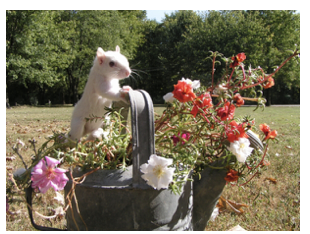
Olney was a quiet place, best known for something that always fascinated me as a child: white squirrels. My grandmother told me about them as if they were magical creatures. They were rare and watchful, darting through yards and city parks. I always hoped I’d see one myself, but somehow we always left too early or came back too late. Still, the idea of them stuck in my imagination like a bright stone in the pocket.
But the real adventure was always in Oklahoma.
Uncle Ben and Aunt Florence lived in a modest home in Cordell. There, the wind blew with purpose. Time slowed enough to sit and stay a while. The cousins from Caddo and Washita Counties began to arrive shortly after us. Many of them had been raised alongside the Illinois kin during the lean years of the 1920s and ’30s.
The car would keep rolling through Binger, Carnegie, Weatherford, and Colony. It traced out a web of family ties that never wore thin. There were hugs that lasted too long and pies that didn’t last long enough. Kids ran barefoot through the same red dirt that had once dusted our grandparents’ boots. The grownups told stories from both sides of the Dust Bowl.
“You remember when that storm blacked out the sky?” “Your mama used to chase us out of the cellar with a broom!”
And everyone laughed, even if the memories came with a tear or two.
The trips began in the early 1960s. They stretched well into the 1980s. Each summer became a soft echo of the one before. Faces aged, but names stayed familiar. Porch swings creaked. Tin-roof rain was still the best music at night.
Eventually, the trips grew fewer, as the elders passed and the younger ones built lives farther away. But in my mind, a stretch of two-lane highway still runs from the white-squirrel town of Olney. It continues to the wide-open sky of Oklahoma. It’s a road paved with memory and love that survives distance, time, and even silence.
And one day, I still hope to see one of those white squirrels.
One cousin wrote a memory down in a letter to another -––
The tires hummed low against the highway as we crossed into Oklahoma, and I felt it—the shift. Not just in geography, but in memory. It had been years since we’d made this drive from Olney, Illinois. However, the road still felt familiar. It was like an old hymn you didn’t realize you remembered until you started humming along.
I leaned my head against the window, watching the land roll out in shades of tan and green. My thoughts rolled back too. I remembered the summers of my childhood. We’d pile into the car every year and head south to visit Uncle Ben and Aunt Florence in Cordell.
They were waiting when we arrived back then—porch light on, arms wide, iced tea already sweating on the kitchen table. The smell of fried chicken greeted us. We could hear the sound of someone laughing from the backyard before our feet ever hit the ground.
We’d stay for a week or more, using Cordell as home base. Then we’d branch out, visiting cousins scattered across Caddo and Washita Counties—Binger, Carnegie, Gotebo. Some were practically siblings. They were raised alongside our parents during the hard years of the 1920s and ’30s. Those were times when everyone shared everything. The stories from those days came freely over pie and coffee. They were told with the kind of clarity that only comes from having truly lived it.
But this trip—this time—was different.
There were no porch lights waiting. No tea glasses on the counter. Uncle Ben had been gone for years now. Aunt Florence too. And many of the cousins had passed, their homes quiet or sold. This time, we came to remember—not just to visit.
We stopped by the old places. Some were still standing, others just foundations and memories. We drove to the Cordell, Eakly, Colony and Alfalfa, cemeteries. I stood at the resting place of our folks I could remember seeing as if it was yesterday. I could still hear their voices in my head. I spoke softly, unsure if the wind could carry my words back to them, but I tried anyway.
Later that evening, we drove out to Binger. One of the cousins—now gray-haired and slow-moving—met us on the porch with a smile that hadn’t changed in 40 years.
“I didn’t think anyone remembered to come back,” she said.
“We never forgot,” I told her.
And we hadn’t. Because the roots ran deep. Deeper than distance. Deeper than time.
So we returned to Oklahoma—not just to see the land or the gravestones, but to feel that presence again. To walk the same dusty paths, sit under the same wide skies, and remember who we are—and who we loved.
Some journeys are round trips. Others are returns. This was both.
As always time came when we had to return. And it always seemed longer going back to Illinois. It was sad to leave. Who would not be here next time we came to visit? Who on our crew would not make the trip next time? Uncle Ben always choked up when he said goodbye. He knew it could be the last time he saw us. Eventually, he was right.
Helen Cornelius (December 6, 1941 – July 18, 2025) was the deeply cherished voice of classic country. She was the beloved duet partner to Jim Ed Brown. She passed away on July 18, at the age of 83 FacebookThe Sun Set TV. She was born as Helen Lorene Johnson in Monroe City, Missouri. She was raised on a farm where music flowed naturally in her family. She joined her sisters Judy and Sharon in a local singing trio before forming her own band, The Crossroads.
Cornelius’s early career blossomed in the late 1960s. She worked as a songwriter signed to Screen Gems Music. She penned songs recorded by artists like Barbara Fairchild and Connie Smith Wikipedia+3Wikipedia+3The Sun Set TV+3. After a brief stint with Columbia and MCA Records, her life’s defining moment arrived in 1976. Teaming up with Jim Ed Brown, she recorded “I Don’t Want to Have to Marry You.” It was a No. 1 country smash. This success launched a string of hit duets. These include “Saying Hello, Saying I Love You, Saying Goodbye.” They also include “Lying in Love with You” and “Fools.” There are more HistoryForSale+7Wikipedia+7Country Music Hall of Fame and Museum+7. Their chemistry was undeniable. It earned them the Country Music Association’s Vocal Duo of the Year award. This accolade came in 1977 Country Music Hall of Fame and Museum.
Cornelius also enjoyed solo success. This includes her charting single “Whatcha Doin’ After Midnight Baby.” She toured with iconic acts like The Statler Brothers. She later brought her signature warmth to stage shows. This included a stint in the musical Annie Get Your Gun. She also opened the Nashville South venue in Gatlinburg HistoryForSale+3Wikipedia+3The Sun Set TV+3. In the 2000s, she became a Branson favorite at the Jim Stafford Theater. She made frequent appearances on RFD‑TV’s Country’s Family Reunion series Facebook+5Wikipedia+5The Sun Set TV+5.
Helen was recognized not just for her pure, heartfelt voice. She was also acknowledged for her humility and graciousness. Moreover, the undeniable bond she shared with Jim Ed Brown on stage and in life was noteworthy. Even after their professional split in 1981, she remained a steadfast presence in country music. They reunited for a 1988 tour. She continued to be a steadfast presence in country music 98.1 – Minnesota’s New Country+4Wikipedia+4The Sun Set TV+4.
She is survived by her loving family and legions of fans who still cherish those golden harmonies. Helen Cornelius’s legacy lives on in every record, performance, and the countless artists she inspired. She will be remembered as one of country music’s finest voices. She was a true steward of its heart.
Continued Connection: Remained active in the community through Country’s Family Reunion and Branson theater gigs YouTube+4Wikipedia+4Wikipedia+4.
Her passing marks the end of a storied chapter in country music. Her voice—filled with warmth, purity, and grace—will continue to echo for generations. Rest in harmony, Helen Cornelius.
The Necklace That Shouldn’t Have Been Worn: A Tragic MRI Reminder
“Do you have any metal on your body?”
It’s a question you’ve probably heard before entering a medical imaging room. It might sound routine—almost too simple to matter. But as one man in Westbury, New York, learned the hard way, ignoring that question can be deadly.
Earlier this week, a 61-year-old man walked into an MRI suite at Nassau Open MRI. He wasn’t a patient—he was a visitor. And according to reports, he entered without permission, unaware (or perhaps unconcerned) about the danger waiting behind the door.
Around his neck hung a heavy metal necklace.
That necklace would soon become a missile.
As the MRI machine powered up, the magnetic field—a force thousands of times stronger than Earth’s natural magnetism—ripped the necklace forward, pulling the man violently toward the magnet. The result was catastrophic. He suffered critical injuries and was rushed to the hospital.
You can read the full report here from the Miami Herald:
MRI machines are marvels of modern medicine. They allow doctors to see deep into the body without needing to cut it open. Yet, the science that powers them relies on an immense magnetic force.
That’s why medical staff ask the same questions again and again:
Do you have any metal implants?
Are you wearing jewelry?
Have you removed your belt, watch, or hairpin?
These aren’t suggestions. They’re essential precautions to prevent precisely what happened in Westbury.
The necklace that injured this man was an everyday item—something many of us wear without a second thought.
But in the MRI room, it was anything but ordinary.
A Reminder Worth Heeding
This tragic incident serves as a sobering reminder:
Always follow MRI safety guidelines. Always respect warning signs. Never assume a machine like this can be taken lightly.
The man who wore the necklace didn’t mean to cause harm. The laws of physics don’t care about intent. In an MRI suite, metal is never safe unless it’s been declared and cleared.
So next time someone asks you,
“Do you have any metal on your body?”
Don’t shrug it off.
Your answer will save your life!
You can read the full report here from the Miami Herald:
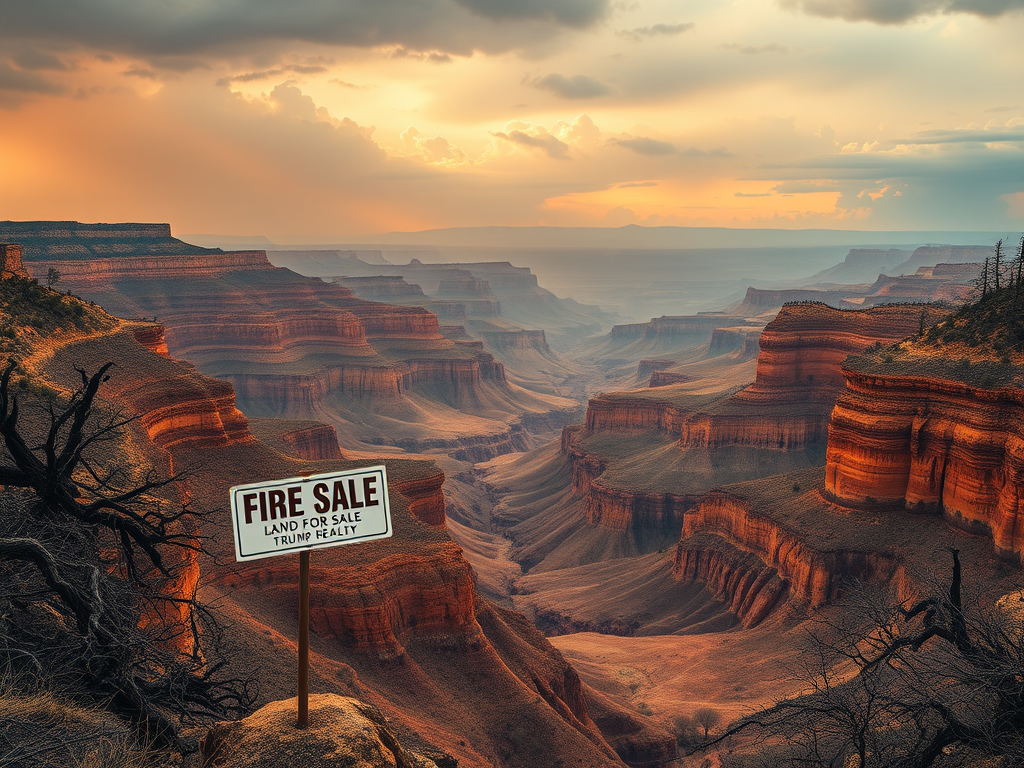
There is a quiet discussion about the concern. People are worried about the destruction of the structures at the Grand Canyon’s North Rim area. Especially if you mention whether Trump will arrange the sale of the property to an investor. Some prospective property companies are considering this, and they have shown interest in the area since it burned last week. The Sale Is –– Not Likely!
It’s doubtful that the U.S. government (i.e., the National Park Service, which manages Grand Canyon National Park) will sell off the burned North Rim properties to private investors. BUT there are always an exception!
“Selling the Canyon: What If the North Rim Was for Sale?”
Private investors will rebuild the lost structures by purchasing the property and assuming control of the North Rim. This would take the burden off the Federal Government. Additionally, it would bring a commercial attraction to the area, increasing yearly traffic compared to the current level.
We have seen with the Trump Administration that the members of his office do not adhere to general practices. These practices are important to ethical principles. They are not below ignoring court orders, laws, and regulations to do what they please. The Administration can obtain anything it asks for with the current House, Senate, and Supreme Court. If Trump asks for a clear title for the Grand Canyon Properties, he would get one. He wipes it from the National Historical Places Monuments list. He removes select pieces of property from the protections of the National Park System.
Don’t think he would, or should? Try stopping renaming a Military Base after a Civil War figure from the Confederacy. Try stopping a military parade on his birthday. Try stopping him from cutting medical insurance coverage for millions of Americans. Inform him that everyone is entitled to civil liberties and must be permitted due process through a legal hearing.
Then, say selling off property in a National Park will never happen. Many do not believe the House and Senate will support Trump’s actions. They will not give him the papers he needs. This includes doing what he wants with the smoldering remains of the North Rim. It also affects any National Park.
🇺🇸 Enter the Trump Administration
Federal law strictly prohibits the sale of national park lands. Nonetheless, recent administrations—especially under Donald Trump—have shown a willingness to test those boundaries. Presidential influence has set a precedent for reshaping public lands policy. Protections in Bears Ears and Grand Staircase-Escalante have been reduced. Formerly protected lands have been opened to oil and gas leases. The Trustee of the National Land and Parks Service will face a force from the Trump Administration. Survival is uncertain if Trump and Company aim to dismantle it.
Sources close to high-level real estate firms claim interest has spiked since the North Rim Lodge was destroyed. The timing has raised questions among environmentalists. They wonder if the destruction of federal structures paves the way. An administration unconcerned with precedent or preservation will try a land transfer.
🏛️ Legal Hurdles (and How They Might Be Circumvented)
Legally, the sale of Grand Canyon National Park land is almost impossible under existing statutes. Some fear the standard rules no longer apply. This fear arises from a cooperative Congress. Additionally, an activist Supreme Court and a President with a record of executive overreach contribute to this concern.
There are those close to the Canyon who are saying – “It’s unlikely, but not unimaginable. In 2020, no one thought sacred tribal lands would be opened to mining. Yet it happened. If political winds shift hard enough, even the Grand Canyon is not be safe from the bulldozer.”
Speaking for the Nay side.
Why a sale isn’t feasible:
There are several points to consider. These points explain why the sale of land owned by the Park Service would not transfer to private ownership. This is due to certain reasons and should be considered. Anyone wishing to ought to consider them further.
The North Rim Is Part of a National Park
The North Rim once included the Lodge, cabins, ranger headquarters, and other structures. It is now part of a federally protected unit of the National Park System. That land is held in trust for the public and can’t be sold or transferred to private ownership.
The area is of Historic and Cultural Significance (does it matter?)
The Grand Canyon Lodge was designated a National Historic Landmark in 1982. It was also listed on the National Register of Historic Places (1). Federal law prevents the disposal of such historic properties without a formal and rare delisting process—something that’s practically unheard of.
Park Policy and Public Trust Doctrine now objects to sale or misuse of property.
The NPS mission requires preserving federal land for future generations. Selling land—even after a disaster—is contrary to this mission and the principles of public trust.
Federal Law on Disposal (would have to be changed.)
Federal agencies must prove the land is excess under laws like the Property Act. The Federal Lands & Policy Management Act also requires this. They must prepare environmental assessments. Agencies must also undergo public notice and comment before any disposal occurs. That’s a lengthy, bureaucratic process—and it rarely results in the sale of park lands.
What’s likely to happen instead:
Reconstruction & Restoration
Park officials and the State of Arizona are more focused on fire investigation. Governor Katie Hobbs is pushing for accountability. There is emphasis on environmental remediation and rebuilding. The North Rim will be closed for the rest of the 2025 season (2).
Congressional/Agency Funding
Efforts now will center on securing federal and state funding to rebuild the Lodge, cabins, ranger facilities, and other infrastructure.
Fire Response Review
Investigations are underway into the decision to let the Dragon Bravo Fire burn before it exploded. Arizona’s government has demanded a thorough, independent review (3).
The burned structures are integral parts of Grand Canyon National Park—they’re not eligible for sale. Instead, the focus will be on recovery, restoration, and rebuilding what was lost, all within the park’s management framework.
Nevertheless, I reserve this statement. We have observed this with the Trump Administration. The members of his office do not adhere to general practices that are germane to ethical principles. They are not below ignoring court orders, laws, and regulations to do what they please. The current House and Senate, along with the Supreme Court, support the Administration. This means the Administration can obtain anything it asks for. If Trump asks for a clear title for the Grand Canyon Properties, he would get one.
Editor’s Note:
I’ve always had something like a sixth sense—premonitions, you can call them. Strangely, the ones I write about never seem to come true. It’s the ones I keep to myself that have a way of becoming reality. – Peace!
On July 17th, a report came out from an Arizona Television News Outlet. The report identified the location as GRAND CANYON NATIONAL PARK, AZ (AZFamily). Arizona’s Family learned a crucial member of the crew was not called in promptly to help. The Dragon Bravo Fire blew up and burned dozens of buildings over the weekend.
As of Thursday, there is still no containment of the wildfire at the Grand Canyon’s North Rim. Six hundred firefighters are working to put out the flames. The wildfire has grown to more than 11,000 acres.
Meteorologists are key to fire management. The Dragon Bravo Fire didn’t have one on scene until Monday. This was several days after the damage was done.
It adds to concerns about how the fire was handled after being sparked by lightning on the Fourth of July. In this case, aside from the actual flames, the weather played a significant role in the destruction.
Strong winds blew up from within the canyon and fanned the flames. Crews on the ground didn’t have an incident meteorologist with them over the weekend. This expert have been capable of warn them ahead of time.
For days, the National Park Service took a “confine and contain” approach. They allowed flames to consume the underbrush. At the same time, they protected the structures within the national park. Nonetheless, that changed on July 11. Firefighters reported that “strong northwest wind gusts were uncommon to the area. These winds jumped multiple containment features.”
Ultimately, the result was more than 70 structures destroyed by flames, including the historic lodge.



















 benandsteve.com