Jeremiah’s Bridge – A Location Of Tragedy

GROFF MEDIA 2024© TRUTH ENDURES IMDBPRO

Presented by benandsteve.com By: Benjamin Groff II©s
3–5 minutes

Jeremiah’s Bridge

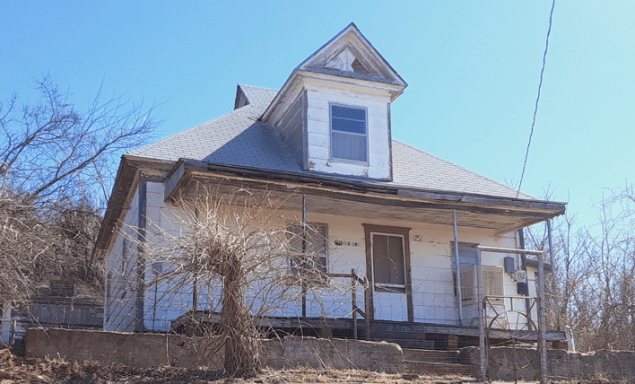
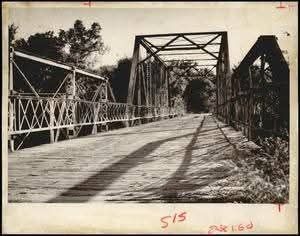
In the early 1900s, a modest bridge spanned the Washita River just west of Anadarko, Oklahoma. Locally known as Jeremiah’s Bridge, it was a vital crossing point. Over time, it became the center of chilling tales whispered among townsfolk.

A popular legend spoke of a grieving mother. She lost her infant son, Jeremiah, to the river’s relentless currents while traversing the bridge. Each night at midnight, a mist reportedly rose from the waters. It embodied the mother’s spirit as she searched and called out for her lost child. This spectral vision drew curious onlookers, solidifying the bridge’s eerie reputation.

However, beneath this sanitized tale lay a darker, harrowing truth. On June 13, 1913, the bridge bore witness to a brutal act of racial violence. Bennie Simmons, an African American man, was accused of raping and murdering 16-year-old Susie Church. He had allegedly done so on Caddo land north of Anadarko.

The Sheriff had gotten word that trouble was expected in town. He reportedly rode his horse to Apache, southwest of the jail. At sundown, a group of horsemen rode into town. A mob, without a fair trial, seized Bennie from his jail cell. They dragged him to a cottonwood tree near the bridge. There, he was doused in coal oil and set ablaze.

As flames consumed him, Bennie’s agonized prayers and screams were drowned out by the mob’s jeers. Unsatisfied, they riddled his body with bullets, ending his life in laughter and ridicule. This atrocity was reported in local newspapers, yet none of the perpetrators faced justice. The riders had all returned home before sunrise and never identified one another. You can verify the hanging by searching the name Bennie Simmons in search engines.

In the mid-1970s, I was still very young when a customer in my dad’s barbershop told him a story. I sat quietly, listening to him tell the story, confessing to being one of the riders. Over the years, pieces of the story have come together. Gradually, I fully understood the gravity of what the man was saying.

In the aftermath, the community took action. They sought to mask the bridge’s gruesome history. This allowed the legend of the mourning mother to overshadow the actual events. Over time, the name “Jeremiah” became associated not with the lost infant of folklore. Instead, it became a distorted remembrance of Bennie Simmons himself. The bridge stood as a silent testament to the fabricated legend. It also represented the suppressed memory of a man’s unjust death.

Another legend about the bridge carried an even more ominous warning. Folklore said that calling out the bridge’s name while standing on it would cause a family member to die. They believed this would happen without fail. Though dismissed as mere superstition, those who dared test the legend often regretted it.

I was one such witness. As a high school student, I accompanied a group of friends to Jeremiah’s Bridge late one night. We had heard the stories and wanted to test our courage. One of my friends, laughing, boldly called out the bridge’s name. The moment was filled with nervous chuckles and unease, but we eventually left, shaking off the eerie tension.

An hour later, everything changed. We stopped by my home. My parents told us that my friend needed to go home right away. His family had been trying to find him. The message was chilling—a relative was near death in a nearby hospital, and the family was being called in. The coincidence was too striking to ignore. That night, we left the bridge with a different fear. It was not just of ghosts. We also felt the weight of history and the unexplainable forces that seemed to linger over the river.

In 1994, decades later, a fertilizer truck caused the collapse of Jeremiah’s Bridge. This event marked the end of its physical presence. Yet, the stories persist. Both the haunting legend and the grim reality urge reflection on the past. They push for recognition of the truths that history often seeks to bury.

Word is they have replaced the structure with a new bridge. I haven’t returned to those parts in many years. The place only holds memories that I choose to keep safely tucked away.

There is also this conversation about the bridge on YouTube.
Cyclops in the Freezer: A Police Investigation Unfolds

GROFF MEDIA 2024© TRUTH ENDURES IMDBPRO

Presented by benandsteve.com By: Benjamin Groff II©s

4–6 minutes

Officer Christopher Cain and Officer William Fife had only been with the department briefly. Max Hinkle and Loyd Mavis’s senior officers often supported them on calls. They ensured the rookies didn’t get in over their heads.


That night, the fog was thicker than the young officers had ever seen. It clung to the streets like a dense blanket, reducing visibility to barely a few feet before their patrol unit. The radio crackled to life, and their dispatcher’s voice cut through the eerie stillness.

“Unit 17 and Unit 23 respond to 809 South Beaver Street. Caller reports strange occurrences and possible screaming.”

The call came in, and without hesitation, the officers prepared to face the unknown.

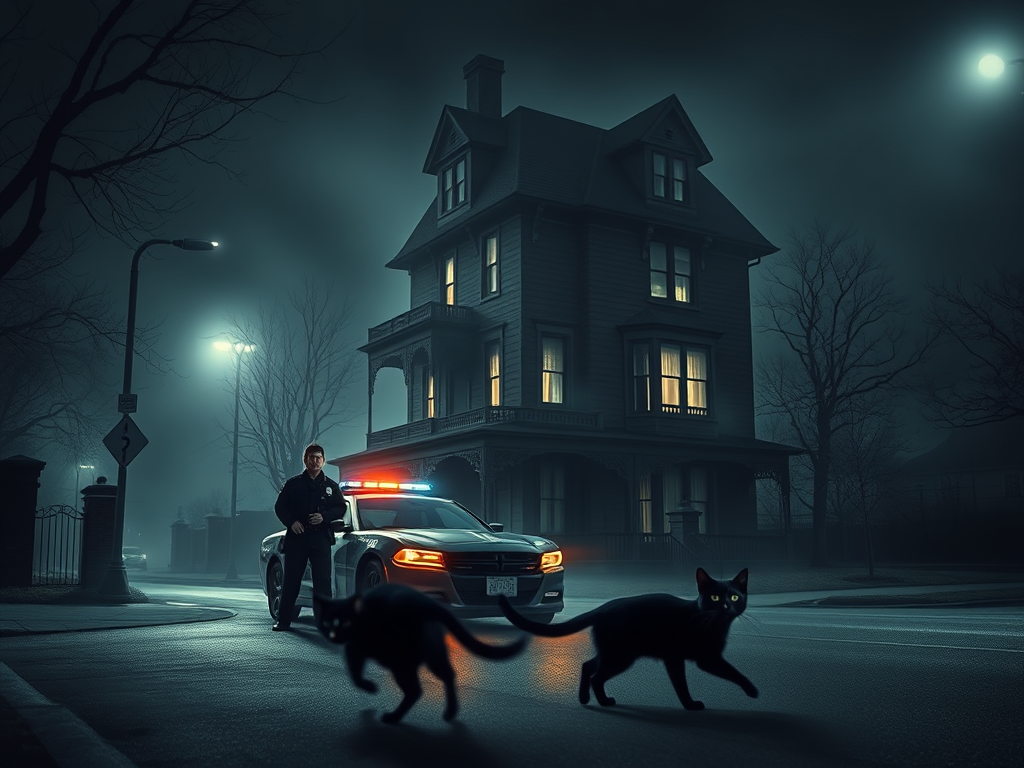
The mention of strange occurrences and possible screaming on Beaver Street sent a shiver down their spines. The street was lined with old, looming houses, most of which had seen better days. This location stood out as a towering two-story relic. It bore an uncanny resemblance to the Addams Family home from television.

The officers pulled up, the house’s silhouette barely visible through the fog. A black cat let out a piercing yowl as they exited the patrol car and bolted past them. Both officers jumped, reaching instinctively for their sidearms. Their senior partners, standing beside them, chuckled.

“Calm down, boys,”

Sgt. Mavis said, shaking his head.

“You watch too many TV shows.”

Still feeling their hearts pound, Cain and Fife took a deep breath. Mavis folded his arms.

“Did either of you catch what the call was about?”

“Uh, something about strange occurrences,”

Fife answered, regaining his composure.

“And screaming.”


Mavis raised an eyebrow.

“Screaming, huh? Alright, let’s do this by the book. You two take the front. Hinkle and I will check around back. Keep your radios on.”

Cain and Fife stepped onto the warped wooden porch and rapped the door. A moment later, the door creaked open, revealing a frail-looking older woman with white curls piled atop her head. She smiled sweetly, her blue eyes twinkling.

“Oh my, what a surprise! I didn’t expect officers at this hour,” she said in a thin, airy voice. “Please, do come in.”


The officers hesitated but, after protocol, stepped inside. The house smelled of mothballs and something faintly metallic. Antique lamps dimly lit the interior, their glow barely pushing back the shadows.

Cain glanced around, feeling a chill prickle his skin.

“Ma’am, we received a call about disturbing noises from this house. Have you heard anything unusual?”


The older woman chuckled softly.

“Oh, I suppose you mean the screaming?”

Fife shifted uneasily.

“Yes, ma’am. Can you tell us about that?”

Fife asked, his voice betraying his unease. The older woman chuckled softly, her response sending a chill down their spines.

The woman clasped her hands together, her expression turning solemn.

“Oh dear, I’m afraid it’s quite the story. You see, it’s my late husband. He doesn’t always know when to keep quiet.”

Cain frowned.

“Your late husband?”

“Yes, yes,”

She said, waving a frail hand.

“Come with me. I’ll show you.”

She turned and shuffled toward the kitchen. Cain and Fife exchanged a glance before trailing. As they entered the room, the smell of something foul hit them—a sickly, sweet, decaying odor. The woman pointed toward an old, industrial-sized freezer in the corner.
Fife hesitated.

“Ma’am, what exactly are we about to see?”

The older woman gave a thin smile.

“Oh, just an old guest who overstayed his welcome.”

Cain swallowed and slowly stepped ahead. He gripped the handle, feeling the frostbite at his fingertips, and lifted the lid.

A massive humanoid form lay frozen inside the ice and frost-covered meat. Its single, lidless eye remained open in an eternal stare.

Cain recoiled.

Cain recoiled in shock, his mind struggling to process what he saw.

“Jesus H. Christ!”

He exclaimed, his voice trembling with disbelief.

Fife staggered back, radioing for backup.

The older woman let out a sigh.

“Oh dear. I’ll have to explain.”

Mavis and Hinkle burst through the back door, weapons drawn.

“What the hell’s going on?”

Mavis demanded.

Fife pointed at the freezer, his face pale.

“There’s a goddamn cyclops in there.”

Hinkle blinked.

“A what?”

Cain barely found his voice.

“A real, honest-to-God cyclops. Dead. Frozen solid.”

Mavis exhaled sharply and turned to the older woman.

“Ma’am, you’d better start talking. Now.”

She folded her hands.

“Oh, it’s time someone knew. Freezer Boy wasn’t from around here, you see. He came looking for refuge long ago. Poor thing couldn’t adapt. He started getting ––– hungry. My husband and I did what we had to.”

Cain felt his blood run cold.

“And what exactly did you have to do?”

She looked at him with a knowing smile.

“We fed him. Until we couldn’t anymore.”

The room fell into silence. The fog outside thickened, swirling like ghosts against the windows.

And somewhere, deep within the house, another scream echoed.

And it wasn’t human.

“What was that?

Sgt. Davis yelled.

“Who? Who was that, Sergeant? Barry, That was Barry.”

She said,

Sargent Davis asked 

“What is up with Barry?”

“He keeps falling out of his crib.”

As the five people went up to the room to look at Barry, the little old lady warned them –

“you were startled at what you saw in the freezer. I don’t know how you will react when you see Barry!”

The Officers asked the old lady whatever became of her late husband. She explained that he died of natural causes. Barry and Freezer Boy fought over who got to eat him. That is how Freezer Boy ended up frozen.

“Poor Freezer Boy never saw it coming, but those two saved me thousands in funeral expenses!”

Childhood Memories and Roberta Flack’s Influence

GROFF MEDIA 2024© TRUTH ENDURES IMDBPRO

Presented by benandsteve.com By: Benjamin Groff II©s

2–3 minutes

The First Time I Ever Saw Your Face, It Was Killing Me Softly

I was between six and eight years old. That was the first time I heard The First Time I Saw Your Face. I also heard Killing Me Softly with His Song for the first time then. My oldest sister, Julie, adored those songs. She was taking piano lessons at that time. She often attempted to play them. Her fingers hesitantly found their way across the keys.

I still remember the old upright piano my parents got for her from a family friend. It was massive and heavy as a full-grown ox. My brothers struggled to carry it to the front wall of our living room. That’s where it stayed for years. Some of the keys stuck, while others refused to make a sound. But a piano tuner visited us. Afterward, the old instrument came to life. It was ready to echo through the house with Julie’s music.

Those long summer days when school was out were filled with Roberta Flack’s voice drifting through our home. Julie played her albums endlessly, the lyrics weaving into my young mind. I remember watching Play Misty for Me. It was my first real brush with suspense. I was more worried about Roberta Flack than I was about Clint Eastwood’s character. My parents had to reassure me that it was just a movie and that no one was in danger.

The First Time I Saw Your Face became inseparable from that film in my memory. In the same way, Killing Me Softly with His Song later found its way into About a Boy. I saw that one at the old Caddo Theater on Main Street in Binger, Oklahoma. My parents never let Julie go to the movies alone, so I was always sent as her reluctant chaperon. At the time, I was too small to protect her from anything. Still, I suppose my presence was enough to keep her out of trouble. At least that’s what my parents hoped.

All these years later, those songs still surface in my mind, uninvited but always welcome. They sneak in when I try to fall asleep while studying and when I need to concentrate. They echo my childhood memories. They replay in the corners of my mind. They are tethered to the days when Julie sat at that old upright piano. She tried to master the melodies.

And for that, I owe it all to Roberta Flack. Shall she rest in peace.

Haunted Memories: The Ghosts of Groff House

GROFF MEDIA 2024© TRUTH ENDURES IMDBPRO

Presented by benandsteve.com By: Benjamin Groff II©s

5–7 minutes

The Old Groff House
The Groff House first moved to Binger from Anadarko, Ok

The old farmhouse was to be our new home. Moving from the city to the farm felt like an adventure, but the others didn’t share my enthusiasm. They struggled with giving up indoor plumbing, a telephone, and dependable electricity.


For my father, though, this was the beginning of a dream—a quarter-horse ranch of his own. The house had been moved from another town and placed onto a block foundation. Uneven concrete blocks, haphazardly arranged, served as makeshift steps leading up to the front door. The door was old, with a large square glass pane in the upper half and weathered wood below. Layers of peeling white paint flaked away inside and out, revealing the scars of time.


But what stood out most was the screen door. It had a single spring that pulled it shut with a sharp clap. This sound still echoes in my memory. Above it, a simple porch overhang provided some protection from the rain. It offered slightly less protection from the sun. The overhang always seemed too small for its purpose.


I was the youngest of six children—or seven, depending on how you counted. My mother’s youngest brother, Uncle Ricky, practically lived with us. He had been raised alongside my older brothers, and I always considered him one of us. These memories of our close-knit family bring a sense of nostalgia and warmth.


My sisters and I stayed close to the house initially. Our parents were wary of hidden dangers lurking in the fields and pastures. Rusted cans, barbed wire, and remnants of years gone by littered the property. My brothers were tasked with clearing the land, ensuring no horse would stumble upon a forgotten hazard. But even without the safety excuse, the grown-ups didn’t need us underfoot as they worked to build barns and fences.


The house felt enormous to my sisters and me. It had only four rooms downstairs. There was one large room upstairs. The ground floor had interconnected doorways. These doorways allowed us to run in endless circles around the stairwell. The kitchen, with its worn linoleum floor and a large propane stove, was the heart of the home. The living room had threadbare furniture. Its windows had seen better days. It was where we gathered in the evenings. We were expected to behave when our parents were home, but the house became our playground when they weren’t.


One evening, my oldest sister shared a story she had heard at school. A man, unknown to us, had been found dead in the upstairs room. Hung himself, they said. His wife had passed away downstairs, and he had followed soon after. My younger sister and I absorbed the tale. We were unsure whether it was truth or fiction. Nonetheless, it rooted itself in our minds.


My parents’ conversations surfaced bits and pieces of the house’s history. They assured us no one had died there—at least, not to their knowledge. But then came the phrase that stuck with us:

“But if they did, there’s nothing to worry about.”

It was as if they had confirmed it without confirming it. They planted just enough doubt to keep our imaginations running wild.


And then, one night, something happened that we would never forget.


It had been an unbearably hot day, the humidity clinging to us like a second skin. We had no air conditioning. We relied on a single box fan upstairs for the boys at night. During the day, we moved it downstairs. As evening fell, a storm rolled in. The sky darkened, thunder rumbled, and the first lightning strike knocked out our power.


We huddled by the screen door, watching the storm unfold. Rain poured down in sheets, lightning flashing every few seconds. We saw him in one brilliant burst of light—a rider on a white horse just beyond our fence.


My oldest sister called for our mother.

“There’s a man out on the road! Should we call him in?”


The lightning illuminated him again. The horse and rider are stark white, motionless against the downpour. They turned into our driveway and stopped at the yard gate. The rider tilted his head, water spilling off the brim of his hat, but he did not move.


We yelled for our parents, urging them to look. The rain intensified, drumming against the roof. And then, in the next flash of lightning—he was gone. No retreating figure, no horse galloping away. Just empty, rain-slicked ground where he had stood.


That wasn’t the last strange occurrence. The memory of the white horse and its rider haunted us, lingering in the corners of our minds. We couldn’t shake the feeling that we were not alone in the house. We felt that unseen presences were walking the same halls.


The dirt roads in Oklahoma turn sandy in the summer. They capture every footprint—deer, bobcat, rabbit, and occasional lost traveler. One morning, waiting for the school bus, we saw her.
A tiny older woman walked at a steady pace past our house. We called out a greeting, but she didn’t acknowledge us. The school bus approached from behind, and I considered asking the driver to stop and offer her a ride.


But when we reached the road, she was gone.


What we didn’t see was more unsettling than her disappearance—tracks. There were no prints in the soft sand, no sign that anyone had walked there.


I looked at my sisters. One of them whispered,

“Don’t say anything. They’ll think we’re crazy.”


Later, an old-timer visited us often. He told us about a train depot standing across the road long before we arrived. He suspected that some soldiers returning from World War I, whose bodies were unclaimed, never left that station. He spoke of ghostly figures wandering the fields at night. Strange sounds echoed from the direction of the old depot. His stories added another layer of mystery to our already haunted farmhouse.


Over the years, my father and I rode our horses through the backcountry. We found old graves. Some were Indian graves, others belonged to settlers, and some were marked only by time-worn stones. One day, I asked my father if it was sad that they had been forgotten.


He looked at me thoughtfully.

“They’re remembered the way they’re meant to be. You don’t need a grave to be remembered. It’s what you do while you’re alive that matters.”


I understood what he meant, but some of me still felt sorrow for those lost souls. Maybe they weren’t as alone as I thought. They still walked in the rain, strolled along dirt roads, or found another way to be remembered. The mystery of their existence lingers, leaving us with more questions than answers.

Tim’s Journey Raising Game Chickens

GROFF MEDIA 2024© TRUTH ENDURES IMDBPRO

Presented by benandsteve.com By: Benjamin Groff II©s

4–5 minutes

Tim and His Prize Chicken

Tim had been caring for his father’s White Rock chicken pen for months. It was a new chore he got handed as he got older. Tim collected eggs from nests, fed the chickens, and cleaned the pens. He also ensured plenty of fresh water for the fowl to drink.

One day, Tim’s father came home from work. He told Tim they were going on a short trip. The purpose of the trip was to look at game roosters and hens. He suggested that if Tim wanted to buy one, he should bring the money. Tim had been saving this money from doing chores and receiving it as gifts.

Tim gathered his savings—an impressive $25.00—and he and his father set off to explore this new thing he had just heard about: “Game Chickens.” They arrived at a property owned by the Gaines family about twenty miles away. Tim was surprised to see dozens of small doghouses spread across the backyard.

Mr. Gaines, a middle-aged man, came out of the house, greeted Tim’s father, and asked, 

“You’re here about the chickens, aren’t you?”

Tim and his father answered in unison, 

“Yes, we are!”

They looked around and discussed their options. Tim’s father purchased five hens and five guineas. Tim proudly bought a rooster with his savings.

When they returned home, Tim’s father explained, 

“We’ll use the rooster you bought to encourage these hens to lay eggs. Once we collect enough eggs, we’ll place them in a new incubator I bought. I’ll teach you how chickens lay eggs. You’ll also learn how they set and hatch their eggs.”

It felt like forever to collect enough eggs, but it only took about a week. Once they had gathered a good number, Tim’s father marked each egg with an ‘X’ on one side. He marked an ‘O’ on the other side of each egg. He then placed them in the incubator. He ensured the proper humidity. He added a small amount of water to the bottom tray. A screen was placed over the water, and the eggs were laid on top.
Tim’s father explained, –––

“For the first eighteen days, we must turn the eggs regularly. Turn them at least thrice daily. This prevents the developing chicks from sticking to the shell. The incubator will handle the temperature, but it’s up to us to turn them.”

Tim learned they couldn’t touch the eggs with bare hands, as oils from their skin clog the shell’s pores. They used cotton gloves to handle them. Tim eagerly helped his father turn the eggs daily, hoping to see signs of life inside.

As they approached the last three days, Tim’s father announced, –––

“No more turning. The chicks need to position themselves for hatching now. And we must keep the incubator closed—no peeking!”

It was the hardest thing for a nine-year-old to resist opening the incubator, but Tim managed. Then, on the twentieth day, he heard a faint ––

“Peep, peep!”

“Should we open it and see if they’re okay?” 

Tim asked excitedly.

“Not yet,”

His father replied.

“Let’s give it another day or two to make sure they all have time to hatch.”

That was not the answer Tim wanted to hear, but he trusted his father. The next two days felt like an eternity. The soft peep grew louder, and his father finally said, –––

“Let’s open it up and see what we have!”

To their amazement, all fifty eggs had hatched. The incubator was full of tiny, fluffy chicks, chirping loudly in their new world.

Tim and his Rooster
Tim holding his Rooster

Over the next month, Tim was responsible for feeding the chicks a unique grain mix. He also provided fresh water with added vitamins to prevent early diseases common in poultry. In about eight weeks, the chicks had grown into young roosters and hens, scattering in all directions across the farm.

Tim learned that game roosters were naturally aggressive toward each other. As they matured, the males had to be separated or butchered. Many ended up in the freezer, while a few got held back as breeders for future generations.

Tim’s father also explained why Mr. Gaines had so many small doghouses in his yard.

“He separates his game roosters to keep them from fighting. Some people sell them, and some even use them for illegal cockfighting, but we’ll never do that. It’s inhumane and against the law.”

As for the guineas, Tim’s father let them roam freely around the farm. 

“They’re the best burglar alarms you can have. If anything or anyone unusual comes around, they’ll make a racket.”

Tim discovered the game chickens laid green, blue, and brown eggs. All are in demand by area residents looking to avoid white eggs, and they have added health benefits.

Through this experience, Tim gained a lifelong appreciation for the care and responsibility of raising animals. He learned patience, the importance of careful handling, and how to nurture life from beginning to maturity. This lesson stayed with him forever.

My Father’s Journey: From Service Station to Horse Ranch

GROFF MEDIA 2024© TRUTH ENDURES IMDBPRO

Presented by benandsteve.com By: Benjamin Groff II©s

4–5 minutes

Today, as I write, I ponder what story to share. Specific recollections stand out, shaping my life in ways that make them worth remembering.


One of my fondest memories is traveling with my father and one of his friends. These journeys often involved a horse—whether for a rodeo, a parade, or taking a mare to be bred. I remember sitting in the middle of the pickup seat. The air conditioning blasted my face. The two men talked nonstop. The smell of their cigarettes filled the cab; they never cracked a window. Though I never smoked a day in my life, I suspect I passively inhaled enough to equate to thirty packs.

This was the early 1970s when smoking held no taboos, even around children. My father eventually quit in his late fifties, relieved to be free of nicotine’s grip. Sadly, six months later, he responded to a chlorine leak at a swimming pool. While shutting off the container, he inhaled the toxic gas, permanently damaging his lungs. From then on, breathing was a struggle. The medications he took to manage his condition weakened his bones. By 63, he was no longer capable of walking. He passed away shortly after. But in those 63 years, he packed in a lifetime of experiences.


Reflecting on my childhood, I marvel at how my parents managed to supply for six children. We weren’t wealthy, yet they kept us clothed, fed, and engaged—horse riding, basketball, piano lessons, and football. We started in a beautiful three-bedroom brick home in a great community. My father owned a Texaco service station and volunteered as a fireman. Some neighbors even urged him to run for city council, but his passion lay elsewhere. He dreamed of owning a quarter-horse farm, a dream that required sacrifice.


The first step was selling our home. We moved into a one-bedroom rental, with my parents in the sole bedroom and us kids on foldout couches. My father attended barber school, planning for the future. A year later, he purchased forty acres in a small town 35 miles away. He used the money from selling the house and service station. The land was densely wooded, and my father and three older brothers worked tirelessly to clear it for a home.


He found a house nearby for sale, provided it was moved. It had four rooms downstairs, one upstairs, and disconnected kitchen and bathroom additions. Two trucks transported the house 28 miles to our new farm. Once settled, we designated rooms: the kitchen, living room, and bedrooms. The steep stairs to the upstairs bedroom often left me bruised from falls. I loved that room. It had windows at both ends, letting a breeze flow as I gazed at the valley. I imagined future adventures.
I discovered my secret hideout underneath those stairs, meant to be my sister’s closet. Small enough to squeeze deep inside, I stayed undetected until I was spotted and lost my perfect hiding place.


Life on the farm lacked modern conveniences, including indoor plumbing. My father found an abandoned outhouse and positioned it over a dry well. Inside, we had two five-gallon buckets of water for drinking, with a dipper hanging above and another for washing dishes. Each day, my father refilled them after closing his barbershop in town.


We also had no phone service at first. When we finally got a phone, I was about eight. The company laid a single line down the rural road. We shared it with three other families on a party line. Each household had a distinct ring. Still, anyone might eavesdrop. Power outages were frequent, lasting days during snowstorms or severe thunderstorms, making access to our home difficult in bad weather.


My father and brothers built horse barns south of our home. At one point, we had over forty horses. Spring was the busiest, with foals being born. My father hosted roping events, where friends gathered to rope all day. Eventually, he installed arena lighting, allowing him to ride even after long days in the barbershop. I joined him often, eating more red sand from falling off horses and calves than I care to remember.


Over time, the horses dwindled to just mine and his. My siblings had moved on from riding. My father worried that his aging stud horse was no longer suitable for breeding. That’s when he became a ranger at the Girl Scout camp, changing my world entirely. Life on the farm transitioned into something new and unknown. What I learned at the camp shaped me. It taught me the value of acceptance. The lessons in resilience have stayed with me through life’s most challenging moments. But that, as they say, is another story entirely.

To end, I want to include a question I recently asked my 95-year-old mother:

“You went through so much. It all started after selling the brick home. You moved from the life we had in the city. Knowing all this, would you do it again?”

She replied,

“in a heartbeat!”

The Great Bison Incident: A True Survival Story

GROFF MEDIA 2024© TRUTH ENDURES IMDBPRO

Presented by benandsteve.com By: Benjamin Groff II©s

3–4 minutes

The Great Bison Incident (A True Story)

Carney had no idea what his neighbor, Ted Ortiz, had done. Ted had recently purchased what everyone around here called a buffalo—though, technically, they were bison. His grand idea? Cross-breeding the massive bull with his cattle. What is there to go wrong?

That morning, Carney had spent hours plowing one of his fields. When he finally finished, he hopped down from his tractor. He stretched his back and pulled out his packed lunch—a simple sandwich and a thermos of water. After a few quick gulps, he was ready to tackle the next field.

He set off across the pasture, taking his usual shortcut. Halfway across, he heard a deep, rumbling snort behind him. At first, he figured it was just one of Ted’s cows and kept walking. But then he noticed something—the snorting sound was moving with him.

Carney turned around and froze.

A massive, very annoyed bull bison stood just a few yards away. And Carney had unknowingly interrupted the beast’s afternoon of affection.

The bison pawed the ground, snorted louder, and locked eyes with Carney. He had seconds to decide—fall, play dead, or run like hell. He chose the latter.

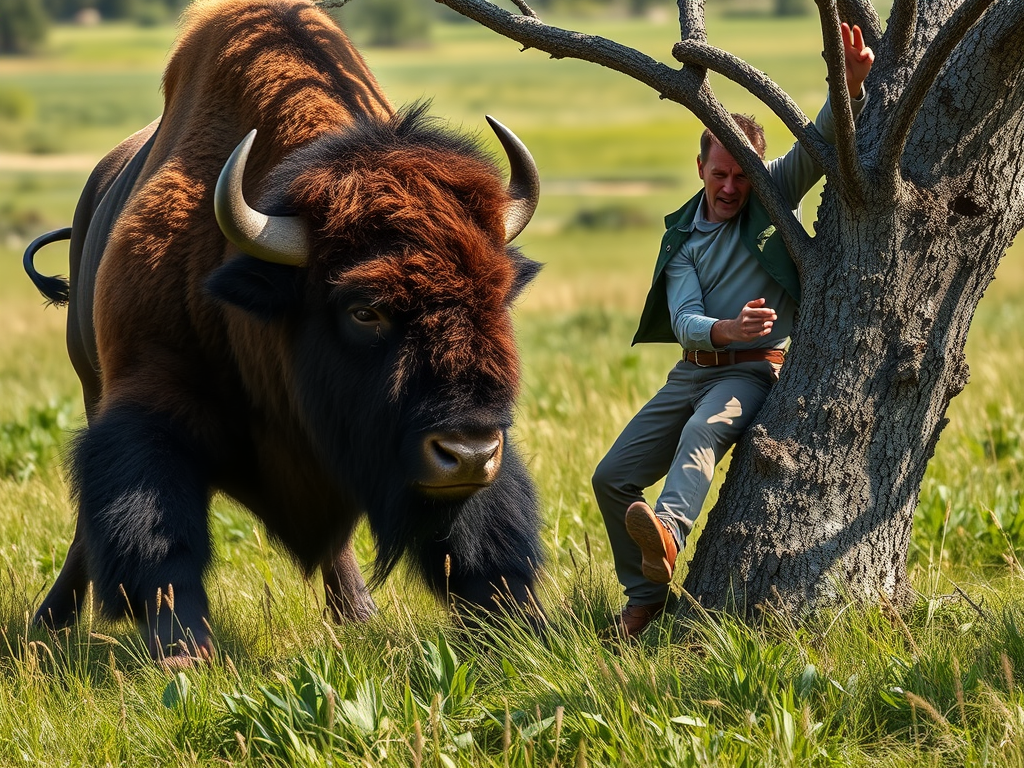
Now, Carney was in his fifties. He was not exactly a sprinter, but he moved like an Olympic athlete when faced with a furious bison. His only hope was a nearby tree. He scrambled up, arms and legs flailing, barely reaching a branch as the bull slammed into the trunk below.

Unfortunately, Carney had picked the wrong tree.

It was dead.

The bison rammed it again. The whole thing groaned and wobbled. Carney had two choices—jump and run or ride the tree down like a doomed cowboy in a slow-motion disaster.

So he jumped. And ran.

And here’s where things took an unexpected turn.

Carney swears he made it to the fence, jumped over, and escaped without a scratch. But according to the newspaper, the story went a little differently.

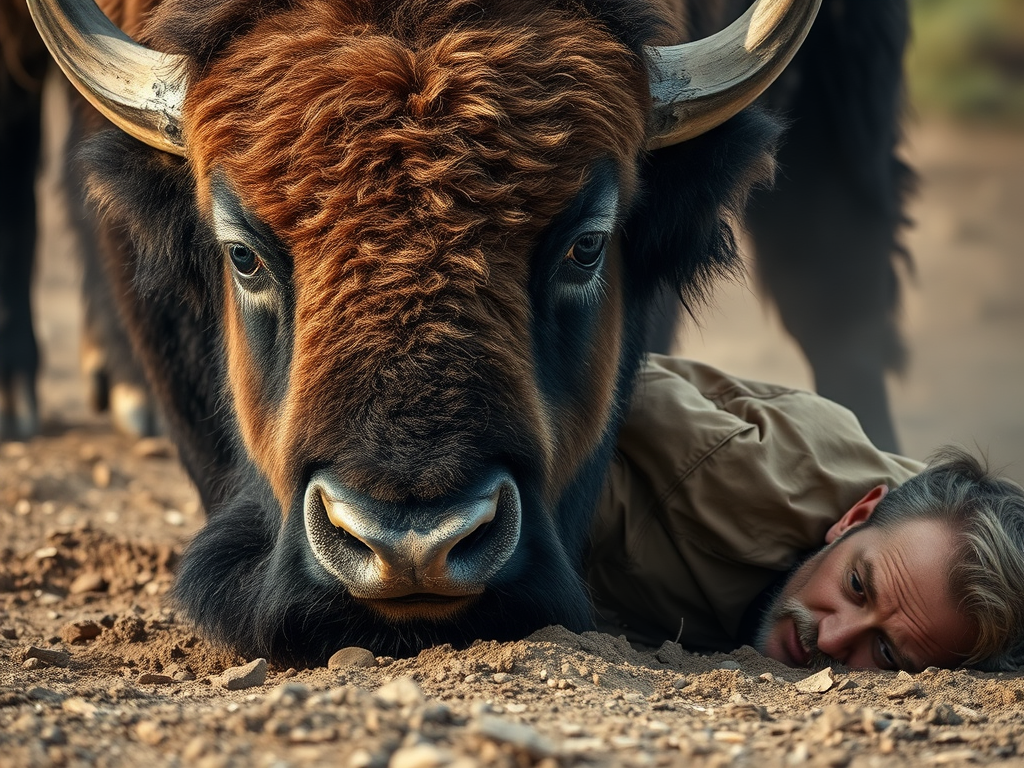
The article claimed that the bison knocked the tree over after Carney hit the ground. Then it turned its fury back on him. Carney had no other options. He did the only thing he thought possible. He dropped to the ground. His face was down in the dirt, and he played dead.

The bison approached, snorting, its heavy breath huffing across Carney’s back. It sniffed his head. His shoulders. His boots. Then, it reached his backside—and suddenly, something changed.

The bull gagged.

Its eyes watered, and its massive body trembled. The mighty beast gave a final snort of disgust. It turned its tail and bolted. The beast ran away as fast as its hooves carried it.

Carney, shaking but victorious, got to his feet and went to the other field. Before plowing, he had to detour into the nearest creek. He needed to scrub off whatever offended that bison so severely.

The newspaper never revealed its source for this version of events, but everyone had their suspicions. Most believed the town barber had something to do with it. After all, most of the town’s best stories started in his shop.

To this day, the Great Bison Incident resurfaces whenever the local men need a good laugh. It is a legendary reminder that sometimes survival comes down to sheer luck, including an unfortunate choice in lunch. It’s a tale that never fails to entertain.

This is a true story. The names have been changed to protect the privacy of those in real life.

Vern Gosdin’s Legendary Blizzard Concert Experience

GROFF MEDIA 2024© TRUTH ENDURES IMDBPRO

Presented by benandsteve.com By: Benjamin Groff II©s

3–5 minutes

The Night Vern Gosdin Played for Twenty

Harry had worn many hats in his life. One of his most memorable roles was as a news director. He also served as an operations manager at a radio station in the lower Great Plains. His job included ensuring that touring musicians arrived at their venues without issue. He also ensured that their shows went off without a hitch.

Artists like Dan Seals, Davis Daniel, and Vern Gosdin have passed through the area over the years. They brought country music to fans eager to taste Nashville. But one night in particular stood out—the night Vern Gosdin played for twenty.

Gosdin, known as “The Voice,” was a country music legend. His pedigree included stints with the Golden State Boys, The Byrds, and collaborations with George Jones. He had a rich, smooth baritone. It gave life to timeless hits like Set’ Em Up Joe. He also brought If You’re Gonna Do Me Wrong, Do It Right to life. Another classic was Chiseled in Stone. Fans were eager to see him live. He was scheduled to sing at a local college auditorium and field house. This event was set for one Saturday night in January.

On Friday, Harry arrived at the venue to oversee the setup. Everything was in place—sound, lighting, seating—and aligned with the band’s requirements. The only concern was the weather. Forecasts hinted at snow, but the storm was expected to stay north of the region. Gosdin’s tour bus had pulled in behind the venue by noon on Saturday. The final checks were made, and everything looked good to go.

Then, the storm took a turn.

By late afternoon, the sky darkened, and the wind began howling. Within hours, blizzard-like conditions descended on the area, dumping nearly a foot of snow. Whiteout conditions made travel treacherous. The state highway department issued warnings urging motorists to stay off the roads unless it was an emergency.

By showtime, only twenty dedicated souls had managed to reach the venue. The sold-out crowd was nowhere to be seen, trapped by the snow. Their decision to be there showed strong dedication. They braved treacherous conditions as a testament to their love for Vern Gosdin and his music.

Despite the dismal turnout, Vern Gosdin and his band took the stage as if playing to a packed house. Gosdin stepped to the microphone, wore a warm smile, and said, –––

“We made it. For those of you here, we will play!”

The Voice filled the nearly empty hall with his opening number. He sang “I’m Gonna Be Moving,” a gospel tune. It resonated with many of his fans. He followed with “I Can Tell By the Way You Dance.” The concert became extraordinary from that moment on.

The crew saw rows of empty seats. They decided to clear a space near the stage, which was turned into a dance floor. The twenty die-hard fans swayed, twirled, and laughed as Gosdin played every song from his setlist. It was no longer just a concert but an intimate, once-in-a-lifetime experience, a privilege they can claim. Between songs, Gosdin and the band chatted with the audience, taking requests and sharing stories.

The small but mighty crowd erupted into cheers when he played his final song and left the stage. Their enthusiasm filled the hall, and they refused to let the night end.

A minute later, Gosdin and his band returned.

He picked up his guitar for his encore and grinned at his audience. He broke into I’m Moving On. Then, he followed with That Just About Does It. The twenty lucky souls in attendance soaked up every note, knowing they were part of something special.

Outside, more than fifteen inches of snow had blanketed the town. The roads were treacherous, but Gosdin’s bus driver was determined to push ahead. He asked Harry to lead them to the highway, where they would inch their way north. Harry agreed, and with the radio station’s car guiding the way, the tour bus crept through the snow-covered streets.

After twenty miles, the highway finally began to clear. As the bus picked up speed, the driver gave a long honk. It was a final thanks to Harry for helping them through the storm. It was also for an unforgettable night on the Great Plains.

The twenty who braved the blizzard that night in Goodwell, Oklahoma, gained more than a concert experience. They had seen a legend up close. It was a personal meeting in a performance that would be talked about for years to come. The memories of that night, the laughter, and the music will stay with them forever. The sense of community was also unforgettable. This is a testament to the enduring power of live music.

Chester’s Revolution: A Fight Against Government Oppression

GROFF MEDIA 2024© TRUTH ENDURES IMDBPRO

Presented by benandsteve.com By: Benjamin Groff II©s

4–6 minutes

When the world turns against you, what do you do? This question had boiled under Chester’s contempt for days. He had watched the nation he loved become the opposite of everything it had ever stood for. The people appeared powerless to stop the crazed leaders who were taking control of the institutions and destroying them.

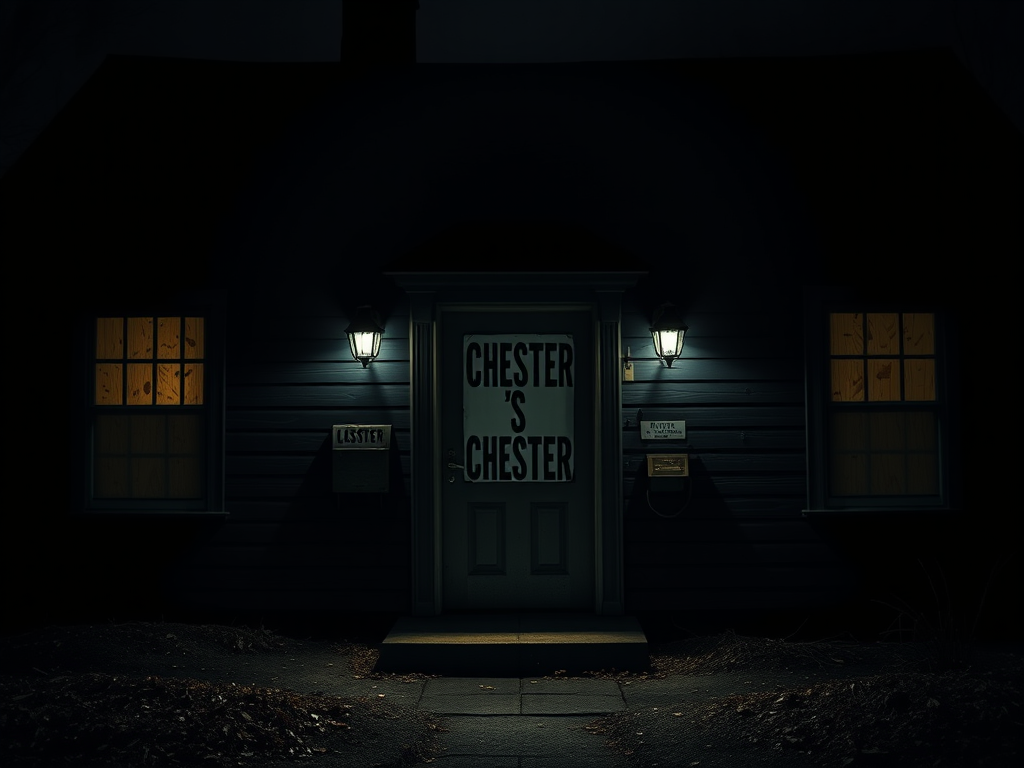
Chester became so incensed that he quit his job. He took about three hundred dollars, bought as many canned food items as possible, and stored them in his home. Chester then purchased one hundred dollars’ worth of bottled water. He had planned for the loss of electricity and home heating petroleum. Chester had medical supplies he thought would handle any matter related to his health. Then, he went and nailed his doors and windows shut. He placed a sign on the outside of his home stating:

I AM HOME – ALIVE – I DO NOT WANT CONTACT WITH THE OUTSIDE WORLD OR ITS DISTURBING GOVERNMENT. THIS HOUSE IS OFF LIMITS TO EVERYONE. PLEASE DO NOT ENTER!

Then, in chalk, on a board that slid in and out from the interior of the home, it read:

DATE – 2-16-2025

Chester planned to update the date every night to let the outside world know he was still alive.

Chester planned to live without listening to what was happening around him. He believed it was the only way he survived. Chester wanted to help others but had no solution, power, or ability. For Chester, this was all he thought he would do.

His home was significant. It had five bedrooms, four bathrooms, two living areas, two kitchens, and a mother-in-law suite. He had inherited it from his parents after they passed. It was paid for, and he had taken control of their Trust. He didn’t have any financial issues.

Every morning, Chester would visit the mother-in-law’s suite. It offered a view of a once-lively park. The government has now abandoned the park. He often spotted young figures lurking behind the trees, their presence a haunting mystery. Why were they there? Why were they hiding? And most puzzling of all, why did they seem to have nowhere else to go?

One day, curiosity got the best of him. He grabbed his hammer. He pulled the nails out around the suite’s window. He cracked it open, trying to hear their conversations.

Two young girls and two young men were hiding behind a tree, whispering urgently. Chester leaned in closer and heard them say:

“Look, it won’t hurt, and we will be free of this world. If we stay any longer, it will only get worse. They will kill us if we don’t beat them to it!”

Chester’s blood ran cold. What in the world were they talking about? Was this some game? Or were they seriously considering group suicide? And was the government truly hunting these kids?

He had heard about new policies stripping rights from the LGBTQI+ community and disenfranchising people of color. But had it escalated to mass executions? Chester had to find out.

He rummaged through an old trunk in his father’s Hollywood memorabilia. It contained all sorts of disguises: wigs, glasses, vintage clothing. Chester dressed as an older, disheveled homeless man and prepared to venture outside for the first time in weeks.

What he would learn would be devastating.

The streets were eerily quiet, yet tension hung in the air like a brewing storm. Checkpoints had been set up at major intersections, where government enforcers—men in military gear with no insignias—patrolled with assault rifles.

Posters were plastered everywhere, declaring:

 “FOR THE SAFETY OF OUR NATION, COMPLIANCE IS MANDATORY.”

 Others simply stated: 

“NON-CONFORMISTS WILL BE RELOCATED.”

Chester approached a group of homeless people warming their hands over a fire in a rusted oil drum. They regarded him warily but allowed him into their circle.

“What’s happening?” 

Chester asked, playing the role of a lost drifter.

A man with hollowed-out cheeks and weary eyes responded,

“They’re rounding people up. Anyone who resists, anyone different. They disappear.”

Chester asked quickly,

“Disappear where?”

The man shook his head.

“No one knows. Some say camps. Others say execution sites.”

Chester’s stomach twisted into knots. The government wasn’t just oppressing people; it was actively erasing them. The kids in the park weren’t paranoid—they were running for their lives.

He couldn’t stay hidden anymore. He had to act.

That night, under the cover of darkness, Chester snuck back to his house and removed the sign from his door. He pried open his windows, unlocked the doors, and gathered supplies. With his home’s ample space and well-stocked provisions, he offered sanctuary to those with nowhere else to go.

The next day, he returned to the park and approached the young people cautiously.

“Come with me,” he whispered. “You don’t have to run anymore.”

At first, they hesitated, but the desperation in their eyes mirrored his determination. One by one, they followed him back to his home. Chester had spent weeks barricading himself from the world, convinced that isolation was the only way to survive. But now, he understood—survival was not just about enduring. It was about resisting.

And Chester was ready to fight back.


“LGBT people are some of the bravest and most potent change agents and leaders I have encountered. They are the most forceful defenders of the vulnerable and voiceless because they know what it’s like to be there.” 

-–– Ronan Farrow -–– a journalist known for his investigative work with the New Yorker and member of the LGBTQI+ Community


Honoring Tradition: Birthday Memories and Family Bonds

GROFF MEDIA 2024© TRUTH ENDURES IMDBPRO

Presented by benandsteve.com By: Benjamin Groff II©s

2–4 minutes

February 17th: A Day to Remember

Today is February 17th. In the United States, it’s recognized as Presidents’ Day. This holiday honors past leaders and their contributions to the nation. Initially, the day was all about Washington and Lincoln, but eventually, every other president wanted in on the act. At least, that’s how I remember it from my elementary school days.

Groff Family Celebrations
Groff Media©

But for me, February 17th holds a much deeper meaning. It marks the birthdays of three people who shaped my life. They are my grandmother, father, and an uncle by marriage to my father’s sister. And with that, it also carries a tradition that has lingered through the years.

When they were alive, our family gathered every year on the Sunday before their birthdays. Relatives, friends, and even neighbors would fill my grandparents’ home. Some were from their old farm. Others came from their city life after retirement. As a child, I didn’t fully grasp the significance of these gatherings. Now, in my retirement years, I see it so clearly. The warmth of belonging, the shared stories, the laughter—it all meant something. Looking back at the old photos, I understand now what I couldn’t then.

After they passed, my mother kept the tradition alive in her way. Every year, without fail, she’d call each of us siblings and ask,

“You know what day it is?”

Groff Family Celebrations Groff Media©

But time moves ahead, as it always does. My mother is now 95. She no longer makes those calls. Her mind can’t reach for the dates and details that once anchored her. So instead, we call her. And the tradition continues, binding us together in shared memories and love.

Only my sister and I acknowledge the day out of six siblings. Sometimes, I call her first. Other times, like this morning, she beats me to it—before I’ve even had my first sip of coffee. Our conversation is brief but meaningful, a moment to honor the three lives that shaped us. And, of course, to share a hearty laugh at the memory of my father’s favorite joke.

My dad was a barber, and in our town, barbershops traditionally closed on Mondays. But when Presidents’ Day landed on February 17th, he saw an opportunity for mischief. At family gatherings, he’d grin and announce,

“If the Post Office is closing on my birthday, then I suppose I have to close my shop too!”

In those years, he’d even hang a sign in his shop window:

“JOINING THE POST OFFICE—WE WILL BE CLOSED ON MONDAY IN RECOGNITION OF MY BIRTHDAY.”

My Father JD
Groff Media©

He thought it was the funniest thing in the world, and as kids, we did too.

I always admired my dad. I looked up to him, though I never told him outright. I wish I had. There were so many times I wanted to say the words, but I never quite found the right moment. And yet, I believe he knew. Somehow, he always knew things about me that I never spoke out loud.

Even on February 17th, I felt his presence in the quiet traditions that remained. I sense it in the phone calls, laughter, and stories we still tell.

And I think—that’s enough.

A Poem and a Poker Game: Life Lessons Learned

GROFF MEDIA 2024© TRUTH ENDURES IMDBPRO

Presented by benandsteve.com By: Benjamin Groff II©s

2–3 minutes

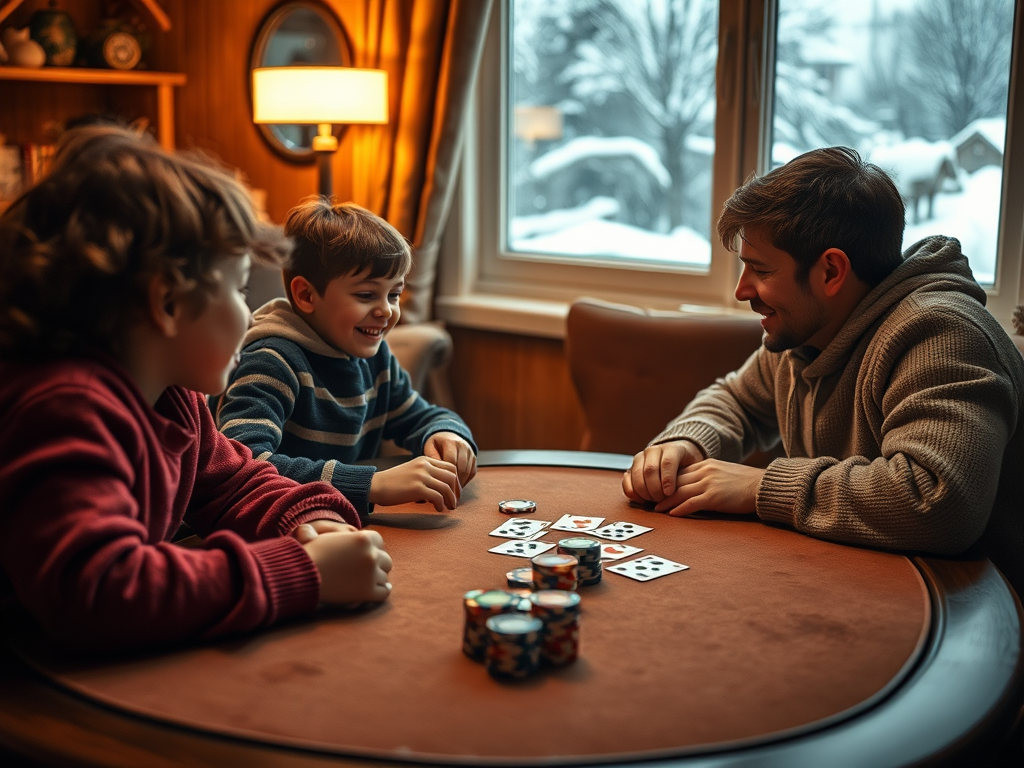
It was cold and snowing the day my dad decided to teach my sister and me how to play poker. We set up a card table in the living room. He brought out his cherished poker chips and cardholder. He placed them carefully in the center.

The chips were red, white, and blue. Dad told us not to worry about their dollar value. White was the least expensive. Red was worth more. Blue held the highest value, at least for this game. Then, with a practiced hand, he shuffled the deck and dealt the cards, and our lesson began.

I can’t recall exactly which variation of poker we played. It was Seven Card Stud, Texas Hold’Em, or Five Card Draw. But I remember the three of us sitting around that table. Each had a tall glass of iced tea. The snow piled up outside. With every inch of snowfall, I grew more hopeful that school would get canceled the next day. In my mind, I was already winning.

I caught on quickly, learning to hold onto high-value cards and giving myself a decent advantage. But the real edge came from my dad. He wasn’t just teaching us poker. He was teaching us something more. This lesson would stay with me long after the cards were put away.

A fire crackled in the fireplace, filling the room with warmth, and for a moment, life felt perfect. That house, that evening, that love—it’s a place I often dream of returning to. Yet, it no longer exists beyond memory. And in that memory, my dad shared something else with us. It was a poem—a warm blanket of words that wrapped us in comfort.

It was nonsensical and crude, but it belonged to him, and now it belonged to me. Decades later, I still carry it with me:

DAD’S POEM

I Woke Up Just This Morning

And I Looked Upon The Wall

The Roaches And The Bedbugs

Were Playing A Game Of Ball

The Score Was Six To Nothing

The Roaches Were Ahead

I Got So Doggone Excited

I Jumped Right Out Of Bed

I Ran Downstairs to Breakfast

But The Coffee Was So Stale

It Tastes Just Like Tobacco Juice

Right Out Of The County Jail.

Dad said he wasn’t sure where he’d first heard it—maybe in school as a boy. He had just always known it. And now, it was mine to carry on.

That silly little poem has come in handy more times than I can count. It has bailed me out when I’ve been put on the spot and asked to speak publicly. When I needed to write something quickly for school, it found its way onto my paper. It has brought laughter to gatherings and lightened tense moments. Somehow, it has traveled with me through time. It serves as a testament to the enduring power of shared memories. It is just like the memory of that snowy afternoon.

I never became a poker player, but I went on to work with words, write, and tell stories. I believe it started with that poem.

Cherished Memories from 608 E Kiowa Street

GROFF MEDIA 2024© TRUTH ENDURES IMDBPRO

Presented by benandsteve.com By: Benjamin Groff II©s

3–5 minutes

The house at 608 E Kiowa Street was a two-story, single-family dwelling. It was the largest home on the street. It was on the road’s south side, just east of Jefferson Elementary School. The exterior was adorned with a well-kept garden. There was a porch with a swing where we spent many evenings. A large oak tree provided shade in the summer. It was my grandparents’ home from when I was born until my grandmother passed away in the mid-1970s.

With its shale shingle siding, the house always seemed enormous to me. The first floor held a kitchen, a cozy den, and a bedroom. It contained a formal sitting room and a living room where their black-and-white television rested. Upstairs were three large rooms—spacious enough for my grandmother to host visiting relatives from out of state.

My grandmother’s hospitality was legendary. She accommodated up to three full-size beds with people. She had sleeping cots and plenty of room to use if needed. She was always ready to welcome more guests into her home, making everyone feel like they belonged.

One of the most memorable aspects of the upstairs was the introduction to an old-fashioned necessity: the chamber pot. My grandmother clarified that it was mainly for the ‘men folk.’ The women seemed to manage through the night without issue. Every morning, my grandfather would empty the pot into the downstairs toilet. Then he would step outside. He would wash it thoroughly with the garden hose. He’d always follow this routine by filling it halfway with water and calling out to my grandmother,

“Ok, Mom, I got halfway there.”

To which she’d respond from somewhere in the house,

“Don’t put the lid on it. I’m bringing the bleach!”

Everyone called them Pop and Mom. Over the years, the names became so natural that they started addressing each other that way. This was true except when my grandmother was exasperated with Pop for not hearing her. Then, she’d call him by his actual name, the very name I shared with him. But beneath the surface, how much they loved and cared for each other was always evident.

“BEN!”

Whenever I visited, I couldn’t help but worry that the neighbors thought she was yelling at me for misbehaving. I loved my grandparents too much to ever cause trouble. I tried my best to help Pop hear her. I acted as a go-between for their familiar, loving banter.

Another curiosity upstairs was an old doorstop. It was a gift from my great-grandfather. He was a stern, fire-and-brimstone Baptist preacher. He roamed Northeast Texas, Southwest Arkansas, and Southeast Oklahoma. His mission work often left my grandmother unsure which state they lived in since their farm straddled all three.

She once told me something interesting. The doorstop had accompanied her brother. He came to give my grandfather permission to marry her. It remained tucked away upstairs because, as she explained,

“Times have changed, and it wouldn’t be proper to show it in the main part of the house.”

In the kitchen, a small toy was tucked inside a cabinet. It was the only toy my grandmother ever bought for my dad during his childhood. Money was tight back then, and buying toys was a luxury most couldn’t afford. Yet, she purchased this wind-up toy. It would dance and entertain my dad as a toddler while she worked around the house. When my grandmother passed away, the toy went to my dad. After his passing, I found it in our attic. It was worn and weathered by time. Yet, it still carried the weight of all those cherished memories. I kept it—not for its value, but for the stories and love it symbolized.

The family gatherings we shared there pull me back to that old house, even though it no longer stands. Mom and Pop’s home was a magnet for loved ones, filled with laughter and warmth. Even during the most challenging economic times, a sense of togetherness and unity prevailed. This feeling seems more elusive in today’s world. Their old radio will not pick up the stations it once did.

I often wonder what Mom and Pop would think if they saw our modern world—technology and conveniences. But more than that, I wonder how they’d feel. How would they react if they saw what we’ve done with the legacy they left us? They instilled the values of hard work, love, and togetherness. Would they be proud of the way we’ve upheld these values? Would they recognize the strong family bonds they worked so hard to instill? The actual family values of love before judgment.

Those questions linger, just like the memory of the old house on Kiowa Street.

The Enduring Love Story of Henry and Harry

GROFF MEDIA 2024© TRUTH ENDURES IMDBPRO

Presented by benandsteve.com By: Benjamin Groff II©s

4–6 minutes

Henry and Harry met by accident one evening when Henry was riding with Harry’s roommate and fellow police officer, Teddy. Henry and Teddy stopped by Teddy’s house to pick up the legal papers Teddy needed for a court filing. He invited Henry in to meet his roommate, Harry.

When they entered the door, Harry was getting ready for his shift. He walked down a hallway wearing only his trousers and no shirt. Henry and Harry’s eyes locked onto each other as Teddy introduced them. Neither knew the other’s intentions or interests; they nodded and said hello, an electric charge lingering between them.

Harry worked at the police station’s front desk and communications center. Suddenly, Henry worked for the local radio station. He began coming to the station instead of calling on the phone for the day’s latest police activity. Henry would sit patiently. He went through the radio and comment logs. He looked for items to place in his news reports on the radio. Then, he would make small talk with Harry, their conversations stretching a little longer each time.

One day, Henry asked Harry if the officer was off the next weekend. Harry confirmed that he was. Henry explained that his boss wanted him to travel to Loca City. He needed to pick up his son and return him to Elm City. Harry said he’d love to go along for the adventure. Henry explained they go there on Saturday and return on Sunday. This way, he would be there to get the youngster after he got out of church.

When Saturday came, the two left Elm City for the nearly two-hour drive to Loca City. During the drive, they talked, learning more about each other’s pasts, dreams, and fears. At times, their arms brushed against each other on the armrest of Henry’s Ford Thunderbird. Unknown to each were the butterflies fluttering in their stomachs as the pair drove down the highway.

Upon arriving in Loca City, the pair stopped for burgers. Across the street, there was a movie theater. And, of course, they would take in a movie— Friday the 13th: Season of the Witch.

By all standards, the movie was a flop. But the film still had spooky moments, especially for Harry, who jumped and yelped throughout. It was ironic—him being the one who worked for the police department. Afterward, the two laughed at how jumpy Harry had been, and Harry was embarrassed.

It was getting late, and they decided to find a motel for the night. The two found a Holiday Inn Holidome. Henry said he would take care of the room. Harry was asked to watch the car. Harry complied. A few minutes later, Henry returned with room keys and said—

“I’m sorry about this. The hotel only had one room, and it had a queen bed.”

Harry’s reply was accepting.

“I don’t have a problem with it. I slept with my best friends all through hay harvest.”

Once in the room, the television came on. Of all things, it was a rerun of The Tonight Show with Joan Rivers. The two settled in with Joan Rivers rattling on. At some point, one of their elbows flinched into the other. Then, a tickling match ensued. The tickling led to rolling around in the bed, which led to a still moment.

Henry reached up and kissed Harry. That was in 1982. And in 2024, that kiss still lasts.

They demonstrated remarkable courage, enduring the hardships of hiding their relationship to protect their careers. They faced moments of having to pretend to be twin brothers to avoid violent repercussions. They even experienced the loss of family members who couldn’t accept their love. But through it all, they clung to each other, a testament to their resilience and the power of their love.

They were finally capable of marrying. They did so without fanfare—just them and a few close friends. There was a quiet understanding that this was always meant to be. But even then, their love faced challenges. They faced the threat of losing their rights as a married couple. Additionally, there was the ever-existing worry of discrimination in housing, employment, and medical care.

After over forty years together, they pridefully ponder on their journey. The fights, love, laughter, and pain were all part of their story. If anything, the years only strengthened their love. Their relationship is a beacon of hope for enduring love in a world that often challenges it.

Henry reaches for Harry’s hand as they sit on their porch, watching the sun set over their quiet neighborhood. His grip is weaker than it used to be, but the warmth is still the same.

“No matter what they take from us,” Henry says softly, “they can’t take this.”

Harry smiles, his thumb brushing over Henry’s knuckles.

“No, they can’t.”

After all, it is where they began—and will always belong. Their home is their sanctuary. It is where their love has blossomed and endured. Their home is a testament to their resilience and the power of love.

This is a true story. The names and places have been changed to protect the identities of those lives involved.

Discovering a Father’s Hidden Letters

GROFF MEDIA 2024© TRUTH ENDURES IMDBPRO

Presented by benandsteve.com By: Benjamin Groff II©s

3–5 minutes

The last of the guests had left. A heavy silence remained, seeming to fill every corner of the house. It had been a long day. Victor placed his hands over his face. He tried to collect himself from everything that had happened in the last few days. His father had passed, and the funeral had brought together friends and family he had not seen in years. Once filled with laughter and conversation, the house now stood eerily silent.

He walked to the refrigerator for a cold glass of water. Something caught his eye—a wooden cigar box atop a cabinet. It was the old kind –– the type that hadn’t been made in years. It was a mystery, a relic from a bygone era. His father must have been holding onto it.

Curious, Victor set his glass on the kitchen table and reached for the box. He found letters bundled with a rubber band as he pried it open. The postmark on the top envelope was dated 1942. He ran his fingers over the stack, noticing the new rubber band. His father had handled these recently.

Victor’s mother, Emily, had passed nearly seven years ago. Since then, his father, Bob, has never been the same. He continued with life, but something had changed—like a light had dimmed.

He carefully removed the band and unfolded the first letter. A small tobacco sack slipped out as he did, landing softly on the table. It felt empty, save for dust. Pushing it aside, Victor began to read.

My Dearest Emily,

Today, we are adrift going “over there.” I don’t know what we will find when or if we wash ashore. Yet, I know one thing—I wish to get back to you more than anything. You are my love, my most faithful and one and only! I promise with all my heart to survive this mission and see you again! I have to make this quick to get to the mail plane before it takes off.

Love, Bob

Letter after letter, Victor saw the same unwavering devotion. His hands trembled as he read the words, feeling the weight of his father’s love and sacrifice. Then, one in particular caught his attention:

My Dearest Emily,

We ran into trouble and had to fight the Japanese in the middle of the ocean. We won. The chiefs say it will be a decisive battle in the war. I certainly hope so. We took losses. Some of my buddies are gone. But I am still here, as I promised you I would be. I love you and can only count the days until this war ends, and I am back home with you. I promise I will never leave your side again once I return!

Love, Bob

Victor looked at the date on the letter and the weight of his father’s words. Could Bob have been in the Battle of Midway? He had never spoken much about his military service. The letters seemed to carry the burden of his unspoken past.

No kid should have to be a killer of another. It is the most horrible thing you can imagine.

Those were the only words his father had ever spoken about the war.

Victor leaned back in his chair, staring at the letters before him. His father had seen horrors he had never spoken of and endured trials he had buried deep. Yet, through it all, the one thing that had kept him going was his profound and unwavering love for Emily.

He suddenly understood why, after her passing, his father had never quite been the same. Bob had kept his promise—he had never left her side. And when Emily was gone, so too, in a way, was Bob.

A lump began to form in Victor’s throat. He had always known his parents’ love was strong, but he had never truly grasped its depth until now. He had a newfound appreciation for the man his father had been. He gently and reverently returned the letters to the cigar box. Each one was a testament to his father’s enduring love.

As he placed the box back on the cabinet, he felt something shift within him. Grief remained, but now it was accompanied by a deep admiration. His father had lived and loved with an intensity few understood.

And finally, after all these years, he was with Emily again.

A Fellow Post To Share With You!

Groff Media is sharing this piece unedited from Foxes Den. The next is the introduction to the piece. The link to the writers’ pages is posted near the end so you can go to the original site’s writing.

FROM THE FOXES DEN – (unedited)

If you could un-invent something, what would it be? 

I’ve browsed around some of the replies to this prompt and I must say I’m quite surprised. Surprised to see so many people wishing that social media could be un-invented. Now I am with these people 100%, I agree it’s a breeding ground for hatred and vitriol, however as so many are already mentioning social media I feel I should suggest something else because to not do so would make this post quite repetitive and boring. 

Well it will probably still be boring but here goes. 

Addiction. If only there wasn’t such a thing. Again it’s one of those things that is good to have in certain scenarios but an absolute nightmare to have in others. Let’s talk about the nightmare scenarios.

Click here to read the entire piece.

Maintaining Integrity Amidst Conflict

GROFF MEDIA 2024© TRUTH ENDURES IMDBPRO

Presented by benandsteve.com By: Benjamin Groff II©s

2–3 minutes

Keeping Your Side of the Street Clean

The smell of fresh rain lingered as Mark walked down Elm Street toward his favorite café. It was his usual morning routine, a quiet moment before the day unraveled. He reached the entrance. Then he saw him—Greg Turner. Greg was leaning against a lamppost, arms crossed. He was watching him with a smirk that dripped with disdain.

Greg had never made it a secret that he disliked Mark. Their history goes back to a business deal gone wrong. Mark handled it ethically, but Greg saw it as a betrayal. Since then, Greg had made it his mission to smear Mark’s name. He spread rumors and whispered doubts into the ears of anyone who would listen.

Mark adjusted his posture, exhaled slowly, and kept walking. He knew better than to engage.

“Hey, Mark,” 

Greg called out loud enough for people at the café’s outdoor tables to turn their heads.

“Still fooling people into thinking you’re the good guy?”

A few customers looked up from their coffee, eyes shifting between them, waiting for a response. Mark felt the moment’s weight pressing against his back, the temptation to defend himself bubbling under the surface.

But he had learned something long ago—some battles weren’t worth fighting. Not in the mud. Not at the expense of his peace.

He turned slightly, just enough to meet Greg’s gaze, and nodded.

“Good morning, Greg.” 

His voice was even, void of malice, but firm. Then, without another word, he stepped inside the café.

The barista, Sarah, greeted him with a warm smile. 

“The usual?”

Mark nodded as he took out his wallet.

“Yep. And maybe an extra shot of patience today.”

Sarah chuckled as she prepared his coffee. 

“Don’t let him get to you.”

He shook his head. 

“I won’t.”

Moments later, as he stirred his coffee, he glanced outside. Greg was still there, now talking to someone else, his hands animated, spinning another version of his tired tale. Mark took a sip, savoring the rich warmth of his drink, and let the moment pass.

There was no need to wade into the mess or wrestle with the bitterness that wasn’t his to carry. His conscience was clear. His integrity was intact.

He walked out of the café with his head high. His side of the street was clean. Mark was guilt-free and ready to face his day. He had not gotten down to Greg’s level; even better, he showed respect for doing so. 

Life Lessons from a Skunk: Trust and Taking Chances

GROFF MEDIA 2024© TRUTH ENDURES IMDBPRO

Presented by benandsteve.com By: Benjamin Groff II©s

3–5 minutes

It was an old house on the southeast side of town. The floorboards creaked. The front porch sagged just a little in the middle. Jeb and Lorine lived there with their giant Boxer. The dog was as broad as a barrel. He was just as heavy when he flopped into your lap.

At five years old, Tim sometimes spent his afternoons there, waiting for his dad to pick him up. He had just started kindergarten and hated school—not just kindergarten, but the whole idea for the next twelve years. The only good thing was that, for now, Tim only had to go until noon. Then, most days, he’d end up at Jeb and Lorine’s, where things were much more enjoyable.

One thing about their house always intrigued Tim: the mysterious knocking and pounding under the floor. It was a constant occurrence as if something—or someone—was moving beneath them. Tim had been taught not to be rude and ask questions in other people’s homes. He sat quietly, but his mind was buzzing with curiosity.

Maybe it was the bees. Jeb had a beehive in the backyard and collected honey from it. Tim imagined a massive honeycomb hidden under the house, so big that its weight made the boards creak. He pictured golden honey dripping through the cracks in the floor. But no, that didn’t explain the noise. The sound traveled, shifting from one end of the house to the other.

One afternoon, while playing in the backyard, Tim noticed a small fence blocking off a crawl space beneath the house. It was big enough to hold an animal—maybe even a dog. But why would Jeb fence it off? Was he trying to keep something out? Or ––– keep something in?

Curious, Tim dropped to his hands and knees, peering into a dark hole in the foundation. He squinted, trying to make sense of the shadows. Suddenly, two glassy eyes stared back at him. A jolt of surprise went through his body.

Tim let out a startled yelp and scrambled backward his heart racing. He barely managed to stop himself from swearing in shock.

“WHOA! HOLY COW!”

The eyes moved closer, emerging from the darkness. Tim’s breath caught as the creature stepped into the light.

“A SKUNK!”

He shot to his feet and bolted inside, bursting into the living room where Jeb and Lorine sat.

“There’s a skunk under your house!” he gasped. “You gotta get a shovel—hit it over the head! It’s living under there!”

Jeb and Lorine burst into laughter.

“You met Johnny,” Jeb said, shaking his head. “He’s a buddy of mine. Come on, I’ll let you hold him.”

Tim’s eyes widened.

“Hold him?! Are you crazy? He’ll spray us!”

Jeb chuckled.

“No, he won’t. Johnny had his scent glands removed when he was a baby. He can’t spray.”

His words were like a soothing balm, calming Tim’s nerves.

Tim hesitated, his skepticism clear.

“How can you be so sure?”

He asked, his voice tinged with doubt.

“Because I raised him,” Jeb said, standing up. “Found him in my barn after his mama got hit by a car on the highway. Watched that nest for days, but she never came back. He would’ve died if I hadn’t taken him in.”

Tim followed Jeb outside, still wary. The last thing he wanted was to go home reeking of skunk.

Jeb knelt by the crawl space and softly said,

“Johnny, Johnny, come on out, boy.”

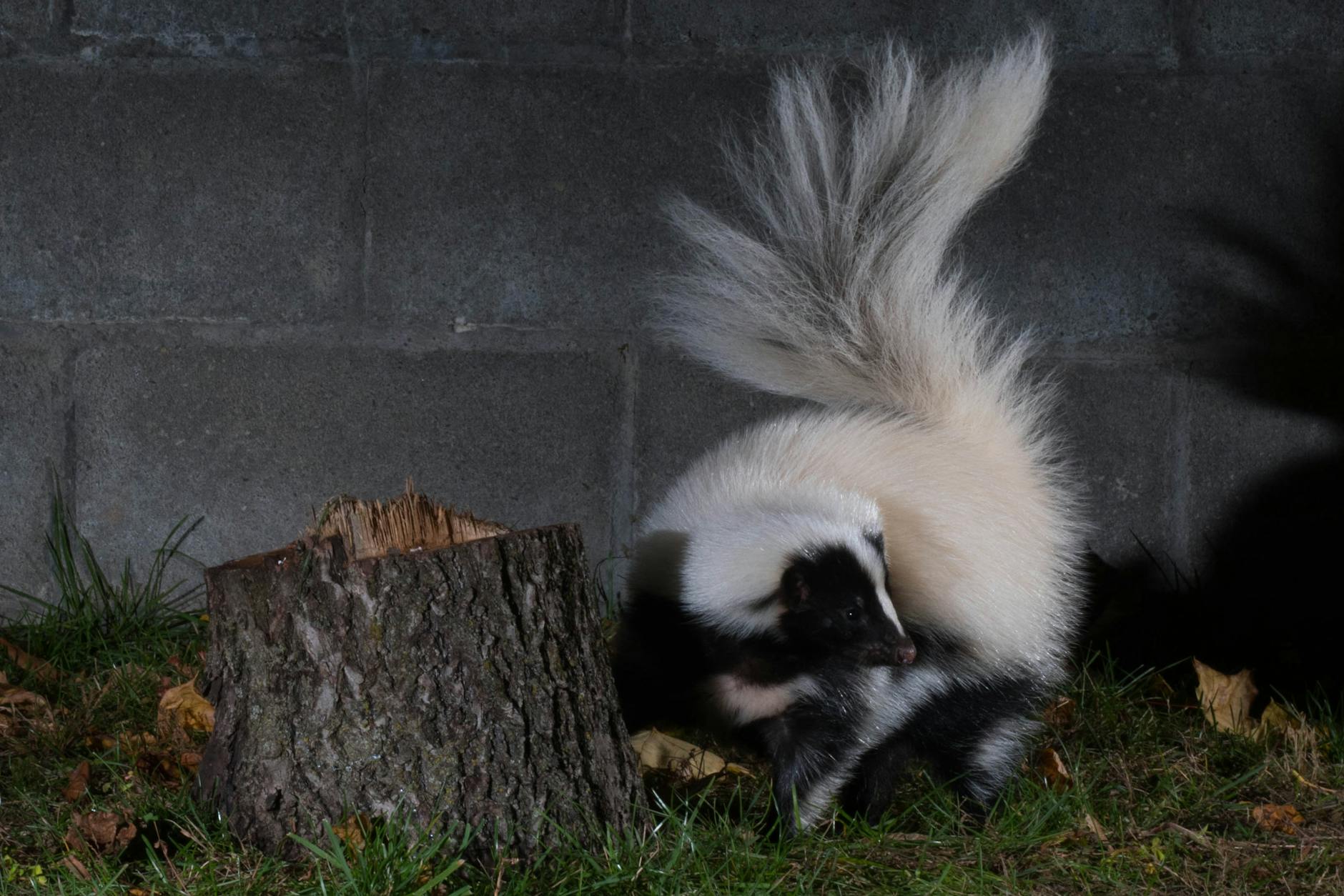
Tim tensed as the skunk waddled into view, its black-and-white fur gleaming in the afternoon sun.

Jeb looked at Tim and grinned.

“Son, I know what you’re thinking. Life’s about trust, taking chances, and finding things out for yourself. You can do all three right now.”

Tim swallowed hard, debating. Does he trust this?

Taking a deep breath, he held out his arms.

Jeb carefully placed Johnny in his hands, and Tim braced himself for the worst. Johnny curled against his chest, nestling under his chin like a kitten. His friendly demeanor melted Tim’s apprehensions.

Tim stood there, stiff at first, then slowly relaxed. The skunk was warm, soft, and oddly ––– pleasant.

After a few minutes, Jeb patted Tim’s shoulder.

“That’s good now. Johnny must return inside, and your daddy’ll be here soon.”

Tim handed Johnny back and followed Jeb into the house. As he sat on the couch, he waited for his dad. He thought about what Jeb had said. It was about trust, taking chances, and learning things for yourself.

When his dad pulled up, Tim climbed into the truck. As they pulled away, his father wrinkled his nose.

“What have you been doing?”

He asked.

“You smell like a skunk!”

Tim just grinned. And said –––

“I’ve been taking a chance on trusting people and other things and learning things for myself.”

Elmer’s Tough Ride: A Journey Through the Dust Bowl

GROFF MEDIA 2024© TRUTH ENDURES IMDBPRO

Presented by benandsteve.com By: Benjamin Groff II©s

4–6 minutes

Pa Elmer’s Ride

The winter had been relentless. The worst sandstorm in memory had swept through the region the year before. It buried the land in towering drifts of dust and sand. In some places, these drifts were waist-deep.

It marked the beginning of the Dust Bowl. This was a devastating era of dust storms. These storms crippled agriculture and reshaped life across the American and Canadian prairies in the 1930s.

Few families had stored enough food from the past year’s harvest. Even fewer were sure how long this disaster would last.

They say two things in life are certain: death and taxes. And for Elmer, tax time had come knocking. He had no choice but to ride nearly forty miles to the courthouse. He needed to pay his property taxes in person. He risked default if he didn’t. Despite the hard times, he had always kept his land in good standing. He intended to do so now, even with their dwindling savings. With three young children to feed, responsibility was heavily on his shoulders. His two sons and daughter were too young to fully grasp the hardship that had taken hold of the land. The struggle was real for Elmer and his wife, Ma Ma.

The night before his journey, Elmer told Ma Ma,

“I’ll be up by 3:30 and gone before sunrise. There’s no need to let anyone know I’m carrying money. Hard times make people desperate.”

While he trusted his neighbors, he wasn’t about to take unnecessary risks. He planned to make it halfway and camp near the Washita River before reaching the courthouse the next day.

At dawn, Pa Elmer saddled his pony, Smokey. Ma Ma handed him a small bundle—a few slices of fresh bread and beef jerky from the smokehouse.

“It’s not much,”

she said, touching his knee as he mounted up,

“but it’ll hold you over till you’re back. Ride safe, and don’t take any risks. Smokey can outrun any trouble that comes your way.”

Pa Elmer bent down in the saddle and kissed her.

“Two days there, a day and a half back. I’ll be fine.”

The parents didn’t know it. Their three children watched from behind the screen door, their little faces pressed against the mesh. As Ma-Ma gave Smokey a firm slap on the hip, Pa clicked his tongue and hollered,

“Yaw!”

The journey had begun.

Back inside, Ma Ma found the children still watching. She shooed them back to bed. Then she settled into her rocking chair with the Bible. It was her source of comfort through times of uncertainty.

The Ride to Town

Pa made good time. Smokey, eager for the open trail, trotted strong beneath him. By evening, they had covered thirty miles. Elmer found a spot near the Washita River where the grass was matted down—a daytime swimming hole. He unsaddled Smokey. Then, he tied him to a long rope to graze. Elmer stretched out beneath a tree, using his saddle as a pillow.

Sleep took him fast; it was a blessing he had dozed off facing east. The first light of dawn warmed his face, stirring him awake. After a quick breakfast of beef jerky, he saddled Smokey and continued.

By mid-morning, he reached the county seat. He tied Smokey to the hitching rail and strode into the courthouse. The county clerk barely glanced up from her papers.

“You here to ask for an extension on your taxes like everyone else?”

she asked.

Elmer tipped his hat.

“No, ma’am. I’m here to pay my taxes for this year and next.”

The clerk blinked, then scribbled out a receipt, her expression unreadable.

Paid this date: $28.33 for two years of property taxes.

Elmer folded the receipt and tucked it into the same safe spot where his money had been. Simply saying ––––

“Thank you, Mam!”

Pa had finished his business.

Trouble in Town

As he walked back to Smokey, a man loitering nearby gave a slow nod.

“That’s a fine-looking horse you got there. I’d buy him off you for $25.”

Elmer stiffened.

“No, you wouldn’t.”

The man’s eyes darkened, and his tone shifted.

“Maybe I just take the horse for nothin’.”

Elmer didn’t flinch. He met the man’s stare with steely resolve.

“No, you’d be lyin’ dead if you tried.”

A tense silence hung between them before the man forced a crooked smile.

“Mister, I was just jokin’.” 

He backed away.

“You have yourself a nice day.”

Elmer wasted no time. He swung into the saddle and galloped out of town.

The Journey Home

The Journey Home

Elmer has made the ride back in a day. Still, he took his time. He stopped by a few relatives along the way. In this part of the country, it was tradition—when you passed by kin, you paid a visit.

Late in the afternoon, as he approached home, he saw Ma Ma and the kids waiting at the gate. The children ran to meet him, full of questions.

“Well, Pa? How’d it go?” 

Ma Ma asked, relief washing over her face.

Elmer grinned and swung down from Smokey.

“Would’ve been home sooner,” 

he said, stretching his legs,

“but I kept runnin’ out of pipe tobacco.”

Ma Ma shook her head with a chuckle. As the family led him inside, the weight of the journey melted away. Home had never felt so good.

The Mayor Who Helped Kill Women

GROFF MEDIA 2024© TRUTH ENDURES IMDBPRO

Presented by benandsteve.com By: Benjamin Groff II©s

6–8 minutes

Jethro’s patrol car rounded the corner in the middle of the night. He had been around the block once before. His patrol practices always involved retracing where he had been. Burglars would often wait for a police car to pass and then start their craft. This practice by Jethro helped him lead the department in felony arrests for two years. 

Half-dressed a week earlier, he had come across the Town’s Mayor. The Mayor, Tim Awning, was running across the front lawn of a residence. Jethro had to calm him down. He then heard a story that the Mayor had been a victim of a holdup. Reportedly, a group of thugs had taken his car. The Mayor’s story was in bits and disoriented. Oddly, Mayor Awning said he only wanted to go home. He didn’t want to file a report. 

While driving the Mayor to his home, they came upon his car less than a block away, and Mayor Awning said –

“Stop here; I have an extra set of keys; I will drive it home myself.”

Jethro thought it odd that the Mayor didn’t want to file a report. Even more suspicious, the Mayor insisted that looking inside was useless. He said whatever the hooligans may have done was not an issue. Mayor Awning went even further, insisting Officer Jethro not look into his vehicle. The Mayor claimed his right to privacy through search and seizure rights. 

Now, Jethro was patrolling the same area. He cruised slowly. His patrol car’s lights were turned off, and the windows were rolled down so he hear. Near where Jethro had come upon the Mayor a week earlier, he went to a near stop. The hair on his neck started to rise; his sixth instinct was telling him something, but what? He crept his patrol unit further when he heard a lady screaming. He stopped and tried to find where the screams were coming from.

He looked over his right shoulder. He saw a lady in night clothes running across the front lawn of a home. The same home he had come across the Mayor. He radioed his headquarters his location and told the operator he was out with a distressed resident. The operator sent an extra unit as a precautionary measure. As Jethro exited his unit, he turned on his overhead red and blues, and the lady ran to him screaming –––

“Officer, it isn’t good. I can’t believe it. I just got home and changed for the night. I went in to say goodnight to my roommates. They are all dead. Blood is everywhere!”

Officer Jethro wasn’t sure what to make of the hysterics. But he asked her to catch her breath. And told her another unit was responding. Understanding that whatever she sees is in the house was dramatic he told her they are safe outside. He made sure she had a seat in his unit. Then, he waited for the backup officer to go into the home to see what she had reported. 

The backup arrived. Her name was Officer Jilly. Jethro and she worked together in the South Division for over a year. As they entered the home with their weapons drawn, they went from room to room, securing it. Finally, in the back of the house, they came to the bedroom where the carnage was found. Three women were found slashed to death.

Jethro’s gut twisted at the sight before him. Blood filled the room with a metallic stench. The dim light from the bedside lamp cast eerie shadows over the bodies. The women sprawled across the bed and floor, their nightclothes soaked in deep crimson. Jilly covered her mouth, swallowing the bile rising in her throat.

Jethro took a deep breath and turned to Jilly. 

“Call it in. We need the homicide unit and CSU here now.”

Jilly nodded and stepped into the hallway to radio for assistance. Jethro scanned the room, taking in every detail. There were no signs of forced entry. The door had been unlocked, and there was no shattered glass or overturned furniture. This wasn’t a robbery gone wrong. This was something else—something far more sinister.

Then, he noticed it: A single business card on the nightstand, smeared with blood. He pulled out a glove from his belt, careful not to contaminate any evidence, and picked it up. 

The card read:

Timothy Awning – Mayor

Jethro’s jaw tightened. His mind flashed back to the Mayor’s bizarre behavior a week earlier. He remembered the frantic running across the lawn. There was also the refusal to report the car theft. The Mayor insisted that Jethro does not look inside.

Jethro was a thorough officer. He made notes of everything, time-stamped his reports, and carried a voice-activated tape recorder in his patrol unit. Anything said inside the vehicle was considered public, and Officer Jethro had recorded the entire meeting with Mayor Awning. Now, he had a reason to review it.

“Jilly!” 

He called.

She reentered the room, her face pale. 

“What is it?”

Jethro held up the card. 

“We need to talk to the Mayor. Now.”

——

Mayor Tim Awning sat in his lavish den when Jethro and Jilly arrived. He held a tumbler of whiskey in his hand. 

His eyes flicked toward them, momentarily startled, before he forced a grin.

“Well, Officers, this is a surprise,” he said, shifting in his chair. “What brings you to my home at this hour?”

Jethro stepped ahead, tossing the bloodied business card onto the coffee table. 

“We just left a crime scene. Three women were murdered in the same house where we found you last week.”

Awning’s face paled, but he quickly regained his composure. 

“That’s—terrible. But I don’t see what that has to do with me.”

Jilly folded her arms. 

“Your business card was found at the scene.”

Awning scoffed. 

“I’ve given out thousands of those over the years. That proves nothing.”

Jethro leaned in.

“Your behavior last week was unusual. You were running half-dressed across the lawn. You claimed your car was stolen but refused to file a report. What happened that night, Mayor?”

Awning’s grip on the tumbler tightened. 

“I told you what happened.”

Jethro’s voice dropped. 

“No, you told me a story. But the real story is that you were at that house that night. You saw or did something that made you run. And I think whatever happened, it’s connected to what we found tonight.”

Awning’s jaw clenched. Beads of sweat formed at the Mayor Awning’s temples. Jilly took a step closer. 

“Where were you tonight, Mayor?”

Awning exhaled sharply and downed the rest of his whiskey. He set the glass down with a sharp clink. 

“At home. Alone.”

Jethro exchanged a glance with Jilly. They had him.

——

The crime scene investigators recovered more evidence. Fibers from the Mayor’s vehicle matched traces found in the victims’ home. Security footage showed his car in the vicinity the night of the murders. And then there was the most damning piece of evidence—blood found in the trunk of his car.

Faced with overwhelming proof, Mayor Awning finally broke. He confessed that he had been involved in a secret arrangement with influential figures in town. The house was where illegal dealings occurred—deals that had gone wrong. That night a week ago, he had seen a gruesome execution. He panicked and fled, leaving behind his car. The killers, nonetheless, had unfinished business.

By the time Jethro and Jilly had put the pieces together, it was too late for the three women. But it wasn’t too late for justice.

Tim Awning was arrested, and his political career ended in disgrace. As he got led out of his mansion in handcuffs, the weight of his crimes hung heavy in the air. Jethro knew this case would haunt him. Nonetheless, at least now, the Mayor would finally pay for his sins. This Mayor had helped kill women.

The Wild West Legacy: Tim’s Cattle Drive Experience

GROFF MEDIA 2024© TRUTH ENDURES IMDBPRO

Presented by benandsteve.com By: Benjamin Groff II©s

4–6 minutes

Sitting in the large living room, Tim’s father called him down from his upstairs bedroom. As Tim entered, he wondered if he had forgotten to do his chores properly. He also thought about whether his father had bad news to deliver.


Sitting on the fireplace ledge, he faced his father, who sat in his favorite chair.


“I’m helping Jess Paul tomorrow down south of Mingo for Doc. We must drive cattle up from their southern pasture. Then, we will move them into holding pens for transport to the sale barns. We need a third rider to keep the point in key areas, and I’d like you to come with us.”


Tim’s heart leaped. He had never been to Mingo but had always heard about the town. It was one of the last places with a 19th-century reputation. It was known as a wild, lawless settlement. Gunfights on the main street occurred weekly. Jess Paul often talked about how the local cowboys were descendants of the originals who roamed the territory before statehood.


Jess Paul was one of his father’s closest friends. Ten years ago, he lost both legs below the knee in a farming accident. Despite this, he rehabilitated himself and learned to walk using only a cane. Jess Paul can mount a horse and ride all day without showing pain or discomfort. With his two wooden legs, he can break a wild two-year-old stud just as well as any other cowboy. To Tim, Jess Paul was the toughest man Tim had ever known. His hands were massive, and he had a story for every place they went.


Tim’s father instructed his older sister to stop by his school and collect any assignments he’d miss.


“Tell his teacher I need him to work cattle,”

he said matter-of-factly.


The next morning came early. At 4:00 AM, Jess Paul was already up, having slept in his truck’s camper parked in front of their house. Jess Paul’s horse had been kept with the others on Tim’s father’s farm. While his father and Jess Paul gathered saddles and horses, Tim hitched the stock trailer to his father’s pickup.


Jake, Tim’s father, rode his horse, Red Man. Tim mounted Sam, his temperamental gelding, while Jess Paul rode Sonny. With the horses loaded, they set out for Mingo—a journey of over 150 miles. Another 20 miles beyond the town lay the range land where the cattle waited.


Jess Paul talked nonstop during the long drive. Tim had heard some of his stories several times before. Each time, Jess Paul added a new detail to keep them fresh. This made the stories engaging.


After three hours on the road, they arrived and unloaded the horses. Tim dreaded the ride on Sam. The weather was unseasonably cool, and Sam was known for taking off bucking at the worst possible times.


“No cowboying,”

Jake warned.

“We want these cattle to walk to the pens. Just guide them—don’t rush them or get them running.”


Tim nodded. He understood why. Running the cattle would make them lose weight, reducing their value at the auction.


No cattle were in sight from the truck. The trio mounted up and rode south across the prairie. Half an hour later, they spotted the herd—about two hundred head—gathered in a valley, sheltered from the cold north wind. Jake moved wide to one side of the herd. Jess Paul took the opposite side. Tim took position on the hill. He was ready to steer the cattle north toward the pens.

Tim fought to keep Sam still as the cattle approached. The horse was itching to jump, and Tim braced himself, expecting a sudden bucking fit.


The first two turning points went smoothly. Tim maneuvered between the cattle and the next position with ease. But at the final turn, he noticed a devil’s claw tangled around Sam’s hind hoof. The dried-up weed flower was notorious for driving horses wild, making them kick and thrash to free themselves. Tim knew he had to stay calm.

Devils Claw
Proboscidea louisianica


Slowly, he dismounted, working his way around Sam. He reached down with deliberate care. Then, he grabbed the devil’s claw and pulled it free. Using his boot, he brushed it away. Miraculously, Sam stood still.


Tim half expected the horse to explode at any moment. The last time Sam went full rodeo, they had been riding a narrow trail along a canyon. On one side was a dirt wall; on the other, a hundred-foot drop. Sam had bucked the entire way down to the canyon floor. Tim had held on for dear life. He cursed the horse with every bounce. Tim’s father scolded him for not stopping the horse. Tim never dared argue back. He had just been trying to survive the ride.


Now, with Sam behaving, Tim remounted and guided the cattle through the final turn. The herd moved steadily into the holding pens, where hay and grain had been spread.
After the last cow entered, the trio loaded their horses back into the trailer, and the gates clanged shut. The job was done. They had answered the call south of Mingo, and now it was time to head home.

Riding home meant Jess Paul would tell more stories.