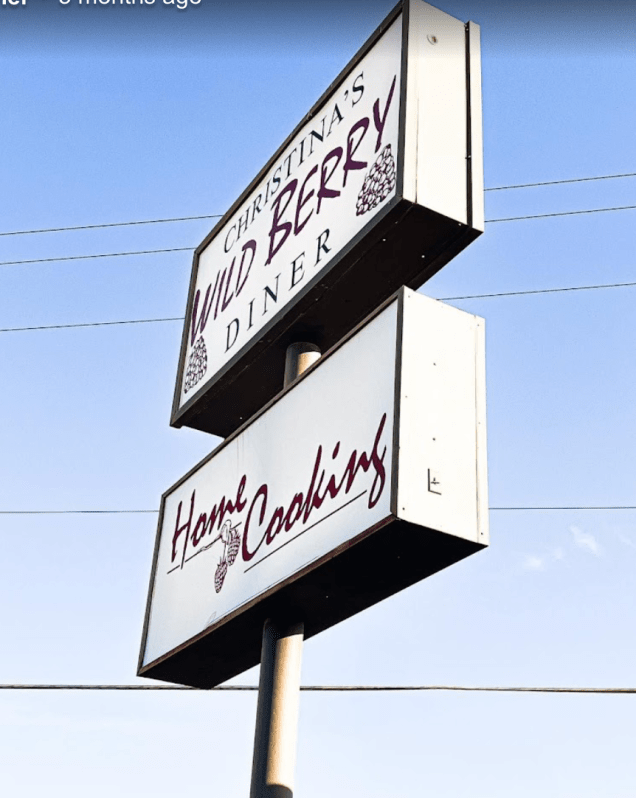
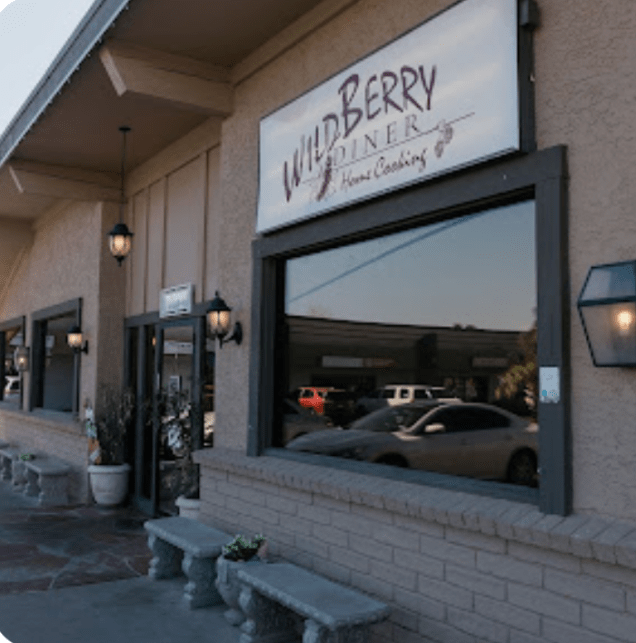
After weeks of rehab after my back surgery, I finally treated myself to breakfast at my favorite spot—Christina’s Wildberry Diner. It didn’t disappoint. It never does. The place is everything a diner should be. It’s a mix of friendly faces. The menu is full of home-cooked favorites. It has the atmosphere that makes first-timers wish they would come back again and again.
Of course, I ordered my usual. Our waitress Christine is our favorite server, not the owner. She knows my routine so well. She brings drinks to the table before we’ve even settled in. She’ll look at me with a grin and ask, “Having your normal with gravy this week?” And my answer is always the same: “Of course!”
My better-half, Steve, makes his order. But it is never quite as predictable. Pancakes one week, toast the next—it keeps Christine on her toes. But no matter what we order, our glasses are never empty. That’s part of what makes this place special. Christine remembers. The staff notices. After four years of showing up on weekends, the diner has come to expect us. If we’re going to be out of town, we let them know. Here, being seen and known is part of belonging.
After breakfast comes the next stop in our routine: Superstition Ranch Market. It’s a no-frills produce market where farmers bring in fresh fruits and vegetables by the bulk. We’ve honed our shopping to an art. We’re in and out in under ten minutes. The savings are worth the trip. The produce is second to none. The clerks know us, too. One cashier in particular likes us at her lane, and when she’s there, that’s where we go. They check on our health. They also check on our recovery. This care says everything about the community we’re lucky to live in.
What makes it remarkable is this: Mesa, Arizona, isn’t a small town. It’s the second-largest city in the state, part of a metro area of more than five million people. And yet, somehow, in the middle of all that, we’ve found a community that feels small, familiar, and deeply connected.
For more than 24 years, we’ve lived in Arizona, and the last 12 in Mesa. Of all the places we’ve called home, this city is one of the most special. It has a blend of people from everywhere. It has a rhythm of routines and unexpected kindness.
If Social Security were eliminated, the effects would be wide-ranging. It would touch nearly every part of American life. This is especially true for retirees, people with disabilities, and survivors of deceased workers. Here’s how it would unfold:
1. Immediate Loss of Income for Millions
Social Security now provides monthly benefits to over 70 million Americans, including retirees, disabled individuals, and surviving spouses or children. Without it, many of these households would lose their main or only source of income overnight.
Retirees: Many older Americans rely on Social Security for the bulk of their income—especially those without significant savings or pensions.
Survivors: Widows, widowers, and children who now get survivor benefits would lose critical support.
Disabled workers: People incapable of work due to disability would lose a major safety net.
2. Surge in Poverty Rates
Before Social Security, poverty among the elderly was extremely high—estimates put it at around 35–50%. The program cut that rate dramatically. Without it, poverty rates among older Americans will return to pre-1935 levels.
3. Strain on Families and Local Communities
The financial burden of caring for elderly or disabled relatives would shift heavily to families. Those without family support be forced into underfunded state programs or charitable care.
Families need to delay retirement, take on extra jobs, or house multiple generations under one roof.
Local charities and churches would see rising demand for basic necessities like food and shelter.
4. Ripple Effects on the Economy
Social Security benefits aren’t just “checks”—they fuel spending in local economies. Without those payments:
Rural and small-town economies (which often have higher percentages of retirees) see sharp declines in consumer spending.
Certain industries—especially healthcare, retail, and housing—would feel immediate impacts.
5. Political and Social Fallout
Because Social Security is one of the most popular federal programs, ending it would be politically explosive. It would lead to intense public backlash, large-scale protests, and significant shifts in voter behavior.
States try to create their own replacement programs, but poorer states struggle to fund them.
The wealth gap would widen sharply. Those without private retirement savings would be left with little to no safety net.
The Social Security Administration (SSA) stands proud according to a press release by the Trump Administration.
August 2025 commemorates its 90th anniversary. It marks its unwavering commitment to the financial security and dignity of millions of Americans. President Franklin D. Roosevelt signed the Social Security Act into law on August 14, 1935. Since then, the program has grown into one of the most successful and trusted institutions in American history.
“For 90 years, Social Security has stood as a promise kept. It ensures that older Americans have the support they need. It also aids people with disabilities, as well as families facing loss,”
said Commissioner Frank J. Bisignano.
“As we honor this legacy, we are also building a future. This future is where service is faster, smarter, and more accessible than ever before. Through President Trump’s vision, we are protecting and preserving Social Security. We achieve this by delivering extraordinary customer service through technological improvements. Enhanced process engineering also plays a crucial role.”
In an open letter to the American people, Commissioner Bisignano emphasized the importance of Social Security. He highlighted his commitment to strengthening the agency. He also mentioned the significant improvements to customer service achieved in his first 100 days in office.
Today, Commissioner Bisignano also joined President Donald J. Trump at the White House. The President issued a presidential proclamation. He recommitted to always defend Social Security. He recognized the countless contributions of every American senior. They have invested their time, talent, and resources into our Nation’s future.
When the law decides you no longer exist, freedom isn’t about where you live.
It’s about how far you’re willing to lose yourself to survive.
2–3 minutes
Getting Marked – Freedom at a cost
What if you belonged to a group that the government suddenly decided was a problem?
Not because of anything you did. Not because of a crime. Not even because of your beliefs. You were placed quietly and without your knowledge. The current leaders decided that the category was “unjust.”
Illegal.
It didn’t matter that you’d lived here your whole life. That your parents and grandparents had, too. It didn’t matter your race, your sex, your creed, your record. None of that mattered anymore. The only thing that mattered was that you had been identified.
The rules you thought protected you suddenly didn’t apply.
Your home wasn’t yours. Your job will vanish with a keystroke. The bank will empty your account without notice. You weren’t even a “person” anymore, not in the legal sense described by the Constitution you once believed in.
It happened so fast you couldn’t trace the moment when it began. At first, it was a news story about “reforms.” Then, “temporary measures.” Then, new identification cards, “to streamline services.” People told themselves it was nothing — until the cards became color-coded. Until the colors meant everything.
Now the world feels smaller every day. Friends stop calling, not because they don’t care, but because they’re afraid to be seen caring. Even strangers look at you differently, as if they’re silently choosing whether to turn away or turn you in.
You start making plans. Options. But they’re illusions. Leave the country? Borders are closed to you. Fight back? With what? Every avenue seems to end at the same locked door.
Then one night, in the quiet of your apartment, you find a letter slipped under your door. No name. No return location. Just a single sentence:
“There’s a way out, but you can’t take anything with you.”
Your heart pounds. Hope flares in your chest — real, breathing hope for the first time in months. You imagine stepping across a border, leaving all this behind, starting over somewhere no one knows your name.
But then the weight comes crashing back. You can’t take anything with you. Not your family, if they’re marked. Not your home. Not even the history that made you who you are.
The choice is yours. Stay and lose everything slowly, or leave and lose it all at once.
It’s hope. And it’s despair.
And tonight, both feel exactly the same.
Will you let this country get to this point? Is the United States already there? Is it too late to turn around?
The Cost of Cutting Costs: Where Are the Savings Going?
In recent years, the Trump Administration has made headlines for its policy stances. It has also garnered attention for the sweeping federal cutbacks. These cutbacks have redefined the size and role of the federal government. Thousands of government employees have been laid off. Hundreds of federal offices have been shuttered. A wide range of services — from healthcare to environmental aid — has been reduced or eliminated entirely.
The administration has championed these actions as part of a broader effort to “drain the swamp.” They aim to reduce federal spending and ultimately return power and resources to American taxpayers. The rationale has been clear. A leaner federal government would lead to significant cost savings. It would result in a more efficient use of tax dollars. But many Americans are beginning to ask a critical question: Where are the savings?
Massive Reductions, Unclear Results
Among the most significant cutbacks:
Layoffs: Tens of thousands of federal workers across agencies have been laid off or had positions eliminated.
Office Closures: Many government-run facilities have been closed. These include Social Security branch offices and rural USDA outreach centers. This closure reduces accessibility for millions of Americans.
Social Programs Slashed: Legislation was recently passed. As a result, funding for programs like Medicaid and Medicare has been reduced. Food assistance and global humanitarian aid are also affected. Preventive services and outreach initiatives that once supported millions are being dismantled or left underfunded.
These cutbacks, in theory, should have freed up hundreds of billions of dollars from the federal budget. Many believed this money would reduce personal tax burdens. Others thought it would be used to invest in infrastructure or support domestic economic growth.
Yet, for the average citizen, these savings have not become visible.
Where Is the Relief?
If the government is spending less, why aren’t Americans seeing a difference in their tax bills? Why are services harder to access, but costs stay the same — or even rise?
Economists point to several possible explanations:
Redistribution of Savings: Much of the money saved through cutbacks has not been returned to taxpayers. Instead, it has been redirected toward defense spending and border enforcement. There are also tax breaks for corporations and high-income earners.
One-Time Costs of Downsizing: Severance packages, contract terminations, and administrative restructuring often generate short-term costs that offset early savings.
Unseen Long-Term Consequences: Cuts to health and humanitarian programs will result in higher long-term costs. These range from emergency medical care to international instability.
A Shift in Priorities
The Trump Administration has often framed these reductions as a necessary reset. They see it as a chance to shrink government. It is also viewed as an opportunity to re-center American values around individual responsibility and self-reliance. Nonetheless, critics argue that the effects are disproportionately felt by the vulnerable. The elderly and rural communities are significantly affected. Those who rely most on public services are also affected.
Meanwhile, for those expecting an immediate drop in taxes, there is little evidence to support those hopes. The same applies to a boost in services funded by savings.
Conclusion: The Hidden Costs of Cutting
In the end, the administration claims victory in trimming government “fat.” Yet, the benefits of those savings stay largely invisible to the average voter. Instead, Americans are paying the same or more for fewer services. They experience longer wait times and less support.
The promise of efficiency has been delivered, but at a human cost. The American people are still waiting for their return on investment.
🔍 Report: “Cutbacks, Promises, and Missing Payoffs”
1. The Layoff Machine
Estimated decline: Over 275,000 federal civil-sector layoffs have been announced under Trump’s second term—roughly 12% of the 2.4 million workforce—comprising 58,000 confirmed cuts, 76,000 buyouts, and 149,000 planned layoffs en.wikipedia.org.
Net reductions: As of March, the Office of Personnel Management reported a single-quarter decline of about 23,700 jobs. This signifies a 1% drop. The federal workforce has been reduced to approximately 2.29 millionreuters.com.
Legal rollback: A federal judge blocked mass layoffs at HHS. The judge deemed them “arbitrary and capricious.” This decision halted over 10,000 planned terminationsen.wikipedia.org+3thedailybeast.com+3apnews.com+3.
“The American people deserve a government that is lean. It should be efficient and focused on core priorities,” OPM Acting Director Charles Ezell said. He framed the downsizing as a fiscal win reuters.com+6federalnewsnetwork.com+6foxnews.com+6.
2. Agency-by-Agency Fallout
Health & Human Services: Targeted a 25% workforce reduction—about 20,000 jobs eliminated—affecting the CDC, FDA, NIH, and CMS apnews.com.
National Science Foundation: Paused or canceled 1,600 grants. It slashed fellowships by 75%. It also dismantled peer-review independence—a move scientists warn will cost U.S. innovation and “a generation of talent” theguardian.com.
National Park Service: Permanent staffing fell by 24%. There were only 4,500 seasonal hires, which is far short of the needed 7,700. This resulted in maintenance backlogs and delayed emergency responses staffingindustry.com+3sfgate.com+3govexec.com+3.
3. The Savings That Never Materialized
DOGE’s bold claims: The Department of Government Efficiency (DOGE) announced $160 billion in savings. They achieved this via contract cancellations, leases, and workforce cuts en.wikipedia.org+5en.wikipedia.org+5cbsnews.com+5.
Reality check: Independent analysts argue that actual cost reductions are closer to $80 billion, and note caveats:
~$135 million lost from disruption.
Contract “savings” often overstated—e.g., a $655 million USAID contract cut was restated at just 35 cents reuters.com.
Budget context:
Federal outlays rose by over $200 billion in Trump’s first 100 days. This amount was more than what was spent in nine of the prior ten years.
Debt-service climbed too: $94 billion in interest payments in one month vs. $80 billion a year earlier reuters.com.
DOGE’s savings amount to just 2.6% of discretionary spending—effectively negligible overall visualcapitalist.com.
4. Impact on Taxpayers & Services
Despite layoffs:
No direct tax relief for average Americans.
Essential services have been impaired: reduced access for Medicaid/Medicare beneficiaries, eroded scientific research, delayed park maintenance, weakened emergency response.
Budget cuts amount to a drop in the bucket. Mandatory expenditures like Social Security, Medicare, defense, veterans’ benefits, and debt interest consume around two-thirds of the federal budget. sfgate.com+1wsj.com+1.
5. Public Opinion & Potential Fallout
Public sentiment: 55% of Americans believe cuts to federal employees and services will harm the economy; only 31% disagree ourpublicservice.org+1cbsnews.com+1.
Economist takeaway:“To cut federal spending significantly, focus on Medicare, Medicaid, and Social Security. Interest spending must also be addressed,” notes AEIs Nat Malkus cbsnews.com.
Even a 10% workforce cut yields only ~$25 billion per year—less than 1% of total federal outlays investopedia.com.
📊 Summary Table
Cutback Type
Scale of Reduction
Estimated Savings
Caveats / Impact
Federal layoffs
~275,000 announced; ~23k net cut
$25–80 B annually
Disruptive, costly; limited fiscal effect
Agency-specific job cuts
HHS (20k), NSF grants (1.6k), NPS (24%)
Not fully quantified
Services degraded: health, science, park management
DOGE-reported cuts
Claimed $160 B
$80 B real impact?
Misdocuments, redistribution to defense/veteran spending
Overall federal spending
Up $200 B first 100 days
–
Outlays still increasing due to fixed costs and one-off obligations
🧾 Conclusion
The Trump Administration’s aggressive federal cutbacks have certainly shrunk parts of government. Yet, they haven’t translated into noticeable savings for average taxpayers. Most reductions target lower-tier programs instead of trimming the core federal budget. Mandatory spending, including defense, healthcare, pensions, and debt interest, continues unchecked. Meanwhile, disruptions to critical services—public health, national parks, scientific research—have been significant.
Bottom line: The headline of a leaner government resonate politically, but the economic reality for taxpayers is murky—and bleak. Unless cuts touch the big-ticket mandatory spending items, true budget relief remains elusive.
Recent coverage on Trump cutbacks
THE BOTTOM LINE
If you’ve got less than $10,000 in the bank, here’s the truth. You’re not cashing in on any of this. The deals and decisions being made right now will fatten the pockets of the top money makers—not yours.
What you will see is the fallout:
Higher grocery bills
Rising medical costs
More expensive fuel
By year’s end, everything you need will cost more, while your paycheck buys less. The framework isn’t built for you to win—it’s built for you to keep paying. And that is the bottom line!
On August 16, 1977, the world stopped spinning — at least in Memphis, Tennessee. That was the day Elvis Presley, the King of Rock and Roll, was found unresponsive in the bathroom of Graceland. The global headlines mourned music’s greatest icon. Meanwhile, things were spinning out of control behind the scenes in the world of law enforcement. And not just in Memphis.
Most people don’t know that Elvis’s death caused a minor frenzy. It affected not just fans, but also federal and local law enforcement. This had everything to do with his name, his guns, and his bizarre honorary narcotics badge.
In 1970, Elvis famously met with President Richard Nixon and requested a federal narcotics badge. He did not intend to arrest drug dealers, well, maybe a few. He believed it would grant him special privileges at airports. It would allow him to carry firearms across state lines without hassle. Nixon, eager to impress a celebrity during a slump in his popularity, gave him the badge. Elvis then began collecting honorary police badges from departments across the U.S., often in exchange for autographs, memorabilia, or a simple smile.
By the time of his death, Elvis had amassed over 100 badges. Some were real, others purely decorative, and a few were questionably obtained. The King had a well-known obsession with guns. He owned dozens of pistols and rifles. He even had a few military-grade toys. When the news of his death broke, more than one law enforcement agency quietly wondered. They asked themselves, ‘What did we give that man?’ And can we please get it back?
According to insiders at the time, several local departments began calling Graceland discreetly. They were hoping to retrieve various “loaned” badges and sidearms. One small-town sheriff reportedly said,
“We didn’t think he’d actually keep the darn thing. It was supposed to be a photo op!”
Even the DEA got involved. They did not act out of malice. Elvis’s collection included a few federal items. These should have never technically left Washington. A flurry of quiet internal memos from late August 1977 hints at an almost comical scramble. They describe recovering government property from the estate of a man. This man had once offered to go undercover as a federal agent “to stop the hippie drug culture.”
This man had once offered to go undercover as a federal agent “to stop the hippie drug culture.”
Meanwhile, fans held candlelight vigils and bought up every Elvis album in sight. Law enforcement agents were busy inventorying his arsenal of firearms and badges. His collection would put most mid-size police departments to shame.
A deputy who had once met Elvis described the moment. They realized the full extent of the collection:
“I walked into that room. I saw enough shiny shields to start a police academy.”
I half expected them to start talking.
Most of the badges were eventually returned. Some were documented as honorary. Yet, a few were mysteriously “lost to history.” They are reportedly still missing to this day. One turned up on eBay years later. This sparked a brief online turf war between Elvis fans and collectors of obscure police paraphernalia.
August 16, 1977, then, marks not just the day the King left the building. It was also the day law enforcement agencies across the country had a new challenge. They found themselves unexpectedly cleaning up behind him. They tried, with straight faces, to explain to their bosses. Why did Elvis Presley have more police gear than some SWAT teams?
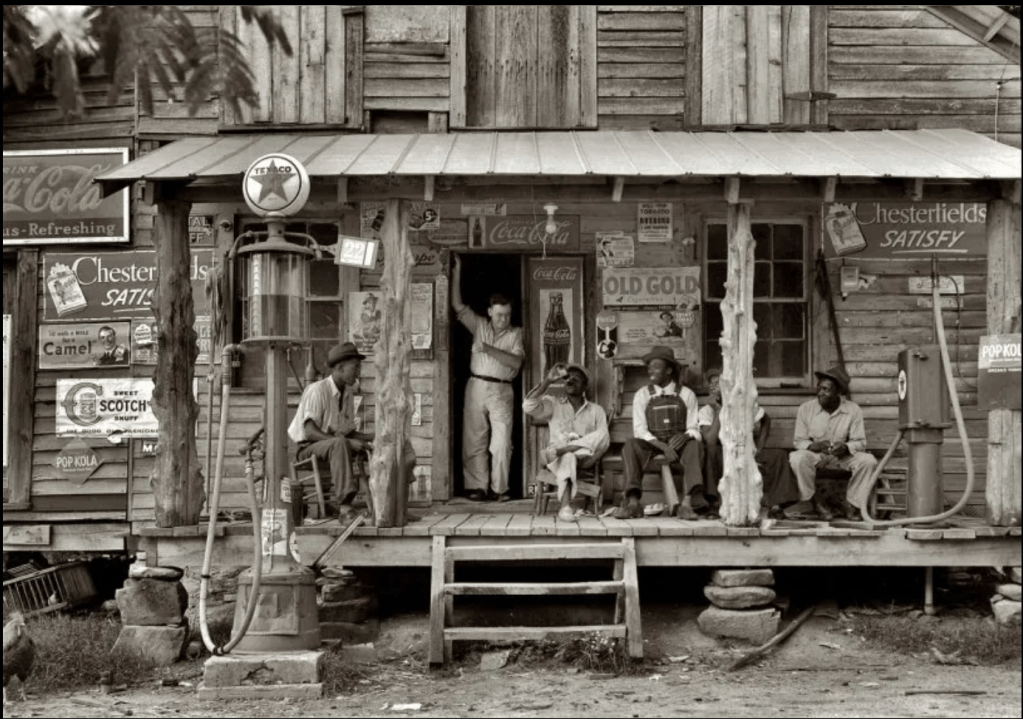
On July 25, 1939, Dorothea Lange was a renowned documentary photographer. She paused her busy travels across the American South. She stepped into a quiet moment just outside Gordonton, North Carolina. It was a humid summer Sunday. Through her lens, she discovered something golden: a rickety country store. Its wooden porch was dappled in shade. A few men sat comfortably in rocking chairs on it. The afternoon moved slowly around them.(1)
“Captured on July 25, 1939: a country store porch in rural North Carolina. Dorothea Lange found the perfect rendition of a lazy summer afternoon here. Let this moment remind you—it’s okay to choose rest today.”
Lange raised her camera and captured exactly what she saw: a peaceful summer tableau. The porch wasn’t staged—it was real life, real rest. The men lounged beside old kerosene and gas pumps, their chatter and quiet breaths blending with cicadas in the heat.
That moment—frozen in a gelatin silver print—became a small celebration of indolent joy. No agenda. No hurry. Just an afternoon spent doing exactly what summer begs you to do: nothing.
I was watching an old Western on television this past weekend. You know, the kind—cowboys and Indians. Or, as we might say today, American Ranchers and Indigenous Peoples.
The film, likely made in the 1950s, had the signature gloss of that era’s post-war cinema. Still, something about it suggested it was possibly shot even earlier, maybe in the 1940s. It was only later spliced, refitted, and packaged for the screen. The costumes, dialogue, and scenery all hinted at a time when the stereotypes were deeply ingrained in the script. They weren’t even questioned.
I probably watched that movie as a kid. I was sitting next to my father, not giving it a second thought. Back then, it was just another Western. But this time around, with a different set of eyes, what I saw was jarring.
It followed the predictable narrative: the cavalry riding in to tame the West and keep the “Indians” under control. Two delicately dressed white heroines were caught in the middle of a brewing conflict. A white doctor stood out as the lone character who dared to see Native people as human beings. He was mocked and ostracized for his compassion. This was especially true when a malaria outbreak swept through the tribe. He insisted they deserved treatment.
At one point, he stood in a room full of fellow whites. He asked,
“Do you think Indians are not human beings? Human beings like you and me, who deserve to live and be healthy?”
And one of the prim ladies, her hair perfect and her face untouched by empathy replied:
“I don’t know… how could they be?”
To which others in the room nodded and added,
“That’s right.”
“Of course, they’re not!”
“No way, in God’s name.”
I sat there stunned, wondering:
“How did a line like that ever make it into a movie script?”
Even more troubling:
“How did it get past editors, producers, censors—only to be broadcast, repeated, and absorbed by generations?”
It wasn’t just offensive. It was abusive. And it made me sad.
Is there a historical context to such language? Possibly. But what would a young Native American child feel sitting in front of that screen? Would they see their life reflected as something lesser—something not worthy of protection or dignity? Listening to the white characters, it certainly felt that way.
And it took me back to where I grew up.
I’m from the Kiowa and Comanche Counties area in Oklahoma—Caddo County, specifically. I was raised alongside Native American children, many of whom I called friends.
Later in life, I worked in law enforcement and came to know tribal members through both personal and professional relationships. I learned a great deal from them—about their culture, their pride, their pain.
When I started in law enforcement, the department had an initiation ritual. It involved arresting a man nicknamed Fifteen Thousand. He was a Native man, around 50 years old, who’d been detained countless times—hence the name. His real name was Thomas Kamaulty Sr.
He was the first person I ever arrested as an officer.
And, in time, Thomas became the first person I ever saw get sober. That meant something.
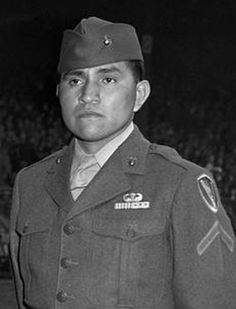
Ira Hayes
I also think about people like Ira Hayes. He was a Pima Indian from Arizona. Ira helped raise the flag at Iwo Jima during World War II. A hero by every standard. And yet, like Thomas, Ira suffered. Both carried the scars of discrimination and trauma. Both turned to alcohol as a way to numb the soul-deep wounds this country handed them.
We often ask why these cycles exist—but we rarely admit the truth: it’s because we’ve designed them to. We’ve placed people like Thomas, like Ira, into roles and systems. Their suffering can be managed. Their voices are diminished. Their lives are controlled. That was always the plan. And until we stop pretending it wasn’t, the script will keep playing—over and over again.
On a breezy Saturday morning in Kansas City, a young girl named Ava stood on the steps of Union Station. She was playing a melody her grandfather once taught her. It was soft, trembling, then bold. People stopped. A man on his bike pulled over. A mother hushed her toddler. A retired Marine tapped his foot.
Without a word, a banjo player joined in. Then a trumpet. Someone brought a drum. Across the plaza, a gospel choir leaving rehearsal couldn’t help but add their voices. Tourists lifted their phones, but eventually set them down, choosing instead to simply listen.
The news spread. Within days, public squares from Birmingham to Boise lit up with spontaneous concerts. There were folk and funk, jazz and country, hip-hop, mariachi, and bluegrass performances. No auditions. No politics. Just people showing up and playing.
The sound swept across the country. Arguments quieted. Strangers talked again. Community cookouts popped up. Elders shared stories. Kids danced. People stopped comparing flags and started waving them together.
A Simple Note
It wasn’t shouted or broadcast. It didn’t flash across screens or scroll across headlines. It was just a single, simple note—played quietly on a porch in a small town.
No one knew where it came from at first. A child said it sounded like home. An old man wiped his eyes. A woman humming nearby forgot why she’d been angry. People paused. They listened.
The note turned into a song—one people didn’t realize they remembered. Neighbors began to gather. Strangers smiled. Across the country, others started to hear it too. Not through wires or speakers—but in hearts that had been waiting for something to believe in again.
It wasn’t about sides, slogans, or speeches. It was about belonging.
One simple note… And a nation began to find its way back to itself.
They called it the Harmony Movement—but there was no name when it began. Just one song, from one girl, on one morning, reminding a fractured nation what it still shared:
A rhythm. A voice. A chance to listen. And something worth singing for.
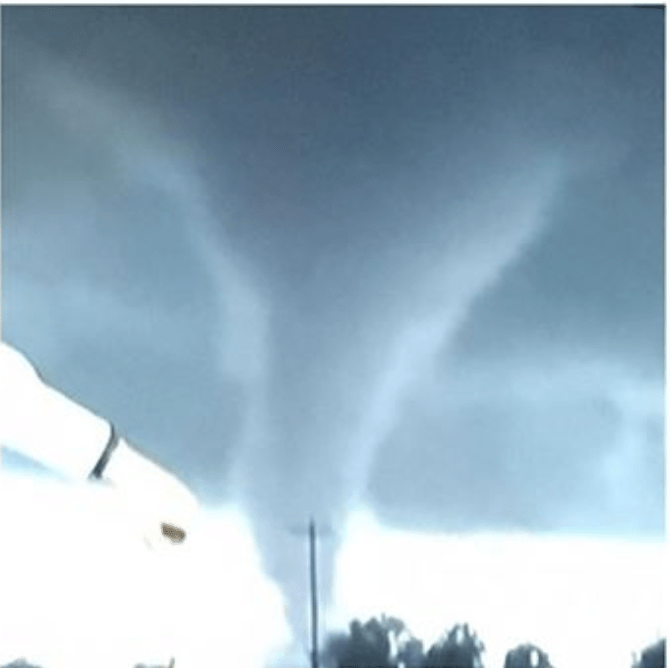
The heat had been unrelenting for days. By the evening of July 11th, something darker than the weather was brewing in the Kansas sky. Just after 6:30 p.m., local news reports began buzzing with concern. A fast-moving system was developing west of the city. Radar, still new technology for military meteorologists, was showing rotation in those days it wasn’t shared like it is now.
At 7:04 p.m., a Category F4 tornado touched down near the town of Udall, Kansas. It was the same town that had been devastated just two months earlier in the deadliest tornado in state history. This one skirted the more populated areas. Still, damage was widespread. Barns were flattened, power lines twisted, and wheat fields scraped bare. Miraculously, only minor injuries were reported. Many locals said they were prepared this time, keeping radios on and basements cleared after the trauma of May 25.
The Wichita Eagle published a late edition the next morning. The headline read
“Twister Brushes Wichita – City Spared, Farms Not So Lucky.”
File Photo
A black-and-white photo captured a twisted silo lying like a crushed can under a red-orange sunrise.
Looking back, July 11, 1955, was a reminder that in the American Midwest, nature rarely knocks. It kicks in the door, and you learn to be ready.
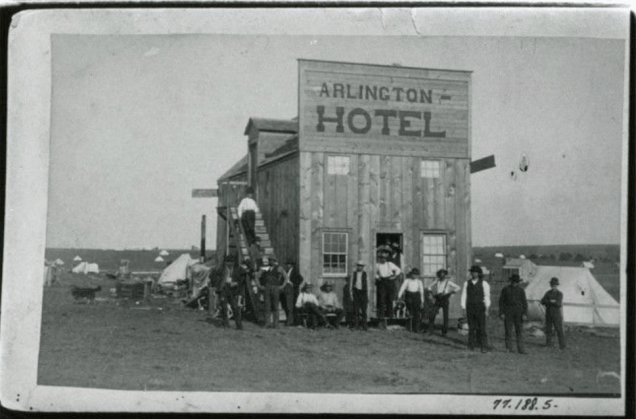
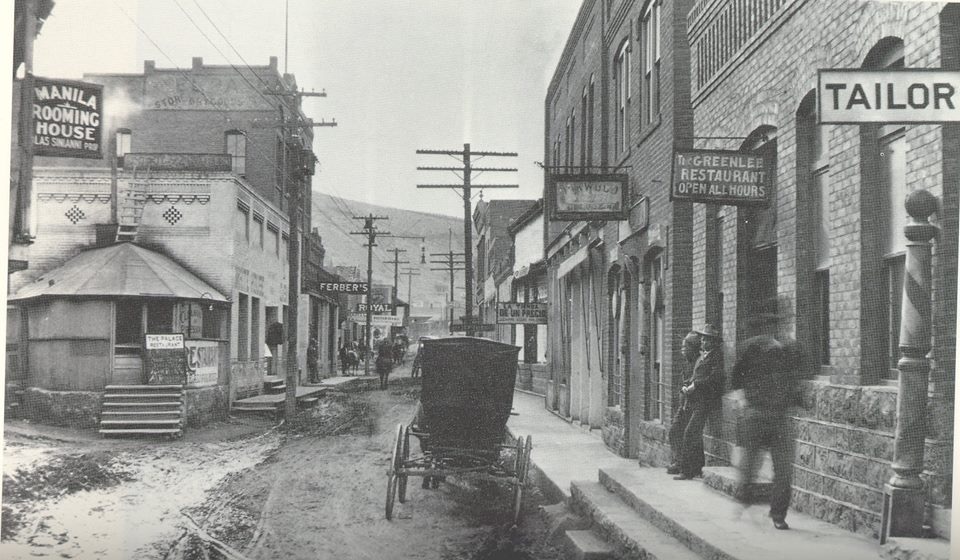
This rare 1889 photograph captures the Arlington Hotel. It was one of the first hotels established in Guthrie. This occurred just days after the historic Land Run opened the Unassigned Lands of Indian Territory.
In the spring of 1889, the red dirt of Oklahoma Territory was still freshly turned. The streets of Guthrie were more dust than road. Madame Jeffries Star, a bold woman, put up a hand-painted sign above a wooden doorway. It read: “Arlington Hotel – Meals Served at All Hours.”
It was less a hotel than a grand idea built with timber and tenacity. The two-story structure is captured in a faded photograph from that year. It stood proudly among a sea of tents. Hastily constructed shacks surrounded it. Its clapboard siding gleamed in the midday sun, and smoke curled from the kitchen chimney like a ribbon of welcome.
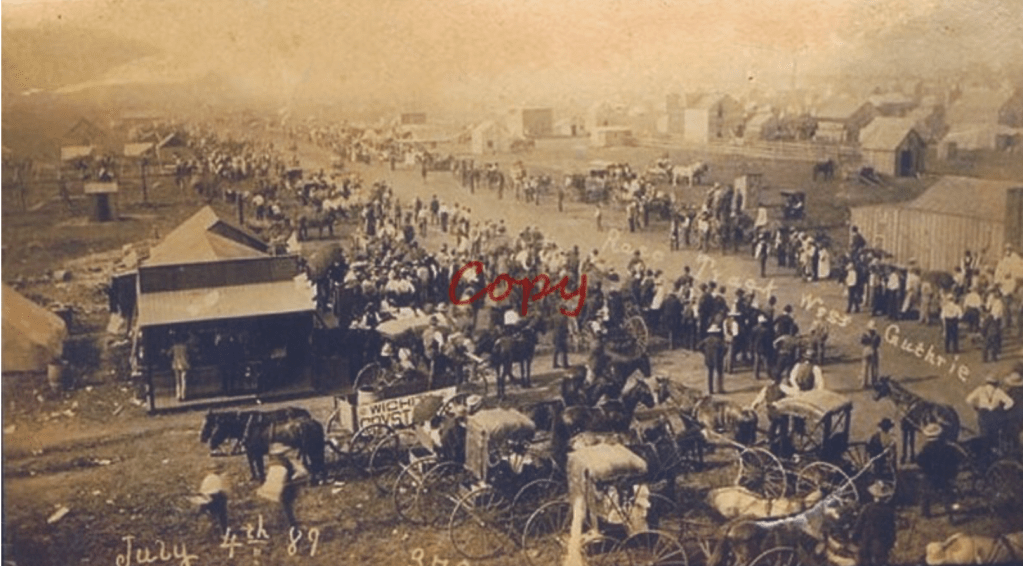
Guthrie had exploded into existence almost overnight with the Land Run of April 22, 1889. Nearly 10,000 settlers poured in by wagon, horseback, and foot, each staking their claim to this new frontier. But when night fell, those same pioneers found themselves with nowhere to go.
Enter Madame Star.
Suggested to be a woman of mystery. Some said she had once owned a boarding house in Kansas City. Others heard she had performed on stage in New Orleans. No one knew for sure. What people knew, though, was that she was shrewd and tireless. She was capable of running a kitchen, a business, and a town council meeting if needed. They had all read about her.
Guthrie Oklahoma1989
The Arlington Hotel was the first of its kind in Guthrie. It offered rooms upstairs and meals downstairs. There was always a pot of coffee brewing. Cowboys shared breakfast with lawyers. Surveyors clinked glasses with newspaper journalists. Sometimes, soldiers bunked beside farmers who were too exhausted to argue over who got the corner bed.
Madame Star insisted that the Arlington be open 24 hours a day. “Because,” she would say, “history doesn’t keep office hours, and neither should hospitality.”
Meals were hot but straightforward: bacon and biscuits, black-eyed peas, and strong coffee so thick it would float a horseshoe. In the parlor, people came not just to rest, but to talk, to strike deals, to dream out loud. The hotel quickly became Guthrie’s beating heart—a place where the dust of the land met the polish of civilization.
Legend has it that the first territorial judge was hastily appointed just days after the Land Run. He spent his first night in Oklahoma sleeping in Arlington’s parlor. He used a law book for a pillow.
By the end of 1889, the town had a newspaper, a post office, and a telegraph line. Yet, it had always had the Arlington. At the center of it all was the name Madame Star. The image of a lady with her sleeves were rolled and her apron tied. Shouting instructions to her cook. While she poured hot coffee for a stranger fresh off the train.
She reportedly ran the hotel for nearly a decade. Then she vanished from public life as mysteriously as she had arrived. Some say she married a wealthy cattleman and relocated to the South. Others believe she returned to the stage, this time in Denver. But no one knows for sure. No one really knew what she looked like. Some thought they had seen her moving about the kitchen. Others said they saw her walking up the stairs. But she was too busy to stop and chat.
The photo taken that first year is what remains. It is a time capsule of promise. It shows a wooden hotel standing tall against a treeless prairie. And beneath the sign that reads “Arlington Hotel,” one can make out the name painted in bold:
“Prop. Madame Jeffries Star.”
The story was told up and down the rail lines. Its purpose was to pull more people into Oklahoma from the surrounding area. But, research indicates it seems Madame Jeffries Star isn’t a real historical figure. Instead, it is a name featured in an old promotional caption or photograph related to the Arlington Hotel. One photo description I found reads:
“Photograph of the Arlington Hotel, the first hotel in Guthrie, Oklahoma Territory. Prop. Madame Jeffries Star, meals served at all hours.”(1)
The name Madame Jeffries Star appears in promotional materials or signage tied to the Arlington Hotel. Yet, there’s no supporting historical record, biography, or documentation confirming she was a real person. It’s that Madame Star was a marketing persona—much like later figures including Ronald McDonald or Jake from State Farm.
The Arlington is often referred to as the first hotel in Guthrie, Oklahoma. But to avoid historical disputes, we prefer to say it was “one of the first.” There’s no verified evidence placing a real Madame Star anywhere in the country during that time period.
So who did own the hotel? The earliest known location was at 1st and Vilas, later moving around 1896 to North 2nd. Records suggest that the owner was James Douglas—the only documented proprietor I found.
Interestingly, I also came across references to over fifty other hotels operating in Guthrie between 1889 and 1910. They all did brisk business. This continued until the state capital was moved to Oklahoma City. Many in Guthrie have long considered this decision nothing short of a political robbery.
The Day the Flag Stood Still: The Forgotten Fourth of July on Wake Island, 1942
48 Star Flag Saved Sept 1945
On July 4, 1942, Americans back home celebrated Independence Day with cookouts and parades. Meanwhile, a small group of American civilian contractors and U.S. Navy personnel held a defiant but somber celebration under Japanese captivity on a tiny Pacific atoll called Wake Island.
Just months earlier, in December 1941, Wake Island had made headlines when a handful of U.S. Marines, Navy men, and civilian construction workers miraculously repelled a much larger Japanese force. This was one of the only successful defenses during the early days of World War II. But eventually, Wake fell. Hundreds of Americans were captured and held as prisoners.
Despite their grim reality, the spirit of independence didn’t die. On July 4, 1942, many had celebrated the day at home a year prior. A group of prisoners marked the holiday. They secretly stitched together a makeshift American flag from scraps of clothing and parachute fabric. They hid it under a floorboard in their barracks. That night, after roll call, they quietly raised the flag. It was up for just a few moments. That was long enough for the men to salute it and whisper a rendition of “The Star-Spangled Banner.”
The penalty for such defiance was death. For those men, risking their lives to honor the flag was worth it. The freedom it stood for—even behind enemy lines—justified their risk.
The flag was never discovered. The war ended in 1945. One of the surviving POWs smuggled the flag fragment home. He had sewn it into the lining of his jacket. It now resides in a museum in Kansas as a silent but powerful witness to patriotism under pressure.
Closing Thought:
Freedom isn’t always loud. It isn’t always celebrated with sparklers and song. Sometimes, it’s whispered in the dark. Saluted in secret. Hidden beneath the floorboards. And yet, even in those moments, it shines just as bright.
The early morning calm in Santa Barbara was shattered at 6:23 a.m. when the earth quaked mightily beneath the coastal city. Buildings shuddered, bricks rained from rooftops, and the streets trembled underfoot. In those precious dawn hours, life had yet to stir—and that spared many. By daybreak, the death toll stood at a modest 13 souls, considering the scale of devastation (1).
Amid the wreckage, sailors from the USS Arkansas joined local workers to dig for survivors. They waded through rubble, their uniforms dusty and stained, hauling beams and calling out names. Looters probed the ruins for valuables, but guards—both Navy and civilian—kept vigilant watch (2).
Yet even as remnants of the old city lay in ruin, a vision for rebirth emerged. Spearheaded by Pearl Chase and other civic leaders, a movement to rebuild in a unified Spanish Colonial style began. The reconstruction led to enduring landmarks. It produced the iconic Santa Barbara County Courthouse, soon hailed as among America’s most beautiful public buildings (3).
Santa Barbara’s quiet elegance faced destruction in one fateful dawn. But the very next dawn laid the foundations of something more beautiful. The earthquake didn’t just shake buildings—it awakened a city’s spirit, forging an architectural legacy that stands to this day.
There is something about the days of summer that never quite leaves you. It is a scent in the air or a golden hue in the light. It is also the sound of cicadas warming up for their evening concert. For a child, summer feels like forever. For an adult, it feels like something you once held in your hands. You didn’t realize it would slip away so quickly.
I remember one summer, I must have been around eleven. We had a tire swing tied to the big oak tree out back. That tree had roots that curled up out of the ground like the backs of old hands. When it rained, they made little rivulets in the dirt. My brothers and I would race leaves down those muddy streams as if they were ships headed for faraway lands.
The days were long and hot, but we didn’t care. Shoes were optional. Supper was whenever someone called out loud enough for us to hear. Most days, we’d roam until we were sunburned and starving, a little wiser than we’d been that morning. There was always a watermelon cooling in the horse trough. We tried to swat away flies as we spit seeds into the grass, but we failed.
Evenings were for catching fireflies in jars. They were the kind with holes poked in the lid. We did this by using a nail we’d hammered with a rock. We thought we were giving them air. We didn’t yet know the difference between freedom and capture.
I think back on those days now and realize that summer isn’t just a season. It’s a feeling. You carry it in your chest long after the sweat has dried. The tan has faded. The swing has stopped creaking in the breeze.
It’s a reminder to slow down. To let the day last a little longer. To chase the light, even if it’s only for a little while.
I received a question yesterday about the United States. They asked why so many people are up in arms over the current immigration raids taking place across the country. Especially after President Obama, during his term in office, removed over 3 million undocumented individuals. Many of whom they claimed never had a hearing.
I wanted to conduct some research to learn more about it for myself.
Understanding Immigration Enforcement: Obama vs. Trump
During his eight years in office (2009–2017), President Barack Obama led an administration that deported over 3 million noncitizens. These deportations were conducted through formal removal proceedings. A formal removal involves a legal process. This process results in a court order for deportation from the United States.
If we include “returns”, the total number of departures exceeds 5 million under the Obama administration. These returns are cases where individuals either voluntarily left the country or were denied entry at the border. They agreed to withdraw their application to enter. Many of those individuals were turned away at the border before ever entering the U.S. Because they were not formally admitted into the country, they were not entitled to a court hearing. These actions, while recorded as enforcement events, differ significantly from deportations after internal apprehensions.
It’s important to note that Obama’s enforcement focused heavily on border security. It prioritized the removal of individuals with serious criminal records. Despite this, he faced criticism from immigrant rights advocates for the high number of deportations. At the same time, Republicans attacked him for not doing enough to secure the border.
In contrast, the Trump administration adopted a far more aggressive and indiscriminate approach. Immigration and Customs Enforcement (ICE) agents under Trump routinely apprehended individuals from homes. They were also taken from workplaces, schools, churches, or even while walking with family. Many were detained without prompt access to legal counsel. They were transferred long distances from their communities. In some cases, they were deported without ever appearing before a judge. This represented a sharp departure from the enforcement priorities of earlier administrations.
It’s worth remembering that President Obama did not pursue mass interior deportations without due process. He implemented programs like DACA (Deferred Action for Childhood Arrivals). These programs offer relief to specific undocumented individuals who were brought to the U.S. as children.
Obama never had to use the military. He deported nearly 8 million non-documented individuals. This includes those he sent back and others never allowed in through customs at airports, ports of entry and borders. He used the border patrol and immigration officials on a budget provided by Congress. Trump has spent more on advertising. He talks about what he is going to do or what he has done. This spending is more than any earlier administration spent deporting a person. He has had to send in the National Guard and Marines. As of this report, 118 immigrants have been apprehended in Los Angeles. It is true they will not get a hearing if their incarceration follows the path of others.
I want to thank the person who asked to stay anonymous for bringing this issue to our attention. It’s vital to understand the differences in immigration enforcement approaches. While no administration is perfect, how a President handles immigration reflects not just policy but a nation’s values.
In the summer of 1963, the hottest thing in the small town of Hickory Bluff wasn’t the weather—it was Mrs. Bonnie Ledbetter’s yard.
She’d just returned from a week in Florida. She unveiled her latest acquisition with grand ceremony. In one hand, she held a glass of instant iced tea. Her latest acquisition was a pair of bright pink plastic flamingos. They were staked proudly beside her birdbath like sentinels of suburbia.
“They’re classy,”
she declared.
“Very Palm Beach.”
This declaration ignited a cold war of lawn decor on Dogwood Lane.
Mr. Gilmore, her neighbor, responded with a gnome holding a fishing pole. Mrs. Thornton countered with a ceramic frog playing a banjo. By August, the entire block looked like a cross between a garden center clearance bin and a fever dream.
But it was eleven-year-old Joey Timmons who took things to the next level.
Armed with a flashlight, a wagon, and a deep appreciation for chaos, Joey launched what he called “Operation Lawn Flamingo.” On a moonless night, he crept from house to house, relocating Mrs. Ledbetter’s flamingos in increasingly absurd places. One was discovered straddling the mailbox. The other was found lounging in the birdbath, wearing doll sunglasses.
Mrs. Ledbetter was baffled but undeterred. She blamed squirrels.
Joey’s nightly missions escalated. The flamingos were soon photographed perched on the church steeple, tied to Mr. Gilmore’s TV antenna, and once—legend says—riding tandem on a neighbor’s Schwinn. Each time, they were quietly returned to the yard by sunrise.
But one morning, they were gone.
Panic swept Dogwood Lane. Mrs. Ledbetter posted hand-drawn fliers. Mr. Gilmore offered a $5 reward. The town paper ran a headline: “Fowl Play Suspected in Flamingo Heist.”
Days later, on Labor Day, the mystery was solved. A float in the town parade rolled by, sponsored by the hardware store. There they were—Bonnie’s flamingos—crowned with tinsel, waving from a kiddie pool atop a hay wagon.
Joey Timmons was soaked in sweat and joy. He rode behind them in a cowboy hat. He was grinning like a kid who had just outwitted the world.
Mrs. Ledbetter crossed her arms and muttered,
“Well, I suppose they are getting some sun.”
After the parade, she let Joey keep one of the flamingos. The other still stood guard in her yard until the day she died.
Joey’s been mayor of Hickory Bluff for twelve years now.
Some say he still keeps the flamingo in his office.
I remember when the telephone was sacred. It wasn’t sacred in the biblical sense. It was sacred in how a thing becomes sacred through ritual and reverence. It hung on the kitchen wall. It was a beige rotary with a coiled cord. The cord always managed to tangle itself, no matter how carefully we stretched it. There was no strolling around the yard while chatting, no slipping it in your pocket. That phone was anchored to the wall, and in a way, so were we.
Back then, if you were expecting a call, you waited—at home. You couldn’t run errands or mow the lawn and hope they’d “just leave a message.” There was no voicemail, and answering machines were still considered a luxury or a spy device. If you missed a call, that was it. Maybe they’d try again. Or, they wouldn’t.
There was an entire culture built around the act of calling. If the phone rang during dinner, it was a dilemma. Do you get up and answer it? That would offend Mom, who just set the casserole on the table. Or do you let it ring and risk missing something important? ‘Important’ means anything—a job offer or a family emergency. More often than not, it was just Aunt Margaret from Tulsa, who forgot about time zones again.
It’s Your Dime!
Long-distance calls were a whole other beast. Before area codes were common knowledge, calling someone more than a town away was a financial decision. “Unlimited minutes” became a birthright later. You thought twice, maybe three times. Sometimes, you waited until Sunday after 7 p.m., when the rates went down. You’d hear people say,
“Make it quick; it’s a long distance,”
And suddenly, the air would tighten. Conversations became lean and efficient. There was no room for small talk when every second cost a dime.
And God help you if you live in a house with teenagers.
We had one line for the whole family. If someone was on the phone, that was it: no call waiting, no second line, no privacy. I sometimes sat on the front steps, listening to my older sister whisper sweet nothings to her boyfriend. At the same time, she stretched the phone cord into the hall closet for “privacy.” This meant insulation from our relentless teasing.
My Name Is In The Phone Book!
Phone books were gospel—fat and yellow and always near the phone. If someone’s number changed, you had to physically write it down in the back of the book. Otherwise, you risked losing it forever. If you didn’t know someone’s number, you called the operator, who answered with an almost magical,
“Information, how may I help you?”
There was a time when arriving in a new town didn’t mean turning on a GPS. It didn’t involve scrolling through social media, either. Instead, it meant pulling up to a phone booth and flipping through the phone book. Every booth had one, thick and heavy, usually hanging from a little metal chain to keep it from wandering off. If you were looking for someone, all you needed was their name. You’d find their phone number listed alphabetically, and right next to it—their home address.
It was all just there, in plain ink, as ordinary as the weather report. Privacy wasn’t the concern it is today. Back then, being listed in the phone book was considered part of being a community member. It was how people stayed connected. Out-of-town relatives, old friends, and even traveling salespeople brought to your doorstep with just a name and a little patience. And it meant something to have your name listed in the phone book.
It’s funny now how phones used to ring, and everyone rushed to answer. It was exciting—an event. Now our phones ring, and we stare at the screen half the time like it’s a burden. Back then, it was a connection. A real, human voice carried over copper lines and across miles. There was a weight to it. You felt the distance.
And maybe that’s what I miss the most—not the inconvenience, not the cords or the costs, but the intention. Calls were planned. Conversations were meaningful, not disposable. There was something beautiful about the limits. There was something grounding about a phone that couldn’t follow you around. There was honesty in waiting for someone to call and hoping they’d find you home.
Because that was the world then—tied to the wall, rooted in place, and always listening. It was a simpler time in many ways. Yet, it would confuse anyone who had never experienced the rotary telephone era.
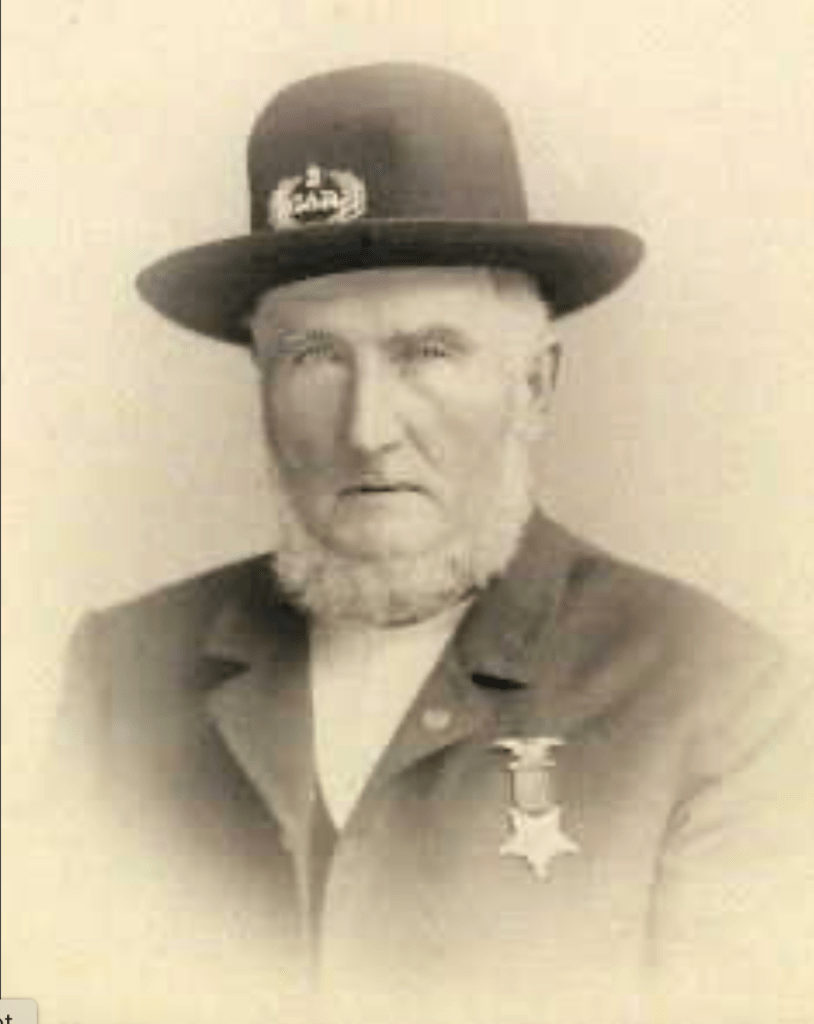
Ulrich L. Groff was born on October 8, 1848, in the alpine village of Wengen, nestled in the canton of Bern, Switzerland. Ulrich and Mary Miller Groff were Swiss natives. They were described on their immigration papers as “tillers of the soil.” These were farmers seeking a better future. In Switzerland, the Groff family lived in a small but close-knit community. It was in this environment that Ulrich learned the values of hard work. He also learned perseverance and family unity.
In 1852, when Ulrich was just four years old, the Groff family made a monumental journey to America.
Their voyage took them across the Atlantic Ocean. This information is from family records shared by Sylvia Little, the mother of Jackie Lee Little. They traveled aboard one of the last great sailing ships. The journey lasted a whole month at sea before they landed in the port of New Orleans. From there, the family traveled north through the Wabash and Illinois Rivers, eventually arriving in Vincennes, Indiana.
There, they purchased wagons and teams of oxen to make the final leg of their journey. The Groffs settled in Richland County, Illinois. They would lay down roots and build a new life from the ground up. They faced challenges like language barriers, unfamiliar customs, and the harshness of the American frontier.
By 1860, the Groffs had firmly established themselves in Claremont Township, Richland County. The census that year listed young Ulrich as a ten-year-old student, attending school alongside his brothers Michael and Joseph. His father, a determined farmer, was farming 640 dollars’ worth of land—no small feat for an immigrant family. It was a humble beginning but one filled with purpose and promise.
On December 6, 1870, Ulrich Jr. married Martha Allen Eaks in Richland County. Martha had been born in Cannon City, Tennessee, on December 11, 1849, to William C. and Frances Eakes. Ulrich and Martha began a family together and raised their children on the Illinois prairie.
Ulrich Groff Jr. And Family
By 1880, Ulrich was a working farmer, and he and Martha had three sons: Ira Allen, Harvey S., and Otis E. Over the years, their household expanded to include nine children, with Benjamin H. Groff I. becoming a middle child. Eight of Ulrich Jr.’s children survived to adulthood. The Groff household, a warm and united family, also became a multi-generational home. By 1900, Ulrich’s mother, Mary, was a 74-year-old widow. She had survived the long journey from Switzerland. She also overcame the challenges of building a life in a new land. At that time, she was living with the family.
Martha passed away on February 22, 1906, at 56, and was laid to rest in Eureka Cemetery in Claremont. In 1909, Ulrich remarried, taking Ellen L. Richter of Olney, Illinois, as his wife. Ellen had been born in Bullitt County, Kentucky, to James and Catherine Yates Richter. Ulrich and Ellen had no children together. Later, they helped raise two grandchildren, Cleo and Walker. They stepped in after the children lost their father, Odis Edward Groff.
Ulrich bridged two continents and saw a century of change. He became a U.S. citizen in 1869 and worked on Illinois soil, much like his ancestors did in Switzerland. He never learned to read or write but valued education and ensured his children access it. His life was defined by perseverance, faith, and the quiet strength of a man who carried his family’s burden. Ulrich also became a respected member of the Richland County community. He was known for his hard work, honesty, and willingness to help others.
Ulrich Jr. passed away on June 6, 1927, at the age of 78 years, 7 months, and 29 days. He was buried beside Martha in Eureka Cemetery. Ellen lived on until 1939 when she passed away at the age of 82. She, too, was buried in Eureka.
The legacy of Ulrich L. Groff endures in the farmland he once tilled. It continues through the descendants he raised. The journey his family made was filled with hope. It was marked by courage and the will to start again. They traveled from the Alps of Switzerland to the heartland of Illinois.
Before Otis passed away, he and Ulrich’s son, Benjamin, discovered land in Oklahoma. In the early 1900s, they began farming it together. Benjamin and his sister, Laura Alice Dowty, eventually settled there permanently. They raised their families there and spent the rest of their lives on that land.
Thirty years ago, today, I was standing in a Federal Building when my pager went off. The screen lit up with all 9s—a code used to signal an emergency assignment. I needed to contact headquarters right away.
I had just stepped out of a federal courtroom in Denver, Colorado. Moments earlier, I had been inside, preparing to testify in a significant case involving a syndicated burglary operation. I’d been working undercover, embedded deep within their ranks. The courtroom was tense, but a recess had been called, and a few of us decided to grab coffee downstairs.
As we stepped into the elevator, my pager buzzed. I glanced around—no one else’s device had gone off. A sinking feeling set in, but I said nothing. When we reached the first floor, I peeled away from the group and went to a pay phone. I called my office.
My supervisor’s voice was grim on the other end of the line. A bombing had just occurred in downtown Oklahoma City. It was devastating—an entire city block destroyed, surrounding buildings heavily damaged. The scope of it was hard to fathom.
My first words were my gut instinct. If they’re still alive, the person who did this is already on the road, on one of the Interstates. They’re putting as much distance as possible between themselves and the blast. They’ll go until they feel safe, then hunker down and watch.
Shortly after that call, my pager buzzed again—this time from the Federal Prosecutor’s Office. They informed me that all federal court proceedings were being canceled nationwide. I wouldn’t be needed back in court that day.
With nothing more to do, I contacted relatives in Oklahoma to ensure their safety. Then, like so many others, I returned to my room. I sat glued to the television and watched the horror unfold in real time.
The next day, I waited to hear if I’d stay in Denver. I wondered whether I would be reassigned. Another page came in from my office. A state trooper had made a traffic stop north of Oklahoma City. The individual taken into custody matched a profile. My instincts had been right.
In the weeks that followed, the nation learned his name. I choose not to say it now. Some people deserve to be remembered. He is not one of them.
Now, on this Saturday, April 19th, 2025, it’s been thirty years. Half of the people living in Oklahoma City today were either not born or didn’t live there in 1995. The memory of that day is fading, becoming a chapter in history instead of a scar felt daily.
Many survivors have since passed. Families of the victims have grown older, some have gone entirely. Some of those in the building that day were too young to remember it now. The face of that tragedy has changed, but its weight remains.
The Oklahoma City Bombing was the first of two national tragedies I learned about while standing in an elevator. The second came years later, on a crisp September morning—9/11. I remember thinking about stairs a lot after that. Elevators started to feel cursed.
But I never gave in to fear. I always got back in and waited for the doors to close. I figured if I didn’t, they would win.
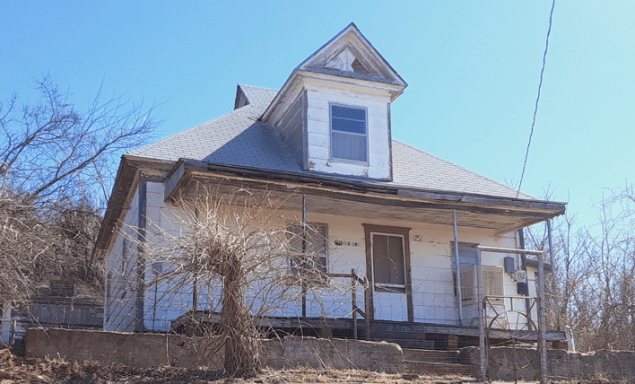
The Groff House, first moved to Binger from Anadarko.
Our move to the farm east of Binger, Oklahoma marked a drastic change in life. It was vastly different from our life in Cordell. My dad had bought a house set on a modest foundation. A propane stove heated it. There was no running water. We had no telephone. The electricity worked until a snowstorm or thunderstorm blew through and took it down. In time, things would improve, but first, we had to learn a new way of living.
Each evening, my dad brought home two five-gallon containers of water and set them on the kitchen floor. Hanging above them was a metal ladle, which we all used to scoop ourselves a drink. It was a crude method, but it worked—and we didn’t think twice about it.
Going to the restroom was another matter. Several attempts had been made to drill wells, but all came up dry. My dad had the holes filled in, except one. Over that one, he placed an old-fashioned outhouse—worn, sun-bleached, and splintered. It looked fifty years old, and maybe it was. But he fitted it with a new toilet seat, and we used it like it was brand new. The worst part? The yellow jacket wasps that swarmed it in summer. They built their cones overnight, and chasing them off was a risky job that none of us looked ahead to.
This story isn’t about the outhouse or the water jugs. It’s about the town’s Main Street during that time. The impression it left on me was significant. I was only five years old, but the images are burned into my memory.
My dad was the town barber. His shop sat on a steep sidewalk, at least three feet above the street. Set into the concrete were old metal rings. For the longest time, I had no idea what they were for. One spring morning, I was playing on the sidewalk. I was flipping one of the rings back and forth. An old timer stopped and looked down at me.
“Do you know what that ring is for, Sonny?”
He asked.
I shook my head.
“No.”
He grinned.
“Those were for tying up horses and wagons. Back in the day, folks would come to town on Saturdays—buggies and wagons lined this whole street. Horses everywhere.”
That answered a mystery I’d long wondered about. But there were more to come—and like those rings, they’d slowly be explained to me, one by one.
That same sidewalk saw a lot of stories. I remember one day. A slick Chevrolet four-door pulled up. Two men and their children—a boy and a girl—went into the drugstore next to Dad’s barbershop. My oldest brother had come into town to visit and was sitting in the shop when someone waiting for a haircut suddenly shouted,
“FIRE! FIRE! THAT CAR IS ON FIRE!”
The man bolted into the drugstore to alert the others. Someone must’ve called the fire department—but “fire department” was a stretch. The town had a 1945 fire truck with a rusted tank and an engine that wouldn’t start. They had to tow it with another truck to get it to the fire. My brother ran to the car and had one of the men pop the hood. Without hesitation, he ripped off his shirt and began beating out the flames around the carburetor.
The twins—those two kids—stood next to me on the sidewalk, watching. They would later become my classmates and lifelong friends. That introduction during the chaos would forge a connection we kept through the years.
My brother eventually put out the fire. The fire truck, still leaking water, finally rolled to a stop behind the car—just as the tank began to empty. The scene would’ve been funny if it hadn’t been so sad. Laughter erupted from my dad’s shop. The volunteer firefighters were embarrassed, and I remember feeling bad for them.
It wasn’t the last mishap. Months later, a house caught fire just behind the fire station. The truck’s wheels locked up that time, and it couldn’t even be towed out. The town then decided it was time for a new truck.
Through donations and fundraisers, they finally got one. The arrival of the new fire truck was a significant moment in our town’s history. It was a testament to our resilience and the importance of community support. It was a real point of pride—a saving grace when it finally arrived.
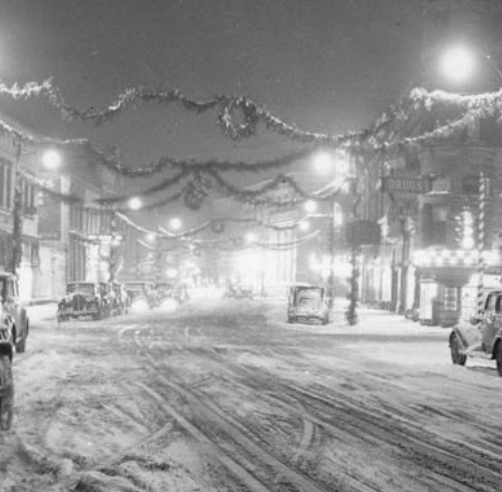
Main Street had its beautiful moments, too, especially at Christmas. The decorations draped across the street like something out of It’s a Wonderful Life. Seeing them lit up at night turned Main Street into a glowing wonderland.
One Christmas, the town threw a parade. The governor came. And so did our hometown hero, Johnny Bench, riding in the back of a convertible. I stood beside my dad in front of his barbershop, watching as they passed by. It was one of the biggest things to happen to our little town of 750 souls.
Main Street had different values back then, too. I remember a funeral procession once drove through town. My dad stopped cutting hair and closed the shop until the last car had passed. Other businesses did the same. That quiet gesture of respect left an impression on me that’s never gone away.
Looking back now, I realize that old Main Street was more than just a stretch of asphalt and storefronts. It was the heartbeat of a simpler time. Life was slower and more mindful then. It taught me about community, kindness, hard work, and the small moments that shape our lives. Those sidewalk rings, flickering Christmas lights, and clunky fire trucks are gone, but the memories stay. And in my heart, Main Street still stands—just as it was.
Spring is here, and that means baseball season is in full swing—just like Sophie’s Baseball Blog! Keeping up with the Phillies and Nationals has never been easier. For a quick way to stay updated, visit benandsteve.com. Click on the NEWS4YOU tab. Then, slide down to Sophie’s page—your one-stop shop for all the latest game insights and highlights. It’s a home run every time! ⚾🔥



















 benandsteve.com