Why Language Choice Is Crucial in Events

3–5 minutes

(inspired by Daria Knupp’s piece at Personify)

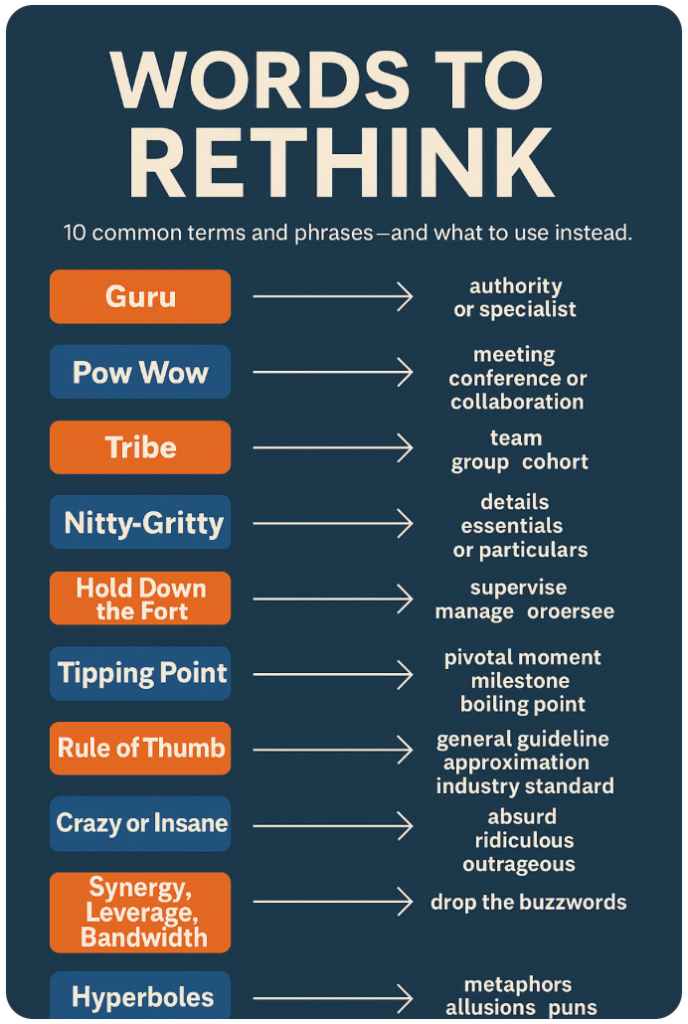
We all know words can inspire, connect, and excite—but they can also alienate, offend, or sound tired. Daria Knupp, Sr. Content Marketing Manager at Personify, recently published a thoughtful article. It lists 10 words and phrases we should stop using in the events industry. We should consider avoiding them everywhere. Her list stopped me in my tracks—and it will surprise you, too.

We use these terms often at conferences, in meetings, and in our everyday work to convey intelligence, wit, and creativity. Nevertheless, some have roots in stereotypes, outdated social theories, or even deeply offensive historical contexts. Here are highlights from Knupp’s list. I also include my own reflections on why they matter. Additionally, I explore how we can do better.

  • “Guru” Originally, the title of the highest spiritual leaders in Hinduism and Buddhism. Using it casually—“event planning guru”—can trivialize a sacred role. Try “expert” or “specialist” instead.
  • “Pow Wow” is not just a “quick meeting.” It’s a sacred Native American gathering of community and celebration. Try “meeting” or “collaboration.”
  • “Tribe” is often used to describe a network or support, but it is tied to outdated and harmful stereotypes. Swap in “team,” “group,” or “cohort.”
  • “Nitty Gritty” Commonly meant “the essentials,” but it was rooted in references to the slave trade. Use “details” or “essentials” instead.
  • “Hold Down the Fort” Seems harmless, but it was initially tied to colonial conflicts with Native Americans. Consider “supervise” or “manage.”
  • “Tipping Point” was popularized by Malcolm Gladwell, but historically referred to racial “thresholds” in neighborhoods. Try “pivotal moment” or “milestone.”
  • “Rule of Thumb” Linked—to wife-beating folklore. Safer to say “general guideline” or “industry standard.”
  • “Crazy” or “Insane” Using mental illness terms casually undermines efforts to destigmatize. Replace with “absurd,” “outrageous,” or “ridiculous.”
  • Buzzwords like “Synergy,” “Leverage,” and “Bandwidth” Overuse makes you sound like a cliché. Switch it up with plainer language.
  • Hyperboles. Nothing wrong with exaggeration—but when overdone, it can make you less credible. Mix in metaphors or puns for variety.

I’ve had very close Native American friends who have been like family to me for nearly fifty years. Through countless conversations, shared meals, and life’s ups and downs, similar concerns about language never arose. We always spoke openly and comfortably with one another, and I thought we understood each other fully.

Now, reading about the origins of these words and their potential to harm, I have to ask myself—was I wrong? Did I unintentionally cause pain, even to the people I love and respect? This personal reflection can make the audience feel empathetic and introspective. Did my long-held assumptions give me a sense of being “above” the issue when in reality I wasn’t?

This is why articles like Daria Knupp’s matter. They challenge us to reevaluate. They help us check our blind spots. They make us confront how easy it is to inherit language without questioning it. This can make the audience feel motivated and empowered. I hope that in sharing this, readers will pause. I hope they think: if language is so powerful, what can we do to use it better?

As Knupp points out, we interact with thousands of attendees, exhibitors, colleagues, and friends. Every word choice carries weight. Being mindful of language isn’t about being “too sensitive”; it’s about making sure everyone feels respected and included. And honestly? It makes us sound more intelligent and up-to-date.

For me, this list was surprising because so many of these phrases have been normalized. Seeing their origins laid out in one place makes me rethink my own habits. It also makes me curious—what other everyday expressions are we using without realizing their history?

Language evolves, and so can we. By phasing out these outdated or offensive terms, we show ourselves as thoughtful professionals and better human beings. Words shape experiences. They can also change them—for the better.


By Benjamin GroffMedia© | benandsteve.com | ©2025 

NOTE: We live in a time when there’s a relentless push to roll back equality. Efforts aim to undo hard-won progress toward balancing the scales between the haves and the have-nots. Reports like this stand as a vital reminder. There will always be voices, somewhere, willing to rise for decency, fairness, and moral courage.


Lessons from the Last Broadcast: Questioning the Airwaves

1–2 minutes

The Last Broadcast

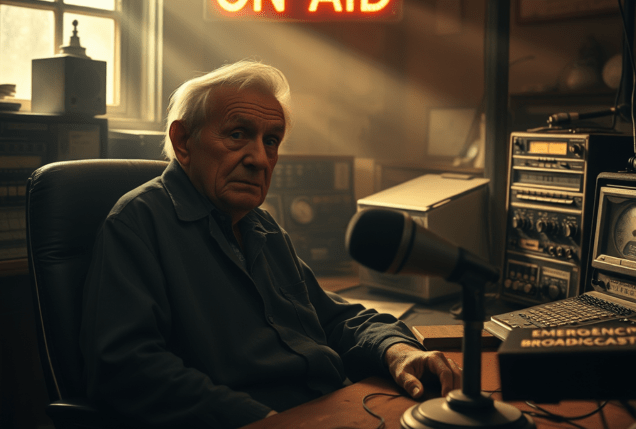
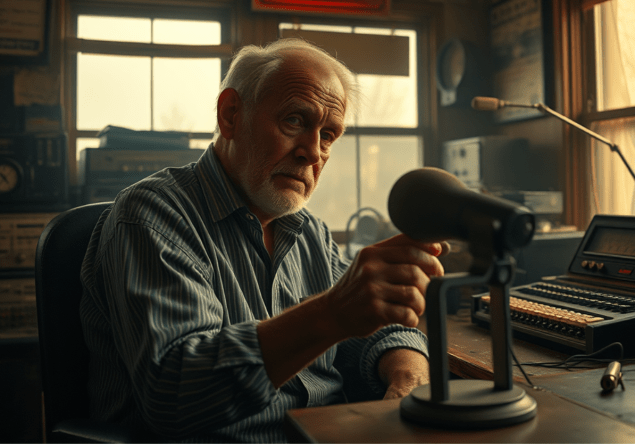
Sam Delaney had been a radio man his whole life. Station manager, on-air talent, janitor when needed—he had done it all. Now, in his seventies, he sat in the empty control room of what was once a bustling AM station. The place smelled of dust and warm circuitry. The walls hummed with silence.

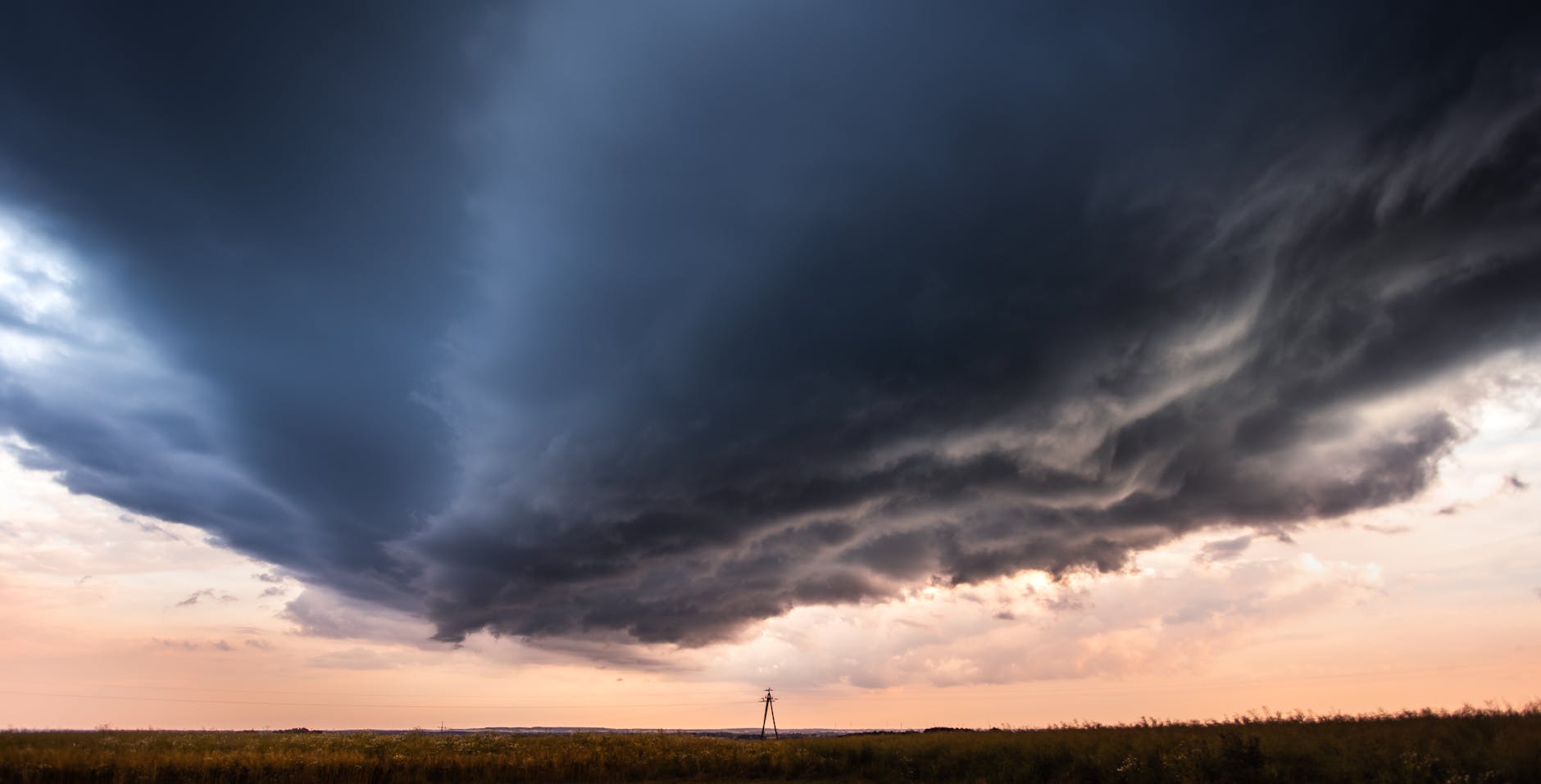
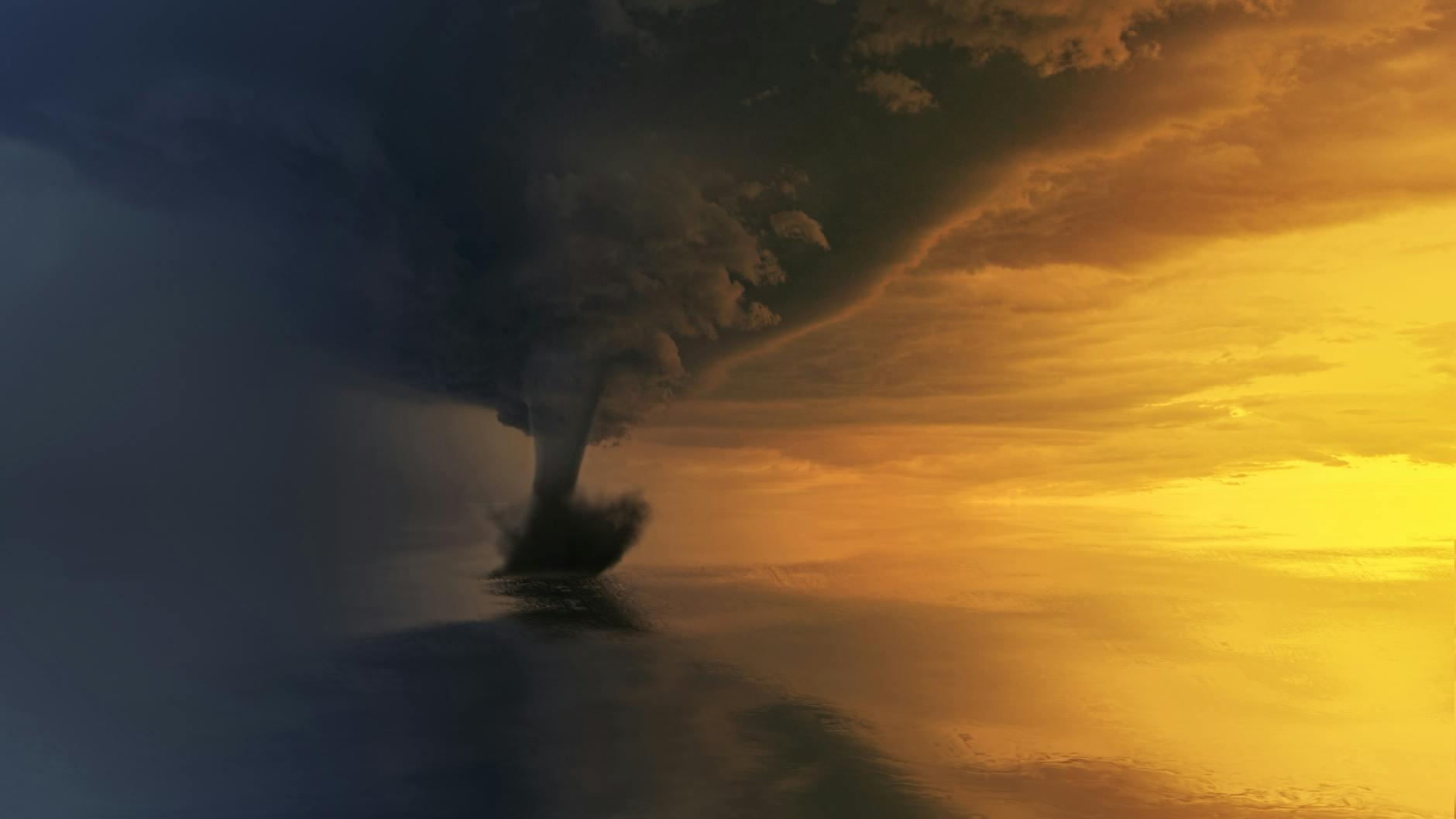
Sam still knew every button by heart. Especially the one marked EBS—Emergency Broadcast System. Back in the day, the FCC’s rules were clear: tones were sacred. The piercing signal wasn’t just a sound; it was a promise. Tornado warnings. Flood alerts. The nation’s line of defense against panic. There had been rules—Title 47 of the CFR, etched into his memory like scripture.

But things had changed. With each new administration, the guardrails loosened. The equal-time law that once kept political chatter balanced had vanished decades ago. A president erased it. He feared his old Hollywood reels would force TV stations to give airtime to his critics. One law changed, and suddenly the airwaves were open territory—bluster, bias, and one-sided noise pumping into homes unchallenged.

Now Sam watched as networks ran those same tones he once revered, but not for weather or disaster. They tested loyalty. They triggered crowds into a frenzy. They commanded obedience in ways he never imagined. Once, tones meant safety. Now, they meant control.

He rubbed the crease in his neck where headphones had rested for thirty years. Outside, the town he had called home was no longer united. Neighbors didn’t trust neighbors. Families split along the fault lines of which voice on the radio they listened to.

Sam leaned into the old microphone. The ON AIR light flickered.

“What if I told you,”

He began. His voice was gravel but steady.

“The lie isn’t in what you’re hearing. It’s in what you stopped questioning.”

He paused, finger hovering over the tone button.

For the first time in his career, he considered sending out a tone. This was not to warn people of a storm but to warn them of themselves.


By Benjamin GroffMedia© | benandsteve.com | ©2025 

The King is Gone — and So is the Evidence Locker…

3–4 minutes


A True Law Enforcement Tale from August 16, 1977

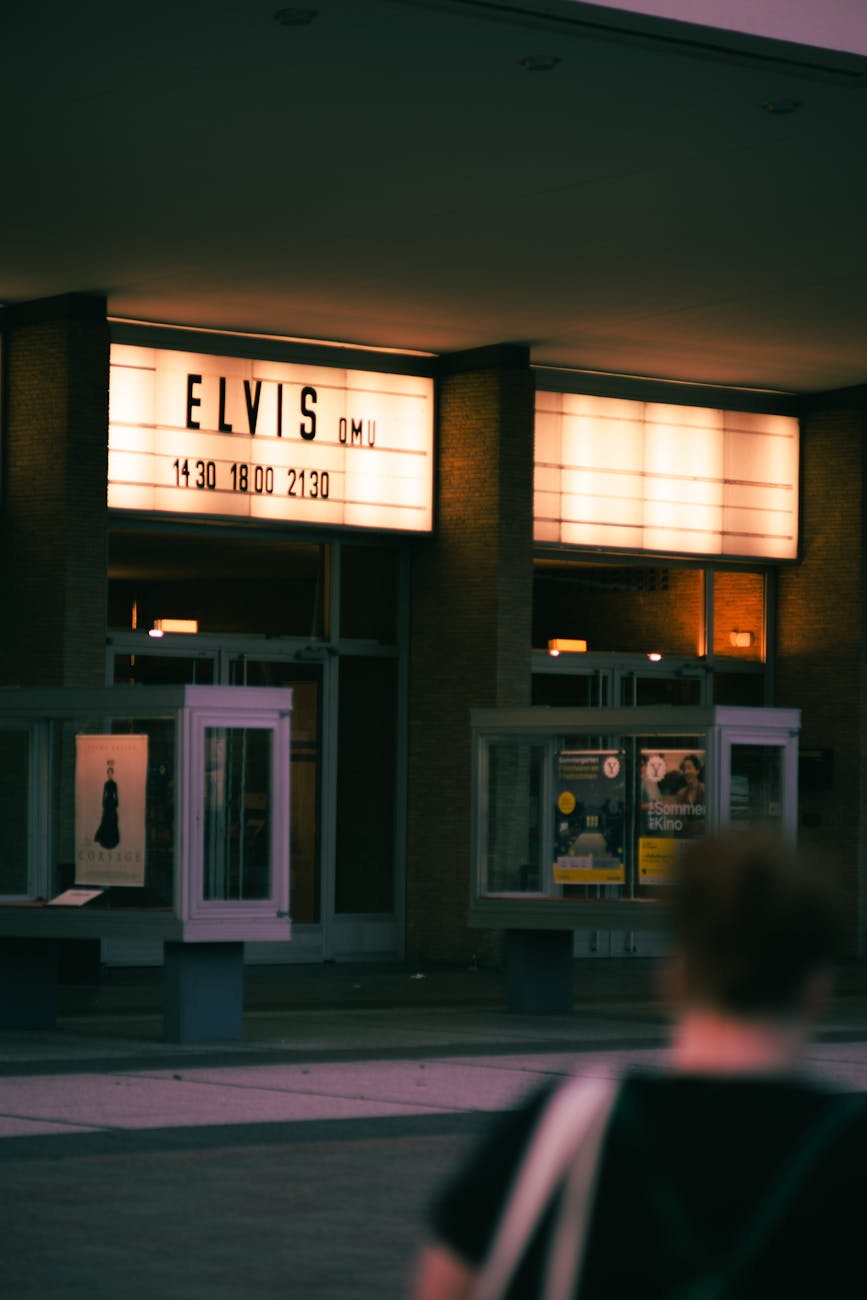
Photo by Paul Volkmer on Pexels.com

On August 16, 1977, the world stopped spinning — at least in Memphis, Tennessee. That was the day Elvis Presley, the King of Rock and Roll, was found unresponsive in the bathroom of Graceland. The global headlines mourned music’s greatest icon. Meanwhile, things were spinning out of control behind the scenes in the world of law enforcement. And not just in Memphis.

Most people don’t know that Elvis’s death caused a minor frenzy. It affected not just fans, but also federal and local law enforcement. This had everything to do with his name, his guns, and his bizarre honorary narcotics badge.

Let’s rewind.

In 1970, Elvis famously met with President Richard Nixon and requested a federal narcotics badge. He did not intend to arrest drug dealers, well, maybe a few. He believed it would grant him special privileges at airports. It would allow him to carry firearms across state lines without hassle. Nixon, eager to impress a celebrity during a slump in his popularity, gave him the badge. Elvis then began collecting honorary police badges from departments across the U.S., often in exchange for autographs, memorabilia, or a simple smile.

By the time of his death, Elvis had amassed over 100 badges. Some were real, others purely decorative, and a few were questionably obtained. The King had a well-known obsession with guns. He owned dozens of pistols and rifles. He even had a few military-grade toys. When the news of his death broke, more than one law enforcement agency quietly wondered. They asked themselves, ‘What did we give that man?’ And can we please get it back?

According to insiders at the time, several local departments began calling Graceland discreetly. They were hoping to retrieve various “loaned” badges and sidearms. One small-town sheriff reportedly said, 

“We didn’t think he’d actually keep the darn thing. It was supposed to be a photo op!”

Even the DEA got involved. They did not act out of malice. Elvis’s collection included a few federal items. These should have never technically left Washington. A flurry of quiet internal memos from late August 1977 hints at an almost comical scramble. They describe recovering government property from the estate of a man. This man had once offered to go undercover as a federal agent “to stop the hippie drug culture.”

This man had once offered to go undercover as a federal agent “to stop the hippie drug culture.”

Meanwhile, fans held candlelight vigils and bought up every Elvis album in sight. Law enforcement agents were busy inventorying his arsenal of firearms and badges. His collection would put most mid-size police departments to shame.

A deputy who had once met Elvis described the moment. They realized the full extent of the collection: 

“I walked into that room. I saw enough shiny shields to start a police academy.”

I half expected them to start talking.

Most of the badges were eventually returned. Some were documented as honorary. Yet, a few were mysteriously “lost to history.” They are reportedly still missing to this day. One turned up on eBay years later. This sparked a brief online turf war between Elvis fans and collectors of obscure police paraphernalia.

August 16, 1977, then, marks not just the day the King left the building. It was also the day law enforcement agencies across the country had a new challenge. They found themselves unexpectedly cleaning up behind him. They tried, with straight faces, to explain to their bosses. Why did Elvis Presley have more police gear than some SWAT teams?

The Power of Actuality Reporting in Journalism

1–2 minutes

I came across this news report and was genuinely impressed by its craftsmanship. The reporter doesn’t just tell the story. They show it. They use actuality reporting and a wraparound technique that gives the piece depth and authenticity. It’s the type of journalism that doesn’t just inform—it immerses you. This level of storytelling should be seen and appreciated by more people.

The Day Music Lost Three Legends

By Benjamin GroffMedia© | benandsteve.com | 2025 Truth Endures©

1–2 minutes

The Day the Music Died: February 3, 1959

On a cold February night in 1959, the heartbeat of American rock and roll fell silent in an Iowa cornfield.

Photo by ArtHouse Studio on Pexels.com

Buddy Holly was just 22 years old. He had chartered a small Beechcraft Bonanza plane. His goal was to avoid the grueling winter tour bus ride. This bus ride plagued the “Winter Dance Party” tour across the Midwest. Along with him were Ritchie Valens, just 17, and J.P. “The Big Bopper” Richardson, 28. All three had become major figures in the rapidly evolving American music scene.

The tour itself was chaos. It was poorly routed and underfunded. Bitter temperatures pushed both buses and artists to the limit. Holly was tired. She was freezing and sick. She made a decision: skip the bus and fly ahead to the next stop in Moorhead, Minnesota.

The plane took off around 12:55 a.m. from Clear Lake, Iowa. Minutes later, it crashed into a frozen cornfield, killing everyone onboard. The pilot, Roger Peterson, was just 21.

The news shocked the country. Three of rock and roll’s brightest stars were gone in an instant. Don McLean would later memorialize the event in his 1971 hit, “American Pie,” calling it “the day the music died.”

But in the silence that followed, the music didn’t die. It grew louder. The tragedy marked a turning point—the moment rock and roll lost its innocence and began to grow up. It was the high cost of youthful rebellion, forever frozen in that snow-covered field.

One member of Holley’s band was supposed to ride on the plane. He gave his seat to Ritchie Valens. Instead, he rode on the band’s bus to the next location. That member was Waylon Jennings. He would deal with that decision for many years before making peace with himself. Jennings would become a legend in his own right. He became a country music singer, having hit after hit. He was known as an outlaw in the industry.

When Radios Fell Silent: The 1978 Trooper Tragedy

By Benjamin GroffMedia© | benandsteve.com | 2025 Truth Endures©

4–6 minutes

The Day the Radios Fell Silent: A Personal Account of May 26, 1978

It was a warm May morning in 1978. I was 15 years old, working the phones at my dad’s office at Camp Red Rock in western Oklahoma. For several days, law enforcement radio traffic had been intense—more active than usual, more urgent. Something serious was happening.

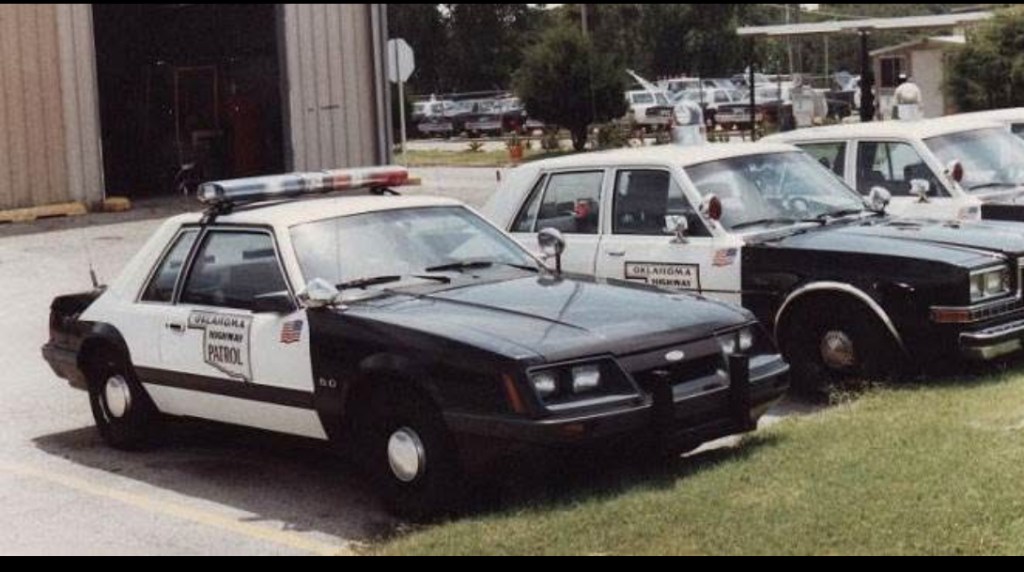
An All-Points Bulletin had been issued statewide: two inmates had escaped from the Oklahoma State Prison in McAlester. They were described as extremely dangerous men, capable of committing horrific crimes. The Oklahoma Highway Patrol (OHP) and local authorities launched a massive manhunt, focusing on the southeastern region of the state. While there were scattered reports from other areas, the belief was that the fugitives remained nearby and on foot.

Trooper Houston F. “Pappy” Summers,
Motor Vehicle Inspection (MVI) Division in Enid.

Still, troubling reports emerged—houses broken into, firearms stolen, and even a car gone missing. An army of troopers scoured the countryside. The fugitives had to move carefully, methodically, to avoid detection. The search had only been underway for days, but it felt like weeks.

May 26, 1978, arrived. It would become one of the darkest days in the history of the Oklahoma Highway Patrol.

Although I was hundreds of miles away from the action, the search was broadcast live to my ears. The ranger office where I worked was equipped with radios that picked up all law enforcement frequencies. I heard it all: the calls, the coordination, the chaos.

Trooper Billy G. Young, Woodward MVI detachment.

That morning, a somber message came over the radio from Highway Patrol District Headquarters:

“Attention all stations and units: All nets are 10-63 until further notice.”

In plain terms, this meant that the radio network was reserved exclusively for emergency traffic related to the escapees. No unnecessary chatter. But maintaining a “10-63 net” requires constant reinforcement. Officers rotate shifts. New dispatchers come on duty. Without reminders, the rule starts to fade, and soon enough, radio traffic returns to normal. That’s exactly what happened.

As the air unit tried to communicate with ground teams, their messages were drowned out by unrelated conversations. Then, something chilling unfolded.

Lieutenant Pat Grimes,
Internal Affairs.

I listened in real time. The air unit tried to warn a team of troopers. They had approached a area. The escapees were hiding—just beyond the trees, lying in wait. The troopers, thinking it was a routine check, got out of their car casually. Suddenly, gunfire erupted. It was an ambush.

One of the troopers managed to retreat to his vehicle and tried to call for backup. The air unit, having seen everything from above, struggled to get through. The radio frequencies were jammed with idle chatter. It was a communications nightmare that have cost lives.

I sat there, helpless, listening to the air unit reporting the tragedy to headquarters. The dispatcher pleaded for all units to clear the net so emergency aid is dispatched. I was stunned—devastated. This moment became a lasting lesson in why radio discipline can be a matter of life and death.

Later that day, I was shocked again—two more troopers had been shot in the same area. And then, I heard the message that signaled the manhunt was over:

“Be advised, the search for the escapees is over. All units and stations can return to regular assignments.”

That phrase said it all. The escapees were no longer a threat. They hadn’t been captured—they were dead. Had they been taken alive, the dispatch would have named the unit responsible for their arrest.

The Fallen

Three troopers lost their lives that day:

  • Trooper Houston F. “Pappy” Summers, 62, a 32-year veteran stationed with the Motor Vehicle Inspection (MVI) Division in Enid.
  • Trooper Billy G. Young, 50, with 25 years of service, attached to the Woodward MVI detachment.
  • Lieutenant Pat Grimes, 36, from Internal Affairs, nearing his 12th year with the Patrol.

Summers and Young died in a gunfight on a rural road near Kenefic. This occurred after the escapees stole a farmer’s truck and weapons. The troopers, unaware of what they were driving into, were ambushed.

Later that day, in the small town of Caddo, Lt. Grimes and his partner, Lt. Hoyt Hughes, were searching a residential area when they, too, came under fire. Grimes was fatally shot. Hughes was wounded but managed to exit the vehicle and return fire at close range, killing one of the fugitives.

Just moments later, Lt. Mike Williams of the Durant detachment arrived. He fatally shot the second escapee. This action brought an end to a 34-day reign of terror that had stretched across six states.

The two escapees caused the deaths of eight people. This number includes the three troopers. They also injured at least three others during their violent run from justice.


Final Thoughts

What I heard that day shaped me. During my time in the police academy, I learned something important. My account of the events closely aligned with what was eventually confirmed. The tragedy of May 26, 1978, became a case study. It highlighted the importance of radio discipline. The event also emphasized operational coordination and situational awareness.

But for me, it was more than that. It was personal. I was there—listening. And I will never forget the sound of silence that followed.

Learn About The Lady In Mickey Gilley’s Song – The Girls All Get Better At Closing Time.

‘I know Robert Redford, even Lola Hall…’

By Benjamin GroffMedia© | benandsteve.com | 2025 Truth Endures©

4–6 minutes

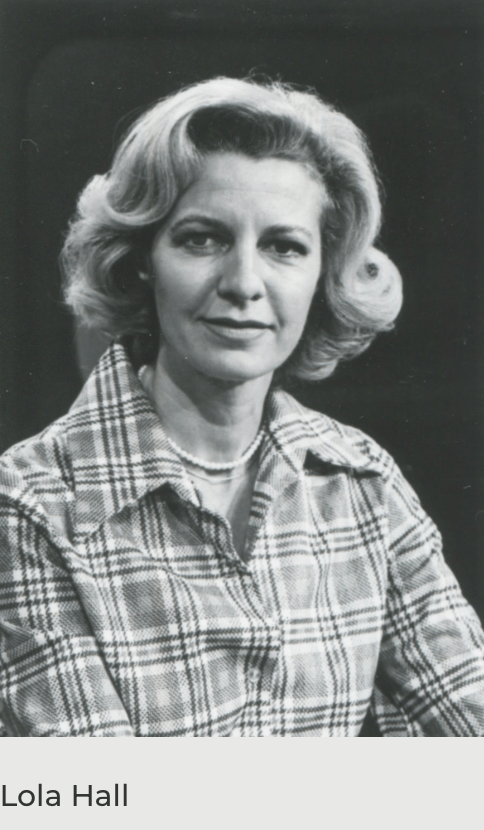
Lola Hall: Oklahoma’s Weather Girl Who Became a Legend

In the heart of America, television was becoming the central storyteller of the modern household. During this time, one woman in Oklahoma City quietly became a beloved figure. She was cherished across living rooms, farms, and small-town diners alike. Her name was Lola Hall, the poised and personable weather girl for KWTV Channel 9. Through the 1960s and 1970s, Lola transitioned from forecasting the weather. She began anchoring the morning news. She carved out a legacy of warmth, professionalism, and unexpected celebrity.

A Humble Start on Channel 9

Lola Hall wasn’t born into the limelight. She was raised in Oklahoma. She considered herself an ordinary woman. “I’m just a plain girl with a good work ethic,” she once said. She never imagined she would become a fixture in households across the state. She also didn’t foresee that her name would one day be immortalized in a hit country song.

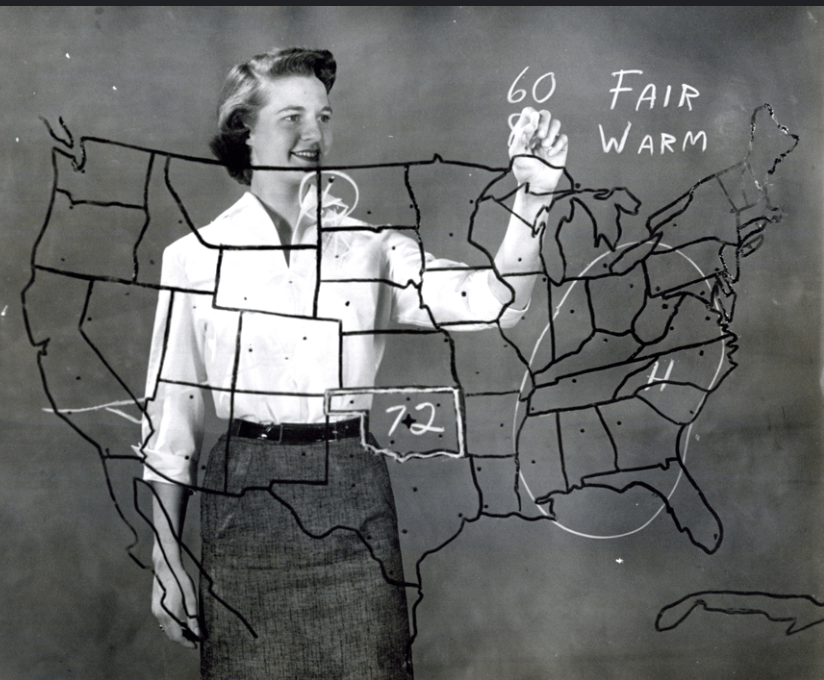
She started at KWTV in the early 1960s. Television was still finding its footing then. Local personalities were becoming stars in their own right. Initially billed as a “weather girl,” a common term at the time, Lola did more. She did more than point at cloud symbols and smile at the camera. She brought a genuine understanding of weather patterns. Her calm demeanor during storms was notable. She had a natural charisma that made viewers trust her.

The Weather Girl also known as the Weather Lady, and Lola Hall

Lola quickly stood out not only for her delivery but for her grounded, approachable nature. She didn’t talk down to viewers or play a character. She was simply Lola — smart, steady, and relatable.

Rising to Anchor the Morning News

As her popularity grew, so did her responsibilities. By the early 1970s, Lola earned a promotion to co-anchor the morning news. This was a significant achievement for a woman in broadcasting. In that early morning slot, she became the face viewers saw as they sipped coffee. People watched her while packing school lunches. They prepared for long days on the farm or at work.

Her calm voice and natural empathy helped set the tone for the day. But it wasn’t a solo act.

Near the end of her career, she welcomed two of Oklahoma’s most trusted newsmen. Bill Haire and Wayne Lyle joined her on the morning show. Both were widely respected for their skill in agricultural reporting — essential content for Oklahoma’s large farming population. The trio became a necessary part of daily life for rural viewers. Farmers tuned in for weather and headlines. They also relied on Bill and Wayne for dependable reports on crop forecasts. Their reports covered market conditions and farming trends.

Lola, Bill, and Wayne worked together to form an Oklahoma morning news trifecta. They delivered information with clarity, sincerity, and a deep respect for their audience. They weren’t just broadcasters; they were neighbors.

A Country Music Cameo

But, Lola’s story wouldn’t be finished without an interesting twist. One of her career’s most surprising moments was an unexpected brush with country music fame.

Lola Hall, KWTV Channel 9′s beloved weather girl and morning news anchor, pictured during a 1970s broadcast. Her calm presence and signature charm made her a household name across Oklahoma.

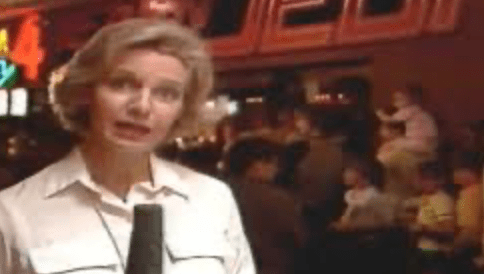
During an interview with country star Mickey Gilley, Lola found herself momentarily flustered. Gilley, known for chart-topping hits and honky-tonk swagger, was in Oklahoma City promoting his music when he confessed on air.

He told Lola that back in his younger days, he grew up in rural east Texas. KWTV Channel 9 was one of the few stations they could pick up. And Lola Hall, with her grace and good looks, was a celebrity to the local boys.

“You were the hottest thing we’d ever seen,” 

Gilley smiled, adding that Lola had made such an impression that he mentioned her by name in his song.

 “The Girls All Get Prettier at Closing Time.”

For a brief moment, Lola lost her composure — laughing, blushing, and turning to the crew off-camera. It was a rare crack in her usually calm exterior, and viewers loved it. She quickly recovered, continuing the interview with her usual charm, but later admitted she was shocked.

“I thought I was just the girl telling them to grab an umbrella,” 

She joked.

A Lasting Legacy

Lola Hall stepped away from the news desk eventually. She left behind a legacy built not on flash or fame. Instead, it was built on trust, relatability, and professionalism. During an era when women in broadcasting often had to work twice as hard, Lola rose through the ranks. Her long-lasting connection with viewers stood as a quiet revolution.

She may never have considered herself glamorous. She may not have thought of herself as remarkable. But, to thousands of Oklahomans—and at least one country legend—she was both.

You know it each time you hear the song and Gilley sings the line,

“I know Robert Redford even Lola Hall!”

Lola Hall wasn’t just the weather girl. She was part of the fabric of Oklahoma life. Her name, her voice, and her smile are still remembered by those who welcomed her into their homes each morning.

For a personal take on her career click here and be taken to an interview with Lola Hall!

To truly dive into the story of Lola Hall and other trailblazing women of the 1950s and ’60s, prepare yourself. They were often known then as “weather girls.” Grab your favorite refreshment and settle in. This captivating podcast offers a rich glimpse into their rise to popularity. Back in the day, we just called it a recording—but whatever the name, you’re in for something special.

Reliving Harry Caray’s Magic: A Cubs Story

GROFF MEDIA 2024© TRUTH ENDURES IMDBPRO

Presented by benandsteve.com By: Benjamin Groff II©

2–3 minutes

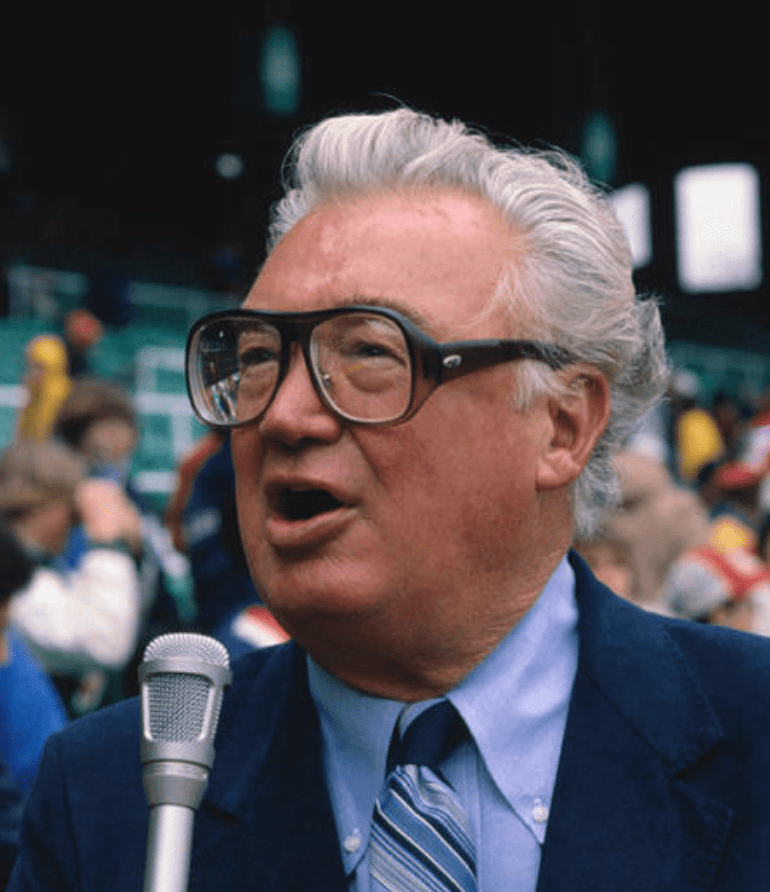
My Afternoons with Harry Caray

The sun beat down outside. The heat rolled in waves off the pavement. Inside my living room, the air was incredible, and the beer was ice-cold. It was that time of day again—my afternoons with Harry Caray.

The ritual was sacred. A six-pack, fresh from the ice chest, sat beside my recliner, already dripping with condensation. The TV crackled to life. There he was—Harry Caray, larger than life. His voice boomed through the speakers like an old friend stepping through the door.

“Holy cow! It’s a beautiful day for baseball!”

It didn’t matter where the Cubs were playing—Wrigley Field, St. Louis, Los Angeles—Harry brought the game home. The crack of the bat and the crowd’s screaming made each moment vivid. The agony of a blown lead and the thrill of a rally were more alive because Harry was calling it.

I took a long sip of my beer as the game unfolded, Harry’s voice rising and falling with every pitch.

“Ahhh, folks, that one just missed!”

he’d groan after a close ball.

“Boy, oh boy, you gotta be kiddin’ me!”

when the ump made a call against the Cubs. And when a fan made a barehanded grab in the stands?

“Let me tell ya, that guy deserves a contract!”

But no moment was more sacred than the seventh-inning stretch.

The organ at Wrigley Field fired up, and Harry’s voice slurred just enough to let you know he was enjoying the day as much as I was, belted out those legendary words:

“All right, Cubs fans, lemme hear ya! A one! A two! A three!”

And then it began:

“Take me out to the ballgame…”

I stood up from my chair, beer in hand, and sang along like I was in the bleachers. My voice didn’t hold a candle to Harry’s, but that didn’t matter. Our tradition was a shared experience that connected me to every other Cubs fan.

For those few moments, nothing else existed—just me, Harry, and the game.

When the ninth inning came, the excitement peaked. Whether the Cubs had pulled off a miracle or suffered another heartbreak, I lifted my beer. I then raised it one last time toward the screen.

“To you, Harry. Your legacy lives on in every Cubs fan. Holy cow, what a ride.”

The Power of Storytelling: My Journey Through Words

GROFF MEDIA 2024© TRUTH ENDURES IMDBPRO

Presented by benandsteve.com By: Benjamin Groff II©

3–5 minutes

A Journey Through Words: For Everyone Who Has Liked My Stories Over Time!

Each day, I search the depths of memory for details that can shape a story. Sometimes, I draw inspiration from current events or pressing concerns that resonate with my readers. Usually, the stories I share come from personal experiences; they are events I lived through firsthand or about those close to me. Or, I was involved enough with a concern to know the details intimately.  

As a child, I had a speech defect. It kept me from speaking up in crowds, around strangers, or in public settings. What seemed like a limitation at the time was a gift—it taught me to listen. I became an observer, absorbing conversations, secrets, and moments others have overlooked. I often teased my older relatives that I held onto some of the family’s best-kept secrets. Over time, those secrets became stories—carefully crafted to preserve history while protecting the people behind them. It also helped me to learn how to be invisible, in a sense. When you stay still and always stay quiet, people overlook the kid in the corner. Conversations happen, and they let their guard down. That was a gift of sorts I brought in my adult life.

There’s a line I often use when people ask what I’ve done in life. I tell them, half-jokingly:  

“I’ve done damn near everything.”

And it’s true.  

I started working on our farm at eight, feeding horses, cleaning barns, and doing chores. Later, I rode fences, helped my dad with his duties as a ranger, and ran errands. As a teenager, I worked at the camp he oversaw, mowing lawns and clearing brush. Once I got my driver’s license, I started hauling hay and peanuts with three friends. It was some of the most challenging work I’ve ever done.  

I became a police officer and served in that role until retirement, after which I transitioned into radio broadcasting. I anchored newscasts for a five-state radio network before moving to a larger market as a news director. Eventually, I returned to law enforcement, working for the Department of Corrections, where I tracked down escaped prisoners. Tracking sometimes required undercover jobs—working at bakeries, hardware stores, magazine suppliers, or grocery stores—blending into communities to locate fugitives. I blend into the scenes, always becoming invisible, just as I did when I was younger. I was always successful, though I often found it hard to leave the undercover roles behind.  The people I had met always became colleagues.

After the September 11th attacks, my spouse’s employer offered a transfer from Kansas to Phoenix, Arizona. The decision was easy. I left law enforcement behind. I found work with Ford-Volvo of North America. I became a vehicle test driver at the Arizona Proving Grounds. I assisted the Ford assembly group in the winter. In the summer, I tested the endurance of Volvo cars and SUVs in the Arizona heat.  

In 2008, medical issues forced me to stop driving. That’s when I turned to writing—first with news articles and then by building news sites for small communities. The site you’re reading now was born from that transition. I created this space when I realized traditional employment was no longer a choice.  

When I started using WordPress, it differed from the platforms I had worked with. I learned through trial and error, studying the work of others, adapting, and refining my skills. Over time, I explored your sites. I saw your creativity, dedication, and unique voices. I better understood how to navigate and thrive in this space.  

I’ve always believed that you get back what you put into something. That’s why I make it a point to read the work of others—it broadens my perspective beyond my world. And for that, I’m grateful.  

To all our followers, subscribers, and readers—thank you. Yesterday, I received a message from WordPress announcing that our site has reached **500 likes!** That’s an incredible milestone, especially since I don’t commercially promote these stories or actively drive traffic to them. This achievement is entirely because of your support, shares, and encouragement.  

I truly appreciate every one of you for being part of this journey. It seems trivial to some. But, for someone who overcame a speech defect, getting 500 likes is a big deal. Thank you, indeed!

Should You Stay on Facebook? Weighing the Pros and Cons

GROFF MEDIA 2024© TRUTH ENDURES IMDBPRO

Presented by benandsteve.com By: Benjamin Groff II©

3–4 minutes

To Stay or Go: Evaluating the Benefits of Remaining on Facebook in Light of Controversial Changes

Social media platforms have become integral to modern life, offering communication, connection, and community building avenues. Nevertheless, as these platforms evolve, so do their policies and practices, often sparking debate about their social and ethical implications. Facebook, a leading social media giant, has recently faced criticism. This criticism is due to changes in its policies on hate speech, bigotry, and LGBTQI support. For individuals making the decision about staying on or leaving Facebook, they hold the power to be informed. Weighing the benefits of both options is essential for this empowerment.

The Case for Staying on Facebook

  1. Maintaining Connections: Facebook remains a vital tool for staying in touch with family. It also helps keep connections with friends and acquaintances, particularly those spread across different regions or countries. For many, it is a lifeline to relationships that would otherwise be difficult to nurture.
  2. Community and Advocacy Opportunities: Despite policy changes, Facebook still hosts several groups and communities that support marginalized voices. These include LGBTQI organizations, social justice movements, and local advocacy efforts. By staying, individuals can continue amplifying positive messages and supporting important causes.
  3. Access to Events and Local Updates: Facebook excels as a hub for event coordination and news dissemination. Whether it’s discovering community gatherings, charity events, or public discussions, the platform enables users to stay engaged with their surroundings.
  4. Platform for Countering Negativity: Staying active on Facebook allows users to directly challenge hate speech and bigotry. Individuals can use their presence to make a positive impact through reporting mechanisms, creating supportive content, and fostering constructive dialogues.
  5. Professional Networking and Opportunities: Beyond personal connections, Facebook provides professional opportunities through networking, business pages, and advertising. Leaving the platform will limit exposure to these tools, which can be crucial for entrepreneurs, freelancers, or small business owners.

The Case for Leaving Facebook

  1. Moral and Ethical Stance: Users can take a stand by leaving Facebook. They do this against policies they perceive as harmful or contrary to their values. This protest can send a powerful message to the platform and its advertisers, influencing change.
  2. Reducing Exposure to Toxic Content: With the relaxation of hate speech policies, users face more harmful content. They become increasingly exposed to offensive material. Removing oneself from the platform eliminates the mental and emotional toll of encountering such material.
  3. Privacy and Data Concerns: Facebook has faced ongoing scrutiny over its handling of user data. Leaving the platform reduces one’s vulnerability to data misuse, targeted advertising, and potential privacy breaches.
  4. Encouraging Other Platforms: Exiting Facebook can prompt individuals to explore different social media platforms that better align with their values. Platforms like Mastodon, MeWe, or local community forums offer a more supportive environment.
  5. Reclaiming Time and Focus: Many users realize an unexpected advantage when they leave Facebook. They find they have more time for hobbies, personal growth, and face-to-face interactions. The departure can foster a sense of liberation from the constant pull of notifications and algorithm-driven content.

Finding a Middle Ground

For those hesitant to make a definitive choice, there are ways to balance the benefits of staying and leaving. Users can regain a sense of control over their Facebook experience by reducing engagement. They can also limit time spent on the platform. Unfollowing toxic pages or users and curating a positive feed helps as well. Additionally, prioritizing different platforms for personal or professional connections while maintaining a minimal Facebook presence can further enhance this control.

Conclusion

The decision to stay on or leave Facebook is very personal. It depends on one’s values, priorities, and tolerance for the platform’s evolving policies. Staying permits individuals to keep connections. They can use their presence for positive change. Leaving can signify a powerful ethical stance. It can lead to personal growth. Regardless of one’s choice, it is essential to evaluate Facebook’s role in one’s life. People should make a decision that aligns with their values and well-being.

A Letter From Paul Harvey, To His Grandchildren

GROFF MEDIA 2024© TRUTH ENDURES IMDBPRO

Presented by benandsteve.com By: Benjamin Groff II©

3–4 minutes

I am sharing a writing listed as “Paul Harvey’s Letter To His Grandchildren. It has been tucked away in a drawer. Finally I pulled it out and made use of it.

Paul Harvey was a news commentator for ABC NEWS in the United States and has been heard worldwide. He was known for “The Rest of The Story” and his Noon News Broadcast from the 1960s through the 1990s.. He provided updates well into his elder years, working from home a lot of the time. His son had built a studio in the Harvey Home. This studio allowed him to work as if he were in the News Room. Paul is always dressed in a suit and tie to report the news. Saying he had to look professional to sound professional.

Here is the letter that is attributed to him.

Grandchildren,

We tried so hard to improve our kids’ lives that we made them worse. I’d like better for my grandchildren.

I’d like them to know about hand-me-down clothes, homemade ice cream, and leftover meatloaf sandwiches.

I hope you learn humility by being humiliated and honesty by being cheated.

I hope you learn to make your bed, mow the lawn, and wash the car.

And I hope nobody gives you a brand-new car when you are sixteen.

It will be good if at least one time you can see puppies born. You should also witness your old dog being put to sleep.

I hope you get a black eye fighting for something you believe in.

I hope you have to share a bedroom with your younger brother or sister. It’s all right if you have to draw a line down the middle of the room. But, when he wants to crawl under the covers with you because he’s scared, I hope you let him.

You want to see a movie. If your little brother or sister wants to tag along, I hope you’ll let them.

You must walk uphill to school with your friends and live in a town where you can do it safely.

I hope you don’t ask your driver to drop you two blocks away on rainy days. It would be unfortunate if you didn’t want to be seen riding with someone as uncool as your Mom.

If you want a slingshot, I hope your Dad teaches you how to make one instead of buying one.

I hope you learn to dig in the dirt and read books.

When you learn to use computers, I hope you also learn to add and subtract in your head.

I hope you get teased by your friends when you have your first crush on a boy or girl. When you talk back to your mother, I hope you learn what ivory soap tastes like.

Try to skin your knee climbing a mountain. By accident burn your hand on a stove. Playing around try to you stick your tongue on a frozen flagpole.

I don’t care if you try a beer once. I hope you don’t like it. If a friend offers you dope or a joint, realize they are not your friend.

I sure hope you make time to sit on a porch with your Grandma or grandpa. I also hope you go fishing with your Uncle.

You will feel a mixture of emotions. Sorrow and joy will arise during the holidays at a funeral. You should stop and understand why.

I hope your mother punishes you when you throw a baseball through your neighbor’s window. I also hope she hugs you at Christmas. I hope she kisses you when you give her a plaster mold of your hand.

I wish you tough times and disappointment, hard work, and happiness. To me, these are the only ways to appreciate life!

The End.

Portions of this entry was edited to allow for space and grammar.

Exciting News! benandsteve.com and our media links are thrilled to be featured on Medioq – Happy Thanksgiving…

Groff Media 2024© Truth Endures IMDbPro

Presented by benandsteve.com By: Benjamin Groff II©

1–2 minutes

benandsteve.com is going places—online and in life. We are proud to announce that we are being listed by Medioq, which connects news and information sites and exchanges information with you online.

“Exciting News! We are thrilled to be featured on Medioq, a premier platform connecting individuals with top-notch media, news, and broadcasting companies worldwide. Explore our profile to stay informed, entertained, and associated with the latest news and updates: https://www.medioq.com/XX/Unknown/1582006558765140/Galaxy8News

be advised—a signal-82 subject is trapped in a burning vehicle –– The Call I Remember

Groff Media 2024© Truth Endures IMDbPro

Presented by benandsteve.com By: Benjamin Groff II©

In law enforcement, some memories haunt you, especially the ones from the most harrowing nights on the job. I was an emergency dispatcher for a police department in southwest Oklahoma, responsible for dispatching fire, police, and ambulance services across five communities. Nights could get overwhelming, but one Saturday evening stands out.

Calls had been constant. Officers were busy responding to domestic disturbances, prowler sightings, burglaries, and other emergencies. In the 1980s, our department monitored Channel 9 on a citizen’s band radio, the go-to emergency frequency.

After 1:00 AM, a call cut through the static:

“Please help—we have an EMERGENCY!”

The voice was frantic. I picked up the station radio and replied, “This is Carnegie Police Department. Go ahead with your emergency traffic.”

The caller explained that a car had veered off the highway east of town, hit a ditch, and burst into flames. The driver was trapped inside. There was no time to lose. I quickly alerted the local police unit, activated the volunteer fire and ambulance lines, and relayed the details.

“Carnegie, Unit 2, be advised—a signal-82 subject is trapped in a burning vehicle near Carlin Lawrence Airport, east of Carnegie on Highway 9.”

The unit acknowledged and responded immediately. Meanwhile, I could hear the fire chief coordinating firefighters over the phone, and the ambulance confirmed they were en route.

Since the crash was outside city limits, I switched to the state’s point-to-point frequency to contact the Oklahoma Highway Patrol.

“Carnegie Police Department to Lawton OHP—rush traffic.”

The “rush traffic” designation signaled an urgent, life-or-death call. The OHP dispatcher responded immediately, and I relayed the details. Within seconds, they were alerting highway patrol units. Nearby sheriff’s deputies also began converging on the scene.

From the initial call, the first responders arrived in just over two minutes. The fire department reached the scene in under seven minutes, and the ambulance arrived by minute eight. The Highway Patrol, coming from the county seat 25 miles away, arrived about 30 minutes later.

Tragically, there was a home nearby, less than half a block from where the car crashed. The residents had slept through the commotion, unaware of the horror unfolding so close. Later, we discovered that the vehicle was registered to someone living in that house— their son. Breaking the news was a gut-wrenching moment for all of us.

The medical examiner arrived around 4:00 AM. Once the flames had subsided, investigators could finally assess the scene. The examiner determined that the driver had died on impact; the fire had not been the cause. If the driver had died from the flames, he would have shown signs of struggling for breath, but there were none. After sending the body for a complete analysis and identification through dental records, investigators believed that he’d likely fallen asleep at the wheel on his way home from a party. There was no indication of intoxication.

The smell of a burning body lingers. For days, sometimes weeks, it haunts those who encounter it. It’s one of the harshest experiences for civilians to witness, let alone the emergency responders who encounter it repeatedly. Nothing truly prepares you for a night like that, even for the most seasoned law enforcement and fire personnel.

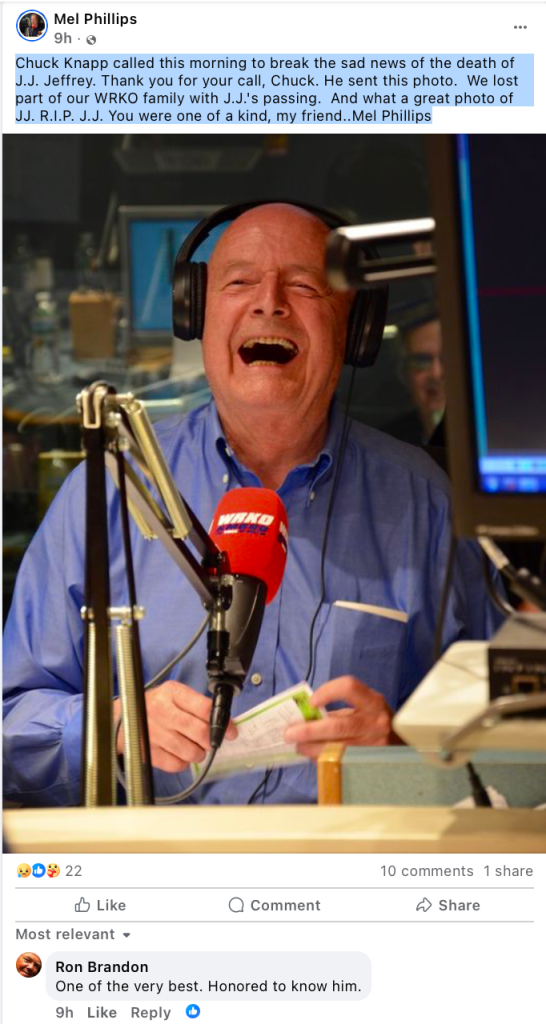
Joseph Noyes “J.J.” Jeffrey, Beloved DJ and Broadcasting Pioneer, Passes Away at 84

In Memoriam By: Benjamin H. Groff II© Groff Media 2024© Truth Endures

Joseph Noyes “J.J.” Jeffrey, a renowned DJ who became a respected station owner, passed away at the age of 84 following a brief battle with cancer. A native of Portland, ME, Jeffrey began his broadcasting career in his home state in the 1950s. His early career included stints at various local stations, where he honed his signature high-energy style and developed a deep passion for Top 40 radio.

Jeffrey’s career took off when he became the afternoon host at WRKO Boston, one of the nation’s premier Top 40 stations. His success in Boston led to similar roles at two of the biggest Top 40 powerhouses of the time: WFIL in Philadelphia and WLS in Chicago. Known for his vibrant personality and memorable catchphrases, Jeffrey quickly became a household name in each of these markets.

In 1975, Jeffrey transitioned from behind the mic to station ownership, partnering with Bob Fuller to launch Fuller-Jeffrey Broadcasting. Their first acquisition was 102.9 WBLM in Lewiston/Portland, ME. Over the next two decades, the company expanded its reach, owning clusters of stations across the country, including in Modesto, Sacramento, Santa Cruz, Santa Rosa, CA, and Des Moines, IA. Fuller-Jeffrey Broadcasting’s portfolio was sold to Citadel in 1999, forming what is now largely Townsquare Media’s clusters in Portland and Portsmouth, NH.

Not one to rest, Jeffrey and Fuller immediately launched Atlantic Coast Radio, building another prominent radio group in Portland, ME. Their stations included the Sports format “WEEI” on 95.5 WPPI Topsham and 95.9 WPEI Saco, “The Big Jab” 96.3 WJJB-FM Gray, and Conservative Talk 1310 WLOB.

J.J. Jeffrey will be remembered for his contributions to the radio industry, both as a beloved on-air talent and as a visionary station owner. He leaves behind a legacy of passion, innovation, and an enduring impact on the world of broadcasting.

Here Comes Hurricane Milton But Not Before CNN and FOX Can Mull It Over

A Review By Benjamin Groff© Groff Media 2024© Truth Endures

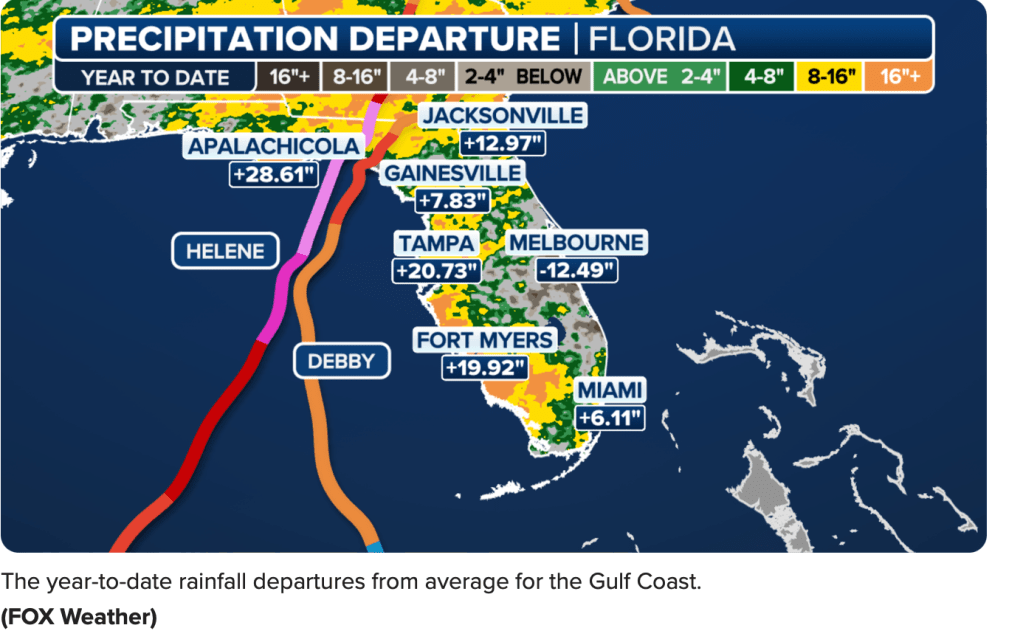
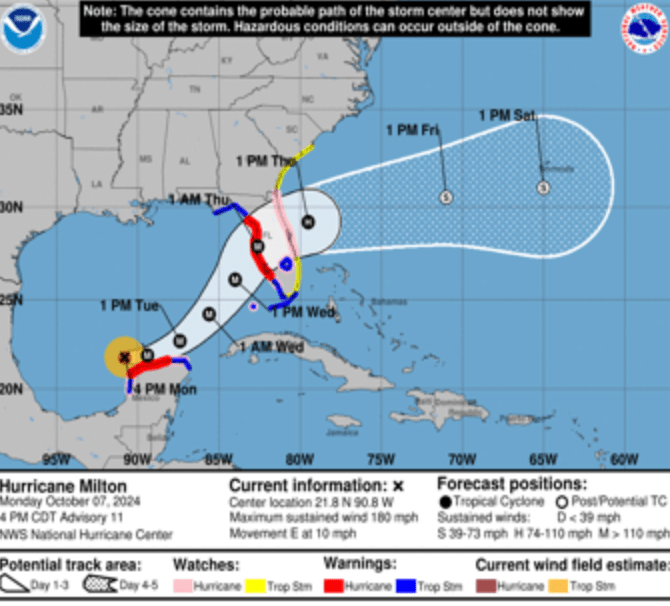
As tropical activity in the Atlantic Ocean quiets down, meteorologists are turning their focus to the Caribbean and Gulf of Mexico, where conditions appear increasingly favorable for the development of the next named storm, possibly forming as early as next week. The National Hurricane Center (NHC) has officially begun monitoring this area, giving it medium odds for tropical development over the next seven days. Beyond that timeframe, forecasters from the FOX Forecast Center suggest that the potential for further intensification exists.

The outlook, however, varies across networks. FOX Weather’s Bryan Norcross reported that while the storm’s primary threat zone stretches from Panama City around the Big Bend of Florida to Sarasota, the possibility of dangerous storm surges could extend even further, particularly into Southwest Florida. Norcross emphasized that while the storm has followed predictions so far, the forecast cone might shift more than usual, leaving some uncertainty. “Nobody should be surprised by sudden changes,” he noted, highlighting the importance of staying prepared.

Meanwhile, CNN’s coverage presented a more urgent scenario, especially concerning a separate storm, Hurricane Helene, which recently prompted evacuations in Florida. Helene’s accelerated approach forced residents to brace for high winds, torrential rainfall, and potentially life-threatening storm surges. With shifts in the storm’s track possible, officials stressed the importance of preparation across the Southeast. Mandatory evacuations were ordered in several coastal counties, including Pinellas, Hernando, and Sarasota, as officials anticipated widespread impacts, including power outages and tornado threats.

While both networks offer different perspectives, the consensus is clear: residents in the affected regions must remain vigilant and ready for the worst, even if the forecast models evolve over time.

CLICK ON THE IMAGE TO VISIT NATIONAL OCEANIC AND ATMOSPHERIC ADMINISTRATION
  1. Damaging hurricane-force winds and a life-threatening storm surge with destructive waves are expected across portions of the
  2. northern coast of the Yucatan Peninsula through tonight.
  3. Milton is expected to grow in size and remain an extremely dangerous hurricane when it approaches the west coast of Florida on Wednesday. A large area of destructive storm surge will occur along parts of the west coast of Florida on Wednesday. This is an extremely life-threatening situation and residents in those areas should follow advice given by local officials and evacuate
  4. immediately if told to do so.
  5. Potentially devastating hurricane-force winds are expected along portions of the west coast of Florida where a Hurricane Warning is in effect. Milton is forecast to remain a hurricane as it crosses the Florida Peninsula and life-threatening hurricane-force winds, especially in gusts, are expected to spread inland across a portion of the entire Florida Peninsula.

Preparations to protect life and property in the warning areas should be complete by Tuesday night since tropical storm conditions are expected to begin within this area early

Wednesday.

4. Areas of heavy rainfall will impact portions of Florida today well ahead of Milton, with heavy rainfall more directly related to the system expected later on Tuesday through Wednesday night.

This rainfall will bring the risk of considerable flash, urban, and areal flooding, along with the potential for moderate to

major river flooding

CLICK ON IMAGE TO VISIT NATIONAL HURRICANE CENTER

Japan’s Culinary Expert Yukio Hattori Dies 1945 – 2024

This Information Provided By: Benjamin Groff© Groff Media 2024© Truth Endures

Obituary: Yukio Hattori (1945 – 2024)

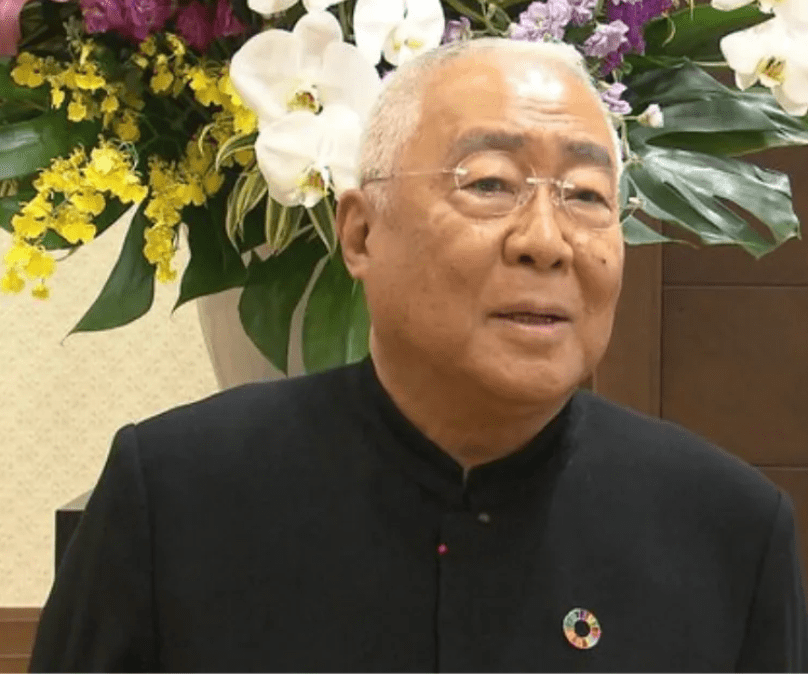
Yukio Hattori, beloved television personality, culinary expert, and educator, passed away on October 4, 2024, in Tokyo, Japan, at the age of 78. Best known as the insightful commentator on the popular Japanese cooking show Iron Chef, Hattori’s contributions to the world of food, nutrition, and culinary arts left an indelible mark on Japanese culture and beyond.

Born on December 16, 1945, in Tokyo, Hattori grew up in a family deeply rooted in the culinary tradition. He was inspired by his father’s work to pursue his passion for food and nutrition, eventually earning a PhD from Showa University. His profound understanding of both cooking and the science of nutrition shaped his career, which would extend far beyond the kitchen.

Hattori became the fifth president of Hattori Nutrition College, a prestigious institution founded by his father, known for its unique blend of culinary excellence and nutritional education. Under his leadership, the college trained thousands of chefs, nutritionists, and food critics, shaping the next generation of culinary professionals. His commitment to culinary education made him a pivotal figure in elevating the standards of both food preparation and healthy eating habits in Japan.

While his educational work was vital, Hattori was perhaps most recognizable for his television career. As a competitor, judge, and commentator on Iron Chef, Hattori’s sharp palate, deep culinary knowledge, and entertaining commentary endeared him to audiences across Japan and worldwide. His presence on the show not only lent credibility but also helped popularize Japanese cuisine internationally.

In addition to his work on television, Hattori appeared in films such as Aji ichi Monme (2011) and Mibu, and he continued to influence Japanese cuisine and public health through his numerous cookbooks, radio shows, and public health campaigns. He was a firm believer that good food should nourish both body and soul, a philosophy he called “Well Taste,” where flavor and health go hand in hand.

Yukio Hattori’s legacy will continue through his extensive contributions to culinary education, his influence on Japanese cuisine, and the students he mentored at Hattori Nutrition College. He is survived by his family, colleagues, and countless admirers who were inspired by his passion for food and nutrition.

Yukio Hattori’s memory will forever be cherished as one of the most prominent voices in Japan’s culinary world, whose life’s work brought taste and health together for the benefit of all.

My Experience With Live Coverage of Severe Weather Events by KKBS 92.7FM: A Crucial Role From The 1990s…

The sky was cloudy to the southwest, and humidity had been building since the morning. Many had yet to pay attention to weather patterns forming in the Oklahoma and Texas Panhandles, particularly dew points that were above average. Everything was out of balance. No one was paying attention except for one News Director at a small community radio station in the Oklahoma Panhandle community of Guymon. That news director was me, Benjamin Groff II (JR), and our role in providing live coverage of severe weather events was crucial.

It had been a busy day for the news department at KKBS 92.7FM. The Oklahoma Secretary of State had been in town attending Civic functions, plus a rape trial at the Texas County Court House was underway, and the suspect had been a topic that brought turmoil in the community for his alleged sexual abuse of a child. There was also an ax murder victim discovered in a dirt cellar in Steven’s County, Kansas, and the Hugoton Court House was buzzing with activity as the sheriff there had a suspect in custody.

The KKBS broadcast signal reached a five-state region, covering the Oklahoma Panhandle, the Northern Texas Panhandle, Southwest Kansas, Southeast counties of Colorado, and Northeast New Mexico. An anomaly in broadcasting also allowed the station’s signal to get received on radios and listened to by residents of Vernal, Utah. Listeners from the area would call the station often with their weather conditions and share local news to be part of the radio station’s mix. Our commitment to serving the community was unwavering, and we valued every listener’s contribution.

In Perryton, Texas, to the southeast of Guymon, a city of less than 7500 souls, the area mainly consisted of farmers and ranchers. KKBS radio station also reached Spearman, Gruver, Stratford, and Dalhart, Texas. In each community, the station, under my direction, established contacts and points of communication to use during news events. The same situation existed in southwest Kansas from Elkhart, Dalhart, Liberal, Hugoton, Johnson City, and Ulysses.

The radio station studio on the north side of Guymon is a one-story building set behind a hill on one side. The broadcast tower is near the city center. It was on the same tower as most emergency services and, thus, on an emergency roster for being tended to promptly during power outages. Our studios were placed on priority through a demand I had made to the power company after I explained that we broadcast to every community in five states and were rebroadcast through each cable carrier of every community. We need to get back on the air to broadcast emergency notices to the people as soon as possible. I did not realize I made such an impact that the power company initiated a person to guarantee our station downtime was as minimal as sixty seconds or less. It was good that it happened.

As the day continued, I stepped outside and felt the air. I had felt the conditions before. It had been in my hometown 12 years earlier when a storm ripped through the area and tore the hell out of the county, killing a lifetime resident of the town and his wife as they were hunkered down in their cellar. Being a retired police officer, I had a sixth sense, which led me to believe we were in store for something more. I felt it. There were times I sit in the newsroom on an afternoon on a slow day and think out loud, saying this feels like a plane crash day, and low and behold, we would be breaking a plane crash somewhere in the valley later. It was the same way this day, and I began planning for it.

I asked our sales team to be on call and ready to return to the station within ten minutes of getting my call, not to ask questions, get in their car, and come. They would answer calls and send me information about storm coverage. They should send their families to storm cellars, and they would be OK with us; the hill protects the station. I asked our evening staff to get ready to rock and roll so that it would be different from business as usual. I was going to be interrupting their shows, and we would be going live with actual news actualities from the field, raw broadcast, and they needed to get prepared for raw emotions to get heard. When it happened, they were not. But maybe they were more than they would have been.

Shortly before 4 PM, I noticed on an antiquated system that there was a massive hail storm in north Texas Panhandle County near Gruver, Texas; I called the Gruver Texas City Manager from the newsroom. I always contacted people in a way that allowed me to quickly air with them regardless of what was happening; in this case, it was gold. I asked him if he was getting hail. He said he was and was trying to drive west out of town; I buzzed the main studio to get ready to go live at any moment with breaking news, and suddenly AJ, the city manager, said

OH MY GOD, BEN, THERE IS A TORNADO ON THE GROUND WEST OF GRUVER, TEXAS, AND IT IS MOVING NORTH…

I flashed the hand signal and said go live; use the weather signal…

Stacy was on the board and broke into music with a particular news weather bulletin where I came on and issued a “KKBS TORNADO WARNING” and had the city manager describe what he was seeing. After the conversation, I returned and said that the National Weather Service has yet to issue a Tornado Warning, and we are in contact with them trying to get them to notice the storm.

A small radio station in the Oklahoma Panhandle doesn’t carry much weight with the National Weather Service, and they should have paid more attention to what we were trying to explain to them or the fact that we had an actual sighting by a city manager. We contacted the Channel4 Meteorologist who used to offer services to our station and explained to him what we were seeing, and he said he would turn his radar toward us and take a look; as he did, he said,

Map-Radar Image is for reference purpose only not actual radar screen used.

Holy Moly! That looks like a hook echo! Has the National Weather Service put out anything on this yet?

I explained to him our frustration with the weather people, and he said look, I am going live and putting my warning out, I told him we had already put ours out. He said

Thank GOD. I hope people are listening!

The Local Civil Defense and the owner of the other radio station in Guymon were listening, and they were severely upset that we were putting out a weather warning without their authorization. They even entered their radio station (one I once worked at KGYN) and denied on air there was any chance of severe weather today, saying the other stations were nuts. The Civil Defense Director went as far as to call our station owner and threaten her with an FCC violation complaint. She called me and asked what type of warning I issued. I explained that I issued a KKBS weather warning and a KKBS tornado warning, confirmed by a city manager talking to us live on the air from Gruver, Texas. She smiled and said issue some more.

I continued broadcasting the weather warnings and hear the disgusting remarks on the police radio frequencies from the civil defense director and his people over our decision to warn people about the threat of undesirable weather moving into the region. What is more, the storm producing the tornado was now moving into an area referred to as Hitchland, an agriculture-based community and ranching area. As we were broadcasting, our friend from the television station called and told me he had confirmation that a tornado was on the ground. We then broke into our programming and broadcast that a tornado had hit the area, and there were casualties. As we did, we began to get phone calls about fatalities in the area. As we tracked this storm, we warned the Beaver County, Oklahoma communities that they would be in the track of the storm-producing tornados.

The dry line producing these storms was like a whiplash effect; it produced storms in front and behind its path. Another line of storms formed twenty miles west of Guymon, stretching from Guymon to Elkhart to Johnson City, Kansas. It was a night of stress and high excitement for those who enjoy broadcasting under pressure.

During one segment of events, the bank that the radio station shared the building with was hosting Claudette Henry, the Oklahoma Secretary of State, at a reception that evening; while I was broadcasting live during one of the live storm updates, I saw Ms. Henry walk past the newsroom. I quickly wrapped up, stretched my headphones cord to the door, and shouted.

“Is that Claudette?”

She responded

“It Sure Is”

In my best Oklahoma demeanor

“I get you to do a live interview with me quickly?”

Claudette said,

“Let’s go for it!”

The interview consisted of talking about how she can’t fly out of Guymon until our radio station gives the all-clear and mentioning how everyone in five states is listening to you guys. She said she was impressed with the quality of coverage we provided; she didn’t expect to see it in Guymon.

My station’s owner was sitting in the basement at her beauty shop, listening to the radio and receiving phone calls on her cell phone. She was one of the few people in town at the time who had a cell phone, and everyone called her on it. On this night, it was to thank her for providing a station with such a spectacular news team.

It have been better news for everyone. The operations manager had called the station manager a bitch during a sporting broadcast, and then failing to join in the weather broadcast appeared to have ended their relationship. The next day, she dismissed him from his duties and placed them upon me and his salary. A few years later, she added the sales manager responsibilities to my duties. A few years later, I accepted a position in Cheyenne, Wyoming.

It was the 1990s and anything goes was a leftover motto from the 80s!

From A Horse Sale To A “CB” Coffee Break”

A True Story By: Benjamin Groff© Groff Media 2024© Truth Endures

Join Us For a Coffee Break!

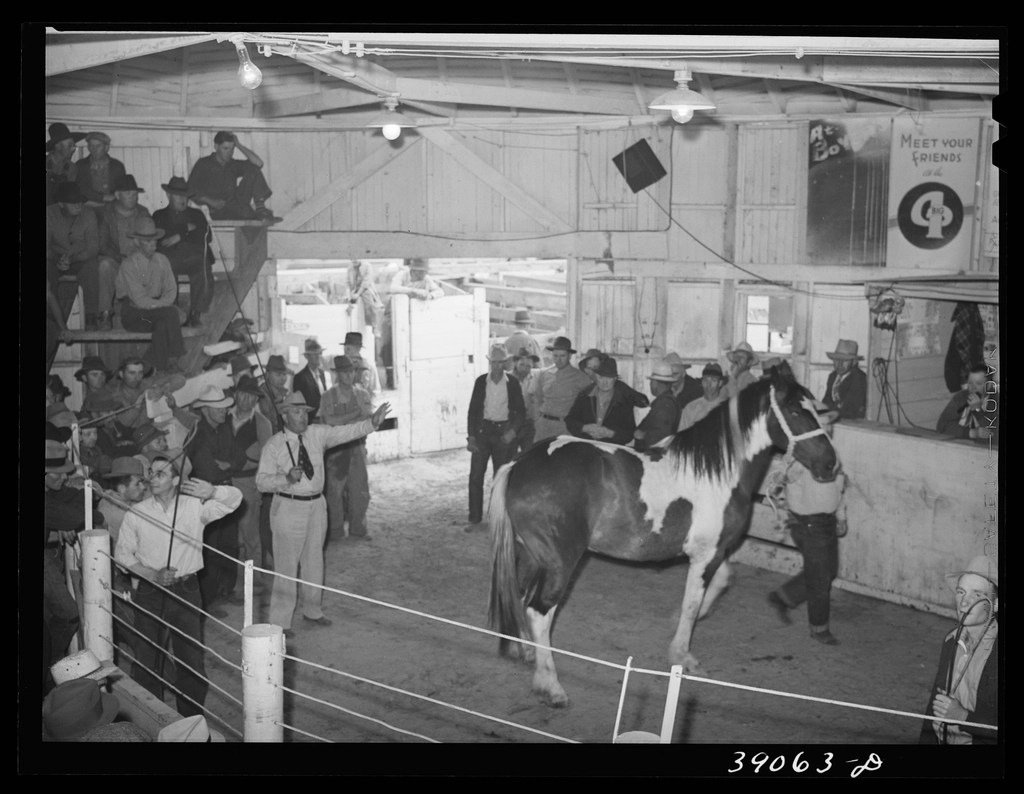
If you’ve read previous stories about my dad and me heading to horse sales during my youth, you’ll know it was a ritual we performed every Friday and Saturday night. It wasn’t just about the horses but the time we spent together and the bond we shared. Somewhere, someplace, we could always find a horse sale. And if the horse sales took a break in the summer, we’d catch a rodeo, no matter how far we had to drive.

I saw more of Oklahoma at night than I ever did during the day. That’s when my dad and I would drive the state highways, venturing wherever the road took us. But this particular trip was different. We were going to our regular sale in the city, about 30 miles from home.

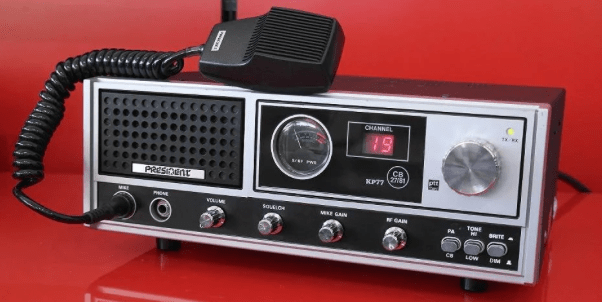
It was the 1970s, and Citizen Band (CB) radio had become all the rage. I had three older brothers, all grown, who installed CB radios in their vehicles, catching my dad’s attention. Before long, we also had one in our pickup, tuned in, and received signals from all over. Dad outfitted our rig with twin whip antennas and a power mic; he even considered adding an amplifier but decided against it after hearing the FCC might crack down on him. My dad always did things by the book. So we were content rolling down the highway, our handles “Big Jake” for him and “Gentle Ben” for me.

We’d pick up reports about ‘Bears in the Air’ and ‘Bear Setups’ just down the road. Although we were doing the speed limit, Dad would ease up on the accelerator to humor me, making me think those reports were helping. On our way to the horse sale that night, we heard a spectrum of new voices on the air—voices we’d never heard before.

I told my dad they were coming in too consistently and clearly to be skip signals; they had to be close.

He said, “Let’s listen to them a minute.”

As we tuned in, these voices discussed being in Indian City and staying set up all night. They invited anyone to come by, mentioning they were at the Coffee Break on the east side of town, near the rodeo grounds. The ‘Coffee Break’ was a popular gathering spot for CB radio enthusiasts to meet, socialize, and share their experiences.

Indian City was the nickname for Anadarko, where we were headed for the horse sale. The town was known for its tourist attraction, Indian City, USA, with teepees and all—a gimmick that drew in visitors.

Dad keyed up the mic and gave a breaker. One of the new voices responded. Dad explained we were headed to a horse sale and might drop by for a cup if the horses weren’t any good later.

They said,

“Come on by! Have you ever been to one of our Coffee Breaks?”

Dad replied,

“That’s a big negatory!”

Well then,” they said,

“park wherever you can and find Booth 12—that’s where we’re set up.

We went to the horse sale, and I spied a horse or two I thought Dad might be interested in. But around 11:00 PM, he nudged me and said,

“Let’s go to the Coffee Break. I want to see what it’s about, and I’m sure you do, too.”

I wanted to say yes, but those two horses had not come up. We had a herd of horses back home, so missing one or two wouldn’t matter. Besides, I was curious about what we’d get into at this place.

When we arrived at the rodeo grounds, the area was full of campers, RVs, and tents—huge tents, at least to me. The tent poles seemed massive, with lighting strung throughout by wire. I wasn’t sure if it was safe, but I trusted my dad as he led the way.

We found what we thought was Booth 12, where a lady sat in a folding lawn chair. She looked up at me and said, 

“Hi, sweetie. You run away from home?”

I quickly replied,

“Oh no, I’m here with my dad; we’re looking for Booth 12.”

She smiled, a crooked grin on her face, and said,

“You’re looking for Honey Badger! HONEY BADGER, GET YOUR ASS OUT HERE!”

From around the corner came a short man with a balding head and a potbelly. He hadn’t shaved in a week and said,

“What is it, Wilda? You don’t have to yell! Oh, hello.”

I whispered to my dad,

“The lady’s name is Wilda,”

Mimicking the style of Sgt—Friday and Officer Bill Gannon on Dragnet.

My dad looked down at me and used his favorite phrase when I tried to do impressions: 

“Don’t be stupid.”

Honey Badger had sharp ears because when he heard Dad’s voice, he said, 

“I know him—that’s Big Jake. We talked to you a few hours ago, and I’ve heard you before when we passed through these parts. I’m Honey Badger. Let me show you around. Wilda, you want to watch the boy?”

Dad told me to stay with Wilda, promising he’d be right back. I wasn’t sure what was happening, but I decided to start searching if I didn’t hear from him by the top of the hour. For all I knew, these could be aliens from another planet up to something strange. I had just turned ten, and the year before, my dad and I had to walk home after the truck we test-drove broke down on our way home from a horse sale. I could take on whatever might be behind those dark tents—or at least that’s what I told myself.

In the meantime, Wilda and I managed to strike up a friendship. She told me they were from Kansas and had retired. Honey Badger worked with honeybees as a hobby, hence his CB name. She said,

“And I’m the Queen Bee; I get on that radio and just Buzz.”

Wilda looked like a much older Ms. Kitty—a short, broad, ancient Ms. Kitty. Her voice reminded me of one of the blonde girls on The Andy Griffith Show who gave Andy and Barney a hard time. She was a sweet soul who must’ve lived quite a life. She got me a hot cup of Pepsi and talked about missing her TV show to come on this trip with Honey Badger. But she said, –––

“It’s worth it. You don’t know when one of you is going to die. You want to do all the things in life you can before you call it quits.”

She shared stories about her and her husband’s adventures, and I did my best to look interested, though I only sometimes followed along.

Dad must have been gone for thirty minutes. I had no idea what he was doing, but I sure had a lot of intelligence gathered from Queen Bee to share with him.

When he finally returned, he scooped me up, thanked Queen Bee for having us over, and assured her we’d made friends on the southern plains that stretched far north.

As we got into the pickup and headed home, I noticed Dad pushed his hat back on his head, just like he did at Christmas when he and one of my uncles secretly toasted shots at my grandparents. He was in such a good mood, so I shared my findings. –––

“So,” I began, “Wilda—or Queen Bee—said they’ve been to several states doing Coffee Breaks because she can’t have kids, and he doesn’t want any. He also has some car problems that he can’t fix. She told me he lost his left nut in the war. But I don’t think he’s still driving the same car he had when he was in the war.”

At the time, I thought whatever Dad had been up to must’ve been a lot of fun because he laughed all the way home. Within a year or two, I realized Honey Badger hadn’t lost a lugnut at all—but maybe it was better when he had.

There are Memorials left behind for those CB Radioer’s who’ve met up and passed on by clicking here.

About that dinner on The River Banks At THe Olympics…A rednecks explanation of what was going on…

Up and dated by the weekend guy B.S. Daily.

Roman sarcophagus depicting the Triumph of Dionysus and the Seasons
Jug used for cooling water into wine.

Well, let me tell you about Dionysus (y’all can just say “D”) in a way that’s as plain as a hog on ice. Dionysus (D) isn’t just some fancy-pants Greek fella; he’s the god of wine, parties, and having a good ol’ time. U know ‘getting shitfaced.’ Picture him like that one buddy who’s always ready to crack open a cold one and throw a rager out by the bonfire. Take it easy; you might think you be at your last supper, especially is shootin’ starts!

da man in stone

Now, Dionysus (D) ain’t just about drinkin’; he’s got a wild side too. He’s all ’bout lettin’ loose, dancin’ like nobody’s watchin’, and just forgettin’ all your troubles. He’s the life of the party, makin’ sure everyone’s havin’ a blast and feelin’ free as a bird. He’s got that divine touch, turnin’ water into wine and makin’ sure there’s always a good time to be had, showin’ his transformative power in every revelry, getting laid. He will have a long table so all his buds can be bellied up.

Many paintings in Renaissance art depict similar scenes of dudes and chicks gathered around a table for a feast. Many polaroids (photos) do the same in America, we call ’em bar-b-ques. ’em guys on the river bank didn’t have many ticks to get their point across, time was spiraling, especially if you’s a Badtist in Texas watchin’ da’t on TV or if you ain’t in jail – you phone.

So, if you ever wonder why folks love to gather around and get drunk, think of Dionysus (D). The French and Greek’s amit do it more than us’n’s. But if you don’t runn offt before the story is ended you’ll hear he’s the spirit of all those good times, reminding us that every now and then, it’s okay to cut loose, have a nip, fetch u a snort-full and enjoy the ride. Cheers to Dionysus (D), the god of gettin’ down and having a heck of a time. Just remember the gathering is not the last supper, no matter how many bubba’s you have. Some say it was just not clear it was a ho-down, and that was Aunt France’s greatest sin!

A-dam-d-en-dum: NEWS MAKES HEADLINES! MEDIATE NEWS WEBSITE CONFIRMED JUST THIS INFORMATION. BUT USING MORE LIVE BODIES TO CONFIRM DETAILS.

Addendum-update edited by Benjamin Groff© Groff Media2024 ©Truth Endures

Friday night’s Paris Olympics opening ceremony angered people across the world as many interpreted it as a mockery of Leonardo da Vinci’s “The Last Supper ” but the man who organized it said it was actually a nod to Greek mythology.

A portion of the ceremony featured semi-nude drag queen performers around a table, which was immediately interpreted by many — particularly on the right — as an attack on Christianity. The man who choreographed the tableau claimed it was anything but on Sunday morning.

Thomas Jolly, the ceremony’s artistic director, claimed to the French media on Sunday that he was not mocking anyone but merely putting on a “celebration of Greek mythology.”

“There is Dionysus who arrives on this table. He is there because he is the God of celebration in Greek mythology,” Jolly told BFMTV, according to an interpretation from NBC News. “The idea was to have a pagan celebration connected to the gods of Olympus. You will never find in me a desire to mock and denigrate anyone.”

The Paris Olympics X account shared the Dionysus portion of the show Friday, describing it as “interpretation of the Greek God Dionysus” which the organizers said “makes us aware of the absurdity of violence between human beings.However, the scene identified as a parody of “The Last Supper” and the appearance of the blue-painted Dionysus were 44 minutes apart in the ceremony.

While Jolly distanced himself from the controversy, TheWrap and many other outlets reported on an official statement from the Olympics which clearly stated Jolly took his inspiration in that scene directly from Da Vinci.

“For the ‘Festivities’ segment, Thomas Jolly took inspiration from Leonardo Da Vinci’s famous painting to create the setting,” the statement read. “Clearly, there was never an intention to show disrespect towards any religious group or belief.”

Two days and one American company’s boycott of the Olympics later and the controversy has yet to die down. As of Sunday, there were still calls to boycott the Olympics.

UPDATE: This story has been updated with a comment from officials with the Paris Olympics, who said Jolly was inspired by da Vinci’s “The Last Supper” mural. Read the report at Mediate here