Parallels Between the Chinese Exclusion Act and Modern Immigration Concerns: Lessons from History –– The Danger Of Losing Immigrants

Groff Media 2024© Truth Endures IMDbPro

Presented by benandsteve.com By: Benjamin Groff II©

You can also refer to the NPR Story America’s first major immigration crackdown and the making and breaking of the West  for additional insights and related material that complement this story, offering a deeper exploration of the subject.


3–5 minutes

The Chinese Exclusion Act of 1882 marked a pivotal moment in U.S. immigration history, becoming the first significant federal law restricting immigration. It targeted a specific ethnic group driven by economic fears, racial prejudice, and political populism. A review of this historic legislation, alongside the context of its enactment, reveals striking parallels to modern immigration debates. Both historical and contemporary issues illustrate how economic anxieties, cultural misunderstandings, and political opportunism can drive restrictive immigration policies that may ultimately prove disastrous for society.

The Role of Immigrant Labor in Economic Development

In the mid-19th century, Chinese immigrants, despite facing systemic discrimination and being blamed for economic problems, played a crucial role in building the American West. Their resilience and determination were evident in their instrumental role in constructing the transcontinental railroad, tackling some of the most dangerous and demanding jobs in brutal conditions. However, when the Panic of 1873 led to widespread unemployment, populist sentiment scapegoated Chinese immigrants, claiming they were stealing jobs from white workers.

A similar narrative exists today. Immigrant labor is fundamental to the agriculture, construction, and technology industries. Despite this, immigrants are often vilified during economic downturns, accused of taking jobs or lowering wages. This cyclical pattern of scapegoating undermines the reality that immigrants frequently perform jobs that native-born workers are unwilling or unable to do, driving economic growth and innovation. Restrictive immigration policies, such as deportations or bans, risk damaging these essential industries and the broader economy, much like the exclusion of Chinese workers stunted specific sectors in the late 19th century.

Cultural Backlash and Populist Politics

The transcontinental railroad’s completion in 1869 symbolized a remarkable technological achievement but also marked a turning point for Chinese immigrants. Their presence sparked a cultural backlash as they settled in communities like Truckee, California. Fueled by racial prejudice and populist rhetoric, white workers and politicians pushed for their exclusion, culminating in the Chinese Exclusion Act. This act institutionalized xenophobia and created a precedent for racially biased immigration policies.

Today, cultural anxieties continue to shape immigration debates. Concerns about preserving cultural identity and fears of “otherness” fuel resistance to immigrants. Particularly from Latin America, the Middle East, and Asia. Politicians often exploit these fears to rally support, pushing for restrictive measures such as border walls, travel bans, or mass deportations. Such actions not only marginalize immigrant communities but also foster division and xenophobia, hindering social cohesion.

Economic Consequences of Restriction

The long-term economic impacts of the Chinese Exclusion Act highlight the dangers of restrictive immigration policies. By limiting a vital workforce, the law hampered industries reliant on immigrant labor. The exclusion of Chinese workers also set a precedent that discouraged innovation and adaptability in labor markets, contributing to stagnation in certain regions.

Policies that limit immigrant contributions to the workforce have modern parallels. For example, restrictive visa programs and deportations threaten industries like agriculture and technology, which rely heavily on immigrant talent. Moreover, these policies can exacerbate labor shortages, driving up consumer costs and reducing the global competitiveness of U.S. industries. History demonstrates that economic growth thrives on diversity and inclusion, not exclusion.

Lessons from the Past

The Chinese Exclusion Act teaches us that targeting immigrants as scapegoats for economic or social challenges is a shortsighted and counterproductive strategy. Immigration is a cornerstone of American prosperity, fostering innovation, cultural richness, and financial resilience. Policies driven by fear and prejudice, rather than informed analysis, risk repeating the mistakes of the past and should be considered.

Today’s immigration debates echo the populist rhetoric and exclusionary measures of the late 19th century. However, we have the benefit of hindsight to recognize that such policies often create more problems than they solve. To avoid a similar disaster, today’s policymakers must approach immigration with a focus on integration, economic opportunity, and respect for human dignity. By learning from history, we can build a more inclusive and prosperous future, where all individuals feel valued and respected.

You can also refer to the NPR Story America’s first major immigration crackdown and the making and breaking of the West  for additional insights and related material that complement this story, offering a deeper exploration of the subject.

Killed Walking Along The Highway – How A Killer Is Captured –– By Two Keen Deputies!

Groff Media 2024© Truth Endures IMDbPro

Presented by benandsteve.com By: Benjamin Groff II©

On a dark, silent night in 1980, the highways through Caddo County near the rural communities of Gracemont and Binger, Oklahoma, were deserted. Residents had long settled in their homes, leaving the quiet stretches of U.S. Highway 281 nearly void of movement. It was a time when law enforcement in rural Oklahoma had limited resources and technology, making cases like this all the more challenging to solve.

That night, an Indigenous man, Jasper Williams, had set out on foot from his home, heading south along a dirt road that eventually led to the pavement of Highway 281. It was common for community members to walk from one home to another, no matter the distance, and Jasper was going to a friend’s house. The night was pitch black, with no moonlight or streetlights to guide him, save for the faint outline of the highway stretching before him.

As Jasper walked, visibility was almost nonexistent. The road was shrouded in darkness, with no nearby lights to help him stay clear of the highway’s center. At some point, as he walked around six miles north of Gracemont—almost midway between there and Binger—tragedy struck. Jasper was hit by a passing vehicle, which left him severely injured on the side of the road. By daylight, he was found deceased, having bled to death, with no car in sight and no immediate reports of an accident.

Upon closer inspection, deputies discovered fragments of evidence scattered on Jasper’s clothing and body: broken glass, bits of chrome, a hubcap, and remnants of a car’s signal light and headlight assembly, as well as traces of paint. With these clues, investigators determined the incident might not be an ordinary accident but potentially a case of vehicular homicide.

Deputy Hamilton drove a
Ford Ranchero

The case was assigned as a homicide due to the absence of witnesses, the lack of any report from the driver, and the fact that the vehicle fled the scene. Caddo County Deputies Hamilton and Ware—both of whom have since passed—took on the painstaking task of finding the person responsible. Armed with the physical evidence, they began an exhaustive search of autobody shops across the county and surrounding areas, hoping to find a vehicle with damage matching the debris at the scene.

After several weeks, their search finally paid off. The deputies located a damaged vehicle that matched the evidence they’d collected. The owner was identified and subsequently interviewed, leading to the arrest of a man named Larry Johnson.

During questioning, Johnson admitted he had left a bar in Binger around 2 a.m. on the night Jasper was killed. On his drive home, he confessed to drifting in and out of sleep, initially thinking he had hit an animal, possibly a dog. However, he chose not to stop. Later, after hearing news of the fatal accident, he realized he was likely the driver involved but continued to hope he was wrong.

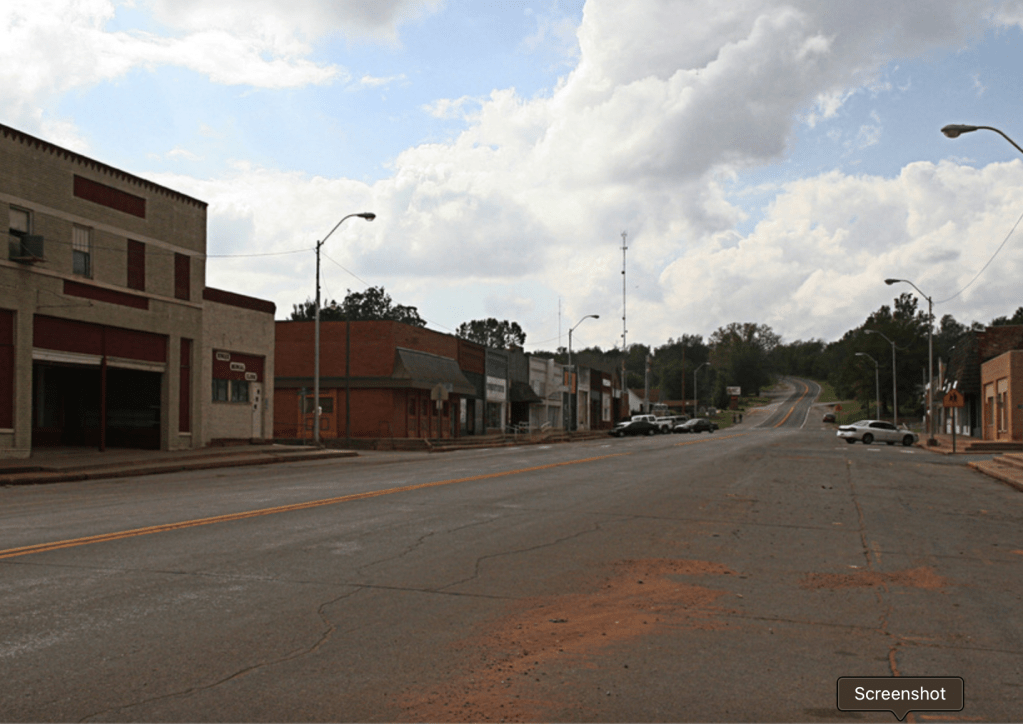
Binger Main St. There Were
Bars On Both Sides of Street.

Johnson was later tried in Caddo County, where a jury found him guilty of manslaughter. He was sentenced to serve 15 years at Oklahoma’s Granite Reformatory.

Note: Some names, dates, and details have been altered to protect individuals’ privacy.

Reminiscences

A True Story By: Benjamin Groff© Groff Media 2024© Truth Endures

When the youngest officer on duty is the only resource available, the weight of responsibility rests heavily on his shoulders, underscoring the significance of his role.

Our town’s police force was small, with just twelve officers. Eight were assigned to the streets, patrolling, responding to calls, controlling traffic, and maintaining visibility. The remaining four worked in the office, answering phones, dispatching calls over the radio, and managing the jail’s inmates. The officers rotated between desk and patrol duties, ensuring they stayed sharp and well-versed in all aspects of the job.

Most shifts saw only one officer on patrol and one in the office. This lean staffing was the backdrop when I first joined the police department and met Chief Marion Toehay Jr., known to me simply as Junior or Chief.

Junior and I formed a friendship that spanned over fifty years. Together, we witnessed the stark realities of life and death, often arriving too late to save those in peril. The helplessness we felt in those moments was crushing, made worse by the accusing stares of grieving families who saw us as their last hope.

One such event took place at a State Park east of the City. We arrived in a secluded area and noticed a boat stalled in the middle of the lake. The people onboard were waving and shouting, but their words got lost in the distance. As we waved back, trying to assess the situation, it became clear the boat was sinking.

We shouted for them to stay with the boat, realizing quickly that we couldn’t reach them from where we stood. We jumped back into the car and raced toward the dam, sirens blaring and lights flashing. Junior was on the radio, desperately calling for the Lake Patrol or anyone with a boat to respond. But the only way to reach the sinking boat was to drive fifteen miles around the lake on rural roads.

When we arrived, only the boat’s nose remained visible, bobbing on the water. A man clung to it, the sole survivor. He told us that a father and his two children had drowned, trying to swim to shore instead of staying with the boat.

At that time, the Oklahoma Lake Patrol was often assigned to different lakes, a reality dictated by tight state budgets. Law enforcement presence on lakes was inconsistent, as it may still be today in some areas. The Lake Patrol recovered the bodies of the father and his children that night and the following day.

Junior and I found ourselves witnessing several drownings, often by tragic coincidence, whenever we were near the lake or river. It seemed almost inevitable.

The department was also where I encountered my first homicide—a brutal murder-suicide that has stayed with me. A couple going through a divorce ended their marriage in violence. The husband had hidden in their home, and when his wife returned to gather belongings, he slipped up behind her and shot her in the back of the head. She crumpled to the floor, unaware of his presence or intent.

He then went to the bedroom, entered the ensuite, and used a shotgun loaded with double-ought buckshot to end his own life. The blast obliterated his face, leaving a gruesome scene with skull fragments embedded in the ceiling and blood splattered across the walls. Fingerprints confirmed his identity, but everyone in town knew who he was.

That was my first assignment at 18, in a department stretched thin. A pow-wow was happening in town, and every officer was working overtime. The City’s ambulance had to transport a critically ill prisoner to a hospital 50 miles away, and someone had to accompany them. It fell to me. Despite having just finished a 12-hour shift, I boarded the ambulance at 7:00 AM, the roads shrouded in fog as we responded to Code 3. The nurse was upset that I’d handcuffed the combative prisoner to the stretcher, and the driver got lost on the way. It was chaotic, but in many ways, it was one of the best times of my life.

Challenges and Solutions for Homelessness in America

Photo by MART PRODUCTION on Pexels.com
Photo by Timur Weber on Pexels.com

My household has always maintained a relatively liberal understanding of the country’s homeless situation. We disagree with outlawing their right to exist and have a place to live and shelter. They are, after all, doing the best they can with the current housing, employment, transportation, or other issues they face. Let them be!

Photo by Rosemary Ketchum on Pexels.com

That is what our stance has been all along, until we went out to breakfast this past weekend and the police department was herding a group along the main boulevard we take to our restaurant. They appeared to be the characters you don’t want to run into in a dark alley at night—or daytime, for that matter. For Christ’s sake, were they planning to put roots down behind our neighborhood. We have a wall around the place, but salespeople always jump in and try to knock on doors. We have security but are not the type that can handle these characters. Every winter, we have a homeless troupe that typically arrives and camps near a river, but they are the same people every year, and they are like the snowbirds who flow in and out of the area from the north. These new homeless characters were of a family we never experienced before. 

And that is what is scaring so many in America. The police found a suitable place for the troupe to travel on to, and there were no more sights of them after that initial spotting. But that is different for many in the country. These homeless populations inundate their communities, and it is an issue they have never before had to face. What if they are following suit? How many more will come? What problems will they bring with them? Will the property values deflate wherever they plant a stake? Jesus, are they diseased? 

California has spent billions of dollars trying to fix its homeless problem and has failed to find a solution. The issue is greater there now than ever. Affordable housing remains unobtainable to those needing it. California is asking people to build tiny homes in their backyards, garages, wherever there is space, and make them available to house people. The problem is, if folks don’t want them in their alleys, will they want them in their garages?

Locally in Phoenix, Arizona. My husband hired an unhoused person years ago and knew she was, although she had not disclosed so on her introduction form. He worked with her schedule to make sure she kept her employment, and within six months, she was able to get a studio apartment, moving from her car. She then told him. He said he knew all along, and that is why he had worked so hard to keep her going, and she turned out to be one of the best employees. Such an example may not be the case with every person, but it is an example of how we can attribute ourselves to improving the situation one person at a time.

While feeling uneasy about sudden changes in your community is natural, it’s important to remember that homelessness is not a choice for many people. They often face a variety of challenges, including mental health issues, substance abuse, lack of affordable housing, and unemployment, which can contribute to their situation.

As for the broader issue of homelessness, it’s clear that a comprehensive and compassionate approach is needed to address the root causes and provide effective solutions. This approach may include increasing access to affordable housing, expanding mental health and addiction services, and providing job training and employment opportunities for homeless individuals.

The Supreme Court now has the issue, and the Lord only knows what they will come up with. But no doubt Texas will pass a law ordering the execution of all homeless people after 30 days of being homeless. 


Florida The Land Of Detention

Florida has a new law that is designed to fill prisons.

Commercial Incarceration Facilities Prospering In Florida. Investments in private prisons contracted with Florida show favor with new laws designed to provide continous population on a rotational basis.

Photo by RDNE Stock project on Pexels.com

The growth and prosperity of commercial incarceration facilities in Florida have been a topic of debate and concern for many. Investments in private prisons have indeed increased in recent years, and this growth can be attributed to several factors, including new laws and policies that aim to maintain a steady population within these facilities.

One of the key issues often raised regarding private prisons is the potential conflict of interest that arises when profit motives intersect with the administration of justice. Critics argue that the financial incentives associated with running a for-profit prison may lead to practices that prioritize cost-cutting over the well-being and rehabilitation of inmates.

Photo by RDNE Stock project on Pexels.com

Proponents of private prisons, on the other hand, argue that these facilities can operate more efficiently than their public counterparts, potentially saving taxpayer money. They also point to contractual agreements that often include occupancy guarantees, ensuring a consistent revenue stream for investors.

However, concerns persist about the quality of care and services provided in private prisons, as well as the potential for abuse and neglect. Reports of overcrowding, inadequate medical care, and safety issues have raised alarm bells among advocates for criminal justice reform.

In Florida, the state has entered into contracts with private prison companies to house a portion of its inmate population. With new laws designed to ensure a continuous flow of inmates into these facilities, investors in private prisons may see this as a lucrative opportunity for growth.

Photo by RDNE Stock project on Pexels.com

It’s essential to approach the topic of private prisons with a critical lens, considering both the potential benefits and drawbacks associated with their operation. As the debate continues, policymakers, advocates, and stakeholders must work together to ensure that any expansion of private prisons prioritizes public safety, justice, and the well-being of inmates.